

Spiritual Scientific Insight into the
Fundamental Impulses of Social Organization
GA 199
4 September 1920, Dornach
Translated by Steiner Online Library
Thirteenth Lecture
[ 1 ] Yesterday I attempted to shed light, from a certain perspective, on the necessity of a hierarchical structure within the social order, and I pointed out that what might be called “proof” in spiritual science consists in the fact that the facts to be pointed out are supported from a wide variety of perspectives, and that ultimately, the degree of conviction increases more and more the more such support one receives. I would like to briefly recap what has been said. We are, of course, familiar with the structure of the human being; we know that the human being is composed of the physical body, the etheric body, the astral body, and what we call the “I.” But we also know that this structure of the human being is, in a sense, something that is in a state of flux. You can follow my explanations as I have presented them in my *Theosophy* and in my *Outline of Esoteric Science*, and you will see from them how the physical body, the etheric body, the astral body, and finally the “I” are not actually fixed entities, but how human development consists precisely in the fact that, through repeated earthly lives, the human being works on these members of his organism. So that at a certain point in time, after a certain number of earthly lives, a human being is born in such a way that one can say he or she consists, so to speak, normally of a physical body, an etheric body, an astral body, and an “I.” But then he or she begins, first of all, to work on his or her “I,” working on it through repeated earthly lives. Once the I has been strengthened—once the I has carried out a certain inner work upon itself—this work then shifts to the astral body. In turn, once the astral body has carried out an inner work upon itself in this way, through the I and through its own cooperation, this work then shifts to the etheric body, and finally to the physical body. But that already takes us into the distant future. For you know that, throughout the earthly lives we are initially considering, the human being essentially remains the same in terms of outward physical form. But this human form—as you also know from the description in my *Esoteric Science*—has changed significantly over the course of time, and it will continue to change in the future. It is compelled to undergo these changes, these metamorphoses, by what the finer bodies—the astral body and the etheric body—bring about in the physical body. And so, in the distant future, the physical body of the human being will also take on different forms.
[ 2 ] But what a person does with his limbs is, in fact, connected to his human environment, just as a person—I would say—is, from his very origins, connected in his individual limbs to the natural environment.
[ 3 ] One must be clear about one thing: Let us take the human physical body. It stands within the natural order as an isolated phenomenon. It is, so to speak, set apart from the natural order. And if we sufficiently consider the marked differentiation between human beings and the various members of the animal kingdom, we cannot help but conclude: Human beings cannot simply be placed at the end of the animal kingdom, as evolutionary theorists do; rather, they are not merely a synthesis of the entire animal world and all animal forms, but also a synthesis on a higher level. We can therefore compare the human physical body to nothing other than itself. Thus, in the entire environment surrounding human beings—in the natural environment of human beings—we find nothing here on Earth with which we can, so to speak, group the human physical body into a single class. This human physical body therefore stands on its own (see diagram).
[ 4 ] Now let us proceed further inward to the etheric body. There we come to the next, already mobile part of the human being. And as I explained to you yesterday—perhaps in a way that seemed a bit strange to some—how mobile this etheric body of the human being is. It simply has a tendency to relate to the animal kingdom in a certain way. It shares a certain kinship with the animal kingdom. I said: When we stand before an elephant or a donkey or even other animal forms, our etheric body has an inner tendency—it is prevented from carrying it out completely—but it has the inner tendency to imitate precisely the animal form, to become similar to the animal form; when a human stands before a donkey, an elephant, or a calf, the etheric body wants to take on these forms. It has a special affinity for these animal forms. The forces concentrated in the physical body prevent it from carrying this out, but it strives toward it. And it is a first experience of initiation that this inner tension and urge arises in relation to the animal world, that one wants to become like the animals. So that one can say: with regard to his physical body, the human being is not related to the animal world, but his etheric body shows a very definite kinship with the animal world.
[ 5 ] Now let us turn to the astral body. There we find a similar inner kinship with the plant world. When the astral body is in the presence of the plant world, it tends to become plant-like—specifically, to become similar to the plant it is facing. I told you more about this yesterday for you to remember: When we stand before a donkey eating thistles, the etheric body will resemble the donkey and the astral body will resemble the thistle. That is how it is. In this way, we are related to the surroundings of the natural kingdoms. Thus, in the astral body, we are related to the plant kingdom.
[ 6 ] And as for our “I,” I told you, we are related to the mineral world.
Physical Body
Etheric Body: Animal Kingdom
Astral Body: Plant Kingdom
Self: Mineral Kingdom.
[ 7 ] This is, of course, because what lies before our immediate consciousness is precisely what we, as human beings, can most easily observe even in our ordinary consciousness. In fact, the entire content of our consciousness is actually due to this kinship with the mineral world. We essentially form the content of our consciousness in relation to the mineral world, and as I have told you, because human beings, with their “I” as it exists today, are organized in relation to the mineral world, it follows that in our scientific endeavors we cannot actually penetrate to an understanding of the plant world or even the animal world—we cannot penetrate to an understanding of the living—and that there is always debate about whether the living can be understood or not. Only people who start from a different kind of perspective—such as Goethe, for example—acquire an awareness that it is possible, in a certain way, to penetrate into the living. And initiation, of course, offers the possibility of inwardly following what takes place in the astral body in relation to the plant world, and in the etheric body in relation to the animal world, in much the same way as one follows, with ordinary consciousness, only the kinship of the human being with the mineral world. And then, as I told you, the human being works on his or her “I.” He or she develops this “I” through repeated earthly lives. Thus, he or she transforms the content that originated in the mineral kingdom. He or she turns it into science, into art, and into religion. Everything that appears in this way as culture and the substance of civilization is, in essence, the transformed mineral kingdom.
[ 8 ] Just consider that when you look at, say, a Greek statue, you have life before you; but everything that is contained within the mineral realm—the form, the structure—you have attained through its transformation, that is, through the artistic transformation of those ideas and sensations that you take up directly from the mineral kingdom into your consciousness. And so it is with the other aspects of culture as well. In this cultural content—insofar as culture consists of art, science, and religion—what is expressed is what the “I” works out within itself, naturally in human interaction, and which is essentially transformed content derived from the mineral kingdom. Anyone who can truly examine these things with an open mind will find that there is transformed content derived from the mineral kingdom. If we sharply demarcate what lives in the human social environment, we find: Everything that arises in such a way that the “I” transforms the content derived from the mineral kingdom and forms from it a spiritual life—that which lives among us as art, as literature, as science, or as the content of the faith of religious communities, and so on— in other words, everything that is essentially encompassed by this transformation of the “I” within itself—all of this very sharply delimits what we call the spiritual realm of the threefold social organism.
[ 9 ] Here, then, you can gain an opportunity to clearly define the spiritual realm of the threefold social organism. There would be no spiritual realm of the social organism if the “I” did not transform its own nature in such a way that it processes the content derived from the mineral kingdom artistically, religiously, and scientifically.
[ 10 ] But human beings also transform their astral bodies. They do not transform this astral body in the same conscious way. When we look at the content of culture, the most conscious elements of this content are those of the spiritual realm, as we have just characterized it. Semi-unconscious—precisely where they have emerged with the sharpest contours—are those concepts that govern life from person to person, those concepts that encompass the law and everything that can be counted as law, namely, the relationship between people. Anyone who fails to grasp the distinction between a concept belonging to the religious, scientific, or artistic realm and one belonging to the realm of law or the state is undoubtedly not a good psychologist, nor a connoisseur of the human soul. For we regulate human interaction—we regulate this vague awareness—in an entirely different way: What is my duty toward another person? What is his right toward me? What is my right toward him?—All these questions that arise in human interaction stem from a much more subdued consciousness than that which animates science, religion, and art. And the realm that unfolds between human beings—which, in fact, cannot be determined by the individual in the same way as science, art, and religion, but can only be determined through human coexistence, through what I might say, people’s mutual agreement and understanding—this is to be encompassed within the realm of legal or political life; this is the legal realm of the social organism.
[ 11 ] Human beings experience a third realm even more dimly—the one that arises from the transformation of their etheric body. This is a realm of which human beings actually become aware only very indirectly, through all sorts of vague dietary guidelines and the like. It is a realm that human beings experience almost unconsciously, and which emerges so little into full consciousness that it cannot even be illuminated through mutual understanding between people. The realm of law can be illuminated through communication between people, and a certain ideal of our social order is that we have implemented complete democracy in the realm of law, where all people who have come of age stand on an equal footing and secure their rights through mutual understanding. The dullness of consciousness, which has the transformations of the astral body as its content, is sufficient for the individual human being when he finds support in communication with other individual human beings. A person must grasp science for themselves; a person must experience religion on their own; a person must bring forth art from their innermost individual source, from the source of their personality. This is what must emerge from the most open, the clearest consciousness. Here, a person must be left entirely to themselves, to their individuality. One already perceives it as something rather abnormal when, in recent times, “association” has occasionally arisen in art; admittedly, it was usually only an association between two people—in the case of playwrights who wrote plays together—so that one sometimes found on theater programs the petty-bourgeois comedy by X, Y, and U, Z. Isn’t it true that, as those in the know in this field are aware, this was usually not a true collaboration between two people, but rather it was typically the case that there was an older gentleman who had written plays in his youth, and whose talent—if one can call it that—for writing such plays had already faded. He would then team up with a younger person who was still completely unknown, have him write the play, make a few minor corrections to it, and then add his own name to it. As a result, the playwright would also find his way into the public eye, and this is how partnerships in this field came about. But of course everyone senses that this is something abnormal, and that what truly belongs to the spiritual realm must also belong entirely and individually to the human personality. In contrast, a person can cope with regard to the establishment of rights when, as an individual, they find support in another individual. But that is not enough in a third realm, where consciousness does not actually penetrate. In the etheric body, where these processes take place, it is not enough for a person, as an individual, to face another individual. Where the individual stands before the whole, it is necessary for associations to form, for judgments to be formed through the association of individuals, so that people pool their experiences and actions and works arise from the associations, not from the individual personalities. We are thus directed toward a way of life in which the individual can accomplish nothing on his own, but can only accomplish something when he is part of an association, and one association, in turn, interacts with another association. In short, we are directed toward what truly takes place within human society in this more subdued state of consciousness; we are directed toward the economic sphere of the social organism.
[ 12 ] So we can say: If we look at what human beings, as they are today, are, in a sense, in reverse—in opposition to nature—we find that they are rooted in the animal kingdom with their etheric body, in the plant kingdom with their astral body, and in the mineral kingdom with their “I.” But he is already transforming these existing aspects of himself; he is transforming his etheric body, and through this, what arises around him in human social life is that in which he is, in turn, rooted with his etheric body in the external world, in the social organism: economic life. He is rooted with his astral body in the legal sphere of the social organism, and he is rooted with his “I” in the spiritual sphere of the social organism. Thus, as human beings, we are on the one hand integrated with the three kingdoms of nature, and on the other hand, as human beings, we are integrated into social life according to its three distinct components: the spiritual component, the legal component, and the economic component.
Physical Body
Etheric Body: Animal Kingdom, Economic Realm
Astral Body: Plant Kingdom, Legal Realm
Self: Mineral Kingdom, Spiritual Realm
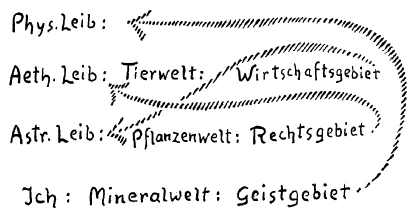
[ 13 ] Now we must place ourselves on a foundation of completely clear conceptual understanding in order to deepen even further this entire insight that we thereby gain. Let us understand this well: through the transformation we undergo in our repeated earthly lives—through the transformation of the etheric body, the astral body, and the “I”—the structure of social life is brought about. So when we turn our gaze in this direction, we find, as it were, that which the human being contributes of his own accord through his own structure, so that social life may arise. But now social life, in turn, acts back upon the human being. I would like to say that up to now we have considered the volitional aspect of social life; we have considered how social life arises, how it flows forth from the structure of human nature. But once it has flowed forth, it is there! So the economic sphere flows out of the etheric body or from the transformation of the etheric body; the legal sphere flows out of the astral body; the spiritual sphere flows out of the transformation of the “I”; but once it has flowed out, this spiritual sphere, this legal sphere, and this economic sphere—these three spheres—are indeed realities, and they then in turn exert a reciprocal influence on the human being. So the human being first projects them out of himself, and they in turn act back upon him.
[ 14 ] We must also take this second type of human interaction into account. We can say that this relates more to the perceptual aspect. What we have considered here pertained more to the volitional aspect—how the human being brings about the threefold social order. Now let us turn more to the perceptual side—to the impressions that arise when a person’s environment, in turn, acts back upon the person. And here it becomes evident that the spiritual realm acts back upon the human physical body (see diagram on page 217), though only to a very limited degree, upon the physical body in the present earthly life. We can, to a certain extent, observe that as a person develops a connection to their environment, they absorb something from that environment insofar as it pertains to the spiritual realm. If a person grows up in a certain artistic atmosphere—and if one has a feeling for such things, one can see it in their physiognomy—or if they grow up in a philistine atmosphere, one can see it in their physiognomy. But this, I would say, is something that is merely a very subtle nuance of life. On the whole, we can say: It is not the case that the physical body of a human being, in terms of its form in this life, shows a strong influence from the spiritual environment. This influence is all the stronger for the next earthly lives. It is certainly true that in our next earthly lives we will strongly bear the physiognomy that stems from the spiritual environment of this earthly life. And the way we look now—the way our physiognomy is now—is essentially the result of the influence of the spiritual realm in which we were in our previous earthly life. If one has a feeling for it, one can indeed discern from a person’s face the environment in which they were in previous earthly lives, even if this is possible, I would say, only in a certain general sense. Certain discrepancies also arise from these factors, which we sometimes encounter quite strongly in human life.
[ 15 ] Consider, for example, a person who, in terms of his previous earthly life, came from a refined family and is now growing up in a coarse family; he carries that subtle nuance of life I spoke of earlier—albeit, I would say, in an insignificant way—in his face. Perhaps what is most strongly reflected in his face is precisely what he brought with him from his previous earthly life. It is often only in this context that one understands how it is that a rough-and-tumble fellow can sometimes actually have a very refined face. Things in human life are, after all, interconnected in quite complex ways.
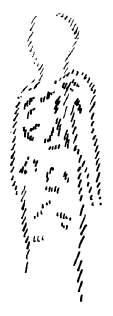
[ 16 ] Now you might say: Yes, but a person doesn’t take their physical body with them into their next earthly life; after all, they leave it behind. — That is true with regard to matter, but I would like to repeat what I said some time ago. What you actually see as the physical body in its form is not, in fact, the human physical organism; it is simply the form (see drawing). And matter is merely incorporated into this form. It is held together by the form, and the form is something entirely spiritual; and it is this form that I mean when I speak now of the influence of the spiritual realm on the physical body. What is shed are, after all, only the material particles that are incorporated into it. The form, however, that a human being possesses is not shed, but continues to influence the next life—namely, what a person develops through the agility and mobility of their limbs, their hands and arms, their feet and legs—this manifests itself in the formation of the head in the next life.
[ 17 ] Thus, the physical organism certainly carries its imprints into the next earthly life, and it carries them in accordance with the spiritual realm surrounding it in this earthly life.
[ 18 ] In contrast, the realm of law has an effect on the etheric body (see diagram on page 217). However, the situation with the etheric body is such that after death, while the physical body—that is, the material aspect of the physical body, not its form—is returned to the earth, returned to the cosmos, and dissolves within it, the forces active within the etheric body carry over into the next earthly life, or at least strive to do so. But it does not merely carry over into the next earthly life; as can be known empirically from spiritual science, it carries over only to a very small degree. While the form of the physical body exerts a strong influence on the next earthly life—and with it, everything the physical body has acquired from the spiritual realm that surrounds it—that which now comes into the etheric body from the realm of justice acts primarily upon the cosmos. And this is a very important discovery made by the science of initiation.
[ 19 ] We live in the world. The way we are socially situated in the world gives us a certain state of mind. After all, our relationship to the people we encounter in life is based on legal concepts or concepts and feelings that are similar to legal sensibilities. This gives our soul a certain configuration. Roughly speaking, in my life I have a certain relationship with ten people: I love one, I hate another, I am indifferent to a third, I am dependent on a fourth, a fifth is dependent on me, and so on. Thus, my rights and duties toward these ten people are configured in a wide variety of ways. But this manifests within me as a state of the soul—not merely in a superficial way, but the very content of my soul’s feelings depends on it. This inner involvement in social life from the perspective of the realm of rights gives my etheric body a certain configuration, which, when I die, is transferred to the cosmos. What resonates within my etheric body continues to resonate in the cosmos once the etheric body is separated from me, and it continues to send out its waves there.
[ 20 ] Unfortunately, such things are completely ignored by what is called “science” today. Consequently, this science has no awareness of the deeper connections between human life and cosmic life. The way wind and weather unfold on Earth today—that is, the way the rhythm of our external climate unfolds—is essentially the lingering resonance of rhythms that were set in motion by the life of justice within the social organism of bygone eras. Human beings stand in a certain relationship to external reality, including natural reality. And it is necessary to realize that what develops around us as the realm of law is not merely something abstract—something that people establish, that arises and then disappears again—but rather that which is initially ideal, which initially lives within the realm of law, lives on in a later period of earthly existence in the atmosphere, in the vibrations, in the entire configuration, and in the movements of the atmosphere.
[ 21 ] When properly understood, this gives a person a sense of their connection to all life on Earth. It is only then that they begin to realize how important it is for them to develop this or that moral life—a good one or a bad one. Everything that is physical actually originates from something that is either spiritually ordered or spiritually disordered. Spiritual science must insist that human beings have a full, living, and conscious connection to the cosmos in their development.
[ 22 ] What is the situation today? In our present age of decadence, we have reached a point where we use abstract concepts to encompass nature, establishing a natural science that actually contains nothing of what lives within the human being—a science that provides a content that is, at its core, not the content of human life. And what the human being experiences inwardly bears no relation to what is happening out there. That is one side of the matter.
[ 23 ] And on the other hand, human beings should—I would say—quite apart from this knowledge of nature that they are developing, cultivate a kind of awareness of God or an awareness of their relationship to God. These two things seem to have nothing to do with one another; in fact, they cannot have anything to do with one another given the way they have developed up to the present. Spiritual science, on the other hand, shows us in very concrete detail not only how human beings are connected to the entire world, but also how they themselves play an active role in it. We can see from what is coming into being how they lived in their previous earthly lives. In past earthly lives, we established legal systems. Now we are living again. Now we have a certain kind of weather, wind, and the like, seasons with this or that configuration: We are now experiencing outwardly in the atmosphere what we once established as a legal order. There, human beings grow in their consciousness together with their surroundings. There, one does not merely speak in general, abstract terms about how human beings have a sense of God within them and form a unity with the outside world; rather, one learns to recognize in detail how this unity is structured, how human beings merge with all that exists in the entire universe.
[ 24 ] Just consider for a moment: what would we know about human beings if we had no idea that it is the blood from the head that flows through the legs—in other words, if we did not observe the entire cycle of events within the organism, insofar as it is contained within the skin? But just as one must not, let us say, consider the head in isolation and fail to take into account its connection with the rest of the organism, so too must one not consider human beings in an earthly life in isolation; rather, one must consider the cycle of metamorphosis. What is a spiritual-social legal order in one instance becomes, in another—albeit in times far removed from our own—a natural order, and with the help of spiritual science one can see how the spiritual-ideal legal order of the one instance is connected to the natural, atmospheric order of the other.
[ 25 ] If these developments lead to a deepening of the human sense of being at the heart of the world—if people come to feel at one with the world—then the necessary and indispensable reconciliation of science and religion, which is absolutely essential for the development of our social life, will indeed come about.
[ 26 ] Just as the legal sphere affects the etheric body and the spiritual sphere affects the physical body, so does the economic sphere affect the astral body; and we can say that the economic sphere affects precisely this innermost aspect of human nature! You must distinguish: the economic sphere arises from the etheric body, but when it exerts a return effect on the human being, it acts back upon the astral body. This return effect is different from that which emanates from the human being. One cannot merely construct these things schematically; rather, one must derive them empirically from direct observation. And precisely because the economic sphere acts upon the astral body, precisely through this, that brotherhood—which is, after all, meant to exist within the economic sphere—is carried through the gate of death, for the astral body is taken along by the human being for a time. And what is established in the human soul through this brotherhood is carried into the spiritual world through death and continues to have an effect as such. Thus, what I have already discussed from other perspectives comes to light once again precisely through this perspective.
[ 27 ] The economic sphere—that is, the way in which human beings, together with others in associations, form the basis for economic judgments and actions—has an effect on the human astral body and shapes it; and in fact, a person carries through death the very form of the astral body that he or she has attained through the brotherhood of economic life. One must not, as an idealist or even a mystic, hold economic life in particularly low regard, for it is precisely in economic life that one can develop brotherhood, as we have often explained. And what is brought into what appears to be material life as something spiritual—that is precisely what a person acquires for his higher realm. What a person establishes in the spiritual realm is drawn from the mineral kingdom; this is something that, fundamentally, lies within their innate dispositions, which they bring with them at birth. But what a person brings into the economic sphere is that which becomes so firmly united with the soul that they carry it through death.
Physical Body
Etheric Body: Animal Kingdom, Economic Realm | Astral Body
Astral Body: Plant Kingdom, Legal Realm | Etheric Body
Self: Mineral Kingdom, Spiritual Realm | Physical Body
Will Aspect | Perception Aspect
[ 28 ] It is true that we must say: Yes, people believe they are idealists or mystics and that they must despise matter, but one is not an idealist simply by despising matter; rather, one is an idealist by knowing how to spiritualize matter. And to approach economic life with a false asceticism—to despise it, to hold it in low esteem—that is not what matters; what matters is to shape this economic life in such a way that the spirit leaves its mark on it everywhere, so that this very economic sphere of the social organism is a sphere shaped by human beings and imbued with spirit. This is also what essentially matters for the future. And on a small scale, isn’t it true that this already makes itself felt—as I have mentioned before—in that people believe they are being idealistic, believe they are being spiritual, when they deny the spirit, so to speak, the tribute of the material and think: It is not necessary to truly offer this or that as a sacrifice for the spiritual! “The spiritual is, after all, the spiritual,” they say, “one must hold it in high esteem; one must not drag it down into the dust by, for example, offering money as a sacrifice for the spiritual!” That is why one is a true idealist when one says to oneself: “Yes, I revere the spirit, but I keep my pockets closed and do nothing to nurture spiritual life.” — One despises matter; above all, one despises the worst aspect of matter, the most Ahrimanic aspect of matter; one keeps one’s pockets so tightly closed that nothing can possibly go toward the cultivation of spiritual life. These are things that are, after all, somewhat connected to the mindset that so easily arises among idealists and mystics. Matter is despised instead of being spiritualized. Yes, despising matter—where does that come from? Because idealists and mystics today are often the most extreme materialists; because they are so subjugated by matter that they can’t relate to it in any other way than by dreaming themselves into a state of contempt. They are, after all, merely dreaming themselves into a state of contempt. And so they despise matter because they themselves could not stand up to it—because they are so deeply entrenched within it.
[ 29 ] One must be clearly aware of how, in our time, certain sensations and feelings exist that are actually masks. And many who strut about today as mystics are in fact merely materialists, as I have also tried to explain from other perspectives, particularly in recent weeks. But above all, you can see once again from what I have tried to convey to you today how spiritual science can awaken a sense of belonging in human beings—a sense of belonging to the world—and how this sense can become ever more intense. This is necessary in the present!
[ 30 ] In fact, humankind has reached a certain point in its development precisely because it did not have to do anything to achieve it. In the development of the Earth, we began at the very origin of earthly existence itself. At the beginning of Earth’s evolution, divine-spiritual beings cared for us; they had already incorporated the soil, the climate, and ultimately even spiritual life into the Earth’s organization; for you know that there were great teachers of the mysteries, whose teachers, in turn, were the gods themselves. Thus, nothing human was accumulated, but rather the divine was taken on. Everything that was orderly and available for humanity had been provided by the gods. But all of that—as I have shown you in a wide variety of contexts—has essentially vanished in our time; and the catastrophic nature of our time is connected to the fact that the old divine content has vanished, that human beings are creating a new content out of themselves. They are creating this new content not only for human life in the spiritual realm, in the legal realm, and in the economic realm, but they are creating it for that which extends beyond these realms into the life of nature. And the future of the Earth must be shaped by human beings themselves; it must be their own concern.
[ 31 ] Therefore, a man like Spengler is entirely correct with regard to the current view of humanity: if people do not stimulate the source within themselves that can be creative—not only for legal, economic, or intellectual life, but which must be creative, extending beyond these spheres, for all life on Earth, including natural life on Earth— For then not only will civilization degenerate into barbarism—as Spengler has already scientifically demonstrated—but the entire Earth will be heading toward ruin, failing to reach its destination. May people be imbued with the awareness that what happens in the future of Earth’s development depends on humanity itself. Then this realization could give rise to the powerful impulse that is needed today to transform the thoroughly declining earthly order back into an ascending one, to rouse the slumbering souls who refuse to see what is actually taking place, and to transform these slumbering souls into awakened ones. For we need an awakened humanity today, and an awakened humanity is solely and exclusively one that perceives what is happening around it and also knows the tasks that lie in the course of human development—tasks in relation to which humanity is currently being subjected to severe trials.