

Spiritual Scientific Insight into the
Fundamental Impulses of Social Organization
GA 199
4 September 1920, Dornach
Translate the original German text into any language:
Versions Available:
Spiritual Scientific Insight into the Fundamental Impulses of Social Organization, tr. SOL
Dreizehnter Vortrag
Thirteenth Lecture
[ 1 ] Gestern versuchte ich von einer gewissen Seite her zu beleuchten die Notwendigkeit einer Gliederung in der sozialen Ordnung und wies darauf hin, daß dasjenige, was man Beweisführen nennen könnte innerhalb der Geisteswissenschaft, darin besteht, daß die Tatsachen, auf die hinzuweisen ist, von den verschiedensten Seiten her gestützt werden, und daß schließlich der Grad der Überzeugung sich immer mehr steigert, je mehr man solche Stützen bekommt. Ich möchte kurz wiederholen, was vorgebracht worden ist. Wir kennen ja die Gliederung des Menschen, wir wissen, daß der Mensch sich gliedert in seinen physischen Leib, seinen Ätherleib, seinen astralischen Leib und das, was wir das Ich nennen. Wir wissen aber auch, daß diese Gliederung des Menschen gewissermaßen etwas ist, was sich in Fluß befindet. Sie können meine Darstellungen verfolgen, wie ich sie gegeben habe in meiner «Theosophie», in meiner «Geheimwissenschaft im Umriß», und Sie werden daraus ersehen, wie physischer Leib, Ätherleib, Astralleib und zuletzt auch das Ich nichts eigentlich Festes sind, sondern wie die menschliche Entwickelung gerade darin besteht, daß der Mensch durch die wiederholten Erdenleben hindurch arbeitet an diesen Gliedern seines Organismus. So daß in einer bestimmten Zeit, nach einer bestimmten Summe von Erdenleben, der Mensch so geboren wird, daß man sagen kann, er besteht sozusagen normalerweise aus physischem Leib, Ätherleib, Astralleib und Ich. Dann aber beginnt er zunächst an seinem Ich zu arbeiten, arbeitet daran durch wiederholte Erdenleben hindurch. Ist das Ich verstärkt, hat das Ich eine gewisse innere Arbeit an sich verrichtet, dann geht diese Arbeit über auf den astralischen Leib. Wiederum, hat der astralische Leib auf diese Weise durch das Ich und durch sein eigenes Mithelfen eine innere Arbeit an sich verrichtet, dann geht diese Arbeit über auf den Ätherleib, und dann zuletzt auf den physischen Leib. Da aber kommen wir dann schon in weite Zukunften hinein. Denn daß der Mensch durch diejenigen Erdenleben, die wir zunächst verfolgen, im wesentlichen der äußerlich-physischen Gestalt nach gleichbleibt, das wissen Sie. Aber diese menschliche Gestalt — das wissen Sie wiederum aus der Darstellung in meiner «Geheimwissenschaft» —, sie hat sich im Laufe der Zeit wesentlich verändert, sie wird sich auch in der Zukunft verändern. Sie wird zu diesen Veränderungen, diesen Metamorphosen gezwungen durch das, was die feineren Glieder, der astralische Leib, der Ätherleib vollbringen an dem physischen Leib. Und so wird zuletzt in fernen Zukunften eben auch der physische Leib des Menschen andere Gestaltungen annehmen.
[ 1 ] Yesterday I attempted to shed light, from a certain perspective, on the necessity of a hierarchical structure within the social order, and I pointed out that what might be called “proof” in spiritual science consists in the fact that the facts to be pointed out are supported from a wide variety of perspectives, and that ultimately, the degree of conviction increases more and more the more such support one receives. I would like to briefly recap what has been said. We are, of course, familiar with the structure of the human being; we know that the human being is composed of the physical body, the etheric body, the astral body, and what we call the “I.” But we also know that this structure of the human being is, in a sense, something that is in a state of flux. You can follow my explanations as I have presented them in my *Theosophy* and in my *Outline of Esoteric Science*, and you will see from them how the physical body, the etheric body, the astral body, and finally the “I” are not actually fixed entities, but how human development consists precisely in the fact that, through repeated earthly lives, the human being works on these members of his organism. So that at a certain point in time, after a certain number of earthly lives, a human being is born in such a way that one can say he or she consists, so to speak, normally of a physical body, an etheric body, an astral body, and an “I.” But then he or she begins, first of all, to work on his or her “I,” working on it through repeated earthly lives. Once the I has been strengthened—once the I has carried out a certain inner work upon itself—this work then shifts to the astral body. In turn, once the astral body has carried out an inner work upon itself in this way, through the I and through its own cooperation, this work then shifts to the etheric body, and finally to the physical body. But that already takes us into the distant future. For you know that, throughout the earthly lives we are initially considering, the human being essentially remains the same in terms of outward physical form. But this human form—as you also know from the description in my *Esoteric Science*—has changed significantly over the course of time, and it will continue to change in the future. It is compelled to undergo these changes, these metamorphoses, by what the finer bodies—the astral body and the etheric body—bring about in the physical body. And so, in the distant future, the physical body of the human being will also take on different forms.
[ 2 ] Nun aber hängt das, was der Mensch an seinen Gliedern arbeitet, ja zusammen mit der menschlichen Umgebung, so wie der Mensch, ich möchte sagen, von seinem Ursprunge her in seinen einzelnen Gliedern zusammenhängt mit der natürlichen Umgebung.
[ 2 ] But what a person does with his limbs is, in fact, connected to his human environment, just as a person—I would say—is, from his very origins, connected in his individual limbs to the natural environment.
[ 3 ] Man muß sich ja über das eine klar sein: Nehmen wir den physischen Leib des Menschen. Er steht innerhalb der Naturordnung als eine vereinzelte Erscheinung da. Er ist gewissermaßen herausgehoben aus der Naturordnung. Und wenn wir genügend ins Auge fassen die starke Differenzierung zwischen den Menschen und den verschiedenen Gliedern des Tierreiches, können wir nicht anders sagen als: Der Mensch ist nicht so einfach, wie es Entwickelungstheoretiker machen, an den Schluß des Tierreiches zu stellen, sondern er ist schon nicht nur eine Zusammenfassung der gesamten Tierwelt, aller Tierformen, sondern auch eine Zusammenfassung auf höherer Stufe. Diesen physischen Leib des Menschen können wir deshalb mit nichts anderem zusammenbringen als mit sich selbst. So daß wir in der ganzen Umgebung des Menschen, in der natürlichen Umgebung des Menschen nichts finden hier auf Erden, womit wir den physischen Leib des Menschen gewissermaßen wie in eine Klasse zusammenstellen können. Dieser physische Leib des Menschen steht also für sich da (siehe Schema).
[ 3 ] One must be clear about one thing: Let us take the human physical body. It stands within the natural order as an isolated phenomenon. It is, so to speak, set apart from the natural order. And if we sufficiently consider the marked differentiation between human beings and the various members of the animal kingdom, we cannot help but conclude: Human beings cannot simply be placed at the end of the animal kingdom, as evolutionary theorists do; rather, they are not merely a synthesis of the entire animal world and all animal forms, but also a synthesis on a higher level. We can therefore compare the human physical body to nothing other than itself. Thus, in the entire environment surrounding human beings—in the natural environment of human beings—we find nothing here on Earth with which we can, so to speak, group the human physical body into a single class. This human physical body therefore stands on its own (see diagram).
[ 4 ] Nun dringen wir vor, weiter nach innen gehend, zu dem Ätherleib. Da kommen wir zu dem nächsten, schon beweglichen Gliede des Menschen. Und ich habe Ihnen ja gestern dargestellt — vielleicht sogar etwas merkwürdig dargestellt für manche Empfindungen —, wie beweglich dieser Ätherleib des Menschen ist. Er hat nun einmal die Tendenz, sich der Tierwelt in einer gewissen Weise gegenüberzustellen. Er hat eine gewisse Verwandtschaft mit der Tierwelt. Ich sagte: Wenn wir gegenüberstehen einem Elefanten oder einem Esel oder auch andern Tierformen, so hat unser Ätherleib die innerliche Tendenz — er wird verhindert, sie ganz auszuführen —, aber er hat die innerliche Tendenz, gerade die Tierform nachzuahmen, ähnlich zu werden der Tierform; wenn der Mensch einem Esel, einem Elefanten, einem Kalb gegenübersteht, so will der Ätherleib diese Formen annehmen. Er hat eine besondere Verwandtschaft zu diesen Tierformen. Durch die im physischen Leib konzentrierten Kräfte wird er verhindert, das auszuführen, aber er strebt darnach. Und es ist eine erste Erfahrung der Initiation, daß dieses innerliche Spannen und Drängen auftritt gegenüber der Tierwelt, daß man ähnlich werden will den Tieren. So daß man sagen kann, der Mensch ist in bezug auf seinen physischen Leib nicht verwandt mit der Tierwelt, aber sein Ätherleib zeigt eine ganz entschiedene Verwandtschaft mit der Tierwelt.
[ 4 ] Now let us proceed further inward to the etheric body. There we come to the next, already mobile part of the human being. And as I explained to you yesterday—perhaps in a way that seemed a bit strange to some—how mobile this etheric body of the human being is. It simply has a tendency to relate to the animal kingdom in a certain way. It shares a certain kinship with the animal kingdom. I said: When we stand before an elephant or a donkey or even other animal forms, our etheric body has an inner tendency—it is prevented from carrying it out completely—but it has the inner tendency to imitate precisely the animal form, to become similar to the animal form; when a human stands before a donkey, an elephant, or a calf, the etheric body wants to take on these forms. It has a special affinity for these animal forms. The forces concentrated in the physical body prevent it from carrying this out, but it strives toward it. And it is a first experience of initiation that this inner tension and urge arises in relation to the animal world, that one wants to become like the animals. So that one can say: with regard to his physical body, the human being is not related to the animal world, but his etheric body shows a very definite kinship with the animal world.
[ 5 ] Nun schreiten wir zum astralischen Leib vor. Da finden wir eine gleiche innere Verwandtschaft mit der Pflanzenwelt. Der astralische Leib hat die Tendenz, wenn er der Pflanzenwelt gegenübersteht, pflanzenähnlich zu werden, und zwar derjenigen Pflanze, der er gegenübersteht, ähnlich zu werden. Ich habe Ihnen gestern mehr zum Memorieren gesagt: Wenn wir gegenüberstehen einem Esel, der Disteln frißt, so will! der Ätherleib dem Esel und der astralische Leib der Distel gleichen. Das ist so. In dieser Weise sind wir verwandt mit der Umgebung der Naturreiche. Also im astralischen Leib sind wir verwandt mit der Pflanzenwelt.
[ 5 ] Now let us turn to the astral body. There we find a similar inner kinship with the plant world. When the astral body is in the presence of the plant world, it tends to become plant-like—specifically, to become similar to the plant it is facing. I told you more about this yesterday for you to remember: When we stand before a donkey eating thistles, the etheric body will resemble the donkey and the astral body will resemble the thistle. That is how it is. In this way, we are related to the surroundings of the natural kingdoms. Thus, in the astral body, we are related to the plant kingdom.
[ 6 ] Und in bezug auf unser Ich, sagte ich Ihnen, sind wir verwandt mit der mineralischen Welt.
[ 6 ] And as for our “I,” I told you, we are related to the mineral world.
Physischer Leib
Ätherleib: Tierwelt
Astralleib: Pflanzenwelt
Ich: Mineralwelt.
Physical Body
Etheric Body: Animal Kingdom
Astral Body: Plant Kingdom
Self: Mineral Kingdom.
[ 7 ] Das ist natürlich, weil es dem unmittelbaren Bewußtsein vorliegt, dasjenige, was wir als Menschen am leichtesten eben auch für das gewöhnliche Bewußtsein konstatieren können. Unser ganzer Bewußtseinsinhalt ist ja eigentlich dieser Verwandtschaft mit der mineralischen Welt verdankt. Wir bilden unseren Bewußtseinsinhalt im wesentlichen aus an der mineralischen Welt, und ich habe Ihnen gesagt, weil der Mensch mit seinem Ich, wie es heute vorliegt, hinorganisiert ist auf die Mineralwelt, davon kommt es ja, daß wir eigentlich in unseren wissenschaftlichen Bestrebungen nicht vordringen können zum Ergreifen der Pflanzenwelt oder gar der Tierwelt, nicht vordringen können zum Ergreifen des Lebendigen, daß immer herumdiskutiert wird, ob das Lebendige begriffen werden könne, ob es nicht begriffen werden könne. Nur Menschen, welche von einer andern Art der Anschauung ausgehen, wie zum Beispiel Goethe, die erwerben sich ein Bewußtsein davon, daß in das Lebendige in einer gewissen Weise hineingedrungen werden kann. Und die Initiation gibt natürlich die Möglichkeit, dasjenige, was im astralischen Leib in bezug auf die Pflanzenwelt, im ätherischen Leib in bezug auf die Tierwelt vorgeht, in einer ähnlichen Weise innerlich zu verfolgen, wie man mit dem gewöhnlichen Bewußtsein nur die Verwandtschaft des Menschen mit der Mineralwelt verfolgt. Und dann, sagte ich Ihnen, arbeitet der Mensch an seinem Ich. Er arbeitet sein Ich durch seine wiederholten Erdenleben aus. Was aus dem Mineralreich herausgeborener Inhalt ist, das arbeitet er also um. Er macht daraus seine Wissenschaft, er macht daraus seine Kunst, er macht daraus seine Religion. All das, was als Kultur, als Zivilisationsinhalt in dieser Weise erscheint, das ist ja im Grunde genommen umgestaltetes Mineralreich.
[ 7 ] This is, of course, because what lies before our immediate consciousness is precisely what we, as human beings, can most easily observe even in our ordinary consciousness. In fact, the entire content of our consciousness is actually due to this kinship with the mineral world. We essentially form the content of our consciousness in relation to the mineral world, and as I have told you, because human beings, with their “I” as it exists today, are organized in relation to the mineral world, it follows that in our scientific endeavors we cannot actually penetrate to an understanding of the plant world or even the animal world—we cannot penetrate to an understanding of the living—and that there is always debate about whether the living can be understood or not. Only people who start from a different kind of perspective—such as Goethe, for example—acquire an awareness that it is possible, in a certain way, to penetrate into the living. And initiation, of course, offers the possibility of inwardly following what takes place in the astral body in relation to the plant world, and in the etheric body in relation to the animal world, in much the same way as one follows, with ordinary consciousness, only the kinship of the human being with the mineral world. And then, as I told you, the human being works on his or her “I.” He or she develops this “I” through repeated earthly lives. Thus, he or she transforms the content that originated in the mineral kingdom. He or she turns it into science, into art, and into religion. Everything that appears in this way as culture and the substance of civilization is, in essence, the transformed mineral kingdom.
[ 8 ] Bedenken Sie nur, daß ja, wenn Sie, sagen wir, eine griechische Statue anschauen, daß Sie dann das Leben forthaben; aber alles das, was innerhalb des Mineralischen beschlossen ist, die Form, die Gliederung, das haben Sie durch ihre Umwandlung, also hier durch die künstlerische Umwandlung derjenigen Vorstellungen und Empfindungen, die Sie aus dem Mineralreich heraus unmittelbar in das Bewußtsein aufnehmen, erreicht. Und so ist es auch mit den andern Kulturinhalten. In diesem Kulturinhalt, da spricht sich, insofern die Kultur aus Kunst, Wissenschaft, Religion besteht, dasjenige aus, was das Ich an sich selber arbeitet, natürlich im menschlichen Zusammenwirken, und was im wesentlichen umgestalteter, aus dem Mineralreich gewonnener Inhalt ist. Wer wirklich unbefangen diese Dinge verfolgen kann, der wird finden, daß da umgestalteter, aus dem Mineralreich genommener Inhalt vorliegt. Wenn wir das, was in des Menschen sozialer Umgebung lebt, scharf abgrenzen, so finden wir: Alles das, was auf solche Weise entsteht, daß das Ich den aus dem Mineralreich gewonnenen Inhalt umgestaltet und daraus ein geistiges Leben formt, dasjenige formt, was unter uns lebt als Kunst, als Literatur, als Wissenschaft oder als Inhalt des Glaubens der Religionsgemeinschaften und so weiter, all das, was also im wesentlichen umfaßt wird durch diese Umarbeit des Ich an sich selbst, all das begrenzt ganz scharf dasjenige, was wir das Geistgebiet des dreigegliederten sozialen Organismus nennen.
[ 8 ] Just consider that when you look at, say, a Greek statue, you have life before you; but everything that is contained within the mineral realm—the form, the structure—you have attained through its transformation, that is, through the artistic transformation of those ideas and sensations that you take up directly from the mineral kingdom into your consciousness. And so it is with the other aspects of culture as well. In this cultural content—insofar as culture consists of art, science, and religion—what is expressed is what the “I” works out within itself, naturally in human interaction, and which is essentially transformed content derived from the mineral kingdom. Anyone who can truly examine these things with an open mind will find that there is transformed content derived from the mineral kingdom. If we sharply demarcate what lives in the human social environment, we find: Everything that arises in such a way that the “I” transforms the content derived from the mineral kingdom and forms from it a spiritual life—that which lives among us as art, as literature, as science, or as the content of the faith of religious communities, and so on— in other words, everything that is essentially encompassed by this transformation of the “I” within itself—all of this very sharply delimits what we call the spiritual realm of the threefold social organism.
[ 9 ] Sie können also hier eine Möglichkeit gewinnen, scharf zu umgrenzen das Geistgebiet des dreigliedrigen sozialen Organismus. Es gäbe kein Geistgebiet des sozialen Organismus, wenn das Ich nicht sein eigenes Wesen so umwandeln würde, daß es den aus dem Mineralreich gewonnenen Inhalt künstlerisch, religiös, wissenschaftlich verarbeitet.
[ 9 ] Here, then, you can gain an opportunity to clearly define the spiritual realm of the threefold social organism. There would be no spiritual realm of the social organism if the “I” did not transform its own nature in such a way that it processes the content derived from the mineral kingdom artistically, religiously, and scientifically.
[ 10 ] Aber der Mensch wandelt ja auch seinen astralischen Leib um. Diesen astralischen Leib wandelt er nicht in derselben bewußten Weise um. Wenn wir den Kulturinhalt ansehen, so sind die bewußtesten Bestandteile dieses Kulturinhaltes die des Geistgebietes, wie wir es eben jetzt charakterisiert haben. Halb unbewußt gerade da, wo sie am schärfsten konturiert entstanden sind, halb unbewußt sind diejenigen Vorstellungen, die das Leben von Mensch zu Mensch regeln, diejenigen Vorstellungen, die das Recht umfassen und alles, was man zum Recht, nämlich zum Verhältnis von Mensch zu Mensch rechnen kann. Wer nicht jenen Unterschied begreift, der besteht zwischen einer Vorstellung, die dem religiösen oder dem wissenschaftlichen oder dem künstlerischen Gebiet angehört, und einer Vorstellung, die dem Rechts- oder Staatsgebiet angehört, der ist zweifellos kein guter Psychologe, kein Seelenkenner. Denn in ganz anderer Weise regeln wir den Verkehr von Mensch zu Mensch, regeln wir dieses dumpfe Bewußtsein: Was ist meine Pflicht gegen den andern Menschen? Was ist sein Recht gegen mich? Was ist mein Recht gegen ihn? — Alle diese Fragen, die da spielen von Mensch zu Mensch, die gehen aus einem viel dumpferen Bewußtsein hervor als dasjenige, was in Wissenschaft, Religion und Kunst lebt. Und das Gebiet, was da zwischen Mensch und Mensch sich abspielt, was eigentlich nicht in derselben Weise vom einzelnen Menschen entschieden werden kann, wie Wissenschaft, Kunst und Religion, sondern was nur entschieden werden kann durch das Zusammenleben der Menschen, durch das, ich möchte sagen, Sich-Verabreden und gegenseitige Sich-Verständigen der Menschen, das ist zu umfassen mit dem Gebiete des Rechts- oder Staatslebens, das ist das Rechtsgebiet des sozialen Organismus.
[ 10 ] But human beings also transform their astral bodies. They do not transform this astral body in the same conscious way. When we look at the content of culture, the most conscious elements of this content are those of the spiritual realm, as we have just characterized it. Semi-unconscious—precisely where they have emerged with the sharpest contours—are those concepts that govern life from person to person, those concepts that encompass the law and everything that can be counted as law, namely, the relationship between people. Anyone who fails to grasp the distinction between a concept belonging to the religious, scientific, or artistic realm and one belonging to the realm of law or the state is undoubtedly not a good psychologist, nor a connoisseur of the human soul. For we regulate human interaction—we regulate this vague awareness—in an entirely different way: What is my duty toward another person? What is his right toward me? What is my right toward him?—All these questions that arise in human interaction stem from a much more subdued consciousness than that which animates science, religion, and art. And the realm that unfolds between human beings—which, in fact, cannot be determined by the individual in the same way as science, art, and religion, but can only be determined through human coexistence, through what I might say, people’s mutual agreement and understanding—this is to be encompassed within the realm of legal or political life; this is the legal realm of the social organism.
[ 11 ] Noch dumpfer erlebt der Mensch ein drittes Gebiet, dasjenige, das dadurch entsteht, daß er seinen Ätherleib umgestaltet. Das ist ein Gebiet, von dem der Mensch eigentlich höchst indirekt, durch allerlei vage diätetische Vorschriften und dergleichen ein Bewußtsein erlangt. Es ist das Gebiet, welches fast schlafend von dem Menschen durchlebt wird, und was so wenig in das volle Bewußtsein heraufschlägt, daß es nicht einmal durch eine Verständigung von Mensch zu Mensch erhellt werden kann. Das Rechtsgebiet kann durch Verständigung von Mensch zu Mensch erhellt werden, und ein gewisses Ideal unserer sozialen Ordnung ist das, daß wir für das Rechtsgebiet die völlige Demokratie durchgeführt haben, wo alle mündig gewordenen Menschen in Gleichheit sich gegenüberstehen und in Verständigung sich ihr Recht besorgen. Die Dumpfheit des Bewußtseins, das die Umwandlungen des astralischen Leibes zum Inhalte hat, sie reicht aus für den einzelnen Menschen, wenn er seine Stütze hat in der Verständigung mit andern einzelnen Menschen. Wissenschaft muß der Mensch für sich begreifen, Religion muß der Mensch für sich allein, Kunst muß der Mensch aus seinem innersten individuellen Quell, aus dem Quell seiner Persönlichkeit hervorbringen. Das ist dasjenige, was aus dem offensten, aus dem klarsten Bewußtsein hervorgehen muß. Da muß der Mensch ganz auf sich allein, auf seine Individualität gestellt werden. Man empfindet es ja schon als etwas doch ziemlich Abnormes, wenn in der neueren Zeit in der Kunst zuweilen die «Assoziation» entstanden ist; allerdings war es in der Regel nur eine Assoziation zu zweien, bei Dramendichtern, die zusammen Dramen gedichtet haben, so daß man zuweilen auf den Theaterzetteln gefunden hat das Spießbürgerlustspiel von X Y und U Z. Nicht wahr, gewöhnlich ist das ja doch, wie Eingeweihte auf diesem Gebiete wissen, nicht eine richtige Assoziation zu zweien gewesen, sondern in der Regel war es ja so, daß ein älterer Herr da war, der in der Jugend Theaterstücke geschrieben hat, und dem das Talent — wenn man das so nennen kann —, solche Theaterstücke zu schreiben, schon verraucht war. Der hat sich dann zusammengetan mit einem jüngeren Menschen, der noch ganz unbekannt war, hat den das Drama schreiben lassen, hat es dann so ein bißchen durchkorrigiert und hat nun seinen Namen dazugeschrieben.. Dadurch ist der Dichter nun auch so in die Öffentlichkeit hinausgerutscht, und auf diese Weise haben sich Assoziationen auf diesem Gebiete ergeben. Aber es fühlt natürlich jeder, daß das etwas Abnormes ist, und daß dasjenige, was wirklich dem Geistgebiet angehört, auch der Persönlichkeit des Menschen ganz individuell angehören muß. Dagegen kommt der Mensch zurecht mit Bezug auf die Fixierung des Rechtes, wenn er als einzelner Mensch seine Stütze an einem andern einzelnen Menschen hat. Das genügt aber nicht bei einem dritten Gebiete, wo das Bewußtsein eigentlich nicht hinunterdringt. Im Ätherleib, wo sich eben Vorgänge abspielen, da genügt es nicht, daß der Mensch als einzelner einem andern einzelnen gegenübersteht. Wo der Mensch der Gesamtheit als einzelner gegenübersteht, da ist es notwendig, daß sich Assoziationen bilden, daß die Urteile durch Assoziieren von einzelnen Personen gebildet werden, daß also Personen ihre Erfahrungen zusammentragen und daß Taten, Werke hervorgehen aus den Assoziationen, nicht aus den einzelnen Persönlichkeiten. Wir werden da auf ein Leben verwiesen, wo der einzelne für sich nichts vermag, sondern wo er nur etwas vermag, wenn er in einer Assoziation drinnensteht und eine Assoziation wiederum in Wechselwirkung tritt mit einer andern Assoziation. Kurz, wir werden auf dasjenige verwiesen, was wirklich innerhalb der menschlichen Gesellschaft in dieser dumpferen Bewußtheit sich abspielt, wir werden auf das Wirtschaftsgebiet des sozialen Organismus verwiesen.
[ 11 ] Human beings experience a third realm even more dimly—the one that arises from the transformation of their etheric body. This is a realm of which human beings actually become aware only very indirectly, through all sorts of vague dietary guidelines and the like. It is a realm that human beings experience almost unconsciously, and which emerges so little into full consciousness that it cannot even be illuminated through mutual understanding between people. The realm of law can be illuminated through communication between people, and a certain ideal of our social order is that we have implemented complete democracy in the realm of law, where all people who have come of age stand on an equal footing and secure their rights through mutual understanding. The dullness of consciousness, which has the transformations of the astral body as its content, is sufficient for the individual human being when he finds support in communication with other individual human beings. A person must grasp science for themselves; a person must experience religion on their own; a person must bring forth art from their innermost individual source, from the source of their personality. This is what must emerge from the most open, the clearest consciousness. Here, a person must be left entirely to themselves, to their individuality. One already perceives it as something rather abnormal when, in recent times, “association” has occasionally arisen in art; admittedly, it was usually only an association between two people—in the case of playwrights who wrote plays together—so that one sometimes found on theater programs the petty-bourgeois comedy by X, Y, and U, Z. Isn’t it true that, as those in the know in this field are aware, this was usually not a true collaboration between two people, but rather it was typically the case that there was an older gentleman who had written plays in his youth, and whose talent—if one can call it that—for writing such plays had already faded. He would then team up with a younger person who was still completely unknown, have him write the play, make a few minor corrections to it, and then add his own name to it. As a result, the playwright would also find his way into the public eye, and this is how partnerships in this field came about. But of course everyone senses that this is something abnormal, and that what truly belongs to the spiritual realm must also belong entirely and individually to the human personality. In contrast, a person can cope with regard to the establishment of rights when, as an individual, they find support in another individual. But that is not enough in a third realm, where consciousness does not actually penetrate. In the etheric body, where these processes take place, it is not enough for a person, as an individual, to face another individual. Where the individual stands before the whole, it is necessary for associations to form, for judgments to be formed through the association of individuals, so that people pool their experiences and actions and works arise from the associations, not from the individual personalities. We are thus directed toward a way of life in which the individual can accomplish nothing on his own, but can only accomplish something when he is part of an association, and one association, in turn, interacts with another association. In short, we are directed toward what truly takes place within human society in this more subdued state of consciousness; we are directed toward the economic sphere of the social organism.
[ 12 ] So daß wir sagen können: Sehen wir auf dasjenige, was der Mensch, so wie er heute ist, gewissermaßen nach rückwärts, gegen die Natur hin ist, so finden wir, er ist mit seinem Ätherleib in der Tierwelt begründet, mit seinem astralischen Leib in der Pflanzenwelt, mit seinem Ich in der mineralischen Welt. Aber er wandelt diese seine bestehenden Glieder schon um, er wandelt seinen Ätherleib um, und dadurch entsteht um ihn herum im menschlichen Zusammenleben dasjenige, worinnen er wiederum mit seinem Ätherleib in der Außenwelt, im sozialen Organismus begründet ist: das Wirtschaftsleben. Er ist mit seinem Astralleib im Rechtsgebiet des sozialen Organismus, und er ist mit seinem Ich im Geistgebiet des sozialen Organismus begründet. Wir stehen also als Menschen auf der einen Seite zusammengegliedert mit den drei Naturreichen, stehen nach der andern Seite als Menschen hineingegliedert in das soziale Leben nach seinen drei verschiedenen Gliedern, dem Geistglied, dem Rechtsglied und dem Wirtschaftsglied.
[ 12 ] So we can say: If we look at what human beings, as they are today, are, in a sense, in reverse—in opposition to nature—we find that they are rooted in the animal kingdom with their etheric body, in the plant kingdom with their astral body, and in the mineral kingdom with their “I.” But he is already transforming these existing aspects of himself; he is transforming his etheric body, and through this, what arises around him in human social life is that in which he is, in turn, rooted with his etheric body in the external world, in the social organism: economic life. He is rooted with his astral body in the legal sphere of the social organism, and he is rooted with his “I” in the spiritual sphere of the social organism. Thus, as human beings, we are on the one hand integrated with the three kingdoms of nature, and on the other hand, as human beings, we are integrated into social life according to its three distinct components: the spiritual component, the legal component, and the economic component.
Physischer Leib
Ätherleib: Tierwelt Wirtschaftsgebiet
Astralleib: Pflanzenwelt Rechtsgebiet
Ich: Mineralwelt Geistgebiet
Physical Body
Etheric Body: Animal Kingdom, Economic Realm
Astral Body: Plant Kingdom, Legal Realm
Self: Mineral Kingdom, Spiritual Realm
[ 13 ] Nun müssen wir uns auf einen Boden vollständig klarer Vorstellungsart stellen, um diese ganze Einsicht, die wir dadurch gewinnen, noch mehr zu vertiefen. Fassen wir das wohl auf, daß durch die Umwandlung, die wir vollziehen in den wiederholten Erdenleben, durch die Umwandlung des Ätherleibes, des Astralleibes, des Ich, das soziale Leben in seiner Gliederung bewirkt wird. Also wenn wir den Blick so wenden, dann finden wir gewissermaßen dasjenige, was der Mensch von sich aus durch seine Gliederung beiträgt, damit das soziale Leben entsteht. Aber nun wirkt das soziale Leben wiederum auf ihn zurück, auf den Menschen. Ich möchte sagen, wir haben bis jetzt die Willensseite des sozialen Lebens betrachtet, wir haben betrachtet, wie es entsteht, das soziale Leben, wie es herausfließt aus der Gliederung der Menschennatur. Aber es ist ja dann da, wenn es herausgeflossen ist! Also es fließt das Wirtschaftsgebiet aus dem ätherischen Leib oder aus der Umwandlung des ätherischen Leibes, es fließt das Rechtsgebiet aus dem Astralleib, es fließt das Geistgebiet aus der Umwandlung des Ich, aber indem es dann ausgeflossen ist, ist dieses Geistgebiet, ist dieses Rechtsgebiet, ist dieses Wirtschaftsgebiet, sind diese drei Glieder ja Realitäten, und dann wirken sie wiederum zurück auf den Menschen. Also der Mensch setzt sie erst aus sich heraus, und sie wirken wiederum auf ihn zurück.
[ 13 ] Now we must place ourselves on a foundation of completely clear conceptual understanding in order to deepen even further this entire insight that we thereby gain. Let us understand this well: through the transformation we undergo in our repeated earthly lives—through the transformation of the etheric body, the astral body, and the “I”—the structure of social life is brought about. So when we turn our gaze in this direction, we find, as it were, that which the human being contributes of his own accord through his own structure, so that social life may arise. But now social life, in turn, acts back upon the human being. I would like to say that up to now we have considered the volitional aspect of social life; we have considered how social life arises, how it flows forth from the structure of human nature. But once it has flowed forth, it is there! So the economic sphere flows out of the etheric body or from the transformation of the etheric body; the legal sphere flows out of the astral body; the spiritual sphere flows out of the transformation of the “I”; but once it has flowed out, this spiritual sphere, this legal sphere, and this economic sphere—these three spheres—are indeed realities, and they then in turn exert a reciprocal influence on the human being. So the human being first projects them out of himself, and they in turn act back upon him.
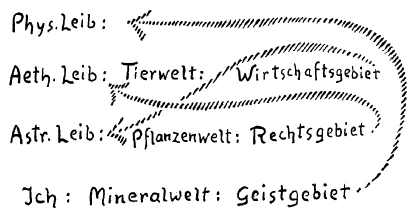
[ 14 ] Diese zweite Art des Zusammenwirkens des Menschen müssen wir auch beachten. Das ist so, daß wir sagen können, das ist mehr von der Wahrnehmungsseite aus. Das, was wir hier betrachtet haben, war mehr von der Willensseite aus, wie der Mensch die Dreigliederung bewirkt. Jetzt wollen wir mehr zu der Wahrnehmungsseite gehen, was für Eindrücke da entstehen, indem des Menschen Umgebung auf den Menschen wiederum zurückwirkt. Und da zeigt sich denn der Beobachtung, daß das Geistgebiet zurückwirkt auf den physischen Leib des Menschen (siehe Schema Seite 217), allerdings nur in sehr spärlichem Grade, auf den physischen Leib im gegenwärtigen Erdenleben. Wir können zwar in einem gewissen Grade konstatieren, daß der Mensch, indem er sich mit einer Verwandtschaft zu seiner Umgebung entwickelt, von dieser Umgebung, insofern sie das Geistgebiet ist, etwas annimmt. Wächst der Mensch auf in einer gewissen Kunstatmosphäre, man kann es ihm, wenn man dafür eine Empfindung hat, ansehen an der Physiognomie, man kann es ihm, wenn er in einer philiströsen Atmosphäre aufwächst, an der Physiognomie ansehen. Aber das ist, möchte ich sagen, doch etwas, was eben nur eine ganz feine Lebensnuance ist. Im ganzen können wir sagen: Es ist nicht so, daß der physische Leib des Menschen in bezug auf seine Gestaltung in diesem Leben eine starke Beeinflussung durch die Umgebung des Geistgebietes zeigt. Um so stärker ist diese Beeinflussung für die nächsten Erdenleben. Das ist allerdings so, daß wir in den nächsten Erdenleben stark jene Physiognomie tragen werden, die herkommt aus der geistigen Umgebung in diesem Erdenleben. Und so, wie wir jetzt ausschauen, wie wir jetzt unsere Physiognomie haben, ist es im wesentlichen das Ergebnis des Einflusses des Geistgebietes, in dem wir waren im früheren Erdenleben. Man kann schon, wenn man dafür eine Empfindung hat, vom Gesichte eines Menschen ablesen, in welcher Umgebung er in früheren Erdenleben war, wenn das auch nur, ich möchte sagen, in einem gewissen allgemeinen Sinne möglich ist. Aus diesen Dingen gehen auch gewisse Diskrepanzen hervor, die uns zuweilen recht stark entgegentreten im menschlichen Leben.
[ 14 ] We must also take this second type of human interaction into account. We can say that this relates more to the perceptual aspect. What we have considered here pertained more to the volitional aspect—how the human being brings about the threefold social order. Now let us turn more to the perceptual side—to the impressions that arise when a person’s environment, in turn, acts back upon the person. And here it becomes evident that the spiritual realm acts back upon the human physical body (see diagram on page 217), though only to a very limited degree, upon the physical body in the present earthly life. We can, to a certain extent, observe that as a person develops a connection to their environment, they absorb something from that environment insofar as it pertains to the spiritual realm. If a person grows up in a certain artistic atmosphere—and if one has a feeling for such things, one can see it in their physiognomy—or if they grow up in a philistine atmosphere, one can see it in their physiognomy. But this, I would say, is something that is merely a very subtle nuance of life. On the whole, we can say: It is not the case that the physical body of a human being, in terms of its form in this life, shows a strong influence from the spiritual environment. This influence is all the stronger for the next earthly lives. It is certainly true that in our next earthly lives we will strongly bear the physiognomy that stems from the spiritual environment of this earthly life. And the way we look now—the way our physiognomy is now—is essentially the result of the influence of the spiritual realm in which we were in our previous earthly life. If one has a feeling for it, one can indeed discern from a person’s face the environment in which they were in previous earthly lives, even if this is possible, I would say, only in a certain general sense. Certain discrepancies also arise from these factors, which we sometimes encounter quite strongly in human life.
[ 15 ] Bedenken Sie einmal, nun, sagen wir, ein Mensch stamme in bezug auf sein voriges Erdenleben aus einer feingestimmten Familie und wächst jetzt auf in einer rohen Familie, dann trägt er jene feine Lebensnuance, von der ich vorhin gesprochen habe, wenn auch, ich möchte sagen, in unbeträchtlicher Weise, in seinem Gesichte. Vielleicht trägt er stark gerade dasjenige in seinem Gesichte, was er aus seinem früheren Erdenleben mitgebracht hat. Man begreift da oftmals nur aus diesem Zusammenhang, wie es kommt, daß ein roher Kerl eigentlich manchmal ein ganz feines Gesicht haben kann. Die Dinge im menschlichen Leben hängen eben durchaus in komplizierter Weise zusammen.
[ 15 ] Consider, for example, a person who, in terms of his previous earthly life, came from a refined family and is now growing up in a coarse family; he carries that subtle nuance of life I spoke of earlier—albeit, I would say, in an insignificant way—in his face. Perhaps what is most strongly reflected in his face is precisely what he brought with him from his previous earthly life. It is often only in this context that one understands how it is that a rough-and-tumble fellow can sometimes actually have a very refined face. Things in human life are, after all, interconnected in quite complex ways.
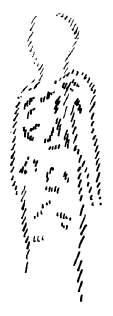
[ 16 ] Nun werden Sie sagen: Ja, aber der Mensch nimmt doch für das nächste Erdenleben seinen physischen Leib nicht mit, er legt ihn ja ab. — Das ist in bezug auf die Materie der Fall, aber ich möchte das noch einmal wiederholen, was ich vor einiger Zeit gesagt habe. Das was Sie eigentlich sehen als den physischen Leib in seiner Form, das ist ja nicht der physische Organismus des Menschen, das ist eben die Form (siehe Zeichnung). Und in diese Form ist nur hineingegliedert die Materie. Sie ist aufgefaßt von der Form, und die Form ist etwas durchaus Geistiges, und diese Form meine ich, wenn ich jetzt von dem Einfluß des Geistgebietes auf den physischen Leib spreche. Das, was abgelegt wird, das sind ja nur die materiellen Teilchen, die eingegliedert sind. Die Form aber, die der Mensch hat, wird nicht abgelegt, sondern wirkt in das nächste Leben hinein — namentlich das, was der Mensch entwickelt durch die Behendigkeit und Beweglichkeit seiner Gliedmaßen, seiner Hände und Arme, seiner Füße und Beine —, das kommt in der Kopfbildung des nächsten Lebens zum Vorschein.
[ 16 ] Now you might say: Yes, but a person doesn’t take their physical body with them into their next earthly life; after all, they leave it behind. — That is true with regard to matter, but I would like to repeat what I said some time ago. What you actually see as the physical body in its form is not, in fact, the human physical organism; it is simply the form (see drawing). And matter is merely incorporated into this form. It is held together by the form, and the form is something entirely spiritual; and it is this form that I mean when I speak now of the influence of the spiritual realm on the physical body. What is shed are, after all, only the material particles that are incorporated into it. The form, however, that a human being possesses is not shed, but continues to influence the next life—namely, what a person develops through the agility and mobility of their limbs, their hands and arms, their feet and legs—this manifests itself in the formation of the head in the next life.
[ 17 ] Also der physische Organismus trägt durchaus seine Spuren in das nächste Erdenleben hinein, und er trägt sie hinein nach Maßgabe des ihn in diesem Erdenleben umgebenden Geistgebietes.
[ 17 ] Thus, the physical organism certainly carries its imprints into the next earthly life, and it carries them in accordance with the spiritual realm surrounding it in this earthly life.
[ 18 ] Dagegen wirkt das Rechtsgebiet zurück auf den ätherischen Leib (siehe Schema Seite 217). Bei dem ist es allerdings so, daß er nach dem Tode, während der physische Leib, also dasjenige, was materiell am physischen Leib ist — nicht die Form — der Erde übergeben wird, dem Kosmos übergeben wird, sich darinnen auflöst; aber das, was in ihm als Kräfte wirkt, das trägt sich hinüber in das nächste Erdenleben, wirkt wenigstens hinüber. Aber es wirkt nicht nur auf das nächste Erdenleben hinüber; da wirkt es sogar, wie man empirisch aus der Geisteswissenschaft wissen kann, in sehr geringem Grade hinüber. Während die Gestalt des physischen Leibes stark in das nächste Erdenleben hinüberwirkt und damit alles das, was der physische Leib sich erobert hat aus dem Geistgebiet, das ihn umgibt, wirkt dasjenige, was im ätherischen Leib nun aus dem Rechtsgebiete kommt, vor allen Dingen auf den Kosmos. Und das ist eine sehr wichtige Entdeckung, welche die Initiationswissenschaft macht.
[ 18 ] In contrast, the realm of law has an effect on the etheric body (see diagram on page 217). However, the situation with the etheric body is such that after death, while the physical body—that is, the material aspect of the physical body, not its form—is returned to the earth, returned to the cosmos, and dissolves within it, the forces active within the etheric body carry over into the next earthly life, or at least strive to do so. But it does not merely carry over into the next earthly life; as can be known empirically from spiritual science, it carries over only to a very small degree. While the form of the physical body exerts a strong influence on the next earthly life—and with it, everything the physical body has acquired from the spiritual realm that surrounds it—that which now comes into the etheric body from the realm of justice acts primarily upon the cosmos. And this is a very important discovery made by the science of initiation.
[ 19 ] Wir leben in der Welt. Wir haben durch die Art und Weise, wie wir sozial in die Welt hineingestellt sind, eine gewisse Seelenverfassung. Wir stehen ja zu den Menschen, mit denen wir in Berührung kommen im Leben, nach Rechtsbegriffen oder Begriffen und Empfindungen, die ähnlich sind den Rechtsempfindungen. Das gibt unserer Seele eine gewisse Konfiguration. Grob gesprochen, stehe ich meinetwillen im Leben zu zehn Menschen in einem gewissen Verhältnisse, den einen Menschen liebe ich, den andern hasse ich, der dritte ist mir gleichgültig, von dem vierten bin ich abhängig, der fünfte ist von mir abhängig und so weiter. Also in der verschiedensten Weise sind meine Rechte und Pflichten gegen diese zehn Menschen konfiguriert. Das aber lädt sich als eine Seelenverfassung in mir ab, nicht nur in oberflächlicher Weise, sondern der Empfindungsgehalt meiner Seele hängt davon ab. Dieses vom Gesichtspunkte des Rechtsgebietes im sozialen Leben Darinnenstehen, das gibt meinem ätherischen Leib eine gewisse Konfiguration, die nun, wenn ich sterbe, sich überträgt auf den Kosmos. Was da in meinem ätherischen Leibe schwingt, das schwingt weiter, wenn der ätherische Leib von mir getrennt ist, im Kosmos, und das zieht da weiter seine Wellen.
[ 19 ] We live in the world. The way we are socially situated in the world gives us a certain state of mind. After all, our relationship to the people we encounter in life is based on legal concepts or concepts and feelings that are similar to legal sensibilities. This gives our soul a certain configuration. Roughly speaking, in my life I have a certain relationship with ten people: I love one, I hate another, I am indifferent to a third, I am dependent on a fourth, a fifth is dependent on me, and so on. Thus, my rights and duties toward these ten people are configured in a wide variety of ways. But this manifests within me as a state of the soul—not merely in a superficial way, but the very content of my soul’s feelings depends on it. This inner involvement in social life from the perspective of the realm of rights gives my etheric body a certain configuration, which, when I die, is transferred to the cosmos. What resonates within my etheric body continues to resonate in the cosmos once the etheric body is separated from me, and it continues to send out its waves there.
[ 20 ] Solche Dinge werden ja leider von dem, was man heute Wissenschaft nennt, gar nicht beachtet. Daher hat diese Wissenschaft kein Bewußtsein von den intimeren Zusammenhängen des Menschenlebens mit dem kosmischen Leben. Die Art und Weise, wie heute auf der Erde Wind und Wetter verlaufen, wie also der Rhythmus unseres äußeren Klimas sich vollzieht, ist im wesentlichen das Fortschwingen von Rhythmen, die durch das Rechtsleben im sozialen Organismus vergangener Zeiten veranlaßt worden sind. Der Mensch steht einmal mit der äußeren Wirklichkeit, auch der natürlichen Wirklichkeit, in einer gewissen Beziehung. Und es ist notwendig, einzusehen, daß dasjenige, was sich als Rechtsgebiet um uns herum entwickelt, nicht etwas bloß Abstraktes ist, was die Menschen begründen, was entsteht und wieder verschwindet, sondern das, was zunächst ideell ist, was zunächst im Rechtsgebiete lebt, es lebt in einer späteren Zeit des Erdendaseins in der Atmosphäre, in den Schwingungen, in der ganzen Konfiguration, in den Bewegungen der Atmosphäre.
[ 20 ] Unfortunately, such things are completely ignored by what is called “science” today. Consequently, this science has no awareness of the deeper connections between human life and cosmic life. The way wind and weather unfold on Earth today—that is, the way the rhythm of our external climate unfolds—is essentially the lingering resonance of rhythms that were set in motion by the life of justice within the social organism of bygone eras. Human beings stand in a certain relationship to external reality, including natural reality. And it is necessary to realize that what develops around us as the realm of law is not merely something abstract—something that people establish, that arises and then disappears again—but rather that which is initially ideal, which initially lives within the realm of law, lives on in a later period of earthly existence in the atmosphere, in the vibrations, in the entire configuration, and in the movements of the atmosphere.
[ 21 ] Das richtig aufgefaßt, gibt dem Menschen eine Empfindung von seinem Zusammenhange mit dem ganzen Erdenleben. Es läßt ihm erst erscheinen, wie wichtig es ist, daß er dieses oder jenes Rechtsleben, ein gutes, ein schlechtes Rechtsleben entwickelt. Alles, was physisch ist, geht ursprünglich aus irgend etwas Geist-Geordnetem oder Geist-Ungeordnetem eigentlich hervor. Geisteswissenschaft muß eben darauf dringen, daß der Mensch einen vollen, lebendigen, bewußten Entwickelungszusammenhang mit dem Kosmos hat.
[ 21 ] When properly understood, this gives a person a sense of their connection to all life on Earth. It is only then that they begin to realize how important it is for them to develop this or that moral life—a good one or a bad one. Everything that is physical actually originates from something that is either spiritually ordered or spiritually disordered. Spiritual science must insist that human beings have a full, living, and conscious connection to the cosmos in their development.
[ 22 ] Wie ist es denn heute? Wir sind in unserer heutigen Zeit der Dekadenz dahin gekommen, daß wir mit abstrakten Begriffen die Natur umfassen, eine Naturwissenschaft begründen, die eigentlich nichts enthält von dem, was im Menschen lebt, die einen Inhalt gibt, der im Grunde nicht der Inhalt des menschlichen Lebens ist. Und das, was der Mensch im Inneren erlebt, steht in keiner Beziehung zu dem, was da draußen vorgeht. Das steht auf der einen Seite.
[ 22 ] What is the situation today? In our present age of decadence, we have reached a point where we use abstract concepts to encompass nature, establishing a natural science that actually contains nothing of what lives within the human being—a science that provides a content that is, at its core, not the content of human life. And what the human being experiences inwardly bears no relation to what is happening out there. That is one side of the matter.
[ 23 ] Und auf der andern Seite soll der Mensch, ich möchte sagen, ganz abgesondert von diesem Naturwissen, das er entwickelt, eine Art Gottesbewußtsein oder ein Bewußtsein von seinem Verhältnis zu dem Gotte entwickeln. Beide Dinge wollen miteinander gar nichts zu tun haben, können eigentlich miteinander nichts zu tun haben nach der Art, wie sie sich bis in die Gegenwart herein ausgebildet haben. Dagegen zeigt uns Geisteswissenschaft, wie im einzelnen ganz konkret der Mensch nicht nur zusammenhängt mit der ganzen Welt, sondern wie er selber mitarbeitet. Man sieht an dem, was entsteht, wie er lebte in früheren Erdenleben. Wir begründeten in früheren Erdenleben Rechtssysteme. Jetzt leben wir wieder. Jetzt haben wir ein bestimmtes Wetter, Wind und dergleichen, Jahreszeiten mit dieser oder jener Konfiguration: Wir erleben jetzt außen in der Atmosphäre, was wir einstmals als Rechtsordnung begründet haben. Da wächst der Mensch in seinem Bewußtsein zusammen mit dem, was seine Umgebung ist. Da redet man nicht nur im allgemeinen abstrakt herum, daß der Mensch ein Gottesbewußtsein in seinem Inneren hat und daß er mit der Außenwelt eine Einheit bildet, sondern da lernt man im einzelnen erkennen, wie diese Einheit gestaltet ist, wie der Mensch zusammenfließt mit dem, was im ganzen Weltenall ist.
[ 23 ] And on the other hand, human beings should—I would say—quite apart from this knowledge of nature that they are developing, cultivate a kind of awareness of God or an awareness of their relationship to God. These two things seem to have nothing to do with one another; in fact, they cannot have anything to do with one another given the way they have developed up to the present. Spiritual science, on the other hand, shows us in very concrete detail not only how human beings are connected to the entire world, but also how they themselves play an active role in it. We can see from what is coming into being how they lived in their previous earthly lives. In past earthly lives, we established legal systems. Now we are living again. Now we have a certain kind of weather, wind, and the like, seasons with this or that configuration: We are now experiencing outwardly in the atmosphere what we once established as a legal order. There, human beings grow in their consciousness together with their surroundings. There, one does not merely speak in general, abstract terms about how human beings have a sense of God within them and form a unity with the outside world; rather, one learns to recognize in detail how this unity is structured, how human beings merge with all that exists in the entire universe.
[ 24 ] Bedenken Sie doch nur einmal, was würde man vom Menschen wissen, wenn man keine Ahnung davon hätte, daß es das Blut seines Kopfes ist, das durch seine Beine rinnt, wenn man also nicht den ganzen Kreislauf der Geschehnisse im Organismus, insofern er in der Haut beschlossen ist, anschauen würde? Aber in derselben Weise, wie man nicht darf, sagen wir, den Kopf für sich betrachten und den Zusammenhang mit dem übrigen Organismus nicht ins Auge fassen, in derselben Art darf man nicht den Menschen in einem Erdenleben für sich betrachten, sondern man muß den Kreislauf der Metamorphose betrachten. Was das eine Mal eine geistig-soziale Rechtsordnung ist, das wird das andere Mal, freilich in fern davon gelegenen Zeiten, eine Naturordnung, und man kann mit Hilfe von Geisteswissenschaft sehen, wie die geistig-ideelle Rechtsordnung des einen Mals zusammenhängt mit der natürlichen, atmosphärischen Ordnung des andern Mals.
[ 24 ] Just consider for a moment: what would we know about human beings if we had no idea that it is the blood from the head that flows through the legs—in other words, if we did not observe the entire cycle of events within the organism, insofar as it is contained within the skin? But just as one must not, let us say, consider the head in isolation and fail to take into account its connection with the rest of the organism, so too must one not consider human beings in an earthly life in isolation; rather, one must consider the cycle of metamorphosis. What is a spiritual-social legal order in one instance becomes, in another—albeit in times far removed from our own—a natural order, and with the help of spiritual science one can see how the spiritual-ideal legal order of the one instance is connected to the natural, atmospheric order of the other.
[ 25 ] Wenn diese Dinge sich so entwickeln, daß dadurch des Menschen Fühlen von seinem Darinnenstehen in der Welt vertieft wird, der Mensch sich mit der Welt als eine Einheit fühlt, dann wird tatsächlich jene notwendige, unerläßliche Versöhnung von Wissenschaft und Religion eintreten, die für den Aufbau unseres sozialen Lebens absolut notwendig ist.
[ 25 ] If these developments lead to a deepening of the human sense of being at the heart of the world—if people come to feel at one with the world—then the necessary and indispensable reconciliation of science and religion, which is absolutely essential for the development of our social life, will indeed come about.
[ 26 ] Wie das Rechtsgebiet auf den Ätherleib wirkt, das Geistgebiet auf den physischen Leib wirkt, so wirkt das Wirtschaftsgebiet auf den astralischen Leib, und wir können sagen, gerade auf dieses Innerlichste der Menschennatur wirkt das Wirtschaftsgebiet! Sie müssen unterscheiden: entstehen tut das Wirtschaftsgebiet aus dem Ätherleib heraus, aber wenn es zurückwirkt auf den Menschen, dann wirkt es auf den astralischen Leib zurück. Die Rückwirkung ist eine andere als diejenige, die vom Menschen ausgeht. Man kann sich diese Dinge nicht schematisch bloß konstruieren, sondern man muß sie empirisch aus der Anschauung hervorholen. Und gerade dadurch, daß das Wirtschaftsgebiet auf den astralischen Leib wirkt, gerade dadurch wird jene Brüderlichkeit, welche ja im Wirtschaftsgebiet sein soll, durch die Pforte des Todes durchgetragen, denn der astralische Leib wird für eine Zeitlang vom Menschen mitgenommen. Und was da durch die Brüderlichkeit in des Menschen Seele begründet wird, das wird durch den Tod in die geistige Welt hineingetragen und wirkt als solches weiter. So daß dasjenige, was von andern Gesichtspunkten von mir schon erörtert worden ist, gerade durch diesen Gesichtspunkt wiederum zum Vorschein kommt.
[ 26 ] Just as the legal sphere affects the etheric body and the spiritual sphere affects the physical body, so does the economic sphere affect the astral body; and we can say that the economic sphere affects precisely this innermost aspect of human nature! You must distinguish: the economic sphere arises from the etheric body, but when it exerts a return effect on the human being, it acts back upon the astral body. This return effect is different from that which emanates from the human being. One cannot merely construct these things schematically; rather, one must derive them empirically from direct observation. And precisely because the economic sphere acts upon the astral body, precisely through this, that brotherhood—which is, after all, meant to exist within the economic sphere—is carried through the gate of death, for the astral body is taken along by the human being for a time. And what is established in the human soul through this brotherhood is carried into the spiritual world through death and continues to have an effect as such. Thus, what I have already discussed from other perspectives comes to light once again precisely through this perspective.
[ 27 ] Das Wirtschaftsgebiet, also die Art und Weise, wie sich der Mensch mit andern zusammen in Assoziationen die Grundlage für wirtschaftliche Urteile und wirtschaftliche Taten bildet, das wirkt auf den astralischen Leib des Menschen zurück, und das gestaltet den astralischen Leib des Menschen, und eigentlich trägt der Mensch diejenige Gestaltung des astralischen Leibes durch den Tod hindurch, die er aus der Brüderlichkeit des Wirtschaftslebens heraus sich erobert. Man darf nicht als Idealist oder gar als Mystiker das Wirtschaftsleben besonders gering achten, denn gerade im Wirtschaftsleben kann man die Brüderlichkeit entwickeln, wie wir oft ausgeführt haben. Und was da im scheinbar materiellen Leben als Geistiges hineingetragen ist, das erobert sich der Mensch gerade für sein höheres Reich. Was er im Geistgebiet begründet, das zieht er aus dem Mineralreich heraus, das ist etwas, was er im Grunde genommen in seinen Anlagen hat, die er sich durch die Geburt mitbringt. Was er aber ins wirtschaftliche Gebiet hineinträgt, das ist dasjenige, was so fest sich mit der Seele zusammenschließt, daß er es durch seinen Tod hindurchträgt.
[ 27 ] The economic sphere—that is, the way in which human beings, together with others in associations, form the basis for economic judgments and actions—has an effect on the human astral body and shapes it; and in fact, a person carries through death the very form of the astral body that he or she has attained through the brotherhood of economic life. One must not, as an idealist or even a mystic, hold economic life in particularly low regard, for it is precisely in economic life that one can develop brotherhood, as we have often explained. And what is brought into what appears to be material life as something spiritual—that is precisely what a person acquires for his higher realm. What a person establishes in the spiritual realm is drawn from the mineral kingdom; this is something that, fundamentally, lies within their innate dispositions, which they bring with them at birth. But what a person brings into the economic sphere is that which becomes so firmly united with the soul that they carry it through death.
Phys. Leib
Ätherleib: Tierwelt Wirtschaftsgebiet | Astralleib
Astralleib: Pflanzenwelt Rechtsgebiet | Ätherleib
Ich: Mineralwelt Geistgebiet | Physischer Leib
Willensseite | Wahrnehmungsseite
Physical Body
Etheric Body: Animal Kingdom, Economic Realm | Astral Body
Astral Body: Plant Kingdom, Legal Realm | Etheric Body
Self: Mineral Kingdom, Spiritual Realm | Physical Body
Will Aspect | Perception Aspect
[ 28 ] Es ist schon so, daß wir sagen müssen: Ja, da glauben die Leute, Idealisten oder Mystiker zu sein und die Materie verachten zu müssen, aber man ist nicht dadurch Idealist, daß man die Materie verachtet, sondern man ist dadurch Idealist, daß man die Materie zu vergeistigen weiß. Und dem Wirtschaftsleben gegenüberzustehen in falscher Äsketik, es verachten, gering achten, das ist nicht dasjenige, worauf es ankommt, sondern worauf es ankommt, ist, dieses Wirtschaftsleben so zu gestalten, daß der Geist ihm überall seinen Stempel aufdrückt, so daß gerade dieses Wirtschaftsgebiet des sozialen Organismus ein vom Menschen geprägtes durchgeistigtes Gebiet ist. Das ist auch das, worauf es für die Zukunft im wesentlichen ankommt. Und im kleinen, nicht wahr, macht sich das schon dadurch geltend — ich habe das schon einmal erwähnt —, daß die Menschen idealistisch zu sein glauben, geistig zu sein glauben, wenn sie dem Geiste, sagen wir, den Tribut des Materiellen versagen und meinen: Es ist nicht nötig, für das Geistige das oder jenes wirklich als Opfer darzubringen! Das Geistige ist ja eben das Geistige — sagen sie —, man muß es hoch schätzen, man muß es nicht dadurch in den Staub herunterziehen, daß man für das Geistige Geld etwa als Opfer hingibt! Darum ist man ein richtiger Idealist, wenn man sich sagt: Ja, ich verehre den Geist, aber ich halte meine Taschen zu und tue nichts für die Pflege des geistigen Lebens. — Man verachtet die Materie, man verachtet vor allen Dingen das Schlimmste der Materie, das Ahrimanischste der Materie, man macht so fest die Taschen zu, damit ja nichts heraus kann für die Pflege des Geisteslebens. Das sind Dinge, die doch auch ein wenig mit der Gesinnung zusammenhängen, die bei Idealisten und Mystikern so leicht aufkommt. Die Materie wird verachtet, statt daß sie durchgeistigt wird. Ja, die Materie verachten, woher kommt das? Weil die Idealisten und Mystiker heute oftmals die stärksten Materialisten sind, weil sie so gebändigt sind von der Materie, daß sie ihr gegenüber gar nicht anders aufkommen, als indem sie sich in eine Verachtung hineinträumen. Sie träumen sich ja nur in eine Verachtung hinein. Und so verachten sie die Materie, weil sie selbst gegen sie nicht aufkommen würden, weil sie so tief in ihr drinnenstecken.
[ 28 ] It is true that we must say: Yes, people believe they are idealists or mystics and that they must despise matter, but one is not an idealist simply by despising matter; rather, one is an idealist by knowing how to spiritualize matter. And to approach economic life with a false asceticism—to despise it, to hold it in low esteem—that is not what matters; what matters is to shape this economic life in such a way that the spirit leaves its mark on it everywhere, so that this very economic sphere of the social organism is a sphere shaped by human beings and imbued with spirit. This is also what essentially matters for the future. And on a small scale, isn’t it true that this already makes itself felt—as I have mentioned before—in that people believe they are being idealistic, believe they are being spiritual, when they deny the spirit, so to speak, the tribute of the material and think: It is not necessary to truly offer this or that as a sacrifice for the spiritual! “The spiritual is, after all, the spiritual,” they say, “one must hold it in high esteem; one must not drag it down into the dust by, for example, offering money as a sacrifice for the spiritual!” That is why one is a true idealist when one says to oneself: “Yes, I revere the spirit, but I keep my pockets closed and do nothing to nurture spiritual life.” — One despises matter; above all, one despises the worst aspect of matter, the most Ahrimanic aspect of matter; one keeps one’s pockets so tightly closed that nothing can possibly go toward the cultivation of spiritual life. These are things that are, after all, somewhat connected to the mindset that so easily arises among idealists and mystics. Matter is despised instead of being spiritualized. Yes, despising matter—where does that come from? Because idealists and mystics today are often the most extreme materialists; because they are so subjugated by matter that they can’t relate to it in any other way than by dreaming themselves into a state of contempt. They are, after all, merely dreaming themselves into a state of contempt. And so they despise matter because they themselves could not stand up to it—because they are so deeply entrenched within it.
[ 29 ] Man muß sich schon klar darüber sein, wie in unserer Zeit gewisse Empfindungen, Gefühle existieren, die eigentlich Masken sind. Und mancher, der heute als Mystiker einherstolziert, ist eigentlich nur Materialist, wie ich ja aus andern Gesichtspunkten gerade in diesen Wochen auch zu erklären versuchte. Aber Sie sehen vor allen Dingen wiederum aus dem, was ich heute Ihnen nahezubringen versucht habe, wie durch Geisteswissenschaft das Zusammengehörigkeitsgefühl des Menschen mit der Welt erwachen kann und immer intensiver und intensiver werden kann. Das ist in der Gegenwart notwendig!
[ 29 ] One must be clearly aware of how, in our time, certain sensations and feelings exist that are actually masks. And many who strut about today as mystics are in fact merely materialists, as I have also tried to explain from other perspectives, particularly in recent weeks. But above all, you can see once again from what I have tried to convey to you today how spiritual science can awaken a sense of belonging in human beings—a sense of belonging to the world—and how this sense can become ever more intense. This is necessary in the present!
[ 30 ] Eigentlich hat es der Mensch bis zu einem gewissen Punkte seiner Entwickelung gebracht, weil er nichts dazu zu tun brauchte. Wir sind in der Erdenentwickelung von dem Ursprunge des Erdendaseins selber ausgegangen. Da haben göttlich-geistige Wesen am Beginne der Erdenentwickelung für uns gesorgt, da haben sie schon eingegliedert der Erdenorganisation den Boden, das Klima und sogar schließlich das geistige Leben; denn Sie wissen, daß große Lehrer in Mysterien da waren, deren Lehrer selber wiederum die Götter waren. So daß also nicht Menschliches aufgespeichert worden ist, sondern Göttliches übernommen worden ist. Da war von den Göttern besorgt worden alles das, was für die Menschheit geordnet vorhanden gewesen ist. Das aber — ich habe es Ihnen aus den verschiedensten Zusammenhängen her gezeigt —, alles das ist im wesentlichen verflogen in unserer Zeit; und das Katastrophale in unserer Zeit hängt damit zusammen, daß der alte Götterinhalt verflogen ist, daß die Menschen aus sich heraus einen neuen Inhalt schaffen. Sie schaffen diesen neuen Inhalt dann nicht nur für das Menschenleben im Geistgebiet, im Rechtsgebiet, im Wirtschaftsgebiet, sondern sie schaffen es für dasjenige, was aus diesen Gebieten hinausgeht bis in das Naturleben. Und die Zukunft der Erde muß des Menschen eigene Gestaltung, muß des Menschen eigene Sorge sein.
[ 30 ] In fact, humankind has reached a certain point in its development precisely because it did not have to do anything to achieve it. In the development of the Earth, we began at the very origin of earthly existence itself. At the beginning of Earth’s evolution, divine-spiritual beings cared for us; they had already incorporated the soil, the climate, and ultimately even spiritual life into the Earth’s organization; for you know that there were great teachers of the mysteries, whose teachers, in turn, were the gods themselves. Thus, nothing human was accumulated, but rather the divine was taken on. Everything that was orderly and available for humanity had been provided by the gods. But all of that—as I have shown you in a wide variety of contexts—has essentially vanished in our time; and the catastrophic nature of our time is connected to the fact that the old divine content has vanished, that human beings are creating a new content out of themselves. They are creating this new content not only for human life in the spiritual realm, in the legal realm, and in the economic realm, but they are creating it for that which extends beyond these realms into the life of nature. And the future of the Earth must be shaped by human beings themselves; it must be their own concern.
[ 31 ] Daher hat ein solcher Mensch wie Spengler in bezug auf die gegenwärtige Menschheitsanschauung ganz recht, wenn die Menschen nicht den Quell in sich anregen, der schöpferisch sein kann nicht nur für das Rechts- oder für das Wirtschafts- oder für das Geistesleben, sondern der schöpferisch sein muß aus diesen Gebieten heraus für das ganze Erdenleben, auch für das natürliche Erdenleben. Denn dann geht nicht nur die Zivilisation in die Barbarei über, wie Spengler heute schon wissenschaftlich beweist, sondern es geht die ganze Erde dem Untergang entgegen, erreicht ihr Ziel nicht. Möchten sich doch die Menschen durchdringen mit diesem Bewußtsein, daß dasjenige, was in der Zukunft der Erdenentwickelung geschieht, an der Menschheit selber hängt. Dann könnte aus dieser Empfindung der starke Impuls hervorgehen, der heute notwendig wäre, um die durchaus absteigende Erdenordnung wiederum überzuführen in eine aufsteigende Erdenordnung, um aufzurufen die schläfrigen Seelen, die nicht sehen wollen, was eigentlich vor sich geht, um umzuwandeln diese schläfrigen Seelen in wachende Seelen. Denn eine wachende Menschheit brauchen wir heute, und eine wachende Menschheit ist einzig und allein diejenige, die dasjenige übersieht, was um sie herum vorgeht, und die auch die Aufgaben kennt, die im Gange der Menschheitsentwickelung liegen und in bezug auf welche die Menschheit in der Gegenwart gerade in starke Prüfungen hineingestellt wird.
[ 31 ] Therefore, a man like Spengler is entirely correct with regard to the current view of humanity: if people do not stimulate the source within themselves that can be creative—not only for legal, economic, or intellectual life, but which must be creative, extending beyond these spheres, for all life on Earth, including natural life on Earth— For then not only will civilization degenerate into barbarism—as Spengler has already scientifically demonstrated—but the entire Earth will be heading toward ruin, failing to reach its destination. May people be imbued with the awareness that what happens in the future of Earth’s development depends on humanity itself. Then this realization could give rise to the powerful impulse that is needed today to transform the thoroughly declining earthly order back into an ascending one, to rouse the slumbering souls who refuse to see what is actually taking place, and to transform these slumbering souls into awakened ones. For we need an awakened humanity today, and an awakened humanity is solely and exclusively one that perceives what is happening around it and also knows the tasks that lie in the course of human development—tasks in relation to which humanity is currently being subjected to severe trials.