

The New Spirituality and the
Christ Experience of the Twentieth Century
GA 200
23 October 1920, Dornach
Translated by Steiner Online Library
Third Lecture
[ 1 ] Yesterday, I once again drew attention—from a different perspective than has been the case for quite some time—to the differentiation that exists among the peoples of the present-day civilized world. I pointed out how the individualization of human beings in the fifth post-Atlantean epoch is guided by the spiritual worlds, and how, on the one hand, in the West, certain beings—who have advanced in an irregular manner and are more advanced than humanity—intervene through human beings themselves, but who, out of certain interests, incarnate as human beings to counteract the true impulses of the present—the impulses of the threefold social order.
[ 2 ] I have also pointed out how, in a different way in the East, the fact makes itself felt that—though not through human beings themselves, yet through their appearance before human beings—certain entities assert themselves, entities that had their true significance in the distant past but now wish to influence human life; how these entities affect the people of the East through the particular state of mind of those living there, whether more or less consciously, by entering the consciousness of some people in the East as imaginations, or by influencing the human “I” and the astral body during sleep and then making their presence felt—without people’s knowledge—in the aftereffects during wakefulness, and in this way bringing in everything that seeks to hinder the steady progress of humanity in the East. So that we can say: In the West, a certain kind of earth-boundness has long been developing in a certain way among such people as I described yesterday—those who are scattered here and there, who occupy leadership positions especially in sects, who also hold leadership positions in secret societies, and the like. In the East, too, there are certain leading figures who, under the influence of such beings from antiquity—who appear through imagination—exercise precisely what they are bringing into the current cultural development. If one wishes to understand how the people of central Europe are, so to speak, wedged between the West and the East, one must look more closely precisely at the spiritual conditions that underlie this situation and at everything that manifests in the physical-sensory world as a result of these spiritual conditions.
[ 3 ] I have just drawn your attention, from a wide variety of perspectives, to how life in the ancient Orient was, for the most part, a spiritual life; how the people of the ancient Orient possessed a highly developed spiritual life—a spiritual life that flowed from a direct perception of the spiritual worlds; how this spiritual life then actually lived on as a legacy, how it was initially present in Greek culture as beautiful artistry, but also as a certain insight; yet how, even in Greek culture, what later became Aristotelianism—which was already intellectual, dialectical thinking—began to intermingle with it. But then what came from Eastern wisdom penetrated Western civilization, and with the exception of what stems from the natural sciences—and what may stem from modern anthroposophically oriented spiritual science—essentially everything that exists in Western civilization in terms of spiritual life is an ancient Eastern legacy. But this spiritual life is thoroughly decadent. It is such that it lacks the necessary sustaining power; although human beings still have a certain inclination toward the spiritual world, they can no longer connect what they believe about the spiritual world with what happens here in the physical world.
[ 4 ] This is most evident in Anglo-Saxon Puritanism, where a—I would say—completely unworldly faith has taken root alongside worldly activities; a faith that aims at entirely abstract spiritual realms and, fundamentally, does not even bother to engage with the external, physical, and sensory world.
[ 5 ] In the East, even entirely secular endeavors—endeavors of social life—take on such a spiritual character that they appear to be religious movements. And in the East, for example, the appeal of Bolshevism stems from the fact that it is actually perceived by the people of the East—and indeed by the Russian people—as a religious movement. The appeal of this social movement in the East does not rest so much on the abstract ideas of Marxism, but rather, essentially, on the fact that its leaders are regarded as new saviors, in a sense as the continuators of earlier religious and spiritual aspirations and ways of life.
[ 6 ] As we know, it was out of Roman culture—and even out of later Greek culture—that what most deeply captivated the people of the Middle Ages developed: the dialectical element, the element of legal, political, and military thought.
[ 7 ] And the role that this later played—what developed out of Roman culture—can only be understood if one first considers that all three branches of human experience—spiritual experience, economic life, and political life—were, during the times when Roman civilization reached its peak of splendor and the Roman Empire emerged, intertwined and intermingled in a similar way to how this is essentially the case throughout the entire civilized world today. Roman civilization certainly ended in decadence, which was essentially caused by the fact that within the Roman Empire there was at work the impossibility that always arises when the three spheres of human activity—spiritual life, political life, and economic life—are chaotically intertwined. One can truly say that the Roman Empire—and the Byzantine Empire in particular—served as a kind of symbol of the decline of the fourth post-Atlantean epoch, the Greco-Latin epoch. One need only consider that of one hundred and seven Eastern Roman emperors, only thirty-four died in their beds. Of one hundred and seven emperors, only thirty-four died in their beds! The others were either poisoned or mutilated and died in prison, or they left prison to become monks, and so on. And from what was heading toward decline in southern Europe (see drawing) as the Romanesque world, something emerged that then, I would say, flowed northward in three branches.
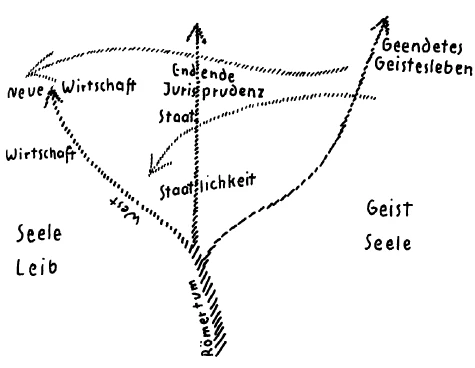
[ 8 ] First, we have the westernmost branch. I do not wish to go into detail today about the historical developments that emerged from what is known as the Middle Ages within the broader context of human evolution; but I would like to draw attention to a few points. The characteristic feature of Western development—and initially of the more southerly Western development—is, of course, that Roman civilization, so to speak, as a collective of people, initially expanded into Spain, across present-day France, and also into part of Britain. It was Romans who developed there. But all of this was interwoven with what, in the form of Germanic tribes of the most diverse kinds, penetrated precisely into these populations of Roman people during the Migration Period.
[ 9 ] And we find a peculiar phenomenon there. The phenomenon we find is that Germanic people forced their way into Roman culture, thrust themselves into it, and that something emerged there that can only be characterized by saying: A human entity of the Germanic kind had penetrated Roman culture; Roman culture as such essentially perished as a human entity; but what remained of Roman culture—that is, what, I would say, was formed through this intermingling (see illustration on p. 50) of the two lines here—what emerged there as the Spanish population, the French population, and in part also the British population—is essentially Germanic blood, overlaid by the Romance linguistic elements. In reality, what is at stake here cannot be understood any other way than by viewing it in this light. This human entity has, in terms of its soul configuration and the orientation of its sensations, feelings, and will, emerged entirely from what moved as a Germanic element in the stream of the Migration Period from the East to the West. But it is a peculiarity of this Germanic element that, when it comes into contact with a foreign linguistic element—and I would say that a culture is always embodied in language—it merges into that foreign linguistic element and adopts that language. It grows into this foreign language, I might say, as if into a garment of civilization. What lives in Western Europe as the Latin race has, in essence, no Latin blood in it. But it has grown into that which flowed up there, embodied in the language. For it lay in the nature of the Latin, the Roman element, to assert itself beyond humanity in the course of world development. That is why the will to testament first arose in Rome—the assertion of egoism beyond death. The fact that the will extends beyond death led to the conception of the will to testament. In the same way, the endurance of language extended beyond the endurance of the human element in the folk culture.
[ 10 ] And more than just the language was preserved. Thus, the ancient traditions of the various secret societies—whose significance I have told you about at length over the past few years—have been preserved for the West along this current here (see illustration on p. 50); these are indeed traditions that originate from the fourth post-Atlantean epoch, from the Greco-Latin era, though they are, admittedly, borrowings from the East — specifically from manuscripts — but which have certainly passed through Roman and Latin culture. Thus, in a certain sense, within Western humanity—insofar as it has been submerged in the Roman linguistic elements that have survived beyond the folk culture—one finds humanity clothed in the garb of a foreign civilization. One also finds humanity clothed in a foreign garment in that, within the ancient truths of the mysteries—which have already become abstract and, particularly in the ceremonies and cult practices of Western societies, have turned into more or less empty formulas—there is something in which humanity is immersed and in which it lives, as if within something that can take hold of it.
[ 11 ] If, then, other circumstances are particularly favorable, it is precisely this—I would say—greater external permeation of the human being by everything that emerges from language that provides a basis for the belief that beings such as those I described yesterday can incarnate in these human beings. But the Anglo-Saxon element is particularly conducive to this embodiment precisely because Germanic human beings also crossed over to the West, because the Germanic human being has been strongly preserved, and because, to a lesser extent than the truly Latin element, it has been permeated by the Roman element. Consequently, there is a much more unstable equilibrium within the Anglo-Saxon race, and through this unstable equilibrium, those beings who incarnate there have much greater freedom of action and much more leeway. In truly Romance countries, they would be extraordinarily constrained. Above all, however, one must be clear that what may then manifest itself in individual personalities depends on such configurations of national psychology. This freer element in Anglo-Saxon culture has made it possible that, while Puritanism certainly represents an abstract sphere of faith, this Anglo-Saxon element was supremely suited to assimilating and developing scientific thinking as a worldview and philosophy of life. Admittedly, it does not encompass the full humanity, but it does encompass precisely that part of the human being which, through the integration of languages and other elements of the human being, makes it possible for such beings—as I described yesterday—to be embodied in these people.
[ 12 ] I would like to expressly note that everything I am now discussing concerns only those individual people who are scattered among the rest of the population. It does not concern nations; it does not in any way concern the great mass of people; it concerns individual human beings who, however, hold exceptionally powerful leadership positions in the regions I have spoken of. What is primarily taken hold of in the West by such beings—who then secure a certain position of leadership for the human body in which they incarnate—is mainly the body and the soul, not the spirit, in which people are therefore less interested.
[ 13 ] Where, for example, does Charles Darwin’s truly magnificent but one-sided formulation of the theory of descent come from? It stems from the fact that, for Charles Darwin, body and soul were indeed particularly dominant, not the spirit. That is why he views human beings solely in terms of body and soul, disregarding the spirit and that which flows from the spirit into the soul. Anyone who looks impartially at the results of Darwin’s research will understand them from the perspective that there was something at work that did not wish to consider human beings in terms of their spirit. The term “spirit” was adopted only from the more recent, international scientific tradition; but what colored and nuanced the entire view of the human being was the inclination toward body and soul, to the exclusion of the spirit. I would say that the most faithful disciples of the Ecumenical Council of 869 were the people of the West. They initially disregarded the spirit, focusing on body and soul—as these are particularly evident in Darwin’s descriptions—and merely superimposed an artificial “head” as the spirit, with a materialistic way of thinking derived from natural science. And because people were, in a sense, ashamed to turn natural science into a universal religion, what remained as an external byproduct—leading an abstract existence—was that which lives on as Puritanism and the like, but which has no connection to actual world culture here. Here we see how, in a certain sense, body and soul are overwhelmed by an abstract, scientific spirit, which we can clearly observe right up to the present day.
[ 14 ] But let us suppose the opposite were to happen. What would be stronger—that which lives on in language, that which lives on in the entire world of spiritual forms of the fourth post-Atlantean epoch—what would come of that? What would emerge would be a strict, fanatical rejection of the modern spirit; and the emphasis would not be on superimposing an artificial head—derived from scientific concepts—onto the physical-soul aspect, but rather on superimposing the old traditions, even though in reality only the physical and the soul would actually be cultivated. We could imagine that some person, in an equally brutal manner, would develop everything that is merely body and soul and invent a doctrine that seeks to focus solely on body and soul—and as its external framework would not have natural science, but rather a part of a revelation carried over from an earlier time into a later one, which in turn has remained merely external: And then we have Jesuitism; then we have Ignatius of Loyola. I would say that just as minds like Darwin necessarily emerged from Anglo-Saxon culture, so too did Ignatius of Loyola emerge from late Romanism.
[ 15 ] What is peculiar about the people we are discussing here in relation to the West is that it is through them that those spiritual beings I characterized yesterday make themselves known to the world; it is through them that these beings work in the world. In the East, it is different. A different current flows toward the East (see diagram on p. 50). But first, let us consider something that emanates from ancient Rome as a second current—one that does not elevate the language itself, but does elevate the entire orientation of the soul’s constitution, that is, the direction of thought. Toward the West, it is language that prevails. This gives rise to all the phenomena I have just described. Toward the European center flows that which is more the direction of thought. But it unites with what is inherent in Germanic culture, and inherent in Germanic culture is a certain desire to become intertwined with language. But this desire to be intertwined with language can only be maintained as long as the people who live in that language remain together. When the Goths, the Vandals, and so on migrated westward, they became absorbed into the Latin element. This intertwining with language remained only in the European center. This means that in this European heartland, although the language is not particularly strongly bound to the people, it is nevertheless more strongly bound than it was among the Romans, who lost their identity as a people but relinquished the language itself. The Germanic peoples would not be able to relinquish their language. The Germanic peoples possess their language as something more alive within themselves. They would not be able to leave it behind as an heirloom. This language can only be preserved as long as it remains connected to the people. This is linked to the entire nature of the human constitution of these peoples, who gradually asserted themselves in the heart of Europe. This means that in this heart of Europe, people asserted themselves who were not particularly suited to offering strong possibilities for the embodiment of such beings, as was the case in the West. Yet they, too, could be moved. Among these people of central Europe, it was entirely possible for beings of the threefold kind—as I described them yesterday—to assert themselves in the figures of their leaders. But this always has the effect that, on the other hand, a certain receptivity is also present in these people for those phenomena that present themselves to the people of the East as imagination. Yet these imaginations remain so faint in the people of the Middle during waking hours that they appear merely as concepts, as ideas. In the same way, what originates from those beings who incarnate through human beings and play such a significant role in the lives of individual people in the West takes effect. As a result, these beings cannot produce such an effect, but they can nevertheless give the whole human being a certain direction. It is particularly true of the people of this middle path that, over the centuries, it has hardly been possible for those who attained any significance to escape embodiment by the spirits of the West on the one hand and the spirits of the East on the other. This has always resulted in a kind of ambivalence in these people.
[ 16 ] One could say, if one were to describe them according to their true reality: When these people were awake, there was something within them from the attacks of the spirits of the West that influenced their drives, their instinctual life, that lived within their will, and that paralyzed their will. When these people slept, when the astral body and the “I” were separated, spirits such as those that often unconsciously influenced the people of the East as apparitions in the imagination would exert their influence upon them. And one need only take a truly characteristic figure from the civilization of the West, and one will, I might say, be able to grasp with one’s own hands that it is just as I have described. One need only take Goethe. Take everything in Goethe that was shaped by the influences of the spirits of the West—what asserted itself in his will, what particularly stirred the young Goethe, what one can sense when reading the scenes from *Faust* or *The Eternal Jew* that were stirred up in his youth; and then you will see how serene Goethe was on the other hand—because the element of the Orient within him, which tended toward the spiritual-soulful, had been subdued and permeated by this element of will—and how, in his old age, he turned more toward imaginings in the second part of his *Faust*. But a gap does exist. Above all, the transition from the style of the first part of *Faust* to that of the second part does not come across quite right.
[ 17 ] And consider Goethe himself, a living figure who grew out of the impulses of the West, who—I might say—was tormented by the spirits of the West, and who, as a young man, found solace in what, after all, also contained much that was Western: Gothic art—but with it emerges a yearning for the spirits of the past, for those spirits that were active in Greek culture and especially in Gothic art, yet were, in essence, the descendants of those spirits that once inspired the peoples of the East as they attained their great primordial wisdom. And so, as we enter the 1880s, we see how he can no longer bear the spirits of the West, how they torment him. He seeks to counterbalance this by turning southward to absorb what might come from the other side. This is precisely what gives the people of the Middle—especially in their outstanding leaders, whom the others naturally follow—their characteristic stamp. As a result, the people of the Middle were particularly well-prepared to assert that one thing which is important in the entire development of humanity. This can best be observed in a thinker such as Hegel. If you take Hegel’s philosophy—I have mentioned this here many times before—you will find this philosophy developed everywhere up to the level of the spirit. But nowhere in Hegel will you find anything that transcends physical-sensory life. Instead of an actual doctrine of the spirit, you find a logical dialectic as the first part of his philosophy; you find natural philosophy merely as a sum of abstractions of what lives as the very essence within the human being; what is to be grasped through psychology is presented in the third part of Hegel’s philosophy. But nothing else emerges other than what human beings experience between birth and death, which then coalesces in history. There is, after all, no mention anywhere in Hegel of the eternal entering into human beings in a pre-birth or post-death existence; nor can such a claim be made at all.
[ 18 ] One thing that the people of the middle realm—the most outstanding among them—assert is that within the human being, as he lives here between birth and death, there exist body, soul, and spirit. For the human being of the sensory world—for our physical world—the spirit and the soul are to be revealed through these people of the middle realm.
[ 19 ] As soon as we turn to the East, we find that—just as we must say in the West that the body and soul live in equal measure—in the East, the soul and spirit live in equal measure. Hence, the ascent to the imaginations is natural, and even if these imaginations do not enter consciousness, they still influence it. The entire structure of thought in Eastern people is such that it tends toward imaginations, even if these imaginations are sometimes, as in the case of Soloviev, expressed in abstract concepts.
[ 20 ] And a third branch extends from the Roman Empire northward, through Byzantium, and into the East (see illustration on p. 50). In a sense, what was chaotically intertwined within the Roman Empire splits into three branches. It spreads apart, reaching the West, where a new economic element asserts itself—one that was particularly suited to the modern era and that connects with the natural sciences. It reaches the East and, emerging from ancient primordial wisdom, enters a phase of decadence; there, what is spiritual in religious form develops. All of this, of course, proceeds in parallel. Developing toward the center is that which is political-military and state-legal, which naturally spreads out in various directions; but we must focus on the characteristic branches. The further east we go, the more we see how these people of the East are not as deeply intertwined with their language as the Germanic peoples are. The Germanic peoples live within their language as long as they have it. Study, for once, this remarkable trajectory of the Germanic peoples of Central Europe. Study these branches of the Germanic population that have moved, for example, across into Hungary to the Spiš region, down into the Banat as Swabians, and to Transylvania as the Transylvanian Saxons. Everywhere, I would say, there is something of a fading of the purely linguistic element. These people are absorbed everywhere into the language into which they immerse themselves. And one of the most fascinating ethnographic studies would be to observe how, around Vienna, in a relatively short time—over the course of the last two-thirds of the 19th century—German identity has receded and been overwhelmed. One could almost touch it with one’s hands if one were to examine this matter carefully. One could see how the Germanic element developed—artificially within Magyar culture, but naturally, and especially, within Slavic culture. In the East, however, people are completely intertwined with their language. That is where the spiritual and soulful aspects live—they live in the language. This is something that is often not taken into account at all. People in the West, after all, live in their language in a completely different way—in a radically different way—than people in the East. People in the West live in their language as if in a garment; people in the East live in their language as if within themselves. That is why people in the West were able to adopt the scientific worldview and pour it into their language, which is, after all, merely a vessel. In the East, the Western scientific worldview will never gain a foothold, for it cannot possibly become immersed in the languages of the East. The languages of the East reject it; they do not absorb the scientific worldview at all.
[ 21 ] You can already sense this when you let Rabindranath Tagore’s—albeit still somewhat coquettish—reflections sink in; even though Rabindranath Tagore’s work is interwoven with coquetry, one can still see how his entire self-expression consists in experiencing a clash with the Western worldview, but immediately—through his life in language—rejecting this Western worldview.
[ 22 ] Humanity in the Middle was thrown into this whole. It had to take in everything it experienced in the West. It did not absorb it as deeply as the West did; instead, it infused it with what the East also possessed. Hence the more precarious balance in the Middle, but also the inner conflict, the duality in the individualization of the souls of the people of the Middle—this striving to find harmony and balance within that duality, as it is so classically and magnificently portrayed in Schiller’s Letters on Aesthetic Education, where two impulses—the impulse of nature and the impulse of reason—which are to be united, clearly point to this duality. But one can point to something even deeper.
[ 23 ] You see, when one looks toward the West, one finds that there is, for the most part, a certain inclination among the people as a whole to embrace the scientific way of thinking, which is so exceptionally well-suited to economic life. I have shown you how the scientific way of thinking has permeated psychology, even the study of the soul. There, people embrace it—they embrace this scientific perspective completely. And Puritanism existed there precisely as an abstract influence—as something that has nothing to do with actual external life, something that is, in a sense, locked away in the inner sanctum of the soul, something that is not allowed to be touched by external culture.
[ 24 ] What is developing in the West is such that one can say: There is a tendency to embrace everything that is accessible to human reason, insofar as it is bound to body and soul. The other, Puritanism, is, after all, merely a Sunday best for what is bodily, what is accessible to reason. Hence deism, this squeezed-dry lemon of a religious worldview, where nothing remains of God but a fairy tale of a general, entirely abstract cause of the world; reason, as it is bound to body and soul, asserts itself there.
[ 25 ] If you go east, there is absolutely no understanding of such rationality. It starts as early as Russia. Do Russians even have any understanding of what we in the West call rationality? Let us not delude ourselves; Russians have not the slightest understanding of what we in the West call rationality. Russians are receptive to what one might call revelation. Essentially, they absorb into the very core of their being everything that they owe to a kind of revelation. Reason—even if he repeats the word after Westerners—he understands nothing of it; that is to say, he does not feel what Westerners feel when they speak of it. But what can be empathized with—when one speaks of revelation, of truths descending from the supersensible world into human beings—that he understands well. But what is spoken of in the West—and Puritanism is precisely proof of this—is such that one sees: In the West, of course, there is not the slightest understanding of what one must actually address as the relationship of the Russian person, and even more so of the Oriental, the Asian person—what one must address as the relationship of the human being to the spiritual world. There is not the slightest understanding of this in the West. For this is something entirely different from what is conveyed through reason; it is something that, emanating from the spiritual, seizes the human being and permeates them with life.
[ 26 ] And as for the people of Central Europe, well, here’s the situation: As the fifth post-Atlantic period was already drawing near—in the 10th, 11th, 12th centuries—it ultimately arrived in the middle of the 15th century—the most outstanding minds of Central Europe were faced with a tremendous question, a question posed to them as people standing between the West and the East, with the West urging them toward reason and the East urging them toward revelation. And let one study, from this perspective, the High Scholasticism—the golden age of medieval intellectual development—and let one study, from this perspective, such thinkers as Albertus Magnus, Thomas Aquinas, Duns Scotus, and so on; compare them with figures such as Roger Bacon—I mean the elder, who was more Western-oriented—and one will see: A great question arose among the thinkers of Central European High Scholasticism from the interplay of what pressed from the West as reason and from the East as revelation. Their dilemma stemmed, on the one hand, from the forces that sought to take hold of the human body and soul through the will, and, on the other hand, from the forces that sought to take hold of the spirit and soul in the East through the imagination. This gave rise to the scholastic doctrine that both are valid: reason on the one hand, revelation on the other—reason for all that can be attained on earth through the senses, and revelation for the supersensory truths that can be drawn only from the Bible and the tradition of Christianity. One truly understands medieval Christian scholasticism when one regards its most outstanding minds as those in whom rationality from the West and revelation from the East converged. Both influences were at work within these individuals, and in the Middle Ages, the only way to reconcile them was by, in a sense, experiencing this conflict within oneself.
[ 27 ] At that spot in our little dome, over there in the small domed room, where the Germanic element was to be depicted with its dualism, you can therefore also see this duality clashing in the brownish-blackish and the reddish-yellowish hues: the reddish-yellowish of revelation, the blackish-brownish of reason; just as what has come to humanity through the various cultures of humankind has had an inspiring effect there in general; only there it is perceived in colors and in the manifestations of colors.
[ 28 ] One might say, then, that what we now have throughout the civilized world—and in the West, in particular—is dominated by that element which has only emerged in modern times: economic life; for in no earlier era was economic life itself such a pressing issue as it has become today. It is, in fact, a product of its time. In contrast, what pertains to the state and politics is already in the process of fading away. And what was established in the last third of the 19th century as the German Empire simply absorbed this fading element of ancient Roman culture and perished as a result. This was true even as it was being built up, but especially as it subsequently took shape. Essentially, within this German Empire there was only a continuation of the legal-state, political element—the organizing force, which certainly possessed great organizational genius—but the economy sought to incorporate this without possessing the necessary economic thinking. For everything the economy pursued within this territory sought more and more to creep under the umbrella of the state system. Militarism, for example—which essentially originated in France or Switzerland, though it took on other forms—was, one might say, nationalized in Central Europe. As a result, this Central Europe was unable to foster either economic life or a spiritual life that was truly self-sustaining and springing from its own roots. The anti-spiritual movement that has been organized in recent times, particularly in Central Europe, is indeed the most dreadful thing of all! We see everything that constitutes spiritual life growing more and more into the form of the political state. And so it came to pass that, in the second decade of the 20th century, there was no one left in Central Europe who wrote about history or similar subjects other than as a political party member. Everything that emanated from the universities is not objective history; it is partisan wisdom, thoroughly politically colored. And even more so in its decadence is the spiritual life that originated in the Orient in ancient times. It became engulfed by a deluge from the West and from the center, in the policies of Peter the Great, which were still imbued with a primal spiritual essence—but which is now itself in a state of decadence, finding expression in Pan-Slavism and Slavophilism. And this ultimately led to the creation of today’s conditions, from which a new spirit seeks to emerge, for the old one is, after all, entirely steeped in decadence.
[ 29 ] Thus, we see the new economy, the declining legal system and statehood, and the demise of intellectual life spreading across the world.
[ 30 ] In the West, we see the state element completely absorbed by the economy, and the spiritual realm is present only in the form of natural science—if one disregards that false Puritanism. In the middle, we had a state that was already aging, one that sought to absorb both the economy and spiritual life and therefore could not survive. And in the East, we have nothing but the dying spirit of the old era, which is to be revitalized through all manner of measures from the West; whether it is Peter the Great or Lenin, whatever comes from the West revitalizes the corpse of the Eastern spirit. Salvation lies in clearly recognizing that a new spirit must permeate humanity.
[ 31 ] This new spirit, which cannot be found in the East but must be found in the West itself, must clearly distinguish between economic life, political-state life, and spiritual life. Then political and spiritual life can join the economic life of the West—for which the West is particularly suited due to its natural characteristics. Then the middle ground can, alongside political life—which, when oriented toward anthroposophy, is improved upon the basis of principles entirely different from those that existed before—truly incorporate economic and spiritual life. And then the East, in turn, can be enriched. The spiritual life that flourishes in the West will be understood by the East, if only it is presented to them in the right way. As soon as artificial boundaries are no longer created—boundaries that prevent the genuine anthroposophically oriented spiritual life of the West from crossing over—and as soon as that life is allowed to flow into the East, it will be understood, even if it initially makes its way through such charming spirits as Rabindranath Tagore or others. The point is that natural science as such is rejected by the East. But that natural science which is illuminated by true spirituality—as we have sought to present it in our University Courses here—will be embraced with great enthusiasm by the East as well. Then the East will have a great deal of understanding for an independent spiritual life. And it will also embrace an independent political and governmental life; it will be able to embrace economic life and conduct it independently. Thus, within this threefold social order, what emerges from a rational and at the same time spiritual perspective as the development of the European and Asian worlds since the decline of the Roman Empire will truly be fulfilled.