

The New Spirituality and the
Christ Experience of the Twentieth Century
GA 200
24 October 1920, Dornach
Translated by Steiner Online Library
Fourth Lecture
[ 1 ] As early as 1891, I drew attention to the connection between Schiller’s *Aesthetic Letters* and Goethe’s *Fairy Tale of the Green Snake and the Beautiful Lily*. Today I would like to point out that there is a certain connection between what I described yesterday as the defining characteristics of Mediterranean civilization—in contrast to Western and Eastern civilizations—and what appears in a very distinctive way in the works of Schiller and Goethe. One can observe this entire striving—as I characterized it yesterday: on the one hand, the human physicality being moved by the spirits of the West, and on the other hand, the perception of those spiritual entities that, as imaginations, as spirits of the East, have an inspiring effect on Eastern civilization—one can observe both of these precisely in these leading figures, Schiller and Goethe. I would just like to point out how Schiller’s *Aesthetic Letters* seek to characterize a state of mind in which a certain middle ground is found between, on the one hand, the state of being devoted to instincts and to the sensual-physical, and, on the other hand, the state of being devoted to the world of logical reason. Schiller believes that in both cases, a person cannot attain freedom. Not when they are wholly devoted to the sensory world, the world of instincts and drives; there they are unfreely subject to their physical nature. But they are also not free when they are wholly devoted to rational necessity, to logical necessity, for then the laws of logic compel them under their tyranny. But Schiller wishes to point to a middle state, where human beings have spiritualized their instincts to such an extent that they can surrender to them without being dragged down or enslaved by them, and where, on the other hand, logical necessity is incorporated into sensory perception and into personal drives, so that this logical necessity, too, does not enslave human beings.
[ 2 ] Schiller, however, finds in the state of aesthetic enjoyment and aesthetic creation that middle ground in which human beings can attain true freedom.
[ 3 ] It is of great importance that Schiller’s entire treatise arose from the same European spirit that gave rise to the French Revolution. The very same forces that erupted tumultuously in the West as a great political movement focused on external upheavals stirred Schiller—and they stirred him so deeply that he sought to answer the question: What must a person do within themselves to become a truly free being? — In the West, the question was posed: What must external social conditions become so that human beings can become free within them? — Schiller asks: How must human beings transform themselves internally so that they can embody freedom in the state of their souls? — And Schiller envisions that if people are educated to attain such a balanced state of mind, they will also form a social community in which freedom reigns; thus, Schiller also seeks to realize a social community in such a way that free conditions are created by the people themselves, not through external measures.
[ 4 ] Schiller arrived at this version of his “Aesthetic Letters” through his study of Kant. He was, after all, an artistic soul to a high degree, but he was strongly influenced by Kant precisely at the end of the 1780s and the beginning of the 1790s and attempted to answer such questions in the Kantian spirit. The writing of the “Aesthetic Letters” coincides precisely with the time when Goethe and Schiller jointly founded the journal “Die Horen,” and Schiller submitted the “Aesthetic Letters” to Goethe.
[ 5 ] Now, of course, we know that Goethe’s state of mind was quite different from Schiller’s. It was precisely because of this difference in their states of mind that the two grew so close. Each was able to give the other what the other lacked. So Goethe received Schiller’s “Aesthetic Letters,” in which Schiller sought to answer the question: How does a person attain, internally, a state of inner freedom of the soul and, externally, socially free conditions? Goethe could not make much of Schiller’s philosophical treatise. This style of conceptual analysis and development of ideas was by no means foreign to Goethe, for anyone who, like me, has seen how Kant’s *Critique of Pure Reason* in Goethe’s own copy is marked with underlines and marginal notes knows how Goethe truly studied this work of Kant’s—which is abstract in a completely different sense. And just as he could certainly have accepted such works as they were, he could naturally have accepted Schiller’s *Aesthetic Letters* as a work for study as well. But that was not the point at all; rather, for Goethe, this entire construct of human nature—on the one hand, the drive of reason with its logical necessity; on the other, the drive of the senses with its sensual needs, as Schiller put it; and the third, middle state—was, for Goethe, something far too straightforward, too simple. He felt: One cannot conceive of human beings as simply as that, nor can one depict human development so simply; and that is why he wrote to Schiller that he did not wish to treat the entire problem, the entire enigma, in such a philosophically rational form, but rather figuratively. Figuratively, then, Goethe also addressed this very same problem—in a sense as a response to the “Aesthetic Letters” , in his fairy tale of the green snake and the beautiful lily, by presenting in the two realms—on this side and beyond the river—in a figurative, multifaceted, and concrete way the very same things that Schiller had set forth on the other side as sensuality and rationality. And what Schiller characterizes merely in the abstract as the middle state—Goethe then sought to address this in a figurative manner through the construction of the temple, in which reign the King of Wisdom, the Golden King, the King of Appearance, the Silver King, the King of Violence, the Iron King, and the Copper King, and in which the mixed king disintegrates. And we have, in a sense, a hint—but still in Goethe’s characteristic manner—at the fact that the external structure of human society must not be a unity, but must be a trinity, if humanity is to flourish within it.
[ 6 ] Goethe already provides a picture of what would later emerge as the threefold social order; of course, the threefold social order does not yet exist, but Goethe portrays the form he intends for the social organism in these three kings—the golden, the silver, and the bronze kings—and he depicts what is in a state of decay in the mixed king.
[ 7 ] You can't present things like that anymore today. I demonstrated this in my first *Mystery Play*, which essentially deals with the same theme, but in the way it had to be treated at the beginning of the 20th century, whereas Goethe wrote his fairy tale at the end of the 18th century.
[ 8 ] Now, however, one can already hint at this in a certain way—even if Goethe himself did not yet do so—as to how the Golden King would correspond to that social member which we designate as the spiritual member of the social organism; how the king of appearances, the silver king, would correspond to the political state; how the king of violence, the copper king, would correspond to the economic element of the social organism; and how the mixed king, who is torn apart within himself, represents the unitary state, which cannot, by its very nature, endure.
[ 9 ] This is, in a sense, Goethe’s figurative allusion to what would eventually emerge as the threefold structure of the social organism. So, in a sense, Goethe said, when he received Schiller’s “Aesthetic Letters”: “You can’t do it that way; you, my dear friend, imagine human beings to be far too simple.” You imagine three forces. That is not how it is with human beings. If one wants to take and examine the whole richly structured inner life of the human being, one finds roughly twenty forces—which Goethe then depicted figuratively in his twenty fairy-tale characters—and one must then portray the interplay and interaction of these roughly twenty forces in a much less abstract way.
[ 10 ] Thus, at the end of the 18th century, we have two depictions of one and the same thing: one by Schiller—one might say, born of reason—but not in the way people usually create something from reason, rather in such a way that reason is permeated by feeling and soul, by the whole human being. The difference, however, lies in whether some stiff, run-of-the-mill professional philistine presents a psychological portrayal of something concerning human beings—where only the head thinks about the matter—or whether Schiller, drawing from the experience of the whole human being, constructs the ideal of a human state of mind and, in a sense, merely transforms what he feels into concepts of reason.
[ 11 ] One could not proceed any further along the path of logical reasoning and rational analysis that Schiller took without becoming philistine and abstract. Schiller’s full feeling and sensibility are still present in every line of these “Aesthetic Letters.” It is not the stiff Königsberg-style of Immanuel Kant with his dry concepts; it is profundity in intellectual form, shaped into ideas. But if one were to take it a step further, one would enter precisely into the rational machinery that is realized in today’s conventional science, where, fundamentally speaking, behind what is rationally elaborated, the human being no longer matters; where it is irrelevant whether Professor A, D, or X elaborates the matter, because things are simply presented without being drawn from the whole human being. With Schiller, everything is still profoundly personal, yet elevated to the level of the intellect. Schiller lives in a phase—indeed, at a pivotal point in the development of modern humanity—that is important and essential, because Schiller pauses precisely before the point into which humanity later fell completely.
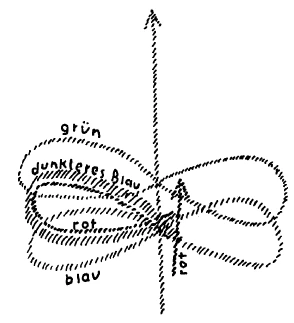
[ 12 ] Let’s try to illustrate what this might mean. One could say: This is, in general, the trend of human development (upward arrow). However, this development of humanity does not proceed in this way—this is merely a schematic, graphical representation—but rather it proceeds such that the development (blue) winds its way in a lemniscate; yet it cannot proceed in this manner, for if the development takes this course, there must continually be new impulses that, in the sense of this line, lift the lemniscate upward. Schiller, having reached this point here (see drawing), would, so to speak, have entered into a darker blue of mere abstraction, of the purely intellectual, had he continued to make independent that which he felt inwardly. He paused, and just in time he halted his intellectual shaping at the point where one does not lose one’s personality, but still retains it within the intellectual form. Therefore, it did not turn blue, but was rendered green on a higher level of personality, which I will highlight here (see drawing) in red. So that one can say: Schiller held back precisely in the realm of the intellectual, just before the point where the intellectual, in its purity, seeks to break through. Otherwise, he would have fallen into the conventional intellect of the 19th century. Goethe expressed the same thing in images—in wonderful images—in the “Fairy Tale of the Green Snake and the Beautiful Lily”; but he, too, stopped at these images; he could not bear it at all when people found fault with them in any way, for to him, what he felt about the individual human nature and about social life was precisely expressed in such images. But he was not allowed to go any further than these images. For if he had attempted to go further from his standpoint, he would have strayed into the realm of the fanciful and the fantastical. The subject would have lost its contours; it would no longer have been applicable to life; it would have transcended life, rising above it. It would have become fanciful fantasy. One might say: Goethe was compelled to avoid the other pitfall, where he would have strayed entirely into the realm of the fantastical red. That is why he incorporated the impersonal—that which kept the images within the realm of the imaginative—and thereby also arrived at the green.
[ 13 ] Schiller, so to speak—if I may put it in simplified terms—avoided blue, which represents the Ahrimanic, intellectual aspect; Goethe avoided red, which represents the impassioned, and stuck to concrete, imaginative imagery.
[ 14 ] As a man of the Mediterranean, Schiller grappled with the intellectual currents of the West. They sought to lead him toward a purely rational approach. Kant falls short in this regard. I illustrated this recently when I pointed out here how Kant, through David Hume, falls short of the rationalism of the West. Schiller forged his own path, even though he was trained by Kant. He remained true to that which is not merely rational.
[ 15 ] Goethe had to struggle with the other spirits—the spirits of the East—that drove him toward the realm of the imagination. In his time, because spiritual science did not yet exist, he could not go beyond the fabric of the imagination found in the “Fairy Tale of the Green Snake and the Beautiful Lily.” But even there, he remained within the firm contours. He did not ascend into the realm of the fantastic or the fanciful. He enriched himself by traveling south, where much of the heritage of the East was still preserved. He came to understand how the spirits of the Orient were still at work there in the lingering bloom of Oriental culture—the Greek arts, as he conceived them from Italian works of art. So one can say: There is something peculiar about this bond of friendship between Schiller and Goethe. Schiller has to contend with the spirits of the West; he does not surrender to them, he holds back, he does not succumb to mere reason. Goethe has to contend with the spirits of the East; they want to drive him into enthusiasm. He holds back; he sticks to the images he presented in “The Fairy Tale of the Green Snake and the Beautiful Lily.” Goethe would either have had to succumb to enthusiasm or accept the Eastern revelation. Schiller would either have had to become entirely rational, or he would have had to take seriously what he had become; as is well known, he was appointed a “French citizen” by the revolutionary government, but he did not take the matter very seriously.
[ 16 ] Here we see how, at a crucial juncture in European development, these two states of mind—which I have described to you—coexist side by side. They are, of course, also present—one might say—in every single significant Central European individual, but in Schiller and Goethe they coexist simultaneously in a certain way. While Schiller and Goethe, so to speak, remained at that point, it was not until the advent of spiritual science that this lemniscate curve (see drawing) was raised, so that it then appears at a higher level.
[ 17 ] And so we see, in a peculiar way, in Schiller’s three states—the state of rational necessity, that of instinctive necessity, and that of free aesthetic mood— and in Goethe’s three kings—the golden, the silver, and the bronze—a foreshadowing of everything we find through spiritual science regarding both the threefold nature of the human being and the threefold structure of the social community, as the next necessary goals and enigmatic questions for the individual and for human coexistence.
[ 18 ] These things surely indicate to us that this threefold structure of the social organism did not come to the surface by mere whim, but that the greatest minds of recent human development have already been striving to bring it about. But if there were nothing else but a way of thinking about social matters such as that found in Goethe’s “Fairy Tale of the Green Snake and the Beautiful Lily,” one would not be able to achieve the impact of outward action. Goethe was at the point of overcoming mere revelation. After all, he did not become a Catholic even in Rome. He simply rose to the level of his own imaginings. But he still remained at the level of the mere image. And Schiller did not become a revolutionary, but rather an educator of the inner human being. He remained at the point where personality is still present within the formation of the intellect.
[ 19 ] Thus, in a later phase of Central European culture, something came to bear that had already been evident since ancient times—and is still most clearly visible to modern people in Greek culture. Goethe, too, was inspired by Greek culture. In Greek culture, one can observe how the social is depicted in myth—and thus also in imagery. But fundamentally, Greek myth is as much an image as Goethe’s “Fairy Tale of the Green Snake and the Beautiful Lily” is an image. One cannot use these images to bring about reform within the social organism. One can, so to speak, only speak as an idealist about what ought to take shape. But these images are too fragile a structure to allow for truly effective intervention in the shaping of the social organism. That is why the Greeks did not believe that by remaining within the realm of mythical imagery, they were also addressing social reality. And if one follows this line of inquiry, one arrives at an important point in Greek development.
[ 20 ] One might say: In everyday life, where things unfold out of habit, the Greeks relied on their mythical gods and spirits. But when it came to making major decisions, the Greeks would say to themselves: “Yes, in such cases, it is not enough to rely on those gods who influence the imagination—the very gods of myth; something real must come to light.” And so the oracle came to light. There, the gods were not merely imagined; they were called upon to truly inspire humanity. And the Greeks turned to the oracles’ pronouncements whenever they sought social impetus. Thus they rose from imagination to inspiration—but to an inspiration for which they summoned external nature. We modern people must, of course, also strive to rise to inspiration—but to an inspiration that does not summon external nature through the oracles, but rather ascends to the spirit in order to be inspired within the sphere of the spiritual. But just as the Greeks turned to the real world when it came to social matters—just as they did not remain at the level of imagination but rose to inspiration—so too can we not remain at the level of mere imagination but must rise to inspiration if we wish to find anything for the social good in the modern era.
[ 21 ] And here we come to another point that is important to note. Why, in fact, did Schiller and Goethe come to a standstill—one on the path toward the intellectual, the other on the path toward the imaginative? Neither of them had a background in spiritual science; otherwise, Schiller could have progressed to a deeper understanding of his concepts through spiritual science, and he would then have found something much more real in his three states of the soul than the three abstractions he presents in the “Aesthetic Letters.” Goethe would have filled the imagination with what truly speaks from the spiritual world, and he could have advanced to the forms of social life that are meant to be brought about from the spiritual world—the spiritual member of the social organism, the golden king; the state member of the social organism, the silver king, the king of appearances; the economic member, the bronze and copper kings.
[ 22 ] The era in which Schiller and Goethe arrived at these insights—one in the “Aesthetic Letters,” the other in “The Fairy Tale”—was not yet ripe for further progress; for in order to make further progress, one must grasp something quite specific. One must realize what would actually become of the world if one were to continue down Schiller’s path to the full realization of the impersonal and rational. The nineteenth century first developed this impersonal, rational element in the natural sciences, and the second half of the nineteenth century began to seek to realize it in external public affairs. Yet there lies a significant mystery here. In the human organism, whatever is taken in is also continually led toward destruction. We cannot simply eat continuously; we must also excrete. What we take in as matter must also face decay; it must be destroyed and expelled from the organism. And the intellectual is that which—and here comes a complication—as soon as it takes hold of economic life in the unitary state, under the mixed monarch, destroys that economic life.
[ 23 ] But we now live in an age in which the intellect must develop. We cannot reach the development of the conscious soul in the fifth post-Atlantean epoch without developing the intellect. And the Western peoples have precisely the task of bringing the intellect into economic life. What does that mean? Because we must shape modern economic life rationally, we cannot shape it imaginatively, as Goethe did in his “fairy tale.” Because we must continue along the path in the economic sphere that Schiller only pursued as far as the still-personal expression of the intellectual, we must establish an economic life that, precisely because it must be rational, will necessarily have a destructive effect in the fifth post-Atlantean epoch. In the present era, there is no economic life that could be conducted imaginatively, as was the case with the economic life of the Orient or even the economic practices of the European Middle Ages; rather, since the middle of the 15th century, we have had only the possibility of an economic life that, whether it existed on its own or was intertwined with the other members of the social organism, has a destructive effect. There is no other way. Therefore, we regard this economic life as one side of the scale that would sink deeply and thereby inevitably have a destructive effect; there must be a balance. Therefore, we must have an economic life as one limb of the social organism, and a spiritual life that now maintains this balance and continually rebuilds it. If one clings to the unitary state today, then economic life—as is the case in the West—will absorb this unitary state along with spiritual life; but such unitary states must necessarily lead to destruction. And if one establishes a state based solely on reason, as Lenin and Trotsky did, it must lead to destruction, because reason is directed solely toward economic life.
[ 24 ] Schiller sensed this as he reflected on his social condition. Schiller felt: If I continue to develop my intellectual abilities and enter economic life, I must apply my intellect to economic life. Then I would no longer be describing that which grows and flourishes; I would be describing that which thrives on destruction. — Schiller recoiled from destruction. He stopped precisely at the point where destruction would begin; there he stood still. Modern thinkers devise all manner of social and economic systems, yet they do not realize—because their sense of the matter is too crude—that every economic system they conceive in this way leads to destruction, inevitably leads to destruction, unless it is continually renewed by the independent, evolving spiritual life, which time and again relates to destruction and the elimination of economic life in the same way as it does to the constructive. In this sense, the interaction between the spiritual element of the social organism and the economic element is also described in my “Key Points.”
[ 25 ] If, under the modern understanding of the fifth post-Atlantic epoch, capital were to remain in the hands of the people—even if they could no longer manage it themselves—then economic life itself would bring about the circulation of capital; destruction would inevitably follow. This is where spiritual life must intervene; through spiritual life, capital must be channeled to those who are once again involved in its management. This is the inner meaning of the threefold social order: that even in a properly conceived threefold social order, one does not succumb to the illusion that economic thinking in the modern era is a destructive element, and that therefore the constructive element of the spiritual component of the social organism must continually be set in opposition to it.
[ 26 ] With each new generation—with the children we teach in school—something is given to us from the spiritual world, something sent down to us; we capture this in our educational work; it is something spiritual, which we in turn incorporate into economic life and thereby prevent its destruction; for economic life, left to its own devices, destroys itself. So one must look into the workings of the system. One must see how, at the end of the 18th century, Goethe and Schiller stood there, with Schiller saying to himself: “I must hold back; I must not depict a social condition that appeals merely to personal reason; I must remain within the personal realm with my reason, otherwise I would be depicting economic ruin”—and Goethe: “I do not want the dreamy images; I want the sharply defined ones; for if I were to go a step further, I would enter a state that is not of this earth, that does not intervene powerfully in life itself; I would leave economic life behind me like something lifeless and establish a spiritual life that cannot intervene in the facts of immediate life.”
[ 27 ] Thus we see that we are living in true Goetheanism when we do not stop at any one point in Goethe’s work, but instead participate in the development that Goethe himself undoubtedly underwent beginning in 1832. I have also touched on this—that economic life today is constantly working toward its own destruction and must constantly be counteracted, just as the destruction of the human being through eating must be counteracted—I have also alluded to this at a specific point in my *Key Points of the Social Question*. But people don’t read these things properly; instead, they assume this book is written the way most books are written today—that is, in a way that allows one to, well, simply skim through it. In a book like this, written from a practical perspective, every single sentence demands careful consideration.
[ 28 ] But if one considers these two things: Schiller’s “Aesthetic Letters” have been little understood in subsequent times—I have spoken of this often—and they have received little attention; otherwise, the study of Schiller’s “Aesthetic Letters” would be a good path toward what you will find in my work “How Does One Attain Knowledge of the Higher Worlds?”; Schiller’s “Aesthetic Letters” could serve as preparation for this. And in turn, Goethe’s “Fairy Tale of the Green Snake and the Beautiful Lily” could serve as preparation for acquiring that kind of spiritual configuration which can arise not from mere intellect but from deeper forces, and which could then truly understand something like the “Key Points of the Social Question.” For both Schiller and Goethe sensed the tragedy of Central European civilization. Certainly, they were not consciously aware of these things, but they sensed them. Both felt—as can be read throughout Goethe’s conversations with Eckermann, with Chancellor von Müller, and in Goethe’s numerous other allusions—that: Unless something emerges—such as a new spiritual impetus, a new understanding of Christianity—then things must go downhill. —Much of the resignation Goethe exemplified in his later decades is undoubtedly rooted in this sentiment.
[ 29 ] And those who have become Goetheans without the study of the spiritual sciences sense how this peculiar interplay between the spirits of the West and the spirits of the East is particularly evident in the German, Central European character. I said yesterday: Within Central European civilization, the balance that High Scholasticism sought between rational science and revelation can also be traced back to the influences of the spirits of the West and the spirits of the East. We have seen today how this manifests itself in Schiller and Goethe. But fundamentally, the entire Central European civilization is caught up in this whirlwind in which East and West swirl together; from the East comes the realm of the Golden King, from the West the realm of the Copper King; from the East comes wisdom, from the West power; and in the middle lies what Goethe portrays in the Silver King—the illusion that is difficult to penetrate with reality. The illusory nature of Central European civilization lay as a tragic mood in the depths of Goethe’s soul. And Herman Grimm, drawing beautifully from his own perception of Goethe—for he viewed Goethe as a person who was, after all, untouched by spiritual science— he characterized, as such a spirit, how this Central European civilization is driven into the maelstrom of the spirits of the East and the spirits of the West, which prevents the will from asserting itself and has led to the eternally fluctuating mood of German history. Herman Grimm speaks beautifully precisely about these things: “For Treitschke, German history is the ceaseless striving for spiritual and political unity, and on the path toward it, the ceaseless interference of our very own innate characteristics.” So says Herman Grimm, who considers himself a German. He goes on to say: “Always the same tendency of our nature to resist where one should yield, and to yield where resistance was necessary. The remarkable forgetting of what has just passed, the sudden loss of desire for what was just fiercely sought after, the disregard for the present, yet the firm, though indefinite, hope. Added to this is the tendency to surrender to the foreign and, once this happened, the simultaneous yet unconscious, decisive influence on the foreigners to whom one nevertheless submitted.”
[ 30 ] When one deals with Central European civilization today and wishes to achieve something through it, one is confronted everywhere by this tragedy, which reveals the entire history of this German, Central European identity, caught between the West and the East. Even today, it is still the case everywhere that one could say, with Herman Grimm: “The urge to resist where one should yield, and to yield where resistance is necessary.”
[ 31 ] This is what stems from the fluctuating Middle—that which stands in the midst of the economy and the constructive spiritual life as the rhythmic back-and-forth oscillation of the state. Because it is precisely in these central regions that the state-political element has celebrated its triumphs, this is why the appearance—which can easily become an illusion—persists. Schiller does not wish to abandon this appearance by writing his “Aesthetic Letters.” He knows that when it comes to mere intellect, one enters into the destruction of economic life; in the 18th century, the part that could be destroyed by the French Revolution was destroyed; in the 19th century, it would become much worse. Goethe knew he must not go so far as to become a dreamer; he must remain within the imaginative realm. But in this oscillation between the one and the other—in this duality that unfolds in the swirling back-and-forth movement of the spirits of the West and the East—an illusory mood arises very easily. It makes no difference whether this illusory mood manifests itself in religion, politics, or the military; ultimately, it is entirely irrelevant whether the dreamer raves about some form of mysticism or whether he raves as Ludendorff did, without standing on the ground of reality. And finally, this can also present itself in a charming way. For the same passage by Herman Grimm that I read to you continues: “Just look at today: No one seemed so completely detached from the fatherland as the German who had become an American, and today American life, in which the lives of our emigrants were absorbed, stands under the influence of the German spirit.”
[ 32 ] This is what Herman Grimm, that brilliant man, wrote in 1895—a time when one could truly only believe, out of the worst kind of delusion, that the Germans who had come to America would infuse American life with German nuances. For what eventually emerged in the second decade of the 20th century had long been in the making: namely, that American culture had completely overwhelmed the little that the Germans were able to contribute.
[ 33 ] And finally, the illusory nature of this statement by Herman Grimm becomes even more apparent when one considers the following. Herman Grimm makes this statement out of a Goethean mindset, for he has modeled himself entirely on Goethe. However, he has been influenced by one particular aspect. Anyone who knows Herman Grimm well—his style, his entire mode of expression, his way of thinking—knows that Herman Grimm adopted a great deal from Goethe, but not the real, penetrating essence of Goethe; for he depicts things in such a way that he is actually portraying shadows, not real people. But he still has something else within him, not just Goethe. And what does Herman Grimm have within him? Americanism, for what he possesses in his style and his modes of thought—besides what he took from Goethe—he acquired through his early reading of Emerson; and even his sentence structure and his train of thought are modeled after the American Emerson.
[ 34 ] Thus Herman Grimm finds himself caught up in this double illusion, in this realm of the Silver King of Appearances. He imagines—just as everything that represents German influence in America is being cast aside—that America is becoming Germanized, while he himself harbors a strong dose of Americanism.
[ 35 ] What is often expressed in an intimate way is then crudely present in external culture. Rough Darwinism and a crude economic mindset have spread there, and would ultimately lead to ruin—unless the threefold social order is established—because economic life constructed purely on the basis of reason must necessarily lead to ruin. And anyone who thinks from the perspective of this economic life, like Oswald Spengler, can scientifically prove that by the beginning of the third millennium, today’s civilized world—which, after all, is no longer all that civilized today—will have sunk into the most desolate barbarism. For Spengler knows nothing of the impact this world must receive—the spiritual impact.
[ 36 ] Yet it is quite a struggle to make headway with what, as spiritual science and spiritual-scientific culture, does not wish to take a back seat in the world today, but must do so. And everywhere, those who do not want this spiritual science to gain a foothold are asserting themselves. And there are, in fact, very few active workers still remaining on this ground of spiritual science, while the others—who are leading the way into the work of destruction—are thoroughly active.
[ 37 ] One need only observe how people today are actually quite at a loss when faced with what is happening in modern civilization. It is characteristic, for example, how a newspaper in eastern Switzerland reported on my lectures about the limits of understanding nature during the university course. And now, in the very town where that newspaper is published, the parrot of Eduard von Hartmann—Arthur Drews—is giving lectures; he has never accomplished anything other than parroting Eduard von Hartmann, the philosopher of the unconscious. In his case, it’s interesting. With this parrot, of course, it is something utterly superfluous. And this philosophical empty-headedness, active at the Karlsruhe University, is now also taking aim at what is anthroposophically oriented spiritual science!
[ 38 ] And how does modern man—and I would like to emphasize this in particular—stand in relation to these things? We have listened to one side; now let us listen to the other. That is to say, modern man doesn’t care about any of it. And that is the terrible thing. Whether Arthur Drews, today’s parrot of Eduard von Hartmann, has anything against anthroposophy or not is completely irrelevant; for whatever objections this man might have to anthroposophy can be fully deduced in advance from his books—not a single sentence needs to be omitted. But the significant point is that people actually take the following stance: You hear it, you take note of it, and then you dismiss it—end of story! All it takes to get on the right path is a genuine engagement with the matter. But people today do not want to allow themselves to be drawn into a genuine engagement with the matter. That is what is so dreadful, so terrible; it is what has already driven people so far that they are no longer able to distinguish between what speaks of realities and what fills entire books—as Count Hermann von Keyserling does—in which there is not a single thought, but only words, jumbled-up words. And if one longs for an enthusiastic reception of anything—which would naturally lead to distinguishing hollow verbal squabbling from what is based on genuine intellectual inquiry—one finds no one who can even bring themselves to gather their courage, steel their resolve, and be moved by what is substantial. People have forgotten how to do this—thoroughly forgotten—especially in an age when truth is no longer judged by its own merits, but when the great lie has taken hold among people: that in recent years, individual nations have deemed true whatever comes from their own nation and false whatever comes from another. This outrageous mutual lying has, in essence, become the hallmark of the public spirit. If anything came from another nation, it was false; if it came from one’s own nation, it was true. This sentiment still resonates today; it has already become ingrained in people’s ways of thinking. In contrast, a genuine, unbiased devotion to the truth leads to spiritualization. But deep down, people today still do not care about this.
[ 39 ] Until a sufficiently large number of people can be found who are truly willing to commit themselves wholeheartedly to what constitutes spiritual substance, nothing beneficial can emerge from today’s chaos. Do not believe for a moment that one can make any progress by simply reviving the old. This “old” establishes “schools of wisdom” based on mere empty words. It has endowed university philosophy with Arthur Drewsen, whose ideas are indeed represented everywhere, and humanity refuses to take a stand. Until humanity takes a stand in all three spheres of life—the spiritual, the political, and the economic—no salvation can emerge from today’s chaos; instead, things must descend deeper and deeper.