

The New Spirituality and the
Christ Experience of the Twentieth Century
GA 200
24 October 1920, Dornach
Translate the original German text into any language:
Versions Available:
The New Spirituality and the Christ Experience of the Twentieth Century, tr. SOL
Vierter Vortrag
Fourth Lecture
[ 1 ] Ich habe bereits im Jahre 1891 aufmerksam gemacht auf die Beziehung, welche besteht zwischen Schillers «Ästhetischen Briefen» und Goethes «Märchen von der grünen Schlange und der schönen Lilie». Heute möchte ich darauf hinweisen, daß ein gewisser Zusammenhang besteht zwischen dem, was ich gestern als Charakteristik der mittelländischen Zivilisation im Gegensatze zu der westlichen und der östlichen gegeben habe, und dem, was ja in ganz eigenartiger Weise bei Schiller und bei Goethe auftritt. Man kann dieses ganze Streben, wie ich es gestern charakterisiert habe — auf der einen Seite das Ergriffensein der menschlichen Leiblichkeit von den Geistern des Westens und auf der anderen Seite das Fühlen jener geistigen Wesenheiten, die als Imaginationen, als Geister des Ostens inspirierend wirken auf die östliche Zivilisation —, man kann beides gerade bei diesen führenden Geistern, bei Schiller und bei Goethe, merken. Ich mache nur noch darauf aufmerksam, wie in Schillers «Ästhetischen Briefen» gesucht wird, eine Seelenverfassung des Menschen zu charakterisieren, die eine gewisse mittlere Stimmung darstellt zwischen dem einen, das der Mensch auch haben kann, dem Hingegebensein an die Instinkte, an das Sinnlich-Physische, und dem anderen, das er haben kann, wenn er an die logische Vernunftwelt hingegeben ist. Schiller meint, daß der Mensch in beiden Fällen nicht zur Freiheit kommen könne. In dem Falle nicht, wenn er ganz der Sinnenwelt, der Welt der Instinkte, der Triebe hingegeben ist; da ist er seiner leiblich-physischen Wesenheit unfrei hingegeben. Aber er ist auch nicht frei, wenn er der Vernunftnotwendigkeit, der logischen Notwendigkeit ganz hingegeben ist, denn da zwingen ihn eben die logischen Gesetze unter ihre Tyrannei. Aber Schiller will hinweisen auf einen mittleren Zustand, wo der Mensch seine Instinkte so weit vergeistigt hat, daß er sich ihnen überlassen kann, daß sie ihn nicht hinunterziehen, daß sie ihn nicht versklaven, und wo auf der anderen Seite die logische Notwendigkeit aufgenommen ist in das sinnliche Anschauen, aufgenommen ist in die persönlichen Triebe, so daß auch diese logische Notwendigkeit den Menschen nicht versklavt.
[ 1 ] As early as 1891, I drew attention to the connection between Schiller’s *Aesthetic Letters* and Goethe’s *Fairy Tale of the Green Snake and the Beautiful Lily*. Today I would like to point out that there is a certain connection between what I described yesterday as the defining characteristics of Mediterranean civilization—in contrast to Western and Eastern civilizations—and what appears in a very distinctive way in the works of Schiller and Goethe. One can observe this entire striving—as I characterized it yesterday: on the one hand, the human physicality being moved by the spirits of the West, and on the other hand, the perception of those spiritual entities that, as imaginations, as spirits of the East, have an inspiring effect on Eastern civilization—one can observe both of these precisely in these leading figures, Schiller and Goethe. I would just like to point out how Schiller’s *Aesthetic Letters* seek to characterize a state of mind in which a certain middle ground is found between, on the one hand, the state of being devoted to instincts and to the sensual-physical, and, on the other hand, the state of being devoted to the world of logical reason. Schiller believes that in both cases, a person cannot attain freedom. Not when they are wholly devoted to the sensory world, the world of instincts and drives; there they are unfreely subject to their physical nature. But they are also not free when they are wholly devoted to rational necessity, to logical necessity, for then the laws of logic compel them under their tyranny. But Schiller wishes to point to a middle state, where human beings have spiritualized their instincts to such an extent that they can surrender to them without being dragged down or enslaved by them, and where, on the other hand, logical necessity is incorporated into sensory perception and into personal drives, so that this logical necessity, too, does not enslave human beings.
[ 2 ] Schiller findet allerdings dann in dem Zustand des ästhetischen Genießens und des ästhetischen Schaffens jenen mittleren Zustand, in dem der Mensch zur wahren Freiheit kommen kann.
[ 2 ] Schiller, however, finds in the state of aesthetic enjoyment and aesthetic creation that middle ground in which human beings can attain true freedom.
[ 3 ] Es ist von großer Wichtigkeit, daß diese ganze Abhandlung Schillers hervorgegangen ist aus derselben europäischen Stimmung, aus der die Französische Revolution hervorgegangen ist. Dasselbe, was sich tumultuarisch im Westen geäußert hat als große politische Bewegung mit der Hinorientierung auf äußere Umwälzungen, das bewegte Schiller, und es bewegte ihn so, daß er suchte die Frage zu beantworten: Was muß der Mensch an sich selbst tun, um zu einem wahrhaft freien Wesen zu werden? — Im Westen stellte man die Frage: Wie müssen die äußeren sozialen Zustände werden, damit der Mensch in ihnen frei werden könne? — Schiller frägt: Wie muß der Mensch selbst in sich werden, damit er in seiner Seelenverfassung die Freiheit darleben könne? — Und Schiller stellt sich vor, daß, wenn die Menschen zu einer solchen mittleren Stimmung erzogen werden, sie auch ein soziales Gemeinwesen darstellen werden, in dem Freiheit herrscht; also auch ein soziales Gemeinwesen will Schiller auf die Weise verwirklichen, daß durch die Menschen die freien Zustände geschaffen werden, nicht durch äußere Maßnahmen.
[ 3 ] It is of great importance that Schiller’s entire treatise arose from the same European spirit that gave rise to the French Revolution. The very same forces that erupted tumultuously in the West as a great political movement focused on external upheavals stirred Schiller—and they stirred him so deeply that he sought to answer the question: What must a person do within themselves to become a truly free being? — In the West, the question was posed: What must external social conditions become so that human beings can become free within them? — Schiller asks: How must human beings transform themselves internally so that they can embody freedom in the state of their souls? — And Schiller envisions that if people are educated to attain such a balanced state of mind, they will also form a social community in which freedom reigns; thus, Schiller also seeks to realize a social community in such a way that free conditions are created by the people themselves, not through external measures.
[ 4 ] Schiller ist zu dieser Fassung seiner « Ästhetischen Briefe» durch seine Kant-Schulung gekommen. Er war ja bis zu einem hohen Grade eine künstlerische Natur, allein er hat sich gerade am Ende der achtziger Jahre und im Beginne der neunziger Jahre des 18. Jahrhunderts von Kant stark beeinflussen lassen und versuchte, im Kantischen Sinne sich solche Fragen zu beantworten. Die Abfassung der «Ästhetischen Briefe» fällt nun gerade in die Zeit, in der Goethe und Schiller zusammen die Zeitschrift «Die Horen» gründen, und Schiller legt die «Ästhetischen Briefe» Goethe vor.
[ 4 ] Schiller arrived at this version of his “Aesthetic Letters” through his study of Kant. He was, after all, an artistic soul to a high degree, but he was strongly influenced by Kant precisely at the end of the 1780s and the beginning of the 1790s and attempted to answer such questions in the Kantian spirit. The writing of the “Aesthetic Letters” coincides precisely with the time when Goethe and Schiller jointly founded the journal “Die Horen,” and Schiller submitted the “Aesthetic Letters” to Goethe.
[ 5 ] Nun wissen wir ja, wie Goethes Seelenverfassung eine ganz andere war als die Schillers. Gerade durch die Verschiedenheit dieser Seelenverfassung kamen sich die beiden so nahe. Sie konnten, jeder dem anderen, das geben, was eben dieser andere nicht hatte. Nun bekam also Goethe Schillers «Ästhetische Briefe», in denen Schiller die Antwort geben wollte auf die Frage: Wie kommt der Mensch innerlich zu einer innerlich freien Seelenverfassung und äußerlich zu sozial freien Zuständen? Goethe konnte aus der philosophischen Abhandlung Schillers nicht viel machen. Diese Art der Begriffsführung, der Ideenentwickelung war Goethe nicht etwa fremd gewesen, denn derjenige, der, wie ich, gesehen hat, wie Kants «Kritik der reinen Vernunft» in Goethes eigenem Exemplar mit Unterstreichungen und Randbemerkungen versehen ist, der weiß, wie Goethe dieses noch in ganz anderem Sinne abstrakte Werk Kants wirklich studiert hat. Und wie er sie als solche Werke durchaus hätte hinnehmen können, so hätte er natürlich als Studiumwerk auch Schillers «Ästhetische Briefe» hinnehmen können. Aber darum handelte es sich gar nicht, sondern für Goethe war diese ganze Konstruktion des Menschen, auf der einen Seite der Vernunfttrieb mit seiner logischen Notwendigkeit, auf der anderen Seite der Sinnestrieb mit seiner sinnlichen Notdurft, wie Schiller sagte, und der dritte, mittlere Zustand, das war für Goethe etwas viel zu Gradliniges, zu Einfaches. Er empfand: So einfach kann man sich den Menschen nicht vorstellen, so einfach kann man auch die menschliche Entwickelung nicht darstellen, und deshalb schrieb er an Schiller, er wolle das ganze Problem, das ganze Rätsel nicht in einer solchen philosophisch verstandesmäßigen Form behandeln, sondern bildmäßig. Bildmäßig hat Goethe denn auch dieses selbe Problem, gewissermaßen als die Antwort auf die Zusendung der «Ästhetischen Briefe» Schillers, in seinem Märchen von der grünen Schlange und der schönen Lilie behandelt, indem er in den beiden Reichen, diesseits und jenseits des Flusses, aber in bildhafter, mannigfaltiger, konkreter Weise dasselbe hingestellt hat, was Schiller als Sinnlichkeit und als Vernunftmäßigkeit auf der anderen Seite hinstellte. Und das, was Schiller bloß abstrakt als den mittleren Zustand charakterisiert, das hat Goethe dann in der Aufrichtung des Tempels, in dem da herrscht der König der Weisheit, der goldene König, der König des Scheines, der silberne König, der König der Gewalt, der eherne, der kupferne König, und in dem zerfällt der gemischte König; das hat Goethe in bildhafter Weise behandeln wollen. Und wir haben gewissermaßen eine Hindeutung, aber eben noch in der Goetheschen Weise eine Hindeutung auf die Tatsache, daß die äußere Gliederung der menschlichen Gesellschaft nicht eine Einheit sein dürfe, sondern eine Dreiheit sein müsse, wenn der Mensch darinnen gedeihen solle.
[ 5 ] Now, of course, we know that Goethe’s state of mind was quite different from Schiller’s. It was precisely because of this difference in their states of mind that the two grew so close. Each was able to give the other what the other lacked. So Goethe received Schiller’s “Aesthetic Letters,” in which Schiller sought to answer the question: How does a person attain, internally, a state of inner freedom of the soul and, externally, socially free conditions? Goethe could not make much of Schiller’s philosophical treatise. This style of conceptual analysis and development of ideas was by no means foreign to Goethe, for anyone who, like me, has seen how Kant’s *Critique of Pure Reason* in Goethe’s own copy is marked with underlines and marginal notes knows how Goethe truly studied this work of Kant’s—which is abstract in a completely different sense. And just as he could certainly have accepted such works as they were, he could naturally have accepted Schiller’s *Aesthetic Letters* as a work for study as well. But that was not the point at all; rather, for Goethe, this entire construct of human nature—on the one hand, the drive of reason with its logical necessity; on the other, the drive of the senses with its sensual needs, as Schiller put it; and the third, middle state—was, for Goethe, something far too straightforward, too simple. He felt: One cannot conceive of human beings as simply as that, nor can one depict human development so simply; and that is why he wrote to Schiller that he did not wish to treat the entire problem, the entire enigma, in such a philosophically rational form, but rather figuratively. Figuratively, then, Goethe also addressed this very same problem—in a sense as a response to the “Aesthetic Letters” , in his fairy tale of the green snake and the beautiful lily, by presenting in the two realms—on this side and beyond the river—in a figurative, multifaceted, and concrete way the very same things that Schiller had set forth on the other side as sensuality and rationality. And what Schiller characterizes merely in the abstract as the middle state—Goethe then sought to address this in a figurative manner through the construction of the temple, in which reign the King of Wisdom, the Golden King, the King of Appearance, the Silver King, the King of Violence, the Iron King, and the Copper King, and in which the mixed king disintegrates. And we have, in a sense, a hint—but still in Goethe’s characteristic manner—at the fact that the external structure of human society must not be a unity, but must be a trinity, if humanity is to flourish within it.
[ 6 ] Dasjenige, was dann entsprechend einer späteren Epoche als die Dreigliederung herauskommen mußte, das gibt Goethe noch im Bilde; natürlich ist noch nicht die Dreigliederung des sozialen Organismus da, aber Goethe gibt eben die Gestalt, die er dem sozialen Organismus anweisen will, in diesen drei Königen, in dem goldenen, dem silbernen und dem kupfernen König; und das, was zerfällt, gibt er in dem gemischten König.
[ 6 ] Goethe already provides a picture of what would later emerge as the threefold social order; of course, the threefold social order does not yet exist, but Goethe portrays the form he intends for the social organism in these three kings—the golden, the silver, and the bronze kings—and he depicts what is in a state of decay in the mixed king.
[ 7 ] Man kann heute nicht mehr so diese Dinge geben. Das habe ich gezeigt in meinem ersten Mysterium, wo im Grunde genommen dasselbe Motiv behandelt ist, wo es aber so ist, wie man es behandeln mußte im Beginn des 20. Jahrhunderts, während Goethe sein Märchen schrieb am Ende des 18. Jahrhunderts.
[ 7 ] You can't present things like that anymore today. I demonstrated this in my first *Mystery Play*, which essentially deals with the same theme, but in the way it had to be treated at the beginning of the 20th century, whereas Goethe wrote his fairy tale at the end of the 18th century.
[ 8 ] Nun kann man aber in einer gewissen Weise schon hindeuten darauf, wenn das auch Goethe selber noch nicht getan hat, wie der goldene König entsprechen würde demjenigen sozialen Gliede, das wir als das geistige Glied des sozialen Organismus bezeichnen; wie der König des Scheines, der silberne König, entsprechen würde dem politischen Staate; wie der König der Gewalt, der kupferne König, entsprechen würde dem wirtschaftlichen Gliede des sozialen Organismus; und wie der gemischte König, der in sich selber zerfällt, den Einheitsstaat darstellt, der in sich selber eben keinen Bestand haben kann.
[ 8 ] Now, however, one can already hint at this in a certain way—even if Goethe himself did not yet do so—as to how the Golden King would correspond to that social member which we designate as the spiritual member of the social organism; how the king of appearances, the silver king, would correspond to the political state; how the king of violence, the copper king, would correspond to the economic element of the social organism; and how the mixed king, who is torn apart within himself, represents the unitary state, which cannot, by its very nature, endure.
[ 9 ] Das ist gewissermaßen Goethes bildhafte Hindeutung auf das, was einmal herauskommen mußte als die Dreigliederung des sozialen Organismus. Goethe hat also gewissermaßen gesagt, als er Schillers «Ästhetische Briefe» bekam: So kann man das nicht machen ; Sie, lieber Freund, stellen sich den Menschen viel zu einfach vor. Sie stellen sich drei Kräfte vor. So ist es beim Menschen nicht. Wenn man dieses ganze reichgegliederte Innere des Menschen nehmen und anschauen will, so bekommt man so ungefähr zwanzig Kräfte — die Goethe dann in seinen zwanzig Märchengestalten bildhaft dargestellt hat —, und man muß dann das Spielen und Ineinanderwirken dieser etwa zwanzig Kräfte auch in einer wesentlich weniger abstrakten Weise darstellen.
[ 9 ] This is, in a sense, Goethe’s figurative allusion to what would eventually emerge as the threefold structure of the social organism. So, in a sense, Goethe said, when he received Schiller’s “Aesthetic Letters”: “You can’t do it that way; you, my dear friend, imagine human beings to be far too simple.” You imagine three forces. That is not how it is with human beings. If one wants to take and examine the whole richly structured inner life of the human being, one finds roughly twenty forces—which Goethe then depicted figuratively in his twenty fairy-tale characters—and one must then portray the interplay and interaction of these roughly twenty forces in a much less abstract way.
[ 10 ] So haben wir am Ende des 18. Jahrhunderts zwei Darstellungen ein und derselben Sache, eine von Schiller, man möchte sagen aus dem Verstande heraus, aber nicht so, wie die Menschen gewöhnlich aus dem Verstande heraus etwas machen, sondern doch so, daß der Verstand durchdrungen ist von Empfindung und Seele, von dem ganzen Menschen. Nur ist es ein Unterschied, ob irgendein steifer durchschnittsprofessionaler Philister irgendeine Sache über den Menschen psychologisch darstellt, wo nur der Kopf über die Sache denkt, oder ob hier Schiller aus dem Erleben des vollen Menschen heraus sich das Ideal einer menschlichen Seelenverfassung konstruiert und gewissermaßen das, was er empfindet, nur in Verstandesbegriffe umwandelt.
[ 10 ] Thus, at the end of the 18th century, we have two depictions of one and the same thing: one by Schiller—one might say, born of reason—but not in the way people usually create something from reason, rather in such a way that reason is permeated by feeling and soul, by the whole human being. The difference, however, lies in whether some stiff, run-of-the-mill professional philistine presents a psychological portrayal of something concerning human beings—where only the head thinks about the matter—or whether Schiller, drawing from the experience of the whole human being, constructs the ideal of a human state of mind and, in a sense, merely transforms what he feels into concepts of reason.
[ 11 ] Man könnte nicht weiter nach dem Logisieren, nach dem verstandesmäßßigen Analysieren hin gehen auf dem Wege, auf dem Schiller gegangen ist, ohne daß man philiströs und abstrakt würde. Es ist noch das volle Fühlen und Empfinden Schillers in jeder Zeile dieser «Ästhetischen Briefe». Es ist nicht die steife Königsbergerität Immanuel Kants mit den trockenen Begriffen, es ist Tiefsinn in Verstandesform, in Ideen hinein gestaltet. Aber würde man einen Schritt weitergehen, dann würde man eben in das verstandesmäßige Getriebe hineinkommen, das verwirklicht ist in der heutigen gewöhnlichen Wissenschaft, wo ja im Grunde genommen hinter dem, was verstandesmäßig ausgestaltet ist, der Mensch nichts mehr bedeutet, wo es gleichgültig ist, ob der Professor A oder D oder X die Sache ausgestaltet, weil die Dinge eben dargestellt werden, ohne aus dem ganzen Menschen heraus genommen zu sein. Bei Schiller ist noch alles urpersönlich, aber bis in den Verstand heraufgehoben. Da lebt Schiller in einer Phase, ja geradezu in einem Entwickelungspunkt der modernen Menschheitsentfaltung, der wichtig und wesentlich ist, weil Schiller gerade haltmacht vor dem, in das dann später die Menschheit vollständig hinein verfallen ist.
[ 11 ] One could not proceed any further along the path of logical reasoning and rational analysis that Schiller took without becoming philistine and abstract. Schiller’s full feeling and sensibility are still present in every line of these “Aesthetic Letters.” It is not the stiff Königsberg-style of Immanuel Kant with his dry concepts; it is profundity in intellectual form, shaped into ideas. But if one were to take it a step further, one would enter precisely into the rational machinery that is realized in today’s conventional science, where, fundamentally speaking, behind what is rationally elaborated, the human being no longer matters; where it is irrelevant whether Professor A, D, or X elaborates the matter, because things are simply presented without being drawn from the whole human being. With Schiller, everything is still profoundly personal, yet elevated to the level of the intellect. Schiller lives in a phase—indeed, at a pivotal point in the development of modern humanity—that is important and essential, because Schiller pauses precisely before the point into which humanity later fell completely.
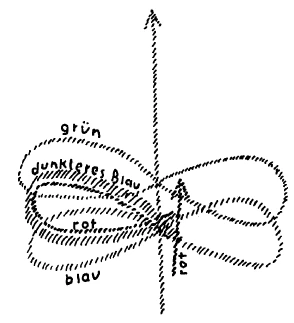
[ 12 ] Wollen wir einmal graphisch darstellen, wie etwa die Sache gemeint sein könnte. Man könnte sagen: Das ist im allgemeinen die Tendenz der Menschheitsentwickelung (Pfeil aufwärts). Sie geht aber nicht so vor sich, diese Menschheitsentwickelung — es ist dies nur schematisch, graphisch dargestellt —, sondern sie geht so vor sich, daß sich die Entwickelung (blau) in einer Lemniskate herumschlängelt; aber sie kann nicht so gehen, sondern es muß fortwährend, wenn die Entwickelung diesen Gang nimmt, neue Antriebe geben, die im Sinne dieser Linie die Lemniskate heraufheben. Schiller würde, angekommen an diesem Punkte hier (siehe Zeichnung), gewissermaßen in ein dunkleres Blau der bloßen Abstraktion, des bloßen Verstandesmäßigen hineingekommen sein, wenn er weiter fortgefahren hätte im Selbständigmachen desjenigen, was er innerlich fühlte. Er machte halt, und gerade noch hielt er mit dem verständigen Gestalten inne an dem Punkt, wo man die Persönlichkeit nicht verliert, sondern in dem verständigen Gestalten noch die Persönlichkeit drinnen hat. Daher wurde das nicht blau, sondern es wurde auf einer höheren Stufe der Persönlichkeit, die ich hier (siehe Zeichnung) mit Rot durchziehen will, grün gemacht. So daß man sagen kann: Schiller hielt zurück gerade im Verstandesmäßigen vor dem, wo das Verstandesmäßige in seiner Reinheit heraus will. Sonst wäre er in den gewöhnlichen Verstand des 19. Jahrhunderts hineinverfallen. Goethe drückte dasselbe aus in Bildern, in wunderbaren Bildern, in dem «Märchen von der grünen Schlange und der schönen Lilie»; aber er blieb auch stehen bei diesen Bildern; er konnte gar nicht leiden, daß man irgendwie an diesen Bildern etwas herummäkelte, denn für ihn ergab sich das, was er über das Individuell-Menschliche und über das soziale Leben empfand, eben in solchen Bildern. Aber weiter durfte er nicht gehen als bis zu diesen Bildern. Denn würde er nun weiterzugehen versucht haben von seinem Standpunkte aus, er wäre in das Schwärmerische, in die Phantastik hineingekommen. Die Sache würde nicht mehr Konturen gehabt haben; sie würde nicht mehr anwendbar gewesen sein für das Leben, sie würde das Leben überschritten haben, sich über das Leben hinaus erhoben haben. Es würde schwärmerische Phantastik geworden sein. Man möchte sagen: Goethe war genötigt, die andere Klippe zu vermeiden, wo er ganz ins PhantastischRote hineingekommen wäre. Darum hat er beigemischt das, was das Unpersönliche ist, dasjenige, was die Bilder in der Region des Imaginativen hielt, und ist dadurch auch auf das Grün gekommen.
[ 12 ] Let’s try to illustrate what this might mean. One could say: This is, in general, the trend of human development (upward arrow). However, this development of humanity does not proceed in this way—this is merely a schematic, graphical representation—but rather it proceeds such that the development (blue) winds its way in a lemniscate; yet it cannot proceed in this manner, for if the development takes this course, there must continually be new impulses that, in the sense of this line, lift the lemniscate upward. Schiller, having reached this point here (see drawing), would, so to speak, have entered into a darker blue of mere abstraction, of the purely intellectual, had he continued to make independent that which he felt inwardly. He paused, and just in time he halted his intellectual shaping at the point where one does not lose one’s personality, but still retains it within the intellectual form. Therefore, it did not turn blue, but was rendered green on a higher level of personality, which I will highlight here (see drawing) in red. So that one can say: Schiller held back precisely in the realm of the intellectual, just before the point where the intellectual, in its purity, seeks to break through. Otherwise, he would have fallen into the conventional intellect of the 19th century. Goethe expressed the same thing in images—in wonderful images—in the “Fairy Tale of the Green Snake and the Beautiful Lily”; but he, too, stopped at these images; he could not bear it at all when people found fault with them in any way, for to him, what he felt about the individual human nature and about social life was precisely expressed in such images. But he was not allowed to go any further than these images. For if he had attempted to go further from his standpoint, he would have strayed into the realm of the fanciful and the fantastical. The subject would have lost its contours; it would no longer have been applicable to life; it would have transcended life, rising above it. It would have become fanciful fantasy. One might say: Goethe was compelled to avoid the other pitfall, where he would have strayed entirely into the realm of the fantastical red. That is why he incorporated the impersonal—that which kept the images within the realm of the imaginative—and thereby also arrived at the green.
[ 13 ] Schiller hat gewissermaßen, wenn ich mich schematisch ausdrücken soll, das Blau vermieden, das Ahrimanisch-Verstandesmäßige; Goethe hat vermieden das Rot, das Schwärmerische, und ist beim konkreten imaginativen Bilde geblieben.
[ 13 ] Schiller, so to speak—if I may put it in simplified terms—avoided blue, which represents the Ahrimanic, intellectual aspect; Goethe avoided red, which represents the impassioned, and stuck to concrete, imaginative imagery.
[ 14 ] Schiller hat sich auseinandergesetzt als mittelländischer Mensch mit den Geistern des Westens. Die wollten ihn verleiten zu dem ganz Verstandesmäßigen. Kant ist dem unterlegen. Ich habe es dargestellt, indem ich vor kurzer Zeit hier darauf hingewiesen habe, wie Kant durch David Hume unterlegen ist dem Verstandesmäßigen des Westens. Schiller hat sich herausgearbeitet, obwohl er von Kant sich schulen ließ. Er ist geblieben bei dem, das nicht bloß das Verstandesmäßige ist.
[ 14 ] As a man of the Mediterranean, Schiller grappled with the intellectual currents of the West. They sought to lead him toward a purely rational approach. Kant falls short in this regard. I illustrated this recently when I pointed out here how Kant, through David Hume, falls short of the rationalism of the West. Schiller forged his own path, even though he was trained by Kant. He remained true to that which is not merely rational.
[ 15 ] Goethe hatte mit den anderen Geistern, den Geistern des Ostens zu kämpfen, die ihn nach der Imagination trieben. Er konnte zu seiner Zeit, weil Geisteswissenschaft noch nicht vorhanden war, nicht weiter gehen als bis zu dem Gewebe der Imagination in dem «Märchen von der grünen Schlange und der schönen Lilie». Aber auch da blieb er innerhalb der festen Konturen. Er ging nicht bis ins Phantastische, Schwärmerische hinauf. Er befruchtete sich, indem er nach Süden zog, wo noch viel erhalten war von dem Erbgute des Orients. Er lernte kennen, wie die Geister des Orients da noch wirkten in der Nachblüte orientalischer Kultur, der griechischen Künste, wie er sie sich konstruierte aus den italienischen Kunstwerken. So daß man sagen kann: Es ist etwas Eigentümliches in diesem Freundschaftsbunde zwischen Schiller und Goethe. Schiller hat zu kämpfen mit den Geistern des Westens; er ergibt sich ihnen nicht, er hält zurück, er verfällt nicht in den bloßen Verstand. Goethe hat zu kämpfen mit den Geistern des Ostens; sie wollen ihn zum Schwärmerischen treiben. Er hält zurück; er bleibt bei den Bildern, die er im «Märchen von der grünen Schlange und der schönen Lilie» gegeben hat. Goethe hätte entweder in die Schwärmerei verfallen oder die orientalische Offenbarung annehmen müssen. Schiller hätte entweder ganz verstandesmäßig werden müssen, oder er hätte das, was er geworden ist, ernst nehmen müssen; bekanntlich ist er ja von der Revolutionsregierung zum «französischen Bürger» ernannt worden, aber er hat die Sache nicht sehr ernst genommen.
[ 15 ] Goethe had to struggle with the other spirits—the spirits of the East—that drove him toward the realm of the imagination. In his time, because spiritual science did not yet exist, he could not go beyond the fabric of the imagination found in the “Fairy Tale of the Green Snake and the Beautiful Lily.” But even there, he remained within the firm contours. He did not ascend into the realm of the fantastic or the fanciful. He enriched himself by traveling south, where much of the heritage of the East was still preserved. He came to understand how the spirits of the Orient were still at work there in the lingering bloom of Oriental culture—the Greek arts, as he conceived them from Italian works of art. So one can say: There is something peculiar about this bond of friendship between Schiller and Goethe. Schiller has to contend with the spirits of the West; he does not surrender to them, he holds back, he does not succumb to mere reason. Goethe has to contend with the spirits of the East; they want to drive him into enthusiasm. He holds back; he sticks to the images he presented in “The Fairy Tale of the Green Snake and the Beautiful Lily.” Goethe would either have had to succumb to enthusiasm or accept the Eastern revelation. Schiller would either have had to become entirely rational, or he would have had to take seriously what he had become; as is well known, he was appointed a “French citizen” by the revolutionary government, but he did not take the matter very seriously.
[ 16 ] Da sehen wir, wie in einem wichtigen Punkte europäischer Entwickelung diese zwei Seelenverfassungen nebeneinanderstehen, die ich Ihnen charakterisiert habe. Sie leben sonst ja auch, man möchte sagen in jeder einzelnen bedeutsamen mitteleuropäischen Individualität, aber in Schiller und Goethe stehen sie zu gleicher Zeit in einer gewissen Weise nebeneinander. Es mußte, während Schiller und Goethe gewissermaßen noch auf jenem Punkte geblieben sind, erst der Einschlag der Geisteswissenschaft kommen, der diese Lemniskatenkurve (siehe Zeichnung) heraufhebt, so daß sie auf einer höheren Stufe dann erscheint.
[ 16 ] Here we see how, at a crucial juncture in European development, these two states of mind—which I have described to you—coexist side by side. They are, of course, also present—one might say—in every single significant Central European individual, but in Schiller and Goethe they coexist simultaneously in a certain way. While Schiller and Goethe, so to speak, remained at that point, it was not until the advent of spiritual science that this lemniscate curve (see drawing) was raised, so that it then appears at a higher level.
[ 17 ] Und so sehen wir denn in einer eigentümlichen Weise in Schillers drei Zuständen, dem Zustand der Vernunftnotwendigkeit, dem der Instinktnotwendigkeit und dem der freien ästhetischen Stimmung, und in Goethes drei Königen, dem goldenen, dem silbernen, dem kupfernen, vorgebildet alles das, was wir sowohl über die Dreigliederung des Menschen, wie über die Dreigliederung des sozialen Gemeinwesens zu finden haben durch Geisteswissenschaft als die nächsten notwendigen Ziele und Rätselfragen des einzelnen Menschen und des menschlichen Zusammenlebens.
[ 17 ] And so we see, in a peculiar way, in Schiller’s three states—the state of rational necessity, that of instinctive necessity, and that of free aesthetic mood— and in Goethe’s three kings—the golden, the silver, and the bronze—a foreshadowing of everything we find through spiritual science regarding both the threefold nature of the human being and the threefold structure of the social community, as the next necessary goals and enigmatic questions for the individual and for human coexistence.
[ 18 ] Diese Dinge weisen uns doch wohl darauf hin, daß nicht durch eine Willkür diese Dreigliederung des sozialen Organismus an die Oberfläche getragen worden ist, sondern daß schon beste Geister der neueren Menschheitsentwickelung darauf hintendiert haben, solches zu bringen. Aber wenn es nichts anderes gäbe als ein solches Denken über das Soziale, wie es Goethes «Märchen von der grünen Schlange und der schönen Lilie» ist, so würde man nicht zur Schlagkraft des äußeren Wirkens kommen können. Goethe stand an dem Punkt, die bloße Offenbarung zu überwinden. Er ist ja auch in Rom nicht zum Katholiken geworden. Er erhob sich eben zu seinen Imaginationen. Aber er blieb doch beim bloßen Bilde stehen. Und Schiller ist nicht zum Revolutionär geworden, sondern zum Erzieher des inneren Menschen. Er blieb stehen bei dem Punkte, wo noch Persönlichkeit in der Verstandesgestaltung drinnen ist.
[ 18 ] These things surely indicate to us that this threefold structure of the social organism did not come to the surface by mere whim, but that the greatest minds of recent human development have already been striving to bring it about. But if there were nothing else but a way of thinking about social matters such as that found in Goethe’s “Fairy Tale of the Green Snake and the Beautiful Lily,” one would not be able to achieve the impact of outward action. Goethe was at the point of overcoming mere revelation. After all, he did not become a Catholic even in Rome. He simply rose to the level of his own imaginings. But he still remained at the level of the mere image. And Schiller did not become a revolutionary, but rather an educator of the inner human being. He remained at the point where personality is still present within the formation of the intellect.
[ 19 ] So wirkte sich in einer späteren Phase mitteleuropäischer Kultur etwas aus, was schon seit älteren Zeiten zu bemerken ist, am klarsten für den modernen Menschen noch im Griechentum. Nach dem Griechentum strebte ja auch Goethe. Im Griechentum ist zu bemerken, wie das Soziale im Mythus dargestellt wird, also auch im Bilde. Aber im Grunde genommen ist der griechische Mythus so Bild, wie auch Goethes «Märchen von der grünen Schlange und der schönen Lilie» Bild ist. Man kann nicht mit diesen Bildern nun etwa reformatorisch wirken im sozialen Organismus. Man kann gewissermaßen nur als Idealist etwas sagen, was sich bilden müßte. Aber die Bilder sind ein zu leichtes Gebäude, als daß man wirklich schlagkräftig eingreifen könnte in die Gestaltung des sozialen Organismus. Daher haben die Griechen auch nicht geglaubt, mit ihrem Stehenbleiben in den Mythenbildern auch das Soziale zu treffen. Und da kommt man, wenn man diese Linie des Forschens verfolgt, an einen wichtigen Punkt der griechischen Entwickelung.
[ 19 ] Thus, in a later phase of Central European culture, something came to bear that had already been evident since ancient times—and is still most clearly visible to modern people in Greek culture. Goethe, too, was inspired by Greek culture. In Greek culture, one can observe how the social is depicted in myth—and thus also in imagery. But fundamentally, Greek myth is as much an image as Goethe’s “Fairy Tale of the Green Snake and the Beautiful Lily” is an image. One cannot use these images to bring about reform within the social organism. One can, so to speak, only speak as an idealist about what ought to take shape. But these images are too fragile a structure to allow for truly effective intervention in the shaping of the social organism. That is why the Greeks did not believe that by remaining within the realm of mythical imagery, they were also addressing social reality. And if one follows this line of inquiry, one arrives at an important point in Greek development.
[ 20 ] Man möchte sagen: Für das Alltagsleben, wo sich die Dinge gewohnheitsmäßig abspielen, da dachten sich die Griechen abhängig von ihren Mythengöttern, Mythengeistern. Dann aber, wenn es sich darum handelte, Großes zu entscheiden, da sagten sich die Griechen: Ja, da machen es diejenigen Götter nicht aus, welche in die Imagination hereinwirken und eben die Mythengötter sind; da muß etwas Reales zutage treten. Und da trat das Orakel zutage. Da wurden die Götter nicht bloß imaginativ vorgestellt, da wurden sie veranlaßt, die Menschen wirklich zu inspirieren. Und mit den Orakelsprüchen befaßten sich die Griechen, wenn sie soziale Impulse haben wollten. Da stiegen sie auf von der Imagination zur Inspiration, aber zu einer Inspiration, zu welcher sie die äußere Natur herbeiriefen. Wir modernen Menschen müssen allerdings auch versuchen, uns zur Inspiration zu erheben, aber dann zu einer Inspiration, die nicht die äußere Natur in den Orakeln herbeiruft, sondern die zum Geiste aufsteigt, um in der Sphäre des Geistigen sich inspirieren zu lassen. Aber so wie die Griechen zum Realen griffen, wenn es sich um Soziales handelte, wie sie nicht bei Imaginationen geblieben sind, sondern zu den Inspirationen aufstiegen, so können wir auch nicht bei den bloßen Imaginationen bleiben, sondern müssen zu den Inspirationen aufsteigen, wenn wir irgend etwas zum sozialen Heile finden wollen in der neueren Zeit.
[ 20 ] One might say: In everyday life, where things unfold out of habit, the Greeks relied on their mythical gods and spirits. But when it came to making major decisions, the Greeks would say to themselves: “Yes, in such cases, it is not enough to rely on those gods who influence the imagination—the very gods of myth; something real must come to light.” And so the oracle came to light. There, the gods were not merely imagined; they were called upon to truly inspire humanity. And the Greeks turned to the oracles’ pronouncements whenever they sought social impetus. Thus they rose from imagination to inspiration—but to an inspiration for which they summoned external nature. We modern people must, of course, also strive to rise to inspiration—but to an inspiration that does not summon external nature through the oracles, but rather ascends to the spirit in order to be inspired within the sphere of the spiritual. But just as the Greeks turned to the real world when it came to social matters—just as they did not remain at the level of imagination but rose to inspiration—so too can we not remain at the level of mere imagination but must rise to inspiration if we wish to find anything for the social good in the modern era.
[ 21 ] Und hier kommen wir an einen anderen Punkt, der wichtig ist zu beachten. Warum sind denn eigentlich Schiller und Goethe stehengeblieben, der eine auf dem Wege nach dem Verständigen, der andere auf dem Wege nach dem Imaginativen? Geisteswissenschaft hatten sie beide nicht, sonst hätte Schiller fortschreiten können dazu, seine Begriffe geisteswissenschaftlich zu durchdringen, und er würde dann etwas viel Realeres in seinen drei Seelenzuständen gefunden haben als die drei Abstraktionen, die er in den «Ästhetischen Briefen» hat. Goethe würde die Imagination ausgefüllt haben mit dem, was real aus der geistigen Welt herein spricht, und er hätte vordringen können zu den Gestaltungen des sozialen Lebens, die da bewirkt sein wollen aus der geistigen Welt herein, dem geistigen Glied des sozialen Organismus, dem goldenen König; dem staatlichen Glied des sozialen Organismus, dem silbernen König, dem König des Scheins; dem wirtschaftlichen Gliede, dem ehernen, dem kupfernen König.
[ 21 ] And here we come to another point that is important to note. Why, in fact, did Schiller and Goethe come to a standstill—one on the path toward the intellectual, the other on the path toward the imaginative? Neither of them had a background in spiritual science; otherwise, Schiller could have progressed to a deeper understanding of his concepts through spiritual science, and he would then have found something much more real in his three states of the soul than the three abstractions he presents in the “Aesthetic Letters.” Goethe would have filled the imagination with what truly speaks from the spiritual world, and he could have advanced to the forms of social life that are meant to be brought about from the spiritual world—the spiritual member of the social organism, the golden king; the state member of the social organism, the silver king, the king of appearances; the economic member, the bronze and copper kings.
[ 22 ] Die Zeit, in der Schiller und Goethe zu diesen Einsichten, der eine in den «Ästhetischen Briefen», der andere im «Märchen», vorgedrungen sind, diese Zeit war noch nicht dazu angetan, weiterzudringen; denn um weiterzudringen muß man etwas ganz Bestimmtes einsehen. Man muß das einsehen, was eigentlich aus der Welt würde, wenn man den Weg Schillers nun weitergehen würde bis zur vollen Ausgestaltung des Unpersönlich-Verstandesmäßigen. Das 19. Jahrhundert hat es ja zunächst in der Naturwissenschaft ausgebildet, dieses Unpersönlich-Verstandesmäßige, und die zweite Hälfte des 19. Jahrhunderts hat angefangen, es in den äußeren öffentlichen Angelegenheiten verwirklichen zu wollen. Da liegt aber ein bedeutsames Geheimnis vor. Im menschlichen Organismus wird fortwährend das, was aufgenommen wird, auch zur Zerstörung geführt. Wir können nicht fortwährend bloß essen, wir müssen auch ausscheiden, es muß das, was wir als Stoff aufnehmen, auch einem Niedergang entgegengehen, das muß auch zerstört werden, muß wiederum heraus aus dem Organismus. Und das Verstandesmäßige ist dasjenige, welches, sobald es — und hier kommt eine Komplikation — das wirtschaftliche Leben ergreift, im Einheitsstaat, im gemischten König, dieses Wirtschaftsleben zerstört.
[ 22 ] The era in which Schiller and Goethe arrived at these insights—one in the “Aesthetic Letters,” the other in “The Fairy Tale”—was not yet ripe for further progress; for in order to make further progress, one must grasp something quite specific. One must realize what would actually become of the world if one were to continue down Schiller’s path to the full realization of the impersonal and rational. The nineteenth century first developed this impersonal, rational element in the natural sciences, and the second half of the nineteenth century began to seek to realize it in external public affairs. Yet there lies a significant mystery here. In the human organism, whatever is taken in is also continually led toward destruction. We cannot simply eat continuously; we must also excrete. What we take in as matter must also face decay; it must be destroyed and expelled from the organism. And the intellectual is that which—and here comes a complication—as soon as it takes hold of economic life in the unitary state, under the mixed monarch, destroys that economic life.
[ 23 ] Nun leben wir aber in der Zeit, in der sich der Verstand entwickeln muß. Wir können nicht im fünften nachatlantischen Zeitraum zur Entwickelung der Bewußtseinsseele kommen, ohne den Verstand zu entwickeln. Und die westlichen Völker haben ja gerade die Aufgabe, den Verstand in das Wirtschaftsleben hineinzutragen. Was bedeutet das? Wir können das moderne Wirtschaftsleben, weil wir es verständig gestalten müssen, nicht imaginativ gestalten, wie Goethe es in seinem «Märchen» gestaltet hat. Weil wir im Wirtschaftlichen den Weg weiter machen müssen, den Schiller nur getrieben hat bis zu dem noch persönlichen Aushauchen des Verstandesmäßigen, müssen wir ein Wirtschaftsleben gründen, das als Wirtschaftsleben, weil es eben verständig sein muß, im fünften nachatlantischen Zeitraum notwendig zerstörend wirkt. Es gibt im heutigen Zeitraum kein Wirtschaftsleben, das etwa imaginativ geführt werden könnte wie das Wirtschaftsleben des Orients oder noch das Wirtschaften des europäischen Mittelalters, sondern seit der Mitte des 15. Jahrhunderts haben wir nur die Möglichkeit, ein solches Wirtschaftsleben zu haben, das, wenn es allein da wäre oder mit den anderen Gliedern des sozialen Organismus vermengt ist, zerstörend wirkt. Es geht nicht anders. Daher betrachten wir dieses Wirtschaftsleben als die eine Waagschale, die tief heruntersinken würde und dadurch zerstörend wirken muß; es muß ein Gleichgewicht da sein. Daher müssen wir ein Wirtschaftsleben haben als das eine Glied des sozialen Organismus, und ein Geistesleben, welches jetzt eben das Gleichgewicht hält, immer wieder aufbaut. Hält man heute an dem Einheitsstaat fest, dann wird das Wirtschaftsleben, wie es im Westen der Fall ist, diesen Einheitsstaat mit dem Geistesleben aufsaugen, dann müssen aber solche Einheitsstaaten notwendig zur Zerstörung führen. Und wenn man bloß aus dem Verstande heraus wie Lenin und Trotzkij, einen Staat begründet, er muß zur Zerstörung führen, weil sich der Verstand bloß auf das Wirtschaftsleben richtet.
[ 23 ] But we now live in an age in which the intellect must develop. We cannot reach the development of the conscious soul in the fifth post-Atlantean epoch without developing the intellect. And the Western peoples have precisely the task of bringing the intellect into economic life. What does that mean? Because we must shape modern economic life rationally, we cannot shape it imaginatively, as Goethe did in his “fairy tale.” Because we must continue along the path in the economic sphere that Schiller only pursued as far as the still-personal expression of the intellectual, we must establish an economic life that, precisely because it must be rational, will necessarily have a destructive effect in the fifth post-Atlantean epoch. In the present era, there is no economic life that could be conducted imaginatively, as was the case with the economic life of the Orient or even the economic practices of the European Middle Ages; rather, since the middle of the 15th century, we have had only the possibility of an economic life that, whether it existed on its own or was intertwined with the other members of the social organism, has a destructive effect. There is no other way. Therefore, we regard this economic life as one side of the scale that would sink deeply and thereby inevitably have a destructive effect; there must be a balance. Therefore, we must have an economic life as one limb of the social organism, and a spiritual life that now maintains this balance and continually rebuilds it. If one clings to the unitary state today, then economic life—as is the case in the West—will absorb this unitary state along with spiritual life; but such unitary states must necessarily lead to destruction. And if one establishes a state based solely on reason, as Lenin and Trotsky did, it must lead to destruction, because reason is directed solely toward economic life.
[ 24 ] Das fühlte Schiller, indem er seinen sozialen Zustand ausdachte. Schiller fühlte: Gehe ich weiter in dem verstandesmäßigen Können, komme ich ins Wirtschaftsleben hinein, so muß ich den Verstand auf das Wirtschaftsleben anwenden. Dann schildere ich nicht dasjenige, was wächst und gedeiht, dann schildere ich dasjenige, was in der Zerstörung lebt. — Schiller zuckte zurück vor der Zerstörung. Er hielt gerade an dem Punkt, wo die Zerstörung anbrechen würde, an; da blieb er stehen. Die Neueren denken alle möglichen sozialen wirtschaftlichen Systeme aus, wissen nur nicht, weil sie ein zu grobes Gefühl dazu haben, daß jedes wirtschaftliche System, das sie so ausdenken, zur Zerstörung führt, unbedingt zur Zerstörung führt, wenn es nicht jederzeit wiederum erneuert wird durch das selbständige, sich entwickeinde Geistesleben, das immer wieder und wiederum sich zu dem Zerstören, zu dem Ausscheiden des Wirtschaftslebens verhält wie das Aufbauende. In diesem Sinne ist auch in meinen «Kernpunkten» das Zusammenwirken des geistigen Gliedes des sozialen Organismus mit dem Wirtschaftlichen geschildert.
[ 24 ] Schiller sensed this as he reflected on his social condition. Schiller felt: If I continue to develop my intellectual abilities and enter economic life, I must apply my intellect to economic life. Then I would no longer be describing that which grows and flourishes; I would be describing that which thrives on destruction. — Schiller recoiled from destruction. He stopped precisely at the point where destruction would begin; there he stood still. Modern thinkers devise all manner of social and economic systems, yet they do not realize—because their sense of the matter is too crude—that every economic system they conceive in this way leads to destruction, inevitably leads to destruction, unless it is continually renewed by the independent, evolving spiritual life, which time and again relates to destruction and the elimination of economic life in the same way as it does to the constructive. In this sense, the interaction between the spiritual element of the social organism and the economic element is also described in my “Key Points.”
[ 25 ] Würde unter der modernen Verständigkeit des fünften nachatlantischen Zeitraums das Kapital bleiben bei den Menschen, auch dann, wenn sie nicht mehr es selber verwalten können, dann würde das Wirtschaftsleben selber den Kreislauf des Kapitals bewirken; Zerstörung müßte kommen. Da muß das geistige Leben eingreifen, da muß über das geistige Leben hinüber das Kapital an denjenigen gebracht werden, der wieder bei seiner Verwaltung dabei ist. Das ist der innere Sinn der Dreigliederung des sozialen Organismus, daß auch in dem richtig gedachten dreigliedrigen sozialen Organismus man sich keiner Illusion hingibt, daß das wirtschaftliche Denken in der modernen Zeit ein zerstörendes Element ist, und daß daher fortwährend ihm entgegengesetzt werden muß das aufbauende Element des geistigen Gliedes des sozialen Organismus.
[ 25 ] If, under the modern understanding of the fifth post-Atlantic epoch, capital were to remain in the hands of the people—even if they could no longer manage it themselves—then economic life itself would bring about the circulation of capital; destruction would inevitably follow. This is where spiritual life must intervene; through spiritual life, capital must be channeled to those who are once again involved in its management. This is the inner meaning of the threefold social order: that even in a properly conceived threefold social order, one does not succumb to the illusion that economic thinking in the modern era is a destructive element, and that therefore the constructive element of the spiritual component of the social organism must continually be set in opposition to it.
[ 26 ] Mit jeder neuen Generation, mit den Kindern, die wir in der Schule unterrichten, wird uns von der geistigen Welt etwas gegeben, etwas heruntergeschickt; das fangen wir auf in der Erziehung, das ist etwas Geistiges, das einverleiben wir wiederum dem Wirtschaftsleben und verhüten dessen Zerstörung; denn das Wirtschaftsleben, durch sich selbst seinen Gang gehend, zerstört sich. So muß man hineinsehen in das Getriebe. So muß man sehen, wie am Ende des 18. Jahrhunderts Goethe und Schiller dastanden, Schiller sich sagte: Ich muß zurückzucken, ich darf keinen sozialen Zustand schildern, der bloß an den persönlichen Verstand appelliert, ich muß mit dem Verstand innerhalb des Persönlichen bleiben, sonst würde ich die wirtschaftliche Vernichtung schildern —, Goethe: Ich will nicht die schwärmerischen, ich will die scharf konturierten Bilder; denn würde ich eine Strecke weitergehen, ich käme hinein in einen Zustand, der nicht auf der Erde ist, der nicht eingreift schlagkräftig in das Leben selber; ich würde wie etwas Unlebendiges das Wirtschaftsleben unter mir lassen, würde ein Geistesleben begründen, das nicht eingreifen kann in die Tatsachen des unmittelbaren Lebens.
[ 26 ] With each new generation—with the children we teach in school—something is given to us from the spiritual world, something sent down to us; we capture this in our educational work; it is something spiritual, which we in turn incorporate into economic life and thereby prevent its destruction; for economic life, left to its own devices, destroys itself. So one must look into the workings of the system. One must see how, at the end of the 18th century, Goethe and Schiller stood there, with Schiller saying to himself: “I must hold back; I must not depict a social condition that appeals merely to personal reason; I must remain within the personal realm with my reason, otherwise I would be depicting economic ruin”—and Goethe: “I do not want the dreamy images; I want the sharply defined ones; for if I were to go a step further, I would enter a state that is not of this earth, that does not intervene powerfully in life itself; I would leave economic life behind me like something lifeless and establish a spiritual life that cannot intervene in the facts of immediate life.”
[ 27 ] So sehen wir, daß wir im richtigen Goetheanismus leben, wenn wir nirgends bei Goethe stehenbleiben, sondern überall mitmachen die Entwickelung, die ja wohl Goethe selber mitgemacht hat seit dem Jahre 1832. Ich habe auch dieses, daß das Wirtschaftsleben fortwährend heute in seine eigene Zerstörung hineinarbeitet und fortwährend der eigenen Zerstörung entgegengearbeitet werden muß, wie der Zerstörung des Menschen durch das Essen entgegengearbeitet werden muß, ich habe auch das an einer bestimmten Stelle in meinen «Kernpunkten der sozialen Frage» angedeutet. Nur liest man die Sachen nicht ordentlich, sondern man denkt, dieses Buch sei auch so geschrieben, wie etwa heute die meisten Bücher geschrieben sind, daß man, nun ja, einfach so durchlesen kann. Es will eben jeder Satz bei einem solchen, aus dem Praktischen heraus geschriebenen Buche durchaus bedacht sein.
[ 27 ] Thus we see that we are living in true Goetheanism when we do not stop at any one point in Goethe’s work, but instead participate in the development that Goethe himself undoubtedly underwent beginning in 1832. I have also touched on this—that economic life today is constantly working toward its own destruction and must constantly be counteracted, just as the destruction of the human being through eating must be counteracted—I have also alluded to this at a specific point in my *Key Points of the Social Question*. But people don’t read these things properly; instead, they assume this book is written the way most books are written today—that is, in a way that allows one to, well, simply skim through it. In a book like this, written from a practical perspective, every single sentence demands careful consideration.
[ 28 ] Aber wenn man diese beiden Dinge nimmt: Schillers «Ästhetische Briefe» sind wenig verstanden worden in der Folgezeit, ich habe davon öfter gesprochen, man hat sich wenig mit ihnen beschäftigt; es würde sonst dasStudium der Schillerschen «Ästhetischen Briefe» ein guter Weg sein zum Hineinmünden in das, was Sie finden in meiner Schrift «Wie erlangt man Erkenntnisse der höheren Welten?»; dazu könnten Schillers «Ästhetische Briefe» die Vorbereitung sein. Und wiederum könnte Goethes «Märchen von der grünen Schlange und der schönen Lilie» die Vorbereitung sein, um jene Art der Geisteskonfiguration sich anzueignen, die nicht aus dem bloßen Verstande, sondern aus tieferen Kräften heraus kommen kann, und die dann so etwas wie die «Kernpunkte der sozialen Frage» wirklich verstehen könnte. Denn sowohl Schiller wie Goethe empfanden das Tragische der mitteleuropäischen Zivilisation. Gewiß, die Dinge waren ihnen nicht bewußt, aber sie empfanden sie. Beide empfanden — man kann das nachlesen bei Goethe überall in den Gesprächen mit Eckermann, mit dem Kanzler von Müller, in den zahlreichen anderen Andeutungen Goethes —: Wenn nicht etwas heraufkommt wie ein neuer Einschlag aus dem Geistigen, wie ein neues Begreifen des Christentums, dann muß es abwärts gehen. — Vieles, was Goethe an Resignation in seinen späteren Jahrzehnten dargelebt hat, beruht zweifellos auf dieser Stimmung.
[ 28 ] But if one considers these two things: Schiller’s “Aesthetic Letters” have been little understood in subsequent times—I have spoken of this often—and they have received little attention; otherwise, the study of Schiller’s “Aesthetic Letters” would be a good path toward what you will find in my work “How Does One Attain Knowledge of the Higher Worlds?”; Schiller’s “Aesthetic Letters” could serve as preparation for this. And in turn, Goethe’s “Fairy Tale of the Green Snake and the Beautiful Lily” could serve as preparation for acquiring that kind of spiritual configuration which can arise not from mere intellect but from deeper forces, and which could then truly understand something like the “Key Points of the Social Question.” For both Schiller and Goethe sensed the tragedy of Central European civilization. Certainly, they were not consciously aware of these things, but they sensed them. Both felt—as can be read throughout Goethe’s conversations with Eckermann, with Chancellor von Müller, and in Goethe’s numerous other allusions—that: Unless something emerges—such as a new spiritual impetus, a new understanding of Christianity—then things must go downhill. —Much of the resignation Goethe exemplified in his later decades is undoubtedly rooted in this sentiment.
[ 29 ] Und diejenigen, die ohne die Geisteswissenschaft Goetheaner geworden sind, die fühlen, wie namentlich aus dem deutschen mitteleuropäischen Wesen gerade dieses eigentümliche Nebeneinanderwirken der Geister des Westens und der Geister des Ostens ersichtlich ist. Ich habe gestern gesagt: Innerhalb der mitteleuropäischen Zivilisation ist jener Ausgleich, den die Hochscholastik gesucht hat zwischen Vernunftwissenschaft und Offenbarung, auch zurückzuführen auf die Wirkungen der Geister des Westens und der Geister des Ostens. Wie das bei Schiller und Goethe zum Vorschein kommt, wir haben es heute gesehen. Aber im Grunde genommen schwankt die ganze mitteleuropäische Zivilisation in diesem Wirbel drinnen, in dem der Osten und der Westen durcheinanderwirbeln; vom Osten herüber die Sphäre des goldenen Königs, vom Westen herüber die Sphäre des kupfernen, vom Osten herüber die Weisheit, vom Westen herüber die Gewalt und in der Mitte dasjenige, was Goethe im silbernen König darstellt, der Schein, der sich nur schwer durchdringt mit Wirklichkeit. Das Scheinhafte der mitteleuropäischen Zivilisation, es lag als tragische Stimmung auf dem Untergrunde der Goetheschen Seele. Und Herman Grimm hat in schöner Weise aus seinem Goethe-Empfinden heraus — er hat ja als ein Mensch, der eben auch von der Geisteswissenschaft unberührt war, Goethe angesehen —, er hat als ein solcher Geist charakterisiert, wie diese mitteleuropäische Zivilisation in sich hat dieses Hineingetriebensein in den Wirbel der Geister des Ostens und der Geister des Westens, was dazu führt, den Willen nicht zu seinem Rechte kommen zu lassen, und was zu der ewig schwankenden Stimmung der deutschen Geschichte geführt hat. Schön sagt Herman Grimm gerade über diese Dinge: «Die deutsche Geschichte ist für Treitschke das unablässige Streben nach geistiger und staatlicher Einheit und auf dem Wege zu ihr das unablässige Dazwischentreten unserer eigensten angeborenen Eigenschaften.» So sagt Herman Grimm, sich selber als Deutscher fühlend. Er sagt weiter: «Immer dieselbe Art unserer Natur, sich zu widersetzen, wo man nachgeben sollte, und nachzugeben, wo Widerstand nötig war. Das wunderbare Vergessen des eben erst Vergangenen, das plötzliche Nichtmehrwollen des eben noch heftig Erstrebten, die Mißachtung der Gegenwart, aber die feste, doch unbestimmte Hoffnung. Dazu der Hang, sich dem Fremden hinzugeben und, wenn dies einmal geschah, zugleich dann aber der unbewußte, maßgebende Einfluß auf die Ausländer, denen man sich doch unterwarf.»
[ 29 ] And those who have become Goetheans without the study of the spiritual sciences sense how this peculiar interplay between the spirits of the West and the spirits of the East is particularly evident in the German, Central European character. I said yesterday: Within Central European civilization, the balance that High Scholasticism sought between rational science and revelation can also be traced back to the influences of the spirits of the West and the spirits of the East. We have seen today how this manifests itself in Schiller and Goethe. But fundamentally, the entire Central European civilization is caught up in this whirlwind in which East and West swirl together; from the East comes the realm of the Golden King, from the West the realm of the Copper King; from the East comes wisdom, from the West power; and in the middle lies what Goethe portrays in the Silver King—the illusion that is difficult to penetrate with reality. The illusory nature of Central European civilization lay as a tragic mood in the depths of Goethe’s soul. And Herman Grimm, drawing beautifully from his own perception of Goethe—for he viewed Goethe as a person who was, after all, untouched by spiritual science— he characterized, as such a spirit, how this Central European civilization is driven into the maelstrom of the spirits of the East and the spirits of the West, which prevents the will from asserting itself and has led to the eternally fluctuating mood of German history. Herman Grimm speaks beautifully precisely about these things: “For Treitschke, German history is the ceaseless striving for spiritual and political unity, and on the path toward it, the ceaseless interference of our very own innate characteristics.” So says Herman Grimm, who considers himself a German. He goes on to say: “Always the same tendency of our nature to resist where one should yield, and to yield where resistance was necessary. The remarkable forgetting of what has just passed, the sudden loss of desire for what was just fiercely sought after, the disregard for the present, yet the firm, though indefinite, hope. Added to this is the tendency to surrender to the foreign and, once this happened, the simultaneous yet unconscious, decisive influence on the foreigners to whom one nevertheless submitted.”
[ 30 ] Wenn man es heute mit mitteleuropäischer Zivilisation zu tun hat und mit ihr etwas erreichen möchte, so weht einem überall diese Tragik entgegen, die die ganze Geschichte dieses Deutschen, Mitteleuropäischen, zwischen dem Westen und Osten verrät. Auch heute ist es überall noch so, daß man mit Herman Grimm sagen könnte: Der Drang, sich zu widersetzen, wo man nachgeben sollte, und nachzugeben, wo Widerstand nötig ist.
[ 30 ] When one deals with Central European civilization today and wishes to achieve something through it, one is confronted everywhere by this tragedy, which reveals the entire history of this German, Central European identity, caught between the West and the East. Even today, it is still the case everywhere that one could say, with Herman Grimm: “The urge to resist where one should yield, and to yield where resistance is necessary.”
[ 31 ] Das ist dasjenige, was von dem schwankenden Mittleren herrührt, von dem, was zwischen Wirtschaft und aufbauendem Geistesleben als das rhythmische Hin- und Herschwanken des Staatlichen mitten drinnensteht. Weil in diesen Mittelländern gerade das staatlich-politische Element seine Triumphe gefeiert hat, deshalb lebt der Schein, der leicht zur Illusion werden kann. Schiller will nicht den Schein verlassen, indem er seine «Ästhetischen Briefe» hinschreibt. Er weiß, wenn es mit dem bloßen Verstande zu tun hat, dann kommt man in die Zerstörung des Wirtschaftslebens hinein; im 18. Jahrhundert wurde der Teil zerstört, der durch die Französische Revolution zerstört werden konnte; im 19. Jahrhundert würde es viel schlimmer werden. Goethe wußte, er darf nicht bis zum Schwärmerischen gehen, er muß im Imaginativen stehenbleiben. Aber es erzeugt sich auch sehr leicht bei diesem Schwanken zwischen dem einen und dem anderen in dieser Zweiheit, die in der wirbelnden Hin- und Herbewegung der Geister des Westens und des Ostens sich vollzieht, es erzeugt sich leicht eine illusionäre Stimmung. Es ist gleichgültig, ob diese illusionäre Stimmung im Religiösen, ob sie im Politischen, im Militärischen herauskommt, es ist schließlich ganz gleichgültig, ob der Schwärmer irgendwelche Mystik ausschwärmt, oder ob er so schwärmt, wie Ludendorff geschwärmt hat, ohne auf dem Boden der Wirklichkeit zu stehen. Und schließlich, auch in einer liebenswürdigen Weise kann einem das entgegentreten. Denn dieselbe Stelle von Herman Grimm, die ich Ihnen vorgelesen habe, fährt fort: «Man sehe doch heute: Niemand schien so völlig vom Vaterlande losgetrennt als der Deutsche, der zum Amerikaner geworden war, und heute steht das amerikanische Leben, in dem das unserer Auswanderer aufging, unter dem Einflusse des deutschen Geistes.»
[ 31 ] This is what stems from the fluctuating Middle—that which stands in the midst of the economy and the constructive spiritual life as the rhythmic back-and-forth oscillation of the state. Because it is precisely in these central regions that the state-political element has celebrated its triumphs, this is why the appearance—which can easily become an illusion—persists. Schiller does not wish to abandon this appearance by writing his “Aesthetic Letters.” He knows that when it comes to mere intellect, one enters into the destruction of economic life; in the 18th century, the part that could be destroyed by the French Revolution was destroyed; in the 19th century, it would become much worse. Goethe knew he must not go so far as to become a dreamer; he must remain within the imaginative realm. But in this oscillation between the one and the other—in this duality that unfolds in the swirling back-and-forth movement of the spirits of the West and the East—an illusory mood arises very easily. It makes no difference whether this illusory mood manifests itself in religion, politics, or the military; ultimately, it is entirely irrelevant whether the dreamer raves about some form of mysticism or whether he raves as Ludendorff did, without standing on the ground of reality. And finally, this can also present itself in a charming way. For the same passage by Herman Grimm that I read to you continues: “Just look at today: No one seemed so completely detached from the fatherland as the German who had become an American, and today American life, in which the lives of our emigrants were absorbed, stands under the influence of the German spirit.”
[ 32 ] So schreibt Herman Grimm, der geistvolle Mann, im Jahre 1895, wo man wirklich nur aus der schlimmsten Illusion heraus glauben konnte, daß die Deutschen, die nach Amerika gekommen sind, das amerikanische Leben deutsch nuancieren würden. Denn längst bereitete sich das vor, was dann im zweiten Jahrzehnt des 20. Jahrhunderts herauskam: daß eben das Amerikanische völlig überflutet hat das Wenige, was die Deutschen hineinbringen konnten.
[ 32 ] This is what Herman Grimm, that brilliant man, wrote in 1895—a time when one could truly only believe, out of the worst kind of delusion, that the Germans who had come to America would infuse American life with German nuances. For what eventually emerged in the second decade of the 20th century had long been in the making: namely, that American culture had completely overwhelmed the little that the Germans were able to contribute.
[ 33 ] Und schließlich, noch größer wird das Illusionshafte dieses Herman Grimmschen Ausspruches, wenn man folgendes ins Auge faßt. Herman Grimm tut diesen Ausspruch aus Goethescher Gesinnung heraus, denn er hat sich ganz an Goethe herangebildet. Nur, einen Einschlag hat er gehabt. Wer Herman Grimm genau kennt, seinem Stil nach, seiner ganzen Ausdrucksform nach, seiner Denkweise nach, der weiß, Herman Grimm hat sehr viel von Goethe angenommen, nicht das Reale, Durchdringende Goethes; denn er schildert ja so, daß er eigentlich Schattenbilder schildert, nicht wirkliche Menschen. Aber er hat doch etwas anderes noch in sich, nicht bloß Goethe. Und was hat Herman Grimm in sich? Amerikanismus, denn dasjenige, was er in seinem Stile, seinen Gedankenformen außer von Goethe in sich hat, das hat er durch eine frühe Lektüre Emersons bekommen; und sogar seine Satzbildung, seine Gedankenführung ist dem Amerikaner Emerson nachgebildet.
[ 33 ] And finally, the illusory nature of this statement by Herman Grimm becomes even more apparent when one considers the following. Herman Grimm makes this statement out of a Goethean mindset, for he has modeled himself entirely on Goethe. However, he has been influenced by one particular aspect. Anyone who knows Herman Grimm well—his style, his entire mode of expression, his way of thinking—knows that Herman Grimm adopted a great deal from Goethe, but not the real, penetrating essence of Goethe; for he depicts things in such a way that he is actually portraying shadows, not real people. But he still has something else within him, not just Goethe. And what does Herman Grimm have within him? Americanism, for what he possesses in his style and his modes of thought—besides what he took from Goethe—he acquired through his early reading of Emerson; and even his sentence structure and his train of thought are modeled after the American Emerson.
[ 34 ] So findet sich also Herman Grimm in dieser doppelten Illusion, in diesem Reiche des silbernen Königs des Scheins. Er wähnt, als schon alles herausgeworfen wird, was in Amerika deutscher Einfluß ist, daß Amerika germanisiert würde, während er einen guten Einschlag von Amerikanismus in sich trägt.
[ 34 ] Thus Herman Grimm finds himself caught up in this double illusion, in this realm of the Silver King of Appearances. He imagines—just as everything that represents German influence in America is being cast aside—that America is becoming Germanized, while he himself harbors a strong dose of Americanism.
[ 35 ] So drückt sich oftmals intim aus, was dann in der äußeren Kultur grob da ist. Da hat sich der grobe Darwinismus, die grobe wirtschaftliche Denkweise ausgebreitet, und würde schließlich, wenn nicht die Dreigliederung des sozialen Organismus kommt — weil eben das bloß verstandesmäßig konstruierte Wirtschaftsleben notwendig zum Ruin führen muß —, zum Ruin führen. Und derjenige, der aus diesem Wirtschaftsleben heraus denkt wie Oswald Spengler, der kann wissenschaftlich beweisen, daß mit dem Beginn des 3. Jahrtausends die heutige zivilisierte Welt — sie ist ja eigentlich heute nicht mehr so stark zivilisiert — in die wüsteste Barbarei wird versunken sein müssen. Denn Spengler weiß nichts von demjenigen, was diese Welt als Einschlag erhalten muß, von dem geistigen Einschlag.
[ 35 ] What is often expressed in an intimate way is then crudely present in external culture. Rough Darwinism and a crude economic mindset have spread there, and would ultimately lead to ruin—unless the threefold social order is established—because economic life constructed purely on the basis of reason must necessarily lead to ruin. And anyone who thinks from the perspective of this economic life, like Oswald Spengler, can scientifically prove that by the beginning of the third millennium, today’s civilized world—which, after all, is no longer all that civilized today—will have sunk into the most desolate barbarism. For Spengler knows nothing of the impact this world must receive—the spiritual impact.
[ 36 ] Aber doch hat sich recht schwer durchzukämpfen, was als Geisteswissenschaft und als geisteswissenschaftliche Kultur vor die Welt heute nicht hintreten will, sondern hintreten muß. Und überall machen sich diejenigen geltend, die gerade diese Geisteswissenschaft nicht aufkommen lassen wollen. Und wenig tatkräftige Arbeiter sind im Grunde genommen noch auf diesem Boden der Geisteswissenschaft da, während die anderen, die in das Werk der Zerstörung hineinführen, durchaus tatkräftig sind.
[ 36 ] Yet it is quite a struggle to make headway with what, as spiritual science and spiritual-scientific culture, does not wish to take a back seat in the world today, but must do so. And everywhere, those who do not want this spiritual science to gain a foothold are asserting themselves. And there are, in fact, very few active workers still remaining on this ground of spiritual science, while the others—who are leading the way into the work of destruction—are thoroughly active.
[ 37 ] Man braucht nur zu sehen, wie eigentlich der heutige Mensch schon ganz ratlos ist gegenüber dem, was im heutigen Zivilisationsleben auftritt. Es ist zum Beispiel charakteristisch, wie eine Zeitung der Ostschweiz Berichte gebracht hat über meine Vorträge über die Grenzen des Naturerkennens während des Hochschulkurses. Und jetzt hält in dem Ort, in dem die Zeitung erscheint, der Nachgackerer Eduard von Hartmanns, Arthur Drews, Vorträge, der niemals etwas anderes zustande gebracht hat, als daß er nachgegackert hat dem Eduard von Hartmann, dem Philosophen des Unbewußten. Bei dem ist es interessant. Bei dem Nachgackerer ist es natürlich etwas höchst Überflüssiges. Und diese an der Karlsruher Hochschule wirkende philosophische Hohlköpfigkeit, die macht sich jetzt auch über dasjenige her, was anthroposophisch orientierte Geisteswissenschaft ist!
[ 37 ] One need only observe how people today are actually quite at a loss when faced with what is happening in modern civilization. It is characteristic, for example, how a newspaper in eastern Switzerland reported on my lectures about the limits of understanding nature during the university course. And now, in the very town where that newspaper is published, the parrot of Eduard von Hartmann—Arthur Drews—is giving lectures; he has never accomplished anything other than parroting Eduard von Hartmann, the philosopher of the unconscious. In his case, it’s interesting. With this parrot, of course, it is something utterly superfluous. And this philosophical empty-headedness, active at the Karlsruhe University, is now also taking aim at what is anthroposophically oriented spiritual science!
[ 38 ] Und wie steht der heutige Mensch — das möchte ich besonders hervorheben — vor diesen Dingen? Nun haben wir dem einen Gehör gegeben, nun geben wir auch dem anderen Gehör. Das heißt, dem heutigen Menschen ist alles egal. Und das ist das Furchtbare. Ob nun der heutige Nachgackerer des Eduard von Hartmann, Arthur Drews, etwas gegen die Anthroposophie hat oder nicht, darauf kommt es schon gar nicht an; denn das, was der Mann haben kann gegen Anthroposophie, kann man aus dessen Büchern durchaus vorher konstruieren, nicht ein einziger Satz braucht auszubleiben. Aber das Bedeutsame ist, daß die Menschen eigentlich auf dem Standpunkte stehen: Man hört das, man notifiziert das, und dann abgetan, dann Schluß! Ein wirkliches Eingehen auf die Sache braucht es ja nur, um auf den rechten Weg zu kommen. Aber der heutige Mensch will sich nicht erfassen lassen von einem rechten Eingehen auf die Sache. Das ist das ganz Furchtbare, das Schreckliche, das ist dasjenige, was die Menschen schon so weit getrieben hat, daß sie nicht imstande sind, noch zu unterscheiden zwischen dem, was von Realitäten spricht, und dem, was ganze Bücher schreibt, wie der Graf Hermann von Keyserling, in denen kein einziger Gedanke ist, sondern nur Worte, durcheinandergewürfelte Worte. Und sehnt man sich nach einem enthusiastischen Aufnehmen von irgend etwas, was ja von selbst dazu führen würde, daß das hohle Wortgeplänkel unterschieden würde von dem, was auf wirklich geistiger Forschung beruht, da findet man niemanden, der auch nur sich aufraffen, sein Herz zusammennehmen und ergriffen werden könnte von dem, was substantiell ist. Das haben die Leute verlernt, gründlich verlernt, namentlich in der Zeit, wo die Wahrheit nicht nach der Wahrheit entschieden worden ist, sondern wo unter die Menschen die große Lüge getreten ist, daß die einzelnen Nationalitäten in den letzten Jahren das wahr gefunden haben, was von ihnen ist, und falsch gefunden haben, was von einer anderen Nationalität ist. Das empörende Gegeneinander-Lügen, das ist im Grunde genommen Signatur des öffentlichen Geistes geworden. Wenn irgend etwas von einer anderen Nation gekommen ist, so war es das Unwahre; wenn es von der eigenen Nation gekommen ist, war es das Wahre. Es klingt heute noch nach, es ist heute schon in die Denkgewohnheiten hineingegangen. Dagegen ein wirkliches, unbefangenes Hingeben an das, was die Wahrheit ist, es führt zu einer Vergeistigung. Aber im Grunde ist das den Menschen heute noch egal.
[ 38 ] And how does modern man—and I would like to emphasize this in particular—stand in relation to these things? We have listened to one side; now let us listen to the other. That is to say, modern man doesn’t care about any of it. And that is the terrible thing. Whether Arthur Drews, today’s parrot of Eduard von Hartmann, has anything against anthroposophy or not is completely irrelevant; for whatever objections this man might have to anthroposophy can be fully deduced in advance from his books—not a single sentence needs to be omitted. But the significant point is that people actually take the following stance: You hear it, you take note of it, and then you dismiss it—end of story! All it takes to get on the right path is a genuine engagement with the matter. But people today do not want to allow themselves to be drawn into a genuine engagement with the matter. That is what is so dreadful, so terrible; it is what has already driven people so far that they are no longer able to distinguish between what speaks of realities and what fills entire books—as Count Hermann von Keyserling does—in which there is not a single thought, but only words, jumbled-up words. And if one longs for an enthusiastic reception of anything—which would naturally lead to distinguishing hollow verbal squabbling from what is based on genuine intellectual inquiry—one finds no one who can even bring themselves to gather their courage, steel their resolve, and be moved by what is substantial. People have forgotten how to do this—thoroughly forgotten—especially in an age when truth is no longer judged by its own merits, but when the great lie has taken hold among people: that in recent years, individual nations have deemed true whatever comes from their own nation and false whatever comes from another. This outrageous mutual lying has, in essence, become the hallmark of the public spirit. If anything came from another nation, it was false; if it came from one’s own nation, it was true. This sentiment still resonates today; it has already become ingrained in people’s ways of thinking. In contrast, a genuine, unbiased devotion to the truth leads to spiritualization. But deep down, people today still do not care about this.
[ 39 ] Bevor sich nicht eine genügend große Anzahl von Menschen findet, die nun wirklich mit dem ganzen Herzen eintreten wollen für das, was geistige Substanz ist, kann nichts Heilsames aus dem heutigen Chaos hherauskommen. Man glaube nur nicht, daß man mit der Galvanisierung des Alten irgendwie weiter vorschreiten könne. Dieses Alte, es gründet «Weisheitsschulen» auf bloße hohle Worte. Es hat die Universitätsphilosophie mit Arthur Drewsen versehen, die aber wahrhaftig überall vertreten sind, und die Menschheit will nicht Stellung nehmen. Ehe sie nicht Stellung nimmt auf allen drei Gebieten des Lebens, auf geistigem, auf politischem, auf wirtschaftlichem Gebiet, eher kann kein Heil hervorgehen aus dem heutigen Chaos, sondern es muß immer tiefer und tiefer hinuntergehen.
[ 39 ] Until a sufficiently large number of people can be found who are truly willing to commit themselves wholeheartedly to what constitutes spiritual substance, nothing beneficial can emerge from today’s chaos. Do not believe for a moment that one can make any progress by simply reviving the old. This “old” establishes “schools of wisdom” based on mere empty words. It has endowed university philosophy with Arthur Drewsen, whose ideas are indeed represented everywhere, and humanity refuses to take a stand. Until humanity takes a stand in all three spheres of life—the spiritual, the political, and the economic—no salvation can emerge from today’s chaos; instead, things must descend deeper and deeper.