

Correspondences Between the Microcosm and the Macrocosm
Man — A Hieroglyph of the Universe
GA 201
9 April 1920, Dornach
Translated by Steiner Online Library
First Lecture
[ 1 ] Today I will try to offer you further perspectives on a topic that has already been touched upon here recently. I have discussed how, for people today, moral views and intellectualist views are diverging. Through intellectualism, people are led to recognize strict natural necessity. According to this strict natural necessity, we observe everything under the law of cause and effect. Even when a person performs an action, we ask what caused it—what acted within them or outside of them—to provide the cause for that action. This recognition of the necessity of all events has taken on a more scientific character in recent times. In earlier times, it had a more theological character, and it still has a theological character for very many people. The scientific character arises when one tends to believe that what we do depends on our physical constitution and on the influences acting upon it. Even today, there are still people who think that a person acts just as necessarily as, say, a stone falling to the ground. That would be the scientific aspect of the concept of necessity.
[ 2 ] The more theological view could be characterized, for example, by saying: Everything is predestined by some divine power, by divine providence, and human beings must carry out what has been predestined for them by that divine power. In both of these cases, either pure scientific necessity or only unconditional divine foreknowledge would apply. There could be no question of human freedom. On the other hand, there is the entire moral world. Human beings sense this moral world—they cannot speak of it without thinking of the freedom of their volitional decisions. For if human beings have no capacity for free volitional decisions, then there can be no question of morality in their actions. Nevertheless, human beings feel obligations and moral impulses, and they must acknowledge a moral world. I have also mentioned to you how the impossibility of bridging these two—the world of necessity and the moral world—led Kant to write two Critiques: the *Critique of Pure Reason*, which, in a sense, is concerned with examining everything that belongs to the natural order of the world, and the *Critique of Practical Reason*, which is concerned with examining what belongs to the moral order of the world. He then felt the need to write the “Critique of Judgment,” which was intended, in a sense, to serve as a mediation between the two, but which ultimately became merely a compromise and, at best, becomes a reality only in the contemplation of the world of beauty and artistic creation. But that would also mean that human beings, on the one hand, have the world of necessity in which they are entangled, and on the other hand, the world of free moral action, and would find nothing else connecting the two but the world of artistic appearance, where—let us say—in sculpture or painting we represent, merely in appearance, that which is indeed taken from natural necessity, but into which we imprint that which is free from natural necessity; we give it, so to speak, the appearance of the free within the necessary.
[ 3 ] Nor will it be possible to bridge the gap between this world of necessity and the world of freedom without finding the path through spiritual science. But for spiritual science to reach its full development, it truly requires the fulfillment of—I might say—the maxim that has been upheld for many centuries, the Greek maxim of Apollo: “Know thyself.” Now, this “Know thyself”—which does not mean brooding over one’s own subjectivity, but rather recognizing the whole essence of the human being, how the human being stands within the world—this seeking is precisely what must be introduced into our entire spiritual movement through spiritual science.
[ 4 ] You see, from this point of view, we can truly say — I want to note this by way of introduction — that the course and development of our anthroposophically oriented spiritual movement has, in recent days, begun to take steps to clearly show humanity’s spiritual movement how this illumination of today’s way of thinking—which, in a sense, has completely lost sight of the human being—must be sought through knowledge of the human being. This was, after all, something that had to thoroughly illuminate the course just held for physicians, which belongs to those endeavors through which we seek to permeate spiritual life with an understanding of the human being, insofar as it represented a first attempt to shed light in a positive way on the necessities facing certain specialized sciences today. And this was evident to the outside world through the series of lectures given here by our friends and by me, in which we sought to show how the relationship between the individual specialized sciences and what they can receive as an impulse through the spiritual sciences should be shaped. It would certainly be desirable for there to be a strong awareness within our spiritual science movement of the necessity of such undertakings. For if we are to flourish, we absolutely must make it clear to the outside world—and, so to speak, compel it to understand—that we are in no way seeking to promote dilettantism in any field, but rather that we must strive for serious knowledge. This is precisely what is often hindered by the way in which our ideas from within our own circles reach the public, so that the public then believes—or, maliciously, can easily be led to believe—that all manner of sectarianism and dilettantism are being promoted here. More and more, the outside world simply must be convinced of the seriousness of the endeavor underlying all of this, of which this building here is the embodiment. And such undertakings—such as those we have now seen taking place here over the past few weeks—should in fact be supported by the forces of the entire anthroposophical movement. For this marks the beginning of a genuine understanding of the human being, which must form the foundation for all true spiritual culture. Since the middle of the 15th century, the more concrete relationship that people once had with the world has, I would say, been increasingly filtered out and abstracted. In ancient times, however, human beings knew far more about themselves through atavistic insights than they do today. For since the middle of the 15th century, intellectualism has spread throughout the entire so-called civilized world. Intellectualism is based on only a small part—a very small part—of human nature. And because this intellectualism is based on only a very small part of human nature, it provides only an abstract framework for understanding the world.
[ 5 ] What has actually become of our understanding of the world over the course of the last few centuries in the broader, popular world? Understanding of the world, insofar as it relates to the universe, has become a mathematical-mechanical calculation—to which, in recent times, the results of spectral analysis have been added—something purely physical, and, moreover, within the realm of physics, a mechanical-mathematical phenomenon. The astronomer observes the movements of the stars and calculates; he notes only those forces that actually reveal the world—the universe, insofar as the Earth is embedded within it—as a great machine, as a great mechanism. And we can say that this mechanical-mathematical approach has become the only thing that is regarded today as truly scientific.
[ 6 ] Well, what, first of all, does everything that finds its revelation and expression in this mathematical-mechanical construction of the universe take into account? It also takes into account something that is, in a sense, rooted in human nature, but only in a very small part of the human being. It relies, first of all, on the three abstract spatial dimensions. The astronomer relies on these. He simply distinguishes one spatial dimension, a second, and—when I draw in perspective—a third that is perpendicular to them (Plate 1, left). And he takes in a star that is moving, or the position of a star, by looking at these three spatial dimensions. Human beings would not be able to speak of these three spatial dimensions if they did not experience them within their own being. Human beings experience these three spatial dimensions. First, in the course of their lives, they experience the vertical dimension. As a child, they crawl and then stand up. That is when they experience the vertical dimension. It would not be possible to speak of the vertical dimension if human beings did not experience it. If people believe that human beings can find anything in the universe other than what they find within themselves, they are succumbing to powerful illusions. Human beings find the vertical dimension in the universe only because they experience it within themselves.
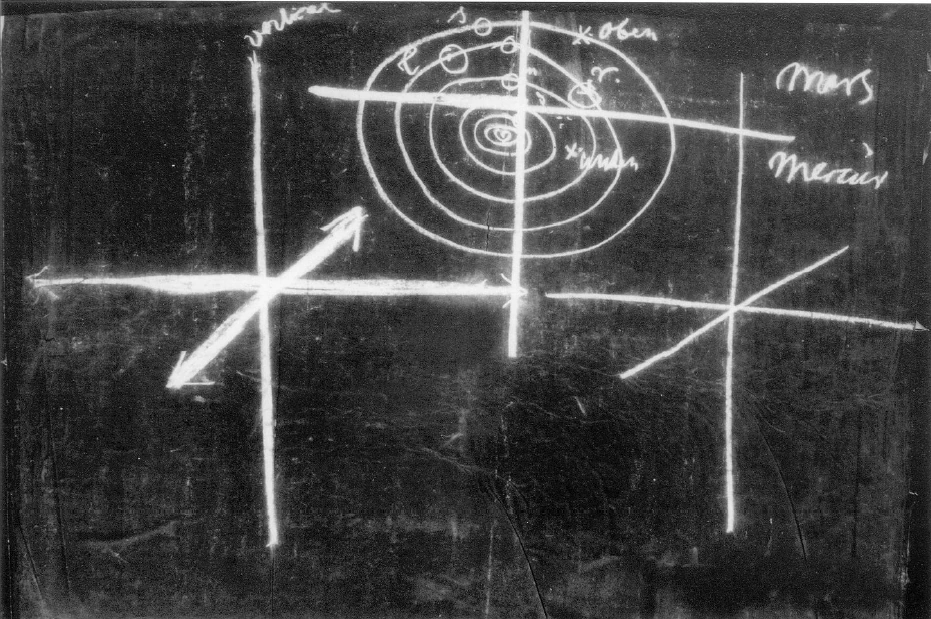
[ 7 ] People can also discover this dimension (the horizontal one) only by experiencing it within themselves. If you extend your hands and arms in relation to the vertical dimension, you will experience the second dimension. And if you add to this what you experience when you breathe, when you speak—that is, when you inhale or exhale air—or when you eat, as the food moves from front to back within your body, you experience the third dimension as well. It is only by experiencing these three dimensions within themselves that human beings project them into external space. There is absolutely nothing that a person can find in the external world without first finding it within themselves. But the peculiar thing is that, in the age of abstraction since the mid-15th century, people have reduced these three dimensions to a single, uniform entity. That is to say, they have simply omitted the concrete differences. They have omitted what makes the three spatial dimensions distinct for them. If they were to give expression to their own human experience, they would actually have to say: my vertical dimension, my active dimension, my encompassing dimension, or my extending dimension. They would have to acknowledge a distinction between these three spatial dimensions. But if a person were to acknowledge a difference between these three spatial dimensions, then he would no longer be able to conceive of the astronomical worldview in such an abstract way as he does. For then he would arrive at a worldview that is not so purely intellectualistic. Instead, he would have to experience in a concrete way how he relates to the world with regard to these three dimensions. He does not experience this today. Today he does not experience the act of standing upright, of being in the vertical. Therefore, he also does not know that he is in this vertical plane fundamentally because he moves with the Earth in a certain direction that maintains this vertical (Plate 2, center top. Earth with a vertical line). Nor does the human being realize that his breathing, his digestive and eating movements, and other movements that proceed in the same direction, all occur in a certain direction through which the Earth, in turn, moves along a certain line (the previous drawing is supplemented by the wavy line). All this alignment with certain directions is a process of integrating oneself into the movements of the universe. Today, human beings completely disregard this concrete understanding of the dimensions. Consequently, they cannot place themselves within the cosmic process; consequently, they also do not know how they are situated within this cosmic process, how they are, so to speak, a link in this cosmic process. It will become increasingly necessary to take steps through which human beings gain a certain understanding of humanity—a certain self-knowledge—regarding their place within the universe.
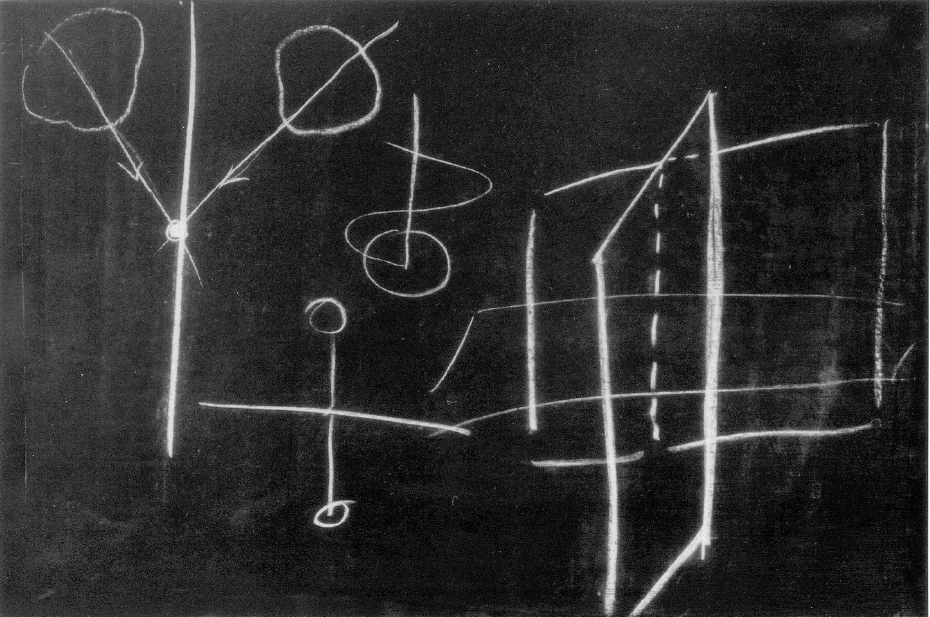
[ 8 ] Now, to begin with, the three spatial dimensions have indeed become so abstract for human beings that it is extremely difficult for them to train themselves to feel how they participate in certain movements of the Earth and the entire planetary system by being active within these three spatial dimensions. But the way of thinking in the spiritual sciences can be extended to human understanding if, at least initially, a substitute is sought for this difficult-to-attain understanding of the three spatial dimensions. And we can more easily rise to this spatial understanding of the human being if, instead of focusing on the three spatial lines that are perpendicular to one another, we consider three spatial planes. Here I ask you to consider the following, at least for now: You will easily see that your symmetry has something to do with your thinking if you pay attention to the fact that you make an elementary, naturally given gesture when you want to express judgmental thinking through gesture. By placing your finger directly on your nose, you pass through this vertical plane of symmetry, which divides you into a “left” and a “right” person (Plate 2, right). This plane, which runs straight through your nose and through your body and is meant to represent the plane of symmetry, is the one you can become aware of as something related to all the distinguishing that takes place within you—all distinguishing thought and all distinguishing judgments. Starting from this elementary gesture, it is possible to actually become aware that, as a human being, one has something to do with this plane in all one’s activities.
[ 9 ] Consider, for a moment, how your vision works. You see with two eyes. You see with two eyes in such a way that what the two eyes do converges here (Figure 2, left). A point located here—you see it from the left and from the right—but you see it only once, because the lines of sight intersect, and they intersect in such a way that they meet in the plane I have drawn here. Much of our human activity is organized in such a way that understanding and perception have something to do with this plane.
[ 10 ] We can then look at another plane that would run roughly through the center of our heart and that would separate the person at the back from the person at the front. The person at the front is structured physiognomically. He is the expression of his soul being. This physiognomic-soul structure of the human being is separated from the rear structure by a plane that is perpendicular to the first plane (previous drawing, second vertical plane). Just as our right and left selves are separated by a plane, so too are our front and rear selves separated by a plane. All you need to do is extend your arms and hands and direct the physiognomic part of the hands—as opposed to what is merely the organic part—forward, and the organic part backward; then, through the main points and main lines that result, you can establish a plane, and you will obtain this plane that I am referring to here. — Similarly, you can establish a third plane that would separate everything above—the head and face—from everything below—the torso and limbs. This would give you a third plane that is perpendicular to the other two, is horizontal, and would run roughly all the way through your arms if you held them like this (extended to the sides, palms facing down). Your hands would then lie within this plane.
[ 11 ] One can develop a sense of these three levels. I have already explained how to develop a sense of the first level. It can be understood as the level of discriminating thought. The second level, which divides the human being into a front and a back, would be the very level that points directly to what makes a human being human. For you could not draw this level onto an animal in the same way. You can draw the plane of symmetry onto an animal, but not the other vertical plane. This second vertical plane is connected to everything that constitutes human volition. And the third, the horizontal plane perpendicular to it, is connected to everything that constitutes human feeling. Just try once again to gain a sense of these things from the elementary gestures. You will see that this is possible, that you are capable of doing something like this. After all, everything in which a person expresses their feelings—whether it be a feeling of greeting, a feeling of gratitude, or any other form of empathy—approaches the horizontal plane in a certain way.
[ 12 ] Similarly, you can see that, in a certain sense, you must always relate volition to the specified vertical plane. It is possible to develop a sense of these three planes. Once a person develops a sense of these three planes, he will be compelled to conceive of the universe in terms of these three planes, just as he—when he conceives of the three spatial dimensions only in an abstract way—calculates the universe’s movements and positions in a mechanical-mathematical manner, whether Galilean or Copernican. But then concrete relationships will enter into this universe for them. They will no longer calculate merely according to the three spatial dimensions, but will become aware that within themselves—as they learn to sense the three planes—there is a difference between right and left, a difference between up and down, and a difference between front and back. From a mathematical standpoint, it makes no difference whether something is a little further to the right or to the left, forward or backward. When we merely measure, we measure from bottom to top, from right to left, and from front to back. Whether three meters are located in this or that position, they are still three meters. At most, we distinguish between the dimensions that are perpendicular to one another so that we can move on to motion. But we do this only because we cannot stop at mere measurement; otherwise, the world would shrink down to a straight line for us. But if we learn to characterize concrete thinking, feeling, and willing within these three planes, and if we learn to place ourselves—as soul-spiritual beings with our thinking, feeling, and willing—into space, then we will learn—just as we learned to apply the three dimensions to astronomy as part of our understanding of the human being—to apply this structure of the human being to astronomy as well. And we will then have the opportunity—if we take Saturn, Jupiter, Mars, the Sun, Mercury, Venus, the Moon, and then the Earth here (Plate 1, center)—to view the Sun, based on its outward manifestation, as something that divides, something that separates. And we will have to imagine a plane established by the Sun (the horizontal line is drawn) and will then no longer view what is above the plane and what is below it merely in terms of distance, but we will regard this plane as something that separates, and will now distinguish between the upper and the lower. So we will no longer simply say that Mars is so many miles away from the Sun, or Venus so many miles away, for we will learn to apply human understanding to our understanding of the world, and we will say to ourselves: Just as it is not simply a matter of dimensions when I say that the human head or nose is this far from the horizontal plane—which I have called the plane of feeling—and the heart is that far away, but rather I will relate this distance—both downward and upward—to form and structure; so too will I no longer merely say: Mars and Mercury—one is this far, the other that far from the Sun—but I will know that, if I regard the Sun as something that separates, Mars above must have a different nature than Mercury below. And I will now also be able to draw, let’s say, a plane perpendicular to it, passing through the Sun (the vertical line is drawn). Then Jupiter or Mars will move in such a way that it is to the right of this plane (r), and it will move across to stand to the left of the plane (l). If I proceed purely abstractly according to the dimensions, it is sometimes to the right, sometimes to the left, so many miles away from the plane. If I concretize this in outer space—just as I must concretize it within myself as a human being—then it is not indifferent to me whether the planet is sometimes on the right and sometimes on the left; rather, I will say that there is a difference between whether it is on the right or on the left, much like the difference between a right-sided and a left-sided organ. It is not enough for me to say that the human liver is so many centimeters to the right of the plane of symmetry and the stomach so many centimeters to the left; rather, the two differ in their structure precisely because one organ is on the right and the other on the left. Here, Jupiter becomes something different when it is on the right and something different when it is on the left—purely to the eye.
[ 13 ] Similarly, I could introduce a third level, and I would again have to base my judgment on how that level is. But at the same time, if I were to extend my understanding of humanity to the entire universe, I would be compelled to view everything pertaining to the first level in a manner similar to how I view human thought; to view everything pertaining to the second level in a manner similar to how I view human feeling; and to view the third level in a manner similar to how I view human volition.
[ 14 ] I merely wanted to show you that this latest worldview retains a final remnant of the utmost abstraction: three lines standing perpendicular to one another in any order, to which the positions and movements of the stars are related, and based on these positions and movements of the stars, calculations are made of the universe as if it were a mechanism. In the Galilean astronomical view, one relates only this “ezze”—this entirely abstract space with its point relationships—to the universe. One can extend this to a deeper understanding of human nature. One can say: Human beings are beings—thinking, feeling, willing. As outwardly spatial beings, their thinking has something to do with one plane, their willing with a plane perpendicular to it, and their feeling, in turn, with a plane perpendicular to that one. This must also relate to the external world. In fact, since the mid-15th century, human beings have known nothing else at all except that they extend across the three abstract dimensions. The rest is merely notes of knowledge; the rest is merely collected observational material. A true understanding of the human being must be regained; then, by way of this understanding of the human being, an understanding of the world will also be attained. And then we will learn to understand how necessity and freedom can be connected, how both can find a place within the human being, in that the human being is born out of the world. For, of course, if one takes only this last remnant of human nature—the three mutually perpendicular dimensions—and regards it as the very thing one still wishes to comprehend, then the entire universe also appears to us as immensely poor, infinitely poor. And our current astronomical worldview is infinitely poor. But it will not become richer unless we first advance to a true understanding of the human being, unless we first learn to truly look into the human being.
[ 15 ] This is connected to certain points I raised here the day before yesterday in a public lecture; it is connected to the fact that an anthroposophically oriented worldview leads the material realm directly into true spiritual knowledge. Do not things like thinking, feeling, and willing appear today as terribly barren abstractions to human understanding? People simply do not examine themselves closely enough. People do not actually ask themselves what they mean by the words they use. That is why so much has become mere phraseology. One should really ask oneself conscientiously, when uttering the word “thinking,” whether one actually has a clear mental image of what it means—not to mention “feeling” and “willing.” But consider how this phraseological use of words gives way to a concrete vision when one truly returns to the image. Even if we have just this one image for thinking—reaching for our nose—we don’t always have to do it, but we know that this movement always wants to be performed in the situation when we are supposed to think; or we also point to our chin when we are supposed to pay attention—so, we reach right into this plane because we also want to judge there what we are listening to. We divide our organism, so to speak, into a left and a right half, because we always do something different with the left sensory organ than with the right. You can gauge how you do something different with the left sensory organ than with the right by the fact that you actually always do something with the left sensory organ that, even in thinking, is like a feeling of the object. With the right sensory organ, you, so to speak, sense your own sensing. Only then does it become your own. You would never be able to arrive at the concept of the “I” if you could not perceive what you experience on the left through what you experience on the right. Simply placing your hands one on top of the other is an image of the concept of the “I.” It must be said that when a person moves from mere verbal expression of life to vivid imagery, they thereby become richer inwardly and also gain the ability to imagine the universe in a richer way.
[ 16 ] By embarking on this path, life will once again flow into the universe, and we as human beings will experience a sense of participation in the life of the universe. Then it will once again make sense to connect the universe with humanity, to build a bridge from the universe to humanity. Only when this bridge is built can we begin to understand whether there truly is a naturally necessary impulse in the universe for everything that exists within human beings; whether the universe determines us through and through, or whether it leaves us free in a certain way. As long as we live only in abstractions, it is impossible for us to build any bridge between the moral and the natural. We must first be able to ask ourselves: How far does the natural extend in the universe, and where does something occur in the universe that we cannot subsume under the concept of the natural? Then we arrive at a relationship—one that is also significant for human beings—between the natural and the free, the moral. In this way, you will learn once again to associate meaning with the words: Mars is a planet far from the Sun, Venus a planet close to the Sun. — By simply stating the distances in abstract numbers, you have said nothing at all, or at least very little. For everything that is described in this way—and, after all, everything in modern astronomy is described in this way—everything that is merely defined in this way is defined in exactly the same way as if you were to look at the line that runs through a person’s two arms and hands and then speak of an organ that is two and a half decimeters away from that line. Yes, but the one organ that is located at a distance from this line (Plate 2, center bottom) may be located downward from it, while the other organ may be located upward from it. It is not merely important that these organs are located at such-and-such a distance, but it makes a difference that one organ is located so far upward and the other so far downward. If there were no difference between above and below, then there would be no difference between your nose and your stomach or between your eyes and your stomach. The eye is an eye only because it lies above this line; the stomach is a stomach only because it lies below this line. The inner nature is determined by this position.
[ 17 ] And so, too, the inner nature of Mars is determined by its position outside the Sun’s orbit, and the nature of Venus by its position within the Sun’s orbit. And anyone who does not understand the intrinsic difference between an organ of the human head and an organ of the human torso—one of which lies above and the other below this level—will also fail to grasp that Mars and Venus, or Mars and Mercury, are fundamentally different in nature. The ability to conceive of the universe as organized depends on our ability to read that in which the hieroglyph of organization is presented before our eyes. We must learn to view the human being as a hieroglyph of the universe, for the human being gives us the opportunity to see up close what the essential difference is between the top and bottom of something, the right and left of something, the front and back of something. And we must learn this from the human being. Then we will also find it in the universe.
[ 18 ] Because today’s scientific worldview actually presents a picture of the world that excludes human beings—it recognizes humans only as the highest of animals, that is, as an abstraction—and because human beings are not included in this worldview at all, everything that constitutes the universe appears to this worldview merely as a mathematical image. Within this mathematical framework, the universal origin of freedom and morality can never be recognized. Yet this is the most important thing of our time: that we may learn to scientifically comprehend the connection between morality and natural necessity, so that these two do not drift further apart. And today I have attempted to present to you, in somewhat subtle terms, something that can—I would say—intimately point the way to how knowledge of humanity can be acquired, and from that knowledge of humanity, in turn, knowledge of the world. You see, I was able to show doctors, in a strictly scientific manner, how this path must be sought for medicine, physiology, and biology. Here we must see how it must be sought for a general human worldview, which we need for our modern social life.
[ 19 ] More on that tomorrow.