

Correspondences Between the Microcosm and the Macrocosm
Man — A Hieroglyph of the Universe
GA 201
10 April 1920, Dornach
Translated by Steiner Online Library
Second Lecture
[ 1 ] Let us continue with our discussion from yesterday. My main concern yesterday was to draw your attention to how, in the current cultural epoch of humanity, we summarize in abstract spatial lines—which are perpendicular to one another and form the three dimensions of space—that which actually turns out to be something much more complex and much more concrete in life. However, one can only gain a proper understanding of this matter by grasping it even more precisely. We must ask ourselves the question: Why is it that—if we are truly predisposed to orient our thinking along a vertical plane passing through our axis of symmetry, and to conceive of our will likewise in terms of a vertical plane that, in turn, stands perpendicular to the plane of thought, and then to conceive of the emotional plane as perpendicular to both of these planes—how is it that we do not perceive up and down, right and left, front and back as three distinct directions that must not be confused with one another, but rather that we simply perceive three—I would say—equivalent spatial dimensions? We do speak of length, width, and height, but ultimately, when we imagine three directions perpendicular to one another, we can arrange these three directions such that we set a line—which we initially have lying horizontally—perpendicularly; then the other two are horizontal. In short, we can arrange such a configuration in three different ways. This precisely demonstrates that the very specificity through which these directions are built into us as human beings is abstracted away when we, as human beings today, apply them—even to organize our entire worldview, which includes the sun and the stars, in our perception.
[ 2 ] The question is important: How do we actually manage to derive abstract spatial directions from concrete spatial directions? An animal would not be able to do this. An animal would not be able to readily derive abstract spatial directions from the three concrete ones. An animal would always perceive its plane of symmetry as a concrete plane of symmetry, and it would not relate this plane of symmetry to any abstract direction; rather, at most—if it were capable of abstract thought or of “imagining” at all in the sense that we humans use the term—it would perceive the rotation. It is also the case with animals that they perceive rotation as a deviation of their plane of symmetry from a normal direction. Herein lie important and essential insights for zoology, which will in turn come to light when this matter is studied from the perspective of its real impulses. The fact that animals—as you can see most strikingly in bird flight—are able to find their way stems from the fact that they do not perceive the three spatial directions in an arbitrary manner, but rather that they feel, as it were, a sense of belonging to a very specifically oriented spatial direction, and that they perceive any deviation from this spatial direction precisely as an angle, as a deviation.
[ 3 ] Well, if one wants to fully understand this matter as it pertains to human beings, one must draw upon what we have heard earlier about the structure of the human being. We have heard, after all, that the human being is divided into three parts: the actual head organization—which, of course, does not encompass only the head, but is primarily located in the head, while its extensions spread throughout the entire human being; Then there is what I would like to call the “circulatory human”—everything that pertains to the lungs and heart and through which the rhythmic aspect of the human being is represented. And then there is the “limb human,” with the inward extensions of the limbs, which represents the “metabolic human.”
[ 4 ] The point now is that we take this threefold human being—I would say—truly seriously. Let us picture it schematically: the head human, the rhythm human, the limb human (Plate 3, center). Of these three parts of the human being, only the limb-human—with its extension inward—is strictly integrated into the forces of our earthly planet—we are considering the forces, not the substances, but the forces. The limb-human is strictly integrated into the forces of our planet, our Earth.
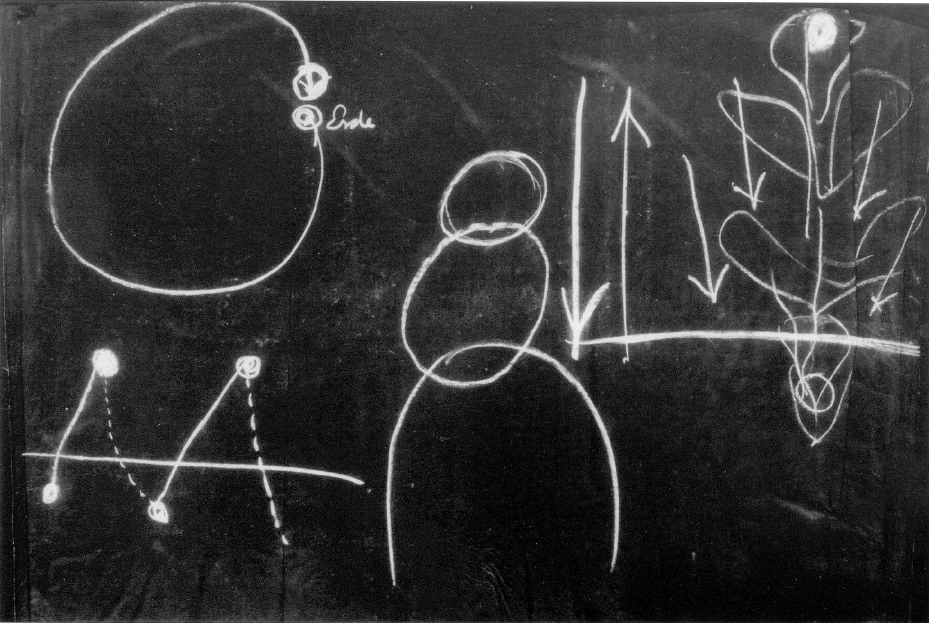
[ 5 ] The “head-human” is not that, for what is this “head-human”? This “head-human”—you need not focus on the substance itself, but rather on the forces, the formative forces, the creative forces that determine it—this “head-human” is, after all, the metamorphosis of the “limb-human” who existed in the previous incarnation, in the previous earthly life. The forces that formed the limb-human in the previous incarnation were in a world that we have often described, between the last death and the last birth—the birth that brought us into this existence. There they underwent a metamorphosis so that they can now form the head. There is thus a complete polar opposition between the limb-human and the head-human. And the middle human is the balance between the two, the one who, through rhythm, creates the balance between them.
[ 6 ] We must now consider this contrast between the “head-oriented” person and the “limb-oriented” person a little more closely. We may perhaps gain a better understanding of what is necessary for us in this area by first considering the following example from a different field. Consider a plant—not a tree, but an annual plant—that sprouts from a seed into a root and, over the course of a year, develops fruit and seeds (Plate 3, right). Such a plant grows by having its seed planted in the earth; from the seed, once planted in the earth, the root and other parts develop, the leaves grow upward to flowering, and in the flower, through the fruit, the new seed develops. A plant’s life cycle is complete. We can schematically illustrate this cycle as follows: The plant originates from the seed, which unfolds through the earth. It grows upward above the earth’s surface. It is nourished by the effects of light, the effects of the sun, and the combined effects of light and heat. There it continues to grow, completes its cycle, and returns once more to seed formation. But now that it has returned to seed formation in the fall, it is no longer underground but above ground; throughout the entire summer, it has also been dependent on extraterrestrial forces—the forces that promote growth from beyond the earth. So the plant has grown to the point of new seed formation, now no longer under the influence of the earth, but has, so to speak, been drawn out of the earth by the non-earthly. It has once again become what it was before, and yet something else. It has become something else. In what sense has it become something else? Yes, it has become something else insofar as this seed brings the growth to a close. That is where it stops, and this cycle (Plate 3, top left) is not yet complete unless we remove the seed from its region and bring it back—in a sense, bring it down to a deeper level—and place it back into the earth. So, by following the seed all the way up into the realm where it is in the extra-terrestrial sphere, we must bring the seed back down beneath the earth. Then it grows toward the heavens once more, and we must bring it back down again and again (Plate 3, bottom left). That is to say, continued growth depends on our bringing the seed back down, as it were, to a deeper level. We must return to the earth what the heavens have brought forth. It is not simply a matter of the cycle; rather, the plant’s development, so to speak, runs its course, and once it has run its course to a certain degree, it must be brought back to its original location. Then it is received by the same forces, and the cycle begins anew. So I can also illustrate this by showing that now, after the plant has come this far, it cannot proceed any further (Plate 4, left. From the seed downward and the first ascent). Therefore, I must say: If this is the level of the earth (horizontal), then I must draw the plant’s cycle in this way. But the plant must now return to the earth. So when I draw several annual cycles of the plant, I must always move a little further along. That is the difference in level. I must always carry the seed back to a different level.
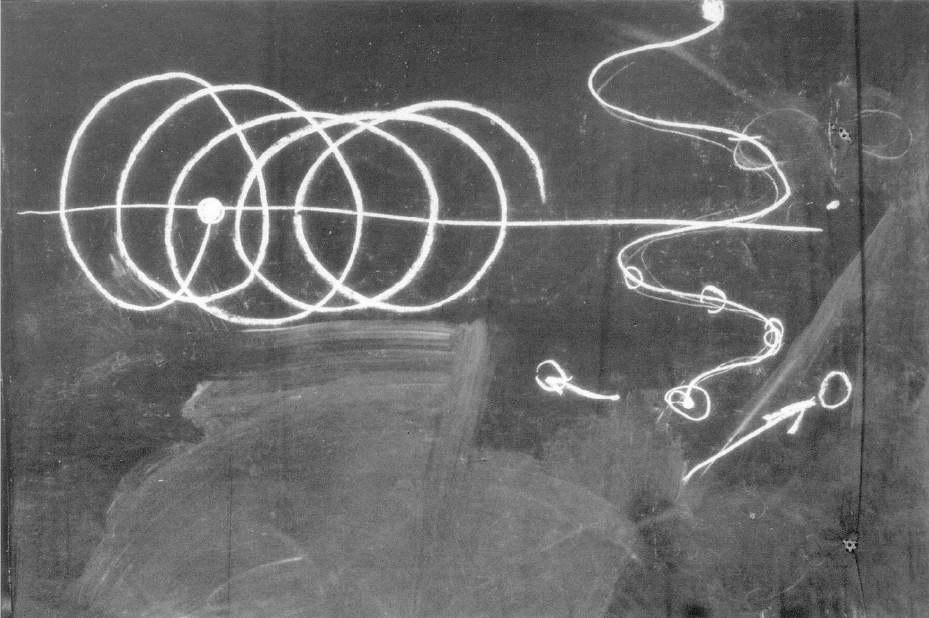
[ 7 ] I first presented this to you as an illustration. But let’s consider something else about this illustration. To understand what I mean, you need only consider the development of the bean plant from the bean seed, and you will see how this process unfolds in detail. You’ll see the matter even more clearly if you consider a plant that twists its stem—that is, if you observe how the plant is not compelled to grow in a perfectly straight line, but rather allows certain forces to act freely, as in the case of the bindweed, which grows toward the seed in this way (Plate 4, right, but only the spiral with the old and new seeds). In this way, it completes its cycle.
[ 8 ] Let us consider this image in relation to human beings. If, instead of focusing on the annual cycle of a plant, we focus on the cycle that extends from one life course through the spiritual world to the next, then we find something similar—something remarkably similar. Let us look, for example, at each of you: at the limb system in your previous incarnation, and now at your head in this incarnation. It arises through a metamorphosis, in which the visible transformation is merely interrupted by everything that happens between death and rebirth. This head arises in the same way as shown here (Plate 3, left), where, in the course of growth, the new seed arises from the old. But the entire rest of plant life lies in between. So that you can say to yourself: In human beings, in terms of their form formation, there is something akin to the root having existed in their previous incarnation, and from this root the head of this incarnation has sprouted. This head thus represents something similar to the seed shown here. Only in the case of human beings is everything, I would say, situated on a different level. It lies in a higher region. It is also more complex.
[ 9 ] Now, to complete this picture, consider the entire metamorphosis of plants. If you observe the morning glory, you will see from its spirally coiled stem—or, more accurately, its helically coiled stem—that the forces acting upon it from the outside do not merely act straight upward, but in fact cause the plant to grow in a spiral. The plant has a tendency to spiral. Only when a new seed forms does this seed resist the spiral tendency; then everything contracts into a tiny seed. There the seed withdraws from the influence of the universe. In human beings, it is the case that, above all, the “limb-oriented human” is subject to the influence of the Earth. In the “rhythmic human,” this is somewhat different; we will return to this later. But the head is something that withdraws from the Earth’s influence; it does not participate in it. Just as the seed here does not participate in extraterrestrial influences, so the head does not participate in the Earth’s influences. The head completely withdraws from the Earth’s influences. Only in this way is it possible for us humans to abstract, to think in abstract terms. If our head were unable to withdraw from earthly influences, it could not think abstractly. It can think abstractly only by withdrawing from earthly influences. This, incidentally, is already expressed in the human form. Just consider for a moment that your head is, in fact, the transformed limb-human. But this “limb-human”—here on Earth, it walks; it moves about on Earth. The head does not participate in this. The head behaves—even though it, too, is merely a human being, albeit one of a later metamorphosis—as if you were sitting comfortably in a car or on a train, remaining still yet moving forward. Your head places itself in precisely this same position in relation to the rest of the organism. The rest of the organism moves forward; the head, however, is like a passenger in a carriage—it rests and does not participate in the movements. It thus visibly withdraws from the influence of the Earth. This is the human being who allows himself to be transported by another human being.
[ 10 ] This is how the human head is organized in general. It is beyond the influence of the earth. And so we can say: this human head represents something—at least initially, figuratively speaking—similar to the seed, which is beyond the reach of the heavenly influence of plant formation. But with humans, it is not the same as with plants. With plants, they grow upward from the earth; that is, they grow against the heavenly influence. Human beings grow downward. They have that which initially eludes the influence of the earth at the top, and everything that grows into the influence of the earth—that is what grows downward. When a human being arrives at conception or at birth, they first appear—and external embryology provides complete proof of this—as a head-like formation. They already bring the head with them as a metamorphosed product from their previous earthly life. Here in this earthly life, the human body—consisting primarily of the limbs—grows from the forces of this earthly life, attaches itself to the head, and is not yet as developed as the head; it is completely exposed to earthly influences. The head withdraws from earthly influences. So we can say: When we observe plants, we can see from the plant’s spiral or helical structure that the forces come from the extra-terrestrial bodies, which give the plant this helical twist. When we look inside the human being, we can see how he grows toward the earth. And we can ask ourselves: What has given human beings this ability—in contrast to the growth of the plant, which grows from the bottom up—to grow from the top down and to adapt to earthly influences? What has given human beings this ability? How is all this connected? This is a fundamental and important question for the study of human morphology, but also for the study of the entire human being. You see, if we were compelled to conduct our soul life without our head, it would be something different. If we conducted our soul life without our head, we would not form abstractions. Above all, we would not form mere three-dimensional space as an abstraction. We would make a strict distinction between: front and back; left and right; up and down. For us, these would be concrete, distinct things. Our organism does the same. The moment you rise, through the method of spiritual science, only as far as the imaginative perception of the world, that is when the convenient three-dimensionality ceases; it is no longer there. There you must make distinctions, for you are, after all, undertaking the peculiar process of shutting off the ordinary organization of the head and returning to the human being’s etheric organization. This is fundamentally different from the physical head organism. Thus, it is only through the fully developed human head—achieved from the previous incarnation into this one—that abstractions come into being. All abstract thinking, all thinking in mere thoughts, is bound to this mental organization; yet we acquire it only by leaving the spiritual world, entering the earthly world, and making that which was previously dependent on the earthly organization now independent of it.
[ 11 ] This points out to you that we, as human beings, are just as much a part of the forces of the universe as plants are. It is only because we make ourselves independent through our minds that we do not participate in these forces. The rest of our organism, if it were to think without the head—which it is capable of doing—would immediately feel itself to be part of the entire cosmic order.
[ 12 ] If one could manage to get a very comfortable sleeper car—though that’s not so easy these days—where one couldn’t look out at all and couldn’t hear the rattling and so on, one might perhaps fall under the illusion that one is in a quiet room. You wouldn’t notice any of the train’s movement. But as soon as you look out the window again, you realize—even though you’re sitting still—that you’re moving forward. As soon as you free yourself from what your mind leads you to believe—by detaching itself from the Earth’s structure—you realize that, together with the Earth’s structure, you’re participating in the Earth’s movements. This means that it is possible, when one rises from the ordinary concrete mode of imagination—as I have called it in my book *How Does One Attain Knowledge of the Higher Worlds?*—to imagination, to feel the Earth’s movements; for when you look out the window there, you are looking into the spiritual world. Just as you look out the window of a train and notice that the view outside is constantly changing, so too, as you move from this physical-sensory world into the spiritual world, you look out the window; and through the changing landscape of the spiritual world—as you pass by—you realize that you are not at rest with the Earth, but are moving along with it. One cannot, therefore, arrive at a true understanding of astronomy’s spatial worldview if one attempts to construct it precisely with that part of our organism that has made itself independent. Just think for a moment about what we, as civilized humanity, have actually been doing since the beginning of this fifth post-Atlantean epoch. We have thought about the world with our heads. But it is precisely the head that has made itself completely independent of the world, that has filtered the directions of the world down to the abstraction of the three spatial directions. We have thus devised a worldview—the Copernican worldview—using the most unsuitable means imaginable for this purpose: the human head, whose essential characteristic lies precisely in its emancipation from participating in the movements of the world. It is much like trying to get a picture of, say, the movements of a train—which you experience firsthand by riding on it—from a sketch you make with your fingers, while orienting yourself not at all by the train’s movement but by your own ideas. You are, after all, sketching something; you are making yourself independent. You cannot regard this as a picture of the train’s movement, for it is entirely independent of it. The picture we construct of external, spatial-astronomical world events is just as independent when we use the most unsuitable means for the task.
[ 13 ] Now consider what a realistic view of the present compels us to do. We are compelled to say that the spatial, astronomical view of the universe has been constructed using the most unsuitable means. No wonder that it conflicts with everything that emerges as soon as one uses appropriate means. Of course, for certain purposes, this worldview is initially suitable. Why? Because we have become accustomed—and had to become accustomed—since the middle of the 15th century, since the dawn of the fifth post-Atlantean period, to thinking independently of the universe. We will hear tomorrow why this has come to be. But as a result, we have lost the ability to truly know anything about those movements that we experience along with the Earth’s movement through the universe—movements that become apparent the moment we train ourselves to perceive the otherwise abstract spatial dimensions concretely, as I briefly outlined for you yesterday. And we will delve deeper and deeper into these matters. One cannot approach them in any other way than—I would say—by proceeding in circles.
[ 14 ] Now, following yesterday’s hints, Dr. Stein has taken the trouble to set up a model here for the motion that results, roughly speaking, when one follows the human being along with the Earth—in other words, for the motion of the Earth, taken in purely absolute terms. Instead of tracing the movement of the plant forces in spirals here (Plate 4, right), when I trace the movement that a person undergoes along with the Earth—that is, the movement of the Earth itself—I also arrive at such a spiral, one that, however, progresses. And this spiral gives me a picture of the Earth’s actual movement. At the same time, it gives me a picture of the Sun’s movement. For you see, suppose the Earth were here and the Sun were there (the positions of the Sun and Earth are drawn into the illustration). An observer sees the Sun moving in this direction. The Earth moves forward, but exactly along the line behind the Sun. Thus, the observer sees the Sun in the opposite direction when the Earth is now in that position. Now the Sun continues here, the Earth following it here; now the Sun is here, the Earth here. The observer again sees the Sun moving in the opposite direction. That is to say, as the Earth follows the Sun in this way, an observer sees the Sun on the right one moment and on the left the next.
[ 15 ] This has been interpreted to mean that the sun stands still and the Earth moves around the sun. In reality, it is not the Earth that moves around the sun, but rather the Earth follows behind the sun. The observer sees the Sun on the right when the Sun has reached this point on the helical path and the Earth has arrived there; here he sees the Sun on the left, here on the right, here on the left. To the naked eye—if one does not perceive one’s own motion—this appears no different from a situation in which the Earth were not moving at all.
[ 16 ] You can see from this how easily one can be misled by judging based on outward appearances, for in this regard there is indeed a relativity of motion. One can truly say that one’s own motion is not perceived even by those who are now making calculations and who do take the apparent motion of the Sun into account, but who do not take into account the Earth’s relationship to the Sun.
[ 17 ] Now I would like you to try to visualize what I have just said about the Earth’s movement in a helical path. For one must indeed first use such a model to properly visualize the Earth’s pursuit of the Sun—its trailing behind it—and only then will one be able to move on to what we will, I believe, reach tomorrow: namely, a genuine process of coming to understand what is actually taking place there. I have deliberately given only hints today, and—I might add—I have intentionally left some questions open. But these questions will be answered as early as tomorrow or in the next few lectures. I simply wanted to present to you, in a communicative way, what is experienced by someone who looks out the window from the physical world and perceives the spiritual world outside—perceives the spiritual world rushing past—so that they can form a judgment as to what the Earth’s actual motion is and what the Sun’s actual motion is. But I will show you that a conception of how the Earth relates to the Sun—that it truly follows behind it—can only be gained by seeking out the one thing in which the relationship of the Earth to the Sun can truly be found, namely, by finding the relationship of certain processes in the human organism to the human representative of the Sun: the human heart. For, starting from our understanding of the human being, we must in turn gain an insight into the universe.
[ 18 ] Let's talk more about that tomorrow.