

Correspondences Between the Microcosm and the Macrocosm
Man — A Hieroglyph of the Universe
GA 201
11 April 1920, Dornach
Translated by Steiner Online Library
Third Lecture
[ 1 ] In these reflections, I wanted to draw your attention to certain points that must, in turn, lead to a more concrete view of the universe than the Copernican worldview. We must not forget that this Copernican worldview emerged at a time when, since the mid-15th century, people had increasingly tended toward the most abstract conception of the world, toward the highest degree of abstraction, and that we need—and this must be particularly emphasized—to move beyond mere abstraction and once again apply specific concepts, whose content includes more than just the abstract, to the universe. It is not a matter of us now being able to immediately sketch on the board, in every detail, a picture of the universe similar to the Copernican one, just with slightly different lines. This struck me strongly in the various questions and yearnings that arose yesterday. The issue there was that people wanted to draw lines again right away, which would in turn represent a worldview in the most extreme abstraction. That is not what matters, however; what matters is grasping the non-human in its spiritualization, in order to be able to build a bridge from the spiritual within the human being to the spiritual outside the human being. You must also bear in mind that here and now, at this very moment, the task at hand certainly cannot be to present a lecture on mathematical astronomy. That would require first working out this mathematical astronomy from the elements themselves. For the basic concepts used today have arisen precisely from the entire materialistic way of thinking that has prevailed since the mid-15th century. And the point is that if one were to complete the worldview we have sketched, one would then need to work entirely from the elements themselves. For you see, precisely in the fate—I might say—that Copernicanism has undergone, it is evident that striving too strongly toward the abstract will always lead to certain, I might say, intellectual excesses. For Copernicanism is not actually what it has become among the Copernicans. People have cherry-picked from certain teachings of Copernicanism those that suited them, particularly over the course of the last few centuries, and this is how the current, school-based worldview came into being.
[ 2 ] I certainly do not wish to contribute to the emergence of yet another scholastic worldview that does not take the elements as its starting point—one in which, instead of the familiar ellipse, with the Sun at one of its foci and the Earth moving with an axis inclined to the plane of its orbit, a helical line is simply drawn instead. My aim was to depict humanity’s relationship to the world. And this time, let us pursue the matter in this direction.
[ 3 ] I have attempted to explore how, at the very moment one shifts even slightly toward a more intense experience, the three directions of space are by no means equivalent for the human being who experiences himself in his physical form, but rather how they differ from one another. Only the intellectual abstraction behaves in such a way that it abstracts three indifferent spatial dimensions from this, by not distinguishing—with regard to three-dimensionality—between up and down, right and left, and front and back, but rather simply conceives of front and back, up and down, and right and left as three lines. One would immediately fall into a similar error if one were now to attempt to construct something abstractly within space. What is important here can be made clear to us by looking at other things—at least initially, I would say.
[ 4 ] Let’s take a look—but really only to illustrate the point—at colors. I’d like to mention the example of color once more. Let’s assume we have a blue area and, for the sake of argument, a yellow area (Plate 5, the two squares—blue on the left, yellow on the right). The same worldview that shaped the Copernican world picture out of its abstractions is also what enabled it to say: “The blue is in front of me; the yellow is in front of me.” This stems from the fact that something makes an impression on me. This impression appears to me as yellow, as blue. — Yes, the point is that one does not even begin to theorize in this way: “Yellow is in front of me, blue is in front of me,” and it makes some kind of impression on me. You see, this is an approach that can be compared to the word “Bild” (the word is written on the board). If someone now comes along and starts pondering: “B”—there must be something behind it; behind this “B” I’m looking for vibrations that cause this “B.” Then again, behind the “z” there are vibrations, behind that there are vibrations, and so on. That makes no sense. It only makes sense if we connect the four letters with one another—within their own framework, I would say—and read “Bild”; that we do not speculate: “What’s in there?”—but rather that we read “Bild.” And so it comes down to this: this surface (blue) prompts me, as it were, to delve behind it, to penetrate it. This surface (yellow) prompts me to move away from it. Try to grasp these feelings into which the impressions merge—then you arrive at the concrete. And when one seeks in the external world what one experiences internally, one also comes to the realization that one is not at all inside oneself, but that one lives with one’s true self in the world, poured out into the world. Instead of searching for vibrations in the external world, the atomists should search for their “I” behind it and seek to understand how their “I” is framed, how it is poured into this external world. Just as we should examine a color to determine whether we should immerse ourselves in it or feel repelled by it, so too should we, in shaping our organism, sense how the three directions—up and down, forward and backward, right and left—are concretely distinct from one another, and how, when we place ourselves within the world, these three directions are experienced differently within us. And when we then recognize ourselves as human beings standing on Earth, with the Earth surrounded by the planets and fixed stars, we will also feel that we belong within that context. But we will also feel within that context that it is not merely a matter of drawing three mutually perpendicular dimensions, but rather of concretizing within the universe, of penetrating into the concreteness of the directions.
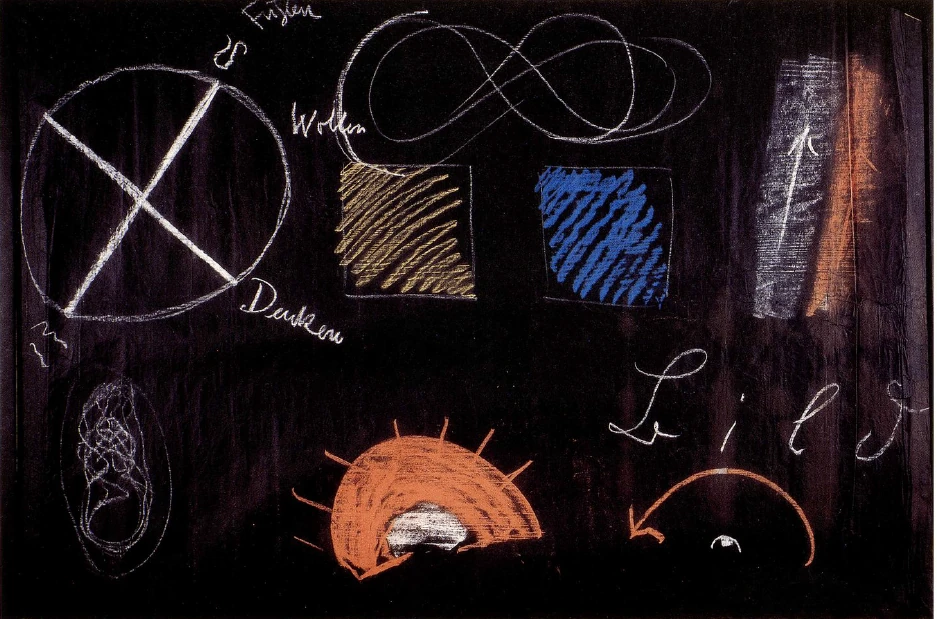
[ 5 ] Well, one thing becomes immediately apparent to anyone who observes the external world at night—something that has always been apparent as long as people have gazed at the stars at night. It is what we call the zodiac. And it also becomes clear that, whether we believe in the Ptolemaic model of the universe or the Copernican one—it makes no difference in this regard—it follows that when we trace the apparent path of the Sun, we see the Sun moving through the zodiac. Even in its daily course, we see it, so to speak, passing through the zodiac. But this means that, when we immerse ourselves vividly in the world, the zodiac offers us something essential, something significant. We cannot regard just any other plane placed within the celestial sphere as equivalent to the zodiac, any more than we can arbitrarily define the plane that bisects us and determines our symmetry. So we can say: It is that which we perceive or see as the zodiac, such that we can establish a kind of plane through it. Let me assume that this plane lies within the board. Let this be the zodiac (it is drawn as the circle at the top left), so that its plane is precisely the plane of the board. With this, we have a plane in the cosmos before us, just as we have imagined three planes drawn within the human being. This is undoubtedly a plane of which we can say that it manifests itself as fixed for us. As we watch the Sun traverse the zodiac, we relate the phenomena of the heavens to this plane. This is at the same time an extrahuman analogue to what we must perceive and experience as such a plane within the human being itself. And now—just as, for example, when we draw the plane of symmetry in the human being, we cannot conceive of it without an inner, concrete relationship—namely, that on one side lies the liver, which is of a different nature than the stomach, and on the other side lies the stomach— we will likewise not be able to conceive that there are merely spatial lines there, but rather that what exists in space manifests itself in specific forces of action, and that it is not indifferent whether something is on the left or the right, but that it matters very much. Likewise, we will have to conceive that, in the organism of the universe, it matters whether something is above the zodiac or below the zodiac. We will begin to think of what exists there as cosmic space—studded with stars—in such a way that we conceive of it as having form.
[ 6 ] Just as we have this plane here—which is the plane of the blackboard—we can imagine another plane that is perpendicular to it. Imagine a plane that runs roughly from the constellation we call Leo to the constellation Aquarius on the other side. Then we can imagine a third plane perpendicular to it, running from Taurus to Scorpio, and we have drawn three mutually perpendicular planes in outer space. These three mutually perpendicular planes are analogous to the three planes we have imagined drawn within the human being. If you imagine the plane we have designated as that of volition—which thus separates our front from our back—you would have the plane of the zodiac itself. If you imagine the plane running from Taurus to Scorpio, you would have the plane of thinking; that is, our plane of thinking would correspond to this plane. And the third plane would be that of feeling. So here, too, you have the cosmos structured into three planes, just as you saw the human being structured into three planes the day before yesterday.
[ 7 ] The important thing, first of all, is not simply to quickly relearn the Copernican world system, but to engage with this concrete reality—in a sense, to conceive of the universe itself as organized in such a way that one can structure it into three such mutually perpendicular planes, just as one can structure the human being into these three mutually perpendicular planes...
[ 8 ] Well, the next question that must arise for us is this: Is humanity truly and completely integrated with everything that appears to us as the external picture of the world, including humanity itself? Yesterday we pointed out that the Earth, together with the Sun and the other planets, moves forward in a spiral path. Of course, this is only a schematic representation, since the spiral itself is curved. But that is not the point. What matters now is that the Earth follows the Sun along such a spiral. I pointed this out yesterday. Now the question is: Is the human being truly so bound up in this movement that he must necessarily go along with it? If human beings are so bound up in this movement that they must absolutely participate in it, then there is absolutely no room left for freedom or for the exercise of morality. Let us not forget that we began precisely with this question: how can we bridge the gap from mere natural necessity to morality—to that which occurs under the impulse of freedom?
[ 9 ] Yes, you see, you won’t get anywhere if you rely solely on what the Copernican worldview offers you. For what does it actually offer you? You imagine the Earth. You’re standing on it. Whether the Earth is whizzing by for my sake or the Sun is whizzing by—it doesn’t really matter. If things are linked to human beings through absolute natural causality, then it’s simply not possible for human beings to develop their freedom in any way. We must therefore ask the question: Does the entire essence of the human being lie within this natural causality, or does it extend beyond it? But we must not pose this question in the same way it was posed by the materialists of the 19th century, who pointed out that so many people have already died on Earth that it would be impossible for all the souls of the deceased to have a place. They asked about the space occupied by the souls. The question is to what extent it makes sense to ask about the soul’s place.
[ 10 ] Well, you see, first and foremost we must be clear that the entire meaning of what is happening in the universe—and movement is also a happening—becomes apparent to us only when we grasp it in specific cases. You see, we somehow distinguish what is taking place in these four or eight realms—what lies above and below the plane of the zodiac, to the right and left of the plane of feeling, on this side and that side of the plane of thought—and we sense that something in the course of world events is connected to it. And as we isolate a certain aspect of world events, it manifests in such a recurring pattern that we call the course of the year. We call it the course of the year, and we must now ask ourselves in concrete terms: How can we find a connection between the human being and the outer course of the world year? First of all, we find that as the human being descends from the spiritual world into the physical world, he or she passes through conception. Then he or she remains in the embryonic state for about nine months. That is three months less than the course of the year. We might say: That is something quite irregular. From the very beginning of their physical existence on Earth, human beings show that they seemingly pay no heed to the course of world events outside. But this is not the case. If we are attuned to observing the child during the first three months of its earthly life, what happens during those first three months is, in the true sense, a continuation of its embryonic life. Such a continuation is what happens to the brain, as well as what else occurs specifically with the child. These first three months, which make up the full year, can in a certain sense still be counted as part of embryonic life, so that we can say: in a certain sense, the first year of human development is indeed situated within the course of the year.
[ 11 ] Then another year passes—roughly a year. For when we observe a child after this first year, he—of course, we must take the average here, the arithmetic mean, but approximately speaking, this is the case—will be at about the stage where he begins to get his baby teeth. We look at another year, after a year has already passed since conception, and observe that the development of the first teeth in this subsequent year generally corresponds to the course of the year. And now we ask ourselves: Does this continue in this way? No, it does not continue in this way. For in fact, the emergence of the first teeth seems to be an inner human annual cycle—and indeed it is, just as the first year of a human life is an inner annual cycle of the human being. In the formation of the baby teeth, the universe is evidently at work within the human being. Then something else comes into play. Then, during a period after birth that is seven times longer, the force that drives the second set of teeth out of the person is at work within them. Something is taking place here that we cannot yet connect to the course of the universe, but which is related to something that eludes the course of the universe—something that acts from within the human being.
[ 12 ] Now you have something concrete. Now you have—I would say—projected the world organism into the human being, in relation to a series of facts, through the formation of the baby teeth. And then, in turn, you observe the emergence of the permanent teeth that emerge from within the human being. What emerges there as permanent teeth introduces an inner human world order into the outer world. Here you can see the first sign of freedom in the fact that the human being undertakes something that is very clearly evident in its dependence on the universe—in that it follows the course of time in the universe even within the human being—but that the human being then slows this down within themselves, giving the same process a different speed, a speed seven times slower. That is why it takes seven times longer. Here you have the inner world of the human being set in contrast to the outer world of the cosmos.
[ 13 ] We have illustrated in a very vivid way a certain dependence of human beings on the outer universe by the fact that we alternate between sleeping and waking, and that the alternation between day and night occurs at different times for different parts of the Earth. What does the alternation between waking and sleeping mean for us humans? It means that, roughly speaking, at one time we go about our business with our “I” and our astral body united with our etheric body and physical body, and at other times with the two—the “I” and the astral body on the one hand, and the etheric body and physical body on the other—separated from one another.
[ 14 ] But the fact is that in today’s cultural cycle—especially if one calls oneself a civilized person—human beings are no longer fully dependent on the natural cycle. The cycle of waking and sleeping still resembles the natural cycle in its temporal rhythm. But there are even people today—I have known such people—who turn night into day and day into night; in short, human beings can break free from their connection to the course of the world. Yet their inner regularity—the succession of states within them—still bears the afterimage of this external regularity. And so it is with many phenomena in human beings. When we observe how human beings alternate between waking and sleeping, and nature alternates between day and night—and although human beings today are bound to the alternation of waking and sleeping, they are not bound to the rhythm of day and night—we must conclude: they were once bound, through their inner states, to the outer course of the world and have torn themselves away from it. Civilized human beings today are almost completely detached from the external course of nature and actually return to it only when they realize—that is, when they discover through their intellect—that it is better for them to sleep at night rather than during the day. But it is not the case that night takes hold of a person in such a way that they must inevitably fall asleep. In fact, this is true for all civilized people: they do not feel that “night makes me fall asleep” or “day wakes me up.” At most, when night falls and a lecture is still being given, the night—combined with the lecture—might have such an effect on some people that they inevitably perceive it as a natural urge to fall asleep. But these are things we do not necessarily need to force into our worldview.
[ 15 ] So what this is all about is that human beings have torn themselves away from the course of nature, yet the rhythmic flow still reflects the image of that natural course. See how transitions take place from one to the other. We can say that with our waking and sleeping, we still clearly reflect the natural course in our patterns, yet we have broken away from this natural course. When we get our second set of teeth, we no longer reflect, in the sequence of time, the natural course that is still expressed in the emergence of our first teeth. But what occurs in us then—this emergence of the second set of teeth—is a new natural course. For we do not have control over this in the same way as we do over sleeping and waking. Our will has no say in the matter. Here, something is brought forth from nature that is not at all part of the grand course of nature, but which the human being possesses specifically for themselves. Yet it does not lie within their free will. A different natural order is superimposed upon the first.
[ 16 ] As I explain these things to you, I am essentially telling you everyday things. But the point is to understand such everyday things in the right way. You see, you will now have to tell yourself: There is a certain natural process. The emergence of a person’s first teeth is part of this natural process. I would like to illustrate this natural process within this current—if I may say so—in this way (Plate 5, top right: the left-hand current). There is a general natural process, and within it—as part of it—the emergence of a human’s first teeth continues to unfold. And then we have another natural process that is not at all part of the general cosmic process, but is specific to human beings: the emergence of the permanent teeth. If you wanted to draw this, you would have to depict it as a separate current (the current to the right of it, in red). But that wouldn’t make it stand out yet; it would be the same. So we can’t draw it that way; we have to do it quite differently. If we want to illustrate the relationship between the first set of teeth and the second set of teeth, we might have to draw the first set of teeth like this (bottom center; the white core)—and the second set of teeth, we might have to draw like this (the wide ring around the core, red), so that this white is contained within the red here seven times (7 sections are indicated). This means that if you draw them side by side, parallel to each other, you won’t get a picture of the relationship between the first set of teeth and the second; rather, you’ll only get a picture if you have the force on which the first set of teeth depends encircled by another force on which the second set of teeth depends.
[ 17 ] As you can see, the difference in speed simply necessitates that the motion curves. So consider this: if there is a star somewhere in space, and another star orbits it in such a way that a certain segment appears seven times as a result of its orbit (bottom right on the board, large red arc), then simply by virtue of the fact of the orbit, you obtain something qualitative—a creation.
[ 18 ] So when we look at the first set of teeth coming in and the second set of teeth coming in, we must say to ourselves: This must have something to do, in the cosmos, with forces, one of which orbits the other—I want to present this example to you so that you can see what it means to concretely observe movements in the cosmos, what it means to speak of concrete movements in the cosmos—and how empty a phrase it is to say: “Jupiter is so many miles away from the Sun and orbits the Sun along a certain path; Saturn is this far away and orbits the Sun along this path” (center top). — That says absolutely nothing. It is an empty phrase. One only truly knows something about these things when one associates a meaning with them—that such-and-such is Jupiter’s orbit, such-and-such is Saturn’s orbit, and that one orbits the other. In this regard, the necessity of specific events simply exists.
[ 19 ] As I bring these things to your attention, you may say that they are difficult to understand, or perhaps you will not say so; in that case, you will probably feel that there is no need to talk about these things at all. But we must talk about these things, for it is only by learning to speak of them again that we will once more arrive at a clear understanding of the world. And one will break the habit that has emerged so one-sidedly in Copernicanism: the mere conception of the world’s movements along straight lines. Rather, something should now take root in humanity that tells it: It is necessary first to gain clarity about the most elementary experiences before turning one’s gaze outward to the outermost mysteries of the universe.
[ 20 ] We only learn what certain connections—which we simply read from the stars—mean when we understand the corresponding processes within our own organism. For what lies within our skin is nothing other than the mirror image of the external world organism. So if you have a schematic representation of the human being here, and you have his blood circulation there—just schematically—then follow the path of this blood circulation (the same chart, bottom left). Try to follow the path of this blood circulation. That is inside the human being. Go out into the cosmos, look for the sun; it corresponds—we’ll talk about this next time—to the heart within the human being. And what flows from the heart through the body, or rather from the body to the heart—as irregular as it actually is—is in truth roughly similar to the movements associated with the sun’s course. Instead of drawing abstract lines, one should look inside the human being. Then one would find within one’s own skin what is outside in the heavens; but then one would also find the human being placed within the cosmic order, and one would also discover how, on the other hand, the human being is independent of this cosmic order. I have shown you how the human being becomes independent in stages. We will discuss this further next time. But let us keep in mind for now that when we sketch something like this schematically here, it is precisely that—a schema.
[ 21 ] Take a look at the general course of the blood vessels in the human body. Viewed from above, it bears some resemblance to a looping line. Instead of drawing on the blackboard, we should trace the hieroglyphs that are inscribed within ourselves. But then we should learn to understand, from this qualitative aspect, what exists out there in the universe. We can only do this if we are able to recognize the following through experience and experience it through recognition—if, above all, we demonstrate to ourselves what I — as I mentioned here in the first one—that spiritual science is concerned with recognizing that the heart does not function like a pump that drives blood through the body, but rather that the heart is moved by the blood circulation, which is a living entity in itself. And the blood circulation, in turn, is determined by the organs. The heart—as you can trace embryologically—is really nothing more than the result of blood circulation. If one understands what the heart is in the human body, then one also learns to understand that the sun is not what Newton meant—the universal rope-puller who sends out his ropes, called gravitational force, toward the planets, toward Mercury, Venus, Earth, Mars, and so on—where it pulls on the ropes that we simply cannot see, which are the forces of attraction, or it beams light out to them and the like (Plate 6, top, circumference and radii omitted)—but rather, just as the movement of the heart is the result of the living nature of circulation, so the Sun is nothing other than the result of the entire planetary system. The Sun is the result, not the starting point (the same plate, bottom). The living interaction of the solar system creates a hollow at its center that reflects. And that is the Sun. That is why I have often told you that physicists would be utterly astonished if they could travel into the sun and find there not at all what they currently imagine, but merely a hollow space—and, moreover, a sucking hollow space that destroys everything within it, so that it is more than just a hollow space. A cavity, after all, does nothing more than absorb whatever is placed inside it. But the sun is such a cavity that when something is brought into its space, it immediately absorbs it and makes it disappear. There is not just nothing there; there is less than nothing. And what appears to us in the light is the reflection of what first comes from outer space—just as the movement of the heart is nothing other than what accumulates there from the vitality of thirst and hunger and so on, through the interaction of the organs and the flow of blood within the heart.
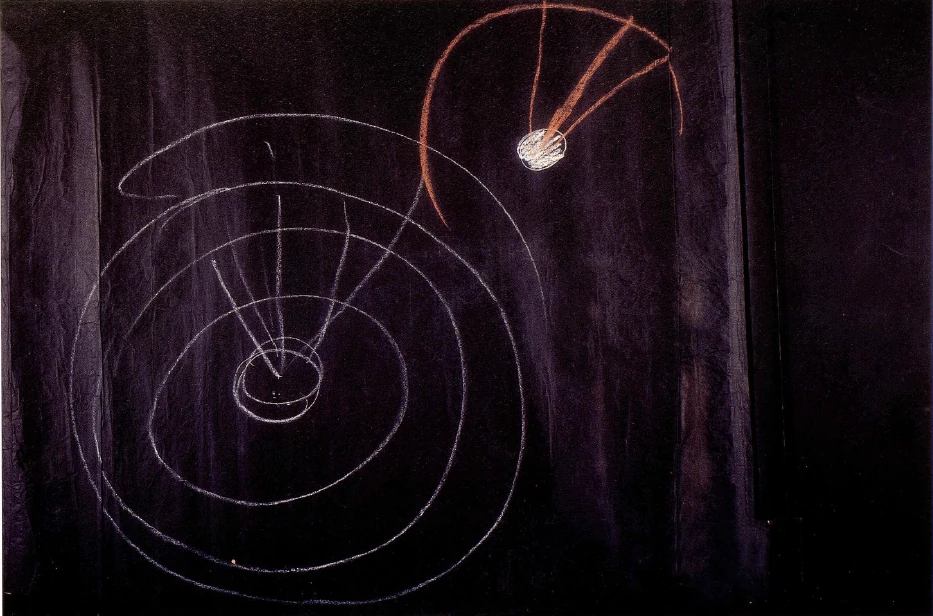
[ 22 ] If we understand what is happening within the organism, then, based on that, we also understand what is happening outside in the whirl of the world. The abstract spatial dimensions into which we then draw our lines are there only to help us conveniently track things. If we want to track them in accordance with the truth, we must try to experience ourselves inwardly and then turn outward with what we have understood inwardly. The sun is understood by the one who understands the human heart. And so it is with the other inner aspects of the human being.
[ 23 ] It is therefore much, much more a matter of taking this “Know thyself” seriously and, starting from “Know thyself,” entering into an understanding of the universe. Starting from a self-knowledge of the whole human being, we should seek to comprehend the non-human universe.
[ 24 ] As you can see, constructing a worldview won’t be a quick process! Of course, to clarify a few properties of this worldview, one can draw this helical line; it characterizes a few properties, but the actual reality does not exist. For to characterize a few other properties, we must make the spiral itself spiral again—that is, this line here is curved. Even then, we still don’t have everything; for certain facts—such as the relationship between the growth of the primary teeth and the growth of the permanent teeth—we must characterize by shifting the line within itself. So you see, constructing the universe is not something that can be done quickly! We must also renounce the desire to construct a worldview with just a few lines, and we must learn to take seriously the idea that the external world, as it presents itself to us, is an illusion. The mathematized world is an illusion all the more so.
[ 25 ] That is what I initially intended to present—as a kind of preparation, a preliminary reflection on what I plan to elaborate on next time. It had to become a little more difficult; but once we have overcome these difficulties, we will also have created the prerequisites for connecting the three most important areas of life—nature, morality, and religion—via two corresponding bridges.
[ 26 ] We'll talk about that next time.