

Correspondences Between the Microcosm and the Macrocosm
Man — A Hieroglyph of the Universe
GA 201
16 April 1920, Dornach
Translated by Steiner Online Library
Fourth Lecture
[ 1 ] In reality, the constitution of the universe cannot be considered at all without constantly referring to human beings—in a sense, always trying to seek out in the universe what is also found in some way within human beings. We want to use these lectures to, from this very perspective, perhaps arrive—at least in one direction—at a kind of vividly coherent worldview that can then lead us to an answer to the question: How do morality and natural laws relate to one another within human beings?
[ 2 ] When we—and I am merely repeating here what has been discussed and described from a wide variety of perspectives—study human beings, we see that they can initially be divided into what we call the “upper human,” then what we call the “lower human,” and then everything that connects the two: the rhythmic human being, who brings about the balance between these two aspects, the upper and the lower human being.
[ 3 ] Now we must admit that, to begin with, there is a complete difference between the laws governing the higher human being and those governing the lower human being. This difference can already present itself to our minds simply by considering how the higher human being—who is governed by the plastic form of the head—comes into being through the laws, I would say, of a world entirely different from our sensory world. That which we have here from the sensory world—which we carry within us from the sensory world as our “limb-human”—we must subject to a metamorphosis—not, of course, in terms of external substance, but in terms of form—a metamorphosis that takes effect only between death and a new birth. That which is here our physical body is completely transformed in its powers. In its supersensible constitution, it is transformed between death and a new birth and then appears in our new earthly life, shaped by our head organization from the universe. Attached to this—formed, as it were, out of the world of the senses—is the rest of the human being. This is something that could already be clearly demonstrated today through embryology, if only one were to reason through the embryological facts sensibly. Consequently, however, there is an element of lawfulness inherent in everything connected with our cranial organization that does not actually belong to this world at all; it belongs to this world only in its beginning—namely, to the extent that it was already present in the previous incarnation. But everything that has transformed our “limb-human” into the “head-human” operates in a completely different world—the world in which we find ourselves between death and a new birth. Thus, another world extends into this world. When we look at the human head, another world is embodied within it. This other world, however, corresponds in a certain way to the world that is spread out there in space and flows by in time, precisely because the head opens the most important senses to the outside. For we take this world in through our perceptions; it penetrates into us through our senses; thus, in a certain sense, it does indeed belong to our head organization. In contrast, our attitude toward our limb-human is actually one of slumber. I have, after all, often spoken of this sleeping relationship of the human being to his volitional nature—that is, to everything that lives within the human being of the limbs. We do not know how we move our limbs, how the will shoots into the movements, which we only explore for ourselves afterward—just like an external thing—through perceptions. We are asleep in our limb-human; we are asleep in it just as we are asleep in the universe, from the moment we fall asleep until we wake up.
[ 4 ] Well, we are actually faced with a completely different world. And if we want to visualize this other world—this entire set of facts—schematically, we must actually say: here is, in a way, a world (Plate 7, center bottom; red section, from which the horizontal red arrow points to the left in red arcs), which outwardly reveals what speaks to our senses. What speaks to our senses there, we perceive through our eyes, our ears, and so on. That is our world, insofar as we are human beings in the primary sense. But we also belong to the world that lies behind it, as “limb-human” (blue, to the right of red; downward arrow and descending arcs in blue). Yet we merely sleep our way into it. We sleep our way into this world, regardless of whether we sleep into our volitional nature or into the universe itself, between falling asleep and waking up.
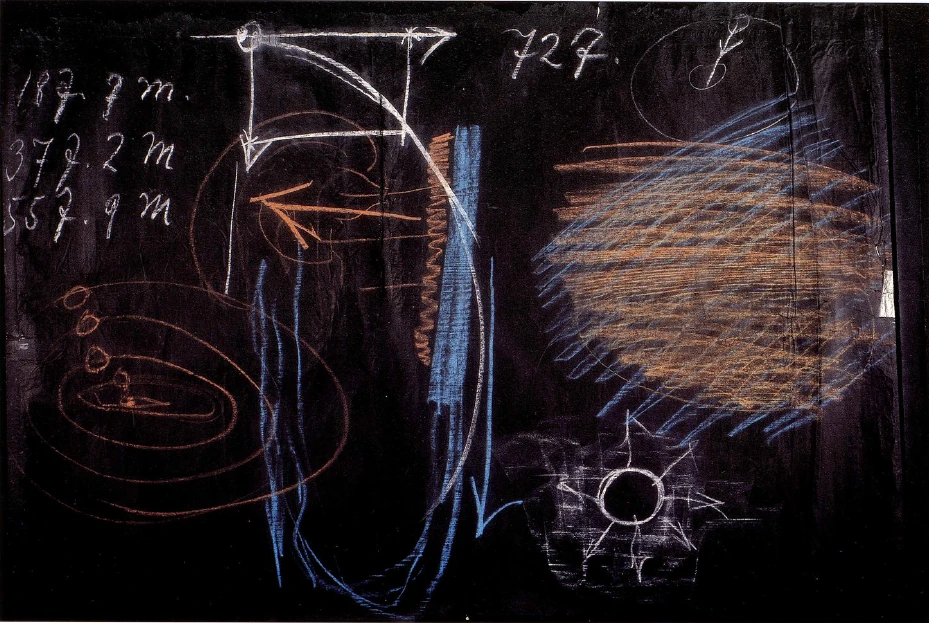
[ 5 ] These two worlds are, in fact, such that one is, so to speak, turned toward us; the other is turned away from us; it lies beyond the world of the senses, yet we come from it. People felt this, especially in earlier times, and people in the East still feel it: that there is a mediation between these two worlds. We in the West seek this mediation in a different way, as you know. But in the East, even today—though it is already antiquated for modern humanity—people still try to seek out this mediation consciously, or relatively consciously. When we eat, it is the blue line that actually symbolizes our food. For as we consume our food, a process takes place that unfolds entirely within the sphere of sleep. Of course, you do not know what is happening there when you eat something—an egg or a head of cabbage. This lies just as much in the unconscious as the processes of sleep initially lie in the unconscious. The head of cabbage and the egg turn away from the outer realm of sensory perception. But that is an entirely different world. Yet the mediation is present in our breathing.
[ 6 ] Our breathing, however, also remains unconscious to a certain degree—though not as unconscious as our eating. But even though breathing does not become as conscious as seeing or hearing, it is still more conscious than the process of digestion, for example. As a rule, even in the East today, people no longer seek to bring the process of digestion into consciousness, as was certainly the case in ancient times. Snakes do this when they digest; they bring the entire process of digestion into their consciousness—though, of course, this is not human consciousness. Ruminants do this as well, but humans do not. In the East, however, the process of breathing is brought into consciousness in a certain way. There is a specific form of breathing training in which breathing is carried out in such a way that, in a certain sense, it flows like a sensory perception. You see, breathing is situated between conscious sensory perception and the entirely unconscious realm of human metabolism. Thus, human beings in fact belong to three worlds: the world that is consciously present to them, the world that remains entirely unconscious, and the world that serves as the mediator—the world of breathing.
[ 7 ] Well, it is indeed a kind of metabolism—at least, these are material processes—but they take place in a more refined form within the respiratory process. Breathing is certainly an intermediate stage between actual metabolism and the process of sensory perception, that is, the fully conscious experience of the external world.
[ 8 ] When we are between falling asleep and waking up, the only things that take place in the environment of the “I”—as it exists at that moment—that are accessible to ordinary consciousness today are those experienced in dreams and reflected in them. But on the whole, one can say that the human being, in a sense, already leaps over into the world that I have depicted here in this diagram (the previous drawing) as the blue area. The human being penetrates into this other world, and it is precisely dreams that, by their very nature, reveal how the human being makes this leap. Just think for a moment how closely related dreams are to the process of breathing, to the rhythm of breathing—how they often seem to echo the rhythm of breathing, or indeed the rhythm itself, when you dream. In a sense, a person crosses a boundary that is otherwise drawn for them in their conscious world by at least getting a taste of the world in which they find themselves while asleep, when they dream. The world of the imagination lies over there as well; only then is it a fully conscious one—a truly conscious perception in that world, which a person otherwise merely gets a taste of when dreaming.
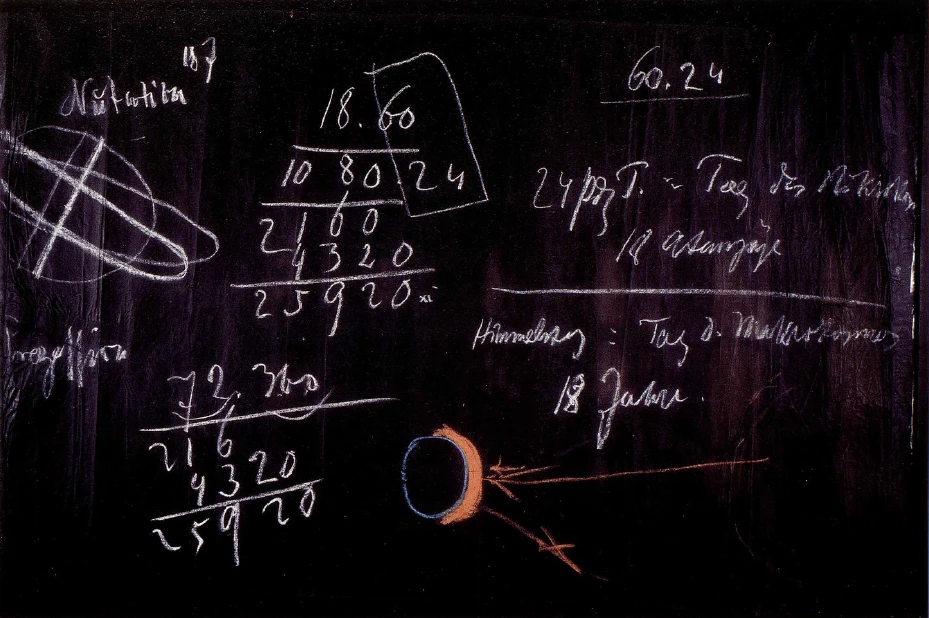
[ 9 ] The point is that a complete correspondence does indeed exist in a certain respect, primarily through numbers. I have often drawn attention to this correspondence between the human being and the world in which the individual and humanity as a whole develop. I have pointed out to you how the human being, in his breathing rhythm—18 breaths per minute—possesses something that is in a remarkable correspondence with other phenomena in the universe. We take 18 breaths, which, as I have mentioned to you on several occasions, amounts to 25,920 breaths per day. But this is the same number you get when you calculate how many days a normal lifespan of about 72 years comprises. That, too, is approximately 25,920 days. So in the course of a single day, something exhales from our astral body and our “I,” and inhales again upon waking—but always according to the same numerical rhythm.
[ 10 ] And again, if we take the number of years it takes the Sun—whether apparently or actually, for that is not the point here—to advance from its vernal equinox—it always advances a little each year—it takes 25,920 years for the Sun to complete one full circuit of the sky from its vernal equinox: a Platonic year.
[ 11 ] In fact, human life—down to its smallest details, down to every breath, and down to its earthly limits between birth and death—is modeled after the laws of the universe. And as we look into this realm of correspondence between the macrocosm and the human microcosm, we are, after all, looking into what is clearly there. But there are other, very significant correspondences as well. Consider the following, for example—today I want to use numbers to guide you to precisely what I’d like to draw your attention to. Take the 18 breaths per minute; that amounts to 1,080 per hour and 25,920 breaths in 24 hours. That means we had to multiply 18 by 60 times 24 to arrive at 25,920 breaths per day.
[ 12 ] But let’s take this as the orbit of the vernal equinox around the heavens. If we were to divide that by 60 times 24, we would, of course, get 18 again. We would get 18 years. 18 years—what would that actually be? Let’s think about what these 18 years would mean. The 25,920 breaths correspond to a 24-hour human day; or, to put it another way, this 24-hour human day is the day of the microcosm. 18 breaths correspond to the unit of the rhythm.
[ 13 ] Let us now—let us not shy away from this—consider the entire orbit of the vernal equinox around the heavens as a great celestial day, not merely as the Platonic year, but as a great celestial day. Let us regard it as a celestial day or a world day, as you will, as a day of the macrocosm. If we were to look for breaths in the macrocosm that correspond to a human’s breaths in one minute, how long would they have to last? These breaths would have to last 18 years. An 18-year breath, performed by the being that corresponds to the macrocosm.
[ 14 ] If we take today’s astronomical data—we’ll discuss what they mean later—let’s consider what astronomers today call the nutation of the Earth’s axis. As you know, the Earth’s axis is tilted relative to the ecliptic, and astronomers speak of the Earth’s axis oscillating around this position, calling this phenomenon “nutation.” The Earth’s axis completes a full rotation around this position in exactly 18 years—or at least approximately so; to be precise, it is 18 years and 7 months, though we need not take the fractions into account, even though they could certainly be calculated accurately. But there is something else connected to these 18 years. Not only does what astronomers call this nutation—this wobble of the Earth’s axis, this rotation of the Earth’s axis in a double cone around the center of the Earth—not only does this take place over 18 years, but something else happens at the same time. Namely, the Moon appears in a different place every year. Just as the Sun, rising and setting along the ecliptic, undergoes a kind of pendulum-like motion away from and back toward the equator, so does the Moon. It takes 18 years for the Moon to return to the same point in the sky where it appeared 18 years earlier. You see, this nutation is connected to the Moon’s celestial path, so that one can say: this nutation indicates nothing other than the Moon’s celestial path. This nutation is merely the projection of the Moon’s movement. We can thus actually observe the breathing of the macrocosm. We need only observe the course of the Moon’s orbit over 18 years, or rather, observe the Earth’s nutation (Plate 8, top left). The Earth dances, and it dances in such a way that its axis traces a cone—a double cone—over the course of 18 years. This dancing reflects the breathing of the macrocosm. It occurs in the Platonic year exactly as often as 18 human breaths in a day. So this nutation movement actually represents a one-minute breath. Thus we can say: we are looking into the breathing of the macrocosm through this nutation—or lunar—movement. There we have the counterpart to breathing. But what does this mean? It means that just as we, when we drift off to sleep or, respectively, simply transition from full wakefulness to dreaming—just as we pass into another world there—so too do we find—in contrast to the ordinary laws of day, year, and so on—including the Platonic year—in this introduction of a lunar regularity, we encounter something that relates to the macrocosm in the same way that breathing—that is, the semi-conscious—relates to our fully conscious state. We are therefore not merely dealing with a world that spreads out before us, but with a second world that reaches into ours and permeates it. Just as we have before us a second aspect of human being—namely, the rhythmic human being in the process of breathing—as opposed to the perceptive human being, so too do we have, in what appears as the movement of the Moon and the annual lunar cycle, a year that is like a one-year breath. This is what we have before us as a second world projecting into our own.
[ 15 ] It cannot, therefore, be the case that we have only a single world in our surroundings. In our surroundings, we have the world that we can perceive through our senses; but there is also a world based on a different set of laws, which relates to ours as our breathing relates to our consciousness, and which reveals itself to us when we know how to interpret the motion of the Moon correctly—or rather, its manifestation, the nutation of the Earth.
[ 16 ] You see, from this you should conclude that it is impossible to seek the laws that reveal themselves to us in the world in any unambiguous way. Today’s materialist thinker seeks a law governing the world. He is mistaken, for he should say: Everything that constitutes the world of the senses—that is, after all, a world in which we are embedded, to which we belong—is the world that our natural science explains to us in terms of cause and effect. But another world intrudes upon it, one that has different laws. (Panel 7, center right, diagonal hatching in yellow, horizontal hatching in blue). The two worlds merely interpenetrate one another. Each world must be attributed its own set of laws. As long as one believes that a single kind of law suffices for our world—that everything hangs solely on the thread of cause and effect—one is succumbing to terrible errors. Only when one can discern, through phenomena such as the Earth’s nutation and the movements of the Moon, that another world does indeed intrude upon ours, can one come to terms with it.
[ 17 ] And you see, this is where the spiritual and the material—as we call them—or, let’s say, the soul and the material, intersect. Anyone who is actually able to observe what is contained within their own self will come to the following conclusion. You see, my dear friends—humanity must gradually become aware of such things—I believe there are many among you who have already passed the milestone of 18 years and about 7 months. That was an important milestone. There are probably also several among you who have passed 37 years and 2 months. That, too, was an important milestone. And then comes another very important milestone: 55 years and 9 months. At present, the individual human being is not yet able to properly mark these milestones, because he is not educated in the way he should be. If he were to mark them properly, he would perceive that, in fact, the most important things happen to the soul at these milestones. The nights that a person experiences at these points in time are the most important nights of human life. That is where the macrocosm completes its 18 breaths, completes a minute, and that is where the person has, so to speak, opened a window onto a completely different world. Well, I said that people today cannot time these moments properly. But everyone could try to look back on such moments in human life. Anyone who has reached the age of 55 can look back on three full such important periods; some on two; most of you probably on one. It is during such stages that things take place which flow in from a completely different world into our own world. That is when our world opens up to another world.
[ 18 ] You see, if one were to describe more precisely how our world opens up to another world, one would have to say: our world is opening up anew to the astral world. Astral currents flow in and out. Admittedly, they flow in and out annually; but we are dealing here, so to speak, with 18 breaths per minute over the course of these 18 years. In short, through the world clock, we become attuned, so to speak, to the breathing of the macrocosm into which we are embedded. This correspondence with another world—which is expressed precisely through the movements of the Moon—is extraordinarily important. For you see, this world that reaches in here is precisely the one into which we drift as we sleep, when we step out of our physical and etheric bodies with our I and our astral body. It is not the case that one can say the world around us is merely abstractly permeated by the astral world; rather, it breathes the astral world, and we can glimpse into its breathing process—the astral—through the Moon’s movement, or rather through nutation. You see, now you already have something extraordinarily significant: on the one hand, you have our world as it is usually viewed, along with the materialistic superstition that, for example, goes so far as to make people look up and think that the sun up there is a ball of gas, just as it is described in the books. That is nonsense. It is not a ball of gas, but rather it is less than space there (Plate 7, bottom right, still without rays); it is a suction body there—less than space—while all around it is still that which exerts pressure to a certain degree. So what comes from the sun has nothing to do with anything produced by burning within the sun or anything of the sort; rather, it is all reflected back (the reflection is shown in the diagram) that was first radiated from the universe. It is emptier than empty where the sun is.
[ 19 ] But nowhere in the universe where ether exists is it emptier than empty. That is why physicists find it so difficult to speak of ether, because they always think that ether is also matter, but thinner: thinner than ordinary matter. Materialism can still accept the thinner forms—both scientific materialism and theosophical materialism—it can still accept the thinner, the ever-thinner forms. Dense matter; etheric matter is thinner; astral matter is even thinner; and then—well, then there are these mental forms and everything else that is ever thinner and thinner. This theosophical materialism accepts the increasingly subtle, just like scientific materialism, except that one lists a few more stages of subtlety than the other. But the transition from ordinary, weighable, substantial matter to the ether is not at all a matter of it becoming more subtle. Anyone who believes—and I’d like to paint this picture for you once more—that the ether is merely a matter of matter becoming thinner stands on the same ground as someone who says: “I have a box full of money here; I take some out, and then some more—the money keeps getting less and less.” Eventually it becomes zero, and that’s the end of it. — But isn’t it true that it can become even less if you go into debt? Then it becomes less than zero. Thus, matter does not merely become empty space, but it becomes negative; it becomes less than nothing; it becomes suction-like. And the ether is suction-like. Matter is oppressive; the ether is suction-like. The sun is entirely a sphere that actually sucks. And wherever there is ether, there is suction.
[ 20 ] There we cross over into the other aspect of three-dimensional space, from the pressing to the drawing. That which initially surrounds us in the world, of which we as physical human beings and as etheric human beings are composed, consists of a pressing and a drawing force. We ourselves, too, consist of a pressing and a drawing force. The difference is that we are a mixture of the oppressive and the drawing-in, whereas the Sun is purely the drawing-in, purely ether. But this interplay of the oppressive and the drawing-in, of weighable matter and ether, exists within a living organism. It breathes continuously, expressing this breathing through the movements of the Moon, through nutation; it breathes the astral realm continuously. So that even here we can already, in a sense, sense a second aspect of the world as a whole: one aspect of the world that is compressing and drawing in—physical and ethereal—and then a second aspect of the world: the astral. This is neither one nor the other, but rather it is breathed in and out, and nutation announces this to us.
[ 21 ] Well, you see, it has long been known that a certain astronomical fact has been observed. Many thousands of years before our era, the Egyptians knew that after 72 years, the fixed stars had moved one day ahead of the Sun in their apparent motion. At first glance, it does seem, doesn’t it, that the fixed stars appear to rotate, and the Sun appears to rotate. But the Sun rotates much more slowly than the fixed stars, and after 72 years, the fixed stars have already moved a bit ahead. That is why the vernal equinox shifts—because the fixed stars are moving ahead. If the vernal equinox keeps moving further and further, then the fixed stars must have shifted relative to the Sun’s position. Well, the fact is that after 72 years, the fixed stars are indeed one day ahead of the Sun. Thus, we find that after 72 years, the stars reach a certain point at the end of December 30, while the Sun does not reach the same point until the end of December 31. It has therefore lagged behind by one day. After 25,920 years, it falls so far behind that the entire cycle is complete, and it returns to the point we noted earlier. So after 72 years, the Sun has fallen one day behind the fixed stars. But that is roughly the normal lifespan of a human being—those 72 years, which amount to 25,920 days.
[ 22 ] And if we multiply these 72 years by 360, then—if we regard human life as a single day and assume 360 cosmic days in which the sun completes one full cycle—we have human life as a single day of the macrocosm—humanity, as it were, breathed forth from the macrocosm—human life as a single day in the macrocosmic year.
[ 23 ] Thousands of years before our era, the Egyptians pointed out this entire apparent oscillation of the vernal equinox, for they saw something very important in the 72-year cycle, and through it they alluded to this macrocosmic year. In this wandering of the vernal equinox, we again see something that has to do with the life and death of human beings in the universe out there—that is, the life and death of the macrocosm. The law of human life and death is something we must indeed pursue. Nutation, too, points us toward another world, just as our world of perception points us toward the world of breathing. What you find in modern astronomy as precession—that is, the advance of the equinoxes—reveals something akin to the transition into complete sleep, the transition to a third world, which I would now have to depict as a separate realm extending into this one (Plate 7, drawing on the right, center, 2nd horizontal hatch, dead). Three worlds that interpenetrate one another, that also relate to one another, but which must not simply be summarized from the standpoint of causality—three worlds, that is, a threefold world, like a threefold human being. A first world, the world that surrounds us, which we perceive; a second world, which announces its presence through the movements of the Moon; a third world that announces itself through the movements of the point where the sun rises—that is, in a certain sense, we must say, through the path of the sun. There we look toward a third world that, however, remains as unknown as the world of our will remains unknown to ordinary consciousness.
[ 24 ] The point, then, is that we should seek such correspondences everywhere—such connections between the human microcosm and the macrocosm. And if in the East today—albeit in a state of decadence, but formerly in the heyday of ancient Eastern wisdom—a consciousness of breathing was sought, it was out of the need to slip over into this other world, which otherwise reveals itself only through, I might say, what the moon intends in our world. But people also knew how to point to this inner law in other respects during the times when there was still a primordial wisdom that had come to humanity in a different way than we must seek it today. In the Old Testament, the initiates who knew these things always used an image—which you can also find, in a certain sense, in the Gospels, as I have pointed out before—namely, the image of moonlight in relation to sunlight. It is true, isn’t it, that moonlight is regarded, in a certain sense, as merely reflecting sunlight. (Plate 8, bottom, red; the small circle on the left, blue). Now I am speaking in the sense of physics—though I will likely have to mention later that these terms are not very precise—we are speaking in the sense of physics, for it was the basis for the concepts that existed at the time. This moonlight was regarded in the Old Testament as the representative of the power of Yahweh. The power of Yahweh was conceived as reflected power, and the initiates—not, of course, the orthodox rabbis of the Old Testament, but the initiates—said: The Messiah, the Christ, will come; he will be the direct sunlight; Yahweh is merely the preceding reflection. It is the same thing, but it is not the direct sunlight. — It goes without saying that we must not think of physical sunlight here, but rather consider the spiritual aspect.
[ 25 ] Now Christ entered into the course of human development, and what had previously existed only in reflection—only indirectly in the form of Yahweh—came into being. At first, therefore, it was necessary to conceive of the Christ who lived in Jesus according to a different set of laws than those underlying ordinary scientific understanding of nature. But if one does not accept such a law, if one believes that the world is connected solely by causes and effects and is a causally interconnected world, then there is no place for what Christ is. One must first prepare a place for Christ by taking into account the three worlds that are interwoven. Then there is also a possibility of saying: Even if, in the world that our senses perceive, everything is interconnected everywhere through cause and effect, just as natural science conceives it—another world permeates this one. This is where the events that follow on from the event at Golgotha belong. If, in our time, the need to gain an understanding of these things continues to grow, then the point is that this understanding must be sought precisely through a recognition of the worlds that are structured within one another, yet are entirely distinct from one another. The point is to seek three kinds of laws, not just one. And it is precisely within the human being that we will have to seek these three kinds of laws. But if you consider what I have just said, you will understand that the point is not merely to draw, as the Copernican and Galilean world systems do, certain ellipses (Plate 7, bottom left; red) that are supposed to represent the orbits of Saturn, Jupiter, Mars; of Earth, Venus, Mercury, and then the Sun. That cannot be the point; rather, the point is that we must conceive of the laws that initially govern the world as it presents itself to us—as expressed through what is perceptible to the senses—as being intersected by a different set of laws, and that, above all, our present Moon, in its motion, represents something that, for its part, has no causal connection whatsoever with the rest of the solar system. It does not belong to it like the other planets. It points to a world that has just been thrust into our own. It points to the breathing process of our world system, just as the Sun points to the permeation by the ether.
[ 26 ] Before engaging in astronomy, one should, above all, gain a qualitative understanding of what moves in space and what is interdependent within it. For one must be clear that one cannot simply establish a relationship between solar matter and any other matter—such as terrestrial matter. Solar matter is, in relation to terrestrial matter, an absorbing force, whereas terrestrial matter is a compressing force. And the movements expressed in nutation are movements that originate in the astral realm, not from anything that can be explained by Newtonian principles. But this Newtonianism is precisely what has hurled us so terribly into materialism, for it has resorted to the utmost abstraction. It speaks of a gravitational force: the Sun attracts the Earth, or the Earth attracts the Moon—a force, a force of attraction from the Moon toward the Earth, or from the Earth toward the Sun, like some invisible string (Plate 7, top right). But if only this force of attraction existed, there would be no reason for the Moon to revolve around the Earth, or for the Earth to revolve around the Sun; rather, there would only be a reason for the Moon to fall down onto the Earth—it would have fallen long ago if only the force of gravity were present—or for the Earth to fall into the Sun. So it doesn’t work to simply assume gravity to explain the imagined or actual movements of the celestial bodies. So what do we do? We say this: Let’s assume there is a planet here (the same plate, top center); it would actually be constantly falling into the Sun if only the force of attraction were present. But a force—a tangential force, a powerful impulse—has been imparted to it once, and here the impulse acts so strongly, the gravitational force perhaps just as strongly; well, then it does not move in such a way that it falls in, but rather it moves along the resulting line.
[ 27 ] You see, this Newtonian theory requires that every planet—indeed, every moving celestial body—have received an initial impulse. So there must always be an extra-mundane God who imparts that impulse, who provides the tangential force. This is assumed everywhere. But this assumption was made at a time when people no longer had any idea how to connect the spiritual with the material in any way, when they had come to a standstill at the very point of the initial impulse. This already reveals materialism’s inability to comprehend matter. That is precisely what I have pointed out so frequently of late. Consequently, materialism cannot understand the movements of the material world either; instead, it must explain them in a completely anthropomorphic way by conceiving of God entirely as a human being—and—whoops—the moon gets a push, then the Earth; they are drawn to one another, and the movements result from that “whoops” push and the force of attraction.
[ 28 ] This is where we stand today. It is from these things that we construct our worldview. But to understand what is, more is needed; it is necessary to learn to understand, in every respect, the connections between what lives within the human being and what lives outside in the macrocosm. For the human being is a true microcosm within the macrocosm. More on this tomorrow.