

Correspondences Between the Microcosm and the Macrocosm
Man — A Hieroglyph of the Universe
GA 201
17 April 1920, Dornach
Translated by Steiner Online Library
Fifth Lecture
[ 1 ] It has probably become clear from the considerations we have made in recent days that one cannot, in general, view the configuration of the universe—the spatial universe in its movements—in the way that is done under the influence of the current scientific mindset. In a sense, not only is everything viewed there entirely in isolation from human beings, but the individual bodies—which, to all appearances, present themselves as separate bodies—are also conceived of in isolation, and their interactions with one another are then considered within that isolation. But this is just as if, for example, one were to consider an arm on its own within the human organism and attempt to study that arm in isolation, then another limb, and thus seek to understand the entire organism from the interaction of its individual limbs. The point is that one cannot, of course, understand the entire human organism from its individual parts, but must take the consideration of the whole as the basis and then examine the individual parts from the perspective of the whole,
[ 2 ] The same applies to, say, our solar system, but also to our solar system in relation to the entire visible universe of stars. For the Sun, the other planets, the Moon, and the Earth are, after all, merely parts of a whole system. And why, for example, should the Sun be regarded in isolation as a single body? There is, after all, absolutely no reason whatsoever to imagine the Sun as being exactly where the eye sees it, or to depict it within the limits in which the eye perceives it. One must admit that, with regard to what underlies this and is overlooked, the philosopher Schelling was quite right when he turned the matter around to ask: Where is the Sun other than where it acts? If the sun exerts its influence on Earth, then precisely what the sun does on Earth belongs within the realm of the sun, and it is very wrong to take a part out of a whole and consider it in isolation. — Yet this was precisely the aim of the newer, albeit materialistic, worldview that had been asserting itself more and more strongly since the mid-15th century. And this is also what Goethe had to oppose throughout his life, insofar as he engaged in the natural sciences—and what every true Goetheanism must likewise oppose. Goethe himself had already pointed out that one should not, in fact, comprehend nature outside of humanity without considering its connection to human beings. Thus, in order to understand what is happening in nature outside of humanity, the human being must serve as the foundation. Just how little value the phenomena you encounter in external astronomy actually have can be seen, for example, from the following:
[ 3 ] People try, based on all sorts of considerations, to speak of an ordinary motion of the Earth around the Sun in an elliptical orbit. It is said that this motion of the Earth around the Sun is caused by that tangential impulse I spoke to you about yesterday at the end of our discussion in connection with the Sun’s gravitational pull. But one cannot deny—when speaking of gravitational forces — and indeed, no one denies this, since it would be completely absurd — that not only does the Sun attract the Earth, but the Earth also attracts the Sun, so that a gravitational force is exerted not only — I am now drawing in a manner similar to that used in astronomy — by the Sun on the Earth, but also by the Earth on the Sun (Plate 9, top).
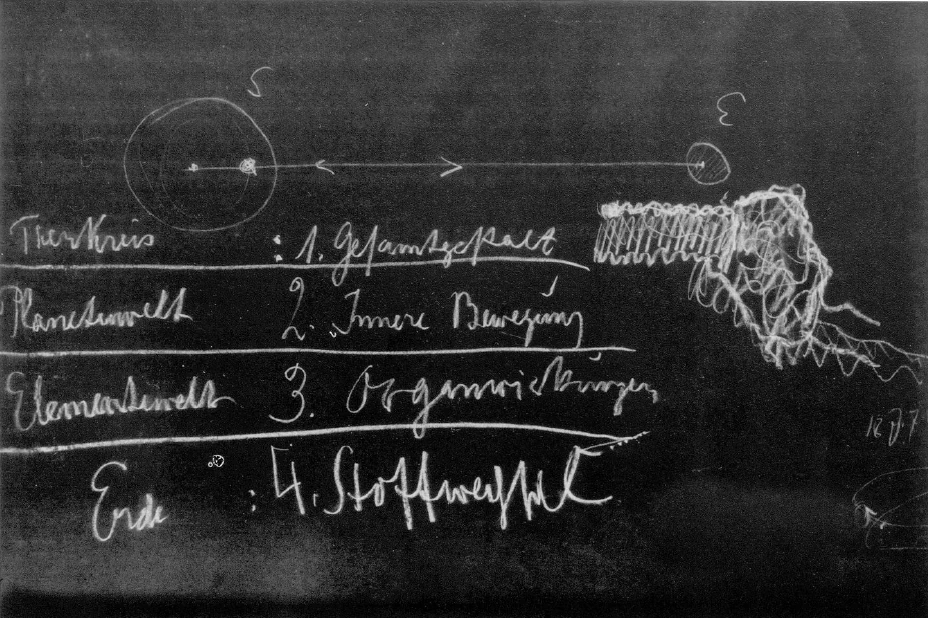
[ 4 ] From this, however, one must conclude that, since the two celestial bodies attract each other, one cannot really speak of the Earth orbiting the Sun in an elliptical path. For if the Earth attracts the Sun and the Sun attracts the Earth—mutually—then, of course, the Earth cannot simply revolve around the Sun on its own; rather, both must revolve around a neutral point; that is to say, the rotation does not take place in such a way that the center of the Sun, so to speak, serves as the pivot point; rather, the pivot point must be a neutral point between the two centers—between the center of the Earth and the center of the Sun. I am not telling you something that I object to in astronomy, but rather what you can find for yourselves in astronomical books. So one must assume that the pivot point lies somewhere in between. Astronomy, however, consoles itself with the fact that the Sun is so large that this pivot point still lies within it. Thus, the Earth and the Sun would revolve around this point; the Earth would not revolve directly around the Sun, but the Sun itself also revolves—around a point that would lie within it. So far, even conventional astronomy has progressed to the point where one speaks of a point that is not the center of the Sun, but rather lies on the connecting line. But it still lies within the Sun itself. Yes, but now something else comes into play. First, one had to calculate the Sun’s entire size. That is, after all, the result of calculations. Thus, the assumption that the point is still within the Sun depends, in turn, on the calculated size of the Sun. And so, based solely on the results of calculations, one constructs something that—quite naturally, since one is calculating based on appearances—must have a certain, limited validity, but which need not be decisive for the actual essence underlying it.
[ 5 ] So the point is, I would say, to keep a close eye on modern astronomy—just as one must keep a close eye on every science today—so that one can see at which points—and there are numerous such points—this science simply goes beyond itself when it encounters certain difficult issues.
[ 6 ] You see, such difficult passages cannot really be judged at all based on the outward appearance of phenomena; rather, one can only arrive at a true conclusion if one is able to grasp the entire universe in its relationship to humankind. But first we must consider the aspects of humanity’s relationship to the universe that we have already mentioned, and then we must add many other factors before we can arrive at a true picture of the world. We concluded yesterday by saying that we must first consider ordinary, weighable matter—that is, matter that we can weigh. We cannot weigh light. Light does not belong to weighable matter; neither does heat—it does not belong to weighable matter. We must first consider what we can weigh, and then we must contrast the weighable with the ether. And we said yesterday that it is incorrect to imagine the Sun in the same way that the Earth consists of weighable matter. It is actually something that is less than space; it is a void in space; it is something that draws in, in contrast to the pressure exerted by weighable matter.
[ 7 ] And so we are not only dealing with this in the external world—I would say, with a concentration of such sucking ether—but this sucking ether is now spreading even further. Everywhere, alongside the pressing force, there is a sucking force. We ourselves carry this sucking force within our etheric body.
[ 8 ] But this exhausts everything we can perceive as spatial. Compressive force and suction force—that is what we can find in space. The point, however, is that we do not merely have our physical body, which consists of weighable matter and which both attracts and repels weighable matter; that we have our etheric body, which consists of suction-like ether; but we also have our astral body—if we may use the word “body” in this context. What does it mean that we have our astral body? To have an astral body means that we carry within us something that is no longer spatial, yet which stands in a certain relationship to the spatial. You can easily deduce from the following that a relationship exists between the astral and the spatial. While we are awake, our astral body fills the etheric body and the physical body, or rather, permeates them. However, the etheric body functions differently within us when we are awake than when we are asleep. A different relationship is established between the etheric body and the physical body when we are awake. This different relationship is brought about by the astral body. It is, therefore, an active force. It acts upon the spatial, even though it is not itself spatial. It organizes and structures the relationships of the spatial. What takes place within us—the ordering of spatial relationships by the astral body—also takes place in the universe. And it takes place in the universe in the following way.
[ 9 ] You see, try now—I would say—to take spatial factors into account by considering those regions of space within the observable universe that are indicated to us in the external world by what we call the zodiac (Plate 10, top left). I don’t want to go into these zodiac images in particular right now; instead, just consider the cardinal directions we look toward when we turn toward the constellation of Aries in the so-called zodiac, then to Taurus, Gemini, Cancer, Leo, Virgo, Libra, Scorpio, Sagittarius, Capricorn, Aquarius, and Pisces. In a sense, we need only observe, at first, how the space that presents itself to us as our visible universe is structured. And let the respective region be indicated merely as a sign of this structure; let the respective constellations in the zodiac be indicated merely as a sign of the direction in which we wish to delimit space.
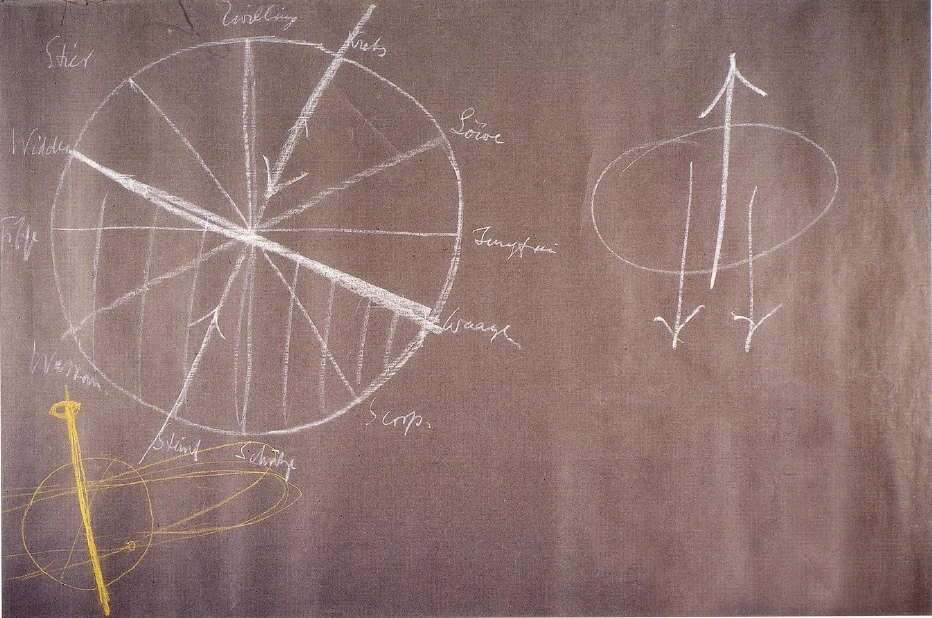
[ 10 ] The point is that these spatial directions are really not something that can be characterized by saying: There is empty space, and I draw some line into that empty space. — Something like what mathematics assumes to be “space” does not exist anywhere at all; rather, everywhere there are lines of force, directions of force, and these directions of force are not the same—they differ from one another; they are differentiated. And one can indeed distinguish these 12 regions of our visible universe by saying: If I look in the direction of Aries, the effect of the force is different than if I look in the direction of Libra or in the direction of Cancer. This is something that, admittedly, people are initially reluctant to admit as long as they remain in the realm of the mere sensory world. But the moment a person ascends to imaginative soul experience, they do not perceive the direction of Aries or Cancer indifferently, but rather perceive them in a highly differentiated way. You see, if I were to give you a comparison, I could illustrate it as follows. Imagine, for a moment, that you arrange twelve people in a circle, according to how much you like or dislike them. You place the people you like the most in one direction, then those you like less and less; now the people you dislike come on the other side. Imagine arranging people around you in this way, differentiating them by degrees of “liking” and “disliking.” It doesn’t have to be personal; for my part, it could be based on appearance or something like that—right? There can certainly be a certain objectivity to it. Then you’ll turn around, and you’ll pass through 12 images while simultaneously experiencing a very nuanced, differentiated sensation. A person has this nuanced, differentiated sensation when they rise to imaginative perception, as soon as they move around the vault of the heavens. These degrees of perception—even these degrees of contemplation—simply emerge. This occurs at the very moment when a person emerges from the indifference of ordinary sensory life. So what we are dealing with here is not something indifferent in space, but rather the fact that the space around us affects us in a highly nuanced way.
[ 11 ] You see, something is coming to light here that is connected to the entire development of the human being. If human beings had remained at the old stage of consciousness, where they had an atavistic pictorial consciousness, then even within this atavistic pictorial consciousness a very high degree of differentiation would already have existed. They would, so to speak, be unpleasantly affected by one region of the heavens, pleasantly affected by another, and so on. But human beings have been torn away from this interplay in which they were once immersed. They have been torn away precisely because they have been placed in the sensory world through their present organization. However, the fact that human beings are organized for the cosmos can still be demonstrated today through certain phenomena observable in everyday experience. For it is no nonsense to say that certain illnesses simply heal better when the patient is placed in bed in an east-west direction. This is not superstition; it is something anyone could easily verify empirically if they so wished. But this is not meant to be a recommendation that everyone should now arrange their bed in some particular way! I have experienced so much along these lines that it is necessary for me to always mention such things. For countless examples could be cited of everything that can be experienced in this regard. For example, it happened once—this was back in Berlin—when an anthroposophy lecture had ended, and I placed some importance on not having to sit down first to put on rubber shoes when it rained, but rather being able to do so while standing, which requires standing on one leg for a short time. I said that a person must surely be able to stand on one leg. Some anthroposophists interpreted this in such a way that, via a detour through London, the message made its way back that the Anthroposophical Society assigns its members the esoteric exercise of standing on one leg for a while at midnight. Well, you see, some things said about us have such deep roots. There are numerous such reports, which then in turn appear in this or that newspaper article by people with good or ill intentions—mostly the latter. So, as I said, I certainly do not mean to suggest that everyone should now arrange their bed in a certain way. But it must be acknowledged that such phenomena—which could be multiplied at will—clearly show that even today, deep within the recesses of his being, man still has connections to the spatial distinctions that exist outside him and into which he is bound. But by what means does man have such connections?
[ 12 ] Human beings have such connections through their astral body. The astral body establishes these connections. This can only happen because human beings, through their astral body, are placed within an astral world—that is, a world that, while it exerts an influence into space, is not itself spatial. We correctly interpret what is depicted here as the zodiac when we regard it as a representation of the outer astral world.
[ 13 ] Let us now set aside the astronomical theories and look at what is evident to the eye. We know, of course, that—whether apparently or in reality—the Sun traverses the zodiac in various ways: its daily course, its annual course, and, in turn, its course through the Platonic year, which I explained to you yesterday through the movement of the vernal equinox. So we can say that what acts upon us from this sun—this absorbing ball of ether—acts in different ways because it passes through various spatial differentiations. Sometimes it comes from the spatial differentiation indicated by Aries, and sometimes from another spatial differentiation.
[ 14 ] If we take, for example, a resident of our region, we must say that at any given moment, one half of these constellations is facing us; the other half is obscured by the Earth. We experience this spatial differentiation in such a way that we are directly facing one part, while the Earth lies between us and the other part. In any case, this has nothing to do with any apparent or actual movement; rather, it is a fact that at any given moment we are directly facing one part of the zodiac, and that the Earth interposes itself between us and the other part. Now let us imagine these spatial distinctions when the Earth interposes itself. What must this mean? It must mean that when, for example, the Earth covers this lower part for us (in the drawing, this part is hatched), one half acts directly here; the other half does not act directly, but through its absence. So in one case we have the direct effect of the differentiated spatial regions, and in the other we have the effect of the absence of these differentiations—the non-existence of these differentiations. This is something that is at work within us, something that, in a sense, enables us to relate what acts directly upon us to what is absent—and thus spares us from being under its direct influence.
[ 15 ] But that gives us an opportunity to discuss something else. Let’s assume that a certain influence comes from Cancer; this would be counteracted by an influence from Capricorn; but that influence is removed, so that I have the Cancer influence within me, and opposite it, the removed Capricorn influence (arrows). As a result, the Cancer influence is, in a certain sense, left to me. After all, I cannot be affected in the same way by what is absent as by what is present. Consequently, I gain a certain influence over what acts upon me, in that it is countered by the removed opposition. Because I stand on Earth, the effects of the heavenly upon me are different than if I were exposed to them while floating freely in space.
[ 16 ] Just take a good look at this, and you’ll see that you can’t simply say: “Up there are Aries, Taurus, Gemini, Cancer, and so on, and down here is this and that”; rather, you’ll have to view the whole thing, in a certain sense, as an organization into which you are integrated. And as you move from constellation to constellation due to the Earth’s motion, you are driven along by the various direct influences. So let’s say, for example, that here the influence of Scorpio had not yet affected you—it was not within you. Now you are being driven toward it. It is as if you were eating here on Earth. You were hungry before; the nutrients were not within you; afterward, when you eat, the nutrients are within you. Here, the influence of Scorpio was not yet present; here, it is active within you. So you enter into relationships with the surrounding world by coming into different relationships with it through the Earth’s movement. But does the human being perceive anything of this influence in his consciousness now that he is in the physical world? No, as we just said a moment ago. The physical world shields the human being from these influences. But he immediately becomes subject to them when he emerges from his physical and etheric bodies with his astral body and his I and is outside. There, they are very clearly and strongly exposed to all these influences. There, these extraterrestrial, celestial influences act upon that which is then outside the physical and etheric bodies just as strongly as food acts upon the physical body. It is precisely this immersion in the physical body that shields human beings from external influences. We can therefore also regard the human astral body as belonging, in a sense, to the heavenly rather than to the earthly, in that we attribute it to extraterrestrial influences when it is outside the physical body together with the “I.”
[ 17 ] In this way, we can come to understand how a human being—by not acting through the organs of his physical body, by being more or less asleep as a result of this inactivity—is thereby exposed to the heavenly influences. You need only remember now that human beings actually “sleep their way” into the world. As small children, we are more or less asleep. That is why, as small children—precisely because we are more or less asleep—we are much more exposed to extraterrestrial influences than we are later on. We gradually work our way more and more into earthly conditions. But as children, what lies within our skin is also malleable; it is shaped even more than it is later on. What lies within our skin is shaped less and less; indeed, from a certain point onward—which, however, does not occur until a later stage of life—it is shaped only very little. From this, however, you can see that the shaping of the inner self is, in a certain sense, related to the movements and configurations of the extra-earthly world. But that which remains dormant in relation to our consciousness—like, say, our heart activity or our digestive activity—that is, what takes place within our skin, what is brought about there, as when I consciously take steps, but which goes inward—that, too, remains under the influence of the extraterrestrial throughout our entire life.
[ 18 ] Take a characteristic example: The chyme is propelled forward by the movements—the internal movements of the intestine. Movements take place there. These movements occur within the human skin. Such movements within the human skin are dependent on the extraterrestrial. Essentially, human beings as such are dependent only on the earthly—on what is truly weighable—insofar as they walk the earth, in matters that occur to them outside their skin. The moment something transitions into activities that take place within our skin, activities related to the non-earthly begin within our organism. When you take a piece of sugar and hold it in your hand, you feel its earthly weight; you feel its pressure, whether it is hard or soft; you look at it: it is white; you lift it to your mouth. All of this is still earthly. The moment you let it dissolve on your tongue and take it into the realm of your sense of taste, at that moment it undergoes processes that are no longer merely earthly, but depend on the non-earthly. To seek out the effects of the non-earthly, we must delve into what lies within the human skin.
[ 19 ] This leads you to realize that when you carry your entire physical self around, you are in the earthly realm. As soon as you enter even the physical body, you are no longer in the earthly realm; rather, you enter the realm of that which depends on the non-earthly. You can best convince yourself that there must be something within you that must not be absorbed into the earthly realm by recalling the fact—which has often been mentioned to you—that the human brain floats in cerebrospinal fluid. The human brain would be so heavy—if it did not float in cerebrospinal fluid—that it would press so strongly on the organs at the base of the skull that the blood vessels would be crushed. You need only pick up any handbook that describes such things, and you will see just how heavy the human brain is. If you pick up the “ Bischoff,” you’ll see that, curiously enough, he always considered the female brain to be much lighter than the male brain—a notion that was, however, taken to absurd extremes in a way that was very flattering to women, since Bischoff’s own brain, when it was later examined, turned out to be much lighter than all the female brains he had previously studied. This is just a little interlude that serves to comment on human judgments in such matters.
[ 20 ] So this brain, which is quite heavy—weighing at least 1,200 or 1,300 grams—does not act with its full weight at all, but only, one might say, with the weight of a few grams, because it experiences buoyancy. You are familiar with Archimedes’ principle, according to which every object becomes lighter by an amount equal to the weight of the water it displaces. Thus, the entire weight of the brain exerts a force of only a few grams because it floats in cerebrospinal fluid. A person could not use their brain for thinking if it were constantly exerting its full downward force. It experiences buoyancy. It overcomes its own heaviness through its organization, through floating in cerebrospinal fluid. We do not think with matter, but rather with that which withdraws from matter through the upward-striving forces of buoyancy—with that which grows out of the earth (Plate 10, right). This must be traced all the way into the entire human organism. Just as we simply withdraw inwardly from earthly gravity through the weight of the brain—externally we cannot withdraw; on a scale, of course, our brain has the corresponding weight, even though it is within us, but within us we withdraw from earthly forces through our organization—so, too, do we withdraw from other earthly physical and chemical forces.
[ 21 ] What is it within us that enables us to withdraw? It is the “I” and the astral body. They are what enable us to withdraw. And at the very moment when the “I” and the astral body act upon their etheric body and physical body in such a regulating way that they draw the etheric body out, then the suction effect is gone. Only ponderable matter remains. In terms of its form, this matter does not belong to the Earth, for its form is not sustained by the Earth; in essence, it is destroyed by the Earth. The forces of the Earth do not contain within themselves that which shapes the human being. This is, after all, quite obvious, because the human being withdraws inwardly from the forces of the Earth. Through everything within him—the astral body and the “I”—he is connected to the extra-terrestrial world.
[ 22 ] Now the question is simply this: What is the nature of this connection? — If one wants to understand the nature of this connection, one must, in a certain way, see what the human being is like. When we consider human nature, we first encounter the human form as a whole. By “human form as a whole,” however, I do not mean merely what one might use when drawing a person, but rather the entire configuration, the entire structure of the human being. This includes the fact that the eyes are on the face and the heel is on the foot. Isn’t that part of the inner, law-governed structure of the human being? Expressionist painters will claim that one can also paint a human being by placing a toe in place of the nose, one eye here, and the other in the hand. Yes, there are such people! This only proves that such people have no inner relationship to the world, that we have already progressed so far in our materialistic mindset that we can imagine everything in isolation—things that belong together and should not be imagined separately. So, first of all, I must distinguish the overall form.
[ 23 ] This overall form of the human being—as you, of course, know—is not created in the same way that we carve our wooden figures here, but is shaped from within. You can’t even carve it again if something doesn’t suit you. So this entire human form is shaped precisely by the forces that lie beneath the skin. But these are forces that are of a non-earthly nature. So when we look at the human form today, we must see in it a result of the non-earthly.
[ 24 ] Second, in human beings we can distinguish—apart from form—everything that constitutes inner movement. Take the movement of the blood; take the movement of the other bodily fluids: inner movement. This inner movement is also something that is configured within the human being. It lies, I would say, even somewhat deeper within the human being than his or her form. Physical form extends more toward the periphery. This inner movement takes place more within. Again, it is something that must be related to the external world—but to the extraterrestrial external world.
[ 25 ] Third, the actual organs in their functioning: organ functions. Organs such as the lungs, liver, spleen, and so on—they do, after all, bring about certain effects in human beings, which I place in third position. I ask you not to be surprised by this, but rather to seek the reason for it. If we look, for example, at one of the most important organs, the heart—which I have been discussing in various ways, especially recently—we see how the heart is, so to speak, fused together. If we study embryology, we find how the heart is “welded” together—how it is not, in fact, something—and this can be well demonstrated embryologically—that is formed primarily on its own, but rather something that is, so to speak, pushed together by the entire blood circulation. And so it is with the other organs. They are much more the effects of the circulatory processes than they are the causes of those processes. Within them, the circulatory processes come to a standstill, so to speak, are transformed, and then continue in a different way. One might say, for example, that if there is a stream of water here sliding down over a rock, it creates all sorts of formations here (Plate 9, right); then it flows on. These formations are brought about by all the forces of equilibrium and motion at this point. Now imagine that all of this suddenly solidified, leaving behind a skin-like wall, and then the rest would split open again. Then there would be an organic structure here. The current would then flow through it in a different way, continue on its path, and be altered in a different manner. This is roughly how you can imagine, for example, the behavior of the blood currents as they pass through any vessel—including the heart. I can only hint at these things; they are well-founded, but for now they should merely be hinted at. The organs themselves, then, in the way they are formed, are indeed dependent on the inner currents of force, but they are precisely something within the human being, and they in turn enter into a relationship with the external world. But here, as you can see from an example, something arises that is closer to the earthly realm, because through the organs we move once again from the inner to the outer world.
[ 26 ] Take the lungs, for example. They are an internal organ; but at the same time, they are fundamental to respiration. By corresponding to the inhaled oxygen and the exhaled carbon dioxide, they are related to something that is significant for human beings, yet which in turn lies outside in the earthly realm. In this way, by considering the organic functions, we once again come into contact with the earthly environment. So at the very moment we go beyond the skin through the organ functions, we emerge into the earthly realm. You see, what takes place entirely within the skin—the formation, the regulation of movements—is connected to the non-earthly realm. Where we approach the organs, there we are already approaching the earthly realm once more. There, in the human being, heaven connects with earth. The lungs are still structured by the non-earthly; what the lungs do with oxygen brings them into relation with the earthly. And especially when a person takes in what is very earthly—external substances—and transforms them into his organism, he enters into a direct relationship with the truly earthly through the actual process of metabolism.
[ 27 ] We can therefore view human beings from four perspectives. We can consider them in terms of their overall form, insofar as it is shaped from within; in terms of their inner movements; in terms of the functions of their organs; and in terms of their metabolism. And when we trace this overall form, which is brought about entirely from within, we find—as we will elaborate further tomorrow—that it is least related to the earthly realm. As we shall see, we only gain insight into this relationship when we relate this entire inner structure to the zodiac itself. We will characterize this further tomorrow. As for the inner movements—blood circulation, lymph, and so on—we gain insight into them when we relate them to the planetary world of our solar system. As soon as we come to the functions of the organs, we find ourselves once again in the earthly realm. I have given you the example of the lungs, which, in terms of their internal structure, are shaped by the extraterrestrial realm, but by taking in oxygen, they enter into a relationship with the air, just as other human organs relate to water, other organs to heat, and so on. We can say that by observing the functions of the organs, we arrive at the elemental world of fire, water, and air. And only by considering metabolism itself do we enter into a relationship with the Earth. The world of the elements is that which surrounds the Earth as water and as the atmosphere, and only by considering metabolism do we come closer to understanding humanity’s relationship to the Earth itself. In this way, we can discover humanity’s relationships to the surrounding world.
Zodiac: 1. Overall Structure
Planetary World: 2. Internal Movement
Elemental World: 3. Effects on the Organs
Earth: 4. Metabolism
[ 28 ] Now just imagine: if we study the nature of the human form and are given the opportunity to trace a path back from the human form to the zodiac—that is, to the world of the fixed stars—then only by starting from the human being can we form a conception of what is configured out there—a conception that should not be investigated mathematically or mechanically, but rather by learning to grasp the human being’s overall form. One should not investigate planetary motion merely with a telescope, for example, where one merely determines their positions—as if one were pointing a telescope at one eye and then at the other eye of a human being, measuring the angle, and in this way determining the position, and so on. What truly exists there is something that is formed from within—that is, something that corresponds to the processes in the planetary world. So that when we understand the effects of the humors in the human being, we understand the effects of the planets. And when we understand the functions of the human organs, we understand what is taking place in the world of the elements. If we could understand what is happening within a human being at any given moment as purely earthly substances are incorporated into their metabolism, then we would be able to spatially distinguish earthly influences from all other extraterrestrial influences.
[ 29 ] More on that tomorrow.