

The Spiritual Backgrounds of the Outer World
The Fall of the Spirits of Darkness
GA 201
10 April 1920, Dornach
Translate the original German text into any language:
Versions Available:
Correspondences Between the Microcosm and the Macrocosm, tr. SOL
Zweiter Vortrag
Second Lecture
[ 1 ] Wir wollen in unserer gestrigen Betrachtung fortfahren. Es hat sich mir gestern namentlich darum gehandelt, Sie darauf aufmerksam zu machen, wie in der gegenwärtigen Kulturperiode der Menschheit man in abstrakten Raumlinien, die aufeinander senkrecht stehen und die drei Dimensionen des Raumes bilden, dasjenige zusammenfaßt, was eigentlich im Leben sich als etwas viel Komplizierteres, viel Konkreteres herausstellt. Nun bekommt man allerdings über diese Sache erst dann eine entsprechende Vorstellung, wenn man sie noch bestimmter faßt. Wir müssen uns die Frage vorlegen: Woher kommt es denn, daß — wenn wir wirklich veranlagt sind, eigentlich unser Denken nach einer durch unsere Symmetrie-Achse gehenden senkrechten Ebene orientiert zu denken, unser Wollen ebenfalls unter dem Bilde einer vertikalen Ebene zu denken, die aber wiederum gewissermaßen auf der Denkebene senkrecht steht, und dann auf beiden Ebenen senkrecht die Gefühlsebene zu denken —, woher kommt es denn, daß wir nicht empfinden oben und unten, rechts und links, vorne und hinten als drei voneinander verschiedene Richtungen, die nicht miteinander verwechselt werden dürfen, sondern daß wir einfach empfinden drei, ich möchte sagen, gleichwertige Raumdimensionen? Wir sagen zwar Länge, Breite und Höhe, aber schließlich, wenn wir uns drei aufeinander senkrechte Richtungen denken, so können wir diese drei Richtungen so anordnen, daß wir eine Linie, die wir zuerst horizontal haben, senkrecht aufstellen; dann sind die beiden anderen horizontal. Kurz, wir können so auf drei verschiedene Arten solch eine Anordnung aufstellen. Das bezeugt eben, daß die ganze Bestimmtheit, durch die diese Richtungen in unseren Menschen hineingebaut sind, verabstrahiert wird, indem sie von uns Menschen heute angewendet wird, sogar um unser gesamtes Weltenbild, in dem Sonne und Sterne drinnen sind, in unserer Anschauung anzuordnen.
[ 1 ] Let us continue with our discussion from yesterday. My main concern yesterday was to draw your attention to how, in the current cultural epoch of humanity, we summarize in abstract spatial lines—which are perpendicular to one another and form the three dimensions of space—that which actually turns out to be something much more complex and much more concrete in life. However, one can only gain a proper understanding of this matter by grasping it even more precisely. We must ask ourselves the question: Why is it that—if we are truly predisposed to orient our thinking along a vertical plane passing through our axis of symmetry, and to conceive of our will likewise in terms of a vertical plane that, in turn, stands perpendicular to the plane of thought, and then to conceive of the emotional plane as perpendicular to both of these planes—how is it that we do not perceive up and down, right and left, front and back as three distinct directions that must not be confused with one another, but rather that we simply perceive three—I would say—equivalent spatial dimensions? We do speak of length, width, and height, but ultimately, when we imagine three directions perpendicular to one another, we can arrange these three directions such that we set a line—which we initially have lying horizontally—perpendicularly; then the other two are horizontal. In short, we can arrange such a configuration in three different ways. This precisely demonstrates that the very specificity through which these directions are built into us as human beings is abstracted away when we, as human beings today, apply them—even to organize our entire worldview, which includes the sun and the stars, in our perception.
[ 2 ] Die Frage ist wichtig: Wie machen wir es denn eigentlich, daß wir aus den konkreten Raumrichtungen abstrakte Raumrichtungen herausbekommen? Ein Tier würde das nicht können. Ein Tier würde nicht ohne weiteres aus den drei konkreten Raumrichtungen abstrakte herausbekommen können. Ein Tier würde stets seine Symmetrie-Ebene als konkrete Symmetrie-Ebene empfinden, und es würde nicht beziehen diese Symmetrie-Ebene auf irgendeine abstrakte Richtung, sondern es würde höchstens, wenn es abstrakt vorstellen könnte oder überhaupt vorstellen könnte im Sinne dessen, was wir Menschen «vorstellen» nennen, es würde die Drehung empfinden. Es ist auch beim Tiere so, daß es die Drehung empfindet, empfindet als eine Abweichung seiner Symmetrie-Ebene von einer Normalrichtung. Da liegen wichtige und wesentliche Dinge für die Tierkunde, die wiederum einmal zutage treten werden, wenn man diese Sache studieren wird aus ihren Wirklichkeitsimpulsen heraus. Daß Tiere, wie Sie es am eklatantesten sehen beim Vogelflug, Richtungen finden, das rührt davon her, daß sie nicht in beliebiger Weise die drei Raumrichtungen empfinden, sondern daß sie gewissermaßen sich zugehörig fühlen zu einer ganz bestimmt orientierten Raumrichtung, und daß sie jedes Abweichen von dieser Raumrichtung eben auch als einen Winkel, als eine Abweichung empfinden.
[ 2 ] The question is important: How do we actually manage to derive abstract spatial directions from concrete spatial directions? An animal would not be able to do this. An animal would not be able to readily derive abstract spatial directions from the three concrete ones. An animal would always perceive its plane of symmetry as a concrete plane of symmetry, and it would not relate this plane of symmetry to any abstract direction; rather, at most—if it were capable of abstract thought or of “imagining” at all in the sense that we humans use the term—it would perceive the rotation. It is also the case with animals that they perceive rotation as a deviation of their plane of symmetry from a normal direction. Herein lie important and essential insights for zoology, which will in turn come to light when this matter is studied from the perspective of its real impulses. The fact that animals—as you can see most strikingly in bird flight—are able to find their way stems from the fact that they do not perceive the three spatial directions in an arbitrary manner, but rather that they feel, as it were, a sense of belonging to a very specifically oriented spatial direction, and that they perceive any deviation from this spatial direction precisely as an angle, as a deviation.
[ 3 ] Nun, wenn man die Sache für den Menschen ganz verstehen will, muß man schon zu Hilfe nehmen das, was wir früher über die Gliederung der menschlichen Wesenheit gehört haben. Wir haben ja über diese Gliederung gehört, daß der Mensch in drei Glieder zerfällt, in die eigentliche Kopforganisation, die natürlich nicht bloß den Kopf umfaßt, sondern die nur hauptsächlich im Kopfe ist, sich aber über den ganzen Menschen ausdehnt in ihren Ausläufern. Dann dasjenige, was ich nennen möchte den Zirkulationsmenschen, alles dasjenige, was zu Lunge und Herz gehört und wodurch repräsentiert wird das Rhythmische im Menschen. Und dann der Gliedmaßenmensch mit den Fortsetzungen der Gliedmaßen nach innen, was den Stoffwechselmenschen darstellt.
[ 3 ] Well, if one wants to fully understand this matter as it pertains to human beings, one must draw upon what we have heard earlier about the structure of the human being. We have heard, after all, that the human being is divided into three parts: the actual head organization—which, of course, does not encompass only the head, but is primarily located in the head, while its extensions spread throughout the entire human being; Then there is what I would like to call the “circulatory human”—everything that pertains to the lungs and heart and through which the rhythmic aspect of the human being is represented. And then there is the “limb human,” with the inward extensions of the limbs, which represents the “metabolic human.”
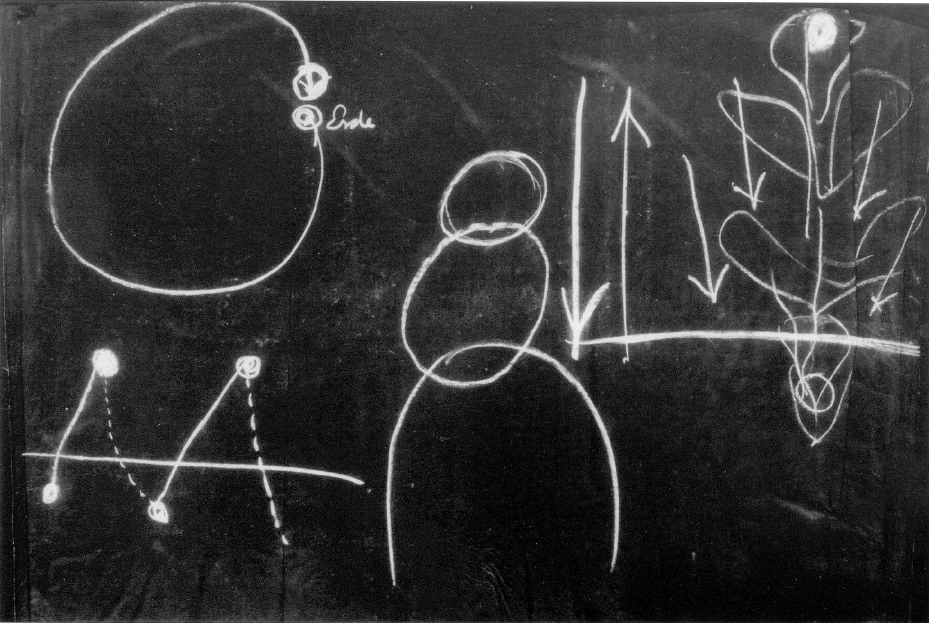
[ 4 ] Nun handelt es sich darum, daß wir diesen dreigliedrigen Menschen, ich möchte sagen, richtig ernst nehmen. Stellen wir ihn uns schematisch vor: Kopfmensch, Rhythmusmensch, Gliedmaßenmensch (Tafel 3, Mitte). Von diesen drei Gliedern des Menschen ist nur der Gliedmaßenmensch mit der Fortsetzung nach innen streng eingegliedert in die Kräfte unseres irdischen Planeten — wir fassen die Kräfte ins Auge, nicht die Substanzen, sondern die Kräfte. Der Gliedmaßenmensch ist streng eingegliedert in die Kräfte unseres Planeten, unserer Erde.
[ 4 ] The point now is that we take this threefold human being—I would say—truly seriously. Let us picture it schematically: the head human, the rhythm human, the limb human (Plate 3, center). Of these three parts of the human being, only the limb-human—with its extension inward—is strictly integrated into the forces of our earthly planet—we are considering the forces, not the substances, but the forces. The limb-human is strictly integrated into the forces of our planet, our Earth.
[ 5 ] Der Kopfmensch ist das nicht, denn was ist dieser Kopfmensch? Dieser Kopfmensch — Sie müssen nicht das Substantielle ins Auge fassen, sondern die Kräfte, die Formkräfte, die Bildungskräfte, die ihn bedingen —, dieser Kopfmensch ist ja die Metamorphose des Gliedmaßenmenschen, der in der vorigen Inkarnation, im vorigen Erdenleben da war. Die Kräfte, die den Gliedmaßenmenschen in der vorigen Inkarnation gebildet haben, die sind in einer Welt gewesen, die wir ja öfter beschrieben haben, zwischen dem letzten Tode und der letzten Geburt, der Geburt, die uns in dieses Dasein gebracht hat. Da haben sie sich metamorphosiert, so daß sie nun den Kopf bilden können. Es ist also ein vollständig polarer Gegensatz zwischen dem Gliedmaßenmenschen und dem Kopfmenschen. Und der mittlere Mensch ist der Ausgleich beider, derjenige, der durch den Rhythmus den Ausgleich beider schafft.
[ 5 ] The “head-human” is not that, for what is this “head-human”? This “head-human”—you need not focus on the substance itself, but rather on the forces, the formative forces, the creative forces that determine it—this “head-human” is, after all, the metamorphosis of the “limb-human” who existed in the previous incarnation, in the previous earthly life. The forces that formed the limb-human in the previous incarnation were in a world that we have often described, between the last death and the last birth—the birth that brought us into this existence. There they underwent a metamorphosis so that they can now form the head. There is thus a complete polar opposition between the limb-human and the head-human. And the middle human is the balance between the two, the one who, through rhythm, creates the balance between them.
[ 6 ] Diesen Gegensatz zwischen dem Kopfmenschen und dem Gliedmaßenmenschen müssen wir nun ein wenig ins Auge fassen. Wir können uns vielleicht zuerst nähern dem, was uns notwendig ist auf diesem Gebiete, wenn wir das Folgende aus einem anderen Felde ins Auge fassen. Betrachten Sie die Pflanze, zunächst nicht eine Baumpflanze, sondern eine einjährige Pflanze, die vom Samen aus in die Wurzel schießt und es im Jahreslaufe bis zu der Frucht- und Samenbildung bringt (Tafel 3, rechts). Eine solche Pflanze wächst dadurch, daß sie den Keim in die Erde gepflanzt erhält, daß aus dem Keim dann, indem er in die Erde gepflanzt ist, die Wurzel und das andere entsteht, die Blätter heraufwachsen bis zur Blüte, in der Blüte durch die Frucht sich der neue Samen entwickelt. Ein Kreislauf der Pflanze ist vollendet. Wir können schematisch diesen Kreislauf so zeichnen: Die Pflanze geht von dem Samen aus, der sich dutch die Erde entfaltet. Sie wächst hinauf über die Erdoberfläche. Sie wird empfangen von der Lichtwirkung, von der Sonnenwirkung, von der Licht- und Wärmewirkung. Da wächst sie weiter, vollendet ihren Kreislauf und kommt wiederum zurück zur Samenbildung. Aber da ist sie jetzt, indem sie zurückkommt in der Samenbildung im Herbste, da ist sie nun nicht unter der Erde, sondern da ist sie über der Erde; da ist sie auch den ganzen Sommer hindurch abhängig gewesen von den außerirdischen Kräften, von den Kräften, die gerade das Wachstum befördern aus dem Außertellurischen. Da ist also die Pflanze gewachsen bis zur neuen Samenbildung, jetzt nicht unter dem Einfluß der Erde, sondern sie ist gewissermaßen herausgezogen worden durch das Außerirdische aus der Erde. Sie ist wiederum das geworden, was sie früher war, und doch etwas anderes. Sie ist etwas anderes geworden. Inwiefern ist sie etwas anderes geworden? Ja, sie ist insofern etwas anderes geworden, als dieser Same das Wachstum abschließt. Da hört es auf, und dieser Kreis (Tafel 3, links oben), der vollendet sich jetzt nicht, wenn wir nicht den Samen aus seiner Region wegnehmen und ihn wieder zurückbringen, gewissermaßen auf ein tieferes Niveau bringen, ihn wiederum unter die Erde hineinbringen. Wir müssen also, indem wir den Samen verfolgen bis hinauf in das Gebiet, wo er im Bereiche des Außertellurischen ist, wir müssen den Samen wiederum hinunterbringen unter die Erde. Dann wächst er wiederum dem Himmel entgegen, und wir müssen ihn immer wiederum hinunterbringen (Tafel 3, links unten). Das heißt, das Weiterwachsen ist davon abhängig, daß wir gewissermaßen auf ein tieferes Niveau den Samen wiederum hinunterbringen. Wir müssen dasjenige, was der Himmel hervorgebracht hat, wiederum der Erde zurückgeben. So ist es nicht getan mit dem bloßen Kreislauf, sondern es handelt sich darum, daß gewissermaßen die Bildung der Pflanze sich selbst entläuft, und wenn sie bis zu einem gewissen Grade sich selbst entlaufen ist, muß sie wieder auf den ursprünglichen Standort zurückgebracht werden. Dann wird sie von denselben Kräften empfangen und der Kreislauf beginnt von neuem. So daß ich auch die Sache so zeichnen kann, daß jetzt, nachdem die Pflanze hierhergekommen ist, sie nun nicht weitergehen kann (Tafel 4, links. Vom Samen abwärts und erster Anstieg). Daher muß ich sagen: Wenn hier das Niveau der Erde ist (Horizontale), so muß ich den Kreislauf der Pflanze so zeichnen. Aber die Pflanze muß jetzt wieder in die Erde hinein. Wenn ich also mehrere Jahresläufe der Pflanze zeichne, so muß ich immer um ein Stück weitergehen. Das ist der Niveauunterschied. Ich muß immer wiederum den Samen zurücktragen auf ein anderes Niveau.
[ 6 ] We must now consider this contrast between the “head-oriented” person and the “limb-oriented” person a little more closely. We may perhaps gain a better understanding of what is necessary for us in this area by first considering the following example from a different field. Consider a plant—not a tree, but an annual plant—that sprouts from a seed into a root and, over the course of a year, develops fruit and seeds (Plate 3, right). Such a plant grows by having its seed planted in the earth; from the seed, once planted in the earth, the root and other parts develop, the leaves grow upward to flowering, and in the flower, through the fruit, the new seed develops. A plant’s life cycle is complete. We can schematically illustrate this cycle as follows: The plant originates from the seed, which unfolds through the earth. It grows upward above the earth’s surface. It is nourished by the effects of light, the effects of the sun, and the combined effects of light and heat. There it continues to grow, completes its cycle, and returns once more to seed formation. But now that it has returned to seed formation in the fall, it is no longer underground but above ground; throughout the entire summer, it has also been dependent on extraterrestrial forces—the forces that promote growth from beyond the earth. So the plant has grown to the point of new seed formation, now no longer under the influence of the earth, but has, so to speak, been drawn out of the earth by the non-earthly. It has once again become what it was before, and yet something else. It has become something else. In what sense has it become something else? Yes, it has become something else insofar as this seed brings the growth to a close. That is where it stops, and this cycle (Plate 3, top left) is not yet complete unless we remove the seed from its region and bring it back—in a sense, bring it down to a deeper level—and place it back into the earth. So, by following the seed all the way up into the realm where it is in the extra-terrestrial sphere, we must bring the seed back down beneath the earth. Then it grows toward the heavens once more, and we must bring it back down again and again (Plate 3, bottom left). That is to say, continued growth depends on our bringing the seed back down, as it were, to a deeper level. We must return to the earth what the heavens have brought forth. It is not simply a matter of the cycle; rather, the plant’s development, so to speak, runs its course, and once it has run its course to a certain degree, it must be brought back to its original location. Then it is received by the same forces, and the cycle begins anew. So I can also illustrate this by showing that now, after the plant has come this far, it cannot proceed any further (Plate 4, left. From the seed downward and the first ascent). Therefore, I must say: If this is the level of the earth (horizontal), then I must draw the plant’s cycle in this way. But the plant must now return to the earth. So when I draw several annual cycles of the plant, I must always move a little further along. That is the difference in level. I must always carry the seed back to a different level.
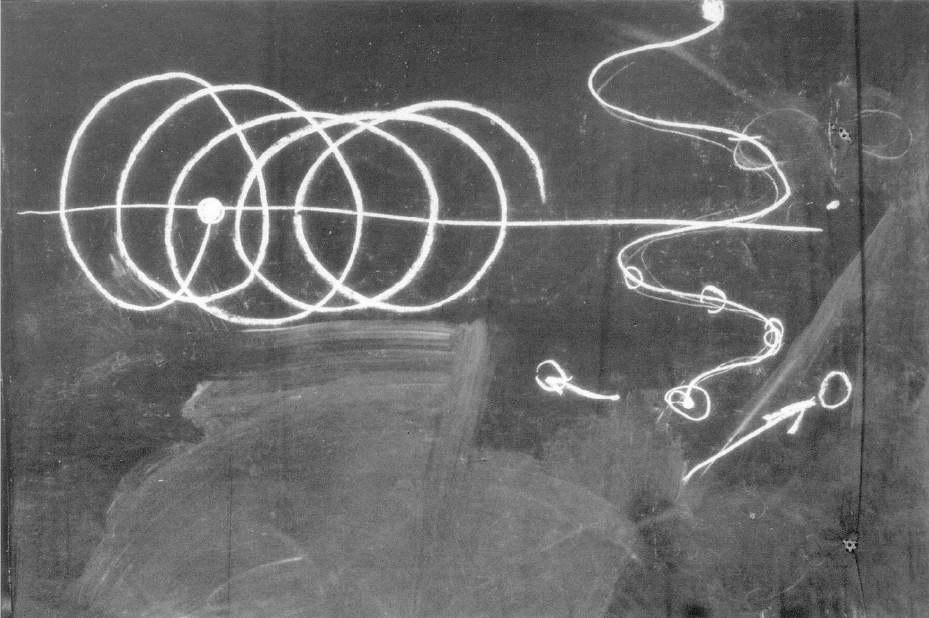
[ 7 ] Das habe ich Ihnen zunächst als ein Bild vorgeführt. Aber betrachten wir an diesem Bilde noch etwas weiteres. Sie brauchen ja nur, um das, was ich meine, zu betrachten, die Entstehung der Bohnenpflanze aus dem Bohnensamen ins Auge zu fassen, und Sie werden sehen, wie sich im einzelnen das vollzieht. Klarer werden Sie die Sache noch sehen, wenn Sie eine Pflanze, die ihren Stengel windet, ins Auge fassen, wenn Sie also die Pflanze verfolgen, wie sie nicht veranlaßt wird, ganz geradlinig zu wachsen, sondern gewisse Kräfte frei wirken können, wie etwa bei der Winde, die so wächst dem Samen zu (Tafel 4, rechts, aber nur die Spirale mit dem alten und neuen Samen). So vollendet sie ihren Kreislauf.
[ 7 ] I first presented this to you as an illustration. But let’s consider something else about this illustration. To understand what I mean, you need only consider the development of the bean plant from the bean seed, and you will see how this process unfolds in detail. You’ll see the matter even more clearly if you consider a plant that twists its stem—that is, if you observe how the plant is not compelled to grow in a perfectly straight line, but rather allows certain forces to act freely, as in the case of the bindweed, which grows toward the seed in this way (Plate 4, right, but only the spiral with the old and new seeds). In this way, it completes its cycle.
[ 8 ] Betrachten wir dieses Bild im Zusammenhang mit dem Menschen. Wenn wir beim Menschen, statt jetzt den Jahreskreislauf der Pflanze ins Auge zu fassen, ins Auge fassen jenen Kreislauf, der von einem Lebenslauf durch die geistige Welt bis zum nächsten Lebenslauf hinübergeht, dann haben wir etwas Ähnliches, etwas ganz merkwürdig Ähnliches. Wir schauen, sagen wir, bei jedem von Ihnen auf den Gliedmaßenorganismus in der vorigen Inkarnation und schauen jetzt auf Ihren Kopf in dieser Inkarnation. Der entsteht durch eine Metamorphose, indem nur unterbrochen ist die sichtbare Verwandlung durch alles das, was geschieht zwischen Tod und neuer Geburt. Dieser Kopf entsteht so, wie hier (Tafel 3, links) im Laufe des Wachstums entsteht der neue Same aus dem alten. Aber das ganze übrige Pflanzenleben liegt dazwischen. So daß Sie sich sagen können: Im Menschen liegt seiner Formbildung nach so etwas vor, wie wenn die Wurzel von ihm in der vorigen Inkarnation dagewesen wäre, und aus dieser Wurzel ist aufgesprossen der Kopf dieser Inkarnation. Dieser Kopf, der stellt also damit etwas Ähnliches dar wie der Same hier. Nur ist beim Menschen alles, ich möchte sagen, auf einem anderen Niveau gelegen. Es liegt in einer höheren Region. Es ist auch komplizierter.
[ 8 ] Let us consider this image in relation to human beings. If, instead of focusing on the annual cycle of a plant, we focus on the cycle that extends from one life course through the spiritual world to the next, then we find something similar—something remarkably similar. Let us look, for example, at each of you: at the limb system in your previous incarnation, and now at your head in this incarnation. It arises through a metamorphosis, in which the visible transformation is merely interrupted by everything that happens between death and rebirth. This head arises in the same way as shown here (Plate 3, left), where, in the course of growth, the new seed arises from the old. But the entire rest of plant life lies in between. So that you can say to yourself: In human beings, in terms of their form formation, there is something akin to the root having existed in their previous incarnation, and from this root the head of this incarnation has sprouted. This head thus represents something similar to the seed shown here. Only in the case of human beings is everything, I would say, situated on a different level. It lies in a higher region. It is also more complex.
[ 9 ] Nun fassen Sie aber, um die Vorstellung fertig zu bekommen, die ganze Metamorphose der Pflanzen ins Auge. Wenn Sie bei der Winde sich das ansehen, so werden Sie aus dem spiralig gewundenen Stengel oder eigentlich schraubenförmig gewundenen Stengel sehen, daß die Kräfte, die da wirken von außen, nicht bloß gerade hinaufwirken, sondern daß sie in der Tat die Pflanze spiralig fortschreiten lassen. Die Pflanze hat eine Spiraltendenz. Nur wenn wieder der neue Same sich bildet, da widerstrebt dieser Same der Spiraltendenz, da zieht sich alles zusammen in ein Körnchen. Da entzieht sich der Same dem Einflusse des Weltenalls. Beim Menschen ist das so, daß vor allen Dingen der Gliedmaßenmensch dem Einflusse der Erde unterliegt. Beim rhythmischen Menschen ist das etwas anders, darauf werden wir noch zu sprechen kommen. Aber der Kopf ist etwas, was sich entzieht dem Erdeneinflusse, was diesen nicht mitmacht. Geradeso wie der Same hier nicht mitmacht die außerirdischen Einflüsse, so macht der Kopf nicht mit die Erdeneinflüsse. Der Kopf entzieht sich vollständig den Erdeneinflüssen. Nur dadurch ist es möglich, daß wir Menschen abstrahieren, daß wit Menschen in abstrakten Gedanken denken. Würde unser Kopf sich nicht entziehen können den Erdeneinflüssen, so könnte er nicht abstrakt denken. Er kann nur dadurch abstrakt denken, daß er sich dem Erdeneinflusse entzieht. Das drückt sich übrigens schon aus in der menschlichen Gestalt. Denken Sie doch nur einmal, daß Ihr Kopf ja wirklich der umgewandelte Gliedmaßenmensch ist. Aber dieser Gliedmaßenmensch — hier auf der Erde geht er, er wandelt auf der Erde. Der Kopf macht nicht mit. Der Kopf verhält sich ungefähr, trotzdem er auch nur ein Mensch ist, wenn auch ein Mensch späterer Metamorphose, der Kopf verhält sich so, wie wenn Sie sich bequem hineinsetzen ins Auto oder in den Eisenbahnzug, sich nicht regen und doch vorwärtskommen. Gerade in dieselbe Lage versetzt sich Ihr Kopf gegenüber dem übrigen Organismus. Der übrige Organismus, der schreitet vorwärts; der Kopf, der ist wie in einer Kutsche, der ruht und macht die Bewegungen nicht mit. Der entzieht sich also in anschaulicher Weise dem Erdeneinflusse. Das ist der Mensch, der sich vom anderen Menschen befördern läßt.
[ 9 ] Now, to complete this picture, consider the entire metamorphosis of plants. If you observe the morning glory, you will see from its spirally coiled stem—or, more accurately, its helically coiled stem—that the forces acting upon it from the outside do not merely act straight upward, but in fact cause the plant to grow in a spiral. The plant has a tendency to spiral. Only when a new seed forms does this seed resist the spiral tendency; then everything contracts into a tiny seed. There the seed withdraws from the influence of the universe. In human beings, it is the case that, above all, the “limb-oriented human” is subject to the influence of the Earth. In the “rhythmic human,” this is somewhat different; we will return to this later. But the head is something that withdraws from the Earth’s influence; it does not participate in it. Just as the seed here does not participate in extraterrestrial influences, so the head does not participate in the Earth’s influences. The head completely withdraws from the Earth’s influences. Only in this way is it possible for us humans to abstract, to think in abstract terms. If our head were unable to withdraw from earthly influences, it could not think abstractly. It can think abstractly only by withdrawing from earthly influences. This, incidentally, is already expressed in the human form. Just consider for a moment that your head is, in fact, the transformed limb-human. But this “limb-human”—here on Earth, it walks; it moves about on Earth. The head does not participate in this. The head behaves—even though it, too, is merely a human being, albeit one of a later metamorphosis—as if you were sitting comfortably in a car or on a train, remaining still yet moving forward. Your head places itself in precisely this same position in relation to the rest of the organism. The rest of the organism moves forward; the head, however, is like a passenger in a carriage—it rests and does not participate in the movements. It thus visibly withdraws from the influence of the Earth. This is the human being who allows himself to be transported by another human being.
[ 10 ] So ist aber überhaupt dieses Haupt des Menschen organisiert. Es entzieht sich dem Erdeneinflusse. Und so können wir sagen: dieses Haupt des Menschen, es stellt etwas — wenigstens zunächst im Bilde — Ähnliches dar wie der Same, der sich dem himmlischen Einflusse der Pflanzenbildung entzieht. Nun aber beim Menschen ist es nicht so, wie es bei der Pflanze ist. Bei der Pflanze ist es so, daß sie von der Erde nach oben wächst, daß sie also entgegenwächst dem himmlischen Einflusse. Der Mensch wächst nach unten. Er hat dasjenige, was sich zunächst dem Erdeneinflusse entzieht, oben, und alles dasjenige, was in den Erdeneinfluß hineinwächst, das ist dasjenige, was nach unten wächst. Wenn der Mensch ankommt bei der Konzeption oder bei der Geburt, so kommt er zunächst — auch die äußere Embryologie ist ein vollständiger Beweis dafür — als ein Kopfgebilde an. Den Kopf bringt er sich schon mit als ein metamorphosiertes Produkt aus dem vorigen Erdenleben. Hier in diesem Erdenleben wächst ihm aus den Kräften dieses Erdenlebens vor allem der Gliedmaßenmensch zu, wächst an den Kopf daran und ist jetzt noch nicht so weit wie der Kopf, ist den Erdeneinflüssen vollständig ausgesetzt. Der Kopf entzieht sich den Erdeneinflüssen. So daß wir sagen können: Wenn wir Pflanzen beobachten, so können wir an dem spiraligen oder schraubenförmigen Bau der Pflanze verfolgen, daß die Kräfte von den außerirdischen Körpern kommen, die der Pflanze diese schraubenförmige Windung geben. Wenn wir in den Menschen hineinschauen, so können wir sehen, wie er der Erde entgegenwächst. Und fragen können wir uns: Was hat denn dem Menschen diese Möglichkeit gegeben, entgegengesetzt dem Wachstum der Pflanze, die von unten nach oben wächst, von oben nach unten zu wachsen und in die Erdeneinflüsse hinein sich zu fügen? Was hat dem Menschen diese Möglichkeit gegeben? Wie hängt das alles zusammen? Das ist eine wesentliche und wichtige Frage für das Studium der menschlichen Gestaltenlehre, der Morphologie, aber auch für das Studium der ganzen menschlichen Wesenheit. Sehen Sie, würden wir angewiesen sein darauf, unser Seelenleben ohne unsern Kopf zu führen, so würde es etwas anderes sein. Wenn wir unser Seelenleben ohne unsern Kopf führten, so würden wir keine Abstraktionen bilden. Wir würden vor allen Dingen nicht den bloßen dreidimensionalen Raum als Abstraktion bilden. Wir würden streng unterscheiden: vorne, rückwärts; links, rechts; oben, unten. Das würden für uns konkret voneinander verschiedene Dinge sein. Das tut auch unser Organismus. In dem Augenblicke, wo Sie sich durch die geisteswissenschaftliche Methode nur bis zur imaginativen Anschauung der Welt erheben, da hört die bequeme Dreidimensionalität auf, da ist sie nicht mehr da. Da müssen Sie unterscheiden, denn Sie begehen ja das Eigentümliche, daß Sie die gewöhnliche Kopforganisation ausschalten und bis zu der ätherischen Organisation des Menschen zurückkehren. Die ist im Vergleich zum physischen Kopforganismus wesentlich anders. So daß erst durch den vollkommenen, von der vorigen in diese Inkarnation errungenen Menschenkopf die Abstraktionen zustande kommen. Alles abstrakte Denken, alles Denken in bloßen Gedanken ist gebunden an diese Kopforganisation, die wir aber erst erhalten dadurch, daß wir verlassen die geistige Welt, in die irdische Welt hereinkommen und dasjenige, was früher abhängig war von der Erdenorganisation, nunmehr von ihr unabhängig machen.
[ 10 ] This is how the human head is organized in general. It is beyond the influence of the earth. And so we can say: this human head represents something—at least initially, figuratively speaking—similar to the seed, which is beyond the reach of the heavenly influence of plant formation. But with humans, it is not the same as with plants. With plants, they grow upward from the earth; that is, they grow against the heavenly influence. Human beings grow downward. They have that which initially eludes the influence of the earth at the top, and everything that grows into the influence of the earth—that is what grows downward. When a human being arrives at conception or at birth, they first appear—and external embryology provides complete proof of this—as a head-like formation. They already bring the head with them as a metamorphosed product from their previous earthly life. Here in this earthly life, the human body—consisting primarily of the limbs—grows from the forces of this earthly life, attaches itself to the head, and is not yet as developed as the head; it is completely exposed to earthly influences. The head withdraws from earthly influences. So we can say: When we observe plants, we can see from the plant’s spiral or helical structure that the forces come from the extra-terrestrial bodies, which give the plant this helical twist. When we look inside the human being, we can see how he grows toward the earth. And we can ask ourselves: What has given human beings this ability—in contrast to the growth of the plant, which grows from the bottom up—to grow from the top down and to adapt to earthly influences? What has given human beings this ability? How is all this connected? This is a fundamental and important question for the study of human morphology, but also for the study of the entire human being. You see, if we were compelled to conduct our soul life without our head, it would be something different. If we conducted our soul life without our head, we would not form abstractions. Above all, we would not form mere three-dimensional space as an abstraction. We would make a strict distinction between: front and back; left and right; up and down. For us, these would be concrete, distinct things. Our organism does the same. The moment you rise, through the method of spiritual science, only as far as the imaginative perception of the world, that is when the convenient three-dimensionality ceases; it is no longer there. There you must make distinctions, for you are, after all, undertaking the peculiar process of shutting off the ordinary organization of the head and returning to the human being’s etheric organization. This is fundamentally different from the physical head organism. Thus, it is only through the fully developed human head—achieved from the previous incarnation into this one—that abstractions come into being. All abstract thinking, all thinking in mere thoughts, is bound to this mental organization; yet we acquire it only by leaving the spiritual world, entering the earthly world, and making that which was previously dependent on the earthly organization now independent of it.
[ 11 ] Das weist Sie darauf hin, daß wir als Menschen ebenso auf der einen Seite hineingestellt sind in die Kräfte des Weltenalls wie die Pflanze. Nur weil wir uns mit unserem Kopfe unabhängig machen, machen wir diese Kräfte nicht mit. Unser übriger Organismus, der würde sich sofort, wenn er kopflos dächte — das kann er ja —, sich sofort in der ganzen Weltenorganisation drinnenfühlen.
[ 11 ] This points out to you that we, as human beings, are just as much a part of the forces of the universe as plants are. It is only because we make ourselves independent through our minds that we do not participate in these forces. The rest of our organism, if it were to think without the head—which it is capable of doing—would immediately feel itself to be part of the entire cosmic order.
[ 12 ] Wenn man einen sehr bequemen Schlafwagen zustande bekommen könnte — in der gegenwärtigen Zeit wird es ja nicht so leicht möglich sein —, gar nicht hinausschauen könnte und es gar nicht rattern hörte und so weiter, könnte man vielleicht in die Illusion verfallen, daß man in einem ruhigen Zimmer ist. Man könnte nichts bemerken von der ganzen Wagenbewegung. Aber sobald Sie wiederum zum Fenster hinausschauen, dann merken Sie doch, trotzdem Sie ruhig sitzen, daß es vorwärtsgeht. Sobald Sie sich von dem, was Ihnen Ihr Kopf dadurch vorgaukelt, daß er sich von der Erdenorganisation frei macht, wiederum befreien, merken Sie, daß Sie mit der Erdenorganisation die Bewegungen der Erde mitmachen. Das heißt, es ist möglich, wenn man sich von der gewöhnlichen gegenständlichen Vorstellungsweise, wie ich sie in meinem Buche «Wie erlangt man Erkenntnisse der höheren Welten?» genannt habe, zur Imagination erhebt, die Bewegungen der Erde zu fühlen, weil man nämlich da zum Fenster hinausschaut: man schaut in die geistige Welt hinein. Geradeso, wie Sie beim Eisenbahnzug zum Fenster hinausschauen und merken, daß da draußen sich das Bild fortwährend ändert, so schauen Sie, indem Sie von dieser physisch-sinnlichen Welt an die geistige kommen, zum Fenster hinaus, und an der Veränderung der geistigen Welt, da merken Sie, wie Sie da vorbeifahren, daß Sie mit der Erde nicht in Ruhe sind, sondern mit der Erde sich weiterbewegen. Man kann daher nicht zu einer wirklichen Auffassung eines räumlichen Weltenbildes der Astronomie kommen, wenn man es konstruieren will just mit dem Glied unseres Organismus, das sich unabhängig macht. Denken Sie doch einmal, was wit seit dem Beginn dieses fünften nachatlantischen Zeitraumes als zivilisierte Menschheit eigentlich getan haben. Wir haben mit unserem Kopf über die Welt gedacht. Aber just der Kopf ist es, der sich ganz unabhängig gemacht hat von der Welt, der die Weltenrichtungen bis zur Abstraktion der drei Raumrichtungen filtriert hat. Wir haben also ein Weltenbild, das kopernikanische Weltenbild entworfen mit dem denkbar ungeeignetsten Mittel dazu, mit dem Menschenkopf, dessen wesentliche Eigenschaft gerade darinnen besteht, daß er sich emanzipiert von dem Mitmachen der Weltbewegungen. Es ist etwa geradeso, wie wenn Sie ein Bild bekommen wollten von, sagen wir, den Bewegungen des Eisenbahnzuges, die Sie mitmachen, indem Sie im Eisenbahnzug fahren, aus einer Zeichnung, die Sie mit Ihren Fingern machen, und wobei Sie sich gar nicht richten nach der Bewegung des Eisenbahnzuges, sondern nach Ihren Ideen. Sie zeichnen ja etwas auf, Sie machen sich unabhängig. Das können Sie nicht als ein Bild der Bewegung des Eisenbahnzuges ansehen, denn es ist ganz unabhängig davon. So unabhängig eigentlich ist dasjenige Bild, das wir entwerfen von dem äußeren räumlich-astronomischen Weltgeschehen, wenn wir das dazu ungeeignetste Mittel verwenden.
[ 12 ] If one could manage to get a very comfortable sleeper car—though that’s not so easy these days—where one couldn’t look out at all and couldn’t hear the rattling and so on, one might perhaps fall under the illusion that one is in a quiet room. You wouldn’t notice any of the train’s movement. But as soon as you look out the window again, you realize—even though you’re sitting still—that you’re moving forward. As soon as you free yourself from what your mind leads you to believe—by detaching itself from the Earth’s structure—you realize that, together with the Earth’s structure, you’re participating in the Earth’s movements. This means that it is possible, when one rises from the ordinary concrete mode of imagination—as I have called it in my book *How Does One Attain Knowledge of the Higher Worlds?*—to imagination, to feel the Earth’s movements; for when you look out the window there, you are looking into the spiritual world. Just as you look out the window of a train and notice that the view outside is constantly changing, so too, as you move from this physical-sensory world into the spiritual world, you look out the window; and through the changing landscape of the spiritual world—as you pass by—you realize that you are not at rest with the Earth, but are moving along with it. One cannot, therefore, arrive at a true understanding of astronomy’s spatial worldview if one attempts to construct it precisely with that part of our organism that has made itself independent. Just think for a moment about what we, as civilized humanity, have actually been doing since the beginning of this fifth post-Atlantean epoch. We have thought about the world with our heads. But it is precisely the head that has made itself completely independent of the world, that has filtered the directions of the world down to the abstraction of the three spatial directions. We have thus devised a worldview—the Copernican worldview—using the most unsuitable means imaginable for this purpose: the human head, whose essential characteristic lies precisely in its emancipation from participating in the movements of the world. It is much like trying to get a picture of, say, the movements of a train—which you experience firsthand by riding on it—from a sketch you make with your fingers, while orienting yourself not at all by the train’s movement but by your own ideas. You are, after all, sketching something; you are making yourself independent. You cannot regard this as a picture of the train’s movement, for it is entirely independent of it. The picture we construct of external, spatial-astronomical world events is just as independent when we use the most unsuitable means for the task.
[ 13 ] Nun denken Sie sich, wozu man genötigt ist durch eine wirklichkeitsgemäße Auffassung in der Gegenwart. Man ist genötigt, zu sagen, das räumliche astronomische Weltenbild ist mit dem ungeeignetsten Mittel konstruiert worden. Kein Wunder, daß es allem widerstrebt, was herauskommt, sobald man geeignete Mittel verwendet. Natürlich, für gewisse Zwecke eignet sich zunächst dieses Weltenbild. Denn warum? Weil wir uns ja angewöhnt haben und angewöhnen mußten seit der Mitte des 15. Jahrhunderts, seit dem Entstehen der fünften nachatlantischen Periode, unabhängig vom Weltenall zu denken. Wir werden morgen hören, warum das so gekommen ist. Aber dadurch haben wir die Möglichkeit verloren, nun wirklich etwas zu wissen über jene Bewegungen, die wir mit der Weltbewegung der Erde mitmachen und die dann herauskommen in dem Augenblicke, wo wir uns dazu erziehen, die sonst abstrakten Raumdimensionen konkret zu empfinden, wie ich es Ihnen gestern kurz schon skizziert habe. Und wir werden auf diese Dinge immer weiter und weiter eingehen. Man kann sie nicht anders als, ich möchte sagen, aufbauend in Kreisen vollziehen.
[ 13 ] Now consider what a realistic view of the present compels us to do. We are compelled to say that the spatial, astronomical view of the universe has been constructed using the most unsuitable means. No wonder that it conflicts with everything that emerges as soon as one uses appropriate means. Of course, for certain purposes, this worldview is initially suitable. Why? Because we have become accustomed—and had to become accustomed—since the middle of the 15th century, since the dawn of the fifth post-Atlantean period, to thinking independently of the universe. We will hear tomorrow why this has come to be. But as a result, we have lost the ability to truly know anything about those movements that we experience along with the Earth’s movement through the universe—movements that become apparent the moment we train ourselves to perceive the otherwise abstract spatial dimensions concretely, as I briefly outlined for you yesterday. And we will delve deeper and deeper into these matters. One cannot approach them in any other way than—I would say—by proceeding in circles.
[ 14 ] Nun hat nach den gestrigen Andeutungen Herr Dr. Stein sich die Mühe gegeben, hier ein Modell aufzustellen für die Bewegung, die etwa herauskommt, wenn man den Menschen verfolgt mit der Erde, also mit anderen Worten, für die Bewegung der Erde, rein absolut genommen. Statt daß ich hier (Tafel 4, rechts) die Bewegung der Pflanzenkräfte in Spiralen verfolge, komme ich, wenn ich die Bewegung, die der Mensch mit der Erde mitmacht, also die Bewegung der Erde verfolge, komme ich auch auf eine solche Spirale, die aber fortschreitet. Und diese Spirale, sie gibt mir ein Bild der wirklichen Erdenbewegung. Sie gibt mir aber zu gleicher Zeit ein Bild der Sonnenbewegung. Denn sehen Sie, nehmen Sie an, hier wäre die Erde, da wäre die Sonne (in die Zeichnung werden Stellungen von Sonne und Erde hineingezeichnet). Ein Beschauer sieht hier die Sonne in dieser Richtung gehen. Die Erde schreitet fort, aber genau der Linie hinter der Sonne nach. So sieht der Beschauer die Sonne in der anderen Richtung, wenn das jetzt die Erde ist. Jetzt geht die Sonne hier weiter, die Erde hier ihr nach; jetzt ist die Sonne hier, die Erde hier. Der Beschauer sieht wiederum die Sonne in der anderen Richtung. Das heißt, indem in dieser Weise die Erde hinter der Sonne herläuft, sieht ein Beschauer das eine Mal die Sonne rechts, das andere Mal sieht er sie links.
[ 14 ] Now, following yesterday’s hints, Dr. Stein has taken the trouble to set up a model here for the motion that results, roughly speaking, when one follows the human being along with the Earth—in other words, for the motion of the Earth, taken in purely absolute terms. Instead of tracing the movement of the plant forces in spirals here (Plate 4, right), when I trace the movement that a person undergoes along with the Earth—that is, the movement of the Earth itself—I also arrive at such a spiral, one that, however, progresses. And this spiral gives me a picture of the Earth’s actual movement. At the same time, it gives me a picture of the Sun’s movement. For you see, suppose the Earth were here and the Sun were there (the positions of the Sun and Earth are drawn into the illustration). An observer sees the Sun moving in this direction. The Earth moves forward, but exactly along the line behind the Sun. Thus, the observer sees the Sun in the opposite direction when the Earth is now in that position. Now the Sun continues here, the Earth following it here; now the Sun is here, the Earth here. The observer again sees the Sun moving in the opposite direction. That is to say, as the Earth follows the Sun in this way, an observer sees the Sun on the right one moment and on the left the next.
[ 15 ] Das wurde interpretiert dahingehend, daß die Sonne stillsteht und die Erde um die Sonne sich herumbewegt. In Wahrheit bewegt sich nicht die Erde um die Sonne herum, sondern die Erde läuft hinter der Sonne nach. Der Beschauer sieht, wenn die Sonne an diesem Punkte der Schraubenlinie angekommen ist, und die Erde dahin gekommen ist, die Sonne rechts; hier sieht er die Sonne links, hier rechts, hier links. Das gibt für den äußeren Anblick, wenn man nicht wahrnimmt die eigene Bewegung, gar nichts anderes, als wenn die Erde nicht herumlaufen würde.
[ 15 ] This has been interpreted to mean that the sun stands still and the Earth moves around the sun. In reality, it is not the Earth that moves around the sun, but rather the Earth follows behind the sun. The observer sees the Sun on the right when the Sun has reached this point on the helical path and the Earth has arrived there; here he sees the Sun on the left, here on the right, here on the left. To the naked eye—if one does not perceive one’s own motion—this appears no different from a situation in which the Earth were not moving at all.
[ 16 ] Sie sehen daraus, welche Täuschungsmöglichkeit vorliegt, wenn man nach dem äußeren Anblicke urteilt, denn in dieser Beziehung liegt wirklich eine Relativität der Bewegung vor. Man kann wirklich sagen, die eigene Bewegung wird auch von denjenigen nicht wahrgenommen, die jetzt rechnen und die die scheinbare Bewegung der Sonne ja in Rechnung ziehen, aber die nicht in Rechnung ziehen das Verhältnis der Erde zur Sonne.
[ 16 ] You can see from this how easily one can be misled by judging based on outward appearances, for in this regard there is indeed a relativity of motion. One can truly say that one’s own motion is not perceived even by those who are now making calculations and who do take the apparent motion of the Sun into account, but who do not take into account the Earth’s relationship to the Sun.
[ 17 ] Nun möchte ich, daß Sie versuchen, dasjenige, was ich jetzt über das Laufen in der Schraubenlinie gesagt habe, sich einmal etwas vorzustellen. Denn man muß in der Tat sich erst an einem solchen Modell richtig vorstellen das Hinterherlaufen der Erde hinter der Sonne, das Nachlaufen, und man wird dann weiterschreiten können zu dem, wozu wir, ich glaube morgen kommen, nämlich zu einem wirklichen Erkennenlernen dessen, was da eigentlich vorliegt. Ich habe absichtlich heute nur Andeutungen gegeben, und, ich möchte sagen, geflissentlich manche Fragen offengelassen. Aber diese Fragen werden schon morgen oder in den nächsten Vorträgen zur Beantwortung kommen. Ich wollte ganz einfach mitteilend dasjenige Ihnen vorführen, was derjenige erlebt, welcher aus der physischen Welt zum Fenster hinausschaut und die geistige Welt draußen wahrnimmt, das Vorübersausen der geistigen Welt draußen wahrnimmt, so daß er ein Urteil bekommen kann, welches die wirkliche Bewegung der Erde ist und welches auch die wirkliche Bewegung der Sonne ist. Ich werde Ihnen aber zeigen, daß darüber, wie nun die Erde zu der Sonne steht — daß sie wirklich hinter ihr nachläuft —, eine Vorstellung erst zu bekommen ist, wenn man das Einzige aufsucht, woran man wirklich finden kann das Verhältnis der Erde zur Sonne, nämlich wenn man findet das Verhältnis gewisser Vorgänge im menschlichen Organismus zu dem menschlichen Repräsentanten der Sonne, zu dem menschlichen Herzen. Denn ausgehend von der Erkenntnis des Menschen müssen wir wiederum eine Anschauung über das Weltenall gewinnen.
[ 17 ] Now I would like you to try to visualize what I have just said about the Earth’s movement in a helical path. For one must indeed first use such a model to properly visualize the Earth’s pursuit of the Sun—its trailing behind it—and only then will one be able to move on to what we will, I believe, reach tomorrow: namely, a genuine process of coming to understand what is actually taking place there. I have deliberately given only hints today, and—I might add—I have intentionally left some questions open. But these questions will be answered as early as tomorrow or in the next few lectures. I simply wanted to present to you, in a communicative way, what is experienced by someone who looks out the window from the physical world and perceives the spiritual world outside—perceives the spiritual world rushing past—so that they can form a judgment as to what the Earth’s actual motion is and what the Sun’s actual motion is. But I will show you that a conception of how the Earth relates to the Sun—that it truly follows behind it—can only be gained by seeking out the one thing in which the relationship of the Earth to the Sun can truly be found, namely, by finding the relationship of certain processes in the human organism to the human representative of the Sun: the human heart. For, starting from our understanding of the human being, we must in turn gain an insight into the universe.
[ 18 ] Davon wollen wir dann morgen weiter reden.
[ 18 ] Let's talk more about that tomorrow.