

Correspondences Between the Microcosm and the Macrocosm
Man — A Hieroglyph of the Universe
GA 201
16 May 1920, Dornach
Translated by Steiner Online Library
Sixteenth Lecture
[ 1 ] When one attempts to understand humanity’s place within the universe as a whole, it is important to consider not only the spatial aspect but also the temporal one. Anyone who follows the history of human development even a little will find that it is a characteristic of the Eastern worldview to place the spatial aspect in the foreground—though not to the extent that the temporal aspect is entirely disregarded; nevertheless, the spatial aspect takes precedence. In contrast, it is a characteristic of the Western worldview to give the temporal aspect particular consideration. And it is precisely this consideration of the temporal aspect in the evolution of humanity and the universe as a whole that must be taken into account above all else in a correct understanding of the Christ force. But if one wishes to correctly recognize the Christ force in its full significance within the evolution of humanity and the Earth, then one must be able to place humanity itself in the proper temporal context within the entire universe. As I have already mentioned several times, what stands in the way of this today is the general belief in the law of conservation of energy and, in particular, the law of conservation of matter. It is above all this law of conservation of energy that seeks to place human beings within the cosmos in such a way that they are viewed merely as a product of nature within it. Attempts have even been made to investigate how the conversion of what humans consume as food occurs through combustion into energy, and how the heat of combustion and other forms of energy that arise within the human body result from the transformed energy of the food. Such experiments have already been conducted in recent times with students. They resemble the line of thought that sought to assert itself in roughly the following way: One sees a building, hears that it is a bank, attempts through various manipulations to count all the money that is carried into this bank, and then also counts all the money that is carried out again; and one finds that it is the same amount. And now one draws the conclusion: so the money inside has been transformed, or it has remained the same, and there are no bank clerks, no people inside this bank building. That, roughly speaking, is the logic of the idea that everything a person consumes can be found again in the transformed forces of their body heat and activity. Here, too, people simply lack the courage to truly examine—I would say—the depth of thought underlying these modern principles. One would uncover all sorts of things if one were to examine what appears in so-called contemporary science for its logical consistency and, in particular, for its connection to reality.
[ 2 ] The point is that, through all these unrealistic and, fundamentally speaking, illogical thought processes of modern times, human beings have been placed precisely in this dilemma that I have been drawing attention to in recent days—where, on the one hand, there are ideals and side effects, and on the other hand, there are natural phenomena, and no bridge can be found between the two. At most, in recent times, decadent philosophizing chatterboxes—such as Eucken or Bergsor— attempt to interpret natural phenomena in a way that might slightly flatter the primitive thinking of those people who have absolutely no interest in engaging with anything concrete, but who are content to settle for such drivel as Euckenism or Bergsonism. The first question to ask is: What does a human being carry within themselves from the entire expanse of the universe? What does a human being carry within themselves such that they can engage with this part of the universe through their own self—and do so in such a way that one can see what emerges is their own? — All other things in the universe, all other “beings”—if I may coin the term—all other beings in the universe are less easy to grasp at a glance, but one being is, in fact, quite easy to study at first, provided one sets aside all the prejudices of so-called modern science: that is, heat.
[ 3 ] Certainly, one must first acknowledge that the animal kingdom—and perhaps, to a certain extent, the plant kingdom—also possesses intrinsic heat; but the way in which the higher animal kingdom and the human realm possess intrinsic heat allows us to distinguish it from other forms of intrinsic heat that develop. In any case, it is necessary to take a closer look at what we might call intrinsic warmth in human beings. I will set aside the animal realm entirely today, although what I am saying is by no means at odds with the facts within the animal world; but it would take us too far afield today to extend this consideration to the animal world as well. In what a human being possesses as their own warmth—and in which there is, to begin with, something that, in a sense, separates itself as a kind of warmth organism for each individual from the rest of the universal warmth—there lies their innermost physical, their innermost bodily sphere of activity. People simply do not pay attention to this because it eludes ordinary consciousness—just as, fundamentally, what lives in the human being as the soul-spiritual finds its immediate continuation in an effect upon the warmth present within the human being. One should actually, when speaking of the human being’s physicality, first speak of his or her warmth body. One should say: When a person stands before you, a self-contained space of warmth also stands before you, which, in a certain sense, has a higher temperature than the surroundings. It is within this elevated temperature that the spiritual and soul aspects of the human being first come to life, and indirectly, through the warmth, these spiritual and soul aspects are also transmitted to the other organs. This is how the will comes into being.
[ 4 ] The will comes about in that one first acts upon the warmth within the human being, and then—by acting upon the warmth—upon the air organism, from there upon the water organism, and only then upon what constitutes the mineral, solid organism within the human being. So one must imagine the human organism in this way: One acts internally first on the warmth, then through the warmth on the air, from there on the water, on the fluid organism, and from there on the solid organism. I have pointed out to you that the human being consists of solid matter as the smallest part of his organism, and that he is, in fact, more than 75 percent water. The fact that we actually live and function within our warmth is one of the physiological facts that must be taken very seriously. Nor should we simply regard what is depicted here as a closed thermal space (Plate 30, large shape at the top center) as merely a thermal space with a higher temperature than its surroundings; rather, we must understand it as containing distinct warmer and colder regions. Just as our liver, lungs, and so on are differentiated within us, so too is our thermal organism differentiated, and it is such that it is constantly changing its differentiation internally. It is in a state of dynamic differentiation. And within this internal organization of heat lies that which is initially connected to soul-spiritual activity.
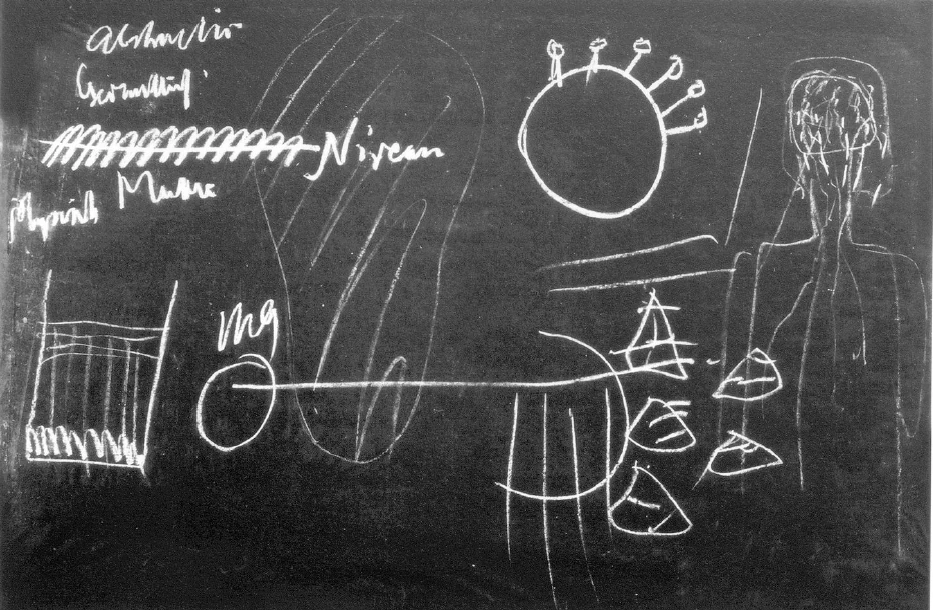
[ 5 ] You see, philosophers today argue that one cannot understand the effect of the spiritual-soul aspect on the physical, because they imagine an arm to be something like a fixed lever mechanism (the same diagram, upper right corner). Then, of course, one cannot understand how the activity of the spiritual-soul aspect—which one imagines as abstractly as possible—is supposed to be transmitted to this fixed lever mechanism. One need only direct one’s attention to the transitions. There, then, we find that which has been organized out of the entire universe specifically for the human being. And now the point is that, when we truly study human thought, we come to realize that the thinking that takes place in our heads has a great deal to do with this inner workings within the thermal conditions. This is expressed somewhat imprecisely, but perhaps over time the imprecise aspects can be supplemented by more precise ones. We must try to obtain a complete picture. Therefore, I will initially characterize this more briefly. The fact is that when one observes this interplay of thoughts within a thermal space—a closed thermal space—it becomes apparent that something like an interaction between the activity of thought and the activity of heat is taking place. And what does this consist of? You see, this brings us to something I ask you to consider very carefully.
[ 6 ] If you take the rest of the human body and then the head (the same diagram, far right), you can, of course, trace a metabolic flow from the rest of the body to the head. And you can sense as a direct experience that the head ultimately has something to do with thinking. But what is actually happening there? I would like to guide you to see what is actually happening there by gradually working our way toward the corresponding image. Suppose you have a liquid; you bring it to a boil; there it evaporates, there it transforms into a substance of greater thinness. This process occurs even more intensely through human thinking. It causes all matter to be separated out—as it were, to settle as sediment—from the metabolic processes taking place in the human head, and then to be excreted (the little dots in the drawing), leaving behind only the image.
[ 7 ] I’d like to use another example so that you can understand me. Imagine you have a vessel here (on the far left). Inside this vessel, you have a solution. You allow the solution to cool, which is also a thermal process. A sediment collects at the bottom, and the finer liquid collects at the top. This is how it is here (in the drawing on the far right) within the human head. Only, nothing material accumulates up there at all—only the pure images—and the material is excreted. This is the primary activity of the human head: that the pure images accumulate and the material is excreted. This process actually takes place in everything that can be called the human transition to pure thinking. In a sense, all that is material that has participated in the human inner life falls back into the organism, and only the images remain. In fact, when we rise to pure thinking, we live in images. Our soul lives in images. And these images are what remain of everything that came before. It is not the material that remains, but the images.
[ 8 ] What I have just explained to you must be traced all the way into the thoughts themselves, for this process occurs only when thoughts are transformed into mere images. Thoughts, after all, initially exist—I would say—in a corporeal form. They are permeated by substance. But they separate themselves from this substance as images. Yet if we proceed correctly in the spirit of spiritual science, we can clearly distinguish what emerges from the material process as pure thoughts—thoughts free of sensuality—and we can distinguish this from all those thoughts that were characteristic of what I have repeatedly called in recent days, and have always called, “the instinctive wisdom of the ancients.” This instinctive wisdom of the ancients, when we come to know it today, bears precisely the character that the ancients did not achieve such a refinement of thought that truly all material elements would have been filtered out. That truly all material elements are filtered out is a result of human development. And even if this cannot be established through external physiology, it is the case that, essentially—of course, essentially and approximately—humanity on Earth, prior to the Mystery of Golgotha, always had only thoughts connected with the material, and that by the time the event of Golgotha entered earthly life, humanity had progressed in its development to the point where it could separate the material aspect within the inner, soul-spiritual thought process; that thinking free of matter had become possible.
[ 9 ] Please do not take this as something insignificant. It is, so to speak, one of the most important facts we can observe in earthly life: that at some point in this earthly existence, human beings, in the course of their further development, become free from the embodiment of thoughts, and that thoughts are transformed into mere images. So that we can say: Development up to the Mystery of Golgotha—embodied images live within the human being; Development after the Mystery of Golgotha—images free of matter live within the human being (Plate 31, above). Before the Mystery of Golgotha, the universe acts upon the human being in such a way that he does not attain images free of the body and free of matter. The universe has, so to speak, withdrawn since the Mystery of Golgotha. The human being is transported into a state of being that takes place solely in images.
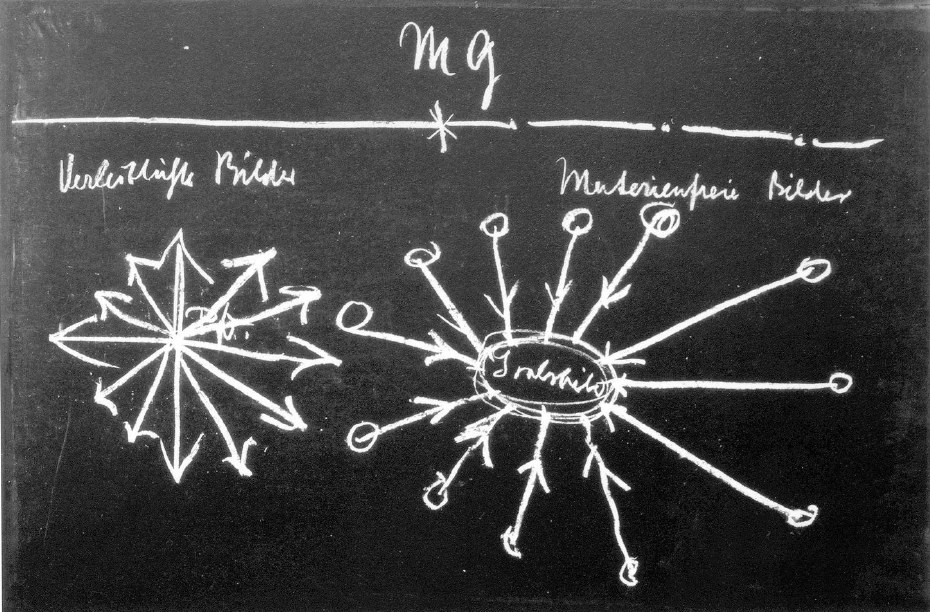
[ 10 ] You see, what human beings sensed as their connection to the Earth in the face of the Mystery of Golgotha, they also applied to the universe. In a sense, they related earthly human life to the heavens. We can observe this very clearly. There was a distinct awareness in ancient Hebrew times that the 12 tribes of Israel are earthly projections of the 12 constellations of the zodiac. The twelvefold structure of the world is expressed in human life. (Plate 31, right.) And we can say: At that time, human life was conceived as a result of the twelvefold nature of the heavens, of the zodiac. People felt—even each individual—as though the starry sky were shining into them. Above all, as a group, they felt as though the starry sky were shining into them. In the development of ancient Hebrew times, we must go back to the period when we are told of the twelve sons of Jacob as the projections of the twelve regions of the heavens onto the earth. Just as this streaming in of the forces of the heavens onto earthly human beings arose within Hebrew development in ancient times, so too—because development occurs at different times at various points on the Earth’s surface—a later point in time arose for Europe. You must go back to the early Middle Ages and study the Arthurian legend—the legend of King Arthur and his Round Table, that significant Celtic legend. For Central Europe—which in later times developed that stage of culture that the ancient Hebrews had already developed millennia ago—had only reached that level by the time the Arthurian legend, the legend of Arthur’s Round Table, is said to have taken place. But there is a difference now. Ancient Hebrew civilization developed to the point where these cosmic influences within the human being still produced what the embodied images represent. Then came the moment when the body withdrew from the images. Now the images had to be given a new substantiality. After all, there was a danger that human beings, in terms of their soul life, would completely slip into an existence as mere images. This danger was not immediately recognized by people. And even Descartes was still struggling; and instead of uttering the sentence, “I think, therefore I am not,” he uttered the sentence that is the opposite of the truth: “I think, therefore I am.” — For when we live in images, we do not truly exist. The fact that we live in mere thoughts—that the thought must be substantively fulfilled—is the clearest sign that we do not exist. So that humanity might not continue to live in mere images, the very entity that entered human evolution through the Mystery of Golgotha now intervenes, so that inner substantiality may once again be present in the human being. This intervention of the central force—which is now intended to restore reality to the human soul that has become an image—is not immediately understood, however. It first strikes the ancient Hebrew world. In the Middle Ages, we see the last vestige of this in the Round Table of the Twelve around King Arthur; but something else immediately emerges in contrast: the Parzival legend, which sets the single human being against the Twelve—the single human being who now develops the quality of the Twelve from his own inner center. Thus, this image (Plate 31, right)—which would essentially be the image of the Grail—must be contrasted with the Parzival image (left), where what the human being now possesses within himself radiates from the center. And the aspiration of those who, in the Middle Ages, sought to understand Parzival—who sought to stir within the human soul the Parzivalian striving—was to instill into human existence that which can crystallize after the filtration of all that is material: substantiality, inner life, and essentiality. While the Grail legend still depicts an influence radiating from the outside, the figure of Parzival is set in contrast—he is meant to radiate from the center into the images, restoring their reality.
[ 11 ] And as the Parzival legend emerges, this legend represents the striving of medieval humanity to find the path to the inner Christ. It is an instinctive striving to understand that which lives as the Christ in the evolution of humanity. If one studies inwardly what was felt in the creation of this figure of Parzival, and then compares it with what lives today in the creeds, one truly gains an impetus for what must happen today. For today people are content with the empty phrase “Christ” and believe they possess Christ, whereas not even the theologians—who are, after all, bound to the external interpretation of words—possess him. In the Middle Ages, there was still so much direct consciousness that people sought to strive upward toward the figure of Christ by grasping the representative of humanity, Parzival. When one reflects on this, however, one also gains an impression of humanity’s place within the entire universe. Everywhere out in the natural world, a transformation of forces is at work; in human beings alone is the substance cast out through pure thought. The matter that is truly expelled from the human being through pure thought is also destroyed as matter; it enters into annihilation. Human life is situated within the universe in such a way that within the human being there is a place where the material ceases to exist, so that it is no longer present.
[ 12 ] If you consider this, then you must imagine the entire existence of the Earth in this way (Plate 30, top right of center): Here is the Earth; on the Earth are human beings; matter enters into human beings. Everywhere else it is transformed; within human beings, it is destroyed. The material Earth will disappear to the extent that human beings destroy the Earth’s matter (bottom, to the right of center, Earth with lines radiating downward). Once all the Earth’s matter has passed through the human organism—so that it is used in human organisms for thinking—the Earth will cease to exist as a world body. And what human beings have extracted from this world-earth are the images (triangular forms). But these images have acquired a new reality, an original reality. And this reality is the one that emanates from the force that asserted itself as the central force through the Mystery of Golgotha (circle MG with a line radiating horizontally into the images). That is to say, when we look toward the end of the Earth, how does the situation present itself? The end of the Earth will have come about when, in the manner just described, the entire substance of the Earth has been destroyed. People will have images of what will have taken place within the course of the Earth’s development. At the end of the Earth’s age, the Earth would have sunk into the cosmos, and only the images would remain, devoid of reality. But what gives them reality is that the Mystery of Golgotha existed within humanity, which continues to endow these images with inner reality for the life to come. Thus, through the Mystery of Golgotha, a new beginning is established for the Earth’s future existence.
[ 13 ] You can see from this that we must not view what is contained in our stream of evolution merely as a continuous stream of development, in which one thing always follows another as effect follows cause; rather, we must view Earth’s evolution in such a way that there was a pre-Christian Earth evolution from which everything emerged that people were capable of conceiving at that time. For that was contained within the Father God; it was communicated to the Earth by its Father God. But the Father God had arranged it so that what He created as Earth’s evolution was dedicated to the dying part of that evolution. A new beginning took place with the Mystery of Golgotha. Of all that had gone before, only the images—the “painting of the world,” so to speak—were to remain. But these images were to be imbued with a new reality through that which, as a being, entered into the Earth’s evolution through the Mystery of Golgotha. That is the cosmic significance of the Mystery of Golgotha. That is what I meant years ago when I said: Christianity will not be understood until it permeates all our knowledge, right down to physics. Christianity will not be understood until we comprehend, right down to the physical level, how Christian substance operates in the existence of the world. Christianity will not be understood until we say to ourselves: Precisely in the realm of heat, a transformation takes place within the human being such that matter is annihilated through it, that mere image-existence withdraws from matter, but that this image-existence is made into a new reality through the union of the human soul with the Christ-substance.
[ 14 ] And if you compare this intertwining of what is spiritual and soul-related in human beings with what constitutes physical existence—if you compare this entire idea with the bleak scientific view of the modern age, which can only lead you into a dead end—then you will see the significance of this idea; for this idea shows us how we are to conceive of everything that is encompassed by Julius Robert Mayer’s laws alone—how we are to conceive of it as that which falls away from world existence, just as ice melts before the sun, just as snow melts in the sun. But human beings hold on to these images. These images, however, acquire a reality for the future through the infusion of a new substance into them—the substance that has passed through the Mystery of Golgotha.
[ 15 ] This, however, also establishes the human concept of freedom, and it is integrated with scientific thought. It is integrated with scientific thought in that one does not say: “conservation of matter and energy,” but rather: “Matter and energy are assigned a mere temporal duration.” We participate not only in the ever-evolving material universe, but also in the passing away of this universe, and we are already in the process of striving toward a mere existence as an image and of permeating ourselves with that to which we can voluntarily devote ourselves alone: the Christ-being. For the Christ-Being is so deeply embedded in human evolution that the relationship between humanity and Christ can only be a free one. Whoever seeks to be compelled to acknowledge Christ cannot find his kingdom. He can only turn to the universal Father-God, who, however, in our world is now involved only with a world in decline—a world for which, precisely because of its decline, he sent the Son. A spiritual worldview must unite with a natural worldview; but they unite within the human being. And they unite within the human being through a free act. Therefore, one cannot help but say that whoever seeks to prove freedom stands on an old pagan standpoint. That is why all attempts to prove freedom fail, for one must not seek to prove freedom, but to seize it. And one seizes it at the very moment one grasps the nature of thinking free from the senses. But this thinking free from the senses, in turn, requires a connection to the world. It does not find this connection unless it unites with that which, as a new substance, has been drawn directly into the evolution of the world through the Mystery of Golgotha.
[ 16 ] Thus, the very act of correctly understanding Christianity serves as the bridge between the natural worldview and the moral worldview. And it might at first seem very peculiar that precisely those who hold modern or ancient beliefs that extend into modern life do not want a science that moves away from Christianity, but rather—if anything—a purely materialistic science, so that a faith devoid of science might come into its own alongside it. In this regard, one can say: Modern materialism and reactionary Christianity are very closely related. For reactionary Christianity has virtually driven humanity into the view that nothing spiritual may be infused into true knowledge. True knowledge must remain free from the spiritual, must stay away from the spiritual, and may extend only to the material. And so, on the one hand, there stands the defender of this or that creed, who says: Science extends only to what is perceptible through the senses; the rest must be grasped solely through faith; and on the other hand, there stands the materialist, who says: Science extends only to what is perceptible through the senses, but I have weaned myself of faith.
[ 17 ] The humanities are not related to materialism. Modern creeds—that is, the old creeds that have carried over into modern life—are, in fact, very closely related to materialism.
[ 18 ] With this, I believe I have pointed out to you how deeply rooted in spiritual science is the possibility of truly penetrating the moral world order with what we can also know about nature, and, conversely, of truly penetrating our knowledge of nature with the moral world order. For, you see, that phantom which still figures as a human being in external science today—that deceptive image that treats the human being as if it were a configuration of mineral matter—is, in truth, not present in the human being walking about. Human beings are organized in the liquid just as in the solid, organized in the gaseous, and above all organized in warmth. And if you ascend to the realm of warmth, you will find the transition into the spiritual-soul realm, for in warmth you already have the transition from the spatial to the temporal. And the soul flows into the temporal realm there. You ascend more and more through warmth from the spatial into the temporal, and you gain the opportunity, through the detour I have indicated here, to seek the moral within the physical. I would say that anyone who thinks short-sightedly will hardly be able to grasp the connection between the moral and the physical in human nature. For one can, of course, live toward one’s death as a villain, and in doing so one does not contort one’s arms, but remains a well-formed human being. But the state of warmth is then not examined—the state of warmth that, admittedly, changes in a far more minute way than one believes, but which in turn has a reciprocal effect on what the human being carries through death. Today’s approach is such that we look, so to speak, down at this level (Plate 30, with notes and drawings in the upper left), look up into abstraction—where we find the intellectual and so on—and look down into the physical-material realm. But we cannot grasp the transition unless we turn to the warmth that moves within itself and lies in between—that warmth which, at least for human instinct, still has both a spiritual and a physical aspect. Instinct has not yet been deprived of the capacity for a human being to develop warmth—spiritual warmth—toward their fellow human beings, a warmth that is the true counterpart of physical warmth. But this spiritual warmth certainly does not arise through a physical transformation in the sense of Julius Robert Mayer’s theory. How, then, does it arise? I would say: Here it becomes tangibly evident. Why do you speak of warm feelings at all? Because you feel, because you sense that emotional warmth is the image of external physical warmth. There, the warmth filters into the image. And what is today merely emotional warmth will play a physical role in the later, future world existence because the Christ impulse will live within it. And within what is today merely image-warmth in our emotional world, there will live—so that it may become physical when the Earth’s warmth has vanished—that which is the Christ substance, the Christ essence. Just try for a moment to discern that delicate relationship between external physical warmth and what we instinctively call emotional warmth. Then turn to what Goethe calls the “Sensual-Moral Effect of Colors” in the sixth section of his Theory of Colors. See how, in color perceptions themselves, he distinguishes on the one hand the cooling colors and on the other the warming colors; see how the sensually-moral aspect is intertwined with the physical state, which we can, so to speak, measure with a thermometer; see how the soul and the external physical realm interact with one another. Then you will gain an insight into how, through genuine Goetheanism, the union between the moral worldview and the physical worldview can be achieved.
[ 19 ] However, Jesuitism hates this union. That is why even the best book on Goethe—one written in the Jesuit spirit—is a venomous book, a terrible book, yet far more incisive and far more effective than anything else ever written about Goethe, precisely because it is written with an inner Jesuit rhetoric. I am referring to Father Baumgartner’s three-volume work on Goethe. It is filled with hatred, full of venom, but it is nonetheless impressive and effective. And you can be quite certain that in the world—a world of which many people today have no conception, yet a world that also opposes us—Goethe is more widespread than among the educated. Those who stand by Goethe and understand him from a positive standpoint are a small community. Those who hate Goethe—that is a large community; people simply do not imagine it to be large enough. I once pointed out to you, quite some time ago now, how little we are actually aware of what is, after all, alive among us humans. I said at the time that I would like to have slips of paper collected at the door to find out how many of those present were familiar with Weber’s German drivel *Dreizehnlinden*. I would have liked to know how many slips would have been turned in. The result back then would certainly have been a sad one. And yet, this work, *Dreizehnlinden*—a work in the spirit of positive Catholicism—went through an extraordinarily large number of printings soon after its publication. Do those who would like to advance humanity have any inkling, in their waking consciousness, of the far-reaching impact such things have? And all these things—from which the struggle against us also arises—do indeed have a far-reaching impact; of that you can be certain. These things are effective. They are effective on a much broader scale than sleepy humanity would like to imagine. And while we truly have a small Goethe community that stands by Goethe—one that cannot even point to anything of any significance derived from this Goethean wisdom—the Jesuit book on Goethe is written with great acumen, skillfully crafted, and is a very effective book.
[ 20 ] But that is precisely what we need: to imbue ourselves with an alert spiritual life. Then spiritual science will flourish once an alert spiritual life truly takes root among us.