

Correspondences Between the Microcosm and the Macrocosm
Man — A Hieroglyph of the Universe
GA 201
15 May 1920, Dornach
Translated by Steiner Online Library
Fifteenth Lecture
[ 1 ] From the reflections we have made here, you will have seen how necessary it is to consider the human being in his or her entirety in order to realize just how precisely the human being, in all his or her nature, is a reflection of the entire world. It is of extraordinary importance to take this in—not only intellectually, but also emotionally and through the will. For only by viewing the human being in his or her entirety as emerging from the totality of the world can one gain a deeper understanding of what Christianity fundamentally seeks to be for the world. One might very easily object: Yes, modern humanity is required to have a complex understanding of the details of the world and also a complex understanding of the details of the human being, so that, in a sense, one may first become a whole human being in one’s consciousness. But just consider that this demand, which now presents itself as a cardinal requirement for humanity, is by no means unique to the spiritual science that has recently emerged. To illustrate what I mean, I would first like to pose the following question: What, in fact, did Christianity actually bring with it when it first emerged? Christianity, after all, essentially brought with it the demand for an understanding of the world that was truly quite comprehensive. And this worldview, which built upon the ancient pagan conceptions—this worldview has, in fact, been completely forgotten over time. Just consider for a moment what has gradually been given to people over time of the fundamental views, the fundamental ideas of Christianity. Christianity presented itself in such a way that one could only understand it if, for example, one understood the Trinity—if one understood the nature of God the Father, God the Son (that is, Jesus Christ), and the Holy Spirit. In the sense that Christianity understood these three aspects of the Divine-Spiritual, this required no less than the understanding of such things as are presented today by spiritual science. But gradually, what led to an understanding of these ideas—of the Father, the Son, and the Holy Spirit—was gradually eliminated; it was cast out of the realm of the comprehensible, and all that remained were empty words, empty phrases. And for centuries, people have been left with these empty phrases. This has gone so far that people, after first dogmatically rejecting these empty phrases, have even begun to mock them. Even the best of people have mocked these empty phrases. Just consider all the mockery that has been poured out, for example, in the form of the claim that dogmatics demands that one be three and three be one. It is indeed a terrible illusion, a mere delusion, when people believe that what once guided the course of Christianity requires less understanding, less devoted insight than what—in order to reclaim Christianity—today’s spiritual science offers. Admittedly, the most important, the most fundamental things have been cast out of Christianity, and if one disregards the fact that they live on as words in the various creeds, one may ask: What, in reality, has actually remained for people of the fundamental concepts of Christ himself? How, then, does modern man—I have pointed out to you that not even theologians like Harnack make this distinction—distinguish between what Christ is and what a general world god is, whom one might also encounter under the concept of Yahweh or Jehovah? And, for that matter, how many people today truly grasp what is meant by the Spirit or the Holy Spirit? People have, after all, gradually become so abstract-minded that they are content with empty phrases; that is, either they are satisfied when they remain at the level of creedal belief, or, when they are—as it is then called—“enlightened,” they scoff. But what is expressed in these empty phrases will never be able to gain the power to shed light on the individual activities of human cognition.
[ 2 ] Just consider how far we have actually come in this regard. Everything that was considered knowledge in ancient Greek times was, at the same time, part of a healing principle. The healer was a priest and, at the same time, the teacher of the people. The fact that the teacher of the people—that the priest—is also a healer presupposes that something “sick” is assumed to exist within the entire cultural process. Otherwise, there would be no justification for speaking of a healer. People spoke of the healer because, out of instinctive insight, they still had—in a certain sense—a more comprehensive, more intense understanding of the entire world process than we do today. Today, people imagine the world process as simply unfolding, with what comes later always being the effect of what came before. But that is not how it really is. And an older, instinctive understanding knew that this is not actually the case. People today imagine—and especially those who speak of abstract progress—that development simply moves ever upward. — We find this view of such an upward development (Plate 28, center; diagonal line with arrows) even in the now-superficial philosophy of modern times. Such a person, who has simply been carried along by the prevailing prejudice of the age—like Wilhelm Wundt, the non-philosopher who has become, for many people, the philosopher of the age—such a person, even as a so-called philosopher, speaks of such general progress without the slightest understanding of what actually lies in the true current of human development. But we must realize that within the true current of human development there lies a constant tendency toward degeneration. There is no tendency toward progress—especially not in history. There is a constant tendency toward degeneration (arrows pointing down). And only by constantly counteracting this tendency toward degeneration through what we call teaching, knowledge, and so on is that which would otherwise be dragged down into the depths lifted up. And only through this does progress arise (arrows pointing up, red).
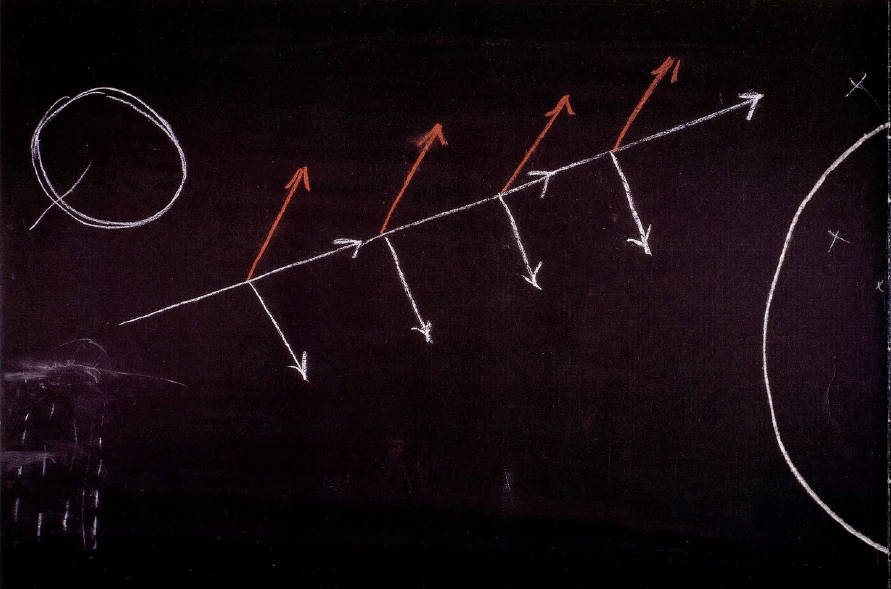
[ 3 ] Let us consider, from this perspective, what happens with the child. The child is born. People speak of heredity. Yes, but only that which would lead to decline, that which would lead to decadence, is inherited. If the child were not educated—first by its entire environment and later by school and life itself—it would degenerate. Education is therefore, in reality, protection against degeneration. Thus, it has a healing effect. Based on instinctive human understanding, everything related to knowledge, education, and the priesthood was once viewed as a healing process. In earlier views, the physician could not be separated from the priest at all; they were one and the same; it was only with more recent developments that knowledge of nature and knowledge of the spirit and soul were separated, as I explained yesterday. Thus, one leaves it to the physician trained in the natural sciences to heal everything that, according to Julius Robert Mayer’s view, has nothing to do with human goals and so on, but rather has to do only with such things as the conversion of horsepower into the heating of the horses, the wagon axles, the heating of the road over which the wheel rolls, and so on. That, roughly speaking, is left to the physical physician. And people like Ruder in Berlin—who is, after all, merely a representative of this school of thought—calculate what a person needs to live in much the same way as if a person were a kind of more complicated stove.
[ 4 ] Now draw the socio-ethical conclusion from such a view—draw it in such a way that you recognize: if everything that is taking place in the transformation of forces is merely a side effect of what is actually happening in terms of people’s intentions and goals, then the possibility—the intellectual possibility—exists that the world could exist even without these secondary intentions. And, when it comes down to it, that is actually the secret opinion of modern people—that reality consists solely of the physical, and that everything else is merely a side effect.
[ 5 ] You see, given such a view, the only consistent course of action would be to strictly reject Christianity, as the materialists did in the mid-19th century. These materialists of the mid-19th century—I cited some of them in my public lecture in Basel—truly took the materialist worldview to its logical conclusion. They drew these conclusions by saying: If naturalism is correct, then there is no choice but to find it ridiculous to make a distinction between a criminal and a good person, for it goes without saying that in a criminal, the energy expended is transformed into heat just as it is in a good person. The questions that are shaking the world today are, at their core, often questions of honesty, courage, and consistency. However, in an age when people lack such honesty regarding the external aspects of life, it is hardly surprising that this honesty is absent when it comes to these fundamental questions.
[ 6 ] And so it is that humanity today still speaks of Christ without really knowing anything about the fact that this Christ must truly be distinguished from a general God who underlies all of nature. When the concept of Christ gradually merges into the mere concept of God, this signifies a regression of humanity back beyond the Mystery of Golgotha. But in order to truly grasp Christianity, it is necessary to take this principle of degeneration seriously and to seriously contrast this principle of degeneration with the necessity of working from something entirely different than that which carries the seed of degeneration within itself. Contemporary humanity will have to become aware that at the moment when the Earth—along with humanity, of course—was moving toward the Mystery of Golgotha, something took place within earthly events through the Mystery of Golgotha that signified not merely a rational aspect of the human, but a rational aspect for the entire life of the Earth.
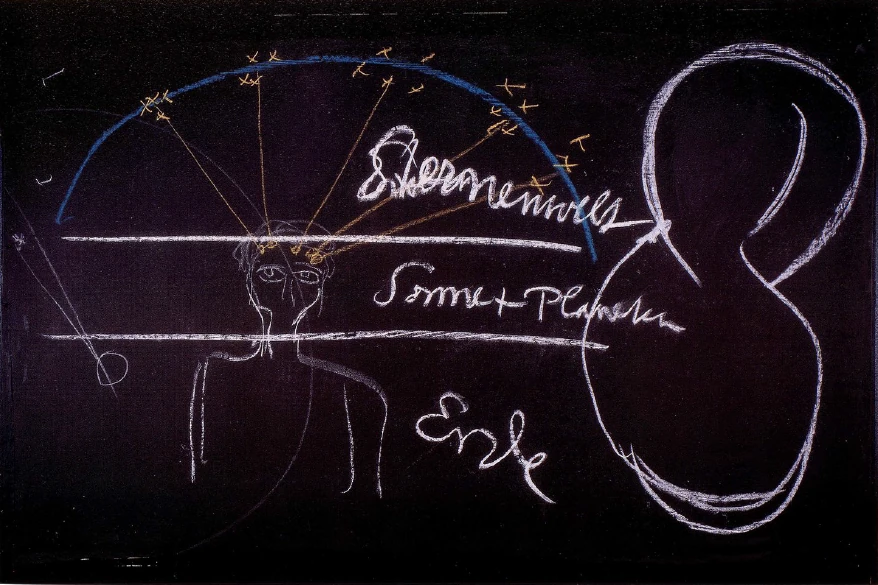
[ 7 ] However, if one is to understand this, one must study nature and the spirit in a much more intensive way than is typical of humanity today. To make this clear, I would like to refer you to something that may have lived in the consciousness of humanity up until the 8th century B.C. Indeed, up until the 8th century B.C., human beings did not feel themselves to be such isolated, self-contained beings as they do today. Today, human beings essentially feel themselves to be nothing more than beings enclosed within their own skin. Until the 7th or 8th century B.C., human beings felt themselves to be a part of the entire universe, and they also felt themselves to be placed within the events of the entire universe. They did not feel—in such an intense way—that the matter seems almost grotesque to people today, but it is so— people of those ancient times did not feel, as people do today, that their head was strictly enclosed by the skull; rather, they felt that what lived within their head had a continuation out into the world and belonged to the entire starry sky (Plate 29, left; blue celestial vault, yellow stars and rays). Human beings—as strange as it may seem to people today—felt that their heads were alive and connected to the stars. So they said to themselves: As the night sky arches above me, it is actually I who live there in the living communion of my head with the stars. — And they said to themselves: “As I move forward through the course of time, when day follows night, and the stars that first rose on one side set on the other, the sun takes the place of the stars. Then the configuration of the starry sky no longer acts within my head; instead, the sun takes the place of the starry sky, and my eyes are associated with the sun.” — And now, as he sensed this: My eyes are attuned to the sun when I go about my business on Earth during the day—as he vividly sensed this, he said to himself: Just as now, since there is an earthly existence, my eyes are attuned to the sun, so in the existence that preceded the Earth—we call it the lunar existence—my entire head was a kind of eye; only this eye did not see, as it does now, merely in a dual way that synthesizes objects, but it looked out into the expanse of the universe; there were, so to speak, within me, in my brain, as many small eyes as there are stars. From these little eyes has come to be everything that now lives in my brain, and my sensory eyes are later products, associated with the sun, just as my brain was associated with the starry sky. My brain is therefore a later product of the evolution of an eye—or, more accurately, of many partial eyes—as many partial eyes as there are suns shining out there at night. My brain has come into being from the sense. And what is now my eye in earthly existence—through which I communicate with what lives in my earthly surroundings—will become an internal organ, just as my brain is now, once the Earth has been replaced by a future planetary state—you know, we call this the Jupiter state. What is now externally on my surface will then move into my interior. People will look different. What they now have as corresponding to their surroundings will, in the future, be an internal organ. — This is how ancient humanity instinctively felt; they said: Light penetrates through my sensory eye; but within me I preserve the light of ancient times; it works within me as thought. Thought was sensory perception when the Earth did not yet exist, when the Earth was still another planet. And my sensory perception will be the thought of the future. — All of this was perceived in ancient times as a wisdom that—as we say today—was instinctively sensed. The ancients did not throw the word “instinctive” about so thoughtlessly as present-day humanity does; rather, the ancients said: This is the wisdom that the gods have brought to us from heaven to Earth. — Regarding that which had instinctively dawned upon them concerning the past, present, and future, they said: “This is what the immortals have brought us.” — And they imagined it in an image. And what does the image of Isis say? “I am the universe. I am the past, the present, and the future. No mortal has yet lifted my veil.” The interpretation offered by modern humanity is actually a strange one. For when faced with such a statement—which, after all, contains the word “mortal”—modern humanity already thinks in materialistic terms. When considering the Isis statement, it does not actually think: “I am the past, I am the present, I am the future. No mortal has yet lifted my veil,” but rather: “I am the past, the present, and the future. No human has yet lifted my veil.” That is how modern humanity thinks. It does not even consider that, on the other hand, it regards itself as immortal, and that it therefore cannot regard the statement “No mortal has yet lifted my veil” as a conclusive matter at all. Novalis said: “Very well, then we must simply become immortals in order to lift the veil of Isis!”
[ 8 ] Just imagine what kind of underlying thought this modern, materialistic humanity has produced. But it does her good, too; for as she thinks: “I am the universe. I am the past, the present, and the future. No one has yet lifted my veil,” it spares itself the effort of lifting the veil, and its philosophers can maintain that human beings do indeed have limits to their knowledge. In truth, these philosophers believe that human beings are too lazy to walk the path of knowledge. But they do not want to say that. Therefore, they say that human beings have limits to knowledge. And in our time, which wants to be free of authority, these things are accepted. They must not be accepted in the future if humanity does not want to fall into decadence. And it must not be overlooked that no one has the right to call themselves a Christian who believes only in general progress, who is not clear about the fact that, if the earth had been left to its own devices since the Mystery of Golgotha, it would have fallen into decadence. Thus, we need to counter decadence with something we cannot take from the earth, cannot take from the very substance of which the earth is made, cannot take from God the Father, but must take from God the Son—we must instill it into the ongoing development of humanity. It is indeed a distraction for humanity from its present task if one constantly refuses to admit that the universe must be brought into connection with the Christ event. Just consider what it actually means when both Catholic and Protestant confessions rail against the claim made by spiritual science that the Christ idea must be linked to the idea of the cosmos—while at the same time it is repeatedly claimed that this spiritual science has no concept of the fact that Christ must first be understood solely as something ethical, as something that fits only into the moral world order. Indeed, if the moral world order is regarded merely as a side effect of the transformation of forces, then the idea of Christ—if it is situated solely within the moral world order—also appears as nothing more than a side effect of that world order.
[ 9 ] This, then, was something to which humanity’s so-called instinctive insight had pointed: how the human brain is connected to the celestial sphere, and how the human eye is, in a certain way, related to the solar sphere. If you go back to certain earlier times, when people still had a qualitative understanding of astronomical phenomena and also of earthly, elemental phenomena, you will see that they related light in a certain way to what immediately surrounds our Earth—namely, the air. The ancients, in their instinctive understanding, could not conceive of light without air. Modern thinkers, with their abstract understanding, separate what they interpret as light—though they describe it as a vibrating movement of the ether and depict it in a very peculiar way—from the air, and can’t reconcile it with the air except by regarding the air, at most, as a medium through which light passes. But you see, it is actually most remarkable how little people reflect on what is, I might say, presented to them: the Earth, the infinite expanse of the universe, the stars. (Plate 29, far left; part of the circumference on the other plate.) Yes, among these stars are some whose light takes millions of years to reach the Earth. Now it’s getting dark. There’s a star—the light from it takes less time to reach Earth. Now suppose for a moment: what do you actually see in those rays of light? Certainly not the star itself, if you look out in the direction of the ray. The ray of light that enters your eye, according to this theory, comes from something that existed millions of years ago; it may even have ceased to exist long ago, yet the light is still coming from it. What is actually out there in the world—that is not what we should be talking about. We should really only be talking about the fact that light channels are arriving that might still lead to some existing stars, but also to those that are no longer there at all.
[ 10 ] We must certainly come to terms with the fact that, for us, light phenomena as such manifest themselves within the phenomenon of air. Even though light passes through what appears to be a vacuum, for us it does not appear in a vacuum but in a space filled with air, for that is the only place where we can exist. And so, for us, light and air coexist. Through this—by, I would say, living together in light and air—one penetrates more deeply into the human constitution. One goes a little deeper; one moves from the eye to the nose on the human head. The nose is, after all—and Eastern philosophy knew a great deal about this—the organ through which we inhale and exhale. The eye is the organ that receives light. The nose and the eye are distinct. The nose adapts to the air, and everything that adapts to the air there extends out into the planetary world. The sun marks the beginning by acting upon our eye. But the rest acts upon the rest of our constitution, and we descend from the world of the stars into the world of the sun and planets, arriving at the human being as a being constituted through the nose. And then we descend all the way to the earth and move from the nose to the mouth—the organ of taste—where we take in the substances of the earth through the organ of taste, entering the earthly world from the planetary world. And we have the rest of the human being as an appendage: the head as an appendage of the eyes, the chest as an appendage of the nose, and the entire rest of the human being—the human being of the limbs, the human being of metabolism—as a whole, as an appendage of the organ of taste. And we have assigned the human being—when we now consider him in his entirety—to the world of the stars, the world of the sun and planets, and the earthly world (these regions are depicted in the drawing on the left, Plate 29). We have placed the human being within the entire universe, and we see in the human head—insofar as it is the bearer of the brain—internally, not externally, not through physical anatomy but through inner knowledge—a direct reflection of the world of the stars. In everything that extends from the nose to the lungs and so on, we see a reflection of the planetary system with the Sun. And when we then consider what remains of the human being, we see in it that which is as bound to the Earth as, for example, the animal is bound to the Earth. In this way, we arrive at the true parallelism between the human being and the rest of the world. We see it interpreted from this rest of the world. And this is how we should also understand human beings in detail.
[ 11 ] Consider, for a moment, the circulatory system: how, for example, the blood—which has been transformed by the outside air—first enters the left atrium, then flows from there into the left ventricle, and from there branches off through the aorta into the rest of the body (see illustration on the right). We can say: blood from the lungs to the heart, from there to the rest of the body, but with a branch leading to the brain. The blood flowing through the body then absorbs nutrients. Involved in this process is everything that depends on the Earth. What is involved in the blood circulation through the digestive system is earthly; what is involved through our breathing, by which we introduce oxygen into the bloodstream, is planetary; and then we have that blood circulation that flows into our head, encompassing everything that constitutes our head. Just as the pulmonary circulation—with its uptake of oxygen and release of carbon dioxide—is assigned to the planetary realm, and just as what is introduced into our blood by our digestive system is assigned to the Earth, so too is that which branches off upward in the small circulation assigned to the world of the stars. This is, so to speak, drawn out of the aorta and then flows back again, uniting with the blood flowing back from the rest of the organism, so that the blood from above and below flows back to the heart together. This part that branches off upward, so to speak, says to the rest of the circulatory system: I am not participating—neither in the oxygenation process nor in the digestive process—but I separate myself; I cover myself over it. — This is what is connected to the world of the stars. One could follow the same pattern for the nervous system. One cannot gain any insight into the human being if one believes one can simply take the human being as one perceives him or her with the senses and study him or her in that way. There one finds that pulp inside the cranial cavity described by our physical anatomy. In truth, what our physical anatomy describes is nothing at all, for it is the confluence of forces from the starry heavens. And it is just as nonsensical to describe this physical brain in isolation as it would be to try to describe a rose in isolation. After all, it makes no sense to describe a rose in and of itself, for it is not a being in and of itself. It cannot be conceived of separately from the rosebush. Indeed, it perishes when separated from the rosebush. It is nothing when separated from the rosebush. Likewise, the human brain is nothing when separated from the starry sky.
[ 12 ] But now let us recall what the Sun actually is. I have emphasized to you time and again that physicists would be very surprised if they could equip a balloon—as is, in any case, their ideal—and travel out to the Sun, expecting to find a glowing ball of gas. They would not find that; instead, they would find a “suction sphere”—something that, admittedly, seeks to absorb everything within it, but which is actually empty space, and even emptier than empty space: negative matter. Within the Sun’s sphere, there is nothing that could be compared to our matter. It is not merely empty; it is less than empty; it is a void in relation to the rest of matter. The point is precisely that we must not, in this day and age, begin to speculate about the things of the world in a way that is out of touch with reality, but rather that we must fill ourselves with the spirit of reality. I did, after all, tell you a little while ago about a nice little bit of the theory of relativity. You recall the box I demonstrated to you—Einstein’s box—which is intended to overcome the theory of gravity. Another point, which Einstein himself also asserted, is that the dimensions of a body are merely relative and depend on the speed of motion; thus, according to Einstein’s theory, a person, when moving through space at a certain speed, no longer has the front-to-back thickness that he normally has, but rather, if he moves at the necessary speed, becomes as thin as a sheet of paper. This is something that is being seriously discussed among the Einsteinians, among these people with the epoch-making invention of the theory of relativity. Such dwelling on thoughts divorced from reality—that is what constitutes science today. And that is the antithesis of what, on the other hand, is a confession of faith.
[ 13 ] The doctor has been confined to the merely physical, the priest to the merely spiritual. The spiritual has, after all, been abolished. The priest is confined to the purely psychological. But just think: if this continues to develop in such a way that everything outside the physical realm is reduced to mere side effects! Horses, carriages—real to the physical senses—the horsepower expended—all of this is transformed into the heating up of the horses, the carriage axle, and the ruts in the road; the other aspect is—well, one cannot say the fifth wheel on the wagon, for it is, after all, less than the fifth wheel on the wagon; it is a mere side effect that does not actually belong to reality. And while the doctor is concerned solely with the transformation of forces, the priests deal with the side effect. So the priest is actually—one can’t even say he’s the fifth wheel on the wagon within the modern worldview—because what does he accomplish, if all of this is just a side effect? It’s true that when doctors like Julius Robert Mayer engage in philosophy, it becomes physics; and when the adherents of the substance of the soul—or whatever it may be—engage in philosophy, it becomes abstract concepts; and these two world currents stand as alien to one another as the materialist doctors of the mid-19th century and the preaching pastors. They truly did not understand one another, nor did they respect one another; rather—well, perhaps they fought one another politically at most. Now, however, a time has dawned in which people are less honest, less consistent, and this must now be overcome in all seriousness. But—it must indeed be done in all seriousness.
[ 14 ] We must fight not only against ill will, but also—and this may well tip the scales—against all forms of stupidity and ignorance. Well, that’s just the way things are. I’d also like to personally emphasize that, driven by a certain impulse, I will be speaking at Pentecost in three lectures on Saturday, Sunday, and Monday: on Saturday about Augustinianism, on Sunday about Thomism itself—the essence of Thomism—and on Pentecost Monday about Thomism and the present day. I do not know whether our opponents will then also begin by denying us the right to discuss and teach Thomism here. But it is perhaps best, after all, to counter the talk coming from that corner with a serious examination of Thomism. As you know, an encyclical by Leo XII declared Thomism to be the official philosophy of Catholicism, and I do not know whether what will be presented here as Thomism will now also be labeled as unwarranted propaganda emanating from Dornach. Let us see how this turns out.