

Correspondences Between the Microcosm and the Macrocosm
Man — A Hieroglyph of the Universe
GA 201
14 May 1920, Dornach
Translated by Steiner Online Library
Fourteenth Lecture
[ 1 ] The essence of these next reflections is to recognize how the two currents of world history—the pagan and the Christian—converge in our lives, how they interact, and how they are connected to events throughout the entire universe. However, in order to understand this in somewhat greater detail, a kind of preliminary consideration is still necessary today. The point is that we must distinguish as precisely as possible between what constitutes the pagan worldview in the broadest sense—which, after all, not only still lies at the foundation of our worldview but must do so—and the Christian worldview, which, even today, has already entered human minds to at least some extent in its full reality. The point is that we must grasp clearly in the eye of the soul something I have often emphasized here. That is, we have now arrived at a situation where what we might call the scientific worldview and what we call the moral world order—which naturally includes the religious worldview—stand side by side without any mediation. More than he realizes, for modern man, scientific reality and moral reality are two things that lie very far apart from one another—things he cannot, in essence, connect at all if he truly wishes to be completely honest with himself from the standpoint of today’s worldview. That is precisely why a large part of the so-called advanced theology of the 19th and 20th centuries, in essence, lacks any Christology at all. I have already pointed out that there are books, such as Adolf Harnack’s *The Essence of Christianity*, in which there is absolutely no reason why the name “Christ” is mentioned at all. For what appears as “Christ” in these works is nothing other than precisely the deity who appears in the Old Testament as Yahweh, as the God of Jehovah. There is, in essence, no real difference between this being—whom Harnack, for example, calls “Christ”—and the God Yahweh; I mean, there is no difference between what is said about the Christ-being and what is said by the adherents of the Old Testament worldview about their Jehovah. And if we even take the conception of Christ held by many people today and compare it with their general outlook on life, there is actually no reason for these people to speak of Christ and Christianity at all. For if someone speaks of Christ and Christianity while, for example, conceiving of national identity in the way many people do today, this is a complete contradiction. The only reason these things do not strike modern people as contradictory is that they avoid courageously drawing a logical conclusion from what is actually before them today. But the deepest rift, the deepest chasm, exists between the scientific view of things and the Christian view of things. And it is the most important task of our time to build a bridge across this chasm. The scientific worldview, as it exists today—I would say the farmer has it; he just doesn’t know it, but he has it—is actually only a child of the 19th century. And it is also quite good not always to characterize things merely in the abstract, but to look a little into the concrete as well.
[ 2 ] I have often mentioned to you a name that belonged to an outstanding figure of the 19th century and that immediately leads us, I might say, to take a very precise look at the scientific worldview; it is the name Julius Robert Mayer, with whom—even though this is misleading in many respects when applied to Julius Robert Mayer himself—we must nevertheless associate the scientific worldview of the 19th century. As you know, it is commonly said that the formulation of the so-called law of conservation of energy goes back to Julius Robert Mayer; more precisely, that the universe contains a constant sum of forces that cannot be increased or decreased and that merely transform into one another. Heat, mechanical force, electricity, and chemical force—they transform into one another. But the sum of the forces present in the universe always remains the same. This is, of course, how every physicist thinks today. Even if people in popular consciousness do not pay attention to this law of conservation of force and energy, they think about natural phenomena in a way that is only possible under the influence of this law of conservation of force. I mean, you should realize that there can indeed be something in a being’s actions that corresponds to a certain principle, without the being being able to grasp this principle clearly. If, for example, you wanted to explain to a dog that a quantity of meat twice as large is simply the result of taking the original amount twice, you would not be able to do so. The dog would not be able to consciously grasp this, but in practice it would still act according to this principle. If it has the choice of snatching a small piece of meat or one twice as large, it will generally, all other conditions being equal, go for the one that is twice as large. In any case, one can be under the influence of a principle without being able to articulate that principle in its abstract form as such. Thus, one can say: Certainly, most people do not think about the law of conservation of energy, but they conceive of the whole of nature in this way because they are taught in school that the law of conservation of energy exists. It is now interesting to observe how Julius Robert Mayer’s way of thinking manifested itself when it came to sharply presenting this way of thinking to others who did not yet think as he did.
[ 3 ] Julius Robert Mayer had a friend who, in a kind of memoir, recorded various conversations he had with Julius Robert Mayer. In it, he recounts some very interesting facts—facts that provide a thorough insight into the way of thinking characteristic of 19th-century natural philosophy. Above all, to characterize something from an external perspective, I would like to mention the following: Julius Robert Mayer was so deeply immersed in the entire mode of thinking that led him to this conception—to this notion of the preservation of force, to this mere transformation of one force into another—that, as a rule, whenever he met a friend on the street, he could not help but call out to him from a distance: “Nothing comes from nothing!”—That is, after all, the phrase that recurs again and again at the beginning of Julius Robert Mayer’s seminal treatise from 1842: “Nothing comes from nothing.” It also happened that Julius Robert Mayer would visit this friend—whose name was Rümelin—knock on the door, open it, and exclaim: “Nothing comes from nothing!” That was his opening remark, even before he offered a greeting. That is how thoroughly Julius Robert Mayer was immersed in this “Nothing comes from nothing.”
[ 4 ] Rümelin then recounts a very interesting conversation that took place once, in which—since Rümelin did not yet know much about this law of conservation of energy—they sought to explain exactly what it consists of. Then Julius Robert Mayer said to Rümelin: “When two horses pull a carriage—and Julius Robert Mayer was, after all, from Heilbronn; his monument also stands in Heilbronn—when two horses pull a carriage and they keep going, what is the effect?” — Rümelin replied: “Well, the effect is that the people sitting in the carriage get to Öhringen, for all I care.” — “But what if they turn around and drive back without having done anything there in Öhringen, so that they arrive back in Heilbronn?” — Then Rümelin said: “It is true that, in this case, one journey happened to cancel out the other, and thus there appears to be no effect, but the real effect is still that the people traveled from Heilbronn to Öhringen and returned from Öhringen to Heilbronn.” — No,” said Julius Robert Mayer, “that’s just a side effect; it has nothing to do with what actually happened. What happened as a result of the horses expending their energy is something entirely different. First, because of the energy expended by the horses, the horses themselves became hotter—they grew warmer; second, the axles of the carriages—around which the wheels turn—became warmer; third, if we were to measure with a sensitive thermometer the ruts in the ground over which the wheels passed, we would find that the temperature in those ruts is slightly higher than on either side. That is the real effect. Substances have also been burned within the horses through metabolism. All of this is the actual effect. The other aspect—that people traveled from Heilbronn to Öhringen and back again—is merely a motive, a side effect, but not what constitutes a real physical phenomenon. The actual physical phenomenon is the force exerted by the horses; its conversion into the increased heat of the horses; the increased heat of the wagon axles; the consumption of the wagon grease due to the heat generated when the wheels are greased; the heating of the ruts in the road, and so on. And when one measures—Julius Robert Mayer did measure this and provided the corresponding numerical value—when one measures, all the force exerted by the horses has been completely converted into this heat. Everything else is merely a side effect.
[ 5 ] As you can see, this naturally has a certain effect on our perspective. Ultimately, it leads to the conclusion that one must say: Yes, one must now clearly separate natural phenomena from everything that is a side effect, in the sense of the strictly scientific thinker. For this side effect actually has nothing to do with scientific thinking in the 19th-century sense. It, so to speak, simply leaps over the scientific process. But if we ask again: In what form does all that we call the moral world order manifest itself? In what form does all that which we call human value and human dignity manifest itself? — Certainly not in the fact that the energy expended by the horses is converted into the increased heat of the wagon axles; rather, the side effect is the main point! But consider that in all scientific inquiry, this side effect is entirely omitted. The people of the 19th century—and even Kant in the 18th century—formed their views on the origin of the universe solely on the basis of those principles that Julius Robert Mayer sharply delineated, by separating everything that truly belongs to nature alone from what is a side effect.
[ 6 ] If we take a proper look at the matter, then we must say that the universe must be constructed on the basis of those principles that are recognized as natural principles. And everything that has come about through Christianity, for example, is a side effect—just as much a side effect as it is a side effect that people travel by carriage from Heilbronn to Öhringen. From the perspective of the natural sciences, what people are doing there is completely irrelevant. But then again, don’t these two currents intersect in some way after all?
[ 7 ] Let’s suppose for a moment that Rümelin hadn’t calmed down right away, but had raised an objection along the following lines—I know that for today’s physicists this isn’t a valid objection, but for the development of a comprehensive worldview it is indeed a valid one—let’s suppose the following were said: If the motive had not been present in the people who traveled from Heilbronn to Öhringen, then the horses would not have expended their energy; the entire conversion into heat would not have taken place, or it would have occurred in a completely different place and in a completely different context. Thus, from a scientific perspective, what happens must be viewed in such a way that it extends only to what does not, in the end, lead to the ultimate reason why it happened. After all, it would not have happened if the people had not believed they had business in Öhringen. Therefore, what science must regard as a side effect does, in fact, play a role in natural events. Or let’s assume the people had business to attend to in Öhringen at a very specific time. Not only would the wagon axles have become hot, but one would have broken, and they would not have been able to continue their journey. Then what happened there—the breaking of the wagon axle—would, of course, be entirely explainable from a scientific standpoint. But what has now come about as a result of this natural event—namely, that something which should have been accomplished could not be carried out—may, under certain circumstances—as one can easily imagine—in turn have incredibly far-reaching consequences, even for other natural processes that are then set in motion as a result of these consequences.
[ 8 ] So you see, even if one remains strictly on logical ground, quite significant and serious questions arise. And these questions that arise—it must be said—cannot be answered without the humanities, given the worldview to which a person today can honestly adhere based on the foundations of our education. They simply cannot be answered. For before the shift toward this scientific way of thinking—which only reached such precision with Julius Robert Mayer—there was by no means such a sharp dividing line between scientific thinking and moral thinking. If you look back to the 13th or 12th centuries, the things people had to say about the moral order and the physical order were constantly intertwined. People today simply no longer read properly. From earlier times, there aren’t many things that, I would say, have come down to our day entirely unadulterated. But even if you take such writings today—which are the remnants of the old worldviews—you will discover all sorts of things in them that prove to you that, in earlier times, the moral was carried into the physical, and the physical was elevated to the moral. Just read, for example, the—I would say—already quite distorted, but still roughly legible today, writings of Basilius Valentinus; read there about the metals, about the planets, read about remedies, and in almost every line you will come across adjectives attributed to the metals: good, bad, or wise metals, and the like—which show you that even in this field, elements of moral thinking have been introduced. Of course, that cannot be the case today. For once abstraction has gone so far that one isolates natural phenomena from all that is a side effect—as Julius Robert Mayer did—one cannot, of course, say that it is a virtue of the horses’ hooves, as they move, that they consume the wagon grease through the heat generated as a result of this movement. It is not possible, within this scientific context, to introduce any moral categories whatsoever. The two realms—the natural realm and the moral realm—stand completely apart from one another. And if the workings of the universe were as this way of thinking presents them, human beings could not exist at all in our world. Human beings would not exist at all. For what, after all, is the reason for the current physical form of human beings?
[ 9 ] When I speak here of the physical form of human beings, I ask you to take the word “form” seriously. Today’s natural philosophers do not take the term “human form” seriously. For what do they do? They do the following, for example. They count—as Huxley and others have done—the bones of humans and the bones of higher animals, and from the numbers they arrive at, they conclude that humans are merely a more highly developed stage of animality. Or they count the muscles and so on. We have always had to point out that the essential point is that the animal spinal line is essentially horizontal, while the human spinal line is essentially vertical (Plate 26, left). And even if certain animals stand upright, that is not the essential feature for them; rather, the essential feature is the horizontal spinal line. And the entire form depends on this. So, I ask you to take what I mean by the word “form” completely seriously.
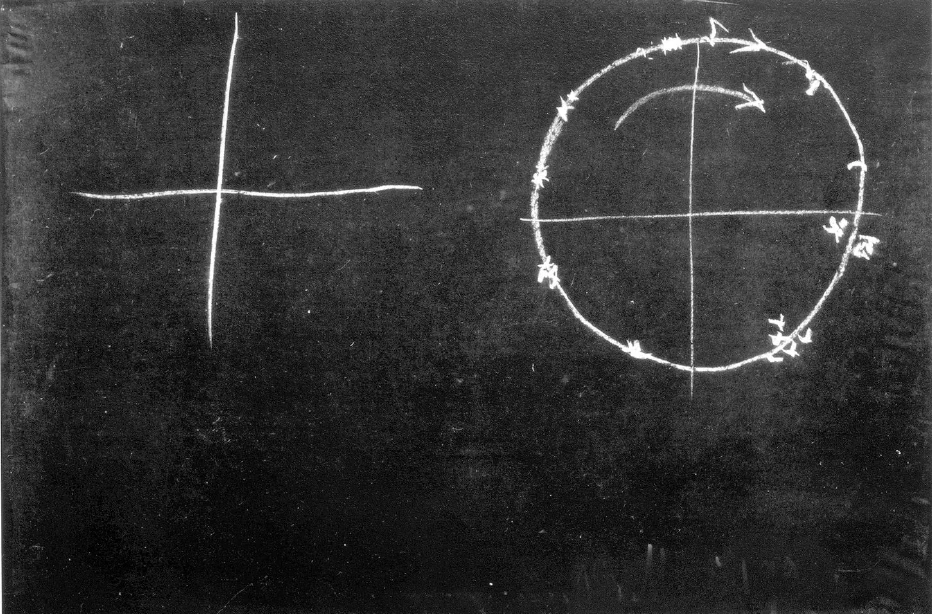
[ 10 ] This form of the human being—where are we to seek its cause, its—I would say—primarily physical cause, in a spiritual sense within the universe? Well, I have already touched on this point in these reflections. I have pointed out to you: The starry sky, which we will sketch here schematically—for my part, as the zodiac with its constellations (Plate 26, right)—moves—apparently or actually, that is of no consequence to us now—around the Earth; the Sun does as well. The Sun, then, follows the same path. But when we consider—as we know—that the Sun shifts its vernal equinox position each year, lagging slightly behind the stars, we arrive at an extraordinarily important fact. This entire retrograde motion of the vernal equinox relative to the constellations is observed in that, when we focus on a specific constellation, it rises earlier than the Sun—or sets earlier—in the following year. This teaches us that the Sun is lagging behind. And I have pointed out to you that even the ancient Egyptians knew: If one divides the circle into 360 degrees, the Sun lags behind the stars by one such degree every 72 years; in 360 times 72 years—which is 25,920 years—it lags behind by the entire circle, that is, it returns to the star with which it rose simultaneously 25,920 years ago.
[ 11 ] So you have presented the fact that in the universe—as I said, I don’t want to concern myself now with whether this is merely an illusion or reality—the stars move around and the sun moves around. But the important fact is that the Sun moves more slowly, that after 72 years the Sun lags behind by one degree of the entire celestial sphere. These 72 years—as I have already pointed out—are, after all, the normal maximum lifespan of a human being. So, a human being lives 72 years—precisely the length of time it takes for the Sun to lag behind the other stars by one degree on the celestial sphere.
[ 12 ] We no longer have any real sense of these things. Even in the Hebrew mysteries, the teacher would say to his students, impressing this upon them very, very deeply: It is Yahweh who causes the sun to lag behind the stars. And with the power that holds back the sun, Yahweh forms the human figure, which is made in his image. So, mind you: the stars move faster, the sun moves slower. This creates a difference in force. And according to these ancient mysteries, this difference in force is what brings about the human form. Out of time, the human being is born in such a way that he owes his existence to the differences in speed between the cosmic day of the stars and the cosmic day of the sun. In our language today, we would say: If the Sun were not in the universe, if it were a star like the other stars, moving at the same speed as the other stars, what would be the consequence? — The consequence would be that the Luciferic forces alone would reign. The fact that the Luciferic forces do not reign alone in the universe, but that human beings are able to withdraw from the Luciferic forces with their entire being, is due to the fact that the Sun does not keep pace with the stars, but lags behind them; it does not unfold the Luciferic speed, but rather the Yahweh speed. Conversely, if only the speed of the Sun existed and not the speed of the stars, then human beings would not be able to use their intellect to outpace the rest of their development. And that, so to speak, would also be incompatible with the overall development of the human being. You see, this is particularly noticeable in our time. If one takes spiritual science seriously, one naturally knows quite well that, at the age of 36, for example, one has grasped things that one could not yet grasp at the age of 25. For experience is part of grasping certain things. This is rarely acknowledged today, because a person at the age of 25 feels complete. But they are complete only in their intellect; they are not complete in their experience. Experience progresses more slowly than intellectual understanding. If people were to consider that experience progresses more slowly than intellectual understanding, the youngest people today would not already have fixed viewpoints, for they would know that they cannot possibly hold viewpoints that require having experienced certain things. The intellect moves with the stars; experience moves with the sun. And if you approach the matter by simply considering human life—72 years, barring extraordinary events that cause a person to live shorter or longer—if you consider human life, you will say to yourself that it takes as long as it takes for the sun to move back one degree from its vernal equinox. It can take that long. Why does it take so long? The reason lies in a certain cosmic subtlety. But I nevertheless ask you to follow me today as we explore this area in our preliminary consideration.
[ 13 ] You see, it’s like this: When you observe a lunar eclipse in a given year, there is a specific date on which the lunar eclipse can occur. The lunar eclipse returns to the same date—or rather, to the same constellation—approximately every 18 years. There is a periodic rhythm in the eclipses that spans 18 years. 72 divided by 4 equals 18. That is exactly one-quarter of a world day and exactly one-quarter of a human life. Human beings, if I may put it this way, endure four such eclipse periods. Why? Because in the universe, everything truly harmonizes numerically. In connection with the rhythmic activity of the heart, a human being has, on average, not only 72 years of life, but also an average of 72 heartbeats and 18 breaths. That, in turn, is a quarter. This numerical correlation, which is expressed in the universe—the 18-year period was called the Chaldean Saros period because the Chaldeans were the first to describe it—this rhythm that exists between the Saros period and the solar period, this very same rhythm also exists within the human being in his inner movement between breath and heartbeat. It was not for nothing that Plato said: “God geometers and arithmetizes.”—Consider that, because of the quarter that corresponds to our breathing activity, we must properly distribute our breathing so that it does not coincide with our pulse, but rather so that the pulse is faster. And this corresponds to the fact that during our 72 years of life—to which our heart activity and pulse activity are assigned—we undergo the Saros period four times, because our breathing activity is contained within it four times. Our human organization is constructed entirely in relation to the universe. However, we will only grasp its significance if we take another connection into account.
[ 14 ] One can only make sense of what I told you in one of my recent reflections—the motion of the Moon, the Moon’s rotation around its axis—if one relates its rotation not to the solar day but to the sidereal day. If one considers sidereal time, a shorter period—27% of a day—is required for the Moon’s rotation. Thus, we can truly make sense of the Moon’s motion only when we do not attribute it to the Sun’s motion, but rather to the motion of the stars. The Sun’s motion, therefore, falls in a certain sense outside a system to which the Moon belongs and to which the stars belong. We are thus situated within the universe in such a way that, on the one hand, we are aligned with the movement of the stars and the Moon, and on the other hand, with the movement of the Sun.
[ 15 ] Here you can already see solar astronomy and stellar astronomy gradually diverging. As I told you last time, we won’t get anywhere if we have only one kind of astronomy. We’ll just end up mixing everything up. We can only make sense of it if we do not limit ourselves to a single branch of astronomy, but rather recognize that, on the one hand, there is the system of the stars—which, in a certain sense, also includes the Moon—and, on the other hand, there is the system to which the Sun belongs. These two systems interpenetrate one another. They interact. But we are mistaken if we apply the same set of laws to both.
[ 16 ] Then, once we realize that we initially have two entirely different forms of astronomy, we will say to ourselves: The cosmic process in which we are immersed has, at first, two origins. But we are so deeply immersed in it that these two currents actually converge within us humans. They converge within us human beings. And what happens within us human beings? You see, suppose that only what today’s natural scientist can accept were to occur within us human beings; then, if I were to draw a schematic diagram (Plate 27, far left, without the lines at the top), all sorts of things would be taking place in the human organism—material processes and so on. These processes would extend to the rest of the organism and also enter the brain, or rather, the senses. But what would be the consequence if the entire metabolic process that takes place in the human organism—and which is embedded in the cosmos, just as I have now described it—if this entire metabolic process were to extend into the brain? We would never be able to have the awareness that we ourselves are thinking. Oxygen, iron, the other substances—carbon and so on—we would have to say that they think within us through their mutual relationships. But we have not at all posited that as a fact of consciousness. There is no question of our having posited that as a fact of consciousness. We have posited the content of our inner life as a fact of consciousness. This can exist under no other condition than that this entire material process breaks down and is annihilated (the lines are drawn in the mind), that within us there is in fact no preservation of energy or matter, but rather space is made through the annihilation of matter for the development of the life of thought. In fact, the human being is the only arena in which true annihilation of matter takes place. People do not come to this realization in our time, in which an understanding of the human being is not developed at all, but instead one focuses solely on everything that is extra-human.
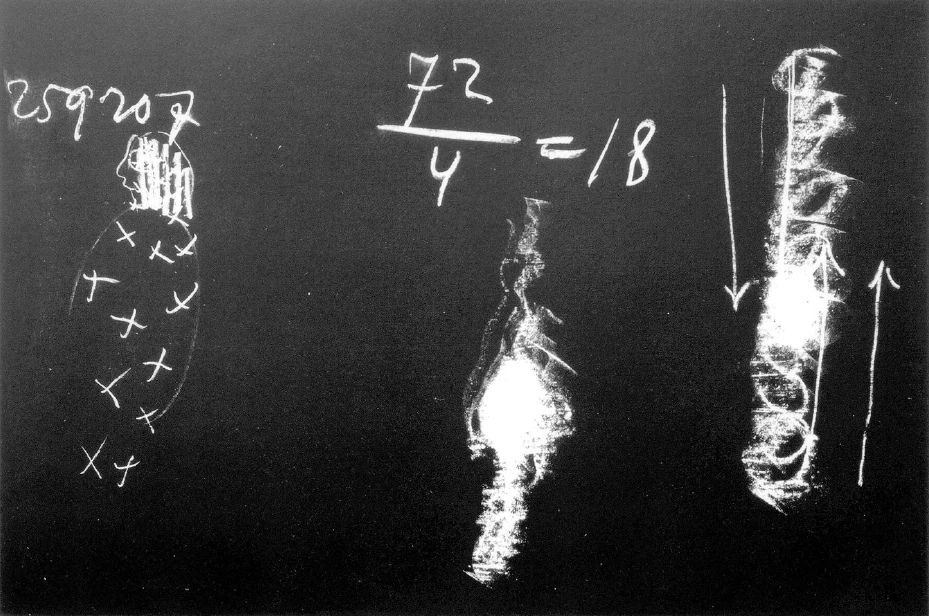
[ 17 ] If we now assume that after 72 years the Sun lags behind by one degree in the celestial sphere, that there is a difference in speed between the motion of the stars and the motion of the Sun, which affects us and converges within us—and if we now imagine that the form of our head comes from the starry sky, and, as we “see the light of the world” according to a very beautiful saying, are enveloped in the Sun’s movement—then we must tell ourselves: There is a constant tendency within us to counteract the faster speed of the stars with a slower speed. What the stars bring about within us is counteracted. What is the effect of this counteraction? The effect of this counteraction is the dissolution of what the stars materially bring about within us: dissolution. The dissolution of the purely material laws, which occurs through the influence of the sun. We can therefore say: If we were to move with the stars as we, as human beings, move through the world, we would move with the stars in such a way that we would be subject to the material laws of the universe. But we do not do that. The laws of the Sun work against it. They hold us back. There is something within us that holds us back. One can calculate—though I cannot work out this calculation for you here; first, it would take too long, and second, you would not be able to follow it— one can calculate that when a certain movement occurs (Plate 27, right, the downward arrow)—that is, when a current flows at a certain speed—and this current merges with another, provided, of course, that the other current does not flow in the same direction but in the opposite direction (upward arrow); that is, if these two currents flow in such a way that they merge into one another. So please, imagine a wind swirling at a certain speed from top to bottom and another from bottom to top, and they swirl into one another (center of the drawing on the right). If we take the difference in speed between the downward current and the upward current, such that the upward current is to the downward current in exactly such a ratio that the resulting speed difference bears the same ratio as the difference in speed between sidereal time and solar time, then, as they swirl together, the vortex would create a compression that takes on a specific shape. Isn’t that right? One swirls downward (center of the board); because the other swirls upward here, striking it at a greater speed—from top to bottom, the speed would be lower—it strikes here, and the collision creates a compression, a certain shape. And this figure is—setting aside everything that affects it; I am drawing only schematically—the outline, the silhouette of the human heart. So it is possible for you to correctly construct the figure of the human heart through the encounter of the Lucifer current and the Yahweh current. This figure of the human heart is simply constructed from the relationships of the universe. One must say quite plainly: As soon as one assumes that the movement of the sun is the expression of a slower movement that meets a faster movement, then we become so intertwined with these two movements that the silhouette of our heart emerges from them. The rest of the human form is attached to this. From this you can see what mysteries are actually hidden in the cosmos. For the moment I say: We have two forms of astronomy, and these two forms of astronomy interact in their results—what is the result? The result is the human heart. The entire current trend in the natural sciences is aimed at not distinguishing these two currents from one another. Hence, the tragic fate befalls it that this interplay falls apart in a different way—into natural phenomena, as Julius Robert Mayer conceived them, and into side effects. Because we are unable to conceive, from a cosmic perspective, that which interacts from two sources as a unified whole, the world falls apart into two extremes for thought.
[ 18 ] Herein lies, first and foremost, the cosmic aspect of something of immense significance for our understanding of humanity and the world. And unless we, based on our present-day premises, renew those insights that once existed in the ancient mysteries—when Christianity was anticipated, anticipated in the way I described in my book *Christianity as a Mystical Fact*—unless we renew these ancient insights in a form appropriate to today, all knowledge remains an illusion. For that which expresses what is most significant in the human heart is, after all, present everywhere. Everywhere, events are such that they can be explained by the convergence of two currents flowing from different sources. One will never understand the entirely unique way in which the Mystery of Golgotha is embedded in the rest of our Earth’s history unless one begins this understanding right here in the cosmos. In this preliminary discussion today, I wanted to lay the foundation we need so that we can build upon it tomorrow and the day after.