The Bridge Between the Spiritual and
Physical Realms of Human Beings
GA 202
28 November 1920, Dornach
Translated by Steiner Online Library
Third Lecture
[ 1 ] If we look back once more at what we discussed yesterday and the day before, a more intimate relationship between the human being and the surrounding cosmos must be revealed to us. And we have been able to relate the human physical body—in terms of its head organization, its rhythmic organization, and its metabolic organization—to the entire cosmos; we have also been able to relate the soul-being and the spirit-being of the human being to the entire cosmos. What may appear to you here as the relationship of the human being to the cosmos—as the human being’s complete immersion in the world—had to be viewed differently in ancient times than it must be viewed now, and than it will have to be viewed more and more as humanity strides further into the future. We have, after all, often mentioned how, in ancient times, an instinctive primordial wisdom was widespread among humanity—a wisdom that human beings did not develop inwardly, but which they felt, one might say, as if it were rising up within them as if in a dream. It was given to them, and they had, in fact, nothing to do but open their soul’s receptive faculties and receive what came to them from the cosmos as a gift from the gods.
[ 2 ] Since human beings are threefold beings, this instinctive primordial wisdom must also have perceived the totality of the human being, so to speak, as threefold. As human beings turned their attention more toward that to which they belonged before their birth—and which shone into the time between birth and death as a spiritual reality, essentially corresponding to what appears in the expanse of the cosmos—they spoke of the beauty that revealed itself to them; the cosmos as beauty, and humanity—in terms of its mental organization, its capacity for imagination, and its waking consciousness—born out of this world of beauty. This is how primitive man perceived it: that it was benevolent spiritual beings revealing themselves all around him; for primitive man did not view natural phenomena as dryly and soberly as we do today when we surrender ourselves solely to ordinary consciousness. Primitive man saw spirituality and the soul manifesting everywhere. This revealed itself to him. And this cosmos—which was the manifestation of the spiritual and the soul and which revealed itself to his instinctive consciousness as in powerful dream images—was called by the people of primeval times the “cosmos of beauty.”
[ 3 ] Then, in a sense, the human being felt as if he were standing on his planet. He felt connected to his planet. It provided him with food, and it was his home. In a sense, he felt its power coursing through his body, revealing itself in his soul as will, which strengthened him as he emerged from sleep. He, in turn, perceived this strength as a gift from benevolent, divine-spiritual beings and called it “strength.” “The planet, imbued with strength, flows through me”—this is roughly how primitive man perceived what he could not, however, express in precisely articulated words.
[ 4 ] In a sense, he felt as if he were standing right in the midst of what was taking shape in his mind, taking form in his imagination, and being illuminated by his waking consciousness. And he felt himself standing on the planet in relation to the force that lived in his limbs—a force he sensed was being imparted to him from the planet itself. He said to himself: The same force that acts in a stone as it falls to the ground—the force that creates a hole when the stone strikes—that same force lives in my legs when I walk. “This connects me through my legs to the Earth as my strength. It also lives in my arms when I work; it permeates my muscular strength.”—And he felt himself standing within, between beauty and strength, and felt that he had been entrusted with the task of bringing about, in rhythm, a balance between the Above—beauty—and the Below—strength—in wisdom. And in turn, as he worked to bring about this balance between beauty and strength, he felt supported by the spiritual beings who were the bearers of wisdom, who illuminated him with wisdom.
[ 5 ] Thus, human beings perceived what the cosmos gave them as beauty, wisdom, and strength. For early humans, drawing on the mystery teachings that shone far and wide, beauty, wisdom, and strength were what made them feel connected to the entire universe and empowered themselves. In a sense, the external world that surrounded him, the inner world he sensed within himself, and the balance between the two—he experienced all of this as beauty, wisdom, and strength.
[ 6 ] What has remained in the various secret societies are the catchphrases “wisdom,” “beauty,” and “strength,” though it sometimes becomes quite clear that only the words themselves have remained, while a deeper understanding is lacking. For a time has dawned for humanity in which this sense of feeling and this knowledge—even if it is instinctive knowledge—of our connections with the cosmos has been pushed further into the darkness. Human beings lived, so to speak, in subordinate ideas, in subordinate feelings. They drew the impulses of their will from subordinate elements of their own being. They forgot what they had once sensed in beauty, wisdom, and strength, for they were to become free beings. Thus, a central force had to emerge, as it were, from their inner chaos—a force to which was not revealed what had revealed itself, luminous and powerful, to the primordial human. But modern humanity will not progress unless it allows what once revealed itself from the cosmos as beauty, wisdom, and strength to rise again from within. As long as humanity remains earthly, the cosmos will not reveal itself anew in beauty from without. Those times are the times of instinctive primordial wisdom. These times are times of the past. These are not the times in which the free human being unfolded, but rather those in which only the human being who was, so to speak, driven by a lack of freedom and by instincts could unfold. These times will not return; rather, from within themselves, human beings must once again allow to rise what came to them from without in the form of wisdom, beauty, and strength.
[ 7 ] What was absorbed—I would say, drawn in—as the power of beauty from the universe, humanity took this into itself, so to speak, in ancient, in very ancient Earth lives. In the middle Earth lives that followed—which we experienced during the Egyptian, Greek, and modern eras—this force was absorbed, but it did not come to the fore of human consciousness. Now humanity is ready to bring this out of consciousness, and it is being brought out. What has been absorbed as the power of beauty will arise anew from within the human being, and spiritual science provides the guidance on how it is to emerge from within the human being. This will arise from within through imagination. And everything that is now consciously conveyed through imagination in spiritual science is nothing other than the resurrected life of beauty, as it existed within primordial wisdom. And what the human being has experienced within themselves in sensing the power of their planet—in which, however, everything that was the power of the cosmos was concentrated, only that it was centered in the planet or is centered in the planet—all of that must rise again as the human being comprehends it from within through the insight of intuition. Beauty, drawn from the universe, becomes imagination for humanity’s future, beginning in the present. Strength becomes intuition, grasped through humanity’s own free power, and wisdom becomes inspiration.
[ 8 ] Thus, humanity has left behind an era in which beauty, wisdom, and strength were bestowed upon it from outside. I would say that in certain secret societies, in Masonic orders, and so on, these buzzwords—wisdom, beauty, strength—have merely been parroted without any deeper inner understanding being cultivated. If one were to understand the matter inwardly, one would know that these are ancient traditions that must be revived as imagination, as inspiration, as intuition. It is therefore a rather superficial form of wisdom when all sorts of members of this or that order come and find a similarity between what appears in spiritual science and what they have as their tradition—a tradition they mostly do not understand. In spiritual science, the connection is drawn from spiritual knowledge itself.
[ 9 ] Humankind has thus left behind an ancient age in which the mysteries of the universe were revealed to them through beauty, wisdom, and strength. Humanity must now move toward an age in which the mysteries of the universe are revealed to them through the imagination, inspiration, and intuition of those who wish to—or are meant to—attain these powers of insight and who can achieve them in some way. Anyone can already understand today what is drawn from inspiration, intuition, and imagination, if only they are willing.
[ 10 ] But the ancient age was now exposed to a certain danger. And this danger, I would say, became most acute toward the end of the second millennium B.C. in the then-civilized world—spanning Egypt, the Near East, India, and so on. The danger was that people did not receive in the proper way what was revealed from the universe—I would say, through grace, as if of its own accord—to human beings, who had only to receive it through their instinct for knowledge. One could fall prey to this danger in the following way.
[ 11 ] You must try to imagine what it means that in the nature surrounding human beings, it was not only revealed what appears to today’s sober consciousness as nature and presents itself as the laws of nature, but that magnificent beauty—that is, beautiful radiance—was revealed in powerful, pictorial manifestations of spiritual beings who gazed forth from every spring, from every cloud, from everything. It was especially during this period, toward the end of the second millennium of the pre-Christian era, that things were not as they had been in even earlier times—when, of course, all of this was also present—but it was, I would say, present in a more self-evident way. During this period, human beings had to participate in this grace by doing something themselves. They did not have to do so in the way that we now seek higher spiritual development out of full consciousness, but they could—and this was, in fact, a rather dubious ability—develop a longing for this spiritual aspect that revealed itself in nature; they could stir up their forces of need, their driving forces; then, in a sense, the spiritual revealed itself to them out of nature. And in this stirring up of the driving forces, the forces of need, lay a powerful Luciferic gift.
[ 12 ] Most of you know, of course, how natural the appearance of elemental beings was to human beings in the ancient Atlantean era. But this phenomenon continues to resonate even in the clairvoyance of the post-Atlantean era. It gradually faded away, however, and then human beings knew how to conjure it up in a certain way from natural phenomena through the power of their needs. That was the Luciferic danger that arose. Human beings could, so to speak, rouse and spur themselves on to unite with the spiritual. But this kind of rousing was something Luciferic within them. Consequently, the world of the culture and civilization of that time, toward the end of the second millennium of the pre-Christian era, was heavily infested with Luciferic influences. We have, of course, alluded to this Luciferic infestation from other perspectives on other occasions; I have traced it back to its other causes; but now let us consider it from the standpoint adopted in these three lectures.
[ 13 ] This Luciferic infestation of the world at that time is countered by another, an Ahrimanic one. And this Ahrimanic infestation is currently on the rise, gaining momentum with tremendous force. It is truly appalling how oblivious modern civilized people are to what is actually unfolding. Just consider for a moment how mechanical forces—the power of machines—have developed in recent times. I have spoken of this before from other perspectives. It was not so long ago that people had to use their own muscle power to do what, in a certain sense, they can now leave to machines—machines they merely operate with a touch. What takes place within these machines is underpinned by the forces that human beings extract from the earth by mining coal. Coal provides the power that then drives our machines.
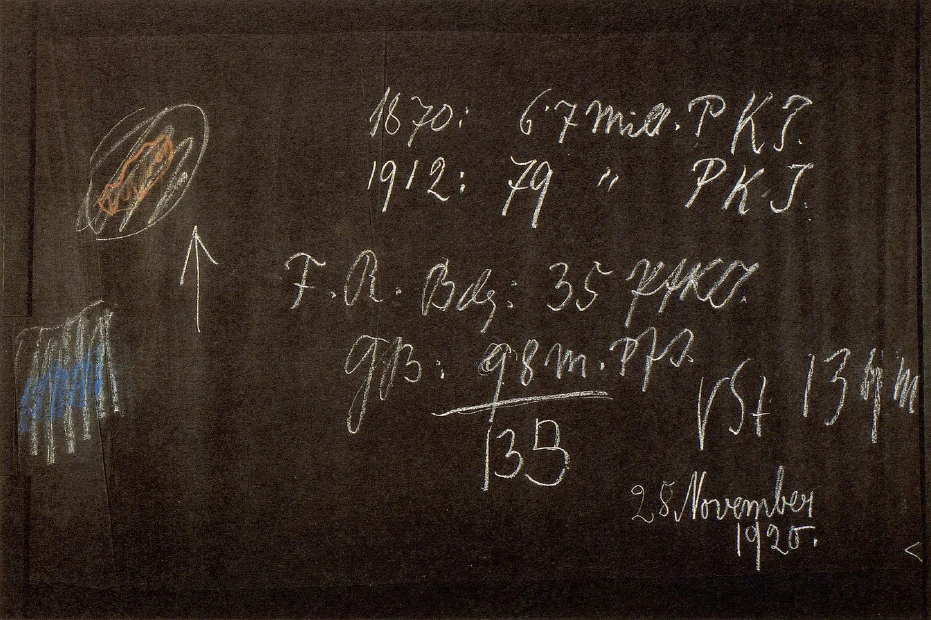
[ 14 ] Now, when a person reaches the point where a machine is working alongside him, what happens is that he, in a sense, hands over to the machine what he used to have to do himself. The machine does it. The machine stands beside him and performs the work that he previously had to do himself. The output of the machine is measured in horsepower, and when measuring on a large scale—that is, the output within a certain territory—it is measured in terms of the power a horse produces in a year while performing its daily work. Now consider the following: In 1870—this can be calculated from coal production—six and seven-tenths million horsepower-years were worked within Germany—I am deliberately choosing the year of the war, quite intentionally. That means that, in addition to what people worked, the machines worked six and seven-tenths million horsepower-years. This, then, is a force that was generated by the machines themselves. In 1912, in the same Germany, 79 million horsepower-years were produced by machine power!
[ 15 ] Since Germany has a population of nearly 79 million, that means there is one horse working alongside every person throughout the year. And just consider the increase from 6.7 million horse-power-years to 79 million horse-power-years in just a few decades!
[ 16 ] And now consider these circumstances in light of the outbreak of the terrible catastrophe of war. In that same year, 1912, France, Russia, and Belgium together could muster 35 million horsepower-years; Great Britain, 98 million horsepower-years. Essentially, the war in 1870 was fought by people, since not much of the mechanical power could be mobilized. After all, Germany had only 6.7 million horsepower-years at that time. Things had changed in the few decades since then. As you know, in this war it was essentially the machines that pitted themselves against one another. What faced off against each other on the front lines came from the machines, so that it was actually the horsepower-years of the machinery that were brought to the front.
[ 17 ] The fact of the matter, however, was that Great Britain was only able to mobilize its 98 million horsepower-years over the course of a longer period of time. But then, when combined, the mechanical power generated by these empires totaled 133 million horsepower-years, compared to Germany’s 79 million horsepower-years; and if one were to add Austria to the mix, the total would come to about 92 million horsepower-years. At first, this was somewhat offset by the fact that, as mentioned, Great Britain could not convert its horsepower-years from agricultural use to the front lines so quickly. In this terrible catastrophe of war, it was certainly not the wisdom of the generals that stood opposed to one another—they merely provided certain directions. —though they did provide certain directions—but what truly stood opposed to one another were the mechanical forces that clashed on the front lines, forces that did not depend on the generals, but rather on the inventions that humanity had previously made based on its natural sciences.
[ 18 ] And what, so to speak, was bound to happen with iron necessity, as if by fate? Let’s assume that the United States of America’s 139 million horsepower-years were now being sent to the front.
[ 19 ] You see, the fate of the world was predetermined by the mechanical power that humankind had created in just a few decades—quite apart from the genius of the generals. There was nothing that could be done against this fate of the world, against this inevitability, where the results of mechanical forces simply clashed on the battlefronts.
[ 20 ] Yes, what exactly is going on here? Humans constructed these mechanisms based on their own thinking. By constructing them, they had imbued the mechanisms with their intellect—the intellect they had derived from the natural sciences. In a sense, reason had run away from his head and had become the horsepower-years in his surroundings. Now, having run away, they were working on their own. The sleeping, civilized human beings of the present day find it hard to even imagine the breakneck speed with which this creation of a world—one that is inhuman and superhuman—has been carried out by humans in recent decades.
[ 21 ] That person I mentioned to you, at the end of the second millennium B.C., was surrounded by the Luciferic contamination; the spiritual beings for whom he developed his needs and who appeared to him from outside himself, from nature. If it was a natural object, the spiritual being appeared within it (it is depicted). Now, however, human beings allow their spirit to flow into matter, into mechanisms. It becomes such that, for example, in Germany every person has created a horse beside themselves out of human intellect—one that now works alongside them, which was not a horse but rather mechanical power. This is separated from the human being, just as these elemental beings were once separated from the human being—only in a different sense. They were separated in such a way that the human being had to direct his Luciferic power toward them. Now he directs his Ahrimanic power toward them. Now he Ahrimanizes it, mechanizes it. We live in the age of Ahrimanic contamination. People do not even realize that they are actually withdrawing from the world, and that they are incorporating their intellect into the world and creating alongside themselves a world that is becoming independent. And the great—I would say diabolical—experiment has been carried out since the year 1914; that one Ahrimanic entity has, in essence, tipped the balance against the other Ahrimanic entity. We have been dealing with an Ahrimanic struggle across almost the entire Earth. It has taken on an Ahrimanic character precisely because human beings have created a new Ahrimanic world within the very machinery that surrounds them. And it is a new Ahrimanic world. If you look at the figures—from 6.7 million to 79 million horsepower-years in just a few decades, non-human mechanical power has increased (the ratio is the same in other countries)—how rapidly Ahriman has grown in recent decades!
[ 22 ] Doesn’t this raise the question of whether human beings are to lose entirely what lies within their will, what lies within their power of initiative? One might ask whether human beings are to be led further and further into the illusion that they are the ones doing things, when in reality the Ahrimanic forces—which can be measured in horsepower-years—are working against one another? From a moral standpoint, those who survey the world are interested only in figures such as Foch, Ludendorff, and Haig. From the standpoint of full reality, he is interested in those forces that arise from coal and clash on the front lines—forces that are brought from the machine shops to the front lines, depending on the inventive powers of previous years—and that reduce what must happen to a simple arithmetic problem.
[ 23 ] Thus, the world’s transformation into Ahriman is a simple mathematical example that shows what must happen. And how does humanity fit into this? It can, of course, stand by as the fool, whose machines will ultimately turn against him if he discovers even more complex combinations of forces.
[ 24 ] This “Ahrimanization” is the modern counterpart to the “Luciferization” of the world I spoke of earlier. This is what we must focus on. For is this not perhaps the very clearest illustration of the necessity for human beings to create from within at this time? We will not stop this Ahrimanization, nor should we; otherwise, we would stand before every new mechanization just as the Nuremberg Medical Association did in 1839, or like the Berlin postmaster before the construction of the railroad, who said: “They want to run a railroad from Berlin to Potsdam—but I send out mail coaches twice a week, and there’s not a single person inside!” — You cannot stop mechanization, for culture must develop in this direction. Culture demands this Ahrimanization. But it must be accompanied by what now works from within the human being—that which, in turn, draws wisdom, beauty, and power—that is, strength—from within the human being through imagination, intuition, and inspiration. For the worlds that will dawn there will be the worlds of humanity; they will be worlds that stand before us in the spirit and in the soul, while outside the Ahrimanic mechanical forces run their course. And these forces that arise from imagination, inspiration, and intuition will have the power to direct what would otherwise overwhelm human beings all around them due to the frenzied pace of Ahrimanization. What comes from the spiritual world—from imagination, inspiration, and intuition—is stronger than all the horsepower-years that can still spring from the mechanization of the world. But the mechanizing forces would overwhelm human beings if they did not find a counterbalance to them in what they can discover through the revelations of the spiritual world, which they must strive to attain.
[ 25 ] What emerges with spiritual science—and what strives toward the knowledge of imagination, inspiration, and intuition—is not just any invention, any abstract ideal, or any catchphrase, but rather something whose necessity can be clearly discerned from the course of human development. And one must point out that human beings would be overwhelmed by the non-human forces—which they themselves have created in an Ahrimanized world—measured in calculable horsepower. When what gave humanity wisdom, beauty, and strength came to it from without, it did not yet have the Ahrimanized world around it; it could receive it in grace, or through grace, and it had on Earth what it had worked out for itself at most through the power of fire or through the simplest mechanical tools, which did not add much to its own strength. And it is only since roughly the second half of the 19th century that we have had a new world—I would say, a powerful new geological layer covering the Earth. Added to all the other strata—the diluvium and alluvium—is the Ahrimanic stratum of mechanized forces, which is forming like a crust over the Earth. Thus, rising from the depths is that which overwhelms human beings unless they bring into the outer world that inner world which arises within them from the spirit—that is, from imagination, intuition, and inspiration.
[ 26 ] These are truly powerful impulses arising from an understanding of the course of the world, which point to the necessity of a spiritual-scientific culture and civilization. These are already quantifiable necessities today. For is it not terrible that, alongside humanity, this—let us call it—“super-geological” layer is rising with such breakneck speed, like a new crust of the Earth, and that many people today still think as they did when, for example, only 6.7 million horsepower-years were produced in Germany through mechanization? Do people even think about what actually drives the course of the world? Are they aware of what is really happening? They are not; otherwise, from the realization of what is happening, they would truly see the necessity of finding a new way to imbue human beings with what past ages called beauty, wisdom, and strength—and what, given the path the human personality must take to attain it, we must call imagination, inspiration, and intuition.
[ 27 ] We are thus looking into a world infested by Ahriman. I have said many times before: I do not wish to use the term “transitional period” lightly, for essentially every era is a transitional period; but a time in which something as extraordinary as Ahrimanism has developed so rapidly—as it has since the last third of the 19th century—such a time does not come along often. And the Biedermeier era, which immediately preceded this for a large part of Central Europe, truly cannot be compared to what has actually taken place in reality over the last few decades. One must truly sense the full gravity of these modern events. And one must sense the following.
[ 28 ] When one looks at an event such as the war that took place in Central Europe in 1870–71, one could reflect on it; one could follow its course in one’s thoughts. But just look at how people are still trying, in exactly the same way, to make sense of the events of recent years! They’re still thinking the way people did back when Germany had only 6.7 million horsepower-years at its disposal! They simply don’t grasp that one must think differently when 79 million horsepower-years are at work apart from human beings! This requires a completely different way of thinking to take hold. Without turning to spiritual science, the mysteries arising from these events simply cannot be solved. When human beings mechanize the world around them through external science, they must all the more allow an inner science—which is, in turn, wisdom—to arise from within themselves. This will have the power to direct what would otherwise overwhelm them.