

The Bridge Between the Spiritual and
Physical Realms of Human Beings
GA 202
5 December 1920, Dornach
Translated by Steiner Online Library
Fifth Lecture
[ 1 ] It will have become clear to you from yesterday’s remarks that one views the world one-sidedly if one regards it in the way that is particularly evident in Hegel—that is, as if it were permeated by what might be called the cosmic idea. One views the world just as one-sidedly when one conceives of its fundamental structure as being of a volitional nature. This is Schopenhauer’s idea: to conceive of the world as being of a volitional nature. We have seen that this particular inclination—if I may say so—to view the world as an effect of thought also points to Western human nature, which tends more toward the intellectual side. We have, after all, been able to demonstrate how Hegel’s philosophy of thought takes on a different form in Western worldviews, and how Schopenhauer’s sentiments reflect a tendency that is actually characteristic of Easterners—as evidenced by Schopenhauer’s particular fondness for Buddhism and, more generally, for Eastern worldviews.
[ 2 ] Essentially, any such perspective can only be properly assessed if one can view it from the standpoint provided by spiritual science. From this perspective, however, such a synthesis of the world—whether from the standpoint of thought or from the standpoint of will—appears as something abstract; and it is, in particular, the more recent phase of human development that, as we have often emphasized, still tends toward such abstractions. Spiritual science must lead humanity back to a concrete understanding, to a realistic understanding of the world. But it is precisely within such a realistic understanding of the world that the inner reasons why such one-sided views take hold will become apparent. What people like Hegel and Schopenhauer—who are, after all, great, significant, and brilliant minds—see is, of course, certainly present in the world; it merely needs to be viewed in the right way.
[ 3 ] Today, let us first of all make it clear to ourselves that we experience thought within ourselves as human beings. So when a person speaks of their experience of thought, they have this experience of thought directly. Of course, they could not have this experience of thought if the world were not permeated by thoughts. For how could a person, in perceiving the world through the senses, derive thought from their sensory perception if thought were not present in the world as such?
[ 4 ] Now, as we know from other considerations, the human head is structured in such a way that it is particularly capable of taking in thoughts from the world. It is shaped by thoughts, formed from thoughts. At the same time, however, the human head points us back to our previous earthly life. We know that the human head is actually the result of a metamorphosis from previous earthly lives, while the structure of the human limbs points toward future earthly lives. To put it simply: We have our head because our limbs from the previous earthly life have metamorphosed into the head. Our limbs, as we now possess them, along with everything that belongs to them, will metamorphose into the head that we will possess in our next earthly life. After all, it is in our head that thoughts are currently at work, especially in the life between birth and death. These thoughts are, as we have also seen, at the same time the transformation, the metamorphosis, of that which acted as will in our limbs during our previous earthly life. And that which acts as will in our present limbs, in turn, will be transformed into thought in our next earthly life.
[ 5 ] If you consider this, you can say to yourself: Thought actually appears as that which, throughout human evolution, continually emerges from the will as a metamorphosis. The will actually appears as that which is, so to speak, the seed of thought. — So that we can say: The will gradually develops into thought. What is first will later becomes thought. When we look at ourselves as human beings—specifically as head-human beings—we must look back on our prehistory, recognizing that in that prehistory we possessed the character of the will. When we look toward the future, we must currently attribute the character of the will to our limbs and say: “In the future, this will become what is formed in our head—the thinking human being.” But we continually carry both of these within us. We are, so to speak, shaped by the universe through the way in which thought from the past organizes itself within us together with the will that strives toward the future.
[ 6 ] Now, what organizes human beings, as it were, through the convergence of thought and will—the expression of which is then their external organization—that which, in a sense, organizes human beings in this way, becomes particularly clear when viewed from the perspective of spiritual scientific research.
[ 7 ] The person who is able to develop to the level of the insights of imagination, inspiration, and intuition does not merely see the outwardly visible head in a human being, but objectively perceives that which, through the head, constitutes the thinking human being. In a sense, they look toward the thoughts. So we can say: With the faculties that are initially normal to human beings between birth and death, the head manifests itself in the configuration in which it simply is. Through the developed insight of imagination, inspiration, and intuition, the thought-force—which underlies the organization of the head and comes from earlier incarnations—also becomes visible, if we use this expression in a figurative sense. How does it become visible? In such a way that, for this becoming visible—for this, of course, spiritual-soul-related becoming visible—we can only use the expression: it becomes as if luminous.
[ 8 ] Certainly, when people who insist on remaining firmly rooted in materialism criticize such things, one immediately sees how greatly present-day humanity lacks the sensitivity to grasp what is actually meant by such matters. I have pointed this out clearly enough in my Theosophy and in other writings: the point is that, of course, a new physical world—a new edition of the physical world, so to speak—does not appear when one looks through imagination, inspiration, and intuition at what the thinking human being is. But this experience is precisely the same as what one has with regard to the physical external world in relation to light. Strictly speaking, one would have to say: The human being has a certain experience of external light. The same experience that a person has through the sensory perception of light in the external world is the experience they have in relation to the element of thought in the head, which is the basis for imagination. So one can say: The element of thought, viewed objectively, is perceived as light—or rather, experienced as light. — As thinking human beings, we live in the light. One sees external light with the physical senses; one does not see the light that becomes thought, because one lives within it, because one is that light oneself as a thinking human being. One cannot see that which one is oneself in the first place. When one steps out of these thoughts, when one enters into imagination and inspiration, then one stands opposite it, and then one sees the element of thought as light. So that when we speak of the complete world, we can say: We have the light within us; only it does not appear to us as light there, because we live within it, and because, as we make use of the light, as we possess the light, it becomes thought within us. — You take possession of the light, so to speak; the light that otherwise appears to you from outside, you take into yourselves. You differentiate it within yourselves. You work within it. That is precisely your thinking; that is acting in the light. You are a being of light. You do not know that you are a being of light because you live within the light. But your thinking, which you unfold, is life in the light. And when you look at that thinking from the outside, you certainly see light.
[ 9 ] Now imagine the universe [see drawing]. You see it—during the day, of course—bathed in light, but imagine you were looking at this universe from the outside. And now let’s do the opposite. We have just considered the human head, which contains thought in its development on the inside and perceives light on the outside. In the universe, we have light that is perceived by the senses. If we step out of the universe and observe it from the outside [arrows], what does it appear to be? A structure of thoughts! The universe—internally light, externally seen as thoughts. The human head—internally thought, externally seen as light.
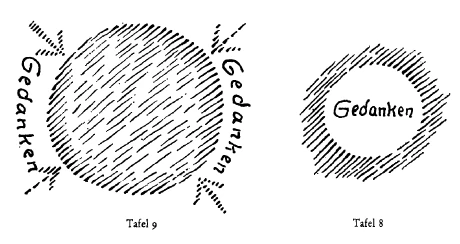
[ 10 ] This is a way of viewing the cosmos that can be immensely useful and enlightening to you if you choose to make use of it, if you truly engage with such things. Your thinking, your entire inner life, will become much more flexible than it otherwise is if you learn to imagine: If I were to step outside of myself—as is constantly the case when I fall asleep—and look back at my head, that is, at myself as a being of thought, I would see myself glowing. If I were to step out of the world—out of the world bathed in light—and view the world from the outside, I would see it as a thought-form. I would perceive the world as a being of thought. — You see, light and thought belong together; light and thought are one and the same, merely viewed from different perspectives.
[ 11 ] But the thought that lives within us is actually that which comes to us from ancient times, that which is most mature within us—the result of earlier earthly lives. What was once will has become thought, and thought appears as light. From this you will be able to sense: Where there is light, there is thought—but in what sense? Thought in which a world is continually dying. A pre-world, a world of the past, is dying within thought—or, to put it another way, within the light. This is one of the mysteries of the world. We look out into the universe. It is permeated by light. Thought lives in the light. But within this light, permeated by thought, a world is dying. The world is constantly dying in the light.
[ 12 ] When a person like Hegel contemplates the world, he is actually contemplating the world’s ceaseless passing away. Those people who have a particular inclination toward the world’s decline, passing away, and withering become, above all, thinkers. And in its passing away, the world becomes beautiful. The Greeks, who were inwardly, in fact, thoroughly imbued with living humanity, found joy outwardly when beauty shone forth in the world’s dying. For in the light in which the world dies, the beauty of the world shines forth. The world does not become beautiful unless it can die, and as it dies, the world shines. So it is actually beauty that emerges from the radiance of the light of the world as it is constantly dying. This is how one views the universe qualitatively. With Galileo, the modern era began to view the world quantitatively, and today people take particular pride in being able—as happens everywhere in our sciences wherever possible—to understand natural phenomena through mathematics, that is, through the dead. Hegel, however, used more substantive concepts to understand the world than mathematics provides; but what was particularly appealing to him was that which had come to maturity, that which was in the process of fading. One might say: Hegel faced the world like a person standing before a tree that is just bursting with blossoms. At the moment when the fruits are about to unfold but are not yet there, when the blossoms have reached their peak, the power of light is at work in the tree; that which is thought borne by light is at work in the tree. This is how Hegel stood before all phenomena of the world. He contemplated the peak of blossoming, that which unfolds entirely into the most concrete form.
[ 13 ] Schopenhauer viewed the world differently. If we want to examine Schopenhauer’s impetus, then we must look at the other aspect of the human being—that which gives rise to action. It is the element of will that we carry within our limbs. Yes, that is actually how we experience it—as I have often pointed out—just as we experience the world in sleep. We experience the element of will unconsciously. Can we also view this element of will from the outside in some way, just as we view thought from the outside? Let us take the will, unfolding in some way within a human limb, and ask ourselves: if we were to view the will from the other side—that is, if we were to observe the will from the standpoint of imagination, inspiration, and intuition—what would be the parallel in this observation to the way we perceive thought as light? How do we perceive the will when we observe it with the developed power of perception, of clairvoyance? When we observe the will with the developed power of perception, of clairvoyance, we also experience something that we see externally. When we observe the thought with the power of clairvoyance, we experience light, we experience something luminous. When we observe the will with the power of clairvoyance, this will becomes thicker and thicker, and it becomes matter. If Schopenhauer had been clairvoyant, this being of will would have stood before him as a material automaton, for that is the outer aspect of the will: matter. Internally, matter is will, just as light is internally thought. And outwardly, the will is matter, just as thought is outwardly light. That is why I was also able to point out in earlier reflections: When a person mystically delves into the nature of their will, those who are actually just fooling around with mysticism—but who in reality strive for well-being and the experience of the worst kind of egoism—believe that by looking inward, they will find the spirit. But if they went far enough with this looking inward, they would discover the true material nature of the human inner being. For it is nothing other than a plunge into matter. When one plunges into the nature of the will, the true nature of matter is revealed to one. Contemporary natural philosophers are merely fantasizing when they say that matter consists of molecules and atoms. The true nature of matter is found when one mystically plunges into oneself. There one finds the other side of the will, and that is matter. And in this matter—that is, in the will—what is essentially a world that is constantly beginning and sprouting is revealed.
[ 14 ] They look out into the world: they are enveloped by light. In that light, a premature world dies away. They step onto the hard substance—the strength of the world supports them. In that light, beauty shines forth in thought. In the radiance of beauty, the premature world dies away. The world dawns in its strength, in its power, in its might, but also in its darkness. In darkness it dawns, the future world, in the material-volitional elements.
[ 15 ] When physicists finally speak seriously, they will not indulge in the speculations in which people today ramble on about atoms and molecules, but will say: The external world consists of the past, and at its core it contains not molecules and atoms, but the future. And when people finally say: “The past appears to us radiant in the present, and the past envelops the future everywhere”—then they will speak correctly about the world, for the present is everywhere nothing other than the interplay of past and future. The future is that which actually lies in the power of matter. The past is that which shines forth in the beauty of light, whereby light stands for everything that reveals itself; for, of course, what appears in sound and what appears in warmth is also meant here under the term “light.”
[ 16 ] And so a person can only understand themselves if they conceive of themselves as a core of the future, enveloped by what comes to them from the past—the luminous aura of thought. One might say: Spiritually speaking, human beings are the past, where they shine in their aura of beauty; but integrated into this aura of the past is that which, as darkness, mingles with the light that radiates from the past and carries into the future. The light is that which radiates from the past; the darkness is that which points toward the future. Light is of a conceptual nature; darkness is of a volitional nature. Hegel was drawn to the light that unfolds in the process of growth, in the ripest blossoms. As an observer of the world, Schopenhauer is like a person standing before a tree who does not actually take pleasure in the splendor of the blossoms, but who feels an inner urge simply to wait until the seeds for the fruit sprout from the blossoms everywhere. It delights him that there is a force of growth within; it spurs him on; his mouth waters when he can imagine that the peach blossoms will become peaches. He turns away from the luminous nature of the flower toward what grips him from within—what unfolds from the flower’s luminous nature as that which can melt on his tongue, that which develops into fruit and carries on into the future. It is indeed the dual nature of the world, and one can only view the world correctly by considering it in its dual nature; for only then does one realize how concrete this world is, whereas otherwise one views it only in its abstractness. When you go outside and look at the trees in bloom, you are actually living off the past. So you look at the springtime nature of the world and you can say to yourself: What the gods have woven into this world in times past is revealed in the splendor of spring’s blossoms. You look at the fruiting world of autumn, and you can say: There a new divine act begins; there falls away what is still capable of further development, what unfolds into the future.,
[ 17 ] The point, then, is not merely to form an image of the world through speculation, but to grasp the world inwardly with one’s whole being. One can indeed, I would say, grasp the past in the plum blossom and sense the future in the plum. What shines into one’s eyes is intimately connected with that from which one has emerged out of the past. What melts on one’s tongue is intimately connected with that from which one rises anew, like the phoenix from its ashes, into the future. There, one grasps the world through sensation. And it was precisely this “grasping the world through sensation” that Goethe actually sought in everything he wished to perceive and feel in the world. For example, he looked at the green plant world. He did not, of course, have what we today might call the “science of the spirit,” but as he gazed upon the greenness of the plant world, he found in the greenness of the plant—which had not yet fully unfolded into bloom—that which projects into the present from the plant’s actual past; for in the plant, the past already appears in the bloom; but what is not quite so past yet is the greenness of the leaf.
[ 18 ] When one looks at the greenness of nature, it is, in a sense, something that has not yet died off entirely, something that has not yet been so completely overtaken by the past [see drawing in green]. But what points toward the future is that which emerges from the darkness, from the shadows. Where the green fades into a bluish hue, there lies what manifests itself in nature as the future [blue].
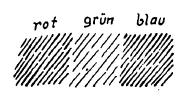
[ 19 ] In contrast, where we are led back into the past—where that which matures and brings things to bloom lies—there is warmth [red], where the light not only brightens but also permeates inwardly with power, where it merges into warmth. Now, one would actually have to depict the whole thing in such a way that one says: There is the green, the plant world—this is how Goethe would perceive it, even if he had not yet translated it into spiritual science or esoteric science—and, building on that, the darkness, where the green gradates into bluish tones. But that which brightens and is filled with warmth would, in turn, follow on toward the upper side. But there one stands as a human being; there, as a human being, one possesses inwardly what one has outwardly in the green plant world; there, inwardly, as a human etheric body—as I have often said—one is the color of peach blossoms. That is also the color that appears here when blue blends into red. But that is oneself. So that, when one looks out into the world of colors, one can actually say: One stands within the peach-blossom hue oneself, with the green opposite. This then presents itself objectively in the plant world. On one side you have the bluish, dark tones; on the other, the light, reddish-yellowish tones. But because you are inside the peach-blossom hue—because you live there—you cannot perceive this in everyday life any more than you perceive a thought as light. What one experiences, one does not perceive; therefore, one leaves out the peach blossom hue and looks only toward the red, which one extends on one side, and toward the blue, which one extends on the other side; and thus such a rainbow spectrum appears to one. But this is only an illusion. One would obtain the real spectrum if one were to bend this band of colors into a circle. In fact, one bends it straight precisely because, as a human being, one stands within the peach blossom, and so one surveys the world of color only from blue to red and from red to blue through the green. The moment one were to have this perspective, every rainbow would appear as a circle—a circle bent in on itself, a roll with a circular cross-section.
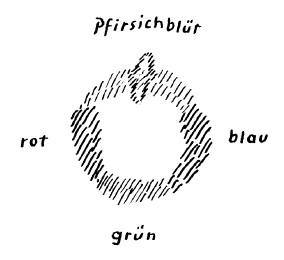
[ 20 ] I mentioned that last point only to draw your attention to the fact that something like Goethe’s view of nature is, at the same time, a view of the spirit—that it fully corresponds to spiritual perception. When one approaches Goethe, the natural scientist, one can say: He did not yet have a science of the spirit, but he viewed the natural sciences in a way that is entirely in the spirit of the science of the spirit. But what must be of essential importance to us today is this: that the world, including human beings, is a systematic organization of thought-light, light-thoughts with will-matter, and matter-will; and that what we encounter in concrete form is structured in the most diverse ways or permeated with content consisting of thought-light, light-thoughts, matter-will, and will-matter.
[ 21 ] One must therefore view the cosmos qualitatively, not merely quantitatively; only then can one come to terms with this cosmos. But then a continuous passing away is also woven into this cosmos—a passing away of the past in the light, and a dawning of the future in the darkness. The ancient Persians, drawing on their instinctive clairvoyance, called that which they sensed as the past fading away in the light “Ahura Mazdao,” and that which they sensed as the future in the dark will “Ahriman.”
[ 22 ] And now you have these two worldly entities, light and darkness: in the light, the living thought, the fading past; in the darkness, the emerging will, the coming future. As we reach the point where we no longer view thought merely in its abstractness, but as light, and no longer view the will merely in its abstractness, but as darkness, indeed in its material nature—by coming to view, for example, the thermal content of the light spectrum as coinciding with the past, and the material and chemical aspects of the spectrum as coinciding with the future—we move from the purely abstract into the concrete. We are no longer such parched, pedantic thinkers who work solely with our heads; we know that what is thinking inside our heads is actually the same thing that floods us as light. And we are no longer such prejudiced people that we merely take joy in the light, but we know: In the light lies death, a world in the throes of dying. We can also sense the tragedy of the world in that light. We thus emerge from the abstract, from the realm of thought, into the surging flow of the world. And we see in what is darkness the dawning part of the future. We even find within it what stirs such passionate natures as Schopenhauer’s. In short, we move from the abstract into the concrete. World-forms arise before us, rather than mere thoughts or abstract impulses of the will.
[ 23 ] That is what we have been exploring today. Next time, we will seek the origin of good and evil in what has taken on a strangely concrete form for us today—the thought of light, the will to darkness— We thus move from the inner world into the cosmos, and within the cosmos we seek the reasons for good and evil not merely in an abstract or religiously abstract world, but we want to see how we can break through to an understanding of good and evil, having begun by grasping the thought in its light and sensing the will in its descent into darkness. More on this next time.