

The Bridge Between the Spiritual and
Physical Realms of Human Beings
GA 202
10 December 1920, Dornach
Translated by Steiner Online Library
Sixth Lecture
[ 1 ] Our recent discussions here have centered on the possibility, on the one hand, of seeing within the realm of the natural that which is, in a certain way, connected to the moral and the spiritual, and, on the other hand, of seeing within the spiritual that which is present in the natural. It is precisely in this area that humanity today faces what one might call a troubling mystery. Not only is there the fact—which I have also frequently addressed in public lectures—that, on the one hand, when a person applies the laws of nature to the universe and looks back at the past, they must conclude: Everything we have in our surroundings arose from some kind of primordial nebular state—that is, something purely material—which then, in some way, differentiated and transformed itself, giving rise to the beings of the mineral, plant, and animal kingdoms, from which human beings also emerged. In a certain sense—albeit in a different form than at the beginning—this purely physical reality will also be present again at the end of the universe. But by then, what is born within us as morality—our ideals—will, in essence, have faded away and been forgotten, and there will be the great graveyard of the physical; and within this final physical state, what has risen within humanity as spiritual development will have no significance, for it was, after all, merely a kind of bubble. The only reality would then be that which develops physically from a primordial nebula into the most highly differentiated forms of various beings, only to return once more to the general, slag-like state of the universe.
[ 2 ] Such a view—which anyone who honestly, that is, truthfully to himself, professes the natural worldview of the present day must inevitably arrive at—can never build a bridge between the physical and the moral-spiritual. Therefore, such a view—unless it is entirely materialistic and seeks to see the material processes as the sole reality of the world—always requires a kind of “second world,” so to speak, drawn from abstraction; a world that, if one acknowledges only the first world as given to science, would be left to faith alone. And this faith, which delights in the thought that, for its part, it in turn reasons: That which arises in the human soul as good cannot remain in the world without compensation; there must be certain powers which—no matter how philosophically one may think about it, it still amounts to the same thing—reward the good and punish the evil, and so on. There are, after all, people in our time who profess both views, even though they stand side by side without any connection between them. There are people who, on the one hand, accept everything presented by the purely scientific worldview—who go along with the Kant-Laplace theory of the primordial nebula, and with everything put forward regarding a slag-like final state of our evolution—and who, on the other hand, also profess some kind of religious worldview: that good deeds are somehow rewarded, evil sinners are punished, and the like. The fact that there are numerous people in our time who allow both one thing and the other to be presented to their souls stems from the fact that there is so little genuine activity of the soul in our time, for if this inner activity of the soul were present, one could not simply, from the same soul, on the one hand accept a world order that excludes the reality of morality, and yet, on the other hand, accept certain powers that reward good and punish evil.
[ 3 ] Compare this with what, due to the intellectual and emotional complacency of many people today, stands as a world view—one that lacks a bridge between the moral and the physical—and compare it with what I discussed here last time as a result of spiritual science. I was able to point out that we first perceive the world of light phenomena around us—that is, in the external natural world, we look upon everything that appears to us through what we refer to as light. I was able to point out to you how one must see, in all that exists around us as light, what are dying world-thoughts—that is, world-thoughts that were once, in the distant past, the thought-worlds of certain beings, thought-worlds from which world-beings of that time recognized the mysteries of their world at that time. What were once thoughts now shines upon us today as, so to speak, a “thought corpse”—that is, a world thought that is dying: this shines upon us as light. — You need only open my Outline of Esoteric Science and read the relevant pages to know that, when we look back into the distant past, the human being as we understand him today did not exist. After all, during the Saturn period, for example, only a kind of sensory automaton existed in place of human beings. But you also know that back then the universe was inhabited, just as it is now. Yet at that time, other beings who inhabited this universe occupied the position within it that human beings occupy today. We know, of course, that those spirits we call Archai, or Primordial Beings, stood on the human level during the ancient Saturn era. They were not human in the same way that humans are today, but they stood on the human level. Despite having a completely different constitution, they nevertheless stood on the human level. Archangels stood on the human level during the ancient Sun era, and so on.
[ 4 ] We thus look back into the distant past and say to ourselves: Just as we now walk through the world as thinking beings, so did these beings walk through the world back then as thinking beings with the character of humanity. But what lived within them back then has become an outer world thought. And that which lived within them back then as thought—so that from the outside it could only have been seen as their aura of light—is then seen in the world’s sphere, appears in the facts of light, so that in the facts of light we see dying worlds of thought. Now, darkness intervenes in these facts of light, and in contrast to the light, what can be called the will in a soul-spiritual sense—which, in a more Eastern interpretation of the matter, can also be called love—manifests itself in the darkness. So that when we look out into the world, we see, on the one hand, the world of light, if I may put it that way; but we would not see this world of light—which would, after all, always be transparent to the senses—if darkness were not perceptible within it. And in that which now permeates the world as darkness, we must seek, on the first level of the soul, that which lives within us as will. Just as the world outside can be viewed as a harmony of darkness and light, so too can our own inner world—insofar as it initially extends into space—be viewed as light and darkness. Only for our own consciousness is the light thought and imagination, while the darkness within us is will, becoming goodness, love, and so on.
[ 5 ] You see, this gives us a worldview in which what is within the soul is not merely spiritual, and what is out there in nature is not merely natural; it gives us a worldview in which what is out there in nature is the result of earlier moral processes, where the light is the dying worlds of thought. But this also implies for us: When we carry our thoughts within us, these are—insofar as they live within us as thoughts—initially triggered, in terms of their power, by our past. But we continually permeate these thoughts with the will from the rest of our organism. For precisely what we call the purest thoughts are remnants of the distant past, permeated by the will. So that even pure thinking—I have expressed this very forcefully in the new edition of my Philosophy of Spiritual Activity—is permeated by the will. But what we carry within us extends into distant futures, and in those distant futures, what is now planted within us as a first seed will shine forth in external phenomena. There will then be beings who look out into the world just as we now look out from the Earth into the world, and these beings will say: Nature shines around us. Why does it shine upon us as it does? Because on Earth, human beings have accomplished deeds in a certain way; for what we now behold around us is the result of what Earth’s human beings have carried within themselves as a seed. — We stand here now, gazing out into the external natural world. We can stand there like dry, sober, abstract thinkers; we can, just as physicists do, analyze light and its phenomena: we will analyze these phenomena coldly and dispassionately, like laboratory scientists; through this, many beautiful and spiritual insights will emerge, but we will not then be facing the outer world as whole human beings. We face the outer world as fully human beings only when we can feel what appears to us in the dawn, what appears to us in the blue firmament of the sky, what appears to us in the green plant—when we can feel what we perceive in the lapping wave — for “light” does not refer only to the light perceptible to the eye; rather, I am using the term “light” here to encompass all sensory perceptions. In what we perceive around us, what do we see? We see a world that can indeed uplift our soul, a world that, in a certain way, reveals itself to our soul as the one we must have in order to be able to look out into a meaningful world in a meaningful way at all. We do not stand as fully human beings when we merely face this world by analyzing it dryly like physicists. We face this world as fully human beings only when we say to ourselves: What shines there, what resounds there—in the final analysis, this is what beings formed in their souls long ago in the distant past; to them we must be grateful. — We then do not look out into the world like dry physicists; we look out with feelings of gratitude toward those beings who, for so many millions of years—let us say, during the ancient Saturn era—lived as human beings, just as we live today as human beings, and who thought and felt in such a way that we now have this magnificent world around us. This is a significant outcome of a worldview steeped in reality, in that it leads us not merely to look out into the world as cold, dispassionate observers, but to do so full of gratitude toward those beings who, in the most distant past, through their thinking and their deeds, brought about what is for us, in our immediate surroundings, this world that uplifts us. Just imagine this with the necessary intensity; let yourself be filled with this sense of obligation to give thanks to those ancient, pre-human beings, precisely because they have shaped our environment for us. Let yourself be filled with this thought, and then bring yourself to say to your soul: We must order our thoughts and feelings accordingly, in a way that we envision as a moral ideal, so that those beings who come after us may look upon an environment for which they must be just as grateful to us as we can be to our ancient ancestors, who now, in the literal sense with regard to their effects, surround us as luminous spirits. Today we see a world of light; millions of years ago, it was a moral world. We carry a moral world within us; millions of years from now, it will be a world of light.
[ 6 ] You see, a fully developed worldview leads to this sense of the world. An incomplete worldview, on the other hand, may indeed lead to all sorts of ideas and concepts, to all sorts of theories about the world, but it does not fulfill the whole person, for it leaves their sense of the world empty. This does, however, have a very practical side to it, although people today can hardly see the practical value of it yet. But anyone who is sincere about the world today knows that they must not let it slide into decline; such a person would look toward a school and university of the future, where people do not enter at eight in the morning with a certain casual indifference, and come out at eleven or twelve or one o’clock with the same casual indifference—at most with a little pride that they have once again become so-and-so much smarter—assuming they actually have. No, one can direct one’s gaze toward a future in which those who leave at eleven or twelve or one o’clock depart from these places of learning with feelings that extend out into the universal realm—for alongside their knowledge, a sense of gratitude toward the distant past, in which beings shaped the nature that surrounds us as it is, and a sense of the great responsibility we bear, a sense of gratitude toward the distant past, in which beings worked to shape the nature that surrounds us as it is, and a sense of the great responsibility we bear, because our moral impulses will later become worlds within us. Of course, it remains a matter of faith if one wants to tell people: The primordial nebula is real, the future dross is real, and in between, beings create moral illusions that rise up within them like foam. Faith does not say the latter; it would have to say it if it were honest. Is it not something fundamentally different when a person says to themselves: “Yes, that which is retribution does exist, for nature itself is so constituted that this retribution occurs: your thoughts become radiant light.” The moral world order reveals itself. What is the moral world order at one time is the physical world order at another, and what is the physical world order at any given time was the moral world order at another time. Everything moral is destined to emerge into the physical realm. Does a person who views nature spiritually still need additional proof of a moral world order? No, for in nature, when viewed spiritually, lies the very justification for the moral world order. One rises to this understanding when one contemplates human beings—I would say—in their full humanity.
[ 7 ] Let us start with a phenomenon that we all experience every day. We know that falling asleep and waking up are based on the fact that the human being, in his “I” and his astral body, detaches himself from the physical body and the etheric body. What does this actually mean in relation to the cosmos? Let us imagine the physical body, the etheric body, the astral body, and the “I” connected to one another during wakefulness. Now let us imagine them separated during sleep: What, then, is the—I would say—cosmic difference between the two? You see, when you look at the state of sleep, you experience light within that state. By experiencing this light, you experience the dying world of thought from times past. And by experiencing, so to speak, the dying world of thought from the past, you become inclined to have a receptivity to perceive the spiritual realm as it extends into the future. The fact that people today have only a dim perception of this does not change the essence of the matter. What is essential for us now is that we are receptive to the light in this state.
[ 8 ] When we now immerse ourselves in the body, we become inwardly spiritual—and when I say “inwardly spiritual,” I mean that we are souls, not scales—and by immersing ourselves in the body, we become receptive, in contrast to the light, to darkness. But this is not merely a negative state; rather, we become receptive to something else as well. Just as we were receptive to light while sleeping, so do we become receptive to heaviness upon waking. I said that we are not scales; we do not become receptive to heaviness by weighing our bodies, but by immersing ourselves in our bodies, we become inwardly, soulfully receptive to heaviness. Do not be surprised that this sounds somewhat vague at first when it is put into words. For the actual soul experience, ordinary consciousness is just as asleep while awake as it is asleep while asleep. In sleep, a person with today’s normal consciousness does not perceive how they live in the light. In wakefulness, they do not perceive how they live in heaviness. But this is how it is: the fundamental experience of the sleeping person is life in the light. In sleep, they are not spiritually receptive to heaviness, to the fact of heaviness. Heaviness is, so to speak, lifted from them. They live in the light. They know nothing of heaviness. They learn to recognize heaviness only inwardly, at first subconsciously. But this becomes immediately apparent to the imagination: they learn to recognize heaviness by immersing themselves in their body.
[ 9 ] This manifests itself in the following way for research in the humanities. Once you have risen to the level of imagination, you can observe the etheric body of a plant. When you observe the etheric body of a plant, you will have the inner experience that this etheric body—which continually draws the plant upward—is weightless. If, on the other hand, you observe the etheric body of a human being, it has weight, even in the imaginative mind’s eye. You simply have the feeling: it is heavy. And from there you then come to realize that, for example, the etheric body of a human being is something that, when the soul is within it, imparts heaviness to that soul. But it is a supersensible primordial phenomenon. While asleep, the soul lives in light and therefore in lightness. While awake, the soul lives in heaviness. The body is heavy. This force is transferred to the soul. The soul lives in heaviness. This signifies something that now enters consciousness. Think of the moment of waking—what does it consist of? When you are asleep—you lie in bed, you do not move, the will is numbed. Admittedly, your thoughts are also numbed, but they are numbed only because your will is numbed—because your will does not surge into your own body, does not make use of the senses; that is why your thoughts are numbed. The fundamental fact is the paralysis of the will. What makes the will active? It is the soul’s sense of heaviness through the body. This coexistence with the soul is what gives rise to the reality of the will in earthly human beings. And the cessation of the will on the part of the human being occurs when the human being is in the light.
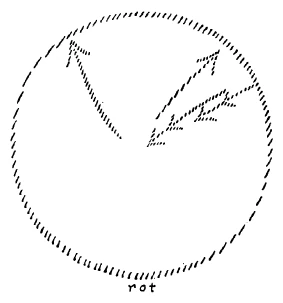
[ 10 ] You have thus presented the two cosmic forces, light and gravity, as the great opposites in the cosmos. Indeed, light and gravity are cosmic opposites. If you imagine the planet: gravity pulls toward the center, while light points away from the center out into the universe [arrows]. People tend to think of light as merely at rest. In reality, it points outward from the planet. Anyone who conceives of gravity simply as a force of attraction—that is, in the Newtonian sense—is actually thinking in a rather materialistic way, because they imagine that there is actually something like a demon or the like sitting inside the Earth, holding an invisible rope that pulls the stone toward it. People speak of a force of attraction that no one can ever prove to exist anywhere other than in the imagination. But they do speak of this force of attraction. Well, people may not visualize this phenomenon, but they do speak of the force of attraction in Newtonian terms. In Western culture, it’s generally the case that whatever exists at all must be conceived of in some sensory way. So one could say to people: Well, you may imagine the force of attraction as an invisible rope; but then you must at least imagine light as a kind of swinging away, as a centrifugal force. One would then have to imagine light as a centrifugal force. For those who wish to remain more grounded in reality, it is sufficient if they can simply grasp the contrast—the cosmic contrast—between light and gravity.
[ 11 ] And now, you see, what I have just said forms the basis for many things, especially as they relate to human beings. When we consider the everyday experience of falling asleep and waking up, we say: When falling asleep, a person moves from the field of heaviness into the field of light. While living in the field of light, if they have lived long enough without heaviness, they once again feel a vivid longing to be enveloped by heaviness, and they return to heaviness once more—they wake up. It is a continuous oscillation between life in the light and life in heaviness, between waking and falling asleep. If someone refines their sensory abilities, they will be able to experience this directly as a personal experience—the ascent, as it were, from heaviness into the light, and the subsequent reclaiming by heaviness upon waking.
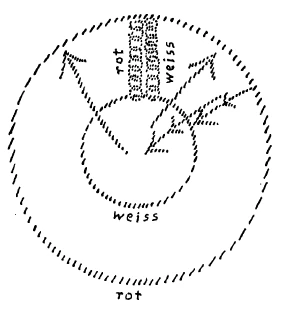
[ 12 ] But now imagine something else—imagine that human beings, as beings existing between birth and death, are bound to the earth. They are bound to the earth in that, in this state between birth and death, their soul—once it has lived for a time in the light—always begins to yearn for heaviness again and returns to the state of heaviness. When—we will speak more about this later—a state has arisen in which this longing for heaviness is no longer present, then the human being will follow the light more and more. He does this up to a certain limit [see drawing, red]. They follow the light up to a certain limit, and when they have reached the outermost periphery of the universe, they have exhausted what heaviness has given them between birth and death; then a new longing for heaviness begins, and they retrace their steps [see diagram, white] toward a new incarnation. Thus, even in that interim between death and a new birth—at the midnight hour of existence—a kind of hunger for gravity arises. This is, first of all, the most general term for what a human being experiences as a longing to return to a new earthly life. Now, however, as the human being returns to a new earthly life, he must pass through the sphere of the neighboring, other celestial bodies. These influence him in the most varied ways, and he then brings the result of these influences with him into this physical life as he enters it through conception. From this you can see that it is indeed meaningful to ask: How are the stars arranged in the spheres through which the human being passes on their way back? — For depending on how the human being passes through their stellar sphere, their longing for earthly gravity takes on different forms. Not only does the Earth, so to speak, radiate a certain heaviness to which the human being longs to return, but the other celestial bodies, whose spheres he traverses as he moves toward a new life, also affect him with their heaviness. Thus, as a person returns, they can indeed find themselves in various situations that justify, for example, the following statement: The person returning to Earth longs once again to live in earthly gravity. But they first pass through the sphere of Jupiter. Jupiter also radiates a heaviness, but one that is suited to adding a certain joy to the longing for earthly heaviness. Thus, not only will the longing for earthly heaviness live in the soul, but this longing will take on a joyful nuance of mood. The human being passes through the sphere of Mars. He longs for earthly heaviness. A joyful mood is already within them. Mars, too, influences them with its gravity, instilling—or, so to speak, inoculating—the soul that joyfully longs for earthly gravity with the impulse to immerse itself in this earthly gravity in order to make powerful use of the next physical life between birth and death. Now the soul has progressed to the point where, in the depths of its subconscious, it has the impulse to clearly yearn for earthly gravity and to make powerful use of earthly incarnation, so that the yearning joy—the joyful longing—is expressed with intensity. The human being is still passing through the sphere of Venus. A loving grasp of life’s tasks blends with this joyful yearning, which tends toward strength.
[ 13 ] As you can see, we are speaking of various forms of gravity emanating from celestial bodies, and relating them to what can live within the soul. In turn, as we look out into the cosmos, we seek to address the spatially and physically expansive realm in a moral sense as well. If we know that volitional forces live within gravity, and if we know, on the other hand, that light is the opposite of the will, we may say: Light radiates back from Mars, light radiates back from Jupiter, light radiates back from Venus; at the same time, the forces of gravity are modified by light. We know that dying world-ideas live in the light, and that worlds-in-the-making live in the forces of gravity through seeds of will. All of this permeates the souls as they move through space. We view the world physically; at the same time, we view it morally. The physical and the moral do not exist side by side; rather, it is only in their limited perspective that human beings are inclined to say: On the one hand is the physical, on the other hand the moral. — No, these are merely different perspectives; in itself, it is a unified whole. The world that develops toward the light develops at the same time toward retribution, toward the retribution that is revealed. A meaningful world order reveals itself out of the natural world order.
[ 14 ] One must be clear that such a worldview is not arrived at through philosophical interpretation, but rather that one grows into it by gradually learning, through spiritual science, to spiritualize physical concepts; in this way, it becomes moralized of its own accord. And when one learns to look through the physical world into the world where the physical has ceased to exist and the spiritual is present, one recognizes: the moral is contained within it.
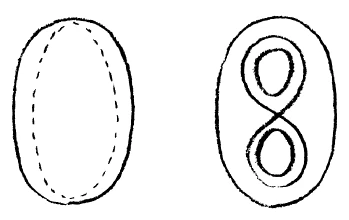
[ 15 ] You see, based on certain ideas, people today might actually come to this conclusion—I just want to demonstrate this to you at the end, even though it lies outside the way most of you think—I would say, to fully grasp in your mind what I have just said. So you have this line, which is not an ellipse, but differs from the ellipse in that it is more curved here [drawing on the left]—you often see this line in architecture—the ellipse would look something like this [dotted]. But that is only one specific form of this line; in fact, if you change the mathematical equation, this line can also take on this shape [lemniscate]. It is the same line as the other one. In one case, I trace it like this and close here; now, under certain conditions, however, I do not go all the way up to the top like that, but trace it like this and then return again, closing at the bottom. But the same line has yet another form. Here, if I start here, I must—only seemingly—end here; now I must go out of the plane, out of space, go over here, and come back here again. Now I must once again leave the space, continue the line here, and close it at the bottom. It is simply the line modified slightly. These are not two lines; it is just one line, and it corresponds to a single mathematical equation; it is a single line, except that I am leaving the space. If one continues this line of thought, another possibility arises: I can simply take this line [lemniscate], but I can also imagine this line such that half of it lies within space; as I come around here, I must go out of space. I must go out of space, then I complete it like this: here is the other half, but it is simply outside ordinary space—it does not lie within ordinary space. It is there as well. And if one were to develop this way of conceiving things—which mathematicians, for example, could certainly adopt today if they wanted to—one would arrive at the other conception of going out of space and coming back into space. This is certainly something that corresponds to reality. For every time you set out to do something, you think about what you’ve set out to do; before you act, you step out of space, and when you move your hand, you step back into space. In between, you’re outside of space—you’re on the other side of space.
[ 16 ] This concept must certainly be developed—from the other side of the room. Then one arrives at the concept of the truly supersensible; but above all, one arrives at the concept of the moral in its reality. The moral in its reality is so difficult for today’s worldview to conceive because people want to conceive of absolutely everything they wish to imagine in terms of space, wanting to determine it by measure, weight, and number, whereas in fact reality, at every point—I would say—of space, extends beyond space and then returns to space. There are people who imagine a solar system, with comets in the solar system, and they say: “The comet appears, then it traces a huge, long ellipse, and then it returns after a long time.” — That is not true for many comets. The fact is that comets appear, they go out, disintegrate here, cease to exist, but then reform on the other side, reform from here again, and return from there, tracing paths that do not return at all. Why? Because the comets travel out into space and return at a completely different location. It is entirely possible in the cosmos that comets somehow disperse out into space and return at another location in space.
[ 17 ] In the continuation of these reflections tomorrow, I will not torment you further with the ideas I have presented to you over the last ten minutes, because I know that they would be beyond the comprehension of many of you. But I must nevertheless point out from time to time that this spiritual science, as it is practiced here, could draw upon the most highly developed scientific concepts if the opportunity were available—in other words, if it were possible to truly infuse with spirit that which is currently pursued in a spiritless manner, particularly in the so-called exact sciences. Unfortunately, this possibility does not exist; in particular, subjects such as mathematics and so on are today for the most part pursued in the most spiritless manner. And that is why, as I also emphasized recently at the public lecture in Basel, spiritual science is for the time being dependent—a fact for which many who now claim to be learned reproach it—on asserting itself before educated laypeople. If scholars were not so averse to spiritual considerations, spiritual science would not need to assert itself merely before educated laypeople, for it can reckon with the highest scientific concepts and does so with complete precision, precisely because it is conscious of its responsibility.
[ 18 ] However, scientists do behave in a most peculiar way when it comes to these matters. You see, there is a learned gentleman—I recently drew attention to him in a public lecture—who has apparently heard that university courses have been held here in Dornach. He had previously heard something about the Waldorf School and, it seems, read my opening address for the Waldorf School and another essay in the Waldorf-Nachrichten. In that opening address, I mentioned, in the context of the discussion, an educator who shares many of the same views as that scholar. On such an occasion, the gentlemen who so often accuse anthroposophy of leading to suggestion or autosuggestion are immediately hypnotized, because they hear: “Someone was mentioned there who is a scientific kindred spirit of mine.” — So the gentleman became quite attentive. Now, he apparently felt uneasy about everything that had been accomplished at the Dornach university courses. That is why he could not help but write the following: “At the anthroposophical university courses in Dornach near Basel, which took place this fall, the hope was expressed that great, powerful ideas arising from here would usher in a new development for our people and breathe new life into them. Anyone who examines the ethical foundations of this movement for their true value cannot share this hope unless these foundations are subjected to critical scrutiny, which is the purpose of the preceding lines.”
[ 19 ] Well, why were these “preceding lines” actually written? Well, the university courses—their ethical foundation must be examined and subjected to criticism, for they must have something to do with what this gentleman has to declare, what he calls the moral low point, since he begins his essay, which he has titled “Ethical Heresy”: “In times of moral decline, the likes of which the German people have likely never before experienced, it is doubly urgent to defend the great moral landmarks, as established by Kant and Herbart, and not to allow them to be shifted in favor of relativist tendencies. Baron von Stein’s statement—that a people can remain strong only by keeping alive the virtues through which it became great—must today be counted among the foremost tasks amid the dissolution of all moral concepts.”
[ 20 ] Now, this man traces the dissolution of moral concepts back to the war and finds one thing particularly noteworthy: “The fact that a text by the leader of the anthroposophists in Germany, Dr. Rudolf Steiner, has played a part in this dissolution is particularly regrettable, since one cannot deny the idealistic character of this movement, which aims at a strong internalization of the individual” — as he has gathered from a few essays in the Waldorf-Nachrichten — “cannot be denied, and in his plan for the threefold social order, which was discussed in issue No. 222 of the Tag, one can find sound ideas that promote the welfare of the people. But in the work The Philosophy of Freedom (Berlin, 1918), he takes his individualistic stance to extremes in a way that leads to the dissolution of the social community and must therefore be opposed.”
[ 21 ] So you’ll see: In 1918, the Philosophy of Freedom was written out of the moral low point that resulted from the war! Of course, for decades after the Philosophy of Freedom was published, the good man paid it no mind; he only read the latest edition, namely the 1918 edition—so closely that he failed to realize how old this book is, that it most certainly dates from the time when he was talking about how wonderfully far we’ve come, to what clarity, when he was still far from speaking of a moral low point: Well, there you have it! That’s the extent of the conscientiousness of these educators of youth. This man is not only a professor of philosophy but, above all, an educator. He is therefore not merely to teach at universities but to educate children pedagogically. And he himself is so well-educated that he perceives the work The Philosophy of Freedom as having been written in 1918. That is why it is also easy for him to discuss the purpose of this work. Just consider the situation: The Philosophy of Freedom was published in 1893. So the ideas originated at that time. If we assume, then, that The Philosophy of Freedom was published back then, what meaning do the following words have—words that constitute the very culmination of the entire essay: “But these free human beings of Dr. Steiner’s are no longer human beings. They have already entered the world of the angels while still on earth. Anthroposophy has helped them to do so.”
[ 22 ] Now I ask you: In 1893, The Philosophy of Freedom was published with the intention of providing people with an ethics that anthroposophy helps them to attain: “Would it not be an indescribable blessing, amid the manifold turmoil of earthly life, to be able to place oneself in such an environment? Suppose a small group succeeds in shedding everything human and entering into a purer existence, in which the truly free are allowed to live life to the fullest beyond good and evil—what remains for the broad masses of the people, who are so closely entangled with the material hardships and worries of life?” So you see, the matter is presented as if The Philosophy of Freedom had been published in Berlin in 1918, and as if anthroposophy were there to educate those people depicted in The Philosophy of Freedom!
[ 23 ] This is the kind of meticulousness with which our scholars write about such matters today. It is the same conscientiousness with which a Doctor of Theology writes that a nine-meter-tall statue of Christ is being constructed here, with Luciferic features at the top and animalistic characteristics at the bottom—whereas the fact is that this statue of Christ has a purely human, ideal face at the top and is still just a block of wood at the bottom—in other words, it does not even exist yet. This is not merely described as if it had been reported to him by someone else—this Doctor of Theology—but rather he writes as if he had personally observed this fact, as if he had been there himself. This brings to mind that anecdote I mentioned publicly in a lecture in Basel, about how someone determines, in the evening when he comes home, whether he is sober or drunk: You lie down in bed with a top hat placed in front of you on the bedspread; if you see it as a single image, you are sober; if you see it as a double image, you are drunk. One must be in at least that state of mind to see what is being created here as a statue of Christ the way that doctor of theology saw it.
[ 24 ] But setting aside these attacks, one can still raise the question in this case: What kind of theologians are these? What kind of Christians are they? What kind of youth educators are they, who have such a relationship to truth and truthfulness, and what must a science look like that is imbued with such a sense of truth and truthfulness? Yet such science is actually represented today by most people from pulpits and in books; humanity lives by such science.
[ 25 ] Among all its other tasks, the science of the spirit also has the task of purifying our spiritual atmosphere of those mists of untruth and hypocrisy that do not merely prevail in external life, but which today can be demonstrated to extend into the very depths of the individual sciences. And it is from these very depths that what has such a devastating effect on social life emanates. We must summon the courage to shed the proper light on these matters. For this, however, it is indeed necessary to first develop a passion for a worldview that truly bridges the moral order of the world and the physical order of the world—a worldview in which the shining sun can be seen both as the concentration of fading worlds of thought, and that which bubbles up from the depths of the earth can at the same time be seen as the preparation for what lives on into the future—in embryonic form, through the power of the will, permeating the world through the power of the will.