The Bridge Between the Spiritual and
Physical Realms of Human Beings
GA 202
17 December 1920, Dornach
Translated by Steiner Online Library
Tenth Lecture
[ 1 ] Today I would like to interject a reflection that may seem somewhat remote to you, but which, precisely because it is an interjection, will be significant for the progress of the discussions we are engaged in at this time. Over the course of time, we have gathered the most diverse elements necessary for understanding the human being. We are now in the process of gradually placing the human being, on the one hand, within cosmic life, and on the other hand, within social life. To this end, it is necessary for us today to draw attention to certain points that can indeed contribute to an understanding of the human being. When one views the human being in accordance with the current scientific approach, one is, in essence, considering only a part of the human being. This is already evident from the fact that no account is taken at all of the fact that, in addition to his physical body, the human being possesses higher aspects of his being. But let us set that aside entirely for now. Let us consider what is more or less acknowledged on the one hand by scientific endeavors, but which, on the other hand, has already entered popular consciousness. In fact, people view human beings in such a way that they count as part of their organization only that which can be imagined in some way as solid or semi-solid. Certainly, they regard the fluid and the gaseous as entering and leaving the human body, but they do not regard them as if they were themselves a component of the human organism. The warmth that a human being possesses—which is a higher temperature than that of their surroundings—is regarded as a state of the human organism, but it is not actually considered a component of the organism. We will see in more detail shortly what is meant by what I have just stated.
[ 2 ] If one—as I have already pointed out to you—considers the up-and-down movement of the cerebrospinal fluid through the spinal canal, one can see how inhalation and exhalation cause a regular oscillatory motion, a swinging movement of the cerebrospinal fluid from bottom to top and from top to bottom; how the cerebrospinal fluid is driven upward during inhalation, striking, so to speak, against the brain tissue, and how it sinks again during exhalation. Such a process, taking place within the purely liquid compartments of the human organism, is not generally considered to be part of the organism itself. One more or less imagines that the human being, as a physical organism, consists of what one finds within it as more or less solid or, at most, solid-liquid parts and substances.
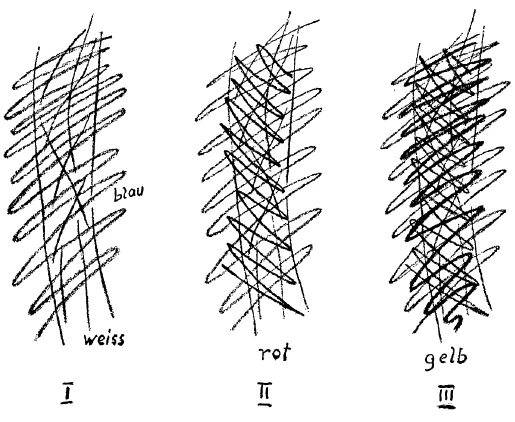
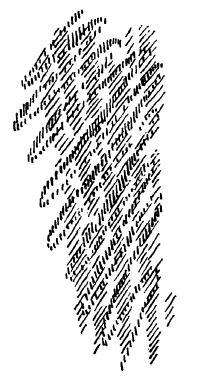
[ 3 ] If I were to draw a schematic diagram (see illustration): Imagine that the human being consists precisely of these substances, which are more or less solid—bone substances and so on—so one imagines the human being, as it were, as a kind of structural framework (white). The other elements within the human being—which are actually liquid, as I have shown using the example of cerebrospinal fluid, and which are gaseous—are not considered, in the study of anatomy and physiology, to be part of the human organism. People say to themselves: Yes, the human being inhales air; it follows certain paths within the body and performs certain functions. It is then exhaled again. People speak of the human body’s thermal state, but fundamentally they regard only the solid as the organizing principle, and they fail to recognize that, apart from having this solid framework, the entire human being is also a fluid—let’s say, initially a column of fluid (see drawing, blue, T), that the entire human being is permeated with air (red, II), and that it possesses a certain thermal state throughout (yellow, III). Yet upon closer examination, it becomes clear that just as one must regard the solid or solid-liquid component as a part, as a link in the human organism, one must also conceive of that which the human being contains as direct liquid not as an indifferent liquid mass, but as being part of an organization—albeit a fluctuating one—and that this organization, the liquid, is just as significant as the organization of the solid.
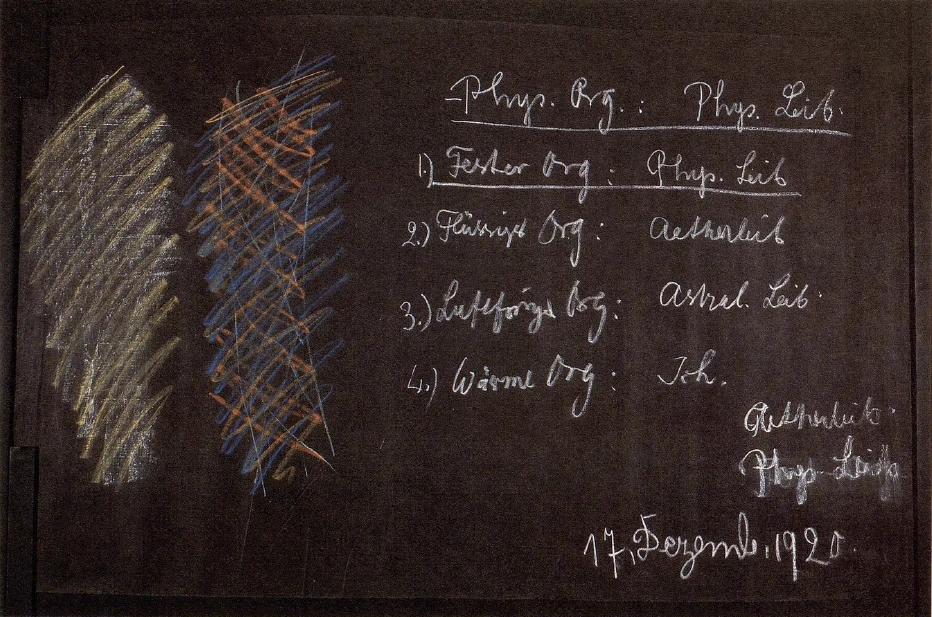
[ 4 ] So, in addition to the “solid” human being, we must also consider the “liquid” human being, and we must furthermore consider the “air” human being. For what we carry within us as air is, in terms of its structure and its parts, just as much an organism as the solid organism is an organism; only this organism is air-like and in motion. And finally, what we carry within us as warmth is not some uniform, spatial warmth spreading throughout the human being, but is likewise organized in its subtleties just like the solid, liquid, gaseous, or air-like organism. But one immediately realizes that the moment one speaks of the liquid organism—which, so to speak, occupies the same space, filling that same space just as the solid organism does— one cannot speak of this liquid organism without also speaking—just as we speak of the human being as an earthly human being—of the etheric body that permeates and animates this liquid organism. The physical organism exists initially in and of itself; it is the physical body. Insofar as we consider it in its entirety, we regard it initially as a solid organism. Here we are dealing, first and foremost, with the actual physical body.
[ 5 ] Second, let us consider the liquid organism, which, of course, cannot be examined in the same way as a solid organism—that is, by cutting into it with a knife—but must be understood as an organism that is in motion within itself, a liquid organism. We cannot consider it without conceiving of it as permeated by the etheric body.
[ 6 ] Third, we have the airy organism. We cannot consider it without imagining it permeated by the astral body. And finally, fourth, the heat organism is fully differentiated in itself. We cannot consider it without finding it permeated by the “I.” This is how human beings are today as earthly human beings.
So we have:
Physical Organism = Physical Body
A Different Perspective on Humanity:
1. Solid organism = physical body
2. Liquid organism = etheric body
3. Airy organism = astral body
4. Thermal organism = ego
[ 7 ] One consequence of this is that we come to understand something clearly: Let us consider blood, for example. Insofar as a major component of it is essentially liquid, and insofar as this blood belongs to the liquid organism, we have within the blood the etheric body that permeates it. But in addition, we also have in this blood what we otherwise call simply the state of warmth. Yet this is an organization that in no way coincides with the organization of the liquid blood as such. And if one were to investigate this—and there can certainly be physical methods of investigation for this, once one sets out to do so—one would find that simply by recording the thermal states in the various parts of the human organism, these do not coincide with the liquid or any other form of organization.
[ 8 ] Now, the moment one views human beings in this way, one will see, however, that in this human perspective one cannot limit oneself to the human organism itself. One can, at most, limit oneself to the human organism if one considers the mere, solid organism. It presents a certain self-contained structure, enclosed from the outside by the skin. However, this is only apparent, for the human being regards what appears to him as solid as if it were a self-contained, solid block. But the solid is itself differentiated and, above all, stands in the most varied relationships to the rest of the solid physical body. We must next consider that the various solid substances, for example, have different weights, and from this alone it can be seen how what is within the human organism—by virtue of its varying weights and specific gravities—exerts a distinct influence on the human being, so to speak. Through this, the human being, in terms of his physical organization, stands in relation to the entire Earth. Nevertheless, at least to the outward appearance, this physical organization can be spatially delineated.
[ 9 ] The situation is quite different with regard to the organization that we recognize as the second—the one permeated by the etheric body—the fluid organization. This fluid organization is such that it can no longer be demarcated from its surroundings in such a strict manner. Whatever is fluid in any part of space borders on the rest of the fluid. And even if, at first, fluid as such exists in our external world only in a diluted state, a fixed boundary between the fluid located within the human being and the fluid located outside the human being can no longer be defined as strictly as it is in the case of the solid organism. Thus, we are already compelled to allow the boundary between the human liquid interior and the physical exterior to become blurred to a certain extent.
[ 10 ] This becomes even clearer when we consider the air-like organism that is permeated by the astral body. What we carry within us as air at a given moment was outside us just a short time before and will be outside us again shortly afterward. We are in a constant process of taking in and giving out what is within us in the form of air. In a sense, we can only consider the air that surrounds our Earth as such, and we can say: it pushes its way into our organism and then withdraws again; but as it pushes its way into our organism, it becomes our organization. In what becomes our airy organization, we actually have a constantly evolving organism that builds itself up from the entire atmosphere and then retreats back into that atmosphere. It is indeed the case that something is built up within us with every inhalation, or at least that a structure is modified with every inhalation. And likewise, a breakdown—at least a partial breakdown—occurs with every exhalation. We can say: In a certain sense, our air-like organism is altered with every breath—not exactly reborn, but altered—both during inhalation and exhalation. During exhalation, of course, it does not die; it merely changes. But there is a continuous interplay between what we have within us as an air-like organism and what the external air is. What is usually conceived of in trivial notions as the human organism can only be conceived of in the way it is because one fails to take into account how the airy organism actually differs only very slightly from the solid organism.
[ 11 ] And this is even more true of our thermal organism. It is, of course, entirely in keeping with the materialistic-mechanistic perspective that one does not take into account the liquid organism, the air organism, or the thermal organism, but only the solid organism. But one cannot gain a true understanding of the human being unless one is willing to accept this division of the human being into a thermal organism, an air organism, a water organism, and an earth organism.
[ 12 ] The organism of warmth—it is within this that the “I” primarily dwells. The “I” itself is, I would say, that spiritual organization which, acting of its own accord, governs and configures the warmth we carry within us—not only configuring it externally within its boundaries, but also configuring it internally throughout. And we cannot understand the soul if we do not take into account this direct influence of the “I” on warmth. After all, the “I” is, first and foremost, that which in the human being sets the will in motion and imparts impulses of will. How does the “I” impart impulses of will? We have spoken from another perspective about how the impulses of will are connected to the telluric, in contrast to the thought impulses and the imagination impulses, which are connected to the non-telluric. But since the “I” does indeed hold the impulses of the will together, how does it find a way to, so to speak, drive these impulses of the will into the organism, into the entire human being? This occurs because the will first acts within the human thermal organism (see summary on page 174). When the “I” has a volitional impulse, this impulse first acts upon the human thermal organism. Of course, under present terrestrial conditions, it is not possible for what I am about to describe to exist as a concrete reality. Nevertheless, one can conceive of it as something essentially present within the human being. One can conceive of it if one disregards the fact that within the space bounded by the human skin lies the solid organization. We disregard it; we disregard the liquid organization; we also disregard the air-like organization. Then what remains is a space filled with warmth, which, admittedly, communicates with the external warmth. But that which is at work within this warmth—that which causes this warmth to flow, to be in inner motion, to be, in fact, an organism—that is the “I.”
[ 13 ] And when we consider the human astral body, this human astral body is, first and foremost, that which contains within itself all the powers of feeling. The powers of feeling live in the astral body in such a way that the astral body, in turn, brings these powers of feeling into physical effect in that which underlies the human being as the air organism.
[ 14 ] So one could say: Just as the human being is, as an earthly being, his “I” brings about through the warmth organism what then manifests when the human being enters the world as a being of will. What the astral body experiences as feelings and then expresses in the earthly organism manifests as the air organism. And when we turn to the etheric organism, the etheric body, it contains within itself—albeit initially more in a pictorial sense than we are aware of, for the physical body still intervenes for consciousness, which attenuates these images into pictorial-physical representations—it contains within itself actual imagination, insofar as imagination is pictorial; this acts upon the liquid organism.
[ 15 ] As you can see, one comes closer to understanding the soul by observing these special organisms within the human being. The materialistic viewpoint, which insists on sticking only to the solid framework—and which takes it for granted that water cannot be organized (even though it is, in fact, organized within the organism)—must, for its part, come to face the spiritual realm with complete incomprehension; for the spiritual is directly present precisely in these other organisms. And the actual solid organism is, in essence, merely something that, I would say, truly serves as a support for the other organisms. We have the solid organism, which stands there like a supporting framework of bones, muscles, and so on. And into this supporting framework is then integrated the fluid organism, which is differentiated within itself and is, in fact, thoroughly configured within itself; and within this fluid organism the etheric body vibrates, and within this fluid organism thoughts arise. How are they generated? They are generated by the fact that, within this fluid organism, a certain metamorphosis brings into play what we otherwise experience in the external world as sound.
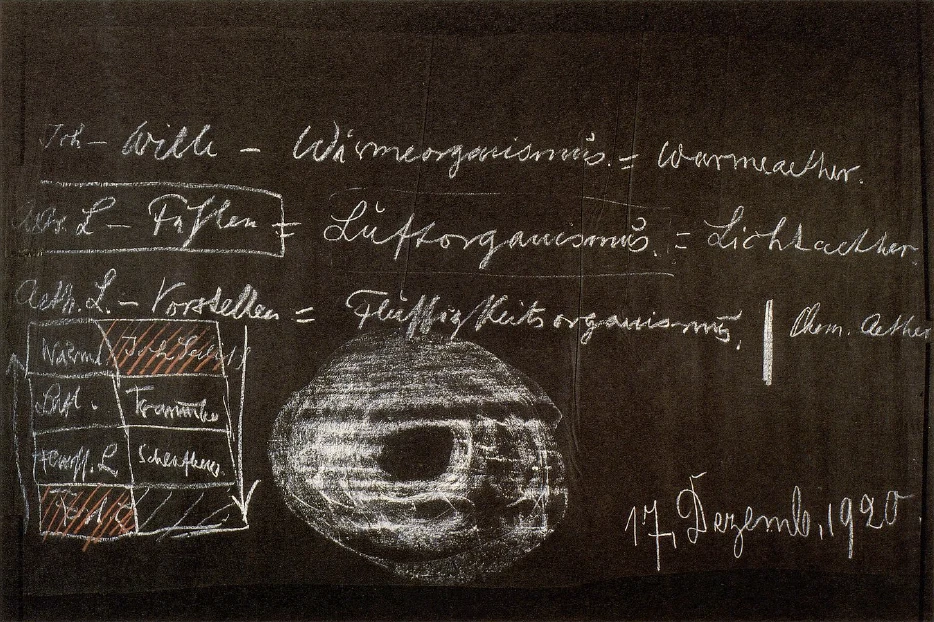
[ 16 ] Sound is, in fact, something that—one might even say—greatly misleads the human way of thinking. As earthly human beings, we initially perceive sound in such a way that the air is the carrier of that sound. Yes, but the air is merely the medium for this sound, which actually weaves through the air. And anyone who sees the essence of sound solely in the air vibrations is like a person who says: “Human beings have only their physical organism; there is nothing spiritual within them.” — It is exactly as if one were to consider only the physical organism of a human being and see nothing spiritual within it; it is as if one were to regard only the air vibrations as the essence of sound, when in fact they are merely the outward expression. What lives within it as sound is essentially an ethereal element. And our airborne sound actually arises only from the fact that we have permeated the air with the sound ether, which is the same as the chemical ether. And as this ether permeates the air, it imparts to the air that which lives within it, and what we call sound comes into being for our perception. This same tone ether, which is at the same time the chemical ether—we will speak of all this in more detail on another occasion—essentially lives within our fluid organism. So that we can distinguish: Within our fluid organism, our own etheric body lives; but in addition, what underlies tone as the tone ether penetrates it from all sides. So please, make this distinction very clearly. We have within us our etheric body, which works and acts by giving effect to thoughts, within our fluid organism. But what we might call the chemical ether is constantly flowing in and out of this fluid organism. So when we consider our organism, we have a complete etheric organism consisting of chemical ether, warmth ether, light ether, and life ether; and in addition, we have, in particular, the chemical ether flowing in and out through the fluid body.
[ 17 ] The astral body, which expresses itself through feeling, lives through the air organism. However, another type of ether—the light ether, which permeates the air in a special way—has a particular affinity with this air organism. In older worldviews, therefore, this relationship between the expanding physical air and the light ether that permeates it was always particularly emphasized. This light ether, which is, so to speak, carried by the air itself and is actually more closely related to the air than sound is, now also penetrates our air organism in a special way, and it underlies that which flows in and out of our air organism. We thus have our astral body, which experiences feeling within itself, which proves particularly active in the air organism, and which is constantly interacting there, especially with the light ether.
[ 18 ] And we have the human “I.” This human “I,” which acts through the will within the thermal organism, is in turn connected to external heat, to the external thermal ether that flows in and out. The following relationships therefore arise:
I — Will — Heat Organism — Heat Ether
Astral Soul — Feeling — _Air Organism — Light Ether
Etheric Body — Imagination — Liquid Organism — Chemical Ether
[ 19 ] But consider this: the etheric body remains within us even when we sleep, from the moment we fall asleep until we wake up. From the moment we fall asleep until we wake up, there is a continuous interaction between the chemical ether and the etheric body within us, mediated by the fluidic organism. The situation is quite different with the astral body and feeling. From the moment we fall asleep until we wake up, the astral body is outside the human organism; in this case, it is not the astral body that acts upon the air organism through feeling, but rather the air organism—which, as we have noted, is connected to the entire surrounding environment—is sustained from the outside. And the human being himself, insofar as he contains his astral body with its feelings, steps out of the physical body—is thus outside this human body—and thereby enters the world with which he is initially connected through the light ether. From the moment of falling asleep until waking, the human being lives directly within that which, with regard to the astral body in the waking state, is mediated to him through the air organism. The same is true for the “I” and the warmth organism.
[ 20 ] You can see from this that one can only gain an understanding of the relationship between human beings and the environment by truly engaging with this structure of the human being—a structure that the usual mechanistic approach does not even take into account. Now, everything in the human being is permeated, and because the “I” is within the thermal organism—and this “I” also permeates the air organism, the liquid organism, and the solid organism—it permeates them precisely through the thermal organism, which now lives in everything. Thus, the warmth organism lives within the air organism; the warmth organism, animated by the “I,” also lives within the liquid organism.
[ 21 ] This, then, is the way in which we must seek, for example, the mode of action of the “I” in the blood circulation. The mode of action of the “I” in the blood circulation is such that the “I” acts upon the blood circulation indirectly through the thermal organism. There, the “I” acts as the entity that, so to speak, sends the will down from the warmth through the air into the fluid. This is how everything in the organism interacts with one another. But we will not succeed if we merely have general, abstract notions of these interactions; rather, we will succeed only if we can concretely imagine how this human being is structured and how everything around him participates in his organization.
[ 22 ] And one can only come to understand the state of sleep by examining these things more closely. Consider, after all, that in the state of sleep, at first, only the physical body—that is, the physical body and the etheric body—are present in the same way as in the waking state; the “I” and the astral body are outside. Thus, since only the physical body and the etheric body are present in the sleeping person, that which is within the physical and etheric bodies can act upon the airy organism and the warmth organism. When we consider the waking organism, we can see from what has been said the connection between the “I,” the astral body, and the entire organism. When, during sleep, the “I” and the astral body are outside, we nevertheless still have the four elements within the human organism: the solid supporting structure, the liquid organism, but also the air organism—through which the astral body otherwise acts—and the warmth organism, through which the “I” otherwise acts. We have these within us, and they act in just as organized a manner as the organizing influence exerted by the “I” and the astral body during the waking state. In our sleeping state, instead of our “I,” which is outside, we have within us the Spirit that otherwise permeates the world and which we have driven out during wakefulness through our “I,” which is a part of it. Our warmth body is permeated by the World Spirit; our air organism is permeated by what we might call the World Soul or World Astral, which we otherwise drive away when we are awake. Thus, we can now also consider waking and sleeping from this perspective. In sleep, our thermal organism is permeated by the world spirit, which we drive away when we wake up through the “I,” which is a part of it; for from waking until falling asleep, the “I” sustains that which is otherwise brought about in the thermal organism by the world spirit. Likewise, the astral nature of the world—we expel it upon waking, and we restore its activity in our organism by falling asleep. So we can say: By leaving our body while asleep, we allow the world spirit to enter our thermal organism, and the world soul and the astral nature of the world to enter our airy organism.
[ 23 ] One comes to understand not only the relationship of the human being to the surrounding physical world, but—if one is open-minded enough in one’s observation of the human being—one also comes to realize how the human being relates to the spirituality of the world, the animation of the world, and the astral nature of the world. Upon waking, the ego and the astral body become integrated, as it were, into the human organism; they dispel the world spirit, the world soul, and the world astral.
[ 24 ] That is one way of looking at the matter. We can now consider it from the perspective of knowledge, and you will see how these two perspectives fit together. People usually proceed in such a way that they call “knowledge” only what they experience cognitively from waking up to falling asleep through perception and the conceptual processing of that perception. But through this alone, we actually come to know only the human being’s physical environment. Certainly, if we proceed from a spiritual-scientific perspective and do not indulge in all sorts of fantasies, we will not see anything immediately essential in dream images, and we will not seek knowledge in dreaming in the same way that we seek it in waking imagination and perception. But in a certain, more rudimentary way, dreaming is indeed a form of insight. It is, in fact, a special kind of physical self-knowledge. Roughly speaking, one can already see how a person dreams of inner states in a certain way when, say, one wakes up from a dream of a burning stove, whose heat one has endured, and then upon waking experiences a sensation of heat or something similar within oneself. In other ways, too, dreams are configured in a specific manner. One dreams of snakes when something is somehow amiss in the intestines. One dreams of caves of some sort into which one must crawl when one has a headache, and so on. In a dark, twilight-like way, the dream points to a person’s inner organic life, and we can already speak of a certain rudimentary insight in dream life. This only intensifies when, in particularly sensitive people, dreams truly reflect the organism with great precision. In deep sleep, in dreamless sleep, we generally believe we perceive nothing. We consider dreamless sleep to be completely meaningless in terms of insight. It is not. It has its own cognitive function, albeit one that is individual and personal to each person. If we were unable to sleep, if our lives were not continually interrupted by sleep, we would not be able to develop a clear sense of self or a distinct inner life. We would constantly experience the external world and be completely absorbed by it. People simply do not pay enough attention to this because they have not become accustomed to truly viewing the things they experience—both psychologically and physically—with an unbiased eye. We look back; we trace the images of our experiences back to the point we can recall. But this entire stream of phenomena is, after all, constantly interrupted every night by sleep. We bypass this by recalling our memories. We do not consider that human beings are constantly interrupted in the flow of memory by sleep. The fact that this flow is interrupted means that, in a sense—albeit unconsciously—in addition to looking into a filled field, we are also looking into nothingness. If we have a white field here with black in the middle, we see the white and the black in the middle [on a black blackboard], which is nothingness in contrast to the white. The fact that this isn’t entirely accurate is of no concern to us at this very moment. We see the black field; we see that something is left out of the white covering, but this is just as much a positive impression, even if it is not an impression that coincides with the impressions of the white field. The black field is just as much a positive impression. Thus, it is a positive experience when we look back, and in this retrospection nothing ever flows in from the periods of time we have slept through. What we have slept through is just as much a part of the retrospection, though initially not immediately present in consciousness, for consciousness is guided only by what remains as images of the life we have been awake to. But this consciousness is inwardly strengthened by the fact that the inner field of vision in retrospect also has empty spaces; this is the source of our self-awareness, insofar as it is precisely an inner experience. We would lose ourselves entirely to the outer world if we were only awake, were this wakefulness not continually interrupted by sleep. We come to know ourselves inwardly through dreamless sleep. But while dream-filled sleep chaotically reflects certain individual parts to us in images, dreamless sleep gives us an awareness of our entire humanity as an organism—and thus also a form of insight. We can say: Through waking consciousness, we perceive the external world. Through dreams, we perceive—albeit dimly and indistinctly—individual aspects of our inner organic states. Through dreamless sleep, we become aware of our overall organization—albeit in a dull and obscure way—but it is precisely through sleep that we become aware of our overall organization. Thus, in a sense, we already have three levels of awareness: sleep, dream-filled sleep, and the waking state.

[ 25 ] Then we come to the three higher states: imagination, inspiration, and intuition. These, in turn, are the higher states that lie above waking consciousness; they become increasingly clear as states of consciousness yield ever clearer insights, whereas, when we descend below ordinary consciousness, we encounter chaotic insights—which are, however, absolutely necessary for ordinary experience.
[ 26 ] You see, this is, in a sense, how the matter of the field of consciousness presents itself. We must not speak of having only this ordinary waking consciousness within us, just as we must not speak of having only the ordinary, solid organism within us. We must speak of the fact that we do indeed have the solid organism, initially as something that stands clearly defined in space, so that, if we think entirely in materialistic terms, we understand it as the human organism. We must think that ordinary consciousness stands out clearly at first, that we have its perceptions with fixed contours. But we must not think that we have only the physical body, nor that we have only this waking consciousness; rather, we have the physical body interwoven with the fluidic body, which has an organization that is blurred within itself, a fluctuating organization, and we, in turn, have the bright, clear waking consciousness permeated by the dream consciousness, which does not have images with fixed contours, but rather with blurring contours, where, so to speak, the life of consciousness becomes fluid. And in addition to the fluid organism, we have the air organism, which is even sustained by something other than ourselves when we are asleep; thus, it is not entirely, but only partially and temporarily connected to our soul life—namely, only in the waking state; yet we possess it as a distinct organism within us. We have a third consciousness, a dark consciousness, the dreamless sleep consciousness, where not only do the images blur, but where they fade into inner darkness, where, in a sense, consciousness ceases to be experienced by us inwardly as a conscious state, just as, under certain circumstances, the airy body ceases to be experienced by us when we sleep.
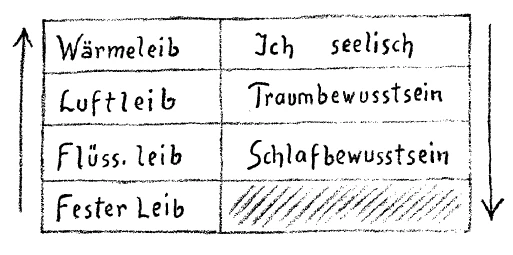
[ 27 ] You see, whether we consider human beings from the inside or the outside, we arrive at an ever broader understanding of the human being. If we move from the solid body to the liquid body, to the air body, to the warmth body, we enter into the soul. If we move from clear waking consciousness to dream consciousness, we enter into the body. And we enter even more deeply into the physical body by knowing ourselves to be within it through dreamless sleep consciousness. If we carry waking consciousness down to the state of sleep, then—when we consider the human being through the stages of his consciousness—we enter into physicality. If we consider physicality itself, moving upward from its solid state to its state of warmth, we emerge from physicality. This shows you the necessity of not simply accepting what initially presents itself to a biased external observation. On the one hand, there is the solid body, to which one clings with a materialistic-mechanistic conception; on the other hand, there is the soul, which to modern consciousness actually appears meaningful only as the bright, clear life of the day. One does not descend from this consciousness (the “I”); for if one descends, one enters the physical body. One does not descend from the spiritual body (the body of warmth); for if one descends, one enters the solid body. Rather, one considers the two that do not belong together at all: the solid body without the fluid body, the air body, and the warmth body; the clear waking consciousness without that which actually only reflects the inner physical, without dream consciousness and sleep consciousness.
[ 28 ] And now, starting from educational psychology, one asks: How does this soul-spiritual aspect live within the physical? — Yes, you see, that’s actually what one does. Consider this: We have the solid body, the fluid body, the air body, and the warmth body. Through the warmth body, the “I” develops ordinary, clear daytime consciousness. But if one goes down, one enters the dream state; further down, one enters the dreamless sleep state. Down there (hatched area), as you know from An Outline of Esoteric Science, there is yet another state of consciousness that we need not consider now. If one now asks about the relationship between what is on the right here and what is on the left here, they fit together, for there (left arrow) one enters the soul from below, moving upward, and enters the physical body here (right arrow); the right and the left fit together. But in today’s external way of looking at things, people actually focus only on the physical body and, in turn, only on this state of consciousness (the “I”). Indeed, the “I” hangs in the air, and the physical body stands on the ground; no connection is found between them. And if you read through today’s teachings on the soul, you will see that the most incredible hypotheses are put forward about how the soul acts upon the body. But this stems solely from the fact that one considers one part of the body, and then something entirely separate from it—a part of the soul.
[ 29 ] The fact that spiritual science must strive for totality in all things, that it must truly build a bridge between the physical on the one hand and the psychological on the other, that it genuinely seeks out those states in which the psychological becomes physical, and the physical becomes a psychological—this irritates our contemporaries, who are determined to remain solely with what presents itself to an outward, biased mode of observation.
[ 30 ] We'll talk more about these things tomorrow.