The Bridge Between the Spiritual and
Physical Realms of Human Beings
GA 202
17 December 1920, Dornach
Translate the original German text into any language:
Versions Available:
The Bridge Between the Spiritual and Physical Realms of Human Beings, tr. SOL
Zehnter Vortrag
Tenth Lecture
[ 1 ] Ich möchte heute eine Betrachtung einschieben, die Ihnen vielleicht etwas entlegen erscheinen könnte, die aber doch eben als eine eingeschobene von Bedeutung sein wird für den Fortgang der Auseinandersetzungen, die wir in dieser Zeit pflegen. Wir haben ja im Laufe der Zeit die verschiedensten Bestandteile zusammengetragen, die notwendig sind zur Erkenntnis des Menschen. Wir sind jetzt daran, den Menschen nach und nach einzureihen auf der einen Seite in das kosmische Leben, auf der anderen Seite in das soziale Leben. Dazu ist nun eben notwendig, daß wir heute auf einiges aufmerksam machen, das zum Verständnis der menschlichen Wesenheit doch beitragen kann. Wenn man im Sinne der heutigen wissenschaftlichen Richtung den Menschen betrachtet, so betrachtet man im Grunde genommen nur einen Teil der menschlichen Wesenheit. Das geht ja schon daraus hervor, daß eben gar nicht berücksichtigt wird, daß der Mensch außer seinem physischen Leib noch höhere Glieder seiner Wesenheit hat. Aber davon wollen wir zunächst heute einmal ganz absehen. Wir wollen ins Auge fassen, was mehr oder weniger auf der einen Seite von den wissenschaftlichen Bestrebungen anerkannt wird, was aber auf der anderen Seite doch auch schon in das populäre Bewußtsein eingegangen ist. Man betrachtet eigentlich den Menschen so, daß man nur dasjenige zu seiner Organisation zählt, was man sich in irgendeiner Weise fest oder fest-flüssig vorstellen kann. Gewiß, man betrachtet das Flüssige, das Luftförmige als in den Menschen einziehend und ausziehend, aber man betrachtet es nicht so, als ob es selber ein Glied der menschlichen Organisation sei. Die Wärme, die der Mensch so in sich hat, daß sie eine höhere Wärme als seine Umgebung ist, die betrachtet man als einen Zustand des menschlichen Organismus, aber man betrachtet sie nicht eigentlich als ein Glied der Organisation. Wir werden gleich sehen im genaueren, was mit dem gemeint ist, was ich eben vorgebracht habe.
[ 1 ] Today I would like to interject a reflection that may seem somewhat remote to you, but which, precisely because it is an interjection, will be significant for the progress of the discussions we are engaged in at this time. Over the course of time, we have gathered the most diverse elements necessary for understanding the human being. We are now in the process of gradually placing the human being, on the one hand, within cosmic life, and on the other hand, within social life. To this end, it is necessary for us today to draw attention to certain points that can indeed contribute to an understanding of the human being. When one views the human being in accordance with the current scientific approach, one is, in essence, considering only a part of the human being. This is already evident from the fact that no account is taken at all of the fact that, in addition to his physical body, the human being possesses higher aspects of his being. But let us set that aside entirely for now. Let us consider what is more or less acknowledged on the one hand by scientific endeavors, but which, on the other hand, has already entered popular consciousness. In fact, people view human beings in such a way that they count as part of their organization only that which can be imagined in some way as solid or semi-solid. Certainly, they regard the fluid and the gaseous as entering and leaving the human body, but they do not regard them as if they were themselves a component of the human organism. The warmth that a human being possesses—which is a higher temperature than that of their surroundings—is regarded as a state of the human organism, but it is not actually considered a component of the organism. We will see in more detail shortly what is meant by what I have just stated.
[ 2 ] Wenn man — ich habe Sie schon einmal aufmerksam darauf gemacht das Aufundabwogen des Gehirnwassers durch den Rückenmarkskanal ins Auge faßt, so sieht man, wie durch die Einatmung und Ausatmung eine regelmäßige Oszillationsbewegung, eine schwingende Bewegung des Gehirnwassers von unten nach oben, von oben nach unten stattfindet, wie das Gehirnwasser bei der Einatmung nach aufwärts getrieben wird, anschlägt gewissermaßen an die Gehirnorganisation, wie es wiederum sinkt bei der Ausatmung. So etwas, was da vorgeht innerhalb der rein flüssigen Einschlüsse des menschlichen Organismus, das betrachtet man nicht mit als zur Organisation selbst gehörig. Man stellt sich mehr oder weniger vor, der Mensch bestünde eben als physische Organisation aus dem, was man als mehr oder weniger feste oder höchstens fest-flüssiige Teile, Substanzen in ihm findet.
[ 2 ] If one—as I have already pointed out to you—considers the up-and-down movement of the cerebrospinal fluid through the spinal canal, one can see how inhalation and exhalation cause a regular oscillatory motion, a swinging movement of the cerebrospinal fluid from bottom to top and from top to bottom; how the cerebrospinal fluid is driven upward during inhalation, striking, so to speak, against the brain tissue, and how it sinks again during exhalation. Such a process, taking place within the purely liquid compartments of the human organism, is not generally considered to be part of the organism itself. One more or less imagines that the human being, as a physical organism, consists of what one finds within it as more or less solid or, at most, solid-liquid parts and substances.
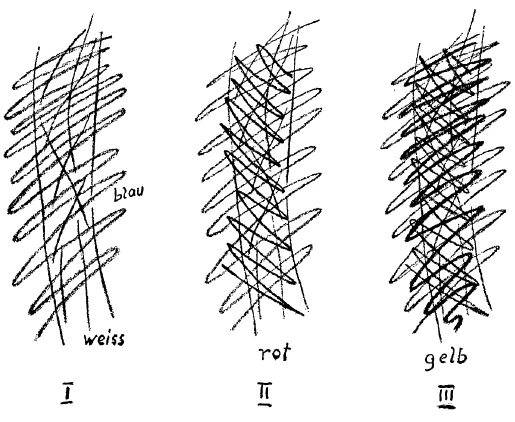
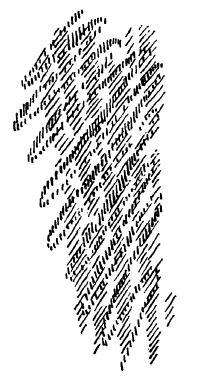
[ 3 ] Wenn ich schematisch zeichnen soll (siehe Zeichnung): Man stelle sich vor, daß der Mensch eben aus diesen Substanzen besteht, die man mehr oder weniger als feste findet, Knochensubstanzen und so weiter, also man stellt sich den Menschen vor als gewissermaßen ein aufgebautes Gerüste (weiß). Das andere, was da im Menschen eigentlich Flüssiges ist, wie ich es an dem Beispiel des Gehirnwassers gezeigt habe, was Luftförmiges ist, das betrachtet man, insofern man Anatomie und Physiologie treibt, nicht als zur menschlichen Organisation gehörig. Man sagt sich: Ja, der Mensch zieht die Luft ein, sie macht gewisse Wege in ihm, sie hat auch gewisse Aufgaben. Sie wird wieder ausgeatmet. Man spricht vom Wärmezustand des Menschen, aber man betrachtet im Grunde doch nur das Feste als das Organisierende, und man sieht nicht hin darauf, daß man außer dem, daß man dieses feste Gerüste hat, den ganzen Menschen auch als eine Flüssigkeit, sagen wir, zunächst Flüssigkeitssäule (siehe Zeichnung, blau, T) zu sehen hat, daß der ganze Mensch durchsetzt ist mit Luft (rot, II) und daß er durch und durch einen gewissen Wärmezustand hat (gelb, III). Aber einer genaueren Betrachtung gegenüber ergibt sich doch, daß man ebenso, wie man das Feste oder Fest-flüssige als einen Teil, als ein Glied der menschlichen Organisation anzusehen hat, man auch dasjenige, was der Mensch als direkte Flüssigkeit in sich hat, nicht als eine gleichgültige flüssige Masse, sondern als in Organisation, wenn auch fluktuierender, aber doch in Organisation begriffen sich zu denken hat, und daß diese Organisation, das Flüssige, ebenso etwas bedeutet wie die Organisation des Festen.
[ 3 ] If I were to draw a schematic diagram (see illustration): Imagine that the human being consists precisely of these substances, which are more or less solid—bone substances and so on—so one imagines the human being, as it were, as a kind of structural framework (white). The other elements within the human being—which are actually liquid, as I have shown using the example of cerebrospinal fluid, and which are gaseous—are not considered, in the study of anatomy and physiology, to be part of the human organism. People say to themselves: Yes, the human being inhales air; it follows certain paths within the body and performs certain functions. It is then exhaled again. People speak of the human body’s thermal state, but fundamentally they regard only the solid as the organizing principle, and they fail to recognize that, apart from having this solid framework, the entire human being is also a fluid—let’s say, initially a column of fluid (see drawing, blue, T), that the entire human being is permeated with air (red, II), and that it possesses a certain thermal state throughout (yellow, III). Yet upon closer examination, it becomes clear that just as one must regard the solid or solid-liquid component as a part, as a link in the human organism, one must also conceive of that which the human being contains as direct liquid not as an indifferent liquid mass, but as being part of an organization—albeit a fluctuating one—and that this organization, the liquid, is just as significant as the organization of the solid.
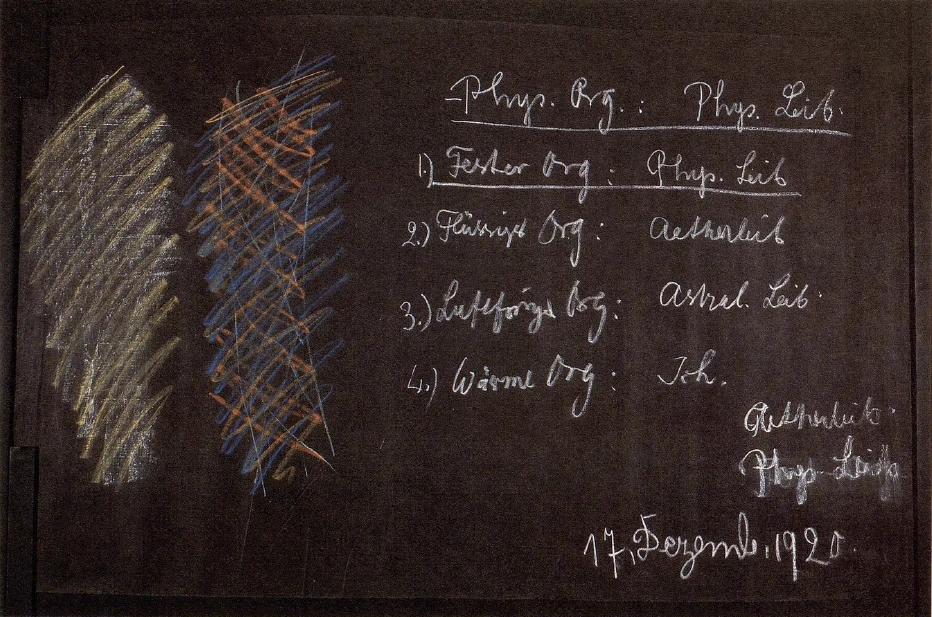
[ 4 ] Man hat also neben dem gewissermaßen festen Menschen den Flüssigkeitsmenschen ins Auge zu fassen, und man hat außerdem den Luftmenschen ins Auge zu fassen. Denn, was wir als Luft in uns tragen, ist in bezug auf seine Gliederung, in bezug auf seine Teile geradeso ein Organismus, wie der feste Organismus ein Organismus ist, nur ist dieser Organismus luftförmig und in Bewegung. Und endlich dasjenige, was wir als Wärme in uns tragen, das ist nicht etwa eine gleichförmige, über den Menschen sich ausbreitende Wärmeräumlichkeit, sondern das ist ebenfalls in seinen Feinheiten organisiert wie der feste, der flüssige, der gasförmige oder luftförmige Organismus. Nun kommt man aber sogleich darauf, daß in dem Augenblicke, wo man von dem flüssigen Organismus spricht, der gewissermaßen in demselben Raume ist, der als ein flüssiger Organismus eben denselben Raum ausfüllt wie der feste Organismus, man von diesem flüssigen Organismus nicht sprechen kann, ohne daß man, so wie der Mensch gegenwärtig als Erdenmensch ist, spricht von dem diesen Flüssigkeitsorganismus durchziehenden, durchkraftenden Ätherleib. Der physische Organismus ist zunächst für sich, es ist der physische Leib; insofern wir ihn in seiner Vollständigkeit betrachten, betrachten wir ihn zunächst als festen Organismus. Da haben wir es zunächst mit dem eigentlichen physischen Leib zu tun.
[ 4 ] So, in addition to the “solid” human being, we must also consider the “liquid” human being, and we must furthermore consider the “air” human being. For what we carry within us as air is, in terms of its structure and its parts, just as much an organism as the solid organism is an organism; only this organism is air-like and in motion. And finally, what we carry within us as warmth is not some uniform, spatial warmth spreading throughout the human being, but is likewise organized in its subtleties just like the solid, liquid, gaseous, or air-like organism. But one immediately realizes that the moment one speaks of the liquid organism—which, so to speak, occupies the same space, filling that same space just as the solid organism does— one cannot speak of this liquid organism without also speaking—just as we speak of the human being as an earthly human being—of the etheric body that permeates and animates this liquid organism. The physical organism exists initially in and of itself; it is the physical body. Insofar as we consider it in its entirety, we regard it initially as a solid organism. Here we are dealing, first and foremost, with the actual physical body.
[ 5 ] Dann betrachten wir zweitens den flüssigen Organismus, der natürlich nicht so untersucht werden kann wie der feste Organismus, daß man ihn mit dem Messer untersucht, sondern der aufgefaßt werden muß als ein in sich beweglicher Organismus, ein flüssiger Organismus. Ihn können wir nicht betrachten, ohne daß wir ihn durchzogen denken vom Ätherleib.
[ 5 ] Second, let us consider the liquid organism, which, of course, cannot be examined in the same way as a solid organism—that is, by cutting into it with a knife—but must be understood as an organism that is in motion within itself, a liquid organism. We cannot consider it without conceiving of it as permeated by the etheric body.
[ 6 ] Drittens haben wir den luftförmigen Organismus. Ihn können wir nicht betrachten, ohne daß wir ihn durchkraftet uns denken von dem astralischen Leib. Und endlich viertens in sich ganz differenziert ist der Wärmeorganismus. Ihn können wir nicht betrachten, ohne daß wir ihn durchkraftet finden mit dem Ich. Das ist so, wie der Mensch heute ist als Erdenmensch.
[ 6 ] Third, we have the airy organism. We cannot consider it without imagining it permeated by the astral body. And finally, fourth, the heat organism is fully differentiated in itself. We cannot consider it without finding it permeated by the “I.” This is how human beings are today as earthly human beings.
Wir haben also:
So we have:
Physischer Organismus = Physischer Leib
Physical Organism = Physical Body
Der Mensch anders betrachtet:
A Different Perspective on Humanity:
1. Fester Organismus = Physischer Leib
2. Flüssiger Organismus = Ätherleib
3. Luftförmiger Organismus = Astralleib
4. Wärmeorganismus = Ich
1. Solid organism = physical body
2. Liquid organism = etheric body
3. Airy organism = astral body
4. Thermal organism = ego
[ 7 ] Eine Folge davon ist, daß wir uns über etwas klar werden: Betrachten wir zum Beispiel das Blut. Insofern ein Hauptbestandteil von ihm im wesentlichen flüssig ist, so haben wir, insofern dieses Blut dem flüssigen Organismus gehört, in dem Blute den das Blut durchkraftenden Ätherleib. Nun aber haben wir außerdem in diesem Blute dasjenige, was wir sonst nur den Wärmezustand nennen. Aber das ist eine Organisation, die keineswegs mit der Organisation des flüssigen Blutes als solchem zusammenfällt. Und würde man das untersuchen — und dazu kann es durchaus, wenn man einmal darauf ausgeht, auch physische Methoden der Untersuchung geben —, so würde man finden, daß, indem man einfach die Wärmezustände in den verschiedensten Partien des menschlichen Organismus registriert, das nicht zusammenfällt mit der flüssigen oder irgend sonst einer Organisation.
[ 7 ] One consequence of this is that we come to understand something clearly: Let us consider blood, for example. Insofar as a major component of it is essentially liquid, and insofar as this blood belongs to the liquid organism, we have within the blood the etheric body that permeates it. But in addition, we also have in this blood what we otherwise call simply the state of warmth. Yet this is an organization that in no way coincides with the organization of the liquid blood as such. And if one were to investigate this—and there can certainly be physical methods of investigation for this, once one sets out to do so—one would find that simply by recording the thermal states in the various parts of the human organism, these do not coincide with the liquid or any other form of organization.
[ 8 ] Nun, in dem Augenblicke, wo man den Menschen in dieser Weise betrachtet, wird man aber sehen, daß man bei dieser menschlichen Betrachtung nicht innerhalb des menschlichen Organismus selber stehenbleiben kann. Man kann allenfalls innerhalb des menschlichen Organismus stehenbleiben, wenn man den bloßen festen Organismus betrachtet. Der gibt ein gewisses abgeschlossenes Gebilde, durch die Haut nach außen abgeschlossen. Allerdings ist das auch nur scheinbar, denn der Mensch betrachtet dasjenige, was ihm als Festes gegenübertritt, so, als ob es ein in sich abgeschlossener fester Klotz wäre. Das Feste ist aber in sich auch differenziert und steht vor allen Dingen in den verschiedensten Beziehungen zu der gesamten übrigen festen Körperlichkeit. Wir haben ja als Nächstliegendes zu beachten, daß die verschiedenen festen Substanzen zum Beispiel verschieden schwer sind, und schon daraus kann ersehen werden, wie dasjenige, was im menschlichen Organismus ist, dadurch, daß es verschieden schwer ist, verschiedenes spezifisches Gewicht hat, in einer ganz verschiedenen Weise gewissermaßen lastet im Menschen. Dadurch steht der Mensch mit Bezug auf seine physische Organisation in Beziehung zur ganzen Erde. Aber immerhin kann man, dem äußeren Augenscheine nach wenigstens, diese physische Organisation räumlich abgrenzen.
[ 8 ] Now, the moment one views human beings in this way, one will see, however, that in this human perspective one cannot limit oneself to the human organism itself. One can, at most, limit oneself to the human organism if one considers the mere, solid organism. It presents a certain self-contained structure, enclosed from the outside by the skin. However, this is only apparent, for the human being regards what appears to him as solid as if it were a self-contained, solid block. But the solid is itself differentiated and, above all, stands in the most varied relationships to the rest of the solid physical body. We must next consider that the various solid substances, for example, have different weights, and from this alone it can be seen how what is within the human organism—by virtue of its varying weights and specific gravities—exerts a distinct influence on the human being, so to speak. Through this, the human being, in terms of his physical organization, stands in relation to the entire Earth. Nevertheless, at least to the outward appearance, this physical organization can be spatially delineated.
[ 9 ] Anders steht die Sache schon bei der Organisation, die wir als die zweite, vom Ätherleib durchkraftete anerkennen, die flüssige Organisation. Diese flüssige Organisation, sie ist ja so, daß sie nun nicht mehr in einer so strengen Weise abgegrenzt werden kann von der Umgebung. Was flüssig ist in irgendeinem Raumteil, das grenzt an das übrige Flüssige an. Und wenn auch zunächst das Flüssige als solches in unserer Außenwelt nur in verdünntem Zustande vorhanden ist, so ist doch eine feste Grenze zwischen dem im Inneren des Menschen befindlichen Flüssigen und dem außerhalb des Menschen befindlichen Flüssigen nicht mehr in so strenger Weise anzugeben wie beim festen Organismus. So daß wir da schon genötigt sind, die Grenze zwischen dem menschlichen flüssigen Inneren und dem physischen Äußeren in einer gewissen Weise verschwimmen zu lassen.
[ 9 ] The situation is quite different with regard to the organization that we recognize as the second—the one permeated by the etheric body—the fluid organization. This fluid organization is such that it can no longer be demarcated from its surroundings in such a strict manner. Whatever is fluid in any part of space borders on the rest of the fluid. And even if, at first, fluid as such exists in our external world only in a diluted state, a fixed boundary between the fluid located within the human being and the fluid located outside the human being can no longer be defined as strictly as it is in the case of the solid organism. Thus, we are already compelled to allow the boundary between the human liquid interior and the physical exterior to become blurred to a certain extent.
[ 10 ] Noch deutlicher wird das, wenn wir den luftförmigen Organismus, der vom astralischen Leibe durchkraftet ist, ins Auge fassen. Was wir als Luft in uns tragen in einem bestimmten Zeitpunkte, das war ja kurz vorher draußen und wird kurz nachher wiederum draußen sein. Wir stehen in einem fortwährenden Einnehmen und Ausgeben dessen, was da als Luftförmiges in uns ist. Wir können gewissermaßen nur die Luft, die unsere Erde umgibt, als solche in Betracht ziehen und können sagen: sie schiebt sich vor in unseren Organismus, nimmt sich wiederum zurück; aber indem sie sich vorschiebt in unseren Organismus, wird sie unsere Organisation. Wir haben da in dem, was unsere Luftorganisation wird, eigentlich fortwährend einen Organismus, der sich aufbaut aus der ganzen Atmosphäre heraus und wiederum in diese Atmosphäre zurücktritt. Es ist ja tatsächlich so, daß in uns etwas aufgebaut wird bei jedem Einatmungsprozesse, oder wenigstens daß ein Aufbau modifiziert wird bei jedem Einatmungsprozesse. Und ebenso ist ein Abbau, ein teilweiser Abbau wenigstens, bei jedem Ausatmungsprozesse vorhanden. Wir können sagen: In einer gewissen Weise wird unser luftförmiger Organismus mit jedem Atemzuge verändert, nicht gerade neugeboren, aber verändert, ebenso beim Einatmen wie beim Ausatmen. Beim letzteren stirbt er natürlich auch nicht, er verändert sich nur, aber es findet eine fortwährende Wechselbeziehung statt zwischen dem, was wir als luftförmigen Organismus in uns haben, und dem, was die äußere Luft ist. Was man gewöhnlich in den trivialen Vorstellungen als die menschliche Organisation ins Auge faßt, das kann man nur dadurch so, wie man es tut, ins Auge fassen, daß man eben nicht in Betracht zieht, wie der luftförmige Organismus eigentlich im Verhältnis zum festen Organismus nur einen ganz geringen Grad von Verschiedenheit hat.
[ 10 ] This becomes even clearer when we consider the air-like organism that is permeated by the astral body. What we carry within us as air at a given moment was outside us just a short time before and will be outside us again shortly afterward. We are in a constant process of taking in and giving out what is within us in the form of air. In a sense, we can only consider the air that surrounds our Earth as such, and we can say: it pushes its way into our organism and then withdraws again; but as it pushes its way into our organism, it becomes our organization. In what becomes our airy organization, we actually have a constantly evolving organism that builds itself up from the entire atmosphere and then retreats back into that atmosphere. It is indeed the case that something is built up within us with every inhalation, or at least that a structure is modified with every inhalation. And likewise, a breakdown—at least a partial breakdown—occurs with every exhalation. We can say: In a certain sense, our air-like organism is altered with every breath—not exactly reborn, but altered—both during inhalation and exhalation. During exhalation, of course, it does not die; it merely changes. But there is a continuous interplay between what we have within us as an air-like organism and what the external air is. What is usually conceived of in trivial notions as the human organism can only be conceived of in the way it is because one fails to take into account how the airy organism actually differs only very slightly from the solid organism.
[ 11 ] Und in noch höherem Maße ist das der Fall für unseren Wärmeorganismus. Es liegt ja natürlich ganz in der materialistisch-mechanistischen Betrachtungsweise, daß man nicht ins Auge faßt den Flüssigkeitsorganismus, den Luftorganismus, den Wärmeorganismus, sondern nur den festen Organismus. Aber man bekommt keine wirkliche Erkenntnis vom Menschen, wenn man sich nicht dazu herbeilassen will, diese Gliederung des Menschen in einen Wärmeorganismus, in einen Luftorganismus, in einen Wasserorganismus und in einen Erdorganismus gelten zu lassen.
[ 11 ] And this is even more true of our thermal organism. It is, of course, entirely in keeping with the materialistic-mechanistic perspective that one does not take into account the liquid organism, the air organism, or the thermal organism, but only the solid organism. But one cannot gain a true understanding of the human being unless one is willing to accept this division of the human being into a thermal organism, an air organism, a water organism, and an earth organism.
[ 12 ] Wärmeorganismus, in ihm lebt vorzugsweise das Ich. Das Ich selber ist, ich möchte sagen, diejenige Geistorganisation, welche von sich aus kraftend das, was wir an Wärme in uns tragen, beherrscht, konfiguriert, nicht nur äußerlich in der Begrenzung konfiguriert, sondern innerlich durchkonfiguriert. Und das Seelische, wir können es nicht verstehen, wenn wir nicht dieses direkte Wirken des Ich auf die Wärme ins Auge fassen. Das Ich ist ja zunächst dasjenige im Menschen, welches den Willen in Tätigkeit versetzt, Willensimpulse verleiht. Wie verleiht das Ich Willensimpulse? Wir haben von einem anderen Gesichtspunkte aus davon gesprochen, wie die Willensimpulse zusammenhängen mit dem Tellurischen, im Gegensatze zu den Gedankenimpulsen, den Vorstellungsimpulsen, die mit dem Außertellurischen in Zusammenhang stehen. Aber indem das Ich die Willensimpulse eben doch beisammenhält, wo hat es den Weg, um nun diese Willensimpulse in den Organismus, in die ganze menschliche Wesenheit gewissermaßen hineinzutreiben? Das geschieht, indem der Wille zunächst in dem Wärmeorganismus des Menschen wirkt (siehe Zusammenstellung Seite 174). Indem das Ich einen Willensimpuls hat, wirkt dieser Willensimpuls zunächst auf den menschlichen Wärmeorganismus. Natürlich ist unter den gegenwärtigen tellurischen Verhältnissen es nicht möglich, daß das in einer konkreten Wirklichkeit da ist, was ich nun beschreiben will. Dennoch aber kann man es als etwas im Menschen wesenhaft Vorhandenes ins Auge fassen. Man kann es ins Auge fassen, wenn man davon absieht, daß in dem Raume, den die menschliche Haut begrenzt, die feste Organisation ist. Wir sehen von ihr ab, wir sehen von der flüssigen Organisation ab, wir sehen auch von der luftförmigen Organisation ab. Dann bleibt uns der Raum erfüllt mit Wärme, die allerdings kommuniziert mit der äußeren Wärme. Aber das, was da drinnen wirtschaftet in dieser Wärme, was diese Wärme so macht, daß sie in Strömung, daß sie in innerlicher Bewegung ist, daß sie eben ein Organismus ist, das ist das Ich.
[ 12 ] The organism of warmth—it is within this that the “I” primarily dwells. The “I” itself is, I would say, that spiritual organization which, acting of its own accord, governs and configures the warmth we carry within us—not only configuring it externally within its boundaries, but also configuring it internally throughout. And we cannot understand the soul if we do not take into account this direct influence of the “I” on warmth. After all, the “I” is, first and foremost, that which in the human being sets the will in motion and imparts impulses of will. How does the “I” impart impulses of will? We have spoken from another perspective about how the impulses of will are connected to the telluric, in contrast to the thought impulses and the imagination impulses, which are connected to the non-telluric. But since the “I” does indeed hold the impulses of the will together, how does it find a way to, so to speak, drive these impulses of the will into the organism, into the entire human being? This occurs because the will first acts within the human thermal organism (see summary on page 174). When the “I” has a volitional impulse, this impulse first acts upon the human thermal organism. Of course, under present terrestrial conditions, it is not possible for what I am about to describe to exist as a concrete reality. Nevertheless, one can conceive of it as something essentially present within the human being. One can conceive of it if one disregards the fact that within the space bounded by the human skin lies the solid organization. We disregard it; we disregard the liquid organization; we also disregard the air-like organization. Then what remains is a space filled with warmth, which, admittedly, communicates with the external warmth. But that which is at work within this warmth—that which causes this warmth to flow, to be in inner motion, to be, in fact, an organism—that is the “I.”
[ 13 ] Und wenn wir ins Auge fassen den menschlichen astralischen Leib, so ist dieser menschliche astralische Leib zunächst das, was in sich trägt alle Kräfte des Gefühles, des Fühlens. Die Kräfte des Fühlens, sie leben im astralischen Leib so, daß der astralische Leib wiederum diese Fühlkräfte zur physischen Wirksamkeit bringt in demjenigen, was dem Menschen zugrunde liegt als der Luftorganismus.
[ 13 ] And when we consider the human astral body, this human astral body is, first and foremost, that which contains within itself all the powers of feeling. The powers of feeling live in the astral body in such a way that the astral body, in turn, brings these powers of feeling into physical effect in that which underlies the human being as the air organism.
[ 14 ] Also könnte man sagen: So wie der Mensch nun einmal ist als Erdenmensch, bewirkt sein Ich durch den Wärmeorganismus das, was sich dann äußert, wenn der Mensch als Willenswesen in die Welt tritt. Was der astralische Leib erlebt als Gefühle und dann auswirkt in der irdischen Organisation, das stellt sich dar als der Luftorganismus. Und wenn wir zum ätherischen Organismus, zum ätherischen Leibe gehen, so enthält der in sich — allerdings zunächst mehr bildhaft als uns das bewußt wird, denn da tritt ja für das Bewußtsein noch der physische Leib ein, der die Bilder eben zu den bildphysischen Vorstellungen abschwächt —, er enthält in sich das eigentliche Vorstellen, insofern das Vorstellen bildlich ist; das wirkt auf den Flüssigkeitsorganismus.
[ 14 ] So one could say: Just as the human being is, as an earthly being, his “I” brings about through the warmth organism what then manifests when the human being enters the world as a being of will. What the astral body experiences as feelings and then expresses in the earthly organism manifests as the air organism. And when we turn to the etheric organism, the etheric body, it contains within itself—albeit initially more in a pictorial sense than we are aware of, for the physical body still intervenes for consciousness, which attenuates these images into pictorial-physical representations—it contains within itself actual imagination, insofar as imagination is pictorial; this acts upon the liquid organism.
[ 15 ] Sie sehen daraus, man kommt dem Seelischen näher, wenn man diese besonderen Organismen im Menschen betrachtet. Die materialistische Betrachtungsweise, die nur bei dem festen Gerüste stehenbleiben will, die es eigentlich wie eine Selbstverständlichkeit ausspricht, daß Wasser nicht organisiert sein kann — es ist eben organisiert im Organismus —, die muß ihrerseits dazu kommen, mit völligem Unverständnis dem Seelischen gegenüberzustehen; denn das Seelische ist unmittelbar vorhanden eben in diesen anderen Organismen. Und der eigentliche feste Organismus ist im Grunde genommen nur etwas, was, ich möchte sagen, wirklich Stütze bildet für die anderen Organismen. Wir haben den festen Organismus, der wie ein Stützgerüste dasteht aus Knochen, Muskeln und so weiter. Und in dieses Stützgerüste hinein gliedert sich dann der flüssige Organismus, der in sich differenziert ist und der in sich eben durchaus konfiguriert ist, und in diesem flüssigen Organismus vibriert der Ätherleib, und in diesem flüssigen Organismus erzeugen sich die Gedanken. Wie erzeugen sie sich? Dadurch erzeugen sie sich, daß in diesem Flüssigkeitsorganismus in einer bestimmten Metamorphose sich geltend macht, was wir sonst in der Außenwelt kennenlernen als den Ton.
[ 15 ] As you can see, one comes closer to understanding the soul by observing these special organisms within the human being. The materialistic viewpoint, which insists on sticking only to the solid framework—and which takes it for granted that water cannot be organized (even though it is, in fact, organized within the organism)—must, for its part, come to face the spiritual realm with complete incomprehension; for the spiritual is directly present precisely in these other organisms. And the actual solid organism is, in essence, merely something that, I would say, truly serves as a support for the other organisms. We have the solid organism, which stands there like a supporting framework of bones, muscles, and so on. And into this supporting framework is then integrated the fluid organism, which is differentiated within itself and is, in fact, thoroughly configured within itself; and within this fluid organism the etheric body vibrates, and within this fluid organism thoughts arise. How are they generated? They are generated by the fact that, within this fluid organism, a certain metamorphosis brings into play what we otherwise experience in the external world as sound.
[ 16 ] Der Ton, er ist ja eigentlich etwas, was, man kann schon sagen, die menschliche Betrachtungsweise in hohem Maße irreführt. Wir vernehmen den Ton zunächst als Erdenmensch so, daß die Luft der Träger dieses Tones ist. Ja, aber die Luft ist eben nur der Vermittler für diesen Ton, der eigentlich in der Luft webt. Und derjenige, der bloß in den Luftschwingungen das Wesen des Tones sieht, der gleicht einem Menschen, der eben auch sagt: Der Mensch hat nur seinen physischen Organismus, da lebt kein Seelisches drinnen. — Es ist gerade so, wie wenn man am Menschen nur den physischen Organismus betrachtet und kein Seelisches darinnen sieht, wenn man bloß die Luftschwingungen als das Wesentliche des Tons betrachtet, die eigentlich nur der äußere Ausdruck sind. Was darinnen lebt als Ton, das ist im wesentlichen ein ätherisches Element. Und unser Luftton rührt eigentlich nur davon her, daß wir die Luft durchsetzt haben von dem Tonäther, was dasselbe ist wie der chemische Äther. Und indem dieser Äther die Luft durchsetzt, teilt er das, was in ihm lebt, der Luft mit, und es entsteht für unsere Wahrnehmung dasjenige, was wir den Ton nennen. Dieser selbe Tonäther, der zu gleicher Zeit der chemische Äther ist — wir werden von alledem bei anderer Gelegenheit genauer sprechen —, der lebt im wesentlichen in unserem Flüssigkeitsorganismus. So daß wir unterscheiden können: In unserem Flüssigkeitsorganismus haben wir unseren eigenen Ätherleib drinnen lebend; aber außerdem dringt von allen Seiten in ihn ein, was dem Ton als der Tonäther zugrunde liegt. Also bitte, unterscheiden Sie das ganz wohl. Wir haben in uns unseren ÄAtherleib, der arbeitet und wirkt, indem er Gedanken auswirkt, in unserem Flüssigkeitsorganismus. Aber in diesen Flüssigkeitsorganismus dringt fortwährend ein und aus, was wir den chemischen Äther nennen können. Wenn wir also unseren Organismus betrachten, so haben wir einen vollständigen ätherischen Organismus aus chemischem Äther, Wärmeäther, Lichtäther, Lebensäther bestehend, und außerdem haben wir ganz besonders, auf dem Wege durch den Flüssigkeitsleib aus- und eindringend, den chemischen Äther.
[ 16 ] Sound is, in fact, something that—one might even say—greatly misleads the human way of thinking. As earthly human beings, we initially perceive sound in such a way that the air is the carrier of that sound. Yes, but the air is merely the medium for this sound, which actually weaves through the air. And anyone who sees the essence of sound solely in the air vibrations is like a person who says: “Human beings have only their physical organism; there is nothing spiritual within them.” — It is exactly as if one were to consider only the physical organism of a human being and see nothing spiritual within it; it is as if one were to regard only the air vibrations as the essence of sound, when in fact they are merely the outward expression. What lives within it as sound is essentially an ethereal element. And our airborne sound actually arises only from the fact that we have permeated the air with the sound ether, which is the same as the chemical ether. And as this ether permeates the air, it imparts to the air that which lives within it, and what we call sound comes into being for our perception. This same tone ether, which is at the same time the chemical ether—we will speak of all this in more detail on another occasion—essentially lives within our fluid organism. So that we can distinguish: Within our fluid organism, our own etheric body lives; but in addition, what underlies tone as the tone ether penetrates it from all sides. So please, make this distinction very clearly. We have within us our etheric body, which works and acts by giving effect to thoughts, within our fluid organism. But what we might call the chemical ether is constantly flowing in and out of this fluid organism. So when we consider our organism, we have a complete etheric organism consisting of chemical ether, warmth ether, light ether, and life ether; and in addition, we have, in particular, the chemical ether flowing in and out through the fluid body.
[ 17 ] Der astralische Leib, der sich im Fühlen äußert, lebt durch den Luftorganismus. Zu diesem Luftorganismus aber hat eine besondere Verwandtschaft nun wiederum eine andere Ätherart, welche die Luft besonders durchsetzt, der Lichtäther. In älteren Weltanschauungen wurde daher auf diese Verwandtschaft der sich ausbreitenden physischen Luft mit dem sie durchsetzenden Lichtäther immer besonders hingewiesen. Dieser Lichtäther, der gewissermaßen gerade von der Luft getragen wird, der verwandter ist eigentlich mit der Luft als der Ton, der dringt nun auch in unseren Luftorganismus besonders ein, und er liegt zugrunde demjenigen, was da aus- und eingeht in unserem Luftorganismus. Wir haben also unseren astralischen Leib, der das Fühlen in sich erlebt, der sich besonders wirksam erweist im Luftorganismus, und der da fortwährend zusammenstößt insbesondere mit dem Lichtäther.
[ 17 ] The astral body, which expresses itself through feeling, lives through the air organism. However, another type of ether—the light ether, which permeates the air in a special way—has a particular affinity with this air organism. In older worldviews, therefore, this relationship between the expanding physical air and the light ether that permeates it was always particularly emphasized. This light ether, which is, so to speak, carried by the air itself and is actually more closely related to the air than sound is, now also penetrates our air organism in a special way, and it underlies that which flows in and out of our air organism. We thus have our astral body, which experiences feeling within itself, which proves particularly active in the air organism, and which is constantly interacting there, especially with the light ether.
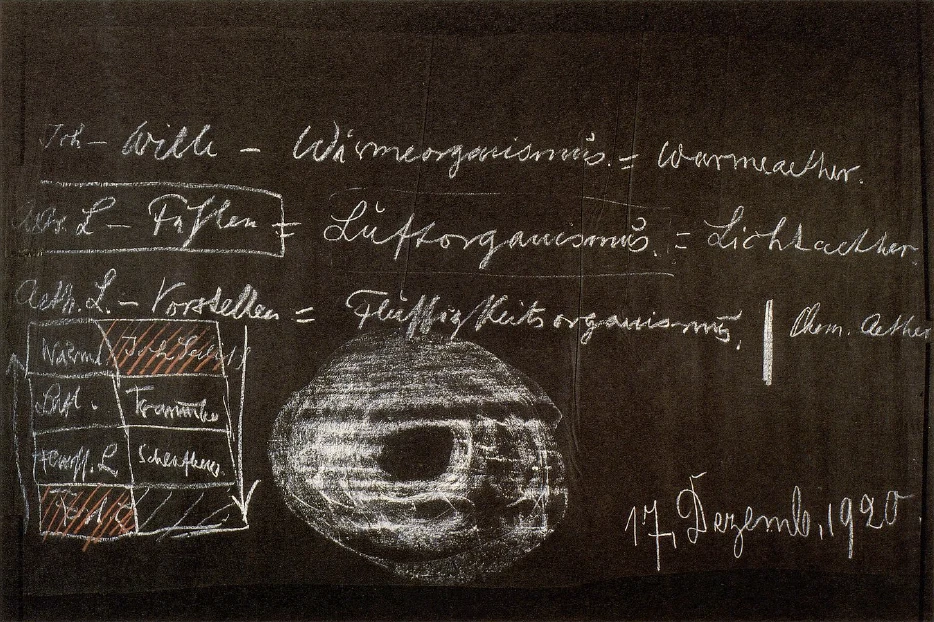
[ 18 ] Und wir haben das menschliche Ich. Dieses menschliche Ich, welches sich durch den Willen im Wärmeorganismus betätigt, steht wiederum in Verbindung mit der äußeren Wärme, mit dem äußeren Wärmeäther, der da ein und ausgeht. Es ergeben sich daher die Zusammenhänge:
[ 18 ] And we have the human “I.” This human “I,” which acts through the will within the thermal organism, is in turn connected to external heat, to the external thermal ether that flows in and out. The following relationships therefore arise:
Ich — Wille — Wärmeorganismus — Wärmeäther
Astrallib — Fühlen — _Luftorganismus — Lichtäther
Ätherleib — Vorstellen — Flüssigkeitsorganismus — chemischer Äther
I — Will — Heat Organism — Heat Ether
Astral Soul — Feeling — _Air Organism — Light Ether
Etheric Body — Imagination — Liquid Organism — Chemical Ether
[ 19 ] Nun bedenken Sie aber: der ätherische Leib, er bleibt in uns, auch wenn wir schlafen, auch vom Einschlafen bis zum Aufwachen. Da ist auch vom Einschlafen bis zum Aufwachen durch den Flüssigkeitsorganismus fortwährend dieses Ineinanderwirken von chemischem Äther mit dem ätherischen Leib im Inneren. Anders ist es schon beim astralischen Leib mit dem Fühlen. Der astralische Leib ist vom Einschlafen bis zum Aufwachen außerhalb des menschlichen Organismus; da wirkt nicht dieser astralische Leib mit dem Fühlen auf den Luftorganismus, sondern da wird der Luftorganismus, von dem wir ja sagen mußten, daß er im Zusammenhange steht mit der ganzen übrigen Umwelt, von außen unterhalten. Und der Mensch selber, insofern er seinen astralischen Leib mit dem Fühlen enthält, geht heraus aus dem physischen Leib, ist also außerhalb dieses menschlichen Leibes und kommt dadurch in diejenige Welt hinein, mit der er zunächst in Beziehung steht durch den Lichtäther. Der Mensch lebt vom Einschlafen bis zum Aufwachen in demjenigen drinnen, direkt drinnen, das ihm in bezug auf den astralischen Leib im Wachzustand durch den Luftorganismus vermittelt wird. In einer ähnlichen Weise ist es für das Ich und den Wärmeorganismus der Fall.
[ 19 ] But consider this: the etheric body remains within us even when we sleep, from the moment we fall asleep until we wake up. From the moment we fall asleep until we wake up, there is a continuous interaction between the chemical ether and the etheric body within us, mediated by the fluidic organism. The situation is quite different with the astral body and feeling. From the moment we fall asleep until we wake up, the astral body is outside the human organism; in this case, it is not the astral body that acts upon the air organism through feeling, but rather the air organism—which, as we have noted, is connected to the entire surrounding environment—is sustained from the outside. And the human being himself, insofar as he contains his astral body with its feelings, steps out of the physical body—is thus outside this human body—and thereby enters the world with which he is initially connected through the light ether. From the moment of falling asleep until waking, the human being lives directly within that which, with regard to the astral body in the waking state, is mediated to him through the air organism. The same is true for the “I” and the warmth organism.
[ 20 ] Sie sehen daraus, daß man ein Verständnis von der Beziehung des Menschen zur Umwelt erst bekommt, wenn man wirklich auf diese Gliederung des Menschen eingeht, die eigentlich die gewöhnliche mechanistische Betrachtungsweise gar nicht ins Auge faßt. Nun ist im Menschen alles durchdrungen, und dadurch, daß das Ich im Wärmeorganismus ist und dieses Ich ja auch den Luftorganismus, den Flüssigkeitsorganismus und den festen Organismus durchdringt, durchdringt es sie eben gerade auch mit dem Wärmeorganismus, der nun in allem lebt. Es lebt also der Wärmeorganismus im Luftorganismus, es lebt der Wärmeorganismus, vom Ich durchkraftet, auch im Flüssigkeitsorganismus.
[ 20 ] You can see from this that one can only gain an understanding of the relationship between human beings and the environment by truly engaging with this structure of the human being—a structure that the usual mechanistic approach does not even take into account. Now, everything in the human being is permeated, and because the “I” is within the thermal organism—and this “I” also permeates the air organism, the liquid organism, and the solid organism—it permeates them precisely through the thermal organism, which now lives in everything. Thus, the warmth organism lives within the air organism; the warmth organism, animated by the “I,” also lives within the liquid organism.
[ 21 ] Das ist dann der Weg, wie wir zum Beispiel zu suchen haben in der Blutzirkulation die Wirkungsweise des Ich. Die Wirkungsweise des Ich in der Blutzirkulation ist so vorhanden, daß auf dem Umwege durch den Wärmeorganismus das Ich auf die Blutzirkulation wirkt. Da wirkt das Ich als diejenige Wesenheit, welche den Willen gewissermaßen hinunterschickt von der Wärme aus durch die Luft in die Flüssigkeit hinein. So wirkt alles im Organismus aufeinander. Aber wir kommen nicht zu Rande, wenn wir bloß die allgemeinen abstrakten Vorstellungen des Aufeinanderwirkens haben, sondern wir kommen nur zu Rande, wenn wir im Konkreten uns vorstellen können, wie dieser Mensch gegliedert ist, wie alles dasjenige, was um ihn herum ist, an seiner Organisation teilnimmt.
[ 21 ] This, then, is the way in which we must seek, for example, the mode of action of the “I” in the blood circulation. The mode of action of the “I” in the blood circulation is such that the “I” acts upon the blood circulation indirectly through the thermal organism. There, the “I” acts as the entity that, so to speak, sends the will down from the warmth through the air into the fluid. This is how everything in the organism interacts with one another. But we will not succeed if we merely have general, abstract notions of these interactions; rather, we will succeed only if we can concretely imagine how this human being is structured and how everything around him participates in his organization.
[ 22 ] Und auch zum Verständnis des Schlafzustandes kommt man nur, wenn man diese Dinge genauer ins Auge faßt. Bedenken Sie doch, daß ja im Schlafzustande zunächst eben wirklich nur der physische Leib, also der physische Körper und der Ätherleib in derselben Weise vorhanden sind wie im Wachzustande; das Ich und der astralische Leib sind heraußen. So daß also, indem im schlafenden Menschen nur der physische Leib und der Ätherleib vorhanden sind, dasjenige in ihm wirken kann, auch auf den luftförmigen Organismus und den Wärmeorganismus, was innerhalb des physischen und des Ätherleibes. ist. Wenn wir den wachen Organismus haben, dann sehen wir aus dem Gesagten den Zusammenhang zwischen dem Ich und dem astralischen Leib und dem ganzen Organismus. Wenn wir im Schlaf das Ich und den astralischen Leib draußen haben, dann haben wir aber trotzdem in der menschenlichen Organisation die vier Elemente drinnen: das feste Stützgefüge, den Flüssigkeitsorganismus, aber auch den Luftorganismus, durch den sonst der astralische Leib wirkt, den Wärmeorganismus, durch den sonst das Ich wirkt. Wir haben diese darinnen, und die wirken ebenso organisiert, wie im wachen Zustande durch das Ich und den astralischen Leib organisierend gewirkt wird. Wir haben eben in unserem Schlafzustande statt unseres Ich, das draußen ist, den Geist in uns, der sonst die Welt durchsetzt und den wir im Wachen vertrieben haben durch unser Ich, das ein Teil von ihm ist. Wir haben unseren Wärmeleib durchzogen von dem Weltengeiste, wir haben unseren Luftorganismus durchzogen von dem, was wir Weltenseele, Weltenastralität nennen können, die wir sonst vertreiben, wenn wir wachen. So daß wir auch von diesem Gesichtspunkte jetzt Wachen und Schlafen betrachten können. Im Schlafe durchzieht unseren Wärmeorganismus die Weltengeistigkeit, die wir vertreiben, wenn wir aufwachen, durch das Ich, das ein Teil davon ist, denn es versorgt vom Aufwachen bis zum Einschlafen dasjenige, was sonst im Wärmeorganismus durch die Weltengeistigkeit bewirkt ist. Ebenso die Weltenastralität, wir vertreiben sie beim Aufwachen, wir geben ihr wiederum ihre Wirksamkeit in unserem Organismus, indem wir einschlafen. So daß wir sagen können: Indem wir schlafend unseren Leib verlassen, lassen wir einziehen in unseren Wärmeorganismus den Weltengeist, in unseren luftförmigen Organismus die Weltenseele, die Weltenastralität.
[ 22 ] And one can only come to understand the state of sleep by examining these things more closely. Consider, after all, that in the state of sleep, at first, only the physical body—that is, the physical body and the etheric body—are present in the same way as in the waking state; the “I” and the astral body are outside. Thus, since only the physical body and the etheric body are present in the sleeping person, that which is within the physical and etheric bodies can act upon the airy organism and the warmth organism. When we consider the waking organism, we can see from what has been said the connection between the “I,” the astral body, and the entire organism. When, during sleep, the “I” and the astral body are outside, we nevertheless still have the four elements within the human organism: the solid supporting structure, the liquid organism, but also the air organism—through which the astral body otherwise acts—and the warmth organism, through which the “I” otherwise acts. We have these within us, and they act in just as organized a manner as the organizing influence exerted by the “I” and the astral body during the waking state. In our sleeping state, instead of our “I,” which is outside, we have within us the Spirit that otherwise permeates the world and which we have driven out during wakefulness through our “I,” which is a part of it. Our warmth body is permeated by the World Spirit; our air organism is permeated by what we might call the World Soul or World Astral, which we otherwise drive away when we are awake. Thus, we can now also consider waking and sleeping from this perspective. In sleep, our thermal organism is permeated by the world spirit, which we drive away when we wake up through the “I,” which is a part of it; for from waking until falling asleep, the “I” sustains that which is otherwise brought about in the thermal organism by the world spirit. Likewise, the astral nature of the world—we expel it upon waking, and we restore its activity in our organism by falling asleep. So we can say: By leaving our body while asleep, we allow the world spirit to enter our thermal organism, and the world soul and the astral nature of the world to enter our airy organism.
[ 23 ] Man kommt schon zu einem Verständnis der Beziehung des Menschen nicht nur zu der umliegenden physischen Welt, sondern man kommt, wenn man nur unbefangen genug in der Betrachtung des Menschen ist, auch dazu, einzusehen, wie der Mensch eine Beziehung hat zur Weltengeistigkeit und zur Weltenbeseelung oder zur Weltenastralität. Im Aufwachen gliedern sich gewissermaßen in die menschliche Organisation hinein das Ich und der astralische Leib; sie vertreiben Weltengeistigkeit und Weltenbeseeltheit, Weltenastralität.
[ 23 ] One comes to understand not only the relationship of the human being to the surrounding physical world, but—if one is open-minded enough in one’s observation of the human being—one also comes to realize how the human being relates to the spirituality of the world, the animation of the world, and the astral nature of the world. Upon waking, the ego and the astral body become integrated, as it were, into the human organism; they dispel the world spirit, the world soul, and the world astral.
[ 24 ] Das ist von der einen Seite die Sache betrachtet. Wir können sie nunmehr nach der Erkenntnisseite betrachten und Sie werden sehen, wie sich diese beiden Betrachtungen zusammenfügen werden. Man geht ja gewöhnlich so vor, daß man nur dasjenige Erkenntnis nennt, was man erkennend erlebt vom Aufwachen bis zum Einschlafen durch die Wahrnehmung, durch die begriffsmäßige Verarbeitung der Wahrnehmung. Allein dadurch lernen wir ja eigentlich nur des Menschen physische Umgebung kennen. Gewiß, wir werden nicht gerade, wenn wir geisteswissenschaftlich vorgehen und uns nicht allerlei Phantastereien hingeben, irgendwie etwas unmittelbar Wesenhaftes in den Traumbildern sehen, und wir werden nicht im Träumen eine Erkenntnis suchen in derselben Weise, wie wir sie im wachen Vorstellen und Wahrnehmen suchen. Aber in einer gewissen niedrigeren Weise ist das Träumen denn doch eine Erkenntnis. Es ist nämlich eine besondere Art physischer Selbsterkenntnis. Im groben kann man ja schon sehen, wie der Mensch innere Zustände in einer gewissen Weise träumt, wenn man, sagen wir, aufwacht mit dem Traume von einem kochenden Ofen, dessen Hitze man ausgestanden hat und dann beim Aufwachen eben einen Hitzezustand oder dergleichen im Inneren hat. Auch sonst sind die Träume in einer bestimmten Weise konfiguriert. Man träumt von Schlangen, wenn man irgendwie in den Gedärmen etwas nicht in Ordnung hat. Man träumt von irgendwelchen Höhlen, in die man sich verkriechen muß, wenn man Kopfschmerz hat und so weiter. Allein in einer dunklen, dämmerhaften Weise weist der Traum auf das innere organische Leben des Menschen hin, und wir können schon von einer gewissen niederen Erkenntnis im Traumleben sprechen. Es steigert sich das nur, wenn bei besonders sensitiven Menschen in den Träumen wirklich sehr genau Widerspiegelungen des Organismus vorkommen. Im tiefen Schlafe, im traumlosen Schlafe glauben wir ja in der Regel nichts zu erkennen. Wir halten den traumlosen Schlaf für die Erkenntnis für ganz bedeutungslos. Er ist es nicht. Er hat seine Erkenntnisaufgabe, allerdings eine individuell-persönliche für den Menschen. Würden wir nicht schlafen können, würde nicht fortwährend unser Leben vom Schlaf durchbrochen werden, so würden wir nicht kommen können zu einer deutlichen Ich-Vorstellung, zu einem deutlichen Innenleben. Wir würden immerfort das Äußere erleben und ganz im Äußeren aufgehen. Der Mensch beachtet das nur nicht genügend, weil er sich nun einmal nicht gewöhnt hat, die Dinge, die er erlebt, seelisch und organisch, wirklich unbefangen ins Auge zu fassen. Wir blicken zurück; wir verfolgen die Bilder unserer Erlebnisse bis zu dem Punkte, an den wir uns zurückerinnern. Aber diese ganze Erscheinungsströmung ist ja fortwährend jede Nacht unterbrochen von dem Schlafe. Den lassen wir aus, indem wir uns zurückerinnern. Wir denken nicht daran, daß der Mensch fortwährend in der Erinnerungsströmung vom Schlafe unterbrochen ist. Daß er unterbrochen ist, das bedingt, daß wir gewissermaßen, allerdings unbewußt, neben dem, daß wir in ein erfülltes Feld hineinsehen, auch in ein Nichts hineinsehen. Wenn wir hier ein weißes Feld haben und in der Mitte Schwarz, so sehen wir das Weiß und in der Mitte Schwarz [auf einer schwarzen Wandtafel], das dem Weiß gegenüber ein Nichts ist. Daß das nicht ganz stimmt, das geht uns jetzt in diesem Augenblicke nichts an. Wir sehen das schwarze Feld, wir sehen, daß in der weißen Bedeckung etwas ausgespart ist, aber das ist ein ebenso positiver Eindruck, wenn er auch nicht ein Eindruck ist, der zusammenfällt mit den Eindrücken vom weißen Felde. Das schwarze Feld ist ein ebenso positiver Eindruck. So ist es ein positives Erleben, wenn wir zurückschauen und in diese Rückschau immer nichts einfließt von den Zeiträumen, die wir durchschlafen haben. Das, was wir durchschlafen haben, liegt in der Rückschau ebenso drinnen, allerdings zunächst nicht unmittelbar im Bewußtsein, denn das Bewußtsein richtet sich nur nach dem, was als Bilder vom durchwachten Leben zurückbleibt. Aber es wird dieses Bewußtsein innerlich befestigt dadurch, daß das rückschauende innere Gesichtsfeld auch leere Stellen hat; davon rührt her unsere Bewußtheit, insofern sie gerade innerlich ist. Wir würden uns ganz verlieren an die äußere Welt, wenn wir nur wachen würden, wenn dieses Wachen nicht fortwährend durchbrochen wäre vom Schlafe. Wir wissen von uns innerlich durch den traumlosen Schlaf. Aber während der traumerfüllte Schlaf uns gewisse einzelne Teile in Bildern chaotisch spiegelt, gibt uns der traumlose Schlaf das Bewußtsein unserer Gesamtmenschlichkeit als Organismus, also auch eine Erkenntnis. Wir können sagen: Durch das wache Bewußtsein nehmen wir die äußere Welt wahr. Durch die Träume nehmen wir, allerdings dämmerhaft und unbestimmt, einzelnes aus unseren inneren organischen Zuständen wahr. Durch den traumlosen Schlaf wissen wir von unserer Gesamtorganisation, allerdings dumpf und dunkel, aber wir wissen eben durch den Schlaf von unserer Gesamtorganisation. Also haben wir schon gewissermaßen drei Erkenntnisstufen: den Schlaf, den traumdurchsetzten Schlaf, den Wachzustand.
[ 24 ] That is one way of looking at the matter. We can now consider it from the perspective of knowledge, and you will see how these two perspectives fit together. People usually proceed in such a way that they call “knowledge” only what they experience cognitively from waking up to falling asleep through perception and the conceptual processing of that perception. But through this alone, we actually come to know only the human being’s physical environment. Certainly, if we proceed from a spiritual-scientific perspective and do not indulge in all sorts of fantasies, we will not see anything immediately essential in dream images, and we will not seek knowledge in dreaming in the same way that we seek it in waking imagination and perception. But in a certain, more rudimentary way, dreaming is indeed a form of insight. It is, in fact, a special kind of physical self-knowledge. Roughly speaking, one can already see how a person dreams of inner states in a certain way when, say, one wakes up from a dream of a burning stove, whose heat one has endured, and then upon waking experiences a sensation of heat or something similar within oneself. In other ways, too, dreams are configured in a specific manner. One dreams of snakes when something is somehow amiss in the intestines. One dreams of caves of some sort into which one must crawl when one has a headache, and so on. In a dark, twilight-like way, the dream points to a person’s inner organic life, and we can already speak of a certain rudimentary insight in dream life. This only intensifies when, in particularly sensitive people, dreams truly reflect the organism with great precision. In deep sleep, in dreamless sleep, we generally believe we perceive nothing. We consider dreamless sleep to be completely meaningless in terms of insight. It is not. It has its own cognitive function, albeit one that is individual and personal to each person. If we were unable to sleep, if our lives were not continually interrupted by sleep, we would not be able to develop a clear sense of self or a distinct inner life. We would constantly experience the external world and be completely absorbed by it. People simply do not pay enough attention to this because they have not become accustomed to truly viewing the things they experience—both psychologically and physically—with an unbiased eye. We look back; we trace the images of our experiences back to the point we can recall. But this entire stream of phenomena is, after all, constantly interrupted every night by sleep. We bypass this by recalling our memories. We do not consider that human beings are constantly interrupted in the flow of memory by sleep. The fact that this flow is interrupted means that, in a sense—albeit unconsciously—in addition to looking into a filled field, we are also looking into nothingness. If we have a white field here with black in the middle, we see the white and the black in the middle [on a black blackboard], which is nothingness in contrast to the white. The fact that this isn’t entirely accurate is of no concern to us at this very moment. We see the black field; we see that something is left out of the white covering, but this is just as much a positive impression, even if it is not an impression that coincides with the impressions of the white field. The black field is just as much a positive impression. Thus, it is a positive experience when we look back, and in this retrospection nothing ever flows in from the periods of time we have slept through. What we have slept through is just as much a part of the retrospection, though initially not immediately present in consciousness, for consciousness is guided only by what remains as images of the life we have been awake to. But this consciousness is inwardly strengthened by the fact that the inner field of vision in retrospect also has empty spaces; this is the source of our self-awareness, insofar as it is precisely an inner experience. We would lose ourselves entirely to the outer world if we were only awake, were this wakefulness not continually interrupted by sleep. We come to know ourselves inwardly through dreamless sleep. But while dream-filled sleep chaotically reflects certain individual parts to us in images, dreamless sleep gives us an awareness of our entire humanity as an organism—and thus also a form of insight. We can say: Through waking consciousness, we perceive the external world. Through dreams, we perceive—albeit dimly and indistinctly—individual aspects of our inner organic states. Through dreamless sleep, we become aware of our overall organization—albeit in a dull and obscure way—but it is precisely through sleep that we become aware of our overall organization. Thus, in a sense, we already have three levels of awareness: sleep, dream-filled sleep, and the waking state.

[ 25 ] Dann kommen wir zu den drei höheren Zuständen, zu der Imagination, zu der Inspiration, zu der Intuition. Das sind nun wiederum die höheren Zustände, die über dem wachen Bewußtsein liegen, die dadurch auch immer klarer werden, als Bewußtseinszustände auch immer klarere Erkenntnisse liefern, während wir, wenn wir unter das gewöhnliche Bewußtsein hinuntergehen, zu den chaotischen Erkenntnissen kommen, die uns aber für das gewöhnliche Erleben durchaus notwendig sind.
[ 25 ] Then we come to the three higher states: imagination, inspiration, and intuition. These, in turn, are the higher states that lie above waking consciousness; they become increasingly clear as states of consciousness yield ever clearer insights, whereas, when we descend below ordinary consciousness, we encounter chaotic insights—which are, however, absolutely necessary for ordinary experience.
[ 26 ] Sehen Sie, so stellt sich gewissermaßen die Sache vom Bewußtseinsfeld dar. Wir dürfen nicht davon sprechen, daß wir nur in uns tragen dieses gewöhnliche Wachbewußtsein, wie wir auch nicht davon sprechen dürfen, daß wir nur in uns tragen den gewöhnlichen festen Organismus. Wir müssen davon sprechen, daß wir allerdings den festen Organismus zunächst als etwas haben, was deutlich begrenzt im Raume dasteht, so daß wir es, wenn wir ganz materialistisch denken, als die menschliche Organisation begreifen. Wir müssen denken, daß das gewöhnliche Bewußtsein zunächst klar dasteht, daß wir seine Vorstellungen in festen Konturen haben. Aber wir dürfen weder denken, daß wir nur den festen Leib haben, noch daß wir nur dieses Tagesbewußtsein haben, sondern wir haben den festen Leib durchsetzt vom Flüssigkeitsleib, der eine in sich verschwimmende, eine fluktuierende Organisation hat, und wir haben wiederum das helle, klare Tagesbewußtsein durchsetzt von dem Traumbewußtsein, das nun nicht die Bilder mit den festen Konturen hat, sondern mit den verschwimmenden Konturen, wo gewissermaßen das Bewußtseinsleben flüssig wird. Und wir haben außer dem Flüssigkeitsorganismus den Luftorganismus, der sogar von etwas anderem versorgt wird als von uns selber, wenn wir im Schlafe sind, der also im Grunde genommen nicht ganz, sondern nur teilweise, vorübergehend mit unserem Seelischen zusammenhängt, nämlich nur im Wachzustande; aber wir haben das als einen besonderen Organismus in uns. Wir haben ein drittes Bewußtsein, ein dunkles Bewußtsein, das traumlose Schlafbewußtsein, wo nicht bloß die Vorstellungen verschwimmen, sondern wo sie sich bis zur inneren Finsternis abdämpfen, wo also das Bewußtsein gewissermaßen aufhört, von uns innerlich als bewußter Zustand erlebt zu werden, so wie unter gewissen Umständen der luftförmige Leib aufhört, von uns erlebt zu werden, wenn wir schlafen.
[ 26 ] You see, this is, in a sense, how the matter of the field of consciousness presents itself. We must not speak of having only this ordinary waking consciousness within us, just as we must not speak of having only the ordinary, solid organism within us. We must speak of the fact that we do indeed have the solid organism, initially as something that stands clearly defined in space, so that, if we think entirely in materialistic terms, we understand it as the human organism. We must think that ordinary consciousness stands out clearly at first, that we have its perceptions with fixed contours. But we must not think that we have only the physical body, nor that we have only this waking consciousness; rather, we have the physical body interwoven with the fluidic body, which has an organization that is blurred within itself, a fluctuating organization, and we, in turn, have the bright, clear waking consciousness permeated by the dream consciousness, which does not have images with fixed contours, but rather with blurring contours, where, so to speak, the life of consciousness becomes fluid. And in addition to the fluid organism, we have the air organism, which is even sustained by something other than ourselves when we are asleep; thus, it is not entirely, but only partially and temporarily connected to our soul life—namely, only in the waking state; yet we possess it as a distinct organism within us. We have a third consciousness, a dark consciousness, the dreamless sleep consciousness, where not only do the images blur, but where they fade into inner darkness, where, in a sense, consciousness ceases to be experienced by us inwardly as a conscious state, just as, under certain circumstances, the airy body ceases to be experienced by us when we sleep.
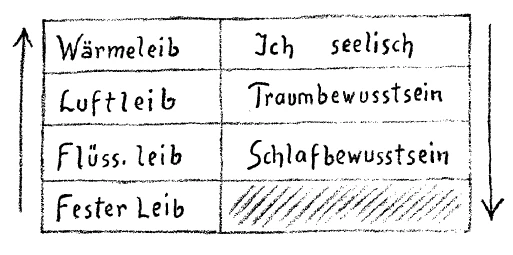
[ 27 ] Sie sehen, ob wir den Menschen innerlich oder äußerlich betrachten, wir kommen zu einer immer weiteren Anschauung über die menschliche Wesenheit. Gehen wir vom festen Leib aus zum Flüssigkeitsleib, zum Luftleib, zum Wärmeleib, wir kommen ins Seelische hinein. Gehen wir von dem klaren Tagesbewußtsein aus zum Traumbewußtsein über, wir kommen in den Leib hinein. Und wir kommen noch gründlicher in den physischen Leib hinein, indem wir uns darinnen wissen durch das traumlose Schlafbewußtsein. Wenn wir das Wachbewußtsein hinuntertragen bis zum Schlafbewußtsein, so kommen wir, wenn wir den Menschen in den Gliedern seines Bewußtseins betrachten, in die Leiblichkeit hinein. Wenn wir die Leiblichkeit selbst betrachten, von ihrem festen Zustand bis zu ihrem Wärmezustand herauf, kommen wir aus der Leiblichkeit heraus. Das liefert Ihnen die Notwendigkeit, wirklich nicht einfach hinzunehmen, was sich zunächst der befangenen äußeren Betrachtung darbietet. Da hat man auf der einen Seite den festen Leib, an den man sich mit der materialistisch-mechanistischen Vorstellung klammert; da haben wir auf der anderen Seite das Seelische, das eigentlich dem modernen Bewußtsein nur inhaltsvoll erscheint als das helle klare Tagesleben. Man geht nicht von diesem Bewußtsein (Ich) nach abwärts; denn geht man nach abwärts, kommt man in den Leib hinein. Man geht nicht vom geistigen Leib (Wärmeleib) nach abwärts; denn geht man nach abwärts, so kommt man in den festen Leib hinein. Sondern man betrachtet die zwei, die gar nicht zusammengehören: den festen Leib ohne den Flüssigkeitsleib, den Luftleib und den Wärmeleib; das klare Tagesbewußtsein ohne dasjenige, was eigentlich nur das innere Leibliche spiegelt, ohne das Traumbewußtsein und das Schlafbewußtsein.
[ 27 ] You see, whether we consider human beings from the inside or the outside, we arrive at an ever broader understanding of the human being. If we move from the solid body to the liquid body, to the air body, to the warmth body, we enter into the soul. If we move from clear waking consciousness to dream consciousness, we enter into the body. And we enter even more deeply into the physical body by knowing ourselves to be within it through dreamless sleep consciousness. If we carry waking consciousness down to the state of sleep, then—when we consider the human being through the stages of his consciousness—we enter into physicality. If we consider physicality itself, moving upward from its solid state to its state of warmth, we emerge from physicality. This shows you the necessity of not simply accepting what initially presents itself to a biased external observation. On the one hand, there is the solid body, to which one clings with a materialistic-mechanistic conception; on the other hand, there is the soul, which to modern consciousness actually appears meaningful only as the bright, clear life of the day. One does not descend from this consciousness (the “I”); for if one descends, one enters the physical body. One does not descend from the spiritual body (the body of warmth); for if one descends, one enters the solid body. Rather, one considers the two that do not belong together at all: the solid body without the fluid body, the air body, and the warmth body; the clear waking consciousness without that which actually only reflects the inner physical, without dream consciousness and sleep consciousness.
[ 28 ] Und jetzt geht man von der Schulpsychologie aus und fragt: Wie lebt dieses Seelisch-Geistige in dem Physischen? — Ja, sehen Sie, da macht man eigentlich dieses. Bedenken Sie: Man hat den festen Leib, den Flüssigkeitsleib, den Luftleib, den Wärmeleib. Durch den Wärmeleib entwickelt das Ich das gewöhnliche klare Tagesbewußtsein. Aber geht man herunter, so kommt man in das Traumbewußtsein hinein; weiter hinunter kommt man in das traumlose Schlafbewußtsein hinein. Da hinunter (schraffiert) gibt es, wie Sie aus der «Geheimwissenschaft im Umriß» wissen, noch einen Bewußtseinszustand, den wir jetzt nicht zu betrachten brauchen. Fragt man nun nach der Beziehung dessen, was hier rechts steht, zu dem, was hier links steht, so passen diese ineinander, denn da (linker Pfeil) kommt man von unten nach oben gehend ins Seelische herein, ins Leibliche herein hier (rechter Pfeil); das Rechte und das Linke, die passen zusammen. Aber in der äußeren Betrachtungsweise ist es heute so, daß man den festen Leib eigentlich nur ins Auge faßt und wiederum nur diesen Bewußtseinszustand (Ich). Ja, da hängt das (Ich) in der Luft, und das (Fester Leib) steht am Boden, da findet man keine Beziehung. Und lesen Sie die heutigen Seelenlehren durch, so werden Sie sehen, daß die unglaublichsten Hypothesen aufgestellt werden, wie die Seele auf den Leib wirkt. Aber das rührt nur davon her, daß man einen Teil des Leibes betrachtet, und dann etwas, das ganz davon abliegt, einen Teil des Seelischen betrachtet.
[ 28 ] And now, starting from educational psychology, one asks: How does this soul-spiritual aspect live within the physical? — Yes, you see, that’s actually what one does. Consider this: We have the solid body, the fluid body, the air body, and the warmth body. Through the warmth body, the “I” develops ordinary, clear daytime consciousness. But if one goes down, one enters the dream state; further down, one enters the dreamless sleep state. Down there (hatched area), as you know from An Outline of Esoteric Science, there is yet another state of consciousness that we need not consider now. If one now asks about the relationship between what is on the right here and what is on the left here, they fit together, for there (left arrow) one enters the soul from below, moving upward, and enters the physical body here (right arrow); the right and the left fit together. But in today’s external way of looking at things, people actually focus only on the physical body and, in turn, only on this state of consciousness (the “I”). Indeed, the “I” hangs in the air, and the physical body stands on the ground; no connection is found between them. And if you read through today’s teachings on the soul, you will see that the most incredible hypotheses are put forward about how the soul acts upon the body. But this stems solely from the fact that one considers one part of the body, and then something entirely separate from it—a part of the soul.
[ 29 ] Daß Geisteswissenschaft überall auf Totalität dringen muß, daß sie tatsächlich die Brücke schaffen muß zwischen dem Leiblichen auf der einen Seite und dem Seelischen auf der anderen Seite, daß sie wirklich diejenigen Zustände aufsucht, wo das Seelische ein Leibliches, das Leibliche ein Seelisches wird, das ärgert unsere Zeitgenossen, die durchaus nur stehenbleiben wollen bei dem, was sich der äußerlichen befangenen Betrachtungsweise darbietet.
[ 29 ] The fact that spiritual science must strive for totality in all things, that it must truly build a bridge between the physical on the one hand and the psychological on the other, that it genuinely seeks out those states in which the psychological becomes physical, and the physical becomes a psychological—this irritates our contemporaries, who are determined to remain solely with what presents itself to an outward, biased mode of observation.
[ 30 ] Von diesen Dingen wollen wir dann morgen weiter sprechen.
[ 30 ] We'll talk more about these things tomorrow.