The Bridge Between the Spiritual and
Physical Realms of Human Beings
GA 202
18 December 1920, Dornach
Translated by Steiner Online Library
Eleventh Lecture
[ 1 ] Yesterday I tried to say a few things about the overall constitution of the human being, so that it would be possible to draw attention to this point at the end. How, through a proper, comprehensive view of human nature, a bridge can be built between what we find in human beings as external organization and what we develop within ourselves through self-consciousness. This bridge is usually not built at all, or only in a very inadequate way—particularly by contemporary external science. And we have seen that, in order to build this bridge, one must be clear about how to view the human organism. We saw that everything that is actually considered today—at least what is seriously regarded as organized by external science—namely, the solid or solid-liquid, must be regarded solely as a single organism; but that we must equally acknowledge a liquid organization, an air-like organization, and a thermal organization. This enables us to understand how those aspects of the human being that we are accustomed to regarding as such interact with this finer organization. Of course, everything up to and including warmth is the physical body. But the etheric body primarily interacts with the liquid body—with everything in the organism that is organized as liquid; the astral body primarily interacts with everything organized as air, and the ego primarily interacts with everything organized as warmth. In this way, we are able, so to speak, to remain within the physical realm while, within that physical realm, ascending into the spiritual.
[ 2 ] On the other hand, we have considered consciousness. As I said yesterday, people usually focus only on the consciousness we experience in the state that spans from waking up to falling asleep. In that state, we perceive the objects around us, process them with our intellect, form feelings about them, and act on our impulses of will; but we experience this entire complex of consciousness as something whose characteristics are entirely different from all the physical phenomena that external physical science considers on its own. And it is not easy to build a bridge between these entirely non-physical experiences that we have in consciousness and the other phenomena, the other objects of perception, that are studied through physical physiology or physical anatomy. But even with regard to consciousness, we are already familiar in ordinary life—besides ordinary waking consciousness—with dream consciousness, and we explained yesterday how dreams are essentially images or symbols of inner organic processes. Something is always going on within us, and what is happening there is expressed figuratively in dreams. We dream, as I said, of snakes writhing when we have some kind of pain in our intestines; we dream of a boiling stove and wake up afterward with a pounding heart; the boiling stove symbolized our irregular heartbeat, the snakes symbolized our intestines, and so on. The dream directs our attention down into our organism, and consciousness during sleep is dull; it is, so to speak, essentially a “zero experience” for the human being. But yesterday I explained how one must have this “zero experience” in order to feel connected to one’s physicality. One would not feel connected to one’s physicality as “I” if one did not leave the body, return to it upon waking, and in this way—precisely through the sense of absence experienced between falling asleep and waking—feel at one with one’s body. There, we are led by ordinary consciousness—which, after all, has nothing to do with ourselves other than providing us with perception and imagination—into dream consciousness, which has to do with what is already within the body. We are thus led toward the body. And we are led even more toward the body when we enter the dreamless state of sleep. So we can say: On the one hand, we regard the soul in such a way that it leads us toward the body. And we regard the physical in such a way that, as it manifests through the organization of the fluid, the organization of the airy, and the organization of warmth—that is, as the organization becomes ever more refined—it leads us toward the soul. — These things must certainly be taken into consideration if one wishes to arrive at a worldview that truly satisfies human beings.
[ 3 ] The big question that has been occupying us for weeks now—and as we have repeatedly tried to recognize—is, first and foremost, the cardinal question of the human worldview: How are morality and the moral world order related to the physical world order? We have often said: The current worldview, which relies on the natural sciences for the external sensory world, and which—when it comes to a comprehensive understanding of the soul (for psychology no longer encompasses such a thing)—can only take refuge in the older religious creeds, this worldview contains no bridge. On the one hand, there is the physical world. According to this worldview, it emerged from a primordial nebula. Everything coalesced from it; and everything will return to a kind of cosmic slag. This is the external picture presented to us by the current scientific paradigm within this entire process of becoming—which, if one is honest as a scientist of our time, ultimately appears to be the only reality. Within this picture, the moral—the moral world order—has no place. It then stands on its own. Human beings receive moral impulses in their souls as soul impulses. But if things are as natural science says, then everything that moves and lives—and ultimately human beings—has emerged from the primordial nebula, and moral ideals arise within human beings. And once the world is said to have returned to a state of waste, that will be the great graveyard for all moral ideals as well. They will have vanished. A bridge cannot be built at all, and what is even worse, unless humanity becomes inconsistent, the true morality of the world order cannot even be acknowledged by today’s science. Only when this science is inconsistent does it allow the moral world order to hold. But if it is consistent, it cannot actually do so. All of this stems from the fact that, on the one hand, we essentially have only a kind of anatomy of the solid; we do not take into account that human beings also carry within themselves an organization of the fluid, an organization of the gaseous, and indeed even an organization of the thermal. If you imagine that, just as you possess within yourself—for the sake of argument—the organization of the solid, configured into bones, muscles, and nerve strands, you also possess an organization of the fluid, of the airy—albeit fluctuating and mobile within you—and then again an organization of the warm, you will be better able to understand what I now have to present based on observations from the spiritual sciences.
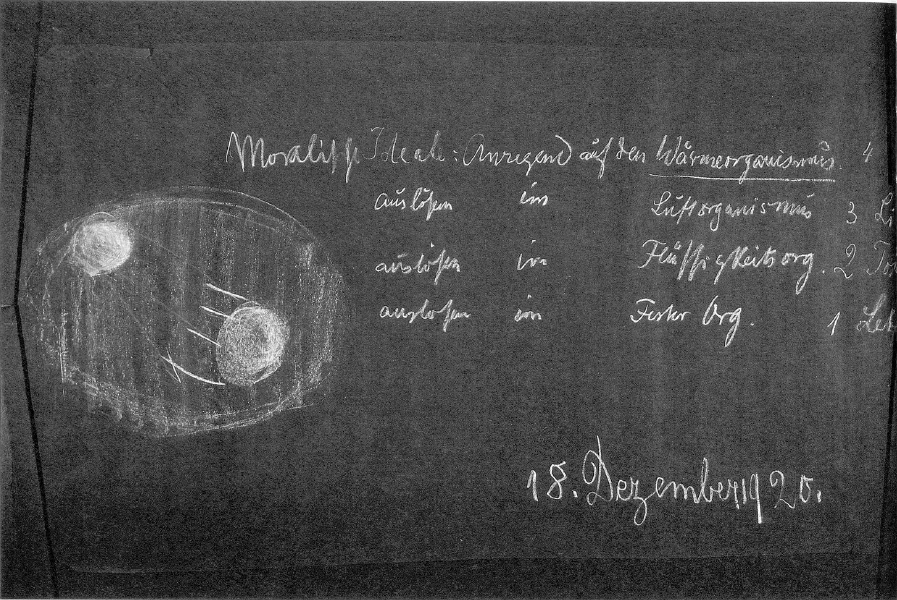
[ 4 ] Let us imagine, for a moment, that a person becomes inspired by a lofty moral ideal. A person can truly feel an inner, spiritual enthusiasm for a moral ideal—for the ideal of benevolence, for the ideal of freedom, the ideal of goodness, love, and so on. In specific situations, they can be inspired by what these ideals represent. But of course, no one can imagine that what is happening in the soul as enthusiasm actually penetrates into the bones or muscles—as bones or muscles are understood by modern physiology or anatomy. But if you simply consult your inner self properly, you will realize that you can very well imagine—and it is indeed the case—that when a person is inspired by a lofty moral ideal, this inner enthusiasm exerts an influence on the thermal organism. And then the spiritual has already penetrated into the physical realm! So that we can say, taking this example: Moral ideals express themselves through an increase in warmth within the thermal system. — A person does not merely become warmer in their soul; a person—even if this is not easily measurable with any physical instrument—truly becomes warmer on the inside through the moral ideals they experience. So it has a stimulating effect on the thermal organism.
[ 5 ] You must now imagine this as a concrete process: enthusiasm for a moral ideal: the revitalization of the thermal organism. — The thermal organism becomes more lively when a moral ideal sets the soul ablaze. But this also has an effect on the rest of the human organism. In addition to the thermal organism—which is, in a sense, the human being’s highest physical organism—the human being also has the air organism. He inhales air, he exhales air; but during inhalation and exhalation, the air is within him. It is, of course, in internal motion, in fluctuation; but this, too, is an organism—a real respiratory system that lives within him, just as the thermal system does. Now, as the thermal system is enlivened by a moral ideal, it in turn acts upon the respiratory system, since heat is active throughout the entire organism, in all systems. This effect on the air organism, however, is not merely one of warming; rather, when the heat—which becomes active within the heat organism—acts upon the human air organism, it imparts to it what I can only describe as a source of light. In a sense, seeds of luminosity are imparted to the air organism, so that moral ideals, which have a stimulating effect on the warmth organism, trigger sources of light in the air organism. These sources of light do not, however, appear luminous to the outer consciousness or to outer perception; rather, they appear in the human astral body. They are initially bound—if I may use this physical term—by the air itself that the human being carries within. They are, so to speak, still dark light, just as the plant seed is not yet the fully developed plant. But by being able to be inspired by moral ideals or moral processes, the human being carries a source of light within.
[ 6 ] Another organism within us is the fluid organism. As heat acts within the heat organism and—proceeding from the moral ideal—triggers within the air organism what might be called a source of light, which initially remains bound and hidden, what I spoke of yesterday—that which actually underlies external air sounds—is set in motion within the fluid organism, because, as I said, everything in the human organism communicates with one another. Air is, after all, merely the body of sound, as I said yesterday, and anyone who seeks the essence of sound in the vibrations of air and speaks of nothing else is speaking of sound in the same way one speaks of a human being when referring only to the outer, visible body. Air, with its vibrating waves, is nothing other than the outer body of sound. In human beings, this sound—this spiritual sound—is not triggered in the air organism, but rather in the fluid organism through the moral ideal. So this is where the sources of sound are triggered. And in a sense, we regard the solid organism as the most solid of all, the one that supports and sustains all the other organisms. Something is also triggered within it, just as in the other organisms; only in the solid organism is that which we might call the life germ triggered—but an etheric life germ, not a physical life germ, as the latter is then separated from the human female organism through birth; rather, it is the etheric life germ that is separated. That which lives there as the etheric life germ is, after all, deep down in the subconscious; indeed, it is the very source of sound, and in a certain sense even the source of light. This is hidden from ordinary consciousness, but it is within the human being.
[ 7 ] Imagine everything you have experienced in life in terms of your soul’s turning toward moral ideas—whether you found these moral impulses appealing simply by grasping them as ideas, or whether you observed them in others, or whether you were able to find a certain inner satisfaction in your own actions by allowing them to be imbued with moral ideals—all of this flows down into the air organization as a source of light, into the liquid organization as a source of sound, and into the solid organization as a source of life. All of this detaches itself, in a certain sense, from what is conscious in the human being. But the human being carries it within. It becomes free when the human being sheds their physical organization at death. What is thus triggered through our moral ideals—what is triggered precisely by the purest ideas in our organization—does not bear fruit at first. It is precisely the moral ideas themselves that become fruitful for life between birth and death, insofar as we remain in the life of ideas and derive a certain satisfaction from what we have accomplished morally. But this has to do solely with memory; it has nothing to do with what is pushed down into the organism by our finding moral ideals appealing.
[ 8 ] So here we see how our entire being, starting with our thermal organism, is in fact permeated by moral ideals. And when, upon death, we separate our etheric body, our astral body, and our “I” from our physical body, we are then, in these higher aspects of human nature, permeated by the impressions we have experienced. We were present with our “I” in our thermal organism, where moral ideals animated our own thermal constitution. We were in our air organism, where sources of light were planted that now, after our death, go out into the cosmos with us. In our liquid organism, we have stirred up the sound that becomes the music of the spheres, with which we resonate out into the cosmos. We carry life out as we pass through the gate of death.
[ 9 ] At this point, you begin to sense what life—which has been poured out into the world—actually is. Where are the sources of life? They lie in that which inspires the moral ideals that have an uplifting effect on human beings. We come to the realization that when we allow ourselves today to be consumed by moral ideals, these ideals carry forth life, sound, and light and become world-creating. We carry forth that which is world-creating, and the source of the world-creating is the moral.
[ 10 ] You see, when we consider the whole human being, we find a bridge between moral ideals and that which, out there in the physical world, has a vitalizing—and even chemical—effect. For it is sound that has a chemical effect, bringing substances together and breaking them down. And the radiance in the world has its source in moral impulses, in the warmth-generating forces within human beings. We look into the future, where world forms are taking shape. And just as we must go back to the seed in the case of a plant, so too must we, in the case of the future worlds that will take shape, go back to the seeds that lie within us as moral ideals.
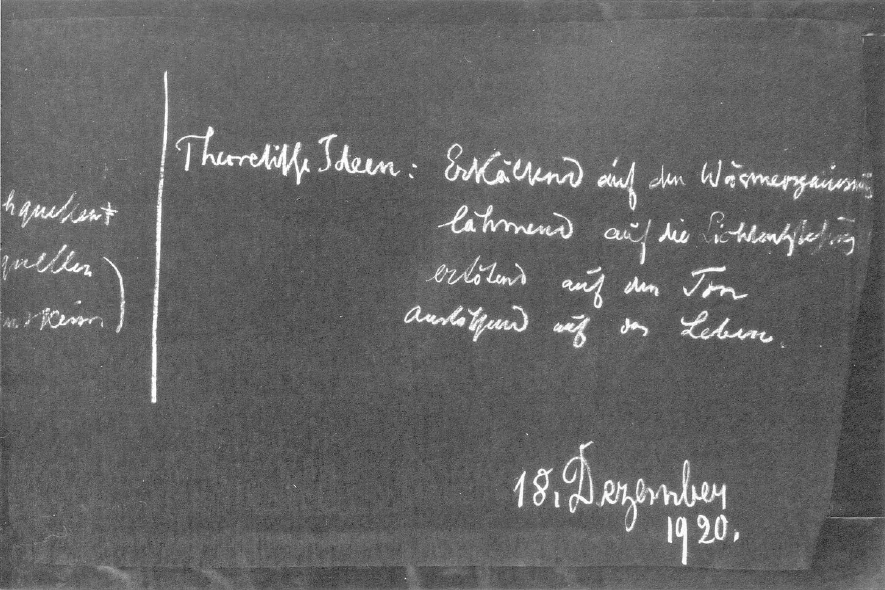
[ 11 ] Now consider theoretical ideas as opposed to moral ideals. With theoretical ideas—no matter how significant they may be—the situation is quite different. In the case of theoretical ideas, we actually observe a dampening, a cooling of the warmth-organism. So we must say: Theoretical ideas have a cooling effect on the warmth organism. — That is the difference in their effect on the human organism. Moral ideas, or those aligned with the moral-religious, the ones that fill us with enthusiasm by becoming impulses for our actions—they have a world-creating effect in this way. Theoretical ideas initially have a dampening, cooling effect on the warmth organism. Because they have a cooling effect on the warmth organism, they also have a paralyzing effect on the air organism and on the source of light, on the generation of light. They further have a destructive effect on the world tone, and they have an extinguishing effect on life. That which was created in the pre-world comes to an end within our theoretical ideas. As we conceive theoretical ideas, a world-universe dies within them. We carry within us the dying of a world-universe; we carry within us the dawning of a world-universe.
| Moral ideals: | Theoretical ideas: | |
|---|---|---|
| stimulating to the heat organism | (4) | cooling effect on the heat organism |
| triggering effect in the air organism | (3) | paralyzing effect on light generation and light sources |
| stimulating in the liquid organism | (2) | killing the clay and clay sources |
| triggering in the solid organism: seeds of life (etheric) | (1) | extinguishing life |
[ 12 ] This is also the point where one who is initiated into the mysteries of the world cannot speak, as so many do today, of the constancy of force or the constancy of matter. It is simply not true that matter remains constant. Matter decays down to zero. Force decays down to zero within our own organism through our theoretical thinking. And we would not be human beings if we did not think theoretically, if the universe did not continually die within us. It is through the dying of the universe that we are, in fact, self-conscious human beings capable of thinking about the universe. But as the universe thinks itself within us, it is already a corpse. The thought about the universe is the corpse of the universe. Only as a corpse does the universe become conscious to us and make us human. A past world, then, dies within us down to its matter, down to its force. And only because a new one immediately dawns again do we fail to notice that matter perishes and is reborn. In human beings, materiality is brought to an end through their theoretical thinking; materiality and the power of the universe are revitalized through their moral thinking. Thus, what takes place within the human body intervenes in the passing away and the arising of worlds. Thus, the moral and the natural are interwoven. The natural passes away within the human being; within the moral, a new natural arises.
[ 13 ] Because people did not want to face these realities, they invented the ideas of the immortality of matter and energy. If energy were immortal, if matter were immortal, there would be no moral world order. People simply want to conceal this today, and today’s worldview has every reason to do so, for it would actually have to abolish the moral world order—and it is abolished when one speaks of the law of conservation of matter and energy. For if matter is somehow conserved, if energy is somehow conserved, then the moral world order is nothing more than an illusion, a figment of the imagination. It is only by realizing how new worlds arise from this “illusory construct”—which is what it is at first, since it exists in thought—of the moral world order that one comes to understand the entire course of the world. But all this does not become apparent by considering only the solid components of the human organism; rather, it becomes apparent when one moves outward through the fluid and air organisms to the heat organism. One can only understand the connection between the human being and the world by, so to speak, tracing the physical realm to that point of refinement and dilution where the soul can directly intervene in this diluted physical realm, as in the case of heat. Only then does one find the connection between the physical and the soul. No matter how many works on psychology or the study of the soul are written: if they proceed from what is currently considered in anatomy and physiology, one will not be able to find a transition from these bodies—conceived as solid or solid-liquid, soft-solid—to the soul, which does not appear to be spiritual at all. But if one traces the physical back to heat, then one will be able to build a bridge from what exists in the bodies as heat to that which acts from the soul into the heat of one’s own human organism.
[ 14 ] Heat is external to the body; heat is internal to the human organism; and because heat itself is organized within the human being, the soul—the soul-spiritual—intervenes in this heat organism, and indirectly, through heat, everything we experience internally on a moral level takes effect. Of course, by “moral” I do not mean only what the philistine imagines “moral” to be, but rather the totality of all that is moral—including, for example, those impulses we gain when we contemplate the splendor of the cosmos and say to ourselves: ‘We were born out of the cosmos; we are responsible for what happens in the world,’ and when we allow ourselves to be inspired to work toward the future based on the insights of spiritual science. — And when we regard spiritual science itself as a source of morality, then we can be most inspired by that which is moral; then such inspiration, arising from spiritual scientific insight, will at the same time be a source of morality in the higher sense. But what is usually called “moral” is only a subdivision of morality in general. All the ideas we form about the external world—about pre-existing natural arrangements—are theoretical ideas. No matter how strongly we may imagine a machine in mathematical-mechanical terms, or how strongly we may imagine the universe in the sense of the Copernican system, what we gain as theoretical ideas is a force of death within us; it is the corpse of the entire universe within us as thought, as conception.
[ 15 ] These things provide an ever-deepening insight into the whole, into the total world. And there are not two orders—a natural order and a moral order—existing side by side; rather, both are one, and that is what people today need; otherwise, they will always stand there and say: “What am I to do with my moral impulses in a world that has only a natural order?” — That was, after all, the question that weighed so heavily on the minds of the 19th century and the early 20th century: How is a transition conceivable from the natural to the moral, and from the moral to the natural? — Nothing other than a humanities-based understanding of both nature on the one hand and the spirit on the other will be able to contribute to the solution of this anxious, fateful question.
[ 16 ] If one possesses the prerequisites that arise from such insights, then one will now be able to use them to counter what, in certain fields, appears to be “external science”—and which has, in fact, already found its way into popular consciousness. We must regard the Copernican worldview as a foundation of our worldview today. This Copernican worldview—which Kepler later developed and Newton theorized—was, in fact, frowned upon by the Catholic Church until 1827. No orthodox Catholic was allowed to believe in it until then. Since then, Catholics have been permitted to believe in it. But it has become so deeply ingrained in popular consciousness that, naturally, anyone today who did not view the world in accordance with this Copernican worldview would be considered a fool.
[ 17 ] What is this Copernican worldview? It is, in fact, something that is based solely on mathematical principles and concepts—on mathematical-mechanical concepts, we might say. And we can then compare this worldview—which gradually took shape within the Greek worldview, which still retained remnants of earlier schools of thought, for example in the Ptolemaic worldview, but which then developed further into what is taught to every child today as the Copernican worldview—we can look back from this worldview to the ancient times of humanity. There we find a different worldview. All that remains of it today are the traditions that preserve it—traditions that, as they exist among people today, are based on a rather amateurish foundation, such as astrology and the like. These are remnants of ancient astronomy, or perhaps what has also survived is what has become ossified and rigid in the symbols of certain secret societies, Masonic lodges, and the like. People generally do not realize that these are remnants of ancient astronomy. But it was a different kind of astronomy; it was an astronomy that was not built on purely mathematical principles in the same sense as modern astronomy is, but rather this ancient astronomy had arisen from ancient clairvoyant insights. Today, people have completely false ideas about the way in which ancient humanity arrived at its astronomical and astrological concepts. It arrived at them through certain instinctive, clairvoyant perceptions of the universe. The oldest post-Atlantean peoples perceived spiritual forms and spiritual beings in the celestial bodies just as modern humans see mere physical forms in them today. When ancient peoples spoke of celestial bodies, planets, or fixed stars, they were speaking of spiritual beings. Today, people imagine that the Sun is some kind of burning ball of gas, and that it radiates light into the world simply because it is a burning ball of gas. The ancient peoples imagined that the sun was a living being, and what appeared to their eyes as the sun was, in essence, merely the outer physical expression of this spiritual being they supposed to exist out there where the sun stands; the same was true for the other celestial bodies. They saw spiritual beings. We must imagine that there was a time—which had already come to an end quite a long time before the Mystery of Golgotha took place—when everything out there in the universe, whether a sun or the stars, was conceived of as a spiritual being; that then, I would say, there was an interim period when people did not quite know how to conceive of these things—a time when, on the one hand, they certainly regarded the planets as something physical, yet imagined them to be animated by souls. In those times, when people no longer knew how the physical gradually transitions into the spiritual, how the spiritual gradually transitions into the physical, and how, fundamentally, the two are one, they posited the physical on the one hand and the spiritual on the other. And people conceived of them in the same way that most psychologists still do today—if they assume the existence of a spiritual realm at all—by conceiving of the spiritual and the physical in human beings as a single entity, which of course leads to nothing other than absurd thinking; or as psychophysical parallelism assumes, which in turn is nothing other than a foolish means of explaining something that is unknown.
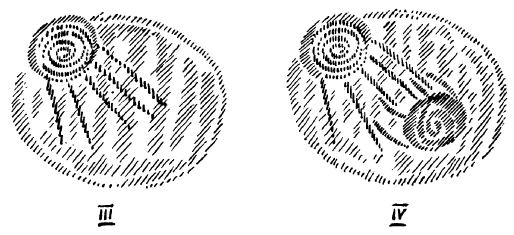
[ 18 ] Then came the time when the celestial bodies were viewed as physical entities that orbit or remain stationary according to mathematical laws, attracting and repelling one another, and so on. However, throughout the ages—more instinctively in earlier times—there has been a knowledge of how things really are. Now it is the case that this instinctive knowledge is no longer sufficient; what was once known instinctively must now be attained through full consciousness. And if we ask how those who were able to perceive the universe in its entirety—that is, through physical, soul, and spiritual perception—imagined the sun, we might say something like this: They initially imagined the sun as a spiritual being (Drawing I). The initiates conceived of this spiritual being as the source of all morality. This is, in other words, what I referred to in my Philosophy of Freedom when I said that moral intuitions are drawn from this source; they are drawn from within the Earth; they shine forth from human beings, from that which can live within them as moral enthusiasm (II).
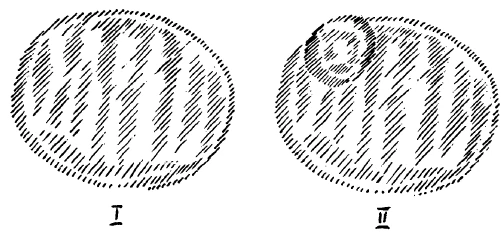
[ 19 ] Just think how our responsibility increases when we realize: If there were no one on Earth whose soul could burn with passion for true, genuine morality or spiritual ideals of any kind, we would not be contributing to the continuation of our world, to a new creation, but rather to the demise of our world. This radiant power (Drawing III), which is here on Earth, extends out into the universe. However, it is initially imperceptible to ordinary human perception—the way in which what lives as morality within human beings radiates out from the Earth. Indeed, if a sorrowful age were to descend upon the entire Earth, in which millions upon millions of people would perish in spiritual darkness—the spiritual, including the moral, being considered here at the same time, for that is indeed the case—then, if there were only a dozen people with bright moral and spiritual enthusiasm, the Earth would still shine with a spiritual, sun-like radiance. That which radiates from them shines only to a certain distance. At this distance, it is reflected, as it were, within itself, and here the reflection of that which radiates from the human being arises. And this reflection was regarded by the Initiates of all ages as the sun. For there is nothing physical there; I have often said so. Where external astronomy speaks of a glowing ball of gas, there is only the reflection of a spiritual reality that appears physical (IV).
[ 20 ] You can see how far the Copernican worldview—and ultimately, ancient astrology as well—are removed from what, in turn, was the mystery of initiation. How these things are connected is perhaps best illustrated by the fact that, at a time when certain groups of people already wielded great power—people who considered such truths, as they put it, dangerous to the masses and did not wish to share them—at such a time, an idealist like Julian, who was therefore called the “Renegade,” wanted to reveal them to the world and was subsequently killed in a roundabout way. There are indeed reasons that prompt certain secret societies not to reveal the profound mysteries of the world, because doing so allows them to exercise a certain power. If, in Emperor Julian’s time, certain secret societies guarded their secrets so fiercely that they had Julian killed, then we need not be surprised if the guardians of certain secrets—who do not reveal them but rather wish to keep them hidden from the masses in order to consolidate their power—resent it when even the beginnings of certain secrets are now being unveiled. And here you can probably see some of the deeper reasons why such terrible hatred is rising in the world against that which spiritual science feels obligated to bring to humanity at the present time. But we live in a time when either earthly civilization will perish, or humanity will be granted access to certain secrets: these things that, in a certain sense, have been guarded as secrets until now—secrets that once came to humanity through instinctive clairvoyance, but which must now be regained through fully conscious perception not only of the physical, but also of the spiritual that is within it! What, after all, did Julian the Apostate want? He wanted to make people understand: You are becoming more and more accustomed to seeing only the physical sun; but there is a spiritual sun, of which the physical sun is merely a mirror! — He wanted, in his own way, to reveal the mystery of Christ to the world. But people want to conceal the connections between Christ—the spiritual sun—and the physical sun. That is why certain people in power become most furious when the mystery of Christ is spoken of in connection with the mystery of the sun. Then all manner of slanders are brought forth. But you see, spiritual science is an important matter in the present age. Only those who regard it as an important matter treat it with the full seriousness it deserves.