The Bridge Between the Spiritual and
Physical Realms of Human Beings
GA 202
19 December 1920, Dornach
Translated by Steiner Online Library
Twelfth Lecture
[ 1 ] Human beings stand in the world, on the one hand, as observers, and on the other hand, as agents; in between, they stand with their feelings. On the one hand, with their feelings, they are devoted to whatever presents itself to their observation; on the other hand, with their feelings, they are also involved in their actions. One need only consider how a person can be satisfied or dissatisfied with what they succeed or fail to achieve as an agent; one need only consider how, ultimately, all action is accompanied by emotional impulses, and one will see that, in fact, our emotional nature connects these two opposing poles: the observing element within us and the acting element within us. It is only because we are contemplative beings that we become truly human in the fullest sense of the word. You need only consider how everything that ultimately gives you the awareness that you are human is connected to the fact that you can, in a sense, internally represent and contemplate the world that surrounds you and in which you live. To think that we cannot observe the world would mean that we would have to renounce our entire humanity. As active human beings, we are immersed in social life. And, fundamentally, everything we accomplish between birth and death has a certain social significance.
[ 2 ] Now you know that, insofar as we are contemplative beings, thought lives within us; insofar as we are acting beings—and thus also insofar as we are social beings—the will lives within us. However, it is not the case in human nature—just as it is not the case in reality at all—that one can intellectually set things side by side; rather, what is active in being can be characterized from one perspective or another; things flow into one another, the forces of the world flow into one another. We can imagine, through thought, that we are beings of thought; we can also imagine, through thought, that we are beings of will. But even when we live contemplatively in thought, amid complete external stillness, the will within us is nevertheless constantly at work. And conversely, when we are acting, thought is at work within us. It is unthinkable that anything should emanate from us as an action, that anything should spill over into social life, without our identifying mentally with what is happening. In everything of a volitional nature, the thought-like lives; in everything of a thought-like nature, the volitional lives. And it is absolutely necessary to gain clarity precisely about the matters at hand here if one seriously wishes to build that bridge—of which I have already spoken so often here—the bridge between the moral-spiritual world order and the physical-natural order.
[ 3 ] Imagine for a moment that, in the sense of the ordinary sciences, you lived for a while in a purely contemplative state; you did not get excited at all; you refrained entirely from any action; you simply lived a life of imagination. But you must realize that in this life of imagination, the will is at work—a will that, admittedly, operates within you and exerts its power in the realm of imagination. Precisely when we observe the thinking human being in this way—as he continually infuses his thoughts with the will—one thing in particular must strike us in contrast to real life. The thoughts we form—if we go through them all—we will always find that they are connected to something in our surroundings, to something among our experiences. Between birth and death, we have, so to speak, no thoughts other than those that life brings us. If our experience is rich, then our thoughts are rich; if our experience is poor, then our thoughts are poor. The content of our thoughts is, in a sense, our inner destiny. But within this experience of thinking, there is one thing that is entirely our own: the way in which we link thoughts together and separate them from one another, the way in which we process thoughts internally, how we judge, how we draw conclusions, how we orient ourselves in our life of thought—that is ours, it is unique to us. The will in our life of thought is our own.
[ 4 ] When we look at this inner life of thought, we must admit—especially upon careful self-examination, and you will see that this is indeed the case upon careful self-examination—that the content of our thoughts comes to us from the outside, while the processing of those thoughts originates within us. — We are therefore, in essence, entirely dependent—with regard to our world of thought—on what we can experience through the birth into which we are fated to be placed, through the experiences that may befall us. But into what comes to us from the outside world, we infuse our own essence precisely through the will that radiates from the depths of the soul. It is of great significance for the fulfillment of what self-knowledge demands of us as human beings that we distinguish between, on the one hand, how the content of our thoughts comes to us from our surroundings, and, on the other hand, how the power of the will—which comes from within—radiates from our inner being into the world of thought.
[ 5 ] How does one actually become more and more spiritual on the inside? One does not become more spiritual by absorbing as many thoughts as possible from the environment, for these thoughts merely reflect—I would say—the external world, which is a sensory-physical one, in images. By chasing after the sensations of life as much as possible, one does not become more spiritual. One becomes more spiritual through inner, will-driven work within one’s thoughts. That is why meditation consists not in indulging in arbitrary mental games, but in bringing a few, easily graspable, easily verifiable thoughts into the center of one’s consciousness—and doing so with a strong will. And the stronger, the more intense this inner radiance of the will becomes in the realm where thoughts reside, the more spiritual we become. When we take in thoughts from the external physical-sensory world—and we can, after all, take in only such thoughts between birth and death—then, as you can easily see, we become unfree, for we are at the mercy of the interrelationships of the external world; we must then think as the outer world dictates, insofar as we focus solely on the content of the thoughts; it is only through inner processing that we become free.
[ 6 ] Now there is a way to become completely free—to become free in one’s inner life—by excluding, as much as possible, the content of thought insofar as it comes from outside, excluding it more and more, and by stimulating to a particular degree of activity the element of will that permeates our thoughts in judgment and reasoning. This, however, brings our thinking into the state that I have called “pure thinking” in my Philosophy of Freedom. We think, but only the will lives within that thinking. I emphasized this particularly strongly in the 1918 revised edition of Philosophy of Freedom. That which lives within us there lives in the sphere of thinking. But once it has become pure thinking, it is actually just as appropriate to speak of it as pure will. Thus, we ascend to rise from thinking to will when we become inwardly free—that is, when we, so to speak, bring our thinking to such a state of maturity that it is entirely permeated by the will, no longer taking in anything from the outside, but living precisely within the will. But precisely by strengthening the will within our thinking more and more, we prepare ourselves for what I have called “moral imagination” in The Philosophy of Freedom—which, however, rises to the level of moral intuitions that then permeate and infuse our will that has become thought, or our thought that has become will. In this way, we rise above physical-sensory necessity, are permeated by what is our own, and prepare ourselves for moral intuition. And everything that can initially fill a person from the spiritual world is based on such moral intuitions. Thus, it thrives on that which is freedom, precisely when we allow the will to become ever more powerful within our thinking.
[ 7 ] Let us consider the human being from the other pole—the pole of the will. When does the will appear particularly clearly before the eye of the soul through our actions? Well, when we sneeze, we are, so to speak, doing something, but we won’t be able to attribute a specific volitional impulse to ourselves when we sneeze. When we speak, we are indeed doing something in which the will is involved in a certain way. But just consider how, in speech, the voluntary and the involuntary, what is in accordance with the will and what is not, intertwine! You have to learn to speak, and you must learn to do so in such a way that you no longer have to form every single word through an act of will—so that, in a sense, something instinctive enters into your speech. This is at least the case in everyday life, and, fundamentally, it is especially true for those people who have little interest in spirituality. Chatterboxes, who, so to speak, must keep their mouths open constantly to say this or that—without much thought being put into it—let others notice—though they themselves do not realize it—just how much that which is instinctive and involuntary lies within their speech. But the more we move beyond our organic nature and transition to activity that is, in a sense, detached from the organic, the more we infuse our actions with thought. Sneezing is still entirely within the organic realm; speaking is largely within the organic realm; walking is already very little so; and what we do with our hands is also very little so. And so it gradually transitions into actions that are increasingly detached from the organic within us. We follow these actions with our thoughts, even if we do not know how the will intervenes in them. And unless we are sleepwalkers and act in that state, our actions will always be accompanied by our thoughts. We bring our thoughts into our actions, and the more our actions develop, the more we bring our thoughts into them.
[ 8 ] You see, we become more and more inward as we send our own power—our will—into our thinking, allowing the will, so to speak, to permeate our thinking entirely. We bring the will into our thinking and thereby attain freedom. We achieve this by increasingly training ourselves to carry our thoughts into our actions. We permeate our actions—which, after all, spring from our will—with our thoughts. On the one hand, inwardly, we live a life of thought; we permeate this with the will and thus find freedom. On the other hand, outwardly, our actions flow from us out of the will; we infuse them with our thoughts.
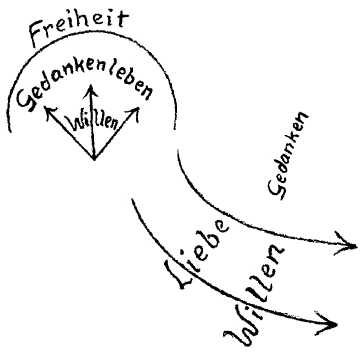
[ 9 ] But what is it that makes our actions increasingly refined? What is it—if we are to use this expression, which is certainly open to criticism—that leads us to ever more perfect action? — We arrive at ever more perfect action, in fact, by cultivating within ourselves that force which can be called nothing other than devotion to the external world. The more our devotion to the external world grows, the more this external world inspires us to act. But it is precisely by finding the way to be devoted to the external world that we come to imbue our actions with thought. What is devotion to the external world? Devotion to the external world—which permeates us and permeates our actions with thought—is nothing other than love.
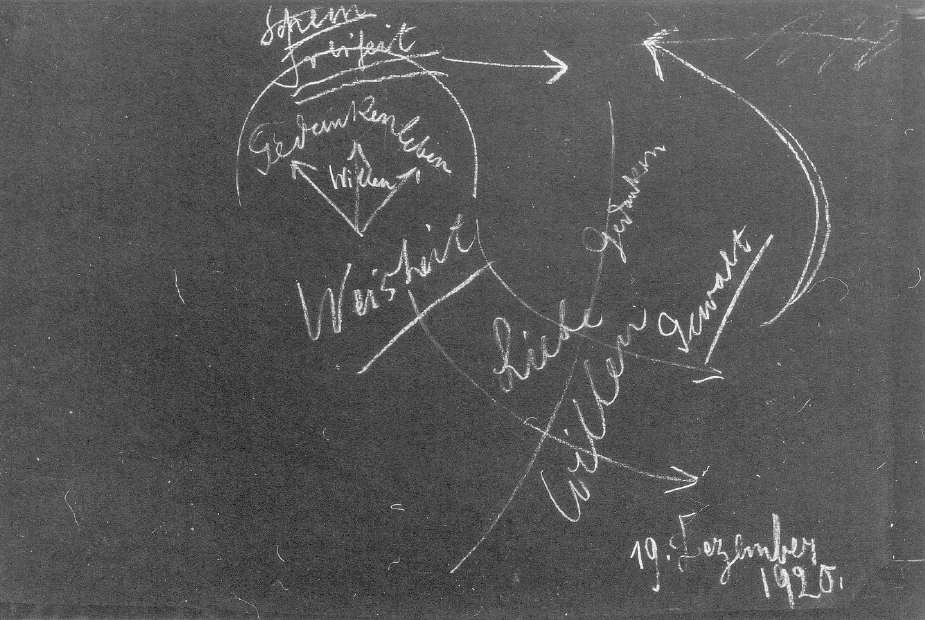
[ 10 ] Just as we attain freedom by infusing our life of thought with the will, so do we attain love by infusing our life of will with thought. We develop love in our actions by allowing thoughts to radiate into what is in accordance with the will; we develop freedom in our thinking by allowing what is in accordance with the will to radiate into our thoughts. And since we, as human beings, are a whole, a totality, when we come to find freedom in our life of thought and love in our life of will, freedom will be at work in our actions and love in our thinking. They permeate one another, and we carry out an action—a thoughtful action in love, a thinking imbued with will—from which, in turn, action in freedom springs forth.
[ 11 ] You can see how the two greatest ideals—freedom and love—converge within the human being. And freedom and love are also precisely what the human being, standing here in the world, can realize within himself in such a way that, in a sense, one is united with the other for the world through the human being himself.
[ 12 ] One must now ask: How, then, can the ideal—the highest—be attained in this life of thought permeated by the will? Indeed, if the life of thought were something that represented material processes, then it could never actually happen that the will would, so to speak, enter fully into the sphere of thought and that the volitional aspect would gain more and more ground within that sphere. Imagine if there were material processes—the will could, at most, radiate into these material processes in an organizing way. The will can be effective only if the life of thought as such has no external physical reality, if the life of thought is something devoid of external physical reality. So what must it be?
[ 13 ] Well, you’ll be able to understand what it must be like if you start with an image. If you have a mirror here and an object here—the object is reflected in the mirror—then you can go behind the mirror, but you’ll find nothing. You simply have an image. Our thoughts have this kind of image-like existence. How do they come to have such an existence? Well, you need only recall what I have told you about the life of thought. It is, after all, not really a reality in the present moment as such. The life of thought radiates in from our pre-birth existence—or, let’s say, from our existence before conception. Thought life has its reality between death and a new birth. And just as the object here stands before the mirror and only images come from the mirror, so what we develop as thought life is, in essence, lived quite realistically between death and the new birth and merely radiates into this life that we have been living since birth. As thinking beings, we have within us only a mirror-image reality. Consequently, the other reality—which, as you know, radiates precisely from our metabolism—can penetrate the mere mirror-image reality of our life of thought. One sees most clearly—if one wishes to develop unbiased thinking at all, which is, however, very rare today in this regard—that the life of thought has a mirror-image existence when one considers the purest form of thought: mathematical thought. This mathematical life of thought flows entirely from within us. But it has only a mirror-like existence. You can, of course, determine all external objects through mathematics; but the mathematical thoughts themselves are merely thoughts, and they have only an image-like existence. They are something that is not derived from any external reality.
[ 14 ] Abstract thinkers like Kant also use an abstract term. They say: Mathematical concepts are a priori. — A priori means: before anything else exists. But why are mathematical concepts a priori? Because they radiate from a pre-birth existence—or, more precisely, from an existence prior to conception; that is what constitutes their a priori nature. And the fact that they appear real to our consciousness stems from the fact that they are permeated by the will. This permeation by the will makes them real. Consider just how abstract modern thinking has become, using abstract words for something whose reality we simply cannot fathom. Kant, in a sense, sensed that we bring mathematics with us from our pre-birth existence, and that is why he called mathematical judgments a priori. But the term “a priori” says nothing more than that, for it does not point to any reality; it points merely to something formal.
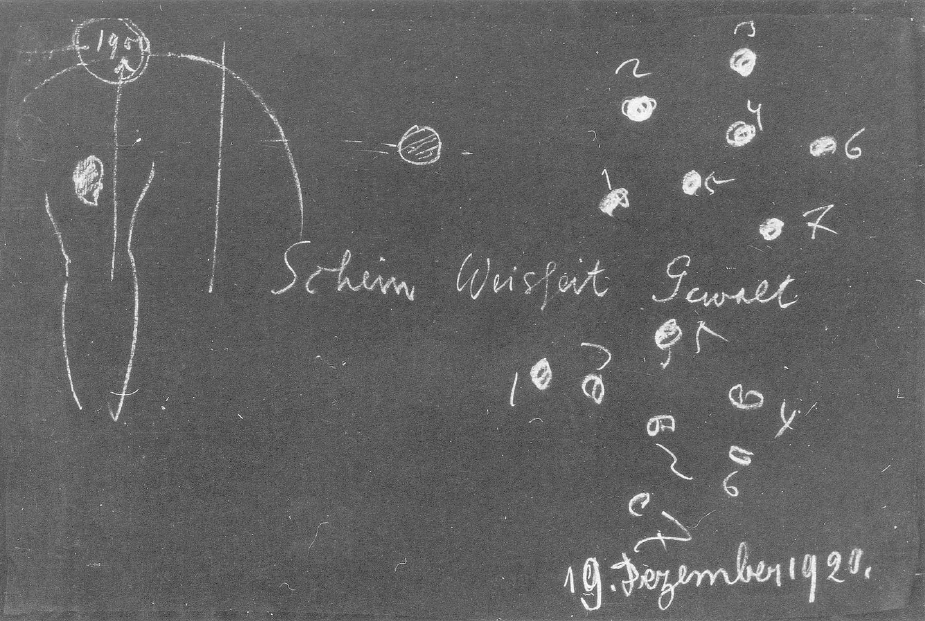
[ 15 ] Here, precisely in regard to what constitutes the life of thought—which, in its existence as an image, depends on being permeated by the will in order to become reality—ancient traditions speak of illusion (see drawing on page 209).
[ 16 ] Let us look at the other pole of the human being, where thoughts radiate toward the realm of the will, where things are accomplished in love: there, our consciousness, as it were, bounces off reality. You cannot look into that realm of darkness—the realm of darkness for consciousness—where the will unfolds, even when you simply raise your arm or turn your head, unless you draw upon supersensible perceptions. You move your arm; but the complex processes taking place there remain just as unconscious to ordinary consciousness as the events of deep, dreamless sleep. We look at our arm; we see how our hand can grasp. All of this is possible because we permeate the action with mental images and thoughts. But the thoughts themselves, which are within our consciousness, remain mere appearances here as well. What is real, however, is that in which we live, and which does not shine up into ordinary consciousness. Ancient traditions spoke of “force” in this context, because that in which we live as reality is indeed permeated by thought, yet thought has, in a certain sense, been deflected from it in the life between birth and death (see drawing).
[ 17 ] Between these two lies the balance, lies that which connects the will—which, so to speak, radiates from the head—and the thoughts—which, so to speak, come from the heart—in our actions, which are experienced in love: the emotional life, which can be directed both toward the will and toward thought. In ordinary consciousness, we live within an element through which, on the one hand, we grasp what is expressed in our thinking—which is oriented toward freedom and permeated by the will—and, on the other hand, we strive to incorporate more and more thoughtfully into our actions what flows from our thinking. And what forms the bridge connecting the two has been called wisdom since ancient times (see illustration).
[ 18 ] In his fairy tale The Green Snake and the Beautiful Lili, Goethe alluded to these ancient traditions through the Three Kings—the Golden King, the Silver King, and the Bronze King. We have already shown from other perspectives how these three elements—which point to an ancient, instinctive insight—must be revived, albeit in a completely different form, and how they can only be revived when human beings take in the insights of imagination, intuition, and inspiration.
[ 19 ] But what actually happens as a human being develops their life of thought? A reality becomes an illusion. It is very important to be clear about this. We carry our head, which—in its ossification and its tendency toward ossification—already outwardly symbolizes, in a figurative sense, that which has died in contrast to the rest of the fresh, living body. Between birth and death, we carry within our head that which extends from a past era—when it was reality—as an illusion, and we radiate through this illusion from the rest of our organism the real element that comes from our metabolism, along with the real element of the will. Here we have a process of formation that initially takes place within our humanity but which has cosmic significance. Imagine a person born in a given year; before that, he was in the spiritual world. He emerges from the spiritual world as that which was reality there as thought becomes an illusion within him, and he infuses this illusion with the activity of the will, which comes from an entirely different direction—rising from the rest of his organism, outside the head. This is the process by which the past, which is fading into illusion, is once again stirred to life by what shines forth in the will, becoming the reality of the future.
[ 20 ] Let us be clear: What happens when a human being rises to pure thinking—that is, thinking permeated by the will? Within them, on the basis of what the illusion of the past has dissolved—and through the fertilization by the will that arises from their sense of self—a new reality directed toward the future develops. He is the bearer of the seed into the future. The real thoughts of the past serve, so to speak, as the fertile soil, and into this soil is sown that which comes from the individual, and the seed is sent into the future toward future life.
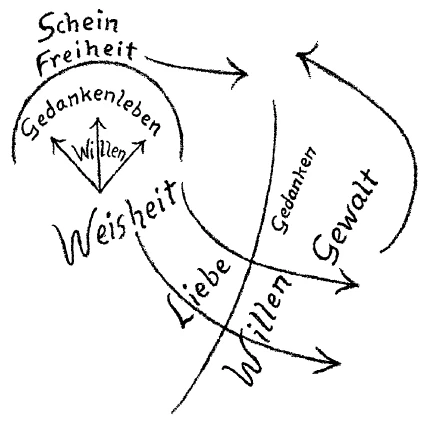
[ 21 ] And on the other hand, by infusing their actions—the expressions of their will—with thought, human beings develop that which they accomplish in love. It detaches itself from them. Our actions do not remain with us. They become part of world events; if they are imbued with love, then that love goes with them. A selfish action is, cosmically speaking, something different from an action imbued with love. As we develop—from the realm of appearances, through the fertilization of the will—that which springs from within us, what flows out of our minds, so to speak, into the world, encounters our actions imbued with thought. Just as when a plant develops—in its blossom lies the seed that must be met by the light of the sun from outside, by the air from outside, and so on, and which must be met by something from the cosmos so that it can grow—so too must that which is developed through freedom find an element of growth in the love that meets it and lives within our actions (see drawing on page 209).
[ 22 ] Thus, human beings are indeed situated within the unfolding of the world, and what happens within their skin—and what flows out from their skin as actions—does not merely have significance for them; it is world history. They are placed within the cosmic, within world history. As that which was real in the past becomes an illusion within the human being, reality continually dissolves; and as this illusion is in turn fertilized by the will, new reality arises. Here, I would say, lies the spiritual grasp of what we have also stated from other perspectives: There is no constancy of matter. Matter transforms itself into appearance, and that appearance is in turn elevated to reality by human will. What has been introduced into the physical worldview as the law of conservation of matter and energy is an illusion, because one is looking only at the natural worldview. In truth, matter is constantly passing away as it transforms into appearance, and something new comes into being precisely because, through what initially stands before us as the highest form of the cosmos—namely, human beings—appearance is in turn transformed back into being.
[ 23 ] We can also see it at the other extreme, though this insight is not as easy to attain as the other, for the processes that ultimately lead to freedom are, in essence, truly comprehensible to an unbiased mind; but to see clearly here requires a certain degree of development in the spiritual sciences. For at first, ordinary consciousness is repelled by violence. It does, of course, imbue with thought that which expresses itself through violence and force; but ordinary consciousness does not see that, just as more and more will and judgment enter the world of thought here, when we bring thoughts into the realm of the will—when we increasingly eradicate violence—we increasingly penetrate that which is merely violence with the light of thought. There, at one pole of the human being, one sees the overcoming of matter; there, at the other pole, one sees the rebirth of matter.
[ 24 ] We know, of course—and I have at least hinted at this in my book The Mysteries of the Soul—that the human being is a threefold being: as a nervous-sensory being, the bearer of the life of thought and the life of perception; as a rhythmic being—breathing, blood circulation—the bearer of the life of feeling; and as a metabolic being, the bearer of the life of will. But how does metabolism unfold within a human being as the will is developed more and more into love? By the fact that the human being is an agent who, in a sense, continually overcomes matter. And what unfolds within a human being as they develop, as a free being, into pure thinking—which is, in fact, of a volitional nature? Matter arises. We look into the process of matter’s formation. We carry within ourselves that which brings matter into being: our head; and we carry within ourselves that which destroys matter, where we can see how matter is destroyed: our limbs, our metabolic organism.
[ 25 ] This means viewing the human being in his or her entirety. We see how that which is otherwise usually conceived only within human consciousness—mostly in abstractions—participates as a real element in the becoming of the world; and how that which lies at the very heart of the world’s becoming—and to which ordinary consciousness clings so tightly that it cannot even imagine anything other than that it is a reality—is dissolved all the way down to nothingness. This is precisely a reality for ordinary consciousness, and if external realities are out of the question, then at least the atoms must be rigid realities. And because one cannot detach one’s thoughts from these rigid realities, one simply allows them to be mixed together, sometimes this way, sometimes that way. One time it becomes hydrogen, another time oxygen; they are grouped differently, precisely because one cannot help but think of what one has once held fast in thought as also being held fast in reality.
[ 26 ] It is nothing other than a weakness of thought to which a person succumbs when he assumes the existence of rigid, eternal atoms. What emerges for us from a conception of reality is that matter is constantly being dissolved down to nothing. It is only because, as matter perishes, new matter is constantly being created that people speak of the constancy of matter. They succumb to the same error they would succumb to, say, if a number of documents were carried into a house, copied inside, but were then burned as such, and the copies were brought back out, and he—because he sees the same thing coming out that was carried in—would think it were the same. In reality, the old ones have been burned and new ones have been written. So it is with becoming in the world, and it is important to advance one’s understanding to this point. For where matter in human beings passes away, becomes mere appearance, and new matter comes into being—there lies the possibility of freedom, and there lies the possibility of love. And freedom and love belong together, as I have already indicated in my Philosophy of Freedom.
[ 27 ] Anyone who, based on any worldview, speaks of the immortality of matter destroys both freedom on the one hand and fully developed love on the other. For it is only through the fact that in human beings the past completely fades away, becomes mere illusion, and the future arises anew—as a pure seed—that within them arises both the feeling of love, which is devotion to something to which one is not driven by the past, and freedom, which is an action arising from that which is not predetermined. Freedom and love are, in reality, comprehensible only within a spiritual-scientific worldview, and not within any other. Anyone who has immersed themselves in the worldview that has emerged over the course of the last few centuries will also be able to appreciate the difficulties that must be overcome in the face of the habitual thinking of modern humanity in order to penetrate it with this unbiased spiritual-scientific thinking. For in the modern scientific worldview, there are, so to speak, virtually no points of reference to enable one to reach the point where freedom and love can truly be understood.
[ 28 ] We will discuss another time how, in the face of humanity’s truly advancing development in the humanities, the scientific worldview on the one hand and the old, traditional worldviews on the other must respond.