The Bridge Between the Spiritual and
Physical Realms of Human Beings
GA 202
19 December 1920, Dornach
Translate the original German text into any language:
Versions Available:
The Bridge Between the Spiritual and Physical Realms of Human Beings, tr. SOL
Zwölfter Vortrag
Twelfth Lecture
[ 1 ] Der Mensch steht da in der Welt auf der einen Seite als ein Betrachtender, auf der anderen Seite als ein Handelnder, zwischen drinnen steht er mit seinem Fühlen. Er ist auf der einen Seite mit seinem Fühlen hingegeben an dasjenige, was sich seiner Betrachtung ergibt, auf der anderen Seite ist er mit seinem Fühlen wiederum beteiligt an seinem Handeln. Man braucht ja nur darüber nachzudenken, wie der Mensch befriedigt oder unbefriedigt sein kann von dem, was ihm als Handelnder gelingt oder nicht gelingt; man braucht nur daran zu denken, wie schließlich alles Handeln begleitet ist von Gefühlsimpulsen, und man wird sehen, daß in der Tat unser gefühlsmäßiges Wesen verbindet die beiden entgegengesetzten Pole: das betrachtende Element in uns und das handelnde Element in uns. Nur dadurch, daß wir betrachtende Wesen sind, werden wir im vollsten Sinne des Wortes eigentlich Mensch. Sie brauchen sich nur zu überlegen, wie alles, was Ihnen schließlich das Bewußtsein gibt, daß Sie Mensch sind, damit zusammenhängt, daß Sie die Welt, die Sie umgibt, in der Sie leben, innerlich gewissermaßen abbilden können, betrachten können. Zu denken, daß wir die Welt nicht betrachten können, würde bedeuten, daß wir unser ganzes Menschsein von uns abtun müssen. Als handelnde Menschen stehen wir drinnen im sozialen Leben. Und im Grunde genommen hat alles das, was wir zwischen Geburt und Tod vollbringen, eine gewisse soziale Bedeutung.
[ 1 ] Human beings stand in the world, on the one hand, as observers, and on the other hand, as agents; in between, they stand with their feelings. On the one hand, with their feelings, they are devoted to whatever presents itself to their observation; on the other hand, with their feelings, they are also involved in their actions. One need only consider how a person can be satisfied or dissatisfied with what they succeed or fail to achieve as an agent; one need only consider how, ultimately, all action is accompanied by emotional impulses, and one will see that, in fact, our emotional nature connects these two opposing poles: the observing element within us and the acting element within us. It is only because we are contemplative beings that we become truly human in the fullest sense of the word. You need only consider how everything that ultimately gives you the awareness that you are human is connected to the fact that you can, in a sense, internally represent and contemplate the world that surrounds you and in which you live. To think that we cannot observe the world would mean that we would have to renounce our entire humanity. As active human beings, we are immersed in social life. And, fundamentally, everything we accomplish between birth and death has a certain social significance.
[ 2 ] Nun wissen Sie, daß, insofern wir betrachtende Wesen sind, in uns der Gedanke lebt, insofern wir handelnde Wesen sind, also auch insofern wir soziale Wesen sind, in uns der Wille lebt. Es ist aber nicht so in der menschlichen Natur, wie es überhaupt in der Wirklichkeit nicht so ist, daß man verstandesmäßig die Dinge nebeneinanderstellen kann, sondern, was wirksam ist im Sein, das kann man nach der einen oder anderen Seite charakterisieren; die Dinge fließen ineinander, die Kräfte der Welt fließen ineinander. Wir können uns denkend vorstellen, daß wir ein Gedankenwesen sind, wir können uns denkend auch vorstellen, daß wir ein Willenswesen sind. Aber auch wenn wir kontemplativ, bei völliger äußerer Ruhe in Gedanken leben, so ist der Wille in uns dennoch fortwährend tätig. Und wiederum, wenn wir Handelnde sind, so ist in uns der Gedanke tätig. Es ist undenkbar, daß irgend etwas als Handlung von uns ausgeht, daß irgend etwas in das soziale Leben auch überspringe, ohne daß wir uns gedanklich mit dem, was so geschieht, identifizieren. In allem Willensartigen lebt das Gedankenartige, in allem Gedanklichen lebt das Willensartige. Und es ist durchaus notwendig, daß man gerade über die hier in Frage kommenden Dinge sich klar werde, wenn man jene Brücke, von der ich hier jetzt schon so oft gesprochen habe, im Ernste bauen will, die Brücke zwischen der moralisch-geistigen Weltordnung und der physisch-natürlichen Ordnung.
[ 2 ] Now you know that, insofar as we are contemplative beings, thought lives within us; insofar as we are acting beings—and thus also insofar as we are social beings—the will lives within us. However, it is not the case in human nature—just as it is not the case in reality at all—that one can intellectually set things side by side; rather, what is active in being can be characterized from one perspective or another; things flow into one another, the forces of the world flow into one another. We can imagine, through thought, that we are beings of thought; we can also imagine, through thought, that we are beings of will. But even when we live contemplatively in thought, amid complete external stillness, the will within us is nevertheless constantly at work. And conversely, when we are acting, thought is at work within us. It is unthinkable that anything should emanate from us as an action, that anything should spill over into social life, without our identifying mentally with what is happening. In everything of a volitional nature, the thought-like lives; in everything of a thought-like nature, the volitional lives. And it is absolutely necessary to gain clarity precisely about the matters at hand here if one seriously wishes to build that bridge—of which I have already spoken so often here—the bridge between the moral-spiritual world order and the physical-natural order.
[ 3 ] Denken Sie sich einmal, Sie lebten im Sinne der gewöhnlichen Wissenschaften für eine Weile rein nachdenklich, Sie regten sich gar nicht, Sie sähen ganz ab von allem Handeln, Sie lebten eben ein Vorstellungsleben. Sie müssen sich aber klar sein, daß dann in diesem Vorstellungsleben Wille tätig ist, Wille, der allerdings dann in Ihrem Inneren sich betätigt, der im Bereiche des Vorstellens seine Kräfte ausbreitet. Gerade wenn wir so den denkenden Menschen betrachten, wie er fortwährend den Willen hineinstrahlt in seine Gedanken, dann muß uns eigentlich eines gegenüber dem wirklichen Leben auffallen. Die Gedanken, die wir also fassen, wenn wir sie alle durchgehen — wir werden immer finden, daß sie an irgend etwas anknüpfen, was in unserer Umgebung, was unter unseren Erlebnissen ist. Wir haben zwischen Geburt und Tod gewissermaßen keine anderen Gedanken als diejenigen, die uns das Leben bringt. Ist unsere Erfahrung reich, so haben wir auch einen reichen Gedankeninhalt; ist unsere Erfahrung arm, so haben wir einen armen Gedankeninhalt. Der Gedankeninhalt ist gewissermaßen unser innerliches Schicksal. Aber innerhalb dieses Denk-Erlebens ist eines ganz uns eigen: Die Art und Weise, wie wir die Gedanken verknüpfen und voneinander lösen, die Art und Weise, wie wir innerlich die Gedanken verarbeiten, wie wir urteilen, wie wir Schlüsse ziehen, wie wir uns überhaupt im Gedankenleben orientieren, das ist unser, ist uns eigen. Der Wille in unserem Gedankenleben ist unser eigener.
[ 3 ] Imagine for a moment that, in the sense of the ordinary sciences, you lived for a while in a purely contemplative state; you did not get excited at all; you refrained entirely from any action; you simply lived a life of imagination. But you must realize that in this life of imagination, the will is at work—a will that, admittedly, operates within you and exerts its power in the realm of imagination. Precisely when we observe the thinking human being in this way—as he continually infuses his thoughts with the will—one thing in particular must strike us in contrast to real life. The thoughts we form—if we go through them all—we will always find that they are connected to something in our surroundings, to something among our experiences. Between birth and death, we have, so to speak, no thoughts other than those that life brings us. If our experience is rich, then our thoughts are rich; if our experience is poor, then our thoughts are poor. The content of our thoughts is, in a sense, our inner destiny. But within this experience of thinking, there is one thing that is entirely our own: the way in which we link thoughts together and separate them from one another, the way in which we process thoughts internally, how we judge, how we draw conclusions, how we orient ourselves in our life of thought—that is ours, it is unique to us. The will in our life of thought is our own.
[ 4 ] Wenn wir auf dieses Gedankenleben hinblicken, so müssen wir uns gerade bei einer sorgfältigen Selbstprüfung sagen, und Sie werden schon sehen, daß das so bei einer sorgfältigen Selbstprüfung ist: Die Gedanken kommen uns von außen ihrem Inhalte nach, die Bearbeitung der Gedanken, die geht von uns aus. — Wir sind daher im Grunde genommen in bezug auf unsere Gedankenwelt ganz abhängig von dem, was wir erleben können durch die Geburt, in die wir schicksalsmäßig versetzt sind, durch die Erlebnisse, die uns werden können. Aber in dasjenige, was uns da von der Außenwelt kommt, tragen wir hinein gerade durch den Willen, der aus der Seelentiefe ausstrahlt, unser Eigenes. Es ist für die Erfüllung dessen, was Selbsterkenntnis von uns Menschen will, im hohen Grade bedeutsam, wenn wir auseinanderhalten, wie auf der einen Seite uns von der Umwelt der Gedankeninhalt kommt, wie auf der anderen Seite aus unserem Inneren in die Gedankenwelt einstrahlt die Kraft des Willens, die von innen kommt.
[ 4 ] When we look at this inner life of thought, we must admit—especially upon careful self-examination, and you will see that this is indeed the case upon careful self-examination—that the content of our thoughts comes to us from the outside, while the processing of those thoughts originates within us. — We are therefore, in essence, entirely dependent—with regard to our world of thought—on what we can experience through the birth into which we are fated to be placed, through the experiences that may befall us. But into what comes to us from the outside world, we infuse our own essence precisely through the will that radiates from the depths of the soul. It is of great significance for the fulfillment of what self-knowledge demands of us as human beings that we distinguish between, on the one hand, how the content of our thoughts comes to us from our surroundings, and, on the other hand, how the power of the will—which comes from within—radiates from our inner being into the world of thought.
[ 5 ] Wie wird man eigentlich innerlich immer geistiger und geistiger? Man wird nicht dadurch geistiger, daß man möglichst viele Gedanken aus der Umwelt aufnimmt, denn diese Gedanken geben ja doch nur, ich möchte sagen, die Außenwelt, die eine sinnlich-physische ist, in Bildern wieder. Dadurch, daß man möglichst den Sensationen des Lebens nachläuft, dadurch wird man nicht geistiger. Geistiger wird man durch die innere willensgemäße Arbeit innerhalb der Gedanken. Daher besteht auch Meditieren darinnen, daß man sich nicht einem beliebigen Gedankenspiel hingibt, sondern daß man wenige, leicht überschaubare, leicht prüfbare Gedanken in den Mittelpunkt seines Bewußtseins rückt, aber mit einem starken Willen diese Gedanken in den Mittelpunkt seines Bewußtseins rückt. Und je stärker, je intensiver dieses innere Willensstrahlen wird in dem Elemente, wo eben die Gedanken sind, desto geistiger werden wir. Wenn wir Gedanken von der äußeren physisch-sinnlichen Welt aufnehmen — und wir können ja nur solche aufnehmen zwischen Geburt und Tod —, dann werden wir dadurch, wie Sie leicht einsehen können, unfrei, denn wir werden hingegeben an die Zusammenhänge der äußeren Welt; wir müssen dann so denken, wie es uns die äußere Welt vorschreibt, insofern wir nur den Gedankeninhalt ins Auge fassen; erst in der inneren Verarbeitung werden wir frei.
[ 5 ] How does one actually become more and more spiritual on the inside? One does not become more spiritual by absorbing as many thoughts as possible from the environment, for these thoughts merely reflect—I would say—the external world, which is a sensory-physical one, in images. By chasing after the sensations of life as much as possible, one does not become more spiritual. One becomes more spiritual through inner, will-driven work within one’s thoughts. That is why meditation consists not in indulging in arbitrary mental games, but in bringing a few, easily graspable, easily verifiable thoughts into the center of one’s consciousness—and doing so with a strong will. And the stronger, the more intense this inner radiance of the will becomes in the realm where thoughts reside, the more spiritual we become. When we take in thoughts from the external physical-sensory world—and we can, after all, take in only such thoughts between birth and death—then, as you can easily see, we become unfree, for we are at the mercy of the interrelationships of the external world; we must then think as the outer world dictates, insofar as we focus solely on the content of the thoughts; it is only through inner processing that we become free.
[ 6 ] Nun gibt es eine Möglichkeit, ganz frei zu werden, frei zu werden in seinem inneren Leben, wenn man den Gedankeninhalt, insofern er von außen kommt, möglichst ausschließt, immer mehr und mehr ausschließt, und das Willenselement, das im Urteilen, im Schlüsseziehen unsere Gedanken durchstrahlt, in besondere Regsamkeit versetzt. Dadurch aber wird unser Denken in denjenigen Zustand versetzt, den ich in meiner «Philosophie der Freiheit» genannt habe das reine Denken. Wir denken, aber im Denken lebt nur Wille. Ich habe das besonders scharf betont in der Neuauflage der «Philosophie der Freiheit» 1918. Dasjenige, was da in uns lebt, lebt in der Sphäre des Denkens. Aber wenn es reines Denken geworden ist, ist es eigentlich ebensogut als reiner Wille anzusprechen. So daß wir aufsteigen dazu, uns vom Denken zum Willen zu erheben, wenn wir innerlich frei werden, daß wir gewissermaßen unser Denken so reif machen, daß es ganz und gar durchstrahlt wird vom Willen, nicht mehr von außen aufnimmt, sondern eben im Willen lebt. Gerade dadurch aber, daß wir immer mehr und mehr den Willen im Denken stärken, bereiten wir uns vor für das, was ich in der «Philosophie der Freiheit» die moralische Phantasie genannt habe, was aber aufsteigt zu den moralischen Intuitionen, die dann unseren gedankegewordenen Willen oder willegewordenen Gedanken durchstrahlen, durchsetzen. Auf diese Weise heben wir uns heraus aus der physisch-sinnlichen Notwendigkeit, durchstrahlen uns mit dem, was uns eigen ist und bereiten uns vor für die moralische Intuition. Und auf solchen moralischen Intuitionen beruht doch alles das, was den Menschen von der geistigen Welt aus zunächst erfüllen kann. Es lebt also auf dasjenige, was Freiheit ist, dann, wenn wir gerade in unserem Denken immer mächtiger und mächtiger werden lassen den Willen.
[ 6 ] Now there is a way to become completely free—to become free in one’s inner life—by excluding, as much as possible, the content of thought insofar as it comes from outside, excluding it more and more, and by stimulating to a particular degree of activity the element of will that permeates our thoughts in judgment and reasoning. This, however, brings our thinking into the state that I have called “pure thinking” in my Philosophy of Freedom. We think, but only the will lives within that thinking. I emphasized this particularly strongly in the 1918 revised edition of Philosophy of Freedom. That which lives within us there lives in the sphere of thinking. But once it has become pure thinking, it is actually just as appropriate to speak of it as pure will. Thus, we ascend to rise from thinking to will when we become inwardly free—that is, when we, so to speak, bring our thinking to such a state of maturity that it is entirely permeated by the will, no longer taking in anything from the outside, but living precisely within the will. But precisely by strengthening the will within our thinking more and more, we prepare ourselves for what I have called “moral imagination” in The Philosophy of Freedom—which, however, rises to the level of moral intuitions that then permeate and infuse our will that has become thought, or our thought that has become will. In this way, we rise above physical-sensory necessity, are permeated by what is our own, and prepare ourselves for moral intuition. And everything that can initially fill a person from the spiritual world is based on such moral intuitions. Thus, it thrives on that which is freedom, precisely when we allow the will to become ever more powerful within our thinking.
[ 7 ] Betrachten wir den Menschen von dem anderen Pol aus, von dem Willenspol. Der Wille, wann tritt er durch unser Handeln uns besonders klar vor das Seelenauge? Nun, wenn wir niesen, so tun wir ja auch etwas sozusagen, aber wir werden nicht in der Lage sein, uns einen besonderen Willensimpuls dabei zuzuschreiben, wenn wir niesen. Wenn wir sprechen, dann tun wir schon etwas, wo in einer gewissen Weise der Wille drinnen liegt. Aber bedenken Sie nur einmal, wie im Sprechen Willentliches und Unwillentliches, Willensgemäßes und Unwillensgemäßes ineinanderlaufen! Sie müssen sprechen lernen und müssen es gerade so lernen, daß Sie nicht mehr jedes einzelne Wort willensgemäß formen müssen, daß gewissermaßen etwas Instinktives hineinkommt in das Sprechen. Für das gewöhnliche Leben ist es wenigstens so, und im Grunde genommen ist es so gerade für diejenigen Menschen, die wenig nach Geistigkeit streben. Schwätzer, die gewissermaßen fortwährend ihren Mund offen haben müssen, um das oder jenes zu sagen, in das nicht viel Gedankliches hineingesandt wird, die lassen den anderen merken — sie selber merken es allerdings nicht —, wieviel Instinktives, Unwillensgemäßes im Sprechen liegt. Aber je mehr wir aus unserem Organischen herausgehen und übergehen zur Tätigkeit, die vom Organischen gewissermaßen losgelöst ist, desto mehr tragen wir in unser Handeln die Gedanken hinein. Das Niesen steckt noch ganz im Organischen drinnen, das Sprechen steckt zum großen Teil im Organischen drinnen, das Gehen schon sehr wenig, dasjenige, was wir mit den Händen vollziehen, auch sehr wenig. Und so geht es allmählich über in immer mehr und mehr vom Organischen in uns losgelöste Handlungen. Diese Handlungen, die verfolgen wir mit unseren Gedanken, wenn wir auch nicht wissen, wie der Wille in diese Handlungen hineinschießt. Und wenn wir nicht gerade Nachtwandler sind und in diesem Zustande uns betätigen, dann werden unsere Handlungen stets von unseren Gedanken begleitet sein. Wir tragen in unser Handeln die Gedanken hinein, und je mehr sich unser Handeln ausbildet, desto mehr tragen wir die Gedanken in unser Handeln hinein.
[ 7 ] Let us consider the human being from the other pole—the pole of the will. When does the will appear particularly clearly before the eye of the soul through our actions? Well, when we sneeze, we are, so to speak, doing something, but we won’t be able to attribute a specific volitional impulse to ourselves when we sneeze. When we speak, we are indeed doing something in which the will is involved in a certain way. But just consider how, in speech, the voluntary and the involuntary, what is in accordance with the will and what is not, intertwine! You have to learn to speak, and you must learn to do so in such a way that you no longer have to form every single word through an act of will—so that, in a sense, something instinctive enters into your speech. This is at least the case in everyday life, and, fundamentally, it is especially true for those people who have little interest in spirituality. Chatterboxes, who, so to speak, must keep their mouths open constantly to say this or that—without much thought being put into it—let others notice—though they themselves do not realize it—just how much that which is instinctive and involuntary lies within their speech. But the more we move beyond our organic nature and transition to activity that is, in a sense, detached from the organic, the more we infuse our actions with thought. Sneezing is still entirely within the organic realm; speaking is largely within the organic realm; walking is already very little so; and what we do with our hands is also very little so. And so it gradually transitions into actions that are increasingly detached from the organic within us. We follow these actions with our thoughts, even if we do not know how the will intervenes in them. And unless we are sleepwalkers and act in that state, our actions will always be accompanied by our thoughts. We bring our thoughts into our actions, and the more our actions develop, the more we bring our thoughts into them.
[ 8 ] Sie sehen, wir werden immer innerlicher und innerlicher, indem wir unsere Eigenkraft als Wille in das Denken hineinschicken, das Denken gewissermaßen ganz vom Willen durchstrahlen lassen. Wir bringen den Willen in das Denken hinein und gelangen dadurch zur Freiheit. Wir gelangen dazu, indem wir immer mehr und mehr unser Handeln ausbilden, in dieses Handeln die Gedanken hineinzutragen. Wir durchstrahlen unser Handeln, das ja aus unserem Willen hervorgeht, mit unseren Gedanken. Auf der einen Seite, nach innen, leben wir ein Gedankenleben; das durchstrahlen wir mit dem Willen und finden so die Freiheit. Auf der anderen Seite, nach außen, fließen unsere Handlungen von uns aus dem Willen heraus; wir durchsetzen sie mit unseren Gedanken.
[ 8 ] You see, we become more and more inward as we send our own power—our will—into our thinking, allowing the will, so to speak, to permeate our thinking entirely. We bring the will into our thinking and thereby attain freedom. We achieve this by increasingly training ourselves to carry our thoughts into our actions. We permeate our actions—which, after all, spring from our will—with our thoughts. On the one hand, inwardly, we live a life of thought; we permeate this with the will and thus find freedom. On the other hand, outwardly, our actions flow from us out of the will; we infuse them with our thoughts.
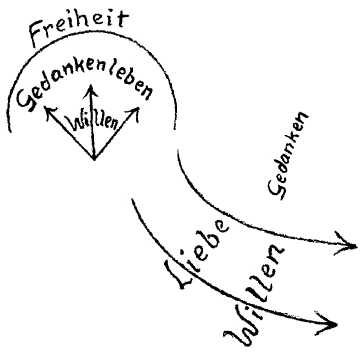
[ 9 ] Aber wodurch werden denn unsere Handlungen immer ausgebildeter? Wodurch, wenn wir den allerdings anzufechtenden Ausdruck gebrauchen wollen, kommen wir denn zu einem immer vollkommeneren Handeln? — Wir kommen zu einem immer vollkommeneren Handeln eigentlich dadurch, daß wir diejenige Kraft in uns ausbilden, die man nicht anders nennen kann als Hingabe an die Außenwelt. Je mehr unsere Hingabe an die Außenwelt wächst, desto mehr regt uns diese Außenwelt an zum Handeln. Dadurch aber gerade, daß wir den Weg finden, um hingegeben zu sein an die Außenwelt, gelangen wir dazu, dasjenige, was in unserem Handeln liegt, mit Gedanken zu durchdringen. Was ist Hingabe an die Außenwelt? Hingabe an die Außenwelt, die uns durchdringt, die unser Handeln mit den Gedanken durchdringt, ist nichts anderes als Liebe.
[ 9 ] But what is it that makes our actions increasingly refined? What is it—if we are to use this expression, which is certainly open to criticism—that leads us to ever more perfect action? — We arrive at ever more perfect action, in fact, by cultivating within ourselves that force which can be called nothing other than devotion to the external world. The more our devotion to the external world grows, the more this external world inspires us to act. But it is precisely by finding the way to be devoted to the external world that we come to imbue our actions with thought. What is devotion to the external world? Devotion to the external world—which permeates us and permeates our actions with thought—is nothing other than love.
[ 10 ] Geradeso wie wir zur Freiheit kommen durch die Durchstrahlung des Gedankenlebens mit dem Willen, so kommen wir zur Liebe durch die Durchsetzung des Willenslebens mit Gedanken. Wir entwickeln in unserem Handeln Liebe dadurch, daß wir die Gedanken hineinstrahlen lassen in das Willensgemäße; wir entwickeln in unserem Denken Freiheit dadurch, daß wir das Willensgemäße hineinstrahlen lassen in die Gedanken. Und da wir als Mensch eine Ganzheit, eine Totalität sind, so wird, wenn wir dazu kommen, in dem Gedankenleben die Freiheit und in dem Willensleben die Liebe zu finden, in unserem Handeln die Freiheit, in unserem Denken die Liebe mitwirken. Sie durchstrahlen einander, und wir vollziehen ein Handeln, ein gedankenvolles Handeln in Liebe, ein willensdurchsetztes Denken, aus dem wiederum das Handlungsgemäße in Freiheit entspringt.
[ 10 ] Just as we attain freedom by infusing our life of thought with the will, so do we attain love by infusing our life of will with thought. We develop love in our actions by allowing thoughts to radiate into what is in accordance with the will; we develop freedom in our thinking by allowing what is in accordance with the will to radiate into our thoughts. And since we, as human beings, are a whole, a totality, when we come to find freedom in our life of thought and love in our life of will, freedom will be at work in our actions and love in our thinking. They permeate one another, and we carry out an action—a thoughtful action in love, a thinking imbued with will—from which, in turn, action in freedom springs forth.
[ 11 ] Sie sehen, wie im Menschen die zwei größten Ideale zusammenwachsen, Freiheit und Liebe. Und Freiheit und Liebe sind auch dasjenige, was eben der Mensch, indem er dasteht in der Welt, in sich so verwirklichen kann, daß gewissermaßen das eine mit dem anderen sich gerade durch den Menschen für die Welt verbindet.
[ 11 ] You can see how the two greatest ideals—freedom and love—converge within the human being. And freedom and love are also precisely what the human being, standing here in the world, can realize within himself in such a way that, in a sense, one is united with the other for the world through the human being himself.
[ 12 ] Man wird nun fragen müssen: Wodurch ist denn das Ideal, das höchste, in diesem willensdurchstrahlten Gedankenleben zu erreichen? Ja, wenn das Gedankenleben etwas wäre, das materielle Vorgänge darstellte, dann könnte das eigentlich gar nie eintreten, daß der Wille ganz in die Sphäre der Gedanken gewissermaßen hineinträte und in der Sphäre des Gedankens das Willensmäßige immer mehr und mehr Platz griffe. Stellen Sie sich vor, da wären materielle Vorgänge — der Wille könnte in diese materiellen Vorgänge höchstens organisierend hineinstrahlen. Nur dann kann der Wille wirksam sein, wenn das Gedankenleben als solches keine äußere physische Realität hat, wenn das Gedankenleben etwas ist, was der äußeren physischen Realität bar ist. Was muß es also sein?
[ 12 ] One must now ask: How, then, can the ideal—the highest—be attained in this life of thought permeated by the will? Indeed, if the life of thought were something that represented material processes, then it could never actually happen that the will would, so to speak, enter fully into the sphere of thought and that the volitional aspect would gain more and more ground within that sphere. Imagine if there were material processes—the will could, at most, radiate into these material processes in an organizing way. The will can be effective only if the life of thought as such has no external physical reality, if the life of thought is something devoid of external physical reality. So what must it be?
[ 13 ] Nun, Sie werden sich klarmachen können, was es sein muß, wenn Sie von einem Bilde ausgehen. Wenn Sie hier einen Spiegel haben und hier einen Gegenstand, der Gegenstand im Spiegel sich spiegelt, dann können Sie hinter den Spiegel gehen, Sie finden nichts. Sie haben eben ein Bild. Solches Bilddasein haben unsere Gedanken. Wodurch haben sie ein solches Bilddasein? Nun, Sie brauchen sich nur zu erinnern, was ich Ihnen über das Gedankenleben gesagt habe. Es ist ja eigentlich als solches gar nicht im gegenwärtigen Augenblick Realität. Das Gedankenleben strahlt herein aus unserem Vorgeburtlichen, oder sagen wir aus dem Dasein vor der Empfängnis. Das Gedankenleben hat seine Realität zwischen dem Tode und einer neuen Geburt. Und geradeso wie hier der Gegenstand vor dem Spiegel steht und aus dem Spiegel nur Bilder kommen, so ist dasjenige, was wir als Gedankenleben entwickeln, im Grunde genommen ganz real durchlebt zwischen dem Tode und der neuen Geburt und strahlt nur herein in dieses Leben, das wir seit der Geburt vollbringen. Als denkende Wesen haben wir in uns nur eine Spiegelbild-Realität. Dadurch kann die andere Realität, die gerade aus unserem Stoffwechsel, wie Sie wissen, aufstrahlt, die bloße Spiegelbild-Realität des Gedankenlebens durchdringen. Man sieht am klarsten, wenn man überhaupt unbefangenes Denken entfalten will, was heute in dieser Beziehung allerdings sehr selten ist, daß das Gedankenleben ein Spiegelbilddasein hat, wenn man das reinste Gedankenleben ins Auge faßt, das mathematische. Dieses mathematische Gedankenleben fließt ganz aus unserem Inneren herauf. Aber es hat nur ein Spiegeldasein. Sie können allerdings durch die Mathematik alle äußeren Gegenstände bestimmen; aber die mathematischen Gedanken selber sind eben nur Gedanken und sie haben bloß ein Bilddasein. Sie sind etwas, was nicht aus irgendeiner äußeren Realität gewonnen ist.
[ 13 ] Well, you’ll be able to understand what it must be like if you start with an image. If you have a mirror here and an object here—the object is reflected in the mirror—then you can go behind the mirror, but you’ll find nothing. You simply have an image. Our thoughts have this kind of image-like existence. How do they come to have such an existence? Well, you need only recall what I have told you about the life of thought. It is, after all, not really a reality in the present moment as such. The life of thought radiates in from our pre-birth existence—or, let’s say, from our existence before conception. Thought life has its reality between death and a new birth. And just as the object here stands before the mirror and only images come from the mirror, so what we develop as thought life is, in essence, lived quite realistically between death and the new birth and merely radiates into this life that we have been living since birth. As thinking beings, we have within us only a mirror-image reality. Consequently, the other reality—which, as you know, radiates precisely from our metabolism—can penetrate the mere mirror-image reality of our life of thought. One sees most clearly—if one wishes to develop unbiased thinking at all, which is, however, very rare today in this regard—that the life of thought has a mirror-image existence when one considers the purest form of thought: mathematical thought. This mathematical life of thought flows entirely from within us. But it has only a mirror-like existence. You can, of course, determine all external objects through mathematics; but the mathematical thoughts themselves are merely thoughts, and they have only an image-like existence. They are something that is not derived from any external reality.
[ 14 ] Abstraktlinge wie Kant gebrauchen auch ein abstraktes Wort. Sie sagen: Die mathematischen Vorstellungen sind a priori. — A priori, das heißt: bevor etwas anderes da ist. Aber warum sind mathematische Vorstellungen a priori? Weil sie hereinstrahlen aus dem vorgeburtlichen beziehungsweise vor der Empfängnis liegenden Dasein; das macht ihre Apriorität aus. Und daß sie uns für unser Bewußtsein als real erscheinen, das rührt davon her, daß sie vom Willen durchstrahlt sind. Diese Durchstrahlung des Willens macht sie real. Bedenken Sie einmal, wie abstrakt das moderne Denken geworden ist, indem es abstrakte Worte gebraucht für etwas, was man seiner Realität nach eben nicht durchschaut. Daß wir uns die Mathematik mitbringen aus unserem vorgeburtlichen Dasein, das spürte gewissermaßen ein Kant und nannte deshalb die mathematischen Urteile a priori. Aber mit a priori ist weiter nichts gesagt, denn es ist auf keine Realität hingedeutet, es ist auf etwas bloß Formales hingedeutet.
[ 14 ] Abstract thinkers like Kant also use an abstract term. They say: Mathematical concepts are a priori. — A priori means: before anything else exists. But why are mathematical concepts a priori? Because they radiate from a pre-birth existence—or, more precisely, from an existence prior to conception; that is what constitutes their a priori nature. And the fact that they appear real to our consciousness stems from the fact that they are permeated by the will. This permeation by the will makes them real. Consider just how abstract modern thinking has become, using abstract words for something whose reality we simply cannot fathom. Kant, in a sense, sensed that we bring mathematics with us from our pre-birth existence, and that is why he called mathematical judgments a priori. But the term “a priori” says nothing more than that, for it does not point to any reality; it points merely to something formal.
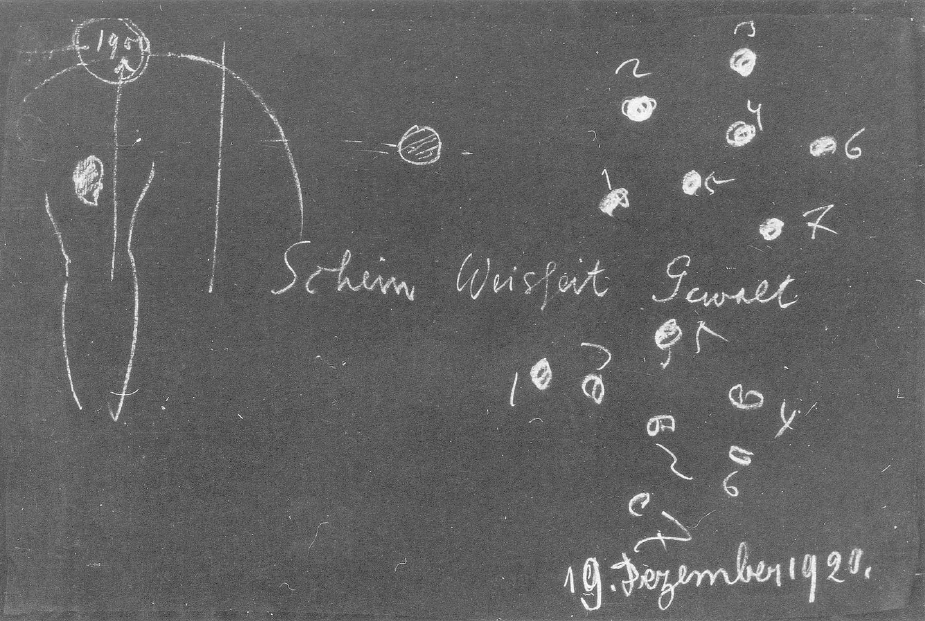
[ 15 ] Alte Traditionen sprechen gerade hier bei dem, was Gedankenleben ist, was in seinem Bilddasein angewiesen ist, vom Willen durchstrahlt zu werden, um zur Realität zu werden — alte Vorstellungen sprechen hier von Schein (siehe Zeichnung Seite 209).
[ 15 ] Here, precisely in regard to what constitutes the life of thought—which, in its existence as an image, depends on being permeated by the will in order to become reality—ancient traditions speak of illusion (see drawing on page 209).
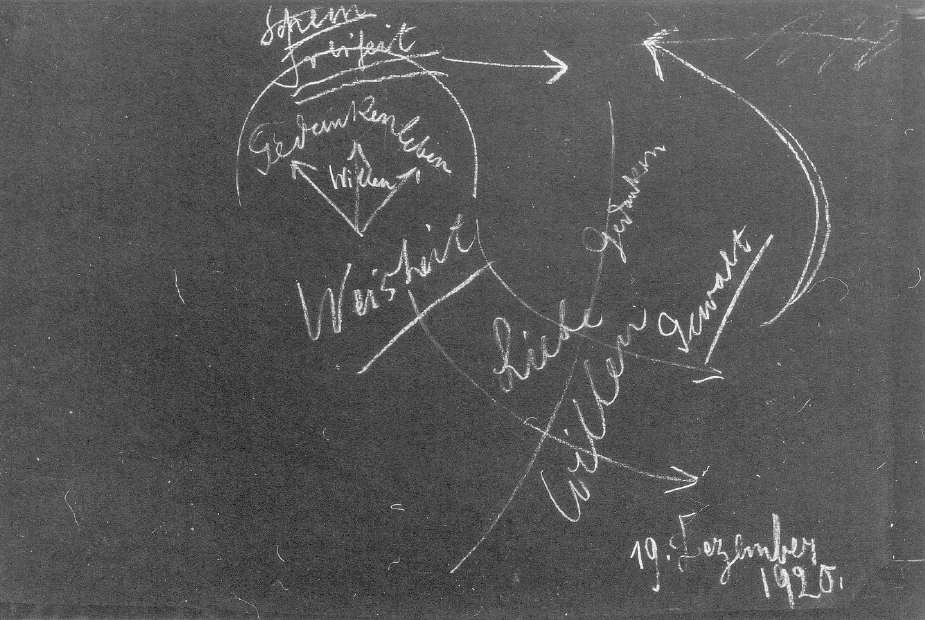
[ 16 ] Sehen wir uns den anderen Pol des Menschen an, wo die Gedanken nach dem Willensmäßigen hinstrahlen, wo in Liebe die Dinge vollbracht werden: da prallt gewissermaßen unser Bewußtsein an der Realität ab. Sie können nicht hineinschauen in jenes Reich der Finsternis — für das Bewußtsein das Reich der Finsternis —, wo der Wille sich entfaltet, indem Sie auch nur Ihren Arm erheben oder Ihren Kopf drehen, wenn Sie nicht zu übersinnlichen Vorstellungen greifen. Sie bewegen Ihren Arm; aber was da Kompliziertes vorgeht, das bleibt dem gewöhnlichen Bewußtsein geradeso unbewußt wie die Dinge des tiefen Schlafes, der traumlos ist. Wir sehen unseren Arm an, wir sehen, wie unsere Hand greifen kann. Das alles ist, weil wir die Sache mit Vorstellungen, mit Gedanken durchsetzen. Aber die Gedanken selber, die in unserem Bewußtsein sind, sie bleiben auch hier Schein. Das Reale aber ist es, in dem wir leben, und das nicht ins gewöhnliche Bewußtsein heraufstrahlt. Alte Traditionen sprachen hier von Gewalt, weil dasjenige, in dem wir als Realität leben, zwar von dem Gedanken durchsetzt wird, aber der Gedanke doch in einer gewissen Weise in dem Leben zwischen Geburt und Tod davon abgeprallt ist (siehe Zeichnung).
[ 16 ] Let us look at the other pole of the human being, where thoughts radiate toward the realm of the will, where things are accomplished in love: there, our consciousness, as it were, bounces off reality. You cannot look into that realm of darkness—the realm of darkness for consciousness—where the will unfolds, even when you simply raise your arm or turn your head, unless you draw upon supersensible perceptions. You move your arm; but the complex processes taking place there remain just as unconscious to ordinary consciousness as the events of deep, dreamless sleep. We look at our arm; we see how our hand can grasp. All of this is possible because we permeate the action with mental images and thoughts. But the thoughts themselves, which are within our consciousness, remain mere appearances here as well. What is real, however, is that in which we live, and which does not shine up into ordinary consciousness. Ancient traditions spoke of “force” in this context, because that in which we live as reality is indeed permeated by thought, yet thought has, in a certain sense, been deflected from it in the life between birth and death (see drawing).
[ 17 ] Zwischen beiden drinnen liegt der Ausgleich, liegt dasjenige, was den Willen, der gewissermaßen nach dem Haupte strahlt, die Gedanken, die sozusagen mit dem Herzen, in unserem Handeln in Liebe erfühlt werden, was diese beiden miteinander verbindet: das gefühlsmäßige Leben, das sowohl nach dem Willensmäßigen hinzielen kann, wie nach dem Gedanken hinzielen kann. Wir leben in einem Elemente im gewöhnlichen Bewußtsein, wodurch wir auf der einen Seite dasjenige erfassen, was in unserem zur Freiheit hinneigenden, willensdurchsetzten Denken zum Ausdruck kommt, auf der anderen Seite, wo wir versuchen, immer gedankenvoller dasjenige zu haben, was in unser Handeln übergeht. Und was die Verbindungsbrücke zwischen beiden bildet, das nannte man von alten Zeiten her die Weisheit (siehe Zeichnung).
[ 17 ] Between these two lies the balance, lies that which connects the will—which, so to speak, radiates from the head—and the thoughts—which, so to speak, come from the heart—in our actions, which are experienced in love: the emotional life, which can be directed both toward the will and toward thought. In ordinary consciousness, we live within an element through which, on the one hand, we grasp what is expressed in our thinking—which is oriented toward freedom and permeated by the will—and, on the other hand, we strive to incorporate more and more thoughtfully into our actions what flows from our thinking. And what forms the bridge connecting the two has been called wisdom since ancient times (see illustration).
[ 18 ] Goethe hat in seinem Märchen von der grünen Schlange und der schönen Lili ein den drei Königen, dem goldenden König, dem silbernen König, dem ehernen König, hingewiesen auf diese alten Traditionen. Wir haben ja auch schon von anderen Gesichtspunkten aus gezeigt, wie wiederum aufleben müssen, aber in einer ganz anderen Form, diese drei Elemente, auf die eine alte, instinktive Erkenntnis hinweisen konnte, und die nur wieder aufleben können, wenn der Mensch die Erkenntnisse der Imagination, der Intuition, der Inspiration aufnimmt.
[ 18 ] In his fairy tale The Green Snake and the Beautiful Lili, Goethe alluded to these ancient traditions through the Three Kings—the Golden King, the Silver King, and the Bronze King. We have already shown from other perspectives how these three elements—which point to an ancient, instinctive insight—must be revived, albeit in a completely different form, and how they can only be revived when human beings take in the insights of imagination, intuition, and inspiration.
[ 19 ] Was aber geht denn eigentlich vor, indem der Mensch sein Gedankenleben entwickelt? Eine Realität wird zum Schein. Das ist sehr wichtig, daß man sich darüber klar werde. Wir tragen unser Haupt, das in seiner Verknöcherung und in seiner Neigung zum Verknöchern bildhaft ja schon äußerlich das Erstorbene gegenüber der anderen, frischen Körperorganisation zeigt. Wir tragen in unserem Haupte zwischen Geburt und Tod dasjenige, was aus einer Vorzeit, wo es Realität war, hereinragt als Schein, und wir durchstrahlen von unserem übrigen Organismus den Schein mit dem realen Elemente, das aus unserem Stoffwechsel kommt, mit dem realen Elemente des Willens. Da haben wir eine Keimbildung, die zunächst in unserem Menschentum abläuft, die aber eine kosmische Bedeutung hat. Denken Sie sich, ein Mensch ist geboren in irgendeinem Jahre, vorher war er in der geistigen Welt; er geht aus der geistigen Welt heraus, indem dasjenige, was da als Gedanke Realität war, in ihm zum Schein wird, und er überführt in diesen Schein die Willenstätigkeit, die aus einer ganz anderen Richtung herkommt, die aus seinem übrigen, nichthauptlichen Organismus aufsteigt. Das ist dasjenige, wodurch die in den Schein ersterbende Vergangenheit wiederum angeregt wird durch das, was im Willen erstrahlt, zur Realität der Zukunft.
[ 19 ] But what actually happens as a human being develops their life of thought? A reality becomes an illusion. It is very important to be clear about this. We carry our head, which—in its ossification and its tendency toward ossification—already outwardly symbolizes, in a figurative sense, that which has died in contrast to the rest of the fresh, living body. Between birth and death, we carry within our head that which extends from a past era—when it was reality—as an illusion, and we radiate through this illusion from the rest of our organism the real element that comes from our metabolism, along with the real element of the will. Here we have a process of formation that initially takes place within our humanity but which has cosmic significance. Imagine a person born in a given year; before that, he was in the spiritual world. He emerges from the spiritual world as that which was reality there as thought becomes an illusion within him, and he infuses this illusion with the activity of the will, which comes from an entirely different direction—rising from the rest of his organism, outside the head. This is the process by which the past, which is fading into illusion, is once again stirred to life by what shines forth in the will, becoming the reality of the future.
[ 20 ] Verstehen wir recht: Was geschieht, wenn der Mensch sich zum reinen, das heißt, willensdurchstrahlten Denken erhebt? In ihm entwickelt sich auf Grundlage dessen, was der Schein aufgelöst hat der Vergangenheit —, durch die Befruchtung mit dem Willen, der aus seiner Ichheit aufsteigt, eine neue Realität in die Zukunft hin. Er ist der Träger des Keimes in die Zukunft. Der Mutterboden gewissermaßen sind die realen Gedanken der Vergangenheit, und in diesen Mutterboden wird versenkt dasjenige, was aus dem Individuellen kommt, und der Keim wird in die Zukunft geschickt zum zukünftigen Leben.
[ 20 ] Let us be clear: What happens when a human being rises to pure thinking—that is, thinking permeated by the will? Within them, on the basis of what the illusion of the past has dissolved—and through the fertilization by the will that arises from their sense of self—a new reality directed toward the future develops. He is the bearer of the seed into the future. The real thoughts of the past serve, so to speak, as the fertile soil, and into this soil is sown that which comes from the individual, and the seed is sent into the future toward future life.
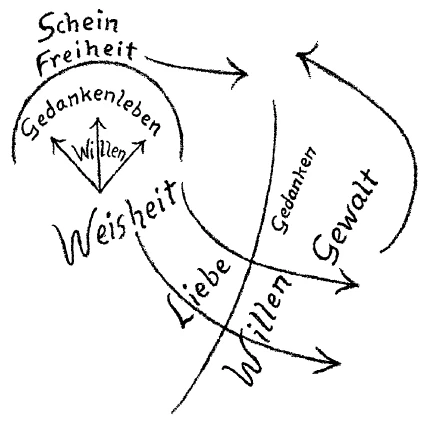
[ 21 ] Und auf der anderen Seite entwickelt der Mensch, indem er seine Handlungen, sein Willensgemäßes mit Gedanken durchsetzt, dasjenige, was er in Liebe vollbringt. Es löst sich von ihm los. Unsere Handlungen bleiben nicht bei uns. Sie werden Weltgeschehen; wenn sie von Liebe durchsetzt sind, dann geht die Liebe mit ihnen. Eine egoistische Handlung ist kosmisch etwas anderes als eine liebedurchsetzte Handlung. Indem wir aus dem Schein durch die Befruchtung des Willens dasjenige entwickeln, was aus unserem Inneren hervorgeht, trifft das, was da gewissermaßen aus unserem Kopfe fortströmt in die Welt, auf unsere gedankendurchsetzten Handlungen auf. Geradeso wie wenn eine Pflanze sich entwickelt, in ihrer Blüte der Keim ist, den außen das Licht der Sonne treffen muß, den außen die Luft treffen muß und so weiter, dem etwas entgegenkommen muß aus dem Kosmos, damit er wachsen kann, so muß dasjenige, was durch die Freiheit entwickelt wird, durch die entgegenkommende, in den Handlungen lebende Liebe ein Wachstumselement finden (siehe Zeichnung Seite 209).
[ 21 ] And on the other hand, by infusing their actions—the expressions of their will—with thought, human beings develop that which they accomplish in love. It detaches itself from them. Our actions do not remain with us. They become part of world events; if they are imbued with love, then that love goes with them. A selfish action is, cosmically speaking, something different from an action imbued with love. As we develop—from the realm of appearances, through the fertilization of the will—that which springs from within us, what flows out of our minds, so to speak, into the world, encounters our actions imbued with thought. Just as when a plant develops—in its blossom lies the seed that must be met by the light of the sun from outside, by the air from outside, and so on, and which must be met by something from the cosmos so that it can grow—so too must that which is developed through freedom find an element of growth in the love that meets it and lives within our actions (see drawing on page 209).
[ 22 ] So steht der Mensch tatsächlich drinnen in dem Weltenwerden, und was innerhalb seiner Haut geschieht, und was aus seiner Haut ausfließt als Handlungen, das hat nicht bloß eine Bedeutung an ihm, das ist Weltgeschehen. Er ist hineingestellt in das kosmische, in das Weltgeschehen. Indem dasjenige, was in der Vorzeit real war, zum Schein im Menschen wird, löst sich fortwährend Realität auf, und indem dieser Schein wiederum befruchtet wird durch den Willen, entsteht neue Realität. Da haben Sie, ich möchte sagen, wie geistig zu greifen dasjenige, was wir auch von anderen Gesichtspunkten heraus gesagt haben: Es gibt keine Konstanz des Stoffes. Der verwandelt . sich in Schein, und der Schein wird vom Willen des Menschen wiederum in die Realität erhoben. Ein Truggebilde ist es, was als das Gesetz der Erhaltung des Stoffes und der Kraft in die physikalische Weltanschauung gebracht ist, weil man eben nur das natürliche Weltbild ansieht. In Wahrheit vergeht fortwährend Stoff, indem er sich in Schein verwandelt, und Neues entsteht, indem gerade durch das, was zunächst als höchstes Gebilde des Kosmos vor uns steht, durch den Menschen, der Schein wiederum in Sein verwandelt wird.
[ 22 ] Thus, human beings are indeed situated within the unfolding of the world, and what happens within their skin—and what flows out from their skin as actions—does not merely have significance for them; it is world history. They are placed within the cosmic, within world history. As that which was real in the past becomes an illusion within the human being, reality continually dissolves; and as this illusion is in turn fertilized by the will, new reality arises. Here, I would say, lies the spiritual grasp of what we have also stated from other perspectives: There is no constancy of matter. Matter transforms itself into appearance, and that appearance is in turn elevated to reality by human will. What has been introduced into the physical worldview as the law of conservation of matter and energy is an illusion, because one is looking only at the natural worldview. In truth, matter is constantly passing away as it transforms into appearance, and something new comes into being precisely because, through what initially stands before us as the highest form of the cosmos—namely, human beings—appearance is in turn transformed back into being.
[ 23 ] An dem anderen Pol können wir es auch sehen, nur ist dieses Sehen nicht so leicht wie das andere, denn die Vorgänge, die schließlich zur Freiheit führen, sind im Grunde genommen für ein unbefangenes Denken wirklich zu durchschauen; aber um hier richtig zu sehen, dazu gehört schon einige geisteswissenschaftliche Entwickelung. Denn zunächst prallt das gewöhnliche Bewußtsein an der Gewalt ab. Es durchsetzt ja allerdings dasjenige, was an der Gewalt, an der Kraft sich auslebt, mit Gedanken; aber das gewöhnliche Bewußtsein sieht nicht, daß geradeso wie hier immer mehr und mehr Wille, Urteilsschluß in die Gedankenwelt hineinkommt, daß, wenn wir die Gedanken in das Willensmäßige hineinbringen, wenn wir eben immer mehr und mehr die Gewalt ausrotten, wir immer mehr dasjenige, was bloß Gewalt ist, durchdringen mit dem Lichte des Gedankens. Da, an dem einen Pol des Menschen, sieht man die Überwindung des Stoffes, da, an dem anderen Pol, sieht man die Neuerstehung des Stoffes.
[ 23 ] We can also see it at the other extreme, though this insight is not as easy to attain as the other, for the processes that ultimately lead to freedom are, in essence, truly comprehensible to an unbiased mind; but to see clearly here requires a certain degree of development in the spiritual sciences. For at first, ordinary consciousness is repelled by violence. It does, of course, imbue with thought that which expresses itself through violence and force; but ordinary consciousness does not see that, just as more and more will and judgment enter the world of thought here, when we bring thoughts into the realm of the will—when we increasingly eradicate violence—we increasingly penetrate that which is merely violence with the light of thought. There, at one pole of the human being, one sees the overcoming of matter; there, at the other pole, one sees the rebirth of matter.
[ 24 ] Wir wissen ja, ich habe es wenigstens andeutungsweise ausgeführt in meinem Buche «Von Seelenrätseln», daß der Mensch ein dreigliedriges Wesen ist: als Nerven-Sinnesmensch Träger des Gedankenlebens, des Wahrnehmungslebens, als rhythmischer Mensch — Atmung, Blutzirkulation — Träger des Gefühlslebens, als Stoffwechselmensch Träger des Willenslebens. Aber wie entfaltet sich denn, wenn der Wille immer mehr und mehr in Liebe entwickelt wird, im Menschen der Stoffwechsel? Indem der Mensch ein Handelnder ist, so, daß eigentlich der Stoff fortwährend überwunden wird. Und was entfaltet sich im Menschen, indem er sich als freies Wesen in das reine Denken, das aber eigentlich willensmäßiger Natur ist, hineinentwickelt? Es entsteht der Stoff. Wir sehen hinein in Stoffentstehung. Wir tragen selbst in uns dasjenige, was den Stoff entstehen macht: unseren Kopf; und wir tragen in uns das, was den Stoff vernichtet, wo wir es sehen können, wie der Stoff vernichtet wird: unseren Gliedmaßen-, unseren Stoffwechselorganismus.
[ 24 ] We know, of course—and I have at least hinted at this in my book The Mysteries of the Soul—that the human being is a threefold being: as a nervous-sensory being, the bearer of the life of thought and the life of perception; as a rhythmic being—breathing, blood circulation—the bearer of the life of feeling; and as a metabolic being, the bearer of the life of will. But how does metabolism unfold within a human being as the will is developed more and more into love? By the fact that the human being is an agent who, in a sense, continually overcomes matter. And what unfolds within a human being as they develop, as a free being, into pure thinking—which is, in fact, of a volitional nature? Matter arises. We look into the process of matter’s formation. We carry within ourselves that which brings matter into being: our head; and we carry within ourselves that which destroys matter, where we can see how matter is destroyed: our limbs, our metabolic organism.
[ 25 ] Das heißt den Menschen in seiner Ganzheit betrachten. Wir sehen, wie dasjenige, was sonst nur innerhalb des menschlichen Bewußstseins zumeist in Abstraktionen aufgefaßt wird, wie das als reales Element sich am Weltenwerden beteiligt; und wie das, was im Weltenwerden darinnensteht und woran das gewöhnliche Bewußtsein so haftet, daß es sich gar nicht etwas anderes vorstellen kann, als daß es eine Realität ist, wie das bis in die Null hinein aufgelöst wird. Das ist eben eine Realität für das gewöhnliche Bewußtsein, und wenn es schon nicht geht mit den äußeren Realitäten, so müssen es wenigstens die Atome sein, die starre Realitäten sind. Und weil man nicht mit seinen Gedanken loskommen kann von diesen starren Realitäten, so läßt man sie einfach durcheinandermischen, einmal so, einmal so. Das eine Mal wird es Wasserstoff, das andere Mal Sauerstoff, sie sind anders gruppiert, eben weil man nicht anders kann, als das, was man einmal in Gedanken festgehalten hat, auch festgehalten zu denken in der Realität.
[ 25 ] This means viewing the human being in his or her entirety. We see how that which is otherwise usually conceived only within human consciousness—mostly in abstractions—participates as a real element in the becoming of the world; and how that which lies at the very heart of the world’s becoming—and to which ordinary consciousness clings so tightly that it cannot even imagine anything other than that it is a reality—is dissolved all the way down to nothingness. This is precisely a reality for ordinary consciousness, and if external realities are out of the question, then at least the atoms must be rigid realities. And because one cannot detach one’s thoughts from these rigid realities, one simply allows them to be mixed together, sometimes this way, sometimes that way. One time it becomes hydrogen, another time oxygen; they are grouped differently, precisely because one cannot help but think of what one has once held fast in thought as also being held fast in reality.
[ 26 ] Es ist nichts anderes als eine Gedankenschwäche, der sich der Mensch hingibt, wenn er starre, ewige Atome annimmt. Was sich uns aus dem Wirklichkeitsdenken ergibt, das ist, daß fortwährend aufgelöst wird bis in die Null hinein das Stoffliche. Nur weil, wenn Stoff vergeht, fortwährend neuer Stoff entsteht, redet der Mensch von einer Konstanz des Stoffes. Er gibt sich demselben Irrtum hin, dem er sich hingeben würde, sagen wir, wenn eine Anzahl von Dokumenten in ein Haus hineingetragen, drinnen abgeschrieben. würden, aber als solche verbrannt würden, und die Abschriften wieder herauskommen, und er, weil er dasselbe herauskommen sieht, was hineingetragen ist, denken würde, es sei dasselbe. In Wirklichkeit sind die alten verbrannt worden und neue sind geschrieben worden. So ist es auch mit dem Werden in der Welt, und es ist wichtig, daß man bis zu diesem Punkte mit seinem Erkennen vordringt. Denn da, wo im Menschen Stoff vergeht, zum Scheine wird und neuer Stoff entsteht, da sitzt die Möglichkeit der Freiheit und da sitzt die Möglichkeit der Liebe. Und Freiheit und Liebe gehören zusammen, wie ich schon in meiner «Philosophie der Freiheit» angedeutet habe.
[ 26 ] It is nothing other than a weakness of thought to which a person succumbs when he assumes the existence of rigid, eternal atoms. What emerges for us from a conception of reality is that matter is constantly being dissolved down to nothing. It is only because, as matter perishes, new matter is constantly being created that people speak of the constancy of matter. They succumb to the same error they would succumb to, say, if a number of documents were carried into a house, copied inside, but were then burned as such, and the copies were brought back out, and he—because he sees the same thing coming out that was carried in—would think it were the same. In reality, the old ones have been burned and new ones have been written. So it is with becoming in the world, and it is important to advance one’s understanding to this point. For where matter in human beings passes away, becomes mere appearance, and new matter comes into being—there lies the possibility of freedom, and there lies the possibility of love. And freedom and love belong together, as I have already indicated in my Philosophy of Freedom.
[ 27 ] Derjenige, der durch irgendeine Weltanschauung von der Unvergänglichkeit des Stoffes redet, der vertilgt sowohl die Freiheit nach der einen Seite wie die völlig ausgebildete Liebe nach der anderen Seite. Denn nur dadurch, daß im Menschen Vergangenes ganz vergeht, zum Scheine wird und Zukünftiges neu entsteht, ganz Keim ist, entsteht in ihm sowohl das Gefühl der Liebe, die Hingabe ist an etwas, wozu man nicht gestoßen wird durch das Vergangene, als auch die Freiheit, die ein Handeln ist aus dem, was nicht vorbedingt ist. Freiheit und Liebe sind in Wirklichkeit nur begreifbar für geisteswissenschaftliche Weltanschauung, nicht für eine andere. Wer sich hineingelebt hat in dasjenige, was als Weltenbild im Laufe der letzten Jahrhunderte heraufgekommen ist, der wird auch ermessen können, welche Schwierigkeiten zu überwinden sind gegenüber dem gewohnheitsmäßigen Denken der neueren Menschheit, um mit diesem unbefangenen geisteswissenschaftlichen Denken durchzudringen. Denn es sind in dem modernen naturwissenschaftlichen Weltbilde sozusagen gar keine Anhaltspunkte da, um so weit zu kommen, daß man Freiheit und Liebe wirklich begreifen kann.
[ 27 ] Anyone who, based on any worldview, speaks of the immortality of matter destroys both freedom on the one hand and fully developed love on the other. For it is only through the fact that in human beings the past completely fades away, becomes mere illusion, and the future arises anew—as a pure seed—that within them arises both the feeling of love, which is devotion to something to which one is not driven by the past, and freedom, which is an action arising from that which is not predetermined. Freedom and love are, in reality, comprehensible only within a spiritual-scientific worldview, and not within any other. Anyone who has immersed themselves in the worldview that has emerged over the course of the last few centuries will also be able to appreciate the difficulties that must be overcome in the face of the habitual thinking of modern humanity in order to penetrate it with this unbiased spiritual-scientific thinking. For in the modern scientific worldview, there are, so to speak, virtually no points of reference to enable one to reach the point where freedom and love can truly be understood.
[ 28 ] Wie sich nun verhalten müssen gegenüber einer wirklich fortschreitenden geisteswissenschaftlichen Entwickelung der Menschheit auf der einen Seite das naturwissenschaftliche Weltbild, auf der anderen Seite die alten traditionellen Weltenbilder, davon wollen wir dann ein anderes Mal sprechen.
[ 28 ] We will discuss another time how, in the face of humanity’s truly advancing development in the humanities, the scientific worldview on the one hand and the old, traditional worldviews on the other must respond.