The Mystery of the Sun
and
The Mystery of Death and Resurrection
Exoteric and Esoteric Christianity
GA 211
24 March 1922, Dornach
Translated by Steiner Online Library
2. The Three States of Night Consciousness
[ 1 ] The human waking state is, of course, what is initially familiar to us, but the mysteries of existence are not actually revealed within this familiar realm. If the solution to life’s mysteries could be readily derived from the waking state—as it serves us in ordinary life and in ordinary science—then those mysteries would not actually exist, for they would be constantly revealing themselves. Humans would never even get around to asking. The fact that humans ask, “What are the deeper reasons for life?”—that even if they may not arrive at a precise formulation of this question about the mystery of life, he nevertheless harbors, from the depths of his soul, a longing to know something that cannot be answered by ordinary consciousness—this testifies that something rises from the depths of the human soul, that is, in a more or less unconscious way, something that belongs to the human being but must first be sought if it is to come into clear consciousness. And this leads those who observe life less closely to speculate and develop all manner of philosophies. Such philosophies ultimately remain unsatisfying. But anyone who looks at the phenomena of life with a certain open-mindedness must surely realize that in the other state—the one opposed to wakefulness, the state of sleep—something is veiled, and that an understanding of life can, after all, arise from an understanding of the state of sleep. We have, of course, discussed such matters many times; yet we must return to them again and again from the most diverse perspectives, for anthroposophy can only be understood if one attempts to grasp it from the most varied angles.
[ 2 ] Now, emerging from sleep, the life of dreams begins. The life of dreams unfolds in images. If one takes the time to observe this life of dreams, one soon notices that the images do indeed point to something from life, from ordinary conscious life. Although one can often say that things are dreamed that one has not actually experienced in that way, I would like to say that the fragments from which the dream is composed—the fragments of images—are, of course, nevertheless drawn from ordinary consciousness. But the entire drama of the dream is something else entirely—the way in which the dream builds tension, how it can evoke inner feelings of fear, joy, and exhilaration. The meaning of the sequence of dream images delves even deeper into human nature, and one can see this when considering, for example, the following:
[ 3 ] You may dream that you are walking along a path and come to a mountain. You enter a cave in the mountain. At first, it is still dim. It grows darker. But an unknown urge compels you to keep going further and further. Anxiety sets in. All of this intensifies until you finally find yourself in a state of fear—let’s say, of falling into an inner abyss. You can then awaken from this state of fear, even as this state of fear, as it were, still persists upon awakening.
[ 4 ] But you might also dream that you are standing somewhere, watching a person approach from a distance. He keeps getting closer; but he has a terrifying expression on his face. And as he draws nearer, you realize he intends to attack you in some way. Your anxiety grows. He keeps getting closer. He may transform the instrument—which at first seemed harmless and which he showed you from a distance—the dream, after all, is a transformer—into a terrible murder weapon. The anxiety escalates once again into fear, and you now wake up with this fear, as the fear continues into your waking daily life.
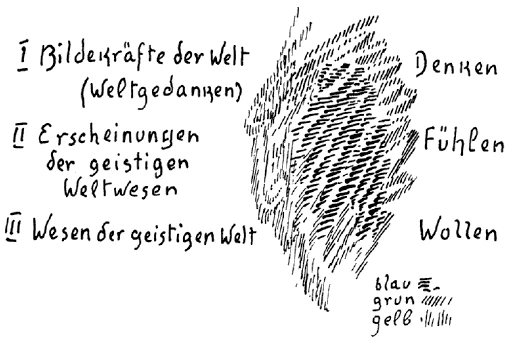
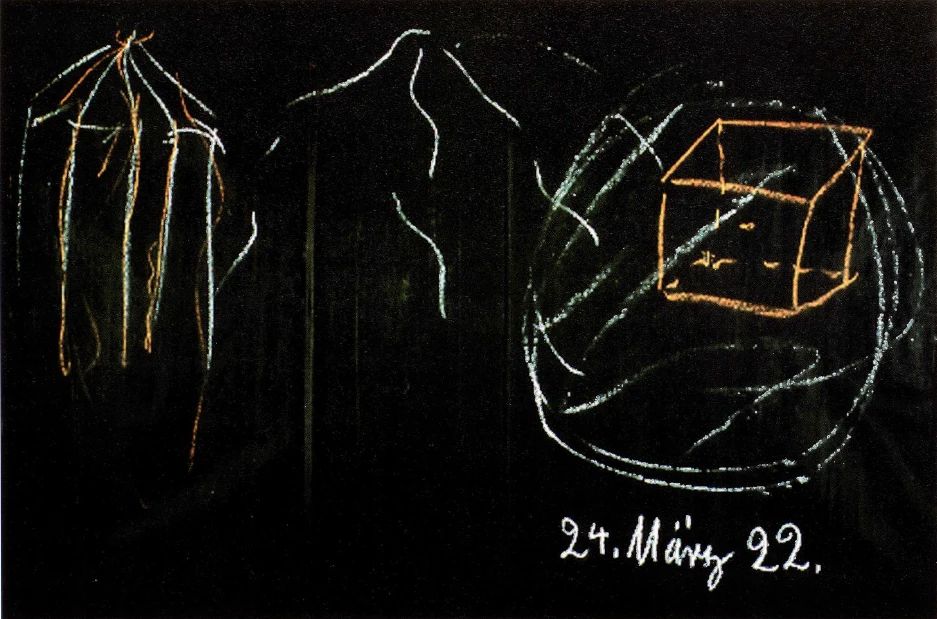
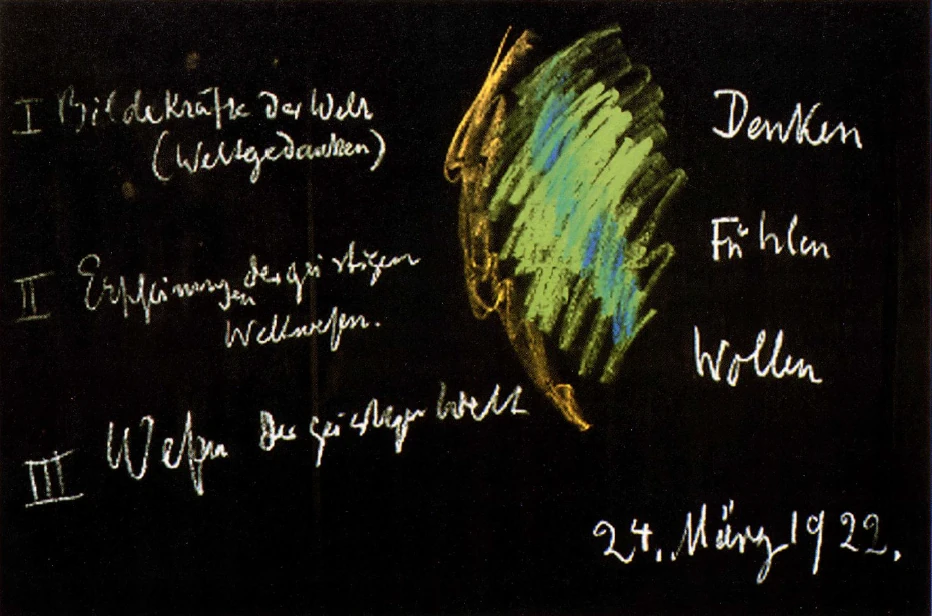
[ 5 ] These are two very different images. In one case, a series of images that leads you into the interior of a mountain; in the other, a series of images that follows an approaching enemy. The soul can go through the same experience, even though the two sequences of images are entirely different. What the soul goes through there is something entirely different from what consciousness experiences upon waking. One could say that the images themselves are not what matters at all; rather, what matters is how the soul experiences a certain inner drama: how the soul initially feels an urge, or how something approaches the soul in place of that urge, and how this then gives way to anxiety and fear, ultimately causing the person, as it were, to rouse themselves from sleep and return to ordinary consciousness. What lies behind the dream—these forces that are intensifying but are not perceived in themselves, which clothe themselves in images—that is what matters. And I could multiply the two series of images I have described many times over; the same inner content of the soul could clothe itself in ten, twenty, or a hundred different images. So we must say: There is something—if I were to sketch it schematically—that is taking place in the soul (blue, green; see drawing on page 46). But what is taking place in the soul there, the person does not notice; they do not know it. What they know are images. I have sketched them here schematically (yellow). The person then experiences these images in their consciousness of the dream. But what really matters is the escalation: mild anxiety, stronger anxiety, supreme fear. The dream images are, to a greater or lesser extent, drawn from life, for both the mountain and the mountain cave—everything, in essence, is borrowed from life. The enemy who approaches is borrowed from life; his weapon is borrowed from life. The images draw their content from life. But that is merely the outer form. If, through what I have often characterized as imaginative consciousness, one has the ability to remain behind this outer form—not to form such images at all, but to remain here within the powers of the soul, where anxiety, fear, and the utmost fear—and to remain there with imaginative consciousness—if one is thus able to form images within that realm, then something entirely different comes into being.
[ 6 ] For when you sleep, you are initially outside your etheric body and physical body, together with your “I” and your astral body. When you wake up, under normal circumstances, you very quickly enter your etheric body—passing through it very rapidly—and immediately enter your physical body. But if, under abnormal conditions, you do not immediately enter your physical body, but instead enter your etheric body before entering your physical body—that is, if you enter the etheric body separately—then these images from life take shape. For in ordinary consciousness, a person has no mental images during sleep itself, and only at the moment when they either enter their physical body and pass through the etheric body do they receive images; or if, while falling asleep, they leave the physical body but remain somewhat within the etheric body, then they again have dream images. Thus, it is only in these intermediate states that such dream images, drawn from life, take shape.
[ 7 ] But imaginative consciousness enables one to live entirely outside the body, within what lies behind the dream as the forces of the soul. And then one lives in a different reality. Then one lives in the world in which a person exists from the moment they fall asleep until they wake up. From the moment a person falls asleep until they wake up, they live in a world in which they lose consciousness. You can picture this as if a person were submerging in water and losing consciousness, only to regain it when the water carries them out and releases them again. The same process that occurs physically also takes place on a spiritual level when a person falls asleep. They submerge into the spiritual world. There they lose consciousness. They leave their body with their soul and lose consciousness. Upon waking, they resurface and regain consciousness. But surfacing means entering the body. And if, as I said, one does not immediately enter one’s body but is still aware of the transition while in the etheric body, then dream images arise. But if one does not allow oneself—and does not need to allow oneself—to experience such dream images, but instead receives images directly in the spiritual world while completely outside the physical body, then the images that emerge are not arbitrary; rather, they are the kinds of images you will find described in my Occult Science as a depiction of the world’s evolution. And everything that is described in the way I have described it in my Occult Science has, first and foremost, this origin, which I am now characterizing for you.
[ 8 ] If you ask yourself, “What exactly is in this ‘Secret Science’?”—then you will say to yourself: “Well, it contains thoughts. You can also think it through.” I always emphasize this again and again: you can think all of this through using common sense. Thoughts are contained within it, but they are not ordinary thoughts. They are the thoughts that are creatively at work in the world outside. A person can live within these thoughts when they stand beyond the threshold that leads into the spiritual world. A person can live within these thoughts that are at work in the world. It is the first thing they encounter when they enter the supersensible world.
[ 9 ] So these are not dream images—for, as I have explained to you, dream images arise in an entirely different way—but rather they are experiences in the spiritual world. Let me put it this way: Imagine a person who is asleep. During sleep, the most comprehensive and intense processes are always taking place in the soul. The person is unaware of any of this, because they are unconscious while asleep. In the morning, they enter their physical body and immediately immerse themselves in it. They use their eyes to see colors and light, their ears to hear sounds, and so on—in other words, they become conscious. But there is this intermediate state: they do not enter the physical body immediately; instead, they enter the etheric body. Then they have a dream or dreams. But imagine if a person were to become conscious before even entering their etheric body. They would become conscious while still in the outer ether that fills the entire world. Then they would become aware of what is described in my Occult Science.
[ 10 ] If, for example, you were to become conscious in the middle of the night without returning to your physical body, so that your physical body appears beside you and you see it—for you can see it then—then you would perceive this cosmology; you would perceive what I have described in my Occult Science. I may call what I have described there: the formative forces of the world, or also world-thoughts.
[ 11 ] This can be described in the same way that one might express individual thoughts in everyday life: The Earth came into being in such and such a way; it once existed as the Moon, as the Sun, and as Saturn—in short, everything I have described in my Occult Science.
[ 12 ] This way of perceiving in the spiritual world, however, is only one of three. When a person looks at their state of daytime consciousness, they know that within this state they can distinguish between thinking, feeling, and willing. But just as waking consciousness has these three states—thinking, feeling, and willing—so too does night consciousness, which for the ordinary person is a state of unconsciousness, have three states. One does not sleep in the same state from the moment one falls asleep until one wakes up, just as one does not always wake up in the same state. One wakes up by thinking, or by feeling, or by willing. One can be awake in three states, just as one can sleep in three states. For the fact that someone with an imaginative consciousness perceives the world’s formative forces—the formative forces of the world—stems solely from the fact that they have acquired an awareness of them, a realization. But every human being falls asleep into these formative forces of the world, into the world’s thoughts. Just as surely as you submerge when you jump into water, just as surely do you, when you fall asleep, first submerge into the formative forces of the world.
[ 13 ] But in addition to this life within the formative forces of the world, there are two other states for the state of sleep, just as there are feeling and willing in addition to thinking for the waking state. When we consider thinking—the having of thoughts—this corresponds in sleep to life within the formative forces of the world. This means that when you become aware of the lightest state of sleep, you are living in that lightest state of sleep within the formative forces of the world. It is as if you were swimming across the universe from one end to the other, moving along through thoughts—which are, in fact, forces. This is the lightest sleep, in which one moves within the thought forces of the world. But there is a deeper sleep—a sleep from which, unless one engages in specific spiritual exercises, nothing can be brought into waking life through dreams. Through dreams, one can bring only something from the lightest sleep into waking life. Yet, as I have explained to you, the images in these dreams are not definitive, for the same dream can take on the most varied forms. Nevertheless, even the lightest sleep can lead to dreaming—that is, one can bring something into consciousness; one can at least sense that one has experienced something in sleep. But it is only from this lightest sleep that one can sense that one has experienced something.
[ 14 ] Only those who attain inspired consciousness can know anything about this deeper sleep. Such a person then perceives more than just what I have described in my Occult Science. Admittedly, I have also described in Occult Science some of what resonates from inspired consciousness, but let us first clarify what can only be described through anthroposophy—namely, what the transition is like in experience from light sleep to deeper sleep, to the sleep from which a person cannot bring back any dreams in ordinary life.
[ 15 ] When sleep is so quiet that one can recall dreams in ordinary life, then the person who can look into these worlds sees the undulating, weaving thought-images—the imaginations of the world—that reveal to him the mysteries of the worlds, that reveal to him to which world a person belongs, other than the one in which they are present with their consciousness from waking until falling asleep. For what I have described in my Occult Science is not merely like painting something on a surface, but is in constant motion, in constant activity. But from a certain point onward, images begin to appear in this world that every human being experiences in light sleep—though they are unaware of it. These images become clear; they increase in brilliance; they reveal certain underlying essences. Then these images ebb away again. Once more, one has nothing in one’s consciousness but a kind of feeling that the images have faded away. Then the images reappear. But as the images become more vivid and then fade away again, something emerges that can be called “sphere harmony”; a kind of “world music” emerges—but not merely one that exists in melody and harmony, but one that depicts the deeds and actions of those beings who inhabit the spiritual world: the deeds of the angels, the archangels, the primordial forces, and so on.
[ 16 ] In a sense, one sees the beings who direct the world from within the spirit moving upon the surging sea of images. This is the world that is perceived through inspiration—the second world. I can call them the manifestations of spiritual beings. And this world—this world of manifestations of spiritual beings—is just as much the second element of sleep as feeling is the second element of wakefulness. Thus, during sleep, a person not only enters the world that represents world thoughts, but within these surging world thoughts, the deeds of the beings belonging to the spiritual world are revealed.
[ 17 ] But in addition to these two states of sleep, there is a third. People are usually completely unaware of this third state of sleep. They generally know that they experience light sleep, and they also know that dreams arise from this light sleep. They are aware that they experience dreamless sleep. But the fact that there is still a third kind of sleep is something that people become aware of, at most, only when they feel upon waking: there has been something very heavy within them during sleep, something they must first overcome in the first few hours after waking. I am quite certain that a number of you are familiar with this state in the morning, when a person knows: I haven’t slept quite as usual after all, but there was something within me that leaves me with a certain heaviness, which I must first overcome over a longer period of time once I am conscious in the morning. This points to a third type of sleep, the nature of which can only be grasped through intuitive consciousness. And this third type of sleep is of great significance for human beings in general.
[ 18 ] When a person is in the lightest stage of sleep, they actually experience much of what they would otherwise go through while awake. They still participate in their breathing, albeit in a different way. They still participate—if not from within, then from without—in their blood circulation and in the body’s other processes. When a person is in the second type of sleep, they no longer participate in physical life, but one could say they participate in a world that is shared by their body and their soul. Something still flows from the body into the soul. It flows in a way similar to how light flows into a plant as the plant develops in the light during the day. But when a person is in the third stage of sleep, there is something within them that—if I may put it this way—has become like a mineral. The salts in their body are deposited particularly heavily. During this third stage of sleep, there are heavy salt deposits in the person’s physical body. In return, however, the person is present with their soul within the mineral world.
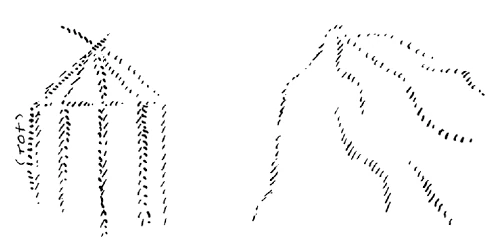
[ 19 ] Suppose you could conduct the following experiment: You lie down in bed, first falling into a light sleep from which dreams can still emerge into ordinary consciousness, then entering a deeper sleep from which no dreams arise, but which nevertheless keeps the human soul connected to the physical body. But now you fall into a sleep such that there are strong salt deposits in your body. You cannot relate in your soul to what is happening there within the body. But if you had placed a rock crystal next to you on the nightstand, you would be able to be with your soul entirely within that rock crystal. You would slip into the rock crystal and perceive it from within. You cannot do this in either the first or the second type of sleep. In the first type of sleep, whose content can enter into dreams, if you were to dream of the rock crystal, you would still experience it as a kind of rock crystal. You would experience something shadowy, yet still something crystalline. If you were to sink into the second stage of sleep, you would no longer experience the rock crystal in such a limited way. If you were then able to dream—you usually cannot, but let’s assume you could—you would experience the rock crystal becoming indistinct and forming into a kind of sphere or ellipsoid, and then retreating again. But if you could dream—that is, if you could reach a state of intuition from deep sleep, from the third stage of sleep—then you would experience the rock crystal in such a way that you would feel as if you were walking inwardly along these lines, then heading toward the tip, and then walking back again: you would then experience the rock crystal from within. You would inhabit it. And so it is with other minerals. And not only do you experience the form, you also experience the inner forces. In short, the third stage of sleep is something that completely lifts a person out of their body, placing them entirely within the spiritual world. During this third stage of sleep, a person stands within the third kind of world—within the very essence of the spiritual world itself. That is to say, you stand within the very essence of the angels, the archangels, and all those beings whom one otherwise perceives only externally—that is, only through their manifestations. You see, when you use your sensory consciousness from the moment you wake up until you fall asleep, you perceive, so to speak, the external manifestations of the gods in nature. During sleep, you penetrate either merely into the world of images in the lightest sleep, or—in the second stage of sleep—into the world of appearances, the world of manifestations, or, when you reach the third stage of sleep, into the innermost being of the divine-spiritual entities themselves.
[ 20 ] Just as a person expresses themselves during the waking state through thinking, feeling, and willing, so too do they express themselves during sleep by either flowing into the thoughts of the worlds, or by having the deeds of the divine-spiritual beings revealed to them from within those thoughts, or by these beings themselves taking the person in, so that, in a sense, their soul rests within them, Just as thinking or imagining is the brightest, clearest, and most distinct aspect of waking consciousness, just as feeling is somewhat more subdued—for feeling is actually always a kind of dreaming—and just as willing, the most subdued state of consciousness during the day, is, in a sense, a form of sleep, so we have three states of sleep: The state of sleep in which ordinary consciousness experiences dreams, and the higher consciousness—the contemplative, clairvoyant consciousness—experiences the thoughts of the worlds. We have the second type of sleep, which remains unconscious even to ordinary consciousness, but which appears to the inspired consciousness in such a way that the deeds of the divine-spiritual beings are revealed everywhere. We have the third type of sleep, which reveals itself to the intuitive consciousness, in which it lives within the divine-spiritual beings themselves. As I said, this manifests itself, for example, by one’s immersion into the inner being of minerals. But this third type of sleep has a special significance for human beings.
[ 21 ] If you first consider the second type of sleep, then, as I have said, you will find within it—in the images that appear, disappear, and ebb and flow—the celestial beings of the angels, the archangels, and so on, but you will also find yourself there. You find yourself there as a soul—not as you are now, but as you were before your birth, or rather, before conception. You come to know yourself—how you lived between death and a new birth. This belongs to this second world. And every time we sleep without dreaming, we live in the same world in which we lived before we descended and took on a physical body. But when you enter the third type of sleep, and if you could wake up there—when intuitive consciousness awakens—that is, if you imagine entering the third type of sleep and waking up there: then you experience your destiny, your karma. Then you know why you have special abilities in this life, based on the nature of your previous lives. Then you will know why you are brought together with these or those personalities in this life. Then you will come to understand karma; then you will come to understand your destiny. One can only learn to recognize this destiny if one—I’ll approach the matter from a different angle now—is able to penetrate into the innermost being of minerals. If you are able to look at a rock crystal not only from the outside but also from the inside—of course, you mustn’t chop it up, because then what you see would always be on the outside, naturally—but you must, as I have described, be inside it; if you can do that, if you can see the crystal from the inside, then you can also understand why this or that stroke of fate befalls you in this life. Take any crystal; take an ordinary cube of salt.
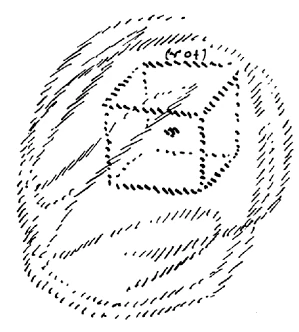
[ 22 ] You see it from the outside: that is how you see it with ordinary consciousness. Your life remains a mystery to you. If you can penetrate it—its physical size is irrelevant here—if you can see it from the inside in all directions, then you are in the world where you can also comprehend your destiny. But you are in this world every night when you enter the third stage of sleep.
[ 23 ] This third type of sleep, however, has something quite special about it. You see, the people facing the Mystery of Golgotha—and we were all among them in our earlier earthly lives—the people in the course of human evolution before the appearance of the Christ on Earth, they very often entered into this third kind of sleep. But even before they, I might say, sank into this third kind of sleep, their angel appeared and brought them back up again. For this is the peculiar thing: As a human being, one can always pull oneself out of the first and second kinds of sleep, but not out of the third. In the third kind of sleep, a human being would have had to die before the appearance of Christ on Earth if they had not been brought out by angels or other beings. Since the appearance of Christ, the Christ-force, as I have often emphasized, has been united with the Earth, and every time a human being must awaken from this third kind of sleep, the Christ-force—which has united itself with the Earth through the Mystery of Golgotha—must come to their aid. Without the Christ-force, a human being could no longer awaken from this third kind of sleep. He can slip into the crystals, but he cannot come out again without the Christ-force. For when one looks behind the scenes of existence, one already realizes what significance this Christ-impulse has for earthly life. So I emphasize this strongly: Human beings could enter the crystals, but they could not come out again.
[ 24 ] These things were felt particularly strongly wherever, after the Mystery of Golgotha—after the appearance of the Christ on Earth—a strong, ancient, pagan consciousness still persisted, even though the revelation of the Christ was already present, as was the case, for example, in Central European regions. It was known that some people had died because they had fallen into such a deep sleep. They would not have had to die if Christ had come to their aid.
[ 25 ] For example, this is how people felt—and I want to say nothing other than what people actually felt—toward Charlemagne or Frederick Barbarossa. Even though Frederick Barbarossa had drowned in the eyes of the outer, physical world, this is nonetheless how he was perceived. But it was felt particularly clearly in the case of Charlemagne. Where did such a soul go, according to this medieval consciousness? Into the interior of crystals. That is why it was placed in the mountains, and there it was to wait until Christ comes and awakens it from its deep sleep. This kind of legend-forming is connected to this consciousness. The strong connection to the Christ impulse on Earth since the Mystery of Golgotha—that is what now prompts the world of the angels, the archangels, and so on, to bring humanity out again; for otherwise, if humanity were to sink into the third kind of sleep, it could not be brought out again. This, then, is connected to the Christ-force, not to belief in the Christ-force; for whether one belongs to this or that religious denomination, what Christ did on Earth was done in an objective sense, and what I am describing here as objective takes place for human beings quite independently of belief. We will discuss the significance of belief in the coming days. But what I am stating now is an objective fact that has nothing to do with faith.
[ 26 ] But how did this come about? It happened because a different destiny entered the divine world itself than had previously existed there—a destiny I would like to characterize by saying: Human beings here in the physical world are born and die. It is the characteristic of the divine-spiritual beings belonging to the higher hierarchies that they are not born and do not die, but merely transform. Christ, who until the time of the Mystery of Golgotha lived among the other divine-spiritual beings, decided to experience death, to descend to Earth, to become a human being, to pass through death within human nature, and then to return to consciousness after death through the Resurrection.
[ 27 ] It is, in fact, a very significant event within the divine-spiritual world that a God underwent death in order to be able to do all that we already know—or that I have just described once again. We can therefore say: There stands, in the history of Earth’s development, the momentous event that God became human and thereby pours His power into such significant manifestations as those I have just described to you. The God who became human possesses such power in earthly life that He draws human souls out of the crystalline interior once they have entered it. Thus, when we speak of Christ, we are speaking of a cosmic being of whom we must say: He is the God who became human. What would be His opposite? His opposite would be the human being who has become God. It need not, of course, be an absolutely good God; but just as Christ descended into the human world and accepted death—that is, first accepted the human body in order to share in the fate of human beings—so we are led to the opposite pole: to the human being who frees himself from death, frees himself from the conditions of the human body, and becomes a god within earthly conditions. Such a person would then cease to be a mortal human being but would walk the earth—though not under the same conditions as an ordinary mortal human being who passes from birth to death and from death to a new birth—but rather, such a human being who has become a god could be found to be a god who has come to earth unlawfully. Just as Christ is a God who became human in a legitimate manner, so too would we have to seek, as his counterpart, the human who has become a god in an illegitimate manner—the human who walks the earth no longer as a mortal and who has assumed the divine nature in an illegitimate way. And as you well know: Just as Christian tradition points to the God who rightfully became human—to Christ Jesus—so too, in connection with Christ Jesus, reference is made to Ahasver, the human being who has become God in an illegitimate manner, who has cast off the mortality of human nature. We thus have in Ahasver the polar opposite of Christ Jesus. This is the deeper rationale, the deeper meaning of the Ahasver legend—that legend which speaks of something that must be spoken of because it is a reality: of a being who wanders upon the earth. This Ahasver figure is there. He wanders upon the earth; he wanders from people to people. Among other things, it is this figure, for example, that prevents the Hebrew faith from dying out. This figure exists—this Ahasver figure, the God who has been wrongfully cast aside.
[ 28 ] If a person wishes to come to know true history, they have every reason to focus their attention on such elements of that history, to see how forces and beings descend from the supersensible worlds into the sensible world, how Christ came from the supersensible worlds into the sensible world, and how, in turn, the sensible world ascends into the supersensible worlds—and how we must also see in Ahasver a genuine, real world force, a world being. The awareness of this journey of Ahasver—who, of course, cannot be seen with physical eyes but only through a certain degree of clairvoyance—has always been present. And the legends that point to him have a sound, objective foundation. One cannot understand human life if one views it merely from the outside, as history books describe it, without looking at its specific manifestations.
[ 29 ] For it is true: Just as Christ has lived within us since the Mystery of Golgotha, and just as Christ can become perceptible within us when we first awaken the contemplative gaze within, so too, when we look outward at human life—and since the contemplative gaze opens up for us in most people, for whom the contemplative gaze opens up in this way— then—just as it happens unexpectedly to the person who crosses the threshold of consciousness—Ahasverus, the eternal Jew, will appear to us. The person may not always recognize him; he may mistake him for something else. But it is just as possible for the eternal Jew to appear to a person as it is for the Christ to shine forth when he looks within himself.
[ 30 ] These things are among the mysteries of the world that must now be revealed in our time, when many mysteries are to be revealed.