The Mystery of the Sun
and
The Mystery of Death and Resurrection
Exoteric and Esoteric Christianity
GA 211
24 March 1922, Dornach
Translated by Steiner Online Library
3. On the Transformation of Worldview
[ 1 ] We have often looked back at the views of earlier times, and in a certain sense we wish to do so again today, with the aim of gaining some perspectives for historical insights into humanity and human development. If we go back millennia in human development—to the times, for example, that we refer to in our terminology as the ancient Indian cultural period—we find that people’s worldview back then was quite different from—even if we take a period very far removed from our own—the worldview of our time. When we go back to those earlier times, we know that people simply did not see nature the way we see it today. People saw nature in such a way that they still perceived spiritual beings directly in everything—in the individual features of the Earth’s surface, in mountains and rivers, but also in all that initially surrounds the Earth, in clouds, in light, and so on. It would have been unthinkable for a person of those earlier times to speak of nature the way we do. For they would have felt as we would feel if we—the image is somewhat grotesque, but it certainly corresponds to the facts—were to sit facing a collection of corpses and then say that we were among human beings. What appears to people today as nature would have been perceived by people millennia before our era merely as the corpse of nature. For in everything that surrounded them, they perceived the spiritual and soul-life.
[ 2 ] We know that when people today learn from works of fiction or from the accounts in myths and legends how it was once believed that spiritual and soul-related forces could be found in springs, in flowing rivers, within mountains, and so on, they assume that the ancients simply let their imaginations run wild—that they were simply making things up. Well, that is a naive point of view. The ancients were by no means making things up; rather, they perceived the spiritual and soul-life just as one perceives colors, just as one perceives the movements of the leaves on a tree, and so on. They perceived the spiritual and soul-life directly, and they would have regarded what we today call “nature” as nothing more than the corpse of nature. But in a certain sense, some individuals among these ancients strove to gain a different perspective than the one that was generally held.
[ 3 ] You know, today, when people strive to gain a different perspective than the usual one—and if they are even capable of doing so—they become “educated people”; they are then given concepts about what they would otherwise see only superficially. Then they take in what is called “science.” This science did not exist in the times we are now speaking of. However, individual people did strive to go beyond the general way of seeing things, beyond what was simply known in everyday life. But they did not study in the way we study today. They performed certain exercises. These exercises were not like those we speak of today in anthroposophy, but were exercises that, especially in those earlier times, were more closely tied to the human organism. They were, for example, exercises through which the breathing process was transformed into something other than what it is by nature. So people did not sit in laboratories or conduct experiments, but they did, in a sense, conduct experiments on themselves. They regulated their breathing. For example, they would inhale, hold their breath, and seek to experience what was happening inside the organism as a result of this altered breathing. Such breathing exercises should not be imitated today. But they were once a means by which people believed they could attain higher insights than those they could reach simply by observing nature through their ordinary perceptions—that is, by seeing the external phenomena of nature as we see them, while also perceiving the spiritual and soul elements within all natural phenomena.
[ 4 ] When people engaged in such exercises—the essence of which, albeit in a diminished form, has been preserved in what is described today as yoga exercises from the East—in other words, when they altered their breathing in contrast to ordinary breathing—then the spiritual-soul aspect vanished from the perception of their surroundings, and it was precisely through such breathing that nature became for these people as we ourselves see it today. So, in order to see nature as we see it today, such people first had to perform exercises in those ancient times. Otherwise, spiritual-soul qualities would, as it were, leap out at them from all the beings in their surroundings as they looked upon them. They dispelled these spiritual-soul qualities, so to speak, by altering their breathing process.
[ 5 ] Thus, to use the term commonly applied today to those who strive to transcend conventional views, they—as “scholars”—sought no longer to have nature around them as something imbued with soul and spirit, but rather to have it around them in such a way that they perceived it as a kind of corpse. One could also put it this way: When these people looked out into nature, they felt as if they were in a surging, undulating, soul-and-spirit-filled universe, but they felt within it just as a person of the present day would feel if they were dreaming in vivid images and could hardly wake up from that dream. That is how they felt. But what did these individuals—let us call them the scholars of that ancient time—achieve when, through such special exercises, they detached themselves from this living, surging world and killed it off in their perception, so that they truly had the feeling they now had something dead, something corpse-like, around them? What were they striving for through this?
[ 6 ] Through this, they sought a stronger sense of self. They sought something through which they could experience themselves, through which they could feel themselves. People today say at every moment: “I am.” For them, “I” is a word they use very frequently from morning to night, for it comes naturally to them; it is second nature. For these ancient people, however, uttering “I” or even “I am” was not second nature in their ordinary, everyday experience. They had to acquire this ability. To do so, they first had to perform certain exercises. And as they performed these exercises, they arrived at such an inner experience that they could say with a certain truth: “I am.” Only then did they become conscious of their own being.
[ 7 ] So what we take for granted only became an experience for these people when they exerted themselves in an inner breathing process. They first had to, so to speak, “kill” their surroundings for the sake of perception, to awaken themselves. Through this, they came to the conviction that they, too, were themselves—that they could say “I am” to themselves. But with this “I am,” they were given something that we today take for granted once again. They were given the inner unfolding of the intellectual. Through this, they developed the capacity for inner, detached thinking.
[ 8 ] If we go back to times when ancient Eastern views set the tone for civilization, it was precisely the case that people perceived nature as animated in their everyday lives, but had a very weak, almost nonexistent sense of self—and certainly not this sense of self based on the conviction “I am”—though individual people who had been trained in the mystery schools were led to experience this “I am.” However, they did not experience this “I am” in the way we take it for granted today; rather, at the very moment when their breathing process enabled them to say “I am” at all—out of inner conviction and inner experience—they experienced something that even people today do not truly experience at first.
[ 9 ] Think back to your childhood: You can think back only so far, and then it stops. You were once a baby, and you don’t know what your inner life was like as a baby. Your memory simply stops there. You were certainly already there, crawling around on the floor, being cherished by your mother or father. You may have squirmed or moved your hands, but what you experienced internally at that time is something you are not aware of in your ordinary consciousness. Nevertheless, it was a more active, more intense soul life than what came later. For this more intense soul life, for example, shaped your brain plastically and permeated the rest of your body, shaping it plastically as well. An intense soul life existed, and the ancient Indian felt himself transported into this very soul life at the very moment he said to himself, “I am.”
[ 10 ] Just imagine very vividly what that was like. When he said to himself, “I am,” he did not feel as though he were in the present moment; he felt transported back to his infancy, he felt just as he had felt in his infancy, and from that place he spoke to his entire later life. He didn’t feel at all that he was now—but that had only been drawn into this inner being after it had previously lived in the spiritual-soul world. That is to say, by first transporting himself back to his infancy through his breathing process, this ancient Indian yogi became aware of the time before his earthly existence. It seemed to him like a memory. Just as when a person today remembers something they experienced ten years ago, so it was like the emergence of a memory at the very moment when the “I Am” shot through the soul—when, in that ancient Indian era, a person strengthened himself inwardly through breathing exercises and “killed off” the external world around him, but in doing so brought to life not what was now his external world, but rather what had been the external world before the human being had descended into the physical world of the Earth.
[ 11 ] Back then—if I may describe it using a modern term, which of course sounds infinitely philistine when applied to those bygone days—the study of yoga truly lifted one out of one’s present earthly existence and elevated one into the spiritual-soul realm. So it was thanks to the study of yoga in those days that one was lifted up into the spiritual and soul worlds. People had a somewhat different consciousness than we do today. But precisely when one was a yoga scholar in the sense of that time, one could think—other people could not do so, other people could only dream—but one could think one’s way into the supersensible world from which one had descended into earthly existence.
[ 12 ] This is also a characteristic of that period of Earth’s evolution which—if we characterize it somewhat broadly—preceded, for example, the Greco-Roman worldviews in the fourth post-Atlantean epoch. By then, the “I am” had already penetrated more deeply into people’s ordinary, everyday consciousness. Although language at that time still contained the “I” within the verb—it was not yet as distinct as it is for us—a clear sense of “I” was nonetheless already present. This clear sense of “I” was now a natural, self-evident fact of inner life. On the other hand, however, external nature had already been more or less de-spiritualized. The Greeks still possessed the ability to experience these two perspectives side by side, and indeed without any special training. The Greeks still clearly experienced—albeit more faintly than people of earlier times—the spiritual-soul aspect in springs, rivers, mountains, and trees. But at the same time, they could set aside the spiritual and soulful, experience the lifeless aspects of nature, and still maintain a sense of self. This, in particular, gives Greek culture its distinctive character. The Greeks did not yet have the same view of the world as we do. Although they were already capable of developing concepts and ideas about the world similar to ours, they could at the same time take seriously those perspectives that were still expressed in images. They lived quite differently from the way we live today. We go to the theater, for example, to be entertained. In Greece, however, people actually began going to the theater for entertainment—if I may put it that way—only in the time of Euripides, hardly in the time of Sophocles, and certainly not in the time of Aeschylus, or even in earlier times. Back then, people attended dramatic performances for other purposes. People had a distinct sense that spiritual and soul entities lived in everything—in trees and shrubs, in springs and rivers. When one experiences these spiritual and soul entities, one has moments in life when one does not have a strong sense of self. But when one develops this strong sense of self again—which the ancients still had to seek through yoga training, and which the Greeks no longer needed to seek through yoga training—then everything around one becomes dead; one sees, as it were, only the corpse of nature. But this leads to one’s own exhaustion. People used to say: Life wears a person down. The Greeks felt that merely looking at dead nature was a kind of spiritual and physical illness. In ancient Greek times, people felt this keenly—that daily life made them sick, that they needed something to restore their health: and that was tragedy. To regain health—because one felt one was wearing oneself out, making oneself sick in a certain sense—one needed, if one wanted to remain fully human at all, a cure; that is why people turned to tragedy. And even in Aeschylus’s time, tragedy was performed in such a way that the one who created the tragedy, who shaped it, was perceived as the physician who, in a certain sense, restored the worn-out human being to health. The emotions aroused there—fear and compassion for the heroes who appeared on stage—acted like a medicine. They penetrated the person, and as he overcame these feelings of fear and compassion, they created a crisis within him, just as a crisis forms in the case of pneumonia, for example. And by overcoming the crisis, one becomes healthy. Thus, the plays were performed to restore health to people who felt worn out as human beings. That was the sentiment with which people approached tragedy and theater in ancient Greece. And the reason for this was that people told themselves: When one feels one’s own ego, the world becomes deified. The play brings the god back into view, for it was essentially a presentation of the divine world and of the fate that even the gods must endure—that is, a presentation of what asserts itself as the spiritual behind the world. That was what was presented in tragedy.
[ 13 ] For the Greeks, art was still a kind of healing process. And as the early Christians relived what was given in the incarnation of Christ in Jesus—and what can be contemplated and experienced in the Gospels: the path of Christ Jesus toward suffering and death on the cross, toward the Resurrection, toward the Ascension—they experienced, in a sense, an inner tragedy. That is why they also called Christ—and increasingly referred to him as—the Physician, the Savior, the great Physician of the world. In earlier times, the Greeks had sensed this healing aspect in their own tragedy. Humanity was to gradually come to experience and feel this historical, redemptive healing in the vision and in the emotional experience of the Mystery of Golgotha, the great tragedy of Golgotha.
[ 14 ] In ancient Greece, particularly in the period before Aeschylus—when what had previously been celebrated only in the darkness of the mysteries had already become more public—tragedy emerged. What did people see in this earlier tragedy? The god Dionysus appeared; it was the god Dionysus who worked his way forth from the forces of the earth, from the spiritual earth. — Because the god Dionysus worked his way forth from the spiritual forces and broke through to the surface of the earth, he shared in the suffering of the earth. In a sense, as a god, he felt—not only spiritually, as was the case with the Mystery of Golgotha, but also physically—what it meant to live among beings who pass through death. He did not experience death in himself, but he learned to behold it. One sensed that there was the god Dionysus, suffering deeply among humanity because he had to bear witness to all that human beings endure. At first, there was only a single figure on stage: the god Dionysus, the suffering Dionysus, and around him a chorus that recited so that the people could hear what was going on within the god Dionysus. For that was, in fact, the very first form of the play, of tragedy: the only character who truly acted on stage was the god Dionysus, and surrounding him was the chorus, which recited what was taking place in Dionysus’s soul. Gradually, the single character who portrayed the god Dionysus in earlier times gave way to multiple characters, and the single performance evolved into the later drama. Thus, people experienced the god Dionysus in a symbolic form. And later, they experienced in reality—as a historical fact of human development—the suffering and dying god, Christ. This was to unfold before humanity as a historical fact, so that all people could experience what had otherwise been experienced in Greek theater. But as humanity approached this great historical drama, the drama—which had been so sacred in ancient Greece that people perceived in it the Savior, the miracle-working remedy for humanity—was, I might say, increasingly cast down from its pedestal and became mere entertainment, as was already the case with Euripides.
[ 15 ] Humanity was living out of step with the times, in an era when it needed more than just to have the spiritual-soul world presented to it in images, now that nature had been stripped of its soul for the sake of observation. Humanity needed the historical mystery of Golgotha. The ancient yoga student of the Indian era had taken in the breath, held it back, as it were, within his own body, in order to feel within that breath: “The divine ‘I’ impulse lives within you.” — As a yoga student, the human being experienced God within himself through the process of breathing. Later times came. Human beings no longer experienced the divine impulse within themselves through the process of breathing. But they had learned to think, and they said: Through the breath, the soul entered into human beings. — The ancient yoga practitioner lived this through. Later generations said: And God breathed the breath of life into human beings, and they became souls. — The ancient yoga student experienced this; later generations merely stated it. And by stating this in ancient Hebrew times, people were already experiencing—in a certain abstract sense—what they had previously experienced concretely. But people did not look inward in ancient Hebrew times; they did so, however, in ancient Greek times. One thing always takes place in one part of the world, another in another part. People no longer experienced God within themselves as the ancient yoga student did; instead, they experienced, in symbolic form, the presence of God within the human being. And this experience—in symbolic form—of God’s presence within the human being was certainly present in ancient Greek drama. But this drama now became a world-historical event. This drama became the Mystery of Golgotha. Consequently, however, the image was now set aside. The image became a mere image, just as the process of breathing was described only in thought. The entire constitution of the human soul changed.
[ 16 ] Man saw the external world as dead, and for him this was the fundamental, the natural thing—that he saw the external world as dead. He saw it as devoid of divinity. He saw himself as the external world, as the physical external world, as devoid of divinity. But he had the consolation that once, into this deified world, the true God had descended—Christ—and had lived as a human being, and through the Resurrection had passed into the entire development of the Earth as the Christ impulse. And so human beings could now develop a certain perspective in the following way. They could say to themselves: I see the world, but it is a corpse. — Of course, he did not say this to himself, for it remained in the unconscious; human beings do not know that they see the world as a corpse. But gradually, the image of the corpse on the cross—the dead Christ Jesus—took shape in their perception. And when one looks upon the crucifix, upon the dead Christ Jesus, one sees nature. One has the image of nature—that nature in which humanity is crucified. And if one looks upon the One who rose from the grave, who was then experienced by the disciples and by Paul as the Christ living in the world, then one has what was seen in all of nature in earlier times. Certainly, in a multitude of spiritual beings—in gnomes and nymphs, in sylphs and salamanders, and in all manner of other beings of the earthly hierarchies—people beheld the divine-spiritual; they beheld nature as spiritualized and animated. But now, driven by the already burgeoning intellectualism, people felt the urge to synthesize what is scattered throughout nature. They synthesized it in the dead Christ Jesus on the cross. Yet in Christ Jesus, people see everything they have lost in external nature. They perceive all spirituality by looking to the fact that: From this body arose the Christ, the Spirit of God, who overcame death, and in whose essence every human soul can now participate. People have lost the ability to see the divine-spiritual within the realm of nature. They have gained the ability, in light of the Mystery of Golgotha, to rediscover this divine-spiritual in the Christ.
[ 17 ] Such is the course of development. What humanity had lost was restored to it in Christ. In what it had lost, it gained selfishness—the capacity for a sense of self. Had nature not become dead to human perception, human beings would never have arrived at the experience of “I am.” They arrived at the experience of “I am”; they were able to sense themselves, to experience themselves inwardly, but they needed a spiritual external world. Christ became that world. But the “I am,” the sense of self, is built upon the corpse of nature.
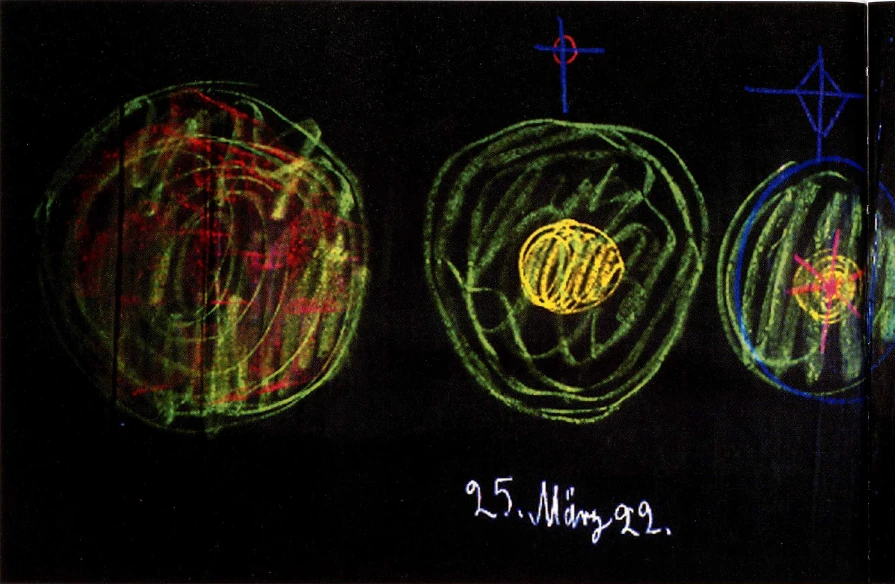
[ 18 ] That is what Paul felt. Let us try to imagine this feeling of Paul’s. All around him lay the corpse of what people had once beheld in ancient times. People viewed nature as the body of the divine, the soul-spiritual. Just as we see our fingers today, so did those people see mountains. It never occurred to them to think of the mountains as lifeless nature, any more than we think of a finger as a lifeless limb; rather, they said: There is a spiritual-soul aspect—that is the earth; it has limbs, and a mountain is one such limb. — But nature became dead. Human beings experienced the “I Am” within. But he would simply stand there like a hermit on an earth stripped of spirit and soul if he could not look toward Christ. Yet he must not merely gaze at this Christ from the outside, so that Christ remains external; he must now take him into his “I.” He must be able to say, as he rises above the everyday “I am”: Not I, but Christ within me.—If we were to schematically represent what was there, we could say: Human beings once perceived nature (green) all around them, but this nature was permeated everywhere by soul and spirit (red). That was in an earlier period of humanity.
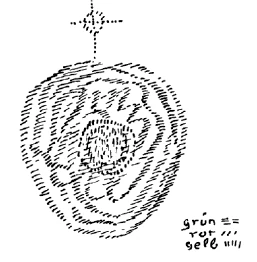
[ 19 ] In later times, human beings also perceived nature, but they perceived the possibility of recognizing their own “I am” in contrast to nature, which had now been stripped of its soul (yellow). To do so, however, they needed the image of God present within the human being, and they perceived this in the god Dionysus, who was presented to them in Greek drama.
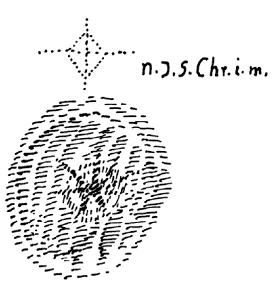
[ 20 ] In even later times, human beings once again sensed the disembodied nature (green) and, within themselves, the “I Am” (yellow). But the drama becomes reality. The cross rises on Golgotha. Yet at the same time, what humanity had originally lost dawns within them and radiates (red) from their very core: Not I, but Christ within me.
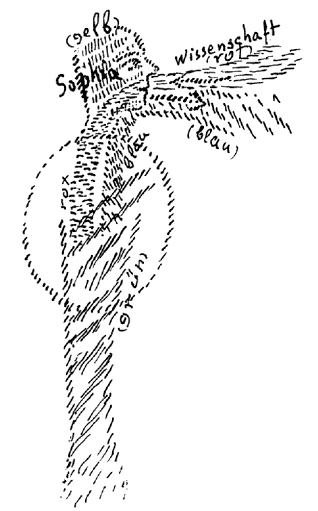
[ 21 ] How did people in ancient times put it? They could not put it into words, but they experienced it: Not I, but the divine-spiritual around me, within me, everywhere. — Humanity has lost this “divine-spiritual everywhere, around me, within me”; they have rediscovered it within themselves, and now, in a conscious sense, they say the same thing they originally experienced unconsciously: Not I, but the Christ within me.— The primordial fact that was experienced unconsciously in the time before human beings experienced their “I” becomes a conscious fact, the experience of the Christ within the human being, in the human heart, in the human soul.
[ 22 ] Don’t you see, when you sketch out such a trivial diagram, exactly what you then have to represent in ideas? Don’t you see the whole world filled with the Spirit of Christ, which rises up within the human being—that which first draws in from the cosmos into the human being? And if you realize what significance sunlight has for human beings—how human beings cannot physically live without sunlight, how light surrounds us everywhere—then you will also be able to understand when I tell you that in those earlier times I have spoken of today, human beings truly felt themselves to be light within the light. They felt they belonged to the light. They did not say, “I am”; they perceived the sun’s rays falling upon the earth, and they did not distinguish themselves from those rays. Wherever they perceived the light, they also perceived themselves, for that is where they felt themselves to be. When the light arrived, they felt themselves riding the waves of light, the waves of the solar essence, the sun.
[ 23 ] With Christ, this became active within us. It is the sun that enters into our inner being and becomes active there. Of course, this comparison of Christ with light appears many times in the Bible, but when anthroposophy today seeks once again to draw attention to the fact that we are dealing with a reality here, it is precisely those people whose academic discipline is listed in university catalogs as “theology” who are most resistant. They actually reject knowledge of these things. And it is indeed a profoundly significant fact that there was once such a theologian in Basel who was also a friend of Nietzsche’s: Overbeck, who wrote the book on the Christian character of contemporary theology. With this book, he actually sought, as a theologian, to establish that what is Christian still exists, that back then—in the 1870s—this Christian element still existed, but that much had already become unchristian, and that, in any case, theology was no longer Christian. Overbeck, a professor of theology at the Faculty of Theology in Basel, sought to demonstrate this through his book on the Christian character of contemporary theology. He succeeded to a great extent. And anyone who takes the book seriously will come to the conclusion that while there may still be some Christian elements today, modern theology has, in any case, become unchristian. And while there may still be many Christian elements today, when theologians begin to speak about Christ, their words are certainly no longer Christian. These matters are simply not usually taken seriously enough. But they should be taken seriously, for if they were, people would not only recognize the necessity of today’s anthroposophical work but would also grasp the full significance of anthroposophy. And above all, one would become aware of the responsibility we have today toward present-day humanity with regard to something like anthroposophical knowledge. For this anthroposophical knowledge should actually underlie all knowledge today. All knowledge—especially social knowledge—should be derived from this anthroposophical knowledge. For as people learn that the light of Christ lives within them—“Christ within me”—and as they fully experience this, they learn to see themselves as something other than what one gets when one regards the human being merely as belonging to nature’s corpse. But it is from this view—that the human being belongs to nature that has become a corpse—that our antisocial, unsocial present has arisen. And a true perspective—one that can once again make people brothers and sisters, and that can once again bring genuine moral impulses to humanity—can only come about when human beings penetrate to the understanding of the words: “Not I, but the Christ within me”—when Christ is found, precisely in human interaction, as an active force. Without this insight, we cannot move forward. We need this insight, and this insight must be found. If we make progress toward it, then we will also move beyond it; then we will arrive at the Christianization of our social life.