

The Mystery of the Sun
and
The Mystery of Death and Resurrection
Exoteric and Esoteric Christianity
GA 211
2 April 1922, Dornach
Translated by Steiner Online Library
7. Exoteric and Esoteric Christianity
[ 1 ] The development of humanity is preserved in those documents that have been handed down as religious texts or as other worldview documents. However, it must be emphasized time and again that in addition to these documents—which speak to all of humanity throughout the ages and are thoroughly justified in their outward effects—there are also those we might call esoteric documents.
[ 2 ] Whenever one has spoken in a deeper sense of human knowledge and the human worldview, a distinction has always been made between an exoteric teaching—through which one perceives things more superficially—and an esoteric teaching, which can be truly grasped only by those who have acquired the necessary inner preparation within their own minds. And so, even for Christianity itself—namely, for its spiritual center, the Mystery of Golgotha—a distinction must be made between the exoteric view and esoteric insights. The exoteric view is, after all, contained in the Gospels for the whole world. Alongside this exoteric view, there has always been an esoteric Christianity for those who wished to prepare themselves in an appropriate way within their own minds to receive such an esoteric Christianity.
[ 3 ] The most important thing in this esoteric Christianity is what can be known about the way the risen Christ—that is, the Christ who passed through death—interacted with those of his disciples who were able to understand him. As you know, the Gospels actually speak of Christ’s interactions with his disciples only in a suggestive and fleeting manner. What is conveyed in the Gospels about the Risen Christ’s interactions with his disciples does indeed give people a sense that something quite special has been incorporated into the development of the Earth through the Risen Christ; yet, unless one advances to the esoteric level, it remains merely a matter of intuition.
[ 4 ] These intuitions, however, are significantly complemented when we add Paul’s confession. This confession of Paul appears to be of very special importance, for Paul expresses his conviction that he was only able to believe in Christ from the moment Christ appeared to him during the event at Damascus—that is, when he was able to gain the insight that Christ had passed through death and still lives after death in connection with the development of the Earth. Paul gained this insight into the living Christ through the event at Damascus, and one need only consider what this means, coming specifically from Paul’s own lips.
[ 5 ] Why was Paul unable to become convinced of the truth of the Christ-being before he had gone through the event at Damascus?
[ 6 ] One must realize what it meant to Paul—who was, in a certain sense, initiated into Hebrew teachings—that, according to human judgment, the being who was present as Christ Jesus had been condemned to a shameful death on the cross. At first, Paul could not conceive that the ancient prophecies could have been fulfilled in any way regarding a being who, according to human law, could have been condemned to a shameful death on the cross. At first, Paul could not conceive of this. Until the event at Damascus, it was, so to speak, conclusive proof for Paul that Jesus of Nazareth could not have been the Messiah, because he had to suffer a shameful death on the cross. And only after Paul had experienced the vision on the road to Damascus—even though Jesus of Nazareth, or rather the being embodied in Jesus of Nazareth, had undergone the shameful death on the cross—only after Paul had been able to gain this certainty from the event, from the vision on the road to Damascus, did he come to the conviction of the truth of the Mystery of Golgotha. This means, precisely because Paul reveals it as his conviction, that it is something extraordinarily great.
[ 7 ] Well, the traditions that were still extant in the early Christian centuries no longer exist today. At most, they survive as external historical notes within certain secret societies, which, however, do not understand them. Whatever goes beyond the sparse accounts of Christ following the Mystery of Golgotha must be rediscovered today through anthroposophical spiritual science. We must, so to speak, rediscover: What did the risen Christ actually say? What did he say to those disciples who were present but are not recorded in the Gospels? — For what is recorded in the Gospels about the disciples who, for example, met Christ Jesus on the road to Emmaus, or what else is recorded about the group of apostles, is always steeped in a tradition such that we are dealing with minds as simple as possible, who could not penetrate to the esoteric. One must therefore ask, going beyond this: What did Christ say to his truly initiated disciples after his Resurrection?
[ 8 ] To understand this, one must consider how people in ancient times might have been disposed in their entire state of mind with regard to the true mystery of Golgotha, and how they might then have been influenced by this event at Golgotha.
[ 9 ] It is extremely difficult for people today to understand when one states an important truth about the earliest periods of humanity’s development on Earth—the truth that the first humans who walked the Earth did not possess the kind of knowledge that we today call “knowledge.”
[ 10 ] Thanks to their atavistic clairvoyant abilities, these first humans to walk the Earth were able to receive divine wisdom. This means nothing less than that they could be taught by the divine beings who descended to Earth from the realm of the higher hierarchies—descending, of course, in a spiritual, mental manner—and who then also taught the souls in a spiritual, mental manner.
[ 11 ] Such instruction by the divine beings themselves, who descended from the spiritual worlds to Earth, was certainly known in the ancient times of human development on Earth. It was a state of ecstasy into which people—mostly those who had undergone mystery initiation—could enter, a state in which they were, for the most part, outside their bodies with their souls, so that they were not dependent on external sensory perceptions, nor on, for example, an external conversation that would have had to be conducted with the mouth, but were instead able to receive messages from the gods in a spiritual manner. They received what these beings regarded as their true wisdom not in what we today call a dream, but through a living, spiritual communion with the divine-spiritual beings.
[ 12 ] This wisdom initially concerned the messages the gods conveyed to humans regarding the sojourn of human souls in the divine-spiritual world before their descent into an earthly body. The gods taught humans about what the souls experienced before they descended into an earthly body through conception, in the state I have described. In doing so, people had the feeling that they were actually just being reminded of something. They believed that when the gods conveyed these messages to them, they were being reminded of what they had just experienced in the spiritual-soul world before birth, or rather before conception. It is still evident in Plato’s writings that such a thing was indeed the case in earlier times. Thus, we can look back today on a divine-spiritual wisdom that human beings received here on Earth in the states described; one may indeed say—not in a figurative sense, but in the very literal sense—that it came from the gods themselves.
[ 13 ] This wisdom was of a very special kind. It was such that the people on Earth knew nothing—as strange as that may sound to people today—about death. As I said, this will sound strange to you today, and yet it is true that the earliest inhabitants of Earth knew nothing of death; for a child knows nothing of death. The people who were taught in this way, as I have indicated, and who in turn passed this teaching on to others who also still possessed atavistic clairvoyance—these people immediately became aware that their soul had descended from divine-spiritual worlds, had entered a body, and would eventually leave the body again, and they looked upon this progression of soul-spiritual life. Birth and death appeared to them as a transformation, not as something that marks the beginning and end of anything.
[ 14 ] If one were to sketch this out schematically, one might say: One saw how the human soul can continue to develop, and one perceived earthly life as a turning point.
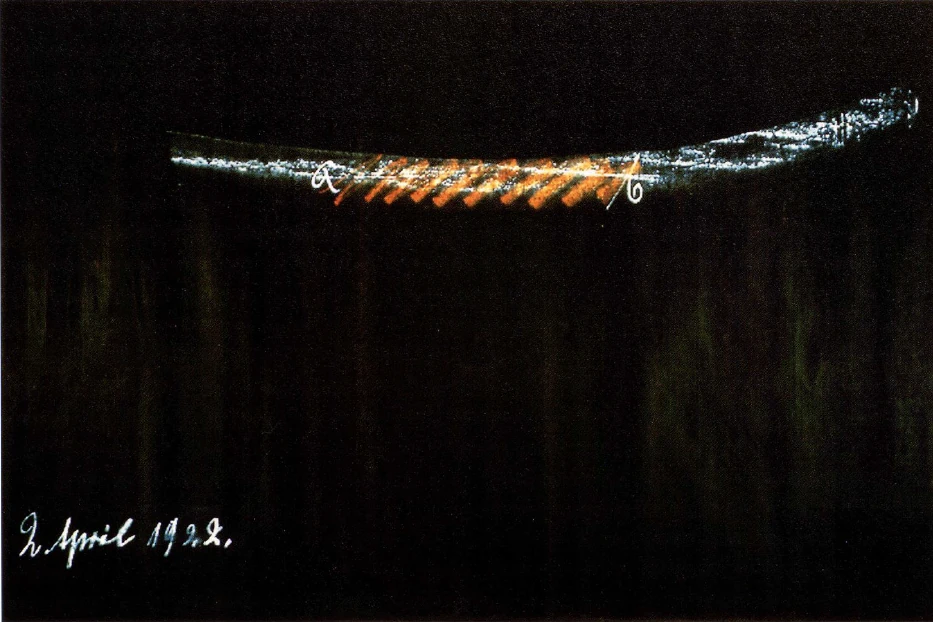
[ 15 ] But one did not see point a and point b as the beginning and the end; rather, one saw the spiritual and soul life flowing forth. It was true that people were also seen to die. You will not expect me to compare these very earliest humans to animals, for although they were physically similar to animals, they possessed a higher spiritual-soul life. I have elaborated on this here before. But just as little as an animal today understands anything about death when it sees another dead animal, so too did these people—who grasped only the concept of the outflowing spiritual-soul life—understand nothing of death. Death was part of Maya, the great illusion. It made no particular impression on people. They knew only life. Although they saw death, they did not know death. Their spiritual-soul life was simply not entangled in death. They viewed human life only from within. When they looked toward birth, this human life extended beyond birth into the spiritual realm. When they looked toward death, the spiritual-soul life in turn extended beyond death into the spiritual realm. Birth and death were of no significance to life. People knew only life; they did not know death.
[ 16 ] People gradually emerged from this state. And if one traces the development of humanity in its progression from the earliest times up to the Mystery of Golgotha, one can say: People came to understand death more and more as something that made an impression on them. Their souls became entangled with death, and it became a matter of feeling: What will become of the soul when a person passes through death?
[ 17 ] Thus, in the earliest times, people did not at all face the question of death as an end. At most, they asked about the specific nature of the transformation. They asked whether it was the breath that leaves the human being and flows onward, thereby carrying the soul into eternity, or they conceived of another way in which spiritual and soul life flows onward. They reflected on the nature of this flow, but they did not reflect on death as an end.
[ 18 ] As the Mystery of Golgotha drew near, it was only then that people truly began to feel that death has meaning, that earthly life is something that comes to an end. Of course, this did not become a philosophically formulated scientific question, but it settled upon the soul as a feeling. People had to arrive at this feeling in earthly life, for the mind—the intellect—had to enter into earthly life for the sake of humanity’s development. The intellect, however, depends on our ability to die. I have elaborated on this on several occasions.
[ 19 ] Humanity thus had to become entangled in death. Humanity had to come to know death. The ancient times, when people did not know death, were all non-intellectual. People received their ideas through inspirations from the spiritual world; they did not conceive them themselves. There was no intellect. But the intellect had to take hold. The intellect can take hold only insofar as—to put it in spiritual-soul terms—human beings can die, in that they continually carry within themselves the forces of dying. In physical terms, one could say: Death can only occur when a person deposits salts—that is, mineral-solid components, dead components—not only in the rest of their body but also within their brain. The brain constantly contains the tendency toward salt deposits, toward bone formations that have not come to fruition. Thus, the brain constantly contains the tendency toward death. This “inoculation” of death had to come upon humanity. And only what arose from this necessity—that death truly played a role in human life—was the external experience of death. If human beings had remained as they were in ancient times, when they did not actually know death at all, then they would never have been able to develop an intellect, for the intellect is possible only in a world in which death reigns.
[ 20 ] That is how it appears from the human perspective. However, one can also view it from the perspective of the higher hierarchies. From that perspective, it looks somewhat different.
[ 21 ] The higher hierarchies contain within their very nature the forces that formed Saturn, the Sun, the Moon, and finally the Earth. If the higher hierarchies had, so to speak, discussed their teachings among themselves up to the Mystery of Golgotha, they would have said: We can shape the Earth out of Saturn, the Sun, and the Moon. But if the Earth contained only what we were able to incorporate from Saturn, the Sun, and the Moon, it would never be able to develop beings who know anything of death—and who could therefore develop intellect within themselves. We, the higher hierarchies, are capable of bringing forth from the Moon an Earth in which human beings know nothing of death, but in which they also cannot develop intellect. It is impossible for us higher hierarchies to shape the Earth in such a way that it yields the forces necessary for human beings to attain intellect. To do so, we must engage with an entirely different being—a being that comes from paths other than those we have taken—the Ahrimanic being. Ahriman is a being who does not belong to our hierarchy. Ahriman enters the stream of evolution by a different path. We must engage with this Ahriman. If we tolerate Ahriman within Earth’s evolution, if we grant him a share, then he brings us death and with it the intellect, and we can incorporate death and the intellect into the human being. Ahriman knows death. Ahriman knows it because he is intertwined with the Earth, because he has followed paths that connect him to Earth’s evolution. He is a knower, a sage of death. He is therefore also the lord of the intellect.
[ 22 ] The gods had to—if one may put it that way—come to terms with Ahriman. They had to tell themselves: Evolution cannot proceed without Ahriman. The point is that Ahriman can be incorporated into evolution. But if Ahriman is incorporated into evolution and he then becomes the master of death—and thus of the intellect—then we will lose the Earth; then Ahriman, whose sole interest is to intellectualize the entire Earth, will lay claim to it for himself.
[ 23 ] The gods were faced with the great question of, in a certain sense, losing dominion over the earth to Ahriman. There was only one possibility: that the gods themselves would come to know something they could not have known in their divine realms, which were not permeated by Ahriman—that the gods, through one of their emissaries, Christ, would come to know death on Earth themselves. A god had to die on Earth, and he had to die in such a way that this would be rooted not in divine wisdom but in the human error that would prevail if Ahriman alone held dominion. A god had to pass through death, and he had to overcome death. Thus, for the gods, the Mystery of Golgotha meant the enrichment of their knowledge through the wisdom of death. Had no god passed through death, the Earth would have become entirely intellectualistic, without ever entering into the evolution that the gods had destined for it from the very beginning.
[ 24 ] In ancient times, people did not know death. But they came to know death. They had to face the realization that with death—that is, with the intellect—we enter a completely different current of evolution than the one from which we came. Now Christ taught his initiates that he had come from a world where death was unknown; that he had come to know death on Earth, and that he had conquered death. If one understands this connection between the earthly world and the divine world, then one can trace the intellect back to spirituality. This is roughly how one might describe the content of those esoteric teachings that Christ imparted to his initiated disciples. What he gave them was precisely the teaching about death as it appears from the vantage point of the divine world.
[ 25 ] If one wishes to grasp the full depth of this esoteric teaching, one must be clear that for the person who understands the entire evolution of humanity, this is a realization: The gods defeated Ahriman by making his powers usable for the Earth, but they blunted his power by themselves coming to know death in the essence of Christ. Although the gods did introduce Ahriman into Earth’s evolution, by using him they forced him to descend into Earth’s evolution, preventing him from carrying out his own dominion to the end.
[ 26 ] Anyone who has come to know Ahriman since the Mystery of Golgotha—and anyone who knew him before that—knows that Ahriman has been waiting for the moment in world history when he could intervene in such a way that his influence would not only—as has been the case since Atlantean times, as you know from my Occult Science —but also into human consciousness. If one were to apply human terms to divine will, one might say: Ahriman waited longingly for the moment when he could penetrate human consciousness with his power.
[ 27 ] He was now surprised to realize that he had not known before that a divine decision had been made to send a being to Earth—Christ, who passed through death. Although this made Ahriman’s intervention possible, the pinnacle of his actual dominion had been broken off. Since that time, Ahriman has seized every opportunity to lead people to rely solely on their intellect; even today, Ahriman has not given up hope that he will succeed in leading people to rely solely on their intellect.
[ 28 ] What would that mean? If Ahriman were to succeed in instilling in human beings the conviction—to the point where every other conviction would vanish from the earth—that a human being can live only in his body, that as a spiritual-soul being he is inseparable from his body, then the human soul would be so gripped by the idea of death that Ahriman could easily carry out his plans. This is what Ahriman always hopes for. And one might say, for example, that in Ahriman’s mind—if one may speak of a “mind” in connection with Ahriman, though it is, of course, only a figure of speech—there was a special joy —I always use human expressions for what actually requires different terms—that a special joy reigned in Ahriman’s mind from the 1840s through the end of the nineteenth century, for under the prevailing dominance of materialism, Ahriman could once again hope for his dominion over the Earth.
[ 29 ] In fact, theology has even become materialistic during this period. I have mentioned how theology has become unchristian, and how the Basel theologian Overbeck wrote a book in which he attempted to prove that modern theology is no longer Christian at all. This gave Ahriman reason to hope once again.
[ 30 ] And opposition to Ahriman actually exists today only in teachings such as those found in anthroposophy. When, through anthroposophy, people once again come to realize the independence of the spiritual-soul being—separate from the physical being—then Ahriman must first give up his hope. This struggle between Christ and Ahriman is indeed possible again, so that a glimpse of it can be found in the Gospel account of the Temptation. But one will only fully understand the matter if one grasps what I have already explained here on several occasions: that in the earlier stages of human development, Lucifer played a greater role, and Ahriman has only been exerting an influence on human consciousness since the time of the Mystery of Golgotha. Before that, he also had an influence on humanity, but not actually on consciousness.
[ 31 ] When one looks into the human soul, one must say: The most important point in humanity’s earthly development is when a person comes to realize that within the Christ impulse there is a power through which, if he connects with it, he can overcome death within himself.
[ 32 ] Viewed from the perspective of the spiritual outer world, this means that, from the side of the hierarchies associated with Saturn, the Sun, the Moon, the Earth, and so on, Ahriman has been drawn into Earth’s evolution, but his claims to dominion have been limited by being placed in the service of Earth’s evolution. In a sense, Ahriman has been compelled to enter into Earth’s evolution. Without him, the gods could not have introduced intellectualism into humanity. If they had not, through the Christ event, brought about a breaking of the tip of Ahriman’s dominion, Ahriman would have intellectually transformed the entire Earth internally and materialized it externally. We must see in the Mystery of Golgotha not merely an inner, mystical event, but also an outer event—one that, however, must not be portrayed in the sense of external, material historical research, but must be portrayed in such a way that it signifies the incorporation of Ahrimanism into Earth’s evolution, while at the same time, in a certain sense, the overcoming of Ahrimanism.
[ 33 ] So we have a battle of the gods that unfolded through the Mystery of Golgotha. The fact that a battle of the gods took place there was precisely something that was also part of the content of the esoteric teachings that Christ imparted to his initiated disciples after his Resurrection. If one were to describe what prevailed there as esoteric Christianity, one could say that people in the early stages of Earth’s evolution knew they were connected to the worlds of the gods. They knew of these divine worlds through the revelations I have described to you. But no message about death could come to them from these divine realms, for death did not exist in those divine realms, nor did it exist for human beings themselves, since one could perceive only the steady, continuous progression of the spiritual-soul life through the divine institutions. Humanity saw the significance of death approaching here. It was able to attain a certain strength to hold fast to Christ in order to overcome death. This is inner human development. But the esoteric teaching that Christ gave to his initiated disciples consisted precisely in his telling them: What took place on Golgotha is the reflection of superterrestrial events, of a relationship that unfolded between the divine worlds associated with Saturn, the Sun, and the Moon—and with the Earth as it was then—and Ahriman. The fact that one cannot simply look upon the cross of Golgotha as if it were merely an expression of something earthly, but that the cross of Golgotha has significance for the entire cosmos—that was the essence of esoteric Christianity.
[ 34 ] Perhaps one can get a sense of what is meant by “esoteric Christianity” by putting it something like this: Suppose two esoteric disciples of Christ, who were advancing further and further in their understanding of esoteric Christianity, were speaking with one another while still struggling with their doubts. One of them might have said to the other: “The Christ who teaches us has descended from those worlds known since ancient times. People knew of the gods, but of those gods who could not speak of death. If we had remained with them alone, we would never have learned anything about the nature of death. The gods themselves first had to send a being down to Earth in order to come to know the nature of death through one of their own. What the gods had to do to lead Earth’s evolution to its proper conclusion—this is what Christ seems to teach us after his Resurrection. If we hold fast to him, we come to know something that human beings have not been able to know until now. We learn what the gods have done behind the scenes of world existence to promote Earth’s evolution in the right way. We learn how they introduced the forces of Ahriman and did not allow them to become a source of ruin for humanity, but rather a source of benefit for humanity.
[ 35 ] What was presented to the initiated disciples as the esoteric teaching of the risen Christ was something deeply moving. And a disciple such as the one I have just described to you could have gone on to say: We would know absolutely nothing about the gods today, for we are entangled in death, if Christ had not died and risen, and after his resurrection had not shared with us his experiences of the gods beyond death. As human beings, we would be sinking into an age in which we could know nothing at all about the gods. The gods sought a way to speak to us once again. And this path led through the Mystery of Golgotha.
[ 36 ] The fact that people had once again drawn near to the Divine, from which they had strayed, was the essential element that was passed on from esoteric Christianity to the disciples. In the early days of Christian development, the disciples were imbued with this profound teaching. And many—of whom history tells us only through external accounts—carried within themselves the knowledge that could have come to them only because they had either received instruction from the risen Christ himself in those early days, or had been connected to teachers who had received precisely that instruction. Later, all these things became externalized. They became so externalized that the earliest preachers of Christianity indeed placed great value on being able to say that they had had a teacher who had been a disciple of a disciple of an apostle. It was a continuous process of development, such that the one who taught them had seen someone who had seen an apostle—and thus someone who had known the Lord himself after his resurrection.
[ 37 ] In the early centuries, this living, ongoing development was still valued; but by the time it reached later generations, it had already become externalized. It had turned into an external historical account. But in essence, it goes back to what I have just described to you here. And the incorporation of the intellect—which, after all, began in earnest as early as the fourth and fifth centuries following the Mystery of Golgotha, and which then underwent a particular turning point in the fifteenth century, when the fifth post-Atlantean epoch began—this development of the intellect led to a situation where people no longer possessed the ancient wisdom through which such things could still be understood, and the new wisdom had not yet been developed. People, so to speak, forgot—over the course of an entire age—what was esoterically essential in Christianity. As I said, records of this remained in secret societies, but their members—at least in the present day—no longer understand what these records refer to; in reality, they refer to the teachings imparted by the risen Christ to certain initiated disciples.
[ 38 ] Let us suppose for a moment that the ancient Hebrew teaching had not undergone a regeneration through Christianity; in that case, what must have emerged would have been what was an unshakable conviction for Paul even before the event at Damascus. Paul thought something like this: There is a time-honored teaching. Originally, it existed as a divine-spiritual revelation that had reached humanity spiritually in primeval times, just as I have just described it today. It was then preserved through the Scriptures. Among the Hebrew people there were scribes who knew from the Scriptures what had been preserved there from the ancient wisdom of the gods. It was from these scribes that the verdict arose which condemned Jesus Christ to death. A man like Paul, when he was still Saul, thus looked up to the primordial divine wisdom. From it flowed down to the scribes of his time that which this divine wisdom had become for humanity. Because outstanding individuals devoted themselves to the study of the Scriptures, this divine wisdom could only lead to just judgments being rendered. An innocent man condemned to death on the cross: impossible, impossible! if everything had unfolded as it did in the condemnation of Christ Jesus. Only the Roman governor Pontius Pilate—who was already instinctively entangled in a completely different worldview—was able to utter those profound words: “What is truth?” — For Paul, when he was still Saul, there was no possibility of even entertaining the thought that what had taken place in accordance with a just judgment might not have been the truth.
[ 39 ] What conviction did Paul have to bring himself to accept? The conviction that what once came from the gods as truth can become error among humans, that humans have been able to turn it into error—such a grave error that even the most innocent must die on the cross.
[ 40 ] To make things perfectly clear, let's draw a schematic diagram of this:
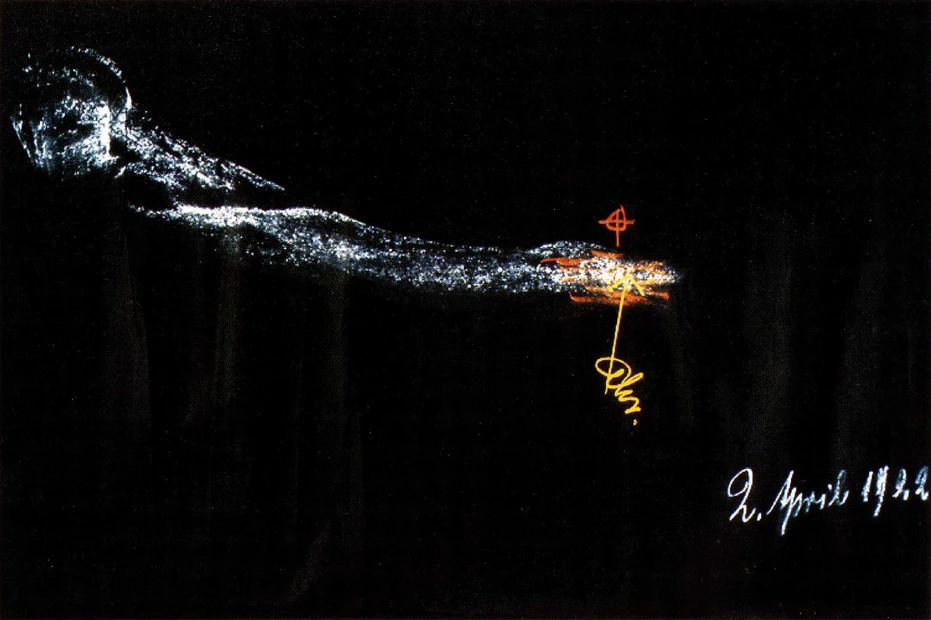
[ 41 ] Primordial divine wisdom flows down to the wisdom of the scribes, who were the contemporaries of the Mystery of Golgotha within the Hebrew people (white). “There can only be truth in this,” Saul must have thought. But one had to think differently. Paul, when he was still Saul, said to himself: If this is truly the Christ, the Messiah, who died on the cross, then there must be error within this current (red). There must be error mixed in with the truth, for it must have been error that brought the Christ to the cross; that is to say, the former divine truth must have become error within humanity.
[ 42] Of course, Saul could only be convinced by the fact that this was indeed the case. Only Christ himself could convince him when he appeared to him, as happened during the event at Damascus. But what did that mean for Saul? It meant that it was no longer the old wisdom of the gods, but that the Ahrimanic had flowed into it.
[ 43 ] Thus Paul came to realize that the development of humanity had been seized by an enemy, and that this enemy is the source of error on Earth.
[ 44 ] By introducing the intellect, he simultaneously introduces the possibility of error, and as this error manifested itself in its most extreme form, it became the very error that led the innocent one to the cross. One first had to be able to gain the conviction that the innocent could be crucified. Only then did one gain an insight into how Ahriman found his way into human evolution, and how, in the development of the human “I”—as the Mystery of Golgotha unfolded—a supersensible, superterrestrial event was indeed taking place. The esoteric can never be merely mystical. It is always a grave misunderstanding to reinterpret mere mysticism as esotericism. The esoteric is always a recognition of facts that unfold as such in the spiritual world, which lies behind the veil of the sensory. And behind the veil of the sensory lies the balancing between the world of the gods and the Ahrimanic world, as it unfolds through the crucifixion of Christ Jesus.
[ 45 ] Only in a world—as Paul could now perceive—in which the human being is seized by the Ahrimanic forces can the error arise that could have led to death on the cross. And now that he had grasped this, he recognized for the first time the truth of esoteric Christianity.
[ 46 ] Paul was, therefore, certainly one of those who, in this sense, belonged to the initiated. But this initiation gradually faded away, precisely under the influence of intellectualism. And today we need to return once again to an understanding of esoteric Christianity. Today we need to realize once again that Christianity is not limited to what is exoteric—even though the Gospels may awaken a sense of it. Little is said about the esoteric today. But humanity must return to that for which there are hardly any external documents—that which must be understood through anthroposophical spiritual science—that which Christ himself taught his initiated disciples after his Resurrection, on the condition that he could only teach it after he had undergone an experience on Earth that he could not have had in the world of the gods above, for in the world of the gods there is no death until the Mystery of Golgotha. No being had ever passed through death there. Christ is the Firstborn who passed through death from the world of hierarchies connected with Earth’s evolution in Saturn, the Sun, and the Moon.
[ 47 ] The acceptance of death into life—that is the mystery of Golgotha. Before, people had known life without death; now they came to know death as an integral part of life, as an experience that enriches life. Humanity lived a weaker life before it had yet come to know death. Humanity must live more fully if it is to pass through death and yet continue to live. And in this context, death also signifies the intellect. People necessarily had a relatively weak sense of life when they did not yet have to grapple with the intellect. The older people, who received the knowledge of the divine worlds through vivid inner revelations, did not die inwardly. They always remained alive. They could laugh at death because, after all, they remained alive inwardly. The Greeks still tell of how happy the ancients were because, before they died, they were, so to speak, so inwardly numbed that they did not realize they were approaching death. But that was already the last vestige of this worldview, which knew nothing of death. Modern man experiences the intellect. The intellect makes us cold inside, makes us dead inside. The intellect paralyzes us. We are not really living when we develop the intellect. One must simply realize that one is not really living when one thinks that one is pouring one’s life into dead mental images, and that one needs a strong life in order to perceive what lies within those dead mental constructs as creative life after all, when one enters that realm where moral impulses arise from the power of pure thought, where one learns to understand human freedom through the impulses of pure thought.
[ 48 ] That is what I have tried to illustrate in my Philosophy of Spiritual Activity. This Philosophy of Spiritual Activity is actually a moral perspective that aims to serve as a guide for reviving dead ideas as moral impulses, bringing them back to life. In this respect, inner Christianity is certainly present in such a philosophy of freedom.
[ 49 ] Through these discussions today, I wanted to present to you, from a certain perspective, something of esoteric Christianity. In our time, when there is so much controversy precisely about the exoteric-historical nature of Christianity, it is necessary to draw attention to this esoteric teaching of Christianity. That is what I intended to do today. I hope that these matters in particular will not be taken lightly, but that they will be received with the gravity they deserve. One always has the feeling, when speaking about such things, that it is difficult to convey them using the words of today’s language, which have already become so abstract. That is why I tried yesterday to attune your souls to this by depicting the inner processes of the human being in images, so that today we might, as it were, move from the individual human being out to what, in the esoteric sense, is the historical development of humanity that incorporates the Mystery of Golgotha as an essential element. When I return from my trip, perhaps we will then have the opportunity to consider, on a different level, the relationship of the human soul to the evolution of the world.