The Mystery of the Sun
and
The Mystery of Death and Resurrection
Exoteric and Esoteric Christianity
GA 211
1 April 1922, Dornach
Translated by Steiner Online Library
6. The Exploration and Formulation of the Word of the World in Inhalation and Exhalation
[ 1 ] Certain things can only be depicted if one tries to approach the corresponding reality through images. When dealing with certain things, one must refrain from speaking in that abstract, intellectualistic manner to which we have become accustomed today. Using that intellectualistic approach, one would not be able to describe at all what I intend to speak to you about today. This, then, is a fundamental prerequisite for the entire manner of presentation I intend to offer today.
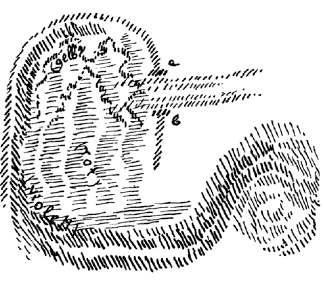
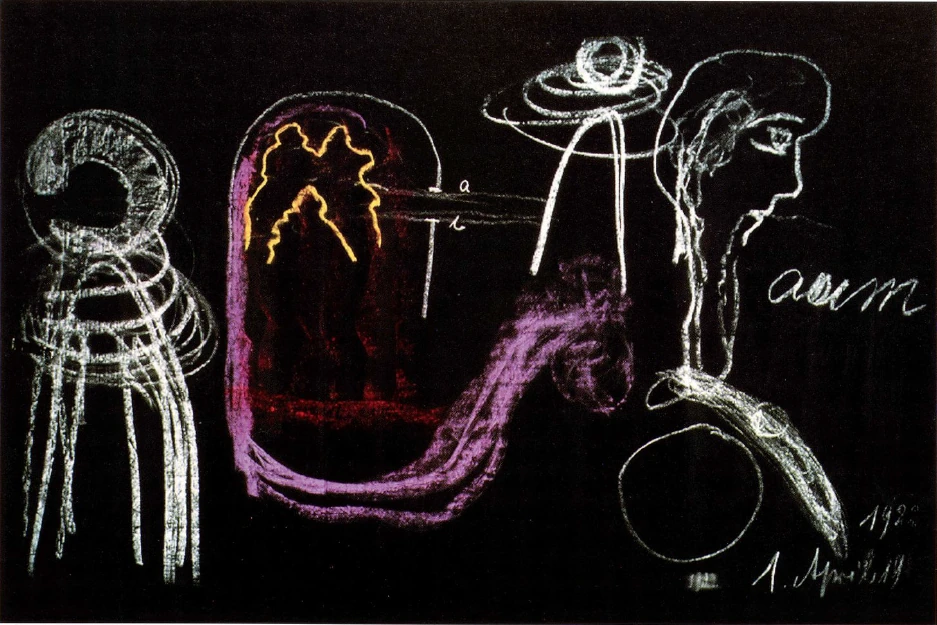
[ 2 ] Let’s take, say, a certain interior space. I want to keep things as simple as possible. Let’s take an interior space that perhaps has a window here (see drawings a, b). Let’s assume that light enters this interior space through this window, and that this light spreads throughout the interior in various ways. But let’s assume the interior is filled with all sorts of permeable walls—a kind of permeable vault. We would thus have an interior filled in various ways with such vaults, through which the light is partly transmitted and partly reflected in various ways, so that this interior would be filled with light that is held back and reflected in various ways.
[ 3 ] Now imagine that I were to let vapors flow through this interior space, allowing them to rise upward (red). But this vapor would be alive; it would be a living, sentient being. It flows upward and would, in turn, have—let’s say—an exhaust channel, so it could flow away again. It thus flows through this light and into this interior space, into glittering light—light that is altered in various ways by these vaults here, light that falls through, is reflected back, and glitters. The vapor would thus perceive what it senses in that light and then flow away. But in other words, this means: This vapor would use its senses to explore what is present there as a glittering light within the interior, and in this way it would form an inner image. It would form an image in its perception of what is there, glittering with light, within.
[ 4 ] Let’s now suppose that, after some time, as the steam flows out again, it could convey what it experienced in there (violet). We could have a kind of instrument through which the steam would somehow—say, by producing musical tones or the like—express what it experienced in there amid the glittering, glowing light. Imagine this scene.
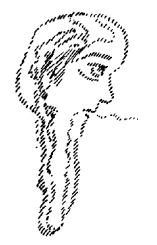
[ 5 ] And now I want to draw this image for you in a different way. You see, instead of the vault, I have drawn the interior of the human head here; instead of the window, the eye through which we see—through which, in other words, light impressions enter. What I have drawn there as a vault are the convolutions of the brain, the spreading nerves. The light enters there and spreads out. Instead of the steam I drew there (see page 92), imagine the inhaled air flowing upward and scanning what may glimmer or glow in the brain as a result of the light—what then takes shape in the brain as thoughts. The air then flows back down through the spinal canal. Instead of an instrument being there, the human larynx is present and can give expression to what has been experienced. There you have a picture of what actually takes place in the human head./
[ 6 ] But now let’s say: We won’t do it that way this time; instead, let’s close this window and create a completely dark interior vault. So we close the window, now have this interior vault here, and let steam flow upward again (red). Now it is not the light that enters (see first drawing)—which is attenuated in various ways and reflected back—that is perceived, but rather the forms that are inside are perceived as such. And as the perceiving vapor rises, it will be able to perceive the forms inside that someone once created—let’s say, that a master builder once created. This vapor will thus be able to perceive the work of this master builder. When the vapor then flows out, it can in turn express (red) what has been perceived there as the work of the master builder.
[ 7 ] But let’s suppose this architect had built in a very special way. Let’s suppose this architect were an extraordinarily universal architect, and that he had made what he built there a reflection of the entire universe. Then, if one were to simply close the window, the steam inside would explore the mysteries of the entire universe. Otherwise, it perceives what glitters in from the outside; but when the window is closed, _ it perceives that which is, inwardly, a reflection of the entire universe.
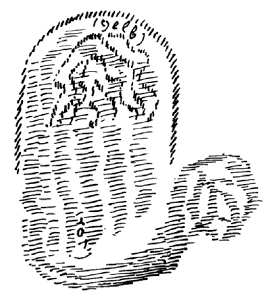
[ 8 ] So imagine that we have here a reflection of the entire universe (see drawing). In the human head, in the marvelous convolutions of the brain, we truly do have a reflection of the entire universe. And if we close off our senses and then allow the breath—which, after all, enters the head through the spinal canal—to flow through, there is a way to explore the mysteries of this inner space of the brain. However, we must not simply let the breath explore in a disorderly, chaotic manner—for then we will gain nothing—but rather, this must be done in an orderly way.
[ 9 ] You know, if you want to identify, say, silk, you have to feel it in a certain way. You have to approach what you want to feel. But if you can do that—if you can approach what you want to feel—then you can certainly find exactly what is there to be felt.
[ 10 ] In the era I have been speaking to you about—those days when people sought to attain higher insights by regulating their breathing, the era when the ancient Eastern system of yoga was truly in its heyday—for what is referred to today as “yoga practice” is, in many cases, merely a secondary matter— there was indeed a consciousness present: When you inhale, when you direct the inhaled air into your head, you can grasp the mysteries of the universe in the reflection of that universe, in the specific configuration of the nervous system within your head. You need only relate to the inhalation process in the appropriate manner.
[ 11 ] I am not speaking now of what later existed in a decadent form, but of the original. And the original was this: People used to say to themselves: When you inhale and shape your breath so that you send it up into this inner vault of the head, which is an imprint of the entire universe, but in such a way that you imbue the breath with a sound that lies between “a” and “o” or between “a” and “u”—that is, when you infuse the breath with “a-u”—then you shape it so that, just as the hand is suited to feel something externally, the sound becomes suited to feel the mystery of the universe within. And one brings it into consciousness by continuing this breathing process in such a way that it culminates in a state of absolute devotion toward what one has perceived there. So when one has what one attains by inhaling, by sending out the breath and probing with it through “a-u,” when one then enters this devotional mood, becomes devoted to the world, and pours out what one has explored there into absolute devotion, then allows the breathing process to culminate in “m,” then in such a breathing process—which takes shape inwardly as “aum”—one has captured—from the replica, from the nervous replica of the universe within—the mystery of the universe. And one has brought it to life, so that it can become conscious in the air exhaled in the sound “m.” In what I have now explained, you have an indication of what once formed the basis of the original yoga training.
[ 12 ] This yogi said to himself: “The secret of the entire universe lies within my head.” I can perceive it by inhaling. As I inhale, the secret of the universe is revealed through me. I grasp it—this secret of the universe. But I can only retain it—otherwise it remains in the unconscious—if I then live my life in absolute, devotional surrender to the universe. And so it is realized by shaping the process of inhalation into the Word of the Universe—that which creatively ripples through and weaves through the world—and by grasping it and exhaling it in absolute devotion to the universe: Inhalation is the revelation of the World Word; exhalation is the inner condensation of the World Word, the affirmation of the World Word. Thus is summarized humanity’s exploration of the World Word and humanity’s articulation of the World Word, through the realization that: Inhalation is revelation, exhalation is confession, and “aum” is the synthesis of revelation and confession—the enlivening of the mystery of the universe within oneself, the affirmation of this mystery of the universe within oneself.
[ 13 ] For us today, in our present era, the tone has shifted even further upward. The tone finds its expression in real, concrete thoughts, not in intellectualistic ones. So that we can say: Inhalation becomes thought, and exhalation becomes the volitional living out of that thought. That is to say, we break down what was once inhalation as revelation and exhalation as confession into exercises of thought and will, and thereby receive—also in thought, but in the thought cultivated through meditation—the revelation, and in the exercises of will, which are carried out on the other side, the confession of what has been revealed.
[ 14 ] For modern humanity, it is as follows: What was previously experienced in the mere process of breathing—and what was formed into a vowel sound during inhalation and a consonant sound during exhalation—now finds expression in a more spiritual way in the inwardly contemplated thought, which is, however, permeated by the will in devotional surrender to the universe. Thus, the process is the same, only made more spiritual and internalized. But here, too, the process consists in perceiving the inner experience of the universe in its mysteries and in professing one’s commitment to this universe, to the spiritual foundation of this universe.
[ 15 ] We can also consider the following thoughts. We can say: Human beings are born out of light, and their inner being—the innermost part of their head—is the result of light. The entire nervous system is, after all, the result of light. Light is conveyed not only through the eye, but also through the other senses. The eye is merely the sense through which light is conveyed in the most primary sense. We cannot say that blind people are completely cut off from light. Light is at work within them; it is only their conscious perception of light that is absent.
[ 16 ] And sound actually lives within the entire organism. Sound lives within us. Sound does not live only in the ear; the ear is merely an organ of perception for sound. When we experience a sound, we experience it with our entire organism. We always experience a symphony with our entire organism. When we listen to a piece of music, the inner process is actually as follows: We attune our entire breathing process to a very specific rhythm, to very specific musical processes that are precisely brought about by the composition. These formations within our air-filled interior resonate with the structures of the brain; the way they are reflected back from there gives us the musical impression. In fact, there is always within us a process of probing the light through sound.
[ 17 ] Keep in mind that within us there is a constant process of exploring light through sound. The world of sound within us—the resonant organism—is actually a sensory organ for light. Light is, in fact, always the external aspect; sound is, in fact, always the internal aspect.
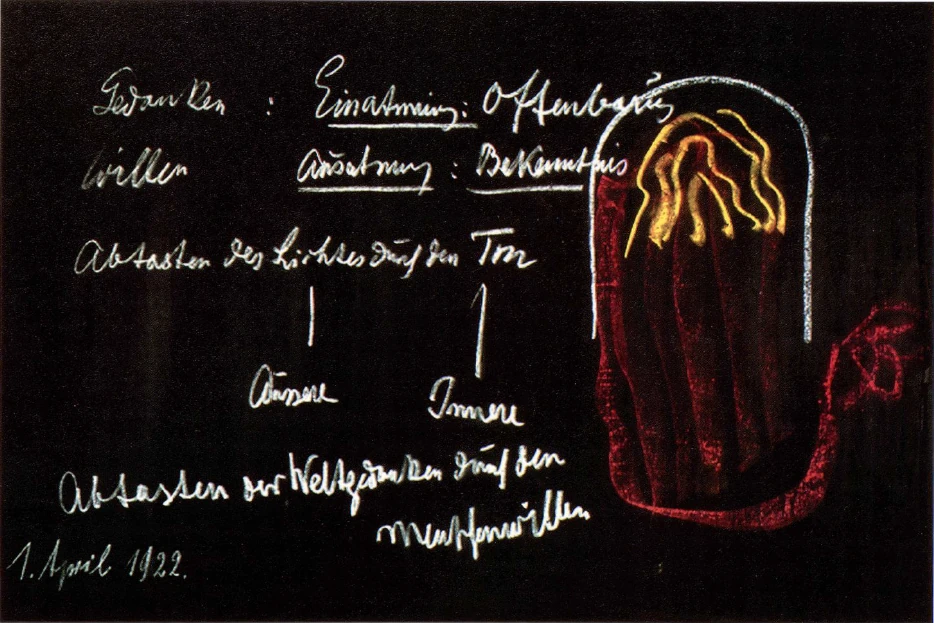
[ 18 ] Thoughts — Inhalation: Revelation
[ 19 ] Will — Exhalation: Confession
[ 20 ] Exploring Light -> The External Through Sound -> The Internal
[ 21 ] Exploring the thoughts of the world through human will.
[ 22 ] The inner world probes the outer world. In fact, we can only truly grasp our own nature in the right way when we perceive ourselves as a unique being, set apart from the harmony of the world’s spheres. This being feels its way in the light, and in the configurations of the light, sound recognizes the nature of the world. It is only in our epoch that we actually have a “feeling out” of the world’s thoughts through the human will (see diagram). We feel out the world’s thoughts with our will. Here, the will takes the place of sound. Thought, on the other hand, takes the place of light. As I said, these things are very difficult to express in intellectual, abstract terms. But what I have tried to present to you in a pictorial way will draw you into these matters if you reflect on them a little, if you realize that humanity’s innermost being in the world is truly such that the human being has, within his head, an image of the entire cosmos. The human being is, in fact, with regard to his head, an image of the entire cosmos.
[ 23 ] As the human embryo develops in the womb, it is initially formed as a reflection of the cosmos. The first point is that, indeed, within the mother’s womb, the human being is formed as a reflection of the cosmos. At first, the human being is, in essence, a brain—a reflection of the cosmos. You can study the cosmos by studying the human embryo in its earliest stages. Only later does something emerge that is no longer a reflection of the cosmos, but rather—to put it this way—if you have the Earth here, with the human being upon it, then—as a part of the embryo is taken—what is added are the forces that, parallel to the surface, circle the Earth in rhythms. The chest organism is formed, which is actually created from currents that circle around the Earth. You can, if you like, still see these currents reflected in the ribs. Last of all comes the effect of the Earth organism itself. Here, the currents are sent up from below: you can see in the two legs a very precise expression of how these currents flow. So that I can depict the human being as currents emanating from the Earth, as currents circling the Earth, which are connected to his chest organism, and at the top as the head, the image of the entire universe.
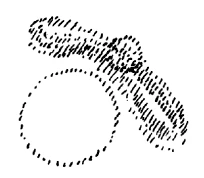
[ 24 ] What takes place in the mind is, in fact, always a reflection of the entire universe, throughout one’s entire life. Because human beings possess a mental organization, they carry within themselves a reflection of the entire universe. They need only perceive it. They would not perceive it if they were not organized for this purpose by the Earth. In fact, the Earth perceives the universe through human beings: the chest organism serves as the mediator. Inhalation is brought about by the cosmos; exhalation is brought about by the Earth. The cosmos gives us pure oxygen; the Earth causes this oxygen to combine with carbon, thus forming the deadly exhaled air. But it is through the formation of this dead air that understanding arises.
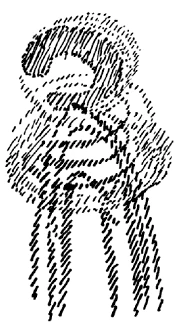
[ 25 ] Understanding is always connected to what is dying within us. We actually die through our understanding; we live through the cosmos. But we would live very quickly if we were simply surrendered to the cosmos. The cosmos provides us with the most life while we are still in our embryonic state; then the Earth’s atmosphere gradually takes over, and later what flows up from the Earth. Through this process, the life that the cosmos gives to our organism is mediated until the amount of life the cosmos gives us is precisely exhausted. The cosmos animates us; the Earth kills us as physical organisms and also as etheric organisms. However, it is the case that the cosmos primarily influences our etheric organism, while our Earth primarily influences our physical organism.
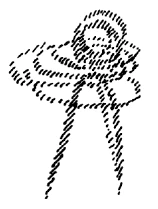
[ 26 ] When you consider all of this and say to yourself: Once upon a time, a regulated breathing process was practiced to cultivate higher knowledge—a process carried out for the purpose of exploring the mysteries of the universe within the human being—then you will come to understand how, in the days of humanity’s earliest aspirations, people felt inwardly how they were connected to the entire universe, and how they sought to experience the Word of the Universe through the process of inhalation, and to offer a sacrifice to the Word of the Universe through the process of exhalation; how, through yogic breathing, they sought to place their consciousness within the cosmic process. Unconsciously, of course, they are always already within this cosmic process. From the external description given today of this yogic breathing, one gains no real insight into what was actually intended by it. But one does gain such real insight by striving to attain it through today’s anthroposophical spiritual science. People have no documents describing how things were originally. In the times from which we have documents on this subject, these things no longer existed in their original form. One must arrive at the true mysteries of humanity’s origins on Earth without documents; otherwise, one must do without them. So anyone who seeks to understand these things solely through external documents that have survived from earlier times will not arrive at them; rather, only those who can look back to states far more primordial than those attested to by external documents will arrive at them. The mystery of the Eastern “Aum” prayer—if I may call it that—I might just as well say: the “Aum” formula of knowledge, for both were contained within it—can only be grasped if one truly understands the connection between the human being and the world in the act of inhaling and exhaling. If one knows that, just as the air—which otherwise produces no specific tones at all—is shaped into specific tones as soon as one has strings tuned to different pitches, so too the inhaled air, which one sends through the brain with the Aum sound, inwardly expresses the entire mystery of the world—if one knows this, then one understands humanity’s connection to the universe. One begins to sense how one actually came to be. Since the human being lived in the spiritual-soul world before conception, he was, after all, in the spiritual world. But as he now descends, he passes through the entire configuration of the cosmos in the ether, absorbing the ether. At this moment, he takes in all the mysteries of the universe and gradually imprints them upon his brain. And the very young child is actually still gradually imprinting upon its brain what the soul has experienced of the total mystery of the universe. And later on, one rediscovers this mystery when one strives—in ancient times through the air one breathed, and now through thought—to experience this mystery of the universe anew within oneself.
[ 27 ] The power of thought—which is, after all, nothing more than a diluted form of the breath’s power—also takes shape when it is truly channeled through the brain. Modern humans do not do this. Modern humans do not actually channel the power of thought through the brain; rather, they hear everywhere the words spoken in their language—words in which thoughts also dwell—and then they channel through themselves what they inwardly parrot from their national heritage. And in doing so, they gain no inner insights whatsoever; at most, they write books about how we have only language and cannot gain any insight through it. He then writes a critique of language because he has no idea what the power of thought encounters, since he knows only what is, so to speak, recorded in the words. Modern man is, after all, merely a sounding board for words. And if he is astute, like Fritz Mauthner, then he simply writes books about how words actually contain nothing of the essence of the world.
[ 28 ] But that does not bring one closer to human beings. Nor does it bring one closer to the world, especially not to the relationship between human beings and the world. One must be clear that it is a profound truth that a human being is “human” through the divine breath, through the air they breathe in. For through this—through this inhaled air—they discover the entire world within themselves; they discover how they are a microcosm.
[ 29 ] If you think through what I have just explained today from every angle, you will see that you will gradually come across some very significant connections. You just mustn’t think it’s some kind of quirk that I started out by merely painting a picture. It is indeed necessary not to characterize these things with our abstract words, but to try to approach the facts through images.
[ 30 ] With this, I believe I have given you a glimpse into a very important chapter of anthroposophical spiritual science, and I will elaborate on it further tomorrow.