The Mystery of the Sun
and
The Mystery of Death and Resurrection
Exoteric and Esoteric Christianity
GA 211
31 March 1922, Dornach
Translated by Steiner Online Library
5. The Nature of Man and Its Expression in Greek Art
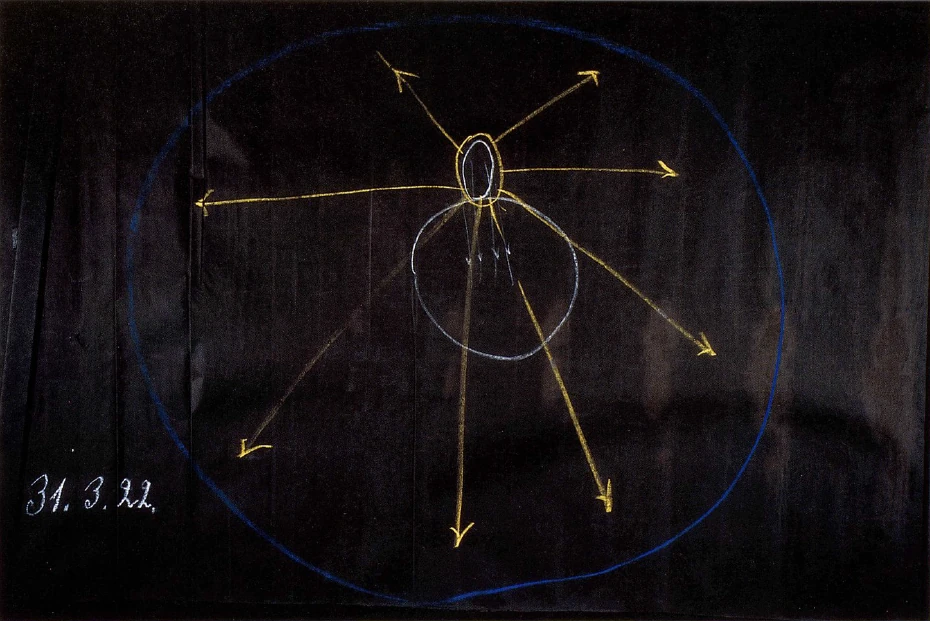
[ 1 ] Let us take a moment today to reflect on the forces that hold the human being together during its earthly life, so that we may gain some insight into cosmology during these days. We know, of course, that when we consider the next aspect that constitutes the human being in earthly life, the human being is divided into the physical body, the body of formative forces—which can also be called the etheric body—the astral body, and the “I.”
[ 2 ] Let us consider how we might characterize these four aspects of the human being. The physical body is, after all, what comes to the human being through the fact that, in a sense, the forces of the Earth work for him. During the time the human being spends between death and a new birth, he has nothing to do with this physical body. From the remarks I made in the immediately preceding lectures, we have seen that when the human being descends from the spiritual-soul realms into physical embodiment, it is, so to speak, spiritually dead and must regain its power in inner life through immersion in physical embodiment. This physical embodiment itself, however, is, so to speak, born out of the forces of the Earth and unites with what descends from the spiritual-soul world. However, shortly before a human being attains physical embodiment on Earth, they do not yet possess the form-forming body or etheric body. This, like the physical body, is only connected to the human being for earthly existence at that point. The difference is that this entire form-forming body or etheric body has a different relationship to the universe than the physical body.
[ 3 ] When we examine the human physical body in terms of its forces, we find within it precisely the forces of the Earth itself. But when we turn our attention to the human etheric or formative body, we find within it more of the forces of the cosmos—the forces of the entire universe. In contrast, the human astral body and the human “I” contain forces that are not actually found in the outer space of the universe—forces that, if we may use the expression, are not of the world to which the Earth belongs.
[ 4 ] The fact is that the Earth constantly strives to claim the human physical body for itself, to incorporate it into its own being. In contrast, the universe constantly tends to disperse the human formative forces—or etheric body—throughout the entire world. When a person is in that state between falling asleep and waking up, the forces at work in what remains in bed—in the physical body and the formative body—actually cause the physical body to constantly, if I may put it that way, seek to connect with the Earth. It wants to become like the Earth; it wants to become entirely earthly. The form-body, or etheric body, wants to disperse into the universe. And when we wake up in the morning and find our physical body and our etheric body again, what is actually happening is that, as we enter the physical body, it tells us: “The earth has claimed me throughout the entire night; the earth wanted to shape me into dust.” It is only because you held me together yesterday and on the preceding days on Earth through your “I” and your astral body that I have remained a physical body; the forces that hold me together continued to work within me. — Likewise, the form-forming body, or etheric body, says: “It is only because I have taken on the habit of resembling you that I have retained the human form. In fact, the forces of the universe wanted to scatter me to the four winds during the night, while you were asleep, while you were outside of me.”
[ 5 ] Every time we wake up, we essentially have to make the effort to regain proper possession of our physical body. It actually tends to slip away from us between falling asleep and waking up. We do this through the “I.” The “I,” when trained to do so, can truly feel as if it were taking possession of the physical body anew every morning. The astral body can sense upon waking that it must make itself resemble the etheric body. The etheric body would already be taking on an inhuman form. The astral body must, in turn, push it back into human form. One might say: During sleep, the physical body loses the inclination to allow the “I” to take possession of it, and the etheric body loses the inclination to have a human-like form. It flares out. So that, in fact, the form of our physical body is merely a result of the “I’s” influence within our human being. In their present state of mind, people do not have much sense of something that can be expressed in these words: When I return to my physical body while awake, I must first take possession of it again. It was about to slip away from me, and the etheric body was about to flutter away.
[ 6 ] But let us suppose there was once a time when people still had a clear sense of this struggle that takes place every time they wake up—between the “I” and the astral body on the one hand, and the physical body and the etheric body on the other. Then, precisely because they had this clear sense of it, they would also have sensed that it must be something quite extraordinary if a person were, for example, suddenly compelled by some force to leave his physical body and his etheric body.
[ 7 ] When, under normal earthly conditions, a human being leaves his physical body and his etheric body, this occurs because the physical body—whether through illness or old age—has become highly earth-like, so that it seeks to unite with the earth; or else the human being has, through some injury, brought his physical body to a state where the “I” can no longer possess it, and so on. But let us suppose that it were to happen quite suddenly that the “I” and the astral body had to leave a completely healthy, uninjured physical body and etheric body—so that these bodies would, in the highest sense, still have the tendency to be possessed by the “I” and to resemble the astral body—what would have to happen then?
[ 8 ] The thought might have dawned on the old man: Yes, then this physical body could not simply disintegrate. It can only disintegrate if it already contains within itself the tendencies toward disintegration, such as through illness, aging, or the like. But if the astral body and the “I” were suddenly to leave a perfectly healthy human organism—one in which the form-body is present—then the human-like form would have to remain, for the tendency to be inhabited by the “I” and the astral body is still fully present. The human form would have to remain intact. The human being would become like a statue. The physical body could not decay, and the etheric body could not become dissimilar, because the separation would have been too rapid. The human being would have to become a statue.
[ 9 ] Such a feeling does indeed seem to have existed at one time. You are all familiar with the Greek myth of Niobe, who had seven healthy sons and seven healthy daughters and who, in the midst of her abundance of health, once mocked the mother of Apollo and Artemis because, despite being a goddess, she had only two children: Apollo and Artemis. She refused to make a sacrifice, and the vengeance of the god or gods came upon her. She had to witness her seven daughters and seven sons suddenly perish, struck down by the arrows of Apollo and Artemis. She saw the entire field of corpses of her fourteen offspring before her, and her ego and her astral body merged in pain with what she saw around her. You are familiar with the pediment figures of Niobe, who is turned into a statue, surrounded by her seven sons and seven daughters as they meet their deaths. She herself is turned into a statue. The physical body and the etheric body must separate from the ego and the astral body. But this physical body and the etheric body—because they were so full of bursting life that Niobe herself could mock the goddess with her two offspring—could not lose their attachment to the ego, and the etheric body could not become dissimilar to the astral body. Niobe became a statue.
[ 10 ] Such a work of art certainly arose from a profound sense of worldview, from something that was perceived as a truth within the worldview of that time. People simply felt: If Niobe had not been so brimming with life that she could come to mock the goddess Latona, then she could have died in such a way that her physical body would have decayed. But she was, in fact, so full of life that she rebelled even against the gods—that is, she lived fully within this physical body. And so we see that the Greek genius perceives: because of the rapid departure of the “I” and the astral body from the physical and etheric bodies, Niobe becomes a statue.
[ 11 ] For when we look back at the development of humanity, we see that art is always closely linked to the sensibility associated with the worldview of a given era. But we can also see this in many other things. Let us once again turn our attention to how, upon waking, a human being must once more take possession of their physical body, because this physical body seeks to become like the earth. Had Niobe been able to sleep even for a single night after experiencing her grief, she would not have been able to turn into a statue, for the physical body would then already have absorbed the forces necessary to become like the earth—that is, to decay. The human being must therefore reclaim possession of the physical body every morning, and the astral body must shape itself to resemble the etheric body every morning, molding it anew so that it takes on a human-like form.
[ 12 ] There was a time in Greek history when people felt very keenly that every morning a person must summon the strength to take firm possession of his physical body. The Greeks derived a certain satisfaction from having possession of their physical bodies, and since they knew that every morning they had to reclaim possession of their physical bodies, they felt the need to strengthen both the forces capable of taking possession of the physical body and those that fortify the astral body, in order to make themselves similar to the etheric body again each morning.
[ 13 ] If a person were to consciously follow the entire process that takes place upon waking while still awake, he would say to himself every morning as he woke up: “Please, let me not lose my physical body; please, let me enter this physical body correctly once again!” — A person would fear not being able to re-enter their physical body properly. The ancient Greeks knew a great deal about this fear, and they knew just as well that every night the etheric body develops a peculiar tendency to flutter apart into four different forms, becoming something angelic, something lion-like, something eagle-like, and something ox-like. Every morning, one must strive anew from within the astral body to, if I may use the expression, synthesize these four parts of the etheric body in such a way that a proper human being is formed once more. But the Greeks loved life in the physical and etheric bodies. I have often quoted to you that saying that echoes to us from Greece: “Better to be a beggar on earth than a king in the realm of shadows,” in the underworld. — The Greeks loved this physical existence. They therefore also sought to be strengthened in their appropriation of their physical body, in making the etheric body more like that of a human being. And you see, it was partly out of this tendency that tragedy arose. And Aristotle himself offers a definition of tragedy that clearly indicates that, fundamentally speaking, the Greeks did not conceive of tragedy in the same way that modern people do. I don’t know if anyone else has had different experiences, but I have mostly found that people today believe tragedies exist for the reason that, after spending the whole day dealing with whatever the day brings, they like to sit down for a few hours in the evening to experience, in a more or less exciting way, something that is not a real experience but merely an image.
[ 14 ] This was by no means how the Greeks thought during the period when Greek culture was actually gradually emerging. For the Greeks, life was one whole, and everything they incorporated into that life was, for them, something that was truly meant to be a living part of the totality of that life. And tragedy was, for them, the means by which a person could truly take possession of their physical body and shape their etheric body. And tragedy was structured in such a way that, as a person watched it, they would feel fear and compassion. Why should a person experience fear in a tragedy? They should experience fear because experiencing this fear strengthens their power to take possession of their physical body in the right way every morning. And they should feel compassion because this makes their astral body stronger every morning, enabling them to shape their etheric body in the right way. “Present me with tragedies,” said the Greek, “and I will be able to properly take possession of my physical body, properly build up my etheric body; then I will be able, in the fullest sense of the word, to be a true human being.” The Greek wanted to be a true human being in his earthly existence. To this end, in addition to immersing himself in his culture, the tragedy was also meant to serve him. Of course, this presupposes that in those earlier times, people knew how the spiritual-soul aspects—the “I” and the astral body—are connected to the physical and etheric aspects of the human being.
[ 15 ] Aristotle provides a definition of tragedy. He says: Tragedy is the imitation of an action that arouses fear and pity, so that the audience, through the arousal of fear and pity, experiences catharsis—the resolution of fear and pity. — Crisis, catharsis—these are terms borrowed from ancient Greek medicine, the art of healing—and even then, when Aristotle was already leading Greek culture into pedantry, he still perceived tragedy itself as having a healing and strengthening effect on people.
[ 16 ] Let’s try to understand the meaning of the term “catharsis”—which, after all, also comes from the Mysteries, and we have often explained what it means in the Mysteries—in our everyday lives.
[ 17 ] When a person becomes ill internally, what is actually happening? Suffering and pain arise within the person that are not normally present. He begins to feel his organism, to perceive it in some way—in a way that he does not perceive it in normal, so-called healthy life. In a healthy life, one believes at first that nothing hurts. When one becomes ill, something begins to hurt, to cause pain. But this means nothing other than that the ego and the astral body are not properly—forgive the somewhat crude expression—connected to the physical body and the etheric body. When a person is then guided back to healing and recovery, the ego and the astral body regain the strength to reattach themselves in the proper way. During the healing process, the ego and the astral body gain greater control over the physical body than they had before the healing began.
[ 18 ] Let us suppose that a person contracts a lung disease. Their ego and astral body are not properly integrated into the etheric and physical aspects of the lungs. What takes place during healing is, once again, this proper integration. And the crisis consists precisely in the fact that, outside of this proper integration, the ego and the astral body gain the strength to reintegrate themselves properly afterward. What takes place externally during the illness was what the Greeks constantly observed taking place internally within the human being.
[ 19 ] The Greeks believed that if a person does nothing for themselves, their ego and astral body will become increasingly estranged from the physical and etheric bodies. These bodies will be less and less able to take possession of the physical body and less and less able to shape the etheric body according to their will. One must bring them out so that they can then re-enter in the proper way. One must allow the astral body to be permeated by observed suffering and by compassion. And one must allow the “I” to be permeated by fear. When the “I” experiences fear, it strengthens itself. And the “I” overcomes this fear because it is presented only as an image. Thus, the “I” does not perish under the fear; it overcomes the fear, undergoes the crisis, the catharsis, and thereby gains increased strength to take possession of the physical body again each morning. Likewise, through compassion—through the contemplation of suffering—the astral body is strengthened, becoming more and more like the etheric body.
[ 20 ] This, then, can show you how art in Greece was seen as something that, on the one hand, is fully connected to the human being—as the figure of Niobe demonstrates—or as something intended to influence the process of becoming human and the process of human education. The Greeks’ gaze was always directed toward the concrete human being, and one could say: Since the time of the Greeks, the essence of the human being has actually been lost by human beings themselves.
[ 21 ] This becomes particularly evident when one turns one’s attention to the young Goethe. Even in his early years, Goethe truly learned a great deal about the world—about the world around him, about the way people think and feel. And he even learned a great deal about how extraordinarily significant, genius-level individuals attempt to conceive of the world. But for Goethe—as I have already discussed here—it was a struggle to grow into his cultural environment. For we know, after all, that over the last four to five centuries, the cultural world has become intellectualistic, and Goethe sensed this intellectualism that had spread over everything. He expressed this in Faust: philosophy has become intellectualistic, jurisprudence has become intellectualistic, medicine has become intellectualistic—“even theology has become intellectualistic.” Faust studied all of these. But the mere thought that lives within all of this is, to him, something alien to reality. He wants to relate the spiritual foundations of existence to himself. — That, in essence, is Goethe’s feeling. This intellectualization of modern humanity—Goethe naturally had to acknowledge it, for such was the course of historical development. Human development had simply reached this point. But for him it was a struggle, because thought does not, after all, fully and intensely encompass the whole of humanity. He felt alienated from the world as he saw the world around him developing as a world of thought.
[ 22 ] One of the people who, back when Goethe was young, strove toward intellectualism with a certain naturalness and vigor was Lessing. Goethe could have met Lessing in Leipzig. He avoided doing so because Lessing was too intellectual for him. Herder, whom he met later in Strasbourg, was not. Despite his intellectualism, Herder had arrived at a comprehensive worldview full of sensitivity and emotion. Goethe could relate to that. Lessing, on the other hand, struck him as unnervingly rational. He avoided him.
[ 23 ] Given this atmosphere, one can also understand how, at a certain age, Goethe could do nothing else but break free from this world in which people want to think about everything. At a certain point in Weimar, Goethe would have loved nothing more than to escape from it all, even though he was doing exceptionally well; even though he was idolized at the Weimar court, he couldn’t stand it. He couldn’t stand the whole situation. He also couldn’t stand this: Herder, who studied Spinoza. But Spinoza is, at the core, an entire machinery of thought—a marvelous one, but one drifts away from the world when one gets entangled in this machinery of thought.
[ 24 ] And so he had to go to Italy, for he wanted to discover the human being. He wanted to discover, through the sensibility of Greek art—of ancient art—the human being who had become alien to modern man. Goethe yearned for this discovery, for the experience of the human being. And, when all is said and done, the whole of anthroposophy is nothing other than a worldview that springs from the longing to find the human being in his or her entirety, to answer the question: What, in fact, is this human being? How does he or she stand within life?
[ 25 ] But through this, the things that have found their way into the development of civilization out of a deep sense of human nature—such as tragedy, or a work of art like the Niobe Group—gradually become more and more vivid. Take this Niobe Group, for example. Niobe, in her soul—that is, in her “I,” in her astral body—lives entirely outside herself; she radiates completely outward into the sphere from which her pain originates. Her soul is torn away by the pain. Her body is still permeated by the forces of the “I” and the astral. The form remains; the form holds everything together. She becomes a statue, this Niobe.
[ 26 ] Consider the opposite case: Suppose there were no reason at all for the I and the astral body to leave the physical and etheric bodies, and yet they are driven out because the physical and etheric bodies are destroyed from the outside, because they are taken away from the I and the astral body. So the I and the astral body must leave. But as the physical and etheric bodies are destroyed from the outside, they take on a form that, on the one hand, follows the destructive force and, on the other hand, literally makes visible how the I and the astral body are forced out. In the case of Niobe, this need not be the case; there it happens suddenly. But suppose Niobe were not to rush out of her physical and etheric bodies simply by looking upon the field of her children’s corpses, but rather something were to happen to her physical and etheric bodies that would force the soul out. In that case, one would not see in the physical and etheric bodies how they turn into statues, nor how they, so to speak, freeze within the matter—within the formed matter—but one would see how the “I” is still active within, how the astral body is still striving to shape the etheric body. You have, after all, depicted this in Greece: that is the Laocoön. You can understand the Laocoön if you imbue yourself with the realization that here the situation is the opposite of that in the case of Niobe—that here the physical body and the etheric body are being destroyed from the outside, and how the whole being struggles with the “I” and the astral body, which are being forced out. So that in every feature—in the shaping of the mouth, in the shaping of the face, in the positioning of the arms, in the shapes the fingers take—you can see in the Laocoön that the situation I am speaking of right now is depicted.
[ 27 ] We must once again arrive at such insights, for otherwise the intellectualism that has been so deeply justified in modern times will distance people from a true perception, from a true understanding of nature, and from reality.
[ 28 ] Just imagine how hard Lessing tried to explain the Laocoön group. He basically explained it in a purely superficial way. Of course, I say this with all due respect for the great Lessing. But if one takes his explanation, it amounts to this: When a poet speaks of Laocoön, Laocoön is allowed to scream, because you cannot see how he opens his mouth wide as he screams. But when the sculptor creates him, you can see how he opens his mouth wide. You must not do that—open his mouth wide. — That is entirely superficial: The poet should do it one way, the sculptor another! Of course, what Lessing accomplished is something extraordinarily significant. One can certainly say: With all due respect, one must treat these matters, but one must be clear that in Lessing’s treatment of the Laocoön group, there is nothing that explains the entire figure of Laocoön in the context of the situation. To do so, it is necessary to grasp, in the appropriate manner, the forces that hold the human being together in his four limbs, as I stated in the introduction to these reflections.
[ 29 ] This sense of perspective has been completely lost in the age of intellectualism. This age of intellectualism, at heart, no longer knew what to make of what it means to be human. And so, precisely in the age of intellectualism, people lost their ability to assess all things. This is precisely what Goethe felt so strongly and what led him to the point where he could not stand it when intellectualism encroached even upon art. The young Goethe could not stand the entire style of Corneille and Racine’s art, because there intellectualism shapes the dramatic in an intellectualistic way.
[ 30 ] In contrast, Goethe turns to Shakespeare, who creates from all of nature’s contradictions. That is why Goethe finds that Shakespeare is something like the interpreter of the world spirit itself. Goethe feels this very deeply because he senses this onslaught of intellectualism. Isn’t it true that I have often pointed out that Hamlet can be viewed as a student of Faust? That Hamlet—Shakespeare’s Hamlet, of course, not that of Saxo Grammaticus—might have sat as a student at Faust’s feet in Wittenberg during those ten years when Faust led his students up and down by the nose—this was immediately clear to Goethe. Of course, he did not spell out these things in detail; but anyone who were now to say, “Thank God, I have studied philosophy, law, medicine, and—for my own salvation—theology as well,” would naturally not be able to feel a deep sense of satisfaction if he were to find, say, the Danish prince artistically portrayed before him, delivering the monologue: To be or not to be—and who speaks of that land from which no traveler has ever returned, even though he had just moments before spoken the ghost of old Hamlet himself, who must therefore have a terribly short memory if, at the very moment he is delivering the monologue, he cannot recall that he had just spoken with his father, who had returned from that unknown land!
[ 31 ] An intellectualist, of course, wouldn't do that. And I’ve met intellectualists like that before. They’d say: “Well, Hamlet wasn’t written by a single poet either—someone else wrote the monologue, and then it all got mixed up. That’s what they did with Homer, too!”
[ 32 ] It is very easy to prove that a whole series of people could have written Hamlet, because there are contradictions throughout—and such contradictions do, in fact, exist in reality. And Goethe sensed the richness of reality as opposed to the poverty of intellectualism. And that is precisely how he should be understood.
[ 33 ] If you ever want to have a laugh at all the things in “Hamlet” that are appalling—and that prove that Shakespeare can be caught in a contradiction at any moment—then all you need to do is read Professor Rümelin, the famous Rümelin from Heidelberg, who pointed out all these things in great detail in his essay on Shakespeare. But there is, after all, a difference between what Goethe perceived as art—so much so that he called the speaking artist the interpreter of the world spirit—and what is handed down as scholarship, even in Heidelberg.
[ 34 ] And if you compare what Lessing said about the Laocoön with Goethe’s beautiful remarks on the subject, you will of course not yet find in Goethe’s remarks what leads to a true understanding—for Goethe did not yet have anthroposophy—but you will find significant progress compared to Lessing’s discussions.
[ 35 ] You will find references throughout Goethe’s work to what I have just explained. So, for example, you can say: From what Goethe observed in the Laocoön Group, everything I have said about it already becomes clear. And that is why one can certainly say: Right down to the finest details, Goetheanism, when properly continued, inevitably leads to anthroposophy.