

Three Perspectives of Anthroposophy
Cultural Phenomena
from the Perspective of Spiritual Science
GA 225
20 July 1923, Dornach
Translate the original German text into any language:
Versions Available:
Anthroposophy as Cosmosophy I, tr. SOL
8. Dreiperspektiven der Anthroposophie: Die physische Perspektive
8. Three Perspectives of Anthroposophy: The Physical Perspective
[ 1 ] Es hat sich in der letzten Zeit bei sehr vielen, insbesondere bei wissenschaftlich vorgebildeten Mitgliedern der Anthroposophischen Gesellschaft der Glaube herausgebildet, daß zwischen dem, was in Anthroposophie als Welterkenntnis gegeben wird, und dem, was heute aus den Voraussetzungen namentlich der zweiten Hälfte des 19. Jahrhunderts als wissenschaftliche Welterkenntnis gegeben wird, diskutierend hin und her gesprochen werden soll. Ja, man glaubt wohl, daß, wenn man in einer gewissen Weise, wie man das so nennt, der Wissenschaft entgegenkommt, auf sie möglichst eingeht, dies für die Anthroposophie etwas außerordentlich Günstiges ergeben könnte.
[ 1 ] Recently, a belief has taken hold among many members of the Anthroposophical Society—especially those with a scientific background—that there should be a back-and-forth discussion between what is presented in anthroposophy as an understanding of the world and what is presented today as scientific understanding of the world, based on the premises of the second half of the 19th century in particular. Indeed, it is believed that if one were to, in a certain way—as it is so-called—accommodate science and engage with it as much as possible, this could prove to be exceptionally beneficial for anthroposophy.
[ 2 ] Gerade dadurch, daß wissenschaftlicher Betrieb in die Anthroposophische Gesellschaft hereingekommen ist, was ja in anderer Beziehung als eine außerordentlich erfreuliche Tatsache zu begrüßen ist, sind mit Bezug auf den angeführten Punkt außerordentlich viele Irrtümer entstanden.
[ 2 ] Precisely because scientific activity has found its way into the Anthroposophical Society—which, in other respects, is an extraordinarily welcome development—an extraordinary number of errors have arisen with regard to the point mentioned.
[ 3 ] Wir dürfen nicht vergessen, daß im Laufe des 19. Jahrhunderts die allgemeine Menschheitsbildung unter dem Einflusse dessen, was man da allmählich Wissenschaft genannt hat und heute noch nennt, einen Charakter angenommen hat, dem gegenüber die anthroposophische Welterkenntnis eben etwas ganz anderes ist. Man muß sich schon auf den Standpunkt stellen, daß derjenige, der einmal mit seinen Denkgewohnheiten hineingewachsen ist in das gegenwärtige Wissenschaftsleben, eigentlich unmöglich so ohne weiteres zur anthroposophischen Auffassung herüber kann. Daher muß man durchaus gewärtig sein, daß von dieser Seite her irgendeine Zustimmung zu der anthroposophischen Welterkenntnis kaum bald kommen kann.
[ 3 ] We must not forget that, over the course of the 19th century, general human education—under the influence of what was gradually coming to be called “science” and is still called that today—took on a character in contrast to which the anthroposophical view of the world is something entirely different. One must recognize that anyone who has become accustomed to the current scientific mindset through their habits of thought cannot, in fact, simply switch over to the anthroposophical view. Therefore, one must be fully prepared for the fact that any acceptance of the anthroposophical view of the world from this quarter is unlikely to come anytime soon.
[ 4 ] Diejenigen Menschen, die entweder nicht mit ihren Denkgewohnheiten in den wissenschaftlichen Betrieb von heute hineingewachsen sind oder die als junge Menschen im Hineinwachsen auch gleich herauswachsen, die werden es sein, die hauptsächlich die Berechtigung anthroposophischer Welterkenntnis einsehen werden.
[ 4 ] Those people who either have not grown up with the habits of thought prevalent in today’s scientific community, or who, as young people, grew into it only to grow out of it just as quickly, will be the ones who primarily recognize the validity of the anthroposophical view of the world.
[ 5 ] Um das, was ich eben gesagt habe, einigermaßen zu beleben, möchte ich heute von einer ersten Perspektive mit Bezug auf den Weltenweg der Anthroposophie sprechen. Ich möchte, damit die Freunde, die weither gekommen sind, möglichst viel mitnehmen, diese drei Vorträge etwas aphoristisch gestalten. Ich möchte anknüpfen an allerlei Erscheinungen im Zivilisationsleben der Gegenwart, aber in der Hauptsache doch den Inhalt für diese Vorträge suchen in rein anthroposophischen Erörterungen.
[ 5 ] To bring what I have just said to life to some extent, I would like to speak today from an initial perspective with regard to the world path of anthroposophy. So that our friends who have traveled from afar may take away as much as possible, I would like to structure these three lectures in a somewhat aphoristic manner. I would like to draw on various phenomena in contemporary civilization, but I will primarily seek the content for these lectures in purely anthroposophical discussions.
[ 6 ] Wir wissen ja, welches die Tatsachen sind, die der Mensch durchlebt, wenn er durch die Pforte des Todes geht. Wir wollen heute, um gewissermaßen die physische Perspektive der Anthroposophie vor unsere Seele hinzustellen, nur die allererste Zeit des Lebens nach dem Durchgang durch die Todespforte zunächst einmal betrachten. Es ist oftmals erwähnt worden, wie der Mensch während seines ganzen Erdenlebens eine so enge Verbindung zwischen seinem physischen Leib und seinem Ätherleib oder Bildekräfteleib hat, daß diese Verbindung durch das ganze Erdenleben aufrechterhalten bleibt.
[ 6 ] We know, of course, what experiences a person goes through when they pass through the gate of death. Today, in order to present the physical perspective of anthroposophy to our souls, so to speak, we will first consider only the very earliest stage of life after passing through the gate of death. It has often been mentioned how, throughout their entire earthly life, human beings have such a close connection between their physical body and their etheric body—or body of formative forces—that this connection is maintained throughout their entire earthly life.
[ 7 ] Wenn der Mensch den gewöhnlichen Bewußtseinszustand seines Erdenlebens durch den Schlaf- und Traumzustand unterbricht, dann trägt er ja aus dem physischen und dem Bildekräfteleib den astralischen Leib und das Ich heraus. Die sind wiederum so eng verbunden, daß sie sich nicht trennen. Also: Die Trennung geschieht jedesmal bei einem normalen Leben im Verlauf von vierundzwanzig Stunden so, daß der physische Leib und der Äther- oder Bildekräfteleib auf der einen Seite und das Ich und der astralische Leib auf der anderen Seite sich trennen, während jede Seite ein eng verbundenes Ganzes bildet.
[ 7 ] When a person interrupts the ordinary state of consciousness of their earthly life through the state of sleep and dreaming, they carry the astral body and the “I” out of the physical body and the body of formative forces. These, in turn, are so closely connected that they do not separate. Thus: In the course of a normal twenty-four-hour day, the separation occurs in such a way that the physical body and the etheric or formative body, on the one hand, and the “I” and the astral body, on the other, separate from one another, while each side forms a closely connected whole.
[ 8 ] Tritt nun der Mensch durch die Pforte des Todes, dann wird das anders. Dann wird das so, daß der physische Leib zunächst abgelegt wird und daß für eine ganz kurze Zeit eine Verbindung hergestellt wird zwischen dem Ich, dem astralischen Leib und dem Ätherleib, die während des Erdenlebens nicht vorhanden war. Diese Verbindung gibt die ersten ja nur durch Tage andauernden Erlebnisse, die der Mensch nach dem Tode durchmacht. Welches sind nun diese Erlebnisse?
[ 8 ] When a person passes through the gate of death, things change. What happens is that the physical body is first shed, and for a very brief time a connection is established between the “I,” the astral body, and the etheric body—a connection that did not exist during earthly life. This connection gives rise to the initial experiences—lasting only a few days—that a person undergoes after death. What, then, are these experiences?
[ 9 ] Sie bestehen darin, daß der Mensch, wie von sich abschmelzend, alles das sieht, was er durch seine Sinne und auch durch den Verstand, der die Wahrnehmungen der Sinne kombiniert, während des Erdenlebens aufgenommen hat.
[ 9 ] They consist in the fact that a person, as if melting away, sees everything that he has taken in during his earthly life through his senses and also through his mind, which synthesizes the perceptions of the senses.
[ 10 ] Während des Erdenlebens gewöhnen wir uns daran, in unserer Anschauung, wenn wir die Augen hinausrichten in die Welt, farbige Dinge und in Farben erglänzende Vorgänge vor uns sich abspielen zu sehen. Aber auch in unserer Erinnerung, in unserem Gedächtnis behalten wir die Eindrücke der Farben, wenn auch abgeschwächt, weiter zurück. Wir tragen sie mit durch unser Gedächtnis. So ist es auch mit den Eindrücken der anderen Sinne. Und wenn wir in der Selbstbeobachtung ehrlich sind, dann sagen wir uns ja: Eigentlich ist auch, wenn wir im stillen Kämmerlein sitzen und unsere Erinnerungen, das heißt unser Inneres, spielen lassen, das, was wir da von unserem Inneren her erleben, aus den schattenhaften Abbildern der äußeren Eindrücke zusammengesetzt. — Wir leben im gewöhnlichen Bewußtsein in diesen entweder unmittelbar lebendigen Eindrücken der Außenwelt oder in den schattenhaften Erinnerungen an sie. Was wir darüber hinaus haben, davon wollen wir dann morgen sprechen. Heute wollen wir uns nur recht stark das in das Bewußtsein hereinrufen, daß ja eigentlich während des ganzen Erdenlebens dieses Bewußtsein ausgefüllt ist von Farben und Farbvorgängen, die sich über die Dinge hin legen und breiten, von Tönen, von Wärme- und Kälteempfindungen, kurz, von den Eindrücken, die wir durch die Sinne bekommen, und von ihren schattenhaften Nachbildern im inneren Seelenleben, wie man wohl auch sagt, in der Erinnerung. Das wollen wir als eine Art von Ausgangspunkt zunächst betrachten.
[ 10 ] During our earthly lives, we become accustomed to seeing, as we look out into the world, colorful objects and events shimmering with color unfolding before us. But even in our recollection, in our memory, we continue to retain the impressions of colors—albeit in a diminished form. We carry them with us through our memory. The same is true of the impressions of the other senses. And if we are honest in our self-observation, then we admit to ourselves: In fact, even when we sit in the quiet privacy of our own room and let our memories—that is, our inner life—unfold, what we experience there from within is composed of the shadowy images of external impressions. — In our ordinary consciousness, we live either in these immediately vivid impressions of the external world or in the shadowy memories of them. We will speak tomorrow about what we have beyond that. Today we want only to bring very strongly into our consciousness the fact that, in reality, throughout our entire earthly life, this consciousness is filled with colors and color processes that lay over and spread across things, with tones, with sensations of warmth and cold, in short, by the impressions we receive through the senses and by their shadowy afterimages in our inner soul life—or, as one might say, in memory. Let us consider this as a kind of starting point for now.
[ 11 ] Alles das, was wir so erleben, schmilzt hinweg, wenn wir durch des Todes Pforte gehen. Innerhalb von wenigen Tagen hat sich sozusagen alles, was unsere Seele von der Geburt bis zum Tode erfüllt, aufgelöst im allgemeinen Kosmos. Man kann das nennen: Der Ätherleib oder Bildekräfteleib des Menschen trennt sich ab von dem Ich und dem astralischen Leib, nachdem er zuerst mit ihnen eine Verbindung eingegangen ist, die vorher im Erdenleben nicht vorhanden war.
[ 11 ] Everything we experience in this way melts away when we pass through the gate of death. Within a few days, everything that fills our soul from birth to death has, so to speak, dissolved into the universal cosmos. One might call this: The etheric body, or body of formative forces, of the human being separates from the “I” and the astral body after first entering into a connection with them that did not previously exist during earthly life.
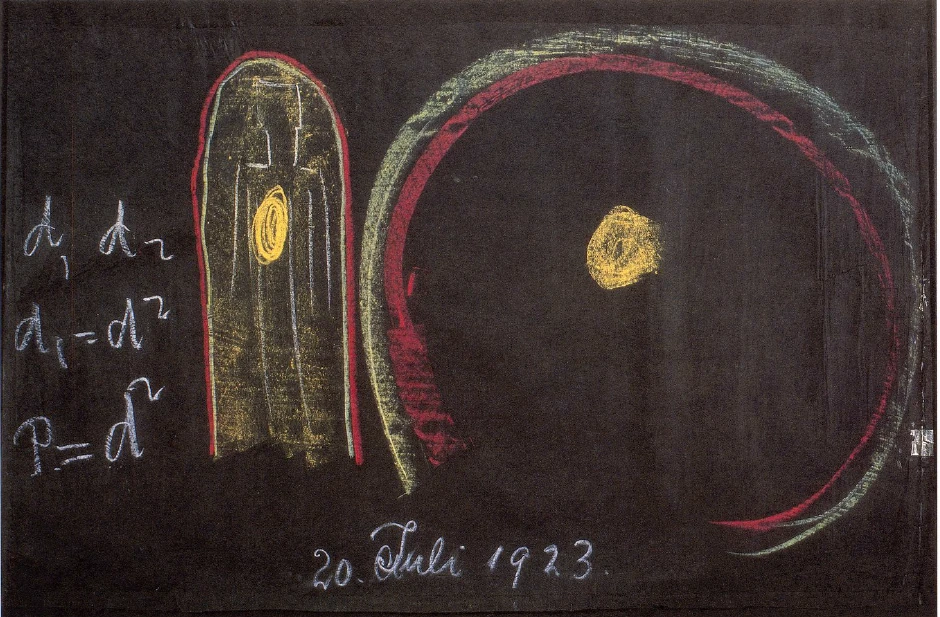
[ 12 ] Nun wollen wir einmal uns genauer vor die Seele führen, wie dieses Erlebnis ist. Ich will dazu eine schematische Zeichnung machen. Nehmen wir einmal an, der physische Leib des Menschen wäre durch diese schematische Zeichnung charakterisiert; der Äther- oder Bildekräfteleib sei durch diese schematische Zeichnung (gelb schraffiert) charakterisiert. Wir erleben das, was ich damit charakterisiert habe, dieses zusammengehörige Gebilde von physischem und Ätherleib nur dann, wenn wir nach dem Aufwachen in dem Inneren stekken. Wir erleben es eigentlich also immer von innen. Und damit wir uns diese Sache möglichst genau ins Bewußtsein rufen, möchte ich die Zeichnung in folgender Weise gestalten. Ich werde meinetwillen grün andeuten den nach innen scheinenden Teil des Ätherleibes. Der physische Leib wird ja ohnedies im Tode abgelegt, den brauchen wir dabei weniger zu betrachten. Und ich werde das, was vom Ätherleib nach außen gerichtet ist, mit dieser roten Linie bezeichnen.
[ 12 ] Now let us take a closer look at what this experience is like. I will draw a schematic diagram to illustrate this. Let us assume that the human physical body is represented by this schematic diagram; let the etheric body, or body of formative forces, be represented by this schematic diagram (shaded in yellow). We experience what I have depicted here—this unified structure of the physical and etheric bodies—only when we are immersed in our inner world after waking up. So we actually always experience it from within. And to help us bring this matter as clearly as possible into our consciousness, I would like to arrange the diagram in the following way. For my own purposes, I will indicate in green the part of the etheric body that appears to face inward. The physical body is, of course, shed at death anyway, so we need not concern ourselves with it as much here. And I will mark what is directed outward from the etheric body with this red line.
[ 13 ] Ich sagte eben, wir erleben dieses Gebilde des Ätherleibes nur nach dem Aufwachen von innen; also gewissermaßen nur das erleben wir, was im Grünen nach innen scheint. Wir erleben nicht dasjenige, was im Roten nach außen scheint.
[ 13 ] I just said that we experience this structure of the etheric body only from within after waking up; so, in a sense, we experience only what shines inward in the green. We do not experience what shines outward in the red.
[ 14 ] Wenn wir durch die Pforte des Todes gegangen sind und mit unserem Ich und unserem astralischen Leib eine gewisse Verbindung mit dem Ätherleib eingehen, so geschieht diese Verbindung in der folgenden Weise. Sie müssen sich nun vorstellen, der ganze Ätherleib wendet sich so wie ein Handschuh, wenn Sie das, was sonst der Haut anliegt, mit allen Fingerlingen umkehren und so das Innere nach außen kehren. So daß ich jetzt das, was hier im Erdenzustande rot nach außen gezeichnet ist, als die innere Partie zeichnen muß, und das, was grün nach innen gezeichnet ist, muß ich grün nach außen zeichnen. Der ganze Ätherleib wendet sich in sich selber um. Aber dieses Umwenden, das ist verknüpft mit einem unermeßlich rasch vor sich gehenden Vergrößern des Ätherleibes. Er wächst, er wird riesengroß, er dehnt sich unermeßlich weit ins Weltenall hinaus, so daß ich die Zeichnung nun etwa so machen müßte (großer grüner Tafel 8 Kreis).
[ 14 ] When we have passed through the gate of death and, with our “I” and our astral body, establish a certain connection with the etheric body, this connection takes place in the following manner. You must now imagine the entire etheric body turning inside out, just as a glove does when you turn it inside out with all your fingers, so that the inside faces outward. So that what is shown here in the earthly state as red on the outside, I must now depict as the inner part, and what is shown as green on the inside, I must depict as green on the outside. The entire etheric body turns inside out. But this turning is linked to an immeasurably rapid expansion of the etheric body. It grows, it becomes gigantic, it expands immeasurably far out into the universe, so that I would now have to draw it something like this (large green circle on Plate 8).
[ 15 ] Und während wir früher da drinnen waren mit unserem Ich und unserem astralischen Leib, sind wir jetzt (roter Kreis) dem sich ins Kosmische vergrößernden Ätherleib gegenüber, aber wir schauen ihn von seiner anderen Seite an. Dasjenige, was wir vorher ohne Bedeutung an uns getragen haben, das für uns äußerlich Rote, das ist jetzt nach innen gewendet. Was vorher nach innen gewendet war und was für uns allein Bedeutung hat während des Erdenlebens, das ist jetzt nach außen gewendet, das geht uns gar nichts mehr an, das zerstreut sich ins Weltenall. In diesem Grün aber — natürlich schematisch dargestellt — ist enthalten alles das, was wir während des Erdenlebens in uns als farbige, tönende und so weiter Welt gehabt haben.
[ 15 ] And whereas we used to be inside there with our ego and our astral body, we are now (red circle) facing the etheric body as it expands into the cosmic realm, but we are looking at it from its other side. That which we previously carried within us without significance—what appeared to us as the “red”—is now turned inward. What was previously turned inward, and what has meaning for us alone during our earthly life, is now turned outward; it no longer concerns us at all; it disperses into the cosmos. But this green—depicted schematically, of course—contains everything that we have had within us during our earthly life as a world of color, sound, and so on.
[ 16 ] Indem das Grün gewissermaßen durch die Wendung des Ätherleibes nach der anderen Seite geht, verlieren wir es vollständig, und wir bekommen eine ganz andere Welt als Eindruck. Wir dürfen uns gar nicht vorstellen, daß wir dieselbe Welt, die wir während des Erdenlebens gehabt haben, nach dem Tode noch haben können. Diese Welt geht fort. Sich etwa vorzustellen, daß wir nach dem Tode erleben könnten, meinetwillen in einer anderen Auflage, den Inhalt des Erdenlebens, das ist ganz falsch, das entspricht nicht den Tatsachen. Was wir durch die Wendung des Äther- oder Bildekräfteleibes erleben, das ist allerdings gegenüber dem Inhalte des Erdenlebens von einer gigantischen Größe, aber es ist eben etwas ganz anderes. Wir erleben zunächst dadurch, daß die Außenseite jetzt nach innen gewendet ist, in mächtigen Eindrücken, die aber anders sind als die Sinneseindrücke, die ganze Bildung unseres Erdenlebens. Wir erleben nicht die Röte der Rose, wir erleben aber, wie wir die Röte der Rose in uns als eine Vorstellung ausgebildet haben. Da fängt es an, nicht so ruhig zu sein, wie es im physischen Erdenleben ist. Da, im Erdenleben, sind in einem Rosengarten so hübsch die Rosen nebeneinander, und jede gibt Ruhe, und man fühlt sich webend da drinnen in der Ruhe. Jetzt wird der Rosengarten etwas ganz anderes, jetzt wird der Rosengarten zu Ereignissen in der Zeit. Und wie wir den Blick haben allmählich schweifen lassen von einer Rose zur anderen, wie wir die Vorstellung der ersten Rose, der zweiten, der dritten Rose und so weiter in unserem Innern gebildet haben, dieses, wie in lebendigem Werden, in blitzartigem Wellen und Weben eine Rose nach der anderen entsteht, aber nicht als Rosen, sondern als Vorstellungen, die sich abspielen, das tritt wie in einem Meer von Geschehen jetzt als unser Innenleben auf. Und so steht vor uns etwas, was wir eben während unseres Erdenlebens nicht gesehen haben: das Werden dieses Erdenlebens, die allmähliche Entstehung dieses Erdenlebens. Wir wissen, wie unsere Seele geworden ist von Kindheit auf. Das, was wir ganz unbeachtet gelassen haben während des Erdenlebens, das spielt sich jetzt in uns ab. Es ist, wie wenn wir aus uns herausgestiegen wären, ein Zweites geworden wären und zuschauen würden, wie wir als Erstes nach und nach die einfache Vorstellung der Kindheit, die kompliziertere des späteren Alters und so weiter gebildet haben. Wir sehen das Entstehen dieses ganzen Erdenwichtes nach seiner Innenseite. Wir sehen, wie sich von Stunde zu Stunde dieses Erdenleben, dieses Erdendasein bildet. Ja, wir gewinnen den Eindruck, daß eigentlich dieses ganze Erdenleben vom Kosmos herein gebildet wird. Denn alles das, was wir da wahrnehmen, wächst ins Unermeßliche, ins Kosmische hinaus, und wir werden dadurch, daß wir hinauswachsen, uns klar darüber, daß nun auch das, was im Erdenleben in uns gebildet worden ist, vom Kosmos herein gebildet wird.
[ 16 ] As the green, so to speak, passes to the other side through the turning of the etheric body, we lose it completely, and we perceive a completely different world. We must not imagine that we can still have the same world after death that we had during our earthly life. That world passes away. To imagine, for example, that after death we could experience—say, in a different version—the content of our earthly life is entirely wrong; it does not correspond to the facts. What we experience through the turning of the etheric or formative body is indeed of a gigantic magnitude compared to the content of our earthly life, but it is simply something entirely different. First of all, because the outer side is now turned inward, we experience the entire structure of our earthly life in powerful impressions—though these are different from sensory impressions. We do not experience the redness of the rose, but we do experience how we have formed the redness of the rose within ourselves as a mental image. That is where things begin to be less tranquil than they are in physical earthly life. There, in earthly life, the roses in a rose garden stand so prettily side by side, and each one radiates tranquility, and one feels oneself weaving within that tranquility. Now the rose garden becomes something entirely different; now the rose garden becomes a series of events in time. And just as we have gradually let our gaze wander from one rose to another, just as we have formed within ourselves the image of the first rose, the second, the third, and so on—this process, as if in living becoming, in lightning-like surges and weaving, in which one rose after another comes into being— but not as roses, rather as mental images unfolding—this now emerges as our inner life, as if in a sea of events. And so something stands before us that we simply did not see during our earthly life: the becoming of this earthly life, the gradual emergence of this earthly life. We know how our soul has developed from childhood onward. What we completely overlooked during our earthly life is now unfolding within us. It is as if we had stepped outside of ourselves, become a second self, and were watching as we first gradually formed the simple concept of childhood, then the more complex one of later years, and so on. We see the emergence of this entire earthly being from within. We see how, hour by hour, this earthly life, this earthly existence, takes shape. Indeed, we gain the impression that this entire earthly life is actually shaped from within the cosmos. For everything we perceive there grows out into the immeasurable, into the cosmic, and as we grow outward in this way, we become clearly aware that what has been formed within us during our earthly life is also shaped from within the cosmos.
[ 17 ] Und jetzt bekommen wir allmählich eine gültige Anschauung darüber, wie es mit diesem menschlichen Erdenleben ist. Lehnen wir uns einmal an dasjenige an, was heute so ziemlich geglaubt wird mit Bezug auf dieses Erdenleben. Der Mensch ißt, und dadurch bekommt er die Stoffe, die draußen sind, in seinen eigenen Organismus hinein. Das ist eine nicht zu leugnende Tatsache. Er verändert auch diese Stoffe. Schon im Munde verändert er sie, dann um so mehr in seinem weiteren Organismus. Was da aufgenommen wird, das geht in den ganzen Organismus über, richtig in den ganzen Organismus über. Die Wissenschaft kommt noch und sagt: Aber wir verlieren auch nach außen immerfort Stoffe. — Wir brauchen nur daran zu denken, wie Sie sich Ihre Nägel abschneiden und Ihre Haare, wenn Sie noch keine Glatze haben. Sie können ja aus dem Abschuppen und so weiter überall wahrnehmen, wie der Mensch Materie verliert, Stoff verliert. Und es ist ja heute allgemein bekannt, daß der Mensch auf diese Weise, indem er fortwährend Stoffe verliert, im Laufe von ungefähr sieben Jahren sich vollständig neu aufbaut.
[ 17 ] And now we are gradually gaining a valid understanding of what this human life on Earth is really like. Let us first consider what is generally believed today with regard to this earthly life. A person eats, and through this process takes in substances from the outside world into their own organism. This is an undeniable fact. They also transform these substances. They begin transforming them in the mouth, and even more so as they move through the rest of the organism. What is taken in is absorbed into the entire organism—truly into the entire organism. Science then adds: But we are also constantly losing substances to the outside world. — We need only think of how you cut your nails and trim your hair, if you are not yet bald. You can observe everywhere—through shedding and so on—how a person loses matter, loses substance. And it is, after all, generally known today that in this way, by continually losing matter, a person completely renews themselves over the course of about seven years.
[ 18 ] So daß also, wenn ich es drastisch ausdrücken will, alles das, was hier auf den Stühlen sitzt, insofern es den Stoff betrifft, vor acht oder neun Jahren überhaupt irgendwo in der Welt zerstreut war. Ich will zunächst so sagen: Was hier auf den Stühlen sitzt, das könnte sich also erst gesammelt haben im Laufe der letzten sieben bis acht Jahre. Wenn das auch noch hier sitzen sollte an Muskelfleisch und so weiter, was vor mehr als sieben oder acht Jahren in Ihnen allen war — Sie sind ja schon älter, Sie werden also schon mehrfach sich regeneriert haben —, so würden Sie alle nicht da sitzen.
[ 18 ] So, to put it bluntly, everything sitting here in these chairs—as far as the material is concerned—was scattered all over the world eight or nine years ago. Let me put it this way: What is sitting here in these chairs could therefore only have come together over the course of the last seven to eight years. If the muscle tissue and so on that was in all of you more than seven or eight years ago were still sitting here—you are, after all, older, so you must have regenerated several times by now—then none of you would be sitting here.
[ 19 ] Also von dem, was Sie zu Hause oder sonstwo als Ihr Muskelfleisch, als Ihr Blut und anderes in sich getragen haben vor sieben oder acht Jahren, von dem sitzt nichts da; das haben Sie nach und nach abgeschnitten, sich abgeschuppt und so weiter.
[ 19 ] So, of what you carried within you at home or elsewhere—your muscle tissue, your blood, and so on—seven or eight years ago, none of that remains; you’ve gradually shed it, peeled it off, and so on.
[ 20 ] Wenn die Wissenschaft nun aber materialistisch orientiert ist, wie sagt sie dann? Sie sagt ungefähr so: Während dieser letzten sieben Jahre haben wir ja alle gegessen. Das, was wir da nun gegessen haben, das sitzt hier, und dasjenige, was wir früher gegessen haben, das sitzt nicht mehr da. — Also zum Beispiel jeder von Ihnen, der hier sitzt, hat ein Herz, nicht wahr. Nun, die physische Materie dieses Herzens, so sagt Ihnen die Wissenschaft, die hat sich erneuert in den letzten sieben bis acht Jahren. Sie haben also durchaus gegenüber Ihrem Zustand vor, sagen wir, neun Jahren ein neues Herz. Ja, so ungefähr könnte man sagen, denkt man im Sinne der Gegenwart.
[ 20 ] But if science is materialistic in its orientation, what does it say? It says something like this: Over the past seven years, we’ve all been eating. What we’ve eaten recently is still here, and what we ate earlier is no longer here. — For example, each of you sitting here has a heart, doesn’t that right? Well, science tells you that the physical matter of this heart has been renewed over the past seven to eight years. So compared to your condition, say, nine years ago, you essentially have a new heart. Yes, that’s roughly how one might put it, if one thinks in terms of the present.
[ 21 ] Aber es ist nicht so. Diese Vorstellung besteht nur aus dem Grunde, weil die Leute das, was ich Ihnen eben auseinandersetzte, nicht kennen, gar nicht einbeziehen in den Bereich ihrer wissenschaftlichen Beobachtung und ihres wissenschaftlichen Denkens. Sie wissen nichts von jener Umkehr des Äther- oder Bildekräfteleibes, von dem, was da, nachdem wir durch die Pforte des Todes geschritten sind, uns zeigt, wie eigentlich nach und nach der ganze Wicht entstanden ist. Denn kennt man das, dann kommt man auch in die Lage, ganz anders hineinzuschauen in den menschlichen Organismus. Und dann lernt man erst die Wahrheit erkennen.
[ 21 ] But that is not the case. This notion exists solely because people are unaware of what I have just explained to you; they do not even include it within the scope of their scientific observation and scientific thinking. They know nothing of that reversal of the etheric or formative body—of what, after we have passed through the gate of death, reveals to us how the whole being actually came into being, step by step. For once one knows this, one is then able to look into the human organism in an entirely different way. And only then does one begin to recognize the truth.
[ 22 ] Man kann glauben, daß aus dem Kohl, aus den Kartoffeln, aus dem sonstigen Gemüse, aus Kirschen, Pflaumen und so weiter, die man da im Laufe der letzten Jahre genossen hat, sich auch nach und nach diese Herzmaterie angesammelt hat. Das hat sie aber nicht, sondern im wesentlichen — hören Sie, daß ich sage, im wesentlichen — hat das Herz, das Sie in sich tragen, mit der aufgenommenen Materie der letzten sieben bis acht Jahre gar nicht so sonderlich viel zu tun, sondern das Herz, das Sie heute in sich tragen, ist im wesentlichen auf eine sehr geheimnisvolle Art entstanden aus dem Äther des Kosmos, den Sie im Lauf der letzten sieben bis acht Jahre zu der Herzdichte zusammengezogen haben. So daß nicht aus der physischen Materie der letzten sieben bis acht Jahre sich dieses Ihr Herz erneuert hat, sondern es hat sich aus dem Kosmos heraus erneuert. Aus dem Äther heraus haben Sie Ihr Herz und Ihre übrigen Organe erneuert. Sie haben tatsächlich sich zu einem neuen Menschen gemacht im Laufe der letzten Jahre nicht von der Erde herauf, sondern vom Kosmos herein. Das sieht man diesen Wirkungen des Ätherleibes nach dem Tode an, wie er gewirkt hat während des ganzen Erdenlebens, daß wir uns immer regeneriert haben aus dem Kosmos herein.
[ 22 ] One might think that this heart substance has gradually accumulated from the cabbage, the potatoes, the other vegetables, the cherries, plums, and so on, that one has enjoyed over the past few years. But that is not the case; rather, essentially — listen carefully when I say “essentially” — the heart you carry within you has not really that much to do with the matter you have taken in over the last seven to eight years; rather, the heart you carry within you today has essentially come into being in a very mysterious way from the ether of the cosmos, which you have condensed into the density of the heart over the course of the last seven to eight years. So it is not from the physical matter of the last seven to eight years that your heart has been renewed, but rather it has been renewed from the cosmos. You have renewed your heart and your other organs from the ether. You have in fact made yourselves into new human beings over the course of the last few years—not from the earth upward, but from the cosmos inward. This can be seen from the effects of the etheric body after death, as it has acted throughout your entire earthly life, showing that we have always regenerated ourselves from the cosmos inward.
[ 23 ] Nun wird Ihr matertalistisches Gewissen — ein solches muß ja der Mensch auch haben — sagen: Aber gegessen haben wir ja doch. Wir haben doch die äußere Materie aufgenommen, und da haben sich innere Prozesse abgespielt. — Ja, diese inneren Prozesse haben aber mit Ihrem eigentlichen tieferen Menschenwesen nicht so viel zu tun, als Sie glauben. Diese Materie, die Sie durch Essen aufgenommen haben, die haben Sie schon auf den verschiedenen Wegen, auf denen der Mensch abgibt, wieder abgegeben. Die gehen allerdings durch den Organismus durch, vereinigen sich aber gar nicht im wesentlichen mit dem, was der Mensch ist, sondern sie bilden nur die Anregung. Wir müssen essen, damit da im Inneren Prozesse, Vorgänge entstehen, die uns anregen. Und indem sie uns anregen, aufstacheln, kommen wir in die Äthertätigkeit hinein, die aber mit dem Kosmos, nicht mit der Erde zusammenhängt. Das, was sich da abspielt mit den aufgenommenen, verdauten, durchs Blut verarbeiteten Speisen und so weiter, das sind Prozesse, die die Anregung bilden, daß sich ihnen ein Gegenprozeß entgegenstelle, der ätherische Prozeß. Mein altes Herz wird aufgestachelt durch die physische, umgewandelte Materie, die in mich hereinkommt. Aber das neue Herz mache ich mir aus dem Weltenäther heraus.
[ 23 ] Now your materialistic conscience—for a human being must surely have one—will say: But we did eat, after all. We did take in external matter, and internal processes took place as a result. — Yes, but these internal processes have less to do with your actual, deeper human being than you think. This matter that you have taken in through eating, you have already excreted again through the various channels by which the human being eliminates waste. These do indeed pass through the organism, but they do not essentially unite with what the human being is; rather, they merely provide stimulation. We must eat so that processes and events arise within us that stimulate us. And as they stimulate and spur us on, we enter into etheric activity, which, however, is connected to the cosmos, not to the Earth. What takes place there with the food that has been ingested, digested, processed by the blood, and so on—these are processes that provide the stimulus for a counter-process to oppose them: the etheric process. My old heart is stirred by the physical, transformed matter that enters me. But I create my new heart out of the world ether.
[ 24 ] Jetzt können wir sogar die für das heutige Denken vielleicht etwas groteske Tatsache hinstellen: Sie sitzen jetzt alle da; was Sie in sich erneuert haben in den letzten sieben bis acht Jahren, das lebte nicht in dem Kohl und auf den Kartoffeläckern, sondern das lebte draußen im Weltenall in Sonne, Mond und Sternen, das kam von da herunter, und Sie bildeten sich aus dem Weltenall heraus neu. Damit haben wir hingedeutet auf einen Irrtum, der einfach aus dem heutigen Denken heraus entstehen muß. Man sucht nur die Beziehungen der menschlichen Regeneration zur physischen Erdenmaterie, nicht aber zum Äther. Und die Folge davon ist, daß, wenn man sich hineingewöhnt hat in die Vorstellungen, die einem in der gegenwärtigen Physiologie gegeben werden, man gar nicht anders kann, als eben alles, was von anthroposophischer Seite gegeben wird, wie eine Art Phantasterei anzusehen. Daher muß man sich klar sein darüber, wie Diskussionen heute unfruchtbar sind, wie man nur, wenn man beide Gebiete beherrscht, die heutige Wissenschaft und die Anthroposophie, sie gegenseitig durcheinander beleuchten kann, wie man aber nicht sich der Hoffnung hingeben darf — denn gibt man sich dieser Hoffnung hin, so geschieht es eigentlich zum Schaden der Anthroposophie! —, daß diejenigen, die eingewöhnt sind in die materiell gearteten Vorstellungen, so ohne weiteres durch eine Diskussion herübergezogen werden können. Darüber muß man ganz klare, präzise Begriffe haben. Dann wird man einschen, daß eben zunächst die ganze Art und Weise, wie man sich Anthroposophie aneignet, von den Menschen angeeignet werden muß, bevor sie überhaupt hineinkommen können in dieses anthroposophische Anschauen und Erkennen.
[ 24 ] Now we can even point out a fact that may seem somewhat grotesque to today’s way of thinking: You are all sitting here now; what you have renewed within yourselves over the past seven to eight years did not live in the cabbage or in the potato fields, but rather lived out there in the cosmos—in the sun, moon, and stars; it came down from there, and you reshaped yourselves out of the cosmos. With this, we have pointed to an error that is bound to arise from contemporary thinking. People look only for the connections between human regeneration and the physical matter of the Earth, but not to the ether. And the consequence of this is that, once one has become accustomed to the ideas presented by contemporary physiology, one cannot help but regard everything presented from the anthroposophical perspective as a kind of fantasy. Therefore, one must be clear about how fruitless discussions are today; one can only shed light on both fields—modern science and anthroposophy—by illuminating them in relation to one another when one has mastered both; yet one must not give in to the hope—for if one does, it actually harms anthroposophy! —that those who are accustomed to materialistic concepts can simply be won over through a discussion. One must have very clear, precise concepts regarding this. Then one will realize that, first and foremost, the entire manner in which one approaches anthroposophy must be adopted by people before they can even begin to enter into this anthroposophical way of seeing and knowing.
[ 25 ] Ich sagte, im wesentlichen ist es so, daß wir eigentlich unseren neuen Menschen regenerieren aus dem Kosmos herein. Wir finden im Kosmos nicht die Stoffe, die wir dann im Herzen finden, selbstverständlich nicht, denn da sind sie so dünn, daß sie mit physischen Erdenmitteln nicht nachweisbar sind. Da sind sie ätherisch. Aber was als dichte Herzmaterie auftritt in einem bestimmten Lebensalter, das ist eben erst verdichtet aus dem kosmischen Äther herein. Also das, was da heute sitzt, alles das war vor neun oder zehn Jahren noch draußen in den Himmeln, in den Sternen, und das, was geblieben ist, was also von der Materie sich hineingedrängt hat in dasjenige, was eigentlich aus dem Äther gebildet hat werden sollen, das ist die Veranlassung zum Kranksein. Wenn wir physische Materie, die zu alt ist, in uns tragen, dann bedeutet die eine Krankheitsursache. Und tiefe Einsichten in das Wesen der Krankheit gibt es, wenn man weiß, wie Materie, statt ausgestoßen zu werden, sich hält; denn alle Materie, die aufgenommen wird als physische Erdenmaterie, ist eigentlich dazu verurteilt, wieder ausgestoßen zu werden. Hält sie sich im Organismus, dann wird sie Krankheitsursache. _
[ 25 ] I said that, essentially, we are actually regenerating our new human being from the cosmos. We do not find in the cosmos the substances that we then find in the heart—of course not, for there they are so subtle that they cannot be detected by physical, earthly means. There they are ethereal. But what appears as dense heart matter at a certain age in life has only just been condensed from the cosmic ether. So what is there today—all of that was still out there in the heavens, in the stars, nine or ten years ago; and what has remained—that is, the matter that has forced its way into what was actually meant to be formed from the ether—is the cause of illness. If we carry physical matter within us that is too old, this constitutes a cause of illness. And deep insights into the nature of illness arise when one understands how matter, instead of being expelled, persists; for all matter that is taken in as physical earthly matter is actually destined to be expelled again. If it persists within the organism, it becomes a cause of illness. _
[ 26 ] Sie sehen daraus auch, wie bis ins Praktische hinein diese wirklich reale Erkenntnis spielt, die wir nur dadurch gewinnen können, daß wir einen Einblick haben in das, was als erste Erlebnisse, kurz nachdem wir den physischen Leib ganz abgelegt haben, in uns auftritt. Es schmilzt also nach dem Tode von uns alles ab, was wir an Sinneseindrücken und Verstandesbearbeitung der Sinneseindrücke gehabt haben. Wir schauen die Welt ganz anders an. Mineralien, Pflanzen, Tiere sind so, wie wir sie vorher angeschaut haben, überhaupt nicht da. Wie Menschen werden, das ist da.
[ 26 ] You can also see from this how this truly real insight plays out in practical terms—an insight we can gain only by having a glimpse into what arises within us as our first experiences shortly after we have completely shed our physical body. Thus, after death, everything we have experienced in terms of sensory impressions and the intellectual processing of those impressions melts away. We view the world in a completely different way. Minerals, plants, and animals—as we previously perceived them—are not there at all. What is there is how human beings become.
[ 27 ] Wir sind geschritten durch die Pforte des Todes. Wir sind dadurch von dem Schauplatz der Erde abgetreten. Wir sind auf den Schauplatz des Kosmos getreten: Eine andere Welt umgibt uns. Es ist, wie wenn wir aus einem kleinen Kämmerchen des Erdendaseins getreten wären in das majestätisch gewaltige Gemach des Kosmos, und wir fühlen uns ausgebreitet über den Kosmos, würden wahrhaftig in dem kleinen Erdengemach dann auch nicht Platz haben. Damit haben wir den Schauplatz des Kosmos also betreten. Und auf diesem Schauplatz des Kosmos müssen wir nun bleiben, bis wir wieder heruntersteigen zum Erdendasein, nur daß wir jetzt mit ganz neuen Welten in Zusammenhang treten, mit Welten, deren Wesen den höheren Hierarchien angehören.
[ 27 ] We have passed through the gate of death. We have thereby departed from the stage of the earth. We have entered the stage of the cosmos: another world surrounds us. It is as if we had stepped out of a small chamber of earthly existence into the majestically vast hall of the cosmos, and we feel ourselves spread out across the cosmos—we truly would have no room in that small earthly chamber. Thus, we have entered the stage of the cosmos. And on this stage of the cosmos we must now remain until we descend once more to earthly existence, except that we now come into contact with entirely new worlds—worlds whose beings belong to the higher hierarchies.
[ 28 ] Diese Betrachtung, die man so unmittelbar in Anknüpfung an den Menschen gewinnt, muß aber ausgedehnt werden auf die ganze Natur. Und ich möchte Ihnen, was da zu geschehen hat, in der folgenden Weise charakterisieren.
[ 28 ] This perspective, which one gains so directly in relation to human beings, must, however, be extended to all of nature. And I would like to describe to you what must happen there in the following way.
[ 29 ] Nehmen wir zum Beispiel an, eine bestimmte, sehr lange Zeit wären wir in der Evolution, in der Erdenevolution zurückgegangen. Wir würden da ganz andere Lebewesen, ganz andere Geschehnisse der Erde antreffen. Sie wissen, es hat Erdepochen gegeben, wo Riesentiere niederer Art gelebt haben, die heute nicht mehr leben. Die ganzen Arten sind ausgestorben, sind nicht mehr da. Einzelne Reste sucht der Paläontologe, der Geologe aus den Formationen der Erde heraus. Nehmen wir an, ich würde schematisch diese sehr alte Entwickelung, wo also meinetwillen Ichthyosaurier, Plesiosaurier, diese merkwürdigen Biester hier auf Erden gelebt hätten, zeichnen. Ja, diese Wesen waren dazumal auf der Erde nicht durch die physische Erdenmaterie, sie waren durch den Kosmos herausgebildet, durch den Äther. Und als die Zeit nahte, in der allmählich diese Biester ausstarben, da blieb, wenn ich so sagen darf, die ganze Äthermaterie zurück. (Siehe Zeichnung: gelb.) Jetzt waren keine Biester mehr da. Aber die ganze Äthermaterie, aus der sich diese Biester herausgebildet haben, die blieb zurück, so wie unser Ätherleib zurückbleibt. Und diese Äthermaterie, die war die Veranlassung, daß in der späteren Zeit sich wiederum im Erdendasein, nachdem diese Ätherbildung durch den Kosmos durchgegangen war, andere Wesen bildeten. Von denen blieb wiederum zurück das Ätherische. Daraus bildeten sich wiederum andere Wesenheiten. Und endlich entstand die Welt von Tieren, die heute da ist.
[ 29 ] Let’s assume, for example, that we had gone back a certain, very long period of time in evolution—in the Earth’s evolution. We would encounter completely different living beings and completely different events on Earth. As you know, there have been geological eras when giant animals of a lower order lived that no longer exist today. Entire species have become extinct; they are no longer here. Paleontologists and geologists search for isolated remains in the Earth’s geological formations. Let’s suppose I were to sketch, schematically, this very ancient phase of development—in which, for the sake of argument, ichthyosaurs, plesiosaurs, and these strange creatures would have lived here on Earth. Yes, these beings were not formed on Earth at that time through physical earthly matter; they were formed through the cosmos, through the ether. And as the time approached when these creatures gradually died out, the entire etheric matter, if I may put it that way, remained behind. (See drawing: yellow.) Now there were no more creatures left. But all the etheric matter from which these creatures had been formed remained behind, just as our etheric body remains behind. And this etheric matter was the cause of other beings forming in later times within earthly existence, after this etheric formation had passed through the cosmos. From these, in turn, the etheric substance remained behind. From this, yet other beings formed. And finally, the world of animals that exists today came into being.
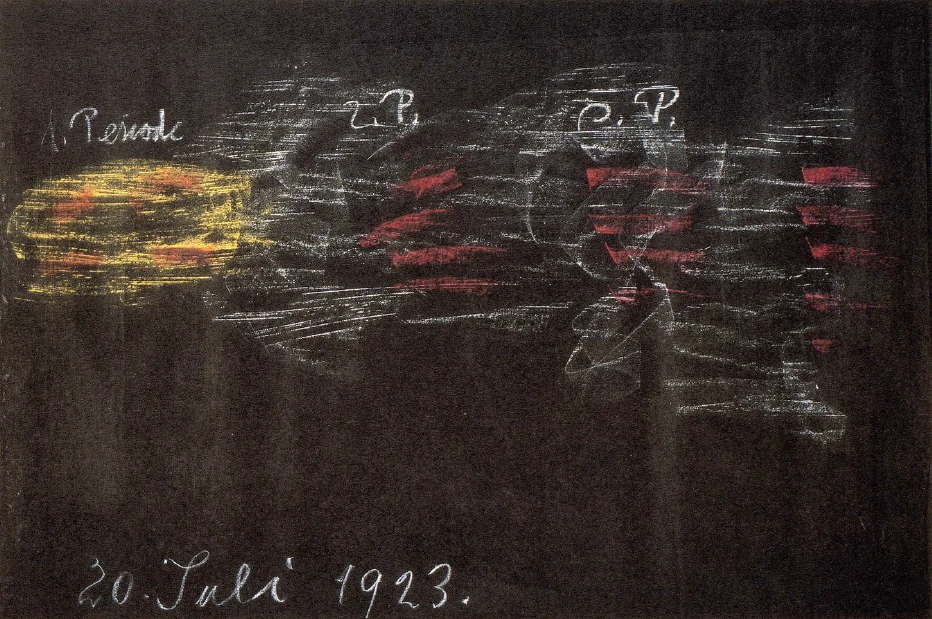
[ 30 ] Wenn Sie also hier drei aufeinanderfolgende Perioden haben, erste Periode, zweite Periode, dritte Periode, so haben Sie, sagen wir, aufeinanderfolgende Tierformen. Aber daß die folgende immer aus der vorhergehenden entstehen kann, dazu ist ein Durchgang durch den Kosmos mit Hilfe des Äthers notwendig, wie der Durchgang durch den Kosmos zwischen zwei Erdenleben für den Menschen notwendig ist. Und wenn wir zuletzt hier Wesenheiten haben (siehe Zeichnung: rot), so kann ja das wiederum in den Äther übergehen, und da kann in einer bestimmten Periode, aus dem Äther heraus gebildet, der Mensch auftreten. Aber immer ist der Einfluß auf dem Umwege durch den Kosmos geschehen.
[ 30 ] So if you have three consecutive periods here—the first period, the second period, the third period—then you have, let’s say, successive forms of animals. But for the subsequent form to arise from the preceding one, a passage through the cosmos with the aid of the ether is necessary, just as the passage through the cosmos between two earthly lives is necessary for human beings. And when we finally have beings here (see drawing: red), these can in turn pass into the ether, and there, formed from the ether during a specific period, the human being can emerge. But the influence has always taken place indirectly through the cosmos.
[ 31 ] Nun kommt der rein materialistische Betrachter. Der sieht das alles, und jetzt glaubt er, das eine ist aus dem andern entstanden. Gewiß, auf der Erde schließt es sich auch an; aber eine Äthertätigkeit, eine kosmische Tätigkeit liegt dazwischen.
[ 31 ] Now comes the purely materialistic observer. He sees all of this, and now he believes that one thing arose from the other. Certainly, on Earth, one thing follows from the other; but an etheric activity, a cosmic activity, lies in between.
[ 32 ] Im 19. Jahrhundert ist es üblich geworden, nur auf das hinzuschauen, was sich auf der Erde folgt, nicht aber auf dasjenige, was kosmische Tätigkeit über das Irdische hinaus ist. Daher ist der Betrachtung geblieben: zuletzt der Mensch, vorher einfachere Formen, noch einfachere Formen und so weiter. Es ist das, was wir als die Entwickelung der Organismen durch die Naturwissenschaft bekommen können, die sich auf das Ätherische nicht einläßt. Diese Naturwissenschaft konnte nichts anderes bekommen, als was sie bekam. Gibt man ihre Voraussetzungen zu, daß man sich auf das Ätherische nicht einlassen soll, stellt man die Frage so, daß man nur dasjenige ins Auge fassen soll, was dem Erdendasein angehört, ja dann bleibt nichts anderes übrig, als die physische Evolutionsströmung hinzustellen. Das haben die Darwinisten, das hat Haeckel getan, und als Erdenwissenschaft mehr verlangen oder gar polemisieren wollen gegen das, was da als Erdenwissenschaft zustande gekommen ist, ist Unsinn. Denn erst, wenn man hinzufügt die Erkenntnis der ätherischen Welt, dann kann sich das ergeben, was dazu gehört. Sie sehen also, ein unmittelbares Polemisieren hat gar keinen Sinn; sondern will jemand auf dem Boden der Naturwissenschaft stehen bleiben, so kann er das. Und dem andern, der eben von irgendwelchen andern Bildungsprinzipien in dem, was auf der Erde ist, spricht, dem kann er immer sagen: Ja, das hat gar keine Bedeutung. Das ist nicht da, wird er sagen, wenn er sich an die bloß irdische Betrachtungsweise gewöhnt hat.
[ 32 ] In the 19th century, it became customary to focus solely on what succeeds one another on Earth, but not on that which constitutes cosmic activity beyond the earthly realm. Consequently, the view that has prevailed is this: ultimately, human beings; before them, simpler forms; even simpler forms; and so on. This is the picture of the evolution of organisms that we can obtain from natural science, which does not engage with the ethereal. This natural science could obtain nothing other than what it did. If one accepts its premise—that one should not engage with the ethereal—and frames the question such that one should consider only what pertains to earthly existence, then indeed there is no alternative but to present the physical current of evolution. That is what the Darwinists did, that is what Haeckel did, and to demand more from Earth science—or even to argue against what has emerged as Earth science—is nonsense. For only when one adds the knowledge of the ethereal world can what belongs to it emerge. So you see, direct polemics make no sense at all; but if someone wishes to remain on the ground of natural science, they may do so. And to the other person, who speaks of some other formative principles in what exists on Earth, one can always say: Yes, that has no significance at all. “That isn’t there,” he will say, once he has become accustomed to the purely earthly perspective.
[ 33 ] Will man anders reden, dann muß man sich zunächst die Kenntnis der ätherischen Welt aneignen. Es bleibt also für eine gültige, für eine vernünftige Polemik gegenüber der heutigen Wissenschaft nur das übrig, daß man sagt: Auf deinem Gebiete, o Naturforscher, hast du ganz recht, da kann gar nichts anderes herauskommen, das leugnen wir dir nicht ab, das geben wir dir voll zu. Willst du aber mit uns reden über das, was wir meinen, ja, dann mußt du dich erst mit den elementaren Vorgängen im kosmischen Äther bekannt machen, dann können wir miteinander reden. Sonst steht man auf keinem Boden der Wirklichkeit, wenn man nicht von diesen Dingen ausgeht.
[ 33 ] If one wishes to speak differently, one must first acquire knowledge of the ethereal world. Thus, the only valid and reasonable argument one can make against modern science is to say: In your field, O natural scientist, you are entirely correct; nothing else can possibly result from it; we do not deny this to you; we fully acknowledge it. But if you wish to speak with us about what we mean—yes, then you must first familiarize yourself with the elementary processes in the cosmic ether; only then can we speak with one another. Otherwise, one stands on no ground of reality if one does not proceed from these things.
[ 34 ] Sehen Sie, ein Mitglied, das hier sitzt, hat eine kleine Botanik vom geisteswissenschaftlichen Standpunkt aus geschrieben. Es ist eine ganz absprechende Kritik in diesen Tagen in einem hiesigen Blatte erschienen. Nun, was kann man da sagen! Ich habe gesagt: Denken Sie sich einmal, Sie wären selber der Botaniker, der diese Kritik geschrieben hat, Sie hätten niemals etwas von Anthroposophie gehört und es käme Ihnen dieses Ihr Büchelchen in dieser zweiten Auflage zu Gesicht, dann würden Sie geradeso schreiben. Es ist ja ganz natürlich, daß Sie geradeso schreiben würden wie der! Daß Sie das nicht tun, sondern im Gegenteil das Büchelchen selbst geschrieben haben, davon ist ja die Veranlassung, daß Sie eben zuerst Anthroposophie aufgenommen haben. Man braucht sich ja nur einmal auf den Standpunkt des anderen zu versetzen, dann kann man doch alle diese gegnerischen Dinge selber schreiben. Aber sehen Sie, wenn man einen Menschen, der einmal mit allen seinen Denkgewohnheiten sich in eine Richtung hineinversetzt hat, anders haben will, wenn man ihn anthroposophisch haben will, das kommt mir fast so vor, wie wenn jemand, der ein blondes Töchterchen bekommen hat, plötzlich ein schwarzes haben wollte. Es geht doch nicht so ohne weiteres. Das, was der Mensch durch die heutige Wissenschaft geworden ist, ist doch nichts, was man so im Handumdrehen umändern kann. Da muß man eben durchaus real denken.
[ 34 ] You see, a member sitting here has written a short work on botany from the perspective of the spiritual sciences. A rather scathing review of it appeared recently in a local newspaper. Well, what can one say! I said: Just imagine you were the botanist who wrote that review yourself, that you had never heard of anthroposophy, and that you came across this little book of yours in its second edition—then you would write exactly the same way. It’s only natural that you would write exactly the same way as he did! The fact that you don’t—but rather, on the contrary, have written the little book yourself—is precisely because you first embraced anthroposophy. One need only put oneself in the other person’s shoes for a moment, and then one could write all these opposing arguments oneself. But you see, wanting to change a person who has already committed himself, with all his habits of thought, to a certain direction—wanting him to become anthroposophical—seems to me almost like someone who has had a little blonde daughter suddenly wanting a black-haired one. It doesn’t just happen that easily. What a person has become through modern science is not something that can be changed in the blink of an eye. One simply has to think in a thoroughly realistic way.
[ 35 ] Es gibt schon diese Zeit, die auf die Mitte des 19. Jahrhunderts gefolgt ist, der ganzen Seelenverfassung ein ganz bestimmtes Gepräge. Ich will Ihnen aus einer ganz anderen Ecke heraus dafür ein Beispiel geben.
[ 35 ] There is indeed a period, following the mid-19th century, that left a very distinct mark on the entire state of mind. I’d like to give you an example of this from a completely different perspective.
[ 36 ] Sie wissen, daß es heute so etwas gibt, was man analytische Psychologie nennt, Psychoanalyse. Ich habe ja hier öfter schon gesagt, die Psychoanalyse bringt manches Schöne; aber sie geht erstens aus einer unvollständigen, dilettantischen Erkenntnis der menschlichen Physiologie hervor, sie ist also Dilettantismus. Dann geht sie hervor aus einer dilettantischen Erkenntnis des menschlichen Seelenwesens, der menschlichen Psychologie. Das ist auch Dilettantismus. Und weil meistens der eine gleich dem andern ist, so multiplizieren sich die Dinge, und Psychoanalyse ist eigentlich dadurch der Dilettantismus im Quadrat. — Wenn man d mit d multipliziert, bekommt man d?. Aber es wirkt doch dieses, wenn auch auf dilettantische Weise, wenn es weiter verfolgt wird. Und man kann auch begreifen, daß diese Sache aus der mangelhaften Physiologie und Psychologie allmählich herauskommen konnte. Aber das färbt doch ab auf die Seele der Menschen, dieses Denken färbt doch ab!
[ 36 ] You know that today there is something called analytical psychology, or psychoanalysis. As I have often said here, psychoanalysis has some positive aspects; but, first of all, it stems from an incomplete, amateurish understanding of human physiology—it is, therefore, amateurism. Second, it stems from an amateurish understanding of the human psyche, of human psychology. That, too, is amateurism. And because the one is usually just like the other, these things multiply, and psychoanalysis is, in effect, amateurism squared. — If you multiply d by d, you get d². But it does have an effect, albeit in an amateurish way, if it is pursued further. And one can also understand that this approach could gradually emerge from deficient physiology and psychology. But it does rub off on people’s souls; this way of thinking does rub off!
[ 37 ] Heute haben wir.eine ungeheure Literatur darüber. Sie können eine große Bibliothek mit der psychoanalytischen Literatur anfüllen. Darinnen streiten sich die Leute ja auch schon wieder gräßlich, so daß, wenn Sie auf die Polemik eingehen, es manchmal recht interessant ist. Nun, es ist ja auch hier manchmal geredet worden von dieser Psychoanalyse. Man kann wirklich heute eine Bibliothek anlegen aus dem, was darüber geschrieben wird. Aber wenn soviel auf diesem Gebiete geschrieben wird, dann muß ja auch, wenigstens auf äußerliche Weise, viel darin studiert werden. Das färbt auf die Seelenverfassung der Menschen ab, die wird koloriert dadurch.
[ 37 ] Today we have a vast body of literature on the subject. You could fill an entire library with psychoanalytic literature. Within it, people are already arguing horribly with one another again, so that if you delve into the polemics, it can sometimes be quite interesting. Well, this topic of psychoanalysis has also been discussed here from time to time. You could really build a library today out of everything that’s been written on the subject. But if so much is being written in this field, then there must also be a great deal of study going on—at least on the surface. This rubs off on people’s state of mind; it colors it.
[ 38 ] Nun ist da etwas sehr Eigentümliches. Sehen Sie, im Jahre 1841, da gab es in Mitteleuropa auch schon eine psychoanalytische Literatur. Die bestand aber nur aus vierzehn Zeilen. Sie lauten: «In unserm modernen überfüllten Bewußtsein werfen wir viele Dinge umher, die wir nicht ausgestalten können, weil es uns an Zeit dazu gebricht. Sie bleiben in der Form von Aufgaben in uns, die wir bearbeiten könnten. Es sind, mit Tieck zu reden, ungeborene Seelen, die, nach Dasein verlangend, im Hintergrund unserer eigenen Seele wie in einem Limbus schweben.»
[ 38 ] Now, there is something very peculiar here. You see, as early as 1841, there was already psychoanalytic literature in Central Europe. However, it consisted of only fourteen lines. They read: “In our modern, overcrowded consciousness, we toss about many things that we cannot bring to fruition because we lack the time to do so. They remain within us in the form of tasks that we could work on. They are, to use Tieck’s words, unborn souls that, yearning for existence, hover in the background of our own soul as if in limbo.”
[ 39 ] Sehen Sie, in diesen vierzehn Zeilen — wenn man die Zeilen länger macht, sind es noch weniger — liegt dem Prinzip nach die ganze Psychoanalyse darinnen. Damals nannte man es ungeborene Seelen, die im Hintergrunde der Seele in einem Limbus leben, die nach Dasein ringen. Jetzt nennt man es in den Tiefen der Seelen verborgene Provinzen, Seelenprovinzen und dergleichen mehr. Dazumal nahm man aber diese Sache als etwas so Unbedeutendes, daß man es sich in ein paar Zeilen notierte. Heute ist unsere Zivilisation dahin gekommen, ganze Bibliotheken darüber zu schreiben. Aber alles Wesentliche, alles Prinzipielle liegt in diesen vierzehn Zeilen. Aber dafür, daß man das bloß in vierzehn Zeilen hatte, waren die Bibliotheken mit anderem angefüllt, als sie heute angefüllt sind, und die Menschen, die lernen wollten, nahmen was anderes auf.
[ 39 ] You see, these fourteen lines—and if you make the lines longer, there are even fewer—essentially encapsulate the entire principle of psychoanalysis. Back then, they were called unborn souls, living in a limbo in the depths of the soul, struggling to come into being. Nowadays, they’re called provinces hidden in the depths of the soul, “soul provinces,” and the like. Back then, however, this matter was considered so insignificant that it was jotted down in just a few lines. Today, our civilization has reached the point of writing entire libraries on the subject. Yet everything essential, everything fundamental, lies within these fourteen lines. But precisely because this was contained in just fourteen lines, the libraries were filled with other things than they are today, and people who wanted to learn absorbed something else.
[ 40 ] Wenn man heute irgendwie als junger Student Psychologie studiert, eine Dissertation schreiben soll, so kommt man ja gar nicht um die Psychoanalyse herum. Man muß sie studieren. Ja, das färbt ab auf die Seelen. Im Jahre 1841 war das Wesentliche in diesen vierzehn Zeilen ausgedrückt. Man betrachtete das nicht als etwas so Wichtiges, was eine so ungeheure Bedeutung für das menschliche Denken haben könnte. Und so ist es mit vielen Dingen gegangen.
[ 40 ] If, as a young student today, you’re studying psychology and are supposed to write a dissertation, there’s simply no getting around psychoanalysis. You have to study it. Yes, that leaves its mark on people’s souls. In 1841, the essence of it all was expressed in these fourteen lines. People didn’t regard it as something so important that it could have such immense significance for human thought. And that’s how it’s been with many things.
[ 41 ] Es bedeutet ja etwas Ungeheures, ob wir auf irgendein Gebiet von Tatsachen hinschauen oder ob wir nicht hinschauen. Dazumal, 1841, haben die Menschen die Psychoanalyse verschlafen. Es tauchte nur in einem einzigen Menschen, in Karl Rosenkranz, einmal dieser Gedanke auf, den ich Ihnen in den vierzehn Zeilen vorgelesen habe. Der träumte einmal davon. Träume gehen rasch vorüber, bilden keinen so großen Einfluß im Leben. Aber die Leute haben ihr Wachsein mit anderem ausgefüllt. Heute dagegen wird vieles verschlafen, weil man ja wachen muß für die Psychoanalyse und ähnliche Dinge.
[ 41 ] It really makes a world of difference whether we look at a particular set of facts or not. Back then, in 1841, people missed the boat on psychoanalysis. This idea—which I read to you in those fourteen lines—occurred to only one person, Karl Rosenkranz. He once dreamed of it. Dreams pass quickly; they do not exert such a great influence on life. But people filled their waking hours with other things. Today, on the other hand, many things are being overlooked because one must, after all, remain vigilant regarding psychoanalysis and similar matters.
[ 42 ] Diese Sache muß man wirklich genau betrachten, dann wird man sich sagen können, wo angesetzt werden muß, um Anthroposophie in der Welt zur Geltung zu bringen. Jedenfalls kann nicht einfach polemisiert werden. Denn das Polemisieren, das ist ja fast so, wie wenn einer in einem Zimmer liegt und furchtbar schnarcht und gar nicht wach zu kriegen ist, und ein anderer wacht, und nun gibt sich der alle Mühe, daß der Schnarchende, der alles verschläft, verstehen
[ 42 ] We really need to examine this matter closely; only then will we be able to determine where to begin in order to bring anthroposophy to the fore in the world. In any case, one cannot simply engage in polemics. For polemics is almost like someone lying in a room, snoring terribly and impossible to wake up, while another person is awake and doing everything in their power to make the snorer—who sleeps through everything—understand
[ 43 ] soll, was der andere sagt. Er kann ihn ja nicht verstehen. Ebensowenig ist es möglich, daß man sich im Geistesleben über zwei Gebiete verständigt, wenn jeder für das Gebiet des anderen schläft und nur für sein eigenes Gebiet wacht.
[ 43 ] should care what the other person says. After all, he cannot understand him. Nor is it possible to reach an understanding in intellectual life across two fields if each person remains oblivious to the other’s field and is attentive only to his own.
[ 44 ] Nun werden schon noch zahlreich diejenigen sein, die für die Anthroposophie schlafen. Die werden schon für die Anthroposophie nicht so schnell aufwachen. Aber man möchte, daß die Anthroposophen aufwachen für die anderen, so daß sie nicht bloß aus ihrem blinden Glauben, sondern aus einer wirklichen Einsicht in die Qualität des andern wissen, warum Anthroposophie das Umfassende ist und auch das mitumfaßt, was die anderen ja als das einzige betrachten, und wie Anthroposophie den Horizont erweitert, weil eben hinausgegangen wird über diejenigen Gebiete, die von den andern bloß auf einem engen Horizont betrachtet werden.
[ 44 ] There will still be many who are asleep when it comes to anthroposophy. They will not wake up to anthroposophy all that quickly. But we would like the anthroposophists to wake up to the others, so that they know—not merely out of blind faith, but out of a genuine understanding of the nature of the other—why anthroposophy is all-encompassing and also encompasses that which the others regard as the only thing, and how anthroposophy broadens the horizon, precisely because it goes beyond those areas that others view only from a narrow perspective.
[ 45 ] Damit habe ich Ihnen eine der Perspektiven dargestellt, diejenige Perspektive, die sich ergibt, wenn wir über das Nähere dessen fragen, was uns als Erdenwelt umgibt und was abschmilzt nach dem Tode. Es ist die physische Perspektive. Sie führte uns, um verstanden zu werden, in dasjenige hinein, was ihr unmittelbar benachbart ist, in das Ätherische.
[ 45 ] I have thus presented to you one of the perspectives—the perspective that arises when we inquire more closely into what surrounds us as the earthly world and what dissolves after death. It is the physical perspective. In order to be understood, it led us into that which is immediately adjacent to it—the etheric.
[ 46 ] Später wollen wir die seelische Perspektive betrachten, betrachten, wie sich der Mensch erweckt für die seelische Perspektive, um dann abzuschließen mit der Betrachtung der geistigen Perspektive der Anthroposophie. Das werden die drei Perspektiven der Anthroposophie sein.
[ 46 ] Later, we will examine the soul perspective—how a person awakens to it—and then conclude by examining the spiritual perspective of anthroposophy. These will be the three perspectives of anthroposophy.