

Three Perspectives on Anthroposophy
Cultural Phenomena
from the Perspective of Spiritual Science
GA 225
20 July 1923, Dornach
Translated by Steiner Online Library
8. Three Perspectives of Anthroposophy: The Physical Perspective
[ 1 ] Recently, a belief has taken hold among many members of the Anthroposophical Society—especially those with a scientific background—that there should be a back-and-forth discussion between what is presented in anthroposophy as an understanding of the world and what is presented today as scientific understanding of the world, based on the premises of the second half of the 19th century in particular. Indeed, it is believed that if one were to, in a certain way—as it is so-called—accommodate science and engage with it as much as possible, this could prove to be exceptionally beneficial for anthroposophy.
[ 2 ] Precisely because scientific activity has found its way into the Anthroposophical Society—which, in other respects, is an extraordinarily welcome development—an extraordinary number of errors have arisen with regard to the point mentioned.
[ 3 ] We must not forget that, over the course of the 19th century, general human education—under the influence of what was gradually coming to be called “science” and is still called that today—took on a character in contrast to which the anthroposophical view of the world is something entirely different. One must recognize that anyone who has become accustomed to the current scientific mindset through their habits of thought cannot, in fact, simply switch over to the anthroposophical view. Therefore, one must be fully prepared for the fact that any acceptance of the anthroposophical view of the world from this quarter is unlikely to come anytime soon.
[ 4 ] Those people who either have not grown up with the habits of thought prevalent in today’s scientific community, or who, as young people, grew into it only to grow out of it just as quickly, will be the ones who primarily recognize the validity of the anthroposophical view of the world.
[ 5 ] To bring what I have just said to life to some extent, I would like to speak today from an initial perspective with regard to the world path of anthroposophy. So that our friends who have traveled from afar may take away as much as possible, I would like to structure these three lectures in a somewhat aphoristic manner. I would like to draw on various phenomena in contemporary civilization, but I will primarily seek the content for these lectures in purely anthroposophical discussions.
[ 6 ] We know, of course, what experiences a person goes through when they pass through the gate of death. Today, in order to present the physical perspective of anthroposophy to our souls, so to speak, we will first consider only the very earliest stage of life after passing through the gate of death. It has often been mentioned how, throughout their entire earthly life, human beings have such a close connection between their physical body and their etheric body—or body of formative forces—that this connection is maintained throughout their entire earthly life.
[ 7 ] When a person interrupts the ordinary state of consciousness of their earthly life through the state of sleep and dreaming, they carry the astral body and the “I” out of the physical body and the body of formative forces. These, in turn, are so closely connected that they do not separate. Thus: In the course of a normal twenty-four-hour day, the separation occurs in such a way that the physical body and the etheric or formative body, on the one hand, and the “I” and the astral body, on the other, separate from one another, while each side forms a closely connected whole.
[ 8 ] When a person passes through the gate of death, things change. What happens is that the physical body is first shed, and for a very brief time a connection is established between the “I,” the astral body, and the etheric body—a connection that did not exist during earthly life. This connection gives rise to the initial experiences—lasting only a few days—that a person undergoes after death. What, then, are these experiences?
[ 9 ] They consist in the fact that a person, as if melting away, sees everything that he has taken in during his earthly life through his senses and also through his mind, which synthesizes the perceptions of the senses.
[ 10 ] During our earthly lives, we become accustomed to seeing, as we look out into the world, colorful objects and events shimmering with color unfolding before us. But even in our recollection, in our memory, we continue to retain the impressions of colors—albeit in a diminished form. We carry them with us through our memory. The same is true of the impressions of the other senses. And if we are honest in our self-observation, then we admit to ourselves: In fact, even when we sit in the quiet privacy of our own room and let our memories—that is, our inner life—unfold, what we experience there from within is composed of the shadowy images of external impressions. — In our ordinary consciousness, we live either in these immediately vivid impressions of the external world or in the shadowy memories of them. We will speak tomorrow about what we have beyond that. Today we want only to bring very strongly into our consciousness the fact that, in reality, throughout our entire earthly life, this consciousness is filled with colors and color processes that lay over and spread across things, with tones, with sensations of warmth and cold, in short, by the impressions we receive through the senses and by their shadowy afterimages in our inner soul life—or, as one might say, in memory. Let us consider this as a kind of starting point for now.
[ 11 ] Everything we experience in this way melts away when we pass through the gate of death. Within a few days, everything that fills our soul from birth to death has, so to speak, dissolved into the universal cosmos. One might call this: The etheric body, or body of formative forces, of the human being separates from the “I” and the astral body after first entering into a connection with them that did not previously exist during earthly life.
[ 12 ] Now let us take a closer look at what this experience is like. I will draw a schematic diagram to illustrate this. Let us assume that the human physical body is represented by this schematic diagram; let the etheric body, or body of formative forces, be represented by this schematic diagram (shaded in yellow). We experience what I have depicted here—this unified structure of the physical and etheric bodies—only when we are immersed in our inner world after waking up. So we actually always experience it from within. And to help us bring this matter as clearly as possible into our consciousness, I would like to arrange the diagram in the following way. For my own purposes, I will indicate in green the part of the etheric body that appears to face inward. The physical body is, of course, shed at death anyway, so we need not concern ourselves with it as much here. And I will mark what is directed outward from the etheric body with this red line.
[ 13 ] I just said that we experience this structure of the etheric body only from within after waking up; so, in a sense, we experience only what shines inward in the green. We do not experience what shines outward in the red.
[ 14 ] When we have passed through the gate of death and, with our “I” and our astral body, establish a certain connection with the etheric body, this connection takes place in the following manner. You must now imagine the entire etheric body turning inside out, just as a glove does when you turn it inside out with all your fingers, so that the inside faces outward. So that what is shown here in the earthly state as red on the outside, I must now depict as the inner part, and what is shown as green on the inside, I must depict as green on the outside. The entire etheric body turns inside out. But this turning is linked to an immeasurably rapid expansion of the etheric body. It grows, it becomes gigantic, it expands immeasurably far out into the universe, so that I would now have to draw it something like this (large green circle on Plate 8).
[ 15 ] And whereas we used to be inside there with our ego and our astral body, we are now (red circle) facing the etheric body as it expands into the cosmic realm, but we are looking at it from its other side. That which we previously carried within us without significance—what appeared to us as the “red”—is now turned inward. What was previously turned inward, and what has meaning for us alone during our earthly life, is now turned outward; it no longer concerns us at all; it disperses into the cosmos. But this green—depicted schematically, of course—contains everything that we have had within us during our earthly life as a world of color, sound, and so on.
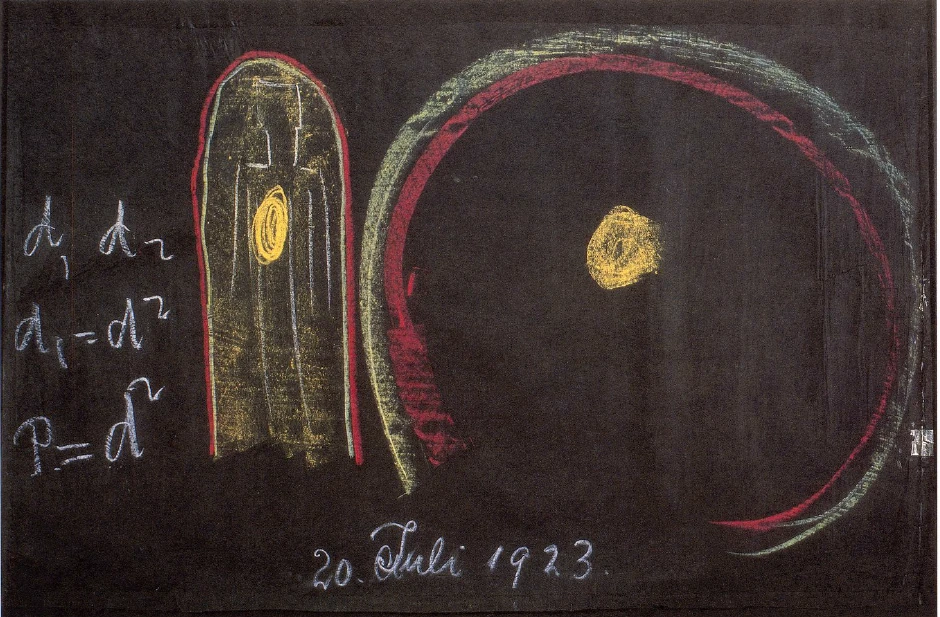
[ 16 ] As the green, so to speak, passes to the other side through the turning of the etheric body, we lose it completely, and we perceive a completely different world. We must not imagine that we can still have the same world after death that we had during our earthly life. That world passes away. To imagine, for example, that after death we could experience—say, in a different version—the content of our earthly life is entirely wrong; it does not correspond to the facts. What we experience through the turning of the etheric or formative body is indeed of a gigantic magnitude compared to the content of our earthly life, but it is simply something entirely different. First of all, because the outer side is now turned inward, we experience the entire structure of our earthly life in powerful impressions—though these are different from sensory impressions. We do not experience the redness of the rose, but we do experience how we have formed the redness of the rose within ourselves as a mental image. That is where things begin to be less tranquil than they are in physical earthly life. There, in earthly life, the roses in a rose garden stand so prettily side by side, and each one radiates tranquility, and one feels oneself weaving within that tranquility. Now the rose garden becomes something entirely different; now the rose garden becomes a series of events in time. And just as we have gradually let our gaze wander from one rose to another, just as we have formed within ourselves the image of the first rose, the second, the third, and so on—this process, as if in living becoming, in lightning-like surges and weaving, in which one rose after another comes into being— but not as roses, rather as mental images unfolding—this now emerges as our inner life, as if in a sea of events. And so something stands before us that we simply did not see during our earthly life: the becoming of this earthly life, the gradual emergence of this earthly life. We know how our soul has developed from childhood onward. What we completely overlooked during our earthly life is now unfolding within us. It is as if we had stepped outside of ourselves, become a second self, and were watching as we first gradually formed the simple concept of childhood, then the more complex one of later years, and so on. We see the emergence of this entire earthly being from within. We see how, hour by hour, this earthly life, this earthly existence, takes shape. Indeed, we gain the impression that this entire earthly life is actually shaped from within the cosmos. For everything we perceive there grows out into the immeasurable, into the cosmic, and as we grow outward in this way, we become clearly aware that what has been formed within us during our earthly life is also shaped from within the cosmos.
[ 17 ] And now we are gradually gaining a valid understanding of what this human life on Earth is really like. Let us first consider what is generally believed today with regard to this earthly life. A person eats, and through this process takes in substances from the outside world into their own organism. This is an undeniable fact. They also transform these substances. They begin transforming them in the mouth, and even more so as they move through the rest of the organism. What is taken in is absorbed into the entire organism—truly into the entire organism. Science then adds: But we are also constantly losing substances to the outside world. — We need only think of how you cut your nails and trim your hair, if you are not yet bald. You can observe everywhere—through shedding and so on—how a person loses matter, loses substance. And it is, after all, generally known today that in this way, by continually losing matter, a person completely renews themselves over the course of about seven years.
[ 18 ] So, to put it bluntly, everything sitting here in these chairs—as far as the material is concerned—was scattered all over the world eight or nine years ago. Let me put it this way: What is sitting here in these chairs could therefore only have come together over the course of the last seven to eight years. If the muscle tissue and so on that was in all of you more than seven or eight years ago were still sitting here—you are, after all, older, so you must have regenerated several times by now—then none of you would be sitting here.
[ 19 ] So, of what you carried within you at home or elsewhere—your muscle tissue, your blood, and so on—seven or eight years ago, none of that remains; you’ve gradually shed it, peeled it off, and so on.
[ 20 ] But if science is materialistic in its orientation, what does it say? It says something like this: Over the past seven years, we’ve all been eating. What we’ve eaten recently is still here, and what we ate earlier is no longer here. — For example, each of you sitting here has a heart, doesn’t that right? Well, science tells you that the physical matter of this heart has been renewed over the past seven to eight years. So compared to your condition, say, nine years ago, you essentially have a new heart. Yes, that’s roughly how one might put it, if one thinks in terms of the present.
[ 21 ] But that is not the case. This notion exists solely because people are unaware of what I have just explained to you; they do not even include it within the scope of their scientific observation and scientific thinking. They know nothing of that reversal of the etheric or formative body—of what, after we have passed through the gate of death, reveals to us how the whole being actually came into being, step by step. For once one knows this, one is then able to look into the human organism in an entirely different way. And only then does one begin to recognize the truth.
[ 22 ] One might think that this heart substance has gradually accumulated from the cabbage, the potatoes, the other vegetables, the cherries, plums, and so on, that one has enjoyed over the past few years. But that is not the case; rather, essentially — listen carefully when I say “essentially” — the heart you carry within you has not really that much to do with the matter you have taken in over the last seven to eight years; rather, the heart you carry within you today has essentially come into being in a very mysterious way from the ether of the cosmos, which you have condensed into the density of the heart over the course of the last seven to eight years. So it is not from the physical matter of the last seven to eight years that your heart has been renewed, but rather it has been renewed from the cosmos. You have renewed your heart and your other organs from the ether. You have in fact made yourselves into new human beings over the course of the last few years—not from the earth upward, but from the cosmos inward. This can be seen from the effects of the etheric body after death, as it has acted throughout your entire earthly life, showing that we have always regenerated ourselves from the cosmos inward.
[ 23 ] Now your materialistic conscience—for a human being must surely have one—will say: But we did eat, after all. We did take in external matter, and internal processes took place as a result. — Yes, but these internal processes have less to do with your actual, deeper human being than you think. This matter that you have taken in through eating, you have already excreted again through the various channels by which the human being eliminates waste. These do indeed pass through the organism, but they do not essentially unite with what the human being is; rather, they merely provide stimulation. We must eat so that processes and events arise within us that stimulate us. And as they stimulate and spur us on, we enter into etheric activity, which, however, is connected to the cosmos, not to the Earth. What takes place there with the food that has been ingested, digested, processed by the blood, and so on—these are processes that provide the stimulus for a counter-process to oppose them: the etheric process. My old heart is stirred by the physical, transformed matter that enters me. But I create my new heart out of the world ether.
[ 24 ] Now we can even point out a fact that may seem somewhat grotesque to today’s way of thinking: You are all sitting here now; what you have renewed within yourselves over the past seven to eight years did not live in the cabbage or in the potato fields, but rather lived out there in the cosmos—in the sun, moon, and stars; it came down from there, and you reshaped yourselves out of the cosmos. With this, we have pointed to an error that is bound to arise from contemporary thinking. People look only for the connections between human regeneration and the physical matter of the Earth, but not to the ether. And the consequence of this is that, once one has become accustomed to the ideas presented by contemporary physiology, one cannot help but regard everything presented from the anthroposophical perspective as a kind of fantasy. Therefore, one must be clear about how fruitless discussions are today; one can only shed light on both fields—modern science and anthroposophy—by illuminating them in relation to one another when one has mastered both; yet one must not give in to the hope—for if one does, it actually harms anthroposophy! —that those who are accustomed to materialistic concepts can simply be won over through a discussion. One must have very clear, precise concepts regarding this. Then one will realize that, first and foremost, the entire manner in which one approaches anthroposophy must be adopted by people before they can even begin to enter into this anthroposophical way of seeing and knowing.
[ 25 ] I said that, essentially, we are actually regenerating our new human being from the cosmos. We do not find in the cosmos the substances that we then find in the heart—of course not, for there they are so subtle that they cannot be detected by physical, earthly means. There they are ethereal. But what appears as dense heart matter at a certain age in life has only just been condensed from the cosmic ether. So what is there today—all of that was still out there in the heavens, in the stars, nine or ten years ago; and what has remained—that is, the matter that has forced its way into what was actually meant to be formed from the ether—is the cause of illness. If we carry physical matter within us that is too old, this constitutes a cause of illness. And deep insights into the nature of illness arise when one understands how matter, instead of being expelled, persists; for all matter that is taken in as physical earthly matter is actually destined to be expelled again. If it persists within the organism, it becomes a cause of illness. _
[ 26 ] You can also see from this how this truly real insight plays out in practical terms—an insight we can gain only by having a glimpse into what arises within us as our first experiences shortly after we have completely shed our physical body. Thus, after death, everything we have experienced in terms of sensory impressions and the intellectual processing of those impressions melts away. We view the world in a completely different way. Minerals, plants, and animals—as we previously perceived them—are not there at all. What is there is how human beings become.
[ 27 ] We have passed through the gate of death. We have thereby departed from the stage of the earth. We have entered the stage of the cosmos: another world surrounds us. It is as if we had stepped out of a small chamber of earthly existence into the majestically vast hall of the cosmos, and we feel ourselves spread out across the cosmos—we truly would have no room in that small earthly chamber. Thus, we have entered the stage of the cosmos. And on this stage of the cosmos we must now remain until we descend once more to earthly existence, except that we now come into contact with entirely new worlds—worlds whose beings belong to the higher hierarchies.
[ 28 ] This perspective, which one gains so directly in relation to human beings, must, however, be extended to all of nature. And I would like to describe to you what must happen there in the following way.
[ 29 ] Let’s assume, for example, that we had gone back a certain, very long period of time in evolution—in the Earth’s evolution. We would encounter completely different living beings and completely different events on Earth. As you know, there have been geological eras when giant animals of a lower order lived that no longer exist today. Entire species have become extinct; they are no longer here. Paleontologists and geologists search for isolated remains in the Earth’s geological formations. Let’s suppose I were to sketch, schematically, this very ancient phase of development—in which, for the sake of argument, ichthyosaurs, plesiosaurs, and these strange creatures would have lived here on Earth. Yes, these beings were not formed on Earth at that time through physical earthly matter; they were formed through the cosmos, through the ether. And as the time approached when these creatures gradually died out, the entire etheric matter, if I may put it that way, remained behind. (See drawing: yellow.) Now there were no more creatures left. But all the etheric matter from which these creatures had been formed remained behind, just as our etheric body remains behind. And this etheric matter was the cause of other beings forming in later times within earthly existence, after this etheric formation had passed through the cosmos. From these, in turn, the etheric substance remained behind. From this, yet other beings formed. And finally, the world of animals that exists today came into being.
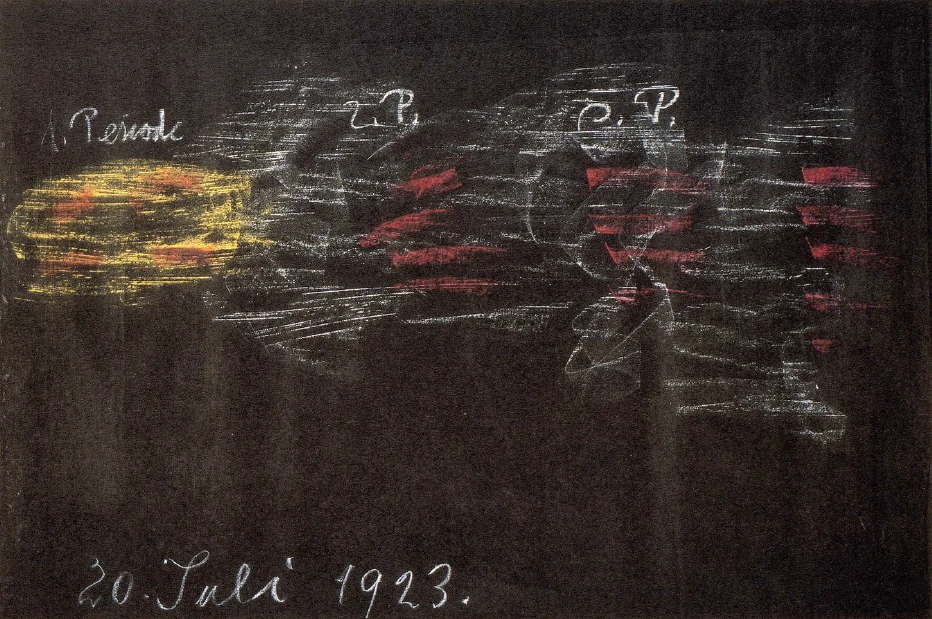
[ 30 ] So if you have three consecutive periods here—the first period, the second period, the third period—then you have, let’s say, successive forms of animals. But for the subsequent form to arise from the preceding one, a passage through the cosmos with the aid of the ether is necessary, just as the passage through the cosmos between two earthly lives is necessary for human beings. And when we finally have beings here (see drawing: red), these can in turn pass into the ether, and there, formed from the ether during a specific period, the human being can emerge. But the influence has always taken place indirectly through the cosmos.
[ 31 ] Now comes the purely materialistic observer. He sees all of this, and now he believes that one thing arose from the other. Certainly, on Earth, one thing follows from the other; but an etheric activity, a cosmic activity, lies in between.
[ 32 ] In the 19th century, it became customary to focus solely on what succeeds one another on Earth, but not on that which constitutes cosmic activity beyond the earthly realm. Consequently, the view that has prevailed is this: ultimately, human beings; before them, simpler forms; even simpler forms; and so on. This is the picture of the evolution of organisms that we can obtain from natural science, which does not engage with the ethereal. This natural science could obtain nothing other than what it did. If one accepts its premise—that one should not engage with the ethereal—and frames the question such that one should consider only what pertains to earthly existence, then indeed there is no alternative but to present the physical current of evolution. That is what the Darwinists did, that is what Haeckel did, and to demand more from Earth science—or even to argue against what has emerged as Earth science—is nonsense. For only when one adds the knowledge of the ethereal world can what belongs to it emerge. So you see, direct polemics make no sense at all; but if someone wishes to remain on the ground of natural science, they may do so. And to the other person, who speaks of some other formative principles in what exists on Earth, one can always say: Yes, that has no significance at all. “That isn’t there,” he will say, once he has become accustomed to the purely earthly perspective.
[ 33 ] If one wishes to speak differently, one must first acquire knowledge of the ethereal world. Thus, the only valid and reasonable argument one can make against modern science is to say: In your field, O natural scientist, you are entirely correct; nothing else can possibly result from it; we do not deny this to you; we fully acknowledge it. But if you wish to speak with us about what we mean—yes, then you must first familiarize yourself with the elementary processes in the cosmic ether; only then can we speak with one another. Otherwise, one stands on no ground of reality if one does not proceed from these things.
[ 34 ] You see, a member sitting here has written a short work on botany from the perspective of the spiritual sciences. A rather scathing review of it appeared recently in a local newspaper. Well, what can one say! I said: Just imagine you were the botanist who wrote that review yourself, that you had never heard of anthroposophy, and that you came across this little book of yours in its second edition—then you would write exactly the same way. It’s only natural that you would write exactly the same way as he did! The fact that you don’t—but rather, on the contrary, have written the little book yourself—is precisely because you first embraced anthroposophy. One need only put oneself in the other person’s shoes for a moment, and then one could write all these opposing arguments oneself. But you see, wanting to change a person who has already committed himself, with all his habits of thought, to a certain direction—wanting him to become anthroposophical—seems to me almost like someone who has had a little blonde daughter suddenly wanting a black-haired one. It doesn’t just happen that easily. What a person has become through modern science is not something that can be changed in the blink of an eye. One simply has to think in a thoroughly realistic way.
[ 35 ] There is indeed a period, following the mid-19th century, that left a very distinct mark on the entire state of mind. I’d like to give you an example of this from a completely different perspective.
[ 36 ] You know that today there is something called analytical psychology, or psychoanalysis. As I have often said here, psychoanalysis has some positive aspects; but, first of all, it stems from an incomplete, amateurish understanding of human physiology—it is, therefore, amateurism. Second, it stems from an amateurish understanding of the human psyche, of human psychology. That, too, is amateurism. And because the one is usually just like the other, these things multiply, and psychoanalysis is, in effect, amateurism squared. — If you multiply d by d, you get d². But it does have an effect, albeit in an amateurish way, if it is pursued further. And one can also understand that this approach could gradually emerge from deficient physiology and psychology. But it does rub off on people’s souls; this way of thinking does rub off!
[ 37 ] Today we have a vast body of literature on the subject. You could fill an entire library with psychoanalytic literature. Within it, people are already arguing horribly with one another again, so that if you delve into the polemics, it can sometimes be quite interesting. Well, this topic of psychoanalysis has also been discussed here from time to time. You could really build a library today out of everything that’s been written on the subject. But if so much is being written in this field, then there must also be a great deal of study going on—at least on the surface. This rubs off on people’s state of mind; it colors it.
[ 38 ] Now, there is something very peculiar here. You see, as early as 1841, there was already psychoanalytic literature in Central Europe. However, it consisted of only fourteen lines. They read: “In our modern, overcrowded consciousness, we toss about many things that we cannot bring to fruition because we lack the time to do so. They remain within us in the form of tasks that we could work on. They are, to use Tieck’s words, unborn souls that, yearning for existence, hover in the background of our own soul as if in limbo.”
[ 39 ] You see, these fourteen lines—and if you make the lines longer, there are even fewer—essentially encapsulate the entire principle of psychoanalysis. Back then, they were called unborn souls, living in a limbo in the depths of the soul, struggling to come into being. Nowadays, they’re called provinces hidden in the depths of the soul, “soul provinces,” and the like. Back then, however, this matter was considered so insignificant that it was jotted down in just a few lines. Today, our civilization has reached the point of writing entire libraries on the subject. Yet everything essential, everything fundamental, lies within these fourteen lines. But precisely because this was contained in just fourteen lines, the libraries were filled with other things than they are today, and people who wanted to learn absorbed something else.
[ 40 ] If, as a young student today, you’re studying psychology and are supposed to write a dissertation, there’s simply no getting around psychoanalysis. You have to study it. Yes, that leaves its mark on people’s souls. In 1841, the essence of it all was expressed in these fourteen lines. People didn’t regard it as something so important that it could have such immense significance for human thought. And that’s how it’s been with many things.
[ 41 ] It really makes a world of difference whether we look at a particular set of facts or not. Back then, in 1841, people missed the boat on psychoanalysis. This idea—which I read to you in those fourteen lines—occurred to only one person, Karl Rosenkranz. He once dreamed of it. Dreams pass quickly; they do not exert such a great influence on life. But people filled their waking hours with other things. Today, on the other hand, many things are being overlooked because one must, after all, remain vigilant regarding psychoanalysis and similar matters.
[ 42 ] We really need to examine this matter closely; only then will we be able to determine where to begin in order to bring anthroposophy to the fore in the world. In any case, one cannot simply engage in polemics. For polemics is almost like someone lying in a room, snoring terribly and impossible to wake up, while another person is awake and doing everything in their power to make the snorer—who sleeps through everything—understand
[ 43 ] should care what the other person says. After all, he cannot understand him. Nor is it possible to reach an understanding in intellectual life across two fields if each person remains oblivious to the other’s field and is attentive only to his own.
[ 44 ] There will still be many who are asleep when it comes to anthroposophy. They will not wake up to anthroposophy all that quickly. But we would like the anthroposophists to wake up to the others, so that they know—not merely out of blind faith, but out of a genuine understanding of the nature of the other—why anthroposophy is all-encompassing and also encompasses that which the others regard as the only thing, and how anthroposophy broadens the horizon, precisely because it goes beyond those areas that others view only from a narrow perspective.
[ 45 ] I have thus presented to you one of the perspectives—the perspective that arises when we inquire more closely into what surrounds us as the earthly world and what dissolves after death. It is the physical perspective. In order to be understood, it led us into that which is immediately adjacent to it—the etheric.
[ 46 ] Later, we will examine the soul perspective—how a person awakens to it—and then conclude by examining the spiritual perspective of anthroposophy. These will be the three perspectives of anthroposophy.