Humanity as the harmony of the
creative, formative, and shaping Word of the World
GA 230
28 October 1923, Dornach
Translate the original German text into any language:
Versions Available:
Man as Symphony of the Creative Word, tr. Compton-Burnett
Sechster Vortrag
Lecture VI
[ 1 ] Ehe wir nun dazu kommen, die übrigen mit dem Menschen im Erdendasein verbundenen Tier-, Pflanzen-, Mineralwesen zu betrachten, müssen wir heute einen Blick auf die Entwickelung des Menschen selber werfen, uns einiges vor die Seele stellen, das ja aus den verschiedenen Darlegungen, die ich mündlich oder schriftlich gegeben habe, bekannt ist, das aber einmal in einer übersichtlichen Weise hier zusammengestellt werden muß.
[ 1 ] Before we proceed to the study of the other members of the animal, plant and mineral kingdoms, which are connected with man, we must first cast a glance at the development of man himself, and call to mind various descriptions already familiar to us through books or lectures in a comprehensive survey.
[ 2 ] Wenn wir uns heute von der äußeren Wissenschaft belehren lassen wollen, dann ist die Sache gewöhnlich so, daß gesagt wird, man müsse untersuchen, wie die höheren, sogenannten höheren Wesenheiten, sagen wir des Pflanzenreiches, dann des Tierreiches, des Menschenreiches sich entwickelt haben aus den leblosen, aus den sogenannten unorganischen Stoffen oder Kräften.
[ 2 ] If we go for instruction to present-day science, we are usually told that it is necessary to investigate how the higher, the so-called higher beings and human kingdoms have evolved out of what is lifeless, out of so-called inorganic substances or forces.
[ 3 ] Die wirkliche Anschauung der Evolution ergibt etwas wesentlich anderes. Die ergibt, wie Sie schon aus meiner «Geheimwissenschaft im Umriß» entnehmen können, daß der Mensch, so wie er heute vor uns steht, dasjenige Wesen ist, welches die längste Entwickelung hinter sich hat, dessen Entwickelung zurückgeht bis in die alte Saturnzeit. So daß wir also sagen müssen: Der Mensch ist das älteste Geschöpf innerhalb unserer Erdenentwickelung. Erst während der Sonnenzeit ist die Tierheit dazugekommen, während der Mondenzeit die Pflanzenheit; und das mineralische Reich, wie wir es heute haben, ist eigentlich erst ein Erdenergebnis, ist erst während der Erdenentwickelung dazugekommen.
[ 3 ] A true conception of evolution reveals something essentially different. It reveals—as you will have been able to gather from my “Occult Science”—that man in his present form is the being who has the longest evolution behind him, an evolution which reaches back to the time of ancient Saturn. We must therefore say that man is the oldest creation within the evolution of our earth. It was only during the Sun-period that the animal kingdom was added, then during the Moon-period the plant kingdom; and the mineral kingdom, as we know it today, is in fact only an Earth-product, something which was only added during the Earth-period of evolution.
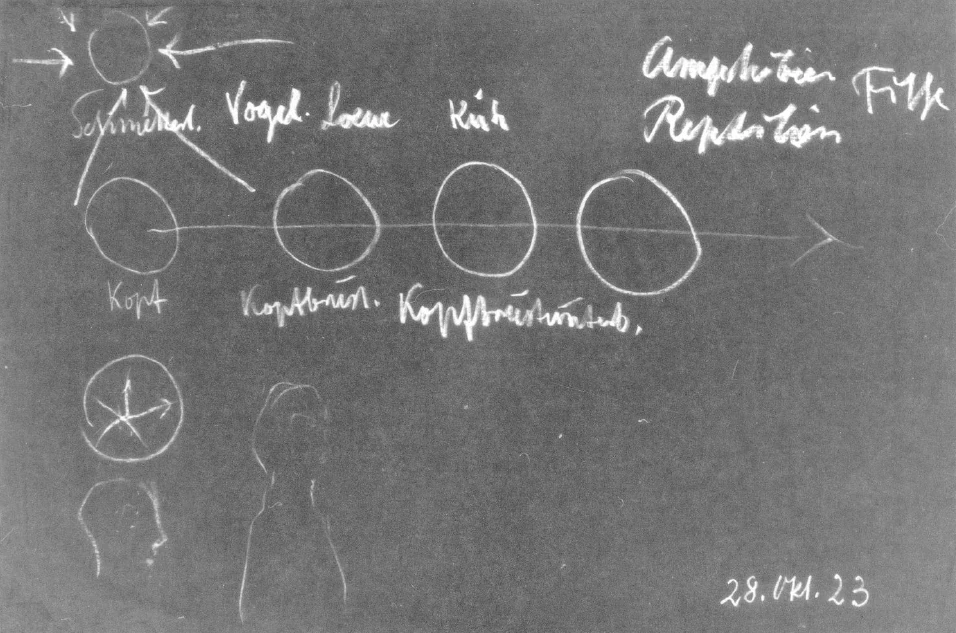
[ 4 ] Nun wollen wir einmal den Menschen in seiner heutigen Gestalt ansehen und uns fragen: Was ist denn entwickelungsgeschichtlich am Menschen selber der älteste Teil? Das ist das menschliche Haupt. Dieses menschliche Haupt hat seine erste Anlage empfangen in der Zeit, als die Erde eben noch in der Saturnmetamorphose war. Allerdings, die Saturnmetamorphose war lediglich aus Wärmesubstanz bestehend, und das menschliche Haupt war eigentlich wallende, webende, wogende Wärme, hat dann luftförmige Form angenommen während der Sonnenzeit, hat flüssige Form angenommen, war also ein flüssig verrinnendes Wesen während der Mondenzeit, und hat die feste Gestalt mit dem Knocheneinschluß erhalten während der Erdenzeit, so daß wir also sagen müssen: Ein Wesen, von dem heute allerdings mit äußeren Erkenntnissen schwer eine Vorstellung zu gewinnen ist, war vorhanden in der alten Saturnzeit, ein Wesen, dessen Nachkomme das menschliche Haupt ist. Gleichzeitig mit dieser Hauptesbildung des Menschen — das können Sie ja aus meinen letzten Darlegungen entnehmen —, mit dieser Hauptesanlage des Menschen sind während der alten Saturnzeit die Anlagen entstanden zu dem Schmetterlingswesen. Wir werden später das andere Insektenwesen noch genauer betrachten; halten wir zunächst an dem Schmetterlingswesen fest. So daß wir die Entwickelung von der alten Saturnzeit bis heute, bis in das Erdendasein verfolgen können und dann sagen müssen: Da bildet sich in einer feinen substantiellen Form der Menschenkopf in seiner Anlage; da bildet sich alles das, was die Luft durchschwirrt als Schmetterlingswesen. — Beide Evolutionen gehen weiter. Der Mensch verinnerlicht sich, so daß er immer mehr und mehr ein Wesen wird, welches die Offenbarung eines Seelischen ausdrückt, das von innen nach außen geht, schematisch etwa so dargestellt: ein Wesen, das sich von innen nach außen strahlend entwickelt. Das Schmetterlingswesen dagegen, das ist ein Wesen, an dessen Außenseite der Kosmos, ich möchte sagen, all seine Schönheiten ablädt. Ein Wesen ist der Schmetterling, das gewissermaßen mit seinem Flügelstaub angeflogen bekommen hat alles, was an Schönheit und Majestät im Kosmos in der Art vorhanden ist, wie ich es Ihnen dargestellt habe. Wir müssen also das Schmetterlingswesen uns so vorstellen, daß es gewissermaßen ein Spiegelbild der Schönheiten des oberen Kosmos ist. Während der Mensch in sich aufnimmt, in sich verschließt das, was oberer Kosmos ist, innerlich seelisch wird, seelisch wie die Konzentration des Kosmos, die dann nach außen ausstrahlt und sich im Menschenhaupt die Form gibt, so daß wir im Menschenhaupt etwas von innen nach außen Gebildetes haben, haben wir im Schmetterlingswesen das von außen nach innen Gebildete. Und es ist schon für denjenigen, der diese Dinge sehermäßig betrachtet, so, daß er eigentlich ein Ungeheures lernt, wenn er in der folgenden Art zu Werke geht, wenn er sagt: Ich will die Geheimnisse, die ältesten Geheimnisse, die Saturngeheimnisse des menschlichen Hauptes ergründen, ich will wissen, was da innerhalb der Hirnschale eigentlich für Kräfte gewaltet haben. — Er muß sich hinweisen lassen auf das, was man äußerlich überall sieht, was äußerlich überall einstrahlt, und das Schmetterlingswesen studieren. Um deine eigenen Haupteswunder kennenzulernen, studiere die Wunder, wie der Schmetterling draußen in der Natur wird: das ist etwa die große Lehre, welche der sehermäßigen Beobachtung der Kosmos gibt.
[ 4 ] Let us now consider man in his present form, and ask ourselves: What is the oldest part of man according to his evolutionary history? It is the human head. This human head received its first rudiments at a time when the Earth was in the Saturn-metamorphosis. It is true that the Saturn-condition was composed entirely of warmth-substance, and the human head was then actually flowing, weaving, surging warmth; it then acquired gaseous form during the Sun-period, and fluidic form during the Moon-period, when it became a liquid, flowing entity; and only during the Earth-period did it receive solid form with its bony casing. We must therefore say that a being of which it is difficult to gain a conception through external forms of knowledge existed during the time of ancient Saturn, and of this being the human head is the descendant. And simultaneously with the formation of man's head—this can be gathered from my recent descriptions—simultaneously with this rudimentary origin of the human head during the Saturn-period, the first rudiments of the being of the butterflies also came into existence. Later we shall make a more exact study of the nature of the other insects, but to begin with let us strictly focus our attention on the being of the butterfly. When we follow the course of evolution from the ancient Saturn-period onwards until today, until Earth-existence, we must say: At that time the rudiments of the human head came into existence in a form of very delicate substantiality; and at the same time there arose everything which now flutters through the air as the world of the butterflies. Both these evolutions proceeded further. Man developed his inner being, so that to an ever greater degree he became a being manifesting a soul-nature, which works from within outwards, a being whose development depends upon a radiating from within outwards (a diagram was drawn). The butterfly, on the other hand, is a being upon whose exterior the cosmos may be said to lavish all its beauties. The butterfly is a creature upon which everything of beauty and majesty in the cosmos—as this has been described to you—has, as it were, alighted, together with the dust, on its wings. We must, therefore, picture the being of the butter-fly as a mirror which reflects the beauties of the upper cosmos. The human being takes up into himself, encloses within himself, what is of the nature of the upper cosmos, and thus becomes inwardly ensouled. It is like a concentration of the cosmos which then streams outwards, itself giving form to the human head, so that in the human head we have something formed from within outwards. But in the being of the butterfly we have what is formed from outside inwards. For one whose clairvoyant vision can look directly at these things, there is something really tremendous to be learned if he sets to work in the following way. He says: I wish to fathom the mysteries, the most ancient mysteries, the Saturn-mysteries of the human head; I wish to know the true nature of the forces which have held sway inside the skull. He must then let his attention be directed to what is everywhere to be seen outside, to what everywhere streams inwards from outside. To learn to know the nature of man and the marvel of thine own head, study the marvel of how the butterfly came to be outside in nature. This is the great lesson imparted by the study of the cosmos through direct spiritual observation.
[ 5 ] Schreitet dann die Evolution vor von der Saturnzeit zur Sonnenzeit, dann entsteht ein Wesen, das eine weitere Ausbildung, eine Luftumbildung, eine Luftmetamorphose des Hauptes hat; aber es gliedert sich an in einer feinen Substanz, was dann später zu den Brustgebilden, zu den Atmungs- und Herzgebilden des Menschen wird. Also hier im Saturn — haben wir noch wesentlich diejenige Metamorphose, welche das menschliche Haupt darstellt. Aber das ist natürlich die spätere Form. Kommen wir zur Sonnenzeit herauf, so haben wir den KopfBrustmenschen; es gliedert sich an, was nun Brust des Menschen ist. Gleichzeitig aber entsteht schon in der letzten Saturn- und in der ersten Sonnenzeit dasjenige, für das wir nun den Repräsentanten zu sehen haben im Adler. Es entsteht das Vogelgeschlecht in der ersten Sonnenzeit, und es entstehen in der zweiten Sonnenzeit die ersten Anlagen derjenigen Tiergeschlechter, welche eigentliche Brusttiere sind, wie der Löwe zum Beispiel — als Repräsentant der Löwe, aber auch andere Brusttiere. So daß die ersten Anlagen dieser Tiere zurückgehen bis in die alte Sonnenzeit.
[ 5 ] Evolution then proceeded from the Saturn-period to the Sun-period, and now a being came into existence possessed of a further development, an air-development, an air-metamorphosis, of the head; but to this there was added in very delicate substance what later became the breast-system, became the breathing-and-heart systems of man. In Saturn we have as the essential metamorphosis what produced the human head. When we come to the Sun-period we have the head-breast-man; for it was now that man's breast-system was added. At the same time, however, there already came into existence, in the later part of the Saturn-period and the earlier part of the Sun-period, what must now be seen as having its representative in the eagle. The bird kingdom arose in the first part of the Sun-period, and in the second part of the Sun-period there arose the first rudiments of that kingdom of the animals which are in fact breast-animals, as, for instance, the lion—other breast-animals, too, but the lion as their representative. So that the first rudiments of these animals go back to the time of old Sun.
[ 6 ] Sie sehen daraus, welch ein gewaltiger Unterschied in der Heranbildung selbst der höheren Tiere und des Menschen vorhanden ist. Ich werde schon über die Übergangstiere, zu denen ja auch das Affengeschlecht gehört, in der Zukunft noch sprechen, aber ich will heute nur einen zusammenfassenden Begriff geben. Sie sehen, welch ein gewaltiger Unterschied da besteht zwischen Menschenbildung und höherer Tieresbildung.
[ 6 ] From this you can see what a stupendous difference is present between the evolution of even the higher animals and that of man. In the future I shall still have to speak about the transitional animals, to which belongs the world of the apes, but today my intention is just to gather things together into a general concept. You see what an immense difference exists between the formation of man and the formation of the higher animals.
[ 7 ] Beim Menschen ist das erste, daß sich in der Evolution das Haupt ausbildet. Das übrige werden Anhangsorgane, die sich gewissermaßen an die Hauptesbildung anhängen. Der Mensch wächst in der kosmischen Evolution von seinem Haupte aus nach unten. Der Löwe dagegen ist zum Beispiel während der alten Sonnenzeit, während des zweiten Teiles der alten Sonnenzeit ein Tier, welches zunächst als Brusttier entsteht, als kräftiges Atmungstier mit einem noch sehr kleinen, verkümmerten Kopf. Erst als die Sonne dann in späteren Zeiten von der Erde sich trennt und von außen wirkt, erst dann entsteht aus der Brust heraus der Kopf. Es wächst also der Löwe so, daß er von der Brust nach aufwärts sich entwickelt, der Mensch, indem er vom Kopf nach unten sich entwickelt. Das ist ein gewaltiger Unterschied in der Gesamtevolution.
[ 7 ] In the case of human evolution it was the head which first took form. All the other organs are, as it were, appended; they may be said to be appended to the formation of the head. In cosmic evolution man's development proceeds from his head downwards. On the other hand the lion, for example, first came into existence during the old Sun-period, during the second part of the old Sun-period, as a breast-animal, as an animal with a powerful breathing-system, but with a head still very small and poorly developed. And only in later times when the sun separated from the earth, working from outside, only then did the head develop out of the breast. Thus the development of the lion was such that it evolved from the breast upwards, whereas the human being evolved from the head downwards. This constitutes an immense difference in evolution as a whole.
[ 8 ] Indem wir weiterschreiten bis zur Mondenmetamorphose der Erde, da erst braucht der Mensch, weil der Mond die Wassermetamorphose darstellt, weil der Mond wässerig ist, allerdings dann verhornt in der späteren Zeit, von jetzt ab die weitere Fortsetzung nach unten. Es bildet sich die Anlage des Verdauungssystems. Während der alten Sonnenzeit, während man nur lichtdurchwelltes, lichtdurchglänztes Luftiges hat, braucht der Mensch auch zu seiner Ernährung nur einen Atmungsapparat, der nach unten abgeschlossen ist; der Mensch ist Kopf- und Atmungsorgan. Jetzt während der Mondenzeit gliedert er sich das Verdauungssystem an. Damit aber kommt der Mensch also dazu, Kopf, Brust und Unterleib zu werden. Und da alles im Monde noch wäßrige Substanz ist, hat der Mensch während dieser Mondenzeit Auswüchse, die ihn schwimmend durch das Wasser tragen. Von Armen und Beinen kann erst während der Erdenzeit gesprochen werden, wenn die Schwerkraft wirkt und dasjenige herausgestaltet, was sich vor allen Dingen in die Richtungen der Schwerkraft hineinstellt, die Gliedmaßen. Das also gehört erst der Erdenzeit an. Während der Mondenzeit aber bildet sich, noch ganz anders geartet als später, der Verdauungsapparat, so geartet, daß dieser Verdauungsapparat des Menschen noch nicht aufzunehmen braucht alles das, was der Verarbeitung der freien, willkürlichen Beweglichkeit der Glieder dient. Es ist ein wesentlich anderer Verdauungsapparat noch; der metamorphosiert sich später um in den Verdauungsapparat, der der Erdenverdauungsapparat ist. Aber der Mensch gliedert sich während der Mondenzeit den Verdauungsapparat an.
[ 8 ] And when we now proceed to the Moon-metamorphosis of the earth, because the Moon represented the water-condition, because the Moon was fluidic—though it certainly developed a horny substance in its later period—it was only then that the human being needed a further extension downwards. The rudiments of the digestive-system took form. During the old Sun-period, while man possessed only what was of the nature of air, undulating, scintillating with light, all he required for the purpose of nourishment was a breathing apparatus shut off from below; man was head-and-breathing organism. Now, during the Moon-period, he acquired a digestive system, thereby becoming a being of head, breast and abdomen. And because everything in the old Moon was still watery substance, during this old Moon-period the human being had outgrowths which buoyed him up as he swam through the water. Arms and legs can first be spoken of only during the Earth-period, when the force of gravity was working, giving form to what is primarily adjusted in accordance with the directions of gravity, namely the limb-system. This therefore, belongs only to the Earth-period. During the Moon-period, however, the digestive system was formed, though still quite differently constituted from what it later became; for man's digestive apparatus did not as yet need to assimilate all that serves the free, independent mobility of the limbs. It was still an essentially different digestive system; this was later metamorphosed into the digestive apparatus appropriate to the Earth. It was, however, during the Moon-period that man first acquired his digestive system.
[ 9 ] Wiederum ist es so, daß jetzt zu den Nachkommen von Schmetterlingen, Vögeln und von solchen Geschlechtern, von denen der Löwe ein Repräsentant ist, hinzukommen diejenigen Tiere, die vorzugsweise nach der Verdauung hinneigen. Wir haben also da hinzukommend während der Mondenzeit zum Beispiel das, was wir durch die Kuh repräsentiert haben.
[ 9 ] And then it came about further that to the descendants of the butterflies, of the birds and of such species as are represented by the lion, those animals were added which are predominantly adapted to digestion. Thus, during the Moon-period we have the addition of those animals which are represented by the cow.
[ 10 ] Aber wie ist nun im Gegensatze zum Menschen das Wachstum der Kuh? Das ist so, daß die Kuh zunächst während dieser alten Mondenzeit hauptsächlich den Verdauungsapparat ausbildet; dann, nachdem der Mond sich abgetrennt, wachsen aus dem Verdauungsapparat die Brustorgane und der eigentümlich gestaltete Kopf erst heraus. Während der Mensch beim Kopf anfängt sich zu entwickeln, dann daran schließt die Brust, die Brustmetamorphosierungen, dann daran schließt die Verdauungsorgane; während der Löwe mit den Brustorganen anfängt, den Kopf daran schließt, und mit dem Menschen zugleich die Verdauungsorgane bekommt während der Mondenzeit, haben wir bei denjenigen Tieren, deren Repräsentant die Kuh ist, als erste Anlage zunächst die Verdauungsorgane, und dann, aus diesen weiterwachsend, haben wir Brust- und Kopforgane gebildet. Also Sie sehen, der Mensch wächst vom Kopf nach unten, der Löwe von der Brust nach oben und unten; die Kuh wächst von den Verdauungsorganen ganz in die Brust und in den Kopf erst hinein, wächst sozusagen, wenn wir es mit dem Menschen vergleichen, ganz nach aufwärts, wächst gegen Herz und Kopf zu. Das gibt die Anschauung der Entwickelung des Menschen.
[ 10 ] How then did the development of the cow proceed in contradistinction to that of the human being? Here matters were such that in this old Moon-period it was first and foremost the cow's digestive apparatus that was formed; then, only after the moon had separated, the breast-organs developed out of the digestive system, as did also the peculiarly formed head. Whereas man began his development with the head, adding to this the breast, and finally the digestive organs; whereas the lion began with the breast-organs, adding to these the head, and then, during the old Moon-period, acquiring the digestive organs together with man; in the case of the animals represented by the cow, we have first, as primary origin, the digestive organs, and then, growing out from these as further development, the formation of the organs of breast and head. So you see, man developed from the head downwards, the lion from the breast both upwards and downwards; the cow developed breast and head entirely from the digestive organs, developed, that is to say—if we compare the cow with the human being—entirely in an upwards direction, developed towards heart and head. This is the correct view of human evolution.
[ 11 ] Nun entsteht natürlich die Frage: Ist es nur die Kuh, welche da wie ein Genosse sich hinzugesellt zu der Evolution des Menschen? — Das ist nicht bloß so, sondern immer, wenn irgendeine solche planetarische Metamorphose entsteht, dann entwickeln sich die alten Wesen weiter, aber zugleich entstehen neue. Die Kuh entsteht schon während der ersten Mondenmetamorphose. Dann aber kommen andere Tiere dazu, die in der letzten Mondenmetamorphose ihre allererste Anlage bekommen. Die können nicht mehr zum Beispiel den Hinausgang des Mondes mitmachen, weil er schon draußen ist. Die können daher auch nicht mitmachen, was dieser Hinausgang des Mondes bewirkt, daß er gewissermaßen aus dem Bauch der Kuh herauszieht die Herzorgane und die Kopforgane, sondern die später auftretenden Wesen bleiben auf dem Standpunkt stehen, der beim Menschen fixiert ist durch die Verdauung. So daß also Wesen entstehen, die eigentlich nur Verdauungstiere bleiben, die auf der Stufe bleiben, die der Mensch in seinem Unterleibe mit sich trägt.
[ 11 ] Here the question naturally arises: Is it only the cow which was, as it were, the companion thus associated with man's evolution? This is not entirely so, for whenever one or other planetary metamorphosis takes place, the earlier creatures develop further, while at the same time new ones come into existence. The cow already came into being during the first phase of the Moon-metamorphosis. Then, however, other animals were added, which acquired their very earliest rudiments in the last phase of the Moon-metamorphosis. These could not, for example, take part in the departure of the moon, for it was already outside. Nor could they participate in what this departure brought about, namely the drawing forth, as it were, from the cow's belly of the organs of heart and head. These creatures, which made their appearance later, remained stationary at the stage which is determined in man by the digestion, the stage which man carries with him in his abdomen.
[ 12 ] Geradeso wie der Adler und die Schmetterlinge dem Kopf zugeordnet sind, wie der Löwe der Brust zugeordnet ist, die Kuh dem Unterleib zugeordnet ist, aber, ich möchte sagen als das Tier, das zu gleicher Zeit alles Obere in sich hineinwachsen läßt in der späteren Evolution, so sind Amphibien und Reptilien, also Kröten, Frösche, Schlangen, Eidechsen und so weiter zugeteilt, wenn ich mich des Ausdrucks bedienen darf, nur dem menschlichen Unterleibe, dem menschlichen Verdauungsapparat. Da sind reine Verdauungsapparate als Tiere entstehend.
[ 12 ] And just as the eagle and the butter-flies are constituted in relation to the head, the lion in relation to the breast, the cow in relation to the abdomen (though it is the animal which was also able to develop all the upper organs at a later period of evolution), so the amphibians and reptiles, such as toads, frogs, snakes, lizards, are distributed, if I may put it so, among the lower organs of the human being, those of the human digestive system. They are simply digestive organs which came into existence as animals.
Schmetterling Vogel. Löwe Kuh. Reptilien, Amphibien. Fische
Saturn: Sonne: Mond: Kopf
Kopf-Brust Kopf-Brust-Unterleib
| BUTTERFLIES | BIRDS, LIONS | COWS, REPTILES, AMPHIBIANS, FISHES |
| Saturn | Sun | Moon |
| Head | Head-Breast | Head-Breast-Abdomen |
[ 13 ] Sie entstehen auch während der zweiten Mondenzeit in einer höchst plumpen Form, sind eigentlich wandelnde Magen und Gedärme, wandelnder Magen und Darmschlauch. Erst später während der Erdenzeit bekommen sie die ja auch noch nicht besonders vornehm aussehenden Kopfteile. Sehen Sie sich die Frösche und Kröten oder die Schlangen an! Sie entstehen eben durchaus in einer Spätzeit als Verdauungstiere, da, wo der Mensch gewissermaßen sich nur noch anhängen kann seine Verdauungsapparate an das, was er früher schon gehabt hat.
[ 13 ] These last creatures appeared during the second Moon-period in an extremely crude form, and were in fact walking stomachs and entrails, walking stomachs and intestinal tubes. And only later, during the earth-period, did they also acquire a still not particularly distinguished-looking head-system. Only look at the frogs and toads, or the snakes. They came into existence simply and solely as animals of digestion, at a late period, at a time when man could still only append his digestive apparatus to what he had already acquired during an earlier period.
[ 14 ] In der Erdenzeit, wenn der Mensch sich seine Gliedmaßen ausbildet unter der Schwere und dem Erdmagnetismus, da strecken allerdings auch — meinetwillen nehmen wir die Schildkröte als Repräsentanten die Schildkröten ihren Kopf heraus über ihren Panzer mehr wie ein Gliedmaßenorgan als einen Kopf. So können wir auch verstehen, wie bei den Amphibien und Reptilien dieser Kopf ungeschlacht gestaltet ist. Er ist eigentlich wirklich so gestaltet, daß man durchaus das Gefühl hat, wie es auch richtig ist: da kommt man aus dem Mund sogleich in den Magen hinein. Da ist nicht viel Vermittelung.
[ 14 ] And in the Earth-period, when man acquired his limb-system under the influence of gravity and earth-magnetism, the tortoises—we may take the tortoises as representative animals in this—actually stretched their head out beyond their armoured shell in a manner more like an organ of the limb-system than a head. And now we can understand how it is that in the case of the amphibians and reptiles the head is formed in such an uncouth way. Its form is such that one really has the feeling—and rightly so—that here one passes directly from the mouth into the stomach. There is hardly any intermediary.
[ 15 ] Wenn man also den Menschen betrachtet und seinem Wesen zuteilt die Tiergenossen, dann muß man demjenigen, was da enthalten ist in den Reptilien und Amphibien, zuteilen die menschliche Verdauungstätigkeit. Und tatsächlich, man kann sagen: So wie der Mensch die Produkte seiner Verdauung in seinen Gedärmen herumträgt, so trägt der Kosmos auf dem Umweg durch die Erde die Kröten, Schlangen und Frösche gewissermaßen in dem kosmischen Gedärm herum, das er sich bildet in dem wäßrig-irdischen Element der Erde. Dagegen dasjenige, was dann mehr zusammenhängt mit der menschlichen Fortpflanzung, was sich überhaupt erst in der allerletzten Mondengzeit in der allerersten Anlage bildet und erst während der Erdenmetamorphose herauskommt, mit dem sind die Fische verwandt, die Fische und noch niedrigere Tiere. So daß wir die Fische anzusehen haben als Spätlinge der Evolution, als solche Wesen, die sich in der Evolution erst da hinzugesellen zu den anderen Tieren, wenn sich beim Menschen die Fortpflanzungsorgane zu den Verdauungsorganen hinzugesellen. Die Schlange ist im wesentlichen der Vermittler zwischen Fortpflanzungsorgan und Verdauungsorgan. Richtig hineingesehen in die menschliche Natur, was stellt die Schlange dar? Die Schlange stellt nämlich den sogenannten Nierenkanal dar; sie ist in derselben Zeit der Weltenevolution entstanden, in der sich beim Menschen der Nierenkanal ausgebildet hat.
[ 15 ] When we study man in this way and apportion his being among his animal contemporaries, we must assign what is comprised in the reptiles and amphibians to the human activity of digestion. And one can actually say: Just as man carries around in his intestines the products of his digestion, so does the cosmos carry around—indirectly by way of the earth—the toads, snakes, and frogs in the cosmic intestine which it formed in the watery-earthly element of the Earth. On the other hand, all that is more connected with human propagation, which appeared in its earliest rudiments in the very last phase of the Moon-period, and only developed fully during the Earth-metamorphosis, with this the fishes are allied, the fishes and still lower animals. So that we have to regard the fishes as late arrivals of evolution, as creatures which only joined the company of the other animals at a time when man added his generative organs to those of digestion. The snake is the intermediary between the organs of reproduction and digestion. Rightly viewed in regard to human nature, what does the snake represent? It represents the so-called renal canal; it originated in world-evolution at the same time as the renal canal was developed in man.
[ 16 ] So können wir richtig verfolgen, wie der Mensch, von seinem Haupte angefangen, nach unten wächst, wie ihm die Erde die Gliedmaßen herausholt und in ihren Dienst stellt, daß diese Gliedmaßen sich hineinstellen in das Erdengleichgewicht der Schwere und der magnetischen Kräfte. Und gleichzeitig mit diesem Wachsen nach unten bilden sich die verschiedenen Tierklassen.
[ 16 ] Thus we can follow in a correct way how the human being, beginning with his head, evolved downwards, how the earth drew forth from him the limb-system, providing what this limb-system required in order to establish itself in the earth-equilibrium of gravity and magnetic forces. And simultaneously with this evolution downwards the different classes of the animals took form.
[ 17 ] Sie sehen, auf diese Weise bekommt man ein wahres Bild der Erdenevolution mit ihren Geschöpfen. Gemäß dieser Evolution haben sich dann diese Geschöpfe so entwickelt, daß sie uns zeigen, was heute ist. Wenn Sie die Schmetterlinge und die Vögel ansehen, so haben sie allerdings irdische Formen; aber Sie wissen aus der früheren Darstellung: der Schmetterling ist eigentlich ein Lichtwesen, und die irdische Materie ist ihm nur angeflogen. Wenn er selber Ihnen sagen könnte, was er ist, so würde er Ihnen verkündigen, daß er einen Leib aus Licht hat, und daß er, wie ich bereits sagte, das, was ihm als Erdenmaterie angeflogen ist, wie ein Gepäck, wie etwas Äußeres an sich trägt. Ebenso ist der Vogel ein warmluftiges Tier, könnte man sagen, denn der wahre Vogel ist die warme Luft, die in dem Vogel ausgebreitet ist; das andere ist sein Gepäck, das er durch die Welt schleppt. Diese Tiere, die also eigentlich heute noch nur mit irdischer Umkleidung, mit Erdenumkleidung, mit Wasserumkleidung sich erhalten haben ihre Lichtes-, ihre Wärmenatur, diese Wesenheiten sind am frühesten in der ganzen Erdenevolution entstanden. Diese Wesenheiten haben auch solche Formen, welche denjenigen, der nun auch hinüberschauen kann in die Zeit, die der Mensch vor seinem Herabstieg in das Erdenleben durchmacht in der geistigen Welt, erinnern an das, was in der geistigen Welt durchgemacht ist. Gewiß, es sind irdische Formen, denn die irdische Materie ist angeflogen. Wenn Sie sich aber richtig vorstellen die schwebenden, webenden Leuchtewesen, die die Schmetterlinge sind, wenn Sie sich wegdenken das, was ihnen vom Irdischen angeflogen ist, wenn Sie sich vom Vogel wegdenken, was ihm vom Irdischen angeflogen ist, wenn Sie sich diese Kraftmasse denken, die den Vogel zum warmen Luftwesen macht, mit dem, was dann sein Gefieder ist, nur als leuchtende Strahlen, wenn Sie sich das denken, dann erinnern diese Wesenheiten, die nur wegen ihrer äußeren Bekleidung so aussehen und auch die Größe, die sie haben, nur eben wegen dieser äußeren Bekleidung haben, denjenigen, der eben auch das Menschenwesen kennt vor seinem Herabstieg auf die Erde, an dieses Menschenwesens Herabstieg auf die Erde. Dann sagt sich derjenige, der so hineinschaut in die geistige Welt: In den Schmetterlingen, in den Vögeln haben wir etwas, was erinnert an jene Geistformen, unter denen der Mensch gelebt hat, bevor er auf die Erde herabgestiegen ist, an die Wesen der höheren Hierarchien. Mit Verständnis Schmetterlinge und Vögel angeschaut, sind sie eine ins Kleine umgesetzte, metamorphosierte Erinnerung derjenigen Formen, die man als Geistformen um sich hatte, als man noch nicht herabgestiegen war in die Erdenentwickelung. Weil die Erdenmaterie schwer ist und überwunden werden muß, so ziehen die Schmetterlinge ihre gigantisch große Gestalt, die sie eigentlich haben, ins Kleine zusammen. Wenn Sie von einem Schmetterlinge absondern könnten alles, was Erdenmaterie ist, so würde er sich allerdings zur Erzengelgestalt als Geistwesen, als Leuchtewesen ausdehnen können. Wir haben schon in denjenigen Tieren, die die Lüfte bewohnen, irdische Abbilder dessen, was in höheren Regionen auf geistgemäße Art vorhanden ist. Daher war es in der instinktiven Hellseherzeit ein selbstverständlich künstlerisches Wirken, aus den Formen der Flugtiere die symbolische Form, die bildliche Form der Geistwesen der höheren Hierarchien zu bilden. Das hat seine innere Begründung. Im Grunde sind die physischen Formen von Schmetterlingen und Vögeln eben die physischen Metamorphosen von Geistwesen. Nicht die Geistwesen haben sich metamorphosiert, aber die metamorphosierten Abbilder davon sind sie; es sind natürlich andere Wesenheiten.
[ 17 ] In this way we get a true picture of the evolution of the earth with its creatures. And in accordance with this evolution these creatures have developed in such a way that they present themselves to us as they are today. When you look at the butterflies and the birds you certainly have earthly forms; but you know from previous descriptions that the butterfly is really a light-being and the earthly substance has, as it were, only alighted upon it. If the butterfly itself could tell you what it is, it would announce to you that it has a body formed of light, and that, as I have already said, it carries about what has alighted upon it in the way of earthly matter like luggage, like something external to itself. Similarly one can say that the bird is a creature of warm air, for the true bird is the warm air which is diffused throughout its body; all else is its luggage which it carries with it through the world. These creatures, which even today have still preserved their nature of light and warmth, and are really only clothed with a terrestrial, an earthly, a watery vesture—these beings were the very earliest to arise in the whole of earth-evolution. The very forms, too, possessed by these beings can remind one, who is able to survey the time which man passes through in the spiritual world before his descent into earthly life, of what is experienced in the spiritual world. Certainly they are earthly forms, for earthly matter has alighted upon them. But if we conceive rightly the fluttering, weaving being of light which is the real butter-fly, thinking away everything of an earthly nature which has alighted upon it; if we think away from the bird everything of earth which has alighted upon it; if we picture the assembly of forces which makes of the bird a being of warm air, taking account also of the nature of its plumage—in reality just shining rays; if we imagine all this, then these creatures (which only look as they do because of their outer vestment, and of their size appropriate to this outer vestment) remind us of the beings which man knew before his descent to the earth, and of the fact that the human being has made this descent to the earth. Then one who can thus gaze into the spiritual world says to himself: In the butterflies, in the birds, we have something reminiscent of those spirit-forms among which man dwelt before he descended to the earth, of the beings of the higher hierarchies. Looked at with understanding, butterflies and birds are a memory—transformed into miniature and metamorphosed—of those forms which man had around him as spirit-forms before he descended into Earth-evolution. Because earth-substance is heavy and must be overcome, the butterflies contract into miniature the gigantic form which is in reality theirs. If you could separate from a butterfly everything of the nature of earth-substance, it would be able, as spirit-being, as a being of light, to expand to archangelic form. In those creatures which inhabit the air we have the earthly images of what exists in higher regions in a spiritual way. This is why, in the time of instinctive clairvoyance, it was the natural thing in artistic creation to derive from the forms of the winged creatures the symbolic form, the pictorial form, of the beings of the higher hierarchies. This has its inner justification. And looked at fundamentally the physical forms of the butterflies and the birds are really the physical metamorphoses of spiritual beings. It is not the spiritual beings themselves which have undergone metamorphosis, but these forms are their metamorphosed image-picture; naturally, the beings themselves are different.
[ 18 ] Daher werden Sie es auch verständlich finden, wenn ich, zurückkommend auf etwas, was ich schon ausgesprochen habe, noch einmal das Folgende Ihnen zeichne. Ich sagte Ihnen, der Schmetterling, der eigentlich ein Lichtwesen ist, schickt fortwährend zeit seines Lebens hinaus die durchgeistigte Erdenmaterie in den Kosmos. Ich möchte nun diese durchgeistigte Erdenmaterie, die da in den Kosmos hinausgeschickt wird, mit Anlehnung an einen gebräuchlichen Ausdruck der Sonnenphysik die Schmetterlingskorona nennen. So strahlt die Schmetterlingskorona fortwährend in den Kosmos hinaus. Aber in diese Schmetterlingskorona strahlt ein, was das Vogelgeschlecht jedesmal, wenn der Vogel stirbt, dem Kosmos übergibt, so daß da hineinstrahlt die vergeistigte Materie vom Vogelgeschlecht, hinaus in den Kosmos. Man hat dann von außen, geistig gesehen, den Anblick einer glimmenden Korona, ausgehend vom Schmetterlingsgeschlecht — nach gewissen Gesetzen erhält sich diese auch im Winter —, und mehr strahlenförmig hineingestellt hat, was von den Vögeln ausfließt.
[ 18 ] You will, therefore, also find it comprehensible if, returning to something which I have already discussed, I again draw what follows in a diagram. [* earlier diagram of Cosmic memory & thinking with butterfly, bird and bat] I told you that the butterfly, which is essentially a being of light, continually sends spiritualized earth-matter out into the cosmos during its life-time. I should now like to call this spiritualized earth-substance, which is sent forth into the cosmos—borrowing a term customary in solar physics—the butterfly corona. Thus the butterfly corona continually streams forth into the cosmos. But into this butterfly corona there rays what the bird-kingdom yields up to the cosmos every time a bird dies, so that the spiritualized matter from the bird-kingdom is rayed into the corona and out into the cosmos. Thus in spiritual perception one beholds a shimmering corona emanating from the butterfly kingdom—in accordance with certain laws this is maintained in winter also—and in a more ray-like form, introduced into it, one beholds what streams out from the birds.
[ 19 ] Sehen Sie, wenn der Mensch sich anschickt, herunterzusteigen aus der geistigen Welt in die physische Welt, da ist es zunächst die Schmetterlingskorona, diese eigentümliche Ausstrahlung von vergeistigter Erdenmaterie, die den Menschen ins irdische Dasein ruft. Und die Strahlen der Vogelkorona, die werden mehr empfunden wie Kräfte, die hereinziehen. Nun sehen Sie noch eine höhere Bedeutung desjenigen, was im Luftkreise lebt. Man muß eben überall in dem, was lebt und webt in der Wirklichkeit, das Geistige suchen. Und sucht man das Geistige, dann kommt man eigentlich erst darauf, was die einzelnen Wesensgebiete für eine Bedeutung haben. Die Erde lockt gewissermaßen den Menschen zur Wiederverkörperung herein, indem sie die Leuchteausstrahlung der Schmetterlingskorona und die Strahlung der Vogelkorona hinausschickt in den Weltenraum. Das sind die Dinge, die den Menschen, nachdem er eine Zeitlang zugebracht hat in der rein geistigen Welt zwischen dem Tode und einer neuen Geburt, wiederum hereinrufen in das neue Erdendasein. Es ist daher kein Wunder, wenn der Mensch sich schwer enträtseln kann das komplizierte Gefühl, das er mit Recht hat beim Anblick der Schmetterlings- und der Vogelwelt. Denn dasjenige, was da wirklich ist, sitzt tief im Unterbewußtsein. Das, was da wirklich ist, ist die Erinnerung an die Sehnsucht nach neuem Erdendasein.
[ 19 ] You see, when the human being has the impulse to descend from the spiritual world to the physical world, it is the butterfly corona, this remarkable out-streaming of spiritualized earth-substance, which first calls him into earthly existence. And the rays of the bird-corona, these are experienced more as forces which draw him. Now you perceive an even higher significance in what has its life in the encircling air. In what lives and weaves in physical reality one must everywhere seek for the spiritual. And it is only when one seeks for the spiritual that one first comes upon the significance of the individual categories of beings. The earth entices man back into incarnation by sending forth into world-space the shining radiance of the butterfly-corona and the rays of the bird-corona. It is these things which once again call man back into a new earthly existence after he has spent a certain period of time between death and re-birth in the purely spiritual world. It is, therefore, not to be wondered at if man finds it difficult to unravel the complicated feelings which he rightly experiences when beholding the world of the butterflies and the birds. For the true reality of these feelings dwells deep in the unconsciousness. What really works in them is the remembrance of a longing for a new earthly existence.
[ 20 ] Und das wiederum hängt zusammen mit dem, was ich Ihnen auch öfter auseinandergesetzt habe, daß der Mensch, nachdem er von der Erde abgegangen ist durch die Pforte des Todes, seinen Kopf eigentlich zerstreut, daß dann sein übriger Organismus, seinen Kräften nach natürlich, nicht seiner Materie nach, umgebildet wird zu dem Kopf des nächsten Erdendaseins. Der Mensch strebt also eigentlich nach dem Kopf, indem er herunterstrebt. Und der Kopf ist das erste, das sich ausbildet am Menschenembryo in einer Gestalt, die schon der späteren Menschengestalt ähnlich ist. Daß das alles so ist, das hängt damit zusammen, daß innig verwandt ist diese Hinbildung nach dem Kopfe mit dem, was wirkt und webt in der fliegenden Welt, durch die der Mensch eigentlich hereingezogen wird aus dem Übersinnlichen in das sinnliche Dasein.
[ 20 ] This again is connected with something I have often explained to you, namely that the human being, when he has departed from the earth through the portal of death, actually disperses his head, and that then the remainder of his organism—naturally in regard to its forces, not in regard to its matter—becomes metamorphosed into the head of the next earthly existence. Thus man is striving towards his head when he is striving towards his descent. And it is the head which is the first part of the human embryo to develop in a form which already resembles the later human form. That all this is so is due to the fact that this directing of the formative element towards the head is intimately connected with what works and weaves in the world of the flying creatures, by means of which man is drawn out of super-sensible into sensible existence.
[ 21 ] Dann, wenn der Mensch während seiner Embryonalzeit zunächst die Kopfesorganisation bekommen hat, dann bildet sich aus dem Erdendasein heraus, plaziert in dem Leibe der Mutter, dasjenige, was Verdauungsorganismus ist und so weiter. Geradeso wie das, was oben ist, die Kopfbildung, zusammenhängt mit dem Wärmeartigen, mit dem Luftartigen, mit dem Wärme-Lichtartigen, so hängt mit dem irdischfeuchten Element zusammen, was dann eine Nachbildung ist dessen, was dem Menschen später während der Evolution angegliedert ist, und was sich jetzt neuerdings angliedert während seiner Embryonalzeit. Dieses irdisch-feuchte Element aber muß für den Menschen erst in einer ganz besonderen Weise zubereitet werden; eben in dem Leib der Mutter. Bildet es sich nur an sich aus draußen im Tellurischen, im Irdischen zerstreut, dann bildet es sich aus zu dem, was die niedrigen Tierformen, die Amphibien und Reptilien, sind, dann bildet es sich aus zu dem, was die Fische und noch niedrigere Tiere sind.
[ 21 ] When the human being, during the embryonic period, has first acquired his head organization, he then forms out of earthly existence, moulding it within the mother's body, what is connected with the digestive organization, and so on. Just as the upper part, the head-formation, is connected with what is of the nature of warmth and air, with the warmth-light element, so what is now added during the embryonic period is connected with the earthly-fluid element and is a reflection of what man acquired later in evolution. This earthly-fluid element must, however, be prepared in a quite special way, within the mother's body. If it took its form only from what is distributed outside in the tellurian, in the earthly world, it would develop only the lower animal-forms of the amphibians and reptiles, or of the fishes and even lower creatures.
[ 22 ] Wenn der Schmetterling eigentlich sich mit Recht als ein Lichtwesen anschaut, der Vogel als ein warmes Luftwesen, so können das die niedrigeren Tiere, die Amphibien, Reptilien und die Fische, nicht.Sehen wir uns zunächst einmal die Fische an. Wie sie heute sind, werden sie im Entstehen draußen überlassen sozusagen der äußeren Bildung, wo auf sie die Kräfte von außen hereinwirken, die auf den Menschen von innen heraus wirken. Der Fisch lebt vorzugsweise im wäßrigen Elemente. Aber das Wasser ist ja nicht nur das, was Wasserstoff und Sauerstoff in ihrer Zusammensetzung für den Chemiker sind, sondern das Wasser ist durchzogen von allen möglichen kosmischen Kräften. Die Sternenkräfte halten auch ihren Einzug in das Wasser, und im Wasser würden keine Fische leben, wenn das Wasser eben nur die gleichartige Zusammensetzung von Wasserstoff und Sauerstoff wäre. Aber geradeso wie der Schmetterling sich als Lichtwesen, wie der Vogel sich als warmes Luftwesen fühlt, so fühlt sich der Fisch eigentlich als das irdisch-wäßrige Wesen. Das eigentliche Wasser, das er in sich aufsaugt, das fühlt er nicht als sein Wesen.
[ 22 ] The butterfly rightly regards itself as a being of light, the bird as a being of warm air, but this is impossible for the lower animals—amphibians, reptiles, fishes. Let us first consider the fishes as they are today, as they come into existence subject to external formative forces which work upon them from without, whereas they work from within upon man. A fish lives primarily in the element of water. But water is certainly not just the combination of hydrogen and oxygen which it is for the chemist. Water is permeated by all possible kinds of cosmic forces. Stellar forces enter into water. No fish would be able to live in water if it were merely a homogeneous combination of hydrogen and oxygen. Just as the butterfly feels itself to be a light-being, and the bird a being of warm air, so the fish feels itself as an earthly-watery being. But the fish does not feel the actual water which it sucks in as its own being.
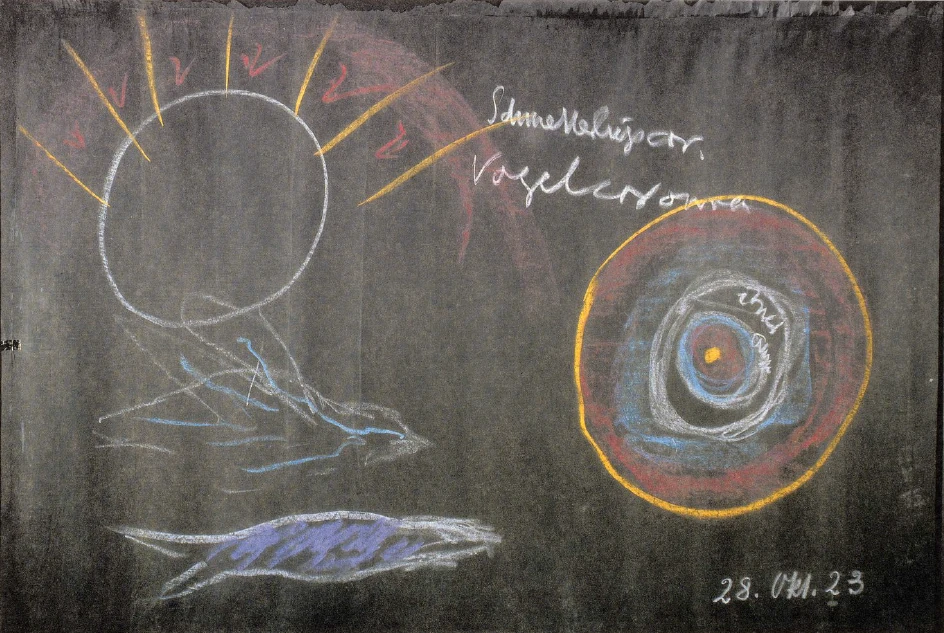
[ 23 ] Der Vogel fühlt die Luft, die er aufsaugt, als sein Wesen. Der Vogel fühlt also eigentlich, schematisch ausgedrückt, das, was als Luft in ihn eindringt, was sich überall ausbreitet, als sein Wesen; diese sich ausbreitende und von ihm erwärmte Luft (siehe Zeichnung blau), das ist sein Wesen. Der Fisch hat das Wasser in sich, aber der Fisch fühlt sich nicht als das Wasser; der Fisch fühlt sich als das, was das Wasser einschließt, er fühlt sich als die Umgebung des Wassers. Er fühlt sich als diese glitzerige Hülle oder Schale des Wassers. Aber das Wasser fühlt er als ein ihm fremdes Element, das in ihm aus- und eingeht, und indem es aus- und eingeht in ihm, ihm auch zugleich die Luft bringt, die er braucht. Aber Luft und Wasser fühlt er als etwas Fremdes. Er fühlt es zunächst als physischer Fisch als etwas Fremdes. Aber der Fisch hat ja auch seinen Äther- und seinen astralischen Leib. Das ist gerade das Eigentümliche des Fisches: dadurch, daß er sich eigentlich als die Hülle fühlt, und das Wasser in ihm verbunden bleibt mit dem übrigen wäßrigen Elemente, fühlt er den Äther als dasjenige, in dem er eigentlich lebt. Das Astralische fühlt er dann nicht als das, was zu ihm gehört. Aber der Fisch ist das eigentümliche Tier, das so recht Äthertier ist. Für sich ist er die physische Schale für das Wasser. Das Wasser, das in ihm ist, fühlt er zusammengehörig mit allen Wassern der Welt. Gewissermaßen überall setzt sich ihm die Feuchtigkeit fort. Feuchtigkeit ist ja überall, und in dieser Feuchtigkeit nimmt er zugleich den Äther (siehe Zeichnung lila) wahr. Die Fische sind allerdings für das irdische Leben stumm, aber wenn sie reden könnten und Ihnen erzählen würden, wie sie sich fühlen, dann würden Ihnen die Fische sagen: Ich bin Schale, aber die Schale trägt ein überall sich ausbreitendes Wasserelement, das der Träger des Ätherelementes ist. In dem Äther schwimme ich eigentlich. — Der Fisch würde sagen: Das Wasser ist nur Maja, die Wirklichkeit ist der Äther, in dem schwimme ich eigentlich. — Also der Fisch fühlt sein Leben als das Leben der Erde. Das ist das Eigentümliche von ihm: er fühlt sein Leben als das Leben der Erde, und daher nimmt er innig teil an alledem, was im Jahreslauf durchgemacht wird von der Erde: dieses Hinausgehen der Ätherkräfte im Sommer, dieses Zurückziehen der Ätherkräfte im Winter. So daß der Fisch etwas fühlt, was in der ganzen Erde atmet. Den Äther empfindet der Fisch als das Atmende der Erde.
[ 23 ] A bird does feel the air which it inhales as its own being. Thus the bird actually feels what enters into it as air, and is everywhere diffused through it, as its own being; this air which is diffused through the bird and warmed by it, this is its being. The fish has water within it, yet the fish does not feel itself as the water; the fish feels itself to be what encloses the water, what surrounds the water. It feels itself to be the glittering sheath or vessel enclosing the water. But the water itself is felt by the fish as an element foreign to it, which passes out and in, and, in doing so, brings the air which the fish needs. Yet air and water are felt by the fish as something foreign. In its physical nature, the fish feels the water as something foreign to it. But the fish has also its etheric and astral body. And it is just this which is the remarkable thing about the fish; because it really feels itself to be the vessel, and the water this vessel encloses remains connected with all the rest of the watery element, the fish experiences the etheric as that in which it actually lives. It does not feel the astral as something belonging to itself. Thus, the fish has the peculiar characteristic that it is so entirely an etheric creature. It feels itself as the physical vessel for the water. It feels the water within itself as part and parcel with all the waters of the world. Moisture is everywhere, and in this moisture the fish at the same time experiences the etheric. For earthly life fishes are certainly dumb, but if they could speak and could tell you what they feel, then they would say: “I am a vessel, but the vessel contains the all-pervading element of water, which is the bearer of the etheric element. It is in the etheric that I am really swimming.” The fish would say: “Water is only Maya; the reality is the etheric, and it is in this that I really swim.” Thus the fish feels its life as one with the life of the earth. This is the peculiar thing about the fish: it feels its life as the life of the earth, and therefore it takes an intimate part in everything which the earth experiences during the course of the year, experiencing the outgoing of the etheric forces in summer, the drawing-back of the etheric forces in winter. The fish experiences something which breathes in the whole earth. The fish perceives the etheric element as the breathing process of the earth.
[ 24 ] Es hat hier einmal Dr. Wachsmuth von dem Atmen der Erde gesprochen. Das ist eine sehr schöne Auseinandersetzung gewesen. Aus eigener Erfahrung hätte das ein Fisch hier vortragen können, wenn er die Vortragskunst gelernt hätte; denn er empfindet das alles, was da vorgetragen worden ist, aus der Verfolgung der dazugehörigen Erscheinungen. Der Fisch ist dasjenige Tier, das das Atmungsleben der Erde während des Jahreslaufes in einer ganz außerordentlichen Weise mitmacht, weil für den Fisch das, worauf es ihm ankommt, gerade das ÄtherLebenselement ist, das aus und ein wogt, und das nur das andere Atmende mitreißt.
[ 24 ] Dr. Wachsmuth1See The Etheric Formative Forces in Cosmos, Earth and Man by Gunter Wachsmuth. once spoke here about the breathing of the earth. This was a very beautiful exposition. If a fish had learned the art of lecturing, it could have given the very same lecture here out of its own experience, for it perceives all that was described in lecture from having itself followed all the phenomena in question! The fish is the creature which takes part in a quite extraordinary way in the breathing-life of the earth during the cycle of the year, because what is important for the fish is the etheric life-element, which surges out and in, drawing all other breathing-processes with it.
[ 25 ] Anders ist es bei den Reptilien und bei den Amphibien, bei den Fröschen zum Beispiel, die in dieser Beziehung außerordentlich charakteristisch sind. Die hängen weniger zusammen mit dem Ätherelemente des Kosmos, die hängen mehr zusammen mit dem astralischen Element des Kosmos. Wenn man den Fisch frägt: Wie steht es denn eigentlich mit dir? — dann sagt er: Nun ja, hier auf Erden bin ich ein erdgewordenes Geschöpf, gebildet aus dem irdisch-feuchten Elemente; aber mein eigentliches Leben ist das Leben der ganzen Erde mit ihrer kosmischen Atmung. — Beim Frosch ist es nicht so, beim Frosch ist es wesentlich anders. Der Frosch nimmt teil an der allgemein ausgebreiteten Astralität.
[ 25 ] It is otherwise with the reptiles and with the amphibians; with the frogs, for instance, which are remarkably characteristic in this respect. These creatures are less connected with the etheric element of the cosmos; they are connected to a greater degree with its astral element. If one were to ask a fish: “How are things with you?” it would answer: “Well, yes, here on earth I have become an earthly creature, formed out of the earthly-moist elements; but my real life is the life of the whole earth with its cosmic breathing.” This is not so with the frog; here matters are essentially different. The frog shares in the general astrality diffused everywhere.
[ 26 ] Ich sprach Ihnen ja bei den Pflanzen davon und werde noch weiter davon sprechen, wie die Astralität des Kosmos oben die Blüte berührt. Mit dieser Astralität, gewissermaßen mit dem astralischen Leib der Erde, hängt der Frosch so zusammen wie der Fisch mit dem Ätherleib der Erde. Der Fisch hat mehr seine Astralität für sich. Der Frosch hat eigentlich seinen Ätherleib sehr stark für sich, viel stärker als der Fisch; aber der Frosch lebt in dem allgemein Astralischen; so daß er namentlich jene astralischen Vorgänge miterlebt, die sich im Jahreslaufe abspielen, wo die Erde die Astralität spielen läßt im Verdunsten des Wassers, im Wiederherabkommen des Wassers. Da sagt natürlich der materialistisch denkende Mensch: das Wasser verdunstet durch diese oder jene aerodynamischen meinetwillen oder aeromechanischen Kräfte; man bekommt den Hinaufstieg. Es formen sich Tropfen; werden die genügend schwer, so fallen sie herab. Aber das ist ja ungefähr ebenso, wie wenn man eine ähnliche Theorie vom Blutlaufe des Menschen aufstellen würde, ohne Rücksicht darauf zu nehmen, daß da alles lebt im Blutlauf. So lebt im Kreislauf des auf- und abwärtsdringenden Wassers die Astralatmosphäre der Erde, die Astralität der Erde. Ich sage Ihnen nicht etwas Fabelhaftes, wenn ich sage: Gerade die Frösche — bei den anderen Amphibien ist das auch vorhanden, aber mehr zurückgetreten — leben dieses astrale Spiel, das sich in den Witterungsverhältnissen, in der Meteorologie auslebt, mit. Nicht nur, daß man sie, wie Sie wissen, in der bekannten einfachen Weise als Wetterpropheten benutzt, weil sie dieses Spiel wunderbar miterleben dadurch, daß sie mit ihrer Astralität hineinversetzt sind in die Astralität der Erde; der Frosch sagt gar nicht, er habe ein Gefühl, sondern der Frosch ist nur ein Träger der Gefühle, die die Erde hat in Regenperioden, in trockenen Perioden und so weiter. Daher haben Sie auch unter gewissen Witterungsverhältnissen die mehr oder weniger schönen oder häßlichen Froschkonzerte. Die sind im wesentlichen der Ausdruck der Frösche für das, was sie im Astralleib der Erde miterleben. Sie quaken wahrhaftig nicht, ohne daß sie Veranlassung dazu haben aus dem ganzen Kosmos heraus; sie leben das Astralische der Erde mit.
[ 26 ] In regard to the plants I told you—and I shall speak further of this—how the astrality of the cosmos above comes into contact with the blossoms. The frog is connected with this astrality, with what may be called the astral body of the earth, just as the fish is connected with the earth's etheric body. The fish possesses its astrality more for itself. The frog possesses its etheric body very strongly for itself, much more strongly than does the fish; but the frog lives in the general astrality; so that it actually shares in those astral processes which play their part in the year's course, where the earth lets its astrality play into the evaporation of water and its re-descent. Here the materialistically minded person naturally says that the evaporation of water is caused by aerodynamic, or, if you will, aero-mechanical forces of one kind or another; these cause the ascent. Drops are formed, and when they become heavy enough they fall downwards. But this is almost as though one were to put forward a similar theory about the circulation of the human blood, without taking into consideration the fact that in the blood-circulation life is everywhere. In the same way there lives in the circulation of water, with its upwards and downwards urge, the astral atmosphere of the earth, the earth's astrality. And I am telling you no fairy-tale when I say that it is just the frogs—this is also the case with the other amphibians, but to a less pronounced degree—which live together with this play of the astrality which manifests in weather-conditions, in meteorology. It is not only that frogs are accepted—as you know—in a naive way as weather-prophets, but they experience this astral play so wonderfully because they are placed with their own astrality right into the astrality of the earth. Certainly the frog does not say “I have a feeling” but it is the bearer of the feelings which the earth has in wet spells, in dry spells, and so on. And this is why in certain weather-conditions you have the more or less beautiful (or ugly) frogs' concert. For this is the frogs' way of expressing what they experience together with the astral body of the earth. It is really true that they do not croak unless they are moved to do so by what comes from the whole cosmos; they live with the astrality of the earth.
[ 27 ] So können wir sagen: Was in dem irdisch-feuchten Elemente lebt, das ist tatsächlich so, daß es auch mehr das Irdische miterlebt; die irdischen Lebensverhältnisse also beim Fisch, die irdischen Empfindungsverhältnisse beim Frosch und überhaupt beim Reptilien- und Amphibiengeschlechte. Wiederum, will man alles das studieren, was menschlicher Verdauungsorganismus ist, dann muß man sagen: dieser Verdauungsorganismus bildet sich allerdings wiederum nach diesem Schema von innen heraus. Aber wer wirklich studieren will, wie die Dinge funktionieren, der muß sich an das Amphibien- und Reptiliengeschlecht wenden, denn dem fliegt von außen an, was der Mensch alsKräfte durch seine Verdauungswerkzeuge durchdrängt. Mit denselben Kräften, mit denen der Mensch verdaut, bildet der äußere Kosmos, die äußere Natur Schlangen, Kröten und Eidechsen und Frösche. Und wer richtig — verzeihen Sie, aber in der Natur ist nichts häßlich, sondern alles muß in objektiver Weise besprochen werden —, wer die innere Natur, sagen wir, des menschlichen Dickdarmes mit seinen Kräften der Absonderung studieren will, der muß die Kröten äußerlich studieren, denn der Kröte fliegt äußerlich dasjenige an, was im menschlichen Dickdarm von innen heraus nach diesem Schema wirkt. Es ist das nicht so schön in der Beschreibung wie das, was ich für die Schmetterlinge zu beschreiben hatte; aber in der Natur muß eben alles in objektiver Gleichheit hingenommen werden.
[ 27 ] So we can say that the fish, living in the earthly-watery element naturally participates to a great degree in the life of the earth: thus we have in the fish earthly life-conditions, in the frogs, earthly feeling-conditions—as also in the various species of reptiles and amphibians. Further, if we wish to study the human digestive organism, we must say that it has developed from within outwards. But if we wish to study how it functions, we must turn to the world of amphibians and reptiles, for to them there comes from outside what permeates the human being as inner forces through his digestive apparatus. It is with the same forces by means of which man digests, that the outer cosmos, outer nature, forms snakes, toads, lizards and frogs. And whoever wishes to make a correct study—excuse me, but there is nothing ugly in nature, everything must be spoken about objectively—whoever wishes to study the inner nature of, let us say, the human large intestine with its power of excretion, must study the toads outwardly; for there comes to the toads from outside what works from within outwards in the human large intestine. Certainly this does not lend itself to such beautiful descriptions as what I had to say about the butterflies; but in nature everything must be taken with objective impartiality.
[ 28 ] Sehen Sie, auf diese Art bekommen Sie nun auch ein Bild davon, wie die Erde das kosmische Leben ihrerseits miterlebt. Denn sehen Sie hin auf die gewissermaßen absondernden Organe der Erde: die Erde sondert nicht nur die geringlebigen menschlichen Absonderungsprodukte ab, sondern sie sondert noch Lebendiges ab, und ihre eigentlichen Absonderungen sind zum Beispiel die Kröten, und in ihnen entledigt sich die Erde dessen, was sie nicht brauchen kann.
[ 28 ] In this way, you see, you also gain a picture of how the earth, from its side, shares in the life of the cosmos. Turn your attention to what may be called the earth's excretory organs; the earth excretes not only the nearly lifeless products of human excretion, but it excretes what is living, and among its actual excretions are the toads. In them the earth rids itself of what it is unable to use.
[ 29 ] Aus alldem sehen Sie, wie das Außen der Natur überall dem Innen entspricht. Wer da sagt: «Ins Innere der Natur dringt kein erschaffner Geist», der weiß nur nicht, daß überall in der Außenwelt dieses Innere der Natur vorhanden ist. Wir können den ganzen Menschen seinem Innenwesen nach studieren, wenn wir das verstehen, was im Kosmos außen webt und lebt. Wir können ihn studieren, diesen Menschen, vom Kopf bis zu den Gliedmaßen, wenn wir studieren, was in der Außenwelt vorhanden ist. Welt und Mensch gehören eben durchaus zusammen. Und man kann schon sagen, ein Schema könnte man aufstellen, das würde so sein: Man hat den großen Umkreis; der große Umkreis konzentriert seine Kraft in einem Punkte. Der große Umkreis schafft sich im Inneren einen kleineren; der Punkt strahlt dasselbe aus. Der kleinere Umkreis bildet wiederum einen weiteren kleineren Umkreis; das, was im Inneren ist, strahlt dasselbe aus. Dieser Umkreis bildet wiederum einen solchen Umkreis; das, was beim Menschen ist, strahlt weiter nach außen aus: und das Äußere des Menschen berührt sich mit dem Inneren des Kosmos. Da, wo unsere Sinne mit der Welt zusammenkommen, da berührt sich dasjenige, was bei dem Menschen von innen nach außen gegangen ist, mit dem, was im Kosmos von außen nach innen gegangen ist. In diesem Sinne ist der Mensch eine kleine Welt, ein Mikrokosmos gegenüber dem Makrokosmos. Aber er enthält alle Wunder und Geheimnisse dieses Makrokosmos, nur eben in entgegengesetzter Entwickelungsrichtung.
[ 29 ] From all this you can see how the outer in nature always corresponds with the inner. Whoever says: “No Creative Spirit penetrates the inner being of nature”, simply does not know that everywhere in the external world this inner quality is present. We can study the entire human being in regard to his inner nature, if we understand what weaves and lives outside in the cosmos. We can study him, this human being, from head to limb-system, if we study what is present in the outer world. World and man belong together in every respect. And one can even say that this could be represented in a diagram, showing the circumference of a large circle concentrating its force in a point. The large circle forms a smaller circle within, produced by a raying outwards from the point. The smaller circle again forms an even smaller small circle; this is again produced by a raying-outwards of what is within. This circle again forms another such circle. What is comprised in the human being streams still further outwards. Thus the outer of the human being comes into contact with the inner of the cosmos. The point where our senses come in contact with the world is where the part of man which reaches from within outwards comes into contact with what reaches in the cosmos from outside inwards. In this sense man is a little world, a microcosm over against the macrocosm. But he contains all the wonders and secrets of this macrocosm, only in the reversed direction of development.
[ 30 ] Es würde für die Erde etwas sehr Widriges sein in bezug auf ihre Fortentwickelung, wenn das nur so wäre, wie ich es bis jetzt dargestellt habe; da würde die Erde die Krötenwesenheiten aussondern, und sie würde eines Tages ebenso wie das physische Menschenwesen zugrunde gehen müssen, ohne Fortsetzung zu haben. Wir haben aber jetzt eigentlich nur den Menschen im Zusammenhang mit den Tieren ins Auge gefaßt, und wir haben in diesen Tagen eine kleine Brücke geschlagen zu den Pflanzenwesen hin. Wir werden weiter in das Reich der Pflanzen eindringen müssen, und dann in das Reich der Mineralwesen, und wir werden sehen, wie die Mineralwesen während der Erdenzeit entstanden sind; wie das, was zum Beispiel die Gesteine unserer Urgebirge sind, Stück für Stück von den Pflanzen abgelagert ist, wie die Kalkgebirge Stück für Stück von den späteren Tieren abgelagert sind. Mineralreich ist Ablagerung des Pflanzen- und Tierreiches, und im wesentlichen Ablagerung der niedersten Tiere. Die Kröten geben noch nicht sehr viel her für das Mineralische der Erde, die Fische auch verhältnismäßig wenig; aber die niederen Tiere und die Pflanzen geben sehr viel her. Die niederen Wesen mit Kieselpanzern und Kalkpanzern, Kalkschalen, die lagern dasjenige ab, was sie erst aus ihrem Tierischen, aus ihrem Pflanzlichen heraus bilden, und das Mineralische zerfällt dann. Wenn das Mineralische zerfällt, dann bemächtigt sich gerade der Zerfallsprodukte des Mineralischen eine höchste Kraft und baut neue Welten daraus auf. Das Mineralische an einem bestimmten Orte kann eben vor allen Dingen wichtig werden.
[ 30 ] It would be something very adverse to the further evolution of the earth if things were only as I have so far described them; then the earth would excrete the beings of the toads, and would one day perish just as physical man must perish, without any continuation. So far, however, we have only considered man's connection with the animals, and have built only a slight bridge over to the being of the plants. We shall now have to penetrate further into the plant-kingdom, and then into the kingdom of mineral-being, and we shall see how the mineral-being arose during the Earth-period-how, for instance, the rock-formations of our primeval mountains were laid down, bit by bit, by the plants, and how, bit by bit, the limestone mountains were laid down by the subsequent animals. The mineral kingdom is the deposit of the plant and animal-kingdom, and it is actually the deposit of the lowest animals. The toads do not contribute very much to the mineral element of the earth; the fishes, too, comparatively little; but the lower animals and the plants contribute a very great deal. The lower creatures, those plated with flinty and chalky armour, or having merely chalky shells, deposit what they have first formed from their own animal—or their plant—natures, and the mineral then disintegrates. And when this mineral substance disintegrates, a power of the highest order takes hold of just these products of mineral disintegration and from them builds up new worlds. The mineral element in any particular place can become of all things the most important.
[ 31 ] Wenn wir die Erdenevolution verfolgen — Wärmemetamorphose, Luftmetamorphose, Wassermetamorphose, mineralische, irdische Metamorphose —: das menschliche Haupt hat alle diese Metamorphosen mitgemacht, die mineralische Metamorphose zunächst nach außen in dem verfallenden, aber eigentlich noch immer mit etwas Vitalität durchsetzten Kopfskelett. Aber in einer noch viel deutlicheren Weise hat dieses menschliche Haupt die irdische mineralische Metamorphose mitgemacht, Es gibt in der Mitte des menschlichen Hauptes in der Gehirnbildung ein pyramidenartig gebildetes Organ, die Zirbeldrüse. Diese Zirbeldrüse in der Nähe des Vierhügelkörpers und der Sehhügel sondert aus sich den sogenannten Gehirnsand ab, zitronengelbe Steinchen, die wie Häufchen an dem einen Ende der Zirbeldrüse liegen und die wirklich das Mineralische im Menschenhaupte sind. Liegen sie nicht da, trägt der Mensch diesen Gehirnsand, dieses Mineralische nicht in sich, dann wird er ein Idiot oder ein Kretin. Die Zirbeldrüse ist verhältnismäßig groß bei den normalen Menschen. Bei Kretins hat man schon bloß hanfkorngroße Zirbeldrüsen gefunden; die können keinen Gehirnsand absondern.
[ 31 ] When we follow the course of Earth-evolution—warmth-condition, air-condition, water-condition, mineral-earthly condition—the human head has participated in all these metamorphoses, the mineral metamorphosis being the first to work outwards in the disintegrating skeleton of the head—though it still retains a certain vitality. But this human head has participated in the earthly-mineral metamorphosis in a way which is even more apparent. In the centre of the human head within the structure of the brain there is an organ shaped like a pyramid, the pineal gland. This pineal gland, situated in the vicinity of the corpus quadrigemina and the optic thalamus secretes out of itself the so-called brain sand, minute lemon-yellow stones which lie in little heaps at one end of the pineal gland, and which are in fact the mineral element in the human head. If they do not lie there, if man does not bear this brain-sand, this mineral element, within him, he becomes an idiot or a cretin. In the case of normal people the pineal gland is comparatively large. In cretins pineal glands have been found which are actually no larger than hemp seeds; these cannot secrete the brain-sand.
[ 32 ] In diesem mineralischen Einschluß liegt eigentlich der Geistesmensch, da schon andeutend, daß das Lebendige eigentlich zunächst nicht den Geist beherbergen kann, sondern daß der Geist im Menschen als seinen Mittelpunkt ein Unlebendiges braucht, also vor allen Dingen als selbständiger lebendiger Geist da sein muß.
[ 32 ] It is actually in this mineral deposit that the spirit-man is situated; and this already indicates that what is living cannot harbour the spirit, but that the human spirit needs the nonliving as its centre-point, that this is above all things necessary to it as independent living spirit.
[ 33 ] Es war eine schöne Entwickelung, die uns gebracht hat von der Schmetterlings-Kopfbildung, Vogel-Kopfbildung herunter bis zu Reptilien und Fischen. Wir werden nun wieder aufsteigen, werden das betrachten, was uns ebenso befriedigen kann wie die Tierreihe: die Pflanzenreihe und die Mineralreihe. Und ebenso wie wir Lehren haben ziehen können über die Vergangenheit aus der Tierreihe, so werden wir aus der Mineralreihe Hoffnungen ziehen können für die Erdenzukunft. Dabei werden wir natürlich noch nötig haben, in den nächsten Vorträgen in der mannigfaltigsten Weise auf die Übergangstiere einzugehen, denn ich habe nur die hauptsächlichsten Tiere, die sozusagen an den Knotenpunkten der Entwickelung erscheinen, in dieser Übersicht berühren können.
[ 33 ] It was a beautiful progression which led us from the butterfly-head-formation, the bird-head-formation, downwards to the reptiles and fishes. We will now re-ascend and study what will give us as much satisfaction as the kingdom of the animals—the kingdoms of the plants and the minerals. And just as we have been able to gather teachings about the past from the animal kingdom, so shall we be able to derive from the mineral kingdom hope for the future of the earth. At the same time it will naturally still be necessary in the following lectures to enter into the nature of transitional animals from the most varied aspects, for in this survey I have only been able to touch upon the animals of principal significance, which, so to say, appear at the key-points of evolution.