

The Composition of the Mysteries
GA 232
15 December 1923, Dornach
Translate the original German text into any language:
Versions Available:
Mystery Knowledge & Mystery Centers, tr. Goddard, et. al.
Elfter Vortrag
11. The Secret Of Plants, Metals And Human Beings
[ 1 ] Aus dem, was ich gestern vorzubringen hatte, wird es vielleicht verständlich sein, wenn ich von Aristoteles, dem Zusammenfasser des gesamten Wissens, der gesamten Erkenntnis im Altertum im vierten vorchristlichen Jahrhunderte, sage, daß er, trotzdem er eigentlich nur eine Art logischen Systems über Mitteleuropa fließen ließ, dennoch auf dem Boden des griechischen und eigentlich des gesamten Mysterienwesens der damaligen Zeit stand. Ja, man wird sogar sagen müssen, daß derjenige, der solche Dinge wie Weltanschauungen nicht bloß mit dem Verstande, sondern auch mit dem Gemüte aufzunehmen in der Lage ist, herausfühlen kann aus den logischen Darstellungen des Aristoteles, daß ein gewisses inniges Verknüpftsein mit Naturgeheimnissen auch der aristotelischen Logik und Philosophie zugrunde liegt. Es war eben mehr das Schicksal des Aristoteles, ein logisches System über Europa auszugießen, als, wenn ich mich so ausdrücken darf, sein eigener Entwickelungsgang. Denn immerhin, man kann schon sagen, um die hier vorliegende eigentümliche Tatsache zu illustrieren: es wäre vielleicht undenkbar, daß Plato hätte der Lehrer Alexanders werden können, während Aristoteles es hat werden können.
[ 1 ] After what I told you yesterday, you will perhaps understand me when I say of Aristotle—who in the fourth century b.c. collected together the whole knowledge of ancient times—that although we find what was spread over Europe by his influence to be no more than a kind of system of logic, he nevertheless stood upon the ground of the Greek Mysteries, and indeed of all the Mysteries of his time. I can go further and say that anyone who is in a position to receive a world-conception not merely with his intellect, but with his heart and understanding, will be able to feel even in the logical and philosophical writings of Aristotle that they have implicit within them a close and intimate connection with the secrets of Nature. To spread over Europe a system of logic was the destiny of Aristotle rather than, if I may so express it, his proper path of development. For after all—to give an illustration of this fact—it would be almost unthinkable that Plato should have been Alexander’s teacher, whereas Aristotle could be.
[ 2 ] Plato setzte gewiß in seiner Art nur die alten Mysterien in einer mehr ideellen Form fort. Aber gerade durch sein Ideelles wurde er die Persönlichkeit, die mehr hinwegführte von den Geheimnissen der Natur, während Aristoteles wiederum auf sie zurückführte, was Sie schon aus meinen ganz kurzen Darstellungen in meinen «Rätseln der Philosophie» ersehen können. Aber den vollen Tatbestand lernt man doch erst kennen, wenn man sich eine Vorstellung machen kann, wie der siebenjährige Unterricht, den Aristoteles dem Alexander gegeben hat, eigentlich seinem Inhalte nach war. Ich will in Kürze zusammenfassen, was, herausgehoben aus dem antiken Mysterienwesen, der Inhalt dieses Unterrichtes war.
[ 2 ] Plato, it is true, continued the teachings of the old Mysteries. But he did so in his own way, in the form of ‘ideas’; and for this very reason he was the one who led man away from the secrets of Nature, whilst Aristotle led back to them—as you will have gathered from the short account of him given in my book, Riddles of Philosophy. We can come to realise this in more detail and completeness when we are able to form an idea of the content of the seven years’ instruction given by Aristotle to Alexander. Let me now summarise for you in brief the content of this teaching which was drawn from the ancient Mysteries.
[ 3 ] Es war ja, wenn man überhaupt in jenen alten Zeiten in einer gültigen Weise über die Natur sprach, so, daß man unter der Natur nicht dasjenige verstand, was die heutige Naturwissenschaft versteht: die bloßen irdischen Erscheinungen, von denen man dann auf die außerirdischen Himmelserscheinungen äußerlich schließt; sondern man gliederte den Menschen an die Natur im allerweitesten Sinne an, und konnte das nur, wenn man auch den Geist in der Natur suchte, denn man ließ es sich in jenen alten Zeiten gar nicht beifallen, den Menschen etwa seelenlos und geistlos zu betrachten. Und so handelte es sich eigentlich bei dem Mysterienunterricht über die Natur immer darum, die Natur weit hinauszudehnen in das Kosmische, so weit, als der Kosmos dem Menschen durch seine Verwandtschaft mit ihm zugänglich sein konnte.
[ 3 ] In those times it was so that whenever one spoke in an authentic way about Nature, one did not understand by the word what the Natural Science of today understands— namely, the purely earthly phenomena, from which one then goes on to infer in an external manner the phenomena of the Heavens beyond the Earth. No, Man was thought of always as a member and part of Nature in the widest sense; and this necessitated looking also for the Spirit in Nature—for to regard man as devoid of soul or devoid of spirit was quite impossible in those olden times. And so in the Mystery teaching about Nature, we find that Nature was thought of as extending far out into the Cosmos, as far indeed as the Cosmos was in any way accessible to man through his relationship with it.
[ 4 ] Nun, aller Unterricht, aller ernst genommener Unterricht in jenen alten Zeiten war ja nicht ein Appell an den menschlichen Verstand oder an das äußere Beobachtungsvermögen des Menschen. Was man sich heute unter Wissen vorstellt, das spielte eigentlich in jenen älteren Zeiten, auch noch zur Zeit des Aristoteles, keine beträchtliche Rolle. Und wenn die Geschichtsschreiber der einzelnen Wissenschaften heute ihr eigenes wissenschaftliches Denken darstellen wollen, so sollten sie eigentlich erst bei Kopernikus oder Galilei anfangen; denn was sie zurückgehend zu dem noch hinzuflicken, das ist ja durchaus nicht zutreffend. Und wenn sie gar gegen das griechische Wissen hin gehen, so ist es die reine Phantasie, die sie da geben: es ist eine Art Fortsetzung der Gegenwart nach früheren Zeiten, die aber niemals real war. Denn auch zu Aristoteles’ Zeiten und von Aristoteles selber wurde jeder Unterricht, der ernst genommen wurde, so gegeben, daß er verknüpft war mit einer Umänderung der ganzen Menschennatur, mit einem Appell nicht nur an das menschliche Denken und Beobachten, sondern an das ganze menschliche Leben. Der Mensch sollte durch Erkenntnis eben ein anderes Wesen werden, als er ohne die Erkenntnis ist. Das war ja das Wesentliche, worauf es in den Mysterien ankam, daß der Mensch durch die Erkenntnis ein ganz anderes Wesen wurde, als er vorher war. Und gerade zu Aristoteles’ Zeiten war es so, daß man diese Umwandelung des Menschen vor allen Dingen dadurch herbeizuführen versuchte, daß man zwei polarisch einander entgegengesetzte Empfindungen auf die menschliche Seele wirken ließ.
[ 4 ] Now you must understand that all teaching that was seriously undertaken in those olden times did not make appeal primarily to the intellect or to the faculty of observation. What we think of today as ‘knowledge’ was really of very little account in those ancient times, even as late as the days of Aristotle. And if a modern historian of some particular science wants to give an account of the progress of thought in that domain of knowledge, he should really begin with Copernicus or Galileo, for anything he may add to his account by going further back, is beside the point. And if he goes back as far as to the knowledge of Greek times, then what he tells is mere phantasy. It is a continuation of the present back into earlier times which is utterly unreal. For even in the time of Aristotle any education that was taken seriously involved a complete change in the very nature of the pupil, for it made appeal not merely to thought and observation but to the whole life of the human being. The essential thing in the Mysteries was that the human being should become through his education an altogether different being from what he was before. And in Aristotle’s time the endeavour was made to bring about this change by subjecting the soul to two diametrically opposite impressions.
[ 5 ] Man ermahnte den Menschen, der unterrichtet werden sollte, der nach und nach zum Wissen, zur Erkenntnis kommen sollte, so recht menschlich sich hineinzufühlen in seine Naturumgebung. Sieh einmal — so sagte man etwa —, du atmest die Luft, aber du atmest die Luft, die im Sommer warm ist, im Winter kalt ist. Du atmest die Luft so, daß du deinen eigenen Atem in Dampfesgestalt, in Dunstgestalt im Winter wahrnehmen kannst. Er wird unsichtbar, wenn du warme Luft im Sommer atmest.
[ 5 ] In the first place the pupil who was to attain to knowledge step by step, was exhorted to feel his way as Man right into the Nature that was all around him. ‘Behold now,’ it was said to him, ‘you breathe the air. And in summer the air you breathe is warm, while in winter it is cold. In winter you can perceive your own breath in the form of vapour. Your breath is invisible when you breathe the warm air in summertime.’
[ 6 ] Und an solch eine Erscheinung wurde angeknüpft. Man knüpfte nicht zunächst etwa so an die Natur an, daß man sagte: Sieh einmal, da hat ein Körper diese oder jene Temperatur; ich erwärme ihn in einer Retorte, er macht diese oder jene Veränderung durch. Nein, man knüpfte an den Menschen an, an den Menschen, wie er sich drinnen fühlt in jenem Zusammenhange, der den Atmungsprozeß darstellt. Und man ließ allmählich den Menschen auf der einen Seite zum Erfühlen, zum Empfinden kommen der erwärmten Luft: Stelle dir recht vor, was das heißt, erwärmte Luft. Sie will hinauf, und du mußt fühlen, indem die erwärmte Luft an dich herankommt, daß dich eigentlich etwas in die Weiten tragen will. Und fühle im Gegensatz dazu das kalte Wasser, das kalte Wasser in irgendeiner Form; fühle es nur. Du fühlst dich darinnen eigentlich nicht heimisch. In der warmen Luft fühlst du dich heimisch, so heimisch, daß dich die warme Luft in die Weiten des Kosmos tragen will. Im kalten Wasser fühlst du dich fremd, nicht heimisch. Aber du fühlst, wenn du fortgehst vom kalten Wasser, und wenn du das kalte Wasser außer dir tun läßt, was es tun will: dann wird diese Tatsache für dich etwas; dann, wenn du das kalte Wasser außer dir tun lässest, was es tun will, dann bereitet es selber zum Beispiel die Schneekristalle, die niederfallen auf die Erde. Außerhalb der Schneekristalle, die Schneekristalle beobachtend, fühlst du dich an deinem richtigen Orte. Die warme Luft kannst du eigentlich nur in dir fühlen, und du möchtest dich mit der aufwärtsstrebenden warmen Luft in die Weltenweiten tragen lassen. Das kalte Wasser kannst du nur eigentlich außer dir fühlen, und du möchtest es, damit du eine Verwandtschaft mit ihm hast, eigentlich in seinen Ergebnissen durch deine Sinne betrachten.
[ 6 ] A phenomenon like this was taken as a starting-point. The teacher of those olden times did not try to make the connection with Nature by saying: ‘Here is a body that has such and such a temperature. I warm it in a retort and it undergoes such and such a change.’ No, he brought Nature into direct contact with the human being himself, by making him attentive to the feeling he experienced in connection with the breathing process. And the pupil learned to develop a true feeling, on the one hand, of the warmed air. ‘Picture yourself,’ said the teacher, ‘what it really means—warmed air. It wants to rise; and you must feel, when the warmed air comes toward you, that something is trying to carry you out into the far spaces. And now feel, on the other hand, as a contrast, cold water in some form or other. You do not feel at home in the cold water. In the warm air you feel at home, you feel how it is trying to carry you out into the far spaces. In the cold water you feel strange. And you feel that if you go away from the cold water and let it do what it will away from you, then it will make the snow crystals that fall down upon the Earth. You feel yourself in your right place outside the snow crystals, watching them from without. The warm air you can only feel in you, and you would gladly let yourself be carried out into the far spaces of the worlds by the ascending warm air. The cold water you can only really feel outside you, and in order to have a relationship with it, you would rather observe it in its results by means of your senses.’
[ 7 ] Das waren die zwei polarischen Gegensätze, an die man dazumal herangebracht wurde: zu fühlen, daß eigentlich «draußen und drinnen vom Menschen» ein leerer Ausdruck ist. Draußen und drinnen will eigentlich gar nichts Besonderes besagen. Viel will besagen: warme Luftigkeit, kalte Wäßrigkeit. Das sind Gegensätze, durch die der Mensch ganz seinem innersten Wesen nach in die Welt hineingestellt wird. Denn «draußen » ist erst etwas dadurch, daß es kalt-feucht ist, «drinnen» ist etwas dadurch, daß es warm-luftig ist. Qualitativ fühlte man diesen Gegensatz, und qualitativ das Hineingestelltsein des Menschen.
[ 7 ] These were the two opposite experiences to which the pupil was brought. If we describe it as ‘learning to feel the difference between what is within man and what is outside him’— that is an empty expression! It really does not say very much. But ‘warm air’ and ‘cold water’ mean a great deal! Through these opposite experiences man is placed into the world with his whole inner being. ‘Outside’ begins to have meaning and reality when we think of it as damp and cold, and ‘inside’ when we think of it as warm and gaseous. The contrast was experienced as having a qualitative character; man learned to feel how he is placed qualitatively into the world.
[ 8 ] Dann sprach man nicht mehr von Dingen, dann sprach man von dem Menschen selbst. Man sprach davon, daß das Warmluftige zu den Göttern hinführt, zu den Göttern in den Höhen, und daß das Feuchtkalte zu den unterirdischen Dämonen führt. Aber mit der Fahrt nach den unterirdischen Dämonen ist zu gleicher Zeit verbunden die Erkenntnis der Natur. Man muß nur mitbringen in die unteren Regionen das, was man erkundet und erlebt durch das Warmluftige in den Höhen, damit einem das Untere nichts anhaben kann. Und wenn man dann mit dieser inneren Empfindung für den Gegensatz des Warmluftigen und des Feuchtkalten, wenn man mit diesem Erlebnis an die Natur heranging, dann konnte man durch das weitere Erleben an den Naturgegenständen und Naturvorgängen tief hineinschauen in das Wesen des Weltenalls überhaupt.
[ 8 ] And then the teacher ceased speaking of things, and spoke of the human being himself. He told how the ‘warm air’ leads to the Gods in the Heights, while the ‘cold damp’ leads to the demons under the Earth. With the journey to the sub-earthly demons is connected the knowledge of Nature. Only the pupil must bring with him into the lower regions the knowledge and experience he has gained through the warm air in the heights, lest the lower regions have evil designs upon him. And when with this inner experience of the contrast between the warm air and the damp cold, the pupil afterwards approached Nature, he was able, through further experience of the things and processes of Nature, to look far into the real being of the whole world.
[ 9 ] Heute untersucht der Chemiker den Wasserstoff, schreibt dem Wasserstoff nach seinen Untersuchungen gewisse Eigenschaften zu. Dann beobachtet er die Weltenräume, sieht da etwas, was dieselben Eigenschaften offenbart wie der Wasserstoff im Laboratorium, und sagt, der Wasserstoff ist auch in den Weiten. Solch eine Unterweisung würde auch zu Aristoteles’ Zeiten noch eine Torheit gewesen sein. Aber man ging dazumal anders zu Werke.
[ 9 ] Today, the chemist examines hydrogen and attributes to it certain properties. Then he observes the spaces of the worlds, finds there something which reveals the same properties as hydrogen does in the laboratory and draws the conclusion that hydrogen is present also out there in the far spaces. Such a method of instruction would have seemed sheer nonsense in Aristotle’s time. One went to work then in quite a different way.
[ 10 ] Wenn vertieft war das innere Erleben durch das, was ich eben angedeutet habe, dann führte man den Schüler zu der Beobachtung dessen, was nun wirklich in der aufstrebenden, sich in die Weltenweiten hinaus öffnenden Blume lebt. Pflanzenerkenntnis, das war dasjenige, wozu man den Schüler führte, Pflanzenerkenntnis: Schaue hinein in die sich öffnende Blumenkrone, beobachte, wie da das, was den Weiten der Welt entgegenstrahlt, auf dich einen Eindruck macht.
[ 10 ] When the inner experience of the pupil had been deepened in the way I have indicated, the teacher led him to observe what is living in the flower as it raises itself upwards and opens out into the far spaces; he had now to pass on to knowledge of the plants. ‘Look into the opening petals of the flower,’ he was told, ‘and observe the impression it makes upon you as it rays out into the World.’
[ 11 ] Und indem der Schüler mit jenen vertieften Empfindungen, von denen ich Ihnen gesprochen habe, so über die sich öffnenden Blumen hinblickte, dann ging ihm eine innerliche Erkenntnis, eine innerliche Erleuchtung auf. Die Blumen draußen auf Erden wurden ihm zu Verkündern von Weltengeheimnissen in den Weiten. Die Blumen sprachen ihm von den Weltenweiten. Und in einer eindringlichen, aber nur andeutenden Weise führte der Lehrer den Schüler dahin, dieses Geheimnis, das von den Weiten der Welt einströmt in das Blumenwesen, aus sich selber heraus zu finden. Und so wurde der Schüler nach und nach dazu gebracht, auf die Frage des Lehrers: Was nimmst du denn da eigentlich wahr, wenn du hineinschaust in den sich öffnenden Blumenkelch, in die sich öffnende Blumenkrone, wo die Staubgefäße herauskommen und dir entgegenstrahlen, was nimmst du eigentlich wahr? — da wurde der Schüler dazu gebracht, zu sagen: Die Pflanzen erzählen mir, daß sie eigentlich durch die schwere, kalte Erde gezwungen sind, ihren Standort auf der Erde zu nehmen, daß sie aber eigentlich nicht aus der festen Erde gekommen sind, sondern in diese nur hineinbefestigt worden sind, daß sie in Wahrheit wassergeborene Wesen sind, und in dieser ihrer Lebendigkeit als wassergeborene Wesen im vorerlebten Zustand des Erdenseins — ich meine den in meiner «Geheimwissenschaft » beschriebenen Zustand, den Mondzustand — ihr wirkliches echtes Dasein gehabt haben. Sehen Sie, dazu wurde der Schüler gebracht, zu sagen: Das, was eigentlich die Geheimnisse des Mondes sind, der aus der Erde herausgegangen ist und noch etwas von dem vorirdischen Mondenzustande bewahrt, das spiegelt mir aus den Blumen entgegen. Denn die Blumen sagten dem Schüler nicht jede Nacht das gleiche. Wenn der Mond vor dem Löwen stand, sagten die Blumen etwas anderes, als wenn der Mond vor der Jungfrau oder vor dem Skorpion stand. Denn das, was der Mond bei seinem Umkreisen durch den Tierkreis erlebte, von dem erzählten die Blumen auf der Erde. Von den Geheimnissen des Weltenalls draußen erzählten die Blumen auf der Erde. Es war wirklich so, daß der Schüler durch das, was herangebracht wurde an ihn, aus seinem innersten Herzen heraus sagte:
[ 11 ] And when the pupil, whose feelings had been deepened in the way I have explained, gazed out over the opening blossoms of the plants, an inward knowledge, an inward illumination, dawned within him. The flowers became for him the proclaimers upon Earth of the secrets of the Cosmos: they spoke to him of the far spaces of the Worlds. And with deep earnestness, though always only in the way of gentle hints and intimations, the teacher then led the pupil to find for himself the secret that streams from the wide spaces of the World into the being of the flower. The teacher put the question: ‘What do you really perceive when you look at the opening flower, when you gaze at the opening petals and see how the stamens push forth and out to meet you? What do you then really perceive?’ And by-and-by the pupil became able to say in answer: ‘The plants tell me that the heavy, cold Earth has compelled them to take up their abode on the Earth; they say that they really do not come from the Earth at all, but have only been placed there and made fast in the Earth. In truth they are water-born, and in a previous condition of Earth existence’—it is the condition I have described in Occult Science as the Old Moon condition of the Earth—‘they enjoyed their true and genuine existence as water-born beings in all their livingness.’ The pupil was led to perceive that in the flowers he can see a reflection of the secrets and Mysteries of the Moon, which has gone out of the Earth and still preserves something of the old, pre-Earthly Moon condition. For the flowers did not tell him the same thing every night! What the flowers said when the Moon stood before Leo was different from what they said when the Moon stood before Virgo or before Scorpio. The flowers on the Earth told what the Moon experienced as she passed round the whole circle of the Zodiac. The secrets and mysteries of the World-All— it was of these that the flowers on Earth told. It was really so that through what came to the pupil in this way he was able to say out of the depth of his heart:
Ich schaue in die Blumen;
Ihre Verwandtschaft mit dem Mondensein offenbaren sie;
Sie sind erdbezwungen nun, denn sie sind Wassergeborene.
I look into the flowers.
They reveal to me their kinship with the Moon.
Captives on Earth are they,
For they are Water-born.
[ 12 ] Das konnte der Schüler fühlen, weil er ja vorher eingeführt worden war in dasjenige, was ihm das erkaltende Wasser gab. Er hatte das erlebt, und durch dieses Erlebnis kam er an der Blume zu dieser Erkenntnis.
[ 12 ] The pupil was able to have this feeling, because he had previously experienced the impression made on him by the cold, chilling water. That experience enabled him now to come to this knowledge about the flowers.
[ 13 ] Und wenn der Schüler genügend vertraut geworden war mit dem Mondengeheimnis, das die Pflanzen, die aus der Erde heraussprossen, verrieten, dann wurde er weiter an die Metalle der Erde herangeführt, an die Hauptmetalle: Blei, Zinn, Eisen, Gold, Kupfer, Quecksilber, Silber, wie ich sie gestern in einem anderen Zusammenhange Ihnen vorgeführt habe. Und wenn er ein so vertieftes Empfindungsleben hatte, wie ich es jetzt angedeutet habe, dann erfuhr er gerade an den Metallen, indem er sich bekannt machte mit dem, was sie ihm geheimnisvoll sagten, die Geheimnisse des ganzen Planetensystems. Denn das Blei klärte ihn auf über den Saturn, das Zinn über Jupiter, das Eisen über Mars, das Gold über die Sonne, das Kupfer über die Venus, das Quecksilber über den Merkur, und wiederum das Silber über den Mond, insoferne der Mond nun nicht in engerer Verwandtschaft mit der Erde steht, sondern auch ein Angehöriger des ganzen Weltenalls ist. Und so wie der Schüler sich das Blumengeheimnis enthüllte, so enthüllte er sich das Metallgeheimnis. Es war also das Erste das Pflanzengeheimnis, das Zweite das Metallgeheimnis.
[ 13 ] And when the pupil was sufficiently familiar with the secret of the Moon as it was disclosed to him in this way by the plants that grow up out of the Earth, he was led a step further, and had to contemplate the metals of the Earth— the principal metals, lead, tin, iron, gold, copper, quicksilver, silver.2ee Lectures III to V of the volume True and False Paths in spiritual Investigation. (Rudolf Steiner Press.) We spoke of them in another connection yesterday. And when he approached the metals, with his feeling and understanding deepened in the way I have indicated, then he gradually made himself familiar with the secrets that they spoke to him; and from the metals he learned the secrets of the whole planetary system. For the lead explained to him about Saturn, the tin about Jupiter, the iron about Mars, the gold about the Sun, the copper about Venus, the quicksilver about Mercury, and the silver again about the Moon—that is to say, the Moon not now in her relationship with the Earth but as a member of the WorldAll. Just as the pupil had discovered the secret of the flowers, so now he discovered for himself the secret of the metals. First he learned the flower secret, and then the metal secret.
[ 14 ] Dieses Metallgeheimnis, das in den eleusinischen Mysterien durch das Ihnen gestern geschilderte mächtige Planiglobium der männlichen Statue gegeben worden ist, dieses Metallgeheimnis wurde in den Unterricht hineinverwoben auch noch zur Aristoteleszeit, und an diesem Metallgeheimnis enthüllte sich das Geheimnis der Planeten. Man empfand ja nicht so grob wie heute; man empfand, indem man an das Metall Blei herantrat, daß das Blei nicht nur in der bleigrauen Farbe dem ‚Auge erscheint, sondern dieses Bleigrau machte einen eigentümlichen Eindruck auf das innere Auge. Es löschte in einer gewissen Beziehung dieses Bleigrau des frischen Bleimetalles die anderen Farben aus, und man empfand ein Mitgehen mit der bleigrauen Metallität. Man kam in einen gewissen Bewußtseinszustand, und man kam hinein in das Erleben von etwas ganz anderem, als die Gegenwart ist. Man kam wirklich in eine Stimmung hinein, wie wenn die ganze Vorzeit der Erde vor einem aufstünde, indem das Gegenwärtige abgeblendet war durch das Bleigrau. Saturn-Natur enthüllte sich.
[ 14 ] This secret or mystery of the metals which was given expression in the male statue of the Eleusinian Mysteries by means of the great Planisphere that I described to you yesterday, still formed part of the education given in Aristotle’s time, and in this secret of the metals was revealed the secret of the planets. Man’s feeling and perception were not so coarse as they are today. When the pupil directed his eyes to a piece of lead, the lead did not merely show itself blue-grey in colour to his eye, but this blue-grey had a very remarkable effect upon his inner eye. In a sense this blue-grey of the fresh lead extinguished all other colours, and the pupil felt as if he were one with this blue-grey metallic nature, is if he were moving with it. He came into a state of consciousness where he had experience of something utterly and entirely different from the present. He came really into a condition of soul when it was as though the whole past of the Earth rose up before him, as though the present were blotted out by the blue-grey. Saturn stood revealed!
[ 15 ] Beim Golde nimmt man, äußeren Analogien nach, an, daß die Alten in dem Golde einen Repräsentanten der Sonne gesehen haben. Das war wahrhaftig nicht bloß ein äußerliches Analogiespiel, daß man die Sonne als etwas Wertvolles am Himmel und das Gold als etwas Wertvolles auf der Erde angesehen hat. Es ist ja im Grunde genommen dem modernen Menschen nichts zu dumm, werin es sich darum handelt, die ‚Alten für dumm zu halten. Schaute man das Gold in seiner in sich geschlossenen glanzgelben Farbe, mit der Anspruchslosigkeit und dem Stolz nach außen, dann fühlte man in der Tat etwas, was man zunächst verwandt empfand der ganzen Blutzirkulation des Menschen. Man fühlte es der Qualität Gold gegenüber: da bist du drinnen, da fühlst du dich ein. Und durch diese Empfindung kam man dazu, die Natur des Sonnenhaften zu begreifen. Man fühlte die Verwandtschaft der Qualität Gold mit dem, was von der Sonne im Blute des Menschen wirkte.
[ 15 ] In the case of gold, people point to external analogies to account for the fact that the ancients saw in gold a representative of the Sun. It was by no means due to some mere external analogy, such as that the Sun is regarded as something precious and valuable on Earth. Really nothing is too stupid for modern man to ascribe to the ancients! When the man of olden times looked upon the gold with its brilliant yellow colour—a colour that is, so to say, complete in itself—and saw how plain and unpretending and at the same time how proud it is in its outward appearance, then he felt in very truth that here was something that was allied to the blood-circulation in himself. Of the very quality of gold man had the feeling that he himself was within it. And through this perception he was able to come to an understanding of the nature of the Sun and of all that belongs to the Sun. For he felt how the quality of gold is allied to something of the Sun that works in man’s blood.
[ 16 ] Und so nahm man durch die einzelnen Metalle das ganze Planetensystem wahr. Und es kam der Schüler dazu, das Denken über die Dinge, das nicht so abstrakt vorzustellen ist wie das heutige Denken, in der folgenden Weise anzuwenden:
[ 16 ] And so, taking the metals one by one, the pupil of the ancient Mysteries came to a perception of the whole planetary system. And as he learned to apply his thought to these things—we arc not, of course, to imagine his thinking to be abstract as is the thinking of the present day—he came to think of the metals in the following way:
Ich denke über die Metalle; Tee
Ihre Verwandtschaft mit den Planeten offenbaren sie;
Sie sind erdbezwungen, denn sie sind Luftgeborene.
I ponder on the metals
They reveal to me their kinship with the Planets.
Captives on Earth are they,
or they are Air-born.
[ 17 ] In der Tat, die Metalle, wie sie in der Erde heute sind, kamen aus dem Kosmos in Luftesform und wurden nach und nach flüssig erst während des Mondendaseins. Sie kamen in Luftesform, als die Erde in ihrem alten Sonnenzustande war, erlangten die flüssige Form während des Mondendaseins und wurden erdbezwungen in die feste Form hinein eben während der Erdenzeit. Das war das zweite Geheimnis, das sich dem Schüler enthüllte.
[ 17 ] For it is a fact that the metals that we find in the Earth today came out of the Cosmos in the form of air, and only during the Moon-existence gradually became fluid. They came first in the form of air, when the Earth was in her Old Sun condition; they acquired fluid form during the Moon-existence, and during the time of Earth they were taken captive and bound into hard solid form. That was the second mystery that was disclosed to the pupil.
[ 18 ] Das dritte Geheimnis, das sollte dem Schüler dadurch aufgehen, daß er beobachten lernte, wie über die Erde hin die Menschen, die Völker verschieden sind. Man gehe nach dem warmen Afrika mit seinem eigentümlichen Klima, man findet dort die Menschen schon äußerlich der Hautfarbe nach verschieden dem Menschen von Hellas. Man gehe nach Asien hinüber; wiederum findet man die Menschen verschieden. Und eine feine Empfindung hatten ja die Griechen für die äußeren Verschiedenheiten der Menschen.
[ 18 ] The third mystery had to be approached by the pupil learning to observe how different are the peoples of mankind all over the Earth. If one were to go to the hot country of Africa with its own peculiar climate, one would find there people who are quite different even in the colour of their skin from the people of Hellas. Or if one travelled across to Asia, there one would find people who were different again. The Greeks had a fine feeling for all these external differences in human beings.
[ 19 ] Eine der interessantesten Schriften, die von Aristoteles auf die Nachwelt gekommen sind, ist die Schrift über die Physiognomik, worunter aber nicht bloß die Gesichtsphysiognomik verstanden wurde, sondern wo die Physiognomik des ganzen Menschen studiert wurde mit dem ‚Anspruch, daß man dadurch die wahre Natur des Menschen kennenlernt, wie der Mensch sein Haar gekräuselt oder glatt hatte, je nach den verschiedenen Klimaten, in denen er war, wie er nicht nur seine Hautfärbung, sondern den gesamten Ausdruck seines Menschenwesens änderte, je nachdem er unter diesem oder jenem Klima geboren wurde.
[ 19 ] One of the most interesting of all the writings of Aristotle that have come down to later times is his book on Physiognomy, by which we are to understand not merely the physiognomy of the human countenance, but the physiognomy of the whole man studied with a view to becoming familiar in this way with the true nature of the human being. He points out, for example, how man’s hair is curly or smooth according to the climate in which he lives, and how it is not only the colour of his skin that varies with the climate of the land where he is born, but the whole expression of the human form.
[ 20 ] Lernte man die Spiegelung des Mondengeheimnisses in den Blumen, lernte man die Spiegelung der Planeten in den Metallen, so lernte man das eigentliche Menschengeheimnis auf Erden nun durch diesen dritten Unterricht kennen. Und darin leistete ja gerade die Naturwissenschaft der damaligen Zeit außerordentlich viel, die Mannigfaltigkeit der Menschennatur auf Erden auf sich wirken zu lassen und zur Beantwortung der Frage zu kommen: Welche Urgestalt des Menschen liegt eigentlich den Absichten der Götter zugrunde ?
[ 20 ] In the flowers the pupil learned to see a reflection of the mystery of the Moon, and in the metals a reflection of the Planets; and now by means of this third teaching he came to know the mystery of man himself on Earth. The Natural Science of those times made great progress in the study of the variety of man on Earth, and it went far towards obtaining an answer to the question: What is the true and original form of Man that lies behind the purposes of the Gods?
[ 21 ] Und an den Gestaltungen, an der Physiognomik der Menschen über die Erde hin, so wie sie vorgeführt wurde, lebendig vorgeführt wurde, ging dem Schüler innerlich erst das Geheimnis des Tierkreises auf. Denn so, wie dieser Tierkreis auf die Elemente der Erde wirkt, wie dieser Tierkreis im Zusammenhange mit dem Planetensystem und mit dem Monde zu der entsprechenden Jahreszeit die Winde in dieser Richtung herträgt, zu der anderen Jahreszeit in jener Richtung, bald warme Lüfte über irgendeine Gegend bringend, bald kalte Schauer über eine Gegend hinfegend und dadurch in das menschliche Leben tief eingreifend, dafür suchten die damaligen Naturforscher die Ursprünge in den Einflüssen, die von den Tierkreissternen, modifiziert durch die Planeten und die Sonne und den Mond, auf die Erde einstrahlten.
[ 21 ] As the pupil was introduced in a living way to the physiognomy, to the various forms of man over the Earth, he felt rise up within him the secret of the Zodiac. For the Zodiac influences the elements on the Earth; in conjunction with the Planets and with the Moon it carries the winds in one direction at one time of year and in another direction at another—now wafting warm air over some region, now again sweeping it with storms of cold rain. All these conditions affect man, they enter deeply into his life. And the researches into Nature in Grecian times sought for the origin of these natural conditions in the influences that stream down upon the Earth from the stars of the Zodiac, modified by Planets, Sun and Moon.
[ 22 ] Und von einem besonderen Interesse war es für die Naturgeschichte der damaligen Zeit, zu sagen: Da ist ein Mensch — schwarzes gekräuseltes Haar, angerötete Gesichtsfarbe, so und so gestaltete Nase und so weiter: das ist ein Mensch, der verweist mich auf das Zeichen des Löwen, wie der Löwe ausstrahlte seine Kräfte, abgeschwächt oder verstärkt durch die anderen Planeten, je nachdem sie in dieser oder jener Stellung waren. Das ist ein Mensch, der innerlich nach seinem Karma in seiner Leber diese oder jene Eigenschaften trägt. Solch eine Eigenschaft in der Leber, die zum Beispiel einen Anflug von Melancholie in das Seelenleben hineinbringt, sie wurde herbeigeführt dadurch, daß sich in einem gewissen Zeitpunkte Venus in ein gewisses Verhältnis brachte zu Jupiter, und das der Löwenstrahlung einen gewissen Charakter gab. Ich schaue in der besonderen Beschaffenheit des Temperamentes im Zusammenhange mit der Leberbeschaffenheit dieses kosmische Determiniertsein, dieses kosmische Bestimmtsein des Menschen. Ich dehne das aus auf die Qualitäten der Völker der Erde. Ich schaue in demjenigen, was der Mensch zusammen erlebt mit dem atmosphärischen Umkreis, das Geheimnis des Tierkreises.
[ 22 ] The Natural History of those times looked with great interest on the fact that a man had black, curly hair, a ruddy countenance, a nose of such and such shape, and so on. It was said: ‘That is a man who refers me to the Sign of Leo—Leo with his forces weakened or strengthened by tire Planets according to their position. He is a man who in accordance with his karma has such and such qualities in his liver. If, for instance, he has a quality in his liver that brings a trait of melancholy to his life of soul, then it is due to the fact that at a certain point of time Venus stood in a particular relation to Jupiter, and that gave a special character to the Leo rays. In the particular nature of the temperament in connection with the nature of the liver, I can behold how the man has been determined from the Cosmos. I can extend this to all the qualities of the different peoples of the Earth. In what the human being experiences from the whole atmosphere around him, I can behold the mystery of the Zodiac.’
[ 23 ] Und indem der Schüler so eingeführt wurde, ging aus seinem Herzen wiederum die Erkenntnis auf, die er etwa in die folgende Form kleidete:
[ 23 ] And when the pupil had been led to this point, once again he felt a clear knowledge arise in his heart which he now clothed somewhat in the following words:
Ich erlebe die Geheimnisse des Tierkreises Tafel 18 in der Mannigfaltigkeit der Menschen;
Die Verwandtschaft dieser Mannigfaltigkeit der Menschen mit den Fixsternen steht vor meiner Seele;
Denn die Menschen leben mit dieser Mannigfaltigkeit Tafel 19 erdbezwungen; sie sind Wärmegeborene.
I experience the mystery of the Zodiac in the variety of men;
There stands before my soul the kinship of this variety of Men
With the Fixed Stars.
As Captives on Earth live Men in their variety,
For they are Fire-born.
[ 24 ] Aus dem Wärme-Äther, aus dem Wärme-Äther unter dem Einfluß der Tierkreiszeichen Geborene: sie sind Wärmegeborene. So fühlte sich der Mensch in seiner Physiognomie als der Wärmegeborene, der nur verändert worden ist während des Mondendaseins, während des Erdendaseins, aber doch die ursprüngliche Anlage in der alten Saturnzeit erlangt hat, so wie er die Metallität der Erde sonnengeboren-luftgeboren empfand, das Blumenhafte, das Pflanzenhafte mondgeboren-wassergeboren empfand. Das konnte er so empfinden, denn er war vorbereitet dazu dadurch, daß er die Dinge gewissermaßen anfaßte mit den Empfindungen, die in ihm erregt worden waren für das Warmluftige und für das Kaltwäßrige.
[ 24 ] (Born, that is, from the warmth ether—from the warmth ether under the influence of the Zodiac.) Thus did man feel himself in his physiognomy as born of the Fire or Warmth. He knew that he had undergone change during the Moon-existence, and again during the Earth-existence, but that what he attained to in the old Saturn time was his true and original condition. Just as he perceived the metals of the Earth to be Sun-born, Air-born, and the plants and flowers to be Moon-born, Water-born, so did he perceive man to be Warmth-born. Man had been prepared for all this by the feelings and perceptions he had been able to experience with the warm air and the cold water.
[ 25 ] Man beobachtete den Menschen so, daß man die Empfindung bekam: er wirkt auf das Warmluftige in einer gewissen Mischung mit dem Kaltwäßrigen; man beobachtete in der Aristoteleszeit den Menschen, indem man auf seine Physiognomie ging, so, daß man sich die Frage beantwortete: wieviel gibt einem dieser Mensch für das Warmluftige, wieviel nimmt er einem an Kaltwäßrigem? Mit dem, was man so in der Seele ausgebildet hatte, schaute man den Menschen an, und man lernte nach und nach die ganze Natur so anschen. Das wurde die Vorbereitung für dasjenige, was dann über Afrika nach Spanien herüberkam und über einzelne Teile von Mitteleuropa sich ergoß als die alte Alchemie, die wirkliche Alchemie: alles in der Natur, in der Welt so anzusehen, jedes Blumenhafte, jedes Tierhafte, aber auch jede Wolke, jedes Dunstgebilde, Sand und Steine, Meer und Fluß, Wald und Wiese so anzusehen, wie sie den Eindruck machen nach dem Warmluftigen und dem Kaltfeuchten.
[ 25 ] In the time of Aristotle men were able to perceive when they observed a human being, the effect he had upon the warm-and-gaseous in its combination with the cold-and-watery. Owing to the development they had undergone in their souls they were able, by looking at the physiognomy of a human being, to answer the question: How much does this man give to the warm-and-gaseous, how much does he take from the cold-and-watery? Men learned to look at the human being in this way, and gradually, little by little, they learned to look upon the whole of Nature in this aspect. This prepared the way for the old and genuine Alchemy that afterwards came across Africa to Spain and spread over certain parts of Central Europe. Every thing in the world, every flower, every animal, every cloud, every rolling mist, sands and stones, seas and river, woodland and meadow,— all were viewed in the light of the impression they made of the warm-gaseous and cold-watery.
[ 26 ] Und so bekam man in bezug auf die Natur ein feines Empfindungsvermögen für vier Qualitäten. Es bildete sich aus, indem man das Warmluftige empfand, die Empfindung für die Wärme, aber zu gleicher Zeit an der Luft, wie die Wärme war eben für das Luftige. Und es bildete sich aus an dem Kalten die Empfindung für das Feuchte und das Trockene. Für diese Unterscheidungen, für diese Differenzierungen bekam man ein feines Empfindungsvermögen, denn man stand mit seinem ganzen Menschen darinnen in dem, was die Welt gab, durch diese Empfindungsfähigkeiten.
[ 26 ] And so men came to acquire a fine faculty of perception for four qualities in Nature. When they perceived the warm-gaseous, they developed a perception for the warmth, and at the same time for the air; they felt what the warmth is for the gaseous. And in the cold they developed a perception for the damp and the dry. They acquired fine faculties of perception and feeling for these differentiations, for their power of perception enabled them to stand with their whole being right within what the world offered.
[ 27 ] Auf dem Gesichtspunkte, auf dem nun des Aristoteles Schüler, Alexander der Große, stand, war es selbstverständlich gegeben, eigentlich zunächst die ganze Gegend, in der die beiden lebten, unter diesem Gesichtspunkte zu verstehen. Und als Alexander durchdrungen war von dem, was gerade aus einer solchen Empfindungsfähigkeit heraus kam, da empfand er eigentlich das ganze griechische Wesen, so wie es in Mazedonien sich offenbarte, unter den zwei Qualitäten des Feuchten und des Luftigen, und das setzte seine Stimmung in einer gewissen Zeit seines Lebens zusammen. Und was er aus, ich möchte sagen der besonderen Art einer Initiation, die er durch Aristoteles empfangen hatte, empfand als den Grundcharakter seiner unmittelbaren Welt, die er erlebte, das faßte er nur als eine Halbheit auf. Das kann doch nur die Hälfte der Welt sein, so sagte er sich. — Sie sehen, in dieser Zeit wurde alles Naturhafte ganz an den Menschen herangebracht, so daß der Mensch eigentlich dieses Naturhafte erlebte, und an dieses Naturhafte konnte nun folgender Unterricht geschlossen werden:
[ 27 ] Having once adopted this standpoint, it was natural for Aristotle’s pupil, Alexander the Great, to regard the whole region in which they both lived from this point of view. And being permeated throughout with the impressions that came to him through this faculty of perception of which we have been speaking, Alexander felt in the whole Greek nature, in so far at any rate as it revealed itself in Macedonia, the qualities of damp and gaseous. And that determined and constituted the mood of his soul at a particular time in his life. This perception that he attained through what one may call a special kind of Initiation received through Aristotle, he took to be an indication of the fundamental character of the world immediately surrounding him, the world of his own experience. It can only be the half of the world—so he said to himself. You see, in those times, people were taught about Nature in such a way that they experienced her. And their experience could lead up to an instruction such as the following:
[ 28 ] Das hier hatte die Windrichtung Nordwest, wenn hier etwa Mazedonien wäre, das die Windrichtung Südwest, die Windrichtung Nordost, die Windrichtung Südost.
[ 28 ] Here you have a wind blowing from the North-West (if Macedonia were in the centre) and here a South-Westerly direction of wind, here again a North-Easterly wind, and lastly here a South-Easterly.
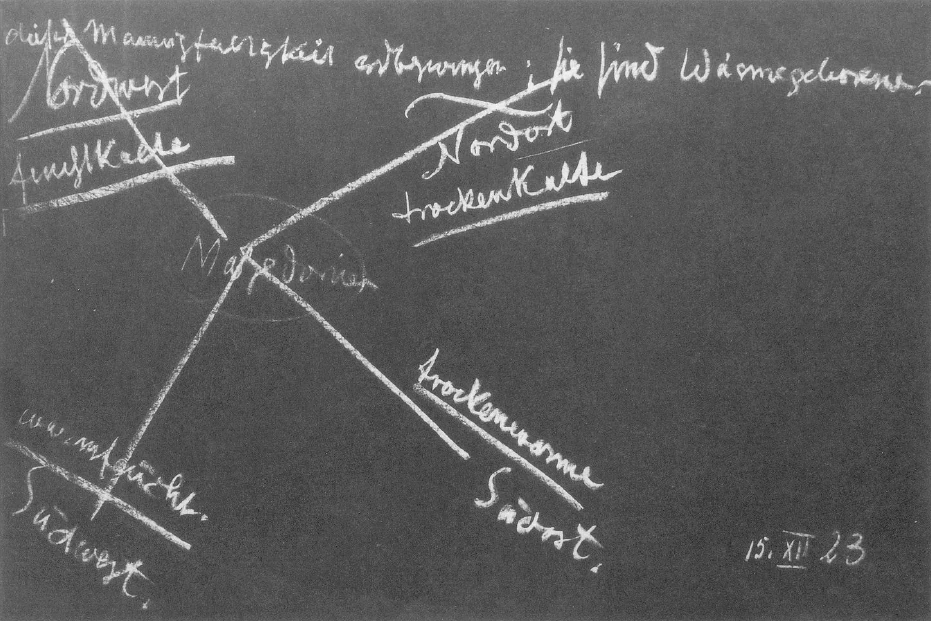
[ 29 ] Nun, von selbst hatte Aristoteles’ Schüler, Alexander, empfinden gelernt namentlich an dem, was die klimatischen Einflüsse, was die Winde hertrugen von Nordwesten, das Feuchtkalte; an dem, was von Südwesten hergetragen wurde, das Warmfeuchte. Das war ihm die Hälfte der Weltempfindung. Im Unterrichte wurde es ihm ergänzt, und es ging ihm das auch innerlich auf, daß das dazugehörte: dasjenige, was vom Nordosten her wehte, strahlte das Trockenkalte, und was vom Südosten her strömte, das Trockenwarme. So hatte er aus den vier Windrichtungen her die Empfindung kennengelernt des Trockenkalten, des Trockenwarmen, des Warmfeuchten, des Kaltfeuchten. Als echter Mensch der damaligen Zeit wollte er die Gegensätze versöhnen: Hier in Mazedonien erlebt man nur das Kaltfeuchte, das Warmfeuchte; verbunden muß es werden mit dem Kalttrockenen, mit dem Feurigtrockenen, mit dem, was aus dem Norden von Asien herüberweht, mit dem, was aus dem Süden von Asien herüberweht durch Asien.
[ 29 ] Now Aristotle’s pupil Alexander had learned from his own experience to feel, in what came from the climatic influences and the winds of the North-West, the damp and cold; and in what came from the South-West, the warm and damp. In this way he had a perception for only half of the world. In the instruction he received, this perception was completed for him, and he himself was able also to feel that what he was taught belonged to what he already knew by his own experience. He was taught how from the winds that blow from the North-East came the dry and cold, while the wind from the South-East brought the dry and warm. So now he had learned to have in the four directions of the four winds the perception of dry and cold, dry and warm, warm and moist and cold and moist. Being a true man of his time, he had the desire to reconcile these opposites. Here in Macedonia one’s experience was limited to the cold and damp and the warm and moist; these must be united with the cold and dry and the fiery and dry, must be united with what blows over from the North of Asia, and with what blows over from the South through Asia.
[ 30 ] Daraus entstand dann jener unwiderstehliche Drang zu den asiatischen Zügen. Und an diesem Beispiel sollen Sie sehen, daß es in der damaligen Zeit anders war als in der späteren Zeit. Denken Sie an eine Prinzenerziehung von heute, was da gelehrt wird; denken Sie sich solch einen Prinzen, der auf Heereszüge erzogen wird. Versuchen Sie sich klar zu machen, wie viel Verwandtschaft zwischen dem Physikunterricht, den irgendein Prinzenerzicher jemandem beibringt, und demjenigen ist, was dann erlebt wird auf dem Heereszuge: was da für eine Beziehung ist! Aus den Retorten schlüpft in der Regel nicht aus, was getan wird auf den Heereszügen. — An solchen Beispielen können Sie ganz besonders sehen, wie weit entfernt heute dasjenige ist, was Erkenntnis ist, was an den Menschen herangebracht werden soll, um seinen inneren Menschen zu formen, von dem, was der Mensch im äußeren Leben ist. Hier haben Sie noch eine Zeit, wo gerade aus der Erkenntnis heraus eine völlige Einheit erstrebt werden konnte zwischen dem, was den Menschen innerlich formt, gestaltet, und demjenigen, was macht, wie er selber in der Welt drinnen steht und in der Welt drinnen tut und handelt. Alte Geschichte geht schon aus der Schulstube hervor. Aber die Schulstube war eben mysterienverwandt, mysterienhaft, und das Mysterium bedeutete die Welt, und die Welt ergab sich als das Ergebnis dessen, was an Kräften im Mysterium war. Das gab den Impuls, nach Asien hinüberzutragen, was alte Naturwissenschaft war. In vielfach gesiebtem Zustande kam sie über Spanien durch Europa hindurch. Man merkt sie noch an dem, was Paracelsus geäußert hat, was Jakob Böhme, was Gichtel geäußert hat, was die verschiedenen Menschen geäußert haben, die dann wiederum angeknüpft haben an solche Geister wie Basilius Valentinus. Aber zunächst sollte siegen, was in bloße Gedankenform getaucht war, was in bloße Logik getaucht wat, und das andere sollte warten.
[ 30 ] Here you have the source of the irresistible urge that lived in Alexander to make expeditions into Asia. And from this example you may see how different things were then from the conditions that prevail in more recent times. Think of the education a prince receives today! Think of what he is taught, and then think of the education he receives ‘on the march’ with the troops. Try to make a clear picture of what kind of relationship exists between the instruction in physics given to a prince by some tutor, and what that prince experiences later on in the campaigns of war! Among the things that come out of a retort one does not as a rule find deeds done in a campaign of war! Such an example may help you to see how very far removed today is the knowledge that it is thought fit to teach a child in order to form his inner being, from what the child has actually to be later in external life. In the case of Alexander you have an era when complete unity was still striven for in knowledge between what was given the human being to mould and form him inwardly and what was given him to enable him to take his right place in the world. In those olden times history began in the schoolroom. But the schoolroom was a place that had affinity with the Mysteries, and the Mysteries meant the World ... and the World was seen to be the result of the forces that were in the Mysteries. It was this kind of education that gave the impulse to carry across into Asia the Natural Science of those ancient times. In a much sifted condition this Natural Science came across Spain into Europe. It can still be traced in the writings of Paracelsus, Jacob Boehme and Gichtl, and many more besides who later had connections with men like Basil Valentine and others. For a time it was inevitable that whatever of the knowledge could be expressed in logical forms of thought won the day and the other part of Aristotle’s knowledge had to wait.
[ 31 ] Aber heute ist die Zeit, wo dieses andere seine Warte-Aufgabe erfüllt hat, wo es wiedergefunden werden muß als die Summe der Naturerkenntnisse. Alexander mußte zunächst diese Naturgeheimnisse im Grunde genommen drüben in Asien begraben, denn nur ihre Leichname wurden nach Europa herübergebracht. Aber nicht diese Leichname sollen galvanisiert werden, sondern das ureigene Lebendige soll heute wieder gefunden werden. Die nötige Begeisterung, die dazu gehört, wird sich freilich im wesentlichen nur dann ergeben können, wenn auch eine warme Empfindung für das vorhanden ist, was in der Zeitenwende einmal da war, und wenn man ein lebendiges Gefühl dafür entwickelt, daß jene ja nur im äußeren als Eroberungszüge ausschauenden Züge Alexanders dahin gingen, zu der einen Seite der Windrose die andere Seite der Windrose zu finden, dahin gingen, zu enträtseln zu dem, was nur halb die Erde sein konnte, die andere Hälfte. Und es war durchaus auch das Aufsuchen eines persönlichen Erlebnisses. Das persönliche Erlebnis bestand eben darin, daß eine gewisse innere Unbefriedigung und Unbehaglichkeit in dem Milieu des bloß Kaltfeuchten und Feuchtwarmen da war, und daß die andere Empfindung sich hinzu ergänzen sollte.
[ 31 ] But now the time has come when this other part has fulfilled its time of waiting and all this knowledge of Nature must be rediscovered. It was really so that Alexander had to bury these secrets of Nature over in Asia, for it was nothing but their corpses that were brought across to Europe. It is not our task to galvanise these corpses but to rediscover the original living truth. And we shall only really find the necessary enthusiasm for such a task when we can develop a warm feeling for what took place at that turning-point of time, when we can perceive and appreciate the real purpose of Alexander’s campaigns. For only to outward appearance were they campaigns of conquest; in reality their object was to find the other side of the compass, to open up the other half of the world. They were also a search for a personal experience. And the personal experience consisted in this, that a certain discomfort, a certain lack of satisfaction was felt in the milieu of the cold-and-damp and moist-and-warm alone, and this needed to be complemented and satisfied by the addition of the other perception.
[ 32 ] Inwiefern das eben im eminentesten Sinne auch eine große historische Bedeutung in der Entwickelung des ganzen Abendlandes hatte, das werde ich dann auseinanderzusetzen haben in den Vorträgen, welche in der nächsten Zeit während der Delegiertenversammlung gehalten werden sollen über die okkulte Grundlage des geschichtlichen Lebens der Menschen auf der Erde.
[ 32 ] Of the immense historical significance of this event in the evolution of the whole Western world, I shall have to speak in the lectures that are to be given in the near future at the Delegates’ Meeting, on the subject of the occult foundations of the history of Man on Earth.
I. Pflanzengeheimmis
Ich schaue in die Blumen;
Ihre Verwandtschaft mit dem Mondensein offenbaren sie;
Sie sind erdbezwungen nun, denn sie sind Wassergeborene.II. Metallgeheimmis
Ich denke über die Metalle;
Ihre Verwandtschaft mit den Planeten offenbaren sie;
Sie sind erdbezwungen, denn sie sind Luftgeborene.III. Menschengeheimnis
Ich erlebe die Geheimnisse des Tierkreises in der Mannigfaltigkeit der Menschen;
Die Verwandtschaft dieser Mannigfaltigkeit der Menschen mit den Fixsternen steht vor meiner Seele;
Denn die Menschen leben mit dieser Mannigfaltigkeit erdbezwungen; sie sind Wärmegeborene.
Not translated