

The Composition of the Mysteries
GA 232
23 December 1923, Dornach
Translate the original German text into any language:
Versions Available:
The Composition of the Mysteries, tr. SOL
Vierzehnter Vortrag
Fourteenth Lecture
[ 1 ] Wir wollen noch den letzten dieser Vorträge heute damit ausfüllen, daß ich, gewissermaßen zusammenfassend das Mysterienwesen, das ich für diese oder jene Gegend der Erde vor Ihnen entwickelt habe, dieses Mysterienwesen wenigstens von einem Gesichtspunkte aus in der Gestalt zeige, die es angenommen hat während des Mittelalters, etwa vom zehnten bis fünfzehnten Jahrhundert.
[ 1 ] We would like to conclude today’s series of lectures by my presenting—in a sense, as a summary of the mystery traditions I have outlined for various regions of the Earth—at least one aspect of these mystery traditions as they took shape during the Middle Ages, roughly from the tenth to the fifteenth century.
[ 2 ] Ich spreche von diesem Zeitraum, nicht weil er ein besonders in sich abgeschlossener ist, sondern weil er gewissermaßen benutzt werden kann, um zu zeigen, welchen Stand das menschliche Seelenstreben in den zivilisiertesten Gegenden damals angenommen hat. Oftmals bezeichnet man ja eben dasjenige, was damals Geistesstreben war, als rosenkreuzerisches Mysterienwesen. Die Bezeichnung ist auch durchaus in einem gewissen Sinne berechtigt, aber man muß dann hinter dieser Bezeichnung nicht das vielfach Scharlatanhafte suchen, von dem in der Literatur die Rede ist, auch oftmals, ohne daß man aufmerksam darauf macht, wie scharlatanhaft die Dinge sind, von denen da berichtet wird, sondern man muß seine Blicke richten auf das tief ernste Erkenntnisstreben, das gerade in diesen Jahrhunderten in fast allen Gegenden Europas, Mittel-, West- und Südeuropas vorhanden war. Man muß sich klar darüber sein, daß der Faust, den Goethe geschildert hat, mit all dem tiefen Seelenstreben, mit all dem ernsten Streben im Grunde genommen eine Spätgestalt ist, die nicht mehr so tief in der Seele war wie mancher Forscher, der in den mittelalterlichen Laboratorien, von denen geschichtlich wenig gemeldet wird, zwischen dem zehnten und fünfzehnten Jahrhunderte arbeitete. Und ich erwähnte schon gestern, daß gerade bei den tieferen Forschern dieser Zeit ein tragischer Zug vorherrschend war. Denn das Eigentümliche war das Gefühl, daß man eigentlich nach dem Höchsten, was im Menschen schöpferisch tätig ist, streben müsse, daß man aber in einem gewissen Sinne nicht nur nicht nach diesem Höchsten streben kann, sondern daß es auch bedenklich ist von einem gewissen Gesichtspunkte aus, nach diesem Höchsten zu streben.
[ 2 ] I am referring to this period not because it is particularly self-contained, but because it can, in a sense, be used to illustrate the state that human spiritual striving had reached at that time in the most civilized regions. Often, what was then spiritual striving is referred to as Rosicrucian mysticism. The term is certainly justified in a certain sense, but one must not look behind this term for the often charlatan-like elements mentioned in the literature—which frequently refers to them without drawing attention to just how charlatan-like the things being reported actually are—but rather one must direct one’s gaze toward the deeply serious quest for knowledge that existed precisely during these centuries in almost all regions of Europe, Central, Western, and Southern Europe. One must be clear that the Faust portrayed by Goethe, with all his deep spiritual yearning and earnest striving, is essentially a later figure who was not as deeply rooted in the soul as many a researcher who worked in the medieval laboratories—about which little is historically recorded—between the tenth and fifteenth centuries. And I already mentioned yesterday that a tragic trait was particularly prevalent among the deeper-thinking researchers of that time. For what was peculiar was the feeling that one must actually strive for the highest that is creatively active in human beings, but that, in a certain sense, not only is it impossible to strive for this highest, but that it is also questionable, from a certain point of view, to strive for it.
[ 3 ] Ich sagte schon gestern, nicht eine theoretische, leichtgeschürzte Erkenntnis fand sich bei diesen Forschern in den alchemistischen Laboratorien zwischen dem zehnten und fünfzehnten Jahrhunderte, sondern etwas, was tief zusammenhing mit dem ganzen Menschen, mit dem innersten gefühlsmäßigen und von Erkenntnissehnsucht getragenen gefühlsmäßigen Erleben des Menschen — eine Herzens- und Gemütserkenntnis.
[ 3 ] As I said yesterday, these researchers in the alchemical laboratories between the tenth and fifteenth centuries did not arrive at a theoretical, superficial insight, but rather at something deeply connected to the whole human being—to the innermost emotional experience of the human being, an experience driven by a thirst for knowledge—an insight of the heart and soul.
[ 4 ] Und woher rührte diese? Nun, am besten wird es Ihnen erklärlich sein, wenn ich Ihnen diese tragische Skepsis der mittelalterlichen Forschung dadurch anschaulich mache, daß ich heute wiederum einmal hinweise auf die Gestaltung, welche menschliches Wissen einmal auf der Erde gehabt hat, auf die älteste Gestaltung.
[ 4 ] And where did this come from? Well, it will be easiest for you to understand if I illustrate this tragic skepticism of medieval scholarship by once again pointing out the form that human knowledge once took on Earth—its oldest form.
[ 5 ] Diese älteste Gestaltung des menschlichen Wissens, die ja eng mit dem Leben des einzelnen Menschen zusammenhing, war aber nicht so, daß die Menschen hinaufgeschaut hätten zu den Planeten und jene mathematische Größe, jene mathematischen Bewegungen gesehen hätten, die man heute da errechnet und erdenkt. Sondern jeder Planet, wie überhaupt alles, was im Felde des Himmels ausgebreitet ist, war ein lebendiges Wesen, nicht nur ein lebendiges, war ein beseeltes Wesen, nicht nur ein beseeltes, war ein durchgeistigtes Wesen. Und immer wiederum hat man gesprochen von den Familien der Planeten, von den Familien der Himmelskörper. Man hat schon gewußt: wie es eine Blutsverwandtschaft gibt zwischen den Mitgliedern einer Familie, so gibt es eine innere Verwandtschaft zwischen den Mitgliedern eines Planetensystems. Zwischen dem Menschlichen und demjenigen, was im Kosmos draußen sich offenbarte, war durchaus in der Erkenntnis ein Parallelismus vorhanden.
[ 5 ] This earliest form of human knowledge, which was, of course, closely linked to the life of the individual, did not, however, mean that people looked up at the planets and saw those mathematical quantities, those mathematical movements, which we calculate and conceive of there today. Rather, every planet—like everything else spread out across the heavens—was a living being, not merely a living one; it was an animated being, not merely an animated one; it was a spiritual being. And time and again, people spoke of the families of planets, of the families of celestial bodies. It was already known that just as there is a blood relationship among the members of a family, so there is an inner kinship among the members of a planetary system. In terms of knowledge, there was certainly a parallelism between the human realm and that which manifested itself out there in the cosmos.
[ 6 ] Nun möchte ich Ihnen auf einem Gebiete darstellen, wie man in urältesten Mysterien erkannte, wenn man hinaufsah zur Sonne. Es gab ja solche Mysterienstätten, die so eingerichtet waren, daß eine Art besonders zubereiteten Oberlichtes vorhanden war, so daß man zu bestimmten Tageszeiten im abgedämpften Lichte zur Sonne aufsah. Also Sie müssen sich vorstellen, daß die wichtigste Kammer in manchen urältesten Sonnenmysterien diejenige war, wo im Dache ein Oberlicht eingesetzt war. Das Fenster war abgeschlossen mit einem solchen Matezial — nicht im heutigen Sinne Glas —, daß im sehr dämmerig abgedämpften Lichte man die Sonnenscheibe zu einer bestimmten Zeit des Tages vor sich hatte. Der Schüler wurde nun vorbereitet, diesen Blick auf die Sonnenscheibe in der richtigen inneren Seelenverfassung in sich aufzunehmen. Er mußte sein Gemüt so empfänglich, so innerlich wahrnehmungsfähig machen, daß, wenn er sozusagen seine Seele durch sein ‚Auge der Sonnenscheibe im abgedämpften Lichte exponierte, das auf ihn einen Eindruck machte, den er wirklich dann sich vorstellen konnte.
[ 6 ] Now I would like to describe to you, in one area, how people in the most ancient mysteries gained insight by looking up at the sun. There were, in fact, such mystery sites that were designed to have a kind of specially prepared skylight, so that at certain times of day one could look up at the sun in subdued light. So you must imagine that the most important chamber in some of the most ancient solar mysteries was the one where a skylight was set into the roof. The window was sealed with a material—not glass in the modern sense—such that, in the very dim, subdued light, one could see the sun’s disk before oneself at a specific time of day. The student was then prepared to take in this view of the sun’s disk with the proper inner state of mind. He had to make his mind so receptive, so inwardly perceptive, that when he, so to speak, exposed his soul through his “eye” to the sun’s disk in the subdued light, it made an impression on him that he could then truly imagine.
[ 7 ] Gewiß, es schauen ja auch heute manche Leute durch gedämpftes Glas in die Sonne, aber sie sind nicht vorbereitet in ihrem Empfindungsvermögen, um den Eindruck, den die Sonne macht, wirklich so vorzustellen, daß die Seele ihn als besonderen Eindruck hat. Für die Schüler dieser Mysterien war dieser Eindruck der abgedämpften Sonnenscheibe, dieser Eindruck, der geholt wurde, nachdem lange Exerzitien vorangegangen waren, ein ganz bestimmter. Und der Mensch, der diesen Eindruck als Schüler der Mysterien-Initiatoren haben konnte, der konnte wahrhaftig diesen Eindruck nicht wieder vergessen. Mit diesem Eindruck hatte aber der Schüler auch etwas gewonnen, was ihm mehr Verständnis für gewisse Dinge geben konnte, als er sonst hatte. Und so wurde denn der Schüler, nachdem er vorbereitet war durch den majestätischen, großartigen Eindruck der Sonne, nun dazu geführt, die besondere Qualität der Substanz Gold auf sich wirken zu lassen. Und durch diese Vorbereitung, durch diese Sonnenvorbereitung war es wirklich so, daß der Schüler zu einem tiefen Verständnis der Qualität Gold kam.
[ 7 ] Certainly, even today some people look at the sun through tinted glass, but their sensory perception is not prepared to truly imagine the impression the sun makes in such a way that the soul experiences it as a special impression. For the students of these mysteries, this impression of the dimmed sun disk—an impression gained after a long period of spiritual exercises—was a very specific one. And the person who, as a student of the mystery initiators, was able to receive this impression could truly never forget it. With this impression, however, the student had also gained something that could give him a greater understanding of certain things than he would otherwise have had. And so, after being prepared by the majestic, magnificent impression of the sun, the student was now led to allow the special quality of the substance gold to take effect upon him. And through this preparation—through this solar preparation—the student truly attained a deep understanding of the quality of gold.
[ 8 ] Wenn man in diese Dinge hineinschaut, kommt einem wirklich schmerzlich die Trivialität zum Bewußtsein, mit der heute in historischen Werken oftmals dargestellt wird, warum diese oder jene älteren Denker das Gold der Sonne zugeteilt haben, der Sonne und dem Golde dasselbe Zeichen gegeben haben. Man weiß eben heute nicht mehr, daß dasjenige, was in dieser Weise einmal gewußt worden ist, wirklich hervorgegangen ist aus langen Übungen und Vorbereitungen. Ich möchte sagen: das Hineinsenken des durchseelten Blickes in das abgedämpfte direkte Sonnenlicht bereitete den Schüler vor, das Gold der Erde zu verstehen. Und wie verstand er es? Nachdem er diese Vorbereitung hatte, fiel zunächst seine Aufmerksamkeit darauf, daß das Gold unempfänglich ist für dasjenige, was sonst für die Organismen Lebensluft ist, und wofür viele Metalle, die meisten anderen Metalle, durchaus empfänglich sind: Sauerstoff. Sauerstoff, Oxygen, verändert das Gold nicht. Diese Unempfänglichkeit, diese Hartnäckigkeit des Goldes gegenüber dem, wovon ja der Mensch sein Leben hat, das übte einen tiefen Eindruck aus auf den alten Mysterienschüler. Und so bekam er vom Golde den Eindruck: An das Leben kann zunächst das Gold nicht heran. An das Leben unmittelbar kann aber auch die Sonne nicht heran. Und es ist gut, daß weder Gold noch Sonne an das Leben unmittelbar heran können. Denn nun wurde der Schüler weitergeführt, und er kam nach und nach darauf, daß das Gold gerade dadurch, daß es gar keine Verwandtschaft zu der Lebensluft, zu dem Sauerstoff hat, wenn es in einer gewissen Dosierung in den menschlichen Organismus eingeführt wird, eine ganz besondere Wirkung auf den menschlichen Organismus hat. Eine ganz besondere Relation hat dieses Gold zum menschlichen Organismus, wenn es nur eben, wie gesagt, in der entsprechenden Dosierung eingeführt wird. Es hat keine Relation zum ätherischen Leib, keine Relation zum astralischen Leib unmittelbar, sondern eine unmittelbare Relation zu dem, was im menschlichen Denken liegt.
[ 8 ] When one looks into these matters, one becomes painfully aware of the triviality with which historical works today often explain why this or that ancient thinker attributed gold to the sun, or assigned the same symbol to both the sun and gold. People today simply no longer realize that what was once known in this way truly arose from long practice and preparation. I would like to say: immersing the soul-infused gaze in the subdued, direct sunlight prepared the student to understand the gold of the earth. And how did he understand it? Having undergone this preparation, his attention was first drawn to the fact that gold is impervious to what is otherwise the breath of life for organisms—and to which many metals, most other metals, are thoroughly receptive: oxygen. Oxygen does not alter gold. This imperviousness, this tenacity of gold toward that from which human life itself derives, made a deep impression on the ancient mystery student. And so he gained the impression from gold: At first, gold cannot approach life. Nor, however, can the sun approach life directly. And it is good that neither gold nor the sun can directly approach life. For now the student was led further, and he gradually came to realize that gold, precisely because it has no affinity whatsoever to the breath of life—to oxygen—has a very special effect on the human organism when introduced into it in a certain dosage. This gold has a very special relationship to the human organism, provided, as mentioned, that it is introduced in the appropriate dosage. It has no direct relationship to the etheric body, no direct relationship to the astral body, but rather a direct relationship to what lies within human thought.
[ 9 ] Fassen Sie nur einmal ins Auge, wie weit das Denken vom menschlichen Leben abliegt, gerade in unserer heutigen Zeit! Man kann wie ein Klotz sitzen, wie ein Holzklotz, und man kann abstrakt denken, ganz lebendig abstrakt denken. Aber man kann auf der anderen Seite durch das bloße Denken eben nichts im Organismus bewirken; das Denken ist immer mehr und mehr für die Menschen ohnmächtig geworden. Aber das Denken wird von der Ich-organisation in Bewegung gesetzt. Und das Gold, in der richtigen Dosierung in den menschlichen Organismus eingefügt, dieses Gold, das bringt wiederum dem Denken Macht zurück. Das bringt dem Denken jene Macht zurück, daß das Denken in den astralischen Leib, ja in den Ätherleib hinunterwirken kann. Vom Denken aus wird der Mensch durch das Gold belebt.
[ 9 ] Just consider for a moment how far removed thinking is from human life, especially in our time! One can sit there like a block of wood, and one can think abstractly—think abstractly in a very lively way. But on the other hand, mere thinking alone cannot bring about anything in the organism; thinking has become increasingly powerless for human beings. But thinking is set in motion by the “I” organization. And gold—introduced into the human organism in the correct dosage—restores power to thinking. It restores to thinking the power to act down into the astral body, indeed into the etheric body. Through gold, the human being is enlivened from within by thinking.
[ 10 ] Das war eines der Geheimnisse urältester Mysterien, das GoldGeheimnis in Verbindung mit der Sonne. Die Verwandtschaft der Substanz Gold mit der kosmischen Wirkung der Sonne fiel dem Schüler auf eben in jenen älteren Zeiten, von denen ich Ihnen gesprochen habe.
[ 10 ] This was one of the secrets of the most ancient mysteries: the secret of gold in connection with the sun. The connection between the substance of gold and the cosmic influence of the sun was recognized by students precisely in those ancient times of which I have spoken to you.
[ 11 ] Und ebenso, in einer ähnlichen Weise, kam der Schüler älterer Mysterien darauf, wie, ich möchte sagen, der entgegengesetzte Pol des Goldes wirkt. Das Gold ist ein Impuls für die Belebung des menschlichen Denkens, so daß das menschliche Denken bis in den ätherischen Leib hinunter wirken kann. Und der entgegengesetzte Pol, welcher wäre es denn?
[ 11 ] And in a similar way, the student of the ancient mysteries came to understand how, I might say, the opposite pole of gold works. Gold is an impulse for the enlivening of human thought, so that human thought can extend its influence down into the etheric body. And the opposite pole—which one would that be?
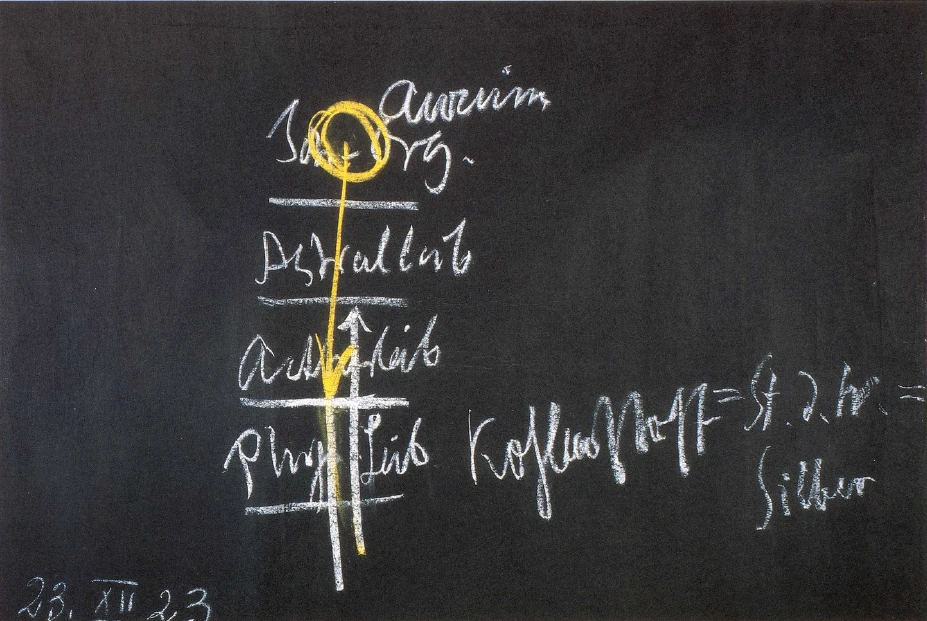
[ 12 ] Sehen Sie, wenn man den menschlichen Organismus hat in seinen Gliedern, Ichorganisation, Astralleib, Ätherleib, physischer Leib, kann man sagen: Durch das Gold wird die Ich-organisation fähig, bis hinunter in den Ätherleib zu wirken. Der Ätherleib kann dann auf den physischen Leib weiter wirken. Aber das Gold bewirkt, daß man tatsächlich die Gedanken bis in den Ätherleib hinein mächtig erhalten kann.
[ 12 ] You see, when we consider the human organism in its various parts—the ego-organization, the astral body, the etheric body, and the physical body—we can say: Through gold, the ego-organization becomes capable of acting all the way down into the etheric body. The etheric body can then continue to act upon the physical body. But gold enables one to actually sustain one’s thoughts powerfully all the way into the etheric body.
[ 13 ] Was ist der entgegengesetzte Pol? Nun, wenn wir eben eine diesem Pfeil hier entgegengesetzte Wirkung hervorrufen! Diese Wirkung aber, das ist eben diejenige, die sich uns darstellt, wenn gerade die Lebensluft, der Sauerstoff, das Oxygen, angezogen wird von etwas im Menschen oder von etwas in der Natur. Und so wie das Gold hartnäkkig gegen den Sauerstoff ist, ihn abstößt, ihn nicht will und dadurch zunächst keinen Einfluß auf den Ätherleib, auf den Astralleib hat, sondern nur auf die Gedankenwelt der Ich-organisation, so hat im Menschen dasjenige, was Kohlenstoff ist, eine unmittelbare Verwandtschaft zu der Lebensluft. Wir atmen ja Kohlensäure aus, wir machen Kohlensäure, verbinden Kohlenstoff mit Sauerstoff. Die Pflanze braucht Kohlensäure zu ihrem Leben. Der Kohlenstoff, er hat gerade die entgegengesetzte Eigenschaft vom Golde.
[ 13 ] What is the opposite pole? Well, when we bring about an effect opposite to that of this arrow here! But this effect is precisely the one that presents itself to us when the breath of life—oxygen—is drawn toward something within the human being or something in nature. And just as gold is resistant to oxygen—repelling it, rejecting it, and thereby initially having no influence on the etheric body or the astral body, but only on the thought world of the “I” organization—so, in the human being, that which is carbon has a direct affinity with the life-giving air. After all, we exhale carbon dioxide; we produce carbon dioxide by combining carbon with oxygen. The plant needs carbon dioxide to live. Carbon has precisely the opposite property of gold.
[ 14 ] Nun, dieser Kohlenstoff spielte eine große Rolle in urältesten Mysterien. Denn man sprach auf der einen Seite vom Golde als ganz besonders wichtiger Substanz, wenn man den Menschen betrachten will, man sprach auf der anderen Seite vom Kohlenstoff. Und vom Kohlenstoff sprach man in den ältesten Mysterien so, daß man ihn nannte den Stein der Weisen. Und Gold und der Stein der Weisen waren sehr wichtige Dinge in diesen älteren Zeiten — Gold und der Stein der Weisen. Kohlenstoff war der Stein der Weisen.
[ 14 ] Well, this carbon played a major role in the most ancient mysteries. For, on the one hand, gold was spoken of as a particularly important substance when considering human beings; on the other hand, carbon was spoken of. And in the most ancient mysteries, carbon was referred to as the Philosopher’s Stone. And gold and the Philosopher’s Stone were very important things in those earlier times—gold and the Philosopher’s Stone. Carbon was the Philosopher’s Stone.
[ 15 ] Auf der Erde kommt der Kohlenstoff in einer Anzahl von Gestaltungen vor. Demant ist Kohlenstoff, harter Kohlenstoff. Graphit ist Kohlenstoff. Steinkohle ist Kohlenstoff. Anthrazit ist Kohlenstoff. Auf Erden kommt also der Kohlenstoff in der mannigfaltigsten Weise vor. Aber jetzt, durch die Methoden, die in den alten Mysterien üblich waren, lernte man erkennen, daß es noch andere Gestaltungen des Kohlenstofles gibt als diejenigen, die auf der Erde sind. Und sehen Sie, da gab es eben eine andere Vorbereitung für die Mysterienschüler als diejenige, von der ich schon gesprochen habe, die Sonnenvorbereitung: es gab die Mondenvorbereitung.
[ 15 ] On Earth, carbon occurs in a variety of forms. Diamond is carbon—hard carbon. Graphite is carbon. Bituminous coal is carbon. Anthracite is carbon. Thus, on Earth, carbon occurs in the most diverse ways. But now, through the methods that were customary in the ancient mysteries, people came to recognize that there are other forms of carbon besides those found on Earth. And you see, there was another preparation for the mystery students besides the one I have already spoken of—the solar preparation: there was the lunar preparation.
[ 16 ] Beigegeben war gerade den Sonnenmysterien, ich möchte sagen eine Art Observatorium, wo nun der Mensch exponiert werden konnte seiner Seele und seinem physischen Auge nach den Gestaltungen des Mondes. Da mußte man nicht bloß im abgedämpften Lichte die Sonne zu einer bestimmten Zeit schauen, da mußte man tatsächlich durch Wochen den verschiedenen Gestaltungen, die die Mondenscheibe zur Nacht annimmt, das durchseelte Auge exponieren. Da bekam man wiederum einen bestimmten Eindruck in seiner Seele, durch den man jetzt erst Erkenntnisse bekam. So wie man die sonnenfähige Seele bekam durch das Exponieren gegenüber der Sonne, so bekam man die mondenfähige Seele durch das Exponieren gegenüber den Mondenphasen.
[ 16 ] Attached to the Sun Mysteries was—I might say—a kind of observatory where a person could be exposed, both in spirit and with their physical eyes, to the phases of the moon. There, one did not merely have to gaze at the sun in subdued light at a specific time; rather, one actually had to expose the soul-imbued eye for weeks on end to the various phases that the lunar disk assumes at night. This, in turn, imparted a specific impression upon one’s soul, through which one could now gain insights. Just as one acquired a soul capable of receiving the sun by exposing oneself to the sun, so too did one acquire a soul capable of receiving the moon by exposing oneself to the phases of the moon.
[ 17 ] Jetzt lernte man erkennen, welche Metamorphose der Kohlenstoff durchmachen kann. Auf der Erde ist der Kohlenstoff entweder Kohle oder Graphit oder Demant oder Anthrazit. Auf dem Monde ist dasjenige, was auf der Erde entweder Demant oder Anthrazit oder Kohle ist, Silber. Das war das Geheimnis der alten Mysterien: Kohlenstoff ist auf dem Monde Silber. Kohlenstoff ist der Stein der Weisen, und er ist auf dem Monde Silber. Was in den alten Mysterien so tief an den Menschen herangebracht wurde als Erkenntnis, das war, daß irgendeine Substanz das, als was sie sich äußerlich darstellt, nur an diesem Orte, um diese Zeit so ist: Man war einfach Ignorant, wenn man nicht wußte, Kohlenstoff ist Kohle, Demant, Graphit nur auf der Erde; dasselbe, was auf der Erde Demant und Graphit ist, ist auf dem Monde Silber; und würde man ein Stück unserer gewöhnlichen schwarzen Kohle in diesem Momente hinaufbefördern können nach dem Monde, sie würde dort Silber. Diese, ich möchte sagen, radikale Metamorphosenanschauung bekam der Schüler in jenen älteren Zeiten. Und das liegt eigentlich jener scharlatanhaften Alchemie, von der heute vielfach gesprochen wird, nicht zugrunde, sondern das liegt der wirklichen älteren Alchemie zugrunde. Aber so etwas, wie diese ältere Alchemie es ist, kann eben nicht auf eine so abstrakte Wissensart errungen werden, wie man heute irgend etwas weiß.
[ 17 ] Now people came to understand the metamorphosis that carbon can undergo. On Earth, carbon is either coal, graphite, diamond, or anthracite. On the Moon, what on Earth is either diamond, anthracite, or coal is silver. That was the secret of the ancient mysteries: carbon is silver on the Moon. Carbon is the philosopher’s stone, and on the Moon it is silver. What was imparted so profoundly to people in the ancient mysteries as knowledge was that a certain substance is what it appears to be on the outside only in this place, at this time: One was simply ignorant if one did not know that carbon is coal, diamond, and graphite only on Earth; the same substance that is diamond and graphite on Earth is silver on the Moon; and if one could transport a piece of our ordinary black coal to the Moon at this very moment, it would become silver there. This—I would say—radical view of metamorphosis was held by students in those earlier times. And this is not, in fact, the basis of that charlatan-like alchemy that is so often spoken of today, but rather it is the basis of the true, older alchemy. But something like this older alchemy simply cannot be attained through the kind of abstract knowledge we possess today.
[ 18 ] Heute beobachtet man, oder man denkt über die Dinge. So konnte Alchemie nicht errungen werden. Heute richtet man das Fernrohr nach einem Stern, bestimmt Parallaxen und dergleichen und rechnet und rechnet, oder etwa um seine Substanz kennenzulernen, wendet man das Spektroskop an und so weiter. Aber alles das, was man da kennenlernt, ist ja so unendlich abstrakt gegenüber dem, was man einmal kennenlernen konnte von den Sternen! Aber man konnte die alte Weisheit, die wirkliche Astrologie, nur kennenlernen, wenn man, wie ich schon gestern sagte, den lebendigen Verkehr hatte mit den Intelligenzen des Kosmos. Das war eben Erlangung eines Wissens, daß man sprechen konnte in seiner Seele, in seinem Geiste mit den Intelligenzen des Kosmos. Was das Aurum für den menschlichen Organismus bedeutet, das hängt mit dem Sonnengeheimnis zusammen. Dadurch, daß man in dieser Weise, wie ich es geschildert habe, die eigene Seele exponierte dem Sonnensein, dadurch kam man in Relation mit den Intelligenzen der Sonne selber. Die konnten einem sagen, wie es sich mit dem Aurum verhält. Und ebenso kam man in Zusammenhang mit den Intelligenzen des Mondes auf die Art, wie ich sie Ihnen geschildert habe.
[ 18 ] Today, people observe or think about things. That is not how alchemy was achieved. Today, people point a telescope at a star, determine parallaxes and the like, and calculate and calculate; or, to learn about its composition, they use a spectroscope, and so on. But everything one learns in this way is so infinitely abstract compared to what one was once able to learn from the stars! Yet one could only come to know the ancient wisdom—true astrology—if, as I said yesterday, one had a living connection with the intelligences of the cosmos. That was precisely the attainment of a knowledge that allowed one to speak in one’s soul, in one’s spirit, with the intelligences of the cosmos. What the Aurum means for the human organism is connected to the mystery of the Sun. By exposing one’s own soul to the Sun’s essence in the way I have described, one entered into a relationship with the intelligences of the Sun itself. They could tell one what the nature of the Aurum is. And in the same way, one came into connection with the intelligences of the Moon in the manner I have described to you.
[ 19 ] Diese Intelligenzen des Mondes lernte man allerdings als diejenigen kennen, die einmal in alten Zeiten selber die großen Lehrer der Erdenmenschheit waren, als die Urweisheit auf Erden gelehrt worden ist. Da waren es dieselben Lehrer, die heute, ich möchte sagen, vom Monde herab ihre Kräfte, ihre Impulse wirken lassen. Sie haben sich zurückgezogen in einer bestimmten Zeit von der Erde nach dem Mondendasein, gewissermaßen von der Erde aus eine Kolonie im Monde gegründet mit der Abtrennung des Mondes von der Erde.
[ 19 ] These intelligences of the Moon, however, came to be recognized as those who, in ancient times, were themselves the great teachers of humanity on Earth, when primordial wisdom was taught on Earth. These were the very same teachers who today—I might say—exert their powers and impulses from the Moon. At a certain time, they withdrew from Earth to the lunar realm; in a sense, they founded a colony on the Moon from Earth when the Moon separated from Earth.
[ 20 ] Also mit dem, was hier (siehe Schema) das zweite war, das Kohlenstoff-Silber-Geheimnis, haben diejenigen Intelligenzen zu tun, die sogar einmal auf der Erde waren, und die heute Mondintelligenzen sind. Sehen Sie, in dieser Weise wußte man in älteren Zeiten.
[ 20 ] So the second element mentioned here (see diagram)—the carbon-silver secret—is associated with those intelligences that were once on Earth and are now lunar intelligences. You see, this is how people understood it in earlier times.
[ 21 ] Ich will ein anderes Beispiel noch sagen. So wie von Sonne und Mond bekam man auch Eindrücke bei einer Seelenvorbereitung von den anderen Planeten. Und so ist es eines der Geheimnisse in den älteren Zeiten, das sich auf die Venus bezieht. Die Venus, man schaut sie heute an durch das Teleskop, und man rechnet sie anderen Sternen, anderen Planeten gleich. Geradeso, wie man mit dem menschlichen Organismus so vorgeht, daß man ein Stück Leber untersucht und dann wiederum ein Stück Gehirn, und da eigentlich nur den Zellenbau untersucht, als wenn es nicht zwei ganz radikal verschiedene Substanzen wären, Gehirnsubstanz und Lebersubstanz, so richtet man auch das Fernrohr hinaus und meint, Merkur, Venus und Mars und so weiter, das seien alles gleichartige Substanzen. In jener alten Zeit wußte man, indem man den Mond und die Sonne ins Auge faßte, kommt man noch aus mit dem, was unmittelbar zur physischen Erde, zum Irdischen, zum Wäßrigen, zum Luftförmigen, zum Feurigen Beziehung hat. Indem man bis zum Monde seine Beobachtungen in geistiger Art ausdehnt, kommt man bis zum Äther. Aber indem man seine Beobachtungen bis zur Venus ausdehnt, kommt man in eine geistige Welt, in eine rein astralische Welt hinein. Das, was als physische Venus erscheint, ist gewissermaßen nur das äußere Merkzeichen für etwas, was lebt und west im Astralischen, respektive im astralischen Lichte. Das physischeLicht ist bei der Venus etwas ganz anderes als zum Beispiel das physische Sonnenlicht. Das physische Sonnenlicht hat noch etwas Verwandtschaft mit dem, was auf der Erde als ein auf Erden entstehendes Licht leben kann. Das, was Venuslicht ist —es ist kindisch, es nur für ein reflektiertes Sonnenlicht zu halten —, leuchtet heraus schon aus der geistigen Welt. Und exponiert man diesem Lichte das eigene Seelenwesen, so lernt man erkennen, welche Intelligenzen mit der Venus verknüpft sind.
[ 21 ] I’d like to give another example. Just as with the sun and the moon, one also gained insights from the other planets during soul preparation. And so one of the mysteries of ancient times relates to Venus. Venus—when we look at it today through a telescope, we treat it just like other stars and planets. Just as one proceeds with the human organism by examining a piece of liver and then a piece of brain—and in doing so actually examines only the cellular structure, as if brain substance and liver substance were not two radically different substances—so, too, one points the telescope outward and assumes that Mercury, Venus, Mars, and so on are all substances of the same kind. In those ancient times, people knew that by gazing at the Moon and the Sun, one could still limit oneself to what is directly related to the physical Earth, to the Earthly, the Watery, the Airy, and the Fiery. By extending one’s observations spiritually as far as the Moon, one reaches the ether. But by extending one’s observations as far as Venus, one enters a spiritual world, a purely astral world. What appears as the physical Venus is, in a sense, merely the outward sign of something that lives and dwells in the astral realm, or rather in astral light. The physical light of Venus is something entirely different from, for example, the physical sunlight. Physical sunlight still bears some resemblance to what can exist on Earth as light arising from the Earth itself. Venusian light—it is childish to regard it merely as reflected sunlight—shines forth directly from the spiritual world. And if one exposes one’s own soul being to this light, one learns to recognize the intelligences associated with Venus.
[ 22 ] Das sind Intelligenzen, welche in einem fortwährenden Gegensatz, ich möchte sagen, in einer fortwährenden Opposition leben zu den Intelligenzen der Sonne. Und eine große Rolle spielte in den alten Mysterien dieser Gegensatz zwischen den Venusintelligenzen und den Sonnenintelligenzen. Man sprach mit einem gewissen Rechte von einem fortdauernden Kampf der Venusintelligenz gegen die Sonnenintelligenz. Da gab es Ausgangspunkte solcher Kämpfe, in denen die Venusintelligenzen gegen die Sonnenintelligenzen zu kämpfen begannen. Da gab es Steigerungen, Kulminationen, da gab es Katastrophen, Krisen, und man hatte sozusagen in dem, was da zwischen einer Exposition und einer Katastrophe oder Krise lag, einen Abschnitt in dem großen Oppositionskampfe, der sich in der geistigen Welt abspielt, und der im äußeren Zeichen nur erscheint in der astrologischen, astronomischen Beziehung zwischen Venus und Sonne. In dem, was sich da abspielt, hatte man aufeinanderfolgende Phasen. Und kein Mensch kann verstehen, was auf Erden als die inneren Impulse der Geschichte lebt, wenn man nicht weiß, wie der Kampf zwischen der Venus und der Sonne ist. Denn dasjenige, was sich hier auf Erden als Kämpfe, was sich sonst abspielt in der Entwickelung der Zivilisation, das ist ein irdisches Abbild dieses Venus-Sonnen-Kampfes.
[ 22 ] These are intelligences that exist in a constant contrast—I would say, in a constant opposition—to the intelligences of the Sun. And this contrast between the Venusian intelligences and the solar intelligences played a major role in the ancient mysteries. People spoke, with some justification, of a continuous struggle of the Venusian intelligence against the solar intelligence. There were starting points for such struggles, in which the Venusian intelligences began to fight against the solar intelligences. There were escalations, culminations; there were catastrophes and crises; and, so to speak, in what lay between an exposition and a catastrophe or crisis, there was a phase in the great struggle of opposition that takes place in the spiritual world—a struggle that appears outwardly only in the astrological and astronomical relationship between Venus and the Sun. In what is taking place there, there were successive phases. And no one can understand what lives on Earth as the inner impulses of history unless one knows the nature of the struggle between Venus and the Sun. For what takes place here on Earth as struggles—and whatever else unfolds in the development of civilization—is an earthly reflection of this struggle between Venus and the Sun.
[ 23 ] Das hat man in alten Mysterien gewußt. Solches Wissen war da, weil es eine Beziehung gab zwischen den Menschen und den Intelligenzen des Kosmos.
[ 23 ] This was known in the ancient mysteries. Such knowledge existed because there was a connection between human beings and the intelligences of the cosmos.
[ 24 ] Nun kam die Zeit, von der ich Ihnen gesprochen habe, vom zehnten bis zum fünfzehnten Jahrhundert. Diese Forscher in den mittelalterlichen alchemistischen Laboratorien, sie konnten nach der Entwickelung der Menschheit nicht mehr hinaufgelangen zu den kosmischen Intelligenzen; aber sie konnten zu den Naturgeistern noch kommen. Indem diese alchemistischen Forscher zahlreiche solcher chemischen Versuche, wie ich Ihnen gestern im Beispiel einen gezeigt habe mit der Verwandlung der Oxalsäure in die Ameisensäure, anstellten, die ihnen enthüllen sollten das göttliche Walten und Wirken in den Naturprozessen und Naturdingen, konnten sie dies nur, indem zu ihnen im rechten Momente — ich habe gestern gesagt, wenn sie in der richtigen Weise durch Frommheit sich vorbereitet hatten — die Naturgeister sprachen. Sehen wir uns das jetzt ganz genau an, in welcher Lage solch ein Forscher war.
[ 24 ] Now came the period I have spoken to you about, from the tenth to the fifteenth century. These researchers in the medieval alchemical laboratories, given the state of human development, could no longer ascend to the cosmic intelligences; but they could still reach the spirits of nature. As these alchemical researchers conducted numerous chemical experiments—such as the one I showed you yesterday as an example, involving the transformation of oxalic acid into formic acid—which were intended to reveal to them the divine governance and activity in natural processes and natural phenomena, they were able to do so only because, at the right moment, — as I said yesterday, if they had prepared themselves properly through piety — the spirits of nature spoke to them. Let us now examine very closely the situation in which such a researcher found himself.
[ 25 ] Solch ein Forscher stand in seinem Laboratorium. Er konnte sich sagen: Da trage ich herein in dieses mein Laboratorium die Substanzen, die Retorten, die Brennöfen. Ich mache die verschiedenen Experimente. Indem ich an die Natur durch meine Experimente die Fragen stelle, treten in mein Laboratorium für mein Anschauen die Naturgeister mit ihren Offenbarungen herein. — Denn das gab es noch bis zum fünfzehnten Jahrhundert, daß die Naturgeister herankamen an den richtig vorbereiteten rosenkreuzerischen Forscher; das gab es! Aber davon wußte er noch äußerlich, daß man in alten Zeiten nicht bloß zu den Naturgeistern, sondern zu den höheren kosmischen Intelligenzen gelangt war, zu jenen Intelligenzen, die einem sprachen von dem AurumGeheimnis im Zusammenhang mit der Sonne, von dem Silber-Geheimnis und dem Kohlenstoff-Geheimnis im Zusammenhang mit dem Monde, von dem historisch wichtigen Venus-Geheimnis und so weiter. Gewiß, aus Nachrichten, die da geblieben waren aus der Tradition, wußte das auch dieser mittelalterliche alchemistische Forscher. Aber das war nicht das besonders Wichtige. Derjenige, der überhaupt einmal berührt wird vom Spirituellen, dem sind historische Dokumente nicht so furchtbar wichtig, wie sie der heutigen materialistischen Zeit sind. Man ist ja immer wiederum erstaunt, wie unendlich wichtig es für manche Menschen ist, wenn so etwas wie neulich der Dinosaurus
[ 25 ] Such a researcher stood in his laboratory. He could say to himself: Here I bring into this, my laboratory, the substances, the retorts, the furnaces. I carry out the various experiments. As I pose questions to nature through my experiments, the spirits of nature enter my laboratory with their revelations for me to behold. — For up until the fifteenth century, it was still the case that the spirits of nature would approach the properly prepared Rosicrucian researcher; it was true! But he knew, at least superficially, that in ancient times people had attained not only the spirits of nature but also the higher cosmic intelligences—those intelligences that spoke to them of the mystery of gold in connection with the sun, of the mystery of silver and the mystery of carbon in connection with the moon, of the historically significant mystery of Venus, and so on. Certainly, this medieval alchemical researcher also knew this from the information that had been preserved through tradition. But that was not what was particularly important. For anyone who has ever been touched by the spiritual, historical documents are not nearly as important as they are in today’s materialistic age. One is always amazed, after all, at how incredibly important it is to some people when something like the recent discovery of the dinosaur
[ 26 ] in der Wüste Gobi gefunden worden ist. Das war ja ein wichtiges Stück, aber es sind das doch immer nur einzelne Brocken; während auf spirituelle Art wirklich in die Geheimnisse der Welt hineinzukommen ist. ‚Also die historischen Dokumente würden diesen mittelalterlichen Forscher ganz gewiß nicht besonders berührt haben. Aber auf eine andere Weise kam er hin zu einem Wissen, daß man früher einmal zu einer kosmischen Erkenntnis herangelangt ist, daß man jetzt nur herangelangen kann an die Naturgeister, die hinter den Elementen, dem Luftförmigen, dem Feurigen, dem Wasserförmigen stehen. Es war nämlich die Sache so: In gewissen Momenten, wenn gewisse Beobachtungen an der Natur gemacht oder Experimente über die Natur ausgeführt wurden, wenn man also an die Sphäre der Naturgeister herankam, dann waren gewisse Naturgeister da, die einem sagten: Es gab einmal Menschen, die mit den kosmischen Intelligenzen in Zusammenhang standen. — Das war das Quälende, das war das Bohrende, das war das Schmerzhafte für diese mittelalterlichen Forscher, daß ihnen die Naturgeister von einer Vorzeit sprachen, in der die Menschen mit den Intelligenzen des Kosmos in Zusammenhang standen. Und die Menschen mußten sich sagen: Von einer alten Zeit erzählen noch die Naturgeister, die hinunterverschwunden ist in den Abgrund des menschlichen Wissens und menschlichen Seins. — Und so war die Gabe der mittelalterlichen Alchemisten, an die Naturgeister heranzukommen, wirklich eine zweifelhafte. Auf der einen Seite kam man an das Geistige der Natur, an das Geistige der Luft, an das Geistige des Wassers, an Gnomen, Sylphen und Undinen heran in ihrer lebendigen Wirklichkeit. Auf der anderen Seite aber wiederum waren unter diesen solche Geister, die ihnen von Dingen erzählten, die sie niederschmetterten, weil sie ihnen zeigten, wie die Menschheit einmal nicht nur mit diesen Naturgeistern in Zusammenhang stand, sondern mit denjenigen Intelligenzen, mit denen diese Naturgeister heute noch in einem lebendigen Zusammenhang stehen, nicht mehr die Menschen. Das war das Gefühl dieser mittelalterlichen Alchemisten, das oftmals in einer viel grandioseren, tragisch grandioseren Weise zum Ausdruck gekommen ist als bei dem Goetheschen Faust, wo es schon so schön und grandios ist.
[ 26 ] was found in the Gobi Desert. That was certainly an important piece, but these are always just isolated fragments; whereas, in a spiritual sense, one can truly penetrate the mysteries of the world. ‘So the historical documents would certainly not have made a particular impression on this medieval researcher. But in another way, he came to realize that people once attained a cosmic understanding, and that today we can only reach the nature spirits that stand behind the elements—the airy, the fiery, and the watery. For the matter was this: At certain moments, when certain observations of nature were made or experiments on nature were carried out—that is, when one approached the sphere of the nature spirits—certain nature spirits were present who told them: There were once people who were in connection with the cosmic intelligences. — That was the tormenting, the nagging, the painful thing for these medieval researchers: that the nature spirits spoke to them of a bygone era in which human beings were connected to the intelligences of the cosmos. And people had to tell themselves: The nature spirits still speak of an ancient time that has vanished into the abyss of human knowledge and human existence. — And so the gift of the medieval alchemists to connect with the spirits of nature was truly a dubious one. On the one hand, they were able to approach the spiritual essence of nature—the spiritual essence of air, the spiritual essence of water—and to encounter gnomes, sylphs, and undines in their living reality. On the other hand, however, there were among these spirits those who told them of things that crushed them, because they showed them how humanity was once connected not only with these nature spirits, but also with those intelligences with which these nature spirits still maintain a living connection today—a connection that humanity no longer shares. That was the sentiment of these medieval alchemists, which was often expressed in a far more grandiose, tragically grandiose manner than in Goethe’s Faust, where it is already so beautiful and magnificent.
[ 27 ] Aber der Ausspruch: nach dem Monde hin, nach dem silberglänzenden Mondenlichte, in dem sich der Faust baden will, dieser Ausspruch, der wurde mit noch größerer Tiefe von manchem Forscher zwischen dem zehnten und fünfzehnten Jahrhundert getan, wenn von Naturgeistern erzählt worden ist etwas von dem Kohlenstoff-SilberGeheimnis, das aber innig wieder zusammenhängt mit dem Menschen. Denn was war es, was man zu gleicher Zeit erfuhr in jenen älteren Zeiten? Man erfuhr ja nicht bloß, wie das Aurum mit der Sonne zusammenhängt, sondern wie das Aurum im Menschen wirkt, wie Argentum, Silber, und Kohlenstoff im Menschen wirken, und wie die anderen, mit den Planeten verwandten Metalle im Menschen wirken. Das aber empfand man in jenen älteren Zeiten in dem Kreisen des Blutes; in bewußter Weise empfand man das Durchwallen, Durchströmen des Blutes durch das Haupt, indem man die ganze Erde im Bilde empfand, wenn man wirklich empfand das Durchströmen des Blutes durch das Haupt. Und in der Sphäre, wo dasmenschliche Haupt.nichtabgeschlossen ist durch Knochen, sondern nach unten geöffnet ist, in diesemnach unten Geöffnetsein gegen das Herz zu, gegen die Brust zu, empfand man ein Abbild dessen, was von der Erde in der Atmosphäre gerade hinaufgeht. Und so empfand man in dem, was man aus dem Kosmos kennenlernte, gerade dasjenige, was sich innerlich im Menschen verwandelte. Und man folgte dem Planeten bei seinem Durchgang durch alle Organe. Da setzte sich dasjenige fest, was dann in der Mephistopheles-Zeile bei Goethe in so eindringlicher Weise dasteht: Blut ist ein ganz besonderer Saft. Denn dieses Blut in seiner Metamorphose spiegelt ab diese Metamorphosen, so großartig sie sind, vom Kohlenstoff nach dem Silber hin. Das alles lebt auch im menschlichen Blut. Und so betrachtete dieser mittelalterliche Forscher den Verlust der Erkenntnis der kosmischen Intelligenzen wie einen Verlust der eigenen Menschheit. Und es ist im Grunde genommen nur ein schwacher Abglanz, wenn der Faust erst das Buch des Makrokosmos aufschlägt und hinauf will nach den kosmischen Intelligenzen, und es wiederum zuschlägt, weil er das nicht kann, und sich nur an den Erdgeist hält; es ist im Grunde genommen ein schwacher Nachklang dessen, was in furchtbar tragischer Weise gerade die besten mittelalterlichen Forscher, deren Namen eben nicht auf die Nachwelt gekommen sind, in sich durchgemacht haben, indem sie hören mußten von den Naturgeistern, in deren Sphäre sie eindrangen durch ihr alchemistisches Forschen, daß es einstmals einen Zusammenhang des Menschen mit den kosmischen Intelligenzen gegeben hat.
[ 27 ] But the saying: “toward the moon,” toward the silvery, shining moonlight in which Faust wishes to bathe—this saying was expressed with even greater depth by many a researcher between the tenth and fifteenth centuries, when tales of nature spirits spoke of the carbon-silver mystery, which is, however, intimately connected with the human being. For what was it that people learned at the same time in those earlier days? They learned not only how aurum is connected to the sun, but also how aurum works within the human being, how argentum—silver—and carbon work within the human being, and how the other metals associated with the planets work within the human being. But in those ancient times, this was perceived in the circulation of the blood; one consciously perceived the surging and flowing of the blood through the head, in that one perceived the entire Earth in one’s mind’s eye when one truly perceived the flow of blood through the head. And in the region where the human head is not enclosed by bone but is open downward—in this downward openness toward the heart, toward the chest—one sensed a reflection of what rises straight up from the Earth into the atmosphere. And so, in what one came to know from the cosmos, one sensed precisely that which was being transformed internally within the human being. And one followed the planet as it passed through all the organs. There took root what is then expressed so powerfully in Goethe’s Mephistopheles lines: Blood is a very special sap. For this blood, in its metamorphosis, mirrors these metamorphoses—as magnificent as they are—from carbon toward silver. All of this also lives within human blood. And so this medieval researcher regarded the loss of knowledge of the cosmic intelligences as a loss of his own humanity. And it is, in essence, only a faint echo when Faust first opens the Book of the Macrocosm and wants to ascend to the cosmic intelligences, only to slam it shut again because he cannot do so, and clings instead to the Earth Spirit; it is, in essence, a faint echo of what the very best medieval researchers—whose names have not been passed down to posterity—experienced within themselves in a terribly tragic way, when they were told by the nature spirits, into whose sphere they had penetrated through their alchemical research, that there had once been a connection between humanity and the cosmic intelligences.
[ 28 ] Und wiederum, alles das hängt in einer tiefen Weise zusammen mit dem, was sich ausbilden mußte noch im alten Griechenland, als die Notwendigkeit vorlag, daß so etwas wie die gestern oder vorgestern erwähnten samothrakischen Mysterien, die Kabiren-Mysterien, abgeschwächt werden mußten bis zu der Philosophie des Aristoteles, die dann weiter gerade im Mittelalter eine so große Rolle gespielt hat, während unter der Oberfläche dessen, was Aristotelismus war, gerade bis hinein ins fünfzehnte Jahrhundert, aber auf tragische Art, dasjenige fortgewirkt hat, was ich Ihnen hier in einem kleinen Fragment skizzieren konnte. Es war schon so, daß hinter der mazedonischen Zeit ein Mysterienwesen auch noch bis nach Griechenland herein liegt — das Genauere wird dann in den nächsten historischen Vorträgen eben darzustellen sein —, ein Mysterienwesen, das tief hineinsah in die Geheimnisse der Weltsubstanzen, wie sie zusammenhängen mit den kosmischen Intelligenzen, ein Mysterienwesen, bei dem man erst herunterging von den kosmischen Intelligenzen zu den Naturgeistern. Es war der Blick wie gebannt, hinweggebannt von diesen kosmischen Intelligenzen, dafür aber hingerichtet nach den Naturgeistern. Das war die Krise, die in der Aristoteles-Alexanderzeit sich vollzogen hat. Überall kann man in dem, was sich da vollzogen hat, noch sehen, durchsehen im Aristotelismus, daß die Abstraktionen des Aristoteles fußen auf dem alten Mysterienwesen. Ich möchte sagen: Derjenige, der da weiß, wie es mit diesem Kohlenstoff-Silber-Geheimnis ist, und dann die Bemerkungen bei Aristoteles liest, die auf die Nachwelt gekommen sind — denn die wichtigsten sind ja nicht auf die Nachwelt gekommen —, dort liest, was über das Mondengeheimnis steht, der weiß sogleich Bescheid, wie der Zusammenhang ist mit diesen älteren Zeiten.
[ 28 ] And again, all of this is deeply connected to what had to develop even in ancient Greece, when it was necessary for something like the Samothracian Mysteries—mentioned yesterday or the day before— the Cabirian Mysteries, had to be toned down to the philosophy of Aristotle, which then went on to play such a major role, particularly in the Middle Ages, while beneath the surface of what Aristotelianism was—right up into the fifteenth century, though in a tragic way—that which I have been able to sketch for you here in a small fragment continued to exert its influence. It was indeed the case that, even after the Macedonian period, a mystery tradition continued to extend into Greece—the details of which will be presented in the upcoming historical lectures— a mystery tradition that looked deeply into the secrets of the world’s substances as they relate to the cosmic intelligences, a mystery tradition in which one first descended from the cosmic intelligences to the nature spirits. It was as if the gaze had been captivated, drawn away from these cosmic intelligences, and instead directed toward the nature spirits. That was the crisis that unfolded during the time of Aristotle and Alexander. Everywhere in what took place then, one can still see—and look through Aristotelianism to see—that Aristotle’s abstractions are rooted in the ancient mystery tradition. I would like to say: Anyone who knows the nature of this carbon-silver mystery and then reads Aristotle’s remarks that have come down to posterity—for the most important ones have not, of course, survived—and reads what is written there about the mystery of the moon, will immediately understand the connection to those earlier times.
[ 29 ] Doch das sind ja nun Dinge, die dann eine genauere Beleuchtung finden werden in den nächsten Vorträgen, die ich über die geschichtliche Entwickelung der Menschheit vom Gesichtspunkte der Anthroposophie aus halten möchte.
[ 29 ] But these are matters that will be examined in greater detail in the upcoming lectures I plan to give on the historical development of humanity from the perspective of anthroposophy.