

Art in the Light of Mystery Wisdom
GA 275
4 January 1915, Dornach
Translated by Steiner Online Library
Eighth Lecture
[ 1 ] Today I would like to begin with a brief reflection on the boiler house associated with our building and to describe, in a few words, the architectural principle behind this boiler house. If you wish to consider the rationale behind the architectural forms of this building, you must bear in mind that it is a component of the entire structure—in a sense, it belongs to the building. This distinct notion—that it is something that belongs to the building—must already be expressed in the artistic conception of the building, if that conception is to be correct. This must not be an abstraction, but must be expressed in the artistic form.
[ 2 ] Now it is a matter of addressing the question: What is the situation, after all, with these interrelated artistic forms? — We come closest to addressing this question when we consider that great artistic creative activity which, unfortunately, people pay far too little attention to—the great creative-artistic activity that we find exemplified when we are able to contemplate nature spiritually, to view natural creation as emerging from the spirit. Since this form of contemplation is still relatively the simplest, I would like to direct your attention to those forms that find expression in the skeletal system. All other parts of organic beings are even more difficult to study in terms of their forms than, for example, the human skeletal system.
[ 3 ] Now you know that for decades it has been my aim to foster a little understanding in the world for the significance of the great anatomical and physiological discoveries made by Goethe—I would say, as a second great work in this field. I do not wish to discuss the first one today; I want only to point out the second. This second significant discovery owes its origin to what, in the external materialistic world, one might call the combination of chance with a genius. Goethe himself recounts that while taking a walk in the Jewish cemetery in Venice, he once found a sheep’s skull whose individual bones had fallen apart along their sutures. And when he picked up this skull and examined it, noting the shape of the bones, a thought occurred to him: “Yes, when I look at these skull bones like this, what are they, actually? They are transformed vertebrae.”
[ 4 ] As you know, the spinal column, within which the human spinal cord is enclosed as a nerve cord, is composed of stacked rings—specifically shaped rings that have processes. And if you now imagine that such a ring expands—initially expanding in such a way that the opening through which the spinal cord passes—since these are stacked rings— initially becomes larger and the bone correspondingly thinner and expands like something elastic—not only expanding horizontally but also in other directions—then these ring-shaped bones form a structure that is nothing other than the bony structure that forms the top of our skull. Our skull bones are thus transformed vertebral bones.
[ 5 ] If we stand on the ground of Spiritual Science, we can develop this discovery of Goethe’s even further, and today it can be expressed in a much more fully developed form—namely, that all the bones a human being possesses are transformations, metamorphoses of a single form. The only reason people do not notice this is because they have very primitive notions about what can arise through transformation and reshaping. If you were to, let’s say, look at a humerus—such a tubular humerus—you know, of course, what such a bone looks like—it would certainly not immediately strike you as similar to a bone we have in our head. But this is only because people have not thought through the ideas of transformation far enough.
[ 6 ] At first, one might think that such a tubular bone must be inflated, and once it is inflated and has a cavity inside, the shape of the skull bone would then become apparent. But that is not how it is with bones; rather, one would first have to turn a tubular bone inside out so that one could then see its resemblance to the skull bone after turning it inside out like a glove, which one turns inside out so that the inside is on the outside. But isn’t it true that people are accustomed to the fact that when you turn a glove inside out, what comes out looks similar to what it was before? Yet the glove is an inanimate object, and with a living being, that is not the case. For example, if the glove were a living thing, the following would happen when it were turned inside out. For instance, certain changes would occur: the thumb and little finger would become very long, the middle finger very short, and so on; the palm would contract, and so on. Then, as a result of turning it inside out and the varying elasticity of the fabric, completely different changes would occur; in short, the glove would take on a completely different shape when turned inside out, even though it is still the same glove. For example, imagine a tubular humerus turned inside out—it would then become a skull.
[ 7 ] So you must realize that the wise, divine powers in the cosmos possessed greater wisdom when they set in motion the formative forces necessary for the formation of the skull than proud human beings possess today. It is precisely on this that the inner unity of all nature rests: that, fundamentally, all forms—even those most dissimilar to one another—are transformations of a primordial form. There is nothing that could be capable of life that would not arise in this way—as a transformed form of a fundamental form. In the course of this transformation, something else also comes into being. Certain parts of the fundamental form grow larger at the expense of others; others become smaller; individual parts expand, while other parts do not expand to the same degree. This gives rise to dissimilarities, which are, however, merely transformations of a fundamental form.
[ 8 ] Now consider the basic structure that may emerge when you take in our entire building. I can only summarize what I have to say to you in broad strokes and hint at just one of the perspectives that come into play.
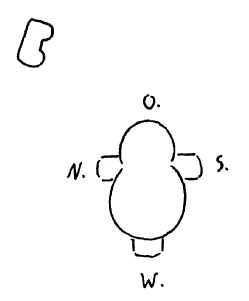
[ 9 ] If you consider our building, you will find that it is a double-dome structure, with the domes resting on a cylindrical base. It is a double-dome structure. This is the essential point, for the presence of a double dome expresses the vitality of the structure. If there were only a single dome, the essence of our building would be lifeless. The vitality of our building is expressed by the fact that, in a sense, one dome has its mirror image of consciousness in the other—that the two domes are reflected within one another, just as what exists in the external world is reflected through the human organs. The fundamental idea of the double sphere must be upheld in everything that is intimately and organically connected to our building, for anything that does not bear the double-dome form in some way—however hidden—would fail to express the essence of our architectural concept. Therefore, the idea of the double dome must also be present in this annex.
[ 10 ] But now consider the double dome with its extensions. First, we have the element whose significance has already been pointed out on several occasions: the interpenetration of the two dome motifs, which, in a sense, represents something new in architecture and, as you know, was brought about with the engineering assistance of Mr. Englert. This interpenetration of the two domes is of particular significance in the main structure because it expresses the intimate interconnectedness of that which is meant to mirror one another. I will first express this idea of mirroring in abstract terms. In this interpenetration of the two dome motifs lies infinite diversity; there is an infinite abundance. Only by bringing about this interpenetration of the double dome motifs will what is to be expressed in the building as a reflection of our ideas from Spiritual Science come to fruition in the building’s subsequent artistic stage. So this interpenetration is precisely what is present in the main building. And if we, I might say, were to dissolve this interpenetration—to separate the dome motifs—then we would move closer to an Ahrimanic principle. If we were to bring them even closer together or press them completely into one another—if we were to construct them by placing one inside the other—then we would be approaching the Luciferic principle in the building.
[ 11 ] The point now is to separate the Ahrimanic principle from this building. The purpose of the annex, then, is to push the domes apart here; for even here, in this annex, the idea of the dome is still what matters most. Now imagine the domes pushed apart; imagine this side motif (the south portal of the main building) on one side completely diminished, so that the dotted line disappears, and on the other side significantly enlarged (toward the chimney). Imagine the main building such that here (in the south) you have the domes pushed apart, here a porch, here the entire structure pushed inward (see drawing a), here, by contrast, the entire structure pulled out instead of pushed in (b), here (a) thus completely stunted rather than further developed. On the other hand, imagine it (the porch at the north portal) as particularly elaborate; then you have the motif of transformation for our main building in the basic forms of an annex associated with it. For if you were to imagine this one (the chimney) becoming smaller and smaller, and this one emerging again, and the whole thing pushed together, then through metamorphosis you would obtain the main building from the auxiliary building.
[ 12 ] This was discussed using the boiler house as a model.
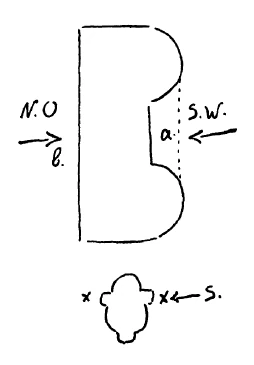
[ 13 ] The point here, then, is that we have an adaptation to what is to take place within it, an adaptation that has arisen through metamorphosis from our primary structure. Just as a vertebra can have emerged from the same basic form as the bones of the human skull—so that one can conceive of one emerging from the other—so it is with the main structure and the secondary structure, which one can conceive of as emerging from one another through transformation. The idea of form, when it transforms, when it comes to life, is such that it can pass from one form into another.
[ 14 ] We must truly become apprentices of the creative hierarchies that have created through metamorphosis, and we must learn to replicate the creative principle of the hierarchies in the same way.
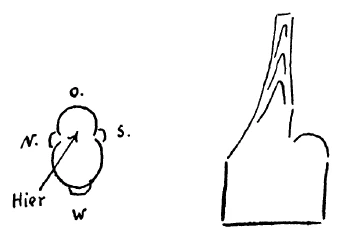
[ 15 ] But now imagine that there must be a force that enlarges what appears here on the side (the north portal of the main building) as a rather insignificant detail (the chimney). If you have a small, elastic bag and you want it to become larger, you must press it from the inside toward the various sides so that it can become larger; there must be a force that makes the small thing large, that shapes it. So if such a side wing were really to be expanded here, it would have to be expanded here (see drawing on the left) by the force penetrating it from within.
[ 16 ] But what kind of forces could be at work there? You can study these forces in the forms of the architraves. Imagine the forces residing in the architraves leaping into the side structure and pushing this outward—that is how you arrive at this form (of the chimney and the back wall). So one must try to slip into these forms of the architraves with one’s artistic, form-oriented thoughts, to synthesize them, to expand them, and to imagine that by slipping in there, one expands what is small inside. Then this form (the chimney and the back wall) emerges. One cannot engage in unified creative work in any other way than by trying to immerse oneself in the matter at hand.
[ 17 ] Even in this process of delving into things and becoming immersed in them lies, once again, a re-creation of the creative forces of nature itself, and only through this can the godlessness of modern industrial culture be overcome. A chimney, as it is commonly found, is something you cannot possibly conceive of as a product of natural creation. It comes into being through the denial of nature’s divine-spiritual forces. There is hardly anything in the natural world that could be compared to such a chimney—at most, the rather hideous plant known as asparagus. But that is, in a sense, an exception. That which truly grows in accordance with the forces present in the earth can never extend upward like a chimney; rather, if you wish to study the forces acting upward, you can best observe what corresponds to the hidden forces in the earth by studying the tree, which does not merely drive its trunk vertically upward but must also extend outward through its branches. Of course, it is not a matter of imitating this directly from the model; rather, one must delve into those forces that radiate from the earth and overcome the purely vertical direction of the tree trunk—forces that strive outward and drive the branches. There, too, you have justified that outward spreading in space, in the cosmos—I would say, a branch-like spreading (at the chimney).
[ 18 ] I could explain to you—I have only been able to outline the broadest principles—how these principles are reflected in every single surface of this architectural form, down to the smallest detail; but that would take too long.
[ 19 ] The point is that such a form is complete when it fulfills its purpose. If you look at this structure now, it is not yet complete. It will only be complete once it is actually heated inside and smoke begins to escape; the smoke is part of it—it truly belongs there—and is incorporated into the architectural design. If one were to perceive clairvoyantly the smoke rising here and exiting through the chimney, one would—since one would know, if one were truly able to perceive it clairvoyantly, that the physical also contains a spiritual aspect—take the spiritual aspect of the rising smoke into account as well. For just as you have a physical, an etheric, and an astral body, so too does the smoke have at least an etheric component. This etheric component, however, takes different paths than the physical component: the physical component rises upward, while the etheric component is actually carried away by these branches that extend outward. One will eventually see the physical part of the smoke rising and the etheric parts of the smoke receding. Through this, however, when it finds expression in form, a principle of all art is gradually fulfilled, namely: to represent the inner in the outer, to truly make the inner the principle of the outer.
[ 20 ] As I said, I would have a great deal to say to you if I were to go into the perhaps even more interesting details underlying this architectural form. And one of the interesting aspects is that it was indeed possible to realize what was to be expressed in this way using this modern material—as a concrete structure. For this will offer the opportunity to go further and further in the design of this modern material and to gradually create buildings—particularly those that serve modern Ahrimanic culture—in this style. But that is precisely what is necessary. And I need not go into further details, because what matters most to me is to show you the principle of this building and what is connected with it. This principle can be modified in many ways. For example, the dome can be altered so that it no longer resembles a dome at all when viewed purely from a geometric-mathematical perspective—that is, when it is not viewed organically—and so on. But today I wanted to discuss this principle: the principle of inner transformation and metamorphosis, the principle of life in transformation and in creation. I wanted to mention this to show you to what extent true artistic creation—insofar as it is connected to our Spiritual Science thought—must lead us away from all symbolic interpretation, for symbolic interpretation is something external. What matters, however, is to grasp what is offered here inwardly and to go along with it with one’s whole soul.
[ 21 ] Once our building is finished, we would not want to keep hearing the question: “What does this mean? What does that mean?”—only to then have to listen to people expressing, as it were, a sense of joy when they believe they have discovered the meaning of this or that in these things. With regard to such interpretations, we have encountered some curious phenomena on certain side paths of theosophy, particularly in connection with all sorts of poetic and literary works. For example, plays have been interpreted in such a way that one character was said to represent Manas, another Buddhi, a third Atma, and so on. Of course, if one wishes, one can interpret anything in this way. But this is not about such interpretations; rather, it is about living within things, about moving in step with the creative force that, as an outflow of the higher hierarchies, permeates and shapes our entire world. Because this latter approach is more difficult than symbolic or allegorical interpretation, one should not avoid it precisely because it is more difficult; for it leads into the spiritual world and is the strongest possible impetus for truly attaining imagination, inspiration, and intuition.
[ 22 ] This is part of the transformative impulses of the present: it is becoming necessary to develop an ever-deeper and broader understanding of the human soul’s ascent into those realms that open up to imaginative, inspired, and intuitive contemplation. For in the spheres that open up to this contemplation lies that which makes our world a whole in the first place, that which lifts us above mere maya and leads us into true reality.
[ 23 ] It must be emphasized again and again that what we are moving toward as a new spiritual insight cannot consist of a mere revival of the results of earlier clairvoyance. Certainly, many people seek to revive the clairvoyance of the past, but the era of that past clairvoyance is over, and what may occur in some individuals are merely atavistic echoes of the old clairvoyance. But the stages of human existence that we must ascend do not open up through a revival of the old clairvoyance. Let us try once more to consider what must underlie this new clairvoyance. We have often pointed out the fundamental principles of the matter, but today we will try to approach it from a different angle.
[ 24 ] Let us once again start from what we all know: that during waking hours, a human being lives with his “I” and his astral body within his etheric and physical bodies. But as I have already emphasized in recent days, this waking state of the human being—from the moment of waking until falling asleep—is not, after all, a state of complete wakefulness; rather, there is still something within the human being that remains asleep. And what we perceive as the will is, in truth, only partially awake. Our thoughts are awake from the moment we wake up until we fall asleep, but volition is something we carry out in a dreamlike state. That is why so much reflection on the freedom of the will—and on freedom in general—has been in vain, because people have failed to realize that what they know about the will in waking daily life is actually nothing more than a dream about the impulses of the will. If you want to and create a mental image of it, then you are indeed awake. But as for how volition comes about and transitions into action—that is something people merely dream about in their waking daily life.
[ 25 ] If you pick up a piece of chalk and create a mental image of the act of picking it up, you can certainly imagine that. But as for how the “I” and the astral body flow into the hand, how the will spreads out there—in your ordinary waking consciousness, without clairvoyance, you know no more about this than you know about a dream when you are dreaming. In ordinary waking daily life, one can only dream of the actual will, and in most cases we do not even dream—we merely sleep. For just as you can clearly create a mental image of taking a bite onto your fork, and just as you can still create a mental image, to a certain extent, of biting into that bite, you do not even dream of swallowing it. You are usually completely unaware of this, just as you are unaware of your thoughts when you sleep. Thus, a large part of volitional activity while awake is actually accomplished in a state of “waking sleep.”
[ 26 ] If we were not asleep—specifically with regard to our capacity for desire and the emotional impulses associated with it—we would first develop a peculiar activity. We would trace the actions we perform all the way into our bodies; with everything we carry out as impulses of the will, we would follow them inward—into our blood, into every blood vessel. That is to say, if you could trace the act of picking up a piece of chalk in relation to the volitional impulse, you would trace what is happening in your hand all the way into every blood vessel; you would observe from within the activity of the blood and the feelings associated with it; for example, you would perceive inwardly the weight of the piece of chalk and the like, and thereby become aware that you are tracing your nerve pathways and the etheric fluid within them. You would experience yourself inwardly through the activity of the blood and the nerves. That would be an inner enjoyment of one’s own blood and nerve activity. However, we must be spared this inner enjoyment of our own blood and nerve activity for the sake of our earthly life; otherwise, we would go through our earthly life in such a way that, in everything we do, we would seek our own inner self-gratification. Our enjoyment of ourselves would thereby increase infinitely. But human beings were not permitted to have this enjoyment, just as we have come to be. And the secret of why they were not permitted to have this enjoyment is once again expressed in a passage of the Bible, toward which we should feel ever greater reverence.
[ 27 ] According to what took place and what is expressed in the myth of Paradise, humans were allowed to eat from the Tree of Knowledge, but not from the Tree of Life. And inner enjoyment would be the enjoyment derived from the Tree of Life. That was not to be for humans. I cannot elaborate further on this motif today, for that would take us too far afield, but through your own meditation on what has been touched upon here as a motif, you will be able to discover even more. Now, however, you can consider something else from this starting point that may be particularly important to us these days: We cannot eat from the Tree of Life—that is, we cannot enjoy our internal blood activity or our internal nervous activity. Yet precisely when we perceive the external world through our senses and our intellect, something comes about that is likely connected to such inner enjoyment. When perceiving any object in the external world and when reflecting on any object in the external world, we trace back toward the senses—that is, toward the eyes, the ears, the nose, and the taste buds—to the blood vessels; and when we think, we trace the nerve pathways. But we do not perceive what we would perceive inside the nerve pathways and the blood; rather, what we would perceive in the blood is reflected by the senses, is cast back, mirrored, and this gives rise to sensory perceptions. And what is conducted through the nerve pathways is likewise reflected and relayed back to where the nerve pathways end, and is then mirrored as our thoughts.
[ 28 ] Suppose a person were to appear who were able not only to observe his blood under the influence of the external world and then to receive a reflection of what his blood does, and not merely to observe his nerves and receive a reflection of what the nerves do, but to experience inwardly what is denied to us with regard to blood and sensory nerves—to experience inwardly the blood as it tends toward the nerves and the eyes—then he would inwardly delight in this—at least with regard to the aspects of blood and nerves. This gives rise to those images that belong to atavistic inner clairvoyance. For what is reflected to us are merely images—as it were, filtered images—of what is in the blood and the nerves. In the blood and the nerves lie the mysteries of the world, but these are mysteries that have already been exhausted by the very fact that we have come into being from them. We come to know ourselves only when we become acquainted with the imaginations that arise within us as we experience our blood flowing toward the senses, and we come to know only those inspirations that are destined to build us up when we immerse ourselves in the nerves leading to the senses.
[ 29 ] But an entire inner world can thus take shape. This inner world can be a sum of imaginations. However, while in our perception of the external, physical world—in a manner typical of our earthly development—we perceive reflections and mirror images of our blood and nervous processes, we cannot—as we immerse ourselves in our own inner experience—go beyond the senses, but only as far as the point where the flow of blood enters the senses. Then one experiences the imaginative world in such a way that one swims, as it were, in the blood like a fish in water. But this imaginative world is in truth not an external world, but a world that lives within our blood. When one lives within the nerves that extend to the senses, one experiences an inspired world, a world of celestial sounds, and a world of inner images. This, too, is cosmic, but it is nothing new. It is merely something that has fulfilled its purpose by congealing within our nervous and circulatory systems.
[ 30 ] This clairvoyance, which thus arises and does not lead a person beyond themselves but rather leads them deeper within themselves, is self-indulgence—true, genuine self-indulgence. This is the reason why, in a certain sense, it produces a higher pleasure in people when they become clairvoyant, when they experience a world that is new to them. And on the whole, one must say that this becoming clairvoyant is a regression to an earlier stage of evolution. For what I have described to you—life in one’s own sense organs and in the blood—did not exist at that time in the form in which it exists now, but the nervous system was already in embryonic form. This mode of perception was the normal perception of human beings on the ancient Moon, and through what existed then as rudiments of nerves, they perceived themselves inwardly. The blood had not yet been formed internally. It was something that approached human beings from the outside more like a warm breath, just as the sun’s rays approach us. Therefore, what is now, here on Earth, a perception of the internal blood system was, on the Moon, a normal perception of the external world.
[ 31 ] One could put it this way: If here (as depicted) lies the boundary between the human inner and outer worlds, then what is now the nerve was already prefigured on the Moon. By tracing the nerve, the human being was able to perceive what was once revealed to him as an inner, imaginative world—what was contained within him. He perceived how he himself is contained within the cosmos. But then he also perceived imaginatively that which approached him like a breath from the outside, not from within. That has now disappeared; what was external on the ancient Moon has become internalized as the blood circulation in Earth’s evolution. Therefore, this is a regression to the ancient lunar evolution.
[ 32 ] It is good to be aware of such things, because what arises in this way through clairvoyance keeps appearing again and again. What arises clairvoyantly in this way does not need to develop through that difficult path of meditation and concentration described in *How Does One Attain Knowledge of the Higher Worlds?*. This clairvoyance, which arises from learning to live inwardly within one’s nerves and blood, from learning to find joy within oneself, is merely a more refined development of organic life in general—a more refined development of what a person experiences when eating and drinking. Therefore, such clairvoyance is, in essence, not really the task facing humanity today; rather, it is—one might say—what arises as a greenhouse plant when we apply to a more refined existence the self-indulgence that eating, drinking, or similar activities provide us. Just as a connoisseur of wine, when drinking Rhine wine or Moselle, experiences an inner aftereffect that, admittedly, rises only to an imagination of the taste but does not take on a concrete form, so too do some people develop a refined inner enjoyment, and that is their clairvoyance.
[ 33 ] Much of what is called clairvoyance is nothing more than a sophisticated, refined, greenhouse-like way of savoring life after the fact. In our time, we must draw attention to these things once again. For, I would say, the last period in which the mysteries of these things were still known—in which literature still spoke of them—was actually the first half of the 19th century. Then came the second half of the 19th century with the discoveries regarded as so magnificent—discoveries rightly considered magnificent from their own perspective—and the understanding of these things and of the finer interconnections of all existence was lost. One has not yet lost—let me say this in parentheses—the ability to take pleasure under the influence of the coarser, let’s say, acts of consumption. That has remained with people: they can still live in the afterglow of eating and drinking; indeed, they have developed this to a certain degree precisely in this materialistic age.
[ 34 ] But in such matters, humanity, too, lives in a cyclical, rhythmic movement. And the materialistic age, having eradicated what used to exist as a general feeling—the penetration of self-indulgence into the senses, into the nervous and blood circulation, which was indeed more prevalent in the past—can therefore indulge more strongly in the pleasures of eating and drinking. It is very easy to observe the entire shift and upsurge that has taken place in this regard in a relatively short time. One need only pick up a hotel menu from the 1870s and compare it with one from today. One would see how life has progressed in terms of refined pleasures and the self-indulgence of one’s own body. But such things also proceed cyclically; everything can only be achieved to a certain degree, and just as a pendulum can only swing to a certain point and must then swing back, so too must purely physical pleasure, once it has reached a certain point—which it will eventually do—swing back again. This will happen when even the most avid hedonists—that is, those who long most for pleasure—will stand before even the most deliciously prepared foods not craving them, but saying: “Ugh! I don’t like that; I’ve already had enough of it all!”—This moment will indeed come, for it is a necessary stage of development. Everything proceeds cyclically.
[ 35 ] People experience the other side of life while they sleep. During sleep, their imaginative life is dormant, and quite different conditions naturally arise. Now, as I said, it was essentially the first half of the 19th century that still had an understanding of these things, and that form of clairvoyance which arises from tracing one’s own blood and nerve pathways—in the first half of the 19th century, recalling certain echoes of the past, this was still called Pythian clairvoyance, because it is in fact related to what underlay the Pythian clairvoyance of antiquity.
[ 36 ] The other states exist during sleep. During sleep, the human being, with his “I” and his astral body, is separated from his physical and etheric bodies. In ordinary life, the mental images are suppressed and dulled. But from the moment of falling asleep until waking, a person lives continuously in a longing for their physical body. This is precisely what sleep consists of: from the moment a person begins to sleep, they develop a longing for their physical body. This longing rises to a climax, and then it draws them back more and more toward the physical body. The longing for one’s own physical body grows ever greater during sleep. And because this longing pervades the “I” and the astral body like a mist, the life of imagination becomes subdued and dimmed. It is precisely because the life of desire for the physical body permeates the “I” and the astral body like a mist that the mental images become subdued and dimmed. Just as we cannot see the trees of the forest when a mist spreads, so too can we not experience our life of perception inwardly when the mist of our desire spreads over it.
[ 37 ] Now, however, a situation may arise in which this life of desire becomes so strong during sleep that the person not only develops this desire outside of his physical and etheric bodies, but also becomes, to a certain degree, so greedy that he partially seizes the innermost parts of his physical and etheric bodies, so that their desire reaches the very ends of their blood and nerve pathways, so that, as it were, from the outside they sink through the senses into the very ends of the blood circulation and into the very ends of the nerve pathways.
[ 38 ] In ancient times, when—in a sense—the gods still helped people through such experiences, this was something entirely normal, something good. The people who accomplished such great things for their nation—the ancient Hebrew prophets—achieved what they did and possessed their prophetic gift precisely because they channeled that immense love into the very blood and spiritual fabric of their people, so that even in sleep they did not wish to be entirely separated from what physically lived within that people. They were seized by such longing, filled with such love—these prophets of Jewish antiquity—that they wished to remain connected, even in sleep, to the blood of their people, to whom they belonged. It was precisely from this that their prophetic gifts sprang.
[ 39 ] This is the physiological origin of these prophetic gifts, and beautiful, magnificent works emerged from what has just been described. The prophets of the various peoples are so significant to their respective peoples precisely because, even after leaving their physical bodies, they continued to live with those physical bodies in the manner just described.
[ 40 ] As I said, a certain awareness of this connection in human life still existed well into the first half of the 19th century. Just as the clairvoyance mentioned and described earlier was called Pythian clairvoyance, the clairvoyance I have just spoken of—in which one, with that which otherwise lives outside the physical and etheric bodies during sleep, still delves into the blood and nerve pathways of the physical body—was called prophetic clairvoyance.
[ 41 ] If you examine the literature of the first half of the 19th century—even though it could not be described with the accuracy and precision of modern Spiritual Science as it is today—you will nevertheless find descriptions of Pythian and prophetic clairvoyance. Today, people no longer recognize this distinction because they can no longer understand what is written about Pythian and prophetic clairvoyance in the books of the first half of the 19th century. However, neither of these forms of clairvoyance is what can truly advance humanity today. These two forms of clairvoyance are those that were relevant in ancient times. Today’s clairvoyance, which must develop more and more toward the future, can arise neither by savoring what permeates our body from within while we are awake, nor by immersing ourselves in this body from the outside in a sleep-like state, out of love—not for ourselves, but for that part of humanity to which our body belongs. Both are outdated perspectives.
[ 42 ] Clairvoyance today must develop in such a way that it emerges as a third form—one that is neither an external grasping of the physical body out of loving greed nor an internal enjoyment of the physical body. That which lives within and can permeate our body while inwardly enjoying it, and that which can grasp the body from the outside, must both depart from the body; both must, if clairvoyance today is to arise, remain connected to the body within the incarnation—between birth and death—only to the extent that it neither enjoys nor loves the blood and nerves, either from within or from without; rather, it must remain connected to the body in pure renunciation of such self-enjoyment or self-love. The connection with the body must, however, remain, for otherwise it would mean death. Human beings must remain connected to the body that belongs to them in their physical incarnation on Earth, remaining connected to this body through the limbs, which are, so to speak, removed—or at least relatively removed—from blood and nervous activity. The detachment from blood and nervous activity must take place.
[ 43 ] When a person no longer finds inner joy along the paths that lead to his senses, or by penetrating from the outside into his senses, but rather when a person is able, as it were, to be in such connection with himself—from within and from without—that he can truly grasp within himself that which is the symbol of death for physical life, when he can connect with that which gives the prospect of physical death, then the state in question is attained. For we actually die physiologically through our ability to develop the skeletal system within us. When we are able to grasp what the people, out of a wondrous intuition, perceive as the symbol of death—the skeletal system, which is as distant from the blood and nervous systems as the skeletal system itself—then we arrive at something higher than Pythian and prophetic clairvoyance; then we arrive at what we may call Spiritual Science clairvoyance.
[ 44 ] In this form of clairvoyance rooted in Spiritual Science, we no longer perceive a part of human nature, but rather the whole human being. And it really makes no difference whether we perceive him from within or from without, for this kind of clairvoyance can no longer be a mere pleasure. It is no longer a refined pleasure, but a merging with the divine-spiritual forces of the universe. It is a becoming one with the world, an experience no longer of the human being and of what is hidden within the human being, but rather a sharing in the deeds of the beings of the higher hierarchies—a true rising above self-indulgence and self-love. And just as our thoughts become members of our soul, so must the human being, as it were, become a thought, a member in relation to the higher hierarchies. To be thought of, to create mental images of oneself, and to be perceived by the higher hierarchies—that is the principle of Spiritual Science clairvoyance. To be accepted, not to accept oneself.
[ 45 ] What I am saying, then, is something I would like to see become the very focus of your further meditations, for precisely what I have expounded today can inspire much, much in all of you, and it can serve to bring about an ever-deeper and more far-reaching penetration of the very impulses of our Spiritual Science movement. And just how much seriousness must be brought to this deepening understanding of our Spiritual Science movement—this has, in fact, been a frequent topic of discussion, especially in recent days. That which, within this movement of Spiritual Science—I do not say was intended, but rather ought to be intended—could once again be realized to some extent if as many people as possible were to resolve to reflect in a practical way on this threefold form of knowledge of higher worlds, so that clearer and ever clearer concepts might arise regarding what we all, after all, fundamentally desire, and which is so easily confused with what is more convenient—much more convenient—to have.
[ 46 ] Indeed, it is not for nothing that we work from cycle to cycle to gather more and more ideas and concepts. Studying these ideas and concepts is not unnecessary; rather, it is the path to preparing within oneself precisely those soul impulses that lead to true Spiritual Science clairvoyance. Sometimes, by taking a little here and there from what is offered within our Spiritual Science movement, one can create a crack in this or that aspect of human nature, and then something of Pythian and prophetic clairvoyance arises, and one can already become proud and arrogant in this Pythian or prophetic clairvoyance. When that is the case, judgments arise that one often has to hear, where one person or another says: “I don’t need to study everything in detail; I don’t need what is said in the cycles. What I hear about these things, I already know quite precisely; I already knew that,” and so on. — The principle of living within a few imaginations—which one might call “blood and nerve imaginations”—still pervades many people. Many people imagine they possess something quite special when they have a few such blood-and-nerve imaginations. But this is not what can lead us to selfless collaboration in human evolution; rather, such dwelling in blood-and-nerve imaginations actually leads to an increase in self-indulgence, to a more sophisticated form of egoism. And then it can indeed happen that, precisely through the cultivation of Spiritual Science, a more sophisticated form of egoism is fostered than is ever found in the outer world.
[ 47 ] Of course, one never speaks of those present in these matters, nor of the Anthroposophical Society, which is, after all, present. But it may be mentioned that there are societies in which certain people find themselves who, according to the principles of these societies, manage—not to collaborate in a truly selfless way—but to take in certain things, preferably those that stir up blood- or nerve-based imaginations here and there, and then believe they can spare themselves the rest. Then they arrive at a kind of atavistic clairvoyance—or perhaps they do not even reach that stage, but only experience the feelings that must be regarded as a side effect of such imaginative clairvoyance. And these feelings are not an overcoming of egoism, but merely a higher flowering of egoism. In such societies—with the exception of the Anthroposophical Society, out of courtesy—although they would have a duty to cultivate love, unity, and harmony from member to member down to the deepest recesses of the soul, one finds disharmony, quarrelsomeness, mutual self-congratulation, and so on growing ever more. I may use this expression, since, as I said, I always exclude the members of the Anthroposophical Society.
[ 48 ] We can then see that precisely where strong light should shine, strong shadows are also cast. Not that I wish to criticize these things to the extent that I believe they could be eradicated overnight. They cannot be, because they arise naturally. But at the very least, everyone can work on themselves, and it is not good if awareness is not at least directed toward those things.
[ 49 ] It is certainly understandable that, precisely because a certain current must be cultivated, the dark sides also make themselves felt within such societies, and that often what runs rampant in the outside world can run rampant to the greatest extent within such societies. But it does, in a sense, evoke a bitter feeling time and again when this occurs in societies that, by their very nature—otherwise there would be no point in having a society—should develop a certain brotherhood, a certain sense of solidarity; yet precisely because people draw closer together, certain characteristics that exist only fleetingly in the outside world develop all the more intensely as they draw closer. Since the Anthroposophical Society is, as a present entity, an exception, it will be all the more possible for us to reflect on and contemplate these matters quite objectively, as it were, as uninvolved observers, so that we may come to know them more deeply; and should we encounter these things anywhere in the world, we will not regard them as anything other than what they are, nor will we succumb to the belief if someone were to claim to understand anthroposophy particularly deeply, yet certain qualities that appear out in the world manifest themselves in that person not merely as they are in the outside world, but much more intensely—so that we do not then believe these things to be incomprehensible, but know that they are comprehensible, yet that they are the very things we must combat. Sometimes we can only combat them once we have truly understood them.
[ 50 ] This, too, is part of what shows us how life is connected to the Spiritual Science worldview, and how the Spiritual Science worldview can truly achieve its goal only if it is understood as a way of life—indeed, as the art of living—and if it is woven into every aspect of life. How wonderful it would be if all the individual relationships within, let us say, the Anthroposophical Society were to prove to be as harmoniously aligned with one another as we strive for in the forms of our building, where the individual forms merge into one another and all are in harmony with one another; if life could be as it is in the building, and if all of life in our Society could become what we intended it to be through a beautiful collaboration among those involved in the construction, so that this work on the building is itself harmonious and noble—a reflection of what is expressed in the building itself.
[ 51 ] Thus, the inner meaning of the life principle of our building and the inner meaning of the interaction of souls—well, I’d rather not say that—thus, the inner meaning of the interaction of forms in our building should pave the way into all the individual relationships of life in our society; it should, as it were, stand before us in its inner form as an ideal. I just want to assure you that I did not slip up when I omitted a sentence earlier; I omitted it quite deliberately, and sometimes what is not said is also said.
[ 52 ] In summary, however, what I have been expounding on these past few days—a topic I have explored in a wide variety of ways—and what I would particularly like to urge you to do is not merely to present the thoughts and ideas of Spiritual Science, the results of spiritual research, to your intellect and reason, but to take into your hearts what lives within Spiritual Science. For the salvation of humanity’s future progress truly depends on this. This can be said without arrogance, and anyone who attempts to study the impulses of our evolution and the signs of our times can see this. With this, I conclude the series of lectures that I took the liberty of presenting to you at the turn of the year.