

Faculty Meetings with Rudolf Steiner
GA 300c
25 April 1923, Stuttgart
Fifty-Second Meeting
Dr. Steiner: Unfortunately, our main problem is that we must give up the Waldorf School ideal for the twelfth grade. We cannot base the twelfth-grade curriculum upon our principles. We simply have to admit that we must take all the subjects in other high schools into account during the final year. I am looking with some horror at the last semester, when we will have to ignore everything except the subjects required for the final examination. It’s inconceivable that we can work any other way if the students are to pass the final examination. This is really a problem. After thinking about it a long time, I do not think there is much to say about the curriculum for that class except those things we already considered, such as chemical technology and such.
The students are about eighteen, and at that age it is best if they attain an overall understanding of history and art. We should give them an understanding of the spirit of literature, art, and history without, of course, teaching them about anthroposophy. We must try to bring them the spirit in those subjects, not only in the content but also in the way we present them. With the students, we should at least try to achieve what I have striven for with the workers in Dornach, pictures that make it clear that, for instance, an island like Great Britain swims in the sea and is held fast by the forces of the stars. In actuality, such islands do not sit directly upon a foundation; they swim and are held fast from outside. In general, the cosmos creates islands and continents, their forms and locations. That is certainly the case with firm land. Such things are the result of the cosmos, of the stars. The Earth is a reflection of the cosmos, not something caused from within. However, we need to avoid such things. We cannot tell them to the students because they would then need to tell them to their professors in the examinations, and we would acquire a terrible name. Nevertheless, that is actually what we should achieve in geography.
In physics and chemistry, we should try to cover every principle that reveals the whole system of chemistry and physics as an organism, a unity, and not simply an aggregate as most people assume. With the twelfth grade, we have a kind of conclusion, and we must draw conclusions everywhere. We must give answers to the questions that arise, for instance, in mineralogy, where the five Platonic solids manifest. We should do that when we study minerals and crystals.
In art, we can only continue what we previously did in music, sculpture, and painting. That can never be concluded.
Unfortunately, we can do none of that. The only new thing we can do is one hour of chemical technology. Elsewhere, we will need to make sure that we simply bring the students far enough along that they can answer the questions on the final examination. This is terrible, but there is nothing we can do to avoid it. However, we should follow our curriculum as exactly as possible until the students are fourteen. As far as possible, I would ask you to consider up to that year all the things that have fallen by the way. We need to strictly carry out the curriculum until the students are fourteen.
I am telling you all this so that you will know how you would need to think were it possible to apply the principles of the Waldorf School with eighteen-year-old students. Eighteen-year-olds need to understand the various historical periods in a living way, particularly regarding the “getting younger” of humanity. That would have an important influence upon people. In the oldest periods of humanity, people could feel the development of their souls until the age of sixty. Following the Mystery of Golgotha, they could feel it only until the age of thirty-three, and today that is possible only until twenty-seven. Students need to comprehend this ongoing decrease before they begin their studies at an institution of higher learning. It is something that belongs in the general education in a Waldorf school and would have a tremendously beneficial effect upon the students’ souls.
The situation is as follows. When we look at the learning goals of the twelfth grade, we need to imagine that the students will continue at a college, and we also need to imagine that they have completed their general education. We can find our teaching goals in the following circumstances. Today, you can represent anthroposophy to the world such that people with sound human feeling can understand it. (Sound human understanding does not exist today.) They can understand it through feeling. Today, however, if those who have gone through a modern high-school education do not have a particular predisposition, it is impossible for them to comprehend certain anthroposophical truths. Today, they have hardly any possibility of understanding such things.
If you consider Kolisko’s chemistry, it is clear that it is unimaginable for modern chemists. You can teach students that kind of imaginative capacity until the age of eighteen or nineteen, that is, until the completion of the moon cycle, which then begins again. If people are to comprehend certain concepts, they must achieve a particular development during that period.
Compared to other people today, you are all a little crazy. You all have something that sets you apart from the current general development, something that is present to a greater or lesser extent in each of you. You have a certain kind of eccentricity. You are, in a certain way, not quite normal. Those who are normal, that is, “normal people,” cannot understand some things. Chemists with a normal education cannot understand Kolisko’s chemistry. They simply have no concepts for it. Our goal should be to make that understanding possible for our students. However, we cannot achieve that when we are forced to work toward ruining brains in exactly the same way that modern schools work toward that goal. Souls cannot be ruined. They undergo a self-correction before the next earthly life, although if things remain as they are today and continue into the next earthly life, humanity will degenerate. We cannot do these things. It is simply impossible. Even people like Herman Grimm could maintain themselves upon their islands only by brusquely brushing away certain concepts. People like him simply went past others, but they were the last who had such concepts. Those people, who were quite old during the 1890s, were the last who had them, and that possibility died with them.
It is particularly difficult with today’s youth. Today’s young people, as we have seen quite clearly in our anthroposophical youth movement, have a tendency to reject all ideas. They are not interested in ideas and, therefore, to the extent that they do not accept anthroposophy, become disorganized. Today’s young people are forced into a terrible tragedy, particularly if they are academically inclined and have gone through our college preparatory schools. We can achieve more for those students who go into practical life at the age of fourteen.
It is impossible, for example, to develop a spatial concept as I described it in the recent teachers’ course in Dornach, that is, the three dimensions, up-down, left-right, front-back. That is why it is so difficult to give people an understanding of anthroposophical truths. No one today is interested in things for which there should be broad public interest. I have said that everything connected with the will works three-dimensionally in the earthly realm. Everything connected with feeling is not three-dimensional, but two-dimensional, so that when you move from willing to feeling in your soul, you have to project the third dimension onto the plane in a direction that corresponds with front to back. We need to remember that we cannot simply—we can reduce it to the symmetry of the human being, but we cannot limit it to only that. This plane is two-dimensional everywhere—thinking then leads to one dimension and the I to zero dimensions. When we do that, the situation becomes quite clear. Now I ask you, how can such elementary things be presented in a lecture? There is simply no possibility of making that plausible to the modern public. No one is interested in it.
It would certainly be wonderful if, for example, in addition to the normal perspective of orthogonals, planes, and centers, people understood perspectives of three dimensions to two, from two dimensions to one, and then from one to the zero dimension. It would be wonderful if people could do that so that we could differentiate a point in many ways.
I am telling you all these things so that you can see how things need to be in the future and how we should form a school that would really educate people. Today, so-called educated people are really very undeveloped because today’s students are required to know many things in a certain way, but they really need to know them in a quite different way. I think we should try to do as much of that as possible in the lower grades, but in the upper grades, we must be untrue to our own principles, at least for the most part. We can only include one thing or another here and there. Even someone like J.W. can say to me that she would take the final examination if she thought she would pass. I told her that would be sensible only if she is certain she will pass. If she failed, it would not be good for the school.
The worst thing is that if we could convince the state to accept our reports, our students could very well follow a course of study at the university with what they would learn from our curriculum. Everything connected with the final examination, which causes such misery in modern school life, is absolutely unnecessary for studying at the university. Students could take up Kolisko’s chemistry as a subject. They would at first be surprised by chemical formulas, of course, but they could learn that later. It is much more important that they understand the inner processes of materials and the relationships between them. These are the things I wanted to say. I would like to discuss this whole question further. I would have completed the curriculum, but it has no meaning for the twelfth grade. We already know what we must do.
The students need to complete all the practical subjects insofar as possible. That is something you will feel after a time. So that the children have some sense of security, I would like to ask them about these subjects. I had the impression a while ago that the children thought the questions were unusual when you stated them poorly.
A teacher: Could we split the classes?
Dr. Steiner: We would need to have parallel classes from the age of fourteen, but we do not have enough teachers. The problem is financial. I would like to know how the finances are now. We should always keep that in mind.
There is some discussion about the financial situation.
Dr. Steiner: Well, the important thing is not that we have a financial report, but that we always have what we need in the bank. We can certainly continue, but we will have to do something. Otherwise, it will be impossible to do what needs to be done. For now, we cannot consider such a split.
At the college level, we cannot reach our goals for a very long time. The Cultural Committee might have done that, but they fell asleep after a few weeks. We might be able to achieve the things we want so much if we had the situation that existed in Austria for many private high schools. There many parochial high schools had the right to give and grade the final examinations, and technical schools could provide an accepted final report. I believe there are no such institutions in Germany. We would need a state official to be present, but the teachers would actually do the testing. A state official, while certainly causing many difficulties in our souls, in the end would have little effect on the grades if the final examination was held by our teachers.
A teacher: I believe we should speak to the students who will not be able to pass the final examination.
Dr. Steiner: That depends. People will say the faculty is at fault if more than a third of the class do not achieve the learning goals. If it is less than a third, the fault is thought to be the students’, but when a third or more do not achieve what they should, then it is seen as the faculty’s problem. You know that, don’t you?
In general, no one who has had good grades fails. The problem is, that is not taken into account. A further point is whether we could avoid using those really unpedagogical textbooks. The teacher could, of course, use them for preparation. Most of those texts are simply extracts from various scientific books. I have noticed that the questions come from such books and that there are readings from them, also. That can, however, cause many problems. We need to get away from using such references. We can use Lübsen’s books since they are quite educational, although the last editions have been somewhat ruined. His books are very pedagogical through all the editions before those made by his successor. Imagine for a moment the wonderful value of calculus in pedagogy. His analytical geometry is also pedagogically wonderful, at least the older edition, as well as his volumes on algebra and analysis. He has, for example, a collection of problems that are extraordinarily good because the methods required to solve them are very instructive.
A teacher: Should we throw out all the textbooks?
Dr. Steiner: For translation, they are not so bad. However, for German readings, you should not use normal textbooks. They are quite tasteless. Perhaps we should write down our lesson plans for the following teachers, so they could at least have some material for reading. There are so many people here who can type. Why can’t we prepare documents that people can read? The offices are filled with people, but I have no idea what they do.
A teacher: The students in the twelfth grade would like an additional hour of French.
Dr. Steiner: I would like to make everything possible. It is terrible that the twelfth-grade students will not receive an introduction to architecture. If everyone teaching languages helped, it might be possible.
An English teacher asks about prose readings for the twelfth grade, about Carlyle’s On Heroes, Hero Worship, and the Heroic in History, and about the English art and literature magazine The Athenaeum.
Dr. Steiner: The Athenaeum is edited very practically. You should not give it to the students, but instead use some individual essays. You could also use it in the eleventh grade. We do not have such well-edited magazines in Germany anymore. This is an old magazine, a humanistic magazine par excellence. There was a terrible German imitation called Literary News. Zarnck’s Literarisches Zentralblatt (Literary journal) was also a terrible imitation. It was a magazine for people who do not exist even in England.
A teacher: We have done enough of Tacitus and Horace. Should we take up Sallustius?
Dr. Steiner: Sallustius and Tacitus. I think the Germania would be enough. You could have them read a larger piece from that and then give them a test.
A teacher asks about music for the twelfth grade.
Dr. Steiner: A feeling for style, as such, an awareness of how Bach differs from others, is the main thing for the twelfth grade. At worst, you will have a problem at Christmastime if we see that we cannot continue all of the art instruction. Do not consider it an impossibility that we have to stop all art instruction at Christmas. Other people make fun of our things.
A teacher asks about religious instruction for the twelfth grade.
Dr. Steiner: You should go through religious history and give an overview of religious development. Begin with the ethnographic religions and then go on to folk religions and finally universal religions.
Begin with the ethnographic religions such as the Egyptian regional gods, where the religions are still quite dependent upon the various tribes. There are also regional gods throughout Greece. You need to do this in stages. At first, we have the religions that are fixed at a given location, the holy places. Then, during the period of wandering, the tent replaces the holy places, the religion becomes more mobile, and folk religions arise. Finally, we have universal religions, Buddhism and Christianity. We cannot call any other religions universal.
In the ninth grade, read the Gospel of Luke, which is a pouring out of the Holy Spirit.
A teacher asks about the Apocrypha.
Dr. Steiner: The children are not yet mature enough to go through the Apocrypha. The Apocrypha contains many things that are more correct than what is written in the Gospels. I have always extended the Gospels by what we can verify from the Apocrypha. Sometimes there are strong conflicts. When they take up the Gospels, the children must grasp them. It is difficult to explain the contradictions, so if they took up the Apocrypha nothing would make sense anymore. I would simply study the Gospels. A teacher asks about religion in the tenth grade.
Dr. Steiner: Following St. John’s Gospel, a number of paths are possible. You could do either the Gospel of St. Mark or Augustine, selecting some sections from the Confessions where he speaks more about religion.
A teacher asks if they should teach zoology and botany in the twelfth grade.
Dr. Steiner: Those subjects need to be included if our reports are to be officially recognized. We study zoology in the fifth grade, then the human being, then zoology again. If we did not have this problem of final examinations, I think it would be wonderful to present zoology to the children in the course of three weeks. That would be eighteen mornings to handle the twelve groups of animals. In the twelfth grade, we should limit zoology to categorization; the same is true of plants.
The students already know about skeletal structure, since you have already done anthropology. The most important thing is that they gain an overview about how we classify animals. You should begin with single-celled animals, then go through the worms. You will have twelve if you consider the vertebrates as one class. A teacher asks about how continents swim.
Dr. Steiner: Usually people do not think about how it looks if you move toward the center of the Earth. You would soon come to regions where it is very fluid, whether it is water or something else. Thus, according to our normal understanding, the continents swim. The question is, of course, why they don’t bump into one another, why they don’t move back and forth, and why they are always the same distance from one another, since the Earth is under all kinds of influences. Why don’t they bump into one another? For instance, why is a channel always the same width? We can find no explanation for that from within the Earth. That is something that comes from outside. All fixed land swims and the stars hold it in position. Otherwise, everything would break apart. The seas tend to be spherical.
A teacher asks for more details. Dr. Steiner takes a teacher’s notebook and draws the following sketch in it while giving an explanation.
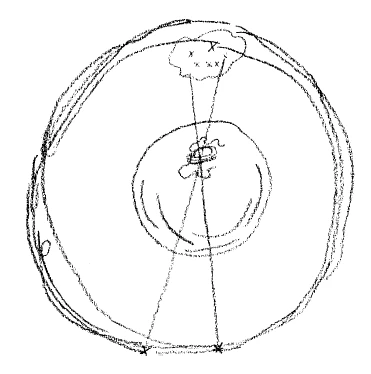
Dr. Steiner: The contrast is interesting. The continents swim and do not sit upon anything. They are held in position upon the Earth by the constellations. When the constellations change, the continents change, also. The old tellurians and atlases properly included the constellations of the zodiac in relationship to the configuration of the Earth’s surface. The continents are held from the periphery; the higher realms hold the parts of the Earth. In contrast, the Earth holds the Moon dynamically, as if on a leash. The Moon goes along as if on a tether.
A teacher asks about drawing exercises for fourteen- and fifteenyear- olds.
Dr. Steiner: You should have the children paint the moods of nature. The continuation students in Dornach have done wonderful work in painting. I had them paint the difference between sunrise and sunset, and some of them have done that wonderfully. They should learn those differences and be able to paint them. Those are the kinds of things you could work with, for example, the mood of rain in the forest. In addition, they should learn the differences between painting and sculpting.
In the lower grades, take care, when things get out of hand and you cannot get through the material, that you do not rashly reach for a substitute and simply tell the children a story to keep them quiet.
I hope to be here again tomorrow morning.
Zweiundfünfzigste Konferenz
Vorsitz: Rudolf Steiner.
RUDOLF STEINER: Die Hauptsorge ist, dass wir leidet- gezwungen sind, mit der letzten Klasse das Waldorfschul-Prinzip zu verleugnen, dass wir nicht einen Lehrplan zugrunde legen können, der dem Prinzip entsprechen würde. Wir werden im letzten Jahrgang alle diejenigen Fächer pflegen müssen, die einfach im Lehrplan der hiesigen höheren Schulen vorhanden sind, und so pflegen, wie sie vorhanden sind, und ich sehe schon mit Schrecken den Verlauf des letzten Halbjahrs, wo wir werden alles sistieren müssen außer den Prüfungsfächern, und nur die Prüfungsfächer pflegen. Denn es ist kaum möglich, daran zu denken, dass auf eine andere Weise zu be-wirken ist, dass die Schüler ein Abiturium bestehen. Das ist eine rechte Sorge, sodass ich eigentlich nach langem überlegen finde, dass es sich im Grunde erübrigt, außer dem, was wir schon in Aussicht genommen haben, unter Einführung der chemischen Technologie, dass es sich erübrigt, über den Lehrplan viel zu sprechen.
Es würde ja wünschenswert sein, dass gerade in diesem Lebensalter — es sind etwa Achtzehnjährig,e — die Schüler ein abschließendes Verständnis gewinnen würden für das Historisch-Künstlerische und schon aufnehmen würden das Spirituelle, ohne ihnen anthroposophische Dogmatik beizubringen, in Literatur, Kunstgeschichte und Geschichte, Wir müssten also eben den Versuch machen, in Literatur, Kunstgeschichte und Geschichte das Spirituelle nicht nur inhaltlich, sondern [auch] in der Art der Behandlung hineinzubringen; müssten also zum Beispiel wenigstens für diese Schüler das erreichen, was ich selbst bei meinen Arbeitern in Dornach angestrebt habe, denen ich schon klarmachen konnte, dass ja eigentlich, sagen wir, solch eine Insel, wie zum Beispiel die britischen Inseln, im Meere schwimmt und festgehalten wird von außen durch Sternenkräfte. Man hat es zu tun mit einer Insel, die sitzt nicht auf Grund auf, sie schwimmt, sie wird von außen festgehalten. Im Ganzen, im Prinzip wird die kontinentale Gestaltung und Inselgestaltung von außen durch den Kosmos bewirkt. Das ist bei der Konfiguration der Festländer überhaupt der Fall. Das sind Wirkungen des Kosmos, Wirkungen der Sternenwelt. Die Erde ist durchaus ein Spiegelbild des Kosmos, nicht etwas, was von innen bewirkt wird. Solche Dinge müssen wir nun doch vermeiden. Wir können sie aus dem Grunde nicht bringen, weil die Schüler veranlasst würden, das im Examen ihren Professoren beizubringen, und dann würden wir in einen schrecklichen Ruf kommen. Das müsste aber eigentlich in der Geografie erreicht werden.
In der Physik und Chemie müsste man es dahin bringen, jenes Prinzip durch.zuführen, wonach das ganze System der Chemie und der Physik ein Organismus ist, eine Einheit, und nicht ein Aggregat, wie jetzt angenommen wird. Wir haben mit der 12. Klasse eine Art von Abschluss, wir müssen überall die Resultate ziehen. [Wir müssen] solche Fragen, zum Beispiel [aus der Mineralogie], beantworten: Warum gibt es fünf regelmäßige Körper? Das müssen wir in der Kristallografie und Mineralogie machen.
Im Künstlerischen ergibt sich überall eine Fortsetzung aus dem Früheren in Musik, Plastik und Malerei. Das kann nie abgeschlossen sein.
All dies können wir gar nicht aufstellen. Wir können nur als neuen Gegenstand eine Stunde chemische Technologie einführen und müssen nun sehen, überall einfach die Schüler so weit zu bringen, dass sie die Abiturientenfragen beantworten können. Das ist im Grunde furchtbar, aber wir können dem nicht entgehen. Wir müssen aber umso mehr sehen, dass wir möglichst viel bis zum vierzehnten Jahre im Sinne des Lehrplans arbeiten. Da würde ich sehr bitten, dass dasjenige, was bisher manchmal noch unter die Bank gefallen ist, dass dies bis in dieses Jahr hinein sehr stark berücksichtigt wird. Der Lehrplan sollte schon strikte bis dahin durchgeführt werden.
Ich habe Ihnen dies gesagt, damit Sie wissen, wie man im Sinne des Waldorfschul-Prinzips die Sache zu denken hätte, wenn man es mit achtzehnjährigen jungen Leuten zu tun hätte. Achtzehnjährige junge Leute sollten dahin gebracht werden, in lebendiger Weise schon die historischen Epochen zu verstehen, und zwar mit dem «Jüngerwerden» der Menschheit; das würde einen bedeutenden Ein-fluss auf die Menschheit ausüben. [In der ältesten Epoche spürten die Menschen die seelische Entwicklung bis zum sechzigsten Jahre.] Als das Mysterium von Golgatha kam, da fiel das Alter der Mensch-heit gerade in das dreiunddreißigste Jahr hinein, während wir heute eigentlich nur bis zum siebenundzwanzigsten Jahr kommen. Das ist ein durchgehender Zug, der müsste begreiflich werden, bevor ein Fachstudium auf einer Hochschule betrieben würde. Das misste allgemeine Bildung werden [in einer Schule nach Waldorf-Lehrplan ]. Das würde einen ungeheuer wohltuenden Einfluss auf die seelische Verfassung haben.
Die Sache ist ja so: Wenn wir uns das Lehrziel vorhalten der 12. Klasse, bei der man sich vorzustellen hat, dass die Schüler an die Hochschule übergehen, da müsste man sich vorstellen, dass die all-gemeine Bildung abgeschlossen ist. Es ergibt sich ein heutiges Lehr-ziel aus folgenden Umständen: Sie können heute der Welt gegenüber Anthroposophie so vertreten, dass die Menschen mit gesundem Menschengefühl — denn gesunden Menschenverstand gibt es heute nicht — Anthroposophie auffassen können, ein gefühlsmäßiges Verständnis dafür gewinnen können. Aber es ist heute schlechterdings jemandem, der nicht besonders dazu veranlagt ist, und der in die Realschule gegangen ist, der die heutige Gymnasialbildung durchgemacht hat, unmöglich, gewisse anthroposophische Wahrheiten zu begreifen. Für gewisse Dinge gibt es heute Vorstellungsunmöglichkeiten.
Wenn Sie sich ausgeführt denken die Kolisko'sche Chemie, sie ist für einen heutigen Chemiker unvorstellbar. Die Vorstellungsfähigkeit dafür können Sie bis zum achtzehnten, neunzehnten Jahr beibringen, bis zum Ablauf des Mondenzyklus. Nach achtzehn, neunzehn Jahren erscheint dieselbe Mondkonstellation. Das ist der Zeitraum, bis zu dem man gekommen sein soll, um gewisse Begriffe aufzunehmen.
Sie alle haben gegenüber der heutigen Menschheit einen gewissen Spleen; Sie haben durch irgendetwas, wodurch Sie herausgefallen sind aus der gegenwärtigen allgemeinen Bildung — was bei dem Einzelnen mehr oder weniger hervortritt —, haben Sie einen gewissen Spleen. Sie sind etwas, einen Grad nicht ganz normal für die heutige Menschheit. Derjenige, der heute normal ist, der sogenannte normale Mensch, der kann gewisse Dinge nicht verstellen. Die Kolisko'sche Chemie kann ein Chemiker mit der gewöhnlichen Bildung nicht verstehen. Er hat keine Begriffe dafür. Das möchte man erreichen als Lehrziel, dass dies unseren Schülern möglich würde. Das können wir nicht ausführen, wenn wir genötigt sind, ebenso am Ruinieren der Gehirne zu arbeiten, wie eben gegenwärtig [durch das] Schulwesen gearbeitet wird am Ruinieren der Gehirne. Die Seelen kann man nicht ruinieren, die korrigieren sich bis zum nächsten Erdenleben, obwohl vielleicht, wenn es so bleibt wie heute, und wenn es im nächsten Erdenleben so weitergeht, die Menschheit degenerieren wird. — Das können wir nicht ausführen. Das können wir unmöglich ausführen.
Selbst solche Menschen, wie Herman Grimm einer war, der konnte nur durch Abweisung gewisser Begriffe sich auf der Insel erhalten, auf der er war. [Er ging an manchem vorbei.] Aber das waren auch die letzten Leute, die noch solche Begriffe hatten. Es ist also mit den Leuten, die etwa in den Neunzigerjahren des vorigen Jahrhunderts ganz alte Leute waren, mit diesen ist diese Möglichkeit ausgestorben.
Besonders schwierig ist es mit der heutigen Jugend. Diese heutige Jugend, was sich stark zeigt in unserer anthroposophischen Jugendbewegung, hat stark die Tendenz, überhaupt alle Ideen abzulehnen, sich nicht zu kümmern um die Ideen. Dadurch wird sie verwildert, sofern sie nicht Anthroposophie aufnimmt. Sie ist in eine furchtbare Tragik hineingetrieben, wenn sie schon akademische Jugend ist und das Gymnasium durchgemacht hat. Wir können sogar mehr erreichen für diejenigen Schüler, die mit dem vierzehnten Jahre ins praktische Leben gehen.
Es ist also zum Beispiel selbst das unmöglich, die Raumlehre [so] zu entwickeln, wie ich es im neuen Lehrerkurs angegeben habe in Dornach, die drei Dimensionen, oben-unten, rechts-links, vorne-hinten. Dadurch ist ja eine Misere auch herbeigeführt für das Verbreiten der anthroposophischen Wahrheiten überhaupt. Sehen Sie, über solche Dinge, für solche Dinge gibt es überhaupt heute kein Publikum, für die es im weitesten Sinne ein Publikum geben sollte. Dass man erörtert: Alles, was willenshaft ist, wirkt innerhalb der Erdensphäre dreidimensional. Alles, was gefühlshaft ist, wirkt nicht dreidimensional, sondern zweidimensional, sodass man immer nötig haben würde, wenn man im Seelischen vom Wollen zum Gefühl übergeht, so müsste man immer die dritte Dimension, nun, nicht auf eine Ebene projizieren, sondern auf eine ebene Richtung, eine Ebenendirektion, die also entspricht dem vorne-hinten. — Dabei ist zu beachten, dass man nicht etwa bloß — man kann es reduzieren auf die Schnitt-(Symmetrie-)Ebene des Menschen, aber man kann es nicht darauf beschränkt sein lassen. [Diese Ebene] ist überall zwei-dimensional. — Das Denken führt [dann] in die Eindimensionalität, das Ich in die Nulldimensionalität. Dadurch würde die Sache sehr durchsichtig werden. Nun frage ich Sie, wie man die Sache heute zum Vortrag bringen könnte, obwohl es elementare Dinge sind. Es gibt heute keine Möglichkeit, das einem Publikum plausibel zu machen. Es gibt kein Publikum dafür.
Nun, nicht wahr, wie schön wäre es zum Beispiel, wenn man außer der gewöhnlichen Perspektive, der orthogonalen, schiefen und zentralen, wenn man außerdem noch könnte Perspektive von drei Dimensionen auf zwei Dimensionen, von zwei auf eine Dimension, dann von einer auf null zurückführen, wenn man das machen könnte, sodass der Punkt in sich ungemein differenziert würde.
Diese Dinge alle, die sage ich Ihnen aus dem Grunde, damit Sie eben sehen, wie es für die Zukunft werden müsste, und wie man eine Schule so anlegen müsste, dass man wiederum gebildete Menschen bekommt. Heute sind die [sogenannten] Gebildeten höchst ungebildet, denn manche Dinge müssen heute einfach die Schüler auf eine bestimmte Art wissen, während es notwendig wäre, dass sie es auf eine ganz andere Weise wissen würden. Nun meine ich, dass man in den unteren Klassen so viel als möglich nach dieser Richtung tun muss, dass wir aber gezwungen sind, in den letzten Klassen einfach untreu zu werden unserem Prinzip. Im Wesentlichen! Wir können nur dies oder jenes einfließen lassen.
Selbst so jemand wie die J. W. sagte mir, sie wird das Abiturium machen, wenn sie sieht, dass sie es machen kann. Ich habe gesagt, es hat nur einen Sinn, wenn sie ganz genau weiß, dass sie durchkommt. Wenn sie durchfliegt, ist es der Schule nicht zum Gunsten.
Nun ist das Schlimme noch das, wenn wir es etwa noch durchsetzen könnten, dass unsere Zeugnisse gelten, dann würden die Schüler mit dem, was unserem Lehrplan entsprechen würde, gut ein Fachstudium auf den Hochschulen treiben können. Alles das, was beim Abiturium und im heutigen Schulleben die Misere bildet, das ist zum heutigen Fachstudium nicht notwendig. Fachstudium könnte man treiben mit der Kolisko'schen Chemie; man würde zunächst schockiert sein von den Formeln, die kann man aber nachholen. Viel wichtiger ist, dass man das innere Gefüge der Stoffe und Verbindungen überhaupt hat. Das sind die Dinge, die ich sagen wollte. Diese Frage möchte ich doch erörtern. Ich würde den Lehrplan ausgearbeitet haben, aber es hat keinen Zweck für die 12. Klasse. Wir kennen ihn jetzt.
Alle praktischen Fächer müssen, soweit es geht, durchgeführt werden. Das muss nach einiger Zeit gefühlt werden. Ich möchte schon einmal, damit die Kinder eine Sicherheit bekommen, abfragen. Dazumal habe ich den Eindruck bekommen, dass sie, wenn sie schlecht gefragt werden, die Fragen als ungewohnt empfinden.
ERICH SCHWEBSCH: Wäre es möglich, eine Gabelung zu machen?
RUDOLF STEINER: Dann müsste man vorn vierzehnten Jahre an Doppelklassen haben. Dazu haben wir nicht genug Lehrer. Wir kommen mit den Geldmitteln in Verlegenheit Mich würde die Bilanz interessieren. So weit müsste man die Bilanz im Kopfe haben.
Es wird über die Bilanz gesprochen.
RUDOLF STEINER: Ja, aber das Wichtigste ist doch nicht, dass wir eine Bilanz haben, sondern dass wir immer das Nötige in der Kasse haben. Weitergehen wird es schon, nur muss man dafür etwas tun.
Sonst ist es unmöglich, gewisse Dinge, die wünschenswert wären, einzurichten. An eine solche Gabelung dürfen wir nicht denken.
Hochschulmäßig unsere Ziele zu erreichen, wird noch lange nicht möglich sein. Das wäre durch den Kulturrat möglich gewesen, der nach ein paar Wochen entschlafen ist. Dies, was wünschenswert wäre, würde ja dadurch zu erreichen sein, dass man den Zustand herbeiführt, der in Österreich für viele Privatrealschulen und -gymnasien bestanden hat. Ordensgymnasien gab es viele, die das Recht hatten, Zeugnisse auszustellen für die Matura, es gab Realschulen, die gültige Zeugnisse ausstellen konnten. Es gibt, glaube ich, nicht solche Anstalten in Deutschland. Was uns bewilligt werden müsste, das wäre, dass ein staatlicher Kommissar käme, aber dass die Lehrer selbst prüfen könnten bei uns. Ein [staatlicher Kommissar, der kann auch furchtbar in die Seele zwicken. Aber schließlich würde er kaum ausschlaggebend sein für die Noten, [wenn] das Abitur hier abgehalten würde mit den Lehrern der Waldorfschule, [wenn] die Leute selbst prüfen können. [Man] wird nach und nach all das machen wollen.
ERICH SCHWEBSCH: Ich glaube, es ist zweckmäßig, von Anfang an es denjenigen unter den Abiturienten zu sagen, die kein genügendes Examen machen können.
RUDOLF STEINER: Da kommt es auf das Folgende an. Es wird zugeschrieben dem Mangel der Lehrerschaft, wenn mehr als ein Drittel in einer Schulklasse das Lehrziel nicht erreicht. Was unter dem Drittel ist, gilt als von den Schülern herrührend. Wenn aber über ein Drittel der Schüler das Lehrziel nicht erreichen, gilt dies als ein Mangel der Lehrerschaft. Es ist doch bekannt?
ERICH SCFIWEBSCH: Einige Schüler spielen bis zum letzten Vierteljahr mit dem Gedanken der Prüfung. Man wird klare Verhältnisse schaffen, wenn man eine gewisse Bilanz zieht.
RUDOLF STEINER: Die Mädchen werden das weiter abwarten. Bei den Knaben ist die Schwierigkeit: Was wird aus denen, die bei uns abgehen aus der höchsten Klasse und die kein Abiturium machen?
Über einige Kandidaten.
RUDOLF STEINER: Es fällt in der Regel niemand durch, dessen Klassenzeugnis gut ist. Wir sind dem ausgesetzt, dass keine Rücksicht genommen wird.
Bei dem Italiener [V. B.] liegt die Sache so: Wenn. er bei uns absolviert, muss er in die Armee eintreten unmittelbar nach unserer Schule. Er wird nicht befreit. Wenn er aber das Abiturium absolviert, dann wird er befreit und kann noch die Handelsschule absolvieren. Er möchte durchaus in die Waldorfschule kommen, weil er etwas lernen möchte. Dies würde er umgehen, wenn er bei uns ein paar Monate bliebe. Er würde nur Hospitant sein. Er ist ein heller Kopf.
Dann ist da ein [weiterer] Punkt, das ist der, ob es nicht möglich wäre, von den so unpädagogisch abgefassten Handbüchern für die Schüler ganz abzugehen. Der Lehrer kann sich daraus vorbereiten. Die meisten Handbücher sind bloß Extrakte Laus den entsprechen-den wissenschaftlichen Büchern]. Nun habe ich bemerkt, dass Auf-gaben gestellt werden aus solchen Büchern, dass Lesestücke gelesen werden. Dadurch kann viel verdorben werden. Von diesen Handbüchern, namentlich Materialienbüchern, von denen müsste man abkommen können. Die Lübsen'schen Handbücher können gebraucht werden, die sind durch und durch pädagogisch abgefasst; die letzten Auflagen sind vielleicht verdorben. Die Lübsen'schen Bücher sind bis in die Auflagen, die der Nachfolger gemacht hat, pädagogisch. Denken Sie, was für ein prachtvolles Werk die Infinitesimalrechnung ist in pädagogischer Beziehung. Dann ist auch die analytische Geometrie ausgezeichnet pädagogisch, die ältere Auflage großartig. Ausgezeichnet ist das Buch über das Algebraische, über Analysis. Da ist da zum Beispiel eine Aufgabensammlung; die Aufgaben sind außerordentlich gut zu stellen, weil die Lösungsmethoden sehr gut pädagogisch sind.
Jemand fragt: Soll man die Schulbücher auch vor dem Examen ganz verwerfen?
RUDOLF STEINER: Wenn es sich um Übersetzungswerke handelt, braucht die Sache nicht so schlecht zu sein. Aber zum Beispiel deutsche Lesestücke, die dürfen aus den gebräuchlichen Handbüchern nicht genommen werden, da ist ein Ungeschmack darin. Wir müssten doch vielleicht dahin streben, die Unterrichtsgänge immer [schriftlich niederzulegen und] für den Lehrer des nächsten Jahrgangs fruchtbar zu machen, sodass wenigstens vielleicht Lektüre daraus werden könnte.
Es gibt doch so viele Leute, die Maschine schreiben, Warum können die nicht Texte zubereiten, die man liest? Alle Büros sitzen doch voll von Menschen. Ich weiß nicht, was die Leute machen, die in den Büros sitzen.
MARTIN TITTMANN: Die Schüler in der obersten Klasse möchten eine Stunde Unterricht mehr haben im Französischen.
RUDOLF STE1NER: Ich würde am liebsten alles Mögliche noch machen. Es ist ein Skandal, dass die Schüler in der 12. Klasse nicht bekommen können die Anfangsgründe der Baukunst. Denken Sie sich, wie Fräulein Dr. Röschl uns aufs Dach kommen würde. Wenn alle zusammen.helfen in den Sprachen, dann wird es schon gehen.
ERICH SCHWEBSCH fragt nach englischer Prosalektüre für die 12. Klasse, nach Carlyle, «Heldenverehrung», nach der englischen Zeitschrift «Athenäum».
RUDOLF STEINER: Das «Athenäum», das ist etwas, was praktisch redigiert worden ist. Man sollte es den Schülern nicht in die Hand geben, sondern einzelne Aufsätze herausnehmen. Auch für die 11. Klasse käme das in Betracht. Solch eine gut redigierte Zeitschrift haben wir in Deutschland nicht mehr. Das ist eine alte Zeitschrift, es ist eine humanistische Zeitschrift par excellence. Die deutsche Nachahmung, eine furchtbar pedantische Nachahmung, waren die «Blätter für Literarische Unterhaltung», die Bösenberg herausgegeben hat. [Auch] Zarnckes «Literarisches Zentralblatt», das sind schreckliche Nachahmungen. Das Zentralblatt war ein Organ von Leuten, die es in England gar nicht gibt.
MARIA RÖSCHL: Mit Tacitus und Horaz hätte man genug zu tun. Soll man Sallust nehmen?
RUDOLF STEINER: Sahst und Tacitus. Ich würde meinen, dass die Germania genügt. Man lässt aus der Germania ein größeres Stück lesen, und dann gibt man eine Probe.
MARIA RÖSCH1.: Soll man einen Überblick über die Aeneis geben? [Antwort nicht überliefert.]
PAUL BAUMANN fragt nach dem Musikunterricht in der 12. Klasse.
RUDOLF STE1NER: Ein Organ für die Stile als solche, ein Bewusst-werden, wodurch Bach sich unterscheidet von anderen, das ist die Hauptsache für die 12. Klasse. Sie können höchstens gestört sein, wenn wir zu Weihnachten sehen, dass es nicht geht, dass wir zu Weihnachten allen Kunstunterricht kassieren. Das betrachten Sie nicht als eine unmögliche Perspektive, wenn wir zu Weihnachten alles Mögliche kassieren. Unsere Dinge sind Allotria für die anderen Leute. Der Brief an Killian war ja interessant.
Bei [der] Mathematik wird es schnell gehen. Im Realschulplan liegt diese Materie nicht in der Prima [12. Klasse]. Heute Morgen konnten die Schüler der Prima nicht 3726 zum Quadrat machen in der Form, wie sie es lernen sollten in der Sekunda, in der Untersekunda [10. Klasse]. Sie haben es heute so genommen, dass man ökonomisch wird fortfahren können, dass sie manches können werden. Die Art, wie sie sich heute zum Quadrieren gestellt haben, die lässt das Furchtbare erahnen — ich habe [aber] den Eindruck bekommen, dass es ihnen nach und nach aufgegangen ist. Das gewöhnliche Quadrieren ist eine Sache der Quarta [7. Klasse].
Es wird gefragt nach dem Religionsunterricht in der 12. Klasse.
RUDOLF STEINER: [Da wäre] Religionsgeschichtliches [durchzunehmen]. Da würde ein Überblick über die religiöse Entwicklung der Menschheit gegeben werden können. Von ethnografischen Religionen ausgehen, Volksreligionen, dann die Universalreligionen.
Von ethnografischen Religionen ausgehen, wo die Religionen {noch ganz] abhängig sind von den Volksstämmen. Ägyptische Lokalgötterreligionen. In Griechenland sind auch überall Lokalgottheiten. Man muss sie stufenweise nehmen. Zuerst hat man die Religionen, wo der Kultus unbeweglich an den Ort gebunden ist, der heilige Ort. Dann diese, wo bei Wandervölkern das Zelt an die Stelle des heiligen Ortes tritt, wo die Kulthandlung beweglich wird; da entsteht die Volksreligion. Und dann sind da die Universalreligionen, Buddhismus und Christentum. Eine andere Religion kann man nicht Universalreligion nennen.
Für die 9. Klasse Apostelgeschichte des Lukas, Ausgießung des Heiligen Geistes.
Es wird nach den Apokryphen gefragt.
RUDOLF STEINER: Die Kinder sind zu unreif, um die Apokryphen zu nehmen. Die Apokryphen enthalten vieles, was richtiger ist als das, was in den Evangelien steht. Wir haben es immer ergänzt, was aus den Apokryphen verifiziert werden kann. Es kommen starke Konflikte heraus. Die Kinder müssen, wenn sie ein Evangelium in die Hand bekommen, die vier Evangelien haben. Man kann es schwer erklären, worauf die Widersprüche beruhen. Wenn sie auch die Apokryphen bekommen, stimmt nichts mehr. Ich würde die Apostelgeschichte nehmen.
MARIA ROSCHL fragt wegen des Religionsunterrichts in der 10. Klasse.
RUDOLF STEINER: Wieder Johannes-Evangelium nehmen. Es sind mehrere Wege möglich. Entweder Markus oder Augustinus in Auswahl; aus den «Confessiones» das auswählen, wo er mehr über das Religiöse spricht.
EUGEN KOLISKO fragt, ob in der 12. Klasse Zoologie und Botanik gegeben werden sollen.
RUDOLF STE1NER: Die Disziplin tritt ein, wenn man gültige Zeugnisnoten hat. In der 5. Klasse gibt es Zoologie. Später den Menschen. Darm kommt wieder die Zoologie. Wäre nicht diese Matura, so würde ich es glänzend möglich finden, in drei Wochen den Kindern herrliche Zoologie beizubringen, das sind achtzeFin Vormittage, zwölf Tierklassen. [En der 12. Klasse sollte sich die Zoologie auf eine Systematik beschränken. Ebenso bei den Pflanzen.]
Die ganze Knochenlehre ist bekannt dadurch, dass Sie Anthropologie getrieben haben. Das Wesentliche ist, dass sie eine Art Übersicht bekommen über die Gliederung der Tiere.
Man fängt bei den Moneren an, geht durch die Schlauchtiere hinauf, es kommen zwölf heraus, wenn man die Wirbeltiere als eine [einzige] Klasse betrachtet.
Es wird noch einmal nach dem Schwimmen der Kontinente gefragt.
RUDOLF STEINER: In der Regel denkt man doch nicht darüber nach, wie es ausschaut, wenn man dem Mittelpunkt der Erde zukommt. Man kommt sehr bald in Schichten, wo es flüssig ist, gleich ob Wasser oder etwas anderes. Also schon nach dem, was man immerhin annimmt, schwimmen die Kontinente. Nun fragt es sich, warum sie nicht durcheinanderpurzeln, warum es nicht hin und her geht, warum sie immer gleich weit voneinander entfernt sind, da doch die Erde allen möglichen Einflüssen ausgesetzt ist. Warum stoßen sie sich nun nicht; warum ist der Kanal zum Beispiel immer gleich breit? Da gibt es aus dein Inneren der Erde keine Erklärung dafür. Das kommt von außen. Es schwimmt ja alles Festland, das ist von den Sternen festgehalten. Es würde zerbrechen. Die Grundform des Meeres tendiert nach dem Sphärischen.
Es wird noch eine Frage gestellt nach näheren Einzelheiten. Rudolf Steiner nimmt das Heft eines Lehrers, zeichnet die nachstehende Skizze hinein und gibt dabei Erklärungen:
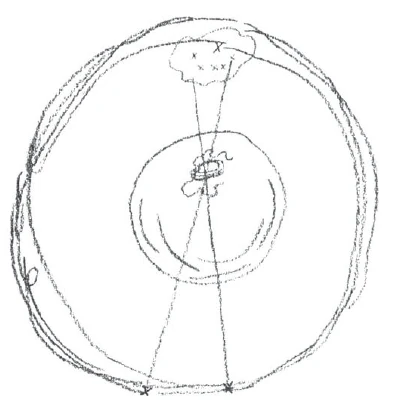
RUDOLF STE1NER: ES ist interessant, der Gegensatz. [Die Kontinente schwimmen, sie sitzen nicht auf.] Die Kontinente auf der Erde werden von außen festgehalten durch Fixstern konstellationen. Wenn die sich ändern, ändern sich auch die Kontinente. Auf alten Tellurien und Atlanten sind auch noch die Tierkreisbilder richtig eingezeichnet, mit diesen Beziehungen zwischen Fixsternkonstellation und Konfiguration der Erdoberfläche. Die Kontinente sind von der Peripherie herein gehalten; die ganze Sphäre hält die Erdteile. Der Mond dagegen wird dynamisch von der Erde gehalten, wie auf einem Zapfen. Der Mond geht so mit, wie wenn er einen richtigen Zapfen hätte.
Es wird gefragt nach Malaufgaben für die etwa Vierzehn- bis Fünfzehnjährigen.
RUDOLF STE1NER: [In der Malerei sollte man die Kinder Naturstimmungen machen lassen.] Die Fortbildungsschüler in Dornach haben in der Malerei Glänzendes geleistet. Sonnenaufgang und Sonnenuntergang habe ich voneinander unterscheiden lassen. Das haben Ein¬zelne glänzend getroffen. [Diese Unterschiede sollten sie kennenlernen und darstellen.] Diese Sachen könnte man schon pflegen, [zum Beispiel] Regenstimmung im Walde. [Ferner sollten sie auch den Unterschied kennenlernen zwischen Malerischem und Plastischem.]
[...] [Über einen Vortrag von Walter Johannes Stein.]
[Zu einzelnen Lehrern:] Aufmerksam waren sie durch die Bank. — Sie werden in 1b eine gute Klasse haben.
Es sollte in den unteren Klassen schon darauf Rücksicht genommen werden, dass nicht, wenn alle Stricke reißen und man nicht durchkommt mit dem anderen Stoff, dass man rasch zu dem Auskunftsmittel greift, den Kindern schnell ein Märchen zu erzählen, damit sie stillehalten.
Jemand spricht über ein Kind: Dieses Mädchen hat eine Geschichte erzählt, noch aus dem Unterricht von Fräulein Hofmann vor den Ferien. Im Temperament ist das Kind merkwürdig. Sie hört zu; es gellt viel vor.
RUDOLF STE1NER: Sie haben eine Musterklasse in Disziplin übernommen. [Ich hoffe, morgen früh in die Schule hinaufzukommen.]
Fifty-second Conference
Chair: Rudolf Steiner.
RUDOLF STEINER: The main concern is that we are forced to deny the Waldorf school principle with the last class, that we cannot base our curriculum on a principle that would correspond to it. In the last year, we will have to teach all the subjects that are simply part of the curriculum of the local high schools, and teach them as they are, and I already dread the course of the last semester, where we will have to suspend everything except the exam subjects and only teach the exam subjects. For it is hardly possible to imagine any other way of enabling the students to pass their Abitur exams. This is a real concern, so that after much consideration, I have come to the conclusion that, apart from what we have already planned, namely the introduction of chemical technology, there is no point in talking much about the curriculum.
It would be desirable that at this age—around eighteen—students would gain a final understanding of history and art and already absorb the spiritual, without teaching them anthroposophical dogma, in literature, art history, and history. We would therefore have to attempt to introduce the spiritual into literature, art history, and history, not only in terms of content, but [also] in the way it is treated; For example, we would have to achieve for these students at least what I myself have strived for with my workers in Dornach, to whom I have already been able to make clear that, let's say, an island such as the British Isles actually floats in the sea and is held in place from outside by stellar forces. We are dealing with an island that does not sit on the ground, it floats, it is held in place from outside. On the whole, in principle, the continental and insular formations are caused from outside by the cosmos. This is the case with the configuration of the continents in general. These are effects of the cosmos, effects of the starry world. The earth is definitely a mirror image of the cosmos, not something that is caused from within. We must avoid such things. We cannot bring them up because the students would be prompted to teach this to their professors in their exams, and then we would get a terrible reputation. But this should actually be achieved in geography.
In physics and chemistry, we would have to implement the principle that the entire system of chemistry and physics is an organism, a unity, and not an aggregate, as is currently assumed. We have a kind of graduation with the 12th grade, we have to draw conclusions everywhere. [We must] answer questions such as [from mineralogy]: Why are there five regular solids? We must do this in crystallography and mineralogy.
In the arts, there is a continuation of the past in music, sculpture, and painting. This can never be completed.
We cannot establish all of this. We can only introduce a new subject, an hour of chemical technology, and now we have to see that we can simply bring the students to the point where they can answer the high school graduation questions. That is basically terrible, but we cannot escape it. However, we must all the more ensure that we work as much as possible up to the age of fourteen in accordance with the curriculum. I would very much ask that what has sometimes fallen by the wayside up to now be given very serious consideration this year. The curriculum should be strictly implemented until then.
I have told you this so that you know how to think about things in accordance with the Waldorf school principle when dealing with eighteen-year-olds. Eighteen-year-olds should be led to understand the historical epochs in a lively way, namely with the “youthfulness” of humanity; this would have a significant influence on humanity. [In the earliest epoch, people felt their soul development up to the age of sixty.] When the mystery of Golgotha came, the age of humanity fell precisely into the thirty-third year, whereas today we actually only reach the twenty-seventh year. This is a continuous trend that should be understood before pursuing a specialized course of study at a university. It should become part of general education [in a school following the Waldorf curriculum]. This would have an enormously beneficial influence on the soul's constitution.
The fact is that if we consider the teaching goal for the 12th grade, where we imagine that the students are moving on to university, we would have to imagine that their general education is complete. Today's teaching goal arises from the following circumstances: Today, you can present anthroposophy to the world in such a way that people with healthy human feelings — because there is no such thing as common sense today — can understand anthroposophy and gain an emotional understanding of it. But today it is simply impossible for someone who is not particularly predisposed to it, who has attended secondary school and gone through today's high school education, to comprehend certain anthroposophical truths. For certain things, it is impossible to imagine them today.
If you think about Kolisko's chemistry in detail, it is inconceivable to a chemist today. You can teach the ability to imagine it until the age of eighteen or nineteen, until the end of the lunar cycle. After eighteen or nineteen years, the same lunar constellation appears. That is the period of time by which one should have arrived at a certain level of understanding in order to grasp certain concepts.
You all have a certain eccentricity compared to today's humanity; you have a certain eccentricity due to something that has caused you to fall out of the current general education — which is more or less apparent in each individual. You are something, a degree not quite normal for today's humanity. Those who are normal today, the so-called normal people, cannot pretend certain things. Kolisko's chemistry cannot be understood by a chemist with a conventional education. He has no concepts for it. We would like to achieve this as a teaching goal, to make it possible for our students. We cannot do this if we are forced to work on ruining brains, just as the school system is currently working on ruining brains. Souls cannot be ruined; they correct themselves until the next earthly life, although perhaps, if things remain as they are today and if this continues in the next earthly life, humanity will degenerate. — We cannot carry this out. It is impossible for us to carry this out.
Even people like Herman Grimm could only survive on the island where he was by rejecting certain concepts. [He ignored many things.] But those were also the last people who still had such concepts. So with the people who were very old in the 1890s, for example, this possibility has died out.
It is particularly difficult with today's youth. Today's youth, as is strongly evident in our anthroposophical youth movement, has a strong tendency to reject all ideas altogether, to not care about ideas. This makes them wild, unless they take up anthroposophy. They are driven into a terrible tragedy if they are already academic youth and have gone through high school. We can achieve even more for those students who enter practical life at the age of fourteen.
So, for example, it is impossible to develop the doctrine of space [as] I have indicated in the new teachers' course in Dornach, the three dimensions, up-down, right-left, front-back. This has also led to a predicament for the dissemination of anthroposophical truths in general. You see, there is no audience at all today for such things, for which there should be an audience in the broadest sense. That one discusses: Everything that is volitional acts within the three-dimensional sphere of the earth. Everything that is emotional does not act three-dimensionally, but two-dimensionally, so that when one passes from the will to the emotions in the soul, one would always need to project the third dimension, not onto a plane, but onto a plane direction, a plane direction that corresponds to front and back. — It should be noted that one cannot simply reduce it to the plane of intersection (symmetry) of the human being, but one cannot limit it to that. [This plane] is two-dimensional everywhere. — Thinking [then] leads to one-dimensionality, the ego to zero-dimensionality. This would make the matter very transparent. Now I ask you how one could present the matter today, even though these are elementary things. Today there is no way to make this plausible to an audience. There is no audience for it.
Well, wouldn't it be wonderful, for example, if, in addition to the usual perspective, the orthogonal, oblique, and central, one could also reduce the perspective from three dimensions to two dimensions, from two to one dimension, and then from one to zero, if one could do that, so that the point itself would become immensely differentiated.
I am telling you all these things so that you can see how things should be in the future and how a school should be designed so that we can once again have educated people. Today, the [so-called] educated are highly uneducated, because there are some things that students simply have to know in a certain way, when it would be necessary for them to know them in a completely different way. Now, I believe that we must do as much as possible in this direction in the lower grades, but that we are forced to simply be unfaithful to our principle in the upper grades. Essentially! We can only incorporate this or that.
Even someone like J. W. told me that she will take the Abitur if she sees that she can do it. I said it only makes sense if she knows for sure that she will pass. If she flies through, it is not to the school's advantage.
Now the bad thing is that if we could enforce our certificates to be valid, then the students would be able to pursue a subject-specific course of study at universities with what would correspond to our curriculum. Everything that causes misery in the Abitur and in today's school life is not necessary for today's specialized studies. Specialized studies could be pursued with Kolisko's chemistry; at first, one would be shocked by the formulas, but they can be learned later. It is much more important to have an understanding of the internal structure of substances and compounds. Those are the things I wanted to say. I would like to discuss this question. I would have worked out the curriculum, but it is of no use for the 12th grade. We know it now.
All practical subjects must be taught as far as possible. This must be felt after some time. I would like to test the children so that they gain confidence. At that time, I got the impression that when they are asked difficult questions, they find the questions unfamiliar.
ERICH SCHWEBSCH: Would it be possible to make a fork?
RUDOLF STEINER: Then you would have to have double classes for the first fourteen years. We don't have enough teachers for that. We are in a difficult situation with the funds. I would be interested in seeing the balance sheet. We would have to have the balance sheet in our heads.
The balance sheet is discussed.
RUDOLF STEINER: Yes, but the most important thing is not that we have a balance sheet, but that we always have what we need in the cash register. Things will continue, but we have to do something to make that happen.
Otherwise, it will be impossible to establish certain things that would be desirable. We must not think about such a fork in the road.
It will not be possible to achieve our goals at the university level for a long time to come. This would have been possible through the Cultural Council, which fell dormant after a few weeks. What would be desirable could be achieved by creating the conditions that existed in Austria for many private secondary schools and high schools. There were many religious high schools that had the right to issue certificates for the Matura, and there were secondary schools that could issue valid certificates. I don't think there are any such institutions in Germany. What we would need to be granted is for a state commissioner to come, but for the teachers themselves to be able to examine our students. A state commissioner can also be terribly harsh. But ultimately, he would hardly be decisive for the grades if the Abitur were held here with the teachers of the Waldorf school, if the people themselves could examine the students. [We] will want to do all this gradually.
ERICH SCHWEBSCH: I think it is appropriate to tell those high school graduates who cannot pass the exam from the outset.
RUDOLF STEINER: The following is important here. It is attributed to the shortcomings of the teaching staff when more than a third of a school class does not achieve the teaching goal. Anything below a third is considered to be the fault of the students. But if more than a third of the students do not achieve the teaching goal, this is considered to be a shortcoming of the teaching staff. This is well known, isn't it?
ERICH SCFIWEBSCH: Some students toy with the idea of the exam until the last quarter. Clear conditions will be created when a certain balance is struck.
RUDOLF STEINER: The girls will continue to wait and see. With the boys, the difficulty is: what will become of those who leave our highest class and do not take the Abitur?
About some candidates.
RUDOLF STEINER: As a rule, no one with good grades fails. We are exposed to the fact that no consideration is given.
With the Italian [V. B.], the situation is as follows: If he graduates from our school, he has to join the army immediately after leaving. He will not be exempted. But if he completes his high school diploma, he will be exempted and can still attend business school. He would very much like to come to the Waldorf school because he wants to learn something. He would avoid this if he stayed with us for a few months. He would only be a guest student. He is a bright young man.
Then there is [another] point, which is whether it would be possible to completely abandon the manuals for students, which are so poorly written from an educational point of view. The teacher can prepare from them. Most manuals are merely extracts from the corresponding scientific books]. Now I have noticed that tasks are set from such books, that reading passages are read. This can spoil a lot. It should be possible to move away from these textbooks, especially materials textbooks. Lübsen's textbooks can be used; they are thoroughly pedagogically written; the latest editions may be spoiled. Lübsen's books are pedagogical, even in the editions produced by his successor. Consider what a magnificent work infinitesimal calculus is in educational terms. Analytical geometry is also excellent for educational purposes, and the older edition is superb. The book on algebra and analysis is excellent. For example, there is a collection of exercises; the exercises are extremely well set because the methods of solution are very good for educational purposes.
Someone asks: Should schoolbooks be completely discarded before the exam?
RUDOLF STEINER: When it comes to translations, the situation is not so bad. But German reading passages, for example, should not be taken from the usual textbooks, as there is something distasteful about them. Perhaps we should strive to always [write down] the lessons and make them useful for the teacher of the next year, so that at least they could be used for reading.
There are so many people who type. Why can't they prepare texts that can be read? All the offices are full of people. I don't know what the people who sit in the offices do.
MARTIN TITTMANN: The students in the top class would like to have one more hour of French lessons.
RUDOLF STEINER: I would like to do everything possible. It is scandalous that students in the 12th grade cannot learn the basics of architecture. Imagine how Dr. Röschl would come down on us. If everyone helps with the languages, then it will work out.
ERICH SCHWEBSCH asks about English prose reading for the 12th grade, about Carlyle, “Hero Worship,” about the English magazine “Athenäum.”
RUDOLF STEINER: The “Athenäum” is something that has been practically edited. It should not be given to the students as a whole, but individual essays should be taken out. It could also be considered for the 11th grade. We no longer have such a well-edited magazine in Germany. It is an old magazine, a humanistic magazine par excellence. The German imitation, a terribly pedantic imitation, was the Blätter für Literarische Unterhaltung, published by Bösenberg. [Also] Zarncke's Literarisches Zentralblatt, these are terrible imitations. The Zentralblatt was an organ of people who do not exist in England at all.
MARIA RÖSCHL: Tacitus and Horace would be enough to keep us busy. Should we take Sallust?
RUDOLF STEINER: Sahst and Tacitus. I would say that Germania is sufficient. You let them read a longer passage from Germania, and then you give them a sample.
MARIA RÖSCHL: Should we give an overview of the Aeneid? [Answer not recorded.]
PAUL BAUMANN asks about music lessons in the 12th grade.
RUDOLF STEINER: An organ for the styles as such, an awareness of what distinguishes Bach from others, that is the main thing for the 12th grade. At most, you may be disturbed when we see at Christmas that it is not possible to cancel all art lessons at Christmas. You do not consider it an impossible prospect if we cancel everything possible at Christmas. Our things are nonsense to other people. The letter to Killian was interesting.
In mathematics, it will go quickly. In the secondary school curriculum, this subject is not taught in the 12th grade. This morning, the 12th grade students were unable to square 3726 in the way they should have learned in the 10th grade. Today, they took it as a sign that they will be able to continue economically and that they will be able to do some things. The way they approached squaring today gives a glimpse of the terrible — but I got the impression that it gradually dawned on them. Ordinary squaring is a matter for the fourth grade [7th grade].
There is a question about religious education in the 12th grade.
RUDOLF STEINER: [There would be] religious history [to cover]. An overview of the religious development of humanity could be given. Starting with ethnographic religions, folk religions, then the universal religions.
Starting with ethnographic religions, where religions are [still completely] dependent on the tribes. Egyptian local god religions. In Greece, there are also local deities everywhere. You have to take them step by step. First, you have religions where the cult is immovably bound to the place, the sacred place. Then there are those where, among nomadic peoples, the tent takes the place of the sacred place, where the cult becomes mobile; this is where folk religion arises. And then there are the universal religions, Buddhism and Christianity. No other religion can be called a universal religion.
For the 9th grade Acts of the Apostles by Luke, outpouring of the Holy Spirit.
There is a question about the Apocrypha.
RUDOLF STEINER: The children are too immature to take on the Apocrypha. The Apocrypha contain much that is more correct than what is written in the Gospels. We have always supplemented what can be verified from the Apocrypha. This leads to strong conflicts. When children get their hands on a gospel, they must have the four Gospels. It is difficult to explain the basis for the contradictions. If they also get the Apocrypha, nothing makes sense anymore. I would take the Acts of the Apostles.
MARIA ROSCHL asks about religious education in 10th grade.
RUDOLF STEINER: Take the Gospel of John again. There are several possible approaches. Either Mark or Augustine in selection; choose from the “Confessions” where he talks more about religion.
EUGEN KOLISKO asks whether zoology and botany should be taught in 12th grade.
RUDOLF STEINER: Discipline comes into play when you have valid report card grades. Zoology is taught in the 5th grade. Later, the human being. Then zoology comes again. If it weren't for the Matura, I would find it perfectly possible to teach the children wonderful zoology in three weeks, that is eighty-five mornings, twelve animal classes. [In the 12th grade, zoology should be limited to systematics. The same applies to plants.]
The whole study of bones is known because you have studied anthropology. The essential thing is that they get a kind of overview of the structure of animals.
You start with the monera, go up through the tubeworms, and you get twelve if you consider the vertebrates as a [single] class.
The question of continental drift is asked again.
RUDOLF STEINER: As a rule, one does not think about what it looks like when one approaches the center of the earth. One very soon comes to layers where it is liquid, whether water or something else. So, according to what we assume, the continents are floating. Now the question arises as to why they do not tumble about, why they do not move back and forth, why they always remain the same distance apart, since the earth is exposed to all kinds of influences. Why do they not collide; why, for example, is the channel always the same width? There is no explanation for this from within the earth. It comes from outside. All the landmasses float, held in place by the stars. Otherwise, they would break apart. The basic shape of the sea tends toward the spherical.
Another question is asked for more details. Rudolf Steiner takes a teacher's notebook, draws the following sketch in it, and provides explanations:
RUDOLF STEINER: It is interesting, the contrast. [The continents float, they do not sit on top.] The continents on Earth are held in place from the outside by fixed star constellations. When these change, the continents also change. On old telluriums and atlases, the zodiac signs are also correctly marked, showing these relationships between fixed star constellations and the configuration of the Earth's surface. The continents are held in place from the periphery; the entire sphere holds the continents. The moon, on the other hand, is held dynamically by the Earth, as if on a pivot. The moon moves along as if it had a real pivot.
There is a demand for painting assignments for fourteen- to fifteen-year-olds.
RUDOLF STEINER: [In painting, children should be allowed to create natural moods.] The advanced students in Dornach have achieved brilliant results in painting. I had them distinguish between sunrise and sunset. Some of them did this brilliantly. [They should learn about these differences and depict them.] These things could already be cultivated, [for example] the mood of rain in the forest. [Furthermore, they should also learn the difference between the painterly and the sculptural.]
[...] [About a lecture by Walter Johannes Stein.]
[To individual teachers:] They were attentive across the board. — You will have a good class in 1b.
In the lower grades, care should be taken not to resort to telling the children a fairy tale to keep them quiet when all else fails and you cannot get through with the other material.
Someone talks about a child: This girl told a story from Miss Hofmann's lesson before the holidays. The child has a strange temperament. She listens; there is a lot of noise.
RUDOLF STEINER: You have taken on a model class in discipline. [I hope to come up to the school tomorrow morning.]