

Remedial Education Course
GA 317
25 June 1924, Dornach
Translate the original German text into any language:
Versions Available:
Curative Education, tr. Adams
Erster Vortrag
Lecture One
[ 1 ] Nun, meine lieben Freunde, wir haben ja eine ganze Anzahl von Kindern, die aus einer unvollständig gebliebenen Entwickelung heraus erzogen werden sollen, beziehungsweise, soweit es möglich ist, geheilt werden sollen. Eine Anzahl dieser Kinder haben wir hier im KlinischTherapeutischen Institut, und eine Anzahl haben Sie im Lauenstein. Wir werden das, was wir hier zu besprechen haben, so einrichten, daß es möglichst auf die praktische Anwendung sogleich hinzielt. Wir werden dann auch in der Lage sein, dadurch daß uns Frau Dr. Wegman die hier befindlichen Kinder — wir können das ja unter uns — zur Demonstration zur Verfügung stellen wird, wir werden da auch einige Fälle unmittelbar ad oculos auseinandersetzen können.
[ 1 ] My dear Friends, we have, as you know, quite a number of children whose development has been arrested and whom we have now to educate—or again, to heal, in so far as this is possible. There are several of these children here in the Clinic at Arlesheim, and you have a number also at Lauenstein.1The first two anthroposophical homes for handicapped children. We shall in these lectures try to deal with our subject in such a way that wherever possible our study leads straight on to the practical application. Then, when Frau Dr. Wegman puts some of the children at our disposal for demonstration—for this is permissible among ourselves—we shall be able also to discuss certain cases with the child immediately in front of us. To begin with, however, I want to speak more in general about the nature of such children.
[ 2 ] Zunächst möchte ich aber heute von dem Wesen solcher Kinder sprechen. Es ist ja natürlich, daß vorangehen soll bei jedem, der unvollständig entwickelte Kinder erziehen will, eine Erkenntnis, eine wirklich eindringliche Erkenntnis der Erziehungspraxis für gesunde Kinder. Das ist dasjenige, was sich jeder, der solche Kinder erziehen will, aneignen müßte. Denn man muß sich ganz klar darüber sein, daß all dasjenige, was eigentlich bei unvollständig entwickelten Kindern, bei krankhaften Kindern auftreten kann, in intimerer Art auch im sogenannten normalen Seelenleben bemerkbar ist, man muß nur entsprechend das normale Seelenleben beobachten können. Man möchte sagen, irgendwo in einer Ecke sitzt bei jedem Menschen im Seelenleben zunächst eine sogenannte Unnormalität. Nur so etwas wie, sagen wir, eine kleine Gedankenflucht oder eine Unfähigkeit, die Worte beim Sprechen in die richtigen Abstände zu stellen, so daß man entweder im Sprechen sich überschlägt, oder aber daß der Zuhörer spazieren gehen kann zwischen zwei Worten, die man herausbringt, oder ähnliche Unregelmäßigkeiten, die auch im Willensleben und Gefühlsleben auftreten können, die sind, wenigstens in einer geringfügigen Anlage, bei der größten Anzahl von Menschen bemerkbar. Und man wird schon über solche Unregelmäßigkeiten dann später noch einiges zu sprechen haben, weil sie demjenigen, der namentlich auf die großen Unregelmäßigkeiten erzieherisch oder heilend eingehen will, als Symptom gelten müssen. Man muß in diesen Dingen seine Symptomstudien machen können, wie der Arzt bei Krankheitsfällen von Symptomen spricht, an denen er die Krankheiten erkennt, auch wohl von dem Symptomenkomplex spricht, an dem er das Krankhafte überschauen kann, aber niemals dasjenige verwechseln wird, was im Symptomenkomplex liegt, mit demjenigen, was eigentlich der substantielle Inhalt der Krankheit ist.
[ 2 ] It is obvious, in the first place, that a thorough knowledge of education for healthy children should already be possessed by one who wants to educate incompletely developed children. For the very things we notice in incompletely developed children, in children who are suffering from some illness or abnormality, can also be discerned in the so-called normal life of soul; only, they show themselves there less plainly, and in order to recognize them we must be able to practise a more intimate and close observation. In some corner of the life of soul of every human being lurks a quality, or tendency, that would commonly be called abnormal. It may be no more than a slight tendency to flights of thought, or an incapacity to place the words at the right intervals in speaking, so that either the words fall over each other or else the listener could go for a walk between them. Irregularities of this kind—and they are to be found also in the life of will and of feeling—can be noticed, at all events to some slight degree, in the majority of human beings. We shall have something to say about them later on, because for anyone who sets out to deal, educationally or medically, with serious irregularities, these slighter ones will be of importance as symptoms. And one must, you know, be able to make one's own careful study of symptoms, in the sense in which the doctor speaks of symptoms by which he recognises illnesses. He speaks indeed also of the complex of symptoms which enables him to take a survey of the disease-process; but he never confuses the complex of symptoms with what is really the essential nature and content of the disease itself. Similarly, in the case of an incompletely developed child, we must regard what can be observed in his life of soul simply as symptoms.
[ 3 ] So sollte man auch nicht beim unvollständig entwickelten Kinde das, was man am Seelenleben bemerkt, für etwas anderes als für Symptome halten. Die sogenannte Psychographie ist eigentlich nichts anderes als eine Symptomatologie. Und wenn heute die Psychiatrie nichts anderes tut, als die abnormen Seelenerscheinungen nach Denken, Fühlen und Wollen zu beschreiben, so bedeutet das nicht viel anderes, als daß sie Fortschritte gemacht hat in der genauen Beschreibung der Symptomenkomplexe, daß sie aber, da sie nicht hinausgehen kann über solche Psychographie, absolut unfähig ist, in das Substantielle der Krankheiten einzudringen. Man muß hineinkommen ins Substantielle des Krankseins. Und da wird Ihnen eine Vorstellung nützlich sein können, die ich Sie bitte festzuhalten.
[ 3 ] Psychography, as it is called—descriptive psychology—is really nothing but symptomatology, the study and knowledge of symptoms. When psychiatry today limits itself to describing abnormal phenomena of thinking, feeling and willing, this means no more than that it has made progress in accurate description of complexes of symptoms; and as long as it cannot get beyond this point, it is quite incapable of penetrating to the essential nature of the illness. It is, however, most important that we should be able to do this, to perceive what the “being ill” really means. And in this connection I want to ask your attention to the following. You will find it helpful. Try to grasp it and hold it clearly before your minds.
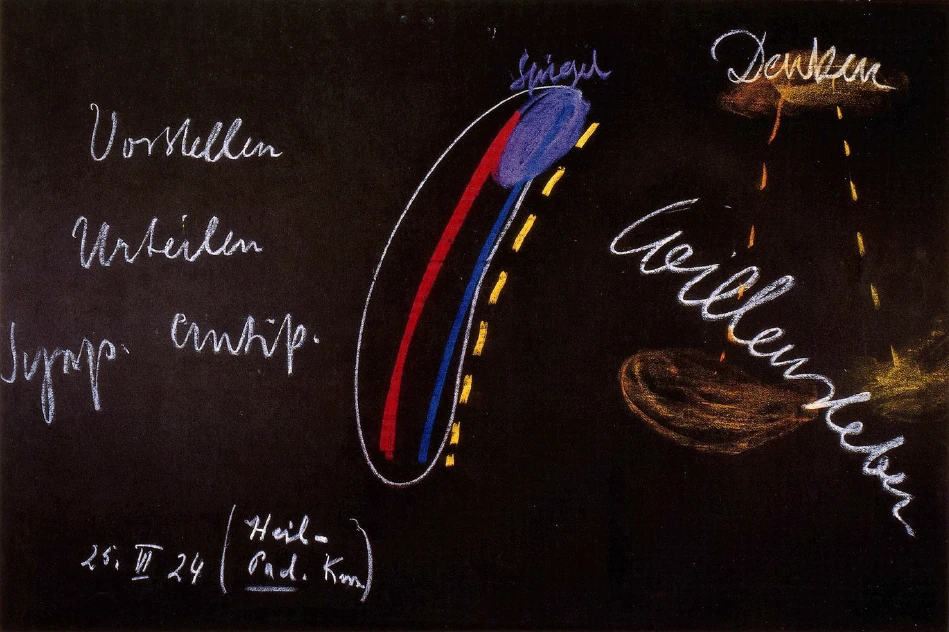
[ 4 ] Nehmen wir an, wir hätten hier (siehe Tafel 1, Mitte) den physischen Leib des Menschen, so wie er uns entgegentritt im Wachsen des kleinen Kindes. Wir haben dann gewissermaßen aufsteigend, herausdringend aus diesem physischen Leib des Menschen das Seelenleben. Dieses Seelenleben, das uns eben als die Äußerungen der kindlichen Seele entgegentreten kann, das kann nun normal oder abnorm sein. Wir haben ja im Grunde genommen gar kein weiteres Recht, über die Normalität oder Abnormalität des kindlichen Seelenlebens oder menschlichen Seelenlebens überhaupt zu reden, als indem wir hinschauen auf dasjenige, was durchschnittsmäßig «normal» ist. Es gibt kein anderes Kriterium als dasjenige, was allgemein üblich ist vor einer Gemeinschaft von Philistern. Und wenn diese Gemeinschaft irgend etwas für vernünftig oder gescheit ansieht, so ist alles dasjenige «abnormes» Seelenleben, was nach Ansicht dieser Philister nicht «normales» Seelenleben ist. Ein anderes Kriterium gibt es zunächst nicht. Daher sind die Urteile so außerordentlich konfus, wenn man anfängt, indem man eine Abnormität konstatieren kann, dann alles Mögliche zu treiben, und damit abzuhelfen glaubt — statt dessen treibt man ein Stück Genialität heraus. Mit solch einer Beurteilung ist überhaupt nicht viel anzufangen, und das erste, was eintreten sollte, ist, daß der Arzt und Erzieher eine solche Beurteilung ablehnt, daß er hinauskommt über die Aussage: das oder jenes ist gescheit oder vernünftig nach den Denkgewohnheiten, die man so gewöhnlich hat. Gerade auf diesem Gebiete ist es von eminentester Notwendigkeit, überhaupt keine Kritik zu üben, sondern die Sachen reinlich anzuschauen. Denn was liegt eigentlich beim Menschen vor?
[ 4 ] Suppose we have here2A drawing was made. the physical body of the human being, as it confronts us while the little child is growing. Then we have the life of soul, rising up, as it were coming forth from this physical body. This life of soul, which can show itself in varied expressions and manifestations, may be normal or it may be abnormal. But now the only possible grounds we can have for speaking of the normality or abnormality of the child's life of soul, or indeed of the life of soul of any human being, is that we have in mind something that is normal in the sense of being average. There is no other criterion than the one that is customary among people who abide by ordinary conventions; such people have their ideas of what is to be considered reasonable or clever, and then everything that is not an expression of a “normal” life of soul (as they understand it) is for them an abnormality. At present there is really no other criterion. That is why the conclusions people come to are so very confused. When they have in this way ascertained the existence of “abnormality”, they begin to do—heaven knows what!—believing they are thereby helping to get rid of the abnormality, while all the time they are driving out a fragment of genius! We shall get nowhere at all by applying this kind of criterion, and the first thing the doctor and teacher have to do is to reject it and get beyond the stage of making pronouncements as to what is clever or reasonable, in accordance with the habits of thought that prevail today. Particularly in this domain we must refrain from jumping to conclusions, and simply look at things as they are. What have we actually before us in the human being?
[ 5 ] Sehen wir jetzt ganz ab von diesem Seelenleben, das ja ohnedies erst nach und nach herauskommt, an dem manchmal höchst zweifelhafte Erzieher einen Anteil haben, sehen wir ab von diesem Seelenleben, dann haben wir hinter der Körperlichkeit ein anderes Geistig-Seelisches, ein Geistig-Seelisches, das heruntersteigt zwischen Konzeption und Geburt aus den geistigen Welten. Jenes Seelenleben ist nicht dasjenige, was heruntersteigt aus den geistig-seelischen Welten, sondern es ist ein anderes Seelenleben, das zunächst für das irdische Bewußtsein nicht äußerlich sichtbar ist. Ich will es schematisch dahinterzeichnen (siehe Tafel 1, gelb). Dieses ganze Seelenleben, das da heruntersteigt, das bemächtigt sich des Körpers, der vererbungsgemäß aufgebaut wird aus der Generationenfolge heraus. Wenn also dieses Seelenleben so geartet ist, daß es eine kranke Leber konstituiert, wenn es die Lebersubstanz ergreift, oder vererbungsgemäß im physischen und Ätherleib Krankhaftes findet und daher eine Krankheitsempfindung entsteht, dann liegt eben eine Erkrankung vor. Ebenso kann jedes andere Organ oder jeder andere Organkomplex falsch eingeschaltet sein in dasjenige, was aus dem seelisch-geistigen Kosmos heruntersteigt. Und erst wenn nun diese Verbindung hier da ist, diese Verbindung zwischen dem, was heruntersteigt und dem, was vererbt ist, wenn dieses Seelisch-Körperliche sich gebildet hat, dann entsteht — mehr aber nur als Spiegelbild dasjenige, was unser Seelenleben ist und was gewöhnlich beobachtet wird als Denken, Fühlen und Wollen (violett). Dieses Denken, Fühlen und Wollen ist überhaupt nur da wie Spiegelbilder, richtig wie Spiegelbilder, löscht aus, wenn wir einschlafen. Das eigentlich dauernde Seelenleben ist dahinter, steigt herunter, das geht durch die wiederholten Erdenleben und sitzt in der Organisation des Leibes darinnen. Und wie sitzt es darinnen?
[ 5 ] Let us look right away from this life of soul, which emerges only by degrees and in which a part is often played by teachers—concerning whom perhaps the less said the better!—let us look away from this life of soul, and then we find, behind the bodily nature, another life of soul, a spirit soul, which makes its descent, between the time of conception and birth, from the spiritual worlds. For the first-mentioned life of soul is not that in man which descends from spiritual worlds. The life of soul which descends from the spiritual worlds is something quite different, and is not, in the ordinary way, perceptible to earthly consciousness. This whole life of soul that comes down from the spiritual worlds takes possession of the body which is being built up from the sequence of generations in accordance with heredity. And if this soul-life is of such a kind that it tends, when it lays hold of the liver-substance, to form a diseased liver, or if it finds in the physical and the etheric body some inherited tendency to disease, which gives rise to a feeling of illness, then disease will make its appearance. Similarly, any other organ or nexus of organs may be faultily inserted into what comes down from the world of soul-and-spirit. When the connection has been made, when the union has come about between what comes down and what is inherited, when this entity of soul-and-body has been formed, then there arises—but even then no more than as a reflection in a mirror—that which we know ordinarily as our life of soul, as it manifests in thinking, feeling and willing. This soul life that manifests in thinking, feeling and willing is, however, as we said, no more than a reflection, it is really just like a reflection in a mirror. It is all obliterated when we fall asleep. The really permanent soul-life is behind; it makes its descent and passes through repeated earth-lives. And if we ask where it is in man, the answer is: It has its seat in the organisation of the body. How is this to be understood?
[ 6 ] Betrachten wir da zunächst den Menschen nach seinen drei Gliedern: dem Nervensystem, dem rhythmischen System und dem GliedmaßenStoffwechselsystem. Sehen Sie, das Nerven-Sinnessystem, denken wir es uns also — wir werden uns verstehen -, denken wir uns dieses NervenSinnessystem, wie es der Hauptsache nach nur, aber schematisch, im Kopfe lokalisiert ist, sprechen wir vom Kopfsystem, indem wir vom Nerven-Sinnessystem sprechen; wir können das beim Kinde um so mehr, als der aufbauende Teil des Nerven-Sinnessystems vom Kopfe ausgeht und in den ganzen Organismus hineinwirkt. Dieses System, dieses Nerven-Sinnessystem ist im Kopfe, im Haupte lokalisiert. Das ist ein synthetisches System.
[ 6 ] Let us think first of the human being in his three systems: nervous system, rhythmical system and metabolism-limb system. You will understand me when I say that the nerves-and-senses system is localised principally in the head; we can therefore speak—although, of course, diagrammatically only—of the head system when we are referring to the nerves-and-senses system. This is more literally correct in the case of the very young child, where the upbuilding function of the nerves-and-senses system proceeds from the head and works thence into the whole organism. The nerves-and-senses system, then, is localised in the head.
[ 7 ] Es ist synthetisch. Was meine ich damit? Es faßt nämlich alle Tätigkeiten des Organismus zusammen. Sehen Sie, im Kopfe ist eigentlich der ganze Mensch in einer gewissen Weise enthalten. Wenn man spricht von der Lebertätigkeit, und man sollte eigentlich nur von Lebertätigkeit sprechen — was ich als Leber sehe, ist der fixierte Leberprozeß -, so ist diese Lebertätigkeit natürlich ganz im unteren Leibe. Aber jedem solchen Funktionenzusammenhang entspricht eine Tätigkeit im menschlichen Haupte. Wenn ich das schematisch zeichne (siehe Tafel 1, rechts), so ist das so: Hier sei die Lebertätigkeit. Dieser Lebertätigkeit entspricht irgendeine Tätigkeit im menschlichen Kopfe oder Gehirne. Hier im Unterleib ist die Leber relativ abgesondert von den andern Organen, von Nieren, Magen und so weiter. Im Gehirn fließt alles ineinander, da fließt die Lebertätigkeit mit den andern Tätigkeiten zusammen, so daß der Kopf der große Zusammenfasser ist alles desjenigen, was im Organismus vor sich geht. Durch diese synthetische Tätigkeit wird ein Abbauprozeß bewirkt. Es fällt das Substantielle heraus.
[ 7 ] It is a synthetic system. What do I mean by that? It brings together all the activities of the organism. In the head is contained, in a sense, the whole human being. When we speak of hepatic activity—and we ought really to speak always of the activity of the liver, for what we see as liver is nothing but a liver process that has become fixed—this liver activity is, naturally, entirely in the lower body; but for each such nexus of functions there is a corresponding activity in the head. Here, shall we say, is the liver activity. And there is a correspondence to this liver activity in a particular activity in the human head or brain. Here in the lower body, the liver is relatively separated from the other organs, from kidneys, stomach and so on. But in the brain everything flows together, the hepatic activity flows together with the other activities; so that the head is the great synthesizer of everything that is going on in the organism. And the effect of all this synthesized activity is to set up a destructive process, a process of breaking down. Substance falls away.
[ 8 ] Genauso wie wir einen synthetischen Prozeß im Haupte haben, haben wir dann im ganzen übrigen Organismus, besonders im Stoffwechsel-Gliedmaßensystem, einen analytischen Prozeß. Da wird alles auseinandergehalten, da wird im Gegensatz zum Kopfe alles auseinandergehalten. Während im Kopfe die Nierentätigkeit mit der Darmtätigkeit zusammen vor sich geht, wird im Gegensatz dazu im übrigen Organismus alles auseinandergehalten, so daß wir also sagen können, wenn wir weiter schematisch zeichnen, meinetwillen die Lebertätigkeit, Magentätigkeit, so sind sie hier voneinander abgesondert; im Kopfe fließen sie ineinander, fließt alles zusammen, da synthetisiert sich alles. Nun liegt dieses Zusammenfließen — zu gleicher Zeit mit einem fortwährenden Herausfallen der Substanz, wie wenn es regnete -, nun liegt diese synthetische Tätigkeit des Kopfes im wesentlichen aller Denktätigkeit zugrunde. Damit der Mensch denken kann, damit der Mensch herauskommt und in Tätigkeit kommt, muß dasjenige, was aus dem Geistig-Seelischen kommt, nach dem Kopfe hin die zusammenfassende Funktion erhalten, und dadurch die Erbsubstanz synthetisch gliedern. Dadurch kann dann in der synthetisch gegliederten Erbsubstanz ein Spiegel gesehen werden. Sie haben also damit folgendes: wenn im Kopfe das eintritt beim Herunterkommen, daß der Kopf organisiert synthetisch, so wird der Kopf ein Spiegel, und dadrinnen spiegelt sich die Außenwelt, und das gibt das Denken, das wir gewöhnlich beobachten. Wir müssen also unterscheiden zwischen den zwei Denk funktionen, derjenigen, die hinter dem Wahrnehmbaren liegt, die das Gehirn aufbaut — die ist das Bleibende -, und der Denkfunktion, die gar nichts Wirkliches ist, die nur gespiegelt ist und fortwährend ausgelöscht wird beim Einschlafen und vergeht, wenn man nicht nachdenkt.
[ 8 ] Whilst we have thus in the head a synthesizing process, in the whole of the rest of the organism, and especially in the metabolism-and-limbs system, we have an analysing process; here, in contrast to the head, everything is kept separate. Whereas in the head, the renal activity takes place together with the intestinal activity, in the rest of the organism the several activities are held apart. In the head, however, everything flows together, it is all synthesized. Now this flowing together—accompanied as it is by a continual falling away of substance, like rain—this synthetical activity of the head lies at the basis of all our thought activity. For what has to happen in order that man may be able to think? That which enters into man from out of the realm of soul and spirit, enabling him to come forth and be active in the world—this soul-and-spirit nature of his has to be endowed, in the region of the head, with the synthesizing function and so be capable of synthesizing in the right way the inherited substance; then this harmoniously synthesized hereditary substance can become a mirror. When, with the descent of soul and spirit, the synthesizing activity begins to take place in the head, the head becomes a mirror; the outer world is reflected in it, and this produces the thinking that we ordinarily observe. We must therefore distinguish between two functions or activities of thinking: there is first the one which takes its course behind the realm of the perceptible, and builds the brain—this one is the permanent element in human thinking; and then there is the thinking function that is not real in itself but only a reflection. This latter function is obliterated every time we fall asleep; it subsides as soon as we stop thinking.
[ 9 ] Eine andere Partie dessen, was da aus dem Geistig-Seelischen herunterkommt, baut nun analytisch das Stoffwechsel-Gliedmaßensystem auf, baut die Organe auf, die auseinanderfallen, die deutlich unterscheidbare einzelne Konturen haben. Wenn Sie nun den ganzen Körper betrachten mit seinen deutlich unterscheidbaren einzelnen Konturen, so haben wir darinnen Leber, Lunge, Herz und so weiter, mit denen auch das Gliedmaßen-Stoffwechselsystem zusammenhängt; das rhythmische System sieht man nicht, alles, was mit physischer Substanz ausgefüllt ist, gehört zum Stoffwechsel-Gliedmaßensystem, auch was man am Gehirn sieht, ist Stoffwechsel. Nun liegt das, was diese einzelnen analytisch aufgebauten Organe sind, dem gesamten Willensleben des Menschen zugrunde, wie die synthetische Tätigkeit zugrunde liegt dem Denken. So liegt all das, was an Organen da ist, zugrunde dem Willensleben.
[ 9 ] Another part of what comes down from the realm of spirit and soul builds up the system of metabolism and limbs—analytically, building there organs which are separate one from another and have each their own clearly distinguishable outlines. If you set out to study the whole human body with its several clearly distinguishable outlines, then in this body you find liver, lungs, heart and so on. With all of these the metabolism-and-limbs system is connected. The rhythmic system we do not see; everything which is filled with physical substance belongs to the system of limbs and metabolism; even what we can see of the brain is metabolism. Now it is these single, analytically built-up organs that lie at the basis of the whole life of will in the human being, just as the synthesizing activity lies at the basis of thinking. Whatever we have in us in the way of organs is the foundation for our life of will.
[ 10 ] Nun betrachten wir einmal folgendes: Denken wir uns einen schon ziemlich erwachsenen Menschen. Was ist mit diesem ziemlich erwachsenen Menschen geschehen, während er sein Erdenleben geführt hat? Er ist vielleicht sieben Jahre alt geworden, er hat die zweiten Zähne bekommen; er ist vierzehn Jahre alt geworden, hat die Geschlechtsreife bekommen; er ist einundzwanzig Jahre alt geworden und hat damit die Konsolidierung seines Seelenlebens zustande bekommen. Wir müssen nun, wenn wir überhaupt die kindliche Entwickelung verstehen wollen, genau unterscheiden zwischen dem Körper, den ein Mensch trägt, der den Zahnwechsel durchgemacht hat, und einem Körper, den ein Kind trägt, das den Zahnwechsel noch nicht durchgemacht hat. Dasjenige, was da an besonders auffälligen Beispielen gebracht wird, geschieht fortwährend. Der Körper wird nach jedem Jahr ausgewechselt. Wir stoßen fortwährend von unserem Körper nach außen ab, es ist fortwährend eine zentrifugale Strömung nach außen, die den Körper abstößt. Das führt dazu, daß der Körper tatsächlich alle sieben bis acht Jahre richtig erneuert wird.
[ 10 ] And now let us think of a human being who has arrived at the stage of being “grown-up”. What has happened to him while he has been living his earthly life? He reached the age of seven and got his second teeth, he grew to be fourteen years old and attained puberty, finally he reached the age of twenty-one, when the consolidation of his soul-life took place. If we want to have any understanding at all of the development of the child, we must clearly distinguish between the body a human being has who has passed through the change of teeth, and the body of a very young child who has not yet experienced the change of teeth. As a matter of fact, what can be observed by comparing these two outstanding examples, is happening continuously. The body changes with each year that passes. We are perpetually thrusting something out from our body; a streaming outwards, a centrifugal impulse is at work all the time, pushing the body out. The consequence is that the body of man is completely renewed every seven or eight years. This renewal is, however, particularly significant about the time of the change of teeth, about the seventh year. For what reason?
[ 11 ] Nun sehen Sie, diese Erneuerung ist ganz besonders wichtig um den Zahnwechsel herum, um das siebente Jahr herum. Warum? Nun, der Körper, den der Mensch von der Geburt bis zum Zahnwechsel trägt, er ist gewissermaßen nur ein Modell, das wir übernehmen von außen, von unseren Eltern, der enthält die Erbkräfte, daran bauen die Vorfahren mit auf. Nun stoßen wir ihn ab, diesen Körper, im Laufe der ersten sieben Jahre. Und was ist? Ein ganz neuer Körper entsteht; dasjenige, was der Mensch an sich trägt nach dem Zahnwechsel, das wird nicht mehr durch die Vererbungskräfte aufgebaut, das wird ganz allein aus dem Geistig-Seelischen aufgebaut, das heruntersteigt, so daß der Mensch seinen Erbkörper substantiell nur bis zum Zahnwechsel trägt, und während er ihn abstößt, aus seiner Individualität einen neuen aufbaut. Unseren eigenen Körper haben wir eigentlich erst seit dem Zahnwechsel. Nur geschieht die Sache so, daß der Erbkörper benutzt wird als Modell, und je nachdem das geistig-seelische Leben stark oder schwach ist, je nachdem wird dieses Geistig-Seelische leichter imstande sein, mehr individuell vorzugehen gegen das, was als Erbgestaltung da ist, oder es unterliegt der Erbgestaltung, es muß den zweiten Körper formen, wie der erste von den Eltern her geformt ist.
[ 11 ] The body which we have from birth till the change of teeth is, in a sense, nothing else than a model that we take over from our parents; it contains the forces of heredity, our forefathers have helped to build it. In the course of the first seven years we thrust off this body. And what have we then? A completely new body comes into being; the body that man has after the change of teeth is not built up by the forces of heredity, but entirely by the spirit-and-soul which has descended. The human being has his body of inherited substance until the change of teeth, and no longer; but while he is thrusting off this body, he builds up a new body, working from out of his own individuality. Thus only since the change of teeth have we had what we may call our own body. But the inherited body is used as a model; and according as the life of spirit-and-soul is strong or weak, will it either be in a position to proceed in a more individual direction when confronted with the inherited form, or be subject to the inherited form—in which case the soul will be compelled to shape the second body like the first, which was shaped by the parents.
[ 12 ] Das also, was gewöhnlich in der Vererbungstheorie vorgebracht wird, ist ja ein Kohl. In dem, was da gewöhnlich vorgebracht wird, setzt man einfach fort die Gesetze des Wachstums bis zum Zahnwechsel weiter hinaus ins spätere Leben. Aber es ist so, daß dasjenige, was als Vererbung zu gelten hat, nicht weiter gilt als bis zum Zahnwechsel; nun eignet es sich die Individualität an und bildet den zweiten Körper aus.
[ 12 ] What is usually adduced in the theory of heredity is really nonsense. For it is assumed that the laws that underlie man's growth up to the change of teeth simply continue into later life; whereas the truth is, that the influence of heredity has to be reckoned with only until the change of teeth, and no further; the individuality then comes in and builds the second body.
[ 13 ] Wir müssen also unterscheiden gerade beim Kinde zwischen dem Erbkörper und dem, was als Folge des Erbkörpers auftritt in dem individuellen Körper. Der bilder sich nach und nach, der individuelle Körper, den man erst den wahren Menschenpersönlichkeitskörper nennen kann. Und sehen Sie, jetzt kriegt man sozusagen im Alter zwischen dem siebenten und vierzehnten Lebensjahre das stärkste Arbeiten, dessen die Individualität fähig ist: entweder obsiegt sie den Erbkräften, dann wird der Mensch, indem er durch den Zahnwechsel hindurchgeht und dadurch bemerken läßt, daß er sich herausarbeitet aus den Vererbungskräften, oder aber — das können wir sehr deutlich bemerken und müssen es daher als Erzieher ins Auge fassen -, es unterliegt die Individualität vollständig den Erbkräften, dem, was im Modell enthalten ist. Dann setzt sich einfach diese Vererbungsähnlichkeit mit den Eltern über das siebente Jahr fort. Das hängt von der Individualität ab und nicht von den Vererbungskräften. Gerade so wenig wie man sagen kann, wenn mir als Maler jemand etwas vorlegt, um es nachzuahmen, ich aber mächtig ändere, gerade so wenig wie ich da sagen kann, meine Malerei hat der erzeugt, der mir das vorgelegt hat ebensowenig können wir sagen: Dasjenige, was wir von dem siebenten Jahre ab, was wir nach dem siebenten Jahr an uns tragen, haben wir vererbt bekommen. - Und das muß man sozusagen im geistigen Griffe haben und wissen, wie stark in dem einen oder andern Falle die Individualität wiikt.
[ 13 ] We must therefore distinguish, when speaking of a child, between the body of heredity and the individual body which is its successor. The individual body—and this body alone can truthfully be called the personal body of the human being—develops by degrees. Between the seventh and fourteenth years the very strongest activity of which the individuality is capable goes forward. Either, the individuality conquers during this period the forces of heredity, and then it can be observed in the child that, after the change of teeth, he begins to work his way out of the forces of heredity—the fact will be clearly perceptible, and we teachers must take note of it—or, the individuality is completely subject to the forces of heredity, to what is contained in the model, with the result that the hereditary likeness to the parents simply continues beyond the seventh year. But it all depends, you see, upon the individuality, not upon the forces of heredity. Suppose I am an artist and you give me something to copy and I change it very considerably. Just as little as I can say that you are responsible for my picture, just so little can it be said that a person has acquired through heredity the body he bears from the seventh year onward. This truth we must master thoroughly, and then be able to know for ourselves in any particular case how strongly the individuality is working.
[ 14 ] Nun geht der Mensch zwischen dem siebenten und vierzehnten Lebensjahre durch ein Wachstum und ein Werden hindurch, das möglichst stark seine Individualität, die der Mensch heruntergebracht hat, zum Ausdruck bringt. Dadurch ist der Mensch in dieser Zeit gegenüber der Außenwelt relativ abgeschlossen. Man hat gerade in dieser Zeit Gelegenheit, die wunderbare Entfaltung der Individualkräfte ins Auge zu fassen. Und der Mensch würde später, wenn er diese Entwickelung fortsetzen würde, und wenn er nur mit dieser Entfaltung ins spätere Leben hineintreten würde, ein furchtbar abweisendes Wesen sein, er würde stumpf sein gegenüber der Außenwelt. Aber in dieser Zeit baut er sich schon seinen dritten Körper auf, der mit der Geschlechtsreife zum Vorschein kommt. Der wird wiederum unter Berücksichtigung der Kräfte in der irdischen Umgebung aufgebaut. Dasjenige, was als Beziehung der Geschlechter auftritt, ist nicht das Ganze; das Überschätzen in dieser Beziehung ist nur eine Folge unserer materialistischen Anschauungen. In Wirklichkeit sind alle Beziehungen zur Außenwelt, die mit der Geschlechtsreife auftreten, im Grunde genommen gleichgeartet. Man sollte daher im Grunde sprechen von einer Erdenreife, nicht von einer Geschlechtsreife, und sollte unter die Erdenreife stellen die Sinnenreife, Atemreife, und eine Unterabteilung sollte auch sein die Geschlechtsreife. So ist der Tatbestand wirklich. Da wird der Mensch erdenreif, da nimmt der Mensch das Fremde wieder in sich hinein, da erlangt er die Fähigkeit, nicht stumpf zu sein gegen die Umgebung. Er wird eindrucksfähig gegenüber der Umgebung. Vorher ist er nicht eindrucksfähig für das andere Geschlecht, aber auch nicht für die übrige Umgebung. Da bildet der Mensch also seinen dritten Leib aus, der wirkt bis zum Beginne der Zwanzigerjahre.
[ 14 ] Between the seventh and fourteenth years every human being passes through a process of growth and development which expresses, as strongly as in his case is possible, the individuality he has brought down with him. In this period of his life the child is thus comparatively shut off from the external world; and we teachers have opportunity to watch during these years the wonderful unfolding of the forces of the individuality. But now, if this development were to continue after the fourteenth year, if the human being were to go on into later life with nothing further than this unfolding of individuality, he would become a person who was perpetually refusing and rejecting everything that approached him, a person utterly without interest in the world around him. That this does not happen is due to the fact that, during the aforesaid period, he is all the time building his third body, which manifests at puberty, and this third body is built up to accord with—to bear right relation to—the forces in the earthly environment. The relation of the sexes is not the whole thing; the exaggerated importance given to it is just a consequence of our materialistic turn of mind. In reality, all connections with the outer world which begin to make their appearance at puberty are fundamentally of the same nature. We should really speak, therefore, not of sexual, but of earthly maturity. And under earthly maturity we have to include the maturity of the senses, the maturity of the breathing—and another such sub-division will also be sexual maturity. This gives the true picture of the situation. The human being, then, reaches earthly maturity. He begins to take again into himself what is outside and foreign to him; he acquires the faculty of being sensitive and not indifferent to his environment. Before this time, he is not susceptible to the other sex, neither is he susceptible to his whole environment. Thus does the human being form and develop his third body, which is active in him until the beginning of the twenties.
[ 15 ] Das, was heruntergestiegen ist aus der geistigen Welt, hat schon ein Ende gefunden durch den Zahnwechsel, hat in den ersten sieben Jahren, bis zum Zahnwechsel, und bis zum zwanzigsten Jahre seine Wirkung getan. Es hat bereits sich gestaltet in den Organen, die dann da sind, und es hat den Menschen individuell reif und erdenreif gemacht. Wenn da nun irgendeine Abnormität im Seelenleben, die sich gemäß des Aufbaues der Organe spiegelt, auftritt, die bedingt ist durch die ganze Entwickelung hindurch, dann ist natürlich eine seelische Abnormität wirklich da. Wenn aber, nachdem der Mensch das einundzwanzigste Jahr durchgemacht hat, eine Abnormität in der Leber oder einem andern Organe auftritt, so ist dieses Organ schon so weit verselbständigt und abgelöst, daß sich das Seelische des Willens unabhängig davon erhalten kann. Das kann um so weniger der Fall sein, je weiter man beim Kinde zurückgeht in seinem Lebensalter. Beim erwachsenen Menschen wird das Seelenleben, weil die Organe schon eine bestimmte Richtung haben, verhältnismäßig selbständig, und eine Organerkrankung wirkt nicht so stark auf das Seelenleben und kann als Organerkrankung behandelt werden. Beim Kinde wirkt noch alles zusammen; ein krankes Organ wirkt noch hinein bis in das Seelenleben, ganz wirksam.
[ 15 ] What descended from the spiritual world reached a kind of end at the time of the change of teeth; but it has continued to work, right until the twentieth year. It has already taken form in the organs which are now there, and has given the human being individual maturity, and earthly maturity. Suppose that now some abnormality shows itself in the life of soul, which reflects—and is in conformity with—the structure of the organs, and is conditioned by the whole development of the human being. We shall then manifestly have an abnormality of soul, that has come about in this way. But if, after the human being has passed his twenty-first year, an abnormality appears in the liver or in some other organ, this organ is by then so much “on its own” and so detached, that the will—in its inner “soul” aspect—can keep itself independent of it. This is less and less possible the further one goes back into the years of childhood. But in a grown person the soul-life has become relatively independent; the organs already have a definite direction, and the oncoming of illness in an organ will not work so strongly upon the soul-life, and can therefore be treated simply as a disease in that organ. In the very young child, however, everything is still working together; a diseased organ still works into the life of soul—and very actively.
[ 16 ] Sehen Sie, die heutigen Krankheiten, welche man gewöhnlich in unserer heutigen Pathologie diagnostiziert, sind die gröberen Krankheiten. Die feineren Krankheiten sind der Histologie nicht eigentlich zugänglich, liegen in dem flüssigen Teile, der ein Organ, zum Beispiel die Leber, durchzieht, in der Bewegung der Flüssigkeit oder sogar in der Bewegung des Gasförmigen, das die Leber durchzieht. Auch die Durchwärmung eines solchen Organs ist von ganz besonderer Bedeutung für das Seelenleben.
[ 16 ] The diseases usually diagnosed by our modern pathology are the cruder illnesses; the subtler illnesses are not really accessible to histology. These lie in the fluids that permeate an organ, such as the liver, for instance; in the movement of the fluids—or even of the air—through that organ. The warmth permeating the organ is also of quite special significance for the life of soul.
[ 17 ] Im kindlichen Organismus hat man also, wenn es sich um einen Willensdefekt handelt, vor allem zu fragen: Mit welchem Organe, mit welcher Organentartung, mit welcher Organerkrankung steht ein solcher Willensdefekt in Zusammenhang? - Das ist die wichtigere Frage.
[ 17 ] If therefore we are dealing with a child who shows evidence of a defect in the will, the first thing we must do is to ask ourselves: with what organ is the defect in the will connected? Is there some organ showing signs of degeneration or of illness, with which we can connect the defect in the will? That is the really important question.
[ 18 ] Von so ungeheurer Wichtigkeit ist nicht der Denkdefekt. Die meisten Defekte sind eigentlich Willensdefekte; denn auch wenn Sie im Denken einen Defekt haben, müssen Sie sorgfältig hinschauen, inwieferne der Denkdefekt ein Willensdefekt ist. Denn, wenn Sie zu schnell oder zu langsam denken, so können die Gedanken ganz richtig sein, es handelt sich nur darum, daß der Wille, der wirkt in der Ineinandersetzung, einen Defekt hat. Man muß hinschauen, bis zu welchem Grade der Wille darinnen steckt. Eigentlich einen Denkdefekt können Sie nur konstatieren, wenn unabhängig vom Willen Deformationen der Gedanken auftreten, Sinnestäuschungen. Bei der Einstellung zur äußeren Welt treten sie im ganz Unbewußten auf, da wird das Vorstellungsbild selber unregelmäßig. Oder aber wir haben etwas wie Zwangsvorstellungen, und daß sie Zwangsvorstellungen sind, hebt sie aus dem Willen heraus. Aber auf das muß man vor allem aufmerksam sein, ob man es mit einem Willensdefekt oder Denkdefekt zu tun hat. Die Denkdefekte fallen zumeist schon in das Gebiet des abgesonderten Heilens. Mit den Willensdefekten hat man es meistens zu tun in der Erziehung von unvollständig entwickelten Kindern.
[ 18 ] A defect in the thinking is not of such tremendous importance. Most defects are really defects in the will; for even when you find a defect in the thinking, you must look carefully to see to what extent this defect in thinking is really a defect in will: When someone thinks too rapidly or too slowly, the thoughts themselves may be quite correct; the trouble is that the will which works in the dove-tailing of the thoughts into each other is faulty. We must be able to discover in all such cases how far the will is a factor. One can really only be sure that there is a defect in thinking when, independently of the will, deformations of thought, sense-delusions, make their appearance. These then arise quite unconsciously in the human being in the process of relating himself to the outer world. The mental picture itself becomes irregular, or we have something like “fixed ideas”, where the very fact that they are fixed ideas lifts them out of the sphere of the will. It is therefore most important we should take pains to discern whether in a particular case we have to do with a defect in the will or a defect in the thinking. Defects in thinking fall for the most part into the strictly medical domain. In the education of incompletely developed children, we have mainly to do with defects of the will.
[ 19 ] Nun denken Sie sich aber, wie das ganze Wesen des Menschen hineinspielt in seine Entwickelung. Sie können es ermessen aus dem, was angeführt ist für diese Entwickelung des Menschen. Man nehme nur die ersten sieben Lebensjahre, da können Vererbungsdefekte vorliegen, dafür kommen wesentlich die Vererbungsdefekte in Betracht. Nun, einen solchen Vererbungsdefekt, den darf man auch nicht in der schauderhaften Weise ansehen, wie ihn die heutige Wissenschaft ansieht; der fällt uns ja nicht als Zufall zu, sondern er fällt uns als karmische Notwendigkeit zu. Wir wählen den Körper, der nach der Generationsfolge defekt ist, aus unserer Unkenntnis heraus allerdings in der geistigen Welt. Wo also defekte Vererbungskräfte vorliegen, da lag vor der Konzeption eine Unkenntnis der menschlichen Organisation vor. Man muß nämlich, bevor man auf die Erde heruntersteigt, den menschlichen Organismus ganz genau kennen, sonst kann man nicht recht hineinsteigen in den ersten sieben Jahren und ihn nicht recht umwandeln. Und was man also erwirbt an Wissen in bezug auf die innere Organisation zwischen dem Tod und einer neuen Geburt, das ist etwas ganz Unermeßliches gegenüber dem bissel von Wissen, das heute die Physiologie oder Histologie von außen her erwerben. Das letztere ist ja nichts. Aber dieses Wissen, das wir da haben, das dann untertaucht in den Körper und daher vergessen wird, weil es untertaucht, das wendet sich nicht durch die Sinne nach der Außenwelt. Dieses Wissen, das ist etwas unermeßlich Großes. Dieses Wissen wird aber beeinträchtigt, wenn wir in einem Erdenleben für unsere Umgebung kein Interesse entwickeln, oder an diesem Interesse verhindert worden sind. Denken Sie, irgendein Zivilisationszeitalter sperre die Menschen ein in Räumen, halte sie darinnen vom Morgen bis zum Abend so, daß sie kein Interesse haben können für die Außenwelt. Wie wirkt eine solche Zivilisation? Sie schließt die Erkenntnis des Menschen von der Außenwelt ab. Und wenn ein Mensch mit diesem Abgeschlossensein durch den Tod geht und in die geistige Welt wenig Vorbedingung hineinbringt, um in dieser geistigen Welt, in der alles enthalten ist, den menschlichen Organismus kennenzulernen, aufzunehmen, so kommt ein solcher Mensch, wenn er heruntersteigt auf die Erde, mit einer geringeren Kenntnis herunter als einer, der sich einen freien Blick für seine Umgebung erworben hat.
[ 19 ] And now look how the entire being of man plays into his development! You can appreciate this from the description we have been giving. Take the first seven years. There may be defects due to heredity. It is during this period that such defects come particularly into consideration. But now, a hereditary defect should not be regarded in the terribly mistaken way in which it is regarded by modern science; it does not fall to our lot by chance, but as a karmic necessity. Out of our own lack of knowledge—in the spiritual world, of course—we have chosen a defective body, one that is defective as the result of the generations. The existence of defective forces of heredity means that before conception there was a lack of knowledge of the human organisation. Before a human being comes down to Earth, he must have an exact knowledge of the human organism; otherwise he cannot enter into this organism in the right way during the first seven years, neither can he transform it rightly. The knowledge about the inner organisation of man which we acquire between death and a new birth is infinite in comparison with the scraps of knowledge that have been acquired by external observation and are to be found in the physiology or histology of today. (As for the latter, it really amounts to nothing at all!) The knowledge which we have between death and a new birth and which then sinks down into the body, and is forgotten because it sinks down, a knowledge that does not direct itself, with the help of the senses, to the outer world—this knowledge is immeasurably great; it is however impaired if, in an earlier life, we neglected to develop interest in our surroundings or were prevented from doing so. Suppose one day a civilisation were to arise that confined human beings in rooms, keeping them there from morning till evening, so that they were debarred from taking any interest at all in the outer world. What would be the result? These human beings would of course by such a process be precluded from acquiring any knowledge of the outer world; and this would mean that when they passed afterwards through death and came into the spiritual world, they would be insufficiently equipped for getting to know the human organism in this spiritual world (where all is contained); with the result that when they descended again to Earth, they would come down with far less knowledge than one who had in his previous life acquired the faculty for looking out upon his surroundings with free, open perception.
[ 20 ] Das andere Geheimnis ist dieses: Sie gehen durch die Welt. Jetzt glauben Sie, wenn Sie so durch die Welt gehen, zum Beispiel einen Tag, jetzt meinen Sie, das ist etwas Geringes: es ist auch etwas Geringes für das gewöhnliche Bewußtsein, es ist aber nichts Geringes für dasjenige, was im gewöhnlichen Bewußtsein das Unterbewußtsein bildet. Denn wenn Sie nur einen Tag durch die Welt gehen und sie genauer anschauen, so ist das schon die Vorbedingung für die Erkenntnis des Inneren des Menschen. Außenwelt im Erdenleben ist geistige Innenwelt im außerirdischen Leben. Und wir werden davon sprechen, was unsere Zivilisation bewirkt und warum deshalb minderwertige Kinder auftreten. Diejenigen Menschen, die heute abgeschlossen leben von der Welt, die werden alle einstmals herunterkommen mit Unkenntnis des menschlichen Organismus, und sie werden sich wählen die Vorfahren, die sonst unfruchtbar bleiben würden. Gerade die Menschen, die sonst schlechte Körper liefern würden, werden dann gewählt, während diejenigen, die gute Körper liefern würden, steril bleiben. Es hängt tatsächlich von der ganzen Entwickelung eines Zeitalters ab, wie sich beim Heruntersteigen wieder ein Geschlecht aufbaut. Und wenn wir ein Kind ansehen, müssen wir sehen, was da in dem Kinde von dem vorigen Erdenleben lebt. Man muß es verstehen, warum es sich wählt Organe, die nach den Vererbungskräften krankhaft sind, warum es sich wiederum durch eine unvollständig entwickelte Individualität in diesen Körper hineinarbeitet.
[ 20 ] There is another secret connected with this. You go through the world. You think perhaps, as you go through the world, that a single day is of little importance. And so it is for ordinary consciousness, but not for that which is building the unconscious within this ordinary consciousness. If for one single day, as you go through the world, you observe the world intently and carefully, then this gives you already the preliminary condition for knowledge of all that is contained in the body of man. For what is outer world in Earthly life is spiritual inner world in life beyond the Earth. And we shall have to speak further of the results that cannot but ensue from our present civilisation, and of how it comes about that children are born defective. Those human beings who live shut off from the world today will all of them at some time or other come down with a lack of knowledge of the human organism, and they will choose ancestors who would otherwise have remained barren. It will be precisely those parents who tend to beget sick or feeble bodies who will be chosen, while those who would be capable of producing good bodies will remain sterile. Yes, it is actually so: it depends upon the whole development of a particular epoch, how a generation, when it descends again to birth, will be formed and built. When we look at a young child, we must see what it is in this child that has come from the previous earthly life. We must understand why he chooses organs that are diseased in consequence of the forces of heredity; and again, why he works himself into this body with an incompletely developed individuality.
[ 21 ] Denken Sie sich, was da für Möglichkeiten gegeben sind bis zum Zahnwechsel hin für das Kind, weil ja nicht immer vollständig adäquat ist das, was herunterkommt, dem, was vorliegt. Da ist die Möglichkeit vorhanden, daß zum Beispiel ein Kind ein gutes Modell hat, das in der Leber gut ausgebildet ist. Weil aber die Individualität unfähig ist, das zu verstehen, was da drinnen liegt, so wird es in der zweiten Lebensepoche unvollständig nachgebildet, und dann entsteht ein sehr bedeutsamer Willensdefekt. Gerade wenn das Beispiel vorliegt, daß die Leber in dieser Weise nach dem Lebermodell unvollständig nachgebildet wird, dann entsteht ein Willensdefekt, der sich äußert dadurch, daß das Kind will, aber es geht nicht über zum Ausführen des Willens, es bleibt das Wollen im Gedanken stecken. Das Kind fängt auch gleich an, etwas anderes zu wollen, wenn es etwas angefangen hat, und es stockt das Wollen, es spießt sich das Wollen. Denn die Crux ist, daß die Leber nicht bloß das Organ ist beim Menschen, das die heutige Physiologie beschreibt, sie ist im eminentesten Sinne dasjenige Organ, das dem Menschen die Courage gibt, eine ausgedachte Tat in eine wirklich ausgeführte umzusetzen. Also wenn es geschieht, daß ich so organisiert bin als Mensch, daß da ein Tram wegfährt, ich weiß, ich soll nach Basel fahren - es gibt solche Menschen - ich bin schon da: im letzten Moment kann ich nicht aufsteigen, es will mich etwas zurückhalten, ich komme nicht dazu, aufzusteigen! — Sehen Sie, so etwas enthüllt sich manchmal auf eine merkwürdige Weise, wenn eine Stockung des Willens auftritt. Wenn aber so etwas auftritt, dann liegt immer ein feiner Leberdefekt vor. Die Leber vermittelt immer das Umsetzen der vorgenommenen Ideen in die durch die Gliedmaßen durchgeführten Handlungen. So ist jedes Organ dazu da, irgend etwas zu vermitteln.
[ 21 ] Think of the many possibilities that exist for a child, in this first period up to the change of teeth, owing to the fact that what has come down is not always quite able to cope with what it finds before it. There is the possibility, let us say, of the child having a good model that has been well developed in the liver; but because the individuality is incapable of understanding what is contained in the liver, the development of the same (upon the model provided) during the second life-period is incomplete, and we have, in consequence, a very significant defect of will. Precisely in a case where the development of the liver has not been complete in this second period, has not been in accordance with the good development of the model, we find a defect in the will. The child has will, but does not get to the point of carrying it out; the will remains in the thinking. As soon as ever the child has begun to do something, he immediately begins to will something else. The will gets “stuck”, it is transfixed. For you must know that the liver is not merely the organ modern physiology describes; it is pre-eminently the organ that gives the human being the courage to transform a deed which has been thought of into an accomplished deed. Imagine a man who sees a tram about to start, and knows that he has to go to Basle, but at the last minute cannot get into the tram. There are people like this! Something holds him back, he does not reach the point of getting in. This kind of stoppage of the will may sometimes reveal itself in most curious ways. But wherever it occurs, there is invariably a subtle defect of the liver. The liver is the mediator which enables an idea that has been resolved upon, to be transformed into an action carried out by the limbs. In point of fact, every organ is there in the body for the purpose of acting as mediator for something to come about.
[ 22 ] Sehen Sie, mir wurde mitgeteilt, daß ein gewisser junger Mann diese Krankheit wirklich hatte, daß wenn er in der Nähe eines Tramwagens stand, daß er plötzlich stehenblieb und nicht einstieg. Kein Mensch wußte, warum er nicht einstieg. Er wußte auch nicht, warum. Er blieb stehen. Der Wille stockt. Nun, was lag da vor? Eine sehr komplizierte Sache. Der Vater des Betreffenden war Philosoph, hat in einer merkwürdigen Weise die Seelenfähigkeiten eingeteilt in Vorstellen, Urteilen und in die Kräfte der Sympathie und Antipathie, und rechnete unter die Seelenkräfte nicht den Willen. Der- Wille fiel heraus aus der Aufzählung der Seelenkräfte. Er zählte nie den Willen auf, wenn er die Seelenkräfte aufzählte. Er wollte aber ehrlich sein. Er wollte nur das geben, was sich im Bewußtsein darstellte. Nun hatte er es so weit gebracht, daß das ihm ganz Natur war, keine Vorstellung vom Willen zu haben. Nun kriegte er in verhältnismäßig spätem Alter einen Sohn. Er, der Vater, hatte durch ewiges Nicht-Denken des Willens der Leber die Anlage eingepflanzt, die subjektiven Intentionen nicht umzusetzen in die Tat. Beim Sohne trat das als Erkrankung auf. Und da können Sie sehen, warum auch dieses Sohnes Individualität gerade diesen Vater gewählt hat: weil sie nichts anzufangen wußte mit der inneren Organisation der Leber. Da hatte sie sich eine Konstitution gewählt, bei der sie sich nicht bemühen mußte um die Leber. Denn die Leber war eben ohne diese Funktion, die der Betreffende nicht mit heruntergebracht hatte. Sie sehen also: in einer ganz merkwürdigen Weise muß man hineinschauen auch in das Karma, wenn man das Kind verstehen will.
[ 22 ] I was once told about a certain young man who had an illness of this kind. He would be waiting for a tram; but when the tram came, he would suddenly stop short and not get in. Nobody knew why, he did not know himself. He simply stood there, rooted to the spot. What was the cause of this condition? It was a very complicated affair. The young man's father was a philosopher. He had divided the faculties of the soul, in a rather singular manner, into ideas, judgments (or conclusions) and the forces of “sympathy” and “antipathy”. He did not reckon the will among the powers of the soul. The will was omitted in his enumeration—from sheer desire on his part, to be honest and not to put forward more than revealed itself clearly to his consciousness. He carried this to such a point that it became perfectly natural to him to have no mental concept of the will at all. Then, at a comparatively advanced age in life, he had a son. By perpetually ignoring the will he, the father, had implanted into the liver an inclination not to transform subjective intentions into deed. This came out in the son as an illness! And now you can see why the individuality of the son chose this man for his father. The individuality of the son had no understanding of how to cope with the inner organisation of the liver; so he chose a constitution in which he need not trouble himself about the liver, a constitution in which the liver was lacking in the very function he had himself failed to bring down. You have here a very striking instance of the need to look also into karma, if we want to understand the child.
[ 23 ] Das wollte ich zunächst heute einmal sagen, und wir wollen dann morgen um dieselbe Stunde weiterfahren.
[ 23 ] This is what I wanted to say to begin with, and tomorrow at the same hour we will continue.