

Remedial Education Course
GA 317
4 July 1924, Dornach
Translate the original German text into any language:
Versions Available:
Curative Education, tr. Adams
Neunter Vortrag
Lecture Nine
[ 1 ] Nun, meine lieben Freunde, wir haben eine Reihe von Kindern gestern vorzunehmen gehabt, und die Dinge, die sich bei der Behandlung für abnorme Kinder ergeben, müssen ja zumeist an Beispielen besprochen werden, weil die Abnormität eine solche ist, die nach allen Seiten geht und jeder Fall ein Fall für sich ist, und man nur etwas lernen kann dadurch, daß man an einem Fall die Praxis sich heranbildet, die für andere Fälle notwendig ist.
[ 1 ] We had before us yesterday a succession of children to whom we gave our attention. It is in this way for the most part that the study of the treatment of abnormal children has necessarily to be pursued—namely, in relation to particular examples. Abnormality manifests in all possible directions, and each single case is a case by itself. The only way you can begin to learn how to deal with such children is to devote yourself to an individual case, and thereby, as time goes on, gradually acquire the skill that will be needed for dealing with other cases.
[ 2 ] Sie erinnern sich an unseren gestrigen Fall, an den Jungen, der zwölf Jahre alt ist, den ich als Kleptomanen vorführen mußte. Es ist geistig gesehen bei einem solchen Kleptomanen so, wie ich es charakterisiert habe in der Aussprache über das Prinzipielle, daß er durch die Hemmungen, die im astralischen Leibe liegen, nicht den Zugang findet zu dem, was die Urteilsmäßigkeit ist unter den Menschen in der äußeren Welt. Sie müssen sich vorstellen, daß dasjenige, was sich auf die Moralität bezieht, alles, was sich auf die Moralität bezieht, was in seinen Begriffsformationen moralische Impulse in sich schließt, daß das nur innerhalb des Erdendaseins zum Ausdruck kommt. Man könnte sagen, wenn das nicht mißverstanden würde von der heutigen Oberflächlichkeit: da, wo die Erde aufhört, wo Sie hinauskommen ins Übersinnliche, gibt es in diesem Sinne wie auf der Erde nicht moralische Urteile, weil dort das Moralische selbstverständlich ist. Moralische Urteile beginnen erst da, wo die Wahl eintritt zwischen Gut und Böse. Dagegen ist Gutes und Böses für die geistige Welt einfach eine Charaktereigenschaft. Es gibt gute Wesen, es gibt böse Wesen. Gerade so wenig wie bei einem Löwen man davon sprechen kann, ob er das Löwenhafte haben soll oder nicht haben soll, ebensowenig kann man, von der Erde weggekommen, von Gutem und Bösem so sprechen. Dazu gehört ein Ja und Nein, das nur innerhalb der Organisation des Menschen in Frage kommt und zwischen den in ihrer moralischen Umgebung lebenden Menschen. Es ist einfach so bei einer solchen Erkrankung, wie es die Kleptomanie ist, daß der betreffende Mensch seinen astralischen Leib nicht so weit zur Entwickelung gebracht hat, weil er die schon charakterisierten Hemmungen hat, daß er einen Sinn für moralische Urteile entwickeln kann. Daher ist es bei einem solchen Jungen so, daß er in dem Augenblick, wo er irgend etwas hat, für das er besonderes Interesse hat, gar keinen Grund einsieht, warum er das Ding sich nicht aneignen soll. Denn er begreift nicht, daß es jemand gehören kann, daß der Begriff: Ich besitze etwas — Bedeutung hat. Er betritt nicht so weit die physische Welt mit seinem astralischen Leib, daß er einen Sinn für solche Urteile hat.
[ 2 ] You will remember the boy of twelve years old who was brought before us yesterday and whom I had to describe as a kleptomaniac. I explained to you how spiritual vision can discern, in the case of such a kleptomaniac, that on account of hindrances in the astral body, he has no means of access to the capacity for judgement that ordinarily belongs to human beings in the world. In this connection, you must realise that everything which has to do with morality, everything of which it can be said that our conception of it must needs include moral impulses, comes to expression within Earth existence alone. We really could say—it would of course be misunderstood by the superficial thinking of the present day—that where the Earth comes to an end, where one goes out beyond into the super-sensible realm, moral judgements such as we are familiar with on Earth cease to exist; for the reason that out there, in the realm of the super-sensible, morality is, so to say, a complete matter of course. Moral judgements begin only where there is a possibility of choice between good and evil. For the spiritual world, good and evil are simply characteristic qualities. There are good beings and there are bad beings. As little as you can say of a lion that he ought, or ought not, to be lion-like, just so little can you say, when you have come away from the Earth, that good and evil ought or ought not to be as they are. To speak in this way pre-supposes the possibility of choice, of saying Yes or No, a possibility which comes in question solely within the organisation of man and where human beings are living socially together. Now, in the case of an illness such as kleptomania, owing to the hindrances of which we spoke, the person in question has not evolved his astral body far enough to enable him to develop a sensitivity to moral judgements. Consequently, the moment a boy of this kind feels a particular interest in some object, he sees no reason at all why he should not take it. He does not understand that it may “belong” to someone, the idea of “mine and thine” has no meaning for him. His astral body does not get far enough into the physical world for him to be able to appreciate the concept of possession.
[ 3 ] Es ist genau dieselbe Erscheinung, wie wenn jemand blaublind oder rotblind ist, daß er gar keine Empfindung für Blau oder Rot hat und die ganze Welt blaufrei oder rotfrei sieht. So also, wie Sie eine Fläche grün sehen, so sieht der Rotblinde eine blaue Fläche. Sehen Sie eine Fläche grün, so sieht der Blaublinde eine rote Fläche. Es ist interessant für einen Blaublinden, einen Wald zu malen, der hat rote Bäume; wenn man es mit einem Blaublinden zu tun hat, muß man die Bäume rot malen. Und wie es da wenig Sinn hat, bei Farbenblindheit von den Farben zu sprechen, ebensowenig hat es Sinn, von Besitz oder Nichtbesitz in der höheren Welt zu sprechen. So weit betritt ein solcher Junge die physische Welt nicht, daß er imstande wäre, irgendwie für sich eine Vorstellung zu verbinden mit demjenigen, was man redet über Besitzverhältnisse. Für ihn gibt es besonders stark den Begriff des Auffindens, den Begriff: etwas überrascht ihn, etwas interessiert ihn. Da hört aber schon das Begriffsvermögen auf. Jetzt ist einfach sein astralischer Leib nicht bis in die Willensregion vorgedrungen, sondern mehr oder weniger in der intellektuellen Sphäre geblieben, was sich so darbietet, daß die Organe des Willens an der Seite verkümmert sind. Die Folge davon ist, daß er das, was im Intellektuellen gut ist, auf den Willen anwendet. Tritt derselbe Fehler auf im Intellektuellen, so sind die Kinder stumpfsinnig. Tritt derselbe Fehler auf im Willensmäßigen, so sind die Kinder kleptoman.
[ 3 ] We have here exactly the same kind of phenomenon as when someone is colour-blind. It's no use talking about colours to one who is colour-blind; and it would have just as little sense to speak in the higher world about possession and non-possession. The child does not find his way far enough into the physical world for him to be able to attach any meaning at all to what he hears people say about “possessing” things. What is particularly strong in him is the idea of discovery—the idea that he has lighted upon some object or other which astonishes him, which fills him with delight and interest. But there his capacity for forming ideas comes to a full stop. The truth is that up to now his astral body has not penetrated to the region of the will, but has remained more or less in the intellectual sphere. We have evidence of this in the fact that the organs of the will are deformed at the side. Consequently, whatever he finds good intellectually he at once turns into will. Let the same defect show itself in the intellect, and you will find the children are dull and stupid; but when, as here, it shows itself in the will, they are kleptomaniacs.
[ 4 ] Nun ist gerade eine solche Abnormität außerordentlich schwierig zu bekämpfen. Denn, sehen Sie, zunächst bemerkt man in dem Lebensalter, wo es darauf ankommt, sich hart dagegenzustellen, die Sache nicht. In diesem Lebensalter ahmen die Kinder nach, machen dasjenige, was die Umgebung macht, und man merkt an ihrem Verhalten nicht, daß sie die kleptomane Veranlagung haben. Diese kleptomane Veranlagung, sie wird erst herauskommen, wenn der Zahnwechsel vorüber ist. Aber wenn der Zahnwechsel vorüber ist, dann ist das Kind immer noch nicht geeignet — weil es noch nicht weit genug draußen ist mit der Seele auf dem physischen Plan -, einen andern Sinn für moralische Urteile zu entwickeln als den: das Gute gefällt mir, das Böse mißfällt mir, Hier bleibt alles beim ästhetischen Urteil. Da ist der Erzieher angewiesen darauf, beim Kinde zu wecken den Sinn für das Gute dadurch, daß das Kind den Erzieher sich zur Norm macht. Deshalb sieht unsere Waldorfschul-Pädagogik darauf, daß in diesem Lebensalter die Autorität wirksam sein muß, daß das Kind in selbstverständlicher Hingebung aufschauen soll zum Erzieher und der Erzieher nur reden soll von dem, was gut ist so, daß es dem Kinde sympathisch wird, und von dem Bösen so, daß es dem Kinde antipathisch wird. Zu alledem ist notwendig, daß die selbstverständliche Autorität da ist. Ist nun diese bei einem sogenannten normalen Kinde notwendig, so ist sie im höchsten Maße notwendig bei einem solchen Kinde, wie dieses es ist. Dasjenige Erziehungsmittel, das am wirksamsten ist, ist die Zutraulichkeit, die das betreffende Kind haben kann zu dem, der sein Erzieher ist. Darauf ist man bei diesen Kindern ganz besonders angewiesen. Es ist durchaus notwendig, daß das als eine Voraussetzung gemacht wird.
[ 4 ] An abnormality of this kind is very difficult to contend with. For at the age of life when it would be important to make a strong stand against the failing, it generally escapes notice altogether. At this early age, the child is naturally imitative, doing what he sees done around him, and so one may easily fail to discern in his behaviour the tendency to kleptomania. Only after the change of teeth, will the tendency begin to be apparent. When the change of teeth has taken place, the child is however even then not far enough out yet on the physical plane to develop a sense for any moral judgement other than: What I like is good, what I don't like is bad. His judgements, that is to say, are entirely aesthetic. It will therefore be for the teacher to awaken in the child the feeling for the good—the meaning of “good”—by bringing it about that the child looks up to him and takes him for his pattern and example. That is why in our Waldorf School education we take particular care that authority shall make itself felt in this age of life. Quite as a matter of course it should come about that the child regards his teacher with devotion. The teacher will then speak of things that are “good” always in such a manner as to arouse the child's interest and enjoyment, and of things that are “bad” in such a manner as to arouse his antipathy. For this to achieve the desired result, it is of course essential that there be first the natural acceptance of the teacher's authority. If this is necessary in the case of a so-called normal child, it is in the very highest degree necessary in the case of such a child as we are considering. In all education nothing contributes so much to true progress as that the child has trust and confidence in the one who is his teacher; and in dealing with abnormal children it is absolutely essential that this right relationship between child and teacher can be relied on from the outset.
[ 5 ] Nun, selbstverständlich darf in einem solchen Kurse nicht vergessen werden, darauf hinzuweisen, daß schon dann, wenn man kleine Kinder zur Erziehung hat, wenigstens darauf geachtet werden soll, wie sich die Entwickelung des Kindes gestaltet. Merkt man, daß das Kind sehr früh eine besondere Lebhaftigkeit und Freude entwickelt an dem, was es gelernt hat, also so gelernt hat, wie man eben vor dem Zahnwechsel lernt, wenn man das Sprechen lernt, merkt man, daß das Kind eine Wollust hat an dem Angeeigneten, da muß man voraussetzen, daß da etwas schief gehen kann. Kinder, die später kleptomane Menschen werden, die entwickeln den Egoismus im zarten Kindesalter zum Beispiel in der Art, daß sie mit der Zunge schnalzen, wenn sie sich ein neues Wort angeeignet haben. Das ist in seltenen Fällen bei Kindern der Fall, aber es kann schon durchaus bei Kindern der Fall sein.
[ 5 ] In a course of study such as we are now engaged in, we must not omit to point out how important it is, when dealing with quite little children, to make careful observation of the whole way in which their development takes place. If we notice that a little child grows very happy and animated on account of something he has learned—learned, I mean, before the change of teeth—if we notice, for instance, that a child who is learning to speak takes inordinate pleasure in some new sound he has learned to utter, then we must be prepared for the possibility that things may go wrong with that child! Children who later on become kleptomaniacs, develop this kind of egotism in the tender age of early childhood; they will perhaps click their tongue with satisfaction, when they have acquired a new word. This is rare with very young children, but it certainly can occur.
[ 6 ] Man muß schon ein gewisses Auge haben für das, was in der Folgezeit daraus entstehen kann, was in der Welt vorgeht. Deshalb ist es für den Arzt wie für den Erzieher noch viel notwendiger, als daß er seine Prinzipien kennt - die eine Selbstverständlichkeit sein müssen -, daß er sich einen Sinn aneignet für das, was in der Welt vorgeht. Sehen Sie, man muß in dieser Beziehung nicht so sein wie der Staatsanwalt Wulffen, man muß so sagen können: Es ist natürlich ungeheuer viel abhängig davon, wie die ganze Umgebung eines Menschenkindes ist, wenn dieses Menschenkind aufwächst. - Sehen Sie, nehmen Sie einmal den folgenden Fall an: ein Kind hat diese Eigenschaft, die ich bezeichnet habe mit Zungenschnalzen in jedem Moment, wenn es sich etwas angeeignet hat. Nun, diese Freude an Aneignen im Intellektuellen, die wandelt sich, so um die Zeit des Zahnwechsels herum, in eine deutlich bemerkbare Eitelkeit, Eitelkeit auch für die andern Dinge. Es hat etwas Bedenkliches, wenn um die Zeit des Zahnwechsels wie autochthon herauswächst die Gier, besonders sich zu kleiden. Diese Dinge muß man beachten.
[ 6 ] One has to learn to be able to look ahead and see what may be the outcome of such a trait in future years. Far more important for the doctor as well as for the educator, than the principles upon which he has to work—although a knowledge of these is, of course, to be taken for granted—far more important for him is that he should acquire a sensitive perception for what is going on in the world around him. You must not, you see, be like Wulffen;1See Lecture 2 you must be ready to appreciate what a vast deal depends on the environment of a growing child. Take, for instance, such a case, where a very little child has the habit I spoke of just now: he clicks his tongue with satisfaction over some new thing he has learned. This delight at acquiring something in the intellectual sphere will change, about the time of the second dentition, into a conspicuous vanity; the child will grow vain and conceited in relation to other things as well. It should indeed be a matter for grave concern, for instance, if at about the time of the change of teeth a child develops—as it were, from an inborn tendency—a hankering after fine clothes. Symptoms of this nature should be carefully noted. But let us now consider two kinds of environment into which such a child may grow up.
[ 7 ] Es können zwei Fälle eintreten: so ein Kind kann aufwachsen - ich will ein kleines Territorium ins Auge fassen - in einer Umgebung, die gewohnt ist, lässig zu leben, sich gehen zu lassen, in der man die Miliz ansieht für etwas, was man haben muß für die Verteidigung des Landes, aber man hat keinen Enthusiasmus dafür, höchstens einen künstlich herangezogenen. Da entwickelt sich bei allen Leuten, die um das Kind herum sind, in jedem einzelnen Fall zwischen dem siebenten und vierzehnten Jahre, die Stimmung für dasjenige, was man als Angehöriger der Menschheit tun muß. Das Kind wächst heran, und wenn man nicht besonders darauf achtet, daß es durch einen Erzieher, zu dem es liebevoll hinschaut, wenn man nicht dafür sorgt, daß es auf den Erzieher hinschaut — was in diesem Lebensalter bei den Eltern ja nicht immer der Fall sein muß -, dann rutscht die intellektuelle Anlage ins Willentliche herunter und die Kleptomanie kann herauskommen.
[ 7 ] The child may be born in a region—we will imagine for the purpose some quite small territory—where people are accustomed to live in an easy-going way and let things take their course, and where they look upon the militia as something that is necessary for the defence of their territory, but that arouses in them no enthusiasm or at best an enthusiasm that has to be artificially stimulated. There will then develop in every child as a matter of course, during the period between the seventh and fourteenth years, a feeling for what is expected of him as a member of the community. The boy grows up; and if particular care has not been taken that he is able to look up with love and respect to his teacher (for parents, as you know, do not always concern themselves about such a matter in this period of the child's life), then the tendency which we have seen at work in the intellectual sphere slips down now into the will, and it is quite possible that kleptomania may ensue.
[ 8 ] Nehmen wir einmal an, ein solches Kind wächst auf nicht da, wo man die Miliz als etwas Lästiges betrachtet — das sind nur Charakteristiken, die ich im einzelnen Falle gebe -—, es wächst auf in einer Art Preußentum, wo man nicht den Militarismus bloß als etwas betrachtet, das etwas Notwendiges ist, sondern als etwas, woran man eine arge Freude hat, was einem in die Augen sticht, wonach man sich hält. Das Kind bleibt auch nicht in der Familie, wird für das Gymnasium bestimmt, für die Hochschule. Es kommt ihm etwas zugute, was einem andern Kinde nicht zugute kommt. Solch ein Kind lebt dasjenige, was in jener Anlage gelebt hat, von der ich gesprochen habe, dadurch aus, daß es Naturforscher wird, daß es Präparate macht, daß es nach allen Seiten ausgreift, um es unter das Mikroskop zu bringen, daß es in einer irregulär-regulären Weise diese Sehnsucht befriedigt; es lebt das ganz aus. Es kommt das betreffende Kind in ein Milieu hinein, in dem gewohnheitsmäßig nicht gestohlen wird, oder wenn gestohlen wird, so sind es Objekte, auf die der Begriff des Stehlens nicht angewendet wird. Die Kleptomanie entwickelt sich dann unter der Oberfläche. Das betreffende Kind wird ein physiologischer Rhetor, wird der berühmteste Physiologe seines Zeitalters, und es bleibt ihm für das Leben nur der eigentümlich kleptomane Zug, der liegt in einer gewissen Kriegsbegeisterung, die deplaciert hervortritt in seinen Reden. Er begibt sich in seinen Bildern in der Rede auf das Gebiet des Kriegführens, des Kämpfens und so weiter. Aber es kann in eigentümlichen Fällen diese Neigung merkwürdig in Eitelkeit ausarten. Es kann bleiben ein Gefühl dafür, daß die rhetorischen Figuren des Betreffenden ein anderer nicht gebrauchen darf. Dann, wenn sich ein mutwilliger Student im Examen findet, der genial ist und auch dieselben Redefiguren gebraucht, dann fällt er durch. Wenn er nun auch mit der Zunge schnalzt, dann wird die Sache besonders schlimm.
[ 8 ] And now let us see, on the other hand, what happens when a child of this kind grows up, not in a country where the militia is regarded as a somewhat troublesome burden, but in a region where the child finds himself surrounded by a kind of Prussianism. (As you will see, I am giving just characteristic features of a particular case.) Militarism is here looked upon by no means merely as a necessity, but as something that gives one tremendous pleasure, something that thrills one with wonder and admiration and to which one is loyal through thick and thin. The child does not remain at home in the family, he is sent to school and then later to the University. And now the trait that was not at all advantageous to the other boy turns out to be of great advantage to him. The disposition of which we have spoken and which was already present in him as a child finds its fulfilment and expression when he becomes a researcher in natural science. He is engaged in preparing microscopic slides; he will look round in all directions for objects to bring under the microscope, and in this regular—and at the same time irregular—way, satisfy his longing to acquire things for himself. The impulse will experience its full satisfaction. For the boy has found his way into a milieu within which the habit of stealing has no place; if things are “taken”, then it is things with which one does not associate the concept of stealing. The kleptomania will in this case go on developing beneath the surface. The boy becomes later a lecturer in physiology, he becomes the most famous physiologist of his time. Something of the kleptomaniac propensity remains with him for life, but it is associated in him with a kind of enthusiasm for war. This enthusiasm now changes however the sphere of its activity, finding its way especially into the imagery he uses in his lecturing; these are all about fighting and going to war. And then, strangely enough, this tendency may in certain circumstances degenerate into a kind of vanity. A feeling may get hold of him that his rhetorical figures are his own possession and that no one else has a right to use them. Suppose some daring and rather mischievous student of his, who is a bit of a genius, ventures in his examination to use the very same figures of speech. That student will certainly be failed. And if he should go so far as to click his tongue at the same time, then things will go very badly with him.
[ 9 ] Solche Dinge gerade zu durchschauen, das ist dasjenige, was einem den Sinn gibt, sie in der rechten Weise zu behandeln. Man muß den Sinn dafür haben, das Leben kennenzulernen, das Leben in seinen mannigfaltigsten Nuancen kennenzulernen. Dann wird man es gleich bemerken, wenn dann die Dinge herauskommen, die nach der einen oder andern Seite hinweisen.
[ 9 ] Once we have the insight to see and understand things of this kind when we meet them in life, the insight itself will guide us to the right method of dealing with them. We must resolve to make ourselves acquainted with life in all its manifold shades and varieties. Then we shall be ready to notice quickly when traits begin to show themselves that point in this or that direction.
[ 10 ] Ich habe schon gesagt, ein gutes Heilmittel auf psychologischem Gebiet ist das, daß man erfinderisch ist und dem Jungen eine Geschichte erzählt, die man erfunden hat, in der nun seine Eigenschaft eine Rolle spielt, wo man erzählt, es gibt Menschen, die tun so etwas, aber sie graben sich eine Grube und fallen hinein. Diesen dramatischen Fort. gang mit innerem Enthusiasmus entwickelt, das ist etwas, das schor zum Ziele führen kann, wenn man nicht dabei erlahmt. Außerdem muß bei einem solchen Knaben angewendet werden Therapeutik, Injektionen mit Hypophysis cerebri und Honig, weil, wie Sie gesehen haben, verkümmert sind die Schläfenlappen und deshalb gesorgt werden muß, daß diese Deformation durch entgegengesetzte Wachstumskräfte beeinflußt werden kann.
[ 10 ] I have already spoken to you of a good curative measure that can be employed in the psychological sphere. You have to cultivate your power of invention and tell the boy a story, in which this characteristic of his plays a part. You tell him of people who do the same kind of thing, and then you make it clear that all the time they are only digging a pit for themselves into which they afterwards fall. If the dramatic character of the story be developed with real enthusiasm, you can attain your end in this way, provided you sustain the effort without any slackening. In addition, you will at the same time need to treat such a child therapeutically; he must receive injections with hypophysis cerebri and honey, because, as you saw, the temporal lobes are stunted and we must do all we can to encourage forces of growth that shall counteract this deformation.
[ 11 ] Besonders günstig kann gewirkt werden, wenn es nur stramm energisch angewendet wird, dadurch, daß man Heileurythmie anwendet, daß man alles das, was vokalisch ist, mit den Beinen machen läßt, aus dem Willen heraustreibt das Intellektuelle, und das Bemühen, das in den Vokalen liegt, aber in den Willen hineintreibt.
[ 11 ] Very good results can also be obtained from the use of Curative Eurythmy; but it must be carried out with tremendous energy. All the movements that belong to the vowels, the boy must be got to make with his legs. For what we have to do is to expel from the will the intellectual element, and at the same time impel into the will the striving, the taking pains, that lives in the vowel sounds.
[ 12 ] Nur muß man sich klar sein, daß man solch ein Kind dazu bringen muß, mit ihm durch die Autorität, die man hat, restlos besprechen zu können das Abscheuliche, was in einer solchen Handlung liegt. Nur darf man das nicht zu früh tun. Man muß in den Intellekt das hineinbringen, nur nicht zu früh, weil man sonst alles tötet. Man muß durch erfundene Geschichten wirken und nach und nach das hinüberleiten. Sehen Sie, es ist außerordentlich schwer, bei diesen Dingen auf Erfolg hinzuweisen, weil die Erfolge nicht beachtet werden. Aber es würde eben mancher Kleptomane nicht da sein, wenn man, wenn sich solche Symptome zeigen, wie ich sie besprochen habe, ganz früh anfangen würde mit solchen Geschichten. Die wirken doch immer, nur darf man nicht die Geduld verlieren. Man kann sicher sein, daß man bei einem solchen Kinde oftmals, wenn die Sache arg eingefressen ist, erst nach sehr langer Zeit etwas erreichen kann.
[ 12 ] Finally, it is most important that by virtue of the authority we have with the child, we should find it possible to speak with him quite plainly and unreservedly on the matter, showing him how objectionable such a habit is. But this must not be done too early. It has to be brought home to the child's intellect, and by attempting it too early we can easily spoil everything. We must go to work with our stories in the first place, and then gradually lead over to this appeal to the intellect. It is most difficult to point to any success in these measures, for the good results are simply not noticed. The truth is, however, that many a kleptomaniac would never have been one at all, if early on, so soon as symptoms began to show themselves, those in charge of the child had at once begun telling the right kind of stories. Such stories always work; but we must have patience. One can be quite sure that in such a case as this boy, good results can be achieved—although, if the habit is deeply ingrained, perhaps only after a very long time.
[ 13 ] Nun, das andere schwierige Kind, das noch nicht ganz ein Jahr alt ist, das ich gestern besprochen habe, der Hydrozephalus. Da war die Behandlung tatsächlich zunächst eine außerordentlich schwierige. Denn, sehen Sie, was liegt vor? Vor allen Dingen liegt vor eine außerordentliche Erregbarkeit und Reizbarkeit des Sinnes-Nervensystems. Nur dadurch ist möglich die ungeheure Vergrößerung des Kopfes. Also eine ganz erhöhte Reizbarkeit des Nerven-Sinnessystems. Jede besondere Reizbarkeit des Nerven-Sinnessystems drückt sich in einer Vergrößerung des Kopfes aus. Nur muß man dabei im Auge haben Verhältniszahlen, nicht absolute Zahlen. Wenn eine kleine Figur veranlagt ist, so kann er einen Kopf haben, wie ihn sonst ein großer Mensch hat, für ihn aber ist es ein großer Kopf. Das muß man dabei ins Auge fassen, wenn man nicht abnorme Fälle hat. Der Junge ist auch abnorm. Da liegt eine übergroße Empfindlichkeit vor und Reizbarkeit des SinnesNervensystems, bewirkt durch jene Umstände, die ich gestern in bezug auf das Embryonale und das Zusammenwirken von Vater und Mutter gesagt habe.
[ 13 ] And now for the other difficult child of whom I was speaking yesterday, who is not yet quite a year old, the case of hydrocephalus. Treatment has indeed in this instance been very difficult so far. For what do we observe in this child? What strikes us about him? First and foremost, excessive excitability and irritability of the nerves-and-senses system. This it is that has made possible such a prodigious enlargement of the head. Marked irritability of nerves and senses will always be found to express itself in an enlargement of the head. We must however be careful here to look at relative and not absolute measurements. If a person who is predisposed to be small altogether, has a head of the same size as that of a big, tall person, then he has what is for him a large head. This must not be forgotten when we are considering cases that are not abnormal. The child we saw yesterday is abnormal. The inordinate sensitiveness and irritability of the nerves-and-senses system, which are so evident in him, have been induced by the conditions under which he was living in the embryo time; I described these conditions to you yesterday, explaining them as due to the uneven way in which the influences of mother and father co-operated in the embryo.
[ 14 ] Was hat man mit diesem Kinde zu tun, wenn es einigermaßen in die Normalität hineingebracht werden will? Es muß jeder Reiz auf das Sinnes-Nervensystem für die meiste Zeit, in der es lebt, vermieden werden. Daher lassen wir das Kind im dunklen Raume sein, in einem Raume, der vollständig verdunkelt ist, so daß das Kind eigentlich immer im Stillen und Finstern liegt, keine Eindrücke empfängt. Ich habe zunächst sogar die Möglichkeit, dadurch zu wirken, etwas überschätzt, weil das Kind noch nicht lichtempfindlich ist. Es ist ganz schwach lichtempfänglich, und dadurch ist die Hintanhaltung von Licht weniger von Bedeutung, als man voraussetzte. Nun bleibt das bestehen, daß man zunächst bei einem solchen Kinde daran denken muß, es im Stillen und Finstern leben zu lassen, möglichst wenig Eindrücke in seine Umgebung zu bringen, dann wird innerlich der Impuls des Zappelns, des Willens erregt und es wird dem Sinnes-Nervensystem entgegengewirkt. Das ist eine erste Maßregel, an die man denken kann. Eine andere ist diese, daß man versucht, auf das SinnesNervensystem zu wirken durch Agenzien, die darauf wirken. Nun, da wurde bei diesem Kinde innerlich Gneis angewendet, um vor allen Dingen nicht Schockwirkungen hervorzurufen, indem man direkt Quarz anwendet, um dasjenige, was in der Quarzwirkung liegt, mehr zu verteilen. Beim Quarz wirken die Kräfte sehr strahlig und spießig, während, wenn sich die Quarzkräfte im Gneis verteilen, wirken sie mild und breiten sich aus im Organismus und kommen leichter an die Peripherie heran. Gneis in einer hohen Potenz wird da zum Ziele führen können. Man muß versuchen, das Aufgeregtsein der Nerven der ganze Mensch ist als Kind Sinnes-Nervensystem — auch in der Willensregion zu beruhigen. Das erreicht man durch Mohnbäder von Wiesenmohn. Es werden Wiesenmohnbäder bereitet. Es muß bei einer solchen Sachlage, wie man sie da hat, fortwährend Hand in Hand gehen die Beobachtung des Falles und die mögliche Therapie. Man hat einen individuellen Fall vor sich. Und sehen Sie, ich will Ihnen das weiter begreiflich machen, indem ich Ihnen nun die weitere Fortsetzung sage, die da eingetreten ist in der Beobachtung. Da haben wir zunächst beobachtet, daß während der Injektionskur die Temperatur niedriger geworden ist. Dann haben wir kurz darauf konstatiert, der Kopfumfang nimmt zu, das Kind schläft am Tage und weint in der Nacht. Das änderte sich, als man ihm die Mohnbäder abends gab. Der Stuhlgang ist hart; da macht es einen Unterschied, ob man die Mohnbäder bei Tag gibt oder bei Nacht. Abends hat der astralische Leib einen ganz andern Zusammenhang mit dem physischen Leib als morgens.
[ 14 ] What must we do in order to bring the child nearer to normality? Everything that could excite or irritate the nerves-and senses system must be shut out for as many hours of the day as possible. Accordingly we have had the child in a dark room, a room that is completely darkened, so that as he lies there, he is all the time in the quiet and the dark, receiving no impressions. As a matter of fact, I overestimated at first the results that could be attained by these means, for the child is actually not yet responsive to light. His sensitivity to light is exceedingly weak; on this account the exclusion of light is of less importance than might have been presumed. Nevertheless, this is the right principle to go on—to let the child live in the quiet and in the dark, having around him as few impressions as ever possible; then the impulse for quick and restless movement—an impulse of the will—will be aroused from within, and will work counter to the nerves-and-senses system. This then will be the first rule we set out to follow. Another thing we must do is to try to influence the nerves-and-senses system through the appropriate agencies. We have been using gneiss as an internal remedy. Quartz itself, used directly, would induce shock, and that we must at all costs avoid; with gneiss, the effects of the influence of quartz are more distributed. In quartz, the forces are strongly “radiant” in their working, sharp and spear-like; whereas when the same forces are distributed as in gneiss, they are mild in their working and spread out in the organism, reaching the periphery with a lighter touch. Gneiss in a high potency can here lead to the desired result. And then we must try to calm down the excited state of the nerves in the region also of the will. For in a very little child the whole human being, you must remember, is nerves-and senses system. This can be achieved by giving poppy baths. Baths are prepared, using the common field poppy. When you see before you a state of affairs such as shows itself in this child, two things must go hand in hand the whole time—observation of the case, and whatever therapy is possible. You are dealing, you see, with an individual case. You will be in a better position to appreciate the importance of what I am saying if I tell you now what further symptoms have presented themselves to our observation. To begin with, we noticed that during the time of the treatment by injection the temperature dropped. Shortly afterwards the head was found to have increased in size. The child was sleeping by day and crying in the night. That changed when we began to give poppy baths in the evening. The fæces are hard, and a difference can be noticed according as the baths are given in the daytime or at night. The connection of astral with physical body is quite different morning and evening.
[ 15 ] Nun handelt es sich darum, gerade dasjenige in Ordnung zu bringen, was vom Verdauungssystem aus ins Gehirn wirkt. Nun können Sie sich denken, daß Muttermilch nicht unter allen Umständen auf ein solches Kind so wirken kann, wie sie auf ein anderes Kind wirkt. Die Muttermilch ist dazu bereitet, daß sie vom Verdauungssystem aus sich in normaler Weise umsetzt bis ins Sinnes-Nervensystem hinein. Daher wurde Anfang März die Muttermilch bei diesem Kinde weggelassen. Das Kind wurde anders ernährt. Dem Kinde wurden Nektariensäfte gegeben, der Inhalt von Nektargefäßen, die man in der Blütenregion von gewissen Pflanzen findet. Dadurch wird insbesondere das Ich in der Willensregion gestärkt. Man appelliert, indem man so etwas gibt, was dynamisch-parasitär aus der Blütenregion sich entwickelt, an die innere Individualität des Kindes, um diese herauszubringen und diese zur Tätigkeit zu bringen. Das ist sogar in einer gewissen Weise gelungen, nur muß man sich, wenn man mit so etwas zu tun hat, ganz einrichten auf die richtige Gelegenheit. Es kann überall Rückschläge geben, die derjenige, der laienhaft eine solche Sache beurteilt, verkennt. Es wird weiter verzeichnet: Seit einigen Tagen bekommt das Kind Nektar, darauf wurde der Stuhl weicher, dann kam es zum Durchfall, nach Absetzen der Nektarsäfte hörte der Durchfall auf und es tritt in der Nacht vom 11./12. Juni ein Zustand ein, wie eine Krisis, das Kind schreit, wimmert und uriniert viel, preßt bei jeder Ausatmung, es sind Krämpfe am linken Bein, Spannungen am linken Arm, die Fontanellen sind ganz prall gespannt, die Reflexe gesteigert. Nach heißen Kompressen und Mohnpackungen schläft das Kind ein und ist das Befinden am nächsten Tage gut. Appetit und Stuhlgang sind in Ordnung. Daß solche Krisen eintreten, das ist gar nicht zu vermeiden, wenn man nicht die Gesundung vermeiden will. Es muß sich einmal dasjenige, was man vornehmen muß im Organismus, das muß sich einmal entladen. Da ist es dann natürlich notwendig, daß momentan so eingegriffen wird, wie Frau Dr. Wegman es getan hat. Nach heißen Kompressen und Mohnpackungen wird die Krisis auslaufen in der entsprechenden Weise. Da kann man einen andern Rat nicht geben als: es ist notwendig, sich nicht verblüffen zu lassen. Es ist in einem solchen Falle vom momentanen Eingreifen unter Umständen alles abhängig. Ich selber habe dabei die kleine Erfahrung gemacht: ich habe von anderer Seite gehört, daß es dem Kinde schlecht gehen sollte. Frau Dr. Wegman sprach nichts darüber. Ich war daher beruhigt, daß die Sache so abläuft, wie sie ablaufen muß. Das ist dasjenige, was als eine Grundstimmung durch die ganze Sache hindurchgehen muß. Man kann sich anhören, wenn jemand, der die Sache nicht überblicken kann, an der Sache etwas Besonderes findet. Aber in solchen Fällen, wo alles eintreten kann, muß man sich klar sein darüber, daß man seine Pflicht tut, und damit, daß die Pflicht getan wird, ist alles so, wie es sein soll.
[ 15 ] What we have to do is to bring order into the processes whereby what comes from the digestive system works into the brain. You will easily realise that mother's milk is not able under all circumstances to benefit a child of this kind in the same way that it does another child. (Normally, you know, mother's milk has an inherent tendency, a natural readiness to transfer itself from the digestive system to the nerves-and senses system.) We therefore discontinued mother's milk at the beginning of March, and the child was from then on nourished by other means. Nectar was given—the content of the nectaries found in the flowers of certain plants. Nectar has the effect of strengthening the ego in the region of the will. By administering a nourishment that develops—with something even of the dynamic of a parasite—in the region of the blossom, we make appeal to the inner individuality of the child, we try to call forth this inner individuality and bring it to activity. We have had some measure of success in this direction. But I must warn you how necessary it is, when one has a plan of this kind on hand, to decide on a suitable time for carrying it out, and then prepare oneself thoroughly for the occasion. Set-backs can always occur, and these are misjudged by anyone who looks at the matter from a layman's point of view. We have it here on record that for some days the child was having nectar and the fæces became softer. Afterwards diarrhoea ensued. The nectar was then discontinued. The diarrhoea stopped, and a condition set in during the night of 11th-12th June, that brought a kind of crisis. The child was crying, and blinking, and passing a great deal of water; the body sank in with every expiration; there were attacks of cramp in the left leg, while the left arm grew tense and rigid; the fontanels were also quite taut, and the reflex actions more pronounced. Hot compresses were applied, and compresses of poppy juice, after which the child fell asleep, and his condition on the following day was good. Appetite and evacuation of the bowels were in order. You must understand that it is impossible to steer clear of such crises—unless one is prepared to steer clear of all hope of a cure! For the very work we have to set ourselves to do in the organism is bound at some time or other to express itself in such a crisis. When this happens, it is of course necessary immediately to intervene—as Frau Dr. Wegman did. After the application of hot compresses and poppy juice compresses the crisis will subside in a proper way. The only advice that can be given for a crisis of this nature is on no account to allow yourself to be alarmed or thrown off your guard. There are moments in such a case when everything depends on prompt and immediate action. I would like to tell you of an interesting little experience that I had on this occasion. News reached me from another quarter that the child was in a very bad way. Frau Dr. Wegman herself said nothing about it; I was accordingly reassured, and was confident that the condition was taking its inevitable course. For one must, you know, retain the whole time a mood of readiness for the natural development of the illness; that is essential. And then one can listen quite quietly to someone or other who, without any real understanding of the case, is frightened and disturbed at the turn the illness is taking. In cases like this, where anything may happen, we must first be perfectly clear in ourselves that we are doing what requires to be done; if this is so, then we can also rest assured that everything is as it should be.
[ 16 ] Sehen Sie, es handelt sich immer darum, auf Krisen aufmerksam zu sein, aber auch zu wissen, daß sie kommen in einem solchen Fall. Da können einem dann nie etwas helfen jene Mitleidsgefühle oder mitleidsähnlichen Gefühle, die sich verblüffen lassen in einem solchen Fall, sondern nur das, den Fall ganz objektiv zu nehmen und zu tun, was zu tun ist.
[ 16 ] It is of course most important to be watchful for crises and, when they come, to give them every care and attention; but we must know that they will certainly occur in a case of this kind. Feelings of pity and the like, which tend to make one agitated and upset, cannot help. It is never of the least use to be overcome with a feeling of pity, that way we merely get bewildered and distraught; the one and only thing that can help is to face the situation quite objectively and do what has to be done.
[ 17 ] Nun gehen wir aber in der Behandlung jetzt noch weiter. Denn Sie wissen ja, wir haben es gesehen, mit einer psychologisch-pädagogischen Behandlung ist da noch nicht viel anzufangen. Ja, psychologisch ist das schon auch möglich: Ruhe und möglichst Finsternis zu haben. Nun handelt es sich aber darum, wirklich an die Stelle dieses nach dem Wässerigen, nach dem Flüssigen Hintendierens des Organismus, das Prinzip des Zerfalls zu bringen. Wasser zerfällt nicht, sondern dehnt sich eben flüssig aus. Man muß diejenigen Kräfte aufrufen, die Zerfall bewirken können, die das stärken, und das sind eben die Kräfte des Bleies. Im Blei haben wir wirklich ein sehr wirksames Mittel, Zerfallskräfte hervorzurufen. Daher muß man medizinisch immer dann, wenn man sieht, daß an Stelle der Abbaukräfte die wuchernden Aufbaukräfte entstehen - denn was ist es denn, als daß wuchernde Aufbaukräfte über die Abbaukräfte vorherrschen, das ist das Grundphänomen, wenn man einen solchen Riesenembryo vor sich liegen hat -, eine Bleikur anwenden, die namentlich, wenn das Blei injiziert wird, außerordentlich gut wirken kann. Sie müssen nur folgendes bedenken, wenn man das Blei in seiner Wirkungsweise bespricht, und man tut das seit Jahrtausenden. Auf die medizinische Wirkung des Bleies machen die, die etwas von den Dingen verstehen, seit Jahrtausenden aufmerksam, nur ist das Wissen von der wohltätigen Wirkung des Bleies mehr und mehr geschwunden. Heute kommt es von einer andern Seite in ganz merkwürdiger Weise zum Vorschein. Denken Sie nur, wo die stärksten Abbaukräfte liegen in der ganzen Erde: da, wo das Radium auftritt, da liegen die stärksten Abbaukräfte, da tritt das auf, daß man aus dem Radium durch ein Zwischentransformationsprodukt das Helium gewinnt; das kann man weiter verwandeln unter gewissen Verhältnissen. Da haben Sie also die inneren Zusammenhänge. Im Kosmos da draußen bereiten sich die stärksten Zerklüftungskräfte im Blei diejenige Substanz, in der sie konzentriert sind. Bringen Sie also Blei in den Organismus, so bringen Sie in ihn direkt den Weltenabbau hinein. Das müssen Sie bedenken. Und bringen Sie das nun durch Injektion in die Blutzirkulation. In der Blutzirkulation haben Sie ein unmittelbares Abbild des ganzen Weltbaus. Die 25920 Jahre, in denen die Sonne die Welt umkreist, haben wir darinnen in der Zirkulation, in der Pulszahl. Wir bringen direkt die Abbaukräfte in den Organismus hinein. Daß sich der Kosmos Zeit läßt, zu wirken, das ist bekannt, aber wenn man innerlich hineinsieht in die Dinge, wird man sich doch klar sein darüber, daß solche Dinge helfen können.
[ 17 ] And now let us go a little further into the subject of treatment. As we have seen, it is not possible to do anything much yet in the way of psychological-pedagogical treatment; we have only one possibility in this direction, namely, to help psychologically by giving rest and, as far as possible, darkness. It is important however to find a way of bringing into the organism the principle of disintegration. We must replace the strong tendency that is at work there towards the watery element, towards fluidity by the principle of disintegration. Water does not fall asunder or disintegrate; it flows and spreads. We want to call upon forces that can promote disintegration, that can aid and encourage it. Such are the forces of lead. In lead we have a most effective means of inducing decomposition, disintegration. Whenever you see that upbuilding forces are rampant in the very place where breaking-down forces should be at work—and is not a preponderance of upbuilding over breaking-down forces the fundamental phenomenon to be observed in a giant-embryo such as this little child?—whenever you see this, you may always start on a course of medical treatment with lead. Lead, especially when injected, can have extraordinarily good results. Let me describe to you how lead takes effect in the organism. Lead has, of course, long been known as a remedy; for thousands of years those who have had any understanding of such things have pointed to the medicinal influence of lead. The knowledge of its beneficial working has however been tending gradually to disappear—although now in our own time it is coming into notice again in a most remarkable way, from quite a new quarter. But now consider for a moment—where, in the whole earth, are the most powerful forces of disintegration to be found? We find them where radium occurs. And from radium we get, along with helium, an intermediary product which, undergoing further transformation, produces lead. Here, then, you have the inner connection. In the great world outside, in the cosmos, the most powerfully working forces of cleavage produce in lead the substance in which these forces of cleavage are ultimately concentrated. If therefore you bring lead into the human body, you are bringing into it cosmic destruction, cosmic disintegration. Think what this means. You introduce the lead, by means of injection, into the blood-circulation. In the circulation of the blood we have an immediate reflection of the structure of the universe. The 25,000 years that the sun takes to go round the universe—these 25,000 years we have in the circulation, in the pulsation of the blood.2The exact number is 25,920. And now you bring disintegrating forces straight into the organism. The cosmos, as we know, gives itself time to work; nevertheless, if we have a real insight into the matter, it will be evident to us that the introduction of such a substance as lead can be of real help.
[ 18 ] Nun wird es sich bei diesem Kinde darum handeln, daß man solche Behandlungen anwendet. Wir haben auch Hypophysis als Salbe angewendet bei den Beinen, um die formierenden, der Deformation entgegenwirkende Kräfte des Hypophysis-Sekrets zu verwenden. Und so wird in einer solchen Weise die Heilung formiert. Natürlich handelt es sich dann darum, daß man Anreize hervorrufen muß, damit die Heilmittel wirken.
[ 18 ] Treatment for this child will therefore be as I have described. We have also used hypophysis, applying it to the legs as an ointment; the formative, shaping forces that are active in the secretion of hypophysis counteract deformation. We shall in this way “form” while we heal. We have of course at the same time to see that the right stimulation is provided in order for the remedies to be able to work.
[ 19 ] Nun, ich möchte sagen, man kann froh sein, daß wir eine erste Krisis bei dem Knaben überwunden haben, daß sie da war zwischen dem elften und zwölften Monat, wo das Kind die angeführten Erscheinungen zeigte. Das Kind wird wahrscheinlich öfter durch solche Krisen hindurchgehen, und dasjenige, was man eben zu bemerken hat, ist das, daß man das Kind im positiven Sinne kuriert. Denn selbstverständlich kann eine Kur auch im negativen Sinne geschehen. Aber das ist alles dem überlassen, daß man nicht zu Tode kuriert, sondern zum Leben. Die Dinge sind, gerade was ein Organ betrifft im Therapeutischen, sehr zart.
[ 19 ] One can, you know, be very thankful that we have now surmounted a first crisis; one can be glad of the crisis that occurred between the 11th and 12th July, when the child manifested the symptoms we described. He will in all probability have to go through many such crises, and we must be very watchful to see that we cure the child, in the positive sense. For it is, you know, quite possible for a cure to take place in a negative sense. It comes to this—we have to cure, not for death, but for life. It is indeed a most delicate matter ever to deal with an organ therapeutically.
[ 20 ] Ich will noch darauf aufmerksam machen, daß bei einem solchen Kinde mit einem Punktieren und Ablaufenlassen des Wassers nichts zu machen ist, weil die Sache von selbst wieder in Gang kommt und sich vergrößert. Natürlich können wir nicht, solange wir nicht Erfolge haben im Zurückgehen des Kopfumfanges, über die Sache mit Bekrittelung von andern Behandlungsweisen reden.
[ 20 ] I would like also at this point to draw your attention to the fact that nothing could be achieved by puncturing and letting water flow out; the trouble then only starts again and grows even more serious than before. Obviously, however, so long as we have not yet ourselves attained any success in diminishing the size of the head, it is not for us to begin criticising other methods of treatment.
[ 21 ] Der Fall wird ganz besonders interessant sein, und ich muß sagen, für mich ist dieser Fall tatsächlich ein außerordentlich interessanter. Denn jedesmal, wenn ich über das Kind denke, oder es sehe, kommt mir aus diesem Kinde nicht nur dieses Kind selbst in den Sinn, sondern denken Sie sich dieses Kind dreißig Jahre alt geworden, und es wäre gewachsen — das kann sein. Und es wäre dann in einer sechsmaligen Vergrößerung vorhanden. Der Kopf vielleicht auch dreieinhalbmal so groß, der übrige Körper sechsmal. So habe ich einen Menschen vor mir, den ich gerade als Knabe, als ich sechs Jahre alt war, vor mir hatte. Wir verkehrten mit ihm, er kam immer zu den Zügen. Er mußte auf Krücken gehen, weil der Körper den Kopf nicht tragen konnte. Die Gehmuskulatur war zurückgeblieben. Er hatte einen riesigen Kopf. Das war also ein dreißigjähriger Embryo geblieben. Er hat auf mich einen außerordentlichen Eindruck gemacht aus dem Grunde, weil er unglaublich gescheit war. Ich unterhielt mich außerordentlich gerne mit dem Menschen. Natürlich eine solche Deformation macht auch gemüthaft einen außerordentlichen Eindruck, wenn man selbst so ganz Jung ist, sieben bis acht Jahre alt ist. Aber auf der andern Seite war er unglaublich gescheit. Man konnte viel von ihm hören und seine Urteile waren alle von einer großen Milde. Die Milde ist ebenso ausgeflossen, wie das sein Kopf war. Man spürte fast, wenn er sprach in seinen Sätzen — die nicht überlang gezogen waren, die schon als Sätze die normale Zeitlänge hatten -, man spürte fast so etwas, wie wenn er die Sätze immer so sprechen würde, indem er Zuckersaft auf den Lippen hätte, als ob die Lippen sich in Zuckersaft aufeinander reiben würden. Es war etwas ganz Eigentümliches an diesem Menschen, und er war eigentlich erfinderisch. Man sagte ihm allerlei Erfindungen nach, die er so im kleinen gemacht habe. Ja, es war eine sehr interessante Persönlichkeit. Er empfand dann seine Abnormität nicht mehr so stark, weil er sich das gewohnheitsmäßig angeeignet hatte. Nun, nicht wahr, es war auf dem Dorfe. Da leben unter Umständen solche Leute so, daß sie mit einem gewissen Verständnis angesehen werden. Ich habe noch nie ein Dorf gefunden, wo nicht das eine oder andere Kind auf diese Weise herangewachsen wäre. Und es war dann das Kind des ganzen Dorfes. Der Mensch konnte immer gehegt und gepflegt werden.
[ 21 ] This is going to be a particularly interesting case, and for me personally it has as a matter of fact quite a special interest. For, whenever I think of this little fellow, whenever I look at him, it is not merely this child that I see before me. Imagine to yourselves this child grown to be thirty years old. He would then be an adult human being. It might well happen. He would be about six times as big as he is now. The head would be perhaps three-and-a-half times its present size, and the rest of the body six times. Imagining this, I see before me a man whom I actually did have before me when I was a boy of six years old. We used to meet constantly, for he was always there at the station when the trains arrived. He was obliged to use crutches, because his body could not carry his head. The whole muscular system that is involved in walking had not developed properly. He had an immense head. The man had in fact remained an embryo, he was a thirty-year-old embryo. The reason why this man made such a remarkable impression on me as a little boy was that he was unbelievably clever. I did so enjoy talking to him! A deformity is of course a bit of a shock to a boy of seven or eight years old; but then, on the other hand, the man was, as I have said, astonishingly clever. One could learn a great deal from him; and all his judgements were pervaded with a great gentleness. This gentleness and mildness seemed to overflow from him—like his head! When he spoke—his sentences were not unduly drawn out, they took the normal length of time to utter, but as he spoke them, it was almost as though he had some sugary moisture on his lips, as though he were rubbing his lips together and tasting the sweetness all the time. There was indeed something quite original about the man. He was moreover genuinely inventive. Inventions of many kinds were attributed to him—which he was said to have made first on a small scale. Altogether, a most interesting personality. In course of time he had become less sensitive about his abnormality, he had grown accustomed to it. After all, he lived, you see, in a village, where a person of this kind is regarded with a certain measure of understanding. I have in fact never yet come across a village where some afflicted child had not grown up in this manner, becoming the child of the whole village, and receiving constant care and help from those around.
[ 22 ] Bekommt man dann ein solches Kind älter, dann müssen diejenigen Dinge eintreten, die ich Ihnen zum Teil schon auseinandergesetzt habe, die ich anwenden mußte auf den Jungen, den ich als Hydrozephalus im elften Lebensjahre bekommen habe, und der vollständig geheilt worden ist.
[ 22 ] If we should have a child of this kind to look after, who is rather older than the little fellow we are considering, we would have to adopt other measures, such as I described to you in part when I told you how I had to treat the hydrocephalic boy of eleven years old who was given into my care, and who was in time completely healed.
[ 23 ] Nun gehen wir zum nächsten Kind über, zu dem Mädchen, das etwas ungebärdig war. Dieses Kind hatte bei der Geburt ein Gewicht von vier Pfund, war ganz ausgetragen, wurde sieben Monate gestillt. Es hat im ersten Jahr gehen gelernt, auch sprechen zur richtigen Zeit. Mit anderthalb Jahren hat es das Bett nicht mehr naß gemacht in der Nacht, aber dann gerade am Tage. Mit dreieinhalb Jahren bekam es Grippe mit Kopfschmerzen und hohem Fieber und drei Wochen danach Masern. Die Mutter hatte zur selben Zeit Grippe und war aufgeregt. Der Appetit des Kindes ist schlecht, es träumt manchmal unruhig.
[ 23 ] Now let us go on to the next—the little girl who was rather unruly and troublesome. This child weighed 41 lb. at birth, was a nine months child and was breast-fed for seven months. She learned to walk in her first year, and learned also to speak at the proper time. When a year and a half old, she ceased to wet the bed at night, but wet herself by day. At the age of three-and-a-half she had an attack of influenza with headache and high fever, and three weeks later developed measles. The mother had influenza at the same time and was nervous and worried. The child's appetite is bad. She sometimes has disturbing dreams.
[ 24 ] Es ist ein normal-abnormes Kind, wie es häufig vorkommt, es ist ein normal-abnormes Kind, bei dem vor allen Dingen dafür gesorgt werden muß, daß der astralische Leib sich so formiert, daß er in einer gewissen harmonischen Art in den Ätherleib und in den physischen Leib eingreift. So etwas erreicht man immer durch Arsenbäder, von außen herangebracht, zuweilen durch Arsen von innen herangebracht. Das harmonisiert die Beziehung zwischen astralischem Leib, Ätherleib und physischem Leib. Nun, damit aber das Arsen gut zur Wirkung kommt von außen, wird es unterstützt, indem man an den Füßen, vor und nach dem Bade, Packungen von Senfsaft macht, geriebenen Meerrettich verwendet. Nur mache ich darauf aufmerksam, daß man in einem solchen Falle, wo man Packungen mit Meerrettich macht, sie immer so machen muß, daß man das Reiben des Meerrettich unmittelbar vorher besorgt und den eben geriebenen Meerrettich nimmt. Wenn man ihn stundenlang liegen läßt, ist er nicht mehr wirksam.
[ 24 ] We have here a condition that is frequently to be met with among these children; we might even describe the little girl as a “normally” abnormal child. Our chief concern must be to see that the astral body receives the right form and configuration that will enable it to fit itself into the ether and physical bodies in a harmonious manner. To achieve this end, we always give arsenic baths—that is, we use arsenic externally; and occasionally we administer arsenic internally as well. The treatment has the effect of harmonising the relationships of astral body, ether body and physical body. Then, to ensure that the externally administered arsenic shall really strike home, we reinforce it by applying mustard compresses to the feet before and after the bath, using also grated horse-radish for this purpose. I should add that in the latter case, you must make sure that the horse-radish is not grated until immediately before use. It is most important that it should be freshly grated; if allowed to stand for some hours, it loses its efficacy.
[ 25 ] In bezug auf das Psychische wird es sich bei einem solchen Kinde durchaus darum handeln, daß man die Eigenheit, die es hat, so aufgeregt zu sein — sie ist immer aufgeregt, ich glaube nicht einmal, daß das, was sie hier an Umgebung gehabt hat, besonders auf sie gewirkt hat -, daß man das bricht, wie Sie überhaupt die wohltätige Wirkung des Brechens von gewissen Charaktereigenschaften ins Auge fassen müssen. Und so wird man bei einem solchen Kind außerordentlich viel erreichen, wenn man es, und sei es selbst durch Anwendung von mechanischen Mitteln, zur Ruhe bringt bei dem, was es sich anhört und wo es sonst leicht aufgeregt wird. Also man beobachte, wodurch das Kind, wenn man ihm etwas erzählt, besonders aufgeregt wird, und dann zwingt man es dazu, nicht aufgeregt zu werden, sondern an sich zu halten, innerlich etwas steif zu werden und an sich zu halten, und dann wird man bemerken, daß nach einiger Zeit eine Art von Brechen dieser Charaktereigenschaft eintritt. Das Kind wird beim Erzählen statt eines aufgeregten einen müden Charakter zeigen. Dann läßt man die Müdigkeit einige Zeit, acht bis vierzehn Tage wirken, und dann läßt man das Kind eine Zeitlang laufen, indem man es wie ein normales Kind behandelt. Dann wird wieder etwas zurückkommen vom Aufgeregtsein, und dann muß man es wieder behandeln. Man muß mit Pausen die Kur machen, weil, wenn man die Sachen fortsetzt, eine Reaktion kommt. Denn die leise Depressionserscheinung, die Müdigkeit, wenn man die zu weit treibt, geht sie über in körperliche Depressionszustände und man verdirbt das Kind eher.
[ 25 ] Coming to the psychological aspect of the case, we must try to cure the child of the habit of being so excited. For she is still always restless and excited; I don't think the environment here has so far had any marked influence on her. We must break her of this habit. Altogether, the breaking of some habit or trait of character in a child can often lead to most salutary results—a fact that should not be overlooked. In the case we are considering, a great deal can be achieved by bringing the child to be quiet and still at the very moment when something is being told her of a kind that generally makes her excited and restless—even if, in order to keep her still, we have to resort to mechanical means. First of all, therefore, we observe, when we are relating some story, what things in the story particularly excite the child. Then, we compel her to restrain herself and not get excited, to become inwardly a little stiff and hold herself in. If we can bring this about we shall find, as time goes on, that the characteristic trait in the child is somehow being broken down. Instead of evincing excitement, she will begin even to show signs of weariness when the story is told. We let this weariness work—say, for a week or two; and then for a while we simply let the child go her way, treating her as though she were quite normal. After a time there will be some return of the excitability; then we shall have to set to work all over again, and repeat our course of treatment. The pauses are necessary; otherwise, if we go straight on without interruption, a reaction will come. The weariness, the slight signs of depression, will, if we push too far with our treatment, lead on to conditions of bodily depression, and we shall harm the child rather than heal.
[ 26 ] Sie sehen, ich konnte Ihnen im Prinzip zeigen, wie man auch psychisch mit solchen Kindern vorzugehen hat. Man muß den Sinn haben, das zu beachten, was da ist, und sich klar sein, daß man in den seelischen Abnormitäten Symptome hat für das, was in dem Kinde vorgeht, für irgendein Verhalten des Ätherleibes, astralischen Leibes, IchOrganisation und so weiter. Ich sage: und so weiter. Denn sehen Sie, wir gliedern ja den Menschen in:
[ 26 ] We have now come to the point where I can indicate for you the principle that underlies the psychological treatment of all such children. We have to be ready and attentive, watching what is there in the child, realising that the abnormalities of soul are symptoms of what is going on within him, symptoms of the behaviour of ether body, astral body, ego organisation, etc. I say “etc.”; what do I mean? For when we divide the human being into
1. Physischer Leib
2. Ätherleib
3. Astralleib
4. Ich-Organisation
5. Geistselbst
- Physical body
- Ether body
- Astral body
- Ego organisation
- Spirit-Self
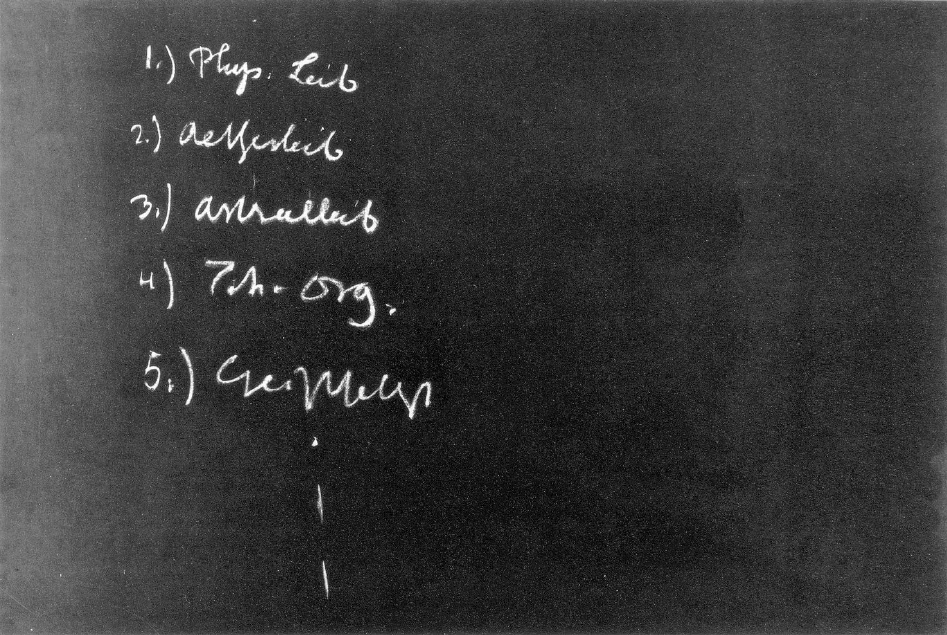
[ 27 ] Aber nun wird man gewöhnlich einfach hinzufügen: Geistselbst, das hat der Mensch noch nicht entwickelt, das geht uns noch nichts an, das lesen wir zwar in den Büchern, aber der Mensch kommt ja im gegenwärtigen Zeitalter nur bis zur Ich-Organisation; daher braucht man sich um das Geistselbst nicht zu kümmern. Ja, meine lieben Freunde, aber so ist es nicht. Die Menschen kommen schon bis zur Ich-Organisation, aber nicht alle Wesen, mit denen wir es zu tun haben, kommen nur bis zum Ich. Wir haben es durchaus - und gerade, wenn wir es mit aufwachsenden Kindern zu tun haben - zu tun mit Wesen, die bis zum Geistselbst kommen, die voraus sind der Entwickelung des Menschen. Wenn man so etwas ausbilden will, wie die Waldorfschul-Pädagogik, und diese aber lebendig wirken soll, dann muß man nicht bloß an die Menschen appellieren, die man dort anstellt, sondern auch an geistige Wesenheiten, die mehr entwickelt haben als die Menschen, die bis zum Geistselbst eine deutliche Entwickelung zeigen. Mit einer bestimmten Art solcher Wesenheiten haben wir es gerade beim heranwachsenden Kinde besonders zu tun: Mit den Wesen, die man als Sprachgenien bezeichnet. Wenn man es den Menschen überlassen würde, die Sprache zu übertragen auf die nächste Generation, dann würden die Menschen alle verkümmern. In der Sprache lebt etwas so Wesenhaftes wie im Menschen selber. Was mit der Sprache an den Menschen herankommt, darinnen leben Wesen, die durchaus in ihrem gewöhnlichen Leben das Geistselbst so ausgeprägt haben, wie der Mensch die Ich-Organisation. Diese Wesen inspirieren uns; diese Wesen leben in uns, dadurch daß wir sprechen.
[ 27 ] we generally go on to say, do we not, that the spirit-self has not yet been evolved by man and does not therefore immediately concern him. We read about it of course in the books, but in the present epoch, man reaches only as far as the ego organisation, and so we have no call to trouble about the spirit-self. But, my dear friends, that is not a true and full picture of the situation. Human beings, we say, reach as yet only as far as the ego organisation; but not all the beings with whom we humans have to do, come only as far as the ego and no further! When we are dealing with growing children, we are necessarily brought into contact with beings who attain to the spirit-self, beings who are further on in evolution than man. If we set out to develop Waldorf School pedagogy and really mean our work to have life, then we must appeal not only to the human beings who are congregated there in our school, but also to spiritual beings who are more highly developed than man, spiritual beings who show quite clearly that they have evolved to the spirit self. In dealing with a growing child, we shall particularly have to do with one specific class of such beings, namely, the beings to whom we give the name of “Genius of Language”. Were it left to the human beings themselves to hand on language to the next generation, man would pine away and perish. Being lives in language, as truly as ever being lives in man himself. Along with speech and language something enters into man, wherein beings live whose whole life bears unmistakably the stamp of the spirit-self, even as man in his life bears the stamp of the ego organisation. These beings inspire us; they live in us through the fact that we speak.
[ 28 ] Denken Sie sich, wie wir ein Kunstsprechen in der Eurythmie ausarbeiten müssen, damit eine sichtbare Sprache zustande kommt. Wir umfassen ja die Sprache gar nicht. Einen kleinen Teil dessen, wie der Sprachgenius wirkt, arbeiten wir in der Eurythmie aus, damit eine sichtbare Sprache herauskommt. Denken Sie sich, wie wir in der Heileurythmie appellieren an dasjenige, was diese Wesenheiten mit dem Geistselbst im Menschen erreichen können in der intuitiven Impulsierung seines Willens.
[ 28 ] Think how in Eurythmy we have to develop an artistic speaking in order for a visible speech and language to arise. We are really very far from comprehending what speech is in its fullness! A little part of the working of the Genius of Language we elaborate in Eurythmy, so as to enable a visible speech to come to birth. And then again in Curative Eurythmy—think how we appeal there to what these beings can achieve with the spirit-self, in the intuitive stimulation of man's will!
[ 29 ] Also wir haben es in dem Augenblick, wo überhaupt von Erziehung gesprochen wird, zu tun mit einem Heranrufen der Geister, die das Geistselbst entwickelt haben. Und in alledem, was wir in der Sprache erläutern, beschreiben wir das Geistselbst. Daher ist es schon gut, wenn diejenigen, die abnorme Kinder erziehen wollen, dasjenige meditieren, was in den Büchern gesagt ist über das Geistselbst. Das ist ein guter Meditationsstoff. Das ist ein Geber an diejenigen geistigen Wesenheiten, die von der Art des Sprachgenius sind. Aber solche geistigen Wesenheiten sind da.
[ 29 ] It is really so: the moment we begin to speak of education, we have immediately to make our appeal to spirits who have evolved the spirit-self. And whenever we try to elucidate what lies hidden in speech, we are actually describing the spirit-self. I would therefore recommend anyone who is setting out to educate abnormal children, to meditate upon what he can read in our books, about the spirit-self. He will find this a good material for meditation. It is a prayer to those spiritual beings who are of the same kind as the Genius of Language.
[ 30 ] Wenn wir in die Schule hineinkommen und Gebärden machen, ja wenn diese Gebärden adäquate Ausdrücke sind desjenigen, was wir seelisch erleben, wirken sie ungeheuer auf das Kind. Aber sie bezeugen auch, daß man mit den geistigen Wesenheiten in Verbindung steht, die das Geistselbst in sich tragen. Man braucht wirklich nicht irgendwelche äußere Agitation zu treiben, selbstverständlich nicht, diese Dinge müssen objektiv wirken, wie die Krise bei dem kleinen Kinde hingenommen werden muß. Aber wenn ganze Volksgemeinschaften sich angewöhnen, die Hände in die Hosentaschen zu stecken, damit sie keine Gebärden machen, bedeutet das geradezu: man will von den Göttern verlassen sein, von den Göttern, welche die allernächsten sind dem Geistmenschen. Man will nichts wissen von denjenigen Wesenheiten, die das Geistselbst ausgebildet haben, wie der Mensch die Ich-Organisation. Und dann wird zunächst die Sprache verschlampt. Das ist die große Gefahr der westlichen Kultur, daß die Sprache nicht zu dem gemacht wird, was sie sein soll, sondern daß sie sich verschlampt.
[ 30 ] Such spiritual beings are verily present among us. Say, we come into the schoolroom. If our behaviour and gestures as we enter give adequate expression to what we are feeling and experiencing in our soul, then they have an immense influence upon the child. And they are moreover a proof that we are connected with the spiritual beings who bear within them the spirit-self. There is a habit that is all too common among people today—I am far from suggesting you should start inveighing openly against it; in matters of this kind, one must adopt a completely objective attitude, the same objective attitude as is required in dealing with the crises that occur in the little child. It is nevertheless a fact that when whole communities of people have a habit of keeping their hands in their trouser pockets and so avoiding any use of gesture, it means nothing else than that they want to be God-forsaken, they want to be left alone by the Gods—the Gods who are next above the spirit-man. It means, they would rather not have any knowledge of the beings who have developed the spirit-self—even as man has developed the I organisation. And one of the first things that happens to such persons is that their speech begins to be slovenly. This, is, in fact, the great danger that faces the civilisation of the West—the danger that speech and language, instead of being developed to become what they should become, deteriorate and grow slovenly.
[ 31 ] Bei dem sich entwickelnden Kinde muß man vor allen Dingen darauf hinschauen - gerade bei abnormen Kindern -, daß sie rein sprechen, deutlich sprechen. Man muß nichts hingehen lassen, was irgendwie eine Verschlampung im Sprechen ist. Das kann man bei allen abnormen Kindern als Regel betrachten, daß man sehen muß auf ein deutliches, klares, konfiguriertes Sprechen. Das wirkt gut zurück. Aber selbst wenn das Kind noch nicht spricht, so ist es gut — wenn nicht gerade die spezielle Anweisung gegeben werden muß, daß es stille sein muß -, wenn gut konfiguriert um das Kind herum gesprochen wird. Man braucht es nicht zu vermeiden, möglichst viel an ein Kind, das man gerade zwischen dem siebenten und dem vierzehnten Jahr zur Erziehung übernommen hat als abnormes Kind, daß man viel gutes Sprachliches, Rezitatorisches an das Kind heranbringt. Immer wieder und wiederum in guter sprachlicher Gliederung an die abnormen Kinder herantreten, diese Notwendigkeit geht aus dem innern Wesen der Abnormität hervor.
[ 31 ] In dealing with the growing child it is of the very first importance to see that he speaks clearly and distinctly, and this is more than ever necessary in the case of the abnormal child. We must on no account overlook the smallest sign of slovenliness of speech. In all your dealings with abnormal children, make it a rule to be watchful of how they speak, mindful always that their speech shall be clear and distinct and well-formed. Your watchfulness will react favourably on the condition of the child. And then for the very young child who does not yet speak himself, it is good if he hears well-formed speech spoken around him—unless of course special instructions have had to be given that he is to be left still and quiet! And for children between the ages of seven and fourteen whom we have received into our care as abnormal, we need not have the slightest hesitation in bringing to them just as much as ever we can in the way of good speaking and recitation. To listen again and again to good speaking, well-ordered and articulate, is for abnormal children an absolute need, a need that springs from the inherent nature of the abnormality itself.