

Remedial Education Course
GA 317
5 July 1924, Dornach
Translate the original German text into any language:
Versions Available:
Curative Education, tr. Adams
Zehnter Vortrag
Lecture Ten
[ 1 ] Es wird sich zunächst darum handeln, daß ich mit einigen Bemerkungen zurückkomme auf die Fälle, die Sie selber am Lauenstein vorliegen haben.
[ 1 ] And now we must go on to say something about the cases you have with you at Lauenstein.1Curative home in Jena-Lichtenhain, founded by Franz Löffler, Siegfried Pickert, and Albrecht Strohschein.
[ 2 ] Da möchte ich zunächst besprechen jenen ältesten Buben, den Sie haben, der sechzehn Jahre alt ist und der im wesentlichen eine Minderwertigkeitsform dadurch gerade zeigt, daß er mit seinem Ich und astralischen Leib durch seine physische Organisation nicht durchkommt. Er ist Ihnen ja in verhältnismäßig spätem Alter erst übergeben worden. Ist es nicht so, daß Sie vorher nicht um ihn waren, Sie haben ihn erst im sechzehnten Lebensjahre bekommen? Daher liegt natürlich ein Fall mit deutlich entwickelten Antezedenzien vor. Hätte man den Knaben früher so behandelt, daß er einfach hätte fühlen können die Prinzipien der Waldorfschul-Pädagogik, also das Autoritätsprinzip zwischen Zahnwechsel und Geschlechtsreife, und wäre er geführt worden unter fortwährender Beobachtung derjenigen Dinge, für die er sich interessiert, hätte man dann, ausgehend von diesen Dingen, für die er sich interessiert, das Interessenfeld weiterziehen können, hätte man in diesem Lebensalter gerade mit einer sanft angebrachten Bleikur gewirkt, so hätte man den Jungen doch heute auf einem andern Seelenniveau. Denn der Junge hat ja, wie sich deutlich zeigt, Interessen. Hat auch ein ganz bestimmtes Können, aber Sie haben gesehen an der Probe, die da gemacht worden ist, wie die Sache liegt. Die Probe war eine verhältnismäßig einfache, aber an dieser ganz einfachen Probe konnten Sie sehen, was eigentlich vorliegt. Nicht wahr, der Junge bekam von mir eine ganz einfache Rechenaufgabe. Eine Subtraktion, wie man sie gewöhnt ist, nach der Methode der Waldorfschul-Pädagogik zu machen. Daß also gefragt wird: Was muß man von einer andern Zahl abziehen, damit eine bestimmte Zahl herauskommt? — Daß also nicht, wie es im gewöhnlichen Rechnen geht, ein Minuend und ein Subtrahend gegeben wird, sondern daß man den Minuend und den Rest gibt, der Subtrahend zu suchen ist. Das ist, was besonders hineinzieht in die Verfassung des seelischen Lebens, aber auf der andern Seite zur Entwickelung außerordentlich viel mehr beiträgt, als wenn man das Umgekehrte macht.
[ 2 ] I would like to speak first of that eldest boy of yours, who is sixteen years old, and in whom we can clearly recognise an inferiority occasioned by the failure of the I and astral body to penetrate the physical organisation. He was given into your care comparatively late; you did not, I think, have him with you until he was in his sixteenth year? So you have here a case with antecedents that have already undergone marked development. If the boy could have been taken in hand earlier on and given the advantage of Waldorf School education, then, in the time between the change of teeth and puberty, he would have experienced the principle of authority in the right way. Care would also have been taken, first of all, to watch all the time and see what things really interested him, and then, starting from these, to extend his field of interest. Had this been possible, and if in addition the boy could at the same time have been given lead in gently administered doses, then notwithstanding his inherent difficulties the boy's soul would be today on quite a different level. For it is plain, the boy has interests. He has moreover definite ability. You will however have seen from the quite simple test that we put to him, where the lad's trouble lies. You will remember, I set him a comparatively simple sum in arithmetic—a problem in subtraction, put in the form that accords with the methods of Waldorf School education. For we always ask, you know: What have I to take from a given number in order to leave another given number as remainder: Thus, we do not, as is usually done in teaching arithmetic, give the minuend and subtrahend, but instead the minuend and the remainder, leaving the subtrahend to be found. This way of stating the problem puts the condition of mind and soul to severer test; on the other hand, the child is helped far more in his development when he has to tackle the problem in this form, than when it is put to him the other way round.
[ 3 ] Nun, Sie haben gesehen, daß der Junge die Aufgabe lösen konnte, aber er konnte sie nicht im Augenblick lösen. Er kam ganz erfreut, nachdem er sie gelöst hatte, nachdem ich ihm gesagt hatte, in eineinhalb Stunden müsse er sie gelöst haben. Er hatte das Spatium von eineinhalb Stunden und war ganz erfreut, daß er die Aufgabe gelöst hatte. Da haben Sie klar gesehen, der Junge konnte die Sache. Alle Glieder seines Organismus sind eingeschaltet auf die Sache. Er braucht nur einen längeren Zeitraum, um die Sache auszuführen, das heißt sein Ätherleib und sein physischer Leib stemmen sich sofort entgegen, sie entfalten nicht ihre Funktion, trotzdem die Möglichkeiten zu dieser Funktion da sind.
[ 3 ] As you saw, the boy was able to do the sum, but not able to do it at once. As soon as he had solved the problem, he came up to me with great delight; but it must have been an hour and a half later. He took thus an hour and a half to do the sum, and was happy and delighted when he had found the answer. There was therefore no doubt about it, the boy had the necessary ability, he was able to do the sum. All the members of his organism were in readiness to be directed to the task; there was, so to speak, no “fault in the contact”. The trouble with him is only that he needs longer time. And the reason for this is, that from the very outset his ether body and his physical body offer resistance; they fail to unfold the activity that is proper to them, in spite of the fact that the possibilities for the activity are there all the time.
[ 4 ] Nun handelt es sich darum, daß der Junge, wenn man verfolgt, wie sich seine Interessen abspielen, durchaus die Interessen hat so, daß sie in der Kopforganisation bleiben. Sie können nicht hinunter in die übrige Organisation.
[ 4 ] Follow carefully how the boy's interests work. You will find they remain in the head organisation; they cannot make their way down into the rest of the body.
[ 5 ] Für diese Sache ist ein kleines Stückchen ganz bezeichnend. Sie sahen, er kam mit seinem kleinen Kodak und wollte uns aufnehmen, er besorgte das ganz ordentlich und besorgte es mit tiefgehendem Interesse. Nun versuchte ich ihm nachher zu sagen, er solle noch eine andere Aufnahme machen. Dazu wäre aber nötig gewesen, daß er sich erst den Film geholt hätte, daß das Interesse weitergegriffen hätte als das, was unmittelbar nahe lag. Da sträubte er sich. Dazu war er nicht zu bringen. Wenn ihn ein Interesse im Augenblick ergreift, ist er ganz da. Soll er aber das hinunterbringen in das Stoffwechsel-Gliedmaßensystem, sträuben sich sein Ätherleib und physischer Leib ganz mächtig. Und gerade da ist es notwendig, daß in diesem Lebensalter immer mehr, trotzdem es schwieriger wird wie früher, immer mehr mit einer pädagogischen Therapie eingegriffen werden muß, was notwendig macht, daß man diejenigen Dinge, die er mit einem gewissen Interesse verfolgt, als Ausgangspunkt nimmt, von da aus aber durchaus weitergeht, um den Interessenkreis nach allen Seiten hin zu erweitern. Man wird bei diesem Jungen ganz besonders viel erreichen, wenn man den immerhin ganz gesunden Instinkt berücksichtigt, den er trotzdem in sich hat. Man sieht nämlich immer, daß gesunde Instinkte bei abnormen Organisationen dennoch vorhanden sind. Der Junge wird sogleich eine Erweiterung des Interessenkreises erfahren, wenn man ihn hinleitet auf Dinge, zu denen Geschicklichkeit notwendig ist.
[ 5 ] This fact was clearly demonstrated in a little incident that took place during my visit. You saw how the boy came up to us with his little Kodak and wanted to take our photograph. He managed it quite well, carrying the whole thing through with intense interest. Afterwards I tried to suggest to him that he should make another exposure. This would have necessitated his going to fetch a new film; his interest would have had to reach beyond what lay immediately to hand. He resisted the idea, and nothing would persuade him to listen to it. When an interest seizes hold of him in the very movement, here and now—he is ready for it—he is “all there”: but if the situation requires that he should bring the interest down into his metabolism-and-limbs system, then at once his ether and physical bodies set up a powerful resistance. What should one do in such a case? With a boy already in his teens, it is of course much more difficult than it would have been earlier; we should however set ourselves even now to intervene with our pedagogical therapy. Taking as our starting point things that the boy follows with a certain interest, we should go on from these, widening the circle of his interest in all directions. A great deal can be achieved by recognising and appealing to an entirely healthy instinct that the boy undoubtedly possesses—despite his difficulties. For you must realise that even in persons who are abnormal, healthy instincts are yet always present. And with this boy, you will find that as soon as you draw his attention to objects and processes that call for skilful handling, he will at once begin to experience a widening of his circle of interests.
[ 6 ] Er kann zunächst jenen Weg, der gemacht wird von der Kopforganisation zu der Stoffwechsel-Gliedmaßenorganisation und, wie Sie gehört haben von mir, darüber hinaus, er kann diesen Teil des Weges schwierig besorgen, weil da keine Perzeptionsfähigkeit vorhanden ist. Auch nicht jene leise, die bei einem normalen Menschen vorhanden ist. Dagegen, sieht er das, was er selber vor sich hat, sieht er die Geschicklichkeit seiner eigenen Gliedmaßen, wird er daran große Freude haben. Man muß ihn also Sachen machen lassen, an denen er die Geschicklichkeit seiner eigenen Gliedmaßen sieht. Das wird insbesondere dadurch gefördert werden können, daß man ihn heileurythmische Übungen machen läßt mit Beinen und Händen, aber dabei in einem ganz energischen Maße die Zehen und die Finger zur Beweglichkeit bringt und ihn seinen Blick auf diese ganzen Bewegungsvorgänge der Gliedmaßen richten läßt, sich also selber ansehen läßt.
[ 6 ] The boy has, you see, difficulty in following the road that leads from the head organisation to the metabolism-and limbs organisation, and thence, as I have explained to you, out again beyond. This latter part of the journey he accomplishes only with great difficulty, since there is in him no capacity to perceive what is going on there. Even the slight measure of perception that is present in a normal human being is in his case lacking. Once, however, he can be brought to see, he has an object plainly before him, the skilfulness of his own limbs, the sight will fill him with joy. You must get him to do things which will bring this about. An excellent plan will be to give him Curative Eurythmy exercises, to be done with legs and hands, but especially taking care to see that the toes and fingers move with great energy. Then draw the boy's attention to these movements that are going on in his limbs, let him watch himself making the movements.
[ 7 ] Es ist für solche Kinder, die deutlich schon zeigen, frühzeitig, daß sie diese Schwierigkeiten haben, daß sie dasjenige, was der Kopf ausmacht, nicht in den Organismus hinuntergehen lassen, für solche Kinder ist es gut — bei diesem Jungen ist es schon zu spät, aber Sie können ja immer solche Kinder bekommen -, da ist es ganz gut, wenn man versucht, erstens sie mit ihrem Kopfe ihre Füße erreichen zu lassen. Wenn Sie das selber probieren, werden Sie sehen, daß das eine schwierige Prozedur ist. Aber es ist gut, wenn man Kinder, die es schwer haben in dieser Hinsicht, dazu bringt, daß sie ihre eigenen Zehen küssen können. Dann ist es auch gut — und es wird immer wirken, es könnte sogar bei diesem Knaben noch außerordentlich segensreich sein —, wenn man solche Kinder veranlaßt, daß sie zwischen der großen Zehe und der nächsten Zehe den Bleistift halten und damit einzelne Buchstabenformen zuwege bringen und dann daran ihre Freude haben, zu schreiben mit dem Fuße. Das könnte vielleicht auch noch bei diesem Jungen ganz gute Dienste leisten. In solchen Fällen wird ihm dann — und das ist auch eine Art Heileurythmie, wenn er lernt mit den Zehen zu schreiben -— die Heileurythmie große Dienste leisten können. Nun, ob auch noch eine Bleikur bei diesem Alter die nötigen Dienste leistet, das wird sich ja zeigen, wenn man beginnt, die Dinge zu probieren und die Wirkungen ansieht,
[ 7 ] If it should happen that you have to do with younger children who already show signs of this kind of difficulty, where what has been decided upon by the head does not easily find its way down into the rest of the organism, try getting them to touch their feet with their head. In the case of the boy we are considering, it is too late for this, but you may any day receive into your Home quite little children with the same disability. Try it yourselves; you will find it is no easy matter! But for small children it is a very good exercise; they can be brought even to kiss their own toes. Another thing that never fails to help in such cases—and it could prove a real blessing even to your boy—is to get the child to hold a pencil between his great toe and the next, and with the pencil contrive to trace out some letters of the alphabet, and so have the enjoyment of discovering that he can write with his feet. It is quite possible that even at his age this boy of yours could receive very great benefit from such an experiment. For in cases such as his, Curative Eurythmy—and writing with the toes is a kind of Curative Eurythmy!—can be of the very greatest help. Whether also a course of treatment with lead will at his age afford him the help he stands in need of, we shall discover when we begin to make trial with it and note its effects.
[ 8 ] Gerade aus dem, was ich gesagt habe, sehen Sie, daß eine feinere Beobachtung da notwendig ist. Man muß solche scheinbaren Kleinigkeiten, wie dieses Ausrechnen nach anderthalb Stunden, wie dieses Nicht-Wollen-ins-Haus-Zurückgehen, sich den Film holen und dergleichen, man muß dieses zu einem Gegenstand fortwährender Beobachtung machen. Dann geht eben daraus hervor, daß ein Wesentliches in der Erziehung von minderwertigen Kindern auch dadurch in die Hand des Erziehenden gegeben ist, daß diese Erziehenden sich angewöhnen müssen, einen Sinn zu haben für alles dasjenige, was mit dem betreffenden Kinde vor sich geht. Sehen Sie, Sie werden sagen: Ja, welche Zeit nimmt denn die Erziehung von minderwertigen Kindern in Anspruch? Man muß immer seine Aufmerksamkeit darauf verwenden, man kann gar nicht meditieren, man hat gar keine Zeit, etwas anderes zu tun. — Das ist nicht der Fall, und diese Ansicht innerlich zu bekämpfen, gehört schon zu der Esoterik einer solchen Lebensaufgabe. Es handelt sich gar nicht darum, daß man den ganzen Tag gewissermaßen auf Auslug steht, sondern daß man sich einen Sinn erwirbt für charakteristische Vorkommnisse. Unter Umständen kann derjenige, der eine Anzahl von Kindern beobachten gelernt hat, in verhältnismäßig kurzer Zeit, in fünf oder zehn Minuten ein Kind durchaus durchschauen, wenn er überall den Blick richtig anwendet. Nicht darauf kommt es an, wieviel Zeit man mit den Dingen verbringt, sondern wie stark man sich innerlich damit verbindet. Viel Zeit wird gerade in geistigen Berufen erspart werden, wenn man berücksichtigen wird, daß man sich innerlich mit den betreffenden Erscheinungen wirklich verbinden muß.
[ 8 ] All that I have been saying will have demonstrated to you the imperative need for a delicate and fine power of observation. The simple calculation that took the boy an hour and a half to make, the reluctance to go back into the house to fetch a new film—facts like these may seem trifling and insignificant, and yet it is just this kind of thing that we must learn to make the object of careful observation. As we come to do so, we shall realise what an invaluable aid it can be to the educator of backward children if he is sensitive to every little thing that happens with the child he wants to help. And now you will be wanting to say to me: It looks as though the education of backward children is going to take up all one's time; one will have to be perpetually giving one's whole attention to the children, and will have no time left to meditate, no time in fact to do anything else whatever! That is not the case; and the esoteric nature of a life-work such as you are undertaking should not allow you ever to admit for a moment this point of view. What is wanted is not that you should all day long be constantly on the watch—not that at all, but rather that you should acquire a quick sense for characteristic happenings. If one has already learned how to watch quite a number of children and knows how to make the right use at every turn of one's powers of perception, it is, under certain circumstances, quite possible to carry out a thorough investigation of a single child in five or ten minutes. It does not depend at all on the length of time one devotes to the matter, but wholly on the degree to which one is able to unite oneself inwardly with the act of perception. If people would only realise that one has to really connect oneself inwardly with the phenomena in question then a great deal of time would be saved, especially for those who work in the professions.E1Rudolf Steiner visited Lauenstein on 18th June, 1924, almost immediately after the Home was opened. The children were brought to him; and having first had a good look at each in turn, talking with the child and enquiring into the history of the case, he explained to us how this or that condition had come about, and gave indications for therapeutical treatment and education.
The explanations and advice given by Rudolf Steiner on the occasion of this visit were noted down, and provide in each case a most valuable addition to the words spoken by him in this course. Wonderful, above all, was the example Rudolf Steiner set us in the whole way in which he met the children, entering with loving and devout interest into every single detail of their condition. For the little group of us who were taking part together in these first beginnings of the work of Curative Education, the whole visit was a deep experience, and the memory of it continues to be cherished in the “Institutions for the Education and Healing of Children in Need of Special Care”. Some of the indications and instructions given by Rudolf Steiner will be added here as Notes to the Course.
As regards this boy, Rudolf Steiner told us that he is lacking in brain sand (the calcareous concretions of the pineal body). The convulsions and the whole general condition must go back to some fright to which the mother had been subjected during pregnancy. (Enquiry afterwards confirmed this.) He added that one must, in such cases, always ask how things were with the mother during pregnancy. The convulsions, he said, were a secondary effect.
For therapy, Rudolf Steiner prescribed injections of thyroid gland secretion. The medicament must enter the body in a centripetal direction, in order to evoke a reaction that works centrifugally. The preparation should still contain epithelial cells. On the day following the injection, the fever curve, also the pulse and the breathing, should be measured, quantitatively and qualitatively.
In addition, the boy should drink a full glass of Levico water in the course of each day, diluted in the proportion 1:8.
Curative Eurythmy: O, I (ee), L.
[ 9 ] Nun war da auch ein Knabe, ein typischer Fall, ein fünfzehnjähriger epileptischer Knabe. Für diesen Knaben haben Sie den typischen Fall an demjenigen, den wir hier gehabt haben, nur ist er wieder eine Anzahl von Jahren älter, der Ihrige. Da handelt es sich darum, daß man die Schwierigkeit berücksichtigt, die dadurch gegeben ist, daß man bei Ihrem Knaben den Übergang in die Geschlechtsreife hat. Wurde er nicht kastriert? Der Vorgang im ganzen Organismus liegt vor. Und da der Junge kastriert ist, hat man es um so mehr mit einer außerordentlich vehementen Erscheinung zu tun, nämlich mit der Reaktion, die durch diesen künstlichen Einfluß auf die Geschlechtsentwickelung ausgeübt wird. So wie der Junge sich darstellt, stellt er sich dar als ein Junge, bei dem sich gerade der Übergang in die Geschlechtsreife außerordentlich schwierig ergeben wird. Denn das Geschlechtsreifwerden ist ja ein Vorgang im ganzen Organismus. Und für ihn hat jetzt die Kastration gar keine weitere Bedeutung noch, als daß sie reaktiv zurückwirkt auf die Geschlechtsreife. So daß es sich bei diesem Jungen einfach darum handeln wird, zu berücksichtigen, daß er in einem Stadium steht, wo es notwendig ist, ihn so zu behandeln, wie man im Geschlechtsreifealter stehende Knaben zu behandeln hat: sie nämlich sorgfältig in Zusammenhang bringen mit allem demjenigen, was ihnen Interesse für die Vorgänge der Welt, in die sie hineingestellt sind, beibringt. Vor allen Dingen handelt es sich darum, daß man Waldorfschul-Pädagogik auf sie anwendet. Daß man versucht, ihn nicht seinen innerlichen Erregungen zu überlassen, sondern daß man versucht, ihn nach außen hin fortdauernd zu beschäftigen, so daß er für äußerliche Dinge und Vorgänge ein intensives Interesse entwickelt.
[ 9 ] Now, there was at Lauenstein another boy, a typical case, a fifteen-year-old epileptic. You could see the same type in the boy we had here before us the other day; only, your boy at Lauenstein is several years older. The first thing that claims our attention in his case is the difficult situation created by the fact that he is at the age of transition to puberty. He has been castrated, has he not? Now what we are concerned with is the process of attaining puberty as it has to go forward in the whole organism. The fact that the boy has been castrated, means that in his case we have to reckon with a phenomenon that manifests in him with extraordinary vehemence—namely, the reaction that is induced as a result of this unnatural influence that has been brought to bear on the evolution of sex. The boy gives indeed every appearance of one in whom the transition to puberty is going to prove difficult. The gradual attainment of puberty is, as we have said, a process that belongs to the whole organism; and the sole significance that castration possesses for the boy at the present time consists in the reactionary influence it has in him upon the attainment of puberty. The first thing to do therefore is to see that the boy is placed where he will be sure of being treated in the way that is right and necessary for boys who are attaining puberty—that is to say, where care is taken to provide conditions under which such boys have their interest aroused in all the processes that go on in the world in which they find themselves. Boys who are at the age of puberty urgently need Waldorf School education. This boy must not be left to the mercy of his own impulses and emotions; we must try to bring it about that he is continually occupied with something outside himself, and takes a keen interest in the objects and processes that he finds around him.
[ 10 ] Schildern Sie mir, wie weit der Junge im Schulmäßigen ist. Vielleicht können Sie das schildern, wie weit er im Schulmäßigen ist.
[ 10 ] Tell me, how is he getting on at school? Perhaps you can tell me this?
Albrecht Strohschein: Er kann weder lesen noch schreiben, es wurde überhaupt noch gar nichts angefangen in bezug auf das Schulmäßige im vorigen Jahr. Im vorigen Jahr hatte Frau F. mit ihm angefangen das Lesen und Schreiben, aber mit diesem Montesso rikasten; er kam durchaus nicht weiter, konnte keine Fortschritte machen, und so ist er eigentlich im Schulmäßigen auf dem Nullpunkt.
(S. “He can neither read nor write. During the past year we have not even made a beginning with school for him. Frau F. did once begin to teach him reading and writing; it was on the Montessori method, and he did not get on at all, he seemed unable to make any progress. His school attainments have really to be counted as nil.”)
[ 11 ] Er zeigt eine gewisse Stumpfheit gegenüber den äußeren Eindrükken. - Nun, wir haben da gerade die Notwendigkeit, die WaldorfschulPädagogik so wie bei ganz kleinen Kindern anzuwenden, also vom Malerischen auszugehen und ihn einfach dahin zu bringen, daß er dasjenige, was ihn innerlich quält, in die Farben hineinlegt. Man läßt ihn zunächst malen und wird sehen, was er dabei herausbekommt. Und von da aus geht man dann weiter in demjenigen, was sich aus seinen eigenen Veranlagungen da ergibt.
[ 11 ] He shows, you see, a certain obtuseness to external impressions. We shall here be under the necessity of applying Waldorf School education in the way we are accustomed to do with quite little children—taking our start, that is, from painting, and so providing the opportunity for the boy to put out into colour whatever is tormenting him inwardly. Get him to paint, and you will see what can be got rid of this way. And then you can go farther with him in whatever direction his own inclinations and abilities indicate.
[ 12 ] Es wird gerade bei diesem Jungen aber unbedingt notwendig sein, therapeutisch einzugreifen. Wir hatten doch noch keine Therapie besprochen? Er sollte Algen bekommen und Belladonna. Also dies würde das Therapeutische sein, was da einzugreifen hätte. Die Algeninjektionen, die können Sie ja ihrem Wesen nach verstehen, aber es ist gut, wenn Sie über diese Dinge tiefer nachsinnen, weil Sie sie ja selbständig in den einzelnen Fällen anwenden sollen. Warum kann man in einem solchen Fall an Algeninjektionen denken? Bei der Alge haben wir es zu tun mit einer Pflanze, die weder stark ausgebildete Wurzelbildung hat, noch stark ausgebildete Blütenbildung. Es schieben sich eigentlich Blüte und Wurzel zusammen. Und das hauptsächlichste ist eigentlich die Krautorganisation, die alles übrige aus sich hervorbringt. Das Blatt überwiegt, so daß bei dieser Pflanze kein sehr intensives Verhältnis zur Erde da ist. Auf der andern Seite ist auch zum äußeren Kosmos kein intensives Verhältnis vorhanden, sondern es ist ein Verhältnis zu alledem vorhanden, was sich abspielt im wäßrigen und luftförmigen Element, unmittelbar an der Erdoberfläche. Algen und Pilze sind diejenigen Pflanzen, die ganz eingetaucht sind in die Wechselwirkungen zwischen Luft und wäßrigem Element. Nun ist das Eigentümliche dieses, daß diese Pflanzen zu der sehr geringen Menge von Schwefel, der heute überall verbreitet ist, sowohl im Wäßrigen wie in der Luft, daß sie zu diesem eine starke Anziehung haben. Dadurch eignen sich diese Pflanzen, wenn man sie in den rhythmischen Organismus hineinbringt, ganz besonders gut dazu, die Harmonie herzustellen zwischen dem astralischen Leib und dem AÄtherleib. Nun, das fehlt gerade bei einem solchen Jungen.
[ 12 ] There can moreover be no question but that we must intervene here also with our therapy. We have not, I think, up to now, prescribed any medicaments? The boy should have algae and belladonna. Therapeutical treatment will consist then of these two remedies. You probably understand in a general way the nature of algae injections, but you will do well to enter a little more deeply into the significance of them; for you should, you know, be ready to make use of them on your own responsibility, in individual cases. Why do we propose for this boy algae injections? In the algae we have plants that have neither strongly developed root formation nor strongly developed flower formation. It is indeed almost as though flower and root had been telescoped. The leaf organisation is the main thing; everything else is produced from it. In algae therefore, since foliage preponderates, we find no very near relationship to the earth. Nor, on the other hand, is there any very near relationship to the outer cosmos. There is however a relationship to the watery and airy elements that are active immediately over the surface of the earth. Algae—and the same applies also to mushrooms—are plants that are, as it were, completely steeped in the interplay of air and water. And these two kinds of plants have in addition this characteristic in common, that they are strongly attracted to the minute quantity of sulphur which is to be found everywhere today in water as well as in air. Consequently, when these plants are introduced into the rhythmic organism of man, they are peculiarly adapted to restore harmony between astral body and ether body. And harmony between astral body and ether body is precisely what is lacking in a boy of this type.
[ 13 ] Nun merkt man, daß man es zu tun hat mit einer Störung, die davon ausgeht, daß die Ich-Organisation den astralischen Leib zu stark in Anspruch nimmt und nicht hineinläßt in den ätherischen Leib, dann muß man mehr zu den Pilzen greifen. Zu den Algen, die sich mehr nähern den gewöhnlichen Pflanzen, wird man greifen, wenn sich der physische Leib und der ätherische Leib weigern, den astralischen Leib hineinzulassen, wenn die Disharmonie dadurch zustande kommt, daß von dem Ätherleib aus der Widerstand kommt, wo nicht eine überwiegende Anziehung der Ich-Organisation da ist, sondern vom AÄtherleib aus der besondere Widerstand kommt.
[ 13 ] In cases where we perceive a disturbance due to the ego organisation making too great demand upon the astral body and not allowing it to enter into the etheric body, we must have recourse rather to the mushroom type of plant. The algae, which come nearer to the ordinary plant, are to be used when the physical body and etheric body refuse to allow the astral body to enter—that is to say, when the disharmony is due not to an excessive attraction exerted by the ego organisation, but to a special resistance put up by the ether body.E2When this poor feeble-minded boy, who was as a rule excessively restless, was brought to Rudolf Steiner, he became for the moment quite peaceful and at rest, and the finer side of his nature, which was generally overlaid and hidden, suddenly revealed itself in a truly beautiful manner. Rudolf Steiner took particular interest in the boy's sense-perceptions, and proved to us that he cannot see far into the distance. When his bad teeth were alluded to, Rudolf Steiner pointed out that his finger nails also were soft and weak. The following notes of the conversation were made at the time: “Did you not notice anything particular about the mother? This is a case where we can see evidence of a remarkable karma. The astral body is over-ripe. Something is working in from the preceding incarnation. The time between death and new birth has been quite short, with the result that the soul has brought into this incarnation something of the astral body of the former incarnation. The boy still has even now strange dreams at night. This fact will reveal itself to you in strange and disconnected remarks that he makes after waking up. Supposing he has at some time or other seen snakes, then it may be that now he will see them coiling and uncoiling themselves. It is a case of a poor astral body, that has its seat mainly in the back of the head.” (Here Dr. Steiner laid his hand, with a gesture of the most intense interest, on the back of the boy's head, which was thickly covered with stubborn black hair. “This condition has to be met by introducing a counter-astrality; and that we can do by the use of algae. For algae draw in the astral forces of the surrounding air. Mushrooms do this still more; but we had better not begin with the strongest influences. All parasitic plants draw in astrality. By means of algae injections, healthy astrality will be attracted—astrality, that is, which is opposite in quality to the astrality already in the body; for there the astrality is bad.
The therapy will therefore be: Algae inoculations D 5; Belladonna D 4, D 10, D 15, D 20, D 30.”
Dr. Steiner was shown the record of the fits. The suggestion having been raised that their occurrence might be running parallel with the rhythms of the Moon, Dr. Steiner said that the influence of the Moon could not in this case be the direct cause of the fits; at the most, it could affect only the consciousness.
Eurythmy should be done, especially with the legs.
[ 14 ] Dann war ein Mädchen da. Können Sie das nicht schildern nach den Angaben, die ich gemacht habe?
[ 14 ] Then there was a girl you had at Lauenstein. Perhaps you would kindly describe her for us, in accordance with the indications I gave at the time?
Albrecht Strohschein: Ein Mädchen mit aufgeworfenen Lippen. Da wiesen Sie darauf hin, daß zwischen dem dritten und vierten Jahr etwas Besonderes geschehen sein müsse mit dem Astralleib, daß es ein starkes Jucken und Kratzen hat haben müssen. Die Mutter bestätigte uns nachher, daß hohe Temperaturen aufgetreten sind und daß Jucken da war. Für die Therapie ist angegeben: Nikotinklysma, und wenn das nicht hilft: Nikotininjektionen. Sie ist fünfzehn Jahre alt.
(S.: “I too have seen this girl only on that one occasion—a girl with protruding lips. You pointed out that something very serious must have happened to her astral body between the ages of 3 and 4; the child must, you said, have had at that time a violent attack of itching and scratching. The mother confirmed afterwards that high temperatures had occurred at that age, accompanied by irritation and itching. For treatment, nicotiana enema was prescribed; and if that did not help, nicotiana injections were to be given. The girl is fifteen years old.”)
[ 15 ] Nun, nicht wahr, wir haben ein Mädchen, das fünfzehn Jahre alt geworden ist, das aber deutlich zeigt, daß in einer wenig intensiven Weise die astralische Organisation in den ganzen Organismus eingegriffen hat. Der ganze Typus des Mädchens zeigt das. Vor allen Dingen “erweist sich die astralische Organisation als viel zu schwach, das Ich festzuhalten gegenüber jenen Versuchungen, die beim Menschen entstehen, wenn er ißt, das Essen, das Schmecken gar zu süß, zu lieblich, zu wohltuend zu empfinden. Wenn der astralische Leib nicht genügend tätig ist in der Region des unteren Antlitzes, dann werfen sich die Lippen besonders am Munde auf, weil eine zu starke Wollust mit dem Schmecken, mit dem Verarbeiten der Speisen schon im Munde vorhanden ist. Solche Erscheinungen haben lange Antezedenzien und es kann natürlich so etwas auftreten in irgendeinem Zeitraum, der verhältnismäßig spät liegt. Nun, nicht wahr, ich gab dazumal an, daß eine Unregelmäßigkeit in der kindlichen Entwickelung aufgetreten sein müßte zwischen dem dritten und vierten Lebensjahr.
[ 15 ] So we have here a girl who has attained the age of fifteen, and in whom we can see quite clearly that the astral organisation has made very weak connection with the organism as a whole. The girl is obviously of that type.E3Dr. Steiner said at Lauenstein: “She has a kink in her astral body; its form has no unity or coherence; above, it is weak, whilst below, it is stronger.” One notices at once that the astral organisation is far too weak to restrain the ego in face of the temptation that always assails man when he eats—the temptation to enjoy the eating too much, to revel in the sweet and pleasant taste of the food. When the astral body is not sufficiently active in the lower region of the face, then the lips will be found to protrude noticeably—a symptom that is due to the excessive pleasure experienced in tasting food and also in the initial process of digestion, that takes place in the mouth. Phenomena such as these have far-back antecedents; obviously they cannot be making their appearance for the first time at this somewhat late stage of childhood. As has been said, I stated at the time that an irregularity must have occurred in the child's development about the 3rd or 4th year.
[ 16 ] So etwas zu bemerken, können Sie natürlich von sich selber erst verlangen, wenn Sie sich mit der eben geschilderten Liebe, auf die ich ja so großen Wert legen muß, in solche Dinge überhaupt erst einleben. Sie dürfen eigentlich nie die Ausrede gebrauchen: Ja, um solche Dinge wahrzunehmen, muß ich erst hellsehend sein. - Das ist eine innere Faulheit, die derjenige, der einen Erzieherberuf ergreift, eigentlich gar nicht haben darf. Sondern es handelt sich darum, daß Sie lange, bevor Sie jene Hellsichtigkeit erlangen, die zum Beispiel für die Forschung im allgemeinen notwendig ist, daß Sie durch die liebevolle Hingabe an dasjenige, was aus dem Menschen herauskommt, was sich entwickelt gerade in abnormen Zuständen, daß Sie durch die liebevolle Hingabe in sich die Fähigkeit erzeugen, hinzublicken einfach auf das, worauf es ankommt. Sie sagen sich in dem Momente selber das Richtige. Natürlich gehört dazu der esoterische Mut. Dieser esoterische Mut, der wird im Menschen entwickelt, wenn ihm nicht eines gegenübersteht.
[ 16 ] How can you learn to perceive such facts for yourselves? You can find your way to such perceptions if you set out to do so with the love that I have described to you and upon which you will remember I laid such stress. You must never say: In order to perceive such things, I should have to be clairvoyant. To say that betokens an inner laziness—a quality that must on no account ever be found in one who undertakes the task of education. Long before you attain to the clairvoyance that is required for spiritual research in general, you can beget in yourself the faculty simply to perceive what is really the matter. The power to do this can be born in you, if you approach with loving devotion all that shows itself in the child, and especially just those developments that come with abnormal conditions. What you say to yourself at that moment will be true. There is of course need here for esoteric courage. This esoteric courage can and does develop in man—provided only that one thing does not stand in the way.
[ 17 ] Sehen Sie, es ist ja eine merkwürdige Erscheinung, daß diese inneren Intuitionen von den Menschen, die sie verhältnismäßig gut haben können, so wenig bemerkt werden. Die Anthroposophen haben doch so viele Gelegenheiten, auf diese inneren Intuitionen achtzugeben, sie haben sie auch viel mehr, als man glaubt, aber sie geben nicht acht darauf, weil sie sich hingestellt finden in dem Augenblick, wo sie auf so etwas achtgeben sollen, vor eine beim Menschen schwer besiegbare Eitelkeit. Nicht wahr, mit diesem Entdecken von Fähigkeiten sprossen herauf alle möglichen Eitelkeitsimpulse, und zu all den Dingen, die ich zum Beispiel vom heutigen Zeitalter gestern geschildert habe, die ich auch bei andern Gelegenheiten geschildert habe, gehört auch die Neigung, die ungeheure Neigung der heutigen Menschheit, zu Eitelkeiten zu kommen.
[ 17 ] It is strange, and at the same time significant, that these inner intuitions are so little noticed by the very people who are, comparatively speaking, well able to have them. Anthroposophists have many an opportunity to pay heed to such inner intuitions! For they have these intuitions, far more than is supposed, but they fail to attend to them—the reason being that in the moment when they should do so, they find themselves assailed by a vanity that is hard to overcome. With the discovery of faculties not known before, all manner of impulses that spring from vanity begin to crop up in the soul. Along with the other characteristics of our age that I described for you in my lecture yesterday, as well as on several other occasions, we have to reckon also a tendency to grow vain and conceited, for it is a tendency that is terribly prevalent in present-day mankind.
[ 18 ] Sehen Sie, da liegt schon etwas vor, was insbesondere diejenigen berücksichtigen müssen, welche aus der heutigen Jugend heraus — und dazu gehören Sie ja auch - sich irgendwie einem großen Beruf widmen, wie sie schon eigentlich entstehen müssen und die wieder regenerierend auf die Menschheit wirken müssen. Es ist wirklich nicht mit Mißverständnis oder Unverständnis von der heutigen Jugendbewegung gesprochen, sondern aus einem wirklichen Verständnis heraus, wenn ich Ihnen das Folgende sage: Die heutige Jugendbewegung ist eine Notwendigkeit, ist etwas außerordentlich Bedeutsames, auch etwas für die verständigen Älteren im höchsten Grade Interessantes. Also gegen die Jugendbewegung soll gar nicht das Geringste gesagt werden. Es soll auch nichts dagegen gesagt werden, daß die ältere Generation so wenig Anlage hat, die heutige Jugendbewegung zu verstehen und daß gerade daran vieles gescheitert ist, weil man sie zu leicht nimmt, nicht genügend eingeht auf sie. Aber auf der andern Seite muß dann, wenn es sich in der Jugendbewegung darum handelt, konkrete, bestimmte Aufgaben zu ergreifen, etwas berücksichtigt werden von der Jugend selber. Natürlich müssen diejenigen, die in solchen Dingen Erfahrung haben, darauf aufmerksam machen. Von der Jugend muß etwas berücksichtigt sein, was ungemein erschwerend ist für alles, was aus der Jugendbewegung hervorgehen soll. Das ist eine gewisse Eitelkeit. Eitelkeit ist auf dem Grunde der Jugendbewegung überall vorhanden, weniger vorhanden aus irgendeiner Ungezogenheit als vielmehr aus jenem Grunde, welcher das wohl notwendig macht: weil gerade, weil das Wollen notwendig macht eine starke Entfaltung innerer Fähigkeiten, einfach durch ahrimanische Einflüsse die Eitelkeit in einem hohen Maße heraufdämmert. Sehen Sie, ich habe in meinem Leben viel hoffnungsvolle Menschen der verschiedensten Lebensalter beobachten können. Es war mir möglich, manche Erscheinung auf diesem Gebiete ganz intim zu beobachten, aber man konnte sehen, daß mit dem Heraufkommen des Zeitalters, das auf das Kali Yuga folgte, die Eitelkeit — nicht bloß bei der Jugend, aber hier interessiert uns jetzt diese spezielle Form, die bei der Jugend heraufkommt - ganz besonders stark aufsprießte und die Jugend selber hindert, die Eigenschaft zu entwickeln, die eben im heutigen Jungsein liegt. Daher die Erscheinung, die so häufig eintritt: das allgemeine Reden von Missionen, von großen Aufgaben, und die geringe Neigung, auf die speziellen kleinen Dinge, die man dazu braucht, einzugehen.
[ 18 ] This is a matter that should receive serious consideration from those of the present-day Youth—and you yourselves are of course among the number—who are devoting their lives to some great and noble calling. There is in our time great need that young men and women should rise up among us and exercise a regenerating influence upon mankind; and what I am now going to say is not said out of misunderstanding of the Youth Movement of our day, nor from lack of understanding, but out of a true understanding of it. It is a necessity, this Youth Movement, it is something of quite extraordinary significance; for those older people who can understand it, the modern Youth Movement is interesting in the highest degree. Not a word shall be uttered here against it. Nor shall we attempt to deny that there is only too often a deplorable lack of readiness on the part of the older generation to understand this Youth Movement, and that a great many plans have suffered shipwreck just because the Movement has not been taken seriously enough, just because people have not troubled themselves to look into it sufficiently. But the Youth Movement does need to beware of one thing when it sets out to undertake specific practical tasks; and it is incumbent on those of us who have had experience in the matter to call attention to it, for it makes one seriously apprehensive for the whole future of the Movement. I mean a certain vanity that shows itself there on every hand. This vanity is not so much due to a lack of education and culture, but is rather the consequence of an inevitable situation. For the will to action necessitates of course a strong development of inner capabilities, and then it follows all too easily that under the influence of Ahriman vanity begins to spring up in the soul. I have had opportunity in my life to make careful and intimate observation of persons who were full of promise—persons too of the most various ages of life—in whom one could see again and again how with the dawn of the Age that has followed Kali Yuga, vanity began to grow and thrive in their souls. It is not, therefore, only among the Youth that the vanity shows itself. What concerns us at the moment however is the special form of it that manifests in the Youth and that has in point of fact hindered them from developing the right and essential character that lies inherent in present-day Youth, waiting to be developed. Hence the phenomenon with which we are so familiar, this endless talk of “missions”, of great tasks, with all too little inclination to set to work upon the details, to take pains about the small things that require to be done in carrying out these tasks.
[ 19 ] Man wird gerade in der Zukunft brauchen das, was einmal auf einem außerordentlich philiströsen Territorium, aber aus einer gewissen Intuition heraus, genannt worden ist: die Andacht zum Kleinen. Das ist etwas, was sich gerade die Jugend aneignen müßte. Sie schweigt zu stark in Abstraktionen. Das ist aber das, was mit Wucht hinaufreißt in die Eitelkeit.
[ 19 ] These will emphatically be need in the future for what has been described in simple words as devotion to detail. Devotion to detail and to little things is something which the Youth of our time need to develop. They are far too apt to revel in abstractions; and this revelling in abstractions is the very thing that can then lure them with irresistible force into the snare of vanity.
[ 20 ] Sie müssen bedenken, was für eine Schwierigkeit da vorliegt und müssen das zum Inhalt Ihres esoterischen Strebens machen. Sie müssen daran denken, welche ungeheure Schwierigkeit da vorliegt. Derjenige, der dazu kommen soll, daß er aus intuitivem Blick heraus einem Menschen irgend etwas sagt — auf der flachen Hand liegen die Dinge ja nicht, und das, was der Laie sagt, ist in der Regel falsch gegenüber minderwertigen Kindern, es kommt darauf an, daß man durchschaut auf dasjenige, was da eben ist —, braucht etwas dazu, dazu braucht er, daß er in energischer, mutvoller Weise sich selber sagt, nicht bloß im Augenblick, sondern es zum fortdauernden qualitativen Inhalt seines Bewußtseins hat: Ich kann das. - Wenn Sie das ohne Eitelkeit, sogar mit Opferwilligkeit, mit Überwindung derjenigen Dinge, die dagegen sind, wenn Sie sich das immer wieder und wieder sagen, nicht bloß empfinden, dann werden Sie sehen, wieviel Sie nach dieser Richtung gerade können. Also nicht im Spintisieren, nicht in Gedankengeweben das suchen, was sich entwickeln soll, sondern in diesem fortdauernden mutvollen Bewußtsein, das sich dadurch einfach entwickelt, daß man in der allereinfachsten Weise dasjenige, was von ungeheurem Schmutz und Sumpf und Torfmoor bedeckt ist, bildlich gesprochen, aus seiner Seele heraufholt.
[ 20 ] I do beg you to bethink yourselves of the difficulties that beset your path on this account. Make it a matter of esoteric striving to master this tendency to vanity; for it does indeed constitute a real hindrance to any work you undertake. Suppose you want to be able to speak to some fellow human being from out of an intuitive power of vision. The things you need to behold in him are by no means written plain for all to see; and you may take it that statements made about backward children from the ordinary lay point of view are generally false. What you have to do is to see through what lies on the surface, see right through it to the real state of affairs. If therefore you want to come to the point of being able to say something to him out of intuitive vision, what do you need for that? You need to tell yourself with courage and with energy—not just saying it at some particular moment, but carrying it continually in your consciousness, so that it determines the very quality and content of your consciousness:—“ I can do it.” If, without vanity, in a spirit of self-sacrifice, and in earnest endeavour to overcome all the things that hinder, you repeat these words, not only feeling them, but saying them to yourself over and over again, then you will begin to discover how far you are able to go in this direction. Do not expect to find the development of the faculty you seek, by spinning out all manner of theories and thoughts. No, what you need to do is to maintain all the time this courageous consciousness, which develops quite simply of itself when once you have begun to fetch up from the depths of your soul what lies hidden there, buried (metaphorically speaking) beneath an accumulation of dust and rubbish.
[ 21 ] Die Menschen können im allgemeinen auf dem Gebiete der Pädagogik nichts erreichen, weil sie nicht ernsthaftig jemals eine Wahrheit in sich rege gemacht haben. Die besteht darin, daß Sie sich am Abend einleben in das Bewußtsein: In mir ist Gott, in mir ist Gott, oder der Gottesgeist, oder was immer — aber sich dieses nicht bloß theoretisch vorschwätzen, die Meditationen der meisten Menschen bestehen darin, daß sie sich etwas theoretisch vorschwätzen -, und am Morgen so, daß das hineinstrahlt in den ganzen Tag: Ich bin in Gott. — Bedenken Sie nur, wenn Sie diese zwei Vorstellungen, die ganz Empfindung, ja Willensimpulse werden, in sich rege machen, was Sie da eigentlich tun. Sie tun das, daß Sie dieses Bild vor sich haben: In mir ist Gott — und daß am nächsten Morgen Sie dieses Bild vor sich haben: Ich bin in Gott. - Das ist eines und dasselbe, die obere und untere Figur (siehe Tafel 12). Und Sie müssen einfach verstehen: das ist ein Kreis, das ist ein Punkt. Es kommt nur abends nicht heraus, es kommt nur morgens heraus. Morgens müssen Sie denken: das ist ein Kreis, das ist ein Punkt. Sie müssen verstehen, daß ein Kreis ein Punkt, ein Punkt ein Kreis ist, und müssen das ganz innerlich verstehen.
[ 21 ] Generally speaking, people are not able to achieve anything of this kind in the realm of pedagogy. They could do so if only they would set themselves seriously to bring to life within them a certain truth. Let me explain to you how this can be done. Try to accustom yourselves to live your way every evening into the consciousness: In me is God. In me is God—or the Spirit of God, or what other expression you prefer to use. (But please do not think I mean just persuading yourself of this truth theoretically—which is what the meditations of the majority of people amount to!) Then, in the morning let the knowledge: I am in God shine out over the whole day. And now consider! When you bring to life within you these two ideas, which are then no longer mere thoughts, but have become something felt and perceived inwardly, yes, have even become impulses of will within you, what is it you are doing? First, you have this picture before you: In me is God;and on the following morning, you have this picture before you: I am in God (see Figure 3, right). They are one and the same, the upper and the lower figure. And now you must understand: Here you have a circle (yellow); here you have a point (blue). It doesn't look like that in the evening, but in the morning the truth of it comes to light. And in the morning you have to think: Here is a circle (blue); here is a point (yellow). Yes, you have to understand that a circle is a point, and a point a circle. You have to acquire a deep, inner understanding of this fact.
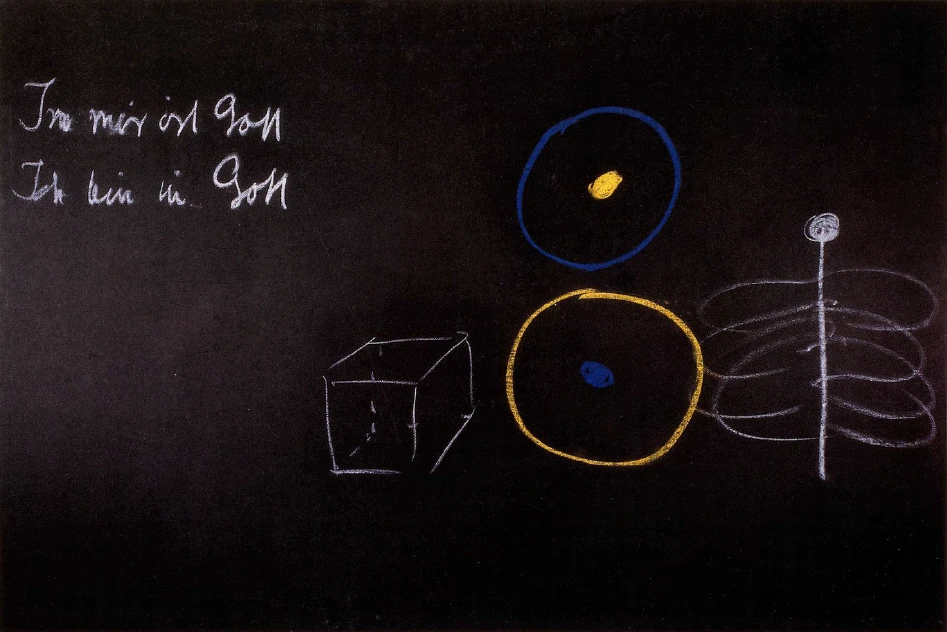
[ 22 ] Sehen Sie, damit kommen Sie überhaupt erst an den Menschen heran. Denn wenn Sie sich erinnern an die Zeichnung, die ich Ihnen vom Stoffwechsel-Gliedmaßenmenschen und vom Kopfmenschen gegeben habe, bedeutet diese Zeichnung gar nichts anderes als die Ausprägung und Verwirklichung dessen, was jetzt in einer einfachen Weise in einer Meditationsfigur vor Sie hingestellt wird. Im Menschen ist das verwirklicht, daß der Ich-Punkt des Kopfes im Gliedmaßenmenschen zum Kreis wird, der natürlich konfiguriert ist. Und Sie lernen verstehen überhaupt den ganzen Menschen, wenn Sie in dieser Weise an ihn herangehen, wenn Sie versuchen, ihn innerlich zu verstehen. Aber zuerst müssen Sie dieses haben, daß die zwei Figuren, die zwei Vorstellungen ein und dasselbe sind, daß sie gar nicht unterschieden sind voneinander. Nur von außen angesehen sind sie verschieden. Da ist ein gelber Kreis, da ist er auch. Da ist ein blauer Punkt, da ist er auch. Warum? Weil das die schematische Figur des Kopfes ist, weil das die schematische Figur des Leibes ist. Aber wenn der Punkt sich behauptet in den Leib hinein, dann wird er eben zum Rückenmark; wenn der Punkt hier sich hineinbegibt, wird dasjenige, was er sein soll in der Kopforganisation, dann eben Rückenmarkansatz (siehe Tafel 12). Die innere Dynamik der Morphologie ergibt sich Ihnen einfach dadurch. Sie können eine Anatomie, eine Physiologie bekommen, indem Sie von dem ausgehend meditieren. Dann kriegen Sie schon die innere Intuition, inwiefern Ihr Oberkiefer und Ihr Unterkiefer Gliedmaßen sind, inwiefern der Kopf ein ganzer Organismus ist, der aufhockt oben - seine Gliedmaßen sind verkümmert -, in der Verkümmerung sie umbildet zu Kiefern, und Sie bekommen die Anschauung, wie in einem polarischen Gegensatz Zähne stehen und Zehen. Sehen Sie sich nur einmal die Ansätze der Kieferknochen an, so werden Sie die verkümmerte Zehenbildung, die verkümmerte Fuß- und Handbildung darin wahrnehmen.
[ 22 ] But now, this is really the only way to come to a true understanding of the human being! You remember the drawing I made for you, of the metabolism-and-limbs man and the head man (see Figure 1.). That drawing was nothing else than a realistic impression or record of what you have before you now in this simple figure for meditation. In the human being it becomes actual reality; the I-point of the head becomes in the limb man the circle—naturally, with modifications. Adopting this line of approach, trying, that is, to understand man inwardly, you will learn to understand the whole of man. You must, first of all, be quite clear in your mind that these two figures, these two conceptions, are one and the same, are not at all different from one another. They only look different from outside. There is a yellow circle; here it is too! There is a blue point; here it is too! Why do they look different? Because that drawing is a diagram of the head, and this a diagram of the body. When the point claims a place for itself in the body, it becomes the spinal cord. It makes its way in here and then the part it plays in the head organisation is continued in the spinal cord. There you have the inner dynamic of the morphology of man. Taking it as your starting point, you will be able, by meditation, to build up a true anatomy, a true physiology. And then you will acquire the inner intuition that can perceive in how far the upper and lower jaws are limbs; for you will begin to see in the head a complete organism in itself, sitting up there on the top of the human being, an organism whose limbs are dwarfed and have—in process of deformation—turned into jaws. And you will come to a clear perception of how teeth and toes are in polarity to one another. For you have only to look at the attachments of the jawbones, and you can see it all there before you—the stunted toes, the stunted hands and feet.
[ 23 ] Aber es darf eben die Meditation, die in solchen Dingen wirkt, nicht die Stimmung haben, meine lieben Freunde: Ich will mich innerlich in ein warmes Nest legen, es soll mir immer warm und wärmer werden -, sondern es muß die Stimmung vorliegen, daß man in die Wirklichkeit untertaucht, daß man die Wirklichkeit ergreift. Andacht zum Kleinen. Ja zum Kleinsten. Es darf nicht das Interesse für dieses Kleine ausgetrieben werden, meine lieben Freunde. Es muß so sein, daß Sie das Ohrläppchen, der abgeschnittene Fingernagel, ein Stück des menschlichen Haares ebenso interessiert, wie Saturn, Sonne, Mond. Denn schließlich ist in einem solchen menschlichen Haar alles andere darinnen, und derjenige, der kahlköpfig wird, verliert ja tatsächlich einen ganzen Kosmos. Es ist tatsächlich so, daß innerlich erschaffen werden kann dasjenige, was äußerlich sichtbar ist, wenn man nur jene Überwindung hat, welche im meditativen Leben eben notwendig ist. Aber diese Überwindung trifft man nie, wenn irgend Spuren von Eitelkeit auftauchen, und die tauchen eben an allen Ecken und Enden auf. Deshalb, meine lieben Freunde, ist es notwendig, wenn Sie wirklich Erzieher, besonders minderwertiger Kinder werden wollen, daß Sie diese Andacht im Kleinen in der allerallerbescheidensten Weise entwickeln, und davon ausgehend, dann auch wiederum diese Andacht zum Kleinen in der übrigen Jugendbewegung erwecken.
[ 23 ] But, my dear friends, meditation that employs such pictures as I have been giving can never take its course in the kind of mood that would allow us to feel: Now I am going to settle down to a blissful time of meditation; it will be like sinking into a snug, warm nest! No, the feeling must be continually present in us that we are taking the plunge into reality—that we are grasping hold of reality. Devotion to little things—yes, to the very smallest of all! We must not omit to cultivate this interest in very little things. The tip of the ear, the paring of a finger-nail, a single human hair—should be every bit as interesting to us as Saturn, Sun and Moon. For really and truly in one human hair everything else is comprised; a person who becomes bald loses a whole cosmos! What we see externally—we can verily create it inwardly, if only we achieve that overcoming which is essential to a life of meditation. But we shall never achieve it so long as any vestige of vanity is allowed to remain—and vestiges of vanity lurk in every corner and crevice of the soul. Therefore is it so urgent, if you want to become real educators, and especially educators of backward children, that you should cultivate, with the utmost humility, this devotion in the matter of little things. And when you have made a beginning in this way in your own sphere, you can afterwards go on to awaken in other circles of the Youth Movement this same devotion to little things.
[ 24 ] Dann kommen eben diese Möglichkeiten, auf so etwas hingewiesen zu werden, was ja dann — wie es ja auch in diesem Falle geschehen ist — äußerlich verifiziert wird. Da muß ich nun sagen, da sehe ich die größten Fehler, die bei den Unternehmungen innerhalb unserer anthroposophischen Bewegung geschehen. — Sehen Sie, da liegt also der Fall vor: Bei dem Mädchen sagte ich Ihnen, es müsse eine Art von Abnormität dagewesen sein zwischen dem dritten und vierten Lebensjahr. Sie fragen die Mutter, die Mutter bestätigt Ihnen das. Was haben Sie nachher getan? Wollen Sie das einmal ganz ehrlich und aufrichtig schildern, was haben Sie getan, wie Ihnen die Mutter das bestätigt hat?
[ 24 ] And then it will indeed become possible for you to receive, for example, indications that are afterwards verified from external evidence—as happened, you remember, in the case we are considering. And here I must say in connection with this very case, I have occasion to find grave fault. The same kind of thing happens only too often in connection with the various undertakings that have been begun within our anthroposophical movement. The situation was as follows. Here was a girl concerning whom I told you that a kind of abnormality must have occurred in her development between the third and fourth year. You question the mother, and the mother confirms that it was so. What did you do then? Please tell me, honestly and sincerely: What did you do, when the mother confirmed the fact?
Schweigen.
(Silence.)
[ 25 ] Wollen Sie einmal ganz esoterisch ehrlich sein, Sie drei? Was haben Sie getan?
[ 25 ] Please be esoterically honest and tell me the truth, you three: what did you do?
Schweigen.
(Silence.)
[ 26 ] Wenn Sie das Richtige getan hätten, würden Sie sagen: Wir sind gesprungen darüber, daß der Plafond ein Loch bekommen hat! — Dann aber würde auch noch heute der Reflex von diesem Sprung nicht nur sprechen aus Ihnen, sondern leuchten.
[ 26 ] If you had done the right thing, you would now be telling me: “We danced and jumped until we made a hole in the ceiling!” And the after-effect of this jumping for joy would be still expressing itself today—and not merely in words, it would be shining out from you like a light.
[ 27 ] Das ist es gerade: der Enthusiasmus im Erleben der Wahrheit! Das ist dasjenige, was da sein muß. Das ist dasjenige, was mir seit Jahren in einer so furchtbaren Weise in der anthroposophischen Bewegung Schmerz macht, daß die Menschen so fest auf den Beinen stehen, die Jungen fast genau so fest wie die Alten. Und denken wir darüber nach, wie sie fest auf ihren Beinen stehen können! Sehen Sie, da war im Grunde genommen der Nietzsche doch ein anderer Kerl, wenn er auch krank darüber geworden ist. Er hat seinen Zarathustra einen Tänzer werden lassen. Werden Sie doch Tänzer, in dem Sinne, wie es bei Zarathustra gemeint ist! Leben Sie mit innerster Freude an der Wahrheit! Es gibt ja nichts Entzückenderes als das Erleben der Wahrheit. Das ist etwas, was eine viel wichtigere und wesentlichere Esoterik ist als das, was mit den langen Gesichtern herumläuft. Dieses innere Erleben der Wahrheit, das ist das, was lange vorangehen muß allem übrigen SichEinreden von einer Mission.
[ 27 ] That is what you need—enthusiasm in the experience of truth. This enthusiasm is an absolute sine qua non: you cannot get on without it. For years it has been so terribly painful to me, the way the members of the anthroposophical movement stand there as if they were rooted to the spot—and the young too, almost as much as the old. But now consider what it means, That they can stand there so impassively. Look at Nietzsche! What a different sort of fellow he was—even if he did get ill from it! He made his Zarathustra become a dancer. Can't you become dancers—in the sense Nietzsche meant it? Why, you should be leading lives of joy—deep inner joy in the truth! There is nothing in the world more delightful, nothing more fascinating, than the experience of truth. There you have an esotericism that is far more genuine, far more significant than the esotericism that goes about with a long face. Before everything else—and long before you begin to talk about having a “mission”—there must be this living inner experience of truth.
[ 28 ] Bei dem Mädchen zwischen drei und vier Jahren trat ein okkultes Fieber auf. Das nennt man auch in der Medizin okkultes Fieber. Das ist eine derjenigen Stellen in der Medizin, wo diese ihre frühere Sprachweise beibehalten hat. Wenn irgendein Arzt nicht weiß, woher das Fieber kommt, nennt er das ein okkultes Fieber. Dieses okkulte Fieber trat auf, es war eine besondere Schwäche in diesem Zeitraum vorhanden zwischen dem dritten und vierten Jahr, es war eine besondere Schwäche des astralischen Leibes. Der physische Leib und der Ätherleib machten eine Reaktion, und es entwickelten sich diese dann zu stark, es konnte nicht mehr nach der astralische Leib. Daher ist es bei diesem Kinde ganz besonders notwendig, daß man erstens weiß: hier tritt mit dem dritten Jahre ein ein merkwürdiges Verkümmern, In-sich-Verkrampfen des astralischen Leibes; ich muß dem nachhelfen. Dem muß ordentlich nachgeholfen werden, und das kann man auf pädagogische Weise dadurch, daß man das Interesse beweglich macht. Nun schildern Sie, wie war es bei diesem Mädchen mit dem Schulmäßigen?
[ 28 ] The girl had, when three or four years old, an occult fever. It is even called that in the medical world—one of those instances where medicine has retained an earlier form of speech. When a doctor does not know what is the cause of a fever, he calls it an “occult” fever. This occult fever, then, made its appearance. During the period round about the third and fourth years, the astral body was particularly weak. The physical body and the ether body reacted to this and developed too strongly; and then the astral body was unable to keep up with them. It is exceedingly important that we take cognisance first of all of this fact: at the age of three the growth of the astral body suffered a significant check, the child's astral body became stunted and cramped within itself. I must come to its aid. It must receive help to make up for what has been lost; and this help can be given through education, by awakening the child's interest in many directions. Tell me now, how has it been with this girl at school?
Albrecht Strohschein: Das Mädchen werden wir nicht in der Anstalt haben, es wird nur zur Behandlung kommen. Es war in der Hilfsschule bis zum sechzehnten Jahr, kann lesen und schreiben, und rechnen mit Zahlen bis ungefähr tausend. Sonst kennen wir das Mädchen weiter nicht, es war nur zur Vorstellung oben. - Es wurde angegeben Klysmamit Tabak.
(S.: “We are not having the girl with us in the Home, she will come only for treatment. She was in a school for giving special help to backward children up to the beginning of her sixteenth year, and can read and write, and work with numbers up to about a thousand. In all other respects we have really no knowledge of the girl, we had her there only in order for you to see her. Enema containing nicotiana was prescribed.”)
[ 29 ] Es wird sich darum handeln, daß es mit Heileurythmie behandelt wird.
[ 29 ] It will be important to treat this girl with Curative Eurythmy.E4At Lauenstein the following prescription was given: Nicotiana enema, a five per cent decoction, twice a week. If this does not help, then Nicotiana injections D 6. Curative Eurythmy: F, M, UT (oot), TU (too).
[ 30 ] Warum ist das? Das ist aus dem Grunde, weil infolge des Verkümmerns des astralischen Leibes bei dem Kinde eine sehr starke Neigung zur Deformation des oberen Organismus eingetreten ist. Das Kind hat ein außerordentlich brutales Aussehen, weil sich alles, was nach den Kauwerkzeugen hin liegt, deformiert. Nun gerade in diesem Falle wird die nun wirklich von dem hiesigen Klinisch-Therapeutischen Institut so sehr sorgfältig ausgeprüfte antideformierende Wirkung des Nikotinsaftes seine gute Wirkung tun können. Man kann dann auch zunächst langsam vorwärtsgehen, gibt es zuerst per os und beobachtet dann sorgfältig; man muß sich einen Blick dafür aneignen, ob die Kauwerkzeuge anfangen, mehr in die Herrschaft des Organismus zu kommen. Hier liegen sie fast ganz außerhalb des Bereiches dessen, was das Kind mit der Seele ergreift. Sie lagern nur da. Das Kind kann durch die Beibringung von Nikotinsaft per os in einer entsprechenden Dezimale man kann anfangen mit der sechsten und bis zur fünfzehnten gehen behandelt werden. Findet man aber, daß die Wirkungen zu schwach sind, bringt man den Nikotinsaft in Hochpotenzen in die Zirkulation, so daß unmittelbar durch die Zirkulation der astralische Leib ergriffen wird dadurch, und man wird sehen, daß man das, was man durch das innerliche Eingeben nicht erreicht, auf diesem Wege erreicht.
[ 30 ] As a result of the stunting of the astral body, a strong tendency to deformation has, you see, made its appearance in the upper organism. The child has about her an extraordinarily animal look, the reason being that all that part which belongs to the organs of mastication is deformed. We have already been making very careful tests here in the Clinic of the influence of nicotiana juice in counteracting deformation; and this girl is just a case in point, where it will be able to do its good work. So you see it will be possible right away to begin—slowly—to make some progress. The nicotiana juice is given by the mouth, to start with; and then one has to watch carefully—one must acquire an eye for such things—to see whether the organs of mastication are beginning to come more under the control of the organism. For, as it is, the organs of mastication lie almost entirely outside the realm of the child's control. They just hang there—limp. The child can thus be treated with nicotiana juice given by the mouth in suitable decimal of dilution, beginning with the sixth and going up to the fifteenth. If it should turn out that this does not work strongly enough, we shall have to resort to injection of nicotiana juice in a high potency into the circulation, so that it may make direct contact there with the astral body and enable us to achieve in this way what we failed to achieve when we administered nicotiana juice by ingestion.
[ 31 ] Es ist aber vielleicht gut — das muß ich noch nachträglich hinzufügen -, wenn man dann versucht, die Wirkungen, die da innerhalb des astralischen Leibes erhalten bleiben sollen, nicht zu stark in die IchOrganisation heraufspielen zu lassen, sie stoppt vor der Ich-Organisation. Das kann dadurch erreicht werden, daß man, wenn auch selten, vielleicht nur in der Woche einmal, ein Bad mit einem schwachen Schwefelzusatz verabreicht, ein schwaches Schwefelbad.
[ 31 ] I have also a further suggestion to make. The nicotiana juice is intended to work within the astral body and remain there, and it will perhaps be good if we try to prevent its influence from entering too powerfully into the ego organisation—if we try, that is, to arrest it before it reaches the ego organisation. This result can be induced by giving—not often, perhaps only once a week—a weak sulphur bath.
[ 32 ] Sehen Sie, wir werden noch morgen die andern Fälle besprechen, die da waren, und es wird mir eine besondere Befriedigung sein, die interessante Erscheinung, die ja gerade dort bei Ihnen sich besonders studieren läßt, die interessante Erscheinung der Albinos ins Auge zu fassen. Wir hatten zwei solche Menschenkinder, ein älteres mit fünfzehn Jahren und ein ganz kleines Schwesterchen vorliegen. Haben Sie vielleicht davon die Horoskope gemacht?
[ 32 ] Tomorrow we will speak about the other cases that you have at Lauenstein, and I shall be particularly glad to be able to consider with you the interesting phenomenon of albinism, which we have opportunity to study in two of your children. One of them is fifteen years old and the other a much younger sister of hers.
Frage an Dr. Elisabeth Vreede, welche die Horoskope übergibt.
(Dr. Steiner asked Dr. Vreede if she had drawn their horoscopes, and she handed them to him. The dates were 6th December, 1909, approximately 4 a.m., and 18th May, 1921, approximately 3 a.m., both at Jena.)
[ 33 ] Das ist das ältere Mädchen, das ist das jüngere. — Wie steht der Uranus? Konstellationen haben Sie nicht besondere gefunden?
[ 33 ] How does Uranus stand? Did you not find any special constellations?
Dr. Elisabeth Vreede: Doch, hier gerade bei Uranus und Neptun. Neptun in Opposition zu Uranus, bei dem älteren Mädchen.
(Dr. Vreede replied that she had—namely with Uranus and Neptune. In the case of the elder girl, Neptune was in opposition to Uranus.)
[ 34 ] Sehen Sie, nicht wahr, nun sind diese Kinder da. Überall, wo man diese Kinder sieht, zeigen sich ja zwei Haupterscheinungen. Die ganz hellen Haare und das schlechte Sehen mit der Veränderung der Augen. Diese zwei Erscheinungen sind die Urphänomene. Das weist aber schon bei ganz oberflächlicher Betrachtung darauf hin, daß man es zu tun hat bei den Albinos mit einer gegenüber der Eisenverarbeitung sehr schwachen Organisation, und daß man es zu tun hat mit einer Organisation, die ungeheuer leicht den Schwefel verarbeitet. Also die Tatsache liegt da vor, daß die Organisation sich sträubt gegen das Eisen, und zwar namentlich sich sträubt gegen das Eisen in der Verarbeitung zur Peripherie hin, es stoppt vor der Peripherie; und es wird gerade der Schwefel nach der Peripherie hingetrieben und über die Peripherie hinausgetrieben, so daß man sieht in der Region der Haarbildung überall die Schwefelaura, die die Haarbildung bleicht, ihnen ihre Kraft herausnimmt. Und in der verhältnismäßig selbständigen Augenbildung, die sogar embryonal von außen in den Organismus hineingebildet werden, sieht man erst recht die selbständige Schwefelaura, die die Augen förmlich dazu drängt, aus dem Ätherischen heraus in das Astralische hinein ihr Wesen zu treiben. Man sieht geradezu bei solchen Kindern das Auge aus seiner Felsenhöhle ausgerissen, den Ätherleib unberücksichtigt gelassen, den Astralleib im Auge ganz besonders stark in Anspruch genommen.
[ 34 ] Such children always show two main characteristic peculiarities: fair hair; and poor sight, with the variation in the eyes. These are the essential phenomena of albinism. No more than a superficial study is required to discover that in albinos we have to do with an organisation that is very feeble at assimilating iron, but on the other hand assimilates sulphur with the greatest ease. The organisation resists iron; it resists dealing with it, and this applies especially to the periphery of the body; assimilation of iron stops short of the periphery. Sulphur, on the other hand, is driven to the periphery; and not only so, but driven even out beyond it. That is how it comes about that in the region of the hair, you see, all around, a sulphur-aura, which pales and bleaches the hair and takes the strength out of it. And in the eyes (which are formed comparatively independently, being built into the organism from without, in the embryo time)—in the eyes you have a still more striking manifestation of a sulphur-aura. Here it has the effect of fairly forcing the eyes to betake themselves out of the etheric into the astral. In such children we see the eye plucked right out of its “grotto”, the etheric body of the eye left disregarded and its astral body very much to the fore and fully engaged.
[ 35 ] Nun entstehen da sehr wichtige Fragen. Der Mensch steht auf der einen Seite in bezug auf seine Bildung im Zusammenhang mit denjenigen Kräften, die in der Erde sind, und die sich uns verraten durch die Substanz der Erde, und er steht im Zusammenhang mit dem ganzen Kosmos. Von beiden ist er abhängig. Beide sitzen sowohl in der individuell-karmischen Fortentwickelung wie auch in der Vererbungsströmung. — Nun die Vererbungsströmungen. Bei den zwei Kindern, die präsentiert worden sind, liegen weder bei Vater noch bei Mutter etwas von Albinoerscheinungen vor. Nichts, gar nichts, normale Menschen. Dagegen in der Aszendenz gab es irgendwo eine Großmutter, von der gesagt wird, daß sie auch Albinoerscheinungen hatte.
[ 35 ] Very important questions arise at this point. If we consider the “forming” of man, we find that he stands in connection on the one hand with the telluric forces that divulge themselves to us in the substances of the earth, and on the other hand, with the whole cosmos. He is dependent on both. Both sets of forces are present in the individual process of evolution, as well as also in the stream of inheritance. Let us take first, in considering these two children, the stream of inheritance. Neither in the case of the father nor of the mother is there any indication of albinism. They are both perfectly normal human beings. There was however somewhere in the antecedents—was it a grandmother, of whom it is reported that she had signs of albinism?
Dr. Ilse Knaner: Es war eine Schwester der Mutter dieses Kindes.
(Frl. Dr. K.: “It was a sister of the mother.”)
[ 36 ] Also eine Tante. Es liegt eben in der Aszendenz. Wir brauchen nur auf das einzugehen, daß in der Aszendenz durchaus eine Neigung dazu vorliegt. Sagten Sie mir an diesem Tage nicht, daß sich noch andere Kinder ergeben hätten, auch in Jena, aus der Saalegegend?
[ 36 ] An aunt, then. Albinism has been known in the family; that is all that need concern us at the moment. A tendency to albinism is present in the antecedents. And did you not tell me that there had been other cases in the Saal region, also at Jena?
Dr. Ilse Knauer: Zwei Kinder und ein Erwachsener, Zweiunddreißigjähriger, der bereits verheiratet ist. Unter diesen dreien findet sich bloß ein Fall, wo ein Albino in der Aszendenz vorhanden war.
(Frl. Dr. K.: “Yes, two children; and one adult, aged thirty-two, who is already married. Of these three, in only one case had there been albinism before in the family history.”)
[ 37 ] Sie sehen, daß die Sache auftritt, man möchte sagen, in einem gewissen Sinne endemisch gebunden an das Territorium. Aber von einer andern Seite aus scharf durchkreuzt. Ganz sporadisch, unter gewissen Umständen wächst aus dem Territorium ein Albino heraus und sonst nicht. Da liegt also die Frage vor: Wie wächst der Albino heraus aus einem Territorium?
[ 37 ] It would seem, therefore, that albinism is in some way endemic to a certain part of the country, but meets also with many counter-influences. And so in fact it makes its appearance quite sporadically! Only under certain circumstances will an albino be born there. The equation will immediately suggest itself: How does it come about that an albino is born in a particular territory?
[ 38 ] Wir wissen, daß es eine Verschwefelung bis nach außen hin ist, so daß kleine Schwefelinfarkte in der Aura auftreten, in der Peripherie. Dann suchen wir in der Umgebung, wo Schwefel auftritt. Nun ist das ganze Saaletal versehen mit Schwefelkies, und Sie haben also die Verbindung von Schwefel und Eisen in einer solchen Art vorhanden, daß man studieren kann: wie ist das Eisen in der Umgebung, wie ist der Schwefel in der Gegend, wo besonders in dieser Gegend die wunderbar schönen Pyrite auftauchen, die in der Saalegegend sind. Diese schönen, feinen, goldglänzenden Pyritwürfel tauchen in der Saalegegend auf (siehe Tafel 12). Die andern Gegenden dort in der Nähe sind gipshaltig. Gips ist, wie Sie wissen, mit zwanzig Prozent Wasser schwefelsaurer Kalk. Also wieder haben wir die Möglichkeit, den Schwefel zu studieren in seiner Bindung in dem Gips. Das wirft Licht auf alles dasjenige, was in der Atmosphäre lebt und so weiter, so daß man zunächst eingehen muß auf alles dasjenige, was aus dem Boden heraus mit der Schwefel- und Eisenabsorption zusammenhängt. Sie haben auch sonst ein sehr eisenreiches Territorium und die Frage entsteht: Wie bildet sich ein gegenseitiges Verhältnis heraus zwischen Erde und Mensch, so daß die Erde das Eisen stark heranziehen kann, der Mensch aber nicht oder nur mit Schwierigkeit? Welche Konstellationen müssen da sein, um den Menschen besonders geeignet zu machen, Eisen zurückzuweisen und den Schwefel aufzunehmen? — Da kommen Sie auf das Kosmische, da untersuchen Sie die Konstellationen, die vorhanden sind — bei der Konzeption kann man das nicht — bei der Geburt bei einem solchen Kinde. Da wird sich zeigen, daß die Frage herantritt, ob bei diesen Kindern, die als Albino auftreten, ganz besondere Konstellationen vorliegen, und zwar so vorliegen, daß sie nicht so auftreten können, daß sie nur selten auftreten können. Da werden wir das Entsprechende nicht zu suchen haben bei denjenigen Angaben, die hervorgehen aus Planetenumdrehungen, die schnell vor sich gehen, sondern wir werden bei denjenigen Planeten die Konstellation zu suchen haben, die lange brauchen, bis sie sich umdrehen, also bei Saturn und Uranus. Sie sehen also, wie sich die Fragen stellen in einem solchen Falle. Erst muß man die Fragen haben, dann kann man eingehen auf einen solchen Fall.
[ 38 ] In the case of an albino we have, as we have seen, a sulphurisation process working outwards, so that little sulphur islets occur in the aura, in the periphery. And now we look round in the native environment of the children to see where we can find sulphur. The whole valley of the Saal abounds in iron sulphide. Iron and sulphur are thus present in combination. You can study first the presence of iron in the neighbourhood, and then again the presence of sulphur; and you can take special note of the whereabouts of the beautiful pyrites (iron sulphide). These delicate and lovely cubes of pyrites with their beautiful golden gleam are a characteristic product of the valley of the Saale. Other regions nearby yield gypsum. Gypsum is, as you know, calcium sulphate with 20 per cent water. So that here again we have an opportunity to study sulphur—this time in combination with calcium. This kind of study of the soil will throw light for us on all that lives in the atmosphere etc.; and so we shall have first of all to give ourselves to the study of that which comes out of the ground and is connected with the absorption of sulphur and iron. For we have here a territory that is also very rich in iron, and the question arises: How does this opposite relationship come about in this territory in regard to earth and man, in the earth has a great power of attraction for iron, while the human being cannot attract iron at all, or only with difficulty? What constellations must be present to cause the human being to be particularly disposed to reject the iron and accept the sulphur? Here we come into the realm of the cosmic; we have to set about investigating the constellations that were present at birth (we cannot of course do it for conception). And this will lead us to ask whether there were not in the case of these children who are albinos, quite special constellations, constellations moreover that can only seldom occur. We shall have to find what we can learn, not from the planets that move more quickly, but from the constellations of the planets that take a long time to revolve, such as Saturn and Uranus. You see, therefore, to what kind of questions such cases will lead us. We must first find the right questions to ask; when once we have the questions, then we are ready to begin our study.E5When the children were brought to Rudolf Steiner at Lauenstein, he particularly enquired whether there had not been some weakness or debility in the mother. The mother declared that she had never been seriously ill, but admitted that she had suffered from chlorosis as a girl and had in general been very anaemic. Rudolf Steiner: “So the mother, you see, was evidently, earlier on, in a delicate state of health.” The father too had in his youth been weak and ailing. Their first child, at whose birth the mother was twenty years old and the father twenty-two, died young of pneumonia. The second was the elder of the girls we are considering. The third, a boy, is entirely normal. Then came, as fourth, the younger of our two albinos.
Rudolf Steiner also made enquiries about the geological conditions of the district in which the children had been born. Information was given of the presence of pyrites and gypsum, to which allusion is made in the lecture. He then asked whether the people of the district were strikingly blond. This was denied; on the contrary, they are inclined to be dark. Lastly, he enquired whether the parents were relatives of one another; the answer was in the negative.
Rudolf Steiner then explained to us the connection of the albinism with the sulphur. “These children”, he said, “are completely sulphurous. In them, sulphur processes are permeating the entire body.” The children are “all eye”; processes which ought to be going on in the eye alone are here taking place throughout the body. The quivering in the eyes and the furtive glancing hither and thither are due to oscillation between ether body and astral body.
[ 39 ] Nun möchte ich eine kleine Kur auch hier angeben. Ich werde also das, was hier angedeutet ist, auch hier anwenden. Ich werde das morgen hier besprechen.
[ 39 ] Now, for these children also, I would like to prescribe a little course of treatment, basing it on the indications I have given today. We will talk of that tomorrow.
[ 40 ] Nach dem, was mir heute morgen gesagt worden ist, wollen Sie noch etwas anderes, als die Vorträge enthalten, weil sie zu stark nach der «Andacht zum Kleinen» gehen, nach dem, was Sie brauchen; ich möchte Ihnen auch da in der stärksten Weise entgegenkommen, indem ich ebenso die neue Methode anwende, wie ich sie bei den Arbeitern angewendet habe. Da habe ich die Vorträge nach und nach so auslaufen lassen, daß ich frage, über was ich sprechen soll, so daß von einem gewissen Punkt an die Themen, die sie besprochen haben wollen, von ihnen selber gestellt werden. Jetzt können die Arbeiter niemals schimpfen, daß ihnen nicht über das vorgetragen wird, was sie wollen.
[ 40 ] I gather from a remark that was made to me this morning, that you are wanting something more than is contained in the lectures. These (you feel) go too much in the direction of “devotion to detail”—too much, that is, in the direction that you need! But I am really entirely ready to meet you in this matter, and propose to use here the new method I have been using with the workmen at the Goetheanum. For there I have allowed it gradually to come to this—that I ask them on what I am to speak; so that, ever since a certain date, the workmen themselves have been specifying the themes they want dealt with in the lectures. And now they can never complain that they do not get lectures on subjects they want to hear about.