

Man and World
How Spirit Works in Nature
GA 351
22 December 1923, Dornach
Translate the original German text into any language:
Versions Available:
How Spirit Works in Nature, tr. SOL
16. Kleesäure, Ameisensäure, Kohlensäure und ihre Bedeutung in der Natur
16. Oxalic acid, formic acid, carbonic acid, and their importance in nature
[ 1 ] Guten Morgen, meine Herren! Eigentlich müssen wir noch etwas über die Frage des Herrn Dollinger sprechen. Er wollte ja in Ihrem Namen wissen — denn das ist wohl für jeden interessant —, wie der Zusammenhang in geistiger Beziehung ist zwischen dieser Herde von Insekten, die sich bewegt, an die Pflanzen herankommt, und dem, was sich in den Pflanzen befindet.
[ 1 ] Good morning, gentlemen! Actually, we still need to discuss Mr. Dollinger’s question. He wanted to know on your behalf—since this is surely of interest to everyone—what the spiritual connection is between this swarm of insects, which moves and approaches the plants, and what is contained within the plants.
[ 2 ] Sehen Sie, meine Herren, ich habe Ihnen ja schon früher gesagt: Es ist um uns überall vorhanden nicht nur so etwas wie Sauerstoff und Stickstoff, sondern es ist in der ganzen Natur vorhanden Verstand, richtig Verstand. Kein Mensch wundert sich, wenn man sagt: Wir atmen die Luft ein -, weil die Luft überall ist und sozusagen die Wissenschaft heute schon so stark in die Schulbücher hineingekommen ist, daß den Leuten gesagt wird: Überall ist Luft, und du atmest die Luft ein. - Aber ich habe zum Beispiel schon Leute gekannt draußen auf dem Lande, die haben das als eine Phantasie betrachtet, weil sie eben nicht gewußt haben, daß draußen Luft ist, ebenso wie die Leute heute nicht wissen, daß überall Verstand ist. Die betrachten es als eine Phantasie, wenn man sagt: Geradeso wie wir mit den Lungen die Luft einatmen, so atmen wir zum Beispiel mit der Nase oder mit dem Ohr Verstand ein. — Und ich habe Ihnen ja früher schon reichlich Beispiele gezeigt, an denen Sie sehen konnten, daß Verstand überall ist. Wir haben ja in der letzten Zeit von einem ganz besonders interessanten naturwissenschaftlichen Kapitel gesprochen, von den Bienen, Wespen und Ameisen. Vielleicht kann man durch wenig von dem, was in der Natur ist, so gründliche Blicke hineintun in die Natur selber wie durch das Treiben der Insekten überhaupt. Die Insekten sind nun einmal ganz merkwürdige Tiere und sie werden noch manches Geheimnis an den Tag bringen.
[ 2 ] You see, gentlemen, I have told you before: It is not just something like oxygen and nitrogen that surrounds us everywhere, but intelligence—true intelligence—is present throughout all of nature. No one is surprised when you say, “We breathe in the air”—because air is everywhere, and science has, so to speak, already become so deeply ingrained in school textbooks that people are told: “Air is everywhere, and you breathe it in.” - But I’ve known people, for example, out in the countryside who regarded this as a fantasy, simply because they didn’t know that air is out there—just as people today don’t know that intelligence is everywhere. They regard it as a fantasy when one says: “Just as we breathe in air with our lungs, so too do we breathe in intelligence with our nose or our ear, for example.” — And I’ve already shown you plenty of examples in the past from which you could see that intelligence is everywhere. We’ve been discussing a particularly interesting topic in the natural sciences lately: bees, wasps, and ants. Perhaps few things in nature allow us to gain such a profound insight into nature itself as the behavior of insects in general. Insects are, after all, quite remarkable creatures, and they will yet reveal many a secret.
[ 3 ] Es ist jamerkwürdig, daß wir sozusagen unser Insektenkapitel gerade in der Zeit besprechen, in der der hundertste Geburtstag des bedeutenden Insektenforschers Jean-Henri Fabre ist, der am 22. Dezember vor einem Jahrhundert geboren worden ist, und der gerade in die materialistische Zeit hineinfiel, daher alles materialistisch ausgelegt hat, der aber ungeheuer viele Tatsachen aus dem Leben der Insekten ans Licht gebracht hat, so daß es schon ganz natürlich ist, daß wir heute, wo wir über Insekten sprechen, an ihn erinnern.
[ 3 ] It is remarkable that we are discussing our chapter on insects, so to speak, at the very time of the 100th birthday of the eminent entomologist Jean-Henri Fabre, who was born on December 22 a century ago and who lived during a materialistic era, and therefore interpreted everything from a materialistic perspective, but who brought an immense number of facts about the lives of insects to light, so that it is only natural that we should remember him today as we discuss insects.
[ 4 ] Nun will ich Ihnen zunächst einmal ein Beispiel von einer Insektenart anführen, die Sie gerade im Zusammenhang mit den Bienen außerordentlich interessieren kann. Die Biene arbeitet ja in einem hohen Grade vollkommen, und es ist schon das Merkwürdigste an der Biene nicht das, daß sie schließlich den Honig hervorbringt, sondern daß sie diese wunderbar gebauten Zellenwaben ganz aus sich selber heraus macht. Sie muß ja dasjenige, was sie als Material verwendet, an sich selber in den Bienenstock hineintragen. Und sie arbeitet eigentlich so, daß sie das Material gar nicht mehr ursprünglich benützt, sondern daß sie das ganz verwandelt in den Bienenstock hineinbringt. Aus sich selber heraus arbeitet sie so.
[ 4 ] First, I would like to give you an example of an insect species that may be of particular interest to you in connection with bees. The bee works with a high degree of perfection, and the most remarkable thing about the bee is not that it ultimately produces honey, but that it creates these wonderfully constructed honeycombs entirely on its own. After all, it must carry the material it uses into the hive itself. And it actually works in such a way that it no longer uses the material in its original form, but rather brings it into the hive completely transformed. It works in this way entirely of its own accord.
[ 5 ] Nun gibt es aber eine Bienenart, die nicht in dieser Weise arbeitet, die aber gerade durch ihre Arbeit zeigt, was für ein ungeheurer Verstand in der ganzen Natur ist. Wollen wir einmal diese Bienenart, die man gewöhnlich die Holzbiene nennt, die nicht so beachtet wird wie die Hausbiene, weil sie den Menschen meistens lästig wird, in ihrer Arbeit betrachten. Das ist ein ungeheuer fleißiges Tier, und ein Tier, das wirklich, damit es leben kann - nicht das einzelne Tier, aber die ganze Art leben kann -, ungeheure Arbeit zu verrichten hat. Dieses Tier sucht sich Holz auf, das nicht mehr an den Bäumen ist, sondern das schon aus den Bäumen herausgenommen und verarbeitet ist. Sie können diese Holzbiene mit ihren Nestern, die ich Ihnen gleich beschreiben werde, finden, sagen wir, wenn Sie Pflöcke irgendwo eingeschlagen haben, also wo eben das Holz aus den Bäumen herausgenommen ist und scheinbar unbelebtes Holz ist, Pflöcke oder Säulen, die aus Holz sind. Da drinnen können Sie die Holzbiene finden, auch in Gartenbänken oder Gartentüren. Also da, wo man Holz benützt hat, da macht die Holzbiene ihr Nest hinein, aber auf eine ganz sonderbare Weise.
[ 5 ] However, there is a species of bee that does not work in this way, but which, precisely through its work, demonstrates the immense intelligence found throughout nature. Let us take a look at this species of bee—commonly called the carpenter bee, which is not as highly regarded as the honeybee because it is usually a nuisance to humans—and observe its work. It is an incredibly industrious creature, and one that must perform an immense amount of work—not just the individual bee, but the entire species—in order to survive. This insect seeks out wood that is no longer on the trees but has already been removed from them and processed. You can find these carpenter bees and their nests—which I will describe to you in a moment—for example, if you have driven stakes into the ground somewhere, that is, where the wood has been taken from the trees and appears to be lifeless: stakes or columns made of wood. You can find the carpenter bee there, as well as in garden benches or garden gates. So wherever wood has been used, the carpenter bee builds its nest there—but in a very peculiar way.
[ 6 ] Denken Sie sich einmal, das wäre solch ein Pfosten (siehe Zeichnung). Das ist also das Holz, das aus dem Baum bereits heraus ist. Jetzt kommt die Holzbiene und bohrt zunächst von außen so in schräger Weise einen Gang hinein. Und wenn sie da drinnen angekommen ist, den Gang ausgeholzt hat, so eine Art Kanal ausgebohrt hat, dann fängt sie an, in ganz anderer Richtung zu bohren. Dann bohrt sie so, daß da zunächst eine kleine ringförmige Höhlung entsteht. Jetzt fliegt das Insekt fort, holt allerlei aus der Umgebung und polstert diese Höhle aus. Und dann, wenn es sie ausgepolstert hat, legt es das Ei hinein, aus dem die Made wird. Das liegt jetzt da drinnen. Wenn es das Ei abgelegt hat, kommt das Bienlein und macht darüber einen Deckel, in dem da in der Mitte ein Loch ist. Und jetzt fängt es an, da oben über diesem Deckel weiterzubohren, legt da drüber eine zweite Wohnung an für eine zweite auskriechende Holzbiene, und legt, nachdem es sie ausgepolstert hat, ein Loch gelassen hat, wiederum ein Ei hinein. Das setzt die Holzbiene fort, bis sie solche übereinandergelegten Höhlungen zu zehn oder zwölf über einander gebaut hat. Überall ist ein Ei drinnen.
[ 6 ] Imagine this is a post like the one shown in the drawing. So this is the wood that has already been cut from the tree. Now the carpenter bee comes along and first drills a tunnel into it from the outside at an angle. And once it’s inside—after hollowing out the tunnel, essentially drilling a kind of channel—it starts drilling in a completely different direction. It drills in such a way that a small, ring-shaped cavity is formed. Now the insect flies away, gathers all sorts of material from the surroundings, and lines this cavity. And then, once it has lined it, it lays the egg inside, from which the larva will emerge. That egg is now inside. Once it has laid the egg, the little bee returns and builds a cap over it, with a hole in the center. And now it begins to drill further up above this lid, creating a second chamber there for a second wood bee that will emerge, and after padding it out and leaving a hole, it lays another egg inside. The wood bee continues this process until it has built ten or twelve such stacked cavities one on top of the other. There’s an egg inside each one.
[ 7 ] Jetzt kann die Made sich da drinnen in diesem Holzstock entwickeln. Überall legt das Insekt noch Futter neben die Made. Die frißt zuerst von dem Futter, das ihr zubereitet war, und wird dann reif zum Auskriechen. Aber jetzt kommt die Zeit, wo das Insekt sich verpuppt hat und sich verwandelt hat in die geflügelte Biene, die nun ausfliegen soll.
[ 7 ] Now the larva can develop inside this piece of wood. The insect places food next to the larva everywhere. The larva first eats the food that was prepared for it and then matures enough to emerge. But now comes the time when the insect has pupated and transformed into the winged bee, which is now ready to fly away.
[ 8 ] Da drinnen ist das so, daß die Made sich nun entwickelt und nach einiger Zeit richtig ausfliegen kann. Wenn die Zeit ist, wo die Made reif ist, sich verpuppt hat und Insekt wird, ist es ja jetzt so, daß das fertig Insekt durch diesen Gang herausfliegen kann. Dadurch ist durch die Geschicklichkeit der Holzbiene erreicht, daß durch den Gang, der zuerst hineingebohrt worden ist, das fertige Insekt wiederum herausfliegen kann. Ja, schön. Aber wenn jetzt das zweite Insekt hier kommt, das ja etwas jünger ist, und das dritte oben ist wieder etwas jünger, weil das Muttertier erst diese Wohnungen machen muß, da finden diese Tiere keinen seitlichen Ausgang, um herauszukommen. Und die fatale Geschichte bestünde jetzt darin, daß die oberen Tiere allmählich da drinnen zugrunde gehen müßten. Aber das verhindert das Muttertier dadurch, daß es das Ei so legt, daß, wenn die Made, die jünger ist, auskriecht, sie da dieses Loch findet, von dem ich Ihnen erzählt habe; sie läßt sich da herunterfallen und kriecht da aus. Das dritte Tier läßt sich durch die zwei Löcher herunterfallen und kriecht so aus. Und dadurch, daß jedes später auskriechende Tier etwas später kommt, stört es das früher auskriechende Tier unter ihm nicht. Sie kommen nie zusammen, sondern das frühere ist immer schon ausgeflogen.
[ 8 ] Inside, the larva develops and, after some time, is able to fly out properly. When the time comes—once the larva is mature, has pupated, and become an insect—the fully developed insect can fly out through this tunnel. Thanks to the carpenter bee’s ingenuity, the fully developed insect can fly out again through the tunnel that was originally bored into the wood. Yes, that’s fine. But when the second insect arrives—which is a bit younger—and the third one above is again a bit younger, because the mother must first construct these chambers, these insects find no side exit to get out. And the tragic outcome would be that the upper insects would gradually perish inside. But the mother prevents this by laying the egg in such a way that when the younger larva hatches, it finds this hole I’ve told you about; it lets itself fall down through it and crawls out. The third larva lets itself fall through the two holes and crawls out that way. And because each larva that hatches later emerges a little later, it does not disturb the larva that hatched earlier beneath it. They never encounter each other; rather, the earlier one has always already flown away.
[ 9 ] Sie sehen, das ganze Nest ist so vernünftig angelegt, daß man nur staunen kann darüber. Wenn Menschen heute maschinell etwas nachmachen, so sind meistens die Dinge, die die Menschen nachmachen, solchen Dingen nachgeahmt, aber sie sind meist weit weniger geschickt gemacht. Die Dinge, die in der Natur vorhanden sind, sind außerordentlich geschickt gemacht, und man muß schon sagen: Da drinnen ist durchaus Verstand, richtiger Verstand. —- Und davon, daß in dieser Art, wie die Insekten bauen, wie die Insekten bei der Arbeit sich benehmen, davon, daß da Verstand drinnen lebt, könnte man Hunderte und Tausende von Beispielen anführen. Denken Sie sich nur, wieviel Verstand in dem liegt, was ich Ihnen neulich von der Ackerbauameise gesagt habe, die ihre ganze Wirtschaft anlegt und alles mit einem ungeheuren Verstand anlegt.
[ 9 ] You see, the entire nest is so ingeniously designed that one can’t help but marvel at it. When people today use machines to replicate something, the things they produce are usually imitations of such creations, but they are generally far less skillfully made. The things that exist in nature are extraordinarily skillfully made, and one really has to say: There is definitely intelligence there—true intelligence. —- And regarding the fact that in the way insects build, in the way they behave while working—that there is intelligence at work there—one could cite hundreds and thousands of examples. Just imagine how much intelligence lies in what I told you recently about the farmer ant, which organizes its entire economy and does everything with tremendous intelligence.
[ 10 ] Nun haben wir aber noch eine andere Sache betrachtet, gerade als wir diese Insekten, Bienen, Wespen und Ameisen, ins Auge faßten. Ich habe Ihnen gesagt, alle diese Tiere haben in sich etwas, was eine Art giftiger Stoff ist, und dieser giftige Stoff, den alle diese Tiere in sich haben, der ist zu gleicher Zeit, wenn man ihn richtig dosiert, in richtiger Dosis gibt, ein ausgezeichnetes Heilmittel. Das Bienengift ist ein ausgezeichnetes Heilmittel. Das Wespengift ist ein ausgezeichnetes Heilmittel. Und die Ameisensäure, die von den Ameisen abgesondert wird, ist erst recht ein gutes Heilmittel. Aber ich habe Ihnen auch das schon angedeutet: Diese Ameisensäure, die kriegen wir, wenn wir an einen Ameisenhaufen herangehen, die Ameisen herausnehmen, sie dann zerquetschen. Also die Ameisen haben diese Ameisensäure in sich; durch das Zerquetschen der Ameisen kriegen wir die Ameisensäure heraus. Diese Ameisensäure findet sich also eigentlich vorzugsweise bei den Ameisen. Aber wenn Sie wüßten, wieviel - verhältnismäßig natürlich - Ameisensäure in diesem Saal drinnen ist, Sie würden eben recht staunen! Sie werden sagen: Wir können doch nicht hier in einer Ecke einen Ameisenhaufen suchen. — Meine Herren, soviel Sie da sitzen, sind Sie in Wirklichkeit selber solch ein Ameisenhaufen! Denn überall in Ihren Gliedern, Muskeln, in Ihren anderen Geweben, im Herzgewebe, im Lungengewebe, im Lebergewebe, im Milzgewebe namentlich - überall da drinnen ist Ameisensäure, allerdings nicht so konzentriert und stark wie im Ameisenhaufen. Aber dennoch, Sie sind so, daß Sie ganz ausgefüllt sind mit Ameisensäure ganz ausgefüllt. Ja, sehen Sie, das ist etwas höchst Merkwürdiges.
[ 10 ] But we have also considered another matter, just as we were examining these insects—bees, wasps, and ants. I told you that all these animals have within them something that is a kind of toxic substance, and this toxic substance, which all these animals possess, is at the same time—when properly measured and administered in the correct dose—an excellent remedy. Bee venom is an excellent remedy. Wasp venom is an excellent remedy. And formic acid, which is secreted by ants, is an even better remedy. But I’ve already hinted at this to you: We obtain this formic acid by approaching an anthill, removing the ants, and then crushing them. So the ants contain this formic acid; by crushing the ants, we extract the formic acid. This formic acid is actually found primarily in ants. But if you knew how much—relatively speaking, of course—formic acid there is in this room, you’d be truly amazed! You’ll say: We can’t very well go looking for an anthill in a corner here. — Gentlemen, all of you sitting here are, in reality, an anthill yourselves! For everywhere in your limbs, muscles, and other tissues—in your heart tissue, lung tissue, liver tissue, and spleen tissue in particular—formic acid is present throughout, though not as concentrated or potent as in an anthill. But still, you are such that you are completely filled with formic acid—completely filled. Yes, you see, that is something most remarkable.
[ 11 ] Wozu haben wir denn eigentlich in unserem Körper diese Ameisensäure? Wenn ein Mensch zuwenig hat, so muß man das erkennen. Wenn irgendein Mensch als kranker Mensch auftritt - und die Menschen sind ja meistens eigentlich ein bißchen krank -, so kann er ja hunderterlei Krankheiten haben, die äußerlich alle gleich ausschauen. Man muß erkennen, was ihm eigentlich fehlt; daß er blaß ist, oder daß er nicht essen kann, das sind ja nur äußerliche Dinge. Man muß darauf kommen, was ihm eigentlich fehlt. Und so kann es bei manchem Menschen sein, daß er einfach in sich selber nicht genug Ameisenhaufen ist, nicht genug Ameisensäure produziert. Geradeso wie im Ameisenhaufen Ameisensäure produziert wird, so muß einfach im menschlichen Körper, in allen seinen Gliedern, besonders in der Milz, stark Ameisensäure erzeugt werden. Und wenn der Mensch zuwenig Ameisensäure erzeugt, muß man ihm ein Präparat beibringen, ein Heilmittel, wodurch man ihm äußerlich hilft, genug Ameisensäure zu erzeugen.
[ 11 ] Why, in fact, do we have formic acid in our bodies? If a person has too little of it, we need to recognize that. When a person appears to be sick—and people are, after all, usually a little sick—they may have all sorts of illnesses that all look the same on the outside. One must determine what is actually wrong with them; the fact that they are pale or cannot eat are merely outward signs. One must figure out what is actually wrong with them. And so it may be with some people that they simply do not have enough of an “ant hill” within themselves—they do not produce enough formic acid. Just as formic acid is produced in an anthill, so too must formic acid be produced in abundance within the human body, in all its limbs, especially in the spleen. And if a person produces too little formic acid, one must administer a preparation—a remedy—that helps them externally to produce enough formic acid.
[ 12 ] Nun muß man aber beobachten, was mit einem Menschen geschieht, der gerade zuwenig Ameisensäure hat. Diese Beobachtungen, die können eben nur dann eintreten, wenn die Leute, die das beobachten wollen, wirklich gute Menschenkenner sind. Man muß sich dann eine Vorstellung darüber bilden, was in der Seele eines Menschen vorgeht, der zuerst genügend Ameisensäure in sich gehabt hat und der nachher zuwenig Ameisensäure in sich hat. Das ist sehr merkwürdig. Solch ein Mensch, der wird Ihnen, wenn Sie ihn in der richtigen Weise fragen, über seine Krankheit das Richtige aussagen. Nehmen Sie an, Sie haben zum Beispiel einen Menschen, der sagt Ihnen, indem Sie ihn auf die Spur bringen: Ach, Donnerwetter, vor einigen Monaten, da ist mir alles gut eingefallen, da habe ich alles gut ausspintisieren können. Jetzt bleibt es aus. Es geht nicht mehr. Wenn ich mich auf etwas besinnen will, da geht es nicht mehr. — Meine Herren, das ist oftmals ein viel wichtigeres Zeichen, als alle äußeren Untersuchungen Ihnen geben können, was man ja heute, mit Recht selbstverständlich, auch tun muß. Aber Sie können heute den Urin untersuchen auf Eiweiß, auf Eiter, auf Zucker und so weiter, Sie kriegen natürlich ganz interessante Resultate heraus; aber unter Umständen kann viel wichtiger sein, daß einem ein Mensch so etwas sagt, was ich Ihnen erzählt habe. Denn dann, wenn er Ihnen so etwas erzählt, müssen Sie natürlich noch einiges andere kennenlernen; aber da können Sie herauskriegen: Es ist in der letzten Zeit die Ameisensäure zuwenig geworden in seinem eigenen Körper.
[ 12 ] Now, however, one must observe what happens to a person who has too little formic acid. These observations can only be made if the people who wish to observe them are truly good judges of character. One must then form a mental image of what is going on in the soul of a person who initially had enough formic acid in them and who subsequently has too little formic acid. This is very curious. Such a person, if you ask them in the right way, will tell you the truth about their illness. Suppose, for example, you have a person who, when you prompt him, says to you: “Oh, my goodness, a few months ago, everything came easily to me; I was able to think things through clearly. Now it’s gone. It doesn’t work anymore. When I try to think of something, I just can’t.” — Gentlemen, this is often a much more important sign than any external examinations can provide—though, of course, such examinations are a necessary part of modern medical practice. You can test urine for protein, pus, sugar, and so on, and you’ll certainly get very interesting results; but under certain circumstances, it can be far more important when a person tells you something like what I’ve described. For when he tells you something like that, you naturally have to find out a few other things; but from that you can deduce: Recently, the formic acid in his own body has become insufficient.
[ 13 ] Jetzt kann einer sagen, der noch äußerlich denkt: Der Mensch hat zuwenig Ameisensäure. Ich quetsche Ameisensäure aus oder stelle sie auf andere Weise her und gebe ihm Ameisensäure ein in entsprechender Dosierung. - Sie können das dann eine Zeitlang machen, und der Patient kommt zu Ihnen und sagt: Aber das hat mir gar nichts geholfen. - Was liegt da wiederum vor? Es hat ihm wirklich nichts geholfen. Es war ganz richtig, er hatte zu wenig Ameisensäure; Sie haben ihm Ameisensäure gegeben und es nützte nichts, hat gar nichts genützt. Was liegt da vor?
[ 13 ] Now someone who still thinks in superficial terms might say: This person has too little formic acid. I’ll extract formic acid or produce it in some other way and administer it to the patient in the appropriate dosage. - You can do that for a while, and then the patient comes to you and says, “But that didn’t help me at all.” - What’s going on here? It really didn’t help him at all. It was quite true that he had too little formic acid; you gave him formic acid, and it didn’t help—it didn’t help at all. What’s going on here?
[ 14 ] Ja, sehen Sie, wenn Sie weiterforschen, so kommen Sie darauf: Bei dem einen Menschen hat die Ameisensäure nicht geholfen, bei anderen Menschen hat sie aber fortwährend geholfen. - Nun, Sie merken nach und nach den Unterschied. Diejenigen Menschen, bei denen die Ameisensäure hilft, die werden namentlich Verschleimungen in der Lunge zeigen. Diejenigen Menschen, bei denen die Ameisensäure nichts hilft, die zeigen die Verschleimungen in der Leber oder in den Nieren oder in der Milz. Es ist das eine sehr eigentümliche Geschichte. Es ist also ein großer Unterschied, ob der Lunge zum Beispiel die Ameisensäure fehlt, oder ob der Leber die Ameisensäure fehlt. Der Unterschied ist der, daß mit dieser Ameisensäure, die im Ameisenhaufen drinnen ist, die Lunge sogleich etwas anfangen kann. Die Leber kann mit der Ameisensäure gar nichts anfangen.
[ 14 ] Yes, you see, if you keep researching, you’ll come to realize this: Formic acid didn’t help one person, but it has consistently helped others. - Well, you’ll gradually notice the difference. The people for whom formic acid helps will specifically show mucus buildup in the lungs. The people for whom formic acid doesn’t help will show mucus buildup in the liver, the kidneys, or the spleen. It’s a very peculiar situation. So there’s a big difference between, for example, the lungs lacking formic acid and the liver lacking formic acid. The difference is that the lungs can immediately make use of the formic acid found inside the anthill, whereas the liver can’t do anything with it at all.
[ 15 ] Und jetzt kommt etwas anderes, meine Herren! Jetzt müssen Sie, wenn Sie bemerken, daß der Mensch an der Leber oder namentlich in den Gedärmen nicht ganz in Ordnung ist und ihm die Ameisensäure nichts hilft, trotzdem er zu wenig Ameisensäure in sich hat, ihm Kleesäure geben. Das heißt, Sie müssen den gewöhnlichen Sauerklee oder den Klee überhaupt, der auf den Äckern ist, zerpressen, diese Säure herausnehmen und ihm eingeben. Also Sie sehen: Bei einem, der in der Lunge etwas hat, müssen Sie Ameisensäure eingeben; bei einem, der in der Leber oder in den Gedärmen etwas hat, müssen Sie Kleesäure eingeben. Das Eigentümliche ist aber das, daß nun der Mensch, dem Sie die Kleesäure eingeben, aus der Kleesäure in sich selber nach einiger Zeit, nachdem Sie ihm die Kleesäure eingegeben haben, Ameisensäure macht! Also es kommt darauf an, daß man nicht bloß von außen her die Dinge in den Menschen hineinbringt, sondern man muß wissen, was der Organismus selber aus sich macht. Wenn Sie ihm die Ameisensäure eingeben, sagt der Organismus: Das ist doch nicht für mich, ich will arbeiten - man gab ihm die fertige Ameisensäure -, an der habe ich nicht zu arbeiten, die schaffe ich nicht in die Lunge herauf. - Natürlich müssen Sie das in den Magen geben. Da kommt es in die Därme zuletzt. Da sagt der seinerseits dem menschlichen Körper, der nun arbeiten will: Was setzt man mir vor? Ich soll nicht erst selber Ameisensäure schaffen, sondern die Ameisensäure, die man mir vorsetzt, soll ich aus dem Magen in die Lunge schaffen? Das tue ich nicht. - Er will Kleesäure haben, und aus dieser macht er die Ameisensäure.
[ 15 ] And now for something different, gentlemen! Now, if you notice that a person’s liver or, specifically, his intestines are not quite right, and formic acid does not help him—even though he has too little formic acid in his system—you must give him clover acid. That is to say, you must crush common wood sorrel—or any clover growing in the fields—extract this acid, and administer it to the patient. So you see: for someone with a lung condition, you must administer formic acid; for someone with a liver or intestinal condition, you must administer clover acid. But the peculiar thing is that the person to whom you administer clover acid will, after some time—once you’ve given them the clover acid—produce formic acid from the clover acid within themselves! So it’s not just a matter of introducing substances into the person from the outside; you must know what the organism itself produces on its own. If you give them formic acid, the organism says: “That’s not for me; I want to work—they gave me the ready-made formic acid—I don’t have to work on that; I can’t get it up into the lungs.”—Of course, you have to put it in the stomach. It eventually reaches the intestines. There, the organism in turn says to the human body, which now wants to work: “What are they presenting me with? Am I not supposed to produce formic acid myself first, but rather am I supposed to transport the formic acid they’ve given me from the stomach to the lungs? I won’t do that.”—It wants formic acid, and from that it produces formic acid.
[ 16 ] Ja, meine Herren, das Leben besteht aus der Arbeit, nicht in Stoffen, und das ist das Allerwichtigste, daß man weiß, daß das Leben gar nicht im Verzehren von Kohl und Rüben besteht, sondern darin, was der Körper tun muß, wenn in ihn der Kohl und der Rübenstoff hineinkommt. Jedenfalls darf er aber nicht wieder Kohl fabrizieren aus seinem Kohl heraus. Das ist aber dasjenige, was unserer heutigen Zivilisation ganz besonders merkwürdig zugrunde liegt.
[ 16 ] Yes, gentlemen, life consists of work, not of substances, and the most important thing of all is to know that life does not consist at all in eating cabbage and turnips, but rather in what the body must do when the substances from the cabbage and turnips enter it. In any case, however, it must not turn its cabbage back into cabbage. Yet that is precisely what underlies our modern civilization in a particularly strange way.
[ 17 ] Sie sehen aber daraus, was für eine merkwürdige Beziehung in der Natur besteht. Da sind draußen die Pflanzen. Der Klee ist ja nur besonders charakterisiert. Kleesäure findet sich aber in allen Pflanzen, ist beim Klee nur am meisten vorhanden; deshalb reden wir von «Kleesäure». Aber geradeso wie Ameisensäure überall in der Natur und überall im menschlichen Körper sich findet, so findet sich überall in der Natur und im menschlichen Körper die Kleesäure.
[ 17 ] But you can see from this what a remarkable relationship exists in nature. There are plants out there. Clover is simply a particularly distinctive example. However, clover acid is found in all plants; it is simply most abundant in clover; that is why we speak of “clover acid.” But just as formic acid is found everywhere in nature and throughout the human body, clover acid is also found everywhere in nature and throughout the human body.

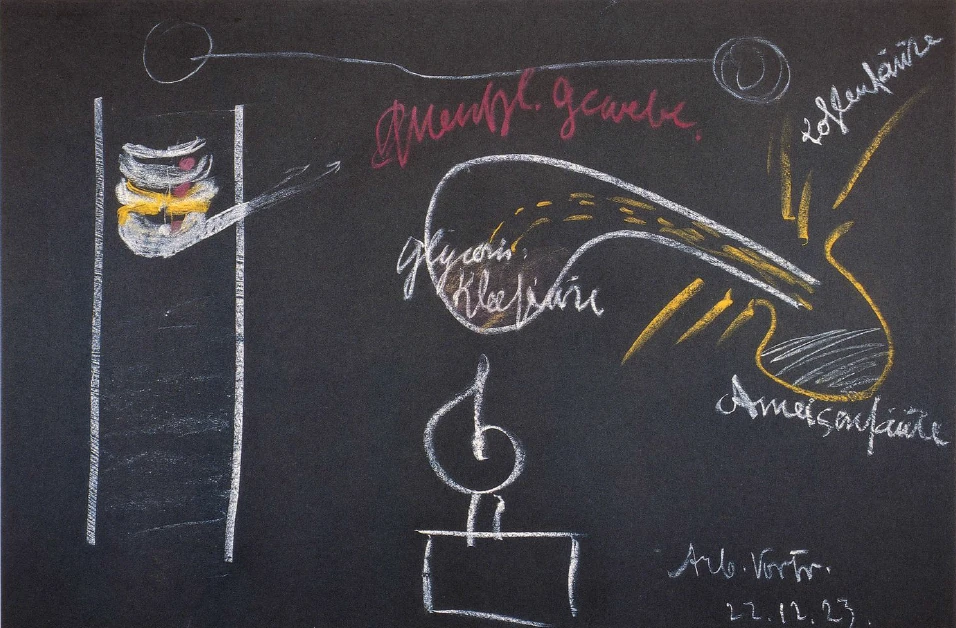
[ 18 ] Nun gibt es etwas anderes Interessantes. Nehmen Sie an, Sie nehmen eine Retorte, wie man sie im chemischen Laboratorium hat; Sie machen darunter eine Flamme und geben nun in diese Retorte Kleesäure hinein — das ist so salzige, bröselige Asche -, dann geradesoviel Glyzerin. Das mischt man durcheinander und erhitzt es. Dann dampft mir die Geschichte da herüber (siehe Zeichnung). Ich kann das, was ich da bekomme, auffangen. Aber zu gleicher Zeit merke ich: Da geht Luft weg. Die geht da überall weg. - Wenn ich diese Luft, die da weggeht, untersuche, so finde ich: Diese Luft ist Kohlensäure. Also da geht überall Kohlensäure heraus. Und hier, wo ich auffange, bekomme ich dann Ameisensäure. Da ist jetzt Ameisensäure drinnen. Da, in der Retorte, habe ich Kleesäure und Glyzerin drinnen gehabt. Das Glyzerin bleibt liegen; das andere geht da herüber, die flüssige Ameisensäure tropft da herunter und die Kohlensäure geht hier fort.
[ 18 ] Now here’s something else interesting. Suppose you take a retort, like the ones used in a chemistry lab; you place a flame beneath it and then add clover acid to the retort—that’s a salty, crumbly ash—and then an equal amount of glycerin. You mix it all together and heat it. Then the mixture starts to evaporate (see drawing). I can collect what I get from that. But at the same time, I notice: Air is escaping. It’s escaping everywhere. — When I examine this escaping air, I find that it’s carbon dioxide. So carbon dioxide is escaping everywhere. And here, where I’m collecting it, I end up with formic acid. There’s formic acid in there now. In the retort, I had formic acid and glycerin. The glycerin stays behind; the rest goes over there—the liquid formic acid drips down there, and the carbon dioxide escapes here.
[ 19 ] Nun, schauen Sie sich die Geschichte da nur einmal ordentlich an, dann werden Sie sagen können: Nehmen wir einmal an, statt dieser Retorte wäre hier die menschliche Leber oder, sagen wir, irgend etwas, ein menschliches oder tierisches Gewebe (es wird gezeichnet), irgendein Organ des tierischen Unterleibes, Leber, Milz oder so etwas. Ich bringe durch den Magen Kleesäure herein. Die Glyzerinkraft hat der Körper selber. Da habe ich ja in meinen Gedärmen drinnen zusammen Kleesäure und Glyzerin. Und was geschieht? Nun, schauen Sie sich jetzt den menschlichen Mund an, dann kommt da Kohlensäure heraus und von der Lunge herunter tropft überall in den menschlichen Körper die Ameisensäure gegen die Organe herein. Also das Ganze, was ich Ihnen hier aufgezeichnet habe, haben wir in unserem eigenen Körper. Wir erzeugen immerfort in unserem Körper aus Kleesäure Ameisensäure.
[ 19 ] Well, just take a good look at that diagram, and then you’ll be able to say: Let’s assume, for a moment, that instead of this retort, we had the human liver here, or, say, something else—some human or animal tissue (it is drawn)—some organ from the animal’s lower abdomen, such as the liver, spleen, or something like that. I introduce clover acid through the stomach. The body has its own glycerin-producing capacity. So there I have clover acid and glycerin together inside my intestines. And what happens? Well, if you look at the human mouth, carbon dioxide comes out of it, and from the lungs, formic acid drips down into the human body, reaching all the organs. So everything I’ve drawn for you here is present in our own bodies. We are constantly producing formic acid from clover acid within our bodies.
[ 20 ] Jetzt denken Sie sich die über die Erde ausgebreiteten Pflanzen. Da ist überall Kleesäure drinnen. Und jetzt denken Sie sich die Insekten. Bei denen kommt das nur in der merkwürdigsten Weise heraus. Denken Sie sich zunächst die Ameisen. Die gehen an diese Pflanzen und so weiter heran, oder sie gehen auch an das heran, was aus den Pflanzen vermodert. Da ist also überall diese Kleesäure drinnen, und diese Tiere machen sich gerade so, wie sie sich der Mensch selber macht, daraus Ameisensäure. Und die Ameisensäure ist überall vorhanden. Durch die Insekten ist überall Ameisensäure vorhanden.
[ 20 ] Now imagine the plants spread out across the earth. Clover acid is present everywhere in them. And now imagine the insects. In them, it manifests itself in the strangest ways. First, imagine the ants. They approach these plants and so on, or they also approach what’s rotting from the plants. So there’s this clover acid everywhere, and these animals, just as humans do, turn it into formic acid. And formic acid is everywhere. Because of the insects, formic acid is everywhere.
[ 21 ] Ja, da schaut der Philister so in die Luft hinein und sagt dann: In der Luft, da ist Stickstoff, Sauerstoff. - Aber, meine Herren, in ganz geringer Menge ist dadurch, daß die Insekten die Luft durchschwirren, immer Ameisensäure vorhanden. Das heißt, wir haben auf der einen Seite den Menschen. Der ist eine kleine Welt. Der macht in sich Ameisensäure und durchdringt namentlich seinen Atem fortwährend mit Ameisensäure. Und in der großen Welt draußen, da ist statt dessen, was im Menschen vor sich geht, das Heer der Insekten. Es wird der große Atem der Luft, der um die Erde herum ist, fortwährend mit Ameisensäure durchdrungen, die aus der Kleesäure der Pflanzen gemacht wird. Es ist schon so.
[ 21 ] Yes, the philistine just stares into the air and then says: “In the air, there’s nitrogen, oxygen.”—But, gentlemen, because insects flit through the air, formic acid is always present in very small quantities. That is to say, on the one hand, we have the human being. He is a small world. He produces formic acid within himself and continually permeates his breath with it. And in the great world out there, instead of what goes on within the human being, there is the army of insects. The great breath of air that surrounds the Earth is constantly permeated with formic acid, which is produced from the clover acid in plants. That is indeed the case.

[ 22 ] Wenn man richtig beobachtet und sich den Unterkörper des Menschen anschaut mit den darinnenliegenden Gedärmen, dem Magen, der Leber, den Nieren, der Milz, dann weiter drinnen liegen die Gedärme, so ist es schon so, daß da fortwährend die Kleesäure in die Ameisensäure verwandelt wird, und diese Ameisensäure geht mit der Luft, die der Mensch einatmet, in alle Teile des Körpers über. So ist es im Menschen.
[ 22 ] If one observes carefully and looks at the lower part of the human body with the internal organs—the intestines, the stomach, the liver, the kidneys, and the spleen—and then looks even deeper inside where the intestines are located, it is indeed the case that oxalic acid is continuously being converted into formic acid, and this formic acid is carried by the air that a person breathes into every part of the body. That is how it is in the human body.
[ 23 ] Draußen auf der Erde haben Sie überall die Pflanzen. Dann haben Sie die Insekten in der verschiedensten Weise, die darüber flattern. Da drunten haben Sie die Kleesäure. Die Insekten flattern heran, und durch ihre Begegnung entsteht die Ameisensäure und die füllt die Luft aus. So daß wir immer auch aus der Luft Ameisensäure einatmen. Dasjenige, was nun die Wespen haben, das ist ein der Ameisensäure ähnliches Gift, nur etwas umgewandelt. Und was die Bienen als Bienengift in ihrem Stachel haben - aber eigentlich hat es ihr ganzer Körper -, ist wieder umgewandelte Ameisensäure, höher verwandelte Ameisensäure. Wenn man dies anschaut, da sagt man sich: Wir schauen uns diese Insekten an, Ameisen, Wespen, Bienen; die führen äußerlich etwas ungemein Gescheites aus. Warum führen sie etwas ungemein Gescheites aus? Wenn die Ameise keine Ameisensäure hätte, würde sie all das, was ich Ihnen als etwas so Schönes geschildert habe, ganz dumm schaffen. Nur dadurch, daß die Ameisen so beschaffen sind, daß sie die Ameisensäure erzeugen können, erscheint alles so vernünftig und verständig, was sie bauen. Ebenso bei den Wespen und bei den Bienen.
[ 23 ] Out here on Earth, there are plants everywhere. Then there are all kinds of insects fluttering about them. Down there, you have formic acid. The insects flutter over, and their interaction produces formic acid, which fills the air. So we’re always inhaling formic acid from the air as well. What wasps have is a toxin similar to formic acid, just slightly modified. And what the bees have in their sting as bee venom—though actually their entire body contains it—is, again, modified formic acid, a more highly transformed form of formic acid. When you look at this, you say to yourself: We look at these insects—ants, wasps, bees—and they carry out something incredibly clever on the outside. Why do they accomplish something so incredibly clever? If the ant did not have formic acid, it would accomplish all that I have described to you as something so beautiful in a completely foolish way. It is only because ants are constituted in such a way that they can produce formic acid that everything they build appears so reasonable and sensible. The same is true of wasps and bees.
[ 24 ] Haben wir jetzt nicht alle Veranlassung, wenn wir selber in uns diese Ameisensäure erzeugen, uns zu sagen: Draußen in der Natur ist überall Verstand; der kommt durch die Ameisensäure. In uns ist auch überall Verstand, weil wir die Ameisensäure haben. - Und die Ameisensäure wäre nicht da, wenn nicht zuerst die Kleesäure da wäre. Nun ja, da flattern die Tierlein über den Pflanzen herum und sind die Veranlassung, daß die in den Pflanzen befindliche Kleesäure sich in Ameisensäure verwandelt, eine Metamorphose eingeht.
[ 24 ] Now that we produce formic acid within ourselves, don’t we all have reason to say: Out there in nature, intelligence is everywhere; it comes from formic acid. Intelligence is everywhere within us, too, because we have formic acid. - And the formic acid wouldn’t be there if the clover acid weren’t there first. Well, the little creatures flit about the plants and cause the clover acid found in the plants to transform into formic acid—to undergo a metamorphosis.
[ 25 ] Diese Dinge, die begreift man erst, wenn man sich jetzt frägt: Ja, wie ist es mit der Kleesäure? Sehen Sie, die Kleesäure ist überall da, wo Leben sein soll. Wo etwas lebt, ist die Kleesäure da. Da ist aber auch ein Ätherleib. Der Ätherleib macht, daß die Kleesäure eben gleich erneuert wird. Aber die Kleesäure wird niemals für den menschlichen oder tierischen Organismus brauchbare Ameisensäure, wenn sie nicht durch einen Astralleib aus der Kleesäure in die Ameisensäure umgewandelt wird. Denn die Ameisensäure, die ich hier aus der Retorte genommen habe, die hilft dem menschlichen und tierischen Leib nichts. Da täuscht man sich, wenn man glaubt, daß die etwas Wirkliches hilft, die ist tot. Die Ameisensäure, die hier und hier - im Menschen und durch die Insekten — erzeugt wird, die ist lebendig, und die tritt überall auf, wo Empfindung, wo Seelisches auftritt. Der Mensch muß Ameisensäure in sich entwikkeln, wenn er aus dem bloßen Leben, das in seinem Unterleibe ist, wo die Kleesäure eine große Rolle spielt, das Seelische hervorbringen will. Dann lebt in der Ameisensäure im Atem das Seelische und geht hinauf nach dem Kopfe und kann im Kopfe weiter wirken. Das Seelische braucht diese Verarbeitung der Kleesäure in die Ameisensäure im Menschen.
[ 25 ] One only begins to understand these things when one asks oneself: Well, what about clover acid? You see, clover acid is present wherever there is life. Wherever something is alive, clover acid is there. But there is also an etheric body there. The etheric body ensures that the clover acid is immediately renewed. But clover acid will never become formic acid usable by the human or animal organism unless it is transformed from clover acid into formic acid by an astral body. For the formic acid that I have taken from the retort here is of no use to the human or animal body. People are mistaken if they believe that this substance—which is dead—has any real benefit. The formic acid produced here and there—in humans and through insects—is alive, and it occurs wherever sensation and the soul are present. Human beings must develop formic acid within themselves if they wish to bring forth the soul from the mere life that exists in their lower abdomen, where clover acid plays a major role. Then the soul lives in the formic acid within the breath, rises to the head, and can continue to work there. The soul requires this transformation of formic acid into acetic acid within the human being.
[ 26 ] Was geschieht denn da eigentlich, wenn die Kleesäure in die Ameisensäure umgewandelt wird? Sehen Sie, das kann das erste, was ich Ihnen gesagt habe, lehren. Diese Holzbiene, von der ich sprach, ist ganz besonders interessant, denn sie arbeitet ja in das Holz hinein, das nicht mehr ein lebendiges ist. Und wenn diese Holzbiene nicht dieses Holz ordentlich brauchen könnte, dann würde sie eben woanders ihren Aufenthalt suchen. In die Bäume hinein macht gerade diese Biene ihr Nest nicht, sondern in vermoderndes Holz, wo schon die Pfosten und Pfeiler anfangen zu vermodern, da legt sie die Eier hinein, nachdem sie sich ihr Nest gebaut hat.
[ 26 ] What actually happens when cloveric acid is converted into formic acid? You see, this is what the first thing I told you can teach us. This carpenter bee I mentioned is particularly interesting because it works its way into wood that is no longer alive. And if this carpenter bee couldn’t make proper use of this wood, it would simply look for a home elsewhere. This particular bee doesn’t build its nest inside trees, but rather in decaying wood—where posts and pillars are already beginning to rot—and that’s where it lays its eggs after building its nest.
[ 27 ] Wenn man nun den Zusammenhang des Vermodernden mit den Holzbienen studiert, dann kriegt man heraus, daß das, was da vor sich geht im vermodernden Holz, im menschlichen Körper fortwährend vor sich geht. Er fängt an zu modern, und wenn er zu stark modert, dann stirbt er. Und was da draußen vor sich geht, das muß der Mensch fortwährend tun: er muß die Zellen aufbauen. Und das kann er nur dadurch, daß er das Pflanzliche, das von der Kleesäure durchdrungen ist, in die Ameisensäure umwandelt, in dasjenige umwandelt, was von der Ameisensäure durchdrungen ist.
[ 27 ] If one studies the connection between decaying matter and wood bees, one discovers that what is happening in decaying wood is constantly taking place in the human body. It begins to decay, and when it decays too much, it dies. And what is happening out there is what the human being must do continuously: he must build up his cells. And he can do this only by transforming the plant substance—which is permeated by formic acid—into formic acid itself, into that which is permeated by formic acid.
[ 28 ] Jetzt können Sie sagen: Was hat denn das ganze für eine Bedeutung für die Natur? - Nun, meine Herren, denken wir einmal an einen solchen Pfeiler oder Pfosten, der aus Holz ist und der vermodert. Wenn da niemals eine solche Holzbiene an einen Pfosten herankommt, so ist das dem Menschen sehr angenehm, denn sie breiten sich ziemlich aus, und der Pfosten fällt das nächste Jahr um, weil sie ihn hohl machen. Den Menschen ist das nicht sehr angenehm, aber der Natur ist es um so angenehmer. Denn wenn alles Holz, das aus den Pflanzen kommt, ohne diese Bienennester weiterexistieren würde, wo würde dieses Holz nach und nach - Sie sehen ja das dem Moder an - zerbröckeln, verstauben und würde ganz unbrauchbar werden. Das Holz aber, worinnen eine Holzbiene gearbeitet hat, das zerstiebt nicht, sondern das belebt sich wiederum. Und aus all dem Holz, das durch diese Holzbienen ein bißchen wiederum belebt wird, entsteht vieles von dem - ebenso aber durch die anderen Insekten -, was macht, daß unsere Erde einmal nicht ganz vermodert, im Weltenraum zerstäuben wird, sondern weiterleben kann, weil sie von diesen Insekten belebt wird. Wir Menschen atmen die Ameisensäure ein. In der Natur wirkt die Ameisensäure, die von diesen Insekten aus der Kleesäure der Pflanzen bereitet wird, so, daß die Erde überhaupt weiterleben kann.
[ 28 ] Now you might ask: What does all this have to do with nature? — Well, gentlemen, let’s consider a pillar or post made of wood that is rotting away. If a carpenter bee never comes near such a post, that is very convenient for humans, because they spread out quite a bit, and the post falls over the following year because they hollow it out. That is not very convenient for humans, but it is all the more convenient for nature. For if all the wood that comes from plants were to continue to exist without these bee nests, where would this wood gradually—as you can see from the rot—crumble, turn to dust, and become completely useless? But the wood in which a carpenter bee has worked does not disintegrate; rather, it comes back to life. And from all the wood that is somewhat revitalized by these carpenter bees—as well as by other insects—much of what ensures that our Earth will not one day completely rot away and disintegrate into space, but can continue to live, because it is revitalized by these insects. We humans inhale formic acid. In nature, the formic acid—which these insects produce from the clover acid in plants—enables the Earth to continue living at all.
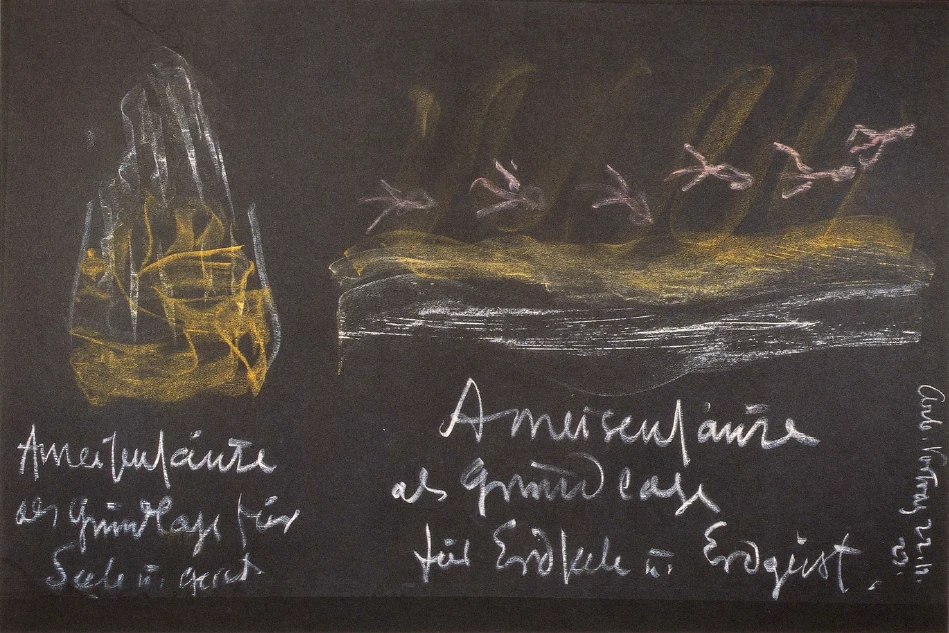
[ 29 ] Betrachten Sie jetzt den Zusammenhang. Hier haben wir den Menschen, hier die Erde (es wird gezeichnet). Betrachten wir zuerst den Menschen. Nehmen wir an, er ist ein junges Kind. Er verwandelt, wenn er ein junges Kind ist, mit Leichtigkeit die im Unterleib befindliche Kleesäure in Ameisensäure. Die Organe kriegen genug an Ameisensäure. Die menschliche Seele entwickelt sich im Kinde. Wir haben also die Ameisensäure als die Grundlage für Seele und Geist. Und wenn der Mensch alt wird und nicht mehr genügend Ameisensäure entwickeln kann, gehen die Seele und der Geist fort. Die Ameisensäure also, die zieht Seele und Geist heran; sonst geht der Geist fort. Es ist sehr interessant.
[ 29 ] Now consider the context. Here we have the human being, here the Earth (it is drawn). Let’s first consider the human being. Let’s assume he is a young child. When he is a young child, he easily transforms the clover acid located in the lower abdomen into formic acid. The organs receive enough formic acid. The human soul develops within the child. So we have formic acid as the foundation for the soul and the spirit. And when a person grows old and can no longer produce enough formic acid, the soul and the spirit depart. Formic acid, then, draws the soul and the spirit to itself; otherwise, the spirit departs. It is very interesting.
[ 30 ] Wenn Sie zum Beispiel einen Menschen, der sehr viel innere Eiterprozesse hat, richtig beobachten, so können Sie finden, daß ihm die Ameisensäure hilft, diese Eiterprozesse zu überwinden. Dann tritt das rechte Verhältnis ein zwischen dem Astralleib und seinem Körper, was durch die Eiterprozesse verhindert war. So daß immer die Ameisensäure gebraucht wird gerade in der richtigen Weise als die Grundlage für Seele und Geist. Wenn der Körper eben zuwenig Ameisensäure hat, vermodert er und kann die Seele nicht mehr haben; der Körper wird alt, die Seele muß fort.
[ 30 ] For example, if you carefully observe a person who has a great deal of internal suppuration, you may find that formic acid helps them overcome these suppurative processes. Then the proper relationship between the astral body and the physical body is restored—a relationship that had been hindered by the purulent processes. Thus, formic acid is always needed in precisely the right way as the foundation for the soul and spirit. If the body has too little formic acid, it decays and can no longer sustain the soul; the body grows old, and the soul must depart.
[ 31 ] Nun haben wir auf der einen Seite hier den Menschen, auf der anderen Seite die Natur. In der Natur wird auch fortwährend aus Kleesäure Ameisensäure gebildet, so daß die Erde immerfort die Möglichkeit hat, umgeben zu sein nicht nur von Sauerstoff und Stickstoff, sondern auch von Ameisensäure (es wird gezeichnet).
[ 31 ] Now, on the one hand, we have human beings here, and on the other, nature. In nature, formic acid is also constantly being formed from cloveric acid, so that the earth always has the potential to be surrounded not only by oxygen and nitrogen, but also by formic acid (illustrated).
[ 32 ] Diese Ameisensäure, die macht nun, daß die Erde überhaupt nicht, ich möchte sagen, jedes Jahr abstirbt, sondern weiter jedes Jahr sich beleben kann da oben. Dasjenige, was unter der Erde ist, das sehnt sich als Same nach der Ameisensäure, die da oben ist. Und in dem besteht das Wiederaufleben. Jedesmal im Winter ist es so, daß der Geist der Erde selber eigentlich bestrebt ist, wegzugehen. Und im Frühling ist es so, daß der Geist der Erde sich wiederum belebt. Der Geist der Erde macht die Erde erstarren im Winter; im Frühling belebt er sie wieder. Das macht [er], weil dasjenige, was als Same unter der Erde wartet, an die Ameisensäure herankommt, die erzeugt worden ist im letzten Jahr durch den Verkehr der Insektenwelt mit der Pflanzenwelt. Und jetzt kommen die Samen nicht nur herauf in Sauerstoff, in Stickstoff und in Kohlenstoff, sondern jetzt kommen die Pflanzen herauf in Ameisensäure. Und diese Ameisensäure, die regt sie an, selber wiederum Kleesäure zu entwickeln, wodurch die Ameisensäure im nächsten Jahr da sein kann. Geradeso aber wie die Ameisensäure im Menschen die Grundlage sein kann für Seele und Geist, so ist die Ameisensäure, die im Weltenall ausgebreitet ist, die Grundlage für das Geistige und Seelische der Erde. So daß wir also sagen können: Auch bei der Erde ist die Ameisensäure die Grundlage für Erdseele und Erdgeist.
[ 32 ] This formic acid is what ensures that the earth does not, so to speak, die off every year, but rather can continue to come to life each year up above. That which lies beneath the earth, as a seed, longs for the formic acid that is up above. And therein lies the renewal of life. Every winter, the spirit of the earth itself actually strives to depart. And in the spring, the spirit of the earth comes to life again. The spirit of the earth causes the earth to freeze in winter; in spring, it revives it again. It does this because what waits underground as a seed gains access to the formic acid that was produced last year through the interaction between the insect world and the plant world. And now the seeds do not merely emerge into oxygen, nitrogen, and carbon; rather, the plants now emerge into formic acid. And this formic acid stimulates them to develop clover acid themselves, thereby ensuring that the formic acid will be present the following year. Just as formic acid can be the foundation for the soul and spirit in human beings, so too is the formic acid spread throughout the universe the foundation for the spiritual and soul life of the Earth. Thus we can say: On Earth, too, formic acid is the foundation for the Earth’s soul and Earth’s spirit.
[ 33 ] Es ist tatsächlich viel schwerer zu telegraphieren in einer Gegend, wo gar keine Ameisenhaufen sind, als in einer Gegend, wo Ameisenhaufen sind, weil die Elektrizität und der Magnetismus, die zum Telegraphieren-Können gehören, von der Ameisensäure abhängen. Wenn die Telegraphendrähte durch Städte gehen, wo keine Ameisen sind, dann muß schon von außen, wo sie durch die Felder gehen, die Kraft darinnenliegen, daß sie überhaupt durch die Städte durchgehen, die magnetischen und die elektrischen Strömungen. Aber natürlich breitet sich ja die ‚Ameisensäure aus und erfüllt auch die Luft der Städte.
[ 33 ] It is actually much more difficult to send telegraph messages in an area where there are no anthills at all than in an area where there are anthills, because the electricity and magnetism necessary for telegraphy depend on formic acid. When telegraph wires pass through cities where there are no ants, the force—the magnetic and electric currents—that enables them to pass through the cities at all must already be present from the outside, where the wires run through the fields. But of course, the ‘formic acid’ spreads and fills the air of the cities as well.
[ 34 ] Nun, sehen Sie, meine Herren, so können wir sagen: Was im Menschen drinnen ist - auch in bezug auf die Erzeugung der Ameisensäure -, das ist auch draußen in der Natur. - Der Mensch ist eine kleine Welt. Nur ist es beim Menschen so, daß er während seines Lebens bis zum Tode hin geeignet ist, aus Kleesäure Ameisensäure zu machen. Dann wird er ungeeignet, dann stirbt sein Körper ab. Er muß erst wieder einen Körper bekommen, der im Kinde in der richtigen Weise aus der Kleesäure Ameisensäure macht. Bei der Natur geht es immer weiter: Winter, Sommer; Winter, Sommer. Es wird immer Kleesäure in Ameisensäure umgewandelt.
[ 34 ] Well, you see, gentlemen, we can say this: What is inside a human being—including with regard to the production of formic acid—is also found out there in nature. —Human beings are a microcosm. The thing is, however, that throughout their lives—right up until death—human beings are capable of converting clover acid into formic acid. Then they lose that ability, and their bodies die. They must first acquire a new body—in the form of a child—that is capable of converting clover acid into formic acid in the proper way. In nature, the cycle continues endlessly: winter, summer; winter, summer. Clover acid is constantly being converted into formic acid.
[ 35 ] Wenn man so einen sterbenden Menschen betrachtet, so hat man eigentlich das Gefühl: er probiert zunächst, indem er stirbt, ob sein Körper noch genügend geeignet ist, Ameisensäure zu entwickeln. Dann, wenn er nicht geeignet ist, tritt eben der Tod ein. Dann geht der Mensch in die geistige Welt über und er hält es eben in seinem Körper nicht mehr aus. So daß wir sagen können: Ein Mensch stirbt in einem gewissen Zeitpunkt. Dann vergeht eine lange Zeit und er kommt wiederum in einen anderen Körper. Dazwischen ist er in der geistigen Welt.
[ 35 ] When one observes a dying person in this way, one actually gets the feeling that, by dying, the person is first testing whether his body is still capable of producing formic acid. Then, if it is not suitable, death simply sets in. The person then passes into the spiritual world because they can no longer endure being in their body. So we can say: A person dies at a certain point in time. Then a long time passes, and they enter another body. In between, they are in the spiritual world.
[ 36 ] Wenn nun im Bienenstock eine junge Königin ausschlüpft, dann ist, wie ich Ihnen gesagt habe, etwas in den Bienen, was diese Bienen stört. Vorher leben die Bienen in einer Art Dämmerung. Dann sehen sie diese junge Königin aufleuchten. Was ist denn verknüpft mit diesem Aufleuchten dieser jungen Königin? Mit diesem Aufleuchten der jungen Königin ist das verknüpft, daß die junge Königin der alten Königin die Kraft des Bienengiftes wegnimmt. Und das, meine Herren, ist die Furcht des ausziehenden Schwarmes, daß er das Bienengift nicht mehr hat, sich nicht mehr wehren, retten kann; er zieht weg. Geradeso wie die menschliche Seele wegzieht im Tode, wenn sie nicht mehr die Ameisensäure haben kann, so zieht die alte Bienenbrut weg, wenn nicht genug verwandelte Ameisensäure — Bienengift — da ist. Und wenn man jetzt den Bienenschwarm anschaut, so ist der zwar sichtbar, aber er schaut just so aus wie die Menschenseele, die den Körper verlassen muß. Es ist ein großartiges Bild, so ein fortschwärmender Bienenschwarm. Wie die Menschenseele den Körper verläßt, so verläßt, wenn die junge Königin herangewachsen ist, die alte Königin mit ihrem Anhang den Bienenstock, und man kann richtig am ausziehenden Schwarm ein Bild von der ausfliegenden Seele des Menschen sehen.
[ 36 ] Now, when a young queen hatches in the beehive, as I have told you, something happens within the bees that disturbs them. Before that, the bees live in a sort of twilight. Then they see this young queen glow. What, then, is connected to this “glow” of the young queen? It is connected to the fact that the young queen takes away the power of the bee venom from the old queen. And that, gentlemen, is the fear of the departing swarm: that it no longer has the bee venom, can no longer defend itself or save itself; so it departs. Just as the human soul departs in death when it can no longer possess formic acid, so the old bee brood departs when there is not enough transformed formic acid—bee venom—present. And when one now looks at the swarm of bees, it is indeed visible, but it looks exactly like the human soul that must leave the body. It is a magnificent image, such a swarm of bees taking flight. Just as the human soul leaves the body, so too, when the young queen has matured, the old queen and her retinue leave the hive, and one can truly see in the departing swarm an image of the human soul taking flight.
[ 37 ] Ach, meine Herren, das ist furchtbar großartig! Nur, die Menschenseele, die hat es nie dazu gebracht, ihre Kräfte bis zu kleinen «ViecherIn» auszubilden. In uns ist fortwährend auch die Tendenz dazu; wir wollen lauter kleine «Viecherl» werden. Wir haben eigentlich das in uns, daß wir uns innerlich immer in krabbelnde Bazillen und Bakterien umbilden wollen, in solche kleinen Bienen, aber wir unterdrücken das wieder. Dadurch sind wir ein ganzer Mensch. Aber der Bienenstock ist kein ganzer Mensch. Die Bienen können nicht den Weg in die geistige Welt hinein finden. Wir müssen sie in einem anderen Bienenstock zur Wiederverkörperung bringen. Das ist direkt ein Bild von dem sich wiederverkörpernden Menschen. Und der, der so etwas beobachten kann, der hat einen ungeheuren Respekt vor diesen schwärmenden alten Bienen mit ihrer Königin, die eigentlich sich so benimmt, wie sie sich benimmt, weil sie in die geistige Welt hinein will. Aber sie ist so materiell physisch geworden, daß sie das nicht kann. Und da schmusen sich die Bienen zusammen, werden ein einziger Körper. Sie wollen zusammen. Sie wollen aus der Welt heraus. Sie wissen ja: Während sie sonst fliegen, setzen sie sich nun an einen Baumstamm oder so etwas an, kuscheln sich zusammen, um zu verschwinden, weil sie in die geistige Welt hinein wollen. Und dann werden sie wieder der richtige Bienenstock, wenn wir ihnen helfen, wenn wir sie wieder zurückbringen in den neuen Bienenstock.
[ 37 ] Oh, gentlemen, that is absolutely magnificent! It’s just that the human soul has never managed to develop its powers to the point of becoming little “creatures.” Within us, there is also a constant tendency toward this; we want to become nothing but little “creatures.” We actually have within us the impulse to constantly transform ourselves inwardly into crawling germs and bacteria, into such tiny bees, but we suppress that impulse. That is what makes us a complete human being. But the beehive is not a complete human being. The bees cannot find their way into the spiritual world. We must bring them to reincarnation in another beehive. This is a direct image of the reincarnating human being. And anyone who can observe such a thing has immense respect for these swarming old bees with their queen, who actually behaves the way she does because she wants to enter the spiritual world. But she has become so materially physical that she cannot do so. And so the bees huddle together, becoming a single body. They want to be together. They want to leave this world behind. You know: whereas they would normally fly, they now settle on a tree trunk or something similar, huddling together to disappear, because they want to enter the spiritual world. And then they become the proper beehive again when we help them, when we bring them back to the new beehive.
[ 38 ] Also man kann schon sagen: Die Insekten lehren uns geradezu das Allerhöchste in der Natur. Daher hat immer der Anblick von den Pflanzen die Menschen, die in alten Zeiten noch Instinkte gehabt haben über das, was ich Ihnen da auseinandergesetzt habe, was der heutigen Wissenschaft ganz verlorengegangen ist, in der richtigen Weise aufgeklärt. Diese Menschen haben in besonderer Art hingeschaut auf die Pflanzen. Jetzt, in dieser Zeit, werden ja die Menschen an manches erinnert in der neueren Zeit, wenn sie einen Tannenbaum hereintragen und sich einen Christbaum daraus machen. Dann werden die Menschen daran erinnert, wie dasjenige, was in der Natur draußen ist, im Menschenleben herinnen etwas werden kann, was im sozialen Leben wirkt. Es soll ja ein Sinnbild für die Liebe sein, dieser zum Christbaum umgewandelte Tannenbaum.
[ 38 ] So one can certainly say: Insects teach us the very highest truths of nature. That is why the sight of plants has always properly enlightened people who, in ancient times, still possessed instincts regarding what I have explained to you—instincts that modern science has completely lost. These people looked at plants in a special way. Now, in this day and age, people are reminded of certain things from more recent times when they bring a fir tree indoors and turn it into a Christmas tree. Then people are reminded of how what exists out there in nature can become something within human life that has an effect on social life. This fir tree, transformed into a Christmas tree, is meant to be a symbol of love.
[ 39 ] Man glaubt gewöhnlich, der Christbaum sei sehr alt. Aber der Tannenbaum wird erst vielleicht seit hundertfünfzig oder zweihundert Jahren als Christbaum verwendet. Früher gab es diese Sitte nicht. Aber dennoch, zu Weihnachten wurde schon eine Art Gesträuch verwendet. Zuın Beispiel bei diesen Weihnachtspielen, die in den Dörfern auch schon im 15., 16. Jahrhundert gemacht wurden, da lief einer, um sie anzukündigen, immer herum und hatte auch eine Art Christbaum in der Hand. Aber das war der sogenannte - in Mitteldeutschland so genannte — Kranewittbaum; das war der Wacholderbaum, der diese wunderbaren Beeren hat. Und in diesem Wacholderbaum sahen die Leute damals ihren Christbaum. Warum? Weil diese Wacholderbeeren, auf die die Vögel so gerne gehen, ihnen zeigten diese geringe Giftwirkung, die da kommt und die durchdringen muß das Irdische, damit das Geistige im Irdischen erstehen kann. Geradeso wie wenn die Ameise an das Holz oder die Holzbiene an die Pfähle geht, so wird jeden Morgen, wenn der Baum da draußen steht und der Vogel heranpickt, überall auch eine, aber eine viel schwächere Säure erzeugt. Das wußten instinktiv die alten Völker und sagten sich: Im Winter, wenn der Wacholderbaum dasteht und die Vögel an seine Beeren herankommen, da wird durch den Wacholderbaum die Erde wieder belebt. - Und das war ihnen ein Bild der Belebung der Erde durch den Christus im moralischen Sinne.
[ 39 ] It is commonly believed that the Christmas tree is very old. But the fir tree has probably only been used as a Christmas tree for about one hundred fifty or two hundred years. This custom did not exist in the past. Nevertheless, some kind of shrub was already used at Christmas. For example, during the Christmas plays that were performed in villages as early as the 15th and 16th centuries, a person would always run around announcing them while carrying a sort of Christmas tree in his hand. But that was what was known—in Central Germany, at least—as the “Kranewittbaum”; it was the juniper tree, which bears those wonderful berries. And in this juniper tree, people back then saw their Christmas tree. Why? Because these juniper berries, which birds love to eat, revealed to them that slight toxic effect that arises and must penetrate the earthly realm so that the spiritual can arise within it. Just as when the ant goes to the wood or the carpenter bee goes to the posts, so too every morning, when the tree stands out there and the bird pecks at it, a mild acid—though much weaker—is produced everywhere. The ancient peoples knew this instinctively and said to themselves: In winter, when the juniper tree stands there and the birds come to its berries, the earth is revitalized through the juniper tree. — And this was for them a symbol of the revitalization of the earth through Christ in the moral sense.
[ 40 ] So daß wir schon sagen können: Richtig natürlich betrachtet ist das so, daß man in dem, was in der Natur draußen vorgeht, wirklich Sinnbilder, Bilder von dem sehen kann, was im Menschenleben vorgeht. Die alten Leute sahen, wenn in einem Wacholderbaum die Vögel saßen, diese Vögel mit derselben Liebe, wie man heute die kleinen Gebäckstücke oder die Geschenke am Weihnachtsbaum sieht. So daß der Wacholderbaum für die Leute draußen eine Art Christbaum war, den sie hereintrugen in ihre Stuben. So ist aus dem Wacholderbaum eine Art Christbaum gemacht worden.
[ 40 ] So we can already say: Viewed correctly from a natural perspective, it is true that in what takes place in the natural world outside, one can truly see symbols and images of what takes place in human life. When the old folks saw birds perched in a juniper tree, they regarded those birds with the same love with which we today look upon the little cookies or the gifts on the Christmas tree. So the juniper tree was, for the people out there, a kind of Christmas tree that they brought into their living rooms. In this way, the juniper tree was turned into a kind of Christmas tree.
[ 41 ] Wir müssen nun aber abschließen. Ich wollte aber die heutige Stunde nicht vorübergehen lassen — da Sie ja in dieser Zeit jetzt besonders angestrengt sind -, ohne daß wir über ein ganz wichtiges Thema gesprochen haben und wir es bis zur Betrachtung eines solchen Strauches gebracht haben, der wirklich wie ein Christstrauch angesehen werden kann, der Wacholderstrauch, der dasselbe für die Vögel gibt, was für die Bienen die Pflanzen, für die Ameisen und die Holzbienen das Holz, überhaupt die Insekten das Holz ist. Und am Schlusse möchte ich dies noch dazu benutzen, um Ihnen ein recht frohes, freudiges, innerlich seelenerhebendes Weihnachtsfest zu wünschen.
[ 41 ] But we must wrap up now. However, I didn’t want to let today’s session pass—since you are particularly busy at this time—without our having discussed a very important topic and having gone so far as to consider a shrub that can truly be regarded as a “Christ bush,” the juniper bush, which provides for birds what plants provide for bees, what wood provides for ants and carpenter bees—and what wood provides for insects in general. And in closing, I would like to take this opportunity to wish you a truly happy, joyful, and spiritually uplifting Christmas.
[ 42 ] Den nächsten Vortrag werden wir Ihnen dann ansagen lassen; es wird nicht in allzuferner Zeit sein.
[ 42 ] We will let you know about the next lecture; it will be held in the not-too-distant future.