

Man and World
How Spirit Works in Nature
GA 351
22 December 1923, Dornach
Translated by Steiner Online Library
16. Oxalic acid, formic acid, carbonic acid, and their importance in nature
[ 1 ] Good morning, gentlemen! Actually, we still need to discuss Mr. Dollinger’s question. He wanted to know on your behalf—since this is surely of interest to everyone—what the spiritual connection is between this swarm of insects, which moves and approaches the plants, and what is contained within the plants.
[ 2 ] You see, gentlemen, I have told you before: It is not just something like oxygen and nitrogen that surrounds us everywhere, but intelligence—true intelligence—is present throughout all of nature. No one is surprised when you say, “We breathe in the air”—because air is everywhere, and science has, so to speak, already become so deeply ingrained in school textbooks that people are told: “Air is everywhere, and you breathe it in.” - But I’ve known people, for example, out in the countryside who regarded this as a fantasy, simply because they didn’t know that air is out there—just as people today don’t know that intelligence is everywhere. They regard it as a fantasy when one says: “Just as we breathe in air with our lungs, so too do we breathe in intelligence with our nose or our ear, for example.” — And I’ve already shown you plenty of examples in the past from which you could see that intelligence is everywhere. We’ve been discussing a particularly interesting topic in the natural sciences lately: bees, wasps, and ants. Perhaps few things in nature allow us to gain such a profound insight into nature itself as the behavior of insects in general. Insects are, after all, quite remarkable creatures, and they will yet reveal many a secret.
[ 3 ] It is remarkable that we are discussing our chapter on insects, so to speak, at the very time of the 100th birthday of the eminent entomologist Jean-Henri Fabre, who was born on December 22 a century ago and who lived during a materialistic era, and therefore interpreted everything from a materialistic perspective, but who brought an immense number of facts about the lives of insects to light, so that it is only natural that we should remember him today as we discuss insects.
[ 4 ] First, I would like to give you an example of an insect species that may be of particular interest to you in connection with bees. The bee works with a high degree of perfection, and the most remarkable thing about the bee is not that it ultimately produces honey, but that it creates these wonderfully constructed honeycombs entirely on its own. After all, it must carry the material it uses into the hive itself. And it actually works in such a way that it no longer uses the material in its original form, but rather brings it into the hive completely transformed. It works in this way entirely of its own accord.
[ 5 ] However, there is a species of bee that does not work in this way, but which, precisely through its work, demonstrates the immense intelligence found throughout nature. Let us take a look at this species of bee—commonly called the carpenter bee, which is not as highly regarded as the honeybee because it is usually a nuisance to humans—and observe its work. It is an incredibly industrious creature, and one that must perform an immense amount of work—not just the individual bee, but the entire species—in order to survive. This insect seeks out wood that is no longer on the trees but has already been removed from them and processed. You can find these carpenter bees and their nests—which I will describe to you in a moment—for example, if you have driven stakes into the ground somewhere, that is, where the wood has been taken from the trees and appears to be lifeless: stakes or columns made of wood. You can find the carpenter bee there, as well as in garden benches or garden gates. So wherever wood has been used, the carpenter bee builds its nest there—but in a very peculiar way.
[ 6 ] Imagine this is a post like the one shown in the drawing. So this is the wood that has already been cut from the tree. Now the carpenter bee comes along and first drills a tunnel into it from the outside at an angle. And once it’s inside—after hollowing out the tunnel, essentially drilling a kind of channel—it starts drilling in a completely different direction. It drills in such a way that a small, ring-shaped cavity is formed. Now the insect flies away, gathers all sorts of material from the surroundings, and lines this cavity. And then, once it has lined it, it lays the egg inside, from which the larva will emerge. That egg is now inside. Once it has laid the egg, the little bee returns and builds a cap over it, with a hole in the center. And now it begins to drill further up above this lid, creating a second chamber there for a second wood bee that will emerge, and after padding it out and leaving a hole, it lays another egg inside. The wood bee continues this process until it has built ten or twelve such stacked cavities one on top of the other. There’s an egg inside each one.
[ 7 ] Now the larva can develop inside this piece of wood. The insect places food next to the larva everywhere. The larva first eats the food that was prepared for it and then matures enough to emerge. But now comes the time when the insect has pupated and transformed into the winged bee, which is now ready to fly away.
[ 8 ] Inside, the larva develops and, after some time, is able to fly out properly. When the time comes—once the larva is mature, has pupated, and become an insect—the fully developed insect can fly out through this tunnel. Thanks to the carpenter bee’s ingenuity, the fully developed insect can fly out again through the tunnel that was originally bored into the wood. Yes, that’s fine. But when the second insect arrives—which is a bit younger—and the third one above is again a bit younger, because the mother must first construct these chambers, these insects find no side exit to get out. And the tragic outcome would be that the upper insects would gradually perish inside. But the mother prevents this by laying the egg in such a way that when the younger larva hatches, it finds this hole I’ve told you about; it lets itself fall down through it and crawls out. The third larva lets itself fall through the two holes and crawls out that way. And because each larva that hatches later emerges a little later, it does not disturb the larva that hatched earlier beneath it. They never encounter each other; rather, the earlier one has always already flown away.
[ 9 ] You see, the entire nest is so ingeniously designed that one can’t help but marvel at it. When people today use machines to replicate something, the things they produce are usually imitations of such creations, but they are generally far less skillfully made. The things that exist in nature are extraordinarily skillfully made, and one really has to say: There is definitely intelligence there—true intelligence. —- And regarding the fact that in the way insects build, in the way they behave while working—that there is intelligence at work there—one could cite hundreds and thousands of examples. Just imagine how much intelligence lies in what I told you recently about the farmer ant, which organizes its entire economy and does everything with tremendous intelligence.
[ 10 ] But we have also considered another matter, just as we were examining these insects—bees, wasps, and ants. I told you that all these animals have within them something that is a kind of toxic substance, and this toxic substance, which all these animals possess, is at the same time—when properly measured and administered in the correct dose—an excellent remedy. Bee venom is an excellent remedy. Wasp venom is an excellent remedy. And formic acid, which is secreted by ants, is an even better remedy. But I’ve already hinted at this to you: We obtain this formic acid by approaching an anthill, removing the ants, and then crushing them. So the ants contain this formic acid; by crushing the ants, we extract the formic acid. This formic acid is actually found primarily in ants. But if you knew how much—relatively speaking, of course—formic acid there is in this room, you’d be truly amazed! You’ll say: We can’t very well go looking for an anthill in a corner here. — Gentlemen, all of you sitting here are, in reality, an anthill yourselves! For everywhere in your limbs, muscles, and other tissues—in your heart tissue, lung tissue, liver tissue, and spleen tissue in particular—formic acid is present throughout, though not as concentrated or potent as in an anthill. But still, you are such that you are completely filled with formic acid—completely filled. Yes, you see, that is something most remarkable.
[ 11 ] Why, in fact, do we have formic acid in our bodies? If a person has too little of it, we need to recognize that. When a person appears to be sick—and people are, after all, usually a little sick—they may have all sorts of illnesses that all look the same on the outside. One must determine what is actually wrong with them; the fact that they are pale or cannot eat are merely outward signs. One must figure out what is actually wrong with them. And so it may be with some people that they simply do not have enough of an “ant hill” within themselves—they do not produce enough formic acid. Just as formic acid is produced in an anthill, so too must formic acid be produced in abundance within the human body, in all its limbs, especially in the spleen. And if a person produces too little formic acid, one must administer a preparation—a remedy—that helps them externally to produce enough formic acid.
[ 12 ] Now, however, one must observe what happens to a person who has too little formic acid. These observations can only be made if the people who wish to observe them are truly good judges of character. One must then form a mental image of what is going on in the soul of a person who initially had enough formic acid in them and who subsequently has too little formic acid. This is very curious. Such a person, if you ask them in the right way, will tell you the truth about their illness. Suppose, for example, you have a person who, when you prompt him, says to you: “Oh, my goodness, a few months ago, everything came easily to me; I was able to think things through clearly. Now it’s gone. It doesn’t work anymore. When I try to think of something, I just can’t.” — Gentlemen, this is often a much more important sign than any external examinations can provide—though, of course, such examinations are a necessary part of modern medical practice. You can test urine for protein, pus, sugar, and so on, and you’ll certainly get very interesting results; but under certain circumstances, it can be far more important when a person tells you something like what I’ve described. For when he tells you something like that, you naturally have to find out a few other things; but from that you can deduce: Recently, the formic acid in his own body has become insufficient.
[ 13 ] Now someone who still thinks in superficial terms might say: This person has too little formic acid. I’ll extract formic acid or produce it in some other way and administer it to the patient in the appropriate dosage. - You can do that for a while, and then the patient comes to you and says, “But that didn’t help me at all.” - What’s going on here? It really didn’t help him at all. It was quite true that he had too little formic acid; you gave him formic acid, and it didn’t help—it didn’t help at all. What’s going on here?
[ 14 ] Yes, you see, if you keep researching, you’ll come to realize this: Formic acid didn’t help one person, but it has consistently helped others. - Well, you’ll gradually notice the difference. The people for whom formic acid helps will specifically show mucus buildup in the lungs. The people for whom formic acid doesn’t help will show mucus buildup in the liver, the kidneys, or the spleen. It’s a very peculiar situation. So there’s a big difference between, for example, the lungs lacking formic acid and the liver lacking formic acid. The difference is that the lungs can immediately make use of the formic acid found inside the anthill, whereas the liver can’t do anything with it at all.
[ 15 ] And now for something different, gentlemen! Now, if you notice that a person’s liver or, specifically, his intestines are not quite right, and formic acid does not help him—even though he has too little formic acid in his system—you must give him clover acid. That is to say, you must crush common wood sorrel—or any clover growing in the fields—extract this acid, and administer it to the patient. So you see: for someone with a lung condition, you must administer formic acid; for someone with a liver or intestinal condition, you must administer clover acid. But the peculiar thing is that the person to whom you administer clover acid will, after some time—once you’ve given them the clover acid—produce formic acid from the clover acid within themselves! So it’s not just a matter of introducing substances into the person from the outside; you must know what the organism itself produces on its own. If you give them formic acid, the organism says: “That’s not for me; I want to work—they gave me the ready-made formic acid—I don’t have to work on that; I can’t get it up into the lungs.”—Of course, you have to put it in the stomach. It eventually reaches the intestines. There, the organism in turn says to the human body, which now wants to work: “What are they presenting me with? Am I not supposed to produce formic acid myself first, but rather am I supposed to transport the formic acid they’ve given me from the stomach to the lungs? I won’t do that.”—It wants formic acid, and from that it produces formic acid.
[ 16 ] Yes, gentlemen, life consists of work, not of substances, and the most important thing of all is to know that life does not consist at all in eating cabbage and turnips, but rather in what the body must do when the substances from the cabbage and turnips enter it. In any case, however, it must not turn its cabbage back into cabbage. Yet that is precisely what underlies our modern civilization in a particularly strange way.
[ 17 ] But you can see from this what a remarkable relationship exists in nature. There are plants out there. Clover is simply a particularly distinctive example. However, clover acid is found in all plants; it is simply most abundant in clover; that is why we speak of “clover acid.” But just as formic acid is found everywhere in nature and throughout the human body, clover acid is also found everywhere in nature and throughout the human body.

[ 18 ] Now here’s something else interesting. Suppose you take a retort, like the ones used in a chemistry lab; you place a flame beneath it and then add clover acid to the retort—that’s a salty, crumbly ash—and then an equal amount of glycerin. You mix it all together and heat it. Then the mixture starts to evaporate (see drawing). I can collect what I get from that. But at the same time, I notice: Air is escaping. It’s escaping everywhere. — When I examine this escaping air, I find that it’s carbon dioxide. So carbon dioxide is escaping everywhere. And here, where I’m collecting it, I end up with formic acid. There’s formic acid in there now. In the retort, I had formic acid and glycerin. The glycerin stays behind; the rest goes over there—the liquid formic acid drips down there, and the carbon dioxide escapes here.
[ 19 ] Well, just take a good look at that diagram, and then you’ll be able to say: Let’s assume, for a moment, that instead of this retort, we had the human liver here, or, say, something else—some human or animal tissue (it is drawn)—some organ from the animal’s lower abdomen, such as the liver, spleen, or something like that. I introduce clover acid through the stomach. The body has its own glycerin-producing capacity. So there I have clover acid and glycerin together inside my intestines. And what happens? Well, if you look at the human mouth, carbon dioxide comes out of it, and from the lungs, formic acid drips down into the human body, reaching all the organs. So everything I’ve drawn for you here is present in our own bodies. We are constantly producing formic acid from clover acid within our bodies.
[ 20 ] Now imagine the plants spread out across the earth. Clover acid is present everywhere in them. And now imagine the insects. In them, it manifests itself in the strangest ways. First, imagine the ants. They approach these plants and so on, or they also approach what’s rotting from the plants. So there’s this clover acid everywhere, and these animals, just as humans do, turn it into formic acid. And formic acid is everywhere. Because of the insects, formic acid is everywhere.
[ 21 ] Yes, the philistine just stares into the air and then says: “In the air, there’s nitrogen, oxygen.”—But, gentlemen, because insects flit through the air, formic acid is always present in very small quantities. That is to say, on the one hand, we have the human being. He is a small world. He produces formic acid within himself and continually permeates his breath with it. And in the great world out there, instead of what goes on within the human being, there is the army of insects. The great breath of air that surrounds the Earth is constantly permeated with formic acid, which is produced from the clover acid in plants. That is indeed the case.

[ 22 ] If one observes carefully and looks at the lower part of the human body with the internal organs—the intestines, the stomach, the liver, the kidneys, and the spleen—and then looks even deeper inside where the intestines are located, it is indeed the case that oxalic acid is continuously being converted into formic acid, and this formic acid is carried by the air that a person breathes into every part of the body. That is how it is in the human body.
[ 23 ] Out here on Earth, there are plants everywhere. Then there are all kinds of insects fluttering about them. Down there, you have formic acid. The insects flutter over, and their interaction produces formic acid, which fills the air. So we’re always inhaling formic acid from the air as well. What wasps have is a toxin similar to formic acid, just slightly modified. And what the bees have in their sting as bee venom—though actually their entire body contains it—is, again, modified formic acid, a more highly transformed form of formic acid. When you look at this, you say to yourself: We look at these insects—ants, wasps, bees—and they carry out something incredibly clever on the outside. Why do they accomplish something so incredibly clever? If the ant did not have formic acid, it would accomplish all that I have described to you as something so beautiful in a completely foolish way. It is only because ants are constituted in such a way that they can produce formic acid that everything they build appears so reasonable and sensible. The same is true of wasps and bees.
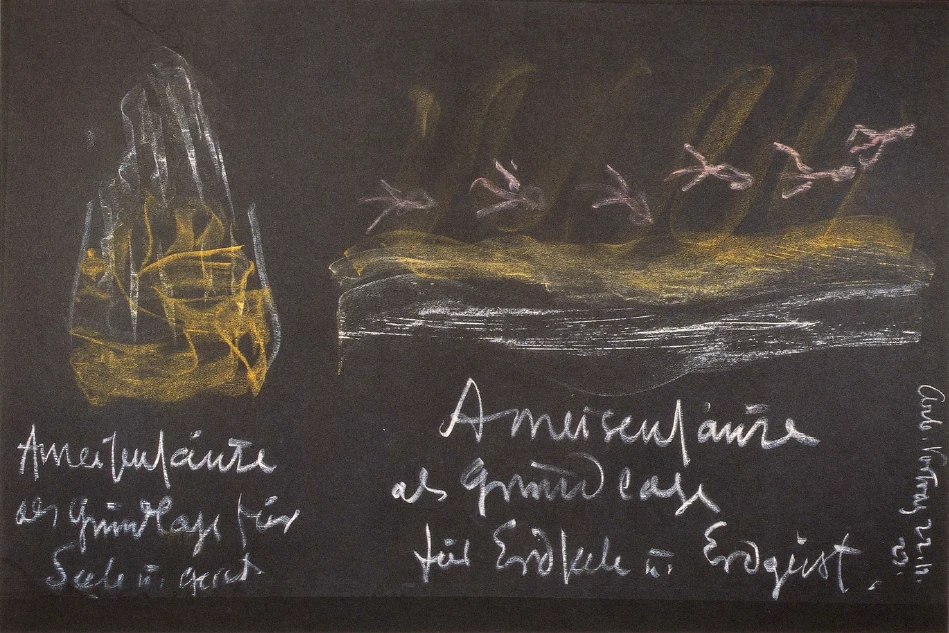
[ 24 ] Now that we produce formic acid within ourselves, don’t we all have reason to say: Out there in nature, intelligence is everywhere; it comes from formic acid. Intelligence is everywhere within us, too, because we have formic acid. - And the formic acid wouldn’t be there if the clover acid weren’t there first. Well, the little creatures flit about the plants and cause the clover acid found in the plants to transform into formic acid—to undergo a metamorphosis.
[ 25 ] One only begins to understand these things when one asks oneself: Well, what about clover acid? You see, clover acid is present wherever there is life. Wherever something is alive, clover acid is there. But there is also an etheric body there. The etheric body ensures that the clover acid is immediately renewed. But clover acid will never become formic acid usable by the human or animal organism unless it is transformed from clover acid into formic acid by an astral body. For the formic acid that I have taken from the retort here is of no use to the human or animal body. People are mistaken if they believe that this substance—which is dead—has any real benefit. The formic acid produced here and there—in humans and through insects—is alive, and it occurs wherever sensation and the soul are present. Human beings must develop formic acid within themselves if they wish to bring forth the soul from the mere life that exists in their lower abdomen, where clover acid plays a major role. Then the soul lives in the formic acid within the breath, rises to the head, and can continue to work there. The soul requires this transformation of formic acid into acetic acid within the human being.
[ 26 ] What actually happens when cloveric acid is converted into formic acid? You see, this is what the first thing I told you can teach us. This carpenter bee I mentioned is particularly interesting because it works its way into wood that is no longer alive. And if this carpenter bee couldn’t make proper use of this wood, it would simply look for a home elsewhere. This particular bee doesn’t build its nest inside trees, but rather in decaying wood—where posts and pillars are already beginning to rot—and that’s where it lays its eggs after building its nest.
[ 27 ] If one studies the connection between decaying matter and wood bees, one discovers that what is happening in decaying wood is constantly taking place in the human body. It begins to decay, and when it decays too much, it dies. And what is happening out there is what the human being must do continuously: he must build up his cells. And he can do this only by transforming the plant substance—which is permeated by formic acid—into formic acid itself, into that which is permeated by formic acid.
[ 28 ] Now you might ask: What does all this have to do with nature? — Well, gentlemen, let’s consider a pillar or post made of wood that is rotting away. If a carpenter bee never comes near such a post, that is very convenient for humans, because they spread out quite a bit, and the post falls over the following year because they hollow it out. That is not very convenient for humans, but it is all the more convenient for nature. For if all the wood that comes from plants were to continue to exist without these bee nests, where would this wood gradually—as you can see from the rot—crumble, turn to dust, and become completely useless? But the wood in which a carpenter bee has worked does not disintegrate; rather, it comes back to life. And from all the wood that is somewhat revitalized by these carpenter bees—as well as by other insects—much of what ensures that our Earth will not one day completely rot away and disintegrate into space, but can continue to live, because it is revitalized by these insects. We humans inhale formic acid. In nature, the formic acid—which these insects produce from the clover acid in plants—enables the Earth to continue living at all.
[ 29 ] Now consider the context. Here we have the human being, here the Earth (it is drawn). Let’s first consider the human being. Let’s assume he is a young child. When he is a young child, he easily transforms the clover acid located in the lower abdomen into formic acid. The organs receive enough formic acid. The human soul develops within the child. So we have formic acid as the foundation for the soul and the spirit. And when a person grows old and can no longer produce enough formic acid, the soul and the spirit depart. Formic acid, then, draws the soul and the spirit to itself; otherwise, the spirit departs. It is very interesting.
[ 30 ] For example, if you carefully observe a person who has a great deal of internal suppuration, you may find that formic acid helps them overcome these suppurative processes. Then the proper relationship between the astral body and the physical body is restored—a relationship that had been hindered by the purulent processes. Thus, formic acid is always needed in precisely the right way as the foundation for the soul and spirit. If the body has too little formic acid, it decays and can no longer sustain the soul; the body grows old, and the soul must depart.
[ 31 ] Now, on the one hand, we have human beings here, and on the other, nature. In nature, formic acid is also constantly being formed from cloveric acid, so that the earth always has the potential to be surrounded not only by oxygen and nitrogen, but also by formic acid (illustrated).
[ 32 ] This formic acid is what ensures that the earth does not, so to speak, die off every year, but rather can continue to come to life each year up above. That which lies beneath the earth, as a seed, longs for the formic acid that is up above. And therein lies the renewal of life. Every winter, the spirit of the earth itself actually strives to depart. And in the spring, the spirit of the earth comes to life again. The spirit of the earth causes the earth to freeze in winter; in spring, it revives it again. It does this because what waits underground as a seed gains access to the formic acid that was produced last year through the interaction between the insect world and the plant world. And now the seeds do not merely emerge into oxygen, nitrogen, and carbon; rather, the plants now emerge into formic acid. And this formic acid stimulates them to develop clover acid themselves, thereby ensuring that the formic acid will be present the following year. Just as formic acid can be the foundation for the soul and spirit in human beings, so too is the formic acid spread throughout the universe the foundation for the spiritual and soul life of the Earth. Thus we can say: On Earth, too, formic acid is the foundation for the Earth’s soul and Earth’s spirit.
[ 33 ] It is actually much more difficult to send telegraph messages in an area where there are no anthills at all than in an area where there are anthills, because the electricity and magnetism necessary for telegraphy depend on formic acid. When telegraph wires pass through cities where there are no ants, the force—the magnetic and electric currents—that enables them to pass through the cities at all must already be present from the outside, where the wires run through the fields. But of course, the ‘formic acid’ spreads and fills the air of the cities as well.
[ 34 ] Well, you see, gentlemen, we can say this: What is inside a human being—including with regard to the production of formic acid—is also found out there in nature. —Human beings are a microcosm. The thing is, however, that throughout their lives—right up until death—human beings are capable of converting clover acid into formic acid. Then they lose that ability, and their bodies die. They must first acquire a new body—in the form of a child—that is capable of converting clover acid into formic acid in the proper way. In nature, the cycle continues endlessly: winter, summer; winter, summer. Clover acid is constantly being converted into formic acid.
[ 35 ] When one observes a dying person in this way, one actually gets the feeling that, by dying, the person is first testing whether his body is still capable of producing formic acid. Then, if it is not suitable, death simply sets in. The person then passes into the spiritual world because they can no longer endure being in their body. So we can say: A person dies at a certain point in time. Then a long time passes, and they enter another body. In between, they are in the spiritual world.
[ 36 ] Now, when a young queen hatches in the beehive, as I have told you, something happens within the bees that disturbs them. Before that, the bees live in a sort of twilight. Then they see this young queen glow. What, then, is connected to this “glow” of the young queen? It is connected to the fact that the young queen takes away the power of the bee venom from the old queen. And that, gentlemen, is the fear of the departing swarm: that it no longer has the bee venom, can no longer defend itself or save itself; so it departs. Just as the human soul departs in death when it can no longer possess formic acid, so the old bee brood departs when there is not enough transformed formic acid—bee venom—present. And when one now looks at the swarm of bees, it is indeed visible, but it looks exactly like the human soul that must leave the body. It is a magnificent image, such a swarm of bees taking flight. Just as the human soul leaves the body, so too, when the young queen has matured, the old queen and her retinue leave the hive, and one can truly see in the departing swarm an image of the human soul taking flight.
[ 37 ] Oh, gentlemen, that is absolutely magnificent! It’s just that the human soul has never managed to develop its powers to the point of becoming little “creatures.” Within us, there is also a constant tendency toward this; we want to become nothing but little “creatures.” We actually have within us the impulse to constantly transform ourselves inwardly into crawling germs and bacteria, into such tiny bees, but we suppress that impulse. That is what makes us a complete human being. But the beehive is not a complete human being. The bees cannot find their way into the spiritual world. We must bring them to reincarnation in another beehive. This is a direct image of the reincarnating human being. And anyone who can observe such a thing has immense respect for these swarming old bees with their queen, who actually behaves the way she does because she wants to enter the spiritual world. But she has become so materially physical that she cannot do so. And so the bees huddle together, becoming a single body. They want to be together. They want to leave this world behind. You know: whereas they would normally fly, they now settle on a tree trunk or something similar, huddling together to disappear, because they want to enter the spiritual world. And then they become the proper beehive again when we help them, when we bring them back to the new beehive.
[ 38 ] So one can certainly say: Insects teach us the very highest truths of nature. That is why the sight of plants has always properly enlightened people who, in ancient times, still possessed instincts regarding what I have explained to you—instincts that modern science has completely lost. These people looked at plants in a special way. Now, in this day and age, people are reminded of certain things from more recent times when they bring a fir tree indoors and turn it into a Christmas tree. Then people are reminded of how what exists out there in nature can become something within human life that has an effect on social life. This fir tree, transformed into a Christmas tree, is meant to be a symbol of love.
[ 39 ] It is commonly believed that the Christmas tree is very old. But the fir tree has probably only been used as a Christmas tree for about one hundred fifty or two hundred years. This custom did not exist in the past. Nevertheless, some kind of shrub was already used at Christmas. For example, during the Christmas plays that were performed in villages as early as the 15th and 16th centuries, a person would always run around announcing them while carrying a sort of Christmas tree in his hand. But that was what was known—in Central Germany, at least—as the “Kranewittbaum”; it was the juniper tree, which bears those wonderful berries. And in this juniper tree, people back then saw their Christmas tree. Why? Because these juniper berries, which birds love to eat, revealed to them that slight toxic effect that arises and must penetrate the earthly realm so that the spiritual can arise within it. Just as when the ant goes to the wood or the carpenter bee goes to the posts, so too every morning, when the tree stands out there and the bird pecks at it, a mild acid—though much weaker—is produced everywhere. The ancient peoples knew this instinctively and said to themselves: In winter, when the juniper tree stands there and the birds come to its berries, the earth is revitalized through the juniper tree. — And this was for them a symbol of the revitalization of the earth through Christ in the moral sense.
[ 40 ] So we can already say: Viewed correctly from a natural perspective, it is true that in what takes place in the natural world outside, one can truly see symbols and images of what takes place in human life. When the old folks saw birds perched in a juniper tree, they regarded those birds with the same love with which we today look upon the little cookies or the gifts on the Christmas tree. So the juniper tree was, for the people out there, a kind of Christmas tree that they brought into their living rooms. In this way, the juniper tree was turned into a kind of Christmas tree.
[ 41 ] But we must wrap up now. However, I didn’t want to let today’s session pass—since you are particularly busy at this time—without our having discussed a very important topic and having gone so far as to consider a shrub that can truly be regarded as a “Christ bush,” the juniper bush, which provides for birds what plants provide for bees, what wood provides for ants and carpenter bees—and what wood provides for insects in general. And in closing, I would like to take this opportunity to wish you a truly happy, joyful, and spiritually uplifting Christmas.
[ 42 ] We will let you know about the next lecture; it will be held in the not-too-distant future.