Man and World
How Spirit Works in Nature
GA 351
15 December 1923, Dornach
Translated by Steiner Online Library
15. The Importance of Formic Acid
[ 1 ] Good morning, gentlemen! Today I will continue the discussion we began last time in response to Mr. Dollinger’s question. If anything else comes up, we can certainly address that as well. Last time, to answer this question, I began by considering ants. We can say that these are related species: bees, wasps, and ants; yet they demonstrate their way of life—which we observe in them—in very different ways. And from all of this, one can actually learn an extraordinary amount about the order of the world in general. For the more one delves into these animals and their way of life, the more one realizes how wisely everything is arranged, especially in their work and in what these animals accomplish.
[ 2 ] Last time, I told you how ants build their nests—how they construct them either from mounds of earth, which are, of course, made of earth itself, or from tiny splinters that they gather from decayed or hard, dead wood, along with other materials they mix in. Then they build their mound. Inside this mound are all sorts of tunnels through which they move in whole swarms, in such processions. You can see them coming out of the holes, going somewhere in the surrounding area, and gathering whatever it is they want to gather.
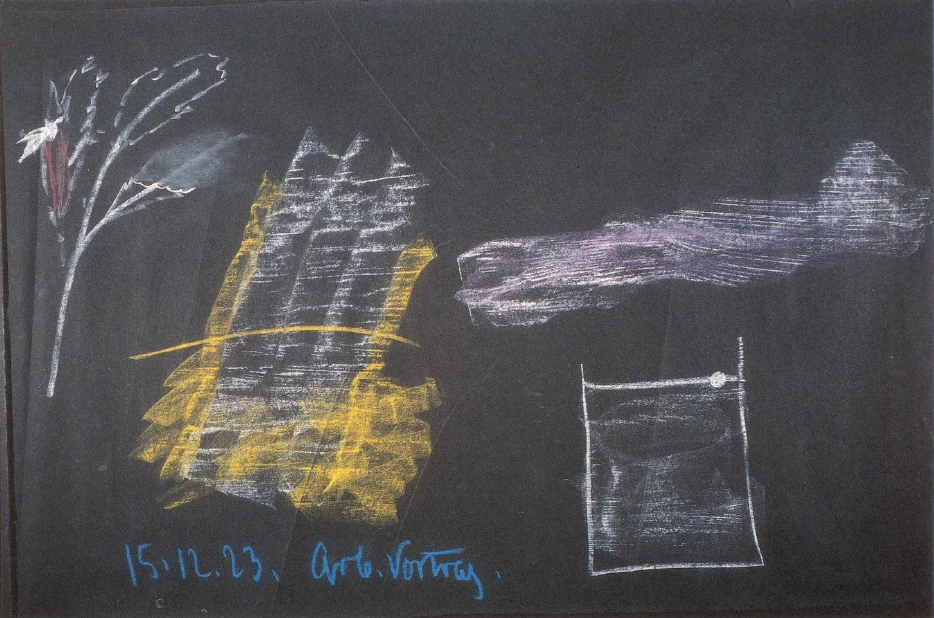
[ 3 ] However, it also happens that these animals do not first build their own nests, but instead use what is already there. Suppose, for example, that a tree has been cut down. The stump is still in the ground where the tree was cut down. Then a colony of ants comes along and builds a chamber somewhere inside it, burrows in, creates a chamber, and digs all sorts of tunnels that lead out (see drawing). They might pile up a little soil, make one tunnel, then another, then a third, and so on. The tunnels are then interconnected. There’s a whole maze of tunnels in there. The ants move around, gathering what they need for their nest and food from the surrounding area.
[ 4 ] Look, gentlemen, to say that all of this is simply animal instinct—well, fine, that’s all well and good, but it doesn’t really say much. For if the animal doesn’t have a tree trunk like that at its disposal, it builds itself a mound of sand. If it happens to find a suitable tree trunk, then it sets itself up in such a way that it saves itself the work involved in building a mound. So the animal adapts to each individual situation. And that makes it very difficult to say that the animal has a general instinct. That would imply that the animal does everything exactly as its instinct dictates. But the animal adapts to external circumstances. That is the important point.
[ 5 ] We don't see that very often here, but as soon as you head south, ants become a real nuisance. Just imagine: there’s a house somewhere, and in some corner—where the residents don’t notice for a long time—ants have gathered. They carry all sorts of things from the surrounding area—grains of dirt, small wood chips—and build themselves a tiny little chamber somewhere that’s hard to reach when cleaning, one that goes unnoticed at first. And from there, they lay their tunnels into the kitchen and the pantry along very intricate paths, fetching what they need for food and other purposes from the kitchen and pantry—so much so that in more southern regions, it happens that such a house is actually completely permeated by an anthill. Of course, you have no idea that you’re living alongside such an anthill; you only realize it when you happen to go there by chance or notice that something in the pantry has been gnawed on—and only then do you find the source when you follow one of those tunnels.
[ 6 ] Again, instinct doesn’t explain much here, because then one would have to say: Nature has instilled in these animals the instinct to build a burrow right inside this house. It has to be built in such a way that it fits perfectly inside the house. - So you see, these animals aren’t really acting out of mere instinct; there’s wisdom behind it.
[ 7 ] But if, on the other hand, one examines a single ant, one does not conclude that it is particularly wise. What it does when separated from its colony—and what one then has it do—does not seem particularly wise. The implication of this is that we must bear in mind that it is not the individual ant that possesses intelligence, but the entire ant colony as such. The entire ant colony as such is wise. And it is not the individual ants within the colony that possess individual intelligence. Thus, work is carried out there in an extraordinarily interesting way.
[ 8 ] But there are still many—I would say, even more interesting—things that happen there. There is even a species of ant that does it this way. It builds a sort of mound somewhere on the ground (see drawing)—it’s raised up—then it forms a circle, and there’s the surrounding soil. Then it burrows into it. The ants are inside. It can also look like a fire-breathing mountain. Inside are the tunnels, which then lead out into the surrounding area.

[ 9 ] Well, these ants do something very special. They eat away all the grasses and plants in the surrounding area, leaving only a single species of grass. They chew away everything that isn’t this one type of grass. And sometimes they chew away absolutely everything, so that there’s a sort of mound in the middle, and all around it looks like it’s been finely paved. Because they chew everything away, the soil becomes a bit denser. The soil becomes very dense. So there’s this anthill, and all around it, it looks like it’s been paved—completely smooth, like asphalt, only lighter in color.
[ 10 ] Now these ants go out into the surrounding area and gather a specific type of grass, which they then cultivate. As soon as the wind carries other seeds their way—they quickly bite them off; when they emerge, the ants throw them out of the area they’ve cleared, and nothing but this single type of grass grows throughout the entire surrounding area. So the ant has established a kind of territory for itself and has cultivated the type of grass that suits it perfectly all around. And it leaves nothing else there—it throws it out and bites everything away. This type of grass that grows there takes on a completely different appearance than the same grass does outside. Because the grass outside grows, for example, in loose soil. It looks completely different there. But this soil has been hardened by the ants, so that the grass growing there—the grass planted by the ants—has very hard seeds, seeds as hard as pebbles.
[ 11 ] Yes, gentlemen, you can find anthills like this: surrounded by an entire agricultural system—these are farming ants! That’s what Darwin called them, having observed the phenomenon closely. So all around you see this entire operation: the soil looks like tiny grains of rice, but the seeds are incredibly hard. Then, when the whole process is complete, the ants emerge, bite off the top part, and carry it into their nest. They stay inside for a while; you don’t see them again. But they’re hard at work inside their nest. Everything they don’t need—the parts of the fruit that are as hard as pebbles, like little stalks—they bite off, and after a while the ants come out, run across it (Drawing p. 130) and throw everything they don’t need out of their field, keeping in their anthill only the pebble-hard seed, which they then use with their very hard jaws partly as food and partly to continue building inside. They are true farmers; they assess whether they can use what’s in the vicinity. Whatever they don’t need, they throw back out. After all, humans don’t do things much differently. These farming ants are exceptionally skilled at producing what they need for themselves.
[ 12 ] It’s the kind of thing that makes you wonder: What’s actually going on there? — You see, basically, a whole new type of grass is being formed! Rice grains as hard as pebbles, like the ones growing there—you don’t find those anywhere else. They’re produced only by the ants. And these ants process them again. What’s actually going on there? Before we tackle this, let’s look at the story from another angle.
[ 13 ] Let’s return to the wasps; as I already told you, we find there certain species that lay their eggs in tree leaves and tree bark, causing the so-called galls to form, from which the young wasps then develop.
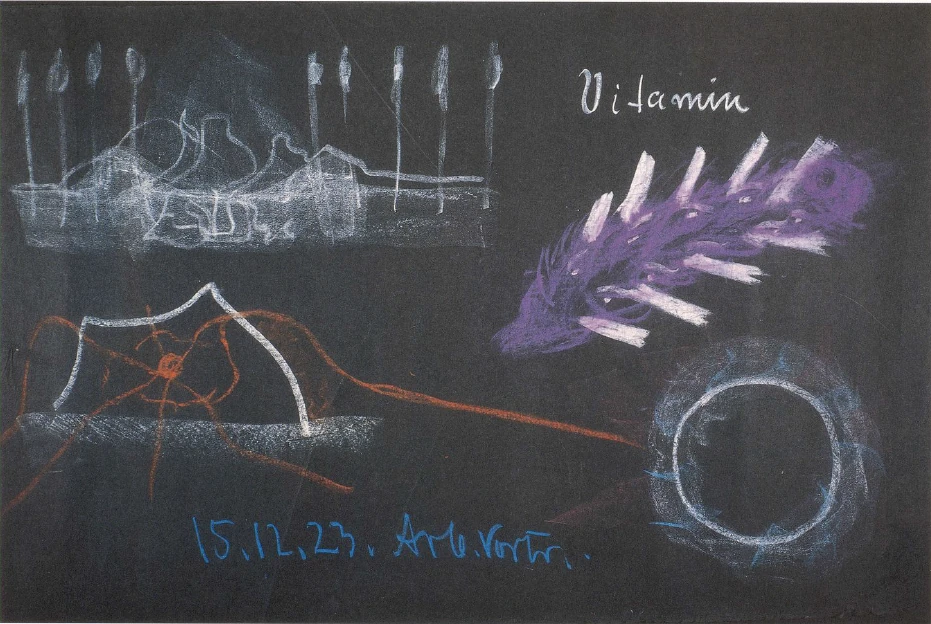
[ 14 ] It can also be different. There are some caterpillars that look something like this (a drawing is shown). You all know these caterpillars—they’re actually covered very densely with hairs; they’re quite prickly. The following can happen to a caterpillar like this. One or more wasps of a special kind come along and simply lay their eggs inside this caterpillar. When these eggs are mature, the larvae hatch from them. The larvae are, after all, the first stage in which both bees and other insects of this kind appear.
[ 15 ] It’s the same with ants. You know that if you dig up an anthill, you’ll find inside it the white so-called “ant eggs,” which are fed to certain songbirds. But these “ant eggs” aren’t really eggs—they’re pupae. The eggs are small, and maggots emerge from them. The pupae are incorrectly called ant eggs.
[ 16 ] Now, when the wasp lays its eggs inside the caterpillar, it’s very strange. I’ve told you about this before. The larvae that hatch are very voracious. But there are countless of them inside this caterpillar. These larvae are voracious; they eat their way out of the caterpillar’s body to get their food. And here’s something very strange—as I said, I’ve told you about this before—: As soon as one of the wasp larvae were to eat into the caterpillar’s stomach, the entire wasp colony inside would perish and could not survive. If an organ—such as an eye, or something like a heart, or the caterpillar’s digestive system—were to be eaten away, life would simply cease. These little wasp larvae show the intelligence not to bite or eat anything the caterpillar needs to survive, but only to bite or eat the organs that can be damaged over a long period of time. The animal does not die; at most, it becomes ill. But the wasp larva can continue to feed inside it.
[ 17 ] It is so ingeniously arranged that these wasp larvae do not eat any of the plants that the caterpillar can destroy. Perhaps you have already seen how the larvae emerge when they are mature. They crawl out, and the entire caterpillar was essentially the foster mother, using its own body to nurture this entire brood. They now crawl out, continue to develop outside into parasitic wasps, and seek their food from flowers and so on. And then, when they are ready, they in turn lay their eggs inside such caterpillars.
[ 18 ] Now you might say: But there’s actually something incredibly clever in there! — And indeed, as I’ve already told you, when you observe these things, you find yourself becoming more and more filled with admiration. It really is no different. You find yourself filled with admiration and then ask yourself: What, exactly, is the connection in all of this? — Let’s now, so to speak, get to the bottom of the matter. We first say to ourselves: There are flowers growing out of the earth. There are caterpillars. And then these insects come along, feast on the flowers and caterpillars, and then reproduce in turn. The cycle always begins anew. And to us humans, it initially seems as though this entire insect world could just as well not exist. Certainly, when we look at the bee, we humans say to ourselves: Bees provide us with honey, and therefore beekeeping is useful to us. Fine, but that’s from the human point of view. And if the bees are predators who simply take the honey away from the flowers, and we humans then use that honey to nourish ourselves or even to heal ourselves, then that is highly beneficial for us; but from the flowers’ point of view, it looks as if it were merely robbery, and as if we humans were merely participating in that robbery. So the question arises: Is the flowers’ perspective one that might say something like this: “Out there are these robbers—bees, wasps, ants—who take our nectar away, and we could thrive much better if they didn’t take our nectar away from us?”
[ 19 ] This is a perspective that people usually assume when it comes to flowers. And you can even hear a lot of lamentations from the uninformed, who say: Oh, the poor flowers, oh, the poor little creatures, the caterpillars! Here come these terrible parasites, feeding on them, doing all sorts of things that take something away from the flowers. — But that’s not how it is. That’s not how it is at all; rather, the situation is quite different. For when you approach a flower and see an insect—let’s say a bee—sitting there and sucking the nectar from the flower or from the willow branches, you have to ask yourself: What would happen to the plant if the bee, or a wasp, or some other insect didn’t come along and suck out that nectar? What would happen then? — That is, of course, a question that is harder to answer than the issue of simple theft, because it requires looking into the entire workings of nature. And the fact is that one cannot arrive at any conclusion unless one can look back to earlier stages of the Earth’s development.
[ 20 ] The Earth wasn't always the way it is today. If the Earth had always been the way it is today—if one were to find dead limestone, dead quartz, dead gneiss, mica schist, and so on out there, with plants growing from today’s seeds, animals, and so on—if the Earth had always been that way, the whole thing could not exist at all; it simply could not be! People who base their science solely on what exists today are succumbing to a complete delusion; for that simply cannot be the case. Gentlemen, anyone who seeks the secrets and laws of the Earth from the same sources that modern science uses is just like a Martian who came down to Earth and had no understanding of living human beings, but instead went only into a morgue to look at the dead. These dead people could not exist if they had not first been alive! The Martian who has never seen a living human being and sees only the dead would first have to be led to the living. Then he would be able to say to himself: Well, now I understand that the dead have such a form, but I did not understand it before because I did not know the living, which preceded them. - And so, if one wishes to understand the laws of Earth’s evolution, one must go back to earlier states. You see, the present Earth was preceded by an entirely different form. I have always called it the “lunar form,” and in my book *Outline of Esoteric Science* it is referred to as the “lunar form,” because today’s Moon is a remnant of this ancient Earth. And in the same way, other states of the Earth preceded it. The Earth has undergone a transformation; it was originally something entirely different.
[ 21 ] Now there was once a time on Earth when plants and insects such as those we have today did not exist at all; rather, the situation was as follows: You see, there was, let’s say, something comparable to the Earth as we know it today. From it grew, let’s say, plant-like formations—but plant-like formations that were constantly changing, constantly taking on different forms, like clouds. There were such clouds in the Earth’s atmosphere (a drawing is made). But they were not like the clouds we see today, which are lifeless at the bottom—or at least appear to be lifeless—but rather they were living clouds, just as today’s plants are alive. If you were to imagine that today’s clouds came to life and turned greenish, then you would have a mental image of the plant world of that time.
[ 22 ] In this regard, some members of the scientific community are truly hilarious. The other day you could have read an incredibly amusing newspaper item. Yet another new scientific discovery has been made, quite in keeping with today’s style. It was terribly amusing! It turned out, you see, that when prepared in a certain way, milk is a good remedy for scurvy, a very nasty disease.
[ 23 ] Well, gentlemen, what does a scientist do these days? I have already pointed this out to you: he analyzes milk. Now he finds that milk contains such-and-such chemical components. But I’ve also pointed out to you that you can feed mice with any of these chemical components—if they’re present in milk—but if you give them these components on their own, the mice die after a few days! Professor Bunge’s students recently discovered this as well and simply said: Well, there’s just a life-sustaining substance in milk—and in honey, too—a vitamin! — You know, I’ve already given you this example before. It’s just like saying: “Poverty comes from pauvrete.” That’s how people here put it: “There’s a vitamin in there.”
[ 24 ] So an important discovery has been made: Milk contains all sorts of substances with very technical names. And now, in a certain sense, milk has been prepared as a remedy for scurvy. But now, in a very scientific manner, it has been investigated whether scurvy can also be cured by giving these substances—with their scientific names—found in milk, on their own, to patients suffering from scurvy. None of them cured the patients—not a single one of the individual components! But when the components are combined in the specially prepared milk, then they can cure patients with scurvy. No single component on its own heals; only the whole heals.
[ 25 ] “But what remains then?” the scholar asks himself. “If you subtract all these components, what remains?”—for now he is subtracting them all. He does not admit that these components are part of an etheric body; but he subtracts them all—and what remains? He says: The vitamin! — The vitamin that is supposed to cure scurvy is not present in any of these components. So where is it, then? And now people come up with this clever idea: It must be in the water of milk, since it isn’t in anything else. And that is why the water is the cure for scurvy!
[ 26 ] It’s incredibly funny, but it’s a very scholarly matter today. Because if water contained vitamins, then our scholarship would have already taken us to the place where the clouds live. Because then we’d have to look out there and say: There are vitamins everywhere in the water. Then we’d be just as the Earth once was. Only, that’s no longer the case today.
[ 27 ] So there was—I would say—a plant-like entity, a living carpet of plants. And this living carpet of plants was fertilized from all around by its surroundings. There were also unformed animals there; it wasn’t wasps that came, but rather only that kind of substance from the surrounding area that lived as animals (it is being drawn). So that at one time our Earth was in a state that could be described roughly as follows: It was surrounded by clouds that contained plant life within them, and other clouds approached these clouds from the surrounding area; they fertilized them, and these were of an animal nature. And from outer space came the animal nature, and from the Earth itself came the plant nature.
[ 28 ] All of that has changed. The plants of that time have become our clearly defined flowers, which grow out of the earth and no longer form large clouds. But what has remained the same about these flowers is that they seek to be influenced by their surroundings. A rose grows out of the earth (it is drawn). There is a rose petal, then another rose petal, a third, and so on. Then a wasp comes along. This wasp literally gnaws a small piece out of the rose petal, carries it to its nest, and uses it to build the nest or feed its young, and so on. It is simply gnawed off by the wasp and carried away. Well, as I said, our rosebushes are no longer clouds; they have become sharply defined objects. But that which lived within them and was connected to the animal nature that came from all around—that has nevertheless remained in the rose petals and blossoms! It resides there within. In every rose petal there is something that cannot help but be, so to speak, fertilized by the entire surroundings.
[ 29 ] And you see, gentlemen, what these flowers need—what they absolutely require—is a substance that also plays a major role in the human body. For if you examine the human body, you will find a wide variety of substances within it. All of these substances are constantly being transformed. But throughout the human body, these substances ultimately transform into something that is always present in the human body in certain quantities. The human body needs it. That is formic acid.
[ 30 ] If you go out to an anthill and collect ants, then squeeze them, you’ll get a juice. This juice contains formic acid and a little alcohol. This juice is inside the ants. But you also have this liquid in your body in a very finely dispersed form. Whatever you eat in your life is always converted—not exclusively, since there are other substances present as well, of course, but in small amounts—into formic acid. This formic acid fills your entire body. And if you’re sick and don’t have enough formic acid in your system, that’s actually very bad for your body. Because then—precisely because you don’t have enough formic acid in your body—your body is prone to developing gout or rheumatism. It produces too much uric acid and too little formic acid.
[ 31 ] So ants have within them what the human body also needs. But formic acid is something that is needed throughout all of nature. In fact, you can’t really find any tree bark that doesn’t contain some formic acid. Formic acid is found everywhere in the entire tree, just as it is in the human body. It must be present in every leaf; it must be present everywhere. But it’s not just formic acid that must be present; related to formic acid is what wasps possess, as well as what bees carry within them, which then becomes bee venom. All these insects carry a certain substance within them that is poisonous. If a bee stings you, you get inflammation; if a wasp stings you, well, sometimes it can be quite serious. This business with wasp stings is something truly dreadful. Brehm recounts a charming scene in which such insects once played a very nasty trick on humans and animals.
[ 32 ] Here’s what happened: A cowherd—he was still young—had a large herd of cows grazing in a pasture, and that pasture was riddled with insect nests. The herding dog was running around. Suddenly, this herding dog went crazy, running around like a madman, and no one knew what was wrong with him. He ran as fast as he could to the nearby stream and threw himself into it, shaking and shaking. The young herdsman was completely distraught by this; he came to the dog’s aid, but from the outside. He didn’t jump into the stream, but tried to help the dog from the outside. Unfortunately, he stepped on an insect nest—just as the dog had done before—and now the insects stung him. Now he, too, runs around like a madman and finally jumps into the stream as well. Because the dog is gone and the shepherd is gone, confusion gradually sets in among the herd of cows. Those cows that step on such an insect nest are also stung and act like mad. And finally, a large part of the herd is in the stream, acting like mad!
[ 33 ] So insect bites like these can really play tricks on you. After all, all these animals have some kind of toxin inside them. And finally, if you’re bitten by an ant, there’s also a little inflammation, because the ant injects formic acid into the wound. But this formic acid, in the right dilution, is found in all living things.
[ 34 ] Gentlemen, if there were no ants, no bees, and no wasps—which are, in fact, the producers of these poisons—what would happen then? The same thing would happen as would happen to the reproduction of humankind if you were to suddenly behead all the men and leave only the women on Earth. Then humanity would not be able to reproduce, because the men’s seed would simply not be there. Now, these insects all have their own additional semen, but nevertheless, what comes from these poisons is necessary for their lives, for these poisons are remnants of what existed in the vicinity of the ancient Moon. Finely dispersed bee venom, wasp venom, and formic acid once came down from outer space onto the plants. The remnants of these substances are still present today. So when you go out and see a bee sitting on a willow tree or a flower, don’t say, “That insect is just going to steal something from the flower”—but rather say: While the little bee sits there and sips, the flower feels so good that it causes sap to flow to the spot where the bee is sipping. That’s very interesting, gentlemen! When the bee is sipping there, the flower allows this sap to flow there. And in this sap, while the bee is taking something away from the flower, venom from the bee flows into the flower through the bee. And even while the wasp [gall wasp] stings, wasp venom flows in; and especially while the ant feasts even on tree trunks and the like—which are certainly no longer alive—formic acid flows in. So when an ant arrives, the flower’s sap combines with the ant’s secretion. This is necessary. For if this did not happen—if there were not these bees, wasps, and ants that constantly come upon this world of flowers and feed on them—then the necessary formic acid and the necessary venoms would not flow into these flowers, and the flowers would die out after some time.
[ 35 ] You see, substances like these, which are commonly called “substances of life”—yes, these substances of life—are what people value. But in reality, only substances like formic acid are true life-substances. When a person ingests belladonna, they are ingesting a poison. That is a harmful substance. But what does belladonna do? It actually gathers the spirit from the surrounding universe. Poisons are gatherers of spirit. That is why poisons are also remedies. And basically, the flowers are constantly becoming sicker and sicker, and these little bees, wasps, and ants are constantly acting as little doctors, bringing the flowers the formic acid they need, which in turn cures the illness, so that everything can be healed again. You see: these bees, wasps, and ants are not merely predators, but at the same time provide what gives the flowers the ability to live.
[ 36 ] And that’s ultimately true even of caterpillars. They, too, would die out; after a while, they would no longer be there. Well, you might say that’s no great loss; those caterpillars would simply die out. — But birds, in turn, feed on those caterpillars, and so on! The whole of nature is, after all, interconnected in this way. And when we see, for example, how ants permeate everything with their formic acid, we gain insight into the workings of nature. That is something truly magnificent. Everywhere, something is happening that is absolutely necessary for the preservation of life and the world.
[ 37 ] Look, there’s the tree. The tree has its bark. Now that bark rots away when I cut down the tree. There’s rot (it’s drawn). Now people say: Let’s just let it rot away. - And people calmly watch and let everything that’s left in the forest rot away. Just think of all the fallen leaves and such that rot away in the forest every year! People let it all rot away. But in the world, things are arranged differently. There are these anthills everywhere nearby. Formic acid seeps from these anthills into the forest floor.
[ 38 ] If you have forest floor here and an anthill there, it is just as if you had a glass full of water here; now, if you add a drop of anything to it, it immediately spreads throughout the entire glass of water. If you add salt, the entire glass of water immediately becomes salty (this is illustrated). If you have an anthill there, the formic acid spreads just like that throughout the entire forest floor, into the humus, and the entire forest floor—which is already dying—becomes saturated with this formic acid. So formic acid penetrates not only into the interior of today’s plants, which are still alive, and today’s caterpillars, which are still alive—or even bee or wasp venom, when the bee sits on the flower and the flower absorbs what it receives from the bee—but also into the decaying soil.
[ 39 ] All of this can only be explored through Spiritual Science. For the other, the physical sciences, are concerned only with what the bee takes from the flower. But the bees would not be able to remain on the flowers for millennia if the flowers did not replenish them by allowing the bees to bite into them.
[ 40 ] And so it is even with the lifeless matter in the forest. Just think about it for a moment, gentlemen: Even physical science, as it stands today, assumes that the Earth will one day become completely dead. It would have to, for there would inevitably come a state where decay would take over and the Earth would be dead. But that state will not come, because wherever the Earth decays, it is simultaneously permeated by what bees, wasps, and ants contribute. Bees, however, provide it only to living flowers, and wasps, too, almost exclusively to living flowers. But ants provide what they secrete—formic acid—to decaying matter as well, thereby stimulating it to life to a certain degree, and they contribute to keeping the Earth alive even in its decaying matter.
[ 41 ] So one might say: One admires the spirit that lies within all of this. But when one takes a closer look at the story, yes, then one sees that all of this has great significance.
[ 42 ] Let’s now take a look at these farming ants, who are cultivating their little fields and tending to the plants in a completely different way. Yes, humans could not sustain themselves on what is grown there. For if humans were to eat these tiny grains of rice, which are as hard as pebbles, they would, first of all, develop strange illnesses because they would ingest too much formic acid; but on top of that, they would wear down their teeth so severely that dentists would have their hands full for quite some time. Eventually, however, humans would perish miserably from these pebble-hard grains of rice that are harvested in this manner.
[ 43 ] But the ants—or rather, the anthill—reason as follows: If we simply go out into the great outdoors and suck the sap from the plants that are everywhere, then we will take in far too little formic acid, and consequently we will be able to release far too little formic acid back into the earth. So what we do is this: we
[ 44 ] select only those plants that we can grow in such a way that everything is very dense, tightly packed together, and we can therefore extract a lot of formic acid from this density. — So these farming ants do this in order to extract as much formic acid as possible. And it is these same ants, in turn, that introduce a great deal of this formic acid into the soil. That is how it all fits together.
[ 45 ] So you can see from this that poisons, when they have an inflammatory effect or the like, are in fact also the enduring remedies against decay. And one can say: The bee, in particular, is immensely important in this regard for the preservation of everything in the flowers, for there is indeed a deep kinship between bees and flowers.
[ 46 ] And this preservation actually shows that every time the insects behave in this way in the earth—I would say that the earth is thereby revitalized. That is the spiritual connection. Whenever someone asks me what the spiritual connections are, I never want to simply say, “It’s this or that,” but rather I present the facts to you, and from those facts you can judge for yourselves whether it makes sense or not. For the facts unfold in such a way that one can see there is meaning in everything. It’s just that the people who call themselves scholars today don’t tell you that. But in life, this plays a certain role. In our parts of the country, it’s perhaps less respected, but as soon as you head further south, you can already hear how the farmers—simple folk—speak with an instinctive understanding: “You mustn’t destroy these anthills, because they help keep the decaying matter from becoming so harmful.”—And the truly wise people in such regions say something else as well. When you go for a walk with them in the forest—especially in a forest where trees have been cut down, where trees have just been felled and the young trees are growing back—these people—who are wise, not in their heads but in their noses; for one can indeed be wise in one’s nose—as they walk through such a cleared area where the young trees are supposed to grow back, they come to a spot and say: “Well, this will thrive quite well; it doesn’t smell as musty as it often does—there must be an anthill nearby that’s proving its usefulness.”—That’s what these people smell; they’re smart with their noses. Much of this folk wisdom, which is quite useful, stems from such “smartness with the nose.”
[ 47 ] Unfortunately, modern civilization has focused solely on intellectual culture and neglected these instinctual matters. But as a result, “instinct” has become nothing more than an empty word. The animals here—particularly in their collective formations, such as a beehive or an anthill—actually know all of this deep down. And this is brought about by a kind of scent. And as I said, in some forms of instinctive knowledge, there is wisdom in the nose.
[ 48 ] Well, we'll continue this lesson next week. I just wanted to say today: Bees, wasps, and ants don't just take things from nature as predators; they also give nature the chance to continue living and thriving.