

Man and World
How Spirit Works in Nature
GA 351
12 December 1923, Dornach
Translated by Steiner Online Library
14. On Bee Venom and Ants
The question is asked: What is the relationship between bees and flowers? What connects the two? And what should honey be—and what is it—to humans? The discussion then returns to the topic of egg-laying.
[ 1 ] Dr. Steiner: Well, gentlemen, let’s discuss this again in today’s lecture. The fact is this: The queen is fertilized during the mating flight. So the queen is first fertilized. Then we have to take into account the time that elapses from egg-laying until the insect is fully developed—until the bee emerges. This period lasts 16 days for the queen, 21 days for the worker bee, and 22 to 24 days for the drone. So these three types of bees differ from one another primarily in that they reach maturity at different times. What is the underlying reason for this? When a bee larva develops into a queen, it does so specifically because the larva is fed in a certain way by the bees themselves. The queens are, after all, fed somewhat differently by the bees; this accelerates their growth.
[ 2 ] Now, the bee is a creature of the sun, and the sun takes about as long to complete one rotation around its own axis as a drone takes to develop. So the queen does not wait for the sun to complete a full rotation before beginning her development; that is, her development takes place entirely within the span of a single solar rotation. As a result, she develops in such a way that she comes entirely under the influence of the sun. This is precisely what makes her a bee capable of laying eggs. So everything that constitutes the ability to lay eggs is also under the influence of the sun, or rather, of the universe.
[ 3 ] At the very moment when the bee is fed in such a way that it develops so rapidly—so that, as in the case of the worker bee, it undergoes nearly a full solar revolution—the bee already comes under the influence of Earth’s evolution to a greater extent. The further the sun progresses, the more the bee comes under the influence of Earth’s evolution. At this point, the worker bee is still very much a creature of the sun, but already somewhat a creature of the Earth. And now the drone, which takes about as long to develop as the sun takes to complete a full revolution, is a creature entirely of the Earth; it thus detaches itself from the sun.
[ 4 ] Now we have three types. We have the Sun Queen; we have the worker bee, which still possesses extraterrestrial powers; and we have the drones, which have nothing left of the sun and are entirely earthly creatures. Everything else that happens does not occur under the influence of earthly forces, but only the fertilization itself.
[ 5 ] Now, here is what is peculiar about this. Just consider the “flight from fertilization.” Lower animals, in fact, do not like fertilization at all; they want to avoid it. We can demonstrate this everywhere. That is why the queen’s flight toward the sun is actually a form of escape. For fertilization does not take place when the weather is overcast. And then the drones, who seek to bring the earthly into the solar, must even fight in the air. Those who are weak are left behind. Only those who retain their last reserves of strength and can fly as high as the queen are able to achieve fertilization.
[ 6 ] However, gentlemen, just because the queen is fertilized does not mean that every egg is fertilized; rather, only a portion of the eggs within the queen are fertilized—these become worker bees or queens. Another portion remains unfertilized within the queen’s body—these become drones. So if the queen is not fertilized at all, only drones are produced. If the queen is fertilized, then drones [from the unfertilized eggs] or worker bees and queens are produced, because the germ is fertilized—that is, the heavenly within it comes into contact with the earthly.
[ 7 ] So even when there are worker bees alongside the drones, the drones originate from the fact that they are most exposed to earthly influences—precisely because fertilization has not taken place. They must, in fact, be exposed to earthly influences all the more so that they can remain viable at all. They must be fed for a longer period and so on. Does that satisfy you?
Questioner: I heard once, years ago, that if a bee or a wasp stings you and you have rheumatism, the rheumatism is supposed to go away.
[ 8 ] Dr. Steiner: This brings me back to a question that may not have been addressed last Monday. Mr. Müller told of a man who, it seems, had some heart problems and collapsed after being stung by a bee.
Mr. Müller: The doctor advised him to give up beekeeping, otherwise it would cost him his life!
[ 9 ] Dr. Steiner: Heart disease is nothing more than evidence that the “I” organization is not functioning properly in this person. This is where what you have learned from my lectures comes into play. You know that we have distinguished four parts in the human being: first, the ordinary physical body, which can be touched; second, the etheric body; third, the astral body; and fourth, the “I”-organization. This “I”-organization acts upon the blood, and it is actually this “I”-organization that drives the blood; and the way the blood is driven determines how the heart beats. In books, you will find a completely incorrect description everywhere. There, it is portrayed as if the heart were a pump and the blood were pumped from there to every part of the body. That is nonsense, because in reality the blood is not pumped but is propelled by the “I”-organization itself and, as a result, comes into motion everywhere.
[ 10 ] If someone claims that it is the heart that drives the blood, then that person might as well claim that if he installs a turbine somewhere, the turbine drives the water. Everyone knows that the water drives the turbine. Human beings have similar counterforces. The blood strikes the heart and drives it. Except that the blood pushes forward once, and as the oxygen combines with the carbon dioxide, it pushes back; as a result, it snaps forward once and back once. This creates the heartbeat. So it is the case that the human ego-organization intervenes directly in the blood circulation.
[ 11 ] The fact is that this “I”-organization is actually contained within bee venom in a mysterious way. That which you, gentlemen, experience as the force circulating in your blood is also present in bee venom. And it is interesting that the bee needs the bee venom within itself. The bee does not need the venom merely so that it can sting. The fact that it can sting is merely a coincidence. The bee needs the venom within itself because the bee needs the same circulatory force that humans have in their blood.
[ 12 ] The beehive, as I told you, is like a whole human being. Now imagine that bee venom enters your body—that is, into your bloodstream. Like any poison that enters the body, it immediately enters the bloodstream. Now imagine that you are a healthy person. This will cause your blood to circulate more rapidly. This leads to inflammation, but your heart will be able to handle it. However, if someone has heart disease and the “I”-organization is strengthened by the venom, this puts strain on a slightly diseased heart valve, and the result is that a person may faint or even die. That is the case Mr. Müller described.
[ 13 ] But here is the peculiar thing: Everything that can make a person sick or kill them can also heal them. And that is precisely the great responsibility one bears when preparing remedies, because there are no true remedies that, if used incorrectly, cannot cause the very same illnesses that they are meant to cure. So if you can induce a certain fainting spell or even death in a person through bee venom, what happens then? Well, you see, when a person faints, the astral body—and specifically the “I”—withdraws from the physical body, leaving it as in sleep, but in a healthy way during sleep and in a pathological way during fainting. In a faint, the “I” remains stuck; in sleep, it withdraws completely. If a person has a weak “I” organization, they cannot bring it back in. You have to jostle and shake them so they wake up from the faint, strengthen their breathing, and so on. One must resort to artificial measures in such cases. As you know, in such situations, one must take the person’s forearms, cross them over the chest, move them backward, and then bring them forward again. This is how one performs artificial respiration on someone who has fainted. Artificial respiration always consists of the deliberate effort to restore the ego organization properly within the organism.
[ 14 ] But now suppose someone has rheumatism, or even gout, or other deposits in the body. In that case, one must try to strengthen the “I” organization. For why does one have rheumatism or gout? Because the “I” organization is too weak. It does not get the blood moving properly. It needs to be stimulated. If the blood is not circulating properly—if, for example, it flows too slowly for the organism in question—then small crystals deposit themselves everywhere and spread into the areas surrounding the blood vessels. These small crystals consist of uric acid. They fill the entire body. This is gout or rheumatism. In these cases, the “I-organization” is too weak.
[ 15 ] If I now give a person the correct dose of bee or wasp venom, their ego organization will be strengthened. However, one must not give too much, otherwise the ego organization will not be able to assert itself. But if one administers just enough to strengthen the ego organization, bee or wasp venom can be used to produce a very effective remedy. It must, however, be mixed with another substance. Such remedies are made. For example, the old so-called “Tartarus remedy” is manufactured in a similar way, albeit from different substances.
[ 16 ] So one can always use these very toxins to produce medicines, such as, for example, to strengthen the ego-organization. But when using such a remedy, one must know the patient in question. Let’s say, for example, someone has gout or rheumatism. The first question is this: Is their heart healthy—that is, does their heart function well in relation to blood circulation? —If that is the case, then they can be treated with bee or wasp venom. If their heart is not healthy, then one must make a distinction. In cases of nervous heart diseases, the risk is not so great, but if one has a heart condition caused by a valve defect, one must be very cautious with such a remedy. Bee or wasp venom has a very strong effect on the valve and on the heart. If the valve is diseased, then under certain circumstances these remedies cannot be used at all. That is precisely the point. That is why it is so dangerous to say in general terms that any given remedy is a cure for this or that disease. You can very well say: I am making a preparation, a remedy. I’ll put wasp venom or bee venom into it—we even have a remedy like that—mix it with some kind of binder, such as gelatin-like substances or other plant-based binders, then it’s put into a vial, and then it’s administered, just as a bee sting is administered. The only difference is that the reaction to a bee sting is vastly more intense. And one can manufacture this remedy and call it a remedy for rheumatism.
[ 17 ] Yes, gentlemen, that is not the only concern one has; rather, the concern is whether the patient can tolerate the remedy given his or her general physical condition. Those remedies that penetrate deeper into the organism should actually only be administered after the patient has been thoroughly assessed in light of his general state of health. One must know everything about the state of his health. Therefore, if you come across remedies that are simply touted in general terms as this or that remedy, they are usually remedies that can do little harm and yet are beneficial. Such remedies can be made available on the market. One can also accept this even if, in reality, there are some unpleasant consequences involved. Healing always has unpleasant consequences. The patient must always first get through the post-treatment phase when being cured of an illness.
[ 18 ] Today, a great many people who aren’t actually sick are seeking treatment. And before the war, this was even more common. Doctors in countries suffering from a currency crisis are the ones who suffer the most, because people aren’t seeking treatment as much anymore. In the past, healthy people, those with minor ailments, the sick, and even the most seriously ill all sought treatment; now, only the most seriously ill can receive treatment in Central European countries!
[ 19 ] Now, if someone is a terribly strong fellow and he develops rheumatism—in most cases it’s not actual rheumatism, but rather gout-like conditions—then, as Mr. Burle said, a bee sting can have an extraordinarily beneficial effect on him. He can be cured because he can tolerate the reaction.
[ 20 ] However, it is usually the case that when an ordinary person has rheumatism, they can indeed tolerate a proper dose of bee venom—prepared for them—as a remedy and can be cured by it. But a full bee sting will generally cause such severe inflammation that the inflammation must first be treated, the bee venom must be removed as quickly as possible, and then there will not be much of the bee venom left to treat the rheumatism. This is certainly the case for the average person—there simply won’t be much left.
[ 21 ] But let’s now consider the following case. Rheumatism can also develop in the following way: A person doesn’t work much but eats a great deal. In such cases, he will usually have a fairly healthy heart—as long as he doesn’t work much and eats a lot—until the situation begins to take a turn for the worse.
[ 22 ] The heart is an extraordinarily resilient organ and, unless it has been compromised by heredity or from a young age, it actually takes years for it to deteriorate from within. But a person who eats an extraordinary amount also drinks a lot of alcohol with their meals. This stimulates the ego-organization and causes very vigorous blood circulation. The heart can no longer keep up with the strain. Toxins, uric acid, and so on are deposited everywhere. Under certain circumstances, the heart may remain quite strong for a long time, while gout and rheumatism are already present throughout the body. In such cases, a bee sting can even be exceptionally beneficial for such a person.
Mr. Burle: I don't know if the person in question was also suffering from a degree of alcoholism at the time.
[ 23 ] Dr. Steiner: You mean you haven’t studied it? You see, precisely when one has remedies such as bee venom—and that is a potent remedy—one must be very clear that one must pay extraordinary attention to the overall state of health of the whole person.
Mr. Müller says that he developed rheumatism after catching a cold, treated it with sun exposure, and it went away; this summer, however, it returned somewhat. He also believed that bee stings could be helpful; but he once had an unfortunate day when he was stung on both legs and received about thirty-two bee stings. The only drawback he experienced was that for eight days he looked as if he were bathed in the colors of the rainbow. Swelling doesn’t always occur either. The human body is simply built differently. As already explained: One person might die from a single bee sting, while another, for example, might have already had sixty stings without their heart even beating faster. Some people are simply more resilient than others.
[ 24 ] Dr. Steiner: When you got those many bee stings, had you already been working with bees for a long time?
Mr. Müller: For many years!
[ 25 ] Dr. Steiner: You may not remember the first time you were stung. When someone is stung for the first time, they feel the effects to a greater or lesser extent. The man you mentioned was certainly stung by a bee for the first time. And once you’ve had that kind of venom in your body—that is, in your blood—you become more and more able to withstand it, more and more immunized, as they say. So if someone gets stung a few times when they’re just starting out in beekeeping and is otherwise in good health, it has the effect of making them less and less sensitive to it. If you know you’re healthy, you can even go so far as to let yourself get stung by a bee once, so that you can continue to let yourself get stung; the symptoms then set in—you see rainbow colors and so on—but it all runs off on the outside. The blood is immunized. This depends not only on one’s constitution but also on what has previously been introduced into the blood. It surprises me that the doctor who observed what you described didn’t tell him: “The second time it won’t be as bad, and by the third time he’ll be immunized.” — But perhaps his heart condition was so severe that he couldn’t be exposed to the risk. That must also be taken into account.
[ 26 ] Isn’t that right? Today it’s just a dangerous story because there are also doctors who believe that every beekeeper should be vaccinated before he even starts. When people go off to war, they’re pumped full of all kinds of toxins. That, of course, is not something one can recommend. It’s also not possible, because the blood can become a sort of waste product. The blood is always somewhat impaired by ingesting these substances. This balances itself out again after some time. After a while, the blood is healthy again, but it is protected against new toxins of the same kind.
Mr. Müller: Regarding drones and the three types of eggs: The doctor has already covered everything up to this point, but there is one point he may not be aware of. If the beehive is, as is generally believed, completely healthy, there are times when the queen is of inferior quality or when she becomes too old, at which point all the eggs she lays develop into drones. Based on his thirty years of experience, he is convinced that this can indeed be the case: that the queen, even in her weakened state—whether due to illness or old age—is still capable of laying one or two good eggs, but that the majority of all eggs are drone eggs.
So, what about the bees’ honey production—how do they make it, and does the beekeeper need to supplement it with sugar? From the discussion that has taken place here, it has become clear that the beekeeper must not and should not use sugar. If someone feeds sugar during the nectar flow, they end up on the blacklist—just as happens when you no longer want an employee who has fallen out of favor.
He has had bad experiences with foreign honey.
[ 27 ] Dr. Steiner: Of course, it’s quite true that you don’t get the same product if you use sugar artificially. And if someone really wants to enjoy some extra sugar in addition to the honey, they can certainly do that on their own. Just as you shouldn’t water down someone’s wine on the grounds that people shouldn’t drink such strong wine—the point is that you get exactly what’s stated on the label. That’s how it has to be. And in this regard, mutual oversight among beekeepers is the very best approach, because they understand this subject better than anyone else.
[ 28 ] As for the issue with drones, I’d also like to add this. It can happen that you suspect from the outset that the queen bee has not been properly fertilized and that too many drones are hatching. In that case, if you don’t want to leave it up to the bees themselves—since if too many drones hatch, the bees won’t do this on their own (these experiments have been conducted)—you could still ensure that they emerge earlier by providing particularly heavy feeding: not after twenty-three or twenty-four days, but after twenty or twenty-two days. Then the drones might still develop into somewhat clumsy bees, but ones similar to the worker bees. However, this won’t work in the long run. This simply shows how time exerts an influence.
[ 29 ] Of course, these are things that probably aren’t done at all in practical beekeeping. But theoretically, that’s how it works. It’s fair to say that the method of feeding has a very strong effect, and there’s certainly no denying that, in one case or another, it has been possible to turn a worker bee into a bee that lays a few eggs—even if it’s not a true queen.
[ 30 ] All of this shows just how adaptable such an animal is. But this has little impact on practical beekeeping.
Mr. Müller: It's called “queen rot.” It's a disease that affects the beehive.
[ 31 ] Dr. Steiner: In practical beekeeping, it is of no great significance. But within the beehive, there is a tendency for the colony itself—through this particular feeding method—to transform what would otherwise be merely a worker bee into an egg-laying bee. This is a kind of disease. The beehive is a single unit. The entire hive then becomes diseased. It’s just like when you force-feed a goose. Then the liver’s functions become particularly overdeveloped, the liver becomes overly healthy, and the entire organism becomes sick. When you induce a worker bee to become a queen, she is actually an overly healthy worker bee, but the entire hive must then be considered diseased.
[ 32 ] Perhaps something else will come to mind in the future. We can always come back to this. I would now like to say a few more words today regarding the issue raised by Mr. Dollinger.
[ 33 ] We can clearly distinguish among the insects that are bee-like—that is, bee-like in the broadest sense—namely, bees, wasps, and ants. These animals are related to one another, and last time I already pointed out the interesting story about gall wasps, which lay their eggs in trees and the like, and showed that these wasps engage in a kind of internal honey production. However, there are also other species of wasps besides gall wasps. These other species are, in turn, more similar to bees in that they build a kind of honeycomb.
[ 34 ] For example, there is an interesting species of wasp that builds its nest in the following way: If, for instance, there is a somewhat stiff leaf on a branch somewhere, it gathers—from the surroundings as it flies by—let’s say very small pieces that it bites off from tree bark and the like, or from other objects; it soaks them in its saliva and first makes a few stalks out of this substance. Then, once it has made these stalks, the wasp continues this process, soaking them in its saliva and attaching to these stalks something that looks very much like a single cell of a honeycomb. But if you examine the substance, it is actually different. A honeycomb consists of what you all know as wax. But if you take this substance from the wasp, what results is grayish in color and very similar to what we make into paper. It really is a kind of paper pulp. The wasp then adds a second, third, and fourth cell to it, and these are suspended up there. Now, once they’re filled—that is, once the eggs have been laid—she seals them off. And now, while egg-laying is still ongoing, the wasp—curiously enough—uses her paper to make a sort of loop here (drawing p. 224) and then another sort of lid; she leaves one side open—there’s an entrance hole—so they can fly in and out and tend to these cells.
[ 35 ] Then she continues building cells, doing it the same way again, covering it up once more, adding another loop, a lid here, and a flight hole there. It can be a very long cone, like a pine cone. She builds herself such a pine-cone-like structure, which—though consisting solely of paper pulp—resembles a beehive.
[ 36 ] As you know, other wasp nests are still enclosed in a membrane. Wasp nests come in all sorts of shapes.
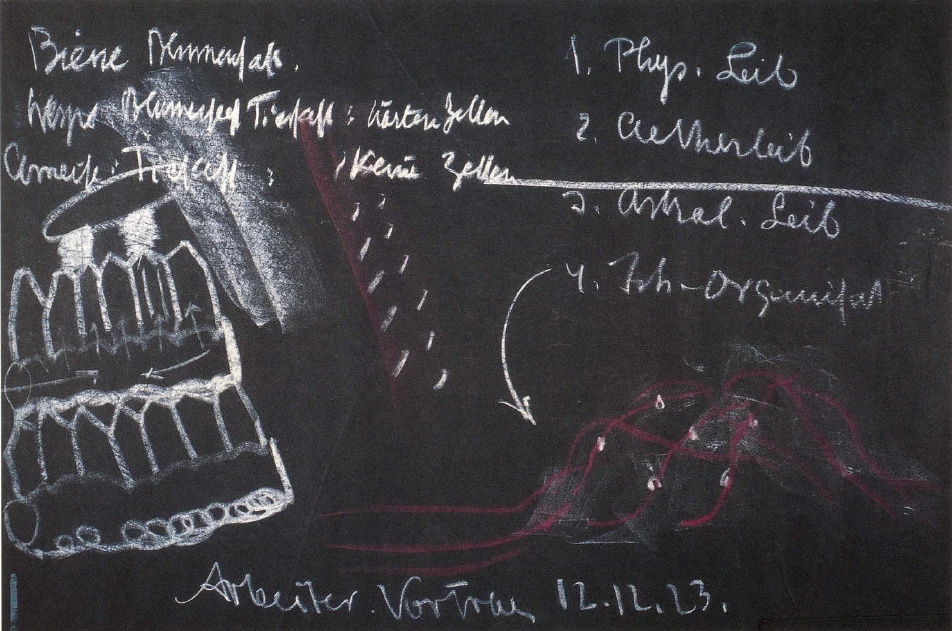
[ 37 ] Now just think about what’s actually happening there. If you ask me what the bee does to make its cells out of wax, I have to tell you: The bee flies to flowers or to whatever resembles flowers on trees; the bee is less concerned with the components of bark or wood. Essentially, it goes to the flower-like parts, or at most to what is a bit like a leaf but still part of the flower, though even less so there.
[ 38 ] There is, however, a case where such higher insects as bees feed on something other than flowers—they do not feed on woody parts or the like, but they do feed on something else that, under certain circumstances, even tastes exceptionally good to them—bees to a lesser extent, but especially wasps and, to a particularly strong degree, ants. Ants and wasps, in fact, particularly enjoy—while on the one hand they use the harder, already lignified components for their nests—the sap that comes from aphids, especially in contrast to bees. That’s very interesting. Because the harder the material—the substance these animals use for their nests—the more they love not just the nectar, but what’s on the flower, the thing that most closely resembles the flower itself: namely, the aphids. These are extraordinarily noble creatures—forgive me if I’m speaking more in “ant language” now; in human language, I wouldn’t call them that either—but in “ant language,” such an aphid is a noble creature. It is entirely plant-based. What it secretes as sap is actually [for the ants] the finest honey there can be. With wasps, for example, you can tell they’re a bit of a gourmet when it comes to aphids.
[ 39 ] But now, turning to the ants: The ant does not have the strength to build such a nest; the ant does things differently. For example, the ant piles up soil, and in this soil you find tunnels everywhere—a whole maze of tunnels. This continues on. And through these tunnels, the ants haul in whatever they can use—including the harder parts of plants, pieces of bark, and so on. But the ants particularly love the parts of wood that are already dead. The ants seek out what they need to further expand this structure, which they build from small pieces of soil. They specifically target wood where a tree has already been cut down and the lower stump remains in the ground. They focus particularly on this wood—which has already turned into very hard pith and bark—carry it back, and use it to build their nest.
[ 40 ] Bee: Nectar: Wax cells
Wasps: Nectar, animal secretions: Harder cells
Ants: Animal secretions: No cells
[ 41 ] So the ants use the hardest material for their nests. They can’t use that for building their cells. That’s a step further for them. They use material that’s too hard. You can see that bees use the material found inside the flowers themselves. They make their wax cells out of it, but as a result, they have to get their food from the flower’s nectar.
[ 42 ] Wasps use a harder material to build their cells, which end up resembling paper. It’s a harder material, but it’s thin, so it’s naturally more fragile than a honeycomb; still, it’s inherently harder.
[ 43 ] The wasp is already becoming a connoisseur of aphids; but it also feeds, much like a bee, on what’s inside the plants. The ants, however, which generally use such hard materials that they can only dig tunnels in the ground—that is, build burrows rather than honeycombs with cells—are particularly fond of aphids. And it happens that ants capture the aphids and drag them into their nests, so you can find aphids in the anthill.
[ 44 ] That's very interesting. When you go into a village, you see a row of houses, and behind them there are cow barns everywhere; that's where the dairy cows are kept, and that's where the milk is produced. It's very similar with ants:

[ 45 ] Everywhere in the anthill you’ll find small structures—that’s where the aphids are. To the ants, these are like dairy cows. What the ants do is just a simpler version of that process. They have their little “cowshed” there, but instead of cows, it’s filled with aphids. The ants approach the aphids and stroke them with their antennae. This feels extraordinarily good to the aphid, and it then releases its sap. As a result, the ant can suck up the sap it has obtained by stroking the aphid. It obtains the most essential part of its diet by receiving the aphid’s sap through this stroking. It’s actually somewhat similar with cows; they just need to be stroked a lot. But the aphids are literally milked by the ants. And they are caught on the flowers and leaves where they settle and are very well cared for by the ants.
[ 46 ] And so one might say: It’s actually wonderful that aphids exist. It is indeed wonderful that aphids exist when there are anthills in the vicinity. There, the aphids are carefully collected by the ants and are then utilized in the ants’ “cowshed.” It is a very ingenious arrangement in nature that these small animals engage in a veritable “cow trade” involving aphids.
[ 47 ] Well, the ant, which uses such hard material for its nest, can’t really make do with just flower nectar anymore. It must use as food what the flower nectar has already provided to the animal. The flower nectar must already have passed through the animal’s system. So one can say: In the case of the bee, it is still pure flower nectar; in the case of the wasp, it is flower nectar and animal sap, resulting in harder cells. In the case of the ant, the only truly nourishing component is the animal sap; hence, there are no more cells. The ant no longer has the strength to form cells; even if it still extracts something from flowers, it must obtain this supplement from the small animal hive; otherwise, it cannot survive.
[ 48 ] You can see what an interesting relationship actually exists between the flowers and these creatures. The bees use the nectar directly. The others—wasps and, in particular, ants—depend on the animals to process this nectar so they can use it as food. In return, they can then use what is no longer nectar to build their nests.
[ 49 ] There really is a big difference between a bee’s wax honeycomb, a wasp’s paper nest, and an ant hill, which can only be built from the outside and does not extend all the way to the cell. The big difference, however, lies in their diet.