

Man and World
How Spirit Works in Nature
GA 351
12 December 1923, Dornach
Translate the original German text into any language:
Versions Available:
How Spirit Works in Nature, tr. SOL
14. Vom Bienengift und von den Ameisen
14. On Bee Venom and Ants
Es wird gefragt, was für eine Verwandtschaft es zwischen Bienen und Blumen gibt, was die beiden so verbindet, und was der Honig dem Menschen sein sollte und ist. Dann wird noch einmal auf die Eiablage zurückgegriffen.
The question is asked: What is the relationship between bees and flowers? What connects the two? And what should honey be—and what is it—to humans? The discussion then returns to the topic of egg-laying.
[ 1 ] Dr. Steiner: Nun, meine Herren, darüber wollen wir im heutigen Vortrag noch einmal sprechen. Die Sache ist diese: Wir haben dieses Befruchten der Königin beim Befruchtungsflug. Da ist also die Königin zunächst befruchtet worden. Dann haben wir die Zeit in Betracht zu ziehen, die verläuft von der Eiablage, bis das Insekt vollständig fertig ist, bis die Biene da ist. Diese Zeit, die beträgt bei der Königin 16 Tage, bei der Arbeitsbiene 21 Tage, bei der Drohne 22 bis 24 Tage. Also diese drei Gattungen von Bienen sind zunächst verschieden voneinander dadurch, daß sie zu verschiedener Zeit fertig werden. Was ist da zugrundeliegend? Wenn aus einer Bienenmade eine Königin wird, so wird sie es namentlich dadurch, daß die Made von den Bienen selber in einer bestimmten Weise gefüttert wird. Sie werden ja etwas anders gefüttert von den Bienen, die Königinnen; dadurch wird das Wachstum beschleunigt.
[ 1 ] Dr. Steiner: Well, gentlemen, let’s discuss this again in today’s lecture. The fact is this: The queen is fertilized during the mating flight. So the queen is first fertilized. Then we have to take into account the time that elapses from egg-laying until the insect is fully developed—until the bee emerges. This period lasts 16 days for the queen, 21 days for the worker bee, and 22 to 24 days for the drone. So these three types of bees differ from one another primarily in that they reach maturity at different times. What is the underlying reason for this? When a bee larva develops into a queen, it does so specifically because the larva is fed in a certain way by the bees themselves. The queens are, after all, fed somewhat differently by the bees; this accelerates their growth.
[ 2 ] Nun ist die Biene ein Sonnentier, und die Sonne braucht ungefähr so viel Zeit, um sich einmal um sich selber herumzudrehen, wie eine Drohne braucht, um sich zu entwickeln. So daß also die Königin nicht abwartet mit ihrer Entwickelung, bis die Sonne sich vollständig umgedreht hat, das heißt, sie bleibt ganz im Bereich von einer einzigen Sonnenumdrehung. Dadurch kommt sie dazu, sich so zu entwickeln, daß sie ganz unter den Einfluß der Sonne gelangt. Dadurch wird sie eben eine eierfähige Biene. Also alles das, was Eierfähigkeit ist, das steht unter dem Einfluß der Sonne respektive des Weltalls auch.
[ 2 ] Now, the bee is a creature of the sun, and the sun takes about as long to complete one rotation around its own axis as a drone takes to develop. So the queen does not wait for the sun to complete a full rotation before beginning her development; that is, her development takes place entirely within the span of a single solar rotation. As a result, she develops in such a way that she comes entirely under the influence of the sun. This is precisely what makes her a bee capable of laying eggs. So everything that constitutes the ability to lay eggs is also under the influence of the sun, or rather, of the universe.
[ 3 ] In dem Augenblicke, wo nun so gefüttert wird, daß die Biene sich so schnell entwickelt, daß sie, wie bei der Arbeitsbiene, fast eine ganze Sonnenumdrehung durchmacht, da kommt die Biene schon näher unter den Einfluß der Erdenentwickelung. Je mehr die Sonne weitergeht, desto mehr kommt die Biene unter den Einfluß der Erdenentwickelung. Jetzt ist die Arbeitsbiene zwar noch sehr stark ein Sonnentier, aber schon etwas ein Erdentier. Und jetzt ist die Drohne, die ungefähr so lange sich entwickelt wie die Sonne zu einer ganzen Umdrehung braucht, ein vollständiges Erdentier; die macht sich also von der Sonne los.
[ 3 ] At the very moment when the bee is fed in such a way that it develops so rapidly—so that, as in the case of the worker bee, it undergoes nearly a full solar revolution—the bee already comes under the influence of Earth’s evolution to a greater extent. The further the sun progresses, the more the bee comes under the influence of Earth’s evolution. At this point, the worker bee is still very much a creature of the sun, but already somewhat a creature of the Earth. And now the drone, which takes about as long to develop as the sun takes to complete a full revolution, is a creature entirely of the Earth; it thus detaches itself from the sun.
[ 4 ] Nun haben wir dreierlei. Wir haben die Sonnenkönigin; wir haben die Arbeitsbiene, in der wir noch außerirdische Kräfte haben, und wir haben die Drohnen, die nichts mehr haben von der Sonne, die ganz Erdentiere sind. Alles, was sonst geschieht, geschieht nicht unter dem Einfluß der Erdenkräfte, sondern nur die Befruchtung selber.
[ 4 ] Now we have three types. We have the Sun Queen; we have the worker bee, which still possesses extraterrestrial powers; and we have the drones, which have nothing left of the sun and are entirely earthly creatures. Everything else that happens does not occur under the influence of earthly forces, but only the fertilization itself.
[ 5 ] Nun ist das Eigentümliche dieses. Betrachten Sie nur einmal die Befruchtungsflucht. Die niederen Tiere haben nämlich die Befruchtung gar nicht gern; sie wollen sich ihr entziehen. Das können wir überall nachweisen. Daher ist es eigentlich eine Flucht, die die Königin anstellt zur Sonne. Denn die Befruchtung findet ja nicht statt, wenn es trübe ist. Und da müssen die Drohnen, die das Irdische in das Sonnenhafte hineinbringen wollen, sogar kämpfen in der Luft. Und diejenigen, die dann schwach sind, bleiben zurück. Nur diejenigen, die die letzte Kraft behalten und so hoch fliegen können wie die Königin, die können die Befruchtung leisten.
[ 5 ] Now, here is what is peculiar about this. Just consider the “flight from fertilization.” Lower animals, in fact, do not like fertilization at all; they want to avoid it. We can demonstrate this everywhere. That is why the queen’s flight toward the sun is actually a form of escape. For fertilization does not take place when the weather is overcast. And then the drones, who seek to bring the earthly into the solar, must even fight in the air. Those who are weak are left behind. Only those who retain their last reserves of strength and can fly as high as the queen are able to achieve fertilization.
[ 6 ] Dadurch aber, meine Herren, daß die Königin befruchtet ist, ist noch nicht jedes Ei befruchtet, sondern nur ein Teil der Eier in der Königin wird befruchtet; das werden Arbeitsbienen oder Königinnen. Ein Teil wird nicht befruchtet im Leibe der Königin; das werden Drohnen. Wenn also die Königin gar nicht befruchtet wird, entstehen lauter Drohnen. Wenn die Königin befruchtet wird, dann entstehen Drohnen [aus den unbefruchteten Eiern] oder Arbeitsbienen und Königinnen, weil der Keim befruchtet wird, also das Himmlische in ihm mit dem Irdischen in Berührung kommt.
[ 6 ] However, gentlemen, just because the queen is fertilized does not mean that every egg is fertilized; rather, only a portion of the eggs within the queen are fertilized—these become worker bees or queens. Another portion remains unfertilized within the queen’s body—these become drones. So if the queen is not fertilized at all, only drones are produced. If the queen is fertilized, then drones [from the unfertilized eggs] or worker bees and queens are produced, because the germ is fertilized—that is, the heavenly within it comes into contact with the earthly.
[ 7 ] So daß also schon auch dann, wenn neben den Drohnen Arbeitsbienen sind, die Drohnen davon herrühren, daß sie also am meisten dem Irdischen dann ausgesetzt sind, weil eben eine Befruchtung nicht stattgefunden hat. Sie müssen eben dann erst recht dem Irdischen ausgesetzt werden, damit sie überhaupt lebensfähig bleiben. Sie müssen länger ernährt werden und so weiter. Befriedigt Sie das?
[ 7 ] So even when there are worker bees alongside the drones, the drones originate from the fact that they are most exposed to earthly influences—precisely because fertilization has not taken place. They must, in fact, be exposed to earthly influences all the more so that they can remain viable at all. They must be fed for a longer period and so on. Does that satisfy you?
Fragesteller: Ich habe vor Jahren einmal gehört, daß wenn einen eine Biene oder eine Wespe sticht und man Rheumatismus hat, so soll der Rheumatismus zurückgehen.
Questioner: I heard once, years ago, that if a bee or a wasp stings you and you have rheumatism, the rheumatism is supposed to go away.
[ 8 ] Dr. Steiner: Da komme ich auf eine Frage zurück, die vielleicht am letzten Montag nicht berücksichtigt worden ist. Herr Müller hat von einem Manne erzählt, der, wie es scheint, etwas herzkrank gewesen ist, umgefallen ist von einem Bienenstich.
[ 8 ] Dr. Steiner: This brings me back to a question that may not have been addressed last Monday. Mr. Müller told of a man who, it seems, had some heart problems and collapsed after being stung by a bee.
Herr Müller: Der Arzt riet ihm, die Bienenzucht aufzugeben, da es sonst noch sein Tod wäre!
Mr. Müller: The doctor advised him to give up beekeeping, otherwise it would cost him his life!
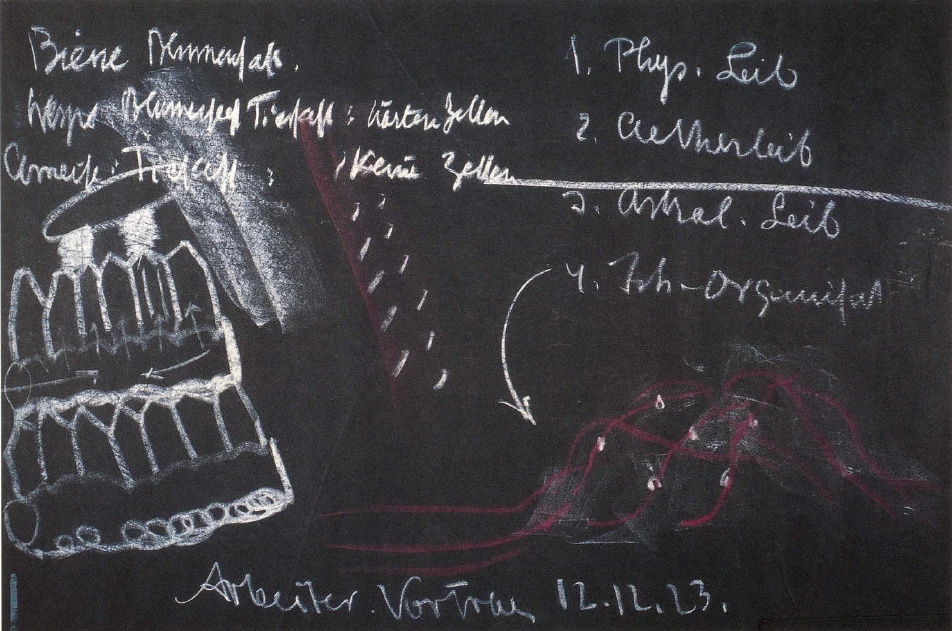
[ 9 ] Dr. Steiner: Die Herzkrankheit, die bezeugt ja nichts anderes, als daß bei diesem Menschen die Ich-Organisation nicht ordentlich eingreift. Da kommt in Betracht, was Sie aus meinen Vorträgen kennengelernt haben. Sie wissen, wir haben vier Teile beim Menschen unterschieden: Erstens den gewöhnlichen physischen Leib, den man angreifen kann, zweitens den Ätherleib, drittens den astralischen Leib und viertens die Ich-Organisation. Diese Ich-Organisation greift ins Blut ein, und diese Ich-Organisation treibt eigentlich das Blut, und wie das Blut getrieben wird, so schlägt das Herz. In den Büchern finden Sie überall eine ganz falsche Darstellung. Da finden Sie dargestellt, wie wenn das Herz eine Pumpe wäre und von da das Blut überall hingepumpt würde in den ganzen Körper. Das ist Unsinn, weil in Wirklichkeit das Blut nicht gepumpt, sondern von der Ich-Organisation selber getrieben wird und infolgedessen überall in Bewegung kommt.
[ 9 ] Dr. Steiner: Heart disease is nothing more than evidence that the “I” organization is not functioning properly in this person. This is where what you have learned from my lectures comes into play. You know that we have distinguished four parts in the human being: first, the ordinary physical body, which can be touched; second, the etheric body; third, the astral body; and fourth, the “I”-organization. This “I”-organization acts upon the blood, and it is actually this “I”-organization that drives the blood; and the way the blood is driven determines how the heart beats. In books, you will find a completely incorrect description everywhere. There, it is portrayed as if the heart were a pump and the blood were pumped from there to every part of the body. That is nonsense, because in reality the blood is not pumped but is propelled by the “I”-organization itself and, as a result, comes into motion everywhere.
[ 10 ] Wenn jemand behauptet, daß das Herz es ist, welches das Blut treibt, dann soll der Betreffende auch gleich behaupten, wenn er irgendwo eine Turbine anbringt, so treibe die Turbine das Wasser. Jedermann weiß, daß das Wasser die Turbine treibt. Geradeso hat der Mensch solche Widerlagen. Da schlägt das Blut an und treibt das Herz. Nur daß das Blut einmal hinstößt, und indem der Sauerstoff mit dem Kohlenstoff sich verbindet, stößt es zurück; dadurch schnappt es einmal vor, einmal zurück. Dadurch entsteht der Herzstoß. Also es ist so, daß in der Blutzirkulation unmittelbar die Ich-Organisation des Menschen eingreift.
[ 10 ] If someone claims that it is the heart that drives the blood, then that person might as well claim that if he installs a turbine somewhere, the turbine drives the water. Everyone knows that the water drives the turbine. Human beings have similar counterforces. The blood strikes the heart and drives it. Except that the blood pushes forward once, and as the oxygen combines with the carbon dioxide, it pushes back; as a result, it snaps forward once and back once. This creates the heartbeat. So it is the case that the human ego-organization intervenes directly in the blood circulation.
[ 11 ] Nun ist es so, daß diese Ich-Organisation eigentlich im Bienengift drinnen auf eine geheimnisvolle Weise enthalten ist. Dasjenige, meine Herren, was Sie haben als die Kraft, die in Ihrem Blute zirkuliert, das ist auch im Bienengift drinnen. Und es ist interessant, daß die Biene das Bienengift in sich drinnen braucht. Die Biene braucht das Bienengift nicht etwa bloß aus dem Grunde, damit sie stechen kann. Das kommt nur zufällig noch dazu, daß sie auch stechen kann. Die Biene braucht das Bienengift in sich selber, weil die Biene dieselbe Zirkulationskraft braucht, die der Mensch im Blut hat.
[ 11 ] The fact is that this “I”-organization is actually contained within bee venom in a mysterious way. That which you, gentlemen, experience as the force circulating in your blood is also present in bee venom. And it is interesting that the bee needs the bee venom within itself. The bee does not need the venom merely so that it can sting. The fact that it can sting is merely a coincidence. The bee needs the venom within itself because the bee needs the same circulatory force that humans have in their blood.
[ 12 ] Der Bienenstock, habe ich Ihnen gesagt, ist wie ein ganzer Mensch. Nun denken Sie sich, Sie kriegen das Bienengift in den Leib hinein, das heißt also ins Blut. Es geht gleich, wie jedes Gift, das in den Leib kommt, ins Blut über. Nun denken Sie, Sie seien ein normaler Mensch. Ihr Blut wird dadurch mehr in Bewegung kommen. Dadurch kommen Entzündlichkeiten, aber Ihr Herz wird es vertragen. Ist aber einer herzkrank und es wird die Ich-Organisation durch das Gift verstärkt, so schlägt das auf eine etwas kranke Herzklappe auf, und die Folge davon ist, daß ein Mensch ohnmächtig werden oder gar sterben kann. Das ist der Fall, den Herr Müller erzählte.
[ 12 ] The beehive, as I told you, is like a whole human being. Now imagine that bee venom enters your body—that is, into your bloodstream. Like any poison that enters the body, it immediately enters the bloodstream. Now imagine that you are a healthy person. This will cause your blood to circulate more rapidly. This leads to inflammation, but your heart will be able to handle it. However, if someone has heart disease and the “I”-organization is strengthened by the venom, this puts strain on a slightly diseased heart valve, and the result is that a person may faint or even die. That is the case Mr. Müller described.
[ 13 ] Nun aber ist es das Eigentümliche: Alles dasjenige, was einen Menschen krank machen oder töten kann, kann ihn auch heilen. Und das ist ja die große Verantwortlichkeit, die man bei der Bereitung von Heilmitteln hat, weil es gar keine richtigen Heilmittel gibt, die nicht, wenn sie falsch angewendet werden, dieselben Krankheiten hervorbringen können, die man mit ihnen heilen kann. Wenn Sie also bei einem Menschen eine gewisse Ohnmacht oder gar den Tod durch das Bienengift hervorbringen können, was geschieht denn da? Ja, sehen Sie, wenn ein Mensch ohnmächtig wird, so zieht sich aus seinem physischen Leib der astralische Leib und namentlich das Ich zurück, geht heraus wie im Schlafe, aber im Schlafe auf gesunde, in der Ohnmacht auf krankhafte Weise. In der Ohnmacht bleibt das Ich nämlich stecken, im Schlaf geht es ganz heraus. Wenn der Mensch eine schwache Ich-Organisation hat, bringt er es nicht wieder hinein. Man muß ihn rütteln und schütteln, damit er aus der Ohnmacht aufwacht, seine Atmung stärker machen und dergleichen. Man muß da irgendwelche künstlichen Dinge anwenden. Sie wissen ja auch: In solchen Fällen muß man die Vorderarme des Menschen nehmen, sie über der Brust kreuzen, zurücklegen, und dann wiederum nach vorne. So macht man diese künstliche Atmung bei einem Ohnmächtigen. Diese künstliche Atmung besteht immer darinnen, daß man eben durchaus die Ich-Organisation wiederum richtig in den Organismus hineinbringen will.
[ 13 ] But here is the peculiar thing: Everything that can make a person sick or kill them can also heal them. And that is precisely the great responsibility one bears when preparing remedies, because there are no true remedies that, if used incorrectly, cannot cause the very same illnesses that they are meant to cure. So if you can induce a certain fainting spell or even death in a person through bee venom, what happens then? Well, you see, when a person faints, the astral body—and specifically the “I”—withdraws from the physical body, leaving it as in sleep, but in a healthy way during sleep and in a pathological way during fainting. In a faint, the “I” remains stuck; in sleep, it withdraws completely. If a person has a weak “I” organization, they cannot bring it back in. You have to jostle and shake them so they wake up from the faint, strengthen their breathing, and so on. One must resort to artificial measures in such cases. As you know, in such situations, one must take the person’s forearms, cross them over the chest, move them backward, and then bring them forward again. This is how one performs artificial respiration on someone who has fainted. Artificial respiration always consists of the deliberate effort to restore the ego organization properly within the organism.
[ 14 ] Nehmen Sie nun aber an: Es hat jemand Rheumatismus oder selbst Gicht oder auch andere Ablagerungen im Körper. Da ist es so, daß man versuchen muß, die Ich-Organisation zu verstärken. Denn warum hat man Rheumatismus oder Gicht? Weil die Ich-Organisation zu schwach ist. Sie bringt das Blut nicht in die richtige Bewegung. Sie muß angeeifert werden. Wenn das Blut nicht in der richtigen Bewegung ist, zu langsam zum Beispiel fließt für den betreffenden Organismus, dann lagern sich überall kleine Kristalle ab, und die gehen dann in die Umgebung der Blutadern hinein. Diese kleinen Kristalle bestehen aus Harnsäure. Die füllen den ganzen Körper aus. Das ist die Gicht oder der Rheumatismus. Da ist die Ich-Organisation zu schwach.
[ 14 ] But now suppose someone has rheumatism, or even gout, or other deposits in the body. In that case, one must try to strengthen the “I” organization. For why does one have rheumatism or gout? Because the “I” organization is too weak. It does not get the blood moving properly. It needs to be stimulated. If the blood is not circulating properly—if, for example, it flows too slowly for the organism in question—then small crystals deposit themselves everywhere and spread into the areas surrounding the blood vessels. These small crystals consist of uric acid. They fill the entire body. This is gout or rheumatism. In these cases, the “I-organization” is too weak.
[ 15 ] Gebe ich jetzt dem Menschen die richtige Dosis von Bienen- oder Wespengift, wird seine Ich-Organisation verstärkt. Nur darf man nicht zuviel geben, sonst kann die Ich-Organisation sich nicht behaupten. Wenn man aber just so viel gibt, daß die Ich-Organisation verstärkt wird, kann man mit Bienengift oder Wespengift ein sehr gutes Heilmittel erzeugen. Nur muß man es mit einem anderen Mittel vermischen. Solche Dinge werden gemacht. Es ist zum Beispiel das alte sogenannte Tartarusmittel in einer ähnlichen Weise, allerdings aus anderen Substanzen, fabriziert.
[ 15 ] If I now give a person the correct dose of bee or wasp venom, their ego organization will be strengthened. However, one must not give too much, otherwise the ego organization will not be able to assert itself. But if one administers just enough to strengthen the ego organization, bee or wasp venom can be used to produce a very effective remedy. It must, however, be mixed with another substance. Such remedies are made. For example, the old so-called “Tartarus remedy” is manufactured in a similar way, albeit from different substances.
[ 16 ] Also man kann immer gerade durch diese Giftstoffe Arzneimittel herstellen, wie zum Beispiel hier zur Verstärkung der Ich-Organisation. Aber wenn man solch ein Heilmittel anwendet, muß man den betreffenden Patienten kennen. Sagen wir zum Beispiel, jemand hat Gicht oder Rheumatismus. Die erste Frage ist diese: Ist sein Herz gesund, das heißt, funktioniert sein Herz gut unter der Einwirkung der Blutzirkulation? — Ist dieses der Fall, dann kann man ihn heilen mit Bienen- oder Wespengift. Ist sein Herz nicht gesund, dann muß man da unterscheiden. Bei den nervösen Herzkrankheiten, bei denen schadet es nicht so viel, aber wenn man eine Herzkrankheit hat, die von einem Klappenfehler kommt, muß man schon sehr vorsichtig sein mit einem solchen Mittel. Es schlägt schon sehr stark an auf die Klappe, auf das Herz, mit Bienen- oder Wespengift. Ist die Klappe krank, dann können unter Umständen diese Heilmittel gar nicht verwendet werden. Das ist eben die Sache. Daher ist es so gefährlich, im allgemeinen zu sagen, irgendein Mittel ist ein Mittel gegen diese oder jene Krankheit. Sie können ganz gut sagen: Ich mache ein Präparat, ein Heilmittel. In das tue ich Wespengift oder auch Bienengift hinein - solch ein Heilmittel haben wir sogar -, vermische es mit irgendwelchen Bindemitteln, mit gelatineartigen oder anderen Bindemitteln aus Pflanzen heraus, dann wird es in die Ampulle gegeben, und dann wird es eingeimpft, geradeso wie der Bienenstich auch eingeimpft wird. Nur ist die Reaktion beim Bienenstich eine furchtbar viel größere. Und man kann dieses Heilmittel fabrizieren und kann sagen: ein Heilmittel gegen Rheumatismus.
[ 16 ] So one can always use these very toxins to produce medicines, such as, for example, to strengthen the ego-organization. But when using such a remedy, one must know the patient in question. Let’s say, for example, someone has gout or rheumatism. The first question is this: Is their heart healthy—that is, does their heart function well in relation to blood circulation? —If that is the case, then they can be treated with bee or wasp venom. If their heart is not healthy, then one must make a distinction. In cases of nervous heart diseases, the risk is not so great, but if one has a heart condition caused by a valve defect, one must be very cautious with such a remedy. Bee or wasp venom has a very strong effect on the valve and on the heart. If the valve is diseased, then under certain circumstances these remedies cannot be used at all. That is precisely the point. That is why it is so dangerous to say in general terms that any given remedy is a cure for this or that disease. You can very well say: I am making a preparation, a remedy. I’ll put wasp venom or bee venom into it—we even have a remedy like that—mix it with some kind of binder, such as gelatin-like substances or other plant-based binders, then it’s put into a vial, and then it’s administered, just as a bee sting is administered. The only difference is that the reaction to a bee sting is vastly more intense. And one can manufacture this remedy and call it a remedy for rheumatism.
[ 17 ] Ja, meine Herren, das ist nicht die einzige Sorge, die man hat, sondern die Sorge ist diese, ob der Kranke das Heilmittel verträgt nach seinem allgemeinen organischen Gesundheitszustand. Diejenigen Mittel, die eben tiefer in den Organismus hineingehen, müssen eigentlich erst gegeben werden, wenn man den Kranken wirklich nach seinem allgemeinen Gesundheitszustand geprüft hat. Das muß man alles wissen, wie es mit seinem Gesundheitszustand steht. Wenn Sie daher irgendwo Mittel finden, die einfach allgemein angepriesen werden als diese oder jene Mittel, dann sind sie meistens solche Mittel, die wenig schaden können und doch nützen. Solche Mittel können in den Handel kommen. Man kann auch einverstanden damit sein, wenn in Wirklichkeit auch etwas unangenehme Folgen dabei sind. Das Kurieren hat immer unangenehme Folgen. Der Kranke muß dann immer die Nachkur erst überwinden, wenn man ihn kuriert bei einer Krankheit.
[ 17 ] Yes, gentlemen, that is not the only concern one has; rather, the concern is whether the patient can tolerate the remedy given his or her general physical condition. Those remedies that penetrate deeper into the organism should actually only be administered after the patient has been thoroughly assessed in light of his general state of health. One must know everything about the state of his health. Therefore, if you come across remedies that are simply touted in general terms as this or that remedy, they are usually remedies that can do little harm and yet are beneficial. Such remedies can be made available on the market. One can also accept this even if, in reality, there are some unpleasant consequences involved. Healing always has unpleasant consequences. The patient must always first get through the post-treatment phase when being cured of an illness.
[ 18 ] Heute lassen sich ja sehr viele Leute kurieren, die in Wirklichkeit nicht krank sind. Und vor dem Krieg war dies noch viel mehr der Fall. Die Ärzte leiden ja in den valutakranken Ländern am meisten, weil die Menschen sich jetzt nicht mehr so viel kurieren lassen. Früher haben sich die Gesunden, Leichtkranken, Kranken, Allerschwerstkranken kurieren lassen; jetzt können sich nur die Schwerstkranken in mitteleuropäischen Ländern kurieren lassen!
[ 18 ] Today, a great many people who aren’t actually sick are seeking treatment. And before the war, this was even more common. Doctors in countries suffering from a currency crisis are the ones who suffer the most, because people aren’t seeking treatment as much anymore. In the past, healthy people, those with minor ailments, the sick, and even the most seriously ill all sought treatment; now, only the most seriously ill can receive treatment in Central European countries!
[ 19 ] Wenn nun einer ein furchtbar starker Kerl ist und er kriegt Rheumatismus — meistens ist es dann kein richtiger Rheumatismus, sondern es sind gichtartige Zustände -, dann kann ein Bienenstich, wie Herr Burle gesagt hat, außerordentlich günstig auf ihn wirken. Er kann geheilt werden, weil er die Reaktion verträgt.
[ 19 ] Now, if someone is a terribly strong fellow and he develops rheumatism—in most cases it’s not actual rheumatism, but rather gout-like conditions—then, as Mr. Burle said, a bee sting can have an extraordinarily beneficial effect on him. He can be cured because he can tolerate the reaction.
[ 20 ] Nur ist es meistens so, daß ein gewöhnliches Menschenkind, wenn es Rheumatismus hat, zwar eine richtige Dosis Bienengift, die man ihm zubereitet, auch richtig als Heilmittel natürlich vertragen kann, auch damit kuriert werden kann. Aber von einem ganzen Bienenstich wird in der Regel eine so starke Entzündung eintreten, daß dann die Entzündung abgeheilt werden muß, das Bienengift womöglich rasch beseitigt werden muß, und dann wird für den Rheumatismus von dem Bienengift nicht mehr viel übrigbleiben können. Das wird beim normalen Menschen schon durchaus so sein, daß da nicht viel übrigbleiben kann.
[ 20 ] However, it is usually the case that when an ordinary person has rheumatism, they can indeed tolerate a proper dose of bee venom—prepared for them—as a remedy and can be cured by it. But a full bee sting will generally cause such severe inflammation that the inflammation must first be treated, the bee venom must be removed as quickly as possible, and then there will not be much of the bee venom left to treat the rheumatism. This is certainly the case for the average person—there simply won’t be much left.
[ 21 ] Aber nehmen wir jetzt folgenden Fall. Der Rheumatismus kann ja auch in der folgenden Weise eintreten: Ein Mensch arbeitet nicht viel, ißt aber sehr viel. Da wird er meistens auch ein recht gesundes Herz haben, wenn er nicht viel arbeitet, viel ißt, so lang, bis die Geschichte anfängt sengerig zu werden.
[ 21 ] But let’s now consider the following case. Rheumatism can also develop in the following way: A person doesn’t work much but eats a great deal. In such cases, he will usually have a fairly healthy heart—as long as he doesn’t work much and eats a lot—until the situation begins to take a turn for the worse.
[ 22 ] Das Herz ist nun ein außerordentlich widerstandsfähiges Organ und läßt sich eigentlich erst im Lauf von Jahren, wenn es nicht durch Vererbung oder von Jugend auf verdorben ist, von innen aus verderben. Aber solch ein Mensch, der außerordentlich viel ißt, der trinkt dann auch zum Essen viel Alkohol. Dadurch wird die Ich-Organisation angeregt, die Blutzirkulation sehr heftig. Da kann das Herz mit seinen Stößen gar nicht mehr nachkommen. Es lagert sich Gift, Harnsäure und so weiter überall ab. Da ist unter Umständen sein Herz noch lange recht stark, und überall sitzt schon Gicht und Rheumatismus. Da kann unter Umständen ein Bienenstich sogar außerordentlich gute Dienste leisten bei einem solchen Menschen.
[ 22 ] The heart is an extraordinarily resilient organ and, unless it has been compromised by heredity or from a young age, it actually takes years for it to deteriorate from within. But a person who eats an extraordinary amount also drinks a lot of alcohol with their meals. This stimulates the ego-organization and causes very vigorous blood circulation. The heart can no longer keep up with the strain. Toxins, uric acid, and so on are deposited everywhere. Under certain circumstances, the heart may remain quite strong for a long time, while gout and rheumatism are already present throughout the body. In such cases, a bee sting can even be exceptionally beneficial for such a person.
Herr Burle: Ich weiß nicht, ob bei dem Menschen, von dem man das sagt, zu gleicher Zeit ein bißchen Alkoholismus vorhanden war.
Mr. Burle: I don't know if the person in question was also suffering from a degree of alcoholism at the time.
[ 23 ] Dr. Steiner: Sie meinen, Sie haben es nicht untersucht? Sie sehen, daß man gerade, wenn man solche Heilmittel hat wie das Bienengift - und das ist ein starkes Heilmittel -, sich ganz klar darüber werden muß, daß man auf den Gesundheitszustand des ganzen Menschen eine außerordentlich große Aufmerksamkeit verwenden muß.
[ 23 ] Dr. Steiner: You mean you haven’t studied it? You see, precisely when one has remedies such as bee venom—and that is a potent remedy—one must be very clear that one must pay extraordinary attention to the overall state of health of the whole person.
Herr Müller sagt, daß er Rheumatismus durch Erkältung bekommen habe, ihn mit Sonne behandelt habe, wodurch er verschwunden sei; diesen Sommer habe er sich wieder etwas eingestellt. Er war auch des Glaubens, daß man durch Bienenstiche helfen könne; aber er habe einmal einen unglücklichen Tag gehabt, an dem er an beiden Beinen gestochen worden sei und etwa zweiunddreißig Bienenstiche gehabt habe. Der einzige Nachteil, den er empfunden habe, sei gewesen, daß er acht Tage wie in Regenbogenfarben gewesen sei. Es gebe auch nicht immer Schwellungen. Der menschliche Körper ist eben verschiedenartig gebaut. Wie schon ausgeführt: Der eine kann bei einem Bienenstich sich den Tod holen, während er zum Beispiel schon sechzig Stiche gehabt habe, ohne daß das Herz schneller geschlagen hätte. Der eine sei halt widerstandsfähiger wie der andere.
Mr. Müller says that he developed rheumatism after catching a cold, treated it with sun exposure, and it went away; this summer, however, it returned somewhat. He also believed that bee stings could be helpful; but he once had an unfortunate day when he was stung on both legs and received about thirty-two bee stings. The only drawback he experienced was that for eight days he looked as if he were bathed in the colors of the rainbow. Swelling doesn’t always occur either. The human body is simply built differently. As already explained: One person might die from a single bee sting, while another, for example, might have already had sixty stings without their heart even beating faster. Some people are simply more resilient than others.
[ 24 ] Dr. Steiner: Als Sie die vielen Bienenstiche bekommen haben, haben Sie da schon lange mit Bienen gearbeitet?
[ 24 ] Dr. Steiner: When you got those many bee stings, had you already been working with bees for a long time?
Herr Müller: Viele Jahre!
Mr. Müller: For many years!
[ 25 ] Dr. Steiner: Sie erinnern sich vielleicht nicht daran, wie Sie das erste Mal gestochen wurden. Wenn einer zum ersten Mal gestochen wird, bekommt er mehr oder weniger die Wirkung zu spüren. Der Mann, von dem Sie erzählt haben, ist sicher das erste Mal von einer Biene gestochen worden. Und wenn man so ein Gift einmal im Leibe gehabt hat, also im Blut, wird man immer mehr und mehr fähig, gegen dieses Gift aufzukommen, immer mehr und mehr immunisiert, wie man sagt. Wenn einer also im Anfang seiner Bienenzucht ein bißchen gestochen worden ist und er ist sonst ein herzgesunder Mensch, so hat das auf ihn so gewirkt, daß er immer unempfindlicher und unempfindlicher wird. Wenn man weiß, man ist gesund, kann man es sogar so machen, daß man einmal von einer Biene gestochen wird, damit man dann weiter sich stechen lassen kann; es treten dann die Erscheinungen ein, man kriegt also Regenbogenfarben und so weiter, aber es läuft an der Außenseite ab. Das Blut ist immunisiert. Das hängt nicht nur von der Organisation ab, sondern davon, was man vorher ins Blut hineingebracht hat. Es wundert mich, daß der Arzt, der das beobachtet hat, was Sie erzählt haben, ihm nicht gesagt hat: Das zweite Mal wird es nicht so schlimm wirken, und das dritte Mal wird er immunisiert sein. — Aber vielleicht war er so stark herzkrank, daß man ihn nicht der Gefahr aussetzen konnte. Das muß man auch berücksichtigen.
[ 25 ] Dr. Steiner: You may not remember the first time you were stung. When someone is stung for the first time, they feel the effects to a greater or lesser extent. The man you mentioned was certainly stung by a bee for the first time. And once you’ve had that kind of venom in your body—that is, in your blood—you become more and more able to withstand it, more and more immunized, as they say. So if someone gets stung a few times when they’re just starting out in beekeeping and is otherwise in good health, it has the effect of making them less and less sensitive to it. If you know you’re healthy, you can even go so far as to let yourself get stung by a bee once, so that you can continue to let yourself get stung; the symptoms then set in—you see rainbow colors and so on—but it all runs off on the outside. The blood is immunized. This depends not only on one’s constitution but also on what has previously been introduced into the blood. It surprises me that the doctor who observed what you described didn’t tell him: “The second time it won’t be as bad, and by the third time he’ll be immunized.” — But perhaps his heart condition was so severe that he couldn’t be exposed to the risk. That must also be taken into account.
[ 26 ] Nicht wahr, heute ist es nur eine gefährliche Geschichte, weil es auch Ärzte gibt, die meinen, jeder Bienenvater müßte erst, bevor er anfängt, geimpft werden. Wenn die Leute in den Krieg ziehen, so werden sie mit allen Giften durchsetzt. Das ist ja auch wieder nicht etwas, was man empfehlen kann. Das geht natürlich auch nicht, weil das Blut zu einer Art von Unratbildung werden kann. Es wird ja das Blut immer etwas verschlechtert dadurch, daß man diese Sachen in sich bekommt. Das gleicht sich nach einiger Zeit wiederum aus. Nach einiger Zeit ist das Blut allerdings gesund, aber es ist geschützt gegen neue Gifte, die von derselben Art sind.
[ 26 ] Isn’t that right? Today it’s just a dangerous story because there are also doctors who believe that every beekeeper should be vaccinated before he even starts. When people go off to war, they’re pumped full of all kinds of toxins. That, of course, is not something one can recommend. It’s also not possible, because the blood can become a sort of waste product. The blood is always somewhat impaired by ingesting these substances. This balances itself out again after some time. After a while, the blood is healthy again, but it is protected against new toxins of the same kind.
Herr Müller: In bezug auf Drohnen und dreierlei Eier: Herr Doktor hat schon so weit alles erledigt, nur ein Punkt ist vielleicht Herrn Doktor nicht bekannt. Wenn der Bienenstock, wie man meint, ganz gesund ist, so treten Zeiten ein, wenn die Königin minderwertig ist, oder wenn die Königin zu alt wird, wo die ganze Eiablage, die die Königin legt, in Drohnen übergeht. Er sei nach seinen dreißigjährigen Erfahrungen überzeugt davon, daß das der Fall sein kann, daß die Königin in ihrem minderwertigen Zustand, bei Krankheit oder Altersschwäche, noch in der Lage ist, das eine oder das andere gute Ei zu legen, daß aber die Mehrzahl aller Eier Drohneneier seien.
Mr. Müller: Regarding drones and the three types of eggs: The doctor has already covered everything up to this point, but there is one point he may not be aware of. If the beehive is, as is generally believed, completely healthy, there are times when the queen is of inferior quality or when she becomes too old, at which point all the eggs she lays develop into drones. Based on his thirty years of experience, he is convinced that this can indeed be the case: that the queen, even in her weakened state—whether due to illness or old age—is still capable of laying one or two good eggs, but that the majority of all eggs are drone eggs.
Dann, wie sich das verhält mit der Honigfabrikation der Bienen, wie die ihn erzeugen, ob der Imker mit Zucker nachhelfen müßte? Aus den Ausführungen, die hier gepflogen worden sind, ist hervorgegangen, daß der Imker keinen Zucker gebrauchen darf oder soll. Wenn jemand während der Tracht Zucker füttert, kommt er auf die Schwarze Liste - wie es ist, wenn man einen Arbeiter nicht mehr haben will, der sich mißliebig gemacht hat.
So, what about the bees’ honey production—how do they make it, and does the beekeeper need to supplement it with sugar? From the discussion that has taken place here, it has become clear that the beekeeper must not and should not use sugar. If someone feeds sugar during the nectar flow, they end up on the blacklist—just as happens when you no longer want an employee who has fallen out of favor.
Mit ausländischem Honig habe er schlechte Erfahrungen gemacht.
He has had bad experiences with foreign honey.
[ 27 ] Dr. Steiner: Das ist natürlich schon ganz richtig, daß man da auch nicht dasselbe Produkt bekommt, wenn man Zucker in künstlicher Weise verwendet. Und wenn es ja doch so sein soll, daß irgend jemand noch extra Zucker neben dem Honig genießen will, kann er das ja selber tun. Geradeso wie man nicht jemandem Wasser in den Wein hineintun soll, mit der Begründung, die Leute sollen nicht so starken Wein trinken, sondern es handelt sich darum, daß man dasjenige kriegt, was auf der Etikette steht. Das muß schon so sein. Und so ist in dieser Beziehung auch die gegenseitige Kontrolle der Imker am allerbesten, weil die auch am allermeisten davon verstehen.
[ 27 ] Dr. Steiner: Of course, it’s quite true that you don’t get the same product if you use sugar artificially. And if someone really wants to enjoy some extra sugar in addition to the honey, they can certainly do that on their own. Just as you shouldn’t water down someone’s wine on the grounds that people shouldn’t drink such strong wine—the point is that you get exactly what’s stated on the label. That’s how it has to be. And in this regard, mutual oversight among beekeepers is the very best approach, because they understand this subject better than anyone else.
[ 28 ] Was die Sache mit den Drohnen betrifft, möchte ich doch auch noch dieses sagen. Es kann schon vorkommen, daß man von vornherein eine Vermutung hat, daß die Bienenkönigin nicht ordentlich befruchtet worden ist und zuviel Drohnen ausschlüpfen. Dann könnte man, wenn man es den Bienen nicht selber überlassen will - wenn zuviel Drohnen ausschlüpfen, werden die Bienen das nicht tun, diese Versuche sind gemacht worden -, durch eine besonders starke Fütterung noch erreichen, daß sie früher auskriechen, nicht erst mit dreiundzwanzig, vierundzwanzig Tagen, sondern mit zwanzig, zweiundzwanzig Tagen. Dann können die Drohnen auch noch zu etwas vertrottelten, aber doch ähnlichen Bienen werden wie die Arbeitsbienen. Nur wird es auf die Dauer nicht gehen. Man sieht nur daraus, wie die Zeit einen Einfluß hat.
[ 28 ] As for the issue with drones, I’d also like to add this. It can happen that you suspect from the outset that the queen bee has not been properly fertilized and that too many drones are hatching. In that case, if you don’t want to leave it up to the bees themselves—since if too many drones hatch, the bees won’t do this on their own (these experiments have been conducted)—you could still ensure that they emerge earlier by providing particularly heavy feeding: not after twenty-three or twenty-four days, but after twenty or twenty-two days. Then the drones might still develop into somewhat clumsy bees, but ones similar to the worker bees. However, this won’t work in the long run. This simply shows how time exerts an influence.
[ 29 ] Das sind natürlich Dinge, die wahrscheinlich in der praktischen Bienenzucht gar nicht gemacht werden. Aber theoretisch sind die Dinge so. Man kann schon sagen: Es wirkt sehr stark, wie man füttert, und es ist auch durchaus nicht in Abrede zu stellen, daß es in dem einen oder anderen Falle einmal gelungen ist, aus einer Arbeitsbiene eine spärlich eierlegende Biene zu bekommen, wenn auch keine richtige Königin.
[ 29 ] Of course, these are things that probably aren’t done at all in practical beekeeping. But theoretically, that’s how it works. It’s fair to say that the method of feeding has a very strong effect, and there’s certainly no denying that, in one case or another, it has been possible to turn a worker bee into a bee that lays a few eggs—even if it’s not a true queen.
[ 30 ] Das alles zeigt, wie verwandelbar solch ein Tier ist. Aber das hat auf die praktische Bienenzucht nicht viel Einfluß.
[ 30 ] All of this shows just how adaptable such an animal is. But this has little impact on practical beekeeping.
Herr Müller: Man nennt das Afterkönigin. Das ist eine Krankheit im Bienenstock.
Mr. Müller: It's called “queen rot.” It's a disease that affects the beehive.
[ 31 ] Dr. Steiner: In der praktischen Bienenzucht ist es von keiner großen Bedeutung. Aber im Bienenstock ist eben die Tendenz, daß das Volk selber durch die besondere Fütterungsmethode so etwas machen kann wie aus einer sonst bloß arbeitenden Biene eine eierlegende Biene. Das ist eine Art Krankheit. Der Bienenstock ist eine Einheit. Es ist dann der ganze Bienenstock krank. Geradeso wie wenn Sie eine Gans nudeln. Dann werden die Leberkräfte ganz besonders stark entwickelt, und die Leber wird übergesund und der ganze Organismus wird krank. Wenn man eine Arbeitsbiene dazu bringt, daß sie eine Königin wird, ist sie eigentlich eine übergesunde Arbeitsbiene, aber der ganze Bienenstock ist dann als krank zu betrachten.
[ 31 ] Dr. Steiner: In practical beekeeping, it is of no great significance. But within the beehive, there is a tendency for the colony itself—through this particular feeding method—to transform what would otherwise be merely a worker bee into an egg-laying bee. This is a kind of disease. The beehive is a single unit. The entire hive then becomes diseased. It’s just like when you force-feed a goose. Then the liver’s functions become particularly overdeveloped, the liver becomes overly healthy, and the entire organism becomes sick. When you induce a worker bee to become a queen, she is actually an overly healthy worker bee, but the entire hive must then be considered diseased.
[ 32 ] Vielleicht fällt Ihnen in der Zukunft sonst noch etwas ein. Wir können immer wieder darauf zurückkommen. Ich möchte nun zu dem, was sich an die Frage des Herrn Dollinger anschließt, heute noch ein paar Worte sagen.
[ 32 ] Perhaps something else will come to mind in the future. We can always come back to this. I would now like to say a few more words today regarding the issue raised by Mr. Dollinger.
[ 33 ] Wir können genau unterscheiden unter den Insekten, die bienenähnlich sind, die also im weiteren Sinne bienenähnlich sind: Bienen, Wespen und Ameisen. Diese Tiere sind miteinander verwandt, und ich habe ja schon das letzte Mal auf die interessante Geschichte mit den Gallwespen, die ihre Eier in die Bäume und dergleichen ablegen, hingewiesen und gezeigt, daß da eine Art innerer Honigbereitung durch diese Wespen stattfindet. Es gibt aber auch andere Wespenarten als Gallwespen. Diese anderen Arten sind wieder ähnlicher den Bienen, indem sie eine Art Waben bauen.
[ 33 ] We can clearly distinguish among the insects that are bee-like—that is, bee-like in the broadest sense—namely, bees, wasps, and ants. These animals are related to one another, and last time I already pointed out the interesting story about gall wasps, which lay their eggs in trees and the like, and showed that these wasps engage in a kind of internal honey production. However, there are also other species of wasps besides gall wasps. These other species are, in turn, more similar to bees in that they build a kind of honeycomb.
[ 34 ] Da gibt es zum Beispiel eine interessante Wespenart, die in der folgenden Weise baut: Wenn da zum Beispiel irgendwo ein etwas steifes Blatt an einem Ast ist, so holt sie sich aus der Umgebung, wo sie hinfliegt, sagen wir ganz kleine Teile, die sie von Baumrinden und dergleichen oder von sonstigen Dingen abbeißt; die durchdringt sie mit ihrem Speichel, macht zunächst ein paar Stiele aus dieser Substanz. Dann, wenn sie diese Stiele gemacht hat, macht diese Wespe immer weiter diese Prozedur, durchzieht sie mit ihrem Speichel und macht an diesen Stielen daran dasjenige, was ganz ähnlich aussieht wie ein einzelnes Glied einer Bienenwabe. Aber wenn man die Substanz untersucht, dann ist es doch anders. Die Bienenwabe besteht aus dem, was Sie alle als Wachs kennen. Wenn Sie aber dieses nehmen von der Wespe: es ist gräulich, was da entsteht, und das ist sehr ähnlich dem, was wir als Papier bereiten. Es ist wirklich eine Art Papiermasse. Da setzt die Wespe dann eine zweite, dritte, vierte Zelle daran, und die sind da oben aufgehängt. Jetzt decken sie sie zu, nachdem sie belegt sind, also die Eier abgelegt sind. Und jetzt, während also die Eiablagerung noch immer andauert, macht die Wespe hier kurioserweise mit ihrem Papier so eine Schleife daran (Zeichnung S. 224) und dann wiederum eine Art Deckel; auf der einen Seite läßt sie es offen, da ist ein Flugloch, da können sie hier hinein- und herausfliegen und diese Zellen bedienen.
[ 34 ] For example, there is an interesting species of wasp that builds its nest in the following way: If, for instance, there is a somewhat stiff leaf on a branch somewhere, it gathers—from the surroundings as it flies by—let’s say very small pieces that it bites off from tree bark and the like, or from other objects; it soaks them in its saliva and first makes a few stalks out of this substance. Then, once it has made these stalks, the wasp continues this process, soaking them in its saliva and attaching to these stalks something that looks very much like a single cell of a honeycomb. But if you examine the substance, it is actually different. A honeycomb consists of what you all know as wax. But if you take this substance from the wasp, what results is grayish in color and very similar to what we make into paper. It really is a kind of paper pulp. The wasp then adds a second, third, and fourth cell to it, and these are suspended up there. Now, once they’re filled—that is, once the eggs have been laid—she seals them off. And now, while egg-laying is still ongoing, the wasp—curiously enough—uses her paper to make a sort of loop here (drawing p. 224) and then another sort of lid; she leaves one side open—there’s an entrance hole—so they can fly in and out and tend to these cells.
[ 35 ] Dann setzt sie weiter Zellen auf, macht es wiederum so, deckelt es wieder ab, setzt wiederum eine Schleife an, hier wiederum einen Deckel, hier ein Flugloch. Es kann ein ganzer langer Zapfen sein, wie ein Tannenzapfen. Sie baut sich solch ein tannenzapfenähnliches Gebilde, das aber, im einzelnen nur aus Papiermasse bestehend, dem Bienennest ähnlich ist.
[ 35 ] Then she continues building cells, doing it the same way again, covering it up once more, adding another loop, a lid here, and a flight hole there. It can be a very long cone, like a pine cone. She builds herself such a pine-cone-like structure, which—though consisting solely of paper pulp—resembles a beehive.
[ 36 ] Andere Wespennester sind ja, wie Sie wissen, noch mit einer Haut umschlossen. Die Wespennester haben alle mögliche Gestalt.
[ 36 ] As you know, other wasp nests are still enclosed in a membrane. Wasp nests come in all sorts of shapes.
[ 37 ] Jetzt bedenken Sie einmal, was da eigentlich stattfindet. Fragen Sie mich, was die Biene tut, um ihre Zellen aus Wachs zu machen, da muß ich Ihnen sagen: Die Biene fliegt auf Blumen oder auf dasjenige, was an den Bäumen ähnlich ist; mit den Rindenbestandteilen, den Holzbestandteilen gibt sich die Biene weniger ab. Im wesentlichen geht sie an das Blütenhafte, höchstens noch an das, was vom Blütenhaften ein bißchen im Blatthaften steckt, aber da schon weniger.
[ 37 ] Now just think about what’s actually happening there. If you ask me what the bee does to make its cells out of wax, I have to tell you: The bee flies to flowers or to whatever resembles flowers on trees; the bee is less concerned with the components of bark or wood. Essentially, it goes to the flower-like parts, or at most to what is a bit like a leaf but still part of the flower, though even less so there.
[ 38 ] Es gibt nun einen Fall, wo solche höheren Insekten, wie die Bienen, an etwas anderes gehen als die Blüten - an Holzbestandteile und dergleichen gehen sie nicht, aber sie gehen noch an etwas anderes, was ihnen sogar außerordentlich fein schmeckt unter Umständen -, die Bienen weniger, aber namentlich die Wespen und namentlich stark die Ameisen. Den Ameisen und den Wespen, denen schmeckt nämlich gerade, während sie auf der einen Seite die härteren Bestandteile, die schon verholzten Bestandteile zu ihrem Bau verwenden, besonders, entgegen den Bienen, der Saft, der da herrührt von den Blattläusen. Das ist sehr interessant. Denn ja härter der Stoff ist, die Substanz, die diese Tiere für ihren Bau verwenden, desto mehr lieben sie nun nicht bloß den Blütensaft, sondern das, was auf der Blüte darauf ist, dasjenige, was noch am ähnlichsten der Blüte ist: nämlich die Blattläuse. Das sind außerordentlich edle Tiere - verzeihen Sie, wenn ich jetzt mehr in der Ameisensprache spreche, in der Menschensprache würde ich das auch nicht so nennen -, solch eine Blattlaus ist in der Ameisensprache ein edles Tier. Das ist ganz Pflanzenblüte. Was es als Saft absondert, ist eigentlich [für die Ameisen] der feinste Honig, den es geben kann. Bei den Wespen merkt man zum Beispiel, die sind auf Blattläuse schon ein bißchen Feinschmecker.
[ 38 ] There is, however, a case where such higher insects as bees feed on something other than flowers—they do not feed on woody parts or the like, but they do feed on something else that, under certain circumstances, even tastes exceptionally good to them—bees to a lesser extent, but especially wasps and, to a particularly strong degree, ants. Ants and wasps, in fact, particularly enjoy—while on the one hand they use the harder, already lignified components for their nests—the sap that comes from aphids, especially in contrast to bees. That’s very interesting. Because the harder the material—the substance these animals use for their nests—the more they love not just the nectar, but what’s on the flower, the thing that most closely resembles the flower itself: namely, the aphids. These are extraordinarily noble creatures—forgive me if I’m speaking more in “ant language” now; in human language, I wouldn’t call them that either—but in “ant language,” such an aphid is a noble creature. It is entirely plant-based. What it secretes as sap is actually [for the ants] the finest honey there can be. With wasps, for example, you can tell they’re a bit of a gourmet when it comes to aphids.
[ 39 ] Aber wenn wir nun zu den Ameisen kommen: Die Ameise hat nicht die Kraft, es zu einem solchen Nest zu bringen; die Ameise macht es wieder anders. Die Ameise schichtet zum Beispiel Erde auf, und in dieser Erde finden Sie überall Gänge, eine ganze Wirrnis von Gängen. Die setzt sich dann fort. Und durch diese Gänge schleppen nun die Ameisen dasjenige herbei, was sie nun auch an härteren Stoffbestandteilen von Pflanzen, Rindenbestandteilen und so weiter gebrauchen können. Aber namentlich lieben die Ameisen dasjenige, was schon abgestorben ist am Holz. Die Ameisen suchen das, was sie nun brauchen, um diesen Bau, den sie aus Erdstückchen aufführen, weiter auszubauen. Da gehen sie namentlich an solches Holz, wo man einen Baum schon abgesägt hat und der untere Holzstock bleibt drinnen. An dieses, was schon ganz hartes Mark und Rinde geworden ist, darauf gehen sie namentlich, das schleppen sie herbei, und aus dem bauen sie sich das Nest aus.
[ 39 ] But now, turning to the ants: The ant does not have the strength to build such a nest; the ant does things differently. For example, the ant piles up soil, and in this soil you find tunnels everywhere—a whole maze of tunnels. This continues on. And through these tunnels, the ants haul in whatever they can use—including the harder parts of plants, pieces of bark, and so on. But the ants particularly love the parts of wood that are already dead. The ants seek out what they need to further expand this structure, which they build from small pieces of soil. They specifically target wood where a tree has already been cut down and the lower stump remains in the ground. They focus particularly on this wood—which has already turned into very hard pith and bark—carry it back, and use it to build their nest.
[ 40 ] Biene: Blumensaft: Wachszellen
Wespe: Blumensaft, Tiersaft: härtere Zellen
Ameise: Tiersaft: Keine Zellen
[ 40 ] Bee: Nectar: Wax cells
Wasps: Nectar, animal secretions: Harder cells
Ants: Animal secretions: No cells
[ 41 ] Also die Ameisen verwenden das Allerhärteste zu ihrem Bau. Das kriegen sie nicht mehr bis zum Zellenbau. Der liegt ihnen schon ferner. Sie verwenden zu hartes Material. Sie können sehen, die Bienen verwenden dasjenige Material, das in den Blumen selber drinnen ist. Sie machen sich ihre Wachszellen daraus, sind aber dadurch darauf angewiesen, die Nahrung selber aus diesem Saft der Blüte zu bekommen.
[ 41 ] So the ants use the hardest material for their nests. They can’t use that for building their cells. That’s a step further for them. They use material that’s too hard. You can see that bees use the material found inside the flowers themselves. They make their wax cells out of it, but as a result, they have to get their food from the flower’s nectar.
[ 42 ] Bei den Wespen ist es schon ein härteres Material, das sie verwenden zu solchem Zellenaufbau, der dann papierähnlich ist. Das ist ein härteres Material, aber es ist ja dünn und dadurch ist es natürlich gebrechlicher als eine Honigwabe; aber es ist eben in sich härter.
[ 42 ] Wasps use a harder material to build their cells, which end up resembling paper. It’s a harder material, but it’s thin, so it’s naturally more fragile than a honeycomb; still, it’s inherently harder.
[ 43 ] Die Wespe fängt schon an, Feinschmecker zu werden für Blattläuse; aber sie nährt sich schon auch noch auf Bienenart von dem, was in den Pflanzen drinnen ist. Die Ameisen aber, die überhaupt so hartes Material verwenden, daß sie also nur noch Gänge in der Erde machen können, daß sie Höhlen bauen, nicht mehr Waben mit den Zellen bauen, die lieben ganz besonders die Blattläuse. Und bei den Ameisen kommt es vor, daß sie die ganzen Blattläuse abfangen und in ihren Bau hineinschleppen, und dann können Sie im Ameisenhaufen die Blattläuse finden.
[ 43 ] The wasp is already becoming a connoisseur of aphids; but it also feeds, much like a bee, on what’s inside the plants. The ants, however, which generally use such hard materials that they can only dig tunnels in the ground—that is, build burrows rather than honeycombs with cells—are particularly fond of aphids. And it happens that ants capture the aphids and drag them into their nests, so you can find aphids in the anthill.
[ 44 ] Das ist sehr interessant. Wenn man in ein Dorf geht, hat man eine Häuserreihe und dahinter sind überall Kuhställe, da sind die Milchkühe drinnen, da gewinnt man die Milch. Bei den Ameisen ist es ganz ähnlich:
[ 44 ] That's very interesting. When you go into a village, you see a row of houses, and behind them there are cow barns everywhere; that's where the dairy cows are kept, and that's where the milk is produced. It's very similar with ants:

[ 45 ] Überall im Ameisenhaufen finden Sie kleine Bauten, da sind die Blattläuse drinnen. Für die Ameisen sind das die Milchkühe. Es ist nur eine entsprechend niedrigere Prozedur, was die Ameisen machen. Sie haben da ihren kleinen Kuhstall, aber es sind nicht Kühe drinnen, sondern Blattläuse. Die Ameisen gehen an die Blattläuse heran und streicheln sie mit den Fühlern. Das tut der Blattlaus außerordentlich wohl, und sie läßt dann ihren Saft von sich. Und die Folge ist, daß die Ameise den Saft aufsaugen kann, den sie durch das Streicheln der Blattlaus bekommen hat. Das Allerwichtigste, was sie zu ihrer Nahrung braucht, bekommt sie dadurch, daß sie den Saft der Blattlaus durch Streicheln erhält. Es ist ja bei den Kühen auch so etwas Ähnliches; sie müssen nur stark gestreichelt werden. Aber die Blattläuse werden von den Ameisen richtig gemolken. Und sie werden abgefangen an den Blumen und Blättern, wo sie sich ansetzen, und werden von den Ameisen sehr gut gepflegt.
[ 45 ] Everywhere in the anthill you’ll find small structures—that’s where the aphids are. To the ants, these are like dairy cows. What the ants do is just a simpler version of that process. They have their little “cowshed” there, but instead of cows, it’s filled with aphids. The ants approach the aphids and stroke them with their antennae. This feels extraordinarily good to the aphid, and it then releases its sap. As a result, the ant can suck up the sap it has obtained by stroking the aphid. It obtains the most essential part of its diet by receiving the aphid’s sap through this stroking. It’s actually somewhat similar with cows; they just need to be stroked a lot. But the aphids are literally milked by the ants. And they are caught on the flowers and leaves where they settle and are very well cared for by the ants.
[ 46 ] Und so kann man sagen: Das ist ja herrlich, daß es Blattläuse gibt. Es ist nämlich herrlich, daß es Blattläuse gibt, wenn in der Umgebung Ameisenhaufen sind. Da werden die Blattläuse sorgfältig von den Ameisen abgelesen und werden dann im weiteren im Kuhstall der Ameisen verwertet. Das ist eine sehr geistreiche Einrichtung in der Natur, daß da bei den kleinen Tieren ein richtiger Kuhhandel um die Blattläuse stattfindet.
[ 46 ] And so one might say: It’s actually wonderful that aphids exist. It is indeed wonderful that aphids exist when there are anthills in the vicinity. There, the aphids are carefully collected by the ants and are then utilized in the ants’ “cowshed.” It is a very ingenious arrangement in nature that these small animals engage in a veritable “cow trade” involving aphids.
[ 47 ] Nun, die Ameise, die so hartes Material zu ihrem Bau verwendet, die kann sich auch nicht mehr eigentlich mit dem bloßen Blumensaft begnügen. Die muß schon das zu ihrer Nahrung benützen, was der Blumensaft dem Tier schon gegeben hat. Der Blumensaft muß da schon durch das Tier durchgegangen sein. So daß man sagen kann: Bei der Biene ist es reiner Blumensaft noch, bei der Wespe, da ist es Blumensaft und Tiersaft, dafür härtere Zellen. Bei der Ameise ist das eigentlich Nährende nur noch der Tiersaft; daher keine Zellen mehr. Die Ameise hat nicht mehr die Kraft, Zellen zu bilden, sie muß überall, wenn sie auch aus Blumen noch etwas gewinnt, diesen Zusatz aus dem kleinen Tierstall haben; sonst kann sie nicht leben.
[ 47 ] Well, the ant, which uses such hard material for its nest, can’t really make do with just flower nectar anymore. It must use as food what the flower nectar has already provided to the animal. The flower nectar must already have passed through the animal’s system. So one can say: In the case of the bee, it is still pure flower nectar; in the case of the wasp, it is flower nectar and animal sap, resulting in harder cells. In the case of the ant, the only truly nourishing component is the animal sap; hence, there are no more cells. The ant no longer has the strength to form cells; even if it still extracts something from flowers, it must obtain this supplement from the small animal hive; otherwise, it cannot survive.
[ 48 ] Sie sehen, was da eigentlich für eine interessante Beziehung zwischen den Blumen und diesem Getier ist. Die Bienen, die gebrauchen den Blumensaft rein. Die anderen, Wespen und namentlich Ameisen, die sind schon darauf angewiesen, diesen Blumensaft zu ihrer Nahrung durch die Tiere durchgehen zu lassen. Dafür können sie dann zum Aufbau ihres Gehäuses das verwenden, was nicht mehr Blumensaft ist.
[ 48 ] You can see what an interesting relationship actually exists between the flowers and these creatures. The bees use the nectar directly. The others—wasps and, in particular, ants—depend on the animals to process this nectar so they can use it as food. In return, they can then use what is no longer nectar to build their nests.
[ 49 ] Es ist wirklich ein großer Unterschied zwischen der Wabe der Biene im Wachs, dem Nest der Wespe im Papier und dem Ameisenbau, der nur noch von außen gebaut werden kann und es nicht mehr bis zu der Zelle bringt. Dafür ist in der Nahrung der große Unterschied.
[ 49 ] There really is a big difference between a bee’s wax honeycomb, a wasp’s paper nest, and an ant hill, which can only be built from the outside and does not extend all the way to the cell. The big difference, however, lies in their diet.