

Man and World
How Spirit Works in Nature
GA 351
10 December 1923, Dornach
Translated by Steiner Online Library
13. On the Gall Wasp
Mr. Dollinger has a question about the honeycombs. Apparently, some people eat the honeycombs, and in the past, they were sometimes served at taverns. He would like to know if it’s harmful to eat the honeycombs.
With regard to bee diseases, he believes that they were not as severe in the past as they are today, when exploitation is more widespread.
Mr. Müller says that eating honeycombs is a hobby. Of course, he’s not talking about artificial honeycombs, but those from natural hives.
As for bee diseases, they are not caused by over-exploitation; rather, they simply weren't taken as seriously in the past. There weren't as many weak colonies, so people didn't pay as much attention to them. A bee disease is said to have spread from England to Switzerland, a disease that had not existed here at all before.
Mr. Erbsmehl believes that this may be due to artificial fertilizer. After all, the flowers would get sick from it.
[ 1 ] Dr. Steiner: As far as these two things are concerned, the following can be said. It is quite true that eating the honeycomb—when people do so—is a kind of hobby. With such things, it naturally comes down to determining how it affects people. But that is a question that, of course, can only be answered from a medical standpoint. It is only possible to say anything about this question if one actually observes the health of people who eat the honeycomb—that is, the wax—as well. I must admit that, although I have met various people who have eaten honeycomb, they have always spit it out again after sucking out the honey. And I have not yet been able to observe people who have consumed larger amounts of wax along with the honey.
[ 2 ] What one might reasonably say is simply this: People have different tolerances; not everyone can handle the same things. And there could be people who would simply develop some kind of stomach ailment from eating the wax; they should be discouraged from doing so. However, there could also be people who digest the wax without any problems and excrete the remains. In their case, however, one could say that because they consume the wax along with the honey—that is, by leaving the honey attached to the wax for as long as possible—once the wax is already inside the body, the honey undergoes more intestinal digestion, whereas otherwise the honey would only be digested by the lymphatic vessels and so on once it has left the intestines. Well, one could say: That, in turn, depends on a person’s state of health. There are simply some who digest more through the intestines, and others who digest more through the lymphatic vessels. One cannot simply say that one is good and the other is bad; rather, it depends on the individual. The only way to be certain would be to have a group of people eat honey with comb and another group eat honey without comb, and then examine how these two approaches compare.
[ 3 ] When it comes to bee diseases—as with diseases in general—we must take into account what Mr. Müller said. It is even the case with humans that certain things were not taken into account at all in the past, whereas today they are studied most carefully; so, as you said, they were not appreciated in humans either, and today they are taken into account.
[ 4 ] But there is something else, something much more significant, at play here. The former beekeeper actually had a great deal of instinct. He did many things without being able to explain why. Humanity has lost these instincts today. Today, people want to know the “why” behind everything. And precisely in order to determine this “why,” it is necessary to be able to examine the matter quite thoroughly. And current knowledge is generally not yet capable of doing that. The beekeeper of old had a strong instinct to treat the bees—I would say—in a very personal way, truly personally. And now you must consider this: there is already a certain difference in the way baskets were used in the past and boxes are used today. The boxes are made of wood. Wood is something entirely different from the material used to weave the old beehives—straw and the like. Furthermore, straw, even when it’s just straw, attracts entirely different substances from the air than abstract wood does. So there is indeed a difference in this external treatment.
[ 5 ] Well, if I were to summarize everything the beekeeper used to do—namely, because he had a strong instinct for it— Sometimes he didn’t even know why he was doing it, but he placed his beehives in a very specific spot—a spot where the wind often blew from one direction or another, and so on. Today, for practical reasons, people place them wherever they have space and so on. Climatic factors are still taken into account, but not to the same extent.
Mr. Müller says that he takes this into account very carefully. He has his apiary on a ridge where he gets almost no north wind and very little east wind or the like.
[ 6 ] Dr. Steiner: Wood is simply less sensitive to such things than straw. I’m not advocating for straw baskets, but such things do exist, and they have a very strong effect—which is certainly important for the bee as it carries out all its internal work. It is an immense process taking place within their bodies as they collect nectar and then transform it into honey—which they themselves consume. This is a massive undertaking. The bee must accomplish this. How? Through a very specific ratio between two types of fluids in the bee. One is the gastric juice and the other is the blood juice. When you examine a bee, you find the whitish gastric juice of which it is composed and the somewhat reddish blood juice of which it is composed. These are essentially the two parts that make up the bee’s being. All other parts are, so to speak, organized from the effects of the gastric juice and the blood juice.
[ 7 ] The point, however, is that there is a very specific relationship between gastric juice and blood. They differ from one another quite significantly. Gastric juice is acidic—what is called “acidic” in chemistry. And blood is what is called “alkaline” in chemistry, meaning it is not acidic but can only be acidified. It is therefore not acidic. If the gastric juice does not have sufficient acidity, something immediately happens within the bee that disrupts its internal metabolism during honey production. And the hemolymph, in turn, is made strong enough only when the appropriate climatic conditions, light conditions, temperature conditions, and so on are present.
[ 8 ] If we are to effectively control such diseases—which have emerged as newer bee diseases—it will depend heavily on applying the correct treatment to achieve the proper balance between the bee’s gastric fluid and hemolymph. Since beekeeping can no longer be practiced as simply as it once was, this cannot be achieved through climatic conditions and temperature, because these no longer have such a strong effect on modern beehives; rather, we will have to investigate what actually has the most beneficial effect on the bees’ blood. And this will likely mean that, in the future, beekeepers will have to ensure that the proper blood composition in the bees is always maintained. And the following factors will be crucial.
[ 9 ] Isn't it true that there are years when bees have to rely almost exclusively on trees for their honey? In those years, the composition of the bees' blood is at extreme risk. In those years, bees also get sick more easily than in other years. And so the key will be for beekeepers in the future to set up a kind of very small greenhouse—you don’t need a large one—where they can artificially cultivate the plants that the bees particularly love at a certain time of year and that they absolutely need. This way, you’ll at least have a small flower bed where you can let the bees out, for example, in May. They’ll seek it out on their own when the specific plants they need are withering away and not available that May.
[ 10 ] So, by using artificial plant breeding to supplement the environment around the beehive, we will certainly be able to overcome such diseases one day. These are the kinds of things I recommend, for example. These are just suggestions for now; but they will certainly prove their worth, for they are based on an understanding of bee behavior. Once tried, they will yield very good results for the beekeeper. You will see: this will help combat bee diseases. But to proceed practically, one must take all the interrelationships into account.
[ 11 ] This is not something I’m claiming today, but rather something I’m simply pointing out: It follows very naturally from the very nature of the bee, and one could conduct such experiments with plants that are artificially cultivated—plants that wither away or are absent during certain seasons—and thereby likely improve the bees’ health significantly. These are precisely the kinds of things I am completely convinced of: they will emerge if one truly approaches matters in a natural way once again. For today, it certainly cannot be a matter of rolling back history to a previous state. Just as one need not be reactionary in political life, one need not be reactionary in other individual areas either. That’s not necessary; instead, one must move forward with progress. But the question is what one does when one simply moves beyond the old, so that this is balanced by something else that restores the balance. That is what I have to say on this matter.
Mr. Müller says that beekeepers are already working toward artificial flower cultivation. For example, yellow crocuses are being planted in large quantities specifically to provide flowers for the bees, as are other plants with small yellow flowers and so on; American clover is also being planted extensively, which grows to about two meters tall and blooms all year round. It is not cut down until fall; until then, the flowers are left for the bees. That is what is needed.
[ 12 ] Dr. Steiner: Certainly, one does start with things like that, but we know far too little about the bigger picture. What you said at the beginning is therefore a good approach that can be continued.
[ 13 ] The point you made about American clover, which blooms all year round, is something we will have to set aside, because it does not improve the blood; rather, American clover merely stimulates the bees for a short time. Just as one might treat a person with alcohol, so it is with American clover; the bees are then stimulated to produce something for a short time. But one must take the utmost care not to introduce anything entirely foreign to the bees, for by their very nature, bees are bound to a certain region—that is, they are accustomed to a certain region. This is evident from the fact that bees from other regions look quite different. There is this Central European bee, which has already been mentioned here—the common house bee. The Italian bee looks quite different, and the Carniolan bee looks yet again quite different. Bees are very strongly accustomed to their regions, and in the long run, it is of no help at all to provide them with honeydew from entirely foreign regions. This puts a great strain on their own bodies; that’s when the trouble begins, because they try to adapt it so that it becomes like the environment where the clover comes from. It will turn out that you’ll have some success for a few years, but afterward you’ll end up with a real mess. You’re quite right—there isn’t any reliable data available yet. But it will become clear, and then people will either stop doing it or they’ll do it the way they did with wine. With wine, people had the following experience: They know that in the 1970s and 1980s, phylloxera suddenly appeared, destroying grapevines across large parts of Europe. At the time, I was able to study this issue in great detail, precisely because I had a good friend who was a farmer, who also published an agricultural newspaper and devoted a great deal of attention to this question. People wondered why American vines were still free of phylloxera and remained unthreatened. But what led to this situation? It turned out that the methods used to combat phylloxera in American vines could not be applied to European vines. As a result, even though people began planting American vines—and succeeded in keeping them healthy—the European vines still perished. People were forced to abandon European viticulture altogether and “Americanize” the entire wine industry. Then the entire system of vine cultivation changes, and something different emerges. In many regions, it has indeed turned out quite differently.
[ 14 ] One cannot think in such a mechanical way; rather, one must be aware that something, by its very nature, is rooted in a specific location. This must be taken into account. Otherwise, one may achieve momentary success, but not something lasting.
[ 15 ] Is there anything else you'd like to ask, or are all the other gentlemen just inclined to eat the honey but not particularly interested in discussing it at length? Maybe one or two of them will think of something else!
[ 16 ] I would now like to return, if I may say so, with a few brief remarks to the very nature of how bees produce honey. For it is, after all, something extraordinarily wonderful that there are such tiny creatures capable of transforming what they suck from blossoms—or indeed from flowers and plants in general—into this extraordinarily healthy honey, which could play a much greater role in the human diet than it does today, if people truly understood just how immensely important the consumption of honey is. For example, if we could have a greater influence on what I would call “social medicine,” I would find it extremely beneficial if people ate honey especially during their engagement—that is, as a preventive measure. For then they would not have rickety children, because honey possesses the power—when further processed by the human body—to influence reproductive health, namely to ensure that children develop properly formed bodies. The parents’ consumption of honey, particularly that of the mother, affects the child’s skeletal structure.
[ 17 ] Such things will become clear once we begin to explore the deeper connections within them; instead of all the trivialities that appear in scientific journals today, once we come to understand these matters, we will ask: What is good to eat in such a lifetime? What is good to eat in another lifetime?—and so on. Yes, this will be of immense benefit to people, for it will significantly improve people’s health and, above all, their vitality. The only thing that can be said in this regard is that people actually give such matters very little appreciation; for while someone who does not have rickety children is certainly very satisfied about it, they do not reflect on it—they take it for granted. Only those who have children with rickets complain. And so I would like to say: It is precisely the most beneficial medical and social measures that are actually long overdue when they establish what people should consider to be the norm.
[ 18 ] But to realize that one can have an immensely beneficial effect in this direction—that is certainly true, and I do believe that if the opinion were to take hold that by pursuing Spiritual Science one arrives at such things, then people would look toward the spirit in a genuine sense, much more so than they often do now when they are merely advised, aren’t they: “You should pray, and then this or that will happen.”—That is something one recognizes through the spirit. Yes, gentlemen, those things that one can indeed recognize through the spirit—and which modern science does not know—are precisely the kinds of things that allow one to know at what time, say during the engagement period, honey has a special benefit, and so on.
[ 19 ] I say that it is something truly wonderful that the bee actually extracts this honey—which is extraordinarily useful for life—from nature itself and transforms it within itself. Now you will understand what this entire process of honey production is actually based on when I show you the same process in a completely different form among the bees’ neighbors and relatives—the wasps. But with wasps, one does not obtain honey that is equally beneficial to humanity, although what wasps produce can also be put to very good use in medicine. But the way the wasp works is quite different from the way the bee works. I will also speak to you later, next time, about the ants. But let us first consider a certain species of wasp.

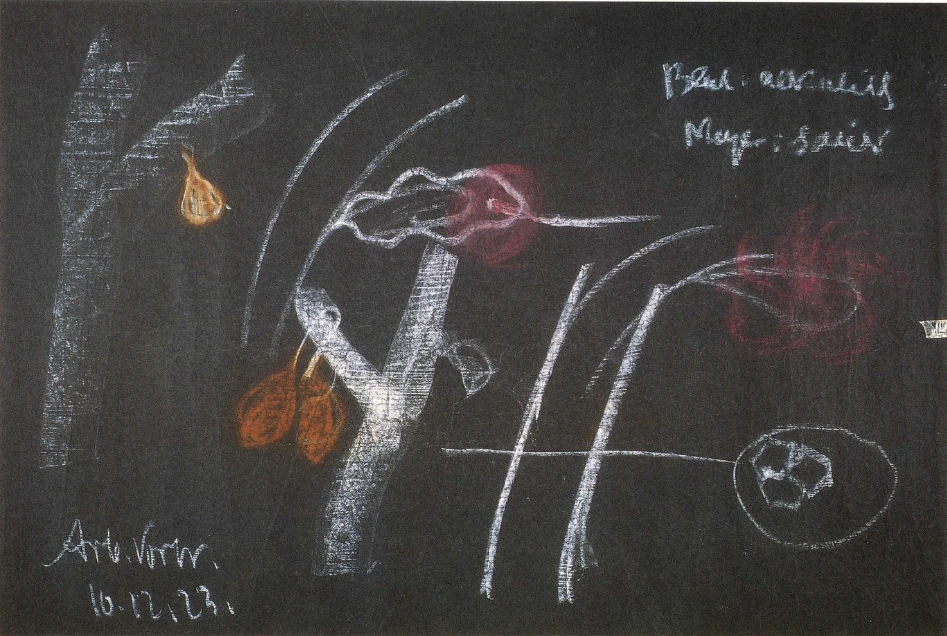
[ 20 ] There are wasps that have the peculiar habit of laying their eggs in various places—in plants, in trees, for example in the leaves or in the bark of trees. There are even some that lay them in the flowers of trees. So it looks like this (drawing on p. 204): There is a tree branch, and let’s say there is an oak leaf, and now the wasp uses an ovipositor—which is a hollow stinger—to lay its egg inside the oak leaf. — What happens next? Now, where the wasp’s egg has been laid, the entire tissue of the leaf surrounding the wasp’s egg changes. The leaf would have grown in a completely different way if the egg had not been laid there. All right. Let’s now look at what results from the wasp egg being laid there. What happens is that plant growth changes completely in this area, and around the wasp egg, protruding from the leaf, the so-called gall forms. These are precisely those brownish-looking galls that you find on trees. Where did they come from? They came into being because a wasp laid its egg at that spot, and now this altered plant tissue surrounds the wasp’s egg. It completely envelops the egg. This wasp egg would perish if it were laid just anywhere. It can only thrive because, first of all, there is this protective substance around the egg—substance that the gall wasp steals from the plant. It takes it away from the plant.
[ 21 ] You see, the bee lays its egg inside the honeycomb, and it develops from a larva and so on, becomes a bee, and later steals the plant’s nutrients and processes them within itself. The wasp, on the other hand, does this a little earlier. The wasp, simply by laying its egg, already takes away from the plant the substance it needs. So the bee waits a little longer than the wasp before doing what it does. The wasp does it earlier. In higher animals and in humans, the egg already surrounds itself with a protective shell while still in the mother’s body. In that case, what the wasp takes from the plant here is taken from the mother. This gall is simply formed from the plant, just as the chorion forms around the zygote in the mother’s womb as a protective membrane, which is later expelled with the afterbirth.
[ 22 ] You can see how the wasp interacts with the plant. In areas with a particularly high wasp population, you’ll find that the trees are completely covered everywhere with such galls. The wasp lives in symbiosis with the trees. It depends on them. Its seed could not thrive at all if this protective covering were not formed by the trees or plants in question. This can also take other forms. There are also galls that do not look like apples, but grow out in a way that makes them hairy and intertwined (see drawing). But everywhere, the wasp’s embryo is inside at the center. Sometimes you can also find these galls in the form of shaggy little nuts. This is something that shows how the wasps live together with the plants. Then, when the wasp is mature, once it has fully developed, it bores its way out with its mandibles and crawls out as an adult wasp. After living outside for a while, it returns to lay its egg in a leaf or something similar. Thus, the egg-laying process always takes place within the context of coexistence with the plants.

[ 23 ] You might now ask: What does this have to do with honey production? — Gentlemen, this actually has a great deal to do with honey production, and one can learn how honey is made by considering this matter. And there are also, in the older—I would say—folk science, instincts that take such a thing into account. As you may know, in more southern regions, particularly in Greece, fig cultivation plays a major role. Now there are so-called wild figs, which are somewhat sweet, but some people have a more refined palate and would like figs that are even sweeter than the wild figs actually are. So what do these people do?

[ 24 ] Now imagine there is a wild fig tree. This wild fig tree is particularly favored by a certain species of wasp, which lays its eggs inside it (see drawing). So let’s imagine: There’s a wild fig tree, and on one of its branches is a wild fig into which the wasp lays its egg.
[ 25 ] Well, the fig grower is actually quite a clever fellow in his own way. He lets these wasps lay their eggs in the wild fig trees that he specifically cultivates for this purpose. Later, the farmer picks two of these figs at a time when the wasp larvae inside are not yet fully developed—meaning the wasps are still far from hatching but have already gone through part of their development. So, what does he do next? He takes a rush stalk and ties these two figs—in which he has not allowed the wasp larvae to reach full maturity—together with this rush stalk so that they stay secured. Now he goes to a fig tree that he wants to graft and hangs the two figs—which he has tied together with the rush and in which the wasps have nested and laid their eggs—onto the fig tree he intends to graft. What happens next?
[ 26 ] Here’s what happens: The wasps sense this because the figs he has picked—which are no longer on the fig tree—are now drying out; they’re losing their moisture, no longer drawing sap from the tree. Even the wasp, which isn’t fully developed yet, senses this internally. Even the egg senses this. And the result is that the wasp hurries terribly to emerge from its egg. So the breeder begins this procedure in the spring: First, he lets the wasp lay her eggs. As soon as May rolls around, he picks those two figs and performs this procedure. “Good heavens,” thinks the wasp inside, “now I have to hurry! The time is already coming when the fig will dry out again!” The wasp hurries terribly, hatching much earlier than it otherwise would have. If the fig had remained on the tree, it would have hatched in late summer. Now, however, it must hatch in early summer. The result, however, is that because it hatches in early summer, the insect must produce a second brood, and it lays eggs while it’s still summer—when it would otherwise have laid them only in the spring.
[ 27 ] With these eggs, the wasp now heads for the figs on the tree that is to be grafted. She lays the eggs there—late-season eggs that do not reach full maturity but develop only to a certain degree. And what happens as a result? These figs, into which the second brood has been laid, become twice as sweet as the other wild figs! This is called the grafting of figs—the process by which they become twice as sweet.
[ 28 ] So what happened there? What happened was that the wasps—which are closely related to bees but are different animals—extracted from the plant, while it was still in the egg stage, the substance that can become honey. And if one skillfully guides them—as the fig grower does, who ties his two wild figs, with the wasp eggs inside, together with a rush stalk and swings them up into the tree so that they hang there—if one skillfully prompts them to weave back into the plant what they have absorbed from the other plant, he allows them to transfer the honey into the plant where he has hung them—into these grafted figs—now as a sweetener. The sweetness enters these grafted figs because the honey has been deposited by the wasp in a very fine distribution. This has happened through nature’s indirect process.
[ 29 ] So you see: We haven’t taken anything away from nature; rather, we’ve left the nature of honey intact. The wasp cannot produce honey the way the bee does, because its physiology simply isn’t suited for it. But if forced to take this detour, it can transfer the sweetness of its honeydew from one fig to another during its reproductive cycle. This makes the second fig—the ripened one—sweet. And there is a kind of honey-like substance inside it. So you see: this leads us to something quite special. It turns out that these wasps have a body that is not capable of taking the honeydew from nature and converting it into honey within their own bodies. But they can facilitate, within nature itself, a kind of honey formation that takes place as the honeydew is transferred from one fig to another.
[ 30 ] The bee, then, is an animal that has developed a wasp-like body to such an extent that it can now separate itself from the tree and do what the wasp must leave inside the tree itself. We must say: The bee is an animal that retains within itself, to a greater extent, the power that the wasp possesses only while it is very young—while it is still an egg or a larva. The wasp loses its honey-producing power in later life, while the bee retains it and can exercise it as an adult. — Yes, consider, gentlemen, what it means to be able to look into the whole of nature and say to oneself: Inside the plants lies the honey, lies this substance that has the sweetness of sugar. It’s right there inside. It also comes to light when one takes the right approach, when one supports nature simply by allowing the wasp to fly over to the tree one wishes to graft at the right time.
[ 31 ] Here in our part of the world, you can't do things like that; in fact, these days it's no longer possible at all. But there was once a time in the Earth’s development when it was possible to use wasps—which are used today and were also used two thousand years ago—in such a way that, like the clever human, right, one induced them to produce a second brood, allowed these wasps to hatch, and then gave them the opportunity to lay eggs in the figs that had been picked, and through this process it was gradually possible to breed bees from the wasps. The bee, in fact, is an animal that was bred from wasps in ancient times. And today, as I said, one can still see how, through the activity of these creatures—that is, through the activity of wasps—this production of honey occurs in nature itself.
[ 32 ] And from this you can also see how it is that bees deposit their honey in honeycombs in a specific way. The honeycomb consists essentially of wax. Indeed, this wax is not only necessary for the honey to be stored in general, but the bee can only produce honey if her entire body is functioning properly. She must therefore secrete wax.
[ 33 ] Well, the second fig tree, in which the sweetness develops on its own, also produces more wax than the wild fig tree. And it is precisely in this way—that it is more wax-rich—that the grafted fig tree differs from the wild one. Nature itself adds this wax. Thus, the grafted fig, the sweet fig, thrives on a tree that, in a certain way, makes itself more wax-rich from within. Here you can already find a foreshadowing of what occurs in beekeeping.

[ 34 ] But if you go about it very carefully, you can take the trunk of the grafted fig tree, cut through it, and—if you look closely—you will, strangely enough, find structures (see illustration) that resemble wax cells. From this wax, which settles inside the stem, such structures form—namely, a kind of honeycomb. The grafted fig produces more wax, and inside the stem, the wax also arranges itself into a sort of cellular structure. So one could say: If we look at this fig grafting, we see a form of beekeeping that did not arise naturally, except that the honey remains inside the fig.
[ 35 ] The bee, if I may put it that way, brings out into the open what, in the case of the cultivated fig, remains within nature itself. The bee brings it out into the open. As a result, the wax—which would otherwise have remained inside the trunk and formed a kind of natural cell structure there, one that is not so distinct, not so solid, but merely hinted at and then disappears again—is driven up into the fig. The entire process of wax and honey production then takes place inside the fig. This entire beekeeping activity that occurs there is contained within the tree itself, so that nature as a whole is a beekeeper.
[ 36 ] What did the bee do first? The bee first laid an egg, placed the egg inside the hive, and the egg hatched. Now she does not need to transform the substance there into a gall apple, but instead extracts the honeydew directly from the plant. Nor does it go to the other tree, which grows more vigorously; instead, it creates—as it were—the honeycomb structure that would otherwise form within the trunk, and pours the sap—which is now honey—into it, whereas in the grafted fig, the sap fills the entire fig. So one can say: What is taking place in the open is precisely what in nature otherwise remains within the realm of the trees, settled between the trees and the wasps themselves. — And from this you can really see quite clearly what you are actually looking at when you have a beehive with its so artfully constructed wax honeycomb cells. It’s actually a wonderful sight—isn’t it, Mr. Müller? —This artificial arrangement of wax honeycomb cells must be a wonderful sight. And inside it all, honey!
[ 37 ] Yes, gentlemen, take a look at this. Then say to yourselves: My goodness, the bee actually creates, within its marvelous wax honeycomb cells, a sort of artificially constructed tree trunk with its branches! It doesn’t go inside the tree itself to lay its eggs, but builds something on the outside that resembles the tree, and instead of letting the fig grow on it, it places the honey right into the finished honeycombs. So, through the bee, we have created a kind of replica of the artificially grafted fig tree.
[ 38 ] This is indeed a glimpse into the heart of nature, which will show you how to learn from nature itself. But one must be able to learn from nature. People will learn a great deal more from nature. But first they must see the spirit within nature; then they will learn such things. Otherwise, don’t you think, you just stand there gawking when you travel south and see that clever fellow tying his pricked figs together with a rush and then flinging them up into the wild fig tree—gawking just like the travelers, even if they’re scientists who don’t know why he does it: Because he saves the bees the work, since nature has already put the honey into the figs for him. And the figs are, in a similar way, as healthy as honey in the region where they thrive, because the honey is already present within them in its initial stage.
[ 39 ] These are the things one should keep in mind when discussing something as important and far-reaching as beekeeping. I believe that, in this way, one will gradually arrive at somewhat more accurate views.
Questions and Answers
R. Hahn: After the lecture, I approached Dr. Steiner and asked him what the cause of bee foulbrood was. He said he could not say anything definite about it until he had actually examined the disease. But he suggested that bee foulbrood was likely due to an abnormal composition of the queen bee’s uric acid. He then added: “After all, bees also have uric acid in their bodies; it’s quite likely that the abnormal composition of the uric acid is the cause of this disease.”
In response to a question regarding the cross-breeding of bees from wasps mentioned in the same lecture, he said something to the effect of: “This process took place in ancient Atlantis, where the individual animal forms were not yet as strictly defined as they are today, and where there were not yet such firm boundaries between the individual species. Today, such cross-breeding would no longer be possible.”