Man and World
How Spirit Works in Nature
GA 351
5 December 1923, Dornach
Translated by Steiner Online Library
12. On Honey
Mr. Erbsmehl argues that in modern beekeeping, the beekeeper is primarily concerned with profitability. Thus, the focus is solely on material gain. The *Schweizerische Bienen-Zeitung*, Issue 10, October 1923, states: “Honey is largely a luxury item, and those who buy it can pay a fair price.” Later in the same issue, an example is given of a certain Mr. Baldensberger, who was traveling through Spain, and encountered a beekeeper with a number of children playing among the blooming flowers. When Mr. Baldensberger asked the beekeeper where he sold his honey, the beekeeper replied: “Here are my customers.” - Here in Europe, the aim is to squeeze as much as possible out of the honey. An entrepreneur with many workers seeks to extract as much as possible. The same is true of bees.
The article also asks whether there is any truth to the claim that moonlight has a certain influence on honey production or the production of nectar by flowers. (Issue No. 11 of the “Bienen-Zeitung.”)
Mr. Müller replies that Mr. Erbsmehl can see from the beekeeping journal that this is a small-scale beekeeper who does not resell his honey. Erbsmehl does not yet understand what beekeeping entails these days, all that goes along with it, and that, as a result, one must also do the math. If one does not factor in profitability—as is the case in other situations—then one simply has to give up beekeeping. And if honey were not produced in this way through artificial breeding, there simply wouldn’t be nearly as much of it. Sometimes there are only one or two kilograms of honey, and in some cases a little fir honey, which must be harvested if one wants to keep the colonies healthy. That’s all. Then there’s a bad year, and it isn’t enough to last until April or May. Colonies that are to remain viable must be sustained with the help of artificial feeding—sugar, chamomile tea, thyme, and a little added salt. In a modern apiary, the hours are recorded very precisely—how much time the beekeeper has spent, five and a half hours—and each hour is billed at 1 franc or 1.50; that brings the cost of the honey up to 7 francs. You also have to factor in depreciation; the comb structure is lost, so you have to replace it. The operation must be profitable after all. If the beekeeper always clings to the old way of thinking, he won’t make any progress. Mr. Erbsmehl can do that, of course; but if I have a large operation, I have to do the math and conclude that a loss has already been incurred at 6 francs. American beekeepers take exactly the same stance.
He could not understand how peoples were supposed to die out after eighty to one hundred years. He could not quite grasp what the doctor meant when he said that, in fifty or one hundred years, artificial breeding might suffer.
Regarding the second point—namely, the bees’ reaction to the death of their queen—he had already mentioned that the majority of a hive had perished upon the queen’s death. He could not understand how this happened.
Regarding non-genuine honey in hotels, he would like to point out that first-class hotels buy a lot of American honey. When bees are fed this honey, they die. And that, after all, is also a bee product.
Now, about bee stings: Sweat is the worst thing for bees. If you hear whistling or buzzing sounds, it’s best to stop where you are.
Regarding the question of how much of an effect a bee sting can have on a person, I know of an example that I would like to share. A strong man, even stronger than Mr. Binder, was stung by a bee. He cried out, “Hold me—I’ve been stung by a bee!”—He was extremely sensitive to it. He was a man who suffered somewhat from heart problems. Perhaps the doctor will have something to add regarding the extent to which a bee sting could pose a particular danger.
For example, there is a saying: “Three hornet stings can kill a horse.” — Some time ago, I found a hornet’s nest in my apiary. I had removed the brood. The hornets were so cowardly that they didn’t sting in the dark; out in the open, they might have done so.
[ 1 ] Dr. Steiner: To discuss these matters as efficiently as possible, let’s start by talking about how bees recognize their queen.
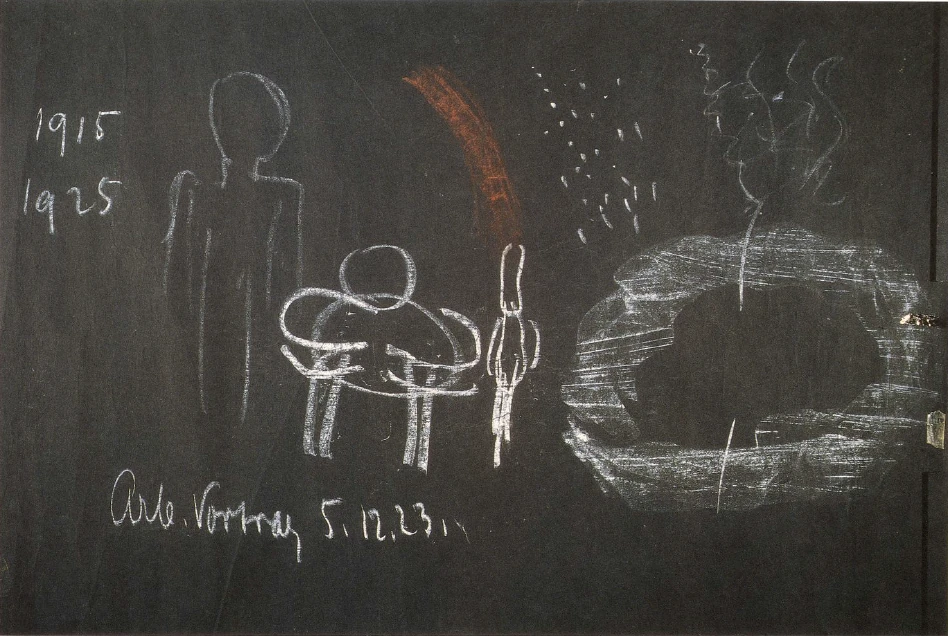
[ 2 ] You have reached a conclusion that, as long as one considers the matter rationally, is of course entirely justified. But now let me tell you something. Imagine you have a friend whom you meet, let’s say, in 1915. This friend stays here in Europe, and you go to America and return in 1925. For my sake, let’s say the friend is in Arlesheim. You arrive in Arlesheim, meet the friend, and recognize him. But what has happened in the meantime? I have already explained to you: The material, the matter, the substance within the human body is completely replaced after seven or eight years. There is nothing left of it at all. So when you see your friend again after ten years, he has nothing left within him of all that—truly nothing left of the physical matter you saw in him ten years ago. And yet you recognized him. And when we look at him outwardly, he certainly appears, as you know, to be a coherent mass. He certainly looks that way. But if you were to look at him now through a sufficiently large magnifying glass, you would see: a blood vessel is flowing in his head. Yes, of course, this blood vessel looks that way when viewed with the naked eye or a small magnifying glass. But if you imagine a gigantic magnifying glass, what appears to be blood no longer looks that way; it consists entirely of tiny dots that look like little animals. But these dots aren’t at rest—they’re constantly trembling. And when you look at that, it bears a striking resemblance to a swarming bee swarm!
[ 3 ] When you magnify a human being’s physical substance enough, he actually looks exactly like a swarm of bees. Once you understand this, it should actually seem incomprehensible that a person would recognize you again after ten years, because not a single one of those tiny moving dots is still there. His eyes contain entirely different points. There are entirely different little creatures in there, and yet the person still recognizes you again.
[ 4 ] So it is absolutely not necessary for these individual tiny creatures and plants that make us up to be the ones that recognize us; rather, the whole human being recognizes us; and the beehive is not merely what is called so-and-so many thousand bees, but the beehive is a whole, a complete being. It is the entire beehive that recognizes us or fails to recognize us.
[ 5 ] If you had reducing glasses instead of magnifying glasses, you would be able to bring all these bees together and connect them just as you would a human muscle. So that is precisely what one must keep in mind when considering bees: that one is not dealing merely with individual bees, but with something that is absolutely interconnected—something that constitutes a whole. And that cannot be grasped by reason alone. You have to be able to view the whole as such. And that is precisely why the beehive and so on are so immensely instructive—because the beehive completely refutes the reasoning we engage in. Our reasoning actually always tells us that things ought to be different. But the most wondrous things take place in the beehive. It is not as we initially imagine it to be with our intellect. So what takes place there—the fact that this change, the death of the drone king, does indeed have a certain influence on the beehive—that cannot be denied. It is there. Experience confirms it. Anyone who has not only been involved with a single apiary but has seen many apiaries will certainly notice this.
[ 6 ] And I can tell you: Beekeeping, for example, became extremely close to my heart in the most diverse ways, especially when I was a boy, and I was able to take a keen interest in it back then simply because, at that time, financial matters, economic issues, and business concerns—especially as they related to beekeeping—interested me less than they do today or than they would later, and this was because honey was already so expensive back then that, given my parents’ poverty, we simply couldn’t afford to buy any. In fact, we always received honey as a gift from our neighbors—mostly at Christmas—and we received so much throughout the rest of the year that we had honey all year round. It was shared around. So the economic aspect didn’t interest me all that much, because as a boy I ate an awful lot of gifted honey, as much as I needed. Why might that be? Today, under the same circumstances, it wouldn’t be so easy to get honey as a gift. But back then, in the neighborhood where my parents lived, most beekeepers were farmers and integrated beekeeping into their farming operations.
[ 7 ] This is quite different from a situation where one of these gentlemen takes up beekeeping while otherwise working as a laborer who must live off his wages. Within agriculture, beekeeping is carried out without anyone even noticing it. Working hours, so to speak, do not come into play at all, because beekeeping is something that is done with whatever time is left over. In agriculture in particular, this is always the case: time has been left over, saved up elsewhere, or another task has been postponed to a later time, and so on. In any case, the honey was produced in between, and people actually had a mental image of honey as something so valuable that it cannot be paid for at all. - And in a certain sense, that is actually true, because the fact is that under today’s conditions, everything that exists is subject to distorted price relations. Today, we really shouldn’t even begin to discuss price relations, because everything is subject to distorted price relations, and the issue of price must be discussed in a much more comprehensive way, specifically on a national economic basis. There’s not much to be gained from discussing the price of individual food items, and honey is a foodstuff, not merely a delicacy or luxury item. In a healthy social order, a healthy price for honey would naturally emerge. There’s no doubt about that at all.
[ 8 ] But because we do not live in healthy social conditions at all today, all these issues end up in an unhealthy situation. You see, it’s also the case today that you come across large estates. Yes, gentlemen, what the estate manager tells you there—as a rule, it’s not a farmer but an estate manager on a large estate—what he tells you about the amount of milk he gets from his cows: it’s horrifying. He gets so many liters of milk a day that anyone familiar with the nature of cows knows: it’s impossible to get that much milk from a cow. But they do get it! They certainly do. In some cases, they manage—as far as I’m concerned—to nearly double what a cow can actually produce in terms of milk. This makes the estate incredibly profitable, of course. And you can’t even say that you’d notice in any significant way that the milk doesn’t have the same nutritional value as milk produced under natural conditions. So, to begin with, there’s no way to prove that anything bad is happening.
[ 9 ] But let me give you the following example. We have conducted experiments with a treatment for foot-and-mouth disease in cattle, just as we have carried out many such experiments in recent years. These trials were conducted on large farms, but also on small family farms, where milk production from the cows was not as high as on the large farms. Of course, we were able to learn a great deal, because we had to test how the treatment worked against foot-and-mouth disease. The project was never completed, however, because officials were unwilling to support it, and today one needs all sorts of permits and so on. But the remedy proved exceptionally effective. And in modified form, it is also used very effectively in remedies such as the so-called “Staupe-Heil,” the remedy for canine distemper.
[ 10 ] If you conduct these experiments, you will find the following: You will see that calves born to cows that are over-trained to produce too much milk are significantly weaker. You can see this in the effect of the remedy; the effect—or lack thereof—is, so to speak, tremendously amplified. The calf will, of course, grow up—provided it doesn’t perish from foot-and-mouth disease. But a calf descended from a cow that you overfeed and thereby force to produce too much milk—such a calf is already weaker than calves descended from cows that are less conditioned to produce milk. You can see this in the first, second, third, and fourth generations. It’s so subtle that it’s almost imperceptible. This practice of raising cows for milk has only been around for a short time; but I know this very well: If we continue this way—if a cow is expected to produce over thirty liters of milk a day, if we keep mistreating her like this—then the entire dairy industry will be completely ruined after a while. There’s absolutely nothing that can be done about it.
[ 11 ] Well, of course, it’s not really that bad with artificial beekeeping, because the bee is an animal that always helps itself—after all, the bee is much closer to nature than a cow can be when it’s bred that way. It’s not even that bad when cows are mistreated in this way through dairy farming, yet you still take them out to pasture. But even those large farms don’t do that anymore. These farms rely solely on barn feeding. The cow is completely torn away from her natural environment.
[ 12 ] You can’t afford that in beekeeping. By its very nature, the bee remains in harmony with the natural world. So it helps itself in turn. And this helping—this helping itself—is something truly marvelous about the beehive as such. This brings us to what Mr. Müller said about the hornets he sometimes finds inside his apiary—and which haven’t stung him—whereas, ordinarily, when a hornet approaches you, it can be a very dangerous situation.
[ 13 ] I’d like to tell you something else. I don’t know if you’ve had this experience yourself—those of you who are beekeepers will know—but you may find yourself in a situation where you need to have an empty beehive. Yes, you see, I once saw something strange inside such an empty beehive—something like a lump (it is drawn). At first, no one knew what it actually was. The bees had made this lump there, seemingly for no reason at all. From all sorts of materials—the same ones used to make their other products—they had formed this lump. It was simply a large lump, like a big stone, made of all kinds of resins, pitch, glue-like substances—which the bees also bring in—wax, and so on; they had formed a large lump out of all that. Well, gentlemen, I was curious to find out what was actually going on there, so I took this lump apart—and bam, there was a dead mouse inside, a real dead mouse!
[ 14 ] This mouse had gotten into the beehive, had died inside, and now just imagine what a terrible ordeal the stench of a dead mouse must have been for the bees! In this extraordinary situation, the entire beehive acted on instinct to surround the dead mouse with a shell. When the shell was taken apart, it already stank terribly; but the stench remained trapped inside the shell. You see, the entire beehive was driven not only by the instinct to build cells and feed the young, but also by the instinct for what to do when—unusually—a mouse gets inside. And since the bees were unable to carry the dead mouse out, they helped themselves by building a shell around it. I have heard from others that snails and slugs, in particular, which enter the hive in this way, become encased in the shell. The beehive is home not only to ordinary instincts, but also to true healing instincts. These are extraordinarily effective.
[ 15 ] Well, if there is a hornet’s nest inside the beehive, the bees do not build such a solid structure around it, but they constantly surround the hornet’s nest with their secretions, and as a result, the hornets lose the energy and strength to even move. Just as the dead mouse inside no longer emits a smell in all directions, so the hornet—even if it isn’t completely encrusted—continues to live amid the fumes with which the bees surround it, so that it grows weak and can no longer harm them. Thus, the hornet completely loses its strength and energy and can no longer defend itself when approached.
[ 16 ] It is certainly true that one can only cope with bees if one goes beyond mere reason and actually observes things with a certain inner insight. This image is truly wonderful. And that is why one must say: The beehive is indeed a whole. It must be understood as a whole. But with a whole, the damage does not appear to be merely momentary.
[ 17 ] Anyone who knows human nature well can, for example, say to themselves: Some people—and there are such people—are still quite spry at sixty-five or sixty-six; others are no longer spry because they suffer from internal calcification of the blood vessels and so on. To observe this and relate it to what took place in childhood is extraordinarily interesting.
[ 18 ] For example, you can give a child milk that comes from cows that consume too much feed—a situation related to the calcareous soil. As a result, the child can absorb some of the calcareous soil simply through the cow’s milk with which they are fed. This may not be immediately apparent. And now some modern-day doctor comes along, shows you a child like this who was raised on cow’s milk—also from the calcareous soil—and another who was raised on breast milk, and says: “It makes no difference at all”—and so on. But the child raised on breast milk is still sprightly at sixty-five or sixty-six years of age, while the child raised on cow’s milk has developed calcification by the time they’re sixty-five or sixty-six! This is because the human being is a whole, and what has an effect during one period continues to have an aftereffect much later on. Something can be perfectly healthy during a certain period; yet its effects linger. And that is what I mean when I say: Nothing at all can be concluded from the current state of affairs regarding what artificial beekeeping does or does not entail; rather, one must consider the consequences after fifty, sixty, or—for my part—a hundred years. That someone today might say, “I don’t understand how this could be different in fifty, sixty, or a hundred years”—that is entirely to be expected. The fact that people today are unwilling to see this—that’s exactly what happened to me once on a farm. You can rest assured: I was once, in all good faith, nearly killed when I merely began to suggest there that a farm shouldn’t produce so much milk; for cattle breeding will suffer much more quickly and will be ruined within a quarter-century.
[ 19 ] Today, one can have no objection whatsoever to artificial beekeeping, because we already live in circumstances where nothing at all can be done in the social sphere. But we must recognize that it is one thing to let nature take its course and simply guide it in the right direction, and quite another to introduce something artificial into the equation. But I don’t want to take any kind of stand against what Mr. Müller said. That is quite correct: We cannot determine that yet today; rather, we must postpone the decision. Let’s speak again in a century, Mr. Müller, and see what your view will be then. This is something that simply cannot be decided today. That is the issue.
Mr. Erbsmehl points out once again that today's beekeepers are focused entirely on profitability.
[ 20 ] Dr. Steiner: The more you find that someone is keeping bees as a side business, the more he tends to share the view of that Spaniard you mentioned. That is to say, while this may no longer be the case in general today, fifty or sixty years ago, farmers didn’t place much value on what they earned from their bees. It was always something he didn’t really count on. He would either give it away, or if he sold the honey, he’d put the money he earned into his children’s piggy banks or something like that. Today, conditions have changed completely. What kind of mental image can one have of someone who works on a time-based schedule—or is involved in something that’s entirely geared toward time—not focusing on profitability? He simply ends up doing so because of the circumstances as a whole.
[ 21 ] Isn’t it true that there are beekeepers today who, if they are working employees, have to stop working for a while—they have to take time off—if they want to run their beekeeping operation properly, don’t they? (- Of course! -) Well, then they naturally calculate what they’ve lost out on—by doing a completely different kind of work.
[ 22 ] Just think about it for a moment: beekeeping is so old that, for external reasons, no one today can say what it was like when it was still entirely wild. People are familiar only with our bees—I mean the European honeybees—and they know only domestic beekeeping. I believe that even in natural history books, the bee that is commonly found throughout Europe is referred to as “the common domestic bee.” So, in reality, people are only familiar with domestic beekeeping. It is quite remarkable that people are only familiar with domestic beekeeping. People don’t know what it was actually like when nature itself was still at work. Beekeeping, after all, is a very ancient practice. With such ancient practices, the value is determined by entirely different principles than those applied to most of what we work on today. Just think about it: today, people mostly work on things where it’s very easy to trace back when they originated. There you have two different systems of valuation. With bees, this goes back to the dawn of antiquity. Their prices aren’t like those in the metal or wood industries, which date back only a few decades. Only healthy social conditions will reveal how the price of honey should be determined—how the price that must result has emerged from entirely different circumstances.
[ 23 ] It’s hard to imagine today just how difficult it is to talk about price formation. To discuss price formation requires a very deep understanding of the actual circumstances. Recently, something truly wonderful happened to me regarding price formation, and I’d like to share it with you because it’s quite interesting.
[ 24 ] A university professor I know wrote a book on economics. He gave me the book—I was on a lecture tour at the time. I ended up staying there for quite a while, had a chance to talk about it, and said I’d be able to skim through the book here and there—though, of course, I wouldn’t be able to read the whole thing right away if I was only there for two or three days. Well, I looked through the book and said the following to him: I noticed—which isn’t always to my liking, but in your case I actually found it quite appealing—that you have an index in the book listing the terms of the topics you’ve covered. So I immediately looked up the entry for “price”—and there was nothing! There was absolutely nothing!
[ 25 ] So this man wrote a book on economics, and there’s absolutely nothing in it about prices! Yes, gentlemen, that’s very telling. Today, economists are completely incapable of even recognizing the most important problem in economics. They leave it out—price formation. And price formation is what matters. Everything depends on price formation. It’s just that you don’t see it. When something like this happens, it becomes particularly evident.
[ 26 ] That is why it is true that one must say: Even in this case, one must simply trust that, little by little, people will come to realize that we must bring about healthier social conditions. Then, I believe, there will be far less talk about profitability or unprofitability. These are concepts related to competition—not competition among producers of the same goods, but competition among producers of different goods.
[ 27 ] If you look back to my youth and consider beekeeping in the area where I was just living—where really only the farmers kept honeybees—well, those farmers were quite portly people. I can’t even say they were like any of you here; because no one here is as stout as those farmers were. The price of honey back then was such that no one would have bothered to keep bees just to sell their honey for money. If the beekeeper had stood next to the farmer, well, it would have looked like this (drawing p. 192): That would have been the farmer, and that the beekeeper! That wouldn’t have worked at all! The farmer simply didn’t factor beekeeping into his calculations, and the beekeeper would have had to. So that wouldn’t have worked at all. And so, as soon as you get down to profitability, you simply have to thoroughly understand and take into account the conditions of the national economy.
[ 28 ] Now I’d like to address a few more points that have come up following the previous discussion.
Questioner: There are people who cannot tolerate honey at all. It immediately gives them stomach problems. Is there a way to prevent this adverse effect of honey?
[ 29 ] Dr. Steiner: Well, people who cannot tolerate honey are generally those who are prone to sclerosis—the hardening of the entire body—at a very early age, so that their metabolic processes proceed very slowly. As a result, they cannot tolerate honey, which is specifically intended to speed up the metabolism. Because they themselves have a metabolism that is too slow, the honey wants to speed it up, and this creates a conflict with their own metabolism—since the honey wants a fast metabolism—and then they develop stomach problems that manifest in all sorts of ways. Everyone should actually be able to enjoy a little honey—that is, not only be able to enjoy it, but also have the innate ability to do so.
[ 30 ] If there are people who cannot tolerate honey, one should first and foremost determine what the actual causes are. One should not try to find a general remedy, but rather, depending on whether the person’s physical condition has been exacerbated by this or that factor, treat that specific cause. For example, the following case may arise.
[ 31 ] Let’s say a person cannot tolerate honey; it gives them stomach problems. Now one wonders: Does this person experience stomach problems from honey because he or she, let’s say, is prone to cerebral sclerosis—as they say, the calcification of the veins, arteries, and blood vessels in the head?—Then it may be that, at a certain stage of life, he or she cannot tolerate honey. In that case, one will have to treat such a person with some kind of phosphorus preparation. Then, if they can be cured, they will begin to tolerate honey.
[ 32 ] But it may also be the case that one notices in a person that the problem lies in the lungs. In that case, one should not take a phosphorus preparation, but rather a sulfur preparation. That is what I can say in response to this question. The point is not to make a general statement—such as, “A person gets stomach problems from honey; how do you treat them?”—but rather to say: If someone, at any age, cannot tolerate honey, that is an illness. A healthy person can tolerate honey. If they cannot tolerate honey, they are ill, and one must identify the illness and cure it.
[ 33 ] Being unable to tolerate honey, of course, isn’t as serious as when someone can’t tolerate sugar and develops diabetes mellitus. It’s obviously worse when someone can’t tolerate sugar, because then they’re sick—more sick than if they can’t tolerate honey. In that case, they’re also sick, and their illness must be treated.
Questioner: Like most insects, bees always fly toward candlelight or lamplight in the dark. Experienced beekeepers have repeatedly assured me that bees react much less to electric light. If you approach the bees with a shining electric flashlight, they remain completely calm, as if they don’t even notice the light. Only after some time do they become restless. Kerosene or candlelight attracts them much more quickly and in greater numbers. Is there an explanation for this behavior?
[ 34 ] Mr. Müller says that he had already noticed the same thing.
[ 35 ] Dr. Steiner: Well, gentlemen, you will have noticed in the old building that the domes were painted in various colors. These colors were made from pure plant substances. And this method of production using various plant substances ultimately showed that if sunlight had shone into the dome—that is, if these same colors had been exposed to sunlight for some time—it would have taken quite a while, perhaps months, perhaps years—they would have faded completely. You would no longer have been able to see anything of the painting inside. In contrast, when exposed to electric light, they remained intact. That is why we worked with these colors in such a way that a painter who had worked in sunlight would not have been able to use them at all in the first place. In sunlight, they would have faded completely. Under electric light, however, they have remained intact.
[ 36 ] So you see that sunlight, which does indeed have chemical effects—and you did say that the bee notices this—works in a completely different way than electric light. Electric light actually has a much more hardening effect on all matter; it does not dissolve it as readily. As a result, in electric light, the bee initially experiences something like a very slight, mild stiffness that it does not experience in sunlight. And then, of course, it recovers.
[ 37 ] That's what I wanted to say about it.
Questioner: Regarding the influence of the zodiac signs on honey production: In farming communities, people still place great importance on this—for example, when sowing seeds, they wait until the moon is in the sign of Gemini, and so on. The question now is whether one judges the individual zodiac signs based on external characteristics, or whether there is something more fundamental underlying them.
[ 38 ] Dr. Steiner: Of course, these matters are never properly addressed from a scientific perspective today. But it is possible to approach them scientifically. What I have told you has an influence on the beehive as such. The bee—and especially the queen—is, in a certain sense, a creature of the sun, and what the sun itself experiences as it passes through the zodiac has the greatest influence on the bee itself. But the bees are, of course, dependent on what they find in the plants. And it is indeed the case that the sowing—the dispersal of pollen—can be closely related to the Moon’s passage through the signs of the zodiac, and it all comes down to what prepared substances the bees find in the plants. So such things are by no means entirely plucked out of thin air; but the way it is usually presented is, of course, an amateurish portrayal. These matters must first be explored in greater scientific depth.
[ 39 ] That concludes our session for today. We’ll discuss whatever else needs to be said next Saturday at nine o’clock. I imagine many of you still have things on your minds. Beekeeping is such a wonderful and useful activity that you can never ask too many questions about it. Feel free to ask each other questions, and ask Mr. Müller and me. I think we’ll be able to find a gentle, harmonious balance between our differing views. After all, we don’t need to get as prickly as the bees themselves—we can settle all this amicably. But we should also be completely open with our questions.