

Man and World
How Spirit Works in Nature
GA 351
1 December 1923, Dornach
Translated by Steiner Online Library
11. Honey and Quartz
[ 1 ] Gentlemen! Mr. Müller gave me another issue of the *Schweizerische Bienen-Zeitung*, which contains an article about experiences with honey cures: “Our Further Experiences with Honey Cures at the Frauenfelder Children’s Home in Amden.” By Dr. Paula Emrich, Weesen, Issue 3 of the “Schweizerische Bienen-Zeitung,” March 1923.
Some passages from it will be read aloud.
[ 2 ] It is quite interesting to make a few comments on this article today. The point is that at this children’s home, an experiment was conducted to treat children who were found to be malnourished in some way with honey—specifically, by dissolving honey in moderately warm milk, stirring it in thoroughly, and then giving the children this honey in the milk, which had not been overheated, in milk that has not reached a boil—that is, milk that has remained below the boiling point.
[ 3 ] She reports excellent results there. In particular, the author notes the encouraging finding that the red blood cell count in children increases in a truly extraordinary manner. For example, she had two children who were siblings. The younger one, when admitted to the facility, had only 53 percent red blood cells. Upon discharge—that is, after completing the honey treatment—the red blood cell count had risen to 82 percent. The older child had 70 percent red blood cells, and when picked up, 78 percent. So while the increase was smaller, it was still an increase. The older child had only undergone the milk regimen and had also gained weight under that regimen, but only from 70 to 78 percent; thus, the child was not as weak to begin with, but also did not become stronger at the same rate.
[ 4 ] She goes on to cite a number of very interesting experiments. And here I ask you, when I mention these experiments, to pay attention to the ages of the children. If one wishes to investigate the effect of any substance on humans at all, it is of no use whatsoever to simply conduct these experiments in the laboratory; rather, just as one must first determine the age of any patient when conducting any dietary or therapeutic trials, one must also immediately determine the children’s ages.
[ 5 ] So we have an eleven-year-old boy who underwent an eight-week honey regimen and, as a result, experienced a very significant improvement in his glands. His apical pneumonia has also improved, and his red blood cell count—which is actually a key indicator—has risen from 53 percent to 75 percent. Next, another eleven-year-old boy. His percentage increased from 55 percent to 74 percent. Then a fourteen-year-old girl showed an increase from 70 percent to 88 percent. I won’t read the rest of the increases to you, as they are all significant. She also notes the weight gain, which likewise attests to the fact that the children have become stronger. She then lists a ten-year-old girl, another ten-year-old girl, a thirteen-year-old boy, a seven-year-old girl, an eleven-year-old boy, an eight-year-old boy, a twelve-year-old boy, a nine-year-old boy, and a seven-year-old boy. The experiments show that children of this age—that is, roughly of school age—benefit tremendously from the honey regimen.
[ 6 ] The author is now investigating what might be the reason that these children benefit so greatly from the honey treatment. She makes a very interesting point. She points out something that strongly condemns a practice that is still so widely used in science today.
[ 7 ] What does science do today when it wants to test foods for their nutritional value? Science breaks down these specific foods and determines how much of one or another so-called chemical substance is contained within them. That is what science does.
[ 8 ] Now, here’s what happened: A student—says the author—of the famous professor of physiology Bunge, whom you surely know by name, was in Basel conducting experiments in which he fed mice milk. These mice had it good; they developed quite excellently. So they were fed milk. But then he conducted the experiment in a different way. He reasoned: Milk consists of casein—that is, the substance in cheese—fat, sugar, and salts. And then he thought: The mice thrived on milk; milk consists of casein, fat, sugar, and salts; so I’ll give a group of mice casein, fat, sugar, and salts. That’s exactly what’s in milk. — And lo and behold, the mice he had given casein, fat, and so on to died after a few days! They were given the same things, but they died. You see: the composition of the substance isn’t what matters. Something else must be at play here—that’s what those gentlemen should have said.
[ 9 ] But what did these gentlemen say to themselves? They said: “Substance—that’s everything; substance must be everywhere. And wherever anything happens at all, there must be a substance there.” - But the substances found in casein, fat, sugar, and salts—well, they don’t do the trick! So the gentlemen said to themselves: There must simply be a new substance in there, in such small quantities that it can’t be detected by chemical analysis. — And this substance is now what people call a vitamin. “Vita” means life, so “vitamin” means “gives life.”
[ 10 ] Heine once wanted to make fun of something; so he said: There are people who, for example, want to explain where poverty comes from. Well, the simplest thing to do is to say: Poverty comes from “pauvrete.” — Then you have another word, but you haven’t actually explained anything.
[ 11 ] I was once in a gathering where people were discussing the origin of humor, and a number of people offered some really interesting thoughts on where humor comes from—on what makes us laugh. But then one person stood up and walked toward the podium in such a way that you could tell he felt he had a lot to say! And then he presented his view on humor and said: Humor comes solely from the fact that human beings possess the *vis comica*. — *Vis comica*: *vis* means power, *comica* means funny. Human beings possess this comic power; that is where humor comes from. — That’s just like when someone in economics says: Where does money come from? Money comes from the power to make money. — That explains absolutely nothing.
[ 12 ] Well, in economics, people will immediately notice that someone is a strange fellow if he says, “Money comes from the power that creates money.” But in the natural sciences, people don’t notice this when someone asks, “Where does the life-giving power in milk come from?” and answers, “From vitamins.” — That’s just like saying: “Poverty comes from pauvrete.”—But no one notices. People think they’ve said something profound, but they haven’t said anything at all.
[ 13 ] And that, I would say, is what makes today’s scientific community so exciting. People think they’re saying something, proclaim it with grand words, and other people believe everything they say. But if this continues for much longer in the course of world history, it will inevitably lead to everything withering away and falling into ruin. For the world depends on people being able to do something, not on people merely talking about things and spouting words. Words must signify what is actually there. And in the past, there really was a kind of science that was directly connected to practice. Today, however, there is a science that knows absolutely nothing about practice anymore. It merely spins out words. And this, of course, has come about partly because a new authority has been added to the old authorities.
[ 14 ] You just have to consider how recently it was that there weren’t as many magazines for such specialized topics as there are today. Back then, information about such topics—like, say, beekeeping—was actually exchanged at beekeepers’ conferences. That goes all the way back to my youth. There, you could find out how these matters were settled at such a beekeepers’ conference. People would share with one another what they knew from their own experiences, and you could tell right away whether someone was just a windbag or whether they actually had real experience behind them. Because it’s a whole different thing when you hear someone talk. That’s when you can tell whether he knows something or is just parroting what he’s heard. Because the printed word has often been added to the mix as a new authority. And when something is in print, people believe there must be some truth to it.
[ 15 ] But there’s more to this article. This doctor has actually done a great deal of good with her honey treatments. And what she’s done in her practice is truly outstanding. Now she’s thinking about it from a scientific perspective, and basically, nothing comes of it. And she says so herself:
“It would be highly desirable for the results of our experiments to become known to as wide an audience as possible, and for our growing youth, in particular, to be given more honey again.”
“For the time being, our reports merely present the results of our practical experience; but we have no doubt that, as the study of vitamins continues to advance, pharmacologists and physiologists will also address the issue of honey’s effects on the body.”
[ 16 ] Similarly, the author of the article states right at the beginning:
“I feel compelled to report on the effects of honey cures from a medical perspective as well. ... Our positive results directly encourage us to explore the deeper connections. Although I am well aware that I am still far from having penetrated their innermost nature, I would nevertheless like to shed light—based on our experiences and research findings—on the areas where, in my opinion, further research should begin.”
[ 17 ] Well, it’s clear from her own words that this doctor has the humility to say: “All this talk about vitamins doesn’t really get to the heart of the matter.”
[ 18 ] Now, let’s take a moment to think carefully about the following. Let’s now see what the effect of honey treatments is actually based on. As you can see, these experiments also reveal something to us. They show us that the effect of honey is particularly strong—and the experiments will demonstrate this more and more—not in very young children, but in those children who have either already reached the stage of tooth replacement or are well past it. So this is something the experiments themselves demonstrate. It is extremely important to take this into account. But the experiments actually reveal even more. They show that honey works best for children when it is added to moderately warm milk. So when you prepare a mixture of honey and milk, it is particularly effective for children.
[ 19 ] And if one were to take this a step further, one would find the following. One would find that honey can already be beneficial even for younger children. In that case, however, one must add only a little honey to the milk; more milk, less honey. For the elderly, it is mainly the honey that helps, not the milk. Favorable results for the elderly can be achieved by having them consume the honey without any milk at all.
[ 20 ] What must be said is that milk and honey are of extraordinary importance to human life. This is precisely what emerges from these experiences.
[ 21 ] And you see, gentlemen, the ancient sciences—as I have often told you—were not as foolish as today’s scholars believe. The ancient sciences sometimes come across as simple, but they were actually very clever, very wise. And now, as you know, the old saying—“It is a land flowing with milk and honey”—expresses the idea that it is a healthy land where one can live a healthy life. So the people of ancient times knew that milk and honey are things that are incredibly closely connected to life.
[ 22 ] Nature sometimes speaks in a very sensible way. You can understand what she is saying if you simply take simple things simply enough. Anyone who knows that nature acts very wisely in general does not need much proof that milk is what is best for small children and adolescents. Otherwise, honey would flow from women’s breasts instead of milk—which is by no means impossible in nature, since plants produce honey, and it is entirely possible that honey could be present in the secretions of the female breast. One simply has to take things at face value. One need not say, “Nature is a bungler, and she produces only milk and not honey in the female breast”—but rather, one must say: Behind this lies the insight that, for the young child, milk is the primary consideration, and that honey can be introduced as the child grows older.
[ 23 ] Yes, but we can’t just form a mental image that is merely a verbal construct and tell ourselves that poverty comes from “pauvrete,” humor from “vis comica,” and the invigorating power of honey from the vitamin it contains; rather, we must look at what is actually real in this regard. And so I will tell you the following—let’s put together what we’ve long known from these lectures, but the point is that one must always view things correctly.
[ 24 ] You see, gentlemen, when you go into the high mountains, you find quartz crystals right where the mountains are at their harshest—where, so to speak, the hardest earthen material protrudes. They are very beautiful. You find all kinds of crystals there. Remember, I drew these quartz crystals for you; they look like this (see drawing).
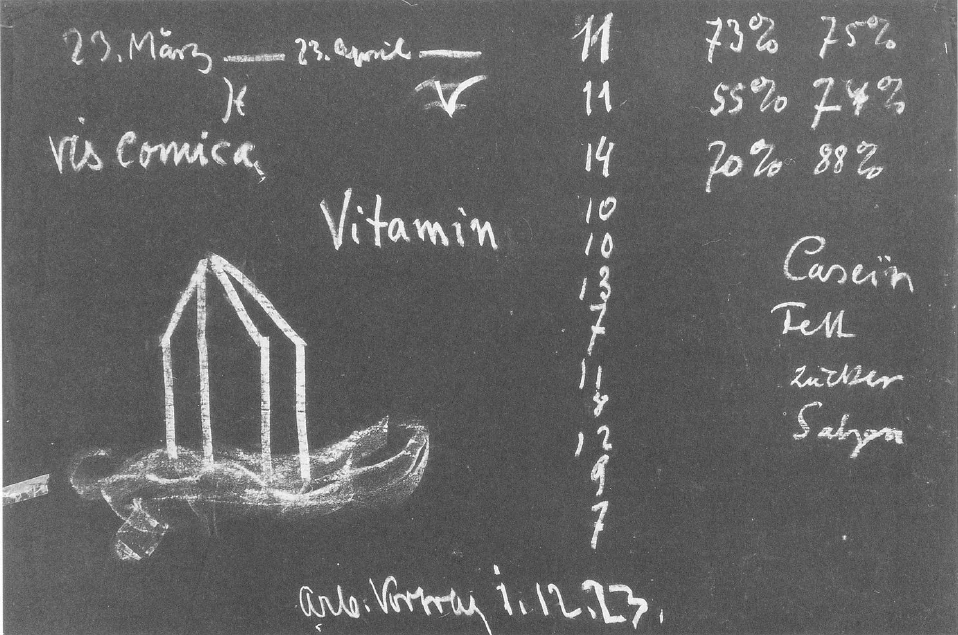
[ 25 ] When they are whole, they are just as complete down there as they are up here; but most of the time they are not whole. So they emerge from the rock, growing out of it, so to speak, in the shape I have sketched for you here, as I have sketched many times before. What does that mean? It means that the earth allows such crystals to grow out of it—crystals that are hexagonal and taper to a point. So there is a force within the earth that shapes things into hexagonal forms.
[ 26 ] You see, as I have explained to you time and again, all the forces that exist in the Earth and in the universe are present within human beings. The Earth, in turn, receives this force from the universe. Human beings receive it from the Earth. Within human beings lies this force that drives the formation of quartz crystals in the Earth. What is it like inside? Well, the human body is, in fact, full of quartz.
[ 27 ] Now you’ll say: “Good grief, what is he trying to tell us here!”—Quartz, as you find it up in the mountains, is one of the hardest substances. You could crack your skull on it. Quartz never breaks, but of course a human head will break if you try that and slam your skull violently against quartz. So hardness is what stands out most about quartz. But substances aren’t always the way they appear to us here and there. In humans, it’s exactly the same as quartz, but in a more fluid form. Why?

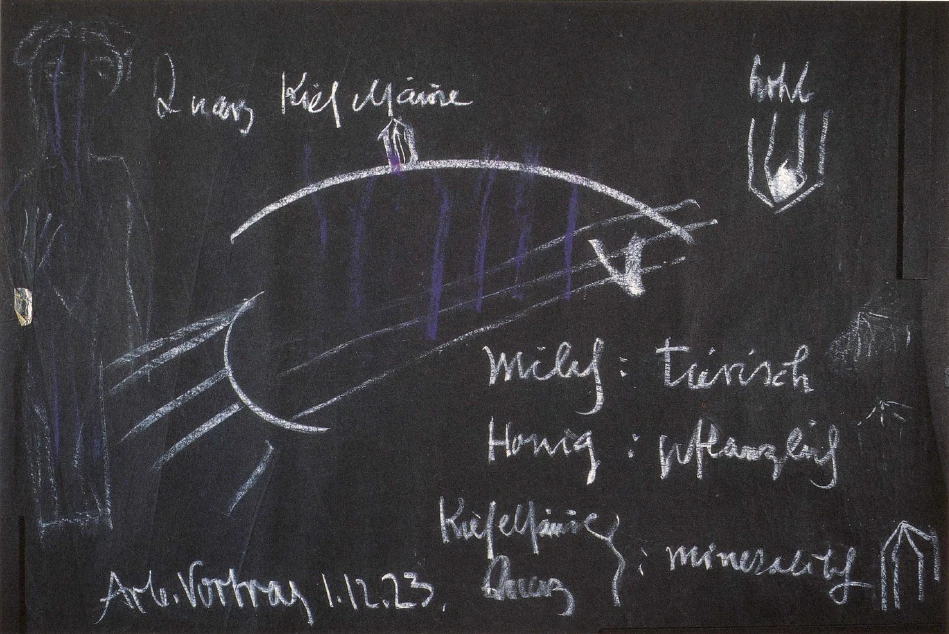
[ 28 ] You see, one can observe—and all it takes is to observe correctly through true inner vision—how something is constantly flowing down from the head into the limbs of the human being (see drawing). This is very interesting: If you consider the human head, the same substance that once flowed from the Earth’s interior to its exterior—and which hardened up there and settled, for example, as quartz crystals—is constantly flowing down from the head. That substance flowed out from the Earth’s interior; and in humans, it flows from the head throughout the entire body. It is quartz, or silicic acid. Only, the human body does not allow the quartz to crystallize. It would be quite a story, actually, if we were completely filled on the inside with nothing but quartz crystals. That would really hurt us! The human body allows it to proceed just to the point where the quartz is about to form hexagonal shapes. And there—that’s where it stops. It doesn’t let it go any further. So that within our bodies, only the beginning of quartz formation takes place, and then it is stopped; it must come to an end. And our life is based on the fact that we constantly want to form hexagonal crystals from the head down, but we don’t let it go that far—instead, we stop it. Inside us, such crystals constantly want to form. But they don’t actually form; they are held back, and we then have, so to speak, the quartz sap within us in a very highly diluted form.
[ 29 ] If we didn’t have quartz sap within us, then, for example, no matter how much sugar we ate—we would never taste sweetness in our mouths. But the quartz we have within us does not do this through its material nature, but rather because the will within it is to become hexagonal like a crystal. That is what makes it so. That is what matters.
[ 30 ] So you see, the Earth contains the same thing, which is simply carried forward. Human beings stop using silicic acid when it begins to take on a narrow-minded character within them. The earth allows it to rise up to the point of becoming narrow-minded. But human beings need this force—this silicic acid force—which is the power to produce hexagonal forms. Human beings need this power to produce hexagonal forms.
[ 31 ] I imagine that not all of you are skilled in geometry. Not all of you are equally familiar with geometry right now. You might not be able to draw such a quartz crystal yourself or mold it out of modeling clay right now. But your body—it is a skilled geometer; it constantly wants to make such crystals. We are prevented from doing so. But all life consists in our holding back death, and when we can no longer hold it back, then we truly die.
[ 32 ] Now let’s look at the bee again. The bee flies out and gathers honey. It then processes the honey within its own body and turns it into the very source of its own life force. But it also produces wax. What does it do with the wax? It uses it to make hexagonal cells. You see, the earth forms hexagonal silica crystals. The bee makes hexagonal cells.
[ 33 ] That is incredibly interesting. If I were to draw the bee’s cells for you—or if you recall how Mr. Müller showed them to you—they look just like quartz crystals, except that they are hollow. Quartz, on the other hand, is not hollow. But in terms of shape, they are exactly the same.

[ 34 ] Yes, you see, gentlemen, these cells are hollow (see drawing). But what goes inside them? The bee egg goes inside. Just as quartz contains silicic acid, the cell is hollow, and that is exactly where the bee egg fits. The bee is formed by the same force that exists in the earth and forms quartz. That is where the finely dispersed silica is at work. There is a force within it; it cannot be physically detected. Through the bee’s body, the honey acts in such a way that it can shape the wax into the form that humans specifically need, for humans must have these hexagonal spaces within themselves. Human beings need the same thing. And since the bee is the animal best able to initially form this hexagonal force, the bee is the animal that, out of all that exists, gathers the food that can best be transformed within the body into this hexagonal force.

[ 35 ] Look, gentlemen, if you eat honey now, you will gain an immensely invigorating strength. For if you have become too weak to develop within yourselves this hexagonal force—which must flow from the head to the entire body—if you no longer have the strength to give the blood enough firmness so that this hexagonal force is constantly present, then honey must take its place, or, in the case of a child, milk. The child does not yet possess this hexagonal force; therefore, it must still obtain it through the milk that is produced within the human being itself.
[ 36 ] That is why, no matter how much casein, fat, sugar, and salt you feed the mice, they will die. Why? Because even animals need this hexagonal force. If you simply mix casein, fat, sugar, and salt together, this force—which operates within the hexagonal structure—is not present. When you give the mice milk, it is present. However, it isn’t strong enough that the milk, when it turns sour, crystallizes into a hexagonal structure. If this hexagonal force in the milk were a little stronger, you could actually drink sour milk that would form tiny silicic acid salts on your tongue. It would taste as if there were lots of tiny hairs in the milk. But with milk, it doesn’t go that far, because milk comes from the human or animal body itself, and there it remains liquid. It’s still sufficient for a child, but for an adult, it’s simply no longer enough. And growing up begins as early as childhood. That’s when you need to introduce this stronger hexagonal force found in honey.
[ 37 ] This is very interesting: If you take milk, even though it comes from a human being, it is actually animal in nature—part of the animal aspect of the human being. In that sense, it is animal. If you take honey, it comes from the plant kingdom, albeit via the bee. It comes from the plant kingdom and is plant-based. If you take silicic acid—that is, quartz—it is mineral in nature. It has a very distinct hexagonal shape. The wax that is produced within the bee itself under the influence of the bee’s food has thus taken on a form—it did not originate from it, but derived its form from it—and it takes shape within the hexagonal cell. The milk, in turn, dissolves that shape. Inside the milk, only a shadow image of hexagonal crystals forms. And so one can say: Honey is what must be most welcome to human beings.

[ 38 ] Isn't it true that one might think it would also be good if, instead of eating honey, a person were to eat silicic acid, because then they would also acquire this hexagonal power within themselves. But because silicic acid has been driven so far in its development to take on a hexagonal form—to form this silicic acid structure within itself—it has too strong an effect on human beings. Nevertheless, it is still something beneficial.
[ 39 ] Now suppose the following. Imagine a poor child who is not fortunate enough to receive the kind of honey treatment described in this article—whether at sixteen or seventeen years old, or at thirteen or fourteen, which is the best time—and as a result, the iron levels in their blood grow weaker and weaker. The percentage in the blood keeps dropping lower and lower. The child grows up, reaches, say, thirty years of age, is poor, and has become a very frail person. The author of the article describes this as well, saying: they collapse. Now we are dealing with a person who has since turned thirty. A honey regimen could certainly be effective here, but the person is already too emaciated. He would have to consume so much honey for it to help that the honey itself would, in turn, upset his stomach. For honey is, at the same time, something that encourages moderation. If one eats too much honey, one upsets one’s stomach.
[ 40 ] This is based on a simple fact. Honey is sweet and contains a great deal of sugar. The stomach, however, primarily needs acid, and if you put too much sweet food into the stomach, you impair its acid production. In short, honey should only be consumed in moderation. So if a person is already so emaciated by the age of thirty, even if you were to give him enough honey for the honey cure to work—which it certainly would—he would immediately develop stomach upset and then go on to suffer from intestinal problems. So that’s not an option.
[ 41 ] But there is another approach. One can first give the person highly diluted, powdered quartz—which is silicic acid—as a remedy. And if one gives them highly diluted silicic acid as a remedy, this will enable them, after some time, to derive benefit from small amounts of honey. The highly diluted silicic acid has then brought forth within them the power to act in a hexagonal manner, and then a smaller amount of honey can follow. Silicic acid can be the way-maker for the honey.
[ 42 ] Another approach is to add a very dilute solution of silicic acid to the honey for such a person—that is, an adult who has reached the age of thirty and whose hemoglobin levels have become severely depleted—while it is advisable to give children plenty of milk. Then the honey has an effect on the person.
[ 43 ] You see, gentlemen, one must be aware of all these connections. So that one can ask: What effect does honey actually have on human beings? What actually affects humans through honey is this six-sided formative power. It is present within the bee. You can see this in their wax cells. And that is precisely why honey is so beneficial. That is why what I mentioned to you is correct: that in children, the power of milk is primarily at work, but it can be strengthened by honey, and that in adults, the power of honey is primarily at work. But once a person has grown older, this honey force must be strengthened by the quartz force, as I have told you. However, a honey-and-milk regimen can still be helpful, since the forces of early childhood are still present within them. A honey regimen alone can also help them. The benefits of the honey regimen remain entirely undisputed.
[ 44 ] The industry knows this very well, and simply by making these things very clear to people, one would only need to ensure that the right amounts of honey are always available on the market. And people are very prone to being deceived—I don’t mean in the usual criminal sense, but, I would say, to being deceived by cultural conditions. If you’ve ever traveled somewhere and stayed in a hotel and asked for honey, it often wasn’t honey at all—it was sugar honey, in other words, something that was artificially produced! Yes, if the
[ 45 ] If people had known that it isn’t the same thing—that there’s no question of this hexagonal-seeming force being present—then they wouldn’t have deluded themselves into thinking that this imitation honey works just like real honey. Of course, you could also feed the mice bee honey. They would really enjoy it. But they would die very quickly from this artificial honey, even if not within a few days.
[ 46 ] This is something I'd like to say regarding the article on honey-milk cures.
[ 47 ] Now, something else interesting has come to my attention that I’d like to discuss—and I’d like to hear what you yourself have to say about it, as well as what Mr. Müller has to say. You’ll see that there are so many questions to consider that it’s definitely worth our while to discuss this again next time. You can ask your questions then, and Mr. Müller or I will answer them. For now, I just want to briefly touch on two things. It may seem a bit strange to you, but I’m actually curious to hear what you have to say about them.
Written Question: In traditional farming beekeeping circles, it is widely believed that certain spiritual bonds exist between the beekeeper and his bees. It is said that when the beekeeper dies, his death must be immediately announced to every bee colony. If this notification is not given, all the colonies will die within the course of the next year. The fact that a certain spiritual connection exists between the two is suggested by the empirical observation that, if one attempts to work with the bees while in an irritable or angry state of mind, one is stung by the bees much more frequently than when performing the same task in a calm, harmonious state of mind. Could there be some truth to the view of old beekeepers described above?
[ 48 ] Dr. Steiner: Now, it would be interesting if Mr. Müller could simply tell us whether he considers such things to be completely unfounded. Such practices are common among rural beekeepers as a way of signaling death, aren’t they? But I’m referring specifically to this spiritual connection, this relationship between the beekeeper and the bees. Perhaps Mr. Müller could say something about that.
Mr. Müller recounts two cases in Basel and Zurich related to such matters. In one family, the wife—who had been very involved with the bees—had died, and within a year, all the bee colonies had perished. Another case that occurred in Basel, where a woman who had also devoted herself to the bees had died, showed exactly the same result. It was a large apiary; within a year, the number of colonies had dropped from twenty-eight to six. How this is related to the passage of time itself or to the bees is something we cannot explain. In one case, it cannot be proven that the bees had any disease; perhaps it was a psychological connection.
[ 49 ] Dr. Steiner: Let’s recall something I’ve told you before about the relationship between humans and animals. You may have heard about this, or perhaps I’ve already mentioned it to you: Some time ago, there was a lot of talk about so-called “calculating horses”—horses that were asked questions such as: “How much is four plus five?” Then they counted: one, two, three, four, five, six, seven, eight, nine—and the horse stamped its foot. The horses performed quite a number of such calculations. You may have heard that the “calculating horses” from Elberfeld, in particular, became famous. Commissions traveled there to investigate the matter and so on. I haven’t seen the Elberfeld horses myself, but I’ve seen another horse—the so-called “calculating horse” of Mr. von Osten—which could calculate just as well. And from that, one could form a very precise idea of what actually underlies the phenomenon.
[ 50 ] People have really racked their brains over these horses that can do math. After all, it’s actually quite a terrifying thought that horses might suddenly start doing math. And they calculated so quickly that the calculating machine was practically put to shame in the process. Well, gentlemen, if this were to find its way into education and we could teach horses to do math, that could mean fierce competition for accountants and for people who are hired to do calculations! So, of course, this whole business with the calculating horses is a terrible affair.
[ 51 ] But science, of all things, has made a complete fool of itself with these “calculating” horses. It’s easy to see why: Of course, a horse can’t really do math, so one must figure out why the horse stamps its hoof at nine. It is, of course, utter nonsense to believe that a horse can do math. Dr. Pfungst, who studied the matter in depth, also knew that the horse cannot do arithmetic. But he put forward a theory. He said: Every time Mr. von Osten counts, he makes a slight facial expression, and the horse observes the lines on his face—that expression. And in response to that expression, the horse stamps its hoof. - He immediately raised the objection: “Yes, but then he would actually have to stand there and look at Mr. von Osten and watch for the facial expression that the horse notices in order to stamp its feet.” So he stood there, but saw nothing. He didn’t lose faith in his theory, but instead said: “The expression is so tiny that I can’t see it, but the horse can see it.” - Well, gentlemen, it follows from this that a horse can see more than a private lecturer. Nothing else follows from it.
[ 52 ] But that wasn’t how it was. If you had a background in Spiritual Science and looked at the situation, you wouldn’t focus on some little expression; rather, this is how it went: On one side stood the horse, and there stood Mr. von Osten, holding the horse’s reins a little. And in the right pocket of his coat, Mr. von Osten had a whole bunch of little sugar cubes. And now Mr. von Osten kept giving the horse little sugar cubes. The horse licked them, found them sweet, and loved Mr. von Osten very much. It came to love him more and more because of the sugar cubes, and as a result, a warm relationship developed between the horse and Mr. von Osten. And Mr. von Osten didn’t need to make so much as a slight facial expression; he merely had to think: “At nine, it’ll be just right.” The horse sensed this, because animals have a much keener sense of what’s going on around them. They sense what’s going on in the mind, even if there isn’t the slightest facial expression that a horse could see but a human couldn’t; the horse senses what’s going on in the mind when he thinks, “Nine”; at that moment, the horse stamps its hoof. If the horse hadn’t received the sugar, then the horse’s love would have turned a little into hatred, and it wouldn’t have stamped its hoof anymore.
[ 53 ] So you see, animals possess a very, very keen sensitivity to things—not to subtle facial expressions, but to things that are actually invisible; in the case of Hans the horse, for example, to what is going on inside Mr. von Osten’s brain. You simply have to observe such things; then you’ll know that animals truly have a wonderful sense of perception.
[ 54 ] Just imagine you walk into a swarm of bees and are absolutely terrified. Yes, the bees can sense that you’re afraid; there’s no denying it. What does it mean to be afraid? — You know: When you’re afraid, you turn pale. Fear makes you turn pale. And when you turn pale, the blood recedes. It doesn’t flow outward into the skin. Now, when a bee approaches a person who is afraid, the bee senses in that person—more than usual, when the blood would be flowing into the skin—this hexagonal force and wants to extract honey or wax from you. Whereas, if a person remains calm and has their blood flowing evenly through their veins, the bee perceives something entirely different. It then senses that the blood possesses this same hexagonal force.
[ 55 ] Now imagine this: when a person is angry and walks among the bees in a fit of rage—yes, anger makes them flush. A lot of blood rushes there; the blood wants to absorb the hexagonal force at work. The bee senses this with its subtle perception and believes you want to take that force away from it, so it stings you. These are precisely the subtle sensations of the natural forces at play, the ones that are present within.
[ 56 ] And then there’s the matter of habituation. Just imagine: A beekeeper doesn’t simply approach the hive the way a human normally would; rather, the bees sense—if I may use that expression—his entire aura; they sense what he’s like. The bees get used to that. If he dies, they have to readjust. And that means an extraordinary amount to the bees. Just think about what you see even with dogs: When their owner died—this has actually happened—they went to the grave and died there because they couldn’t get used to another owner. So why shouldn’t we assume, in the case of bees—who have such a refined chemical sense—that they perceive everything, that they become so accustomed to the queen that they cannot immediately adjust to another? There is, therefore, certainly something significant underlying this.
[ 57 ] But you might ask: Is it the same with dogs and horses as it is with these tiny little creatures, the insects?—Well, you may not have noticed this, but it’s true nonetheless: There are people who, as they say, have a particularly green thumb when it comes to growing flowers. Everything thrives for them when they have a flower bed, plants, and so on. Someone else tends it just the same, yet nothing grows. This is the human aura—one person’s aura has a beneficial effect on the flowers, while another’s has an adverse effect. For some people, growing flowers simply doesn’t work at all. And this adverse effect is directed primarily at the very force within the flower that produces honey—the force that sweetens the flower. And so one can say: Humans even have an effect on flowers, and in the most profound sense, they have an effect specifically on the bees.
[ 58 ] So there is no need to be surprised by this; one simply has to consider the facts as they arise, and then one will see that things really can be this way. One will also be able to take this into account in practice.
Second question: According to an old farmer’s saying, if it rains on May 3—the Feast of the Finding of the Cross—it washes the honey from the flowers and trees, so that there will be no honey harvest that year. My observations over the past four years seem to indicate that there is some truth to this saying. Is something like this even possible?
[ 59 ] Dr. Steiner: Yes, gentlemen, this is something that takes us very deep into the workings of nature. The fact that it is precisely the Feast of the Finding of the Cross, that it is precisely May 3rd—that is of lesser importance. But what matters is that it is this time of year that is particularly active during these days. What does it mean, then, that it rains at this time, in early May? I once told you that the vernal equinox is now in the constellation of Pisces. The Sun remains in the constellation of Pisces until about April 23. Then, as it moves on, the Sun enters the constellation of Aries. So at the beginning of May, the Sun’s rays come from a completely different corner of the world than at other times. Suppose, then, that at the beginning of May—on May 3, for example—the weather is nice. What does that mean? It means that on May 3, the Sun exerts a powerful influence over everything earthly. Everything that happens on Earth takes place under the Sun’s influence when the weather is nice. So what does it mean if it rains on May 3—that is, in early May? It means that the Earth has the greater power and counteracts the Sun’s influence.
[ 60 ] All of this, however, is of immense importance for plant growth as a whole. If the sun’s energy—precisely when the sun’s rays come from the constellation of Aries—can act in such a way that it directs all its power toward the flowers, then the flowers develop this sweet substance that manifests itself in honey. Then the bees find honey. But if the earth has the upper hand—if it rains at that time—then the flowers cannot develop under the sun’s rays coming from Aries; instead, they must wait for a later time or their development is interrupted altogether. In that case, the flowers do not produce honey properly, and the bees find no honey.
[ 61 ] This is exactly the kind of thing that becomes clear when you realize that everything that happens on Earth—as I have told you time and again—is under the influence of the universe, that which lies beyond Earth. Rain simply means that the sun’s energy is being dispersed. Fine weather means that the sun’s power can unfold its full force. And what matters is not that the sun’s power comes in general, but that it comes precisely from that corner—not where we’re looking now, but right there from the direction of Aries. The sun’s power comes differently from every corner. It is not the sun alone that does this, but rather the fact that the sun shines directly onto the Earth from the front while Aries stands behind it in the cosmos. The sun first absorbs what Aries gives it, and then passes it on as sunbeams. It makes a world of difference whether the sun sends its rays to Earth at the beginning of May or at the end of May. At the beginning of May, the full power of Aries is still at work. By the end of May, the power of Taurus is already at work. Then comes that which can no longer act upon the plants with the same intensity—that which hardens and dries them out, and which, in particular, prevents the power of honey formation from developing within the plants.

[ 62 ] Thus, something has come to light in the old farmers’ sayings that has its reasons, and one should therefore take them seriously. Of course, as I’ve said before, awareness of such things has been lost, and as a result, we’ve fallen into superstition. And naturally, when one can no longer distinguish between fact and fiction, one can fall into superstition. Then farmers’ sayings have roughly the same value as: “If the rooster crows on the manure heap, the weather will change—or it will stay the same.” - But that’s not the case with all sayings; some are based on a deep wisdom that one must then explore. The farmers who used these sayings sometimes fared quite well with them! So you see, a deeper understanding also makes it possible to use these sayings again.
[ 63 ] To be continued next Wednesday.