

Man and World
How Spirit Works in Nature
GA 351
28 November 1923, Dornach
Translated by Steiner Online Library
10. On the Perception of Bees
[ 1 ] Good morning, gentlemen! Have you thought of anything else you'd like to ask?
[ 2 ] An article from the *Schweizerische Bienen-Zeitung N. F.*, issues 2 and 3, February and March 1923, titled “Do Bees See Colors That Are Invisible to Us?” by Prof. Dr. Buttel-Reepen of Oldenburg, is read aloud.
[ 3 ] Dr. Steiner: Well, let’s say a few words about this. These experiments—the ones conducted by Forel, Kühn, and Pohl—really show just how thoughtlessly such experiments are actually being carried out these days. Of course, one can’t imagine anything more absurd than such an interpretation of an experiment! Just consider that I could then also explain the following. Suppose I have a substance—such substances do exist—that is particularly sensitive to ultraviolet light, that is, to colors beyond blue and violet; for example, barium platinum cyanide, which is mentioned in the article. It glows even when I block out all other colors.

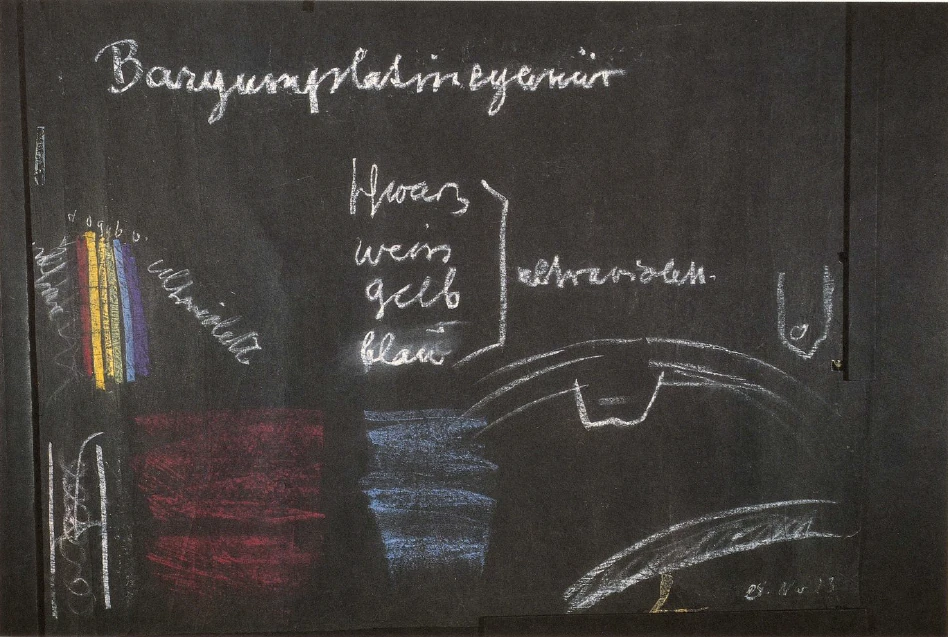
[ 4 ] So, I’m also filtering out red, orange, yellow, green, blue, indigo, and violet. That leaves me with red, orange, yellow, green, blue, indigo, and violet. Now I’ll make a filter—that is, I’ll block out everything in the spectrum. Then I still have what are called ultraviolet rays, which are invisible to humans. If I put this substance—a white powder called barium platinum cyanide—inside and close the shutters, it starts to glow. We humans can’t see anything in this darkened room; now we let these rays in, block out the rest, so that only ultraviolet light gets through. But when I add barium platinum cyanide, what happens? Then it “sees.”
[ 5 ] That’s exactly what you do when you use ants in an experiment. Instead of using barium platinum cyanide, I use ants. The ants are attracted to sugar—and as a result, I say: they see. They are no more in need of seeing than barium platinum cyanide is in need of seeing in order to glow. All I can claim at this point is that, if I have a substance somewhere, it has an effect on the ants. I cannot claim anything more than that. So the scholars in question are as thoughtless as can be and make claims that are nothing but pure fantasy.
[ 6 ] The only thing that can be said—and this is proven by the article, which states that if the eyes are painted over, no effects occur—is that the sensory organs had a more or less significant effect on these insects. What is also characteristic is that the scholar extrapolates what he observes in bees to ants and wasps. This shows how thoughtlessly such experiments are conducted.
[ 7 ] But there is more to it than that. If you continue along here (Figure $. 149), you arrive at what are known as ultraviolet rays. So here we have red, orange, yellow, green, blue, followed by indigo and violet. Here we have the ultra-red rays; there, the ultraviolet rays. So here on the right we have the ultraviolet rays, and these ultraviolet rays have the peculiarity—as he himself puts it in the article—of having a very strong chemical effect. So whatever is placed within the ultraviolet spectrum is subjected to a strong chemical attack. And the result of this is that if I place an ant there, it is immediately subjected to a strong chemical attack. It senses this. That’s right; it feels it most acutely in its eyes. It’s a sensation as if someone were crawling over it when it’s exposed to ultraviolet rays—just as barium platinocyanide reacts when it’s placed in a chemical environment. It’s exactly the same. If I block out all light in a room and have only ultraviolet rays inside, then the ant immediately senses: Something is happening there. — Especially when you have ant eggs or larvae there, they are completely altered; they would perish the moment this strong chemical reaction occurred. That is why these ants save the eggs. So what this article is about is, in fact, a chemical effect. What I claimed the other day is indeed true. I said: Bees have a kind of smell-taste, something that lies between smell and taste. That is what bees sense—and it’s similar with ants.
[ 8 ] These gentlemen know so little about what this is all about that they do not realize, for example, that when humans perceive colors with their own eyes, even when they perceive violet rays, small chemical changes take place. Thus, human color perception is already chemically oriented. So the whole point of what has been investigated here with regard to bees is the effect on the internal chemical changes that take place in bees when they live in ultraviolet light.
[ 9 ] Well, you see, everything that falls within the range of black, white, yellow, gray—which is really just a darker shade of white—and blue-gray is clearly perceptible to bees. That is, none of these colors contain ultraviolet light. So these chemical effects, which the bees sense so strongly when they encounter ultraviolet light, are not present with these colors. When a bee moves from the range of black, white, yellow, and blue-gray into this range, it senses something in the ultraviolet light that is foreign to it; there’s nothing it can do about it. It all comes down to the fact that the bee has a kind of sense that lies between smell and taste. After all, we make a very clear distinction between smelling and tasting. Taste is primarily a chemical sense; it is based entirely on chemistry. The bee has a sense that lies somewhere in the middle between smell and taste.
[ 10 ] Nor does it contradict this that the bee—if you paint the front of the box where it lives—has the ability to distinguish between colors; for consider that every color has a different chemical effect and a different warmth. For example, if you were to paint a surface red and the bee approached that red, it would feel warm to her. How could she not know that this is different from when she enters the blue area, for instance! With the blue surface, it gets colder. So the bee senses the warmth of the red and the coldness of the blue. Naturally, it can distinguish between them. But one must not conclude from this that the bee sees with its eyes the same way humans see with theirs. That is, of course, utter nonsense.
[ 11 ] It’s the same with many other things people do. I’ve already told you what all these experiments boil down to. I told you: There’s a certain plant called the Venus flytrap that immediately snaps its leaves shut when you touch it. Just as you clench your hand into a fist when it’s about to be struck—that is, when someone is about to hit you—the Venus flytrap waits for an insect to come near, and then it snaps shut. Now people say: So this plant, the Venus flytrap, has a soul like humans do. It senses when the insect arrives, snaps shut, and so on. — Yes, gentlemen, I always say: I know of a certain device that is designed so that when another animal comes near and touches something in the device, the device snaps shut immediately and the animal is trapped. That is, in fact, a mousetrap. And if one attributes a soul to the Venus flytrap, then one must likewise attribute a soul to the mousetrap. So if one attributes sight to bees simply because they do something in ultraviolet light, then one must also attribute sight to barium platinum cyanide.
[ 12 ] If people were to think about it, they would come up with some very strange ideas, because barium platinum cyanide is extraordinarily interesting. Barium platinum cyanide consists, among other things, of barium. This is a white metal that belongs to the alkaline earth metals. Now, it is interesting that such metals also play a certain role in human life. In fact, as humans, we would not be able to properly utilize the protein we eat in our bodies if we did not have such metals in our pancreas. They must be there. So, barium plays a role in how well we feel during digestion.
[ 13 ] Platinum is a particularly valuable metal, as you know—a metal that is also exceptionally hard and heavy, a precious metal. These metals all share the characteristic that they are connected to what we call “feeling” or “sensation.”
[ 14 ] And now, remember one more thing. You see, there’s still cyanide in there. That’s a certain type of cyanic acid, or hydrocyanic acid. Now, I’ve told you that the human body always produces a small amount of hydrocyanic acid precisely where the muscles are working. So this entire substance is similar to what the human body constantly produces. And from this you can see that the human body itself—not the eyes—is particularly sensitive to what is happening in ultraviolet light, that is, in the chemical components of light. So that we humans, too, can judge it for ourselves, if only we pay attention to such things.
[ 15 ] But it is precisely Spiritual Science that enables us to observe such things—that where barium platinum cyanide is particularly affected, a certain kind of sensation is present. And this is present to the very highest degree in the bee. Bees perceive colors with a very special intensity and see them only when a self-luminous creature appears, glowing very faintly. And that is why I said: Generally speaking, it is only dim around the bee. But when the new queen bee appears, she shimmers to the bees just as the ladybug does to us when June arrives. But that is what the bee’s three small eyes perceive; the other eyes, the larger ones, do have a kind of light sensitivity, but only as if in twilight. And when it is dim, when the light is subdued, the animal senses precisely the presence of a color that has a chemical effect—ultraviolet—or one that has no chemical effect at all—ultra-red.
[ 16 ] At the end of the article in the *Bienen-Zeitung*, it states that further reports on the ultra-red spectrum will follow. - Certainly, when the bees are exposed to ultra-red light, they will behave quite differently, because there are no longer any chemical effects at play. As far as the factual findings of the experiments are concerned, they are correct; but one must be clear that one cannot draw the same conclusions as Forel and Kühn did. That is a completely thoughtless interpretation of the experiments. But then people say: This has been proven beyond a doubt. — Yes, of course, for someone who even attributes a soul to a mousetrap! But for someone else who knows how far he can go, how far he can think, so that things are truly examined with precision, this is by no means proven beyond a doubt.
[ 17 ] In life, people aren’t really used to keeping a close eye on things. When people experience some minor incident, it turns—as the saying goes—into a mountain out of a molehill. This is often the case with our scholars as well. When they encounter any issue, they don’t stop thinking about it; instead, they carry their thinking forward to whatever is immediately at hand. It turns into some fantastical nonsense; a mountain is made out of a molehill. When modern science asserts something—it does so solely by virtue of its power, because it controls all the journals—what is put forward is generally not contradicted. But in the end, all that nonsense will be of no use.
[ 18 ] I believe that if you take a look at beekeeping as a whole, you will see that it is precisely the most accomplished beekeepers who pay little attention to what Forel and Kühn have discovered, because beekeepers must take a practical approach, and they instinctively do what is necessary.
[ 19 ] Of course, it’s better if you’re also aware of this instinctive aspect. I also believe I’ve generally noticed that the beekeeper might sit down—perhaps just on a Sunday evening when it’s snowing outside—and read an article like this because he’s naturally interested in it. “But he can’t do much with the article, because you can’t really put anything into practice with it.
[ 20 ] But I'm sure you have other interesting questions to ask.
Mr. Müller: I’d like to say a few more words about the queen. We’ve already discussed that she lays eggs. However, we also have unfertilized queens—for example, during bad weather—and their eggs develop into drones, which have no value. Likewise, if the queen has left and there is no longer any young brood, a worker bee is raised to become the queen; she also lays eggs, but these are unfertilized as well, and they develop into inferior drones.
Then I’d like to say a few more words about the swarm. The first swarm doesn’t have a new queen yet. The new queen is still resting in her cell. Only the older bees leave with the queen. I catch the queen and am able to return all the bees to the hive.
Regarding the bees’ vision, I would like to say: When we are working in the apiary and there is too much light—which, for the beekeeper, is still not enough light—the bees get incredibly agitated. Regarding bee stings during swarming: It is common knowledge among us that a primary swarm can be a bit “prickly”; this is less the case with a secondary swarm. We take the view that young bees do not yet sting—they do not yet use their stingers.
There are areas where people don't harvest the honey until it has been blessed by the priest. August 8 is Honey Day.
It’s also possible that the swarm will fly off, that the queen will settle somewhere, and it may seem as if that’s the end of it; but that’s not the case—not quite.
[ 21 ] Dr. Steiner: Regarding what I said, the way it actually works is that the old queen leaves the colony when the young queen makes herself known—that is, when she appears to the bees like a little firefly. Once the swarm has swarmed out and the old queen has been intercepted, you can, as you say, bring the colony back into the hive, and it will calmly continue working. You can’t say that it isn’t true that the colony initially swarmed off because of the strong light emitted by the young queen through her three small eyes. That fact isn’t negated by this. You have to approach this quite logically. Let me give you a real-life example. Imagine for a moment that you were all employed somewhere where, one day, you realized you all had to go on strike together because something was amiss in the management. Let’s assume you decide to go on strike. So you swarm out, gentlemen.
[ 22 ] Now, isn’t it true that some time passes, and you no longer have the means to buy food? You’ve reached the brink of starvation and are forced to turn back. Yes, can I say now: So isn’t it true that something went wrong in the first place?! After all, you must consider that if you take the old queen away from the swarm that has swarmed off and bring it back into the hive, it is naturally compelled—because it no longer has the old queen, which it senses—to put up with the new queen, to bite the bullet. That is why what I said is not incorrect; rather, the point is precisely that one must view all these things in the proper light.
[ 23 ] Then you mentioned pre-swarming—a situation where a young queen isn't actually present yet, so one wouldn't normally talk about it. Well, have you ever observed such pre-swarming, even when the young queen's egg isn't there yet?
Mr. Müller: Nine days before the young queen hatched.
[ 24 ] Dr. Steiner: At first, the young queen is inside her cell as an egg. After sixteen days, she becomes a fully grown queen bee. That’s when she hatches. But nine days before that, she is already inside the egg or in the larva. Now, the peculiar thing about this is that the egg glows the brightest at that point. It gradually stops glowing, and the young queen continues to glow for some time. But she glows the brightest when she is still an egg and a larva. So it’s quite understandable that swarms break off, consisting of the most sensitive bees, and set off on their own. This is explained by the fact that nothing happens until a young queen is present. For what is the young queen? She is already there as soon as the egg is present.
[ 25 ] If the queen remains unfertilized, she does not produce worker bees, but only drones—and, as Mr. Müller said, poor-quality drones at that. That is indeed correct. Therefore, such brood from an unfertilized queen—a so-called “after-queen”—is of no use, because it contains no worker bees. One must therefore ensure that the bees are able to make their nuptial flight while under the influence of sunlight.
[ 26 ] Once again, you can see what a major role chemistry plays here. After all, isn’t it true that everything that happens there occurs as an effect on the bee’s reproductive system? But the reproductive system is entirely a chemical system. When the queen bee flies up there, it is only natural that the effect is not caused by the light itself, but by the chemical components present in the light. So right there you can see just how finely attuned the bee is to chemical processes.
[ 27 ] They also said that when you work with a beehive, you naturally need light as a human being, and that makes the bees restless. Now imagine this very vividly: The light has chemical effects on the bee that it feels very strongly. Now, when you, as a human, come along and let in light—suddenly making it bright—it affects the bee just as a strong gust of wind affects you, just as when you’re sitting somewhere and open the window and a strong gust of wind blows in. The bee senses the light; it doesn’t perceive that it’s becoming particularly bright, but it senses it as a shock, and is completely shaken up. And one could almost say—without having seen it myself—that when the beekeeper lets in a lot of light, the bees behave extremely nervously, become restless inside, are caught up in these chemical effects of the light, and begin to fly up and down almost like little swallows. They dance back and forth. And that is precisely the sign that they feel restless inside. Just think about it: the bees wouldn’t exactly behave so nervously if they saw the light. They would instead hide away more, retreating into a corner so that the light wouldn’t affect them.
[ 28 ] Now, of course, when considering all these things, one must be aware that there are effects everywhere that should not be compared to the effects that things have on human beings. Otherwise, one anthropomorphizes everything, and one never gets around to forming a different mental image of the matter than: Since humans see it this way, an animal must see it this way too. — One must not assume that from the outset. You may already have noticed the following. Anyone who observes such things can perceive it. Imagine yourself in a kitchen where the stove is slightly warm. The cat likes to sit on the stove when it’s warm, curls up, sleeps there, with its eyes closed. Now, if there’s a mouse somewhere under a cabinet—one the cat can’t even see with its eyes—it happens that the cat suddenly, without opening its eyes, jumps down, leaps with absolute certainty at the mouse, leaps with complete certainty at the mouse, and before you’ve even had time to think the whole thing through, the cat returns with the mouse, already holding it in its mouth.
[ 29 ] Well, gentlemen, you certainly won’t claim that the cat saw the mouse, because its eyes were closed—it was asleep. Yet people claim: It has very keen hearing, and through that keen hearing it detected the mouse. — Well, then one would have to claim: The cat hears best when it’s asleep. — That’s actually a somewhat questionable claim, because sight and hearing are the senses that really only play such a major role when we’re awake, whereas smell, for example, plays an extraordinarily large role while we’re asleep. It works chemically. And something chemical happens in the nose and throughout the entire brain. But besides that, when you hear something, can you immediately pounce on it with certainty? That’s not the case at all. Hearing doesn’t work in such a way that you can orient yourself that quickly. So hearing can’t be the deciding factor for the cat. But what is particularly remarkable in cats is their incredibly keen sense of smell, which they have within their bristly whiskers. And this incredibly keen sense of smell exists because each whisker actually contains a channel, and inside the whisker (as shown in the diagram) there is a substance, and this substance undergoes a chemical change due to the presence of a mouse. When there is no mouse present, this substance has a certain chemical composition. If a mouse is anywhere in the vicinity—even quite far away—the cat detects the mouse through the chemical action of its whiskers. I once told you that there are people who, if they live on the third floor and there is some substance in the basement—for example, buckwheat—can detect that substance and even become ill from it. And people can see for themselves that the sense of smell certainly works; otherwise, there could be no police dogs. They can see very little with their eyes, but they can detect “a great deal” with their sense of smell. Thus, in the animal kingdom, detection is not attributable to the eyes but to chemical effects; these are strongest in the case of ultraviolet rays.
[ 30 ] If you wanted to show a police dog a special favor, it would be a good idea, for example, to walk with him and always hold a flashlight in front of him so that he is constantly bathed in ultraviolet light. Then the police dog would be even more effective at detecting scents, because even more reliable chemical reactions would occur in its scent-detecting hairs—since, in dogs, these are also the scent-detecting hairs.
[ 31 ] So everything one can possibly know about animals suggests that, as soon as one enters the animal kingdom, one must set aside the idea of such conscious senses in animals and focus instead on the senses of smell and taste—that is, the chemical senses.
[ 32 ] They also said that young bees do not sting. But it is, of course, quite understandable that young bees have not yet developed the stinging organ—their entire internal structure has not yet fully formed. That only comes with age. This is nothing out of the ordinary and does not contradict what I have said.
Mr. Müller asks about artificial feeding. He takes four liters of water, five kilograms of sugar, and adds thyme, chamomile tea, and a pinch of salt. What effects might this have?
[ 33 ] Dr. Steiner: We are particularly well-positioned to shed light on this, precisely because our remedies are based in part on such principles, which are applied instinctively here. Not all of them, but a number of our remedies are based on this.
[ 34 ] Feeding bees sugar is, in fact, nonsense at first glance, because bees do not naturally feed on sugar, but rather on nectar and pollen.
Mr. Müller: For example, you have to empty the forest harvest, even the brood combs, because otherwise the bees will get dysentery. And then sometimes the bees only weigh two to three kilograms, which isn’t enough.
[ 35 ] Dr. Steiner: Bees are generally not accustomed to eating sugar; rather, they are actually accustomed to feeding on honey. That is what they are truly accustomed to. It is in their nature. Now, what is peculiar is that in winter, the bee transforms any food it receives into a kind of honey. After all, the food is transformed again by the organism that ingests it. So during the winter, the bee is capable of transforming what it ingests into a kind of honey during digestion. And you can have a mental image of this being actually a process that requires more energy than simply feeding the bees honey. In that case, they don’t need to expend the energy to convert the sugar back into honey within their own bodies.
[ 36 ] What kind of bees, then, are able to convert sugar into honey within themselves to such an extent? These will be only the strong bees—the ones that are truly useful. Weak bees cannot be made to convert sugar into honey within themselves. Therefore, they are more or less useless.
[ 37 ] But as I said earlier: This is particularly easy for us to understand if, for example, you add chamomile tea, because then you are, in effect, relieving the bee of part of the work it would otherwise have to perform in its own body. If you mix sugar with chamomile tea, the substance in the chamomile is the very thing in the plant that produces honey. For the substance contained in chamomile tea is not found only in chamomile, but in every plant that produces honey. But chamomile, of course, contains this substance in greater quantities, and that is why it cannot really be used as a honey plant at all. However, if you have a plant, there is a lot of so-called starch inside it. Starch constantly tends to turn into sugar. The chamomile sap acts on this starch right inside the plant in such a way that it directs the sugary sap in the plant toward the production of honey. So when you give chamomile tea to an animal, you’re supporting its internal honey-producing process. By adding chamomile tea, you’re making the sugar more like honey.
[ 38 ] That is how we proceed with our remedies as well. If you have any kind of metal, you cannot simply give it to a person, because it would be excreted during digestion; instead, you must mix it with something else, so that it is more easily absorbed. The same applies to the chamomile tea to which you add sugar.
[ 39 ] Salt must be added for this very reason: because salt makes otherwise indigestible foods digestible. People instinctively add salt to their soup and other dishes because salt has the property of expanding rapidly in the body and making food digestible.