

Man and World
How Spirit Works in Nature
GA 351
26 November 1923, Dornach
Translated by Steiner Online Library
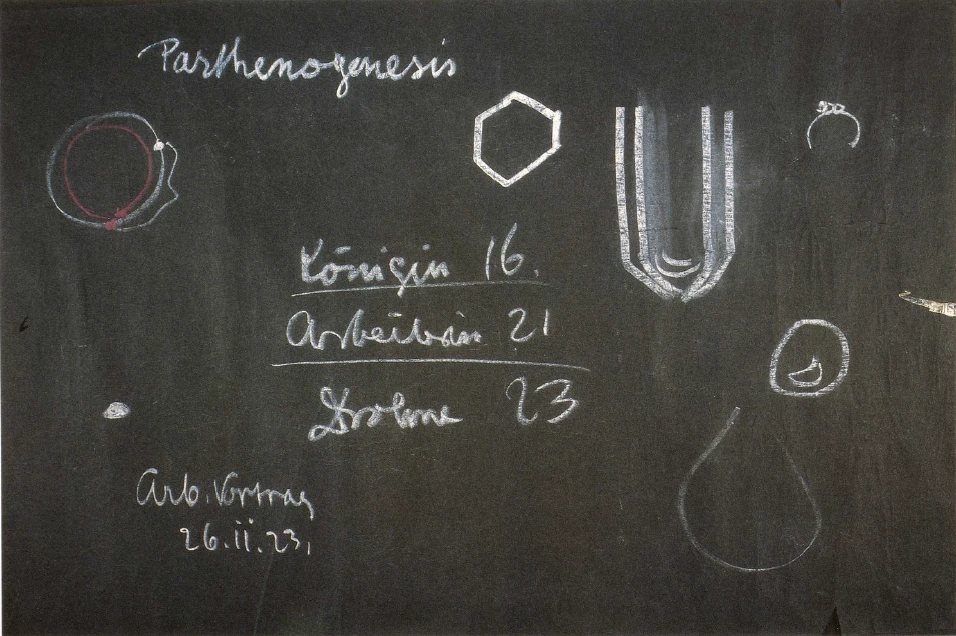
9. Bees and Man
[ 1 ] Good morning, gentlemen! I had intended to make a few comments on Mr. Müller’s remarks that might be of interest to you, even though, of course, there isn’t time today to actually apply such things in practical beekeeping. After all, there is very little—or actually nothing at all—left to say about the practical aspects of beekeeping, since Mr. Müller has already explained everything to you in a very clear and concise manner, exactly as it is done today.
[ 2 ] But if you’ve been listening carefully, something must have dawned on you regarding the whole nature of beekeeping in this—I would say—mysterious world. The beekeeper, of course, is primarily interested in what he has to do. In fact, everyone should have the greatest interest in beekeeping, because human life really depends on beekeeping more than one might think.
[ 3 ] Let’s consider the matter from a slightly broader perspective. You see, bees are capable—as you’ve seen from the lectures given to you by Mr. Müller—of collecting what is actually already contained in the plants as honey. They actually just collect the honey, and we humans then take only a portion of what they collect in their hive—not even a very large portion. For one might say that what humans take amounts to about 20 percent. That is roughly how much humans take from the bees.
[ 4 ] Furthermore, through its entire physical being and its entire organization, the bee is also able to remove pollen from the plants. Thus, the bee collects precisely that which is actually present in very small quantities in the plants and which is very difficult to obtain. Pollen—in the minuscule quantity in which it is present—is collected by the bees using the brushes on their hind legs and is then stored or consumed in the hive. Thus, in the bee, we have an animal that absorbs a substance prepared with extraordinary precision by nature and uses it for its own sustenance.
[ 5 ] But then it goes on: After the bee—and this is perhaps the least noticeable thing at first, because no one really thinks about it—has first converted its food into wax through its own digestive system—it produces the wax itself, after all—it makes its own little container, both to lay eggs and to store its supplies. And this little container of its own—I’d say that’s quite remarkable. This container looks hexagonal when viewed from above, and like this when viewed from the side (see drawing), and on one side it’s closed off. Eggs or stores can be placed inside. One cell is connected to the next. The pieces fit together very well, so that in the honeycombs—thanks to this plate that connects one such cell (as it’s called) to the next—the space is utilized exceptionally well.

[ 6 ] When one asks the question: How is it that the bee, acting on instinct, builds a cell with such an artificial shape? — people usually say: It’s so that the space is used efficiently. - And that is indeed true. If you were to imagine any other shape for the cell, there would always be a gap. With this shape, there is no gap; instead, everything fits together so that the space in this honeycomb sheet is fully utilized.
[ 7 ] Well, that is certainly one reason. But it is not the only reason; you must consider this: When the little maggot, the larva, is inside there, it is completely enclosed, and one must not think that anything that exists somewhere in nature has no power. This entire hexagonal shell—this six-sided shell—contains forces within it, and it would be something entirely different if the larva were enclosed in a sphere. The fact that it lies within such a six-sided shell signifies something entirely different in nature. The larva itself takes on these forms within itself, and in its body it senses that in its youth—when it was at its softest—it was inside such a hexagonal cell. And from the very same force it absorbs there, it then builds such a cell itself. Within that lie the forces from which the bee derives its very ability to work. So what the bee does externally is rooted in its environment. That is the very first thing we must be mindful of.
[ 8 ] But now you’ve been told about another very, very remarkable fact: throughout the entire beehive, there are different kinds of cells. I believe a beekeeper can very easily distinguish between worker bee cells and drone cells. Isn’t that right? It’s not particularly difficult. And it’s even easier for him to distinguish the cells of the worker bees and the drones from the queen cells, because the queen cells don’t have that shape at all; they’re actually shaped like a sack. There are also very few of them in a beehive. So one must say: The worker bees and the drones—that is, the males, which are the drones—develop in these six-sided cells, but the queen actually develops in a sack. She pays no heed to what such a flat environment is like.
[ 9 ] But there’s something else to consider. You see, gentlemen, the queen needs only 16 days to fully develop—until she is completely ready and has become a mature queen. By then, she is already a mature queen. A worker, on the other hand, needs about 21 days—in other words, longer. So one could say that nature takes much greater care in the development of the workers than of the queens. We’ll see shortly that there’s another reason for this as well. So the worker bee takes 21 days. And the drone—the male, which is discarded the earliest (the males are killed after they’ve fulfilled their task)—takes as many as 23 to 24 days.
[ 10 ] You see, that's another new thing. The different types of bees—queen, worker, and drone—require a different number of days.
[ 11 ] Well, gentlemen, you see, there is a very special significance to these 21 days that the worker bee needs. Twenty-one days is no trivial period of time in everything that happens on Earth. These 21 days are the time it takes for the Sun to complete approximately one revolution around its own axis.
[ 12 ] So imagine that the worker bee finishes her task just as the sun has completed one full rotation around its own axis. As a result, gentlemen, the worker bee completes a full revolution of the sun; thus, by having undergone a full revolution of the sun, it is exposed to everything the sun can do to it.
[ 13 ] And if she were to continue on from there, she would always encounter the same thing from the perspective of the sun. For if you have a mental image of the worker bee (as illustrated), when the egg is laid, that point is exactly opposite the sun. The sun completes one rotation around its own axis every 21 days. When it returns to that point, the spot is there again. As things progress from there, all the effects emanating from the sun are ones that have already been experienced before. Thus, the worker bee fully enjoys everything the sun has to offer right up to her full development. If the worker bee were to continue developing beyond this point, she would move from the sun’s sphere into the Earth’s sphere of development; she would no longer undergo solar development, because she has already experienced it and fully savored it. Now: it enters into the Earth’s development. But as a fully formed insect—as a completely mature animal—it merely participates in this. So, it takes just—I would say—a moment, an instant for itself, and afterward it is complete in terms of its solar development and is entirely a solar creature, the worker bee.
[ 14 ] Now consider the drone. It, I would say, takes the story a step further. It does not consider itself complete after 21 days. Before it has fully matured, it enters into the process of earthly development. Thus, the drone is an earthly creature. The worker bee is the fully formed child of the sun.
[ 15 ] And what about the queen? The queen doesn’t even complete the entire sun development process. She lags behind. She always remains a “sun creature.” In other words, the queen, so to speak, always remains closer to her larval state—her maggot state—than the other bees. And the farthest removed from the maggot state is the drone, the male. Because of this—[because she remains closer to the maggot state]—the queen is able to lay her eggs. And you can really see in the bee what it means to be under the influence of the earth or under the influence of the sun. For whether a bee becomes a queen, a worker bee, or a drone depends solely on whether it waits for a phase of solar development or whether it does not wait for it. The queen is able to lay eggs because the influence of the sun always remains with her; she absorbs nothing at all from the earth’s development. The worker bee continues on; she develops for another 4 to 5 days. She makes full use of the sun. But just as her body becomes firm enough, she also enters into the earth’s influence a little—as I mentioned a moment ago. She cannot return to the sun’s influence because she has absorbed it completely. As a result, she cannot lay eggs.
[ 16 ] The drones are males; they are capable of fertilization. Fertilization, then, comes from the earth. The drones acquire their fertilizing powers during the few extra days they spend in a state of development—not in the completed state—of earthly development. So one can say: In bees, it is quite clear that fertilization—male fertilization—comes from the forces of the Earth; the female ability to develop eggs comes from the forces of the Sun.
[ 17 ] You see, gentlemen, you can simply gauge from this what the length of time means in the development of a being. This is of great importance because, of course, during a certain period of time, something happens that does not happen during another period—whether shorter or longer—but rather, something else happens during that time.
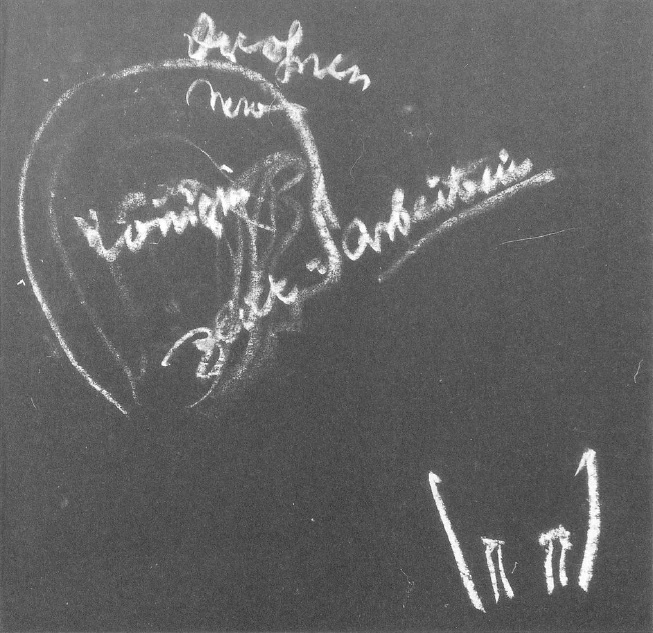
[ 18 ] But there is something else to consider. You see, the queen develops over the course of 16 days. There is a point (it is drawn on the board) that was opposite her in the sun—perhaps only at that point; she remains within the sun’s development. The worker bees also complete the rest of the sun’s orbit, but they remain within the sun’s influence; they do not leave it to enter the Earth’s development. As a result, they feel a kinship with the queen. Because they belong to the same solar development, the entire swarm of worker bees feels a kinship with the queen. They feel bound to the queen. The drones, they say, are already traitors; they have already fallen away to the Earth. They don’t really belong to us anymore. We only tolerate them because we need them. And what do we need them for?
[ 19 ] It does happen from time to time that a queen is not fertilized, yet she still lays viable eggs. The queen does not necessarily need to be fertilized; she lays eggs anyway. Among bees—and to some extent among other insects as well—this is called virgin brood, because the queen is unfertilized. The scientific term for this is parthenogenesis. But only drones hatch from the eggs that are laid now! No more worker bees or queens emerge from them. So if the queen is not fertilized, no more worker bees or queens can be produced—only drones. Naturally, a beehive like that is of no use.
[ 20 ] So you see, in virgin brood, only the opposite sex is produced, never the same sex. This is a very interesting fact, and it is, in general, important for the entire balance of nature that fertilization is necessary for the same sex to be produced—among lower animals, of course, not among higher ones. But the fact remains that, in the case of bee eggs, only drones develop if fertilization does not occur.
[ 21 ] Mating is something quite special among bees. It doesn't happen in the sense that there is a sort of “wedding bed” where they retreat during mating; rather, it takes place in a completely different way. Instead, they go out into the open—into the fullest sunlight—with the fertilization taking place, and, as seems very strange, they first fly as high as possible. The queen flies as high as possible toward the sun, to which she belongs. I have described this to you. And the drone—which can still overcome its earthly forces, for the drones have united with the earthly forces—the one that can fly the highest is the one that can fertilize her right up in the air. Then the queen returns and lays her eggs. So you see, the bees do not have a nuptial chamber; they have a nuptial flight, and when they wish to be fertilized, they strive to fly toward the sun as much as possible. It is certainly true that good weather is needed for the nuptial flight—that is, the sun is truly necessary—because in bad weather, this simply does not take place.
[ 22 ] All of this shows you just how closely the queen is connected to the sun. And when fertilization occurs in this way, worker bees are produced in the corresponding worker cells; first—as Mr. Müller has described so well—the small larvae form, and so on, and they then develop into worker bees in twenty-one days. A queen then develops in these sac-shaped cells.

[ 23 ] To understand what follows, I must tell you something that you will, of course, initially view with some skepticism, because it requires a more detailed study. But it is true. I must build on this: once the worker bee has matured and is ready, she flies out and approaches the flowers and trees, clinging to them with her leg claws (as shown in the drawing), and then she can suck up nectar and collect pollen. She carries the pollen on her body, where she deposits it. This is done via a special structure—the so-called bristles on her hind legs—where she can deposit it. But she sucks up the honey with her proboscis. Part of it serves as her own food, but she stores most of it in her honey stomach. She regurgitates this again when she returns. So when we eat honey, we’re actually eating the bee’s regurgitated food. We really need to be clear about that. But it’s a very clean and sweet regurgitation—which regurgitation usually isn’t, is it? So you see, the bee collects what it needs for food, for stores, for processing, for wax, and so on.
[ 24 ] Now we must ask ourselves: How does the bee find its way to the flower? — It approaches the flower with incredible precision. This is something we simply cannot explain by looking at the bee’s eyes. The bee—the worker bee; the drones have slightly larger eyes—has two small eyes on the sides and three very tiny eyes on its forehead (a drawing is shown). The drones have slightly larger eyes. If you examine these eyes on the worker bee, you realize that they can see very little, and the three small, tiny eyes can’t see anything at all at first. The curious thing is that the bee doesn’t actually find its way to the flower through sight, but through something similar to smell. It feels its way forward guided by the scent and thus encounters the flower. So, in fact, a certain sensation—somewhere between smell and taste—leads the bee to the flower. The bee actually tastes the pollen and honey as it flies toward them. It can taste them even from a distance. That is what actually motivates the bee to not use its eyes at all.
[ 25 ] Now create a very clear mental image of the following. Picture this: a queen was born—born within the realm of the sun—but she did not fully experience the sun’s influence; rather, she remained, so to speak, under its influence. An entire army of worker bees did indeed continue to participate in the sun’s influence, but did not transition to earthly development. Now these worker bees feel connected to the queen; not because they were under the same sun, but because they remained within the sun’s development, they feel connected to her. They have not separated themselves in their development from the queen’s development. The drones, however, do not belong to this group. They have separated themselves.
[ 26 ] But now the following happens. When a new queen is born, the nuptial flight must have taken place. The creature—the queen—has emerged into the sunlight. A new queen has been born. At that moment, something very peculiar happens to the entire colony of worker bees, who feel a bond with the old queen. Their small, tiny eyes become able to see when a new queen is born. The bees cannot bear this. They cannot bear that something identical to themselves comes from elsewhere. The three small eyes on the head—these three tiny eyes—are formed entirely from within the worker bees; they are permeated by the bees’ inner life force and so on. They have not been exposed to the sun’s external rays. Because the new queen, born of the sun, now brings sunlight into the hive with her own body, these bees with their tiny eyes suddenly become—I would say—clairvoyant and cannot tolerate this light from the new queen. Now the entire swarm begins to swarm. It is something like fear of the new queen, as if they were being blinded. It is just like looking up at the sun. That is why they swarm out. And one must reestablish the hive with the old queen, at least to maintain the cohesion of most of the worker bees who still belong to the old queen. The new queen must acquire a new colony.
[ 27 ] There are, of course, bees left behind, but these are the ones that were born under different conditions. The reason the bees swarm, however, is precisely because they cannot tolerate the new queen, who brings with her the new influence of the sun.
[ 28 ] Now you might ask: But how did the bees become so sensitive to this new effect of the sun? — Gentlemen, there is something very strange going on here. As you may know, encountering a bee can sometimes be unpleasant. It stings you. And when you’re as large a creature as a human, you might end up with nothing more than a red, inflamed patch of skin or something similar, but it’s still unpleasant. The small creatures, however, actually die from it. This is because the bee has a stinger that is actually a tube. Inside this tube, something like a piston moves up and down, extending all the way back to the venom sac, allowing venom to be released.
[ 29 ] This venom, which can be quite unpleasant for anyone who encounters it, is extremely important to bees. It is not even particularly pleasant for the bee to have to release this venom when stinging; but she does so because she cannot tolerate any external influence at all. She wants to remain within herself. She wants to remain in the world of her hive, and she perceives every external influence as a disturbance. She then fends it off with her venom. But the venom also has another, ongoing significance. In the bee, this venom constantly permeates her entire body in very small, minute quantities. And without this venom, the bee could not survive at all. And when one observes the worker bee, one must realize that she cannot see with her small, tiny eyes. This is because the venom constantly enters these small, tiny eyes as well. This venom, in fact, is compromised the moment the new queen—the new influence of the sun—is present. The venom is no longer effective then. The eyes suddenly gain the ability to see. So the bee actually owes its very existence to its venom—the fact that it lives, so to speak, in a state of perpetual twilight.
[ 30 ] And if I were to describe to you, in figurative terms, what the bees experience when a new queen emerges from such a sac-shaped cell, I would have to say: Such a little bee, which always lives in the twilight, feels its way along with a sense of smell and taste—with something that lies midway between smell and taste—feels its way along, lives in the twilight, and that suits her just fine. But when the new queen arrives, it is just as if we were walking in the dark in June and the fireflies were glowing. That’s how the new queen glows to the swarm, because the venom is no longer strong enough to keep her contained within herself. The bee needs a separation from the world—a twilight separation from the world. It has this when it flies out, precisely because it can sustain itself with its venom. It needs the venom then when it fears that some influence might come from outside. The beehive wants to be entirely within itself.
[ 31 ] To ensure that the queen can remain in the sunlit area, she must not be in a square cell, but rather in a round cell. That way, she remains under the sun's influence.
[ 32 ] And you see, gentlemen, this brings us to something that truly makes beekeeping a subject of extraordinary interest to everyone. Inside the beehive, things basically work the same way—with just a few differences—as they do inside the human brain. Except that in our own human heads, these substances don’t develop to the same extent. Isn’t that right? Inside the human head, we have nerves, blood vessels, and then also individual so-called protein cells that remain roundish. They’re always located somewhere inside. So we have three kinds of things inside the human head. But the nerves also consist of individual cells that—simply because they are covered on all sides by nature—do not fully develop into animals; yet these nerves actually want to become animals, they want to become small animals as well. And if the nerve cells in the human head were able to develop in all directions under the same conditions as in the beehive, then the nerve cells would become drones. The blood cells flowing through the veins would become worker bees. And the protein cells, which are found particularly in the middle head, undergo the shortest development; they can be compared to the queen. So we have these same three forces inside the human head.
[ 33 ] Well, the worker bees bring home what they collect from the plants, process it into wax inside their own bodies, and build all these wonderful honeycomb structures. Gentlemen, the blood cells in the human head do the same thing! They travel from the head throughout the entire body. And if you look at a bone, for example—a piece of bone—you’ll see these hexagonal cells everywhere inside it. The blood that circulates throughout the body performs the same work that the bees perform in the hive. Except—don’t you see—with the other cells, such as the muscles, where the situation is similar—since muscle cells are also similar to the bees’ wax cells—they dissolve too quickly and are still soft; so you don’t notice it as much there. You can see it very clearly in the bones if you study them. So the blood also possesses the same powers as a worker bee.
[ 34 ] Yes, gentlemen, you can even study this in relation to time. The cells that you first find developing in the human embryonic germ and that then remain—the protein cells—are the ones that are already present in the earliest stages of the embryo’s development. The others—the blood cells—develop somewhat later, and the nerve cells develop last. Just as it happens inside a beehive! Except that humans build a body that seemingly belongs to them, and the bee also builds a body: these are the honeycombs, the cells. The same process occurs with this wax structure as inside our own bodies, except that it is not so easy to demonstrate there that the blood cells actually form it from a kind of wax. But we ourselves are made from a kind of wax, just as the bees form the honeycombs inside the hive or in the box. So it is like this: A human being has a head, and the head works on the large body, which is actually the beehive; and the beehive, particularly in the relationship between the queen and the worker bees, contains the same relationship that the protein cells—which remain round—have with the blood. And the nerves—they are constantly being ruined. The nerves are constantly being worn down, because we wear down our nervous system. We do not immediately wage a battle of the nerves within ourselves—otherwise we would die every year—as the bees do in a drone battle; but nevertheless, our nerves grow weaker with each passing year. And it is actually the weakening of the nerves that causes a person to die. We can then no longer perceive the body as we once did, and a person actually always dies because they wear out their nerves.
[ 35 ] If you now look at the head, which actually represents the beehive, you will find that everything inside this human head is protected. And if something is brought in from the outside, it is a terrible violation. The head cannot tolerate this. Nor can the beehive tolerate this process during the emergence of the new queen; it would rather leave than have to be with this new queen.
[ 36 ] It is precisely for this reason that beekeeping has always been regarded as something of immense importance. Isn’t it true that humans take 20 percent of the honey from the bees, and one can certainly say: This honey is extraordinarily useful to humans, because otherwise humans would consume very little honey in their diet, since honey is distributed in very small quantities among plants. Otherwise, we would only ingest tiny amounts of honey. We also have “bees” within us—namely, our blood. It carries this honey to the various parts of the body. But this honey is precisely what the bee needs to make wax, from which it can construct the body of the hive—the honeycomb structure.
[ 37 ] For us humans—especially as we grow older (for children, it is milk that has this effect)—honey has an extraordinarily beneficial effect on us. It actually promotes our physical well-being. Therefore, honey is highly recommended for people who have grown old. However, one should not overeat it. If you overindulge in it—if you don’t enjoy it merely as an ingredient—it will lead to excessive physical formation. Then the body becomes brittle, and you’ll develop all sorts of illnesses. Well, a healthy person knows how much they can eat. And so, especially for people as they grow older, honey is an exceptionally healthy food because it actually gives our bodies strength—real strength.
[ 38 ] If, therefore, one were to follow this rule even with children suffering from rickets—though, of course, not at first, during the very first weeks, when the children should really be living on milk alone, because honey isn’t effective yet—but if one were to administer it in just the right dosage, specifically to a child with rickets, once the child is about nine, ten months old, and then let them follow this honey diet until they are three or four years old, then rickets—the English disease—would not be as severe as it is, because rickets consists of the body remaining too soft and collapsing in on itself. But honey contains within itself the power to give the human being form and strength. These connections must be fully understood. So that one can say: Actually, honey—and beekeeping—should be given much, much more attention than they currently receive.
[ 39 ] The following is also possible. In nature, there is a remarkable connection between everything. The laws that humans cannot fathom with their ordinary intellect are actually the most important ones. Isn’t it true that these laws operate in such a way that they always leave a little bit of freedom? Take, for example, the sexes on Earth. Not quite the same number of men and women are born on Earth, but roughly the same number. Across the entire Earth, it is roughly equal. This is brought about by the wisdom of nature itself. If—as I believe I have already told you—a time were to come when humans could arbitrarily determine their sex, things would immediately fall into disorder. Well, it’s also true that if, for example, the population in a certain region is decimated by fierce wars, it subsequently becomes more fertile. In nature, therefore, every deficiency gives rise to a counteracting force.
[ 40 ] Now, it’s also true that when bees are foraging for honey somewhere in an area, they naturally take the honey from the plants. But they take the honey from plants that we also need—plants that give us all kinds of fruits and the like. And the interesting thing is that in areas where beekeeping takes place, fruit trees and similar plants thrive better than in areas where there is no beekeeping. So when the bees take the honey from the plants, nature does not stand idle, but instead produces more of these fruitful plants. Thus, humans not only benefit from the honey the bees provide, but also receive benefits from the plants that the bees visit. This is a law that is truly easy to understand and that is important.
[ 41 ] Well, all of this is connected to the fact that, when one really understands these things, one can say: In the very essence of a bee colony—an organism—there is something into which nature has imbued a truly wondrous wisdom. - Bees are subject to natural forces that are extraordinarily important and truly marvelous. That is why one feels a certain reluctance to meddle with these natural forces.
[ 42 ] The fact is that even today, whenever humans meddle with the forces of nature, they do not make things better, but worse. But they do not make things worse immediately; rather, it is simply the case that nature faces obstacles everywhere. Despite these obstacles, nature works as best as it can. There are certain obstacles that humans can indeed remove, and in doing so, they can also make things easier for nature in many ways. And, for example, in beekeeping, humans apparently make things much easier for nature by using the newer beehives—which are comfortably equipped and so on—instead of the old beehives.
[ 43 ] But now we come to this chapter on artificial beekeeping. Gentlemen, do not think that I fail to recognize—even from a perspective entirely unrelated to Spiritual Science—that artificial beekeeping certainly has its merits, at least in the initial stages, since it naturally makes many things easier; but this strong cohesion—I would say—of a generation of bees, of a bee colony, will ultimately be compromised by it. Today, provided all the precautions outlined by Mr. Müller are taken, one can of course only praise artificial beekeeping to a certain extent. But we must wait and see how things will be in fifty or eighty years, for by then certain forces that have hitherto acted organically within the bee swarm will simply be mechanized—they will be made mechanical. It is no longer possible to establish that intimate bond between the purchased queen bee and the worker bees, as occurs when the queen bee is produced by nature itself. But in the very early stages, this is not yet a factor.
[ 44 ] Of course, I certainly would not want a fanatical movement to be launched against artificial beekeeping. You can’t really do things like that in practical life. Because that would be roughly like something else I’m about to tell you. We can roughly calculate when there will be no more coal left in the earth. The earth’s coal reserves are, after all, finite—they will eventually run out. Now, we could extract so little coal from the earth today that it would last roughly until the earth itself has perished. We can’t say we should do it that way, because we have to have a little faith in the future. One has to tell oneself: Well, yes, certainly, we’re robbing the Earth of all its coal—that is, we’re actually robbing our descendants of their coal—but they’ll surely invent something else by then so that they won’t need coal. —Of course, one can also say this in response to the disadvantages associated with artificial beekeeping, for example.
[ 45 ] But it is still good to be aware that introducing something mechanical and artificial into what nature has formed in such a wondrous way actually disrupts it. For beekeeping has always been regarded as something truly marvelous. The bee was considered a sacred animal, especially in ancient times. Why? It was considered a sacred animal because, in all its work, it actually reveals what goes on within human beings themselves. And when someone receives a small piece of beeswax, they actually have an intermediate product between blood, muscles, and bones. This goes through the wax stage internally within the human being. The wax does not yet become solid, but remains liquid until it can be transformed into blood, muscles, or bone cells. Thus, in the wax, one actually sees what one has within oneself as forces.
[ 46 ] When people in ancient times made beeswax candles and lit them, they truly saw in this a very remarkable sacred act: We took this wax, which is burning there, from the beehive. It was solid there. When the fire melts this wax and it evaporates, the wax returns to the same state it is in within our own bodies. —And in the burning wax of the candle, people of old sensed something rising up to heaven—something that is within their own bodies. For them, this was something that inspired a special sense of reverence and, in turn, led them to regard the bee as a particularly sacred creature, because it produces something that humans themselves must continually produce within themselves. And so it is true: the further back in time we go, the more we find that people held the entire world of bees in awe. Of course, this was initially a wild phenomenon; people encountered it and regarded it as a revelation. Later, it was incorporated into human households. But in everything that occurs with bees, there are still many wonderful mysteries, and one can only truly understand bees by studying in depth what actually takes place between the human head and the body.
[ 47 ] Well, I have shared these remarks with you. We’ll have our next class on Wednesday. Perhaps some questions will arise in connection with this. Perhaps Mr. Müller himself will also come up with one or two ideas. I just wanted to share these remarks with you—remarks that are beyond doubt, since they are based on genuine insight. But the point is that perhaps some things can be made even clearer.