

Man and World
How Spirit Works in Nature
GA 351
31 October 1923, Dornach
Translated by Steiner Online Library
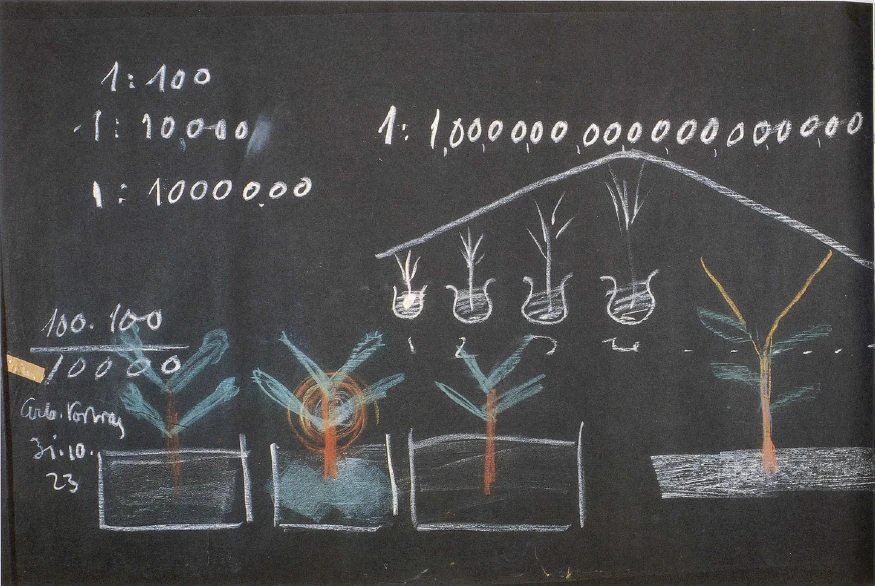
7. On the Causes of Polio — On Plant Growth
[ 1 ] Good morning! Did you think of anything?
Questioner: The doctor spoke about the possibility of widespread diseases breaking out and how they might be combated. Now an epidemic has broken out—polio—which has also affected adults. Could the doctor say a few words about this?
Is it harmful to humans to have plants in the room?
[ 2 ] Dr. Steiner: As for the question about plants in the room, here’s the thing: On a large scale in nature, it is absolutely true that plants release oxygen, which humans then breathe in, and that humans themselves exhale carbon dioxide. So what the plant needs, humans exhale; what humans need, the plant emits. That is generally correct. Now, if you have plants in the room, there’s something else to keep in mind. If you have plants in the room during the day, then the process I described takes place to a large extent. If you have plants in the room at night, however, the plants do need some oxygen even at night. During the night, the plant behaves somewhat differently; it doesn’t need oxygen to the same extent as humans, but it does need oxygen. So, especially when it is dark, they draw upon the very thing they otherwise provide to humans. Now, of course, it is not the case that humans must completely do without oxygen, but they receive too little of it, and that then has a toxic effect. These principles apply, by and large, to life in nature. Of course, it is also true that every being has something within it that requires what others also need. This is the case with plants, if one were to observe them closely. If you were to remove the plants you have in your room at night, while you sleep, this toxicity would not occur. That is all I have to say on this matter.
[ 3 ] Now, as far as polio is concerned—which is currently causing such a major outbreak in Switzerland—it is indeed still somewhat difficult to speak about this disease today, for the reason that it has actually only been appearing in its current form for a short time, and we must wait and see what other specific symptoms it may develop. We have, for example, had a severe case of polio at the Stuttgart Clinic; however, based on the picture we can already form today—since one can always judge only by the cases that have occurred—based on the cases we have encountered here, one must say today that polio, like its origin, the flu, which leads to so many secondary illnesses, is also an extraordinarily complicated matter. And it seems to be treatable only if the entire body is treated. Just the other day, there was discussion here in medical circles about how to combat polio. There is currently a great deal of interest in this, because polio is, in essence, spreading more with each passing week. It is called “polio” because it occurs most frequently in children. But there was a recent case where a young doctor—and one is no longer quite a child when one is a young doctor—was, I believe, still perfectly healthy on Saturday, contracted polio on Sunday, and was dead by Monday. So polio can strike a person extremely rapidly under certain circumstances, and one might actually be concerned that it could develop into a very serious epidemic.
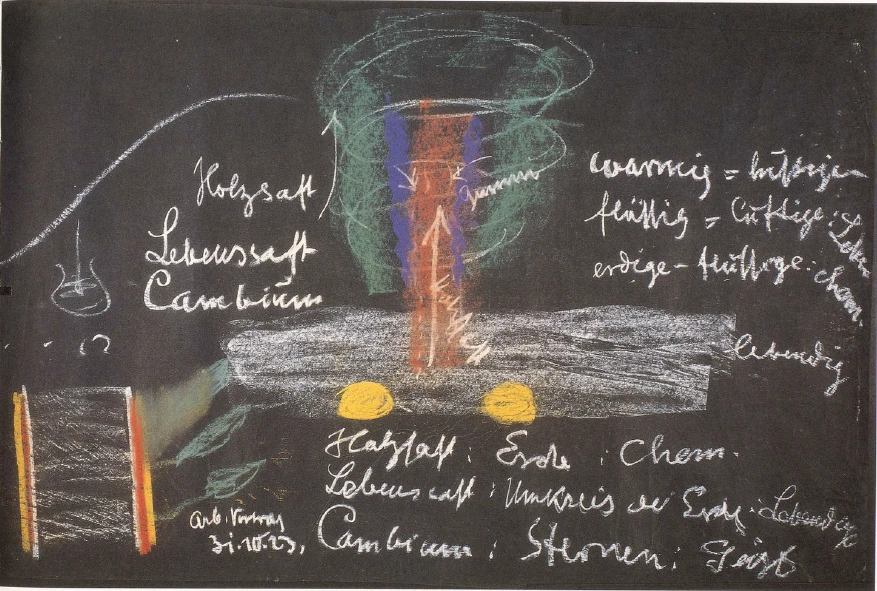
[ 4 ] Now, it is certainly linked—just like the flu itself—to the difficult events of our time. The fact is: Ever since we at our Biological Institute in Stuttgart succeeded in demonstrating the effects of the tiniest particles of substances, we have actually needed to talk about these things in a completely different way; especially in public, we should be talking about them differently than we usually do.
[ 5 ] In Stuttgart, we simply demonstrated that if you take any substance, dissolve it, dilute it very strongly, and use this diluted substance, you can achieve an effect. You put a very small amount of a substance into a glass of water: you dilute it so that you add one part of the substance to nine parts of water, meaning it is diluted tenfold. Now you take one part of what you have there—which contains only one-tenth of the original substance—and treat it again by putting it in a glass of water and diluting it to a ratio of 1:10. Now you have diluted it 10 times 10; the first time at a 1:10 ratio, and the second time—after diluting the volume of the drops by a factor of 10 times 10—this results in two zeros, or a 1:100 ratio. If you dilute it further—that is, if you take another such volume and mix it with nine parts water—you must add another zero, resulting in a 1:1000 ratio. Now only one-thousandth of the substance remains. In Stuttgart, we diluted it all the way to one part per trillion—that’s 18 zeros; we diluted it that far and even further.
[ 6 ] So you can imagine that there’s only a trace of the original substance left in it, and that what really matters isn’t how much of the original substance is in it, but how this substance acts as a diluent. The diluent acts quite differently. These dilutions were made in Stuttgart. It won’t be easy for anyone to replicate this. At most, the German Valuta might be able to replicate it, but otherwise, it won’t be easy for anyone. — This was done with a wide variety of substances. We then proceeded as follows: we took a small type of flowerpot and put what we had received into it. So first, plain water—the ordinary solution—then the one containing one-tenth, then the one with one-hundredth, then the one with one-thousandth, then the one with one-ten-thousandth, the one with one-hundred-thousandth, and so on up to one trillion. So this is what was done. Then we placed seeds—wheat grains—into the little flower pots. The wheat grain grows (it’s drawn), and it grows better in the dilution than in the undiluted solution! And so it goes on. You see, with further dilution, growth became faster and faster: one, two, three, four, five, and so on, until we reached the twelfth dilution. At the twelfth dilution, it slowed down again; growth became slower. Then it picked up again and then slowed down once more.
[ 7 ] So this is how you bring out the effect of the tiniest substances. The effect of the tiniest substances—and this is very curious, you see—is rhythmic! As you dilute, you eventually reach a certain dilution where growth is strongest; then it declines again, then it rises again; it proceeds rhythmically. So one sees: When the plant grows out of the earth, something acts upon it, depending on how it is imbued with the substances that act rhythmically in its environment. The earth’s environment, so to speak, exerts its influence; one can see this quite clearly.
[ 8 ] Well, once you realize that even the tiniest amounts have an effect, you’ll have no qualms about acknowledging that in times like these—when so many people consume unhealthy food and then decompose as corpses in the ground—the effect is different! Of course, this is highly diluted for the entire Earth, but it does have a different effect than when people live healthy lives. And this, after all, is contained in the food that grows from the Earth. People consume it along with their meals. So one can say: This is something that is influenced by the circumstances of the times. Of course, people who adhere to crude, materialistic science don’t realize this, because they say to themselves: “Well, what significance could what is placed into the earth as a human body possibly have for the entire earth?”—What comes from the human being is, of course, very diluted, but it does have an effect.
[ 9 ] You see, gentlemen, it is good, then, if we talk about the plant as a whole for once. People’s health depends entirely on plant growth, and that is why we need to know exactly what factors are at work in plant growth.
[ 10 ] The issue of polio, in particular, has preoccupied me immensely, and it has become clear that one must actually treat the whole person. There have also already been indications of all sorts of remedies specifically for polio. This is likely of great importance, because polio could play a truly devastating role in the future. It is, of course, a matter that weighs heavily on one’s mind, and I have been focusing specifically on it. A remedy will likely have to be developed consisting of soda baths, arsenic acid iron, and a special substance derived from the cerebellum—the rear part of the brain in animals. So there will have to be a very complex remedy specifically for this type of polio. You see, with a disease like this, which stems from very hidden causes, the very fact that its causes are hidden means that its cure must also be particularly complex. These issues are actually quite relevant today, and it is good for you to understand how the entire process of plant growth takes place.
[ 11 ] So the plant grows out of the ground. Today I want to illustrate it in a way that corresponds exactly to the question posed by Mr. Dollinger (see drawing). Now the root grows out of the seed. Let’s start with a tree; we can then move on to an ordinary plant. When we consider a tree, the trunk grows out of it. Yes, gentlemen, you see, even this growth of the trunk is something extraordinarily remarkable. This trunk that is growing is actually formed solely by the fact that it allows sap to rise from the earth, and this sap that rises—that is, what I have drawn here in red—this rising sap carries with it all kinds of salts and constituents of the earth; this is what gives the trunk its strength in the first place. So when you look at wood from a tree trunk, you see an ascending sap, and this sap then carries along the solid particles of the earth—all kinds of salts, such as sodium bicarbonate and iron salts found in plants. All of this is carried along with it, and that is what gives the wood its internal strength. Now, the essential point is that the sap rises.
[ 12 ] What is actually happening there? You see, when that rises—the solid, the earthy—it combines with the liquid, and we end up with an earthy-liquid substance rising. An earthy-liquid substance rises there; it is a thick, earthy-liquid substance. The liquid then evaporates, and the earthy substance remains behind. What remains there as earth is the wood. When the sap rises up there, it does not originate there (pointing to the drawing), but this sap that rises up in the wood—let’s call it wood sap—is actually contained throughout the entire earth, so that, in this respect, the earth is a single, great living being. This wood sap that rises upward in the tree is, as I said, essentially present throughout the entire earth; only, in the earth, this sap is actually something quite special. It only becomes what it is in the tree; it only becomes that in the tree. In the earth, it is, in fact, the sap that actually animates the earth. The Earth is truly a living being. And what then rises up into the tree is present throughout the entire Earth; it is through this that the Earth lives. In the tree, however, this sap loses its vitality; it becomes a “chemist,” possessing only chemical forces.
[ 13 ] So when you look at a tree, you have to tell yourself: The earthy, fluid substance in the tree has become chemical, whereas down in the earth itself, it was still alive. So the sap has, in part, died as it rose up into the tree.
[ 14 ] If it were any other way, plants would never come into being at all; instead, only stumps would form, which would die off toward the top and in which chemical processes would take place. But then what forms from the sap—the trunk—emerges into the air—and the air is always permeated with moisture—it emerges into the moist air, into the moist, into the watery-airy. The sap—along with what it produces—thus emerges from the earthy-liquid into the liquid-airy. And in the fluid-airy realm, life forms anew, so that the trunk becomes filled all around with what then lives in the green foliage (it is drawn) and ultimately in the flower and in everything that is out there. This, in turn, is brought back to life. In the foliage, in the leaf, in the flower, and in the bud, life sap lives once more; the wood sap is dead life sap. In the trunk, life continually dies off; in the leaf, it renews itself. So we must say: We have wood sap, which rises upward; then we have life sap. - What does it do? You see, the life sap circulates there and produces leaves everywhere. That is why you can also observe such spirals in the arrangement of the leaves. The life sap, then, actually circulates. And it originates from the fluid-airy realm, into which the plant enters once it has grown out of the earthy-fluid realm.
[ 15 ] You see, gentlemen, that the trunk—the log—is dead, and only the part here on the plant, which grows all around it, is alive. You can prove this in a very simple way, namely as follows: Imagine you’re walking up to a tree; there’s the trunk, then there’s the bark, and inside the bark, that’s where the leaves grow (a drawing is made). Now I’ll go over to the blackboard! and cut away the bark—which also removes the leaf—but here I’ll leave the leaves attached to the bark. And what happens is that here the tree remains alive and fresh, while there it begins to die off. The wood alone, with its sap, cannot keep the tree alive. What comes with the leaves must flow in from the outside; that, in turn, contains life. In this way we see: Although the earth can cause the tree to sprout, it would have to let it die if it hadn’t received life from the outside, from the moist air; for inside the tree, the sap is merely a chemical substance, not a source of life. It is the life that circulates that constitutes its life. And one can actually say: When the sap rises in the spring, the tree is renewed within the earth. When the life-sap begins to circulate anew in the spring, the tree comes to life anew every year. The earth acts upon the sap—the earthy-fluid element; the fluid-airy element acts upon the life-sap.
[ 16 ] But that is not the end of it; rather, as this is happening, a new layer of plant tissue forms between the bark—which is still permeated by sap—and the wood; at this point, I can no longer say that sap is forming there. Here I have said: wood sap, life sap; but here I can no longer say that a sap is forming, because what is forming there is quite thick. It is called the cambium. It forms inside between the bark—which still belongs to the leaves—and the wood. So if I cut this part away here (it is drawn), no cambium will form inside. But the plant also needs the cambium in a certain way. The wood sap forms in the earthy-liquid, the life sap forms in the liquid-airy, and the cambium forms in the warm air, in the warm-airy or the airy-warm. The plant develops warmth by receiving life from the outside. It sends this warmth into its own interior, and from this warmth the cambium forms inside. Or, if the cambium has not yet formed—the plant needs the cambium, as you will hear in a moment—but before the cambium forms, something thick already forms: that is the inner plant gum. In their warmth, the plants also form the plant gum inwardly, which under certain circumstances is an important remedy. So the sap draws the plant upward, the leaves enliven the plant; but then, in turn, the leaves—by generating warmth—form the gum substance, which in turn acts back on the cambium. And in old plants—in very old plants—this gum, having flowed down into the earth, has become transparent. When the earth was still less solid, still moist and fluid, it became transparent, and there it turned into amber. So you see, when you take a piece of amber, it is precisely what, in an ancient plant, oozed from the leaf like blood and flowed down to the earth: resin, pitch. All of this flows back down; the plant returns it to the earth: pitch, resin, amber. And when the plant retains it itself, it becomes the cambium. Through the sap, the plant is connected to the earth; the life sap connects the plant to what circles around the earth, to the airy, moist atmosphere surrounding the earth. But the cambium connects the plant to the stars, to what is above. And so it is that within this cambium, the form of the next plant is already taking shape. This is then transferred to the seed, and through this the next plant is born; so that the stars, indirectly through the cambium, bring forth the next plant. Thus, the plant is not produced solely from the seed—that is to say, it is of course produced from the seed, but the seed must first be influenced by the cambium, that is, by the influence of the entire heavens.
[ 17 ] You see, this is truly something wonderful: When you hold a plant seed in your hand, this unassuming, modest little speck of dust—the seed—could only have come into being because the cambium—not in a liquid state, but in something viscous—reproduces the entire plant. And this form that arises inside the cambium—a new plant form—transfers its power to the seed, and from this the seed then has the power to cause a new plant to grow upward under the influence of the earth.
[ 18 ] So you see, gentlemen, mere speculation—simply placing the seed under a microscope—yields nothing. One must understand clearly how the whole process relates to the sap, the life sap, and the cambium. That is why the sap is a relatively thin fluid; it is actually designed so that chemical reactions can easily take place within it. The plant’s life sap, on the other hand, is much thicker—it is what secretes the gum. If you thicken the gum a little, you can make wonderful shapes out of it. So the sap is somewhat thicker than the wood sap; it conforms more closely to the plant’s form. And then it imparts its entire form to the cambium. This is even thicker, already quite tough, yet still soft enough to take on the forms given to it by the stars.
[ 19 ] This is true of trees, but also of ordinary plants. When there is soil and a little root, the shoot grows upward; but at this stage it does not immediately produce solid tissue—it does not turn into wood—it remains just like a herb stem—it does not progress that far; then the leaves form around it in a spiral, and then the cambium also forms inside right away, and the cambium, in turn, carries everything back down to the earth. So that in an annual plant, the process—the entire sequence of events—takes place much more quickly. In a tree, only the solid components are set aside, and not everything is used right away. But the same process also takes place in the most ordinary plant; it just doesn’t go as far as it does in a tree. In a tree, it’s actually a rather complicated process. If you look at the trunk from above, you’ll see that first there’s the pith inside—which serves as a sort of guide; then, around the pith, wood deposits form. As autumn approaches, the gum comes from the other side and binds the wood together. Now we have the gummed wood from one year. The following year, the same thing happens with what rises up; it just has to go to a different place, is bound together again with gum in the fall, and as this binding with gum continues, the annual rings are formed. So you see, all these things become very clear if one can only truly understand the processes inwardly, if one only knows that there are three kinds of substances present: wood sap, life sap, and cambium. The wood sap is the most fluid; it is, so to speak, a chemist. The life sap, which gives life—it is, if I may put it that way, a living being. And what happens in the cambium—well, that is actually where the entire plant is drawn from the stars. It really is so, gentlemen! There the sap rises, dies off; there life arises again, and now the influence of the stars comes into play: there, from the cambium—which has already become tough and thick—the new plant is drawn under the influence of the stars. So that in the cambium one truly has a drawing, a sculptural work of the new plant; it is sculpted into it there. There, from the entire cosmos, the stars model into it that which then constitutes the entire form of the plant. There, you see, we move from life into the spirit. For what is modeled there is modeled out of the world spirit. This is very interesting, gentlemen: The earth first imparts its life to the plant; the plant dies; the atmosphere, together with its light, in turn gives life back to the plant; and the world spirit imparts the new plant form. This is then preserved in
[ 20 ] Seed and then grows again in the same way. Thus, in the growing plant, one sees a path by which the entire plant world builds itself up from the earth, through death, to the living spirit.
[ 21 ] Tree sap: Earth: Chemical
Life force: Earth's orbit: Living
Cambium: Stars: Spirit
[ 22 ] Now, other experiments are being conducted in Stuttgart. These experiments are extremely instructive. Instead of merely studying growth—which is certainly important, especially when one reaches the higher dilutions ranging from one to one trillion, which is already very interesting—one can also do the following. One takes highly diluted metals or metal compounds—diluted in the manner described—Table 10; let’s say, for example, one takes copper, highly diluted so that it is in solution. Now one pours this into a flowerpot. There is soil inside. One adds the copper to this soil, so to speak, as a kind of fertilizer. Next to it, you place a pot containing plain soil—the same soil, but one that has not been fertilized with copper. It has to be the same soil, but it doesn’t contain the copper. Now you take exactly the same plants—the plants must be as close as possible in their stage of growth—and place one plant in the soil that has been fertilized with copper, so to speak, and place the other plant in the soil that contains no copper fertilizer. And what’s remarkable is that, especially when the copper has been diluted quite strongly, the leaves here develop wrinkles along the edges—the others don’t develop wrinkles if their leaves are smooth to begin with, not wrinkled from the start. That’s why you have to use the same soil, because many soils already contain copper from before. You have to use the same soil—add copper to it just once—and you have to use the same plant so that you can make an accurate comparison.
[ 23 ] Now take a third plant, put the same soil into a third container, but this time add lead instead of copper. In this case, the leaves don’t even think to wrinkle; instead, their tips wither and fall off—so they end up wilting and shedding their leaves when lead is added. Now you suddenly have a very curious sight. These experiments are being conducted in Stuttgart, and they look quite beautiful—all those flowerpots lined up one after another, and you can see how the substances in the soil affect the plants.
[ 24 ] In the future, you will no longer be surprised when you see plants with wrinkled leaves. If you dig into the soil there, you will find traces of copper. Or if you have leaves that are slightly wrinkled and withered at the edges, and you dig into the soil, you will easily find traces of lead. Take, for example, the well-known plant called horsetail, which is used to scrub pots. This plant, in turn, grows precisely in places where the soil contains silicon; that is why it develops these stiff, siliceous stems. In this way, you can understand plant forms by looking at the soil.
[ 25 ] Now you can also understand what it means when very small amounts of any substance are mixed into the soil. Of course, the cemetery is out there somewhere, but the earth is completely permeated by tree sap everywhere, and those small amounts seep right into the ground everywhere. And once you’ve conducted the experiments to see how these small amounts—which I’ve just told you about—work, you realize: Yes, the very substance that has just seeped into the soil in small amounts—we’re actually eating that too! It’s so potent that it lives on in the plant form. And what happens next? Imagine, for example, that I’ve obtained a plant here that comes from lead-contaminated soil. People say that lead isn’t produced these days. But lead is produced in the soil when decaying organic matter is introduced into it. Lead simply forms in the soil. Then the plant grows out of it—we can practically say: a lead-containing plant grows out of it. - All right. If we eat this plant—this lead plant—it has a completely different effect than if you eat a plant that isn’t a lead plant. When we eat a lead plant, it causes our cerebellum—which is located at the back of the head—to become drier than it normally is. It becomes drier.
[ 26 ] Now you have a connection between the soil and the cerebellum. So there may be plants that, simply because of the nature of the soil—because of what is introduced into the earth somewhere and then spreads out—cause the cerebellum to dry out somewhat. Well, gentlemen, the moment our cerebellum is not functioning at full strength, we become clumsy. If anything happens to the cerebellum, we become clumsy and can no longer move our feet and arms properly; and if this condition worsens, our limbs become paralyzed.
[ 27 ] You see, gentlemen, this is the path from the soil to human paralysis. A person eats from a plant, and if the edges of the leaves show signs of withering—if they have become as I have described to you—then the person’s cerebellum will begin to wither somewhat. In everyday life, one does not notice it right away, but the person can no longer orient themselves properly; if this becomes more severe, paralysis sets in. Now, it is also the case that, first and foremost, when one cannot orient oneself—when this occurs in the head, stemming from the withering of the cerebellum—it initially affects all the muscles in the upper part of the head that are supplied by a small gland, the so-called pineal gland, and particularly the visual centers. If this happens, one merely catches the flu. If the paralysis progresses, the flu transforms into a state of total paralysis. So there is something underlying all manifestations of paralysis that is intimately connected with the earth’s core. And from this you can see that one really must draw on knowledge from many different sources in order to bring about something healing for human beings. It really isn’t enough to just make all sorts of declarations, saying, “It should be this way or that way!” For if one does not know what causes people’s organisms to begin to die off in the first place, then no matter how good one’s facilities may be, people simply will no longer be healthy. For everything that acts within the plant and passes from the plant into the human being is, in turn, of great significance within the human being as well.
[ 28 ] You see, the sap of the plant actually corresponds in humans to the very ordinary, colorless cellular fluid—mucus. The sap in the plant is, in humans, the life-giving mucus. The life sap of the plant, which circulates from the leaves, corresponds to human blood. And the cambium of the plant corresponds to milk and milk sap in humans. When a woman begins to breastfeed, she simply produces more milk sap through certain glands in the breast. Here again you have what is most strongly influenced by the stars in humans: milk sap. This milk sap, however, is particularly necessary for the formation of the brain. The brain is, so to speak, essentially solidified milky sap in humans. So when leaves die off, they do not produce a proper cambium because they no longer have the strength to radiate heat back in the correct way. They allow the heat to radiate outward through the dying parts rather than radiating it back properly. We eat plants with an improperly formed cambium: they do not properly produce the milky sap within us; women do not properly produce breast milk, and children receive milk upon which the stars do not exert a particularly strong influence, so the children cannot develop properly. That is why this paralysis naturally occurs especially in children. However, it can also occur in adults, because human beings must remain under the influence of the starry world throughout their entire lives, as I have already explained to you.
[ 29 ] In these matters, the natural sciences and medical practice must work together. They must collaborate in every area. But one cannot isolate oneself within any single branch of science. Isn’t that right? Today, there are people everywhere who deal only with animals; others deal only with humans—these are the anthropologists. Then there are others who focus on a specific part of the human body: diseased senses, diseased livers, diseased hearts; in other words, these people specialize in internal organs. Then there are botanists who study only plants, mineralogists who study only rocks, and geologists who study the entire earth. This creates a very convenient situation for science. One has less to learn if one becomes merely a geologist or has to learn only about rocks. Yes, but such knowledge is of no use at all! It serves no purpose whatsoever,
[ 30 ] Such knowledge; if one wants to do something for a person when they are sick, one must take nature as a whole into account. It is of no use to understand mere geology, mere botany, or mere chemistry. Isn’t that right? One must be able to trace chemistry all the way down to the workings of tree sap! It really is true. The students have come up with a saying—as you may know, at the university there are full professors and associate professors—and the students have come up with this saying: The full professors know nothing extraordinary, and the associate professors know nothing ordinary. - But today, one can take that much further: The geologist knows nothing about plants, animals, or humans; the anthropologist knows nothing about animals, plants, or the Earth. No one really knows how the things they study are connected. Just as one specializes in one’s work, one becomes overly specialized in one’s knowledge. And that is far more harmful. It’s appalling when there are only geologists, only botanists, and so on, because this fragments all knowledge, and nothing worthwhile comes of it. This has happened for the sake of people’s convenience. People are already saying today: You can’t be a person who knows everything. — Yes, if you don’t want to be a person who can bring all knowledge together, then you might as well say right away: One must forgo useful knowledge altogether. We are already living in a time when things have, in essence, taken on a dreadful form. It is just as if someone who works with clocks were to want to learn only how to file metals. Isn’t that right? Then, of course, the result would be that one person knows how to file metals, another how to weld them, and so on. And then there would be someone who knows how to assemble a clock but doesn’t know how to work with the individual metals. Well, isn’t that so: in the mechanical field, it works to some extent, although of course it doesn’t really work without forcing people. But in medicine, for example, nothing at all is achieved unless one can bring together all knowledge, right down to the knowledge of the earth. For within the tree trunk lives that which is carried upward from the earth—that is, from the realm of geology—to the sap. There it dies. One must also understand meteorology and the atmosphere, because what is carried from the environment to the leaves is what in turn gives rise to life. And one must also understand astronomy and the study of the stars if one wishes to comprehend the formation of the cambium. In turn, one must understand what enters a person along with the cambium when they consume it: the milky sap that is transformed into the brain; so that if one ingests corrupted cambium, one will, as an adult, have a corrupted brain. And in this way, diseases arise from what is inside the earth.
[ 31 ] This is what needs to be discussed: where such seemingly inexplicable illnesses come from. They have their roots in the soil.