

Man and World
How Spirit Works in Nature
GA 351
31 October 1923, Dornach
Translate the original German text into any language:
Versions Available:
How Spirit Works in Nature, tr. SOL
7. Über die Ursachen der Kinderlähmung - Vom Pflanzenwachstum
7. On the Causes of Polio — On Plant Growth
[ 1 ] Guten Morgen! Ist Ihnen etwas eingefallen?
[ 1 ] Good morning! Did you think of anything?
Fragesteller: Herr Doktor hat davon gesprochen, daß Volkskrankheiten ausbrechen könnten und wie sie eventuell zu bekämpfen wären. Nun ist eine Epidemie ausgebrochen, die Kinderlähmung, die auch die Erwachsenen ergriff. Könnte Herr Doktor etwas darüber sagen?
Questioner: The doctor spoke about the possibility of widespread diseases breaking out and how they might be combated. Now an epidemic has broken out—polio—which has also affected adults. Could the doctor say a few words about this?
Ist es schädlich für den Menschen, wenn man Pflanzen im Zimmer hat?
Is it harmful to humans to have plants in the room?
[ 2 ] Dr. Steiner: Was die Frage wegen der Pflanzen im Zimmer betrifft, so ist das so, sehen Sie: Dieses ist im Großen in der Natur absolut gültig, daß die Pflanzen Sauerstoff von sich geben, den der Mensch dann einatmet, und daß der Mensch selber die Kohlensäure ausatmer. Also dasjenige, was die Pflanze braucht, atmet der Mensch aus; dasjenige, was der Mensch braucht, strömt die Pflanze aus. Das ist im ganzen richtig. Nun, wenn man Pflanzen im Zimmer hat, muß man noch folgendes beachten. Wenn man Pflanzen bei Tag im Zimmer hat, dann geschieht ungefähr der Vorgang, von dem ich gesprochen habe. Wenn man Pflanzen in der Nacht im Zimmer hat, dann ist es so, daß die Pflanzen allerdings in der Nacht auch etwas Sauerstoff brauchen. Während der Nacht verhält sich die Pflanze etwas anders; sie braucht nicht in demselben Maße Sauerstoff wie der Mensch, aber sie braucht Sauerstoff. Also da macht sie, gerade wenn es finster ist, Anspruch auf dasjenige, was sie sonst dem Menschen gibt. Nun ist es natürlich nicht so, daß der Mensch den Sauerstoff vollständig zu entbehren hat, aber er kriegt zuwenig, und das wirkt dann giftig. Die Dinge gelten im großen und ganzen für das Naturdasein. Natürlich ist es wiederum so: Jedes Wesen hat etwas in sich, das etwas braucht, was die anderen auch brauchen. So ist es bei den Pflanzen, wenn man streng beobachten würde. Stellt man die Pflanzen, die man im Zimmer hat, in der Nacht, wenn man schläft, heraus, dann würde diese Giftigkeit nicht eintreten. Das in bezug auf diese Frage.
[ 2 ] Dr. Steiner: As for the question about plants in the room, here’s the thing: On a large scale in nature, it is absolutely true that plants release oxygen, which humans then breathe in, and that humans themselves exhale carbon dioxide. So what the plant needs, humans exhale; what humans need, the plant emits. That is generally correct. Now, if you have plants in the room, there’s something else to keep in mind. If you have plants in the room during the day, then the process I described takes place to a large extent. If you have plants in the room at night, however, the plants do need some oxygen even at night. During the night, the plant behaves somewhat differently; it doesn’t need oxygen to the same extent as humans, but it does need oxygen. So, especially when it is dark, they draw upon the very thing they otherwise provide to humans. Now, of course, it is not the case that humans must completely do without oxygen, but they receive too little of it, and that then has a toxic effect. These principles apply, by and large, to life in nature. Of course, it is also true that every being has something within it that requires what others also need. This is the case with plants, if one were to observe them closely. If you were to remove the plants you have in your room at night, while you sleep, this toxicity would not occur. That is all I have to say on this matter.
[ 3 ] Nun, was die gerade jetzt auch in der Schweiz so stark auftretende Kinderlähmung betrifft. so ist es ja tatsächlich heute noch etwas schwierig, über diese Krankheit zu sprechen, aus dem Grunde, weil sie in der Form, wie sie jetzt auftritt, eigentlich erst seit einiger Zeit auftritt undman abwarten muß, was sie noch alles für besondere Symptome annimmt. Wir haben ja durchaus in der Stuttgarter Klinik zum Beispiel auch einen schweren Fall von Kinderlähmung gehabt; jedoch nach dem Bilde, das man heute schon haben kann - man kann ja immer nur nach den Fällen, die vorgekommen sind, urteilen -, nach den Fällen, die wir kennengelernt haben, die bei uns vorgekommen sind, muß man heute sagen, daß die Kinderlähmung, wie ja ihr Ausgangspunkt, die Grippe, die zu so sehr vielen Folgekrankheiten führt, auch eine außerordentlich komplizierte Sache ist. Und sie scheint nur zu bekämpfen zu sein, wenn man den ganzen Körper behandelt. Gerade neulich ist hier in ärztlichen Kreisen die Rede davon gewesen, wie man die Kinderlähmung bekämpfen soll. Es ist heute eben ein starkes Interesse dafür vorhanden, weil die Kinderlähmung im Grunde genommen mit jeder Woche sich mehr ausbreitet. Man nennt sie «Kinderlähmung», weil sie bei den Kindern am meisten auftritt. Aber es ist neulich ein Fall vorgekommen, wo ein junger Arzt - da ist man ja nicht mehr ganz Kind, wenn man ein junger Arzt ist- ich glaube am Samstag noch ganz frisch war, am Sonntag von der Kinderlähmung befallen wurde und am Montag tot war. Also die Kinderlähmung ergreift den Menschen unter Umständen in einer außerordentlich raschen Weise, und man könnte eigentlich besorgt sein, daß sie zu einer sehr schweren Epidemie sich ausbilden könnte.
[ 3 ] Now, as far as polio is concerned—which is currently causing such a major outbreak in Switzerland—it is indeed still somewhat difficult to speak about this disease today, for the reason that it has actually only been appearing in its current form for a short time, and we must wait and see what other specific symptoms it may develop. We have, for example, had a severe case of polio at the Stuttgart Clinic; however, based on the picture we can already form today—since one can always judge only by the cases that have occurred—based on the cases we have encountered here, one must say today that polio, like its origin, the flu, which leads to so many secondary illnesses, is also an extraordinarily complicated matter. And it seems to be treatable only if the entire body is treated. Just the other day, there was discussion here in medical circles about how to combat polio. There is currently a great deal of interest in this, because polio is, in essence, spreading more with each passing week. It is called “polio” because it occurs most frequently in children. But there was a recent case where a young doctor—and one is no longer quite a child when one is a young doctor—was, I believe, still perfectly healthy on Saturday, contracted polio on Sunday, and was dead by Monday. So polio can strike a person extremely rapidly under certain circumstances, and one might actually be concerned that it could develop into a very serious epidemic.
[ 4 ] Nun hängt sie ganz sicher zusammen, wie die Grippe selbst auch, mit unseren schwierigen Zeitereignissen. Es ist ja so: Seit es uns in Stuttgart in unserem Biologischen Institut gelungen ist, die Wirkungen kleinster Teile von Stoffen nachzuweisen, seit der Zeit muß über diese Dinge eigentlich ganz anders noch geredet werden; gerade auch in der Öffentlichkeit müßte anders noch geredet werden als sonst.
[ 4 ] Now, it is certainly linked—just like the flu itself—to the difficult events of our time. The fact is: Ever since we at our Biological Institute in Stuttgart succeeded in demonstrating the effects of the tiniest particles of substances, we have actually needed to talk about these things in a completely different way; especially in public, we should be talking about them differently than we usually do.
[ 5 ] Wir haben in Stuttgart ja einfach gezeigt, daß man, wenn man irgendeinen Stoff nimmt, ihn auflöst, ihn ganz stark verdünnt, mit diesem verdünnten Stoff eine Wirkung erzielt. Man gibt von einem Stoff eine ganz kleine Menge in ein Wasserglas: man verdünnt ihn also so, daß man einen Teil von dem Stoff in neun Teile Wasser gibt, er also zehnmal verdünnt ist. Jetzt nimmt man von dem, was man da hat, was nur noch das Zehntel von der ursprünglichen Substanz enthält, wiederum einen Teil; den behandelt man wieder so, daß man ihn in ein Wasserglas gibt und ihn wiederum auf die Größe von 1:10 ausdehnen läßt. Jetzt hat man ihn schon 10 mal 10 verdünnt; das erste Mal 1:10, das zweite Mal, wenn man die Tropfenmenge verdünnt hat mit einer Verdünnung 10 mal 10, gibt das also zwei Nullen, 1:100. Wenn Sie die jetzt weiter verdünnen, wenn Sie also wiederum eine solche Menge nehmen und sie in neun Teile Wasser bringen, so müssen Sie wiederum eine Null anhängen, dann haben Sie 1:1000. Jetzt hat man nur noch das Tausendstel der Substanz drinnen. So haben wir in Stuttgart die Verdünnung gebracht bis zu eins zu einer Trillion - das ist mit 18 Nullen; so weit und sogar noch weiter haben wir verdünnt.
[ 5 ] In Stuttgart, we simply demonstrated that if you take any substance, dissolve it, dilute it very strongly, and use this diluted substance, you can achieve an effect. You put a very small amount of a substance into a glass of water: you dilute it so that you add one part of the substance to nine parts of water, meaning it is diluted tenfold. Now you take one part of what you have there—which contains only one-tenth of the original substance—and treat it again by putting it in a glass of water and diluting it to a ratio of 1:10. Now you have diluted it 10 times 10; the first time at a 1:10 ratio, and the second time—after diluting the volume of the drops by a factor of 10 times 10—this results in two zeros, or a 1:100 ratio. If you dilute it further—that is, if you take another such volume and mix it with nine parts water—you must add another zero, resulting in a 1:1000 ratio. Now only one-thousandth of the substance remains. In Stuttgart, we diluted it all the way to one part per trillion—that’s 18 zeros; we diluted it that far and even further.
[ 6 ] Also Sie können sich denken, daß da nur noch eine Spur drinnen ist von der ursprünglichen Substanz, und daß es eigentlich gar nicht mehr ankommt auf das, wieviel von der ursprünglichen Substanz drinnen ist, sondern wie diese Substanz als Verdünnungsmittel wirkt. Das Verdünnungsmittel wirkt ganz anders. Diese Verdünnungen also sind in Stuttgart gemacht worden. Dieses wird nicht so leicht jemand nachmachen. Höchstens die deutsche Valuta wird das nachmachen können, aber sonst nicht so leicht jemand. — Das ist mit den allerverschiedensten Stoffen gemacht worden. Wir haben es dann weiterhin so gemacht, daß wir eine kleine Art von Blumentöpfen genommen haben und da hinein dasjenige gegeben haben, was wir da bekommen haben. Also zunächst gewöhnliches Wasser, die gewöhnliche Lösung, dann dasjenige, wo das Zehntel drinnen war, dann das mit dem Hundertstel, dann das mit dem Tausendstel, dann das mit dem Zehntausendstel, mit dem Hunderttausendstel und so weiter bis zu einer Trillion. Also dies ist gemacht worden. Dann haben wir in die Blumentöpfchen Samen, Weizenkörner hineingesetzt. Das Weizenkorn wächst (es wird gezeichnet), und es wächst in der Verdünnung besser als in der Nichtverdünnung! Und so geht das fort. Sehen Sie, man bekam bei der weiteren Verdünnung also immer schnelleres Wachstum: eins, zwei, drei, vier, fünf und so weiter, bis man heraufkam zu der zwölften Verdünnung. Bei der zwölften Verdünnung ging es wiederum zurück, wurde wiederum kleiner. Dann stieg es wiederum hinauf und ging dann wiederum herunter.
[ 6 ] So you can imagine that there’s only a trace of the original substance left in it, and that what really matters isn’t how much of the original substance is in it, but how this substance acts as a diluent. The diluent acts quite differently. These dilutions were made in Stuttgart. It won’t be easy for anyone to replicate this. At most, the German Valuta might be able to replicate it, but otherwise, it won’t be easy for anyone. — This was done with a wide variety of substances. We then proceeded as follows: we took a small type of flowerpot and put what we had received into it. So first, plain water—the ordinary solution—then the one containing one-tenth, then the one with one-hundredth, then the one with one-thousandth, then the one with one-ten-thousandth, the one with one-hundred-thousandth, and so on up to one trillion. So this is what was done. Then we placed seeds—wheat grains—into the little flower pots. The wheat grain grows (it’s drawn), and it grows better in the dilution than in the undiluted solution! And so it goes on. You see, with further dilution, growth became faster and faster: one, two, three, four, five, and so on, until we reached the twelfth dilution. At the twelfth dilution, it slowed down again; growth became slower. Then it picked up again and then slowed down once more.
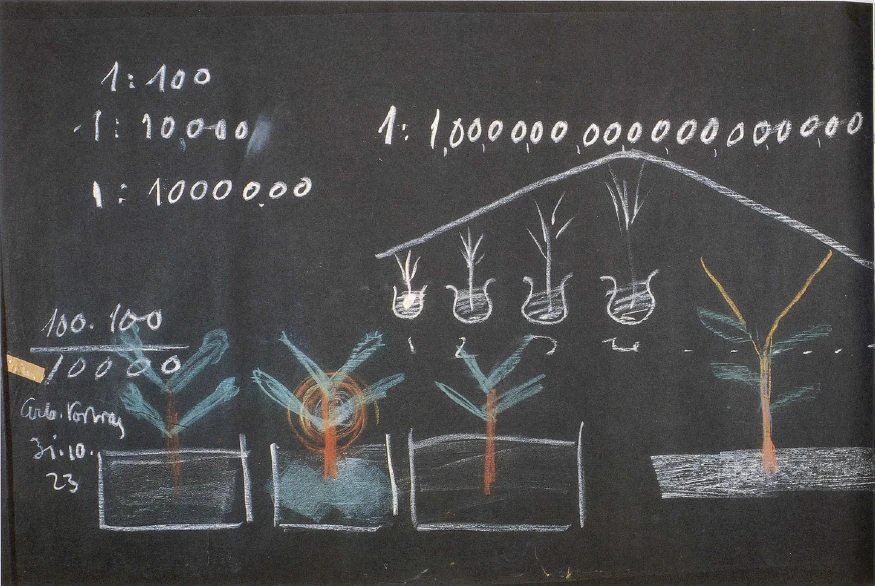
[ 7 ] Also auf diese Weise bekommt man die Wirkung von kleinsten Substanzen heraus. Die Wirkung von kleinsten Substanzen - das ist sehr merkwürdig, sehen Sie -, die ist rhythmisch! Verdünnt man, so bekommt man zuletzt bei einer gewissen Verdünnung das stärkste Wachstum, dann geht es wieder herunter, dann geht es wieder herauf; das geht rhythmisch. So daß man sieht: Wenn die Pflanze aus der Erde herauswächst, dann wirkt auf sie etwas, je nachdem sie belastet ist mit den Stoffen, was rhythmisch in der Umgebung wirkt. Da wirkt sozusagen die Erdenumgebung herein; das sieht man ganz deutlich.
[ 7 ] So this is how you bring out the effect of the tiniest substances. The effect of the tiniest substances—and this is very curious, you see—is rhythmic! As you dilute, you eventually reach a certain dilution where growth is strongest; then it declines again, then it rises again; it proceeds rhythmically. So one sees: When the plant grows out of the earth, something acts upon it, depending on how it is imbued with the substances that act rhythmically in its environment. The earth’s environment, so to speak, exerts its influence; one can see this quite clearly.
[ 8 ] Nun, wenn man sich darüber klar ist, daß kleinste Mengen etwas wirken, so wird man auch keine Bedenken mehr tragen, anzuerkennen, daß in solchen Zeiten wie jetzt, wo so viele Menschen unrichtige Nahrungsmittel zu sich nehmen und dann als Leichnam in der Erde verwesen, daß das anders wirkt! Das ist natürlich für die ganze Erde in starker Verdünnung, aber es wirkt eben anders, als wenn die Menschen gesund leben. Und das ist doch wieder in der Nahrung enthalten, die aus der Erde herauswächst. Das essen die Leute mit. So daß man sagen kann: Das ist etwas, was durch die Zeitverhältnisse mitbewirkt wird. Natürlich machen sich das die Leute mit der groben materialistischen Wissenschaft nicht klar, weil die sich sagen: Nun ja, was soll das, was man da in die Erde hereinlegt als Menschenleib, für die ganze Erde eine Bedeutung haben? - Es ist sehr verdünnt natürlich, was da vom Menschen hineinkommt, aber es wirkt.
[ 8 ] Well, once you realize that even the tiniest amounts have an effect, you’ll have no qualms about acknowledging that in times like these—when so many people consume unhealthy food and then decompose as corpses in the ground—the effect is different! Of course, this is highly diluted for the entire Earth, but it does have a different effect than when people live healthy lives. And this, after all, is contained in the food that grows from the Earth. People consume it along with their meals. So one can say: This is something that is influenced by the circumstances of the times. Of course, people who adhere to crude, materialistic science don’t realize this, because they say to themselves: “Well, what significance could what is placed into the earth as a human body possibly have for the entire earth?”—What comes from the human being is, of course, very diluted, but it does have an effect.
[ 9 ] Sehen Sie, meine Herren, da ist es dann gut, wenn wir überhaupt einmal über die ganze Pflanze sprechen. Die Gesundheitsverhältnisse der Menschen hängen ganz vom Pflanzenwachstum ab, und deshalb muß man kennen, was da im Pflanzenwachstum eigentlich alles mitwirkt.
[ 9 ] You see, gentlemen, it is good, then, if we talk about the plant as a whole for once. People’s health depends entirely on plant growth, and that is why we need to know exactly what factors are at work in plant growth.
[ 10 ] Gerade das mit der Kinderlähmung hat mich ungeheuer stark beschäftigt, und es ist dabei herausgekommen, daß man eigentlich den ganzen Menschen behandeln muß. Es haben sich auch schon Anhaltspunkte für allerlei Heilmittel gerade für die Kinderlähmung ergeben. Dieses ist wahrscheinlich von einer großen Wichtigkeit, weil die Kinderlähmung in der Zukunft eine wirklich schmerzliche Rolle spielen könnte. Es ist natürlich eine Frage, die einen tief beschäftigt, und ich habe mich gerade damit beschäftigt. Es wird wahrscheinlich ein Arzneimittel hergestellt werden müssen, das da besteht aus Sodabädern, arseniksaurem Eisen und aus einer besonderen Substanz noch, die genommen wird aus dem Kleinhirn, aus dem hinteren Teil des Hirnes bei den Tieren. Also es wird ein sehr kompliziertes Heilmittel geben müssen gerade bei einer solchen Kinderlähmung. Sehen Sie, hier handelt es sich bei einer solchen Krankheit, die aus sehr verborgenen Ursachen kommt, darum, daß sie auch gerade kompliziert wieder wird geheilt werden müssen. Die Dinge sind eigentlich heute durchaus aktuell, und es ist gut, wenn Sie sich klarmachen, wie das ganze Pflanzenwachstum vor sich geht.
[ 10 ] The issue of polio, in particular, has preoccupied me immensely, and it has become clear that one must actually treat the whole person. There have also already been indications of all sorts of remedies specifically for polio. This is likely of great importance, because polio could play a truly devastating role in the future. It is, of course, a matter that weighs heavily on one’s mind, and I have been focusing specifically on it. A remedy will likely have to be developed consisting of soda baths, arsenic acid iron, and a special substance derived from the cerebellum—the rear part of the brain in animals. So there will have to be a very complex remedy specifically for this type of polio. You see, with a disease like this, which stems from very hidden causes, the very fact that its causes are hidden means that its cure must also be particularly complex. These issues are actually quite relevant today, and it is good for you to understand how the entire process of plant growth takes place.
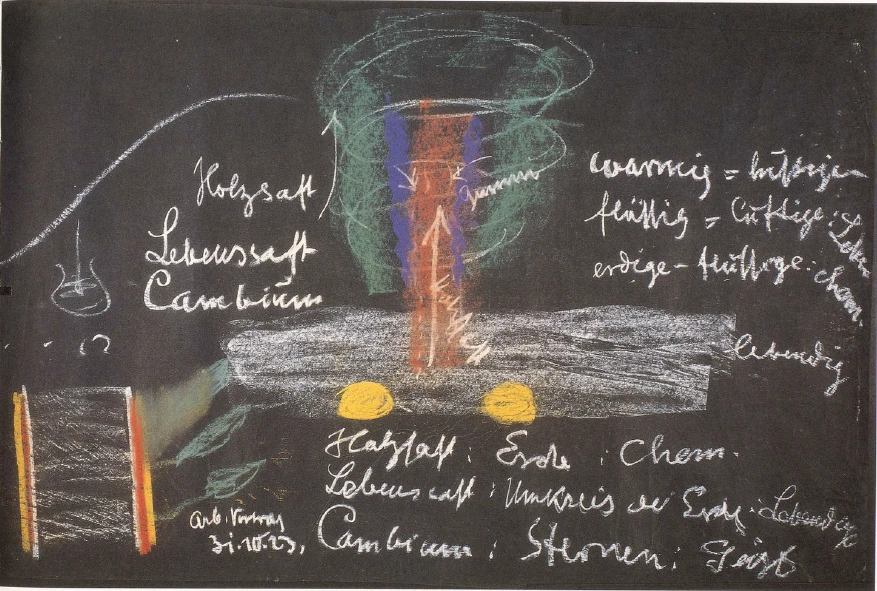
[ 11 ] Da wächst also die Pflanze aus dem Erdboden heraus. Ich will es heute sodarstellen, wie es geradederFrage entspricht, diederHerrDollinger gestellt hat (siehe Zeichnung). Nun wächst aus dem Keime die Wurzel heraus. Nehmen wir zunächst einen Baum; wir können dann zu der gewöhnlichen Pflanze übergehen. Wenn wir einen Baum nehmen, so wächst da der Stamm heraus. Ja, meine Herren, sehen Sie, schon dieses Wachsen des Stammes ist etwas außerordentlich Merkwürdiges. Dieser Stamm, der da wächst, der ist eigentlich nur dadurch gebildet, daß er Saft von der Erde nach oben gehen läßt, und dieser Saft, der aufsteigt - also das, was ich hier rot gezeichnet habe -, dieser aufsteigende Saft, der reißt mit sich alle möglichen Salze und Bestandteile der Erde; dadurch ist der Stamm überhaupt fest. Wenn Sie also Holz anschauen aus dem Stamm eines Baumes, so haben Sie einen aufsteigenden Saft, und dieser Saft reißt dann die festen Staubteile der Erde mit, allerlei Salze, also sagen wir kohlensaures Natrium, Eisensalzbestandteile in den Pflanzen. Alles das wird nun damitgerissen, und dadurch ist das Holz in sich fest. Nun, das Wesentliche ist, daß da der Saft aufsteigt.
[ 11 ] So the plant grows out of the ground. Today I want to illustrate it in a way that corresponds exactly to the question posed by Mr. Dollinger (see drawing). Now the root grows out of the seed. Let’s start with a tree; we can then move on to an ordinary plant. When we consider a tree, the trunk grows out of it. Yes, gentlemen, you see, even this growth of the trunk is something extraordinarily remarkable. This trunk that is growing is actually formed solely by the fact that it allows sap to rise from the earth, and this sap that rises—that is, what I have drawn here in red—this rising sap carries with it all kinds of salts and constituents of the earth; this is what gives the trunk its strength in the first place. So when you look at wood from a tree trunk, you see an ascending sap, and this sap then carries along the solid particles of the earth—all kinds of salts, such as sodium bicarbonate and iron salts found in plants. All of this is carried along with it, and that is what gives the wood its internal strength. Now, the essential point is that the sap rises.
[ 12 ] Was geschieht denn da eigentlich? Sehen Sie, da kommt, wenn da das aufsteigt, das Feste, das Erdige, zum Flüssigen, und wir haben da aufsteigend Erdig-Flüssiges. Erdig-Flüssiges steigt da auf, es ist solch ein dicklicher, erdig-flüssiger Stoff. Das Flüssige verdunstet dann, und das Erdige bleibt zurück. Das, was da erdig zurückbleibt, das ist das Holz. Wenn der Saft nun da hinaufsteigt, so entsteht er nicht etwa da (es wird auf die Zeichnung hingewiesen), sondern dieser Saft, der da im Holz aufsteigt — nennen wir ihn Holzsaft -, der ist eigentlich in der ganzen Erde enthalten, so daß die Erde in dieser Beziehung ein einziges großes Lebewesen ist. Dieser Holzsaft, der im Baum nach aufwärts steigt, der ist im Grunde, wie gesagt, in der ganzen Erde vorhanden; nur, in der Erde ist dieser Saft eigentlich etwas ganz Besonderes. Er wird erst zu dem, was er im Baume darstellt, er wird erst dazu im Baume. In der Erde ist er nämlich der eigentlich erdenbelebende Saft. Die Erde ist wirklich ein Lebewesen. Und das, was dann in den Baum hinaufsteigt, das ist in der ganzen Erde; durch das lebt die Erde. Im Baum, da verliert nämlich dieser Saft seine Lebensfähigkeit, er wird ein Chemiker, da hat er nur noch chemische Kräfte.
[ 12 ] What is actually happening there? You see, when that rises—the solid, the earthy—it combines with the liquid, and we end up with an earthy-liquid substance rising. An earthy-liquid substance rises there; it is a thick, earthy-liquid substance. The liquid then evaporates, and the earthy substance remains behind. What remains there as earth is the wood. When the sap rises up there, it does not originate there (pointing to the drawing), but this sap that rises up in the wood—let’s call it wood sap—is actually contained throughout the entire earth, so that, in this respect, the earth is a single, great living being. This wood sap that rises upward in the tree is, as I said, essentially present throughout the entire earth; only, in the earth, this sap is actually something quite special. It only becomes what it is in the tree; it only becomes that in the tree. In the earth, it is, in fact, the sap that actually animates the earth. The Earth is truly a living being. And what then rises up into the tree is present throughout the entire Earth; it is through this that the Earth lives. In the tree, however, this sap loses its vitality; it becomes a “chemist,” possessing only chemical forces.
[ 13 ] Wenn Sie also einen Baum anschauen, so müssen Sie sich sagen: Das Erdig-Flüssige im Baum, das ist chemisch geworden, und in der Erde selber drunten, da war es noch lebendig. Es ist also der Holzsaft zum Teil gestorben, indem er in den Baum hinaufging.
[ 13 ] So when you look at a tree, you have to tell yourself: The earthy, fluid substance in the tree has become chemical, whereas down in the earth itself, it was still alive. So the sap has, in part, died as it rose up into the tree.
[ 14 ] Wenn nichts anderes wäre, dann würde überhaupt niemals eine Pflanze entstehen, sondern es würden nur Stümpfe entstehen, die nach oben absterben und in denen chemische Vorgänge sich abspielen. Aber da kommt ja das, was sich aus dem Holzsaft bildet, der Stamm, in die Luft heraus - und die Luft ist immer von Feuchtigkeit durchsetzt -, er kommt in die feuchte Luft heraus, in das Feuchte, in das Wäßrig-Luftige. Der Holzsaft- mit dem, was er erzeugt- kommt also aus dem Erdig-Flüssigen in das Flüssig-Luftige. Und im Flüssig-Luftigen, da bildet sich wiederum das Leben neu, so daß sich der Stamm ringsherum besetzt mit dem, was dann im grünen Laub lebt (es wird gezeichnet) und zuletzt in der Blüte und in allem, was da draußen ist. Das wird wiederum zum Leben erweckt. Im Laub, im Blatt, in der Blüte und in der Knospe, da lebt wiederum Lebenssaft; der Holzsaft ist abgestorbener Lebenssaft. Im Stamm stirbt fortwährend das Leben ab, im Blatte macht es sich neu. So daß wir sagen müssen: Wir haben Holzsaft, der steigt nach oben; dann haben wir Lebenssaft. - Was tut denn der? Sehen Sie, der Lebenssaft der kreist da herum und erzeugt überall die Blätter. Daher können Sie auch solche Spiralen, in denen die Blätter angeordnet sind, beobachten. Der Lebenssaft, der kreist also eigentlich herum. Und der rührt aus dem Flüssig-Luftigen her, in das die Pflanze kommt, wenn sie aus dem Erdig-Flüssigen herausgewachsen ist.
[ 14 ] If it were any other way, plants would never come into being at all; instead, only stumps would form, which would die off toward the top and in which chemical processes would take place. But then what forms from the sap—the trunk—emerges into the air—and the air is always permeated with moisture—it emerges into the moist air, into the moist, into the watery-airy. The sap—along with what it produces—thus emerges from the earthy-liquid into the liquid-airy. And in the fluid-airy realm, life forms anew, so that the trunk becomes filled all around with what then lives in the green foliage (it is drawn) and ultimately in the flower and in everything that is out there. This, in turn, is brought back to life. In the foliage, in the leaf, in the flower, and in the bud, life sap lives once more; the wood sap is dead life sap. In the trunk, life continually dies off; in the leaf, it renews itself. So we must say: We have wood sap, which rises upward; then we have life sap. - What does it do? You see, the life sap circulates there and produces leaves everywhere. That is why you can also observe such spirals in the arrangement of the leaves. The life sap, then, actually circulates. And it originates from the fluid-airy realm, into which the plant enters once it has grown out of the earthy-fluid realm.
[ 15 ] Sehen Sie, meine Herren, daß der Stamm, der Holzstamm tot ist und nur das da hier bei der Pflanze lebt, was sich ringsherum ansetzt, das können Sie auf eine sehr einfache Weise beweisen, nämlich folgendermaßen: Denken Sie einmal, Sie gehen an einen Baum heran, haben da den Holzstamm, dann haben Sie da die Rinde, und in der Rinde drinnen, da wachsen nun die Blätter darinnen (es wird gezeichnet). Jetzt gehe ich her Tafel! und schneide die Rinde weg - dadurch kommt das Blatt auch weg -, hier lasse ich aber die Blätter daran mit der Rinde. Und die Geschichte stellt sich so heraus, daß hier der Baum lebendig, frisch bleibt, und daß er da anfängt, abzusterben. Das Holz allein mit seinem Holzsaft kann den Baum nicht lebendig erhalten. Da muß von außen einfließen dasjenige, was mit den Blättern kommt; das enthält wieder das Leben. Wir sehen auf diese Weise: Die Erde kann zwar den Baum heraustreiben, aber sie müßte ihn sterben lassen, wenn er nicht von außen, von der feuchten Luft das Leben gekriegt hätte; denn im Baum drinnen ist der Holzsaft nur ein Chemiker, kein Lebenserreger. Das Leben, das herumkreist, das macht sein Leben aus. Und man kann eigentlich sagen: Wenn der Holzsaft im Frühling aufsteigt, so wird in der Erde der Baum neu. Wenn dann im Frühling der Lebenssaft wieder neu herumkreist, wird der Baum jedes Jahr neu lebendig. Die Erde wirkt auf den Holzsaft, das Erdig-Flüssige; das Flüssig-Luftige wirkt auf den Lebenssaft.
[ 15 ] You see, gentlemen, that the trunk—the log—is dead, and only the part here on the plant, which grows all around it, is alive. You can prove this in a very simple way, namely as follows: Imagine you’re walking up to a tree; there’s the trunk, then there’s the bark, and inside the bark, that’s where the leaves grow (a drawing is made). Now I’ll go over to the blackboard! and cut away the bark—which also removes the leaf—but here I’ll leave the leaves attached to the bark. And what happens is that here the tree remains alive and fresh, while there it begins to die off. The wood alone, with its sap, cannot keep the tree alive. What comes with the leaves must flow in from the outside; that, in turn, contains life. In this way we see: Although the earth can cause the tree to sprout, it would have to let it die if it hadn’t received life from the outside, from the moist air; for inside the tree, the sap is merely a chemical substance, not a source of life. It is the life that circulates that constitutes its life. And one can actually say: When the sap rises in the spring, the tree is renewed within the earth. When the life-sap begins to circulate anew in the spring, the tree comes to life anew every year. The earth acts upon the sap—the earthy-fluid element; the fluid-airy element acts upon the life-sap.
[ 16 ] Das ist aber noch nicht zu Ende, sondern jetzt, während das geschieht, bildet sich zwischen der Rinde, die noch vom Lebenssaft durchzogen ist, und dem Holz eine neue Pflanzenschicht; da kann ich gar nicht mehr sagen, daß sich da ein Saft bildet. Hier habe ich gesagt: Holzsaft, Lebenssaft; aber hier kann ich nicht mehr sagen, daß sich ein Saft bildet, weil das, was sich da bildet, ganz dicklich ist. Es heißt das Kambium. Das bildet sich darinnen zwischen der Rinde, die noch zu den Blättern gehört, und dem Holz. Wenn ich also das da hier wegschneide (es wird gezeichnet), so bildet sich dadrinnen kein Kambium. Aber das Kambium, das braucht die Pflanze auch in einer gewissen Weise. Der Holzsaft bildet sich im ErdigFlüssigen, der Lebenssaft bildet sich im Flüssig-Luftförmigen, und das Kambium bildet sich in der warmen Luft, im Warmig-Luftigen oder im Luftig-Warmen. Die Pflanze entwickelt Wärme, indem sie von außen das Leben empfängt. Diese Wärme schickt sie in ihr eigenes Inneres, und aus dieser Wärme bildet sich da drinnen das Kambium. Oder, wenn sich noch nicht Kambium bildet - das Kambium braucht die Pflanze, Sie werden gleich noch hören wozu -, aber bevor das Kambium sich bildet, bildet sich schon etwas Dickliches: das ist der innere Pflanzengummi. In ihrer Wärme bilden die Pflanzen nach innen auch den Pflanzengummi, der unter Umständen ein wichtiges Heilmittel ist. Also der Holzsaft reißt die Pflanze nach aufwärts, die Blätter beleben die Pflanze; dann aber bilden wiederum die Blätter, indem sie die Wärme erregen, den Gummistoff, der wiederum zurück auf das Kambium wirkt. Und bei alten Pflanzen, bei ganz alten Pflanzen hat sich dieser Gummi, indem er zur Erde heruntergegangen ist, durchsichtig gemacht. Als die Erde noch weniger fest war, noch feucht-flüssig war, hat er sich durchsichtig gemacht, und da ist er zum Bernstein geworden. Also Sie sehen, wenn Sie ein Stück Bernstein nehmen, so ist das dasjenige, was bei einer uralten Pflanze der Erde aus dem Blatt wie Blut herausgeronnen ist, zur Erde herunter: Harz, Pech. Das alles fließt wieder nach unten, das gibt die Pflanze wieder der Erde zurück: Pech, Harz, Bernstein. Und wenn es die Pflanze selber behält, wird es eben das Kambium. Durch den Holzsaft steht die Pflanze mit der Erde in Verbindung; der Lebenssaft bringt die Pflanze in Verbindung mit dem, was um die Erde herumkreist, mit dem luftig-feuchtigen Umkreis der Erde. Aber das Kambium, das bringt die Pflanze in Verbindung mit den Sternen, mit dem, was oben ist. Und da ist es nun so, daß in diesem Kambium drinnen schon die Gestalt der nächsten Pflanze entsteht. Das geht dann auf den Samen über und dadurch wird die nächste Pflanze geboren; so daß die Sterne auf dem Umwege durch das Kambium die nächste Pflanze erzeugen. Also die Pflanze wird nicht aus dem Samen bloß erzeugt - das heißt, sie wird natürlich schon aus dem Samen erzeugt, aber der Samen muß zunächst die Einwirkung vom Kambium, das heißt, die Einwirkung vom ganzen Himmel haben.
[ 16 ] But that is not the end of it; rather, as this is happening, a new layer of plant tissue forms between the bark—which is still permeated by sap—and the wood; at this point, I can no longer say that sap is forming there. Here I have said: wood sap, life sap; but here I can no longer say that a sap is forming, because what is forming there is quite thick. It is called the cambium. It forms inside between the bark—which still belongs to the leaves—and the wood. So if I cut this part away here (it is drawn), no cambium will form inside. But the plant also needs the cambium in a certain way. The wood sap forms in the earthy-liquid, the life sap forms in the liquid-airy, and the cambium forms in the warm air, in the warm-airy or the airy-warm. The plant develops warmth by receiving life from the outside. It sends this warmth into its own interior, and from this warmth the cambium forms inside. Or, if the cambium has not yet formed—the plant needs the cambium, as you will hear in a moment—but before the cambium forms, something thick already forms: that is the inner plant gum. In their warmth, the plants also form the plant gum inwardly, which under certain circumstances is an important remedy. So the sap draws the plant upward, the leaves enliven the plant; but then, in turn, the leaves—by generating warmth—form the gum substance, which in turn acts back on the cambium. And in old plants—in very old plants—this gum, having flowed down into the earth, has become transparent. When the earth was still less solid, still moist and fluid, it became transparent, and there it turned into amber. So you see, when you take a piece of amber, it is precisely what, in an ancient plant, oozed from the leaf like blood and flowed down to the earth: resin, pitch. All of this flows back down; the plant returns it to the earth: pitch, resin, amber. And when the plant retains it itself, it becomes the cambium. Through the sap, the plant is connected to the earth; the life sap connects the plant to what circles around the earth, to the airy, moist atmosphere surrounding the earth. But the cambium connects the plant to the stars, to what is above. And so it is that within this cambium, the form of the next plant is already taking shape. This is then transferred to the seed, and through this the next plant is born; so that the stars, indirectly through the cambium, bring forth the next plant. Thus, the plant is not produced solely from the seed—that is to say, it is of course produced from the seed, but the seed must first be influenced by the cambium, that is, by the influence of the entire heavens.
[ 17 ] Sehen Sie, das ist schon etwas Wunderbares: Wenn man einen Pflanzensamen in die Hand bekommt, so hat dieses anspruchslose, bescheidene kleine Staubkörnchen Samen nur dadurch entstehen können, daß das Kambium - jetzt nicht im Flüssigen, sondern in etwas Dicklichem - die ganze Pflanze nachmacht. Und diese Gestalt, die da drinnen im Kambium entsteht — eine neue Pflanzengestalt -, die überträgt die Kraft auf den Samen, und davon hat der Samen dann die Kraft, wiederum eine neue Pflanze unter der Einwirkung der Erde nach aufwärts wachsen zu lassen.
[ 17 ] You see, this is truly something wonderful: When you hold a plant seed in your hand, this unassuming, modest little speck of dust—the seed—could only have come into being because the cambium—not in a liquid state, but in something viscous—reproduces the entire plant. And this form that arises inside the cambium—a new plant form—transfers its power to the seed, and from this the seed then has the power to cause a new plant to grow upward under the influence of the earth.
[ 18 ] Also Sie sehen, meine Herren, mit dem bloßen Spekulieren, wenn man einfach das Samenkorn unter das Mikroskop legt, kommt nichts heraus. Da muß man sich klar sein darüber, wie das Ganze zusammenhängt mit dem Holzsaft, Lebenssaft und Kambium. Daher ist auch der Holzsaft ein verhältnismäßig dünnlicher Saft; er ist eigentlich darauf berechnet, daß in ihm leicht chemische Wirkungen sich bilden können. Der Lebenssaft der Pflanze, der ist schon viel mehr dicklich, er sondert ja auch den Gummi ab. Wenn Sie den Gummi ein bißchen dick machen, können Sie wunderbare Figuren daraus machen. Der Lebenssaft also, der hat schon etwas Dicklicheres gegenüber dem Holzsaft, der schmiegt sich schon mehr der Pflanzenform an. Und dann gibt er die ganze Form an das Kambium ab. Das ist noch dicklicher, schon ganz zäh, ist nur noch so weich, daß es die Formen annehmen kann, die ihm von den Sternen gegeben werden.
[ 18 ] So you see, gentlemen, mere speculation—simply placing the seed under a microscope—yields nothing. One must understand clearly how the whole process relates to the sap, the life sap, and the cambium. That is why the sap is a relatively thin fluid; it is actually designed so that chemical reactions can easily take place within it. The plant’s life sap, on the other hand, is much thicker—it is what secretes the gum. If you thicken the gum a little, you can make wonderful shapes out of it. So the sap is somewhat thicker than the wood sap; it conforms more closely to the plant’s form. And then it imparts its entire form to the cambium. This is even thicker, already quite tough, yet still soft enough to take on the forms given to it by the stars.
[ 19 ] So ist es beim Baum, so aber auch bei der gewöhnlichen Pflanze. Wenn da die Erde ist und man da das Würzelchen hat, so wächst der Sproß nach oben; aber jetzt setzt es nicht gleich die festen Stoffe ab, es wird nicht zum Holz - es bleibt so wie eben ein Krautstengel ist -, das kommt nicht so weit; dann bilden sich gleich die Blätter daran im Umkreis, spiralig, und dann bildet sich auch da im Inneren gleich das Kambium aus, und das Kambium nimmt wiederum alles zur Erde mit zurück. So daß bei der einjährigen Pflanze der Prozeß, der ganze Vorgang viel schneller vor sich geht. Beim Baume, da sondern sich nur die festen Bestandteile ab, und es wird nicht gleich alles verwendet. Aber derselbe Vorgang findet auch bei der ganz gewöhnlichen Pflanze statt, nur kommt es nicht so weit wie beim Baume. Beim Baume ist es überhaupt ein ziemlich komplizierter Vorgang. Wenn Sie den Stamm von oben anschauen, haben Sie das so, daß zunächst das Mark darinnen ist - das ist also etwas, was die Richtung angibt; dann bildet sich um das Mark herum das, was Holzablagerungen sind. Geht es jetzt gegen den Herbst zu, da kommt der Gummi von der anderen Seite, und der klebt das Holz zusammen. Jetzt haben wir von einem Jahr das gummierte Holz. Im nächsten Jahr geschieht mit dem, was da aufsteigt, wiederum dasselbe, es muß jetzt nur mehr an einen anderen Ort gehen, wird wiederum zusammengummiert im Herbst, und dadurch, daß immer weiter zusammengummiert wird, entstehen die Jahresringe. Also Sie sehen, alle die Dinge werden sehr erklärlich, wenn man nur innerlich die Vorgänge richtig verstehen kann, wenn man nur weiß, daß da dreierlei Stoffe vorhanden sind: Holzsaft, Lebenssaft und Kambium. Der Holzsaft ist am flüssigsten, der ist also eigentlich ein Chemiker. Der Lebenssaft, der belebt; der ist also eigentlich, wenn ich mich so ausdrücken darf, ein Lebendiger. Und dasjenige, was im Kambium geschieht - ja, da wird eigentlich aus den Sternen heraus die ganze Pflanze gezeichnet. Es ist wirklich so, meine Herren! Da geht der Holzsaft aufwärts, stirbt ab; da entsteht wieder das Leben, und jetzt kommt die Sternenwirkung: da entsteht das, daß aus dem Kambium, das schon zäh, dicklich geworden ist, aus dem Sterneneinflusse die neue Pflanze gezeichnet wird. So daß man im Kambium richtig eine Zeichnung, eine Bildhauerarbeit der neuen Pflanze hat; das wird da hinein gebildhauert. Da wird von den Sternen hineinmodelliert aus dem ganzen Weltenraum dasjenige, was dann die ganze Pflanzenform ist. Da, sehen Sie, kommen wir aus dem Leben in den Geist hinein. Denn was da modelliert wird, das wird aus dem Weltengeist heraus modelliert. Das ist sehr interessant, meine Herren: Die Erde gibt ihr Leben zunächst an die Pflanze ab, die Pflanze stirbt, die Luftumgebung gibt der Pflanze mit ihrem Licht zusammen wiederum das Leben, und der Weltengeist gibt die neue Pflanzenform herein. Die bewahrt sich dann im
[ 19 ] This is true of trees, but also of ordinary plants. When there is soil and a little root, the shoot grows upward; but at this stage it does not immediately produce solid tissue—it does not turn into wood—it remains just like a herb stem—it does not progress that far; then the leaves form around it in a spiral, and then the cambium also forms inside right away, and the cambium, in turn, carries everything back down to the earth. So that in an annual plant, the process—the entire sequence of events—takes place much more quickly. In a tree, only the solid components are set aside, and not everything is used right away. But the same process also takes place in the most ordinary plant; it just doesn’t go as far as it does in a tree. In a tree, it’s actually a rather complicated process. If you look at the trunk from above, you’ll see that first there’s the pith inside—which serves as a sort of guide; then, around the pith, wood deposits form. As autumn approaches, the gum comes from the other side and binds the wood together. Now we have the gummed wood from one year. The following year, the same thing happens with what rises up; it just has to go to a different place, is bound together again with gum in the fall, and as this binding with gum continues, the annual rings are formed. So you see, all these things become very clear if one can only truly understand the processes inwardly, if one only knows that there are three kinds of substances present: wood sap, life sap, and cambium. The wood sap is the most fluid; it is, so to speak, a chemist. The life sap, which gives life—it is, if I may put it that way, a living being. And what happens in the cambium—well, that is actually where the entire plant is drawn from the stars. It really is so, gentlemen! There the sap rises, dies off; there life arises again, and now the influence of the stars comes into play: there, from the cambium—which has already become tough and thick—the new plant is drawn under the influence of the stars. So that in the cambium one truly has a drawing, a sculptural work of the new plant; it is sculpted into it there. There, from the entire cosmos, the stars model into it that which then constitutes the entire form of the plant. There, you see, we move from life into the spirit. For what is modeled there is modeled out of the world spirit. This is very interesting, gentlemen: The earth first imparts its life to the plant; the plant dies; the atmosphere, together with its light, in turn gives life back to the plant; and the world spirit imparts the new plant form. This is then preserved in
[ 20 ] Samen und wächst dann wieder auf die gleiche Weise. So daß man also in der aufsteigenden Pflanze einen Weg sieht, wie aus der Erde heraus durch den Tod zum lebendigen Geist die ganze Pflanzenwelt sich aufbaut.
[ 20 ] Seed and then grows again in the same way. Thus, in the growing plant, one sees a path by which the entire plant world builds itself up from the earth, through death, to the living spirit.
[ 21 ] Holzsaft: Erde: Chemisches
Lebenssaft: Umkreis der Erde: Lebendiges
Kambium: Sterne: Geist
[ 21 ] Tree sap: Earth: Chemical
Life force: Earth's orbit: Living
Cambium: Stars: Spirit
[ 22 ] Nun werden in Stuttgart noch andere Versuche gemacht. Diese Dinge hier sind außerordentlich lehrreich. Statt daß man bloß das Wachstum untersucht — was also schon wichtig ist, besonders wenn man in die höheren Verdünnungen hinaufkommt von eins zu einer Trillion, was also schon sehr interessant ist -, kann man nämlich noch folgendes machen. Man nimmt ganz verdünnte, auf die beschriebene Weise verdünnte Me- Tafel 10 talle oder Metallverbindungen, sagen wir zum Beispiel man nimmt Kupfe- """ riges, ganz verdünnt, so daß man es in einer Lösung hat. Jetzt gibtman das in einen Blumentopf. Da ist Erde drinnen. In diese Erde gibt man gewissermaßen als eine Art Dünger das Kupfer hinein. Daneben stellt man einen Topf auf, der bloße Erde hat, dieselbe Erde, die aber nicht durch das Kupfer gedüngt ist. Es muß dieselbe Erde sein, aber sie hat nicht das Kupfer. Nun nimmt man wiederum ganz dieselben Pflanzen - die Pflanzen müssen möglichst gleich weit im Wachstum sein -, setzt die eine Pflanze hinein in die mit Kupfer also gewissermaßen gedüngte Erde, und die andere Pflanze setzt man in die Erde hinein, in der keine Kupferdüngung enthalten ist. Und das Merkwürdige stellt sich heraus, gerade wenn man das Kupfer recht stark verdünnt hat, daß die Blätter hier am Rande Runzeln kriegen — die anderen kriegen keine Runzeln, wenn sie glatte Blätter haben, nicht schon von vornherein Runzeln haben. Deshalb muß man dieselbe Erde nehmen, weil viele Erden ja schon von früher das Kupfer enthalten. Man muß dieselbe Erde nehmen - das eine Mal verkupfert man sie- und man muß die gleiche Pflanze nehmen, damit man das genau vergleichen kann.
[ 22 ] Now, other experiments are being conducted in Stuttgart. These experiments are extremely instructive. Instead of merely studying growth—which is certainly important, especially when one reaches the higher dilutions ranging from one to one trillion, which is already very interesting—one can also do the following. One takes highly diluted metals or metal compounds—diluted in the manner described—Table 10; let’s say, for example, one takes copper, highly diluted so that it is in solution. Now one pours this into a flowerpot. There is soil inside. One adds the copper to this soil, so to speak, as a kind of fertilizer. Next to it, you place a pot containing plain soil—the same soil, but one that has not been fertilized with copper. It has to be the same soil, but it doesn’t contain the copper. Now you take exactly the same plants—the plants must be as close as possible in their stage of growth—and place one plant in the soil that has been fertilized with copper, so to speak, and place the other plant in the soil that contains no copper fertilizer. And what’s remarkable is that, especially when the copper has been diluted quite strongly, the leaves here develop wrinkles along the edges—the others don’t develop wrinkles if their leaves are smooth to begin with, not wrinkled from the start. That’s why you have to use the same soil, because many soils already contain copper from before. You have to use the same soil—add copper to it just once—and you have to use the same plant so that you can make an accurate comparison.
[ 23 ] Nun nimmt man eine dritte Pflanze, gibt in ein drittes Gefäß wiederum dieselbe Erde hinein, gibt ihr aber jetzt statt Kupfer Blei hinein. Da fällt es den Blättern gar nicht ein, sich zu runzeln, sondern sie werden in der Spitze dürr und blättern ab, werden also welk am Ende und blättern ab, wenn man Blei hineintut. Jetzt haben Sie auf einmal ein ganz merkwürdiges Bild. Diese Untersuchungen werden in Stuttgart gemacht, und sie sehen sehr schön aus, diese Dinge, wenn man da hintereinander alle die Blumentöpfe stehen hat und nun sieht, wie die Stoffe der Erde auf die Pflanzen wirken.
[ 23 ] Now take a third plant, put the same soil into a third container, but this time add lead instead of copper. In this case, the leaves don’t even think to wrinkle; instead, their tips wither and fall off—so they end up wilting and shedding their leaves when lead is added. Now you suddenly have a very curious sight. These experiments are being conducted in Stuttgart, and they look quite beautiful—all those flowerpots lined up one after another, and you can see how the substances in the soil affect the plants.
[ 24 ] Sie werden sich künftighin nun nicht mehr verwundern, wenn Sie irgendwo Pflanzenformen sehen mit runzeligen Blättern. Wenn man da in die Erde hineingräbt, so werden Sie Spuren von Kupfer finden. Oder wenn Sie Blätter haben, die am Rande leicht runzeln und dürr werden, und Sie graben dann in die Erde hinein, so werden Sie leicht Spuren von Blei finden. Sehen Sie zum Beispiel hin auf die bekannte Pflanze, die man Zinnkraut nennt, mit der man die Töpfe scheuert. Diese Pflanze wächst wiederum gerade an solchen Orten, wo der Boden Silizium enthält; daher bekommen sie diese steifen kieseligen Stengel. So können Sie aus dem Boden heraus die Pflanzenformen verstehen.
[ 24 ] In the future, you will no longer be surprised when you see plants with wrinkled leaves. If you dig into the soil there, you will find traces of copper. Or if you have leaves that are slightly wrinkled and withered at the edges, and you dig into the soil, you will easily find traces of lead. Take, for example, the well-known plant called horsetail, which is used to scrub pots. This plant, in turn, grows precisely in places where the soil contains silicon; that is why it develops these stiff, siliceous stems. In this way, you can understand plant forms by looking at the soil.
[ 25 ] Nun können Sie aber auch verstehen, was es für eine Bedeutung hat, wenn ganz kleine Mengen von irgendeiner Substanz dem Grund und Boden beigemischt werden. Natürlich ist der Kirchhof irgendwo draußen, aber die Erde ist ja überall ganz durchzogen vom Holzsaft, und die kleinen Mengen gehen überall gerade in den Boden über. Und wenn man einmal die Versuche gemacht hat, wie diese kleinen Mengen wirken, von denen ich Ihnen jetzt erzählt habe, dann sagt man sich: Ja, dasjenige, was gerade in kleinen Mengen in den Boden hinein verflüchtigt war, das essen wir ja mit! Es ist so stark, daß es in der Pflanzenform lebt. Und was geschieht da weiter? Denken Sie sich, ich hätte also hier eine Pflanzenform gekriegt, die aus einem bleihaltigen Boden kommt. Heute, sagen die Leute, entsteht das Blei nicht. Aber im Boden entsteht eben Blei, wenn man gerade in den Boden hinein verwesendes Lebendiges bringt. Es entsteht eben einfach im Boden Blei. Da wächst nun die Pflanze heraus - wir können geradezu sagen: es wächst eine Blei-Pflanze heraus. - Nun schön. Wenn wir diese Pflanze, diese Blei-Pflanze essen, dann hat sie eine ganz andere Wirkung, als wenn Sie eine Pflanze essen, die keine Blei-Pflanze ist. Wenn wir eine Blei-Pflanze essen, so wirkt das so, daß unser Kleinhirn, das da hinten im Kopfe ist, trockener wird, als es sonst ist. Es wird trockener.
[ 25 ] Now you can also understand what it means when very small amounts of any substance are mixed into the soil. Of course, the cemetery is out there somewhere, but the earth is completely permeated by tree sap everywhere, and those small amounts seep right into the ground everywhere. And once you’ve conducted the experiments to see how these small amounts—which I’ve just told you about—work, you realize: Yes, the very substance that has just seeped into the soil in small amounts—we’re actually eating that too! It’s so potent that it lives on in the plant form. And what happens next? Imagine, for example, that I’ve obtained a plant here that comes from lead-contaminated soil. People say that lead isn’t produced these days. But lead is produced in the soil when decaying organic matter is introduced into it. Lead simply forms in the soil. Then the plant grows out of it—we can practically say: a lead-containing plant grows out of it. - All right. If we eat this plant—this lead plant—it has a completely different effect than if you eat a plant that isn’t a lead plant. When we eat a lead plant, it causes our cerebellum—which is located at the back of the head—to become drier than it normally is. It becomes drier.
[ 26 ] Jetzt haben Sie einen Zusammenhang zwischen dem Boden und dem Kleinhirn. Es kann also Pflanzen geben, die einfach durch die Beschaffenheit des Bodens, durch das, was man irgendwo in die Erde hineinbringt und was sich dann irgendwo verteilt, das Kleinhirn etwas austrocknen. Nun, meine Herren, in dem Augenblick, wo wir das Kleinhirn nicht in voller Kraft haben, werden wir ungeschickt. Wenn dem Kleinhirn irgend etwas passiert, werden wir ungeschickt, können die Füße und die Arme nicht mehr ordentlich bewegen; und wenn das dann etwas stärker wird, werden wir an den Gliedern gelähmt.
[ 26 ] Now you have a connection between the soil and the cerebellum. So there may be plants that, simply because of the nature of the soil—because of what is introduced into the earth somewhere and then spreads out—cause the cerebellum to dry out somewhat. Well, gentlemen, the moment our cerebellum is not functioning at full strength, we become clumsy. If anything happens to the cerebellum, we become clumsy and can no longer move our feet and arms properly; and if this condition worsens, our limbs become paralyzed.
[ 27 ] Sehen Sie, meine Herren, so ist der Weg von dem Boden zu der Menschenlähmung. Der Mensch ißt von einer Pflanze, und wenn diese an dem Rande der Blätter etwas Absterbendes hat, wenn sie so geworden ist, wie ich es Ihnen beschrieben habe, so wird jetzt sein Kleinhirn etwas vertrocknen. Im gewöhnlichen Leben merkt man es nicht gleich, aber der Mensch kann sich dann nicht mehr richtig orientieren; wird das stärker, so kommt die Lähmung. Nun ist es wiederum so, daß zuallererst, wenn man sich nicht orientieren kann, wenn dieses auftritt im Kopfe, daß man sich nicht orientieren kann - was vom Vertrocknen des Kleinhirns ausgeht -, so ergreift das zunächst alle die Muskeln, die da oben im Kopfe von einer kleinen Drüse versorgt werden, von der sogenannten Zirbeldrüse, und namentlich die Sehpartien. Geschieht das, dann kriegt man bloß die Grippe. Geht die Lähmung weiter, so bildet sich die Grippe um zum ganzen gelähmten Menschen. So daß also in allen Lähmungserscheinungen etwas steckt, was mit dem Boden der Erde innig zusammenhängt. Und daraus sehen Sie, daß man wirklich von vielen Seiten her die Kenntnisse nehmen muß, damit man etwas Gesundendes für den Menschen zustande bringt. Es genügt wirklich nicht, daß man allerlei Redensarten macht, so und so soll es sein! Denn wenn man nicht weiß, wodurch die Menschen zuerst ihren Organismus abgestorben bekommen, dann kann man noch so gute Einrichtungen haben: die Menschen werden halt eben doch nicht mehr tüchtig sein. Denn alles dasjenige, was in der Pflanze wirkt und von der Pflanze in den Menschen übergeht, das ist ja auch im Menschen wiederum von einer großen Bedeutung.
[ 27 ] You see, gentlemen, this is the path from the soil to human paralysis. A person eats from a plant, and if the edges of the leaves show signs of withering—if they have become as I have described to you—then the person’s cerebellum will begin to wither somewhat. In everyday life, one does not notice it right away, but the person can no longer orient themselves properly; if this becomes more severe, paralysis sets in. Now, it is also the case that, first and foremost, when one cannot orient oneself—when this occurs in the head, stemming from the withering of the cerebellum—it initially affects all the muscles in the upper part of the head that are supplied by a small gland, the so-called pineal gland, and particularly the visual centers. If this happens, one merely catches the flu. If the paralysis progresses, the flu transforms into a state of total paralysis. So there is something underlying all manifestations of paralysis that is intimately connected with the earth’s core. And from this you can see that one really must draw on knowledge from many different sources in order to bring about something healing for human beings. It really isn’t enough to just make all sorts of declarations, saying, “It should be this way or that way!” For if one does not know what causes people’s organisms to begin to die off in the first place, then no matter how good one’s facilities may be, people simply will no longer be healthy. For everything that acts within the plant and passes from the plant into the human being is, in turn, of great significance within the human being as well.
[ 28 ] Sehen Sie, der Holzsaft, der entspricht eigentlich im Menschen dem ganz gewöhnlichen farblosen Zellsaft, dem Schleim. Der Holzsaft in der Pflanze ist beim Menschen der Lebensschleim. Der Lebenssaft der Pflanze, der da von den Blättern herumkreist, der entspricht dem menschlichen Blute. Und das Kambium der Pflanze, das entspricht im Menschen der Milch und dem Milchsaft. Wenn die Frau zum Stillen kommt, entwickelt sie nur den Milchsaft durch gewisse Drüsen in der Brust stärker. Da haben Sie wiederum das, was am stärksten beim Menschen von den Sternen beeinflußt wird: der Milchsaft. Dieser Milchsaft aber, der ist ganz besonders notwendig zur Bildung des Gehirns. Das Gehirn ist sozusagen eigentlich im Menschen verhärteter Milchsaft. Wenn man also solche Blätter hat, die absterben, dann erzeugen sie kein ordentliches Kambium, weil sie nicht mehr die Kraft haben, zurückzuwirken in der richtigen Wärme. Sie lassen die Wärme durch die absterbenden Teile nach außen wirken, nicht mehr richtig zurückwirken. Wir essen Pflanzen mit einem nicht ordentlich ausgebildeten Kambium: sie bilden in uns den Milchsaft nicht ordentlich aus; die Frauen bilden die Frauenmilch nicht ordentlich aus, die Kinder bekommen schon eine Milch, auf welche die Sterne nicht besonders stark wirken, die Kinder können sich nicht gut ausbilden. Daher tritt diese Lähmung natürlich auch besonders bei Kindern auf. Sie kann aber auch bei Großen auftreten, weil ja der Mensch das ganze Leben beeinflußt bleiben muß von der Sternenwelt, wie ich Ihnen schon auseinandergesetzt habe.
[ 28 ] You see, the sap of the plant actually corresponds in humans to the very ordinary, colorless cellular fluid—mucus. The sap in the plant is, in humans, the life-giving mucus. The life sap of the plant, which circulates from the leaves, corresponds to human blood. And the cambium of the plant corresponds to milk and milk sap in humans. When a woman begins to breastfeed, she simply produces more milk sap through certain glands in the breast. Here again you have what is most strongly influenced by the stars in humans: milk sap. This milk sap, however, is particularly necessary for the formation of the brain. The brain is, so to speak, essentially solidified milky sap in humans. So when leaves die off, they do not produce a proper cambium because they no longer have the strength to radiate heat back in the correct way. They allow the heat to radiate outward through the dying parts rather than radiating it back properly. We eat plants with an improperly formed cambium: they do not properly produce the milky sap within us; women do not properly produce breast milk, and children receive milk upon which the stars do not exert a particularly strong influence, so the children cannot develop properly. That is why this paralysis naturally occurs especially in children. However, it can also occur in adults, because human beings must remain under the influence of the starry world throughout their entire lives, as I have already explained to you.
[ 29 ] In diesen Dingen muß die Naturwissenschaft und die Heilmethode zusammenarbeiten. Das muß überall zusammenarbeiten. Aber man kann nicht in irgendeiner einzelnen Wissenschaft sich abschließen. Nicht wahr, heute gibt es überall Leute, die beschäftigen sich nur mit den Tieren; andere nur mit dem Menschen, das sind die Anthropologen. Dann wiederum andere mit einem Teil vom Menschen: mit kranken Sinnen, mit kranken Lebern, kranken Herzen; also auf Inneres spezialisieren sich diese Leute. Dann wieder studieren die Botaniker nur die Pflanzen, die Mineralogen die Steine, die Geologen das ganze Erdreich. Dadurch wird etwas sehr Bequemes geschaffen für die Wissenschaft. Man hat weniger zu lernen, wenn man bloß Geologe wird oder bloß von den Steinen zu lernen hat. Ja, aber solch ein Wissen nützt gar nichts! Es hat gar keinen Zweck,
[ 29 ] In these matters, the natural sciences and medical practice must work together. They must collaborate in every area. But one cannot isolate oneself within any single branch of science. Isn’t that right? Today, there are people everywhere who deal only with animals; others deal only with humans—these are the anthropologists. Then there are others who focus on a specific part of the human body: diseased senses, diseased livers, diseased hearts; in other words, these people specialize in internal organs. Then there are botanists who study only plants, mineralogists who study only rocks, and geologists who study the entire earth. This creates a very convenient situation for science. One has less to learn if one becomes merely a geologist or has to learn only about rocks. Yes, but such knowledge is of no use at all! It serves no purpose whatsoever,
[ 30 ] solch ein Wissen; wenn man mit dem Menschen etwas anfangen will, wenn er krank ist, so muß man die ganze Natur zusammennehmen. Es hat keinen Nutzen, solch eine bloße Geologie oder eine bloße Botanik oder eine bloße Chemie zu verstehen. Nicht wahr, die Chemie muß man verfolgen können bis hinein in das Arbeiten des Holzsaftes! Es ist wirklich so. Die Studenten haben einen Spruch ersonnen - es gibt ja an der Universität, wie Sie vielleicht wissen, ordentliche Professoren und außerordentliche Professoren -, und die Studenten haben da den Spruch ersonnen: Die ordentlichen Professoren wissen nichts Außerordentliches, und die außerordentlichen Professoren wissen nichts Ordentliches. - Aber das kann man heute viel weiter ausdehnen: Der Geologe weiß nichts von der Pflanze, vom Tier, vom Menschen;der Anthropologe weiß nichts vom Tier, von der Pflanze, von der Erde. Keiner weiß eigentlich, wie die Dinge zusammenhängen, mit denen er sich beschäftigt. Geradeso wie man sich in der Arbeit spezialisiert hat, verspezialisiert man sich im Wissen. Und da ist es viel schädlicher. Es ist haarsträubend, wenn es nur Geologen, nur Botaniker und so weiter gibt, denn dadurch wird das ganze Wissen zersplittert, und es kommt nichts Ordentliches zustande. Es ist dieses zur Bequemlichkeit der Menschen geschehen. Die Leute sagen heute schon: Man kann nicht ein Mensch sein, der alles weiß. - Ja, wenn man eben nicht ein Mensch sein will, der alles Wissen zusammennehmen kann, dann muß man eben auch gleich sagen: Man muß überhaupt verzichten auf ein nützliches Wissen. Wir leben schon in einer Zeit, in der die Dinge im Grunde eine fürchterliche Gestalt angenommen haben. Es ist gerade so, wie wenn einer, der mit der Uhr zu tun hat, dazu bloß das Feilen von Metallen lernen will. Nicht wahr, dann muß eben natürlich das herauskommen, daß schließlich einer das Feilen der Metalle kennt, der andere das Schweißen der Metalle und so fort. Und dann käme wiederum einer, der das Zusammensetzen der Uhr kennt, aber wiederum nicht weiß, wie man die einzelnen Metalle bearbeitet. Nun, nicht wahr: beim Maschinellen, da geht es wiederum ein bißchen, obwohl es natürlich auch wiederum nicht geht, ohne daß man die Menschen zwingt. Aber im Medizinischen zum Beispiel wird überhaupt nichts erreicht, wenn man nicht alles Wissen, bis zum Wissen der Erde, zusammennehmen kann. Denn im Holzstamm drinnen lebt dasjenige, was von der Erde, also von dem Gegenstand der Geologie, aufwärtsgetragen wird bis zum Holzsaft. Da erstirbt es. Man muß nun auch die Meteorologie, die Luft kennen, weil von der Umgebung den Blättern dasjenige zugetragen wird, was wiederum Leben hervorruft. Und man muß auch Astronomie, Sternkunde kennen, wenn man die Gestaltung des Kambium verstehen will. Wiederum muß man das kennen, was mit dem Kambium in den Menschen hineinkommt, wenn er ihn verzehrt: den Milchsaft, der zum Gehirn sich umbildet; so daß man also, wenn man verdorbenes Kambium kriegt, als Erwachsener ein verdorbenes Gehirn bekommt. Und auf diese Weise erzeugen sich aus dem, was in der Erde drinnen ist, die Krankheiten.
[ 30 ] Such knowledge; if one wants to do something for a person when they are sick, one must take nature as a whole into account. It is of no use to understand mere geology, mere botany, or mere chemistry. Isn’t that right? One must be able to trace chemistry all the way down to the workings of tree sap! It really is true. The students have come up with a saying—as you may know, at the university there are full professors and associate professors—and the students have come up with this saying: The full professors know nothing extraordinary, and the associate professors know nothing ordinary. - But today, one can take that much further: The geologist knows nothing about plants, animals, or humans; the anthropologist knows nothing about animals, plants, or the Earth. No one really knows how the things they study are connected. Just as one specializes in one’s work, one becomes overly specialized in one’s knowledge. And that is far more harmful. It’s appalling when there are only geologists, only botanists, and so on, because this fragments all knowledge, and nothing worthwhile comes of it. This has happened for the sake of people’s convenience. People are already saying today: You can’t be a person who knows everything. — Yes, if you don’t want to be a person who can bring all knowledge together, then you might as well say right away: One must forgo useful knowledge altogether. We are already living in a time when things have, in essence, taken on a dreadful form. It is just as if someone who works with clocks were to want to learn only how to file metals. Isn’t that right? Then, of course, the result would be that one person knows how to file metals, another how to weld them, and so on. And then there would be someone who knows how to assemble a clock but doesn’t know how to work with the individual metals. Well, isn’t that so: in the mechanical field, it works to some extent, although of course it doesn’t really work without forcing people. But in medicine, for example, nothing at all is achieved unless one can bring together all knowledge, right down to the knowledge of the earth. For within the tree trunk lives that which is carried upward from the earth—that is, from the realm of geology—to the sap. There it dies. One must also understand meteorology and the atmosphere, because what is carried from the environment to the leaves is what in turn gives rise to life. And one must also understand astronomy and the study of the stars if one wishes to comprehend the formation of the cambium. In turn, one must understand what enters a person along with the cambium when they consume it: the milky sap that is transformed into the brain; so that if one ingests corrupted cambium, one will, as an adult, have a corrupted brain. And in this way, diseases arise from what is inside the earth.
[ 31 ] Das ist dasjenige, was darüber zu sprechen ist, woher solche scheinbar unerklärlichen Krankheiten kommen. Sie liegen im Erdboden drinnen begründet.
[ 31 ] This is what needs to be discussed: where such seemingly inexplicable illnesses come from. They have their roots in the soil.