

A Spiritual Scientific View
of Nature and Man
GA 352
19 January 1924, Dornach
Translate the original German text into any language:
Versions Available:
A Spiritual Scientific View of Nature and Man, tr. SOL
2. Über Giftstoffe und ihre Wirkungen im Menschen
2. Toxins and Their Effects on the Human Body
[ 1 ] Ich will nun, meine Herren, einiges Ergänzende zu den Vorträgen, die wir bisher gehabt haben, beifügen. Das nächste Mal will ich Sie dann wieder bitten, die eine oder andere wissenschaftliche Frage zu stellen.
[ 1 ] Gentlemen, I would now like to add a few supplementary remarks to the lectures we have had so far. Next time, I will again ask you to pose one or two scholarly questions.
[ 2 ] Nun, ich habe Ihnen ja gesagt, man muß den Menschen ansehen als bestehend aus seinem physischen Leib, den man mit Augen sieht, aber auch aus höheren Organisationsgliedern, aus unsichtbaren Leibern. Und ich habe Ihnen angeführt, daß der erste unsichtbare Leib der Ätherleib ist. Das ist also ein feiner Leib, den man mit gewöhnlichen Sinnen nicht wahrnehmen kann, der aber eigentlich der Grund ist, warum der Mensch lebt, der aber auch der Grund ist, warum alles Pflanzliche und Tierische lebt. Dann ist ein weiterer höherer Leib der sogenannte Astralleib. Dieser Astralleib macht, daß wir empfinden, daß wir fühlen können. Wir haben das mit den Tieren gemeinsam, denn die Tiere haben auch einen Astralleib. Dann ist aber im Menschen etwas vorhanden, was im Tiere nicht vorhanden ist: das ist das Selbstbewußtsein. Dazu haben wir ein Ich. So daß der Mensch besteht aus dem physischen Leib, den man sieht, und aus den drei höheren Leibern: dem Ätherleib, dem astralischen Leib und dem Ich.
[ 2 ] Well, I have told you that one must view a human being as consisting not only of his physical body, which one sees with the eyes, but also of higher levels of organization—of invisible bodies. And I have explained to you that the first invisible body is the etheric body. This is therefore a subtle body that cannot be perceived with the ordinary senses, but which is actually the reason why human beings live—and also the reason why all plants and animals live. Then there is another higher body, the so-called astral body. This astral body enables us to sense and feel. We share this with animals, for animals also have an astral body. But there is something in human beings that is not present in animals: self-consciousness. For this, we have an “I.” Thus, a human being consists of the physical body that can be seen and the three higher bodies: the etheric body, the astral body, and the “I.”
[ 3 ] Man kann am besten einsehen, daß es wohl begründet ist, wenn aus einem gewissen übersinnlichen Wahrnehmen heraus behauptet wird, der Mensch hat diese übersinnlichen Wesensglieder - man kann es aus anderem auch einsehen, aber gut einsehen kann man es, wenn man einmal die Giftwirkung auf den menschlichen Körper betrachtet.
[ 3 ] One can best see that it is well-founded when, based on a certain supersensible perception, it is asserted that human beings possess these supersensible constitutional elements—one can see this from other sources as well, but one can truly grasp it when one considers the toxic effects on the human body.
[ 4 ] Wir haben ja bei der Besprechung der Insekten gesehen, daß die Giftwirkung auf den Menschen unter Umständen eine außerordentlich günstige sein kann. Wir haben gesehen, wie das Insektengift gewisse Krankheiten wegnimmt. Und deshalb sind ja auch Heilmittel meist aus dem zusammengesetzt, was im gewöhnlichen Leben Gifte sind. Man muß sie nur in entsprechender Dosierung nehmen, das heißt, man muß sie so nehmen, daß sie richtig auf den menschlichen Organismus wirken können.
[ 4 ] As we saw when discussing insects, the toxic effect on humans can, under certain circumstances, be extremely beneficial. We have seen how insect venom can cure certain diseases. And that is why most medicines are composed of substances that are considered poisons in everyday life. One simply has to take them in the proper dosage—that is, one must take them in such a way that they can act correctly on the human organism.
[ 5 ] Bei der Giftwirkung hat es so seine Eigenheit mit dem menschlichen Organismus. Sie müssen nur einmal in bezug auf die Giftwirkung das Folgende betrachten. Sehen Sie, Arsenik, das man ja auch als Rattengift zuweilen verwendet, ist ein sehr starkes Gift. Wenn der Mensch Arsenik nimmt, oder auch wenn man dem Tiere Arsenik beibringt, so tritt entweder sofort der Tod ein, oder aber wenn es einem gelingt, durch die entsprechenden Gegengifte den Tod fernzuhalten von dem Menschen, also das Arsenik sozusagen wiederum herauszutreiben, dann kann eine Art von langsamer Arsenikkrankheit beginnen, und es setzt sich dann die Arsenikkrankheit langsam fort. Oder es kommt auch so, daß der Mensch, sagen wir, im Beruf mit irgend etwas zu tun hat, wo Arsenik drinnen sein muß, dann kann eine Arsenikvergiftung durch kleine Mengen von Arsenik zur Berufskrankheit werden. Wenn das eintritt, daß der Mensch nicht so viel Arsenik nimmt, daß er sofort getötet wird, sondern wenn er wenig Arsenik nimmt, aber doch so viel, daß es entsprechend schadet, dann wird er blaß, bekommt eine Art ganz kreidigen Aussehens, wird mager und geht allmählich an dem Hinschwund des Körpers zugrunde. Er verliert das frische farbige Aussehen und verliert außerdem die Fettigkeit für den Körper, die notwendig ist. Also der Körper geht nach und nach, auch wenn die Arsenikwirkung langsam ist, zugrunde.
[ 5 ] When it comes to the effects of poison, the human organism behaves in a rather peculiar way. Just consider the following example regarding the effects of poison. You see, arsenic—which is sometimes used as rat poison—is a very potent poison. When a person ingests arsenic—or even when arsenic is administered to an animal—death either occurs immediately, or, if one succeeds in preventing death by administering the appropriate antidotes—that is, by expelling the arsenic from the body, so to speak—then a kind of slow-onset arsenic poisoning may begin, and the condition then progresses gradually. Or it may also happen that a person, let’s say, is exposed to something at work that necessarily contains arsenic; in that case, arsenic poisoning from small amounts of arsenic can develop into an occupational disease. If this occurs—that is, if a person does not ingest enough arsenic to be killed immediately, but instead ingests a small amount, yet enough to cause significant harm—then they become pale, take on a chalky appearance, grow thin, and gradually waste away as their body wastes away. They lose their fresh, healthy complexion and also lose the necessary body fat. Thus, even though the effects of arsenic are slow, the body gradually wastes away.
[ 6 ] Aber dem steht etwas anderes gegenüber. Es gibt zum Beispiel in Österreich Alpentäler, wo man im Gestein Arsenik findet. Da fangen die Leute an, ganz kleine, winzige Mengen Arsenik zu nehmen. Das können sie vertragen. Sie fangen mit kleinen Mengen an; dann gehen sie immer weiter und weiter, nehmen immer mehr und mehr, und zuletzt ist das Merkwürdige, daß sie furchtbar viel Arsenik vertragen können.
[ 6 ] But there’s another side to this. For example, there are Alpine valleys in Austria where arsenic is found in the rock. There, people begin by taking very small, minuscule amounts of arsenic. They can tolerate that. They start with small amounts; then they go further and further, taking more and more, and ultimately—and this is the strange part—they can tolerate an enormous amount of arsenic.
[ 7 ] Warum tun sie das? Ja, sehen Sie, meine Herren, die meisten Leute, die das tun, die tun es aus Eitelkeit. Sie bekommen nämlich eine nach ihrer Ansicht sogar schöne Hautfarbe davon und sie werden, wenn sie vorher mager waren, sogar dicklich. Also sie nehmen das aus Eitelkeit, gewöhnen sich das Arsenikessen aus Eitelkeit an und werden dadurch gut aussehend.
[ 7 ] Why do they do that? Well, you see, gentlemen, most people who do this do it out of vanity. They believe it gives them a beautiful complexion, and if they were thin before, they even become a bit plump. So they take it out of vanity, get used to eating arsenic out of vanity, and become good-looking as a result.
[ 8 ] Da haben Sie diesen merkwürdigen Widerspruch. Solche Widersprüche sind nicht nur im menschlichen Denken vorhanden — da widerstreitet ja alles einander für gewöhnlich —, sondern solche Widersprüche sind durchaus auch in der Natur vorhanden. Da haben Sie diesen Widerspruch: Das eine Mal wirkt das Arsenik so, daß der Mensch abmagert und fahl, grau wird - nicht an den Haaren grau wird, sondern die Haut wird grau. Das eine Mal schwindet der Mensch dahin, das andere Mal nimmt der Mensch Arsenik, um gerade gut auszuschauen! Da haben Sie einen vollständigen Widerspruch.
[ 8 ] There you have this strange contradiction. Such contradictions are not only present in human thought—where, after all, everything usually contradicts one another—but such contradictions are certainly also present in nature. Here you have this contradiction: Sometimes arsenic causes a person to lose weight and become pale and gray—not gray in the hair, but the skin turns gray. Sometimes a person wastes away, and other times a person takes arsenic precisely to look good! There you have a complete contradiction.
[ 9 ] Was liegt denn dem zugrunde? Für solch eine Sache finden Sie überall, wo darüber heute in der Wissenschaft gesprochen wird, nur das einzige, daß man Ihnen sagt: Das kann man nicht erklären, das ist eben so. - Man kann es nicht erklären, wenn man eben nichts weiß von den übersinnlichen Leibern des Menschen! Sehen Sie, die Sache ist so, daß der Mensch geradeso, wie ich Ihnen gesagt habe, daß er immer ‚Ameisensäure in sich haben muß, auch fortwährend Arsenik in sich haben muß. Er erzeugt es nämlich selber. In vieler Beziehung ist ja das, was in Betracht kommt, für den Menschen höchst merkwürdig, denn, nicht wahr, ich habe Ihnen schon einmal gesagt: Wenn behauptet wird, daß der Mensch ganz ohne Alkohol leben kann, so stimmt das nicht. Der eine Mensch kann leben, ohne daß er Alkohol trinkt; das ist wahr. Aber er kann nicht ohne Alkohol leben. Denn wenn er eben keinen Alkohol trinkt, dann erzeugt sein eigener Körper in ihm die nötigen Mengen von Alkohol. Alle Stoffe, die der Mensch hat, werden nämlich in ihm selber erzeugt. Das, was der Mensch von außen aufnimmt, ist nämlich bloß zum Unterstützen, zur Anfeuerung da. In Wahrheit erzeugt der Mensch die Stoffe, die er braucht, aus dem Weltenall herein. Im Weltenraum sind alle Stoffe in ganz feiner Verteilung. Im Weltenraum ist alles; im Weltenraum ist zum Beispiel Eisen. Er atmet es nicht nur ein, sondern er kriegt es auch durch seine Augen und Ohren in den Körper hinein. Und das Eisen, das der Mensch ißt, das ist nur zur Unterstützung da. Das scheidet er zum großen Teil wiederum aus. Wenn der Mensch nämlich nicht darauf angewiesen wäre, zwischen Geburt und Tod auf der Erde zu leben und dadurch auch Erdenverrichtungen zu machen, so brauchte er überhaupt nicht zu essen, denn er könnte alles aus dem Weltenraum anziehen. Aber wenn wir mit unseren Händen arbeiten, oder wenn wir gehen müssen, da brauchen wir die Unterstützung durch das Essen, da erzeugt der Körper nicht genügend.
[ 9 ] What is the basis for this? Whenever this topic is discussed in scientific circles today, the only thing you’ll ever hear is: “We can’t explain it; that’s just the way it is.” —You can’t explain it if you simply know nothing about the human being’s supersensible bodies! You see, the fact is that, just as I’ve told you, the human being must always have formic acid within them, and must also constantly have arsenic within them. For they produce it themselves. In many respects, what comes into play here is highly remarkable for human beings, because—as I’ve told you before—when it’s claimed that a person can live entirely without alcohol, that’s simply not true. One person can live without drinking alcohol; that is true. But he cannot live without alcohol. For if he does not drink alcohol, then his own body produces the necessary amounts of alcohol within him. All the substances a human being has are, in fact, produced within himself. What a human being takes in from the outside is merely there to support and stimulate this process. In truth, human beings produce the substances they need from the universe itself. In outer space, all substances are distributed in a very fine dispersion. Everything exists in outer space; for example, iron is found there. They not only breathe it in, but it also enters their bodies through their eyes and ears. And the iron that people eat is there merely for support. For the most part, they excrete it again. For if human beings were not dependent on living on Earth between birth and death—and thereby performing earthly tasks—they would not need to eat at all, since they could draw everything from outer space. But when we work with our hands, or when we have to walk, we need the support provided by food, since the body does not produce enough on its own.
[ 10 ] Also, Arsenik erzeugt der Mensch fortwährend; das Tier auch, die Pflanze nicht. Warum? Weil die Pflanze bloß einen Ätherleib hat! Dasjenige, was Arsenik erzeugt, ist der Astralleib. Daher erzeugen der Mensch und das Tier Arsenik. Und wozu dient das Arsenik? Ja, sehen Sie, meine Herren, wenn der Mensch nicht in sich selber Arsenik erzeugen könnte, so würde er nicht empfinden können. Dann würde er nach und nach ein Pflanzendasein führen. Er würde anfangen, zuerst zu träumen und nachher wie ein schläfriger Kerl herumzugehen. Das Arsenik gibt dem Menschen die Möglichkeit wach zu sein und zu empfinden. Wenn ich mit meiner Hand irgendwo aufdrücke, so wird ja nicht nur die Haut da vorne eingedrückt, sondern ich habe eine Empfindung. Und die Empfindung kommt davon, daß mein Astralleib fortwährend Arsenik erzeugt.
[ 10 ] So, human beings constantly produce arsenic; animals do as well, but plants do not. Why? Because plants have only an etheric body! It is the astral body that produces arsenic. That is why human beings and animals produce arsenic. And what is the purpose of arsenic? Well, you see, gentlemen, if humans could not produce arsenic within themselves, they would be unable to feel. Then they would gradually begin to lead a plant-like existence. They would start by dreaming and then go about like a sleepy person. Arsenic gives humans the ability to be awake and to feel. When I press my hand against something, it’s not just the skin on the front that gets pressed in—I also have a sensation. And that sensation comes from the fact that my astral body is constantly producing arsenic.
[ 11 ] Derjenige nun, der Arsenik ißt, zu sich nimmt, der verstärkt also die Tätigkeit seines Astralleibes. Und was ist die Folge davon? Die Folge davon ist, daß der Astralleib überall im Körper sich einrichtet. Er wird zu stark. Er greift alle Organe an, zermürbt sie. Und das ist die Folge einer schnellen Arsenikvergiftung. Wenn einer viel Arsenik nimmt, schnell, so fängt sein Astralleib an, furchtbar tätig zu werden, wirbelt, wirbelt, wirbelt und zerstört endlich die Tätigkeit der ganzen Organisation. Er treibt das Leben aus den Organen heraus, weil im Menschen ein fortwährender Kampf stattfinden muß zwischen dem Astralleib und dem Ätherleib. Der Ätherleib bringt das Leben, der Astralleib bringt die Empfindung. Aber die Empfindung kann nicht da sein, wenn nicht das Leben unterdrückt wird. Es ist also beim Menschen so, wenn ich es Ihnen schematisch aufzeichne: Da ist der Astralleib, da ist der Ätherleib; die bekämpfen sich fortwährend. Siegt der Ätherleib, dann werden wir ein bißchen schläfrig; siegt der astralische Leib, dann werden wir stark wach. Das wechselt aber fortwährend im Tagesleben, und es ist nur so kurz, so schnell, daß man es nicht bemerkt, daß man glaubt, man sei fortwährend wach. Aber in Wirklichkeit schwingt fortwährend Wachsein, Schlaf, Wachsein, Schlaf und so weiter. Und dasjenige nun, was der Astralleib braucht, um richtig hinunterzuwirken, das hat er gerade durch die Menge von Arsenik, die der Mensch selber erzeugt.
[ 11 ] Now, anyone who eats or ingests arsenic thereby intensifies the activity of their astral body. And what is the consequence of this? The consequence is that the astral body takes hold throughout the entire body. It becomes too powerful. It attacks all the organs, wearing them down. And that is the result of rapid arsenic poisoning. If someone ingests a large amount of arsenic quickly, their astral body begins to become terribly active, swirling, swirling, swirling, and finally destroying the functioning of the entire organism. It drives the life out of the organs, because a constant struggle must take place within the human being between the astral body and the etheric body. The etheric body brings life; the astral body brings sensation. But sensation cannot exist unless life is suppressed. So it is with human beings—if I were to sketch it out for you schematically: there is the astral body, there is the etheric body; they are constantly fighting each other. If the etheric body prevails, we become a little drowsy; if the astral body prevails, we become wide awake. But this alternates constantly throughout the day, and it happens so briefly, so quickly, that we do not notice it—we believe we are constantly awake. But in reality, wakefulness and sleep constantly alternate: wakefulness, sleep, wakefulness, sleep, and so on. And what the astral body needs in order to exert its influence properly is precisely the amount of arsenic that the person produces themselves.
[ 12 ] Gibt man nun extra Arsenik in den Astralleib hinein, flugs wird der Astralleib stark, viel zu stark, und tötet das ganze Leben im Ätherleib. Jetzt kann der Mensch gar nicht mehr leben; der Mensch stirbt. Aber wenn ich nun einem Menschen so viel Arsenik gebe, daß der Astralleib viel zu stark wird, dann werden die Glieder, die inneren Organe, allmählich unbeleibt und der Mensch wird mager, bekommt ein graues Aussehen, weil die inneren Organe nicht ordentlich arbeiten. Fange ich aber an, dem Menschen zunächst ein bißchen Arsenik zu geben, ganz wenig, oder nimmt er es— man wird es ihm dann nicht geben, sondern er nimmt es -, dann fängt der Astralleib an, so ein wenig lebhaft zu werden, recht wenig; da regt er gerade die Organe an und die Wirkung ist eine entgegengesetzte. Wenn ich ihm von Anfang an zuviel gebe, flugs tötet er die Organe. Gebe ich ihm nur ein bißchen, da regt er die Organe an. Es regt an, geradeso, wie wenn man ein Gewürz nimmt. Geht man dann langsamer hinauf, gibt eine stärkere Dosis, dann vertragen die Organe das. Der Mensch fängt an, ein etwas schöneres Aussehen zu bekommen, etwas dicker zu werden, weil sein Astralleib tätiger ist als früher, wo er kein Arsenik genommen hat.
[ 12 ] If one now introduces extra arsenic into the astral body, the astral body quickly becomes strong—far too strong—and kills all life in the etheric body. Now the person can no longer live; the person dies. But if I give a person so much arsenic that the astral body becomes far too strong, then the limbs and internal organs gradually lose their substance, and the person becomes emaciated and takes on a gray appearance because the internal organs are not functioning properly. But if I start by giving the person a little arsenic at first—just a tiny amount—or if they take it on their own—it won’t be given to them, but they’ll take it themselves—then the astral body begins to become a little more lively, just a little; it stimulates the organs just enough, and the effect is the opposite. If I give them too much from the start, it quickly kills the organs. If I give them just a little, it stimulates the organs. It stimulates them, just as when one uses a spice. If one then increases the dose more gradually, the organs can tolerate it. The person begins to look a little better, to gain a little weight, because his astral body is more active than before, when he was not taking arsenic.
[ 13 ] Aber nun denken Sie sich einmal, ein solcher Mensch, der nun einmal Arsenik «gefressen» hat, muß damit aufhören. Ja, dann hört auch sein Astralleib auf, tätig zu sein, denn der hat dann nicht mehr die Peitsche von Arsen hinter sich, und dann verfällt der Mensch ganz rasch. Also ist ein Mensch, der anfängt einmal Arsen zu essen und es zu einer gewissen Dosis gebracht hat, darauf angewiesen, es immer zu essen, bis zu seinem Tode. Und das ist das Schlimme: Die Menschen können sich das nicht abgewöhnen. Das ist das Schlimme, daß der Mensch es sein ganzes Leben hindurch essen muß. Sonst müßte man — aber das gelingt auch sehr schwer — anfangen, langsam es wieder herunterzusetzen, immer weniger und weniger zu geben. Aber gewöhnlich geht es dann so, wie es dem Bauern gegangen ist, der einem Ochsen das Fressen abgewöhnen wollte durch eine solche Theorie. Er hat dem Ochsen immer weniger und weniger gegeben. Der Ochse ist zwar sehr mager geworden, aber er hat immer noch gelebt. Schließlich hat er ihm nur noch einen Halm gegeben; da ist der Ochs gestorben. Aber er hat gemeint, der Bauer: Ja, just wenn er sich den letzten Halm auch noch abgewöhnt hätte, dann lebte er heute noch. - Ja, just so ist es bei denjenigen, die das Arsenik sich abgewöhnen sollen! Sie bringen es nicht dahin, das letzte Quantum sich noch abzugewöhnen; vorher gehen sie zugrunde.
[ 13 ] But now just imagine: a person like that, who has “consumed” arsenic, must stop doing so. Yes, then their astral body also ceases to function, because it no longer has the whip of arsenic driving it, and then the person deteriorates very quickly. So a person who starts eating arsenic and has reached a certain dose is forced to keep eating it until their death. And that is the worst part: People cannot break the habit. That is the worst part—that a person must eat it throughout their entire life. Otherwise, one would have to—though this is also very difficult—begin to slowly reduce the amount, giving less and less. But usually it turns out the way it did for the farmer who wanted to wean an ox off its food using such a theory. He gave the ox less and less. The ox did indeed become very thin, but it was still alive. Finally, he gave it just one blade of grass; that’s when the ox died. But the farmer thought to himself: “Yes, if only it had weaned itself off that last blade of grass as well, it would still be alive today.”—Yes, that’s exactly how it is with those who are supposed to wean themselves off arsenic! They don’t manage to wean themselves off that last bit; they perish before they can.
[ 14 ] Sehen Sie, meine Herren, der Astralleib des Menschen braucht das Arsenik, und es ist sehr merkwürdig, wie heute die Wissenschaft furchtbar herumtapst. Sie tapst wirklich furchtbar herum! Sie hören nämlich heute alle Augenblicke, daß irgendwo zum Beispiel ein Mittel gegen die Syphilis erfunden worden ist. Vor ein paar Tagen haben Sie es wieder in der Zeitung lesen können, daß in Paris ein Mittel gegen die Syphilis erfunden worden ist. Nun, eigentlich wissen die Leute alle nicht, die so herumexperimentieren, worauf die Syphilis beruht. Sie beruht nämlich darauf, daß der physische Leib zu stark tätig wird und der Astralleib nicht eingreifen kann. Aber das wissen die Leute nicht, und deshalb probieren sie herum. Und das Komische ist, in allen diesen Mitteln ist Arsenik drinnen! Sie können es immer bemerken, schauen Sie nur einmal nach. Aber man kann nur durch Geisteswissenschaft in die Dinge wirklich eindringen. In allen diesen Dingen ist immer etwas Arsenik drinnen; aber die Leute wissen nicht, um was es sich handelt, sie tappen ganz im Finstern herum. Das ist die Eigentümlichkeit der heutigen Wissenschaft. Natürlich merken die Leute: es entsteht etwas im Menschen, wenn man so ein Präparat verwendet, wo Arsen drinnen ist. Aber sie wissen nicht, daß der Astralleib in größere Tätigkeit kommt und daß dadurch, daß der physische Leib das empfangen hat an Auflösung, er sich auflösen wird. Das ist eben dasjenige, was eine neue Medizin bewirken muß, daß man wieder richtig hineinsieht in den Menschen; dann erst kann man wirklich Heilwirkungen einleiten.
[ 14 ] You see, gentlemen, the human astral body needs arsenic, and it is very strange how science today is floundering terribly. It really is floundering terribly! After all, you hear every few moments these days that, for example, a cure for syphilis has been discovered somewhere. Just a few days ago, you could read in the newspaper again that a cure for syphilis had been discovered in Paris. Well, actually, none of the people who are experimenting like this know what syphilis is really based on. It is based on the fact that the physical body becomes too active and the astral body cannot intervene. But people don’t know that, and that’s why they’re experimenting. And the funny thing is, all these remedies contain arsenic! You can always notice it—just take a look. But one can only truly penetrate to the heart of these matters through Spiritual Science. There is always some arsenic in all these things; but people don’t know what it is—they’re groping completely in the dark. That is the peculiarity of modern science. Of course, people notice that something happens within a person when they use a preparation that contains arsenic. But they do not know that the astral body becomes more active and that, because the physical body has been subjected to a process of dissolution, it will itself dissolve. This is precisely what a new form of medicine must achieve: that we look deeply into the human being once again; only then can we truly bring about healing effects.
[ 15 ] Nun, wenn wir auf die Gifte weiter zu sprechen kommen: es gibt mineralische Gifte. Mineralisches Gift ist ja zum Beispiel das Arsen, mineralische Gifte sind Kupfer, Blei, Phosphor, Brechweinstein; solche Dinge sind mineralische Gifte, sind Steine, mit denen man es da zu tun hat, oder Pulver, die pulverisiertes Gestein sind. Also mineralische Gifte gibt es. Dann gibt es Pflanzengifte, zum Beispiel das Gift, das in der Belladonna, in der Tollkirsche drinnen ist, oder das Gift, das im Schwarzen Bilsenkraut, Hyoscyamus niger, drinnen ist, oder im Roten Fingerhut, Digitalis purpurea. Das sind Pflanzengifte.Und eine dritte Art sind die tierischen Gifte - von denen haben wir ja vor kurzer Zeit einiges besprochen, ich brauche es deshalb heute nur noch zu ergänzen -: das sind die Insektengifte, die Schlangengifte. Und von den tierischen Giften ist ja ein besonders furchtbares, schreckliches Gift das Wutgift der Hunde, das Wutgift vom wütenden Hund.
[ 15 ] Well, if we’re going to talk more about poisons: there are mineral poisons. Arsenic, for example, is a mineral poison; other mineral poisons include copper, lead, phosphorus, and emetic tartar; such substances are mineral poisons—they are stones that we’re dealing with here, or powders made from pulverized rock. So there are mineral poisons. Then there are plant poisons, for example, the poison found in belladonna, or the poison found in black henbane, *Hyoscyamus niger*, or in red foxglove, *Digitalis purpurea*. These are plant poisons. And a third type consists of animal poisons—we discussed some of these quite recently, so I need only add a few details today—namely, insect venoms and snake venoms. And among the animal poisons, there is one particularly dreadful, terrible poison: the rabies toxin of dogs, the toxin from a rabid dog.
[ 16 ] Man unterscheidet also mineralische Gifte, pflanzliche und tierische Gifte, Jedes dieser Gifte wirkt auf den Menschen in ganz verschiedener Weise. Nehmen wir zum Beispiel mineralische Gifte, also sagen wir Blei, Kupfer — die Dinge wirken ja alle giftig - oder Schwefelsäure, Salpetersäure, Phosphor und so weiter, Solche Gifte kann man eigentlich nur studieren, wenn sie nicht in solchen Mengen in den Menschen hineingebracht werden, daß sie ihn gleich töten. Denn es ist merkwürdig, stark genommen, tötet das Gift den Menschen, das mineralische Gift tötet den Menschen. Schwächer genommen, macht es ihn krank. Und das ist die Hauptsache, daß man richtig studieren kann, unter welcher Gifteinwirkung der Mensch krank wird. Gerade bei den schwachen Einwirkungen kann man am besten die Wirkungen des Giftes studieren. Und von der entsprechenden Dosis, wenn eine Krankheit vorhanden ist, kann der Mensch gesund werden.
[ 16 ] A distinction is thus made between mineral poisons, plant poisons, and animal poisons; each of these poisons affects humans in very different ways. Take mineral poisons, for example—lead, copper—all of which are toxic—or sulfuric acid, nitric acid, phosphorus, and so on. Such poisons can really only be studied if they are not administered to humans in quantities large enough to kill them immediately. For it is remarkable: when taken in high doses, the poison kills a person; the mineral poison kills a person. When taken in weaker doses, it makes a person sick. And that is the main point: that one can properly study under what conditions of poison exposure a person becomes ill. It is precisely with weak exposures that one can best study the effects of the poison. And with the appropriate dose, when a disease is present, a person can recover.
[ 17 ] Mit diesen Giften ist es nun so: Wenn der Mensch mineralische Gifte, also Arsenik, Kupfer oder Blei in sich bekommt, dann treten die ersten Erscheinungen auf: Übelkeit, Reiz zum Brechen, zum Übergeben, dann Übelkeit im Bauch, Darmübelkeit, Darmgrimmen, kolikartige Erscheinungen. Das tritt ein, wenn der Mensch mineralische Gifte nimmt. Nun, der Körper hat ja das Bestreben, nur dasjenige in sich aufzunehmen, was er auch wirklich in sich verarbeiten kann. Daher tritt sofort, wenn mineralische Gifte aufgenommen sind, Brechreiz ein. Der Mensch bekommt das Speien. Das ist die Selbsthilfe des Körpers, aber in der Regel reicht das nicht aus. Wenn also eine gewisse Menge von Gift vorhanden ist, reicht das nicht aus, da muß man dann mit Gegengiften wirken. Man muß dafür besorgt sein, daß man ein Gegengift in den Magen und in das Gedärm hineinbringt, mit dem sich das Gift verbindet. Wenn das Gift nun in den Magen kommt und in die Gedärme, da greift es den Körper an. Wenn ich aber ein Gegengift gebe, da verbindet sich Gift und Gegengift, und das wird ein Körper. Dadurch greift das Gift nicht mehr den Körper an, da es sich sozusagen verehelicht hat mit dem Gegengift. Und dann muß ich eben ein starkes Brechmittel oder Abführmittel geben, daß das herauskommt.
[ 17 ] Here’s the thing about these poisons: When a person ingests mineral poisons—that is, arsenic, copper, or lead—the first symptoms appear: nausea, the urge to vomit, followed by abdominal discomfort, intestinal distress, and colic-like symptoms. This occurs when a person ingests mineral poisons. Now, the body naturally strives to absorb only what it can actually process. Therefore, as soon as mineral poisons are ingested, the urge to vomit sets in. The person begins to vomit. This is the body’s self-defense mechanism, but as a rule, it is not enough. So if a certain amount of toxin is present, this is not sufficient; in that case, one must counteract it with an antidote. One must ensure that an antidote is introduced into the stomach and intestines, with which the toxin can bind. When the toxin enters the stomach and intestines, it attacks the body. But if I administer an antidote, the toxin and the antidote bind together and become one substance. As a result, the toxin no longer attacks the body, since it has, so to speak, “married” the antidote. And then I simply have to administer a strong emetic or laxative to expel it.
[ 18 ] Bei schwachen Vergiftungen — von stärkeren Vergiftungen kann man ja nur in der Medizin reden —, aber bei schwachen Vergiftungen mit mineralischen Giften, was sind da die Gegengifte? Sehen Sie, da ist ein gutes Gegenmittel, wenn man rasch lauwarmes Wasser nimmt und ein Ei hineinschlägt, also flüssiges Eiweiß hat, und das in den Magen und in die Gedärme kommen läßt. Mit diesem flüssigen Eiweiß verbindet sich nun das Gift und kann ausgespieen werden oder im Durchfall entleert werden; oder aber, besonders wenn schwache Vergiftung da ist, kann man das mit lauer Milch erreichen, auch mit allerlei Ölen, die man aus Pflanzen gewinnt. Die sind Gegengifte gegen mineralische Gifte, nur nicht gegen Phosphor. Wenn einer Phosphorvergiftung hat, darf man nicht Pflanzenöle geben, die verstärken sogar noch die Giftwirkung des Phosphors. Aber alle anderen mineralischen Substanzen kann man mit öligen Substanzen auch wiederum binden, vertreiben.
[ 18 ] In cases of mild poisoning—since only the medical profession can really speak of severe poisoning—but in cases of mild poisoning with mineral poisons, what are the antidotes? You see, there is a good antidote: if you quickly take lukewarm water and crack an egg into it—so that you have liquid egg white—and allow it to enter the stomach and intestines. The toxin then binds to this liquid egg white and can be vomited up or expelled through diarrhea; or, especially in cases of mild poisoning, this can be achieved with lukewarm milk, as well as with all kinds of oils extracted from plants. These act as antidotes against mineral poisons, but not against phosphorus. If someone has phosphorus poisoning, one must not administer vegetable oils, as these actually intensify the toxic effect of the phosphorus. However, all other mineral substances can also be bound and expelled using oily substances.
[ 19 ] Was geschieht denn da, wenn ich das Gift nun da drinnen im Magen habe? Nun, nicht wahr, das Gift ist da. Nehmen wir jetzt das, was ich gesagt habe, also ein Ei in lauwarmes Wasser geschlagen, so umgibt im Magen dieser Stoff das Gift. Alle diese Gifte, die ich Ihnen aufgezählt habe, erzeugt wieder der menschliche Organismus selber. Der menschliche Organismus erzeugt in sich etwas Blei, er erzeugt etwas Kupfer, er erzeugt Phosphor. Der Mensch ist eben ein Produzent von allem möglichen. Es müssen aber diese Stoffe eben nur in derjenigen Menge erzeugt werden, in der sie der Körper braucht. Bringe ich nun Blei in den menschlichen Körper, so ist zuviel Blei drinnen. Da muß man also jetzt sich fragen: Was tut das Blei im Menschen? Ja, sehen Sie, meine Herren, wenn wir nie Blei erzeugen würden im menschlichen Körper, dann würden wir alle rachitisch herumgehen! Unsere Glieder würden weich. Und ein rachitisches Kind ist eben gerade ein solches, das zu wenig Blei erzeugt. Der menschliche Körper darf nicht zuviel und nicht zuwenig Blei haben. Im allgemeinen ist ja der Mensch so gearter, daß er die Stoffe eben in genügender Menge erzeugt. Erzeugt er sie nicht, wird er eben krank. Bringe ich nun also Blei in den menschlichen Organismus, was geschieht da? Was geschieht mit dem Blei, das der Mensch fortwährend erzeugt? Denken Sie sich nur, Sie fangen doch als Kind an, in Ihrem Körper Blei zu erzeugen. Aber Blei ist eigentlich niemals in wahrnehmbarer Menge im Körper zu finden, weil es eben gleich wieder ausgeschwitzt wird. Wenn es aber nicht ausgeschwitzt würde, da hätten Sie, wenn Sie als Kind ein paar Jahre alt geworden wären, schon so viel Blei in sich, daß man das Blei nachweisen könnte. Und jetzt, wo Sie bejahrte Männer sind, da würden Sie alle statt mit den weichen Knochen mit ganz harten Knochen herumgehen. Sie brauchten sich nur irgendwie aufzuschlagen, der Knochen würde gleich, weil er spröde ist, auseinanderfallen. Also das Blei, das der Mensch in sich hat, diese kleine Menge, wird immer erzeugt und wieder ausgeschwitzt. Wenn ich aber einmal zuviel hineinbringe, kann das nicht gleich wieder ausgeschwitzt werden; es zerstört den Menschen. Nun bringe ich Eiweißwasser hinein. Das verhindert, daß das Blei eine schädliche Wirkung hat. Woher kommt das? Ja, meine Herren, daß ich mein eigenes Blei fortwährend ausschwitze, das geschieht dadurch, daß ich ja fortwährend auch Eiweiß in mir habe. Und wenn das Kind die Muttermilch trinkt, die Jauwarme Muttermilch, so ist unter andern Wirkungen, die diese Milch hat, auch diese, daß das Kind sich gewöhnt durch den Milchgenuß, das Blei immer wieder auszuschwitzen. Ich kann also auch lauwarme Milch verwenden; da wird gerade das Blei veranlaßt, seinen Weg aus dem Körper heraus zu nehmen entweder durch Speien oder durch Ausschwitzen. Die letzten Reste müssen immer durch Ausschwitzen heraus.
[ 19 ] So what happens when I have that poison in my stomach? Well, the poison is there, isn’t it? Let’s take what I just said—an egg beaten into lukewarm water—and imagine that this substance surrounds the poison in the stomach. All these poisons that I’ve listed for you are produced by the human organism itself. The human organism produces some lead, it produces some copper, it produces phosphorus. Human beings are, in fact, producers of all sorts of things. But these substances must be produced only in the quantities the body needs. If I now introduce lead into the human body, there is too much lead inside. So one must ask oneself: What does the lead do in the human body? Yes, you see, gentlemen, if we never produced lead in the human body, we would all be walking around with rickets! Our limbs would become soft. And a child with rickets is precisely one who produces too little lead. The human body must have neither too much nor too little lead. Generally speaking, humans are designed in such a way that they produce these substances in sufficient quantities. If it doesn’t, it simply becomes ill. So if I introduce lead into the human organism, what happens? What happens to the lead that the human body constantly produces? Just think about it: you begin producing lead in your body as a child. But lead is actually never found in detectable quantities in the body because it is immediately excreted through sweat. But if it weren’t excreted through sweat, by the time you were a few years old as a child, you would already have so much lead in your body that it could be detected. And now that you are elderly men, you would all be walking around with very hard bones instead of soft ones. You would only need to bump into something, and the bone would immediately fall apart because it is brittle. So the lead that a person has inside them—this small amount—is constantly being produced and sweated out again. But if I were to introduce too much of it at once, it couldn’t be sweated out right away; it would destroy the person. Now I introduce protein-rich water. This prevents the lead from having a harmful effect. Where does that come from? Well, gentlemen, the fact that I constantly sweat out my own lead is due to the fact that I also constantly have protein in my system. And when a child drinks its mother’s milk—lukewarm mother’s milk—one of the effects this milk has is that, through drinking the milk, the child becomes accustomed to constantly sweating out the lead. So I can also use lukewarm milk; this causes the lead to be expelled from the body, either through vomiting or sweating. The last traces must always be expelled through sweating.
[ 20 ] Also Sie sehen, man bildet ja dasjenige nach, was die Natur fortwährend tut. Das Eiweiß, das immer vorhanden ist im Menschen, löst fortwährend das Blei auf. Bringe ich nun zuviel Blei in den Magen hinein und bringe dann Eiweißwasser wieder hinein, so tue ich ja dasselbe auf künstliche Weise, was der Körper fortwährend tut. Also es ist so, daß diese mineralischen Gifte in ihrer Wirkung dadurch zerstört werden müssen, daß man etwas vom Leben hineinbringt. Es muß immer etwas vom Leben sein, entweder Eiweißwasser - das Ei kommt vom Huhn, ist vom Leben -, oder lauwarme Milch, die vom Tier gekommen ist, vom Leben, oder Öle, die kommen von der Pflanze, sind vom Leben. Also ich muß etwas heranbringen, was vom Leben ist, was noch etwas vom Ätherleben hat. Und so kuriere ich, wenn eine mineralische Vergiftung da ist, den physischen Leib durch den Ätherleib. Der physische Leib schickt seine Stoffe zu stark in den Ätherleib hinein, wenn eine mineralische Vergiftung da ist. So daß wir sagen können: Mineralische Gifte bewirken, daß der physische Leib in den Ätherleib dringt, irgendwo in den Organen in den Ätherleib sich hineinzieht. Also sehen Sie, wenn ich Blei zuviel habe und es im Magen nicht durch das Gegengift forıgeschafft wird, wenn es in den Körper übergeht, dann wird sofort im ganzen menschlichen Körper der physische Leib in den Ätherleib hineingetrieben. Der physische Leib ist tot, der Ätherleib lebt. Der Ätherleib wird aber getötet durch den physischen Leib, der zu stark eindringt.
[ 20 ] So you see, we are simply imitating what nature does continuously. The protein, which is always present in the human body, continuously dissolves the lead. If I now introduce too much lead into the stomach and then reintroduce protein-rich liquid, I am essentially doing the same thing artificially that the body does constantly. So the fact is that the effects of these mineral toxins must be neutralized by introducing something from life. It must always be something from life—either protein-rich water (the egg comes from the chicken and is from life), or lukewarm milk that comes from an animal and is from life, or oils that come from plants and are from life. So I must introduce something that is from life, something that still retains some of the etheric life. And so, when mineral poisoning is present, I treat the physical body through the etheric body. The physical body sends its substances too forcefully into the etheric body when mineral poisoning is present. So we can say: Mineral toxins cause the physical body to penetrate the etheric body, drawing itself into the etheric body somewhere within the organs. So you see, if I have too much lead and it is not eliminated from the stomach by the antidote, when it passes into the body, the physical body is immediately driven into the etheric body throughout the entire human body. The physical body is dead; the etheric body is alive. But the etheric body is killed by the physical body, which intrudes too forcefully.
[ 21 ] Wenn ich Kupfergift habe und ich bringe es nicht gleich dahin im Magen, daß es durch Gegengift unschädlich gemacht wird, geht es in den Leib über, und im Unterleibe durchdringt dann der physische Leib zu stark den Ätherleib. Es entsteht wiederum Schädigung des Leibes. Und so kann man sagen, alle mineralischen Gifte bewirken, daß der physische Leib in den Ätherleib eindringt. Gebe ich jetzt mein Gegengift, etwas, was vom Ätherleib herkommt, Eiweißwasser, lauwarme Milch und so weiter, so wird das Physische wiederum ausgetrieben vom Ätherleib. Sehen Sie, da sieht man ganz genau hinein, wie es im menschlichen Körper zugeht.
[ 21 ] If I ingest copper poison and do not immediately neutralize it in the stomach with an antidote, it passes into the body, and in the lower abdomen, the physical body then penetrates the etheric body too strongly. This, in turn, causes damage to the body. And so one can say that all mineral poisons cause the physical body to penetrate the etheric body. If I now administer my antidote—something that comes from the etheric body, such as protein water, lukewarm milk, and so on—the physical body is once again expelled from the etheric body. You see, here one can look right into the inner workings of the human body.
[ 22 ] Nun, und wie ist es bei Pflanzengiften? Wenn man das Gift von der Tollkirsche hat, oder vom Bilsenkraut, oder von Digitalis, Fingerhut, oder von Datura stramonium, Stechapfel, wenn man also irgend solch ein Pflanzengift hat, dann geschieht folgendes. Bei mineralischen Giften ist es so, daß einem übel wird, daß es im Magen anfängt zu kollern, in den Därmen anfängt zu kollern. Aber wenn man Pflanzengifte zu sich nimmt — in starken Mengen genommen, wirkt auch der Alkohol als Pflanzengift, das Opium als Pflanzengift —, da bleibt es nicht bei der Übelkeit, dem Brechreiz und so weiter stehen, sondern da wird der ganze Körper ergriffen. Und zuerst tritt im Magen eigentlich kaum etwas ein bei Pflanzengiften. Dagegen in den weiteren Gedärmen tritt etwas ein, da tritt Durchfall ein. Während bei den mineralischen Giften mehr Brechreiz eintritt, tritt bei den Pflanzengiften mehr Durchfall ein. Aber es geht weiter. Der Körper wird aufgedunsen, wird bläulich, er bekommt Krämpfe. Das Schwarze in den Augen, der Augenstern, geht auseinander, wird groß, oder wird auch klein; bei Opium wird er ganz klein, bei anderen Pflanzengiften wird er ganz groß. Ja, sehen Sie, solche Pflanzengifte greifen viel mehr in den Körper ein. Die mineralischen Gifte greifen nur in den physischen Körper des Menschen ein. Die Pflanzengifte, weil sie vom Ätherischen herkommen, von dem Leben, greifen gleich in den Ätherleib ein. So daß man sagen kann: Pflanzengifte bewirken, daß der Ätherleib sich in den Astralleib hineinzieht. Da geht es tiefer in den Körper hinein. Während mineralische Gifte den physischen Körper irgendwo in den Ätherleib, in das Leben hineintreiben, treiben die Pflanzengifte das Leben in die Empfindung hinein, in den astralischen Leib. Und die Folge davon ist, daß der Mensch betäubt wird, daß überhaupt die Empfindung schwindet, daß er betäubt wird, daß gerade diejenigen Organe, durch die man die feineren Empfindungen hat, die Augen, angegriffen werden - die Pupillen werden groß oder klein —, daß die Haut angegriffen wird, womit man tastet. Also bei Pflanzengiften geht es dann tiefer in den Körper hinein. Und es ist so, daß man jetzt daran denken muß, daß man geradeso, wie man das mineralische Gift aus dem Ätherleib herausgeschmissen hat mit etwas, was vom Leben kommt, man jetzt das Pflanzengift aus dem astralischen Leib herausschmeißen muß. Und da handelt es sich darum, daß man suchen muß nach solchen Pflanzen, die mehr sind als die gewöhnlichen Pflanzen, bei denen der Astralleib aus dem Kosmos, aus der Welt bereits eingegriffen hat.
[ 22 ] Well, what about plant poisons? If you have the poison from belladonna, or henbane, or digitalis (foxglove), or Datura stramonium (jimsonweed)—in other words, if you have any such plant poison—then the following happens. With mineral poisons, you feel nauseous; your stomach starts churning, and your intestines start churning. But when you ingest plant poisons—taken in large quantities, alcohol also acts as a plant poison, as does opium—it doesn’t stop at nausea, the urge to vomit, and so on; rather, the entire body is affected. And at first, with plant poisons, hardly anything happens in the stomach. In contrast, something does occur in the lower intestines: diarrhea sets in. While mineral poisons tend to cause more nausea, plant poisons tend to cause more diarrhea. But it goes further. The body becomes bloated, takes on a bluish hue, and experiences cramps. The black part of the eye—the pupil—expands, becomes large, or even shrinks; with opium it becomes very small, while with other plant poisons it becomes very large. Yes, you see, such plant poisons affect the body much more profoundly. Mineral poisons affect only the human physical body. Plant poisons, because they originate in the etheric—in life itself—affect the etheric body directly. So one can say: Plant poisons cause the etheric body to draw itself into the astral body. There it penetrates deeper into the body. While mineral poisons drive the physical body somewhere into the etheric body—into life itself—plant poisons drive life into sensation, into the astral body. And the result of this is that the person becomes numb, that sensation fades away altogether, that they become numb, that precisely those organs through which one experiences the finer sensations—the eyes—are affected—the pupils become large or small—and that the skin, through which one feels, is affected. So with plant poisons, the effect penetrates deeper into the body. And the fact is that one must now bear in mind that, just as one expelled the mineral poison from the etheric body with something that comes from life, one must now expel the plant poison from the astral body. And this involves seeking out plants that are more than ordinary plants—plants in which the astral body has already been influenced by the cosmos, by the world.
[ 23 ] Sehen Sie, meine Herren, die gewöhnlichen Pflanzen, die wachsen im Frühling, sie dauern den Sommer hindurch, im Herbste dorren sie wiederum ab. Das sind die gewöhnlichen Pflanzen. Es gibt aber auch Bäume; die dorren nicht ab, sondern die dauern lange fort. Das ist deshalb, weil da das Astralische von außen herankommt und eingreift. Das ist bei besonderen Bäumen besonders stark; die werden zwar nicht Tiere, das Pflanzenwesen hat die Oberhand, aber es greift das Astralische ein, und zwar vorzugsweise in der Rinde. Bäume haben ja das Eigentümliche, daß sie sich mit der Rinde umgeben, und am wirksamsten, weil am stärksten da das Astrale eingreift, ist die Rinde von Eichenbäumen und von Weidenbäumen. Aber alle diejenigen Bäume, die dasjenige in sich enthalten, was man Gerbsäure nennt, alle diese sind Bäume, wo das Astrale stark eingegriffen hat. Und die Folge davon ist, daß der Saft, den man von der Rinde von Weidenbäumen oder Eichenbäumen auspressen oder auskochen kann, als Gegengift hilft, weil man damit aus dem astralischen Leib wiederum herausschmeißen kann, was durch das Pflanzengift hineingekommen ist. Aber in einem gewissen Sinne hat eine solche Säure, welche das Schädliche aus dem astralischen Leib herausschmeißt, auch der Kaffee und auch der Tee. Und starker Kaffee und guter Tee haben auch diese Wirkung gegen Pflanzengifte. Und jetzt sehen wir, warum wir, wenn wir Mahlzeiten einnehmen, unter Umständen gar nicht schlecht tun, wenn wir schwarzen Kaffee trinken. Wenn wir schwarzen Kaffee trinken, dann ist das so — weil ja immer in den Pflanzen ein bißchen Gift drinnen ist, daß wir dasjenige, was den Körper verzehrt dadurch, daß der Ätherleib in den Astralleib eindringt, mit dem schwarzen Kaffee aus dem astralischen Leib wieder hinausschmeißen. Und dieses Trinken von schwarzem Kaffee bedeutet eigentlich, daß wir jedesmal, wenn wir durch eine Mahlzeit dem Körper etwas zuführen, was ihn etwas ungesund macht, dasjenige wieder herausbringen, was etwa im Essen drinnen sein könnte und zu stark in den Astralleib hineinkommen könnte.
[ 23 ] You see, gentlemen, the ordinary plants that grow in the spring last through the summer, and in the fall they wither away. These are the ordinary plants. But there are also trees; they do not wither away, but endure for a long time. This is because the astral force approaches from the outside and intervenes. This is particularly strong in certain trees; although they do not become animals—the plant nature has the upper hand—the astral force intervenes, particularly in the bark. Trees, after all, have the distinctive characteristic of surrounding themselves with bark, and the bark of oak and willow trees is the most effective—because that is where the astral realm intervenes most strongly. But all those trees that contain what is called tannic acid are trees in which the astral realm has intervened strongly. And the result of this is that the sap which can be squeezed or boiled out of the bark of willow or oak trees serves as an antidote, because it can be used to expel from the astral body what has entered it through the plant toxin. But in a certain sense, coffee and tea also contain such an acid that expels harmful substances from the astral body. And strong coffee and good tea also have this effect against plant toxins. And now we see why, when we eat meals, it may not be a bad idea at all to drink black coffee. When we drink black coffee, the reason is this—since there is always a little poison in plants—that we use the black coffee to expel from the astral body whatever is consuming the physical body as the etheric body penetrates the astral body. And drinking black coffee actually means that every time we consume a meal that introduces something into the physical body that makes it somewhat unhealthy, we expel whatever might be in the food that could penetrate too deeply into the astral body.
[ 24 ] Beim Tee müßte man die Vorsicht haben, ihn während des Essens zu trinken, weil er sogar etwas stärker wirkt und den astralischen Leib angreift. Wenn der Tee während des Essens getrunken wird, so vermischt er sich mit der Verdauung und befördert die Verdauung, indem er den astralischen Leib wiederum freikriegt, der mit der Verdauung beschäftigt ist. Wenn man aber nachher den Tee trinkt, so geht man direkt an den astralischen Leib heran und macht ihn zu wirbelnd, zu stark tätig.
[ 24 ] When drinking tea, one should be careful to drink it during a meal, because it has an even stronger effect and affects the astral body. If tea is drunk during a meal, it mixes with the digestive process and aids digestion by freeing up the astral body, which is otherwise occupied with digestion. However, if one drinks tea afterward, it acts directly on the astral body and causes it to become too active and turbulent.
[ 25 ] Aber sehen Sie, meine Herren, die Menschheit hat eigentlich einen ganz guten Instinkt gehabt. Es ist schon so, daß die Menschen nicht umsonst sich gewöhnt haben, ein bißchen Kaffee zu trinken, denn das macht ihren Astralleib von dem, was als Schädigung eintreten will, frei. Immer hat der Körper ein bißchen die Tendenz, Gifte zu entwickeln. Daher muß der Mensch schon auch diese schwachen Gegengifte, die da sind im Kaffee, haben. Und Sie wissen ja auch, daß es Menschen gibt, welche die Verdauung befördern wollen nicht durch schwarzen Kaffee nur, sondern indem sie zum schwarzen Kaffee auch noch ein Gläschen Kognak dazumischen. Ja, mit dem Kognak ist es so, daß in dem Kognak selber etwas als ein Pflanzengift wirkt, und das schaltet den astralischen Leib ganz aus. Und dann wirkt der Ätherleib besonders stark, wenn der Mensch Kognak trinkt. Bei allen Schnäpsen wirkt der Ätherleib besonders stark. Der Mensch fühlt sich wohlig, weil er das Bewußtsein ausschaltet und ganz Pflanze wird. Er senkt sich ganz ins Pflanzenhafte ein, wenn er Schnäpse trinkt, und dabei fühlt er sich wohl, geradeso wie sich der Mensch sonst im Schlaf wohlfühlt. Im Schlaf aber hat er nicht das Bewußtsein vom Wohlsein. Wenn der Mensch nämlich im Schlaf sich wohlfühlen kann, dann fühlt er sich wohl, weil er die Tätigkeit des Fleisches dabei wahrnehmen kann. Aber im gewöhnlichen, wenn die Menschen schlafen, so wissen sie ja nichts von ihrem Wohlsein. Wenn sie aber Kognak trinken, dann wissen sie von ihrem Wohlsein, und dann sind sie doch ein bißchen wach, aber auf der andern Seite schläft ihr Unterleib, und da fühlen sie sich bei diesem schlafenden Unterleib, während der Kopf wach ist, unendlich wohl. Es ist also tatsächlich das Schnäpsetrinken eine Beförderung des tierisch-pflanzlichen Wohlseins beim Menschen.
[ 25 ] But you see, gentlemen, humanity has actually had quite a good instinct. It is true that people have not gotten into the habit of drinking a little coffee for no reason, because it frees their astral body from whatever is trying to harm it. The body always has a slight tendency to produce toxins. That is why people need these mild antidotes found in coffee. And as you know, there are people who want to aid digestion not only with black coffee, but by adding a small glass of cognac to it. Yes, with cognac, there is a substance in the cognac itself that acts as a plant toxin, and this completely shuts down the astral body. And then the etheric body acts particularly strongly when a person drinks cognac. With all types of spirits, the etheric body acts particularly strongly. A person feels at ease because they shut off their consciousness and become entirely plant-like. They sink completely into the plant-like state when they drink spirits, and in doing so they feel at ease, just as a person otherwise feels at ease while sleeping. In sleep, however, they are not conscious of this sense of well-being. For when a person feels at ease while sleeping, it is because they can perceive the activity of the physical body. But ordinarily, when people sleep, they are unaware of their sense of well-being. But when they drink cognac, they are aware of their sense of well-being, and they are still somewhat awake; yet, on the other hand, their lower body is asleep, and with this lower body asleep while their head is awake, they feel infinitely at ease. Thus, drinking schnapps is in fact a promotion of the animal-plant-like sense of well-being in humans.
[ 26 ] Nun, die dritte Art von Giften, das sind die tierischen Gifte. Da ist also zum Beispiel das Schlangengift, dann sind die verschiedenen Insektengifte; dann sind solche Gifte da, wie das bei der Wutkrankheit der Hunde auftretende Gift. Diese Gifte wirken im Blut. Man kann das am besten am Schlangengift sehen. Wenn die Schlange Sie beißt, so geht das Gift ins Blut hinein, da wirkt es ungeheuer schädlich. Wenn Sie sich aber eine Mahlzeit bereiten und entziehen den Schlangen Gift und verwenden es mit Pfeffer oder Salz, mischen es zu einer Mahlzeit — es hat nur keinen Sinn, weil es nicht schmeckt, aber ich meine, wenn Sie es zum Vergnügen machen -, dann könnte Ihr Magen das Schlangengift famos vertragen! Im Magen ist es gar nicht giftig. Und in ähnlicher Weise wirken andere tierische Gifte, zum Beispiel Insektengifte. Nur beim Wurgift ist es so, daß es vor allen Dingen in den Speichel dringt und vom Speichel dann wiederum ins Blut kommt und daher unter Umständen wenigstens auch etwas schädliche Wirkungen hervorrufen könnte, wenn man es in den Magen bekäme, aber gar nicht so schädliche, als wenn man vom Hund gebissen wird. Das Wutgift kommt auch aus dem Speichel ins Blut. Also im allgemeinen kann man sagen: Tierische Gifte wirken eigentlich erst im Blut, wirken gar nicht in der Verdauung.
[ 26 ] Now, the third type of poison consists of animal venoms. These include, for example, snake venom, various insect venoms, and toxins such as the one associated with rabies in dogs. These poisons act in the blood. This is best illustrated by snake venom. When a snake bites you, the venom enters the bloodstream, where it has an extremely harmful effect. But if you were to prepare a meal by extracting the snake’s venom and mixing it with pepper or salt—though it wouldn’t make any sense because it doesn’t taste good, but I suppose if you were to do it for fun—then your stomach could tolerate the snake venom just fine! In the stomach, it isn’t poisonous at all. And other animal venoms, such as insect venoms, work in a similar way. The only exception is constrictor venom, which primarily enters the saliva and then passes from the saliva into the bloodstream; therefore, under certain circumstances, it could cause at least some harmful effects if ingested, though not nearly as harmful as being bitten by a dog. Rabies toxin also enters the bloodstream via saliva. So, in general, one can say: Animal venoms actually take effect only once in the bloodstream; they have no effect whatsoever in the digestive tract.
[ 27 ] Ja, sehen Sie, wenn der Mensch die Verdauung anfängt, dann kommen die Sachen, die er in sich hineinnimmt, zunächst in den Magen. Da sind sie noch so, wie sie außen sind, physische Dinge, also noch physisch. Wenn die Sache weitergeht bei den Pflanzengiften, die nicht bloß physisch sind, die von einem Ätherleib kommen, da geht es schon tiefer hinein, Aber alle Nahrungsmittel kommen ja auch ins Blut. Schlangengift, das kann richtig verdaut werden; wenn es von der Seite der Verdauung ins Blut kommt, dann macht es nichts. Warum? Nun ja, wenn die Dinge im Magen sind, da wirkt noch der physische Leib. Wenn die Dinge weiter in den Gedärmen sind, bis sie ins Blut übergehen, da wirkt der Ätherleib, beim Übergang ins Blut der Astralleib. Aber im Blut drinnen wirkt das Ich. Wenn Sie also Schlangengift ins Blut bringen, dann bewirkt das, daß der Astralleib ins Ich sich hineinzieht. Mineralische Gifte bewirken, daß der physische Leib in den Ätherleib sich hineinzieht. Pflanzengifte bewirken, daß der Ätherleib in den Astralleib sich hineinzieht. Tierische Gifte bewirken, daß der Astralleib in das Ich sich hineinzieht. Und daher hilft beim tierischen Gift nichts anderes, als daß Sie es aus dem Blut wiederum herausbringen, weil das Ich das Höchste ist. Da kann man nicht mehr etwas geben, wodurch es herausgeworfen wird, da muß man es direkt herausbringen. Und daher kann man es nur durch dasjenige, was im Blute selber ist, herausbringen. Wenn man also Wutgift der Hunde in sein Blut hineinbekommen hat, oder wenn man Schlangengift in sein Blut hineinbekommen hat, dann muß man irgendein Tier nehmen und muß das Tier mit dem betreffenden Gift impfen. Stirbt das Tier, nun ja, so ist es eben durch das Gift zugrunde gegangen; stirbt es aber nicht, dann kann sein Blut dieses Gift bekämpfen. Wenn man dann den Blutsaft aus diesem Blut nimmt und ihn einem wutkranken Menschen einimpft, so bekommt er Blut in sich, das das Gift bekämpfen kann, und auf diese Weise kann man ihn eventuell heilen. So daß man da nur das Gift direkt durch das eigene Gegengift, das im Blut entsteht, herausschaffen kann.
[ 27 ] Yes, you see, when a person begins digestion, the things they take into their body first enter the stomach. There, they are still just as they are on the outside—physical things, that is, still physical. When it comes to plant poisons—which are not merely physical but originate from the etheric body—the process goes deeper. But all food eventually enters the bloodstream. Snake venom, for example, can be properly digested; once it enters the bloodstream via the digestive system, it causes no harm. Why? Well, when the substances are in the stomach, the physical body is still at work. When these substances move further into the intestines until they pass into the blood, the etheric body is active; upon entering the blood, the astral body takes over. But once inside the blood, the “I” is active. So if you introduce snake venom into the blood, it causes the astral body to withdraw into the “I.” Mineral poisons cause the physical body to withdraw into the etheric body. Plant poisons cause the etheric body to withdraw into the astral body. Animal poisons cause the astral body to withdraw into the “I.” And therefore, with animal poison, the only remedy is to remove it from the blood, because the “I” is the highest principle. In such cases, you can no longer administer anything that will cause it to be expelled; you must remove it directly. And that is why it can only be removed through what is already present in the blood itself. So if you have gotten dog rabies into your blood, or if you have gotten snake venom into your blood, then you must take some animal and inoculate that animal with the poison in question. If the animal dies, well, then it has simply perished from the poison; but if it does not die, then its blood can combat that poison. If one then takes the blood serum from that animal and injects it into a person suffering from rabies, that person receives blood that can combat the poison, and in this way, one may be able to cure them. So that the only way to eliminate the poison is directly through one’s own antidote, which is produced in the blood.
[ 28 ] Das ist aber überhaupt lehrreich, wie es mit den tierischen Giften ist. Denn sehen Sie, meine Herren, tierische Gifte erzeugt der Mensch auch fortwährend selber. Alles eigentlich, was vorhanden ist, erzeugt der Mensch selber. Und daß die Tiere solche Gifte erzeugen, das bewirkt ja vor allem, daß sie eigentlich ihre Kräfte haben; sie wären dumm, wenn sie nicht Gifte erzeugen würden. Und der Mensch erzeugt Gifte, die den tierischen Giften sehr ähnlich sind, namentlich in denjenigen Organen, die mehr gegen den Kopf zu liegen, aber wiederum in schwachem Maße, so daß sein Körper sie brauchen kann. Erzeugt er sie zu stark, so kann er solche tierischen Gifte selber zuviel in seinem eigenen Organismus in sich haben.
[ 28 ] But this is actually quite instructive when it comes to animal venoms. For you see, gentlemen, humans themselves constantly produce animal venoms as well. In fact, humans produce everything that exists. And the fact that animals produce such venoms is, above all, what gives them their strength; they would be foolish if they did not produce toxins. And humans produce toxins that are very similar to animal toxins, particularly in those organs located closer to the head—though in a weaker form, so that their bodies can utilize them. If they produce them in excess, they may end up with too many of these animal toxins in their own organism.
[ 29 ] Das ist zum Beispiel bei Diphtherie der Fall. Die Diphtherie entsteht eben dadurch, daß der Mensch selber tierische Gifte in sich erzeugt. Daher kann die Diphtherie in ähnlicher Weise geheilt werden, indem man Diphtherie einimpft einem Tier, das sie verträgt, und dann den Blutsaft dem Menschen wiederum zurück einimpft. Der bekommt dann in das Blut etwas hinein, was das Diphtheriegift bekämpft.
[ 29 ] This is the case, for example, with diphtheria. Diphtheria arises precisely because the human body itself produces animal toxins. Therefore, diphtheria can be cured in a similar way by inoculating an animal that can tolerate the disease with the diphtheria toxin and then re-inoculating the human with the animal’s blood serum. The person then receives something into their blood that combats the diphtheria toxin.
[ 30 ] Sie sehen daraus, daß es in der Natur nicht nur dasjenige geben muß, was in gewissem Sinne nützlich ist, sondern dasjenige, was schädlich ist, hat schon auch seine Aufgabe. Mineralische Gifte, die sind nur in einem stärkeren Maß dasselbe, mit dem es der Ätherleib im Menschen drinnen zu tun hat. Pflanzliche Gifte sind dasselbe, mit dem es der astralische Leib fortwährend im Menschen zu tun hat. Tierische Gifte sind dasselbe, mit dem es das Ich fortwährend zu tun hat. So daß man sagen kann: Etwas von Vergiftung ist fortwährend beim wachen Menschen vorhanden - beim schlafenden auch —, aber dieses Gift hat in sich wiederum die Gegengifte. Und die Sache ist eben wirklich diese, daß man sich klar sein muß, daß Gift und Nichtgift in der Natur eben vorhanden sein müssen, damit der ganze Haushalt der Natur in der richtigen Weise vor sich gehen kann.
[ 30 ] You can see from this that nature does not consist solely of what is, in a certain sense, useful; rather, even that which is harmful has its own purpose. Mineral poisons are simply, to a greater degree, the same substance that the etheric body within the human being constantly deals with. Plant poisons are the same substance that the astral body in humans is constantly dealing with. Animal poisons are the same substance that the ego is constantly dealing with. So one can say: A certain degree of poisoning is constantly present in the waking human—and in the sleeping one as well—but this poison, in turn, contains its own antidotes. And the fact of the matter is precisely this: one must be clear that poison and non-poison must exist in nature so that the entire balance of nature can proceed in the proper way.
[ 31 ] Und jetzt werden Sie auch begreifen, warum ich gesagt habe: Ameisensäure muß vorhanden sein. Ameisensäure wird ja fortwährend von den Ameisenhaufen in die große Natur hinaus verdunstet. Dadurch ist eigentlich überall immer Ameisensäure vorhanden. Der Mensch erzeugt sich seine Ameisensäure selber. Aber die Natur braucht die Ameisen, die die Ameisensäure nach außen entwickeln. Und würde die Ameisensäure nicht erzeugt werden, dann würde unsere Erde eben niemals wiederum im Weltenall erneuert werden können, sondern sie würde absterben.
[ 31 ] And now you will also understand why I said: Formic acid must be present. Formic acid is, after all, constantly evaporating from anthills out into the natural world. As a result, formic acid is actually always present everywhere. Humans produce their own formic acid. But nature needs the ants that release formic acid into the environment. And if formic acid were not produced, then our Earth would never again be able to be renewed in the universe; instead, it would die.
[ 32 ] Sehen Sie, wenn man einen menschlichen Leichnam hat, dann entsteht in diesem menschlichen Leichnam das sogenannte Leichengift, wiederum ein Gift. Aber diesen Leichnam trägt ja der Mensch fortwährend an sich herum. Das Gift entsteht fortwährend. Haben Sie einen Leichnam, so liefert Ihnen der Leichnam das Leichengift. Haben Sie einen lebenden Menschen, liefert der physische Körper auch das Leichengift, aber es sind noch der ätherische Leib, der Astralleib und das Ich da. Die beschäftigen sich fortwährend mit diesem entstehenden Gift, zehren es auf, leben davon, daß die Gifte da sind. Wären wir als Leichen nicht giftig, so würden wir als lebender Mensch eben nicht ein Mensch sein können. Aber daraus geht Ihnen ja hervor, daß etwas weggegangen sein muß vom Menschen, wenn der Mensch stirbt. Das ist eben sein Übersinnliches. Jetzt, weil das Übersinnliche weggegangen ist, wird das Gift nicht mehr kaputt gemacht, es bleibt das Gift im Menschen vorhanden. Wenn die Menschen also richtig nachdenken könnten, warum im physischen Körper Leichengift entsteht, so würden sie sagen: Nun ja, der physische Körper hat fortwährend Leichengift erzeugt; es ist gar kein Grund, warum er das nicht erzeugen soll, er ist ja als physischer Körper noch dasselbe, wenn der Mensch gestorben ist oder gelebt hat. Aber der Mensch, der übersinnliche Mensch, der das Leichengift braucht zu seinem Leben, der ist fort; daher bleibt das Leichengift zurück. Also bezeugt doch dieses, wie der übersinnliche Mensch im sinnlichen, im physischen drinnensteckt. Nur kann die heutige Wissenschaft nicht darauf kommen, weil die heutige Wissenschaft nicht denkt.
[ 32 ] You see, when you have a human corpse, what is known as “corpse poison”—which is, in turn, a poison—is produced within that corpse. But a person carries this corpse around with them constantly. The poison is constantly being produced. If you have a corpse, the corpse provides you with cadaveric poison. If you have a living human being, the physical body also produces cadaveric poison, but the etheric body, the astral body, and the “I” are still present. They are constantly engaged with this developing poison, consuming it, and deriving their life from the fact that the poisons are there. If we were not toxic as corpses, we simply could not be human beings as living people. But this shows you that something must have departed from the human being when the person dies. That is precisely the supersensible aspect. Now that the supersensible has departed, the poison is no longer neutralized; it remains present within the human being. So if people could really think through why corpse poison arises in the physical body, they would say: Well, the physical body has been producing corpse poison all along; there is no reason at all why it shouldn’t produce it—after all, as a physical body, it remains the same whether the human being is dead or alive. But the human being—the supersensible human being—who needs the corpse poison for his life, is gone; therefore, the corpse poison remains. So this does indeed testify to how the supersensible human being is embedded within the sensory, the physical. Only modern science cannot arrive at this conclusion, because modern science does not think.
[ 33 ] Das ist also dasjenige, was, ich möchte sagen, die allgemeine Lehre ist, die aus den Giftwirkungen hervorgeht. Sie sehen aber zu gleicher Zeit daraus: Wenn man medizinisch über den Menschen sprechen will, von einem Heilmittel wissen will, dann muß man sich fragen können: Ja, wie wirkt denn dieses Heilmittel? Man muß unter Umständen, wenn man bemerkt, daß der astralische Leib nicht ordentlich wirken kann, über den physischen Leib und Ätherleib nicht Herr wird, dem Menschen gerade etwas Arsenik eingeben, weil das, dem astralischen Leib zugefügt, diesen astralischen Leib verstärkt. Und so ist es, wenn man bemerkt, daß das Ich nicht ordentlich wirkt. Man merkt das daraus, daß der Mensch Gicht oder Rheumatismus bekommt, weil das Ich zu schwach wird und die Nahrungsmittel nicht auflösen kann. Dann dringen sie ins Blut und werden da Fremdkörper. Merkt man das an Gicht oder Rheumatismus, daß die Körper Fremdkörper werden, dann muß man das Ich verstärken. Das kann man eben durch Insektengift tun. Und wenn einen eine Biene sticht, dann wird dies auf naturgemäße Weise erreicht und der Mensch kann dann zu seinem Glück geheilt werden. Kenntnis von den Heilmitteln heißt: Wie wirkt die Natur auf das Ich? Wie wirkt die Natur auf den astralischen Leib? Wie wirkt die Natur auf den Ätherleib? Gerade die übersinnliche Natur muß man kennen, wenn man die Kenntnis von Heilmitteln haben will.
[ 33 ] So this, I would say, is the general principle that emerges from the effects of poisons. But at the same time, you can see from this: If one wants to speak medically about human beings, if one wants to know about a remedy, then one must be able to ask oneself: Yes, how does this remedy actually work? Under certain circumstances, if one notices that the astral body cannot function properly—that it has no control over the physical body and the etheric body—one must administer a small amount of arsenic to the person, because when administered to the astral body, it strengthens that astral body. And the same is true when one notices that the ego is not functioning properly. One can tell this by the fact that a person develops gout or rheumatism, because the ego becomes too weak and cannot break down the food. Then the food enters the bloodstream and becomes a foreign body there. If one notices through gout or rheumatism that the bodily tissues are becoming foreign bodies, then one must strengthen the ego. This can be done precisely through insect venom. And when a bee stings a person, this is achieved in a natural way, and the person can then be healed for their own good. Knowledge of remedies means: How does nature act upon the ego? How does nature act upon the astral body? How does nature act upon the etheric body? One must know the supersensible nature in particular if one wishes to have knowledge of remedies.
[ 34 ] So sehen Sie, wirkliche Wissenschaft entsteht auf irgendeinem Gebiete erst, wenn man den übersinnlichen Menschen betrachten kann. Nun werden Ihnen dabei allerlei Fragen aufgehen oder schon aufgegangen sein. Damit wollen wir am nächsten Mittwoch um neun Uhr fortsetzen.
[ 34 ] As you can see, true science in any field only emerges when one is able to consider the supersensible human being. Now, all sorts of questions will arise for you—or may already have arisen. We will continue with this next Wednesday at nine o’clock.
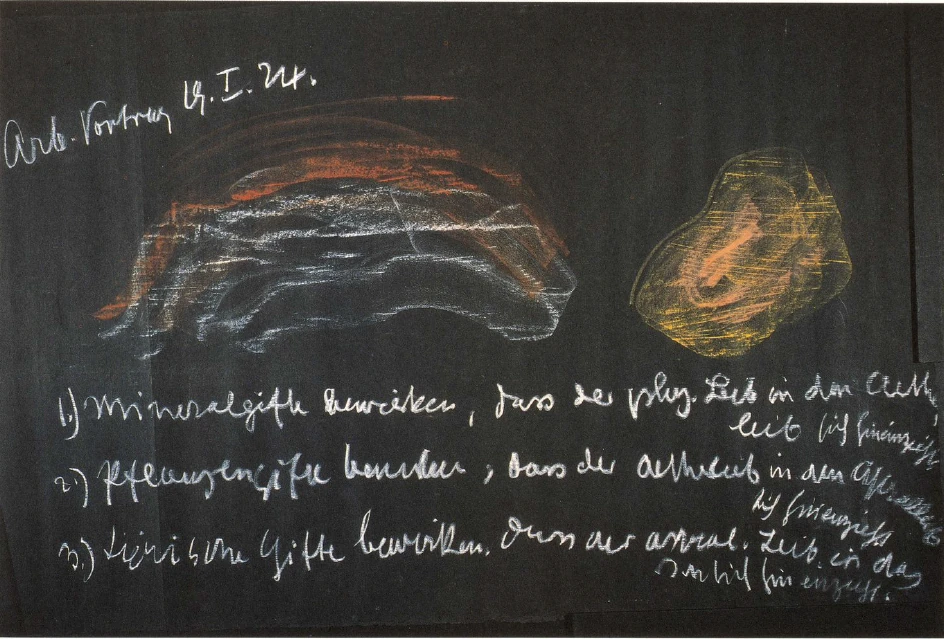
[ 35 ] 1. Mineralgifte bewirken daß der physische Leib in den Ätherleib sich hineinzieht.
[ 35 ] 1. Mineral toxins cause the physical body to be drawn into the etheric body.
[ 36 ] 2. Pflanzengifte bewirken, daß derÄtherleib in den Astralleib sich hineinzieht.
[ 36 ] 2. Plant toxins cause the etheric body to be drawn into the astral body.
[ 37 ] 3. Tierische Gifte bewirken, daß der astralische Leib in das Ich sich hineinzieht.
[ 37 ] 3. Animal poisons cause the astral body to withdraw into the “I.”